Drainage and Floodplain Governance
Reengineering Capital Drainage and Floodplain Governance: A Framework for Delhi’s Flood Resilience
Delhi Urban Shelter Improvement Board (DUSIB), Government of National Capital Territory of Delhi, New Delhi, India
Published September2026
Abstract
Delhi’s recurring urban flooding is an engineering and design failure, not just a weather anomaly. Rapid urbanization has sealed the ground surface, rendering legacy stormwater master plans completely obsolete against climate-driven cloudbursts. This brief delivers an actionable roadmap to transition Delhi from high-risk legacy "grey" infrastructure to a resilient, smart, and adaptive "sponge-and-sensor" grid. By decoupling urban drainage from traditional gravity-fed river discharge, we can drastically reduce economic downtime and protect critical public assets.
1The structural crisis: technical problem statement
The vulnerability of Delhi's current civil infrastructure stems from three compounding factors (Figure 1):
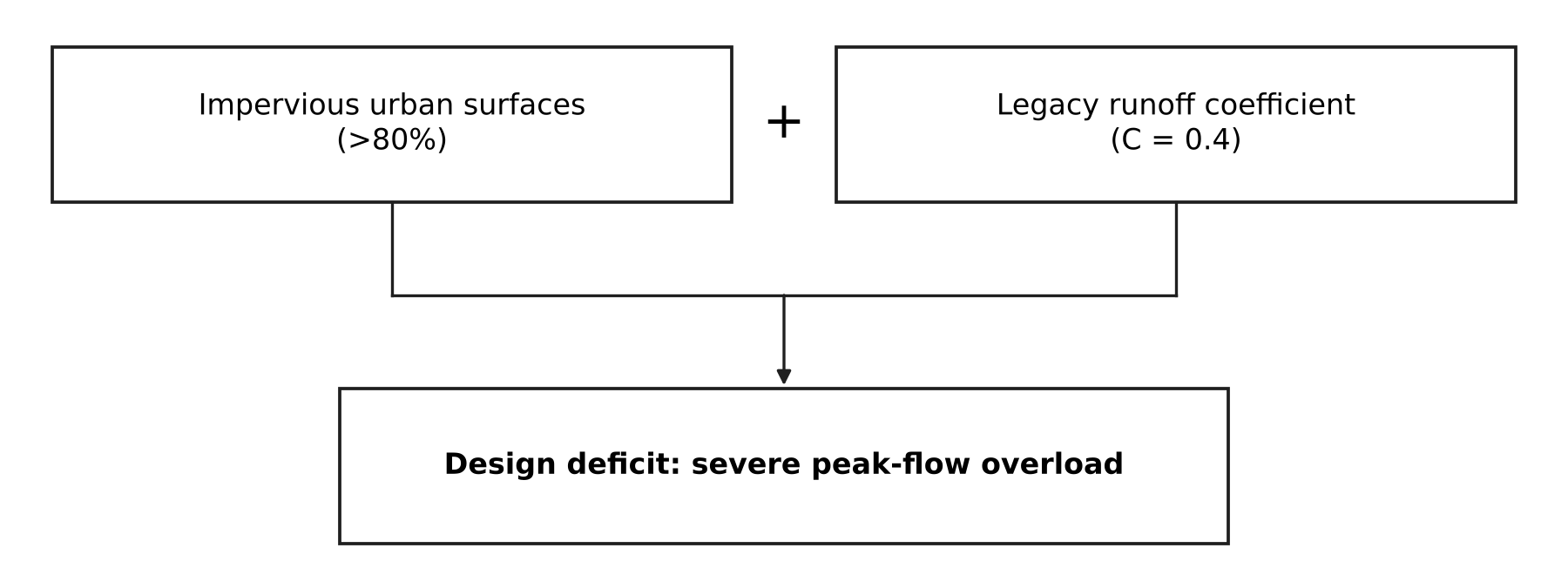
- Obsolete Hydrological Base Models: The city's current drainage infrastructure relies on rational formula models and historical rainfall data from decades ago [1]. Modern climate shifts have compressed seasonal rain into violent, short-duration cloudbursts, rendering static drainage models useless.
- Loss of Natural Catchments & High Runoff Coefficients: Due to massive asphalt paving, the urban runoff coefficient (C) has surged from a manageable 0.4 to an aggressive 0.85 [2]. This means over 85% of rainfall immediately turns into surface runoff instead of infiltrating the ground.
- Yamuna River Backflow Vulnerability: When river levels rise during peak monsoon, the gravity-fed outfalls face hydraulic blockages. Instead of discharging water, the drains backflow into the city's low-lying urban centers.
2The strategic engineering framework
2.1Phase A: Decentralized infiltration and “sponge infrastructure”
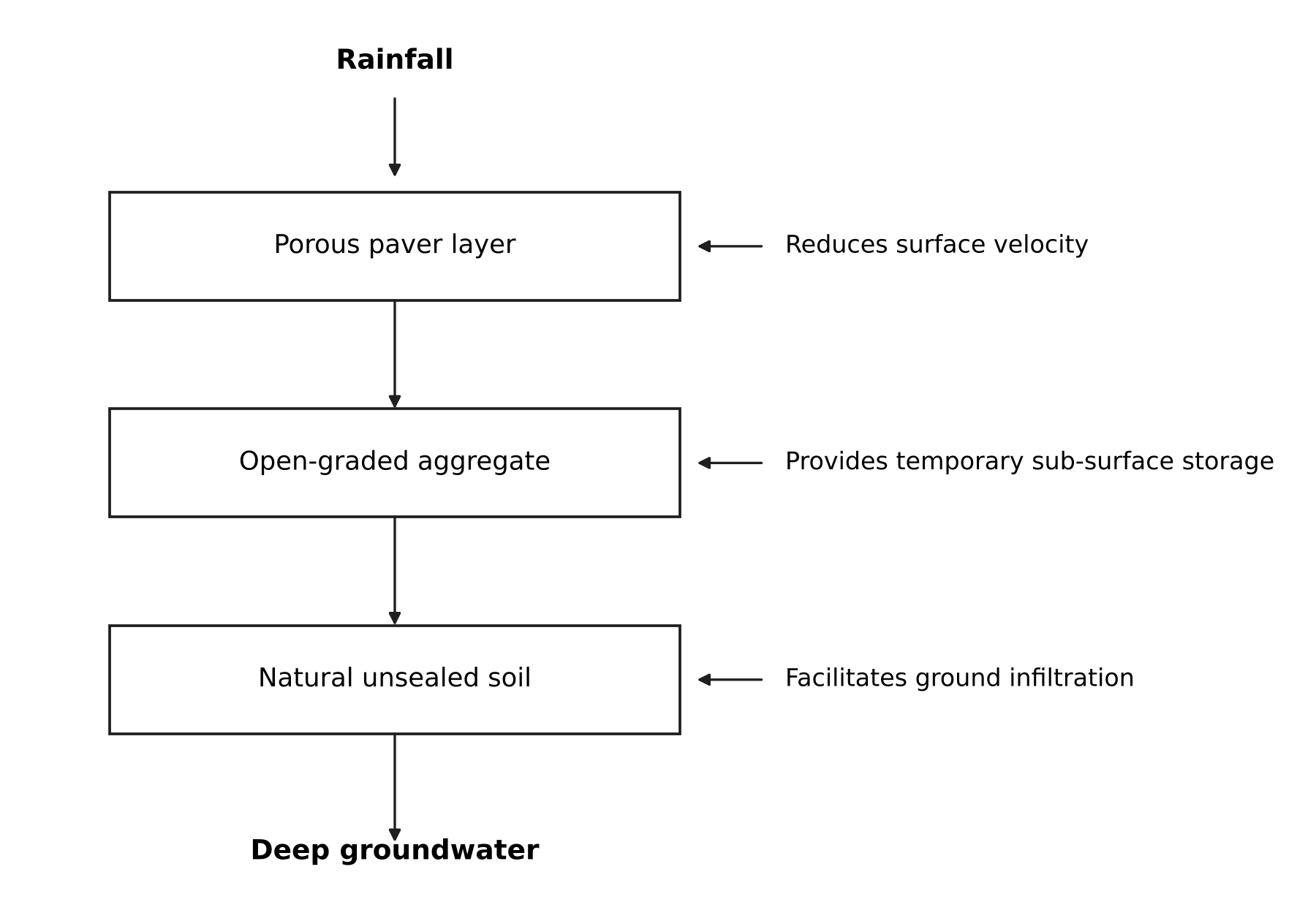
To fix the runoff problem at the source, the city must replace impervious concrete surfaces with a multi-layered infiltration matrix [3] (Figure 2).
- Permeable Pavement Specifications: Mandate the use of porous asphalt and pervious interlocking concrete pavers (PICP) for all new sidewalks, public parking lots, and service lanes. The sub-base must be engineered with open-graded crushed stone aggregates to act as a temporary water reservoir.
- Linear Bioswale Networks: Replace standard concrete road shoulders with deep, engineered vegetative bioswales. These channels use specific soil mixtures and deep-rooted native plants to filter and slow down stormwater before it reaches the main drains.
2.2Phase B: Cognitive infrastructure and AI-driven drainage
Static pipes cannot adapt to changing rainfall patterns. We must upgrade Delhi's primary drainage network into a real-time responsive asset.
- IoT SCADA and Edge Computing: Install ultrasonic water-level sensors and flow-rate meters every 500 meters along critical trunk drains (e.g., Najafgarh, Barapullah, and Supplementary drains) [4].
- Automated Pneumatic Sluice Gates: Deploy heavy-duty, solar-powered automated gates at major outfalls. Linked to real-time Doppler radar weather feeds, these gates can dynamically adjust water routing. If a cloudburst is detected, the system pre-emptively drains retention basins to maximize capacity before the storm hits.
2.3Phase C: Advanced sedimentation control and sub-surface storage
Silt and solid waste currently reduce Delhi's drainage capacity by half. We must isolate and manage debris before it chokes the underground network.
- Vortex Drop Shaft Technology: Construct deep vortex drop shafts at high-risk urban intersections (like Minto Bridge and Connaught Place) [5]. These structures force incoming stormwater into a whirlpool spiral, dissipating its energy and separating heavy silt and trash into a central chamber for easy mechanical removal.
- Deep Aquifer Recharging Well Fields: Connect stormwater filtration systems directly to dry deep-bore injection wells. This channels excess floodwater past clay layers directly into deep aquifers, solving urban flooding while actively restoring Delhi's depleting groundwater table [6].
3Implementation and risk matrix
The main implementation risks and the engineering measures proposed to mitigate them are summarized in Table 1.
| Risk factor | Impact | Engineering mitigation strategy |
|---|---|---|
| Heavy Siltation & Plastic Blinding | High | Install automated trash rakes at the entry points of all secondary and primary drains. |
| High Capital Expenditure (CapEx) | Medium | Use Public-Private Partnerships (PPP) backed by green bonds and climate resilience funds. |
| Utility Congestion (Water, Gas, Fiber) | High | Use Sub-Surface Utility Engineering (SUE) and 3D GPR mapping before building storage tanks. |
4Conclusion and recommendations
The economic impact of structural damage, lost business hours, and disrupted logistics makes urban flooding an expensive systemic risk for Delhi. Retrofitting the city with smart, resilient infrastructure requires substantial upfront capital. However, this investment will pay for itself within a few monsoons by avoiding asset damage and maintaining city productivity.
Municipal planners and corporate developers must move away from simply building larger concrete pipes. The future of Delhi’s urban viability relies on building flexible, smart infrastructure that works with water, not against it.
References
- [1]Central Public Health and Environmental Engineering Organisation (CPHEEO). Manual on storm water drainage systems. Ministry of Housing and Urban Affairs, Government of India; 2019.
- [2]Subramanian V, Ramanathan AL. Impact of urbanization on runoff coefficients in the National Capital Territory of Delhi. Journal of Hydrology: Regional Studies. 2021;34:100785.
- [3]Zevenbergen C, Fu D, Pathirana A. Transitioning to sponge cities: Challenges and opportunities to address urban water problems in China. Water. 2018;10(9):1230. https://doi.org/10.3390/w10091230
- [4]Kerkez B, Gruden C, Lewis M, Montestruque L, Quigley M, Wong B, et al. Smarter stormwater systems. Environmental Science & Technology. 2016;50(14):7267–7273. https://doi.org/10.1021/acs.est.5b05870
- [5]Hager WH. Wastewater hydraulics: Theory and practice. Springer-Verlag; 1999.
- [6]Central Ground Water Board (CGWB). Master plan for artificial recharge to groundwater in India. Ministry of Jal Shakti, Department of Water Resources, RD & GR, Government of India; 2020.