Construction Materials
An Investigation into the Structural Characteristics of Concrete Produced with Palm Kernel Shells as Partial Replacement for Granite Coarse Aggregate
Department of Civil Engineering, Niger Delta University, Wilberforce Island, Bayelsa State, Nigeria
Published September2026
Abstract
Rising granite costs and the environmental burden of palm kernel shell (PKS) waste disposal have driven interest in sustainable concrete aggregates. This study investigated the structural performance of concrete produced with PKS as a partial replacement for granite coarse aggregate at 0%, 10%, 20%, 30%, 40%, and 50% by volume, using a 1:1½:3 mix ratio and a constant water-cement ratio of 0.50. Slump tests assessed fresh concrete properties, while compressive strength was determined on water-cured cubes at 7, 14, 21, and 28 days. PKS exhibited higher moisture content and water absorption than granite. Workability declined sharply with increasing PKS content, with slump falling from 90 mm (control) to 10 mm at 50% replacement. Compressive strength followed a similar downward trend, dropping from 23.56 N/mm² (control) to 7.56 N/mm² at 50% replacement after 28 days, while density fell from 2370.3 kg/m³ to 1925.9 kg/m³ over the same range. Replacement levels up to 20% met the 17 N/mm² minimum compressive strength required for non-critical structural applications; beyond this, the concrete is better suited to lightweight and non-structural uses. PKS therefore offers a viable, cost-effective, and environmentally sustainable partial substitute for granite, particularly in oil-palm-producing regions where it is readily available.
Keywords: compressive strength; cost efficiency; granite aggregate; lightweight concrete; palm kernel shell (PKS); sustainable concrete; workability
1Introduction
Concrete remains the most widely used construction material globally, and coarse aggregate typically constitutes 60–75% of its volume, strongly influencing strength, workability, and durability. Granite is the predominant coarse aggregate used in structural concrete production in Nigeria and other developing economies; however, rising haulage costs, environmental degradation from quarrying, and depletion of natural granite deposits have intensified the search for alternative, more sustainable coarse aggregate materials.
Palm kernel shell (PKS) is an agro-industrial waste generated in large quantities during palm oil processing, particularly in tropical, oil-palm-producing regions of West Africa and Southeast Asia. Being a hard, durable, and largely under-utilized by-product, PKS has attracted growing research interest as a lightweight coarse aggregate substitute for granite. Beyond cost savings, its use offers a pathway for waste valorization, reducing the environmental burden of disposal while conserving natural granite reserves and lowering the carbon footprint associated with aggregate quarrying and haulage.
Several researchers have investigated the suitability of PKS as a partial or full coarse aggregate replacement, generally reporting reductions in workability, density, and compressive strength with increasing PKS content, alongside improved lightweight characteristics that make PKS concrete attractive for non-structural and low-rise construction. However, the specific replacement level at which PKS can be introduced without significantly compromising structural performance varies with mix design, PKS particle size, and aggregate source, warranting further site- and mix-specific investigation.
This study therefore investigates the structural characteristics — workability (slump), density, and compressive strength — of concrete produced with granite coarse aggregate partially replaced with palm kernel shell at 0%, 10%, 20%, 30%, 40% and 50% replacement levels, with a view to establishing an optimum replacement level suitable for structural and non-structural applications.
1.1Aim and objectives
The aim of this study is to investigate the structural characteristics of concrete produced with granite coarse aggregate partially replaced with palm kernel shell. The specific objectives are to:
- 1. Determine the physical properties (specific gravity, bulk density, moisture content, aggregate crushing value, and particle size distribution) of granite and palm kernel shell aggregates;
- 2. Determine the workability (slump) of fresh concrete at varying PKS replacement levels;
- 3. Determine the density and compressive strength of hardened PKS concrete at 7, 14, 21 and 28 days of curing; and
- 4. Establish an optimum PKS replacement level suitable for structural and non-structural concrete works, alongside an indicative cost assessment.
2Literature review
Oti et al. (2017) assessed palm kernel shell as a composite aggregate in concrete and confirmed its potential as a low-cost, locally available substitute for conventional coarse aggregate in regions where palm oil processing generates large volumes of shell waste, noting favourable physical characteristics for lightweight concrete production. Building on this, Azunna (2019) investigated the compressive strength and water absorption capacity of concrete produced with PKS as a partial replacement for coarse aggregate, and found that both properties declined with increasing PKS content, with strength reductions attributed to the shells' higher porosity and weaker interfacial bonding with the surrounding cement paste.
Danso and Appiah-Agyei (2021) investigated the effect of PKS particle size (6, 8, 10 and 12 mm, as well as a blended mix) on the density, compressive strength, and flexural strength of lightweight PKS concrete, finding that larger PKS particle sizes generally produced better strength outcomes while all specimens remained within the density range for structural lightweight concrete. Their scanning electron microscopy analysis confirmed a reasonably strong bond between the PKS particles and the surrounding mortar, supporting the aggregate's suitability for lightweight structural applications.
Fapohunda et al. (2022) examined the structural behaviour of reinforced concrete beams incorporating crushed PKS as a coarse aggregate replacement, assessing workability, density, and mechanical properties, and confirmed that PKS inclusion is feasible for structural members provided replacement levels are carefully controlled. More recently, Tongbram et al. (2023) carried out a comparative study of PKS, periwinkle shell (PS), and coconut shell (CS) as coarse aggregate substitutes, reporting that PKS concrete generally exhibited lower compressive and tensile strengths than periwinkle shell concrete across all curing ages, underlining that differences in shell type and particle morphology materially affect strength outcomes even at comparable replacement levels.
Collectively, this recent body of work indicates a consistent trend: workability, density, and compressive strength decrease as PKS content increases, while the lightweight benefits of the resulting concrete increase, with the specific “optimum” replacement level depending on mix ratio, water–cement ratio, PKS particle size, and the structural demands of the intended application. This study contributes to this body of work by evaluating a 0–50% replacement range using a 1:1½:3 mix ratio at a water–cement ratio of 0.50, across four curing ages (7, 14, 21 and 28 days), to establish an optimum replacement level for structural use.
3Materials and methods
3.1Materials
The materials used for this study were ordinary Portland cement (Dangote Cement) from Amassoma, Bayelsa State; sharp sand (fine aggregate) from Amassoma River, Bayelsa State; crushed granite (coarse aggregate) from Auchi, Edo State; palm kernel shells (partial coarse aggregate replacement) from Yenagoa, Bayelsa State; and clean potable water from Niger Delta University free from any deleterious substances, in accordance with relevant British Standard specifications.
3.2Mix design and sample preparation
A nominal mix ratio of 1:1½:3 (cement:sand:granite) was adopted at a constant water–cement ratio of 0.50 for all mixtures. The granite content of the mix was partially replaced with palm kernel shells at 0% (control), 10%, 20%, 30%, 40% and 50% by volume. All concrete materials were batched by volume and mixed manually on a clean, non-absorbent mixing platform.
The slump test was performed on the fresh concrete for each mix in accordance with BS 1881-102, before the mix was placed into 150 mm × 150 mm × 150 mm cube moulds in three layers, each layer compacted with a tamping rod. A total of 105 concrete cubes of size 150 mm × 150 mm × 150 mm were cast, covering all six replacement levels (0%, 10%, 20%, 30%, 40% and 50%) across the four curing ages (7, 14, 21 and 28 days), with three cubes tested per replacement level per curing age. The cast specimens were covered with polythene sheeting and de-moulded after 24 hours, after which they were cured in a water tank until their respective testing ages.
3.3Testing procedures
The physical properties of the aggregates — particle size distribution (sieve analysis), dry density, bulk density, specific gravity, and moisture content — were determined in accordance with BS 1377-2. The compressive strength of the hardened concrete cubes was determined in accordance with BS 1881 using a compression testing machine, with the failure load recorded and the compressive strength computed as the mean of three cubes per replacement level per curing age.
4Results and discussion
4.1Physical properties of aggregates
| Parameter | Granite | PKS | Sand | Cement |
|---|---|---|---|---|
| Coefficient of Uniformity (Cu) | 1.40 | – | 2.43 | – |
| Coefficient of Curvature (Cc) | 1.03 | – | 0.95 | – |
| Fineness Modulus | 3.32 | – | 4.69 | – |
| Dry Density (kg/m³) | 2800 | 2563 | 2273 | 2736 |
| Bulk Density (kg/m³) | 2933 | 2692 | 2727 | 3753 |
| Specific Gravity | 2.800 | 2.563 | 2.273 | 2.736 |
| Moisture Content (%) | 1.44 | 8.23 | 5.43 | – |
| Aggregate Crushing Value (%) | 25.87 | – | – | – |
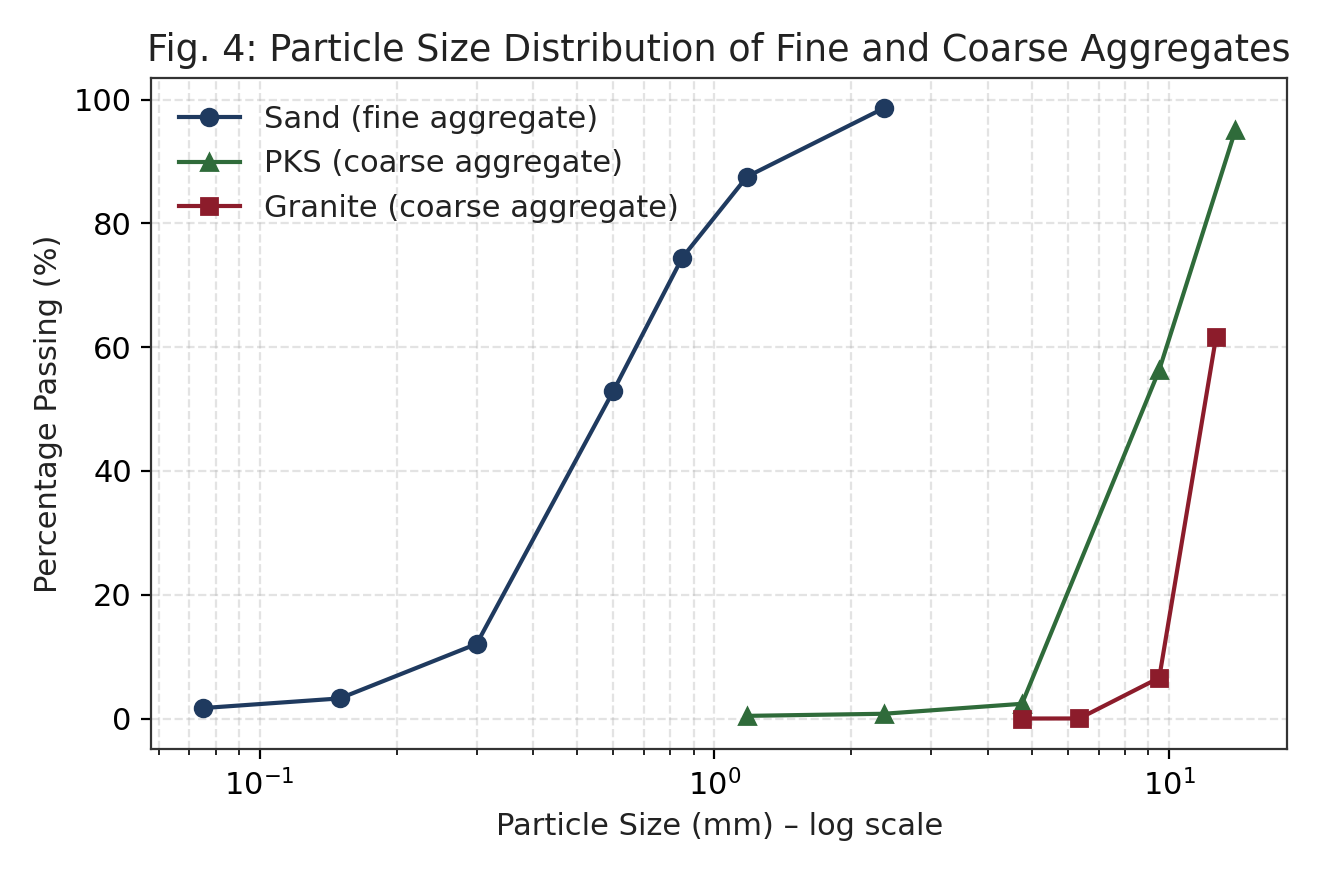
The particle size distribution curves (Figure 1) show the granite aggregate ranging predominantly between 4.76 mm and 12.7 mm, with a coefficient of uniformity of 1.40 and coefficient of curvature of 1.03, while the palm kernel shell exhibited a comparable coarse-aggregate grading, ranging up to 14.0 mm. The sand fraction passed the 2.36 mm sieve with a coefficient of uniformity of 2.43 and coefficient of curvature of 0.95, indicating a reasonably well-graded fine aggregate. All sieve analysis results conformed to BS 1377-2.
4.2Workability (slump)
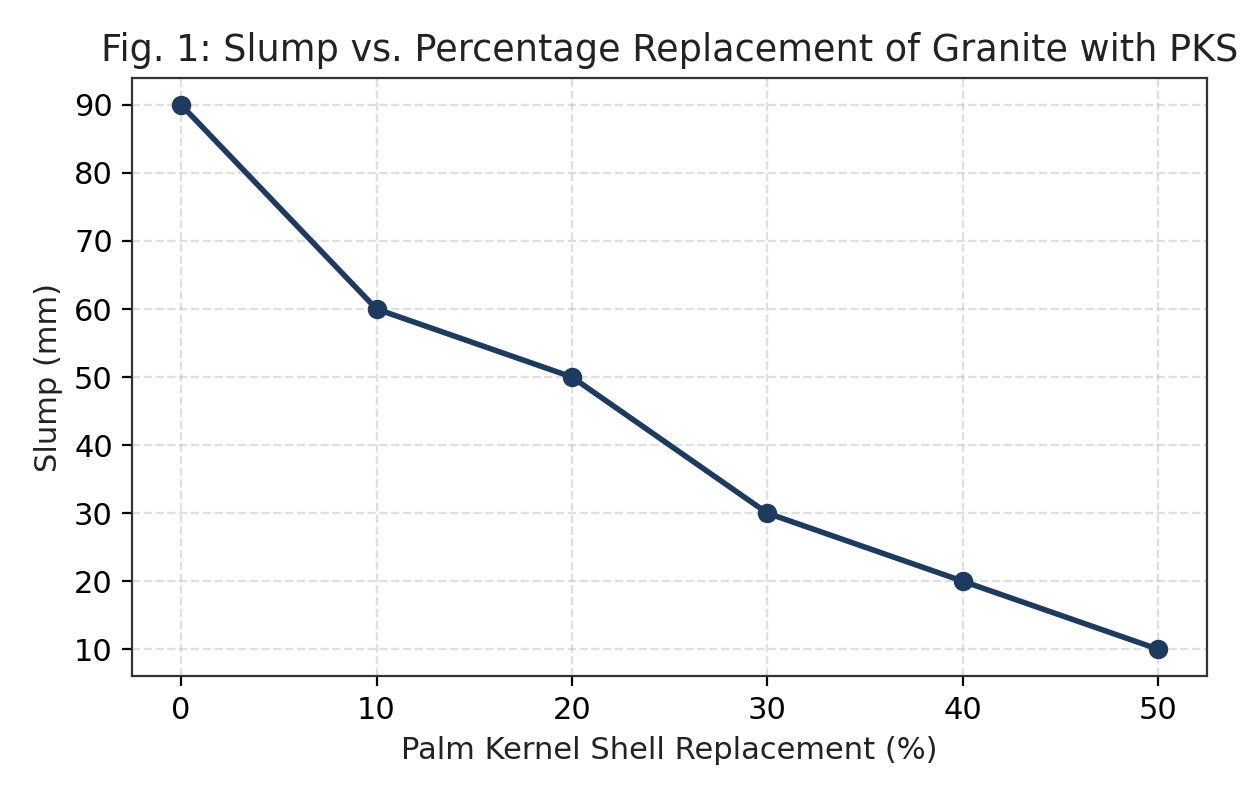
The slump test results showed that workability decreased consistently as palm kernel shell content increased. The control mix (0% PKS) recorded the highest average slump value of 90 mm, which reduced progressively to 60 mm, 50 mm, 30 mm, 20 mm, and 10 mm at 10%, 20%, 30%, 40% and 50% PKS replacement respectively (Table 2, Figure 2). This trend is attributable to the angular, irregular particle shape of palm kernel shells relative to granite, which increases internal friction within the mix, combined with the higher water absorption of the shells drawing free water away from the paste and reducing effective workability.
4.3Density
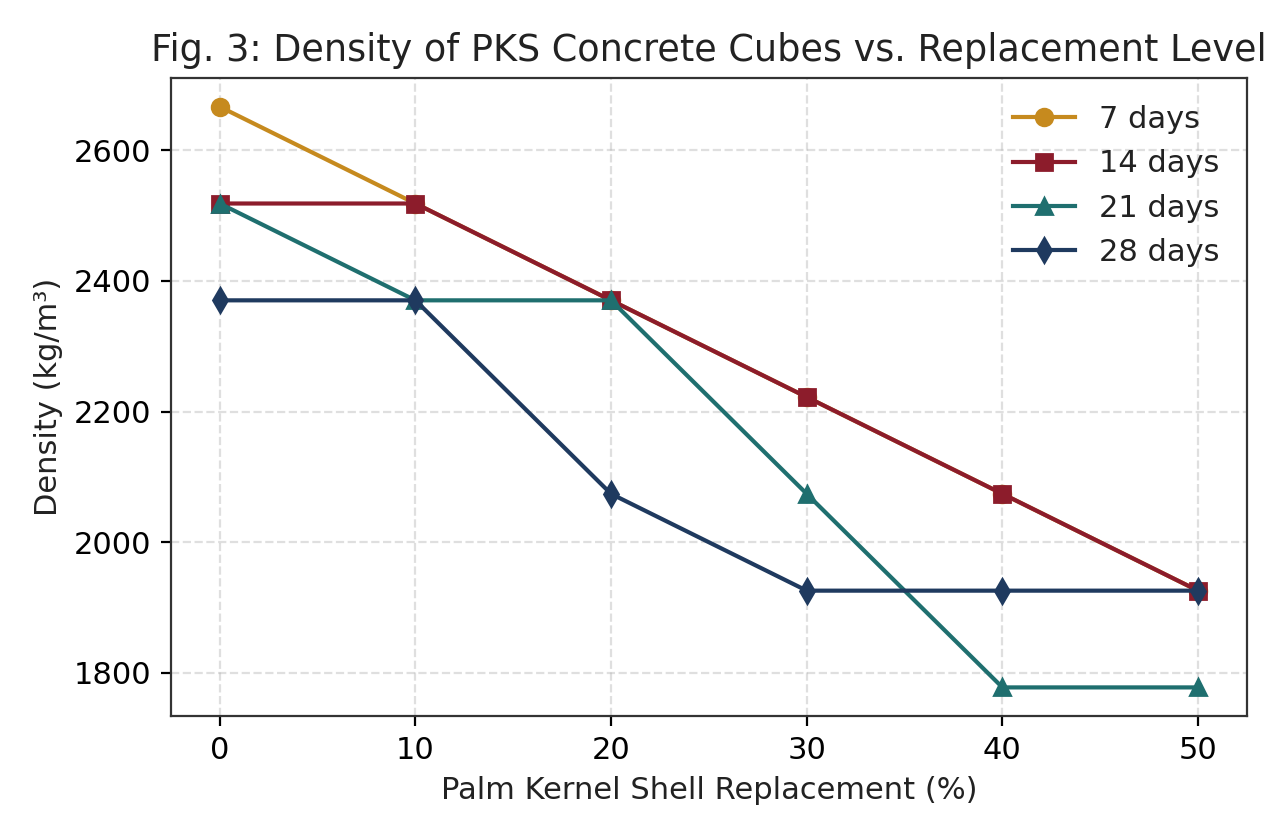
Concrete density decreased progressively with increasing palm kernel shell content at all curing ages (Table 2, Figure 3), from 2370.3 kg/m³ at 0% replacement to 1925.9 kg/m³ at 50% replacement at 28 days. This reduction reflects the lower particle density of palm kernel shell relative to granite and confirms the potential of PKS concrete for lightweight construction applications where reduced self-weight is desirable.
4.4Compressive strength
| PKS Replacement (%) | Slump (mm) | 7-day Strength (N/mm²) | 14-day Strength (N/mm²) | 21-day Strength (N/mm²) | 28-day Strength (N/mm²) | 28-day Density (kg/m³) |
|---|---|---|---|---|---|---|
| 0 (Control) | 90 | 19.56 | 21.33 | 22.22 | 23.56 | 2370.3 |
| 10 | 60 | 19.10 | 20.00 | 20.00 | 21.33 | 2370.3 |
| 20 | 50 | 18.67 | 18.70 | 19.56 | 20.44 | 2074.07 |
| 30 | 30 | 15.56 | 16.00 | 17.78 | 17.56 | 1925.9 |
| 40 | 20 | 11.11 | 12.90 | 11.11 | 12.89 | 1925.9 |
| 50 | 10 | 4.44 | 7.56 | 6.67 | 7.56 | 1925.9 |
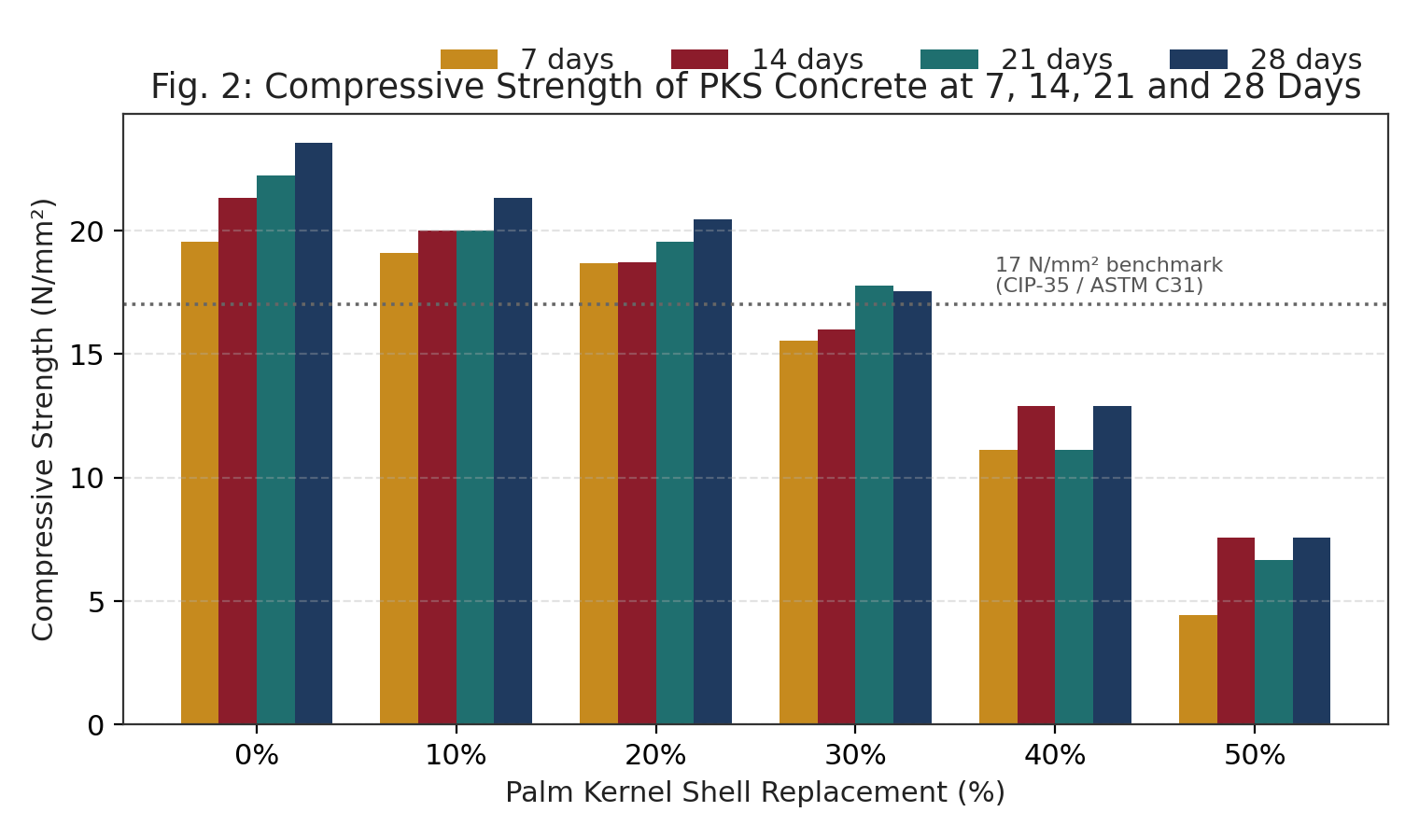
At the 28-day curing age, compressive strength reduced by approximately 9.5%, 13.2%, 25.5%, 45.3% and 67.9% at 10%, 20%, 30%, 40% and 50% PKS replacement respectively, relative to the control. Similar declining trends, of comparable magnitude, were observed at 7, 14 and 21 days, with reductions ranging from about 2–10% at 10% replacement up to 64–77% at 50% replacement across the four curing ages. This reduction is attributed to the weaker crushing resistance and greater porosity of palm kernel shell relative to granite, together with the increased water demand of the shells, which reduces the effective workability and bond strength of the cement paste around the aggregate particles.
Comparing the results against the 17 N/mm² benchmark recommended for non-critical structural concrete works (CIP-35, Concrete in Practice; ASTM C31/39), the control (0%), 10% and 20% replacement mixes exceeded this benchmark at 28 days (23.56 N/mm², 21.33 N/mm² and 20.44 N/mm² respectively), while the 30% replacement mix (17.56 N/mm²) also marginally satisfied it. Replacement levels of 40% and 50% fell below the 17 N/mm² threshold at 28 days, indicating suitability for non-critical or non-structural applications only, such as low-cost walling units, non-load-bearing partitions, or lightweight fill. A preliminary cost assessment indicated that zoning the concrete strength in this manner could yield savings of approximately 20–40%, where up to 30% PKS is used to partially replace granite, reinforcing the economic case for its use in structural applications within this replacement range.
5Conclusion
This study investigated the structural characteristics of concrete produced with granite coarse aggregate partially replaced with palm kernel shell at 0–50% replacement, using a 1:1½:3 mix ratio at a water–cement ratio of 0.50. Based on the results obtained, the following conclusions were drawn:
- 1. The workability of concrete decreases with an increasing percentage replacement of granite with palm kernel shell, as evidenced by the reduction in slump from 90 mm (0% PKS) to 10 mm (50% PKS).
- 2. For every replacement level, compressive strength increases with curing age and decreases with increasing palm kernel shell content.
- 3. The maximum 28-day compressive strength (23.56 N/mm²) was recorded at 0% replacement (control), while the 28-day strength at 50% replacement was 7.56 N/mm².
- 4. At 28 days, replacement levels of 0%, 10%, 20% and 30% met the 17 N/mm² benchmark for non-critical structural works, whereas 40% and 50% replacement fell below this benchmark and are more suitable for non-structural applications.
- 5. The density of concrete decreases with increasing palm kernel shell content, confirming the potential of PKS concrete as a lightweight construction material with reduced dead load.
- 6. Zoning concrete strength by replacement level in this manner offers indicative cost savings of about 20–40%, particularly where up to 30% PKS is used to partially replace granite in structural applications.
6Recommendations
Palm kernel shell can be adopted as a lightweight partial coarse aggregate in concrete works, given its comparatively low bulk density and the resulting reduction in dead load on structures.
- 1. Based on the findings of this study, a granite replacement level of up to 20–30% palm kernel shell is recommended where structural adequacy at 28 days must be maintained; higher replacement levels are recommended only for non-structural, lightweight applications such as blockwork, partitions, and low-cost housing components.
- 2. Given the higher-than-typical specific gravity recorded for PKS in this study relative to the wider literature, it is recommended that aggregate characterisation (specific gravity and water absorption in particular) be repeated and cross-checked in future work to confirm consistency of results.
- 3. Further research is recommended on the durability (water absorption, sulphate resistance), flexural and tensile strength, and long-term performance of palm kernel shell concrete, as well as on smaller, more finely graded replacement percentages and extended curing ages, in order to further optimise the replacement level.
References
- [1]American Society for Testing and Materials (n.d.). ASTM C31/C39: Standard practice for making and curing concrete test specimens / Standard test method for compressive strength of cylindrical concrete specimens. ASTM International.
- [2]Azunna SU (2019). Compressive strength of concrete with palm kernel shell as a partial replacement for coarse aggregate. SN Applied Sciences, 1, 342. https://doi.org/10.1007/s42452-019-0334-6
- [3]British Standards Institution (1983). BS 1881: Testing concrete – Methods for determination of slump and compressive strength. BSI.
- [4]British Standards Institution (1990). BS 1377-2: Methods of test for soils for civil engineering purposes – Classification tests. BSI.
- [5]Danso H, Appiah-Agyei F (2021). Size variation of palm kernel shells as replacement of coarse aggregate for lightweight concrete production. Open Journal of Civil Engineering, 11, 153–165. https://doi.org/10.4236/ojce.2021.111010
- [6]Fapohunda C, Ikponmwosa E, Osekita I (2022). Structural behavior of reinforced concrete beams with crushed palm kernel shell as coarse aggregates. Academy Journal of Science and Engineering, 9(1), 16–30.
- [7]National Ready Mixed Concrete Association (n.d.). CIP 35 – Testing compressive strength of concrete. NRMCA Concrete in Practice Series.
- [8]Oti O, Nwaigwe K, Okereke N (2017). Assessment of palm kernel shell as a composite aggregate in concrete. Agricultural Engineering International: CIGR Journal, 19.
- [9]Tongbram BD, Singh HK, Devi VV (2023). A comparative study on partial replacement of coarse aggregates in concrete with sustainable waste materials. Materials Today: Proceedings.