Entomology and Fish Feed Production
The Use of Black Soldier Fly (Hermetia illucens) as an Alternative Protein Supplement in African Catfish Production
Department of Animal and Environmental Biology, Faculty of Science, University of Port Harcourt, P.M.B. 5323, Choba, Port Harcourt, Nigeria
Published September2026
Abstract
The high cost of conventional fish feed is a major constraint to the sustainability and profitability of aquaculture in Nigeria. This study investigated the potential of using Black Soldier Fly (Hermetia illucens) Larvae (BSFL) as a sustainable and cost-effective alternative feed for African catfish (Clarias gariepinus). A total of 45 fingerlings were randomly allocated to three dietary treatments in a 56-day feeding trial: a diet of whole BSFL, a conventional commercial diet, and a combination of both. Growth performance parameters (weight gain, length increase, specific growth rate, feed conversion ratio) and economic indices were evaluated. Results indicated that fish fed with the combination diet achieved the highest numerical growth in final weight (29.52 g) and length (15.73 cm), followed by the conventional diet group, while the BSFL-only group recorded the lowest growth. However, these differences were not statistically significant (p > 0.05). Economically, the BSFL-only diet was most viable, yielding the lowest feed cost per fish (₦180.95) and production cost (₦280.95). The study concludes that while a BSFL-conventional combination supports better growth, the use of whole BSFL as a complete feed replacement offers a highly cost-effective strategy for farmers prioritizing input cost reduction over maximum growth speed. BSFL is therefore a promising, sustainable alternative protein source for African catfish aquaculture.
Keywords: African catfish; Clarias gariepinus; black soldier fly larvae; alternative protein; conventional feed
1Introduction
Aquaculture is one of the fastest-growing food production sectors globally and plays a vital role in food security and poverty reduction, particularly in developing countries such as Nigeria (Tacon & Metian, 2015; FAO, 2022). Fish provides a major source of high-quality animal protein, essential fatty acids, and micro nutrients. Among cultured fish species in Nigeria, African catfish (Clarias gariepinus) is widely preferred due to its rapid growth rate, high survival capacity, tolerance to adverse environmental conditions, and strong consumer demand (Adewolu et al., 2010; Dauda et al., 2019). Despite its importance, catfish production is constrained by the high cost of feed, especially protein ingredients such as fish-meal and soybean meal, which account for a large proportion of production costs (Henry et al., 2015). Increased competition for these ingredients between humans, livestock, and aquaculture has resulted in scarcity and rising prices, threatening the sustainability of fish farming (Tacon & Metian, 2015; Gasco et al., 2018). Consequently, there is growing interest in identifying alternative, affordable, and sustainable protein sources.
Insects have been identified as promising alternative protein sources due to their high protein content, favourable amino acid profile, efficient feed conversion, and low environmental footprint (Henry et al., 2015; Gasco et al., 2018). Among them, black soldier fly (Hermetia illucens) larvae have gained attention because they can be mass-produced using organic waste substrates and possess high nutritional value (Makkar et al., 2014; Barragan-Fonseca et al., 2017).
Several studies have reported successful inclusion of black soldier fly larvae meal in aquaculture diets with acceptable growth performance and survival (Belghit et al., 2019; Ogunji et al., 2020; Magalhães et al., 2017). However, local data on its application in African catfish production under Nigerian conditions remain limited. This study therefore evaluated the growth performance, daily growth rate, specific growth rate, feed conversion ratio, survival rate, and economic viability of African catfish fed with black soldier fly larvae, conventional feed, and a combination of both.
2Materials and methods
2.1Study area
The research was conducted at the Animal House of the Department of Animal and Environmental Biology, Faculty of Science, University of Port Harcourt. The Animal House is situated on the Choba campus, precisely at latitude 4.8697764° North and longitude 6.9085454° East of the University of Port Harcourt, Rivers State, Nigeria.
2.2Materials
- 1. Rectangular plastic tank: used to house the fish.
- 2. Meter rule: used in measuring the length gained by the fish.
- 3. Electronic digital weighing balance: used in weighing the weight gained by the fish.
- 4. BSF Larvae: used in feeding the fish.
- 5. Conventional feed: used for the fish.
- 6. Multi-parameter water quality meter (YSI).
2.3Collection of fish samples
A total of forty-five C. gariepinus fingerlings of an average body weight of 3.80 g were obtained from the Fishery Unit, Faculty of Agriculture, University of Port Harcourt, Rivers State, Nigeria.
2.4Water quality assessment
The water used during the experiment was collected from the Faculty of Agriculture Demonstration Farm, University of Port Harcourt, Rivers State. The water quality was evaluated based on several key parameters, including pH, temperature, dissolved oxygen (DO), total dissolved solids (TDS), electrical conductivity, and salinity. These measurements were taken using a multi-parameter water quality meter (YSI). To ensure accurate readings, the sensor was fully immersed in the water sample, avoiding any air bubbles that could interfere with the measurements. Once proper contact with the water was established, the corresponding values for each parameter were displayed on the device screen and recorded accordingly. The values are given in Table 1.
| Parameter | Value |
|---|---|
| pH | 7.09 |
| Temperature (°C) | 29.7 |
| Dissolved oxygen (mg/L) | 5.6 |
| Total dissolved solids (ppm) | 15 |
| Electrical conductivity (μS) | 30 |
| Salinity (ppt) | 0.00 |
2.5Experimental design
The experiment followed a randomized block design comprising three treatment groups (1, 2, and 3), each containing 15 C. gariepinus fingerlings, totaling 45 fish. Each group was housed in rectangular plastic tanks measuring 23 × 39.5 × 27.5 cm. Group 1 was fed fresh BSFL at 6% of body weight, Group 2 received a combination of BSFL/Conventional feed at 6% of body weight, while Group 3 was provided with conventional feed at 6% of body weight. (The body weight was determined using the formula (average body weight of fish x no. of fish / 100) x the body percentage). The feeding regimen was maintained for two weeks following an initial acclimatization period. Starting from week 3 through week 6, fish in all groups were weighed and measured weekly. Individual fish weights were recorded using an electronic weighing balance, and their lengths were measured using a meter rule. The average values per group were then calculated. Feeding was conducted twice daily, at 8:00 AM and 6:00 PM. The tank water was changed partly at every two-day interval and completely once every week.
2.6Assessment of growth performance
The recorded weights were used to determine the Mean Weight Gain (MWG), Percentage Weight Gain (PWG), Specific Growth Rate (SGR), Feed Conversion Ratio (FCR), and survival rate, in accordance with the procedures outlined by Hammed et al. (2023). Additionally, the daily growth rate and average increase in length of the fish were computed using the approach described by Maranga et al. (2023).
3Results
3.1Growth performance based on final length and weight
The effects of the different dietary treatments on the final length and weight of Clarias gariepinus are summarized in Table 2. The data indicate that fish fed the combination diet (BSFL + Conventional) attained the highest mean final length (15.73 cm) and weight (29.52 g), followed by those fed the conventional diet, while the group fed solely whole BSFL recorded the lowest values. However, a one-way ANOVA revealed that these observed differences in final length (F (2, 9) = 0.672, p = 0.535) and final weight (F (2, 9) = 1.133, p = 0.364) were not statistically significant at the 95% confidence level (p > 0.05). Post-hoc analysis using Tukey's HSD test confirmed no significant pair-wise differences between any of the dietary groups for both parameters.
| Dietary treatment | Length (cm) | Weight (g) |
|---|---|---|
| BSFL | 14.69±0.40a | 22.93±1.16a |
| Conventional | 15.08±0.77a | 26.46±3.53a |
| BSFL/conventional | 15.73±0.69a | 29.52±3.87a |
3.2Growth rate based on length
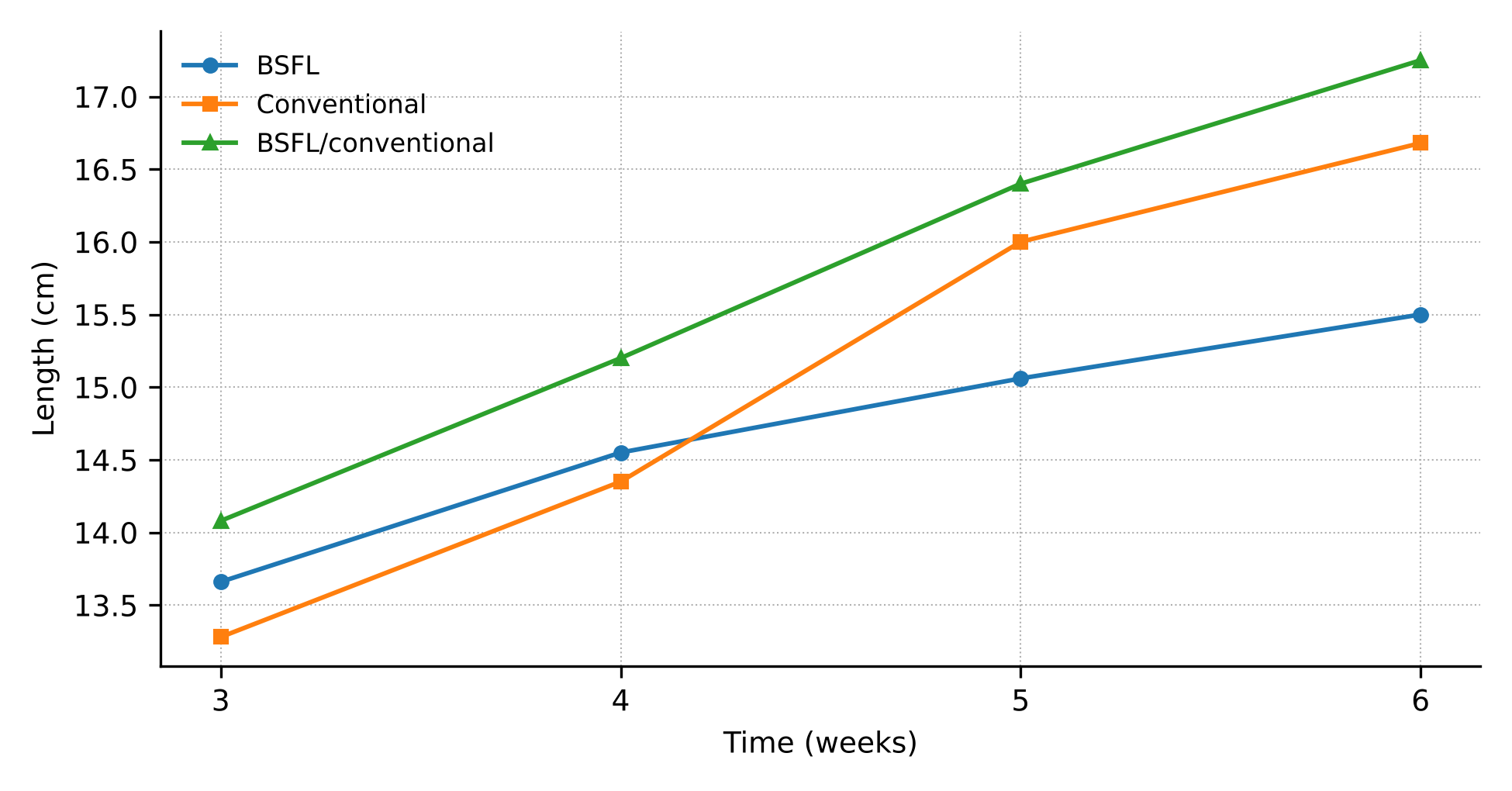
Figure 1 illustrates the growth rate of C. gariepinus fingerlings based on body length across the different dietary treatments over the experimental period. The figure shows a distinct separation in the growth trajectories from the initial stages. The group fed the BSFL+Conventional diet consistently demonstrated the highest rate of increase in length, maintaining a lead throughout the study. The group fed the Conventional diet followed an intermediate growth path, while the group fed solely Whole BSFL showed the slowest incremental gain in body length. This visualization confirms the trend observed in the final length measurements, where the combination diet promoted the best linear growth.
3.3Growth rate based on weight
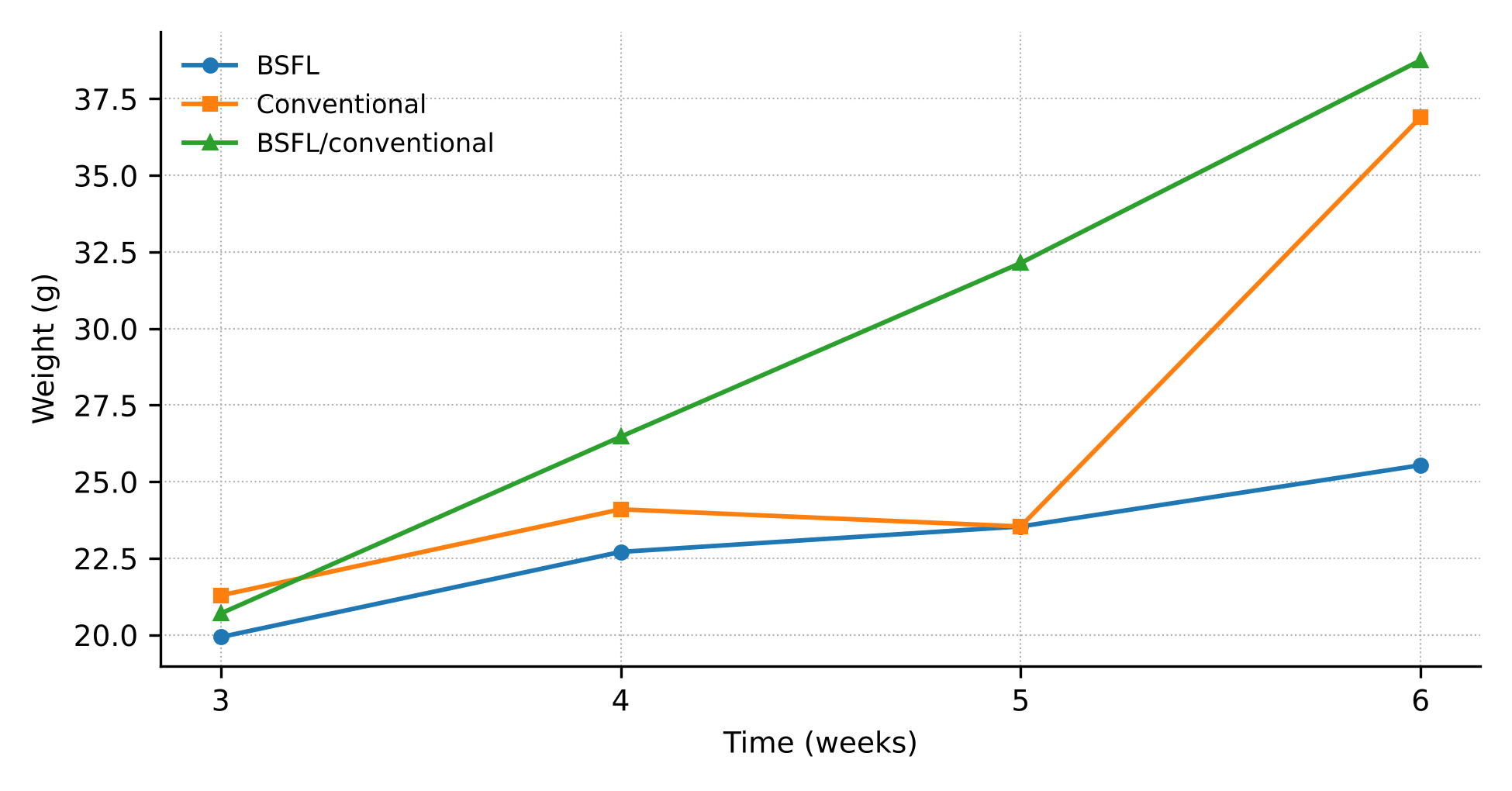
Figure 2 depicts the growth rate based on the body weight of the fish. The figure reveals a more pronounced divergence between the treatment groups compared to the length-based growth. The BSFL + Conventional group exhibited a steep and consistent weight gain curve, culminating in the highest final biomass. The Conventional feed group also showed a strong positive trend but at a slightly lower rate. In contrast, the Whole BSFL group displayed a markedly flatter growth curve, indicating a substantially lower weight accumulation efficiency over the same period. This graph underscores the significant impact of diet on biomass production, with the combination diet being the most effective for weight gain.
3.4Growth parameters and economic analysis
A comprehensive evaluation of growth performance and economic indices is presented in Table 3. The results show a clear trend where the BSFL + Conventional diet supported the highest growth metrics, including Mean Weight Gain (34.96 g), Percentage Weight Gain (920.00%), and Specific Growth Rate (5.52 %/day). In contrast, the conventional feed diet resulted in the best Feed Conversion Ratio (FCR = 0.78), indicating superior efficiency in converting feed to body mass. The survival rate was highest in the Whole BSFL and Conventional feed groups (86.67% each), but lower in the combination group (66.67%). From an economic perspective, the Whole BSFL diet was the most cost-effective, yielding the lowest Feed Cost per Fish (₦180.95) and the lowest total Cost of Production per Fish (₦280.95).
| Variable | Conventional | Conventional/BSFL | BSFL |
|---|---|---|---|
| Mean weight gain (g) | 33.10 | 34.96 | 21.74 |
| Percentage weight gain (%) | 871.05 | 920.00 | 572.63 |
| Specific growth rate (%/day) | 5.41 | 5.52 | 4.53 |
| Feed conversion ratio | 0.78 | 0.96 | 1.18 |
| Percentage survivability (%) | 86.67 | 66.67 | 86.67 |
| Daily growth rate (g/day) | 0.79 | 0.83 | 0.52 |
| Mean increase in length (cm) | 13.84 | 14.42 | 12.66 |
| Feed consumed per fish (g) | 25.85 | 33.6 | 25.85 |
| Feed cost per fish (₦) | 245.58 | 277.20 | 180.95 |
| Cost of production per fish (₦) | 345.58 | 377.20 | 280.95 |
3.5Interpretation
The results indicate that dietary treatment influenced growth performance, feed utilization, survival, and production cost of African catfish, although differences in final growth were not statistically significant (p>0.05), suggesting that all diets supported acceptable development. Fish fed the combined BSFL and conventional feed showed the highest mean final weight and length, indicating that supplementation of conventional diet with black soldier fly larvae enhanced growth performance. The conventional feed alone produced moderate growth but demonstrated the most efficient feed utilization, as reflected by the lowest feed conversion ratio, meaning fish converted feed into body mass more effectively. Fish fed only BSFL exhibited the slowest growth, suggesting that while BSFL can sustain development, it may not fully meet optimal growth requirements when used alone. Survival was highest in both the BSFL-only and conventional groups, whereas the combined diet recorded slightly lower survival, possibly due to dietary adjustment or management factors. Economically, the BSFL-only diet had the lowest feed and production cost, indicating strong cost-saving potential despite slower growth. Overall, the findings reveal a trade-off between growth performance, feed efficiency, and cost: combining BSFL with conventional feed maximizes growth, conventional feed alone optimizes feed efficiency, and BSFL alone minimizes production cost while still supporting acceptable fish survival and development.
4Discussion
The search for sustainable and cost-effective alternatives to conventional fish feed is crucial for the future of aquaculture. This study evaluated the potential of using Black Soldier Fly Larvae (BSFL) as a complete or partial replacement for commercial feed in the diet of African catfish (Clarias gariepinus). The findings indicate that while a full replacement with whole BSFL may not optimize growth, its strategic use can offer significant economic benefits.
The highest final weight and length were observed in fish fed the combination diet (BSFL + Conventional), followed by the conventional feed group, with the whole BSFL group recording the lowest values. Although these differences were not statistically significant (p > 0.05), the clear numerical trend is economically and practically important. The superior performance of the combination diet can be attributed to a more balanced nutrient profile. Conventional feeds are formulated to be nutritionally complete, providing an optimal balance of proteins, lipids, carbohydrates, vitamins, and minerals. BSFL, while an excellent source of protein and fat, particularly rich in lauric acid which has antimicrobial properties, may lack certain essential nutrients or have an imbalanced amino acid profile when used as the sole feed ingredient. The combination likely provided a synergistic effect, supplementing the strengths of BSFL with the nutritional completeness of the commercial diet. This aligns with previous studies reporting that partial substitution of fish-meal with insect-based protein often results in improved growth performance compared to total replacement (Henry et al., 2015; Gasco et al., 2018).
A key finding of this study is the superior Feed Conversion Ratio (FCR) of the conventional diet (0.78) compared to the whole BSFL diet (1.18). A lower FCR indicates higher efficiency in converting feed into body mass. The less efficient FCR of the whole BSFL diet suggests that the fish may have to consume more BSFL to meet their nutritional requirements for optimal growth, possibly due to lower digestibility or nutrient imbalance in the larvae. This observation is consistent with previous studies that have reported the influence of chitin in insect exoskeletons on nutrient digestibility in fish diets when insect meal is included at high levels (Makkar et al., 2014; Barragan-Fonseca et al., 2017).
Despite the lower growth performance, the whole BSFL diet presented a clear economic advantage. The Feed Cost per Fish was substantially lower compared to the conventional and combination diets. This resulted in the lowest total Cost of Production per Fish for the whole BSFL group. This finding is particularly relevant for small-scale fish farmers in developing countries, where the high cost of commercial feed represents a major constraint to aquaculture expansion (Tacon & Metian, 2015). The reduced feed cost demonstrates that BSFL can serve as a viable alternative feed ingredient for farmers seeking to minimize production expenses while maintaining acceptable fish growth and survival (Gasco et al., 2018).
The high survival rate recorded in the whole BSFL and conventional feed groups indicates that BSFL is a safe and palatable feed source for C. gariepinus. The lower survival observed in the combination group may be attributable to factors unrelated to diet, such as handling stress or tank-specific environmental conditions. African catfish are naturally omnivorous and are known to feed on insects and other invertebrates in natural aquatic environments, which further supports the suitability of insect-based diets for this species (Dauda et al., 2019).
5Conclusion
This study demonstrates that the dietary inclusion of Black Soldier Fly Larvae (BSFL) has distinct impacts on the growth and economics of raising African catfish (C. gariepinus). The combination of BSFL with conventional feed resulted in the best growth performance in terms of weight gain and length, though not statistically superior to conventional feed alone. However, feeding fish solely with whole BSFL proved to be the most economically viable strategy, significantly reducing feed and overall production costs despite resulting in lower growth rates and feed conversion efficiency. Therefore, the choice of diet depends on the farmer's objective: maximizing growth speed or minimizing production costs. This research confirms that BSFL is a promising, sustainable, and cost-effective alternative protein source for African catfish aquaculture.
6Recommendations
Based on the findings of this study, the following recommendations are made:
- 1. For aquaculture farmers seeking to maximize growth and achieve the fastest time to market, a diet combining Black Soldier Fly Larvae with conventional feed is recommended. This approach leverages the nutritional benefits of both feed sources.
- 2. For small-scale or subsistence farmers for whom minimizing input cost is the primary concern, the use of whole BSFL as a complete replacement for conventional feed is a viable and highly recommended strategy to ensure profitability.
Acknowledgement
The authors would like to thank everyone who contributed one way or another in the course of this research. The laboratory staff of the Department of Animal and Environmental Biology, and some colleagues who contributed in the rearing of the larvae; Miss Nmerole C. H, Miss Ayanate, S. A.
Conflict of interest
The authors declare that they have no conflict of interest.
References
- [1]Adewolu MA, Adeniji CA, Adejobi AB (2010). Feed utilization and growth performance of African catfish (Clarias gariepinus). Journal of Applied Aquaculture, 22(4), 344–354.
- [2]Barragan-Fonseca KB, Dicke M, Van Loon JJA (2017). Nutritional value of the black soldier fly (Hermetia illucens) and its suitability as animal feed – a review. Journal of Insects as Food and Feed, 3(2), 105–120. https://doi.org/10.3920/JIFF2016.0055
- [3]Belghit I, Liland NS, Gjesdal P, et al. (2019). Black soldier fly larvae meal can replace fish meal in diets of sea-water phase Atlantic salmon (Salmo salar). Aquaculture, 503, 609–619. https://doi.org/10.1016/j.aquaculture.2018.12.032
- [4]Dauda AB, Ajadi A, Tola-Fabunmi AS, Akinwole AO (2019). Waste production in aquaculture: Sources, components and managements in different culture systems. Aquaculture and Fisheries, 4(3), 81–88. https://doi.org/10.1016/j.aaf.2018.10.002
- [5]Gasco L, Finke M, Van Huis A (2018). Can diets containing insects promote animal health? Journal of Insects as Food and Feed, 4(1), 1–4. https://doi.org/10.3920/JIFF2018.x001
- [6]Henry M, Gasco L, Piccolo G, Fountoulaki E (2015). Review on the use of insects in the diet of farmed fish: Past and future. Animal Feed Science and Technology, 203, 1–22. https://doi.org/10.1016/j.anifeedsci.2015.03.001
- [7]Magalhães R, Sánchez-López A, Leal RS, Martínez-Llorens S, Oliva-Teles A, Peres H (2017). Black soldier fly (Hermetia illucens) pre-pupae meal as a fish meal replacement in diets for European seabass (Dicentrarchus labrax). Aquaculture, 476, 79–85. https://doi.org/10.1016/j.aquaculture.2017.04.021
- [8]Makkar HPS, Tran G, Heuzé V, Ankers P (2014). State-of-the-art on use of insects as animal feed. Animal Feed Science and Technology, 197, 1–33. https://doi.org/10.1016/j.anifeedsci.2014.07.008
- [9]Ogunji JO, Toor RS, Schulz C, Kloas W (2020). Growth performance of Nile tilapia fed diets containing black soldier fly larvae meal. Aquaculture Nutrition, 26(4), 1232–1242.
- [10]Tacon AGJ, Metian M (2015). Feed matters: Satisfying the feed demand of aquaculture. Reviews in Fisheries Science & Aquaculture, 23(1), 1–10. https://doi.org/10.1080/23308249.2014.987209