Clinical Health
Knowledge and Confidence Level Regarding Manual Removal of Placenta and Umbilical Cord Oxytocin Injection for Postpartum Haemorrhage Management among Midwives in Kwara State, Nigeria: A Quasi-Experimental Study
Kwara State College of Nursing Sciences, Ilorin, Nigeria
Published October 2026
Abstract
Background: Manual removal of the placenta (MROP) and umbilical cord oxytocin injection (UCOI) are used in the management of retained placenta and postpartum haemorrhage (PPH), but evidence on midwives' knowledge of, and confidence in, these procedures in Nigeria is limited. This study assessed knowledge and self-confidence regarding MROP and UCOI among midwives in Kwara State, Nigeria, before and after simulation-based training.
Methods: A two-group pre-test/post-test quasi-experimental study was conducted among 276 midwives (134 experimental, 142 control) in 12 public hospitals across the three senatorial districts of Kwara State. Hospitals were randomly allocated to the experimental or control group. Knowledge of MROP and of UCOI (12 items each) and self-confidence (12 items) were assessed at baseline and at six and twelve weeks after a four-week training programme delivered to the experimental group. Item responses were scored and summed into composite scores, which were classified as good or poor knowledge and high or low self-confidence using the mean score. Data were analysed with chi-square, Friedman and Mann-Whitney U tests (p<0.05).
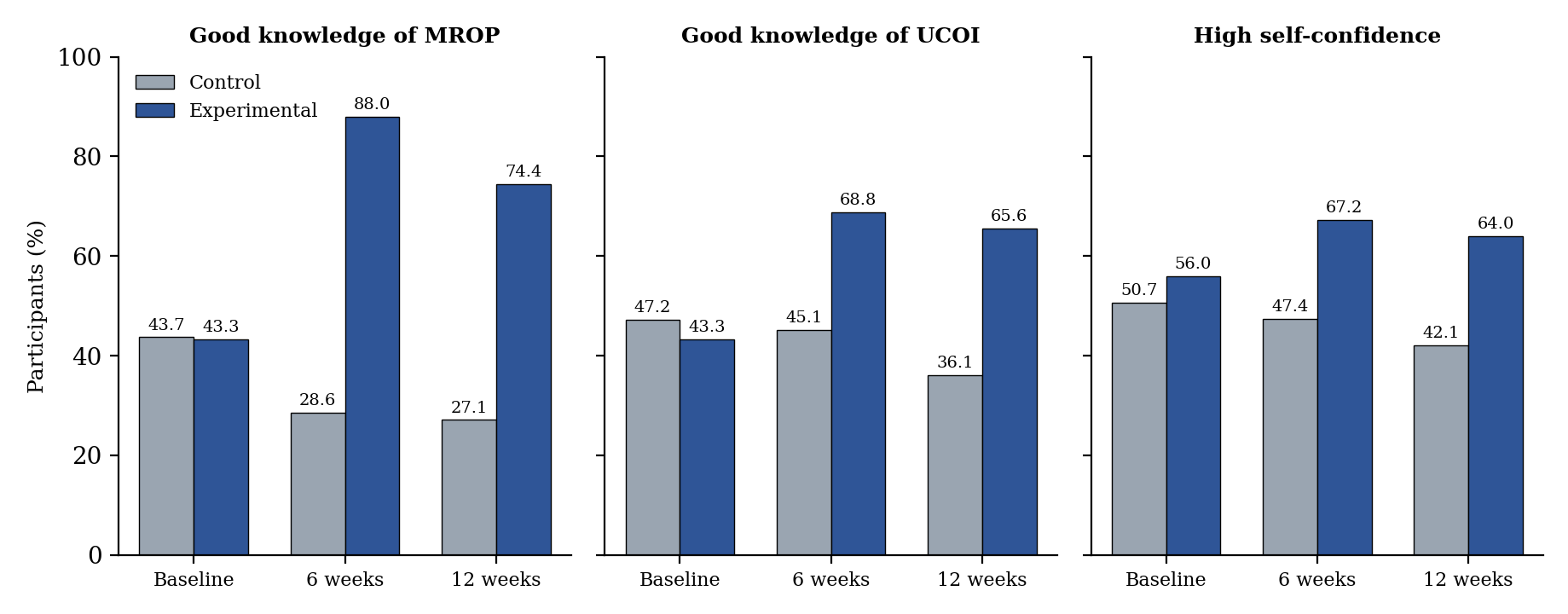
Results: Of the 276 participants, 258 (93.5%) were assessed at both follow-up points. At baseline, the control and experimental groups were similar in the proportions with good knowledge of MROP (43.7% vs 43.3%), good knowledge of UCOI (47.2% vs 43.3%) and high self-confidence (50.7% vs 56.0%; all p>0.05). At six weeks, the proportions in the control and experimental groups were 28.6% vs 88.0% for good MROP knowledge, 45.1% vs 68.8% for good UCOI knowledge and 47.4% vs 67.2% for high self-confidence (all p≤0.001); differences persisted at twelve weeks (27.1% vs 74.4%, 36.1% vs 65.6% and 42.1% vs 64.0%, respectively). In the experimental group, mean knowledge scores changed significantly over time for MROP (Friedman χ²=93.85, p<0.001) and UCOI (χ²=36.21, p<0.001), and were higher than in the control group at six weeks (both p<0.001). Mean self-confidence scores were also higher in the experimental group at six weeks (p<0.001), but the within-group change across the three assessments was not statistically significant (χ²=5.04, p=0.081).
Conclusion: Simulation-based training was associated with higher knowledge of MROP and UCOI and higher self-confidence among midwives, although gains declined by twelve weeks. Periodic refresher training, delivery of UCOI content in line with current guidelines, and assessment of observed skills alongside self-reported confidence are recommended.
Keywords: knowledge; self-confidence; manual removal of placenta; umbilical cord oxytocin injection; postpartum haemorrhage; midwives; simulation-based training; Kwara State; Nigeria
1Introduction
Maternal mortality due to postpartum hemorrhage is still prevalence globally. World Health Organisation conducted a study on causes of maternal mortality between 2009 and 2010 which found that hemorrhage was the leading cause accounting for about 27% of all maternal deaths worldwide [1]. Sub-Saharan Africa bears most of the burden with Nigeria accounting for around 75,000 maternal deaths out of a total of 2 million worldwide in 2023 (28.7%) [1].
Placenta retention plays a significant role in causing preterm birth. It is reported to complicate between 1% and 6% of births, and when it is not treated the risks of bleeding and infection are high [3]. Manual removal of the placenta (MROP) is an emergency procedure within the scope of skilled birth attendants, and WHO guidance on PPH is directed at midwives and other health professionals working in under-resourced settings [4]. Because MROP is invasive, its safe performance depends on sound knowledge of its indications, technique and risks, and on the confidence to act promptly and appropriately.
Umbilical cord oxytocin injection (UCOI) involves injecting an oxytocin solution through the umbilical vein to be used as a simple, cheap and non-invasive alternative to MROP [3]. But there are no studies showing any benefits; therefore, according to the current WHO guidelines, it should not be used on retained placentas by means of an umbilical vein injection of oxytocin until more research has been done [5]. The midwife is trained on this procedure, so they should have an understanding about why it was done, what went wrong during that process as well as how risky it could be for patients according to standards.
Knowledge of clinical competence includes skill set and self-confidence for applying it effectively. The self-efficacy theory states that confidence affects whether and how well someone performs tasks through mastery experience and positive reinforcement [6]. There is a lot of evidence to show there are large gaps between healthcare providers’ understanding about stage three treatment options for patients. Of all 361 obstetricians surveyed from South-West Nigeria, only 28.3% correctly and exclusively defined the components of active management of the third stage of labor; 37.7% incorrectly included manual removal of the placenta among them while midwives had lower odds for accurate knowledge than postgraduate residents [7].
Training by simulation has been applied for improving skills of an emergency obstetric doctor. The systematic review and meta-analysis showed a significant effect of technology enhanced simulations on knowledge, skill acquisition and behavior than without any intervention [8]. Simulation based PPH training (Helping Mothers Survive Bleeding After Birth) showed an initial improvement of knowledge, skill and confidence levels among participants from a low resource setting in northern Tanzania; however, knowledge and simulated skills declined by nine months [9] whereas another study found better outcomes to be seen through improved clinical practices following this intervention [10]. Size and longevity of these benefits is an important issue that should be addressed by training programmes but there is no information available about it for MROP and UCOI among Nigerian midwives.
There are little available literatures on midwife knowledge and confidence levels regarding MROP/UCOI within Kwara State, North Central Nigeria; also there is little data to show any changes due to formal education programs for them. There should be more of this information for targeting programs while also knowing their duration. Thus, this research was conducted to evaluate midwife’s understanding about maternal reproductive health and confidence level regarding management of postpartum hemorrhage (PPH), pre- and post-simulation based skills training program for midwives at hospitals located within Kwara state, Nigeria. In particular, this research aimed at assessing the level of midwives’ knowledge about MROP and UCOI for PPH management both at baseline and post-intervention as well as their confidence levels towards it prior to that time point compared with later on during an intervention period.
This paper is concerned with answering two research questions. What is the current level of knowledge about MROP and UCOI by midwives on managing PPH through simulations compared to traditional methods? Also, how do they rate their confidence levels towards managing PPH through RCP vs MROP/UCOI post-simulation experience. There are two null hypothesis tests conducted here. H01: There is no significant difference between midwives’ knowledge of MROP and UCOI regarding PPH management before and after implementing simulation-based training. There is no significant difference between midwives' self-confidence levels of MROP and UCOI for PPH management before and after implementation of simulation based training.
2Methods
2.1Study design
The present study provides an empirical analysis evaluating how much impact does simulation based training have upon midwife competence levels regarding MORP/UCIO standards. Two groups were compared by means of a pretest-posttest quasi experiment between an experimental group and a control group. This study reports the knowledge and self-confidence outcomes, which were assessed at baseline (P0) and at six weeks (P1) and twelve weeks (P2) after the intervention. This paper is prepared according to the TREND guidelines for non-randomized studies [11].
2.2Study area
This research took place at Kwara State, North Central Nigeria. There are 16 LGAs located within three senatorial districts (Kwara Central, Kwara North and Kwara South). Healthcare services are delivered by public healthcare institutions such as primary health centers, community clinics, general medical facilities and specialized hospitals. Twelve public hospitals with functional maternity services were selected across three LGAs: Ilorin West (Kwara Central), Moro (Kwara North) and Ifelodun (Kwara South). They are chosen by purpose to provide maternity care, high patient turnaround rate, strong healthcare staff numbers and function as referral centers for PPH.
2.3Study population
Midwives working at 12 selected public hospitals are the study population for this study. Sampling frame is a list of 449 midwives working at the selected hospitals according to information provided by Kwara State Hospitals Management Board.
2.4Determining sample size and its justification
The sample size was calculated using the formula for comparing two proportions at a 5% level of significance (Z = 1.96) and 80% power (Z = 0.84), for a two-sided test, based on a proportion of 23.7% reported in a previous study of PPH management and a target proportion of 35% in the present study. With an attrition of 10% for follow up there were 276 midwives selected sample. The sample was allocated in proportion to the number of nurses and midwives in each facility, giving 134 (48.6%) participants in the experimental group and 142 (51.4%) in the control group.
2.5Sampling procedure
Multistage sample selection method was applied. In stage one, Kwara State and its three senatorial districts were purposively selected. In the stage two, one LGA was randomly selected from each of the three senatorial districts. The selected LGAs are Moro, Ifelodun and Ilorin West. Stage 3 involved selecting four public hospitals from each LGA for a total of 12 hospitals. Stage four was randomized so that each hospital would be assigned either an experimental or a control group by coin toss, with six hospitals in each group. Experimental Group included Adewole Hospital, Sobi Specialist Hospital, Cottage Hospital Ajikobi, Specialist Hospital Jebba, Ajase-Ipohospital and General hospital Saare while Control Group consisted of General Hospital Ilorin, Bode-Saadu Hospital, Cottage Hospital Shao, Cottage Hospital Malete, Omupo Hospital and Idofian Hospital. In stage five, convenience sampling was used to select eligible midwives as those who volunteered and consented to be part of course are selected until a proportionate sample per hospital was achieved.
2.6Inclusion and exclusion criteria
A person was eligible for inclusion as a participant if he/she is a member of the Nursing and Midwifery Council of Nigeria along with any other qualifications; currently employed by an obstetrician-gynae department at selected hospital/clinic and willing to be part of it. Those midwives who were sick during this research period, had been on a study or maternity leave, or refused participation were excluded.
2.7Data collection instrument
The data was gathered through a structured research questionnaire as well as guidelines provided by WHO. Section A collected information on socio-demographics charactersitics of the participants such as age, sex, marital status, religion, rank, years of experience, ethnic background and education level. Section B measured knowledge about MROP through 12 dichotomous (and inquiries such as "reasons for" indications of MROP, procedures, and risks. Section C was concerned with assessing knowledge about UCOI through 12 dichotomics by Yes / No questions that cover all three domains. Section D measured self-confidence through 12 questions about recognizing signs and symptoms. The observational skill checklist was applied to this research as well. Both groups were given this survey before an intervention (baseline) as well as during follow-up sessions of 6 months and 12 months later.
Face validity was determined by comparison to other instruments for similar purposes and also reviewed by an expert on reproductive health research and statistics; any ambiguous questions are corrected prior to application. A pilot study was conducted on this questionnaire by testing it out to around 10 percent of our participants at an equivalent location within Oyo State. The Cronbach's alpha value is 0.694 for knowledge of of MROP, 0.704 for knowledge of UCOI and 0.984 for self-confidence.
2.8Knowledge measurement and confidence level
In general terms, the knowledge measurement was obtained through three stages. Each knowledge item was given a score of 1 if it is given as correct and 0 if it as wrong. Secondly, item scores are aggregated per domain (0, as 0-4) and across all three domains to obtain an overall knowledge score between 0-12 for MROP and another one between 0-12 for UCOI. Thirdly, the values were categorized by their level of performance; those higher than average were considered good knowledge while lower ones were bad knowledge based on our pooled baseline mean which serves as a cutoff point for this purpose. Self-confidence scores are calculated by measuring higher levels of confidence and then averaged together for an overall index that was categorized as either high or low self-confidence. The cumulative composite score was analyzed to be a continuous variable.
2.9Intervention
Pregnancy, childbirth, postnatal and neonatal care was taught by simulation based program to experimental group from WHO manual of pregnancy, childbirth, postpartum and newborn care [12]. There were four modules to this program that lasted a total of 4 hours over 1 month (one hour per week). The first module is about placental anatomy, third stage of labor, definition, risk factors, causes and complications of retained placenta. The module 2 is about preparing for and as well as the process of MROP, its complications, and supervised practical demonstration. The module 3 is about anatomy of the umbilical cord, reason why it should be done, dosage and preparation for UCOI, and demonstration of this procedure. The module 4 was about practicing UCOI procedure steps, postoperative care and group activities. The teaching method included Powerpoint presentation, Video Demonstration Skills, Demonstrations Simulation Model and Question and Answer Session. Control group was not given any training for this experiment.
2.10Data collection procedure
Two research assistants, who are, as midwives and certified trainers were trained for 120 minutes about study goals, tools used to administer questionnaires ethically. The permission to collect this information came from the head nurses at selected hospitals. Data was gathered during a period of three-week study at each of the twelve locations. The participants who were identified by their codes for linking answers from all three tests are called "participants". Questionnaires were submitted online on completion. Assessments were done again at 6 months and 12 months’ post-intervention for each group.
2.11Bias
There are several ways of reducing biases. Randomly assigned hospitals instead of individual midwives for group allocation through a coin toss helped to eliminate selection bias and contamination from facilities. Same structured, piloted instruments were employed for all tests; they are also monitored by an observer during testing sessions where codes of response are assigned accordingly. However, there was no evidence of bias as all respondents answered identical questionnaires on multiple occasions; therefore, it remains possible for test effects, social desirability and some cross-hospital contamination to occur.
2.12Data analysis
The data was checked, coded and analyzed by means of SPSS version 23. The sociodemographic data was summarized by means of frequency tables and percentage distributions. Since the Kolmogorov-Smirnov test showed that the composite scores are not normally distributed, p<0.001 for all outcome variables at baseline and post-intervention, a non-parametric test was used instead of parametric ones. Proportions of participants with good knowledge and high self-confidence are compared among experimental vs control group members at each stage by means of a Chi-Square Test. Variations to composite score among different levels over a period of 3 months are analyzed by means of Friedman’s test while comparing between-group differences after 6 weeks through Mann Whitney U analysis. The effect size for the Mann-Whitney U test was expressed as r = |z|/√N and interpreted as small (0.1), medium (0.3) or large (0.5) 13. An omnibus test called Friedman does not involve any pairwise post hoc analysis. P < 0.05 is used for statistical significance. The follow-up analysis was done on 258 subjects at each of these three stages.
2.13Ethical considerations
The ethical clearance is granted by Research and Ethics Board at Afe Babalola University, Ado-Ekiti, Nigeria. Also permission granted by Kwara State Hospitals Management Board and its management committee members for these institutions' participation in this project. Objectives of this research are described; also informed consent was sought from the participants before data collection. Voluntary participation allowed for withdrawal from studies at any point; anonymity was ensured through pseudonyms while information was stored on an encrypted file that can be accessed only by members of this study group.
3Results
There are 276 midwives who were enrolled; 134 for the experimental group and 142 for the control group. There were nine members per group who did not get evaluated during follow up sessions, resulting in 258 subjects, 125 experimental and 133 controls, 93.5% of those enrolled, being followed for six and twelve weeks. The results include information on socio-demographics, general knowledge about MROP and UCOI, confidence levels among participants, and test findings related to research questions.
3.1Sociodemographic characteristics
The table 1 shows a demographic profile for these 276 midwives at baseline. The majority of participants were women, 85.9% for controls, 94.0% for experiments, and had a bachelor's degree, 92.3%, 94.0%. Age group 20-30 years old was most prevalent among both groups at 47.2% and 36.6%, while those with 5-10 years of experience were most common at 50.7% and 56.7%. There was a difference between these two groups regarding certain factors; for example, Nursing Officer-I participants made up 46.5% of the control group while they constituted only 17.2% of an experimenter sample.
| Characteristic | Category | Control (n = 142) n (%) | Experimental (n = 134) n (%) |
|---|---|---|---|
| Age group (years) | 20-30 | 67 (47.2) | 49 (36.6) |
| 31-40 | 47 (33.1) | 41 (30.6) | |
| 41-50 | 21 (14.8) | 35 (26.1) | |
| 51-60 | 7 (4.9) | 9 (6.7) | |
| Gender | Female | 122 (85.9) | 126 (94.0) |
| Male | 20 (14.1) | 8 (6.0) | |
| Marital status | Single | 54 (38.0) | 33 (24.6) |
| Married | 86 (60.6) | 101 (75.4) | |
| Divorced | 2 (1.4) | 0 (0.0) | |
| Religion | Christianity | 44 (31.0) | 50 (37.3) |
| Islam | 94 (66.2) | 82 (61.2) | |
| Traditional | 4 (2.8) | 2 (1.5) | |
| Rank | Nursing Officer II | 29 (20.4) | 29 (21.6) |
| Nursing Officer I | 66 (46.5) | 23 (17.2) | |
| Senior Nursing Officer | 14 (9.9) | 16 (11.9) | |
| Principal Nursing Officer | 15 (10.6) | 41 (30.6) | |
| Assistant Chief Nursing Officer | 7 (4.9) | 14 (10.4) | |
| Chief Nursing Officer | 4 (2.8) | 7 (5.2) | |
| Deputy Director of Nursing Services | 7 (4.9) | 4 (3.0) | |
| Years of experience | <5 | 59 (41.5) | 32 (23.9) |
| 5-10 | 72 (50.7) | 76 (56.7) | |
| >10 | 11 (7.7) | 26 (19.4) | |
| Ethnicity | Yoruba | 124 (87.3) | 116 (86.6) |
| Hausa | 8 (5.6) | 6 (4.5) | |
| Igbo | 10 (7.0) | 12 (9.0) | |
| Professional qualification | RM | 38 (26.8) | 42 (31.3) |
| RM/RN | 104 (73.2) | 92 (68.7) | |
| Highest academic qualification | BSc | 131 (92.3) | 126 (94.0) |
| MSc | 10 (7.0) | 5 (3.7) | |
| PhD | 1 (0.7) | 0 (0.0) |
Note: RM = registered midwife; RN = registered nurse. Percentages are column percentages. Three participants in the experimental group were not allocated to an academic qualification category in the source data, so those percentages sum to 97.8%.
3.2Overall knowledge of MROP and UCOI
Table 2 provides an overview of MROP and UCOI knowledge based on their cumulative score. Baseline proportion of participants with good knowledge of MROP is equal between control and experimental groups, 43.7% vs 43.3%, p=0.949. By six weeks, 88.0% of the experimental group had good knowledge of MROP while 28.6% of the control group did not have any knowledge about it (p<0.001). At twelve weeks, there was a proportion of 74.4% and 27.1%. Therefore, there was an increase of good knowledge of MROP from 43.3% to 88.0% and then a decline to 74.4%, whereas in the control group it went down from 43.7% to 27.1%.
UCOI knowledge is similar but on a smaller scale. Baseline, 47.2% of the control group and 43.3% of the experimental group had good knowledge (p=0.515). By six weeks it was 45.1% and 68.8%, by twelve weeks it was 36.1% and 65.6%. The proportions are shown in Figure 1.
| Outcome | Time point | Control n/N (%) | Experimental n/N (%) | χ² (df = 1) | p |
|---|---|---|---|---|---|
| Good knowledge of MROP | Baseline | 62/142 (43.7) | 58/134 (43.3) | 0.004 | 0.949 |
| 6 weeks | 38/133 (28.6) | 110/125 (88.0) | 93.050 | <0.001 | |
| 12 weeks | 36/133 (27.1) | 93/125 (74.4) | 57.745 | <0.001 | |
| Good knowledge of UCOI | Baseline | 67/142 (47.2) | 58/134 (43.3) | 0.423 | 0.515 |
| 6 weeks | 60/133 (45.1) | 86/125 (68.8) | 14.718 | <0.001 | |
| 12 weeks | 48/133 (36.1) | 82/125 (65.6) | 22.447 | <0.001 |
Note: MROP = manual removal of the placenta; UCOI = umbilical cord oxytocin injection. Overall knowledge was classified from the cumulative score of 12 items (1 mark per correct response): scores above the mean were classified as good knowledge and scores below the mean as poor knowledge. Groups were compared with the Pearson chi-square test. Baseline N = 276; N = 258 at six and twelve weeks.
3.3Self-confidence
The proportion of people who have high self-confidence is shown in Table 3. Baseline data shows that 50.7% of the control group and 56.0% of the experimental group had high self-confidence (p = 0.381). At six weeks, the proportion was 67.2% in the experimental group compared with 47.4% in the control group (p=0.001), and at twelve weeks it was 64.0% compared with 42.1% (p<0.001). Therefore, there was a decline of 8.6% points for those who had high levels of self-confidence during the study period (from 50.7% to 42.1%).
| Outcome | Time point | Control n/N (%) | Experimental n/N (%) | χ² (df = 1) | p |
|---|---|---|---|---|---|
| High self-confidence | Baseline | 72/142 (50.7) | 75/134 (56.0) | 0.768 | 0.381 |
| 6 weeks | 63/133 (47.4) | 84/125 (67.2) | 10.338 | 0.001 | |
| 12 weeks | 56/133 (42.1) | 80/125 (64.0) | 12.393 | <0.001 |
Note: Self-confidence was classified from the composite score of 12 items: scores above the mean were classified as high self-confidence and scores below the mean as low self-confidence. Groups were compared with the Pearson chi-square test. Baseline N = 276; N = 258 at six and twelve weeks.
3.4Changes in composite scores within and between groups
The table 4 is showing a change of mean composite score among these three tests for each group. For MROP knowledge, the mean score in the experimental group rose from 8.16 at baseline to 9.99 at six weeks and then fell to 9.23 at twelve weeks, a significant change (Friedman χ²=93.846, p<0.001). In the control group the mean score declined from 8.38 to 7.82 and 7.60, which was also significant (χ²=16.425, p<0.001). For UCOI knowledge, the experimental group's mean score changed significantly (7.30, 9.17 and 8.78; χ²=36.209, p<0.001), whereas the control group's mean score did not (8.23, 7.82 and 7.66; χ²=4.336, p=0.114). Mean self-confidence scores did not change significantly across the three assessments in either the experimental group (7.64, 8.44 and 8.25; χ²=5.036, p=0.081) or the control group (6.74, 7.06 and 6.67; χ²=2.419, p=0.298)..
| Outcome | Group | n | Baseline mean | 6-week mean | 12-week mean | Friedman χ² (df = 2) | p |
|---|---|---|---|---|---|---|---|
| MROP knowledge | Control | 133 | 8.38 | 7.82 | 7.60 | 16.425 | <0.001 |
| Experimental | 125 | 8.16 | 9.99 | 9.23 | 93.846 | <0.001 | |
| UCOI knowledge | Control | 133 | 8.23 | 7.82 | 7.66 | 4.336 | 0.114 |
| Experimental | 125 | 7.30 | 9.17 | 8.78 | 36.209 | <0.001 | |
| Self-confidence | Control | 133 | 6.74 | 7.06 | 6.67 | 2.419 | 0.298 |
| Experimental | 125 | 7.64 | 8.44 | 8.25 | 5.036 | 0.081 |
Note: Means are mean cumulative scores (knowledge, possible range 0-12). The Friedman test was used because composite scores were not normally distributed (Kolmogorov-Smirnov p<0.001). Sample sizes are those with data at all three time points. No pairwise post hoc comparisons were performed.
The table 5 shows a comparison of composite scores for each group at six weeks. Experimental group scored much higher on MROP knowledge, mean rank 177.48 vs 84.41, z = -10.162, p < 0.001, r = 0.63, large effect, UCOI knowledge, 153.20 vs 107.23, z = -5.060, p < 0.001, r = 0.32, medium effect, and self-confidence, 146.31 vs 113.70, z = -r = -3.561, p < 0.001, r = 0.22, small to medium effect.
| Outcome | Mean rank, control (n = 133) | Mean rank, experimental (n = 125) | z | p | Effect size (r) |
|---|---|---|---|---|---|
| MROP knowledge | 84.41 | 177.48 | -10.162 | <0.001 | 0.63 |
| UCOI knowledge | 107.23 | 153.20 | -5.060 | <0.001 | 0.32 |
| Self-confidence | 113.70 | 146.31 | -3.561 | <0.001 | 0.22 |
Note: Effect size r = |z|/√N, with N = 258, calculated from the reported z values; by convention 0.1 = small, 0.3 = medium and 0.5 = large.
3.5Test of hypotheses
The table 6 is a summary of these test results for both null hypotheses. H01 Null Hypothesis Rejected for Both MROP and UCOI Knowledge: Experimental group scores significantly higher than control group at six weeks’ time point and knowledge scores of experimental group changed significantly over twelves time period. For H02, the null hypothesis was rejected on the between-group comparison at six weeks; however, there is no statistical significance of changes to self-confidence scores among individuals during these three tests, which means that there is less evidence for an increase or decrease in self-confidence compared with knowledge.
| Hypothesis | Outcome | Evidence | Decision |
|---|---|---|---|
| H01: no difference in knowledge before and after training | MROP knowledge | Between groups at 6 weeks: z=-10.162, p<0.001. Within experimental group: χ²=93.846, p<0.001. | Reject H01 |
| UCOI knowledge | Between groups at 6 weeks: z=-5.060, p<0.001. Within experimental group: χ²=36.209, p<0.001. | Reject H01 | |
| H02: no difference in self-confidence before and after training | Self-confidence | Between groups at 6 weeks: z=-3.561, p<0.001. Within experimental group: χ²=5.036, p=0.081. | Reject H02 (between groups); not rejected (within experimental group) |
4Discussion
The research is about midwife's knowledge and confidence level regarding MOPs and UCOs prior to and post-simulation based training at a hospital located within Kwara state. Experimental and control group had same proportion of participants who have good knowledge and high confidence levels initially. Post-training results showed that there was an improvement in knowledge about MROP and UCOI among participants from both groups after 6 months and 12 months compared to controls; also more participants were confident with their abilities. But there is a decline of knowledge gain from 6 to 12 weeks; also, changes on average levels of self confidence among participants were not found as significant by means test at this time period.
4.1MROP and UCOI knowledge
Knowledge of MROP by the experimental group increased after six weeks; there is a significant difference between groups for composite scores and gain of UCOI is lower. The results align with other studies on simulations that show better outcomes due to simulation-based training for knowledge and skill development [8]; also there is some evidence from low resource obstetric settings showing immediate gains in knowledge, skills and confidence [9] as well as improvement of observed practices [10]. The lower gains of UCOI could be due to its being an untested approach compared with MROP as per standard curriculum and guidelines, which aligns with the current WHO stance that limits it to research settings [5].
At baseline, less than half of participants from both groups had a good understanding of MROP or UCOI. Since classification was based on an average value for cutoff points, this is more about relative status rather than actual numbers; it shouldn't be interpreted as how many midwives are meeting a competence level requirement. However, mean scores of around seven to eight out of ten are still low compared to Nigerian research findings on gaps in knowledge of third stage care by nurse midwives 7.
4.2Retention of knowledge
For the experimental group, knowledge about MROP decreased at six weeks to twelve weeks; mean knowledge scores for MROP and UCOI also declined but were still above baseline levels and above those of the control group. There is a decrease of trained knowledge and skills over time as per 14 which was observed after simulation based PPH training in Tanzania where knowledge and simulated skills declined by nine months [9]. Refresher courses are supported by this model; our findings indicate a possible onset of decline after three months from training.
The knowledge level of the control group was also declining significantly, especially for MROP. Since it is an identical survey being administered again for this purpose there will likely be higher results instead of lower ones due to test effects. There are no clear reasons why it has declined; there may be a lack of reinforcement during regular activities, differences between people involved, randomness, etc. so this result must be taken carefully.
4.3Self-confidence
Self-confidence is different from knowledge. The proportion with high self-confidence was higher in the experimental group at six weeks and at twelve weeks, and composite scores were higher at six weeks, but the effect was small to medium and the within-group change across assessments was not significant in either group. There was some difference between groups on average scores for experimenters versus controls; however, there were no significant differences among those who reported high levels of self-confidence at baseline. In general terms, these results indicate an increase of moderate levels of self-confidence compared with controls due mainly to their tendency towards decline instead of significant improvement among participants within experiments themselves.
It is possible according to self-efficacy theory where confidence is developed primarily by repeated success experiences and constructive feedback [6]; four one hour sessions might be more effective for acquiring knowledge compared to building confidence during an invasive emergency procedure. There are immediate increases of self-confidence following simulation based PPH training [9]; however, there is no significant difference between them according to our results. Also note that self-assessed confidence may not reflect actual ability since studies show it is often inaccurate compared with objective measurements [15]. Therefore, these results of confidence should also be considered together with other measures such as those obtained through skill assessment tests conducted on this population that were done independently rather than being used to replace them.
4.4Implications for training and guidelines
The study shows that midwives are able to learn more information on MROP and UCOI through a well-designed simulation based program. There is no evidence to support the effectiveness of UCOI use outside of a study protocol; there are uncertainties about its efficacy from umbilical vein injections of oxytocin for retained placentas [3], while the World Health Organization recommends it only within an experimental setting [5]. Therefore, training for UCOI needs to align itself with current national and WHO guidelines.
5Strengths, limitations and generalisability
The strengths of this research are its use of a control group, random assignment of patients to different treatment centers, assessments taken at three stages, high patient retention rate (93.5%), and inclusion of facilities from all three senatorial districts. Nevertheless, there are some issues to consider. This is an experimental design where patients were assigned to facilities rather than individuals, with each site having only 6 sites per group; however, there was no adjustment made for clustering among hospitals, so accuracy might be too high. Secondly, there were differences among them on a basis such as ranking level, years of experience, sex ratio and marriage status; furthermore, inter group comparison was done to compare scores after 6 weeks without adjusting for initial values. Thirdly, knowledge and confidence levels are measured as means instead of being compared with an established level of competence through statistical analysis like the Friedman test does not detect differences between any two groups since there was no comparison made after each observation. Fourthly, self-report measures were used for measuring confidence levels; however, there is little value to these items as they do not reflect adequately on baseline or within a control group setting. Lastly, this paper does not evaluate patient results.
These results would be particularly relevant for midwives at public secondary level hospitals of Kwara State and could also be useful for other institutions located in North Central Nigeria. Generalization of this topic to private facilities, primary health centers and other areas should be done carefully as there might be differences in staffing, equipment, supervision and training opportunities.
6Recommendations
The simulation based training enhanced midwives’ understanding of MROP and UCOI but did not lead to any improvement over a year later as there were no changes observed between groups regarding their level of confidence towards visiting public hospital facilities in Kwara State; however, it showed an increase from 12 months ago which is quite low compared to other studies on this topic. The health care administrator and Kwara State Hospital Management Board may want to include a simulation based course on managing retained placentas as part of their regular courses.
The training programme of UCOI must be in accordance with current WHO guidelines and national regulations that currently restrict it from being used for retained placental studies. Confidence reported by individuals needs to be validated through observation of their abilities. More research should be done on randomized or cluster randomization trials, adjusted for clusters of patients' data points by their age group; criteria based competence levels; extended periods between assessments including refresher sessions; and patient outcomes measurement tools.
Acknowledgments
All midwives involved in this study are acknowledged; also nurse managers from hospitals where data were collected as well as research assistants that helped gather information for this study are all acknowledged.
Funding
This study received no external funding.
Conflict of Interest
The authors declare no conflict of interest.
References
- [1]Cresswell JA, Alexander M, Chong MYC, Link HM, Pejchinovska M, Gazeley U, et al. Global and regional causes of maternal deaths 2009-20: a WHO systematic analysis. Lancet Glob Health. 2025;13(4):e626-e634. doi:10.1016/S2214-109X(24)00560-6.
- [2]World Health Organization, United Nations Children's Fund, United Nations Population Fund, World Bank Group, United Nations Department of Economic and Social Affairs/Population Division. Trends in maternal mortality 2000 to 2023: estimates by WHO, UNICEF, UNFPA, World Bank Group and UNDESA/Population Division [Internet]. Geneva: World Health Organization; 2025. Available from: https://www.unfpa.org/publications/trends-maternal-mortality-2000-2023
- [3]Kumar N, Jahanfar S, Haas DM, Weeks AD. Umbilical vein injection for management of retained placenta. Cochrane Database Syst Rev. 2021;3(3):CD001337. doi:10.1002/14651858.CD001337.pub3.
- [4]World Health Organization. WHO recommendations for the prevention and treatment of postpartum haemorrhage [Internet]. Geneva: World Health Organization; 2012. Available from: https://www.who.int/publications/i/item/9789241548502
- [5]World Health Organization. WHO recommendation on umbilical vein injection of oxytocin for the treatment of retained placenta [Internet]. Geneva: World Health Organization; 2020. Available from: https://www.who.int/publications/i/item/9789240013940
- [6]Bandura A. Self-efficacy: the exercise of control. New York: W.H. Freeman; 1997.
- [7]Oladapo OT, Fawole AO, Loto OM, Adegbola O, Akinola OI, Alao MO, et al. Active management of third stage of labour; a survey of providers' knowledge in southwest Nigeria [Internet]. Lagos: University of Lagos Institutional Repository; 2009. Available from: https://ir.unilag.edu.ng/handle/123456789/7119
- [8]Cook DA, Hatala R, Brydges R, Zendejas B, Szostek JH, Wang AT, et al. Technology-enhanced simulation for health professions education: a systematic review and meta-analysis. JAMA. 2011;306(9):978-988.
- [9]Nelissen E, Ersdal H, Mduma E, Evjen-Olsen B, Twisk J, Broerse J, et al. Helping Mothers Survive Bleeding After Birth: retention of knowledge, skills, and confidence nine months after obstetric simulation-based training. BMC Pregnancy Childbirth. 2015;15:190. doi:10.1186/s12884-015-0612-2.
- [10]Nelissen E, Ersdal H, Mduma E, Evjen-Olsen B, Twisk J, Broerse J, et al. Clinical performance and patient outcome after simulation-based training in prevention and management of postpartum haemorrhage: an educational intervention study in a low-resource setting. BMC Pregnancy Childbirth. 2017;17:301. doi:10.1186/s12884-017-1481-7.
- [11]Des Jarlais DC, Lyles C, Crepaz N; TREND Group. Improving the reporting quality of nonrandomized evaluations of behavioral and public health interventions: the TREND statement. Am J Public Health. 2004;94(3):361-366.
- [12]World Health Organization. Pregnancy, childbirth, postpartum and newborn care: a guide for essential practice. 3rd ed. Geneva: World Health Organization; 2015.
- [13]Cohen J. Statistical power analysis for the behavioral sciences. 2nd ed. Hillsdale (NJ): Lawrence Erlbaum Associates; 1988.
- [14]Arthur W Jr, Bennett W Jr, Stanush PL, McNelly TL. Factors that influence skill decay and retention: a quantitative review and analysis. Hum Perform. 1998;11(1):57-101.
- [15]Davis DA, Mazmanian PE, Fordis M, Van Harrison R, Thorpe KE, Perrier L. Accuracy of physician self-assessment compared with observed measures of competence: a systematic review. JAMA. 2006;296(9):1094-1102.