Cybersecurity
JobShield AI
1Assistant Professor, Department of Computer Science and Engineering, Sri Shakthi Institute of Engineering and Technology, Coimbatore, Tamil Nadu, India
2Department of Computer Science and Engineering, Sri Shakthi Institute of Engineering and Technology, Coimbatore, Tamil Nadu, India
Published October 2026
Abstract
JobShield AI is an AI-powered recruitment safety and career application platform designed to protect job seekers from fake job postings, advance-fee scams, phishing attempts, and fraudulent recruiters. The system follows the principle “CHECK BEFORE YOU APPLY” by performing a Job Safety Analysis before a candidate submits an application. It analyzes job URLs, job descriptions, PDF or DOCX contracts, recruiter emails or messages, and screenshots using multiple risk indicators. In addition to recruitment safety, JobShield AI provides an ATS and Profile Match feature that compares a resume with job requirements and identifies missing keywords and formatting improvements. The platform also provides an Application Toolkit for generating AI-based cover letters and optimizing LinkedIn profiles. An Interview Coach generates role-specific interview questions and evaluates candidate answers based on their relevance and quality. The Jobs and Applications module provides a safe job feed and Kanban-style application tracker with stages such as Saved, Applied, Interviewing, and Offered. The platform is developed using Flutter and Dart with Firebase Authentication, Cloud Firestore, and Firebase Storage. A multi-signal rule and heuristic based Risk Analysis Engine evaluates potential recruitment fraud. By combining job safety analysis, resume optimization, application assistance, interview preparation, and application tracking, JobShield AI provides a unified and secure platform that helps job seekers make safer and more informed career decisions.
Keywords: JobShield AI; recruitment safety; fake job detection; job scam detection; artificial intelligence; fraud detection; ATS Match; resume analysis; interview coach; LinkedIn Optimization; Flutter; Firebase; risk analysis; career application platform
1Introduction
In the modern digital employment ecosystem, online job platforms have become one of the primary ways for candidates to search and apply for employment opportunities. Job seekers regularly use websites, social media platforms, recruitment portals, emails, and messaging applications to discover job opportunities. Although digital recruitment provides convenience and accessibility, it has also be created.
Many job seekers apply for opportunities without verifying whether the job posting or recruiter is trustworthy. Fraudulent job postings may request personal information, payment, banking details, or other sensitive information from candidates. In some cases, scammers may use professional-looking job descriptions, fake company or fraudulent recruiter communications to appear legitimate. Therefore, there is a need for an intelligent system that can help candidates evaluate the safety of a job opportunity before they apply.
JobShield AI is proposed as an AI-powered Recruitment Safety and Career Application Platform that focuses on protecting job seekers throughout the recruitment process. The main objective of the platform is represented by the principle “CHECK BEFORE YOU APPLY.” Instead of allowing users to apply immediately, the system provides a Job Safety Analysis that evaluates potential risks associated with the opportunity. It analyzes different types of recruitment information, including job URLs, job descriptions, PDF and DOCX contracts, recruiter emails or messages, and screenshots.
The Job Safety Analysis uses multiple risk indicators to identify suspicious characteristics associated with recruitment fraud. By combining different signals through a rule and heuristic based Risk Analysis Engine, the platform can provide users with a clearer understanding of the potential safety of a job opportunity. This helps candidates make informed decisions and reduces the possibility of becoming victims of recruitment scams.
In addition to recruitment safety, JobShield AI provides several career assistance features. The ATS and Profile Match module compares a candidate's resume with the requirements of a selected job. It provides an ATS match score, identifies missing keywords.
The Application Toolkit provides AI-assisted career preparation features such as cover letter generation and LinkedIn profile optimization. Candidates can generate customized cover letters according to the job opportunity and select suitable writing tones. The LinkedIn optimization feature helps candidates improve their professional profile and present their skills more effectively.
Another important feature of JobShield AI is the Interview Coach. Preparing for interviews can be difficult for candidates, particularly when they are unsure about the types of questions that may be asked. The Interview Coach generates role-specific interview questions and evaluates candidate answers. It provides scores along with strengths and areas for improvement, allowing users to practice and improve their interview performance.
The platform also provides a Jobs and Applications module that helps users organize their job search activities. It includes a safe job feed and a Kanban-style application tracker. Users can organize applications according to different stages such as Saved, Applied, Interviewing, and Offered. The Scan Before Applying feature further encourages users to verify job opportunities before submitting applications.
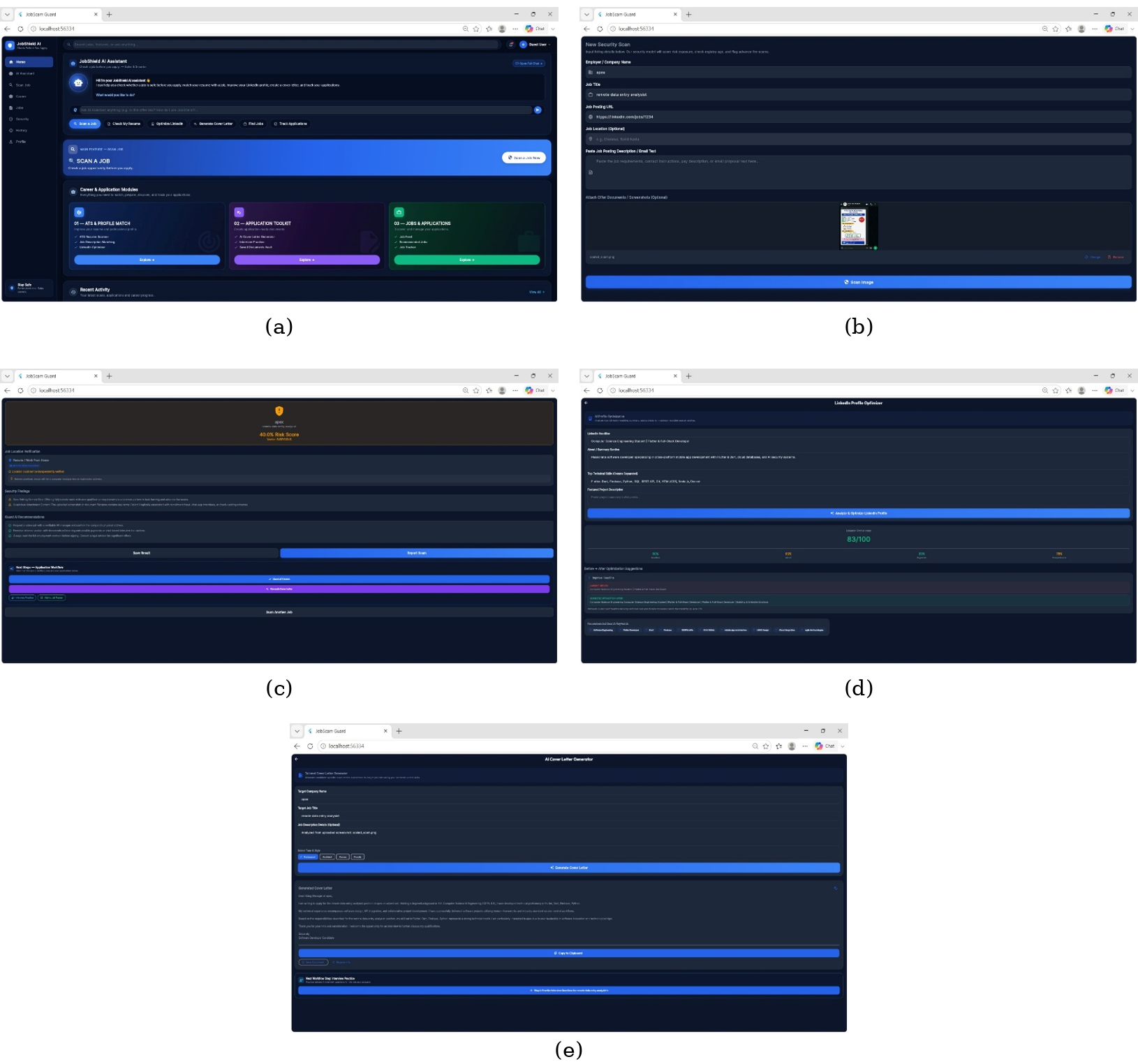
JobShield AI also includes an AI Assistant Hero Dashboard that acts as a central guide for users. The dashboard provides quick actions such as Scan a Job, Check Resume, Optimize LinkedIn, Generate Cover Letter, Find Jobs, and Track Applications. This integrated approach reduces the need for users to depend on multiple separate platforms for different stages of their job search.
From a technical perspective, JobShield AI is developed using Flutter and Dart, allowing the platform to support Web, Mobile, and Desktop environments through a responsive interface. The application follows the Provider Pattern for state management and uses Firebase services for authentication, database management, and storage. Firebase Authentication, Cloud Firestore, and Firebase Storage form the major backend components of the system.
The system follows a modular architecture in which recruitment safety, resume analysis, application assistance, interview preparation, and application tracking work together as a unified workflow. Data can flow across the different stages of the recruitment process, allowing users to move from job verification to profile matching, application preparation, interview preparation, and application tracking.
The development of JobShield AI demonstrates how artificial intelligence can be applied not only to improve recruitment processes but also to improve the safety and confidence of job seekers. By identifying potential recruitment risks before application, assisting with resume and profile improvement, supporting interview preparation, and organizing applications, the platform provides a comprehensive career assistance solution.
Overall, JobShield AI aims to create a safer and more intelligent digital recruitment experience. It combines recruitment fraud detection, career assistance, AI-based analysis, and application management into a single platform. This integrated approach helps candidates reduce recruitment risks, improve their applications, prepare more effectively for interviews, and make better-informed career decisions.
The recruitment process has also become increasingly competitive, making it important for candidates to present their skills and experience effectively. A strong resume alone may not be sufficient when job applications are evaluated using Applicant Tracking Systems (ATS). JobShield AI addresses this challenge through its ATS and Profile Match module, which compares the candidate's resume with the selected job requirements. It identifies missing keywords and provides suggestions for improving resume formatting, helping candidates create applications that are more closely aligned with the requirements of the target position.
Another important challenge faced by job seekers is preparing professional application materials for different job opportunities. Creating a suitable cover letter for every application can require considerable time and effort. JobShield AI provides an Application Toolkit that uses AI assistance to generate customized cover letters based on the selected opportunity. The platform also provides LinkedIn optimization support, enabling candidates to improve the presentation of their professional information and make their profiles more suitable for career opportunities.
Interview preparation is another major stage of the recruitment process where candidates may require continuous practice and feedback. Many candidates may find it difficult to identify suitable questions for a particular job role or evaluate the quality of their own answers. JobShield AI addresses this requirement through its Interview Coach module. The system generates role-tailored interview questions and evaluates candidate responses, providing scores along with identified strengths and areas that require improvement. This allows users to practice interviews in a structured manner before attending actual interviews.
Managing multiple job applications can also become difficult when candidates apply for several positions simultaneously. Applications may be at different stages, such as saved, submitted, interview, or offer stages. JobShield AI provides a Jobs and Applications module with a safe job feed and Kanban-style application tracker. Users can organize their applications according to different stages, making it easier to monitor their recruitment progress. The Scan Before Applying feature further integration.
2Literature survey
Online recruitment platforms have transformed the way candidates search and apply for employment opportunities. The increasing use of digital recruitment has made job searching faster and more accessible, but it has also introduced several security concerns. Fake job advertisements, fraudulent recruiters, phishing messages, and advance-fee scams can mislead candidates and cause financial or personal-data loss. Existing recruitment platforms mainly focus on connecting employers and candidates, while limited attention is given to evaluating the safety and credibility of a job opportunity before application. This creates a need for systems that combine recruitment assistance with fraud-risk analysis.
Research on online recruitment fraud detection highlights the importance of identifying suspicious patterns in job advertisements and recruiter communications. Fraudulent postings may contain unusual payment requests, misleading job descriptions, suspicious links, unrealistic salary promises, or requests for sensitive personal information. A multi-signal approach can improve the identification of suspicious recruitment activities by considering several indicators rather than depending on a single characteristic. JobShield AI follows this concept through a rule and heuristic based Risk Analysis Engine that evaluates multiple risk indicators before a candidate applies.
Artificial Intelligence and Machine Learning have also been increasingly applied to fraud detection and security-related applications. AI-based systems can analyze large amounts of information and identify patterns that may not be easily recognized through manual inspection. In the recruitment domain, such techniques can support the analysis of job descriptions, URLs, recruiter messages, and other application-related information. The JobShield AI approach extends this concept by providing a recruitment safety analysis across multiple input formats, including job URLs, descriptions, PDF or DOCX contracts, emails or messages, and screenshots.
2.1Recruitment fraud detection
Online recruitment platforms have made it easier for candidates to search and apply for jobs. However, the growth of digital recruitment has also increased the risk of fake job postings and fraudulent recruitment activities. Fraudulent recruiters may publish misleading job descriptions, provide unrealistic salary offers, request advance payments, or collect sensitive information from candidates. These risks create a need for systems that can evaluate the safety of a job opportunity before the candidate applies. JobShield AI focuses on this requirement by providing a Job Safety Analysis before application.
Existing recruitment platforms generally concentrate on providing job listings and connecting candidates with employers, while safety verification may not be integrated into the complete application process. A recruitment safety system can help candidates identify suspicious characteristics before submitting an application. JobShield AI addresses this requirement by performing a Job Safety Analysis before the user applies. The platform is designed to help users identify potential recruitment risks and make safer decisions.
2.2AI-based job scam analysis
Artificial Intelligence can be used to analyze large amounts of recruitment-related information and identify suspicious patterns. Job advertisements, recruiter messages, URLs, contracts, and screenshots may contain different indicators of fraudulent activity. A system that analyzes these inputs can assist candidates in identifying potential risks. JobShield AI applies AI-based analysis to different recruitment inputs and helps users understand whether an opportunity contains suspicious characteristics.
JobShield AI applies AI-assisted analysis to different types of recruitment inputs. The system can analyze job URLs, job descriptions, PDF or DOCX contracts, recruiter emails or messages, and screenshots. By analyzing these different sources, the platform provides users with a more comprehensive understanding of the potential risks associated with a job opportunity. This approach supports the main objective of the platform, “CHECK BEFORE YOU APPLY.”
2.3Multi-signal risk assessment
Identifying recruitment fraud using only one characteristic may not always provide sufficient evidence. A suspicious job opportunity may contain several different warning signs, such as unusual payment requests, misleading information, suspicious links, or inconsistent recruiter details. Therefore, considering multiple indicators can provide a broader assessment of recruitment safety. A multi-signal approach can combine different observations before producing a risk assessment.
JobShield AI uses a multi-signal rule and heuristic based Risk Analysis Engine to evaluate potential recruitment fraud. The engine considers multiple risk indicators while analyzing the information provided by the user. The system supports different input formats, including URLs, descriptions, documents, messages, and screenshots. This helps the candidate obtain a safety assessment before proceeding with the job application.
2.4Resume analysis and ATS matching
Applicant Tracking Systems (ATS) are widely used by organizations to screen and organize job applications. These systems may compare resumes with job descriptions and identify relevant skills and keywords. As a result, candidates need to ensure that their resumes contain appropriate keywords and are formatted in a suitable manner. A resume that does not match the requirements of a job may receive a lower ATS match even when the candidate has relevant skills.
JobShield AI provides an ATS and Profile Match module to support this requirement. The system compares the candidate's resume with the selected job requirements and provides an ATS match score. It also identifies missing keywords and suggests formatting improvements.
2.5AI-based career assistance
Candidates require support at several stages of the recruitment process, including finding jobs, preparing application documents, improving professional profiles, preparing for interviews, and tracking applications. Using different applications for each activity can make the overall recruitment process difficult to manage. An integrated platform can provide these services through a single workflow.
JobShield AI combines recruitment safety with several career assistance features. The platform provides job scanning, resume checking, ATS matching, cover letter generation, LinkedIn optimization, interview preparation, job discovery, and application tracking. This integrated approach allows users to manage multiple stages of their career application process from one platform.
2.6Cover letter and LinkedIn optimization
A customized cover letter can help candidates present their skills and experience according to the requirements of a particular job. However, preparing separate cover letters for multiple applications can require considerable time. Candidates may also need to modify the tone and content according to different job roles and organizations.
JobShield AI provides an Application Toolkit that includes AI-based cover letter generation and LinkedIn optimization. Users can generate customized cover letters and select suitable tones according to their requirements. The LinkedIn optimization feature helps candidates improve their professional profiles and present their career information more effectively.
2.7AI-based interview preparation
Interview preparation is an important part of the recruitment process. Candidates may find it difficult to identify questions relevant to a particular job role and evaluate the quality of their answers. Conventional preparation methods often depend on sample questions and individual practice, which may not provide personalized feedback.
JobShield AI includes an Interview Coach that generates role-tailored interview questions and evaluates candidate answers. The system provides scores, identifies strengths, and highlights areas for improvement. This enables candidates to practice according to the requirements of their selected role and improve their interview preparation before attending an actual interview.
2.8Security and data privacy
Recruitment platforms handle sensitive information such as resumes, application details, recruiter communications, and employment documents. Protecting this information is therefore an important requirement for career applications. Authentication, controlled data storage, and appropriate backend services are necessary to support secure management of user information.
JobShield AI uses Firebase Authentication, Cloud Firestore, and Firebase Storage as its backend services. Firebase Authentication supports user authentication, Cloud Firestore manages structured application information, and Firebase Storage supports file storage. These components provide the technical foundation for managing recruitment-related information within the platform.
2.9Cross-platform career applications
Job seekers may access career applications through desktop computers, smartphones, and other devices. A modern career platform should therefore provide an interface that can adapt to different screen sizes and device types. Cross-platform development can help provide consistent access to important features while reducing the need for separate application implementations.
JobShield AI is developed using Flutter and Dart and supports Web, Mobile, and Desktop environments. The platform provides responsive navigation through a desktop sidebar and mobile bottom navigation. This allows users to access the major JobShield AI functions across different platforms while maintaining a consistent workflow.
2.10Future trends in AI-based recruitment
Artificial Intelligence is creating new possibilities for improving recruitment and career applications. Future systems can provide intelligent assistance throughout the recruitment process, including job safety analysis, resume matching, application preparation, interview practice, and application management. Combining these capabilities can provide candidates with a more complete and efficient recruitment experience.
JobShield AI follows this integrated approach by connecting its five major workflow stages: Scan Job, ATS & Profile Match, Application Toolkit, Interview Coach, and Jobs & Applications. The modular architecture also provides a foundation for future enhancements to recruitment safety and career assistance. By combining these capabilities, the platform aims to support candidates throughout their complete job application journey.
3Proposed methodology
3.1System overview
JobShield AI is proposed as an AI-powered Recruitment Safety and Career Application Platform designed to support candidates throughout the job application process. The system follows the principle “CHECK BEFORE YOU APPLY” by providing a Job Safety Analysis before a candidate proceeds with an application. The platform combines recruitment fraud analysis, resume matching, application assistance, interview preparation, and application tracking within a unified workflow.
The proposed system is developed using Flutter and Dart for Web, Mobile, and Desktop environments. Firebase services are used as the backend components, including Firebase Authentication, Cloud Firestore, and Firebase Storage. The system follows a modular architecture that allows the different career assistance features to work together and enables automatic data flow across the major workflow stages.
3.2User-friendly interface
The dashboard is designed for simplicity and clarity. Users can:
- Upload datasets
- View analytics
- Filter results
Charts and graphs provide easy understanding of complex data, making the system accessible even for non-technical users.
3.3Scalable and modular design
The system is built with scalability in mind.
- Modular architecture
- Easy integration of new models
- Cloud deployment support
This allows the system to grow with business requirements.
3.4Security and data protection
Security measures include:
- Data encryption
- Secure API communication
- User authentication
These ensure privacy and protection of customer data.
3.5Job safety analysis
The first stage of the proposed methodology is the Scan Job module. It analyzes recruitment information before the candidate applies for a job. The system accepts different types of inputs, including job URLs, job descriptions, PDF or DOCX contracts, recruiter emails or messages, and screenshots. These inputs are examined using multiple risk indicators to identify characteristics associated with potential recruitment fraud.
The Risk Analysis Engine uses a multi-signal rule and heuristic based approach to evaluate the available information. Instead of depending on a single indicator, the system considers multiple signals to provide a broader recruitment safety assessment. This stage helps candidates understand potential risks and supports safer decision-making before submitting an application.
3.6ATS and profile matching
After checking the safety of a job opportunity, the proposed system provides an ATS and Profile Match module. This module compares the candidate's resume with the requirements of the selected job. The system analyzes the available resume information and identifies how closely it matches the job requirements.
The module provides an ATS match score, identifies missing keywords, and suggests formatting improvements. These results help candidates understand the strengths and weaknesses of their resumes for a particular position. The information obtained during this stage can support candidates in improving their profile before proceeding with the application.
4System implementation
JobShield AI is implemented using Flutter and Dart to provide a responsive interface for Web, Mobile, and Desktop platforms. The interface is designed to provide users with simple access to the major recruitment and career assistance functions.
The dashboard provides options such as Scan a Job, Check Resume, Optimize LinkedIn, Generate Cover Letter, Find Jobs, and Track Applications. The interface follows a responsive navigation approach, using a desktop sidebar for larger screens and mobile bottom navigation for smaller devices. This allows users to access the same core functionality across different device types.
The system connects five major workflow stages: Scan Job, ATS & Profile Match, Application Toolkit, Interview Coach, and Jobs & Applications. Data flows between these stages so that users can move from checking a job opportunity to improving their profile, preparing an application, practicing for an interview, and tracking the application.
4.1Hardware requirements
The JobShield AI platform is designed to operate across Web, Mobile, and Desktop environments. The user can access the system through commonly available computing devices without requiring specialized hardware. The responsive interface allows the application to adapt to different screen sizes and device types.
For development and testing, a computer capable of running Flutter and Dart development tools is required. A stable internet connection is also necessary for communication with Firebase services and for accessing the different features of the platform. Mobile devices can be used to access the responsive mobile interface and its bottom navigation.
4.2Software requirements
JobShield AI is developed using Flutter and Dart. Flutter provides the cross-platform application framework, while Dart is used as the primary programming language for implementing the application interface and functionality. The platform is designed to support Web, Mobile, and Desktop environments.
The backend uses Firebase Authentication, Cloud Firestore, and Firebase Storage. Firebase Authentication manages user authentication, Cloud Firestore manages structured application information, and Firebase Storage supports file storage. The Provider Pattern is used for state management, with MockDataService supporting application data flow.
4.3Backend implementation
The backend implementation uses Firebase services to support authentication, data management, and file storage. Firebase Authentication is used to manage user authentication, while Cloud Firestore provides storage for structured application and user-related information. Firebase Storage is used for storing relevant files and documents.
The backend works together with the Flutter frontend to support the different modules of the system. The Provider Pattern manages application state and enables information to flow between different components. This provides a structured foundation for connecting the recruitment safety and career assistance features.
5Advantages
- Improved decision making: JobShield AI helps candidates identify potential unsafe
- Personalized marketing: Provides customized recommendations and offers based on customer preferences, increasing engagement.
- Higher ROI: Focuses on high-value customers, reducing unnecessary marketing expenses and improving return on investment.
- Real-time insights: Analyzes data in real time, enabling quick responses to changing customer behavior.
- Automation of analysis: Reduces manual work by automatically processing and analyzing large datasets.
- Interactive dashboard: Visualizes data through charts and graphs, making it easy to understand complex information.
- Scalability: Can handle large volumes of data and grow with business needs.
- Better experience: Helps businesses understand customer needs and provide improved, personalized services.
- Integration capability: Easily integrates with CRM systems, websites, and other data sources.
- Enhanced security: Protects sensitive customer data using encryption and secure access controls.
6Results and analysis
JobShield AI successfully provides an integrated platform for recruitment safety and career application assistance. The implemented system combines job scanning, ATS and profile matching, application preparation, interview coaching, job discovery, and application tracking within a unified workflow. The platform follows the principle “CHECK BEFORE YOU APPLY”, making recruitment safety an important part of the application process
The Job Safety Scanner provides analysis of different recruitment inputs, including job URLs, job descriptions, PDF or DOCX contracts, recruiter emails or messages, and screenshots. The multi-signal Risk Analysis Engine evaluates multiple risk indicators and provides a recruitment safety assessment. This enables candidates to identify potential warning signs before submitting an application.
The ATS and Profile Match module provides a comparison between the candidate's resume and the requirements of the selected job. The system generates an ATS match score, identifies missing keywords, and provides formatting improvement suggestions. This helps candidates understand their resume compatibility and improve their applications according to specific job requirements.
The Application Toolkit provides AI-assisted cover letter generation and LinkedIn optimization. Candidates can generate customized cover letters and adjust the tone according to their requirements. The LinkedIn optimization feature supports improvements to the user's professional profile, making the application preparation process more convenient.
The Jobs and Applications module provides a safe job feed and Kanban-style application tracking. Users can organize opportunities under Saved, Applied, Interviewing, and Offered stages. The Scan Before Applying functionality connects job safety analysis with application management, allowing users to verify opportunities before progressing with their applications.
From an implementation perspective, the system uses Flutter and Dart for the frontend and Firebase services for backend functionality. Firebase Authentication, Cloud Firestore, and Firebase Storage support authentication, structured data management, and file storage. The Provider Pattern supports application state management and data flow between the different modules.
The implemented platform also provides responsive support for Web, Mobile, and Desktop environments. Desktop users can access the application through sidebar navigation, while mobile users can use bottom navigation. The project documentation reports clean compilation with zero syntax and widget errors, indicating stable implementation of the developed application.
The results demonstrate that JobShield AI can combine recruitment safety and career assistance into a single workflow. By integrating job risk analysis, ATS matching, application assistance, interview preparation, and application tracking, the system provides candidates with a more structured and safety-oriented approach to the modern job application process.
The Interview Coach provides role-tailored interview questions and evaluates candidate responses. The system provides scores, strengths, and improvement areas, allowing users to identify weaknesses in their preparation. This provides candidates with a structured method for practicing interviews before attending actual recruitment interviews.
By integrating clustering techniques for segmentation and predictive models for churn analysis, the system enables organizations to understand customer behavior more effectively. The use of Node.js ensures efficient backend processing, while MongoDB provides scalable and flexible
7Conclusion
The Analytics System successfully demonstrates how advanced technologies such as machine learning, data analytics, and web-based platforms can be combined to deliver intelligent business solutions. The system provides a centralized platform for processing customer data, generating insights, and supporting strategic decision-making.
The system improves accuracy, reduces manual effort, and enhances the ability to analyze large datasets. It not only functions as a data processing tool but also acts as a decision-support system that helps businesses improve customer retention, marketing strategies, and overall performance.
In conclusion, the AI-Based Customer Analytics System is a scalable, efficient, and intelligent solution that meets modern business requirements and demonstrates the importance of data-driven analytics in today’s digital environment.
8Future work
Future versions of JobShield AI can incorporate advanced Natural Language Processing and transformer-based models for detecting recruitment fraud. Recent research has explored BERT, RoBERTa, explainable AI, and ensemble approaches for online recruitment fraud detection, showing potential for improving contextual understanding beyond traditional keyword-based methods.
The Risk Analysis Engine can also be extended to continuously learn from newly identified fraudulent job postings and user feedback. This can help the system recognize new scam patterns, suspicious communication styles, misleading salary claims, and emerging recruitment techniques. Explainable AI can additionally be used to show users why a particular job was considered risky, improving transparency and trust.
References
- [1]Vidros S, Kolias C, Kambourakis G, Akoglu L. Automatic detection of online recruitment frauds: Characteristics, methods, and a public dataset. Future Internet. 2017;9(1):6. https://doi.org/10.3390/fi9010006
- [2]Vidros S, Kolias C, Kambourakis G. Online recruitment services: Another playground for fraudsters. Computer Fraud & Security. 2016;2016(3):8–13. https://doi.org/10.1016/S1361-3723(16)30025-2
- [3]Alghamdi B, Alharby F. An intelligent model for online recruitment fraud detection. Journal of Information Security. 2019;10(3):155–176. https://doi.org/10.4236/jis.2019.103009
- [4]Taneja K, Vashishtha J, Ratnoo S. Fraud-BERT: Transformer based context aware online recruitment fraud detection. Discover Computing. 2025;28:9. https://doi.org/10.1007/s10791-025-09502-8
- [5]Wang Y. A comparative analysis of fraudulent recruitment advertisement detection methods in the IoT environment. Journal of Sensors. 2022;2022:4583512. https://doi.org/10.1155/2022/4583512
- [6]Scanlon JR, Gerber MS. Automatic detection of cyber-recruitment by violent extremists. Security Informatics. 2014;3:5.
- [7]Wang J, Xu D, Siau KL, Zhang Z. Fighting against recruitment scams: Theory-driven supervised learning and empirical analysis for digital fraudulent recruitment posting behavior. Production and Operations Management. 2026. https://doi.org/10.1177/10591478261457242
- [8]Jobu RA, Baral A, Rahman SMS, Probor MN. An explainable, cost-aware hybrid framework for fraudulent online job posting detection. Array. 2026;31:101191. https://doi.org/10.1016/j.array.2026.101191
- [9]A transformer-based framework for online recruitment fraud detection using BERT, RoBERTa, SMOBD, and 2D CNN. Procedia Computer Science. 2026;283:1145–1153. https://doi.org/10.1016/j.procs.2026.06.193
- [10]XAI-recruit: Explainable AI for job recruitment fraud detection using deep learning. In: IEEE International Conference on Smart Futuristic Technology. 2026. https://doi.org/10.1109/ICSFT66733.2026.11507788
- [11]Vaswani A, et al. Attention is all you need. In: Advances in Neural Information Processing Systems 30; 2017.
- [12]Devlin J, Chang MW, Lee K, Toutanova K. BERT: Pre-training of deep bidirectional transformers for language understanding. In: Proceedings of NAACL-HLT. 2019. p. 4171–4186. https://doi.org/10.18653/v1/N19-1423
- [13]Chen T, Guestrin C. XGBoost: A scalable tree boosting system. In: Proceedings of the 22nd ACM SIGKDD International Conference on Knowledge Discovery and Data Mining. 2016. p. 785–794.
- [14]Breiman L. Random forests. Machine Learning. 2001;45:5–32.
- [15]Pedregosa F, et al. Scikit-learn: Machine learning in python. Journal of Machine Learning Research. 2011;12:2825–2830.
- [16]Chawla NV, Bowyer KW, Hall LO, Kegelmeyer WP. SMOTE: Synthetic minority over-sampling technique. Journal of Artificial Intelligence Research. 2002;16:321–357.
- [17]He H, Bai Y, Garcia EA, Li S. ADASYN: Adaptive synthetic sampling approach for imbalanced learning. In: Proceedings of the IEEE International Joint Conference on Neural Networks. 2008. p. 1322–1328.
- [18]Fawcett T. An introduction to ROC analysis. Pattern Recognition Letters. 2006;27(8):861–874.
- [19]Sokolova M, Lapalme G. A systematic analysis of performance measures for classification tasks. Information Processing & Management. 2009;45(4):427–437.
- [20]Ribeiro MT, Singh S, Guestrin C. Why should i trust YOU?: Explaining the predictions of any classifier. In: Proceedings of the 22nd ACM SIGKDD International Conference on Knowledge Discovery and Data Mining. 2016. p. 1135–1144. https://doi.org/10.1145/2939672.2939778
- [21]Lundberg SM, Lee SI. A unified approach to interpreting model predictions. In: Advances in Neural Information Processing Systems. 2017.
- [22]Goodfellow I, Bengio Y, Courville A. Deep learning. Cambridge, MA: MIT Press; 2016.
- [23]Bishop CM. Pattern recognition and machine learning. New York: Springer; 2006.
- [24]Mitchell TM. Machine learning. New York: McGraw-Hill; 1997.
- [25]Manning CD, Raghavan P, Schütze H. Introduction to information retrieval. Cambridge: Cambridge University Press; 2008.
- [26]Jurafsky D, Martin JH. Speech and language processing. 3rd ed. (draft). Pearson.
- [27]Amershi A, et al. Guidelines for Human-AI Interaction. In: Proceedings of the 2019 CHI Conference on Human Factors in Computing Systems. 2019.
- [28]Jobin A, Ienca M, Vayena E. The global landscape of AI ethics guidelines. Nature Machine Intelligence. 2019;1:389–399.
- [29]Mehrabi N, Morstatter F, Saxena N, Lerman K, Galstyan A. A survey on bias and fairness in machine learning. ACM Computing Surveys. 2021;54(6).
- [30]Fabris A, et al. Fairness and bias in algorithmic hiring: A multidisciplinary survey. ACM Transactions on Intelligent Systems and Technology. 2025;16(1). https://doi.org/10.1145/3696457
- [31]Pisanelli E. Your resume is your gatekeeper: Automated resume screening as a strategy to reduce gender gaps in hiring. Economics Letters. 2022;221:110892. https://doi.org/10.1016/j.econlet.2022.110892
- [32]Hamid M, et al. Automated resume screening using machine learning: An ensemble-based approach for efficient candidate selection. Scientific Reports. 2026. https://doi.org/10.1038/s41598-026-54959-2
- [33]Nielsen J. Usability engineering. San Francisco: Morgan Kaufmann; 1994.
- [34]Google. Flutter: Build beautiful, multiplatform applications from a single codebase. Flutter Documentation. 2026.
- [35]Google. Firebase authentication. Firebase Documentation. 2026.