Flooding and Access to Secondary Education
An Assessment of Flooding on Students’ Access to Secondary Education in Fiidi Ward, Makurdi Local Government Area
Department of Geography, College of Education, Katsina-Ala, Benue State, Nigeria
Published October 2026
Abstract
Flooding has become one of the most devastating environmental hazards affecting communities and public institutions globally, particularly in developing countries. In Nigeria, recurrent flooding along the River Benue has continued to disrupt socio-economic activities, including access to education. This study examines the effects of flooding on students’ access to secondary education in Fiidi Ward, Makurdi Local Government Area of Benue State, Nigeria. A descriptive survey and correlational research design were adopted. A total of 120 respondents were selected using simple random sampling. Data were collected using a structured questionnaire and analyzed using descriptive statistics, Pearson Product Moment Correlation, and simple linear regression. Findings revealed that flooding significantly affects students’ access to secondary education through destruction of roads, displacement of families, and disruption of school activities. Correlation analysis showed a strong negative relationship between flooding and educational access (r = −0.72, p < 0.05). Regression analysis further revealed that flooding accounts for 55.1% of the variation in students’ access to education (R² = 0.551). The study drew on Vulnerability Theory and Systems Theory to explain how flooding hazards disrupt educational systems and threaten vulnerable communities. The study concludes that flooding is a significant barrier to educational accessibility in flood-prone communities. It recommends infrastructural improvement, disaster preparedness, and policy intervention to mitigate educational disruption.
Keywords: flooding; secondary education; access to education; Fiidi Ward; Makurdi
1Introduction
Climate variability has recently increased in the incidence and severity of climate hazards around the globe, particularly floods and droughts. Among environmental hazards, flooding remains one of the most destructive natural disasters, causing prevalent damage to infrastructure, interruption to the public and private services, environmental degradation, and loss of human life (Fanzo, 2019). There are records of frequent incidence of severe flood events over the past decade in countries such as Bangladesh, China, India, Germany, the United States, Malawi, Ethiopia, and Nigeria. These recurring disasters have negatively affected economic development, mostly in developing countries, and are responsible for most of the hydro-meteorological hazards in West Africa.
Flooding is generally defined as the overflow of water onto normally dry land, often resulting from excessive rainfall, river overflow, or inadequate drainage systems. It is widely associated with climate change and environmental degradation (Magami et al., 2014). The Norwegian Refugee Council (2012) identifies floods as the most damaging climate-related hazard globally, primarily as a result of rising sea levels, intense rainfall events, and saturated floodplain environments. In addition, the United Nations International Strategy for Disaster Reduction (UNISDR, 2008) explains the disaster of flooding is when its magnitude exceeds the coping capacity of affected surrounding, resulting in widespread losses or damage on human, economic, and environmental properties.
In Sub-Saharan Africa, flooding affects multiple sectors including agriculture, transport, housing, public health, and education. In Nigeria, the educational sector is particularly vulnerable as floods disrupt school infrastructure, damage transportation networks, and hinder the movement of students and teachers, thereby affecting academic calendars and learning continuity (Anabaraonye et al., 2021). In flood-prone areas such as Makurdi Local Government Area, educational systems are frequently disrupted due to excessive overflow of flood water covering pathways, damaging roads, displacement of communities, destruction of lives and properties and creating unsafe learning environments (Peter et al., 2020). Education is a fundamental human right and important cognitive tool for human development. However, disasters affect school aged children, who are the most endangered and vulnerable group during flood emergencies (Masese et al., 2012). While the socio-economic impacts of flooding have been studied and widely documented, its effects on educational access remain insufficiently explored in many developing contexts.
Flooding causes closures of some schools and destroys learning infrastructure, displaces families, and increases health risks, thereby disrupting educational continuity as some schools are rendered inaccessible due to submerged roads and destruction of school facilities (Tuz Zohora Jui et al., 2021).
Given these challenges, this study investigates the effect of flooding on students’ access to secondary education in Fiidi Ward, Makurdi Local Government Area of Benue State.
1.1Statement of the problem
Flooding has become one of the most severe and persistent environmental challenges in Benue State, particularly in Makurdi due to its location along the River Benue floodplain. Over the past two decades, recurrent flooding has caused extensive damage to communities, infrastructure, and livelihoods (Eimuhi & Ogedegbe, 2016; Iortyer & Yio, 2023).
These flood events have disrupted socio-economic activities and educational systems. Schools are often closed, infrastructure is damaged, students are displaced, students often experience stress and trauma during heavy rainfall and academic calendars are interrupted (Fatemi et al., 2020).
In Fiidi Ward, several secondary schools are located in flood-prone areas. During flooding periods, classrooms are submerged, learning materials are destroyed, roads become impassable, and schools are sometimes converted into temporary shelters for displaced persons. These conditions significantly disrupt teaching and learning processes and may contribute to reduced attendance, low enrolment, and poor classroom participation.
Although studies such as Iortyer and Yio (2023), Shabu and Tyonum (2013) and Isma’il et al. (2019) have examined flooding impacts on agriculture, health and environmental conditions in Makurdi, there remains a lack of empirical evidence focusing specifically on how flooding affects students’ access to secondary education in Fiidi Ward.
This gap is of crucial importance to policymakers and educational planners who need evidence to design strategic interventions that can address educational disruption in flood-prone communities. Therefore, this study investigates the effect of flooding on students’ access to secondary education in Fiidi Ward, Makurdi Local Government Area.
1.2Aim and objectives of the study
The aim of the study is to examine the effect of flooding on students’ access to secondary education in Fiidi Ward, Makurdi Local Government Area. The objectives are to:
- 1. determine the effect of flooding on students’ physical access to secondary schools;
- 2. examine the effect of flooding on students’ enrolment in secondary schools;
- 3. assess the effect of flooding on students’ school attendance; and
- 4. evaluate the effect of flooding on students’ classroom participation.
1.3Research hypotheses
H01: There is no significant relationship between flooding and students’ access to secondary education in Fiidi Ward.
H02: There is a significant relationship between flooding and students’ access to secondary education in Fiidi Ward.
2Literature review
2.1Conceptual review
Flooding is among the devastating and frequent environmental hazards globally today. The Intergovernmental Panel on Climate Change (IPCC, 2022) defines flooding as the overflow of water onto land that is normally dry due to excessive rainfall, river overflow, or drainage failure. In Nigeria, the flooding mostly occurs along major river basins during extreme weather events, particularly the River Benue, where it brings infrastructure destruction, displacement of communities in flood-prone areas, and disruption of socio-economic activities, including education (Shabu and Tyonum, 2013).
Access to education goes beyond enrolment in school and regular class attendance, participation in classroom activities, and continuity of learning. According to United Nations Educational, Scientific and Cultural Organization (2023), educational access involves the capability of learners to safely and effectively participate in uninterrupted learning environments. Flooding negatively affects school access through destruction of educational facilities, damaged transportation routes, displacement of families and prolonged school closures.
2.2Theoretical framework
This study uses the Vulnerability Theory developed by Piers Blaikie. The theory argues that disasters become more threatening when they are far beyond the coping capacity of the flood prone community. The perspective of the study indicates students in flood-prone communities are vulnerable to flooding due to at-risk infrastructure, poor drainage systems, making flooding a major barrier to educational access.
The study is also supported by the Systems Theory proposed by Ludwig von Bertalanffy, which views society as a unified system where disruption in one sector affects others. Flooding disrupts transportation, school infrastructure, and household stability, thereby affecting attendance, participation, and learning processes, which in turn affects the academic performance of students.
2.3Empirical review
A number of studies have recorded the negative effects of flooding on educational activities. Anabaraonye et al. (2022) observed that recurrent flooding in Nigeria damages infrastructure and disrupts transportation networks, limiting access to education. Similarly, Echendu (2021) reported that flooding contributes to displacement, school closure, and interruption of learning activities in vulnerable communities.
Within Benue State, Adamu and Ologunorisa (2019) and Shabu and Tyonum (2013) found that flooding significantly affects urban mobility in Makurdi, making movement difficult during flood periods. Ologunorisa and Tersoo (2006) further revealed that increasing rainfall variability has intensified flooding in Makurdi over time.
Munsaka and Mutasa (2020) also reported that flooding contributes to absenteeism among students, school closure, and destruction of educational infrastructure in developing countries. Likewise, Umeji (2023) found that flooding negatively affects students’ academic performance through disruption of classroom activities, psychological trauma and destruction of educational materials. Overall, existing studies demonstrate that flooding affects education through infrastructure damage, restricted mobility, displacement, and reduced classroom participation.
2.4Research gap
Despite the growing body of literature on flooding and its impacts on education, the existing research in Nigeria focused largely on the effects of flooding on agriculture, livelihoods, and general socio-economic conditions, with limited attention given specifically to the education sector. Limited studies have specifically examined how flooding affects students’ access to secondary education in Fiidi Ward, Makurdi. Existing studies in Nigeria have focused mainly on environmental and socio-economic impacts of flooding with limited attention to attendance, participation, and accessibility at the student level. In addition, many previous studies relied heavily on secondary data without providing localized field-based evidence from affected schools and communities.
This study therefore fills the gap by providing empirical evidence on the effects of flooding on students’ access to secondary education in Fiidi Ward, Makurdi Local Government Area.
3Methodology
3.1Research design
A descriptive type of survey design was adopted in the study with a correlation and explanatory quantitative approach. The descriptive method was used to obtain perception data from the respondents on flooding and educational access, while the correlation and explanatory components were used to determine the relationship and the influence of flooding on students’ access to secondary education.
3.2Description of the study area
The study was conducted in Fiidi Ward, Makurdi Local Government Area of Benue State, Nigeria. Benue State is situated within the middle belt of Nigeria, located between longitudes 6°33′E and 10°0′E and latitudes 6°30′N and 8°10′N, and occupies a land mass of about 33,955 square kilometers with a population of 6,814,430 (2025 projection).
The climate of the study area lies within the Koppen’s Aw climate and experiences two distinct seasons: the wet and the dry seasons. The wet season begins in April and ends in November while the dry season starts in December and ends in March. It is generally located in a plain that slopes up gently on either side of the river. Thus, the elevation rises to the north about 154 m at Daudu, and to the south about 216 m at Ikpayongo.
The geology of the study area consists mainly of sedimentary formation of sandstones divided into micaceous and feldspathic sand-stones. The soils of the area are the tropical ferruginous soils that comprise hydromorphics along flood plains and wetlands and lithosols of flood plains that are frequently affected by seasonal flooding, which impacts transportation infrastructure, school accessibility, and educational participation.
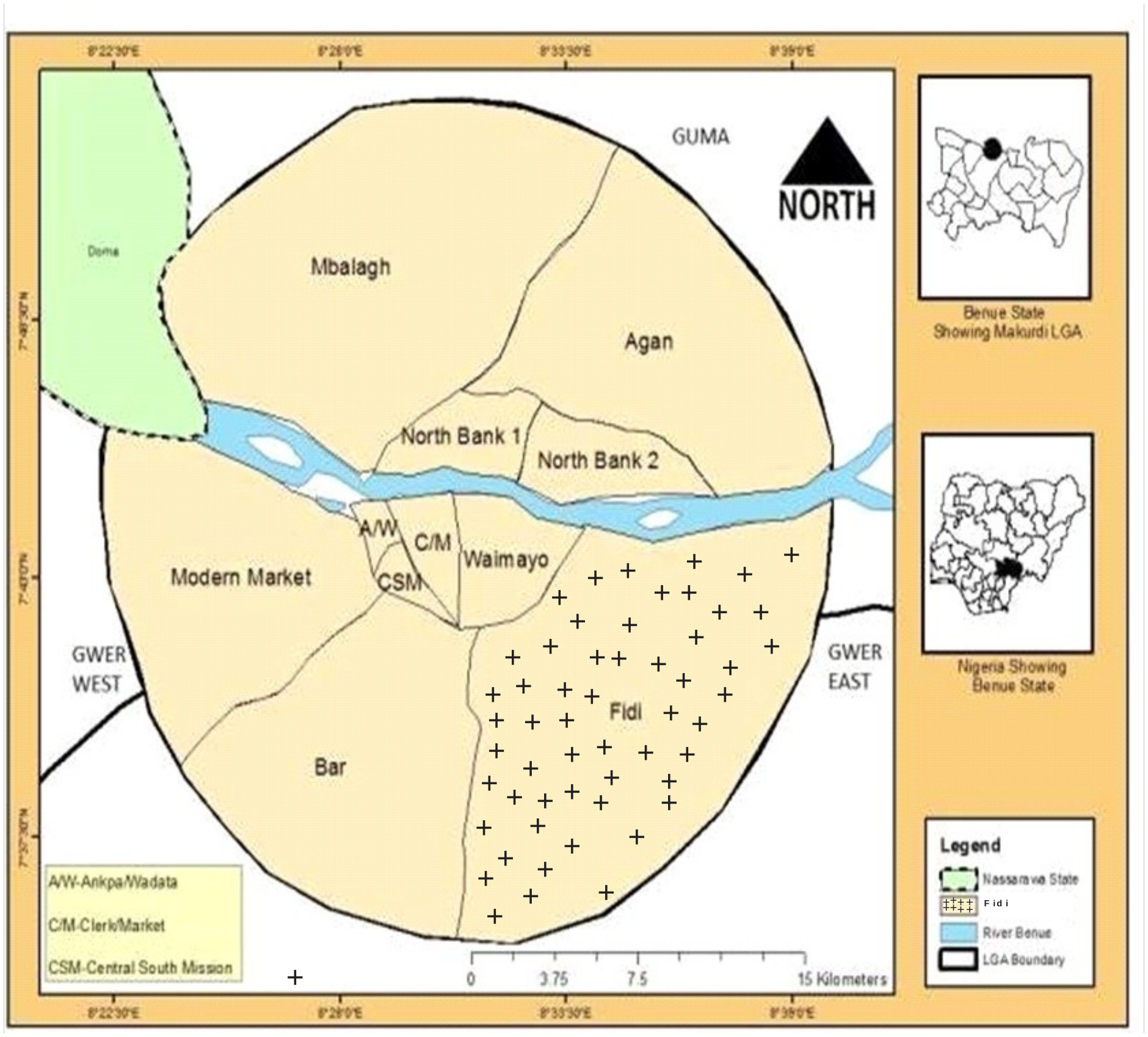
The vegetation of the study area is characterized by a mixture of trees and grasses of the guinea savanna. However, human activities have depleted the natural vegetation due to the increase in urbanization. The location of the study area is shown in Figure 1.
3.3Data needs and sources
Data needs are on flood impact and Educational Access scale. The Flood Impact variables are the destruction of roads, collapsed bridges, displacement of families, destruction of classrooms, and transportation disruption. While the Educational Access Scale included variables such as attendance, enrolment, participation, school accessibility, and learning continuity. The data were sourced from the students, teachers and community stakeholders in the study area because of their direct experience of flooding in the study area. The study also adopts the use of composite variables for relationship assessment between flooding and educational access.
3.4Sampling technique
The sampling frame consists of all the secondary schools located within the flood prone areas of the study area. The study population comprises of 43 public secondary schools, from which 10 schools were purposely selected based on their exposure to similar flooding conditions. A uniform sample size of 12 students was selected from each school, resulting in a total sample size of 120 respondents (Table 1).
| S/N | Name of sampled school | Number of students |
|---|---|---|
| 1 | Jewel Model School Wurukum | 12 |
| 2 | Holy Trinity College Tyo-Mu Yaikyo | 12 |
| 3 | U.B.E –NKST Opposite GAADI | 12 |
| 4 | Grace Academy Tyo-Mu | 12 |
| 5 | Nyajo Divine Wisdom Academy | 12 |
| 6 | Athans Model College Wurukum | 12 |
| 7 | Lady Victory Academy Makurdi | 12 |
| 8 | U.B.E Agbaikyor | 12 |
| 9 | Excellent Foundation Academy Agbaikyor | 12 |
| 10 | Emmanuel Foundation Academy (Phase II) Tyo-Mu | 12 |
| Total | 120 | |
Source: Field study, 2026.
3.5Data collection and analysis
Data was collected using structured questionnaires that were administered to respondents, assisted by trained research assistants on the field. The questionnaire was structured in four sections (A, B, C and D) titled “Flooding and Access to Secondary Education Questionnaire (FASEQ)”. The sections were A: Socio-demographic data, B: Effects of flooding on access to education, C: Effects of flooding on attendance and participation and D: Classroom participation and learning outcomes. The data were coded and analysed with IBM SPSS Statistics. The study employed the use of descriptive statistics to analyze the socio-demographic characteristics using frequencies, percentages, mean scores and standard deviations of respondents to answer the research questions and inferential statistical techniques to analyse the effects of flooding on students’ access to secondary education by respondents using the mean scores and standard deviations. The study adopts the decision rule of 2.50 and above as the accepted mean score while any items below 2.50 stand rejected.
Responses were scored on a four-point Likert scale: strongly agree (SA) = 4, agree (A) = 3, disagree (D) = 2 and strongly disagree (SD) = 1.
The hypotheses were tested with inferential statistical techniques, Pearson Product Moment Correlation and the chi-square test, at the 0.05 level of significance.
Pearson correlation analysis was used to determine the relationship between flooding and educational access variables such as attendance, participation, and enrolment.
Simple linear regression analysis was also employed to determine the extent to which flooding affects variations in attendance, participation, enrolment, and school accessibility within the study area while Chi-square analysis determines whether the observed responses differed significantly from expected frequencies.
The Pearson correlation coefficient is expressed as:
where r is the Pearson correlation coefficient, X is the flooding variable, Y is the educational access variable, n is the number of respondents, ΣXY is the sum of the products of paired scores, and ΣX2 and ΣY2 are the sums of the squared values of X and Y.
The chi-square statistic is expressed as:
where O is the observed frequency and E is the expected frequency.
The regression model is expressed as:
where Y is students’ access to secondary education, a is the constant, b is the regression coefficient, X is flooding and e is the error term.
4Results
4.1Socio-demographic characteristics of respondents
A total of 120 questionnaires were administered and successfully retrieved from respondents across the selected flood-prone secondary schools in Fiidi Ward, Makurdi Local Government Area, representing a 100% response rate. The characteristics of the respondents are given in Table 2.
| Variable | Category | Frequency | Percentage (%) |
|---|---|---|---|
| Gender | Male | 56 | 46.7 |
| Female | 64 | 53.3 | |
| Age | 8–15 years | 31 | 25.8 |
| 16–22 years | 56 | 46.7 | |
| 23–29 years | 33 | 27.5 | |
| Marital Status | Single | 104 | 86.7 |
| Married | 16 | 13.3 | |
| Educational Level | Secondary | 90 | 75.0 |
| Tertiary | 30 | 25.0 |
Source: Field survey, 2026.
The findings in the study revealed that there were 64 female respondents (53.3%) and 56 male respondents (46.7%), a slight female majority. The study shows that both male and female respondents were effectively represented.
The age distribution showed that the largest group of respondents (46.7%) was aged 16–22 years, the age of secondary school students; 31 respondents (25.8%) were aged 8–15 years, and 27.5% were aged 23–29 years, reflecting the inclusion of teachers and adult respondents. This indicates that the respondents were of an age to give reliable information that can be considered useful in the study.
The distribution of the marital status revealed that 86.7% of respondents were single, while only 13.3% were married. This is likely given that most respondents were students.
The educational qualification results showed 75.0% of respondents possessed secondary education, while 25.0% had tertiary education qualifications. The respondents with tertiary education were mostly teachers. This suggests that respondents possessed adequate educational background to provide reliable information regarding flooding and educational access within the study area.
4.2Descriptive analysis of flooding and educational access
To improve statistical credibility and analytical depth, questionnaire items relating to flooding and educational access were analyzed using mean scores and standard deviations. The results are given in Table 3.
| S/N | Item | Mean | SD | Decision |
|---|---|---|---|---|
| 1 | Flood destroys roads and makes schools inaccessible | 3.61 | 0.69 | Strongly Agree |
| 2 | Flooding displaces families and disrupts schooling | 3.48 | 0.83 | Agree |
| 3 | Floodwaters damage classrooms and school infrastructure | 3.42 | 0.87 | Agree |
| 4 | Students are unable to cross streams due to collapsed bridges | 3.39 | 0.91 | Agree |
| 5 | Flooding reduces students’ attendance in school | 3.56 | 0.73 | Strongly Agree |
| 6 | Flooding contributes to school dropout | 3.28 | 0.96 | Agree |
| 7 | Schools are sometimes used as evacuation centres | 3.33 | 0.88 | Agree |
| 8 | Learning materials are destroyed during floods | 3.67 | 0.64 | Strongly Agree |
| 9 | Flooding negatively affects classroom participation | 3.44 | 0.81 | Agree |
| 10 | Students and teachers experience psychological trauma after floods | 3.37 | 0.89 | Agree |
| Grand mean | 3.46 | |||
Source: Field survey, 2026.
The results in Table 3 show that the majority of the respondents agreed that flooding incidence has serious negative effects on students’ accessing school in the study area. The grand mean of 3.46 is higher than the criterion mean of 2.50, indicating strong agreement among respondents.
The highest mean (3.67, SD = 0.64) was recorded for the destruction of learning materials during floods. This shows that flooding causes considerable damage on educational resources, which is a distracting factor on the teaching and learning processes.
Correspondingly, respondents strongly agreed to the fact that, flooding destroys transportation routes (roads) hindering accessibility to school. The mean score was 3.61 (SD = 0.69). This implies that transportation disruption is one of the major factors flooding affects educational access within the study area.
Flooding also affects attendance by reducing the number of days students attend school (mean = 3.56, SD = 0.73), showing that many students are unable to attend school regularly during flood periods. This finding supports earlier studies by Anabaraonye et al. (2022) and Munsaka and Mutasa (2020), who reported that flooding contributes to absenteeism and disruption of educational activities.
The findings also revealed that flooding contributes to community displacement, school dropout, psychological trauma, and reduced classroom participation. These results suggest that the effects of flooding extend beyond physical infrastructure to include social and psychological dimensions that negatively affect educational continuity. Conclusively, the findings revealed that flooding negatively affects access to secondary school by destruction of road or overflow of flood water on the pathway, destruction of infrastructure, restrict movement, affects the psycho social state of school children and displacement of families.
4.3Hypothesis testing
4.3.1Hypothesis one: correlation analysis
H01: There is no significant relationship between flooding and students’ access to secondary education in Fiidi Ward, Makurdi Local Government Area. The results are given in Table 4.
| Variables | N | r | Sig. (2-tailed) | Decision |
|---|---|---|---|---|
| Flooding and School Attendance | 120 | −0.72 | 0.000 | Significant |
| Flooding and Classroom Participation | 120 | −0.69 | 0.000 | Significant |
| Flooding and School Enrolment | 120 | −0.65 | 0.001 | Significant |
| Flooding and Access to School | 120 | −0.74 | 0.000 | Significant |
Source: SPSS output, 2026. Note: Correlation significant at the 0.05 level (2-tailed).
The study revealed a strong negative relationship between flooding and school attendance (r = −0.72, p < 0.05), demonstrating that an increase in flooding events in the study area reduces students’ attendance in school significantly.
Flooding has a negative impact on students’ school enrolment (r = −0.65, p < 0.05), indicating frequent flooding activities in a flood prone area discourages students in participation of school activities.
The findings similarly revealed a strong negative relationship between flooding and classroom participation (r = −0.69, p < 0.05), and a negative relationship between flooding and students’ access to school (r = −0.74, p < 0.05). This implies that students exposed to flood-related disruptions experience reduced participation due to trauma, displacement, and interruption of learning. These findings correspond with earlier studies by Echendu (2021), Umeji (2023), and Samman et al. (2026), who reported that flooding significantly affects educational continuity, participation, and student well-being. The findings revealed that all the significance values obtained were less than the 0.05 level of significance, the null hypothesis was rejected. This shows that, flooding has a negative significant relationship with students’ access to secondary education in the study.
4.3.2Hypothesis two: regression analysis
H02: There is a significant effect of flooding on students’ access to secondary education in Fiidi Ward, Makurdi Local Government Area. This was tested using simple linear regression (Table 5, Table 6 and Table 7).
| Model | R | R 2 | Adjusted R2 | Std. error of estimate |
|---|---|---|---|---|
| 1 | 0.742 | 0.551 | 0.544 | 0.512 |
Source: SPSS output, 2026.
| Model | Sum of squares | df | Mean square | F | Sig. |
|---|---|---|---|---|---|
| Regression | 36.842 | 1 | 36.842 | 140.612 | 0.000 |
| Residual | 30.922 | 118 | 0.262 | ||
| Total | 67.764 | 119 |
| Variable | B | Std. error | Beta | t | Sig. |
|---|---|---|---|---|---|
| Constant | 4.218 | 0.184 | 22.924 | 0.000 | |
| Flooding | 30.922 | 0.063 | −0.742 | −11.858 | 0.000 |
Dependent variable: students’ access to secondary education. Source: SPSS output, 2024.
The regression analysis in Table 5 shows a strong relationship between flooding and students’ access to secondary education (R = 0.742) and coefficient of determination (R² = 0.551) shows that flooding accounts for 55.1% of the variation in students’ access to secondary education within the study area. This implies that flooding is a major factor influencing accessibility to secondary education in the study area. The remaining 44.9% may be caused by other factors not included in the study. The finding revealed that flooding has strong negative effects on educational participation mostly, affecting accessibility within flood-prone communities.
The ANOVA in Table 6 confirms that the regression model is statistically significant (F = 140.612, p < 0.05); the model reliably predicts the effect of flooding on educational accessibility.
In Table 7, the standardized regression coefficient (β = −0.742, p < 0.05) revealed a strong negative result on flooding and educational access. These findings proved that increased flooding significantly negatively affects students’ participation, attendance, enrolment, and access to school.
Therefore, since the significance value obtained (0.000) is less than the 0.05 level of significance, the null hypothesis was rejected, while the alternative hypothesis was accepted.
4.4Chi-square test of respondents’ opinions
To further determine whether the observed responses significantly differed from the expected frequencies, Chi-square analysis was conducted. The results are given in Table 8 and Table 9.
| Response category | Observed frequency (O) | Expected frequency (E) | Residual (O − E) |
|---|---|---|---|
| Strongly Agree | 72 | 30.0 | 42.0 |
| Agree | 38 | 30.0 | 8.0 |
| Strongly Disagree | 2 | 30.0 | −28.0 |
| Disagree | 8 | 30.0 | −22.0 |
| Total | 120 | 120 |
| Variable | Chi-square (χ2) | df | Asymp. sig. |
|---|---|---|---|
| Flooding and Students’ Access to Education | 119.962 | 3 | 0.000 |
Source: SPSS output, 2024.
The Chi-square result revealed that the observed responses differed significantly from the expected frequencies (χ2 = 119.962, df = 3, p < 0.05). Since the significance value obtained (0.000) is less than the 0.05 level of significance, the null hypothesis was rejected.
This indicates that respondents significantly agreed that flooding negatively affects students’ access to secondary education in Fiidi Ward, Makurdi Local Government Area.
5Discussion of findings
The findings of the study revealed that flooding is a major threat to the environment affecting students’ access to secondary education in Fiidi Ward, Makurdi Local Government Area. The study established that flooding destroys roads, bridges, classrooms, and learning facilities, thereby reducing students’ ability to attend and participate effectively in school activities.
The findings further demonstrated that flooding significantly contributes to school absenteeism, reduced classroom participation, and increased dropout rates among students. The strong negative correlations obtained between flooding and educational access variables indicate that increased flooding significantly reduces educational participation and continuity.
The regression analysis further strengthened the findings by revealing that flooding accounts for approximately 55.1% of the variation in students’ educational access. This suggests that flooding remains one of the major predictors of educational disruption in the study area.
These findings support the work of Echendu (2021), who observed that flooding disrupts social services and educational continuity within vulnerable Nigerian communities. The findings also agree with Anabaraonye et al. (2022), who reported that recurrent flooding damages transportation systems and limits access to schools. Similarly, Munsaka and Mutasa (2020) found that flooding contributes significantly to absenteeism, infrastructure damage, and educational discontinuity in developing countries.
The findings also support the Vulnerability Theory, which argues that disaster impacts are intensified by poor infrastructural and socio-economic conditions. In Fiidi Ward, poor drainage systems, weak infrastructure, and proximity to River Benue increase students’ vulnerability to flooding and educational disruptions.
6Conclusion
This study examined the effects of flooding on students’ access to secondary education in Fiidi Ward, Makurdi Local Government Area of Benue State. Climate variability severity has identified flooding as one of the most destructive natural disasters, causing prevalent damage to infrastructure, interruption to the public and private services. The findings show that flooding destroys roads, contributes to school absenteeism and reduces classroom participation, and that it has significant negative effects on students’ access to secondary education, with strong negative correlations between flooding and educational access in Fiidi Ward, Makurdi Local Government.
7Recommendations
Based on the findings of the study, the following recommendations are made:
- 1. Government should improve drainage systems and flood-control infrastructure in flood-prone communities;
- 2. Roads, bridges, and access routes to schools should be rehabilitated regularly;
- 3. Counseling and psychosocial support services should be provided for students and teachers affected by flooding;
- 4. Schools in vulnerable areas should be provided with durable and flood-resistant infrastructure;
- 5. Educational authorities should establish emergency learning plans to reduce disruption during flooding.
Acknowledgments
The researchers sincerely acknowledge the support of the Tertiary Education Trust Fund through the Institution-Based Research (IBR) sponsorship, which contributed significantly to the successful completion of this study.
Appreciation is also extended to the management, teachers, and students of the sampled secondary schools in Fiidi Ward, Makurdi Local Government Area, for their cooperation during data collection.
References
- [1]Achoka J, Maiyo J (2008). Horrifying disasters in Western Kenya: Impact on education and national development. Educational Research and Review, 3(33), 154–161.
- [2]Anabaraonye B, Ajator C, Otti V, Ewa B, Anukwonke C (2021). A brief look at flooding and its impacts on Nigeria’s health sector. Medical and Research Publications, International Open Access, 2(6). https://medicalandresearch.com/journals/view_article/661
- [3]Echendu AJ (2020). The impact of flooding on Nigeria’s sustainable development goals (SDGs). Ecosystem Health and Sustainability, 6, 1791735.
- [4]Eimuhi J, Ogedegbe B (2016). The effect of environmental factors in teaching and learning in primary and secondary schools in Edo State of Nigeria. Journal of Emerging Trends in Educational Research and Policy Studies, 7(4), 310–317.
- [5]Fatemi MN, Okyere SA, Diko SK, Kita M, Shimoda M, Matsubara S (2020). Physical vulnerability and local responses to flood damage in peri-urban areas of Dhaka, Bangladesh. Sustainability, 12(10), 3957. https://doi.org/10.3390/su12103957
- [6]Masese A, Opiyo R, Okayo J, Ombui NM (2012). Impact of floods on attainment of education for all (EFA) and vision 2030 in Nyando Basin, Kisumu County. International Journal of Disaster Management and Risk Reduction, 4(2), 19–31.
- [7]Muhammed, Atu, Mahmud (2019). ‘Children are starving’: A cry for help from flood-hit Bangladesh. Al Jazeera. https://www.aljazeera.com/news/2022/5/25/children-are-starving-a-cry-for-help-from-flood-hit-bangladesh
- [8]Nabaraonye B (2018). Keep clean, stay cool. https://projectgreeninitiative.wordpress.com/2018/04/22/keep-cleanstay-cool/
- [9]Intergovernmental Panel on Climate Change (IPCC) (2022). Climate change 2022: Impacts, adaptation and vulnerability. Cambridge University Press.
- [10]Iskra, Borislav, Rositsa, Gieva E (2023). A concept for flood early warning. https://www.e3sconferences.org/articles/e3sconf/pdf/2023/41/e3sconf_eepes2023_01002.pdf
- [11]Okaka FO, Odhiambo B (2018). Relationship between flooding and outbreak of infectious diseases in Kenya: A review of the literature. Journal of Environmental and Public Health, 2018, 1–8. https://doi.org/10.1155/2018/5452938
- [12]Okuom H, Simatwa E, Olel M, Wichenje K (2012). Assessment of factors that contribute to repetition and dropout of pupils in primary schools in flood prone areas of Nyando District, Kenya: An analytical study. Education and Research, 3(2), 190–201.
- [13]Olanrewaju O (2023). Flooding making access to education difficult in rural communities. Dataphyte. https://www.dataphyte.com/latest-reports/flooding-making-access-to-education-difficult-in-rural-communities/
- [14]Ortyer D, Yio WB (2023). Flood and food security in the Benue Valley: Stylized facts. ABUAD Journal of Social and Management Sciences, 4(2), 318–337.
- [15]Slavov D (2021). A concept for flood early warning. https://www.e3s-conferences.org/articles/e3sconf/ref/2023/41/e3sconf_eepes2023_01002/e3sconf_eepes2023_01002.html
- [16]Susan A (2014). Effects of floods on students’ access to secondary education in Nyando District, Kisumu County, Kenya (Master’s research project). University of Nairobi. http://erepository.uonbi.ac.ke/bitstream/handle/11295/76382
- [17]United Nations Office for Disaster Risk Reduction (UNDRR) (2021). UNDRR terminology on disaster risk reduction. United Nations.