Economics
Economic Uncertainty and Corporate Investment: An Exploratory Analysis
Poornima University, Jaipur, India
Published October 2026
Abstract
Economic uncertainty can influence how firms make investment decisions, particularly when businesses face uncertain future economic conditions. This study will analyse the relationship between economic uncertainty and corporate investment decisions. Using firm-level financial data and macroeconomic uncertainty indicators for the period of 5 years, the study will look into whether higher uncertainty reduces the corporate investment. Corporate investment will be evaluated using capital expenditure relative to total assets, while economic uncertainty captured using the Economic Policy Uncertainty Index and the VIX. Panel data regression models with firm and year fixed effects will be utilized, controlling for firm size, profitability, leverage, cash holdings, and sales growth. The study aims to determine whether financially constrained firms are more sensitive to uncertainty than firms with stronger financial positions. The research aims to provide empirical evidence on how uncertainty affects corporate investment behavior and contribute to a better understanding of investment decisions under uncertain economic conditions.
1Introduction
Economic uncertainty is an important factor that can influence the decisions of firms or businesses. When businesses face uncertainty about future economic conditions, government policies, demand, or financial conditions, they may become more careful about making long-term investment decisions. Corporate investment plays an important role in a firm's growth as it allows a company to increase its production capabilities, optimize its operations, and adopt new technologies. Accordingly, the impact of uncertainty on a firm's investment decisions is of great importance to both firms and policymakers. In uncertain economic conditions, the firms might expect lower proceeds from their investments, which decreases their motivation to make them. Such a scenario would affect the cash flow of the business, limiting its ability to grow and perform R&D. The situation with the increased volatility of the economy would affect the two groups of firms differently. The firms which do not have enough reserves to make loans during the time of crisis will freeze their investments due to the lack of opportunity. However, the ones with stable finances can continue their development without significant disruptions.
This study will examine the relationship between economic uncertainty and corporate investment decisions using firm-level financial data and macroeconomic uncertainty indicators over a five-year period. Corporate investment will be measured using capital expenditure relative to total assets, while economic uncertainty will be measured using the Economic Policy Uncertainty Index and the VIX. The study will also consider factors such as firm size, profitability, leverage, cash holdings, and sales growth that may influence corporate investment.
The main purpose of this study is to determine whether higher economic uncertainty is associated with lower corporate investment and whether financially constrained firms are more sensitive to uncertainty. By examining these relationships, the study aims to provide a better understanding of how firms respond to uncertain economic conditions and how their financial position may influence their investment decisions.
1.1Research problem
Economic uncertainty is often accompanied by firms’ doubts about future costs, demands, profits, and investment payoffs. This, in turn, leads to pessimism and/or reduced willingness to invest. At the same time, the impact of uncertainty on firms’ investment behavior may depend on firms’ financial position. Firms that are relatively financially strong may be less sensitive to economic uncertainty than firms that are facing financial constraints. Although several studies have been conducted on the relationship between uncertainty and investment, the question regarding the differential impact of uncertainty on firms with different financial positions still remains open. An empirical analysis of financial constraints’ effect on the relationship between economic uncertainty and corporate investment would help to answer this question.
This study aims to investigate whether economic uncertainty leads to a decrease in corporate investment and whether firms with financial constraints respond more strongly to uncertainty than firms that are not financially constrained.
1.2Research questions
- 1. Does economic uncertainty negatively affect corporate investment decisions?
- 2. Are financially constrained firms more sensitive to economic uncertainty than firms with stronger financial positions?
1.3Research objectives
The main objectives of this study are:
- 1. To examine the relationship between economic uncertainty and corporate investment decisions.
- 2. To determine whether higher economic uncertainty reduces corporate investment.
- 3. To examine whether financially constrained firms are more sensitive to economic uncertainty than firms with stronger financial positions.
- 4. To analyse the effect of firm-specific factors, including firm size, profitability, leverage, cash holdings, and sales growth, on corporate investment.
1.4Research hypotheses
H1: Higher economic uncertainty is negatively associated with corporate investment.
H2: Financially constrained firms are more sensitive to economic uncertainty and reduce their investment more than financially stronger firms.
2Literature review
The impact of economic uncertainty in literature has been subject to extensive research since the outcomes it might have on firms’ investments have been questioned. The primary idea is that if the future outlook of the economy in terms of stability cannot be easily identified, firms would prefer to defer investments since the returns to their capital expenditures might be lower. The rationale behind this argument considers the trade-off between the value of waiting and the forgone opportunity cost associated with investment projects with a long payback period (Julio and Yook, 2012; Gulen and Ion, 2016).
Most of the previous research has demonstrated a negative correlation between uncertainty and corporate investment. The former tends to increase the latter’s risk, which means that firms become more hesitant to make investments when the economy is unstable. Baker et al. (2016) found that economic policy uncertainty is associated with lower investment, while Gulen and Ion (2016) found a strong negative relationship between policy uncertainty and corporate investment. Kang et al. (2014) also found that economic policy uncertainty depresses firm-level investment, particularly when firms face higher firm-level uncertainty.
The financial constraints hypothesis states that investment demands are particularly vulnerable to financing costs and availability at episodes of economic uncertainty. As a result, it could be stated that the current financial position of firms plays a critical role in the way economic unpredictability could affect their investment process. For example, if a firm is under financial constraints, its responsiveness to uncertainty would be higher due to having more challenges with external financing and less access to internal cash resources. In other words, financial constraints would make it harder for firms to sustain continuous levels of investment during economically unstable periods. Subsequently, such firms would tend to delay their investments due to the increased level of risk. Wang et al. (2014) found that firms with greater internal financing capacity were better able to mitigate the negative effect of economic policy uncertainty on corporate investment. More recent evidence also suggests that the negative effect of uncertainty is stronger for firms with higher financial vulnerability and less access to credit (Meng et al., 2023).
On the contrary, firms that are not under financial constraints could have higher access to internal financing and thus a stable level of investment regardless of the state of the economy.
Overall, it could be stated that the literature review has revealed that economic uncertainty has a significant impact on firms’ investments. However, the heterogeneity of firms’ financial positions suggests that such an impact would be different for firms under financial constraints and those that are not constrained. Thus, the present study aims to examine the relationship between investment and economic uncertainty and explore if financial constraints moderate this relationship. By integrating the firm-level financial indicators with the Economic Policy Uncertainty index and VIX, the study will explore this link over a five-year period.
3Data and variables
The proposed study will employ firm-level financial data and macroeconomic uncertainty indicators as the key variables. The former will be used to evaluate corporate investment, while the latter will serve as a proxy for the economic uncertainty. It is anticipated that both variables will be integrated into a panel dataset that will involve multiple firms under a five-year observation period. It is noteworthy that firm-level financial data will be regarded as a basis for analyzing corporate investment and other firm-related variables, whereas the Economic Policy Uncertainty (EPU) Index and the VIX will be incorporated as the central measures of economic uncertainty.
The dependent variable of the proposed study will be corporate investment that will be estimated in terms of a ratio between capital expenditure and total assets:
The independent variable will be economic uncertainty that will be operationalized by the EPU index and the VIX. In addition, the proposed analysis will also include a number of firm-related control variables among which size, profitability, leverage, cash, and sales growth will play an important role. In particular, firm size will be estimated by means of the natural logarithm of total assets. The profitability will be measured as the Return on Asset (ROA), while leverage will be evaluated using the firm’s debt-to-asset ratio. Cash will represent the amount of liquid assets owned by a firm, while sales growth will signal firms’ performance.
3.1Econometric model
The relationship between economic uncertainty and corporate investment will be analyzed within a firm fixed-effects panel regression framework:
In the aforementioned equation, i denotes firms, while t stands for the year. In addition, β₀ is the constant term, whereas β₁–β₆ are the coefficients that represent the linear relationship between each independent variable and the dependent one. Finally, αᵢ represents the firm-specific fixed effects, while εᵢₜ is the error term.
The special focus will be paid to the coefficient β₁ that will measure the association between economic uncertainty and corporate investment after having controlled for the impact of other variables, and it is expected that β₁ will be negative in accordance with the first hypothesis in which economic uncertainty has a detrimental impact on corporate investment.
3.2Financial constraints and interaction effect
To test the second hypothesis, a financial constraint variable will be introduced and incorporated as an interaction term:
The interaction term is of particular importance because it will help to quantify the additional impact of financial constraints on corporate investment beyond the effect of economic uncertainty. If the coefficient β₃ turns out to be negative and statistically significant, it will provide evidence that financially constrained firms are particularly sensitive to the impact of economic uncertainty. The aforementioned financial constraints will be selected based on the availability of firm-related financial data. The firms will be categorized according to their financial constraints so that a comparison can be made between the investment behavior of financially unconstrained and financially constrained firms.
3.3Estimation and robustness
The above-described econometric models will be estimated by employing panel-data regression that will integrate firm fixed effects. The former will control for unobserved, time-invariant firm-specific factors that include management practices, business model, and investment strategy. The heteroskedasticity-robust clustered standard errors will be utilized to ensure that the standard errors are not biased due to possible within-firm correlation of errors.
The results will be reported that will highlight the statistical significance of key variables that will be evaluated on the basis of conventional significance levels. Overall, the analysis will aim at examining whether financial constraints moderate the relationship between economic uncertainty and corporate investment.
| Firm | Year | Investment (CapEx/Assets, %) | India EPU | VIX | Total Assets (₹ cr) |
|---|---|---|---|---|---|
| L&T | 2023 | 1.39 | 78.85 | 16.85 | 172424 |
| L&T | 2024 | 1.66 | 132.23 | 15.55 | 175764 |
| L&T | 2025 | 1.46 | 143.1 | 18.93 | 186416 |
4Results and discussion
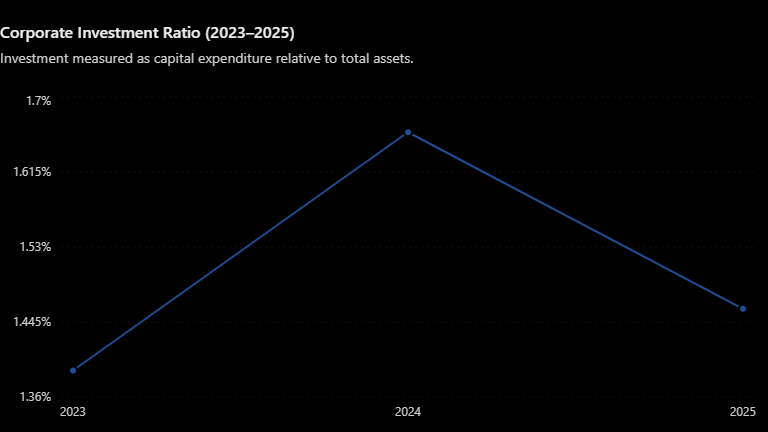
The results presented demonstrate that the investment ratio was not consistent throughout the period of 2023-2025. Specifically, corporate investment as a share of total assets was equal to 1.39% in 2023, increased to 1.66% in 2024, and decreased to 1.46% in 2025.
Over the same period, the India EPU Index was equal to 78.85 in 2023, increased to 143.10 in 2025, demonstrating that economic policy uncertainty (EPU) was positively correlated with time. Additionally, the VIX was equal to 16.85 in 2023, decreased to 15.55 in 2024, and increased to 18.93 in 2025.
As such, based on the data, it can be stated that investment was not positively correlated with either of the uncertainty indices. Although the level of uncertainty increased significantly over the analyzed period, the investment ratio demonstrated a mixed trend, peaking in 2024, followed by a decrease in 2025. As such, it can be stated that other forces besides uncertainty may also drive corporate investments.
It is also evident from the results that increased levels of uncertainty coincide with a decline in corporate investment. Such a trend can be observed in the changes in 2025. However, as mentioned above, the analyzed period was too short to provide more substantial evidence of a positive correlation between uncertainty and investment. Additionally, it is recommended to analyze more data points at the firm level in order to make more concrete conclusions regarding the relationship between the variables and test the initial hypothesis.
5Conclusion
The purpose of this study was to investigate the relationship between economic uncertainty and corporate investment using firm-level financial data and macroeconomic uncertainty indicators. The analysis suggests that during the period of 2023-2025, the investment ratio changed, while the India EPU Index rose, and a mixed trend was observed for the VIX. However, the study’s results offer limited evidence of a significant relationship between the variables in question.
Specifically, the study suggests that the rise in economic uncertainty may be associated with the reduction of corporate investments. Nevertheless, the evidence gathered from the limited number of observations is insufficient to prove a significant relationship between the variables and provide sufficient evidence to support the initial hypothesis. Furthermore, the results illustrate the potential influence of factors unrelated to economic uncertainty on corporate investment and serve as a basis for further research on the subject.
In conclusion, the study provides a basis for further investigation into the relationship between economic uncertainty and investment. The current analysis was limited to the financial data of a few firms and the trends of two uncertainty indices, which reduces the reliability of the results and their applicability to the broader business environment. Subsequent research that utilizes the data of multiple firms and observes the trends in the variables over an extended period would generate more reliable results and provide sufficient empirical evidence for the initial hypothesis.
References
- [1]Baker SR, Bloom N, Davis SJ (2016). Measuring economic policy uncertainty. The Quarterly Journal of Economics, 131(4), 1593–1636. https://doi.org/10.1093/qje/qjw024
- [2]Gulen H, Ion M (2016). Policy uncertainty and corporate investment. The Review of Financial Studies, 29(3), 523–564. https://doi.org/10.1093/rfs/hhv050
- [3]Julio B, Yook Y (2012). Political uncertainty and corporate investment cycles. The Journal of Finance, 67(1), 45–83. https://doi.org/10.1111/j.1540-6261.2011.01707.x
- [4]Kang W, Lee K, Ratti RA (2014). Economic policy uncertainty and firm-level investment. Journal of Macroeconomics, 39, 42–53. https://doi.org/10.1016/j.jmacro.2013.10.006
- [5]Wang YZ, Chen CR, Huang YS (2014). Economic policy uncertainty and corporate investment: Evidence from China. Pacific-Basin Finance Journal, 26, 227–243. https://doi.org/10.1016/j.pacfin.2013.12.008