Civil Engineering Materials
Compressive Strength and Workability of Concrete Containing Rice Husk Ash with a Constant 2% Palm Kernel Shell Ash as Partial Cement Replacement
Department of Civil Engineering, Nigerian Army University Biu, Borno State, Nigeria
Published October 2026
Abstract
The production of Ordinary Portland Cement (OPC) is energy-intensive, costly and a major source of carbon dioxide emissions, while rice husks and palm kernel shells are commonly disposed of by open burning in Nigeria. This study evaluated the workability and compressive strength of concrete in which cement was partially replaced by Rice Husk Ash (RHA) at 5%, 10%, 15% and 20% together with a constant 2% Palm Kernel Shell Ash (PKSA), relative to a plain OPC control. The RHA was calcined at 600 °C and the PKSA incinerated at 350–750 °C, and both were passed through a 75 µm sieve. A nominal 1:2:4 mix with a water–binder ratio of 0.50, targeting a characteristic strength of 25 N/mm² (C25), was used to cast thirty 100 mm cubes, which were water-cured and tested at 7, 14 and 28 days. Slump decreased progressively from 70 mm for the control to 60 mm at 20% RHA, but all mixes remained within the S2 consistence class. The mix containing 10% RHA and 2% PKSA gave the highest mean 28-day strength of 38.22 N/mm², 14.8% above the control (33.30 N/mm²), and strength declined at higher RHA contents. All mixes exceeded the C25 target at 28 days and had densities of 2220–2370 kg/m³, typical of normal-weight concrete. Analysis of variance showed a significant effect of mix composition on 28-day strength (p = 0.028). A blend of 10% RHA and 2% PKSA is recommended as the optimum among the levels studied, subject to confirmation with larger samples and durability testing.
Keywords: compressive strength; palm kernel shell ash; rice husk ash; supplementary cementitious materials; workability
1Introduction
Concrete is the most widely used construction material in the world, valued for its ability to take any shape when fresh and for its strength when hardened [1], [2]. Its principal binder, Ordinary Portland Cement (OPC), is energy-intensive to manufacture: cement production accounts for roughly 8% of global CO2 emissions, with approximately 927 kg of CO2 released for every 1000 kg of cement produced [3]. In developing countries such as Nigeria, the high cost of cement compounds these environmental concerns and constrains low-cost housing and rural infrastructure, while the extraction of natural aggregates by mining, dredging and blasting causes further environmental degradation [4]. These pressures have intensified the search for supplementary cementitious materials (SCMs) that can partially replace cement without compromising structural performance [5].
Agricultural residues are attractive sources of SCMs in such settings because they are locally abundant and otherwise wasted [5]. Nigeria is a major producer of both rice and oil palm, and large volumes of rice husk and palm kernel shell are disposed of by open burning, which pollutes the air and poses risks to public health [2]. When burnt under controlled conditions, these residues yield silica-rich ashes, Rice Husk Ash (RHA) and Palm Kernel Shell Ash (PKSA), that can react with the calcium hydroxide released during cement hydration to form additional calcium silicate hydrate (C‑S‑H) [3], [6].
RHA has been studied extensively as a partial cement replacement [6]–[9], and palm kernel shell (PKS) has been widely investigated as a lightweight coarse aggregate [1]–[3]. In contrast, PKSA has received far less attention as a cementitious material, and the combined use of PKSA and RHA as partial cement replacements has rarely been reported. Studies of RHA-blended palm kernel shell concrete have used the shell as an aggregate rather than as an ash and have focused largely on early-age performance up to 28 days [2].
This study therefore investigated concrete in which cement was partially replaced by RHA at 0–20% together with a constant 2% PKSA. The specific objectives were to: (i) assess the workability of the fresh concrete; (ii) evaluate its compressive strength and density at 7, 14 and 28 days; (iii) identify the optimum RHA replacement level, at 2% PKSA, that satisfies the C25 design strength; and (iv) assess the implications for sustainable and cost-effective construction in Nigeria. Flexural strength, splitting tensile strength and durability were outside the scope of the study.
2Literature review
2.1Pozzolanic materials and supplementary cementitious materials
Pozzolans are siliceous or siliceous-aluminous materials that, in finely divided form and in the presence of moisture, react with the calcium hydroxide liberated by cement hydration to form additional C‑S‑H and calcium aluminate hydrate (C‑A‑H). This secondary reaction refines the pore structure and can improve both strength and durability. Fly ash, ground granulated blast-furnace slag and silica fume are the most widely used SCMs, but their availability is limited and geographically uneven in many developing countries, where agricultural ashes such as RHA and PKSA provide a locally available alternative [5]. ASTM C618 specifies a minimum combined SiO2 + Al2O3 + Fe2O3 content of 70% for raw or calcined natural pozzolans [10]; RHA samples characterised by Philips et al. [4] and Oriola et al. [2] exceeded this threshold, with combined oxide contents of 80.5% and 94.24%, respectively.
2.2Rice husk ash
Rice husk constitutes about 20% of the weight of paddy. Nigeria was ranked second to Egypt among African rice producers, with about 6.1 million tonnes in 2016, so substantial quantities of husk are generated as agro-industrial waste [2]. Controlled calcination at 500–700 °C produces an ash with an amorphous silica structure, a high specific surface area (50,000–100,000 m²/kg) and particle sizes of 5–10 µm, particles finer than 45 µm showing the highest pozzolanic activity [3]. Oriola et al. [2] reported an SiO2 content of 92.40% for RHA by X-ray fluorescence, compared with 20.92% for OPC. Reported replacement levels typically range from 10% to 30% by weight of cement, with the optimum depending on ash quality and application [6].
Bheel et al. [7] and the review of Fapohunda et al. [8] concluded that RHA improves the mechanical properties of concrete and mortar when the replacement level is kept within an optimum range. Hasan et al. [9] found that 5–20% RHA reduced the workability of fresh high-strength concrete but increased its compressive, splitting tensile and flexural strengths by up to 7.16%, 7.03% and 3.82%, respectively, with 10% RHA giving the best overall performance. Data-driven tools such as hybrid artificial neural network models have also been developed to predict the compressive strength of RHA concrete from mix parameters [11].
2.3Palm kernel shell ash
Palm kernel shell is the hard endocarp that remains after palm oil extraction. Incineration at 350–750 °C produces PKSA containing reactive SiO2, CaO, K2O and Al2O3 [3]. Unlike RHA, which is predominantly silica (80–95% SiO2), PKSA has a more moderate silica content and a higher calcium oxide fraction, giving it a mild cementitious character in addition to its pozzolanic activity; PKS itself contains about 20.6% SiO2 and is largely amorphous [3]. Evidence from a related oil-palm residue is also encouraging: Ismail et al. [12] produced high-strength concrete with an improved microstructure using palm oil fuel ash combined with metakaolin. In a recent review, Kilani et al. [13] reported that PKSA contains about 85% pozzolanic oxides, suggested 8–25% PKS or PKSA for green concrete, and recommended ternary or quaternary use of these wastes and their blending with other highly pozzolanic materials.
When raw PKS and rice husk were instead used together as a composite replacement for granite, Asuzu et al. [1] obtained a best 28-day strength of only 9.18 N/mm² (75% PKS and 25% rice husk) against 17.33 N/mm² for the normal-weight control, with densities of 1501–2262 kg/m³. This reflects the low specific gravity (1.74) and bulk density (970 kg/m³) of PKS compared with granite (2.69 and 1650 kg/m³).
2.4Workability and strength of RHA and PKS concretes
Both RHA and PKS-based materials generally reduce the workability of fresh concrete. Oriola et al. [2] observed slump falling from 60 mm for the control to 18 mm at 100% PKS (1:1½:3 mix), RHA being a major contributor because of its absorptive nature and high surface area. Asuzu et al. [1] recorded a slump of 3 mm for a PKS–rice husk composite mix against 13 mm for the control at the same water–cement ratio of 0.5. Practitioners surveyed by Manap et al. [3] rated superplasticisers (mean score 4.21) and optimisation of the water–cement ratio (4.04) as the most effective remedies. The effect is not universal, however: Miah et al. [14] reported slump increasing by about 17% with RHA content, which they associated with the lower temperature of the fresh RHA mixes.
Regarding strength, Oriola et al. [2] found that PKS concrete containing 15% RHA gained 18–24% in strength between 28 and 90 days, compared with 7–16% for the corresponding mixes without RHA, and attributed the late gain to the continued pozzolanic action of RHA. Their mixes with up to 40% PKS (1:1½:3) and 20% PKS (1:2:4) met the 17 N/mm² minimum for structural lightweight concrete of ASTM C330 [15] at 28 days. Manap et al. [3], using 10% RHA with 5–20% PKS, obtained an optimum at 5% PKS (15.84 MPa at 7 days and 22.05 MPa at 28 days); electron microscopy showed pore refinement by RHA but increased porosity and weaker paste–aggregate bonding at higher PKS contents. Babatola [16] reported that concrete containing up to 15% PKSA continued to gain strength up to 56 days, immersion curing giving the highest strengths.
2.5Research gap
Most of the reviewed studies used PKS as a coarse aggregate rather than as an ash, and the effect of varying the RHA content at a fixed PKSA level has not been isolated. The present study addresses this gap by holding PKSA constant at 2% and varying RHA from 0% to 20%. This inverts the design of Manap et al. [3], who fixed the RHA content and varied PKS, so that the contribution of RHA at different replacement levels can be quantified directly.
3Materials and methods
3.1Materials
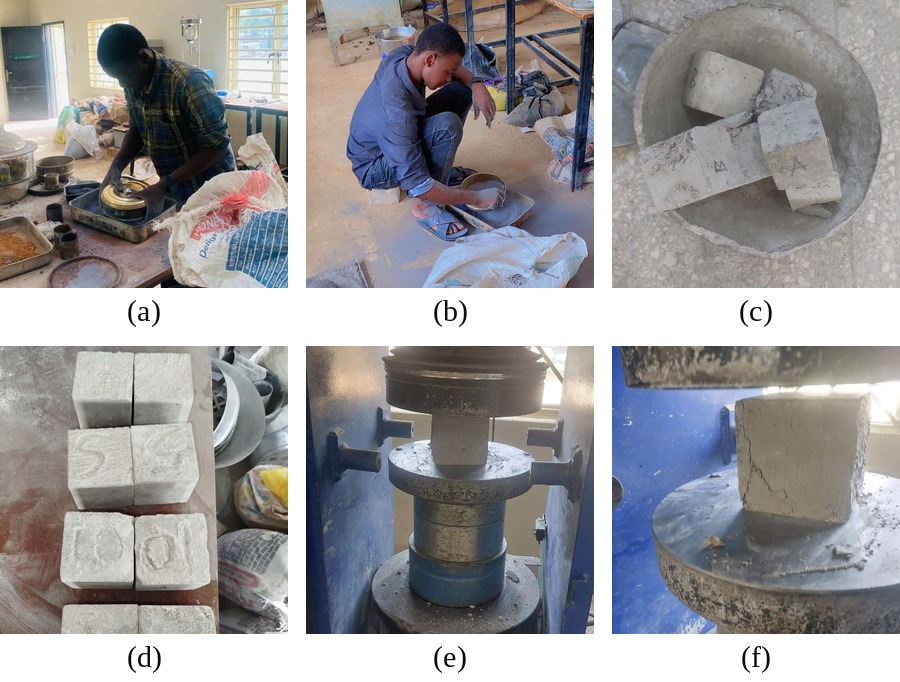
Ordinary Portland Cement (CEM I 42.5N) conforming to BS EN 197-1 [17] was obtained from a single batch from a supplier in Bauchi State, Nigeria. Rice husks were collected from a rice mill in Bauchi State, cleaned, sun-dried and calcined in a muffle furnace at 600 °C for 4 h; the ash was cooled and passed through a 75 µm sieve. Palm kernel shells from an oil-palm processing plant in Bauchi State were washed with detergent and water, sun-dried and incinerated at 350–750 °C; the ash was cooled, ground and passed through the same sieve (Figure 1a, b). The fine aggregate, sourced from Sabon Kaura, Bauchi State, was passed through a 4.75 mm sieve in accordance with BS 1377-2 [18]. Crushed granite with a nominal maximum size of 20 mm, graded in accordance with BS 812-103.1 [19], was used as coarse aggregate. Potable water from the mains supply of Abubakar Tafawa Balewa University (ATBU), Bauchi, was used for mixing and curing.
3.2Mix proportions
Five mixes were prepared (Table 1). The control mix (M1) contained OPC only. In mixes M2–M5, 2% of the cement by mass was replaced by PKSA and a further 5%, 10%, 15% or 20% by RHA, giving total replacement levels of 7–22%. A nominal mix proportion of 1:2:4 (binder : sand : granite) with a water–binder ratio of 0.50 was used for all mixes, targeting a characteristic 28-day compressive strength of 25 N/mm² (C25).
| Mix | OPC (%) | RHA (%) | PKSA (%) | Total replacement (%) |
|---|---|---|---|---|
| M1 (control) | 100 | 0 | 0 | 0 |
| M2 | 93 | 5 | 2 | 7 |
| M3 | 88 | 10 | 2 | 12 |
| M4 | 83 | 15 | 2 | 17 |
| M5 | 78 | 20 | 2 | 22 |
3.3Specimen preparation and curing
Steel cube moulds of 100 mm × 100 mm × 100 mm were cleaned, oiled and assembled before casting. The constituents were weighed on a calibrated electronic balance and mixed, and the slump of each fresh batch was measured before casting. The concrete was placed in three layers, each compacted with 25 strokes of a tamping rod, in accordance with BS EN 12390-2 [20]. The specimens were left undisturbed at room temperature for 24 h, demoulded (Figure 1c), marked (Figure 1d) and cured by full immersion in water at ambient temperature until testing. Two cubes were cast for each mix and curing age, giving 30 cubes in total (5 mixes × 3 ages × 2 cubes).
3.4Test methods
Workability was measured by the slump test immediately after mixing, in accordance with BS EN 12350-2 [21]. At 7, 14 and 28 days, the cubes were removed from the curing tank, surface-dried, weighed and tested in a hydraulic compression machine calibrated in accordance with BS EN 12390-4 [22] (Figure 1e). Load was applied at a constant rate of 0.6 ± 0.2 MPa/s until failure (Figure 1f), following BS EN 12390-3 [23]. The compressive strength was calculated as
where F is the maximum load at failure (N) and A is the loaded cross-sectional area of the cube (mm²). Density was obtained from the measured mass and volume of each cube before testing. The result for each mix and age is the mean of two cubes. As a quality-control check, the deviation of the individual results from the pair mean was expressed as a percentage of the mean, and pairs deviating by more than 10% were flagged.
3.5Data analysis
The mean strength and the percentage deviation of each pair of cubes were calculated for each mix and curing age. One-way analysis of variance (ANOVA) was used to test the effect of mix composition on compressive strength at each curing age, and a two-way ANOVA (mix × curing age) was applied to all 30 cube results, at a significance level of 0.05. Tukey’s honestly significant difference (HSD) test was used for pairwise comparisons between mixes at 28 days.
4Results and discussion
4.1Workability
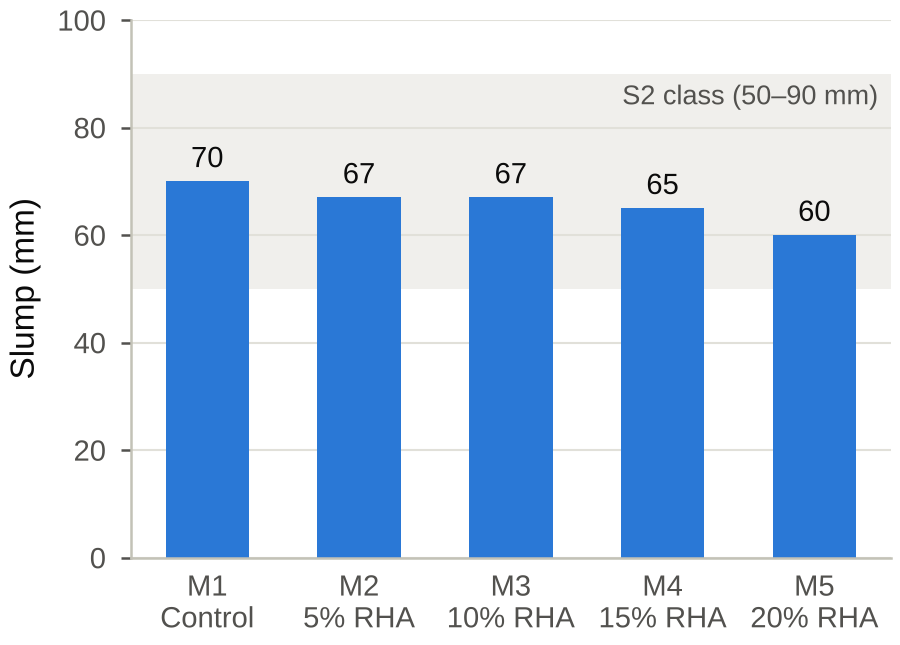
All mixes exhibited a true slump. The slump decreased progressively from 70 mm for the control to 60 mm at 20% RHA, a reduction of 14.3% (Table 2 and Figure 2). All mixes nevertheless remained within the S2 consistence class (50–90 mm) of BS EN 206 [24], so workability was adequate for normal placing and compaction throughout the range studied. The reduction is consistent with the higher water demand of RHA reported by Philips et al. [4] and Oriola et al. [2], who attributed it to the fineness, porous cellular structure and large surface area of the ash. Because the PKSA content was the same (2%) in all blended mixes, the progressive decline from M2 to M5 can be attributed mainly to the increasing RHA content. The loss of slump was small compared with that reported when PKS replaces coarse aggregate [1], [2], because only a small fraction of the binder was replaced. The opposite trend reported by Miah et al. [14] suggests that the effect of RHA on workability depends on the characteristics of the ash and the mix composition.
| Mix | RHA (%) | PKSA (%) | Slump (mm) | Change vs control (%) | Class (BS EN 206) |
|---|---|---|---|---|---|
| M1 | 0 | 0 | 70 | – | S2 |
| M2 | 5 | 2 | 67 | −4.3 | S2 |
| M3 | 10 | 2 | 67 | −4.3 | S2 |
| M4 | 15 | 2 | 65 | −7.1 | S2 |
| M5 | 20 | 2 | 60 | −14.3 | S2 |
4.2Compressive strength
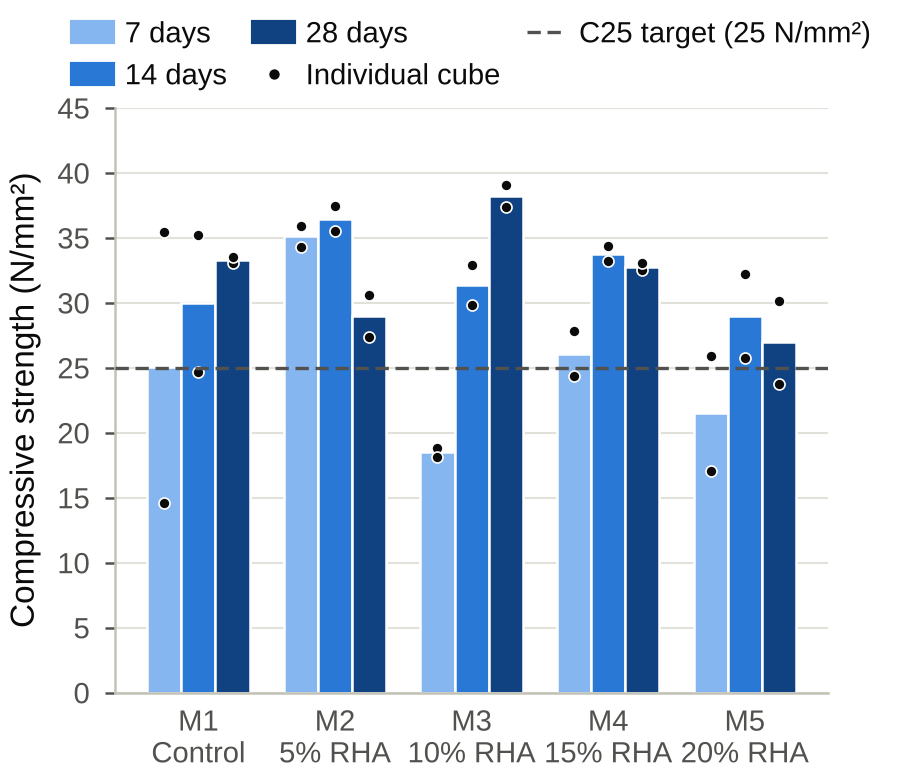
The individual cube results are given in Table 3; the mean strengths are summarised in Table 4 and compared in Figure 3.
| Age (d) | Mix | Compressive strength (N/mm²) | Dev. (%) | ||
|---|---|---|---|---|---|
| Cube A | Cube B | Mean | |||
| 7 | M1 | 14.56 | 35.48 | 25.02 | 41.8* |
| M2 | 35.94 | 34.33 | 35.14 | 2.3 | |
| M3 | 18.84 | 18.13 | 18.49 | 1.9 | |
| M4 | 27.83 | 24.35 | 26.09 | 6.7 | |
| M5 | 25.94 | 17.07 | 21.51 | 20.6* | |
| 14 | M1 | 35.25 | 24.66 | 29.96 | 17.7* |
| M2 | 35.56 | 37.41 | 36.49 | 2.5 | |
| M3 | 32.91 | 29.83 | 31.37 | 4.9 | |
| M4 | 33.21 | 34.36 | 33.79 | 1.7 | |
| M5 | 32.23 | 25.77 | 29.00 | 11.1* | |
| 28 | M1 | 33.04 | 33.55 | 33.30 | 0.8 |
| M2 | 30.59 | 27.40 | 28.99 | 5.5 | |
| M3 | 39.08 | 37.36 | 38.22 | 2.3 | |
| M4 | 32.53 | 33.05 | 32.79 | 0.8 | |
| M5 | 23.77 | 30.12 | 26.95 | 11.8* | |
* Deviation from the pair mean exceeds the 10% quality-control limit.
Agreement between paired cubes was good for most mixes but poorer for the control and M5 at early ages: the deviation exceeded 10% for M1 at 7 days (41.8%) and 14 days (17.7%) and for M5 at all three ages (20.6%, 11.1% and 11.8%). The very low 7-day result for cube A of the control (14.56 N/mm², against 35.48 N/mm² for cube B) was not repeated at later ages and is attributed to a defective specimen, most probably caused by incomplete compaction or a hidden crack introduced during casting or handling. The result was retained and flagged rather than discarded, but it lowers the 7-day mean of the control considerably. At 28 days, agreement improved markedly, with deviations below 1% for M1 and M4 and below 6% for M2 and M3. This suggests that early-age results were more sensitive to minor inconsistencies in compaction and curing, whose influence diminished as hydration and pozzolanic reactions progressed.
| Mix | Mean strength (N/mm²) | Change vs control at 28 d (%) | Gain from 7 to 28 d (%) | ||
|---|---|---|---|---|---|
| 7 d | 14 d | 28 d | |||
| M1 | 25.02 | 29.96 | 33.30 | – | 33.1 |
| M2 | 35.14 | 36.49 | 28.99 | −12.9 | −17.5 |
| M3 | 18.49 | 31.37 | 38.22 | +14.8 | 106.7 |
| M4 | 26.09 | 33.79 | 32.79 | −1.5 | 25.7 |
| M5 | 21.51 | 29.00 | 26.95 | −19.1 | 25.3 |
4.3Effect of curing age
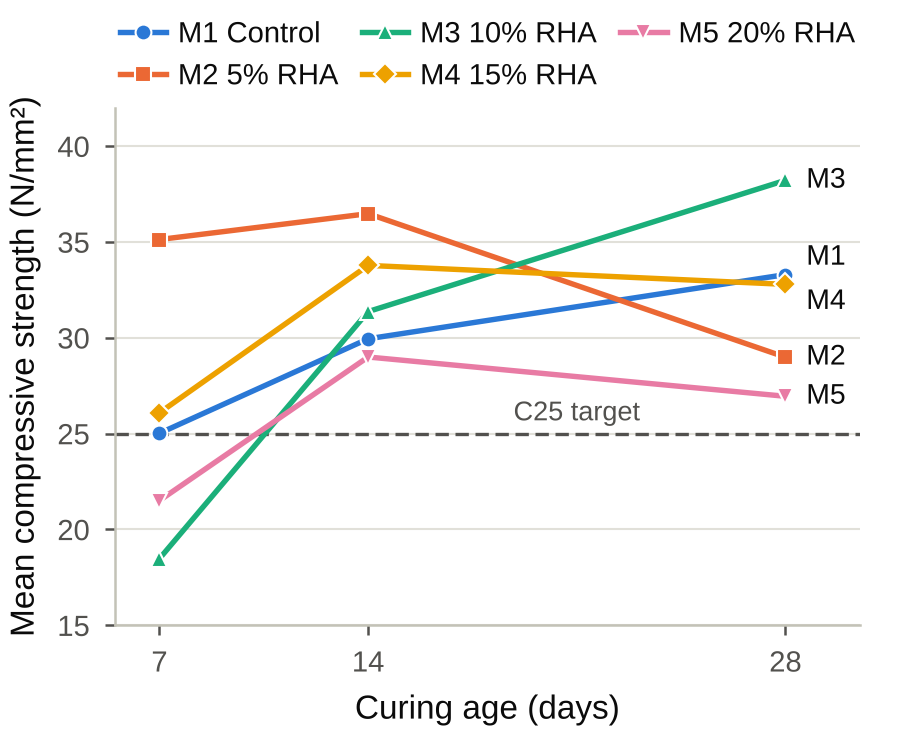
Strength increased in all mixes between 7 and 14 days (Table 4 and Figure 4), and the two-way ANOVA confirmed that curing age had a significant effect (Table 5). Only M1 and M3 continued to gain strength up to 28 days, consistent with continued cement hydration and, in the blended mix, ongoing pozzolanic reaction between the amorphous silica of the ashes and calcium hydroxide. M3 showed by far the largest gain, from 18.49 N/mm² at 7 days to 38.22 N/mm² at 28 days (106.7%), compared with 33.1% for the control. This slow early and strong later development agrees with the observation of Oriola et al. [2] that the pozzolanic contribution of RHA becomes increasingly important with age, because the reaction of its silica with calcium hydroxide proceeds more slowly than the primary hydration of cement.
M4 and M5 reached their highest strengths at 14 days and then decreased by 3.0% and 7.1%, respectively, by 28 days, while M2 decreased from 36.49 N/mm² at 14 days to 28.99 N/mm² at 28 days (20.6%). A genuine loss of strength under continuous water curing is not expected from the hydration and pozzolanic mechanisms described above. These reversals are therefore attributed to specimen-to-specimen variability associated with the small sample size of two cubes per mix and age.
4.4Effect of RHA content and optimum replacement level
At 28 days, the standard age for characteristic strength, strength did not vary monotonically with RHA content (Table 4). It increased from the control to a peak at 10% RHA (M3, 38.22 N/mm²) and then fell at 15% RHA (32.79 N/mm²) and 20% RHA (26.95 N/mm²), giving the order M3 > M1 > M4 > M2 > M5. This indicates that, at 2% PKSA, RHA contributes positively to strength up to about 10% replacement, beyond which the dilution of cement outweighs the additional pozzolanic contribution. A similar optimum followed by a marked decline was reported by Manap et al. [3], who attributed it to increased porosity and weaker paste–aggregate bonding. The low 28-day strength of M2 relative to M4 departs from this simple trend and is attributed to the specimen variability discussed above rather than to a genuine effect of RHA at low replacement levels.
All five mixes exceeded the 25 N/mm² C25 target at 28 days, including M5 (26.95 N/mm²), confirming that up to 20% RHA combined with 2% PKSA (22% total replacement) can be used for concrete of this grade. M3 is identified as the optimum mix among those tested: its mean 28-day strength was 14.8% higher than that of the control and 52.9% above the target strength.
4.5Statistical analysis
The ANOVA results are summarised in Table 5. Mix composition had no significant effect on strength at 7 or 14 days, largely because of the high within-pair scatter at early ages, but it had a significant effect at 28 days (p = 0.028). Tukey’s HSD test at 28 days showed that M3 was significantly stronger than M5 (p = 0.024) and marginally stronger than M2 (p = 0.052), whereas the difference between M3 and the control was not significant at the 0.05 level (p = 0.337). The 14.8% improvement of M3 over the control is therefore indicative and should be confirmed with a larger number of specimens. In the two-way analysis, curing age was significant (p = 0.011), whereas the main effect of mix and the mix × age interaction were not.
| Analysis | Source | F (df) | p | Significant (p < 0.05) |
|---|---|---|---|---|
| One-way, 7 d | Mix | 1.49 (4, 5) | 0.332 | No |
| One-way, 14 d | Mix | 1.10 (4, 5) | 0.450 | No |
| One-way, 28 d | Mix | 7.00 (4, 5) | 0.028 | Yes |
| Two-way | Mix | 1.87 (4, 15) | 0.168 | No |
| Two-way | Age | 6.20 (2, 15) | 0.011 | Yes |
| Two-way | Mix × age | 1.76 (8, 15) | 0.165 | No |
4.6Density
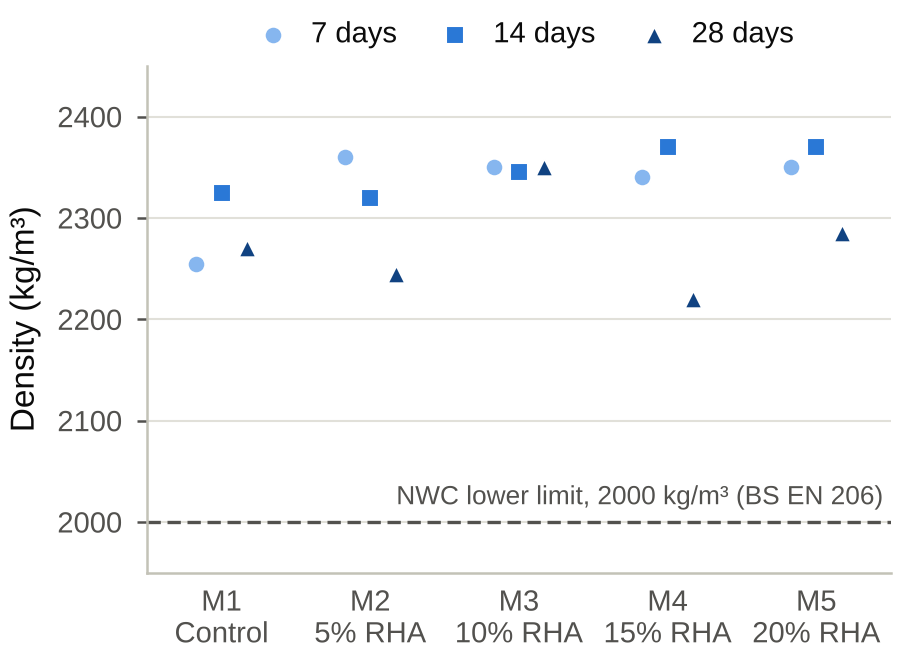
All densities lay between 2220 and 2370 kg/m³ (Table 6 and Figure 5), above the 2000 kg/m³ lower limit for normal-weight concrete in BS EN 206 [24]. Unlike concretes in which raw PKS replaces the coarse aggregate, which are semi-lightweight (1501–2262 kg/m³) [1], the use of RHA and PKSA as ashes replacing a small part of the binder did not compromise the normal-weight classification. The differences between mixes and ages show no consistent trend and are attributed mainly to variability in compaction; the lower specific gravity of the ashes relative to cement would be expected to reduce density only slightly at the replacement levels used. The optimum mix, M3, recorded the highest and most uniform density (2345–2350 kg/m³), consistent with a well-compacted, dense matrix.
| Mix | 7 d | 14 d | 28 d | Mean |
|---|---|---|---|---|
| M1 | 2255 | 2325 | 2270 | 2283 |
| M2 | 2360 | 2320 | 2245 | 2308 |
| M3 | 2350 | 2345 | 2350 | 2348 |
| M4 | 2340 | 2370 | 2220 | 2310 |
| M5 | 2350 | 2370 | 2285 | 2335 |
4.7Comparison with previous studies
Table 7 compares the present results with related studies. The optimum of 10% RHA agrees with Manap et al. [3] and Hasan et al. [9], who also found 10% RHA most favourable despite different mix designs. The 28-day strength of M3 (38.22 N/mm²) is considerably higher than the 22.05 MPa reported by Manap et al. [3] and the values reported by Philips et al. [4], whose best combination of 25% PKS and 15% RHA exceeded the 17 MPa minimum for structural concrete given in ACI 116R [25]. The difference arises mainly because those studies replaced part of the coarse aggregate with PKS, whereas the present study used PKSA only as a binder component and retained granite as the coarse aggregate. Similarly, Oriola et al. [2] found that only mixes with up to 40% PKS (1:1½:3) or 20% PKS (1:2:4) satisfied the 17 N/mm² minimum of ASTM C330 [15]. The much lower strength obtained by Asuzu et al. [1] with raw PKS and rice husk underlines the importance of ashing: unburnt husk lacks the amorphous silica responsible for pozzolanic reactivity, and its use as an aggregate substitute gives far lower strength than its use as ash.
Overall, the results confirm that RHA and PKSA used in ash form are viable partial cement replacements, that RHA reduces workability, and that an optimum replacement level exists beyond which the dilution effect of reduced cement content outweighs the pozzolanic benefit.
| Study | Use of RHA and PKS | Best mix | 28-day result |
|---|---|---|---|
| Present study | RHA + PKSA as cement replacement | 10% RHA + 2% PKSA | 38.22 N/mm² (+14.8% vs control) |
| Manap et al. [3] | RHA (cement) + PKS (aggregate) | 10% RHA + 5% PKS | 22.05 MPa |
| Philips et al. [4] | RHA (cement) + PKS (aggregate) | 15% RHA + 25% PKS | > 17 MPa |
| Oriola et al. [2] | 15% RHA (cement) + PKS (aggregate) | ≤ 20% PKS (1:2:4 mix) | ≥ 17 N/mm² |
| Asuzu et al. [1] | Raw PKS + rice husk (aggregate) | 75% PKS + 25% husk | 9.18 N/mm² (control 17.33) |
| Hasan et al. [9] | RHA (cement), high-strength concrete | 10% RHA | +7.16% vs control |
5Conclusion
The following conclusions are drawn from this study of concrete containing 0–20% RHA with a constant 2% PKSA as partial cement replacement:
- 1. Slump decreased progressively from 70 mm for the control to 60 mm at 20% RHA (−14.3%), but all mixes remained within the S2 consistence class, so workability was adequate for normal placing and compaction.
- 2. All mixes exceeded the 25 N/mm² C25 target at 28 days, showing that up to 20% RHA with 2% PKSA (22% total replacement) can be used for C25 concrete.
- 3. The 28-day strength peaked at 10% RHA and declined at 15% and 20% RHA. The mix with 10% RHA and 2% PKSA (M3) gave the highest mean strength of 38.22 N/mm², 14.8% above the control and 52.9% above the target, and is the optimum among the levels studied.
- 4. M3 showed the largest strength gain between 7 and 28 days (106.7%), consistent with the slow pozzolanic reaction of RHA.
- 5. Mix composition had a significant effect on 28-day strength (p = 0.028), but the improvement of M3 over the control was not statistically significant with two cubes per age and requires confirmation with larger samples.
- 6. All mixes had densities of 2220–2370 kg/m³ and qualify as normal-weight concrete.
These findings support the use of RHA and PKSA as partial cement replacements to reduce cement consumption and agricultural waste in Nigerian construction.
6Recommendations and limitations
- 1. A blend of 10% RHA and 2% PKSA is recommended where the highest strength is required; RHA contents above 10% should then be avoided, although up to 20% RHA may be used for C25 concrete.
- 2. Mixes with up to 20% RHA can be placed without workability-enhancing admixtures where S2 consistence is acceptable; a superplasticiser may be considered where higher workability is needed at RHA contents above 10%.
- 3. Further work should use at least three specimens per mix and age, extend testing to 56 and 90 days, characterise the ashes by XRF, XRD and SEM, vary the PKSA content, and evaluate flexural and splitting tensile strength and durability (water absorption, sulfate and chloride resistance).
The main limitations of this study were the small sample size of two cubes per mix and age, the maximum curing age of 28 days, the absence of direct chemical and mineralogical characterisation of the ashes used, and the absence of durability tests.
Acknowledgments
The authors thank the Head and staff of the Department of Civil Engineering and the Faculty of Engineering, Nigerian Army University Biu, for academic support and facilities; the laboratory staff and technicians of Abubakar Tafawa Balewa University (ATBU), Bauchi, for their assistance with casting and compression testing; and Mele Justice for technical assistance.
References
- [1]Asuzu CC, Chukwuezie OC, Ehumadu CN, Ufomba CJ. Investigation of the strength and workability of composite material (palm kernel shells and rice husks) as substitute to granite in concrete. ISA J Eng Technol. 2026;3(1):121–127. https://doi.org/10.5281/zenodo.18761680
- [2]Oriola KO, Raheem AA, Kareem MA, Abdulwahab R. Assessment of workability and compressive strength of rice husk ash-blended palm kernel shell concrete. LAUTECH J Civil Environ Stud. 2021;7(1):100–115. https://doi.org/10.36108/laujoces/1202.70.0101
- [3]Manap N, Azman NAN, Alshehhi FAST, Albastaki AAMA, Jingzhi C. Strength and microstructure of lightweight concrete with palm kernel shell and rice husk ash substitutions: A technological conciliation for facilities management. IOP Conf Ser Earth Environ Sci. 2025;1548(1):012020. https://doi.org/10.1088/1755-1315/1548/1/012020
- [4]Philips ES, Mutuku RN, Mwero JN. Effects of palm kernel shell and rice husk ash as partial replacements of normal weight aggregate and ordinary Portland cement in concrete. Eur Int J Sci Technol. 2017;6(8):42–54.
- [5]Paul SC, Mbewe PBK, Kong SY, Šavija B. Agricultural solid waste as source of supplementary cementitious materials in developing countries. Materials. 2019;12(7):1112. https://doi.org/10.3390/ma12071112
- [6]Barbhuiya S, Das BB, Adak D, Rajput A, Katare V. Rice husk ash in structural concrete: Influence on strength, durability and sustainability. Discover Concrete Cement. 2025;1:14. https://doi.org/10.1007/s44416-025-00013-9
- [7]Bheel N, Abro AW, Shar IL, Dayo AA, Shaikh S, Shaikh ZH. Use of rice husk ash as cementitious material in concrete. Eng Technol Appl Sci Res. 2019;9(3):4209–4212. https://doi.org/10.48084/etasr.2746
- [8]Fapohunda C, Akinbile B, Shittu A. Structure and properties of mortar and concrete with rice husk ash as partial replacement of ordinary Portland cement – A review. Int J Sustain Built Environ. 2017;6(2):675–692. https://doi.org/10.1016/j.ijsbe.2017.07.004
- [9]Hasan NMS, et al. Integration of rice husk ash as supplementary cementitious material in the production of sustainable high-strength concrete. Materials. 2022;15(22):8171. https://doi.org/10.3390/ma15228171
- [10]ASTM International. ASTM C618-23 Standard specification for coal ash and raw or calcined natural pozzolan for use in concrete. West Conshohocken: ASTM International; 2023.
- [11]Li C, Mei X, Dias D, Cui Z, Zhou J. Compressive strength prediction of rice husk ash concrete using a hybrid artificial neural network model. Materials. 2023;16(8):3135. https://doi.org/10.3390/ma16083135
- [12]Ismail MH, Megat Johari MA, Ariffin KS, Jaya RP, Wan Ibrahim MH, Yugashini Y. Performance of high strength concrete containing palm oil fuel ash and metakaolin as cement replacement material. Adv Civil Eng. 2022;2022:6454789. https://doi.org/10.1155/2022/6454789
- [13]Kilani AJ, Ikotun BD, Abdulwahab R. A holistic review on the structural performance of concrete incorporating palm kernell and coconut shells: An approach to waste management and production of sustainable green composite. Discover Appl Sci. 2026;8:205. https://doi.org/10.1007/s42452-025-07988-x
- [14]Miah MJ, Miah MS, Mughal H, Hasan NMS. Mitigating environmental impact through the use of rice husk ash in sustainable concrete: Experimental study, numerical modelling, and optimisation. Materials. 2025;18(14):3298. https://doi.org/10.3390/ma18143298
- [15]ASTM International. ASTM C330/C330M-23 Standard specification for lightweight aggregates for structural concrete. West Conshohocken: ASTM International; 2023.
- [16]Babatola O. Influence of selected curing techniques on compressive strength of concrete from palm kernel shell ash and ordinary Portland cement. J Archit Environ Struct Eng Res. 2021;4(3):1–8. https://doi.org/10.30564/jaeser.v4i3.3315
- [17]British Standards Institution. BS EN 197-1:2011 Cement – Part 1: Composition, specifications and conformity criteria for common cements. London: BSI; 2011.
- [18]British Standards Institution. BS 1377-2:1990 Methods of test for soils for civil engineering purposes – Part 2: Classification tests. London: BSI; 1990.
- [19]British Standards Institution. BS 812-103.1:1985 Testing aggregates – Part 103: Methods for determination of particle size distribution – Section 103.1: Sieve tests. London: BSI; 1985.
- [20]British Standards Institution. BS EN 12390-2:2019 Testing hardened concrete – Part 2: Making and curing specimens for strength tests. London: BSI; 2019.
- [21]British Standards Institution. BS EN 12350-2:2019 Testing fresh concrete – Part 2: Slump test. London: BSI; 2019.
- [22]British Standards Institution. BS EN 12390-4:2019 Testing hardened concrete – Part 4: Compressive strength – Specification for testing machines. London: BSI; 2019.
- [23]British Standards Institution. BS EN 12390-3:2019 Testing hardened concrete – Part 3: Compressive strength of test specimens. London: BSI; 2019.
- [24]British Standards Institution. BS EN 206:2013+A2:2021 Concrete – Specification, performance, production and conformity. London: BSI; 2021.
- [25]American Concrete Institute. ACI 116R-00 Cement and concrete terminology. Farmington Hills: ACI; 2000.