Industrial and Production Engineering
Green Manufacturing Adoption and Sustainable Production Framework for Nigerian Industry
Department of Mechanical Engineering, Federal University of Technology Owerri, Owerri, Imo State, Nigeria
Published October 2026
Abstract
Green manufacturing is increasingly important to industrial competitiveness, environmental protection, and sustainable development in emerging economies. This article reports a mixed-methods assessment of green manufacturing adoption in six Nigerian manufacturing firms and proposes an integrated sustainable production framework for wider industry application. The study drew on 108 valid questionnaire responses from technical manufacturing personnel and six semi-structured interviews with senior managers across food and beverages, metals and engineering, chemicals and pharmaceuticals, building materials, plastics and packaging, and textiles and apparel. The findings show that awareness is higher than implementation: 74.1% of respondents were at least moderately familiar with green manufacturing, while only 5.6% reported full implementation. Material-use optimization, preventive maintenance, hazardous-waste disposal, and emissions monitoring were the most established practices. Renewable-energy use and energy-conservation training were the least implemented. Cost-reduction opportunity was the strongest adoption driver, followed by management commitment, government regulation, and employee health and safety. The most severe implementation constraints were high initial investment costs, limited financial resources, and inadequate technical expertise. Reported outcomes indicate that green manufacturing has generated positive environmental, social, and economic benefits, especially reduced waste generation, improved worker health and safety, improved corporate reputation, and lower operating costs. Building on these findings, the article advances a six-stage framework that integrates Life Cycle Assessment, Environmental Management Systems, cleaner production, circular-economy practices, enabling finance and skills, and continuous performance monitoring. The framework is designed for phased implementation in Nigeria’s infrastructure- and capital-constrained manufacturing environment.
Keywords: green manufacturing; sustainable production; Nigeria; cleaner production; circular economy; life cycle assessment; environmental management systems; resource efficiency; industrial sustainability; sustainable development
1Introduction
Manufacturing is indispensable to employment creation, technological advancement, and national economic development. However, conventional production systems are also associated with high material and energy consumption, emissions, process waste, hazardous effluents, and resource depletion. Green manufacturing provides an alternative industrial approach that seeks to reduce these impacts while protecting productivity, quality, profitability, and worker welfare (Abualfaraa et al., 2020; Khalfallah and Leitão, 2024; Polo et al., 2025).
Green manufacturing extends beyond pollution control. It involves integrating environmental considerations throughout product design, material sourcing, production, maintenance, distribution, recovery, and end-of-life management. This orientation is consistent with the principles of cleaner production, resource efficiency, Environmental Management Systems (EMS), Life Cycle Assessment (LCA), and circular economy practices. Firms that integrate these principles can reduce waste, improve process efficiency, strengthen compliance, and build long-term industrial resilience (Chen and Rojniruttikul, 2025; Setyadi et al., 2025; Zhang et al., 2024).
Nigeria’s manufacturing sector is strategically positioned to support industrial diversification and employment but faces persistent challenges related to unreliable energy supply, aging machinery, financial constraints, weak access to clean technologies, limited technical capacity, and fragmented environmental-management practices. Although Nigeria’s Energy Transition Plan establishes a national net-zero ambition toward 2060, industrial implementation requires practical frameworks that translate policy commitments into plant-level action (Energy Transition Office, 2022; Manufacturers Association of Nigeria [MAN], 2023).
Existing evidence in Nigeria indicates growing awareness of sustainability and green practices, but adoption remains uneven across firms and subsectors (Mohammed, 2025; Nwamekwe et al., 2025; Oke et al., 2025). The challenge is not merely awareness; it is the absence of a context-sensitive implementation pathway that combines environmental assessment, management systems, cleaner technology, circular resource flows, financing, skills, and monitoring.
This article is derived from Usak’s (2026) thesis, Integration of Green Manufacturing Principles for Sustainable Production System in Nigerian Manufacturing Industries. It presents the empirical findings in publication format and develops an operational framework for Nigerian industry. The article has four objectives:
- 1. To assess the level of green manufacturing awareness and adoption among selected Nigerian manufacturing firms.
- 2. To identify key drivers and barriers influencing adoption.
- 3. To examine reported environmental, economic, and social outcomes.
- 4. To propose an integrated sustainable production framework suitable for phased implementation in Nigerian industry.
The study contributes to the literature by providing empirical evidence from six manufacturing subsectors and by translating the findings into a practical framework based on LCA, EMS, circular economy, cleaner production, skills development, finance, and performance monitoring.
2Methodology
2.1Research design
The study adopted a sequential explanatory mixed-methods design, combining a structured quantitative survey with qualitative interviews of senior manufacturing managers. Mixed-methods research is appropriate where numerical patterns require contextual explanation from organizational decision-makers and operational experience (Creswell and Plano Clark, 2018).
The quantitative component measured green manufacturing awareness, policy status, implementation practices, adoption drivers, implementation barriers, sustainability outcomes, future intentions, and required support mechanisms. The qualitative component provided managerial perspectives on institutional readiness, investment constraints, energy challenges, operational practices, and the conditions needed for scale-up.
2.2Study population and scope
The study focused on six manufacturing subsectors with substantial resource use and environmental relevance:
- 1. Food and beverages
- 2. Metals and engineering
- 3. Chemicals and pharmaceuticals
- 4. Building materials
- 5. Plastics and packaging
- 6. Textiles and apparel
Six formally registered manufacturing firms were selected, representing the six subsectors. The survey targeted technical employees involved in production, operations, quality assurance, maintenance, and environmental or sustainability functions.
A total of 120 questionnaires were administered, and 108 valid questionnaires were returned, producing a 90.0% response rate. In addition, all six planned senior-manager interviews were completed, yielding a 100% qualitative response rate.
2.3Sampling procedure
A multistage sampling approach was used. At the institutional level, firms were purposively selected based on operational history, formal registration, workforce size, sectoral representation, and willingness to participate. Within firms, respondents were selected from production, operations, quality, maintenance, and environmental-management functions.
The sample-design logic was informed by Yamane’s (1967) sample-size principles and stratified respondent selection to ensure that participants possessed relevant knowledge of production systems, resource use, maintenance, waste management, and sustainability activities.
2.4Data collection instrument
The questionnaire used a five-point Likert scale:
| Scale | Interpretation |
|---|---|
| 1 | Very low / strongly disagree / never |
| 2 | Low / disagree / rarely |
| 3 | Moderate / neutral / sometimes |
| 4 | High / agree / often |
| 5 | Very high / strongly agree / always |
The instrument covered four implementation domains:
| Domain | Key indicators |
|---|---|
| Resource efficiency | Material-use optimization, water conservation, recycling, process optimization |
| Waste minimization | Waste reduction, recycling, hazardous-waste disposal, lean practices |
| Energy optimization | Efficient equipment, energy monitoring, renewable energy, conservation training |
| Pollution prevention | Environmental materials, cleaner technologies, emission monitoring, preventive maintenance |
The questionnaire was reviewed by academic and industrial experts. Pilot testing and internal-consistency procedures were applied before full deployment. Reliability evaluation was guided by Cronbach’s alpha standards, with α ≥ .70 considered acceptable for multi-item measures (Cronbach, 1951; Hair et al., 2019).
2.5Data analysis
Quantitative data were analyzed using descriptive statistics, including frequencies, percentages, and mean scores. The study also used ranking logic to compare drivers, barriers, and implementation practices. Qualitative interviews were transcribed, coded, and analyzed thematically in line with Braun and Clarke’s (2006) thematic-analysis approach.
The study used the following conceptual pillars:
- ISO 14040/14044 Life Cycle Assessment for environmental hotspot identification;
- ISO 14001 Environmental Management Systems for governance, documentation, and continuous improvement;
- Circular economy principles for recycling, recovery, reverse logistics, and waste minimization; and
- Triple Bottom Line performance for environmental, economic, and social outcomes (ISO, 2006a, 2006b, 2015; Jali et al., 2025).
3Results and discussion
3.1Response rate and firm characteristics
The 90.0% survey response rate indicates strong participation by the selected firms. The complete participation of senior managers also strengthened the qualitative component by ensuring that strategic views on sustainability investment, technology adoption, and operational constraints were represented.
The largest proportion of respondents came from food and beverages firms (34.3%), followed by metals and engineering (22.2%) and chemicals and pharmaceuticals (18.5%). Building materials, plastics and packaging, and textiles and apparel accounted for 12.0%, 8.3%, and 4.6%, respectively.
Most respondents worked in medium- and large-sized companies. Firms with 101–250 employees represented 38.9% of the sample, while firms with 251–500 employees represented 25.9%. More than half of the surveyed firms had been in operation for over 20 years, suggesting that the study largely captured established companies with substantial production experience and legacy operating systems.
3.2Green manufacturing awareness, policy and implementation gap
The study identified a substantial awareness-to-implementation gap. A total of 74.1% of respondents were familiar, very familiar, or moderately familiar with green manufacturing principles. However, only 5.6% reported that green manufacturing practices were fully implemented within their companies.
| Indicator | Category | Frequency | Percentage |
|---|---|---|---|
| Environmental policy | Formal written policy | 50 | 46.3 |
| Informal guidelines | 32 | 29.6 | |
| Under development | 18 | 16.7 | |
| No policy | 8 | 7.4 | |
| Green manufacturing implementation | Fully implemented | 6 | 5.6 |
| Partially implemented | 32 | 29.6 | |
| Beginning implementation | 28 | 25.9 | |
| Planning to implement | 26 | 24.1 | |
| No implementation | 16 | 14.8 |
Note. Adapted from Usak (2026).
The result demonstrates that many organizations have developed environmental policies or informal sustainability guidelines, yet these commitments have not consistently translated into comprehensive shop-floor implementation. Similar gaps between sustainability intention and operational execution have been reported in developing-country manufacturing contexts, where investment risk, weak infrastructure, and constrained technical capacity slow the transition from policy to practice (Kato and Manchidi, 2025; Liang et al., 2023; Zhang and Li, 2025).
3.3Implementation of green manufacturing practices
Preventive maintenance to avoid spills and leaks had the highest mean score (M = 3.83), followed by proper hazardous-waste disposal (M = 3.76), material-use optimization (M = 3.65), and regular emissions monitoring (M = 3.57). The lowest-scoring practices were renewable-energy use (M = 2.65), energy-conservation training (M = 2.89), and cleaner-production technologies (M = 3.00).
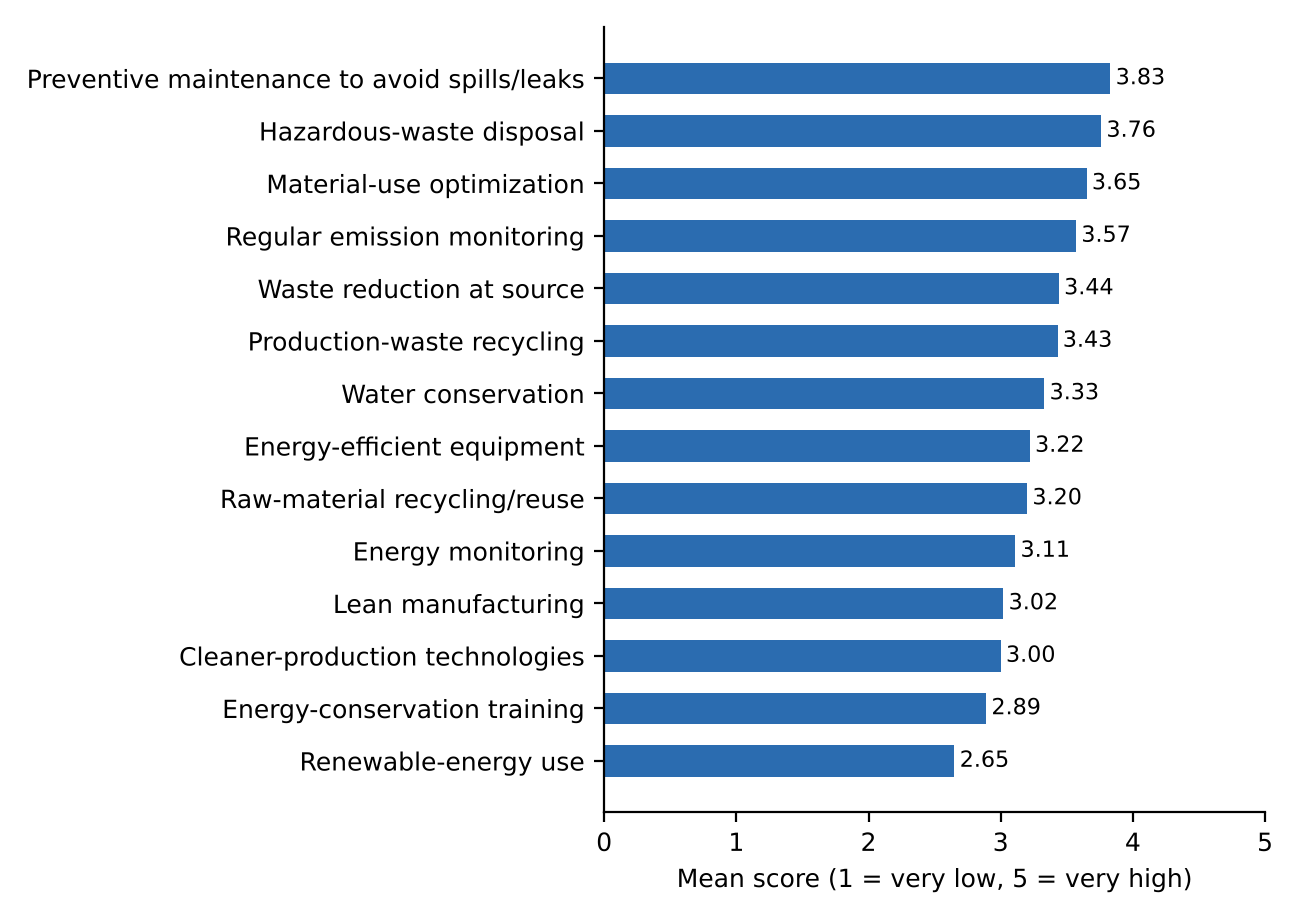
The results indicate that Nigerian firms tend to prioritize practices with immediate operational relevance and relatively low capital requirements. Preventive maintenance, material optimization, waste reduction, and emissions monitoring can often be implemented through better procedures, supervision, housekeeping, and incremental equipment improvement. In contrast, renewable-energy systems and cleaner production technologies require larger capital investments, technical expertise, supplier access, and more reliable infrastructure.
This pattern is consistent with research showing that lean-green approaches often begin with operational efficiency and waste reduction before progressing to capital-intensive decarbonization technologies (Abualfaraa et al., 2020; Elemure et al., 2023; Khalfallah and Leitão, 2024).
3.4Drivers of green manufacturing adoption
The highest-ranked driver was cost-reduction opportunity (M = 4.20), followed by management commitment (M = 4.07), government regulations (M = 4.05), and employee health and safety (M = 4.04). Competitive advantage (M = 3.56) and customer requirements (M = 3.67) were comparatively less influential.
| Rank | Driver | Mean score |
|---|---|---|
| 1 | Cost-reduction opportunities | 4.20 |
| 2 | Management commitment | 4.07 |
| 3 | Government regulations | 4.05 |
| 4 | Employee health and safety | 4.04 |
| 5 | Corporate social responsibility | 3.91 |
| 6 | Brand-reputation enhancement | 3.81 |
| 7 | Customer requirements | 3.67 |
| 8 | Competitive advantage | 3.56 |
Note. Scale: 1 = not important; 5 = very important. Adapted from Usak (2026).
The dominance of cost reduction as a driver suggests that green manufacturing should be communicated to Nigerian firms as a resource-efficiency and operational-improvement strategy, rather than only as an environmental obligation. This does not diminish environmental responsibility; rather, it recognizes that investment decisions in resource-constrained settings are strongly influenced by measurable financial outcomes.
Management commitment is equally critical because green transformation requires changes in procurement, maintenance, production planning, employee training, environmental reporting, and investment allocation. Prior research supports the role of leadership commitment and green orientation in translating sustainability initiatives into improved organizational performance (Chen and Rojniruttikul, 2025; Kouser et al., 2025).
3.5Barriers to green manufacturing adoption
High initial investment cost was the most serious barrier (M = 4.09), followed by limited financial resources (M = 3.96), lack of technical expertise (M = 3.94), limited access to green technologies (M = 3.83), and inadequate infrastructure (M = 3.81).
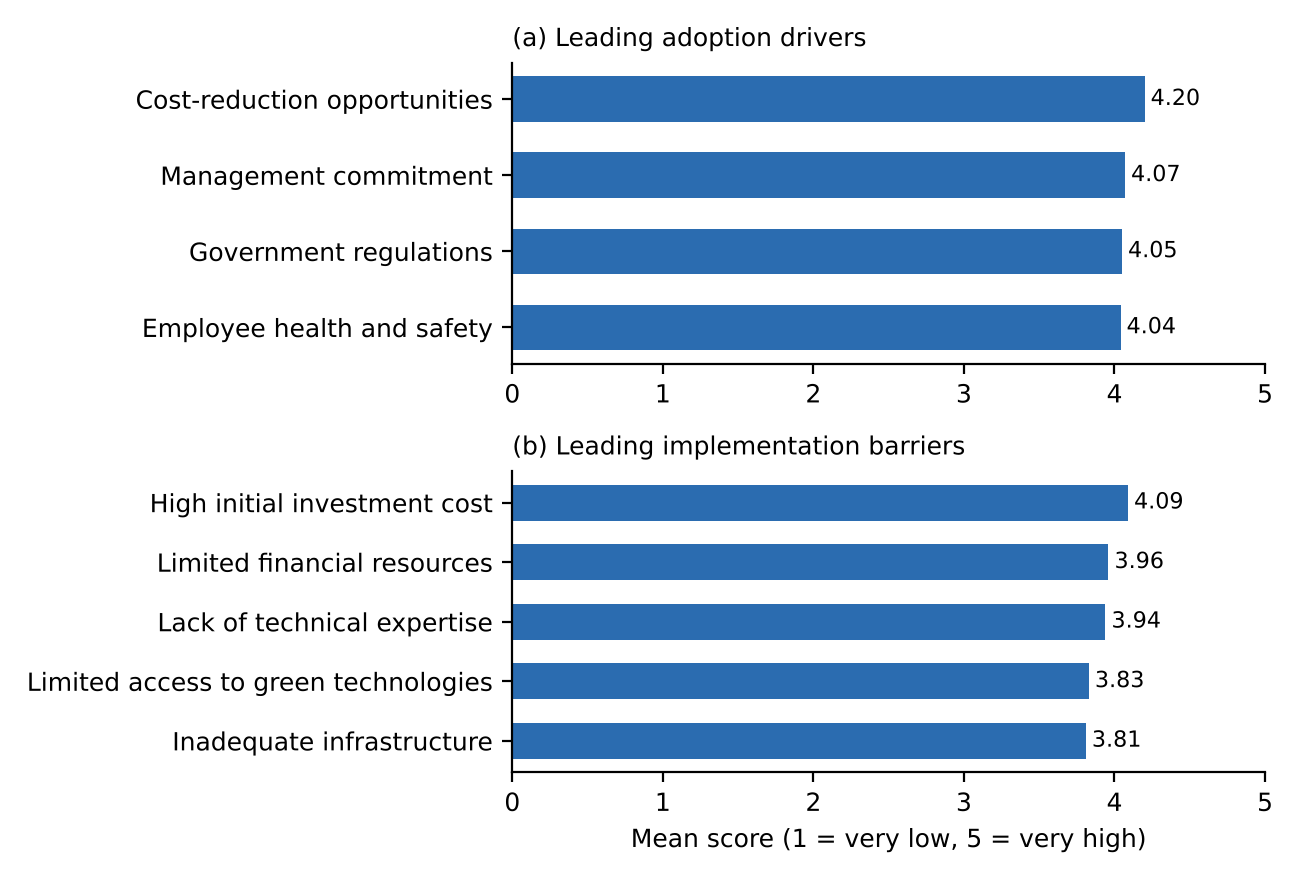
The result highlights a policy paradox: firms recognize the benefits of green manufacturing and are willing to adopt it, but they cannot easily finance or technically implement the required transition. This challenge has also been reported across Sub-Saharan Africa, where industrial sustainability is affected by infrastructure limitations, high cost of capital, limited access to low-carbon technologies, and insufficient regulatory or financing support (Aquilas et al., 2024; Mohammed, 2025).
The findings suggest that awareness campaigns alone are insufficient. Effective interventions must address financing, technology access, energy reliability, workforce capability, and practical implementation support.
3.6Environmental, economic, and social outcomes
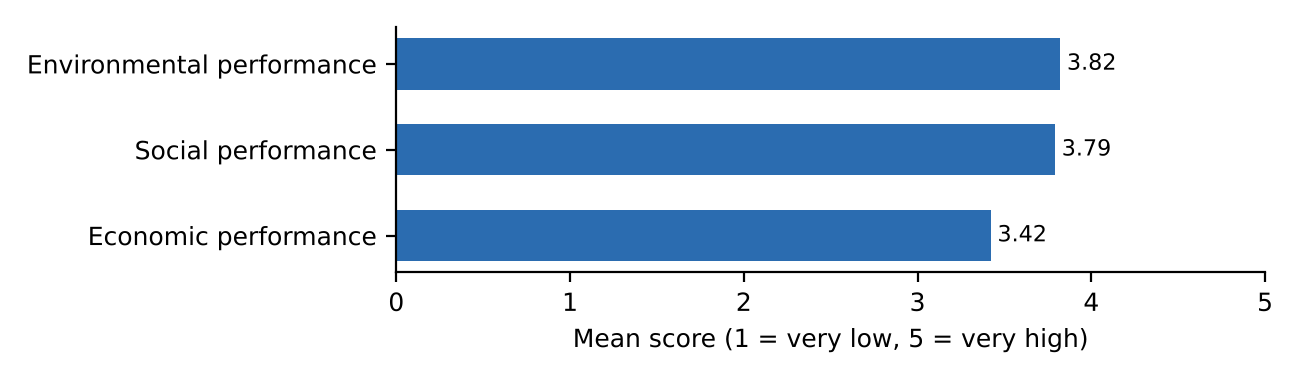
The study recorded positive outcomes across all Triple Bottom Line dimensions. Environmental performance had the highest overall mean score (M = 3.82), followed closely by social performance (M = 3.79); economic performance was positive but lower (M = 3.42).
| Dimension | Outcome | Mean score |
|---|---|---|
| Environmental | Decreased waste generation | 3.94 |
| Reduced material consumption | 3.85 | |
| Reduced emissions and pollution | 3.85 | |
| Lower energy consumption | 3.65 | |
| Economic | Reduced operational costs | 3.57 |
| Enhanced competitiveness | 3.52 | |
| Improved profitability | 3.37 | |
| Increased market share | 3.20 | |
| Social | Improved worker health and safety | 3.96 |
| Enhanced company reputation | 3.87 | |
| Better community relations | 3.70 | |
| Increased employee satisfaction | 3.63 |
Note. Scale: 1 = strongly disagree; 5 = strongly agree. Adapted from Usak (2026).
The finding that waste reduction scored highest among environmental outcomes is important. It suggests that many firms are obtaining early sustainability benefits through material management, improved process control, disposal practices, and maintenance. These interventions can reduce material losses and disposal costs while building internal confidence for larger sustainability investments.
The social-performance result is also notable. Improved worker health and safety received the highest score of all outcome indicators (M = 3.96). Green manufacturing should therefore be understood not only as an environmental strategy but also as an occupational-health, employee-welfare, and stakeholder-relations strategy. This aligns with Triple Bottom Line theory, which argues that sustainable organizational performance requires simultaneous attention to environmental, economic, and social value creation (Jali et al., 2025).
3.7Future adoption intentions and support requirements
Future adoption intentions were strongly positive: 44.4% of respondents selected “definitely yes,” while 31.5% selected “probably yes,” producing a combined positive intention of 75.9%. Only 11.1% expressed negative adoption intentions.
The most preferred support mechanisms were government incentives or subsidies (63.0%), technical training and expertise (57.4%), access to green technologies (51.9%), and financial assistance or loans (48.1%).
| Rank | Required support mechanism | Frequency | Percentage |
|---|---|---|---|
| 1 | Government incentives/subsidies | 68 | 63.0 |
| 2 | Technical training and expertise | 62 | 57.4 |
| 3 | Access to green technologies | 56 | 51.9 |
| 4 | Financial assistance/loans | 52 | 48.1 |
| 5 | Industry best-practice guidelines | 46 | 42.6 |
| 6 | Research and development support | 40 | 37.0 |
| 7 | Regulatory clarity | 36 | 33.3 |
| 8 | Customer-demand creation | 28 | 25.9 |
Note. Adapted from Usak (2026).
The high willingness to adopt indicates that Nigeria has a favorable foundation for sustainability transition. However, willingness must be matched by enabling institutions. Government incentives, concessional green finance, industry training, technological partnerships, and university-industry collaboration can reduce perceived risk and support credible implementation.
4Proposed green manufacturing adoption and sustainable production framework
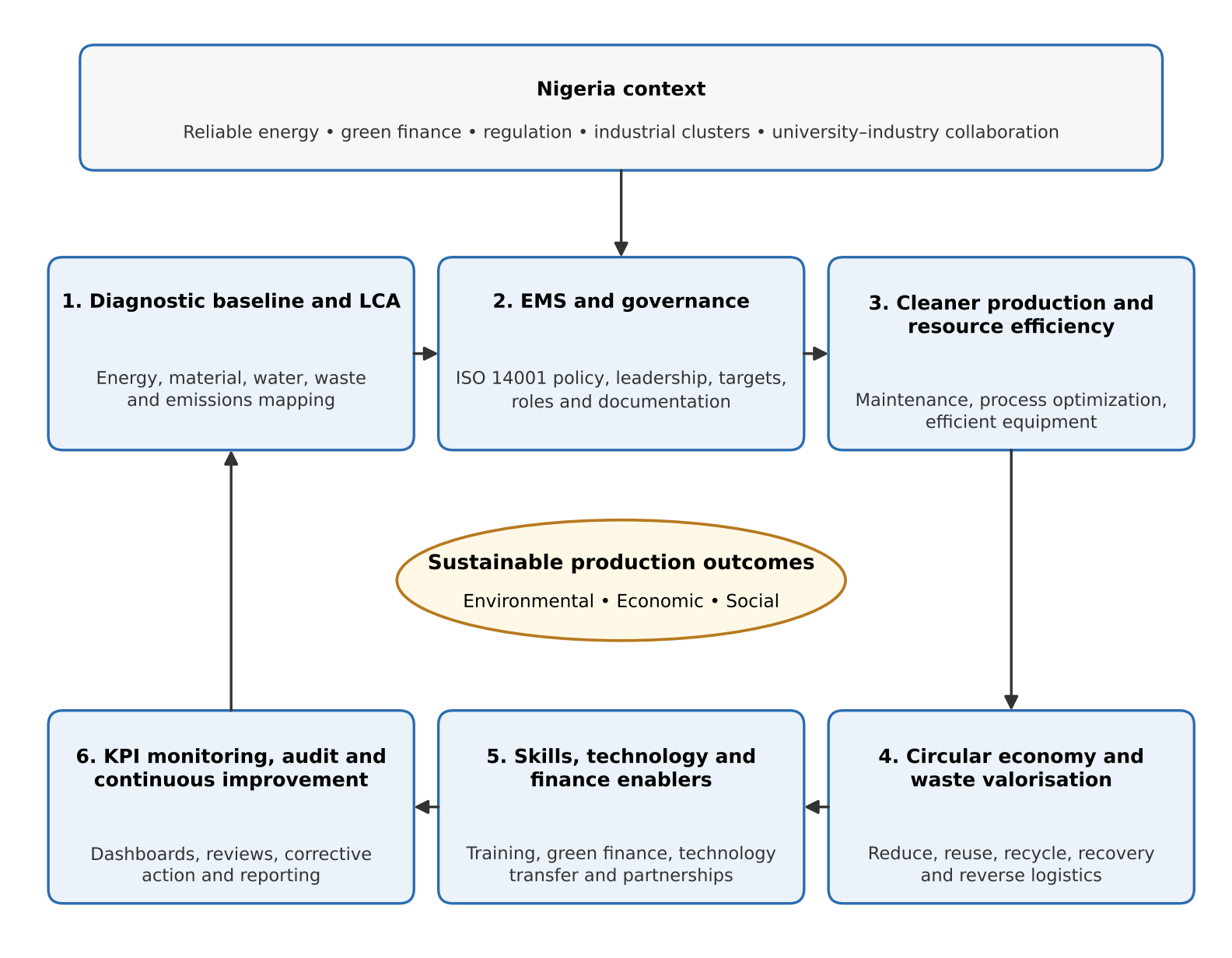
The proposed framework integrates the empirical findings with internationally recognized sustainability practices. It is designed as a cyclical, phased model rather than a one-time compliance exercise.
4.1Framework interpretation
4.1.1Diagnostic baseline and life cycle assessment
Firms should begin by measuring material use, energy consumption, water use, waste generation, emissions, maintenance losses, and hazardous-material streams. LCA provides a systematic basis for identifying environmental hotspots across a product’s life cycle and prioritizing areas where intervention will have the greatest effect (ISO, 2006a, 2006b; Lizarzaburu-Aguinaga and Benites Alfaro, 2026).
4.1.2EMS and governance
Firms should adopt an EMS aligned with ISO 14001. Key actions include creating environmental policies, assigning management responsibility, setting measurable targets, maintaining compliance records, conducting internal audits, and implementing corrective actions. EMS adoption transforms sustainability from an informal activity into a managed organizational system (Castelluccio et al., 2026; ISO, 2015).
4.1.3Cleaner production and resource efficiency
The first operational priorities should be practical, low-cost actions that produce immediate benefits:
- preventive maintenance;
- material-use optimization;
- leak and spill prevention;
- process optimization;
- waste segregation;
- energy monitoring;
- efficient lighting and motors; and
- production-loss reduction.
These measures are particularly suitable for firms facing capital constraints because they can generate savings that support subsequent investments.
4.1.4Circular economy and waste valorisation
The framework requires manufacturers to move from a linear “take-make-dispose” model toward resource circulation. Practices include source reduction, reuse, recycled-content procurement, production-waste recovery, by-product exchange, packaging redesign, reverse logistics, and industrial symbiosis. Circular operations can reduce dependency on virgin materials while creating value from waste streams (Davidaviciene et al., 2026; Olipp et al., 2025; Setyadi et al., 2025).
4.1.5Skills, technology, and finance enablers
The study confirms that finance and skills are central constraints. Therefore, green manufacturing implementation should be supported by:
- low-interest green loans;
- tax relief for clean equipment;
- industrial energy-efficiency funds;
- technical training in LCA, EMS, energy management, and cleaner production;
- university-industry technical partnerships;
- supplier partnerships for cleaner technologies; and
- industrial-cluster service platforms.
Digital tools, sensor systems, artificial intelligence, and digital twins may progressively strengthen monitoring and decision-making, but should be introduced according to each firm’s readiness and financial capacity (Fan et al., 2025; Sajadieh and Noh, 2025; Shaban et al., 2026).
4.1.6KPI monitoring, audit, and continuous improvement
A national or firm-level framework should track a small set of practical performance indicators:
| KPI | Suggested formula |
|---|---|
| Energy intensity | Total energy consumed / units produced |
| Material intensity | Total raw material input / units produced |
| Waste intensity | Total waste generated / units produced |
| Water intensity | Total water used / units produced |
| Recycling rate | Recovered material / total waste generated × 100 |
| Emission intensity | Total GHG emissions / units produced |
| Green-training coverage | Employees trained / total employees × 100 |
| Green-investment return | Annual savings / green investment cost × 100 |
Monitoring should be linked to management review, internal audit, production reporting, and investment decisions.
5Recommendations
5.1Establish green manufacturing finance facilities
The Federal Government, Bank of Industry, commercial banks, development-finance institutions, and state governments should establish concessional green-credit facilities for energy-efficient equipment, renewable-energy systems, waste recovery, cleaner technologies, and environmental monitoring systems.
Financial interventions should include:
- low-interest loans;
- credit guarantees;
- equipment-leasing arrangements;
- accelerated depreciation for green assets;
- tax incentives; and
- performance-based grants for verified resource savings.
Green finance is essential because high initial cost and limited financial resources were the most severe barriers reported in the study. Green investment should also be linked to credible environmental-performance targets and reporting requirements (Ozoemena et al., 2026).
5.2Strengthen technical capacity and workforce training
Manufacturers Association of Nigeria, engineering institutions, universities, polytechnics, and environmental regulators should jointly develop modular training programmes on:
- LCA and environmental hotspot analysis;
- ISO 14001 EMS implementation;
- energy management;
- preventive maintenance;
- waste minimization;
- material-flow analysis;
- circular-economy design; and
- environmental performance reporting.
Training should be tailored to the operational realities of SMEs and medium-sized manufacturers. Technical capability is necessary for translating environmental policy into measurable operational action.
5.3Prioritize low-cost, high-impact quick wins
Firms should not postpone green manufacturing until they can afford major technology upgrades. Initial implementation should prioritize preventive maintenance, material-use optimization, hazardous-waste control, waste segregation, energy tracking, efficient lighting, leak detection, and process housekeeping.
These early interventions are likely to generate visible savings, improve employee engagement, and create the business case for more capital-intensive investments. This phased approach is consistent with lean-green manufacturing best practice (Abualfaraa et al., 2020; Elemure et al., 2023).
5.4Develop industrial-cluster sustainability platforms
Industrial clusters should establish shared services for energy audits, waste processing, technical training, environmental testing, technology demonstration, and sustainability reporting. Shared platforms can lower transaction costs for individual firms, particularly SMEs.
Cluster-based implementation can also support industrial symbiosis, where one company’s waste becomes another company’s raw material or energy input. Such collaboration is particularly relevant for packaging, food processing, plastics, textiles, chemicals, and metal-processing industries.
5.5Improve electricity reliability and renewable-energy access
Reliable and affordable electricity is essential for green manufacturing. Public policy should improve industrial-grid reliability, while firms should be encouraged to evaluate solar photovoltaic systems, energy storage, efficient motors, variable-speed drives, and energy-management systems.
Renewable-energy adoption was the lowest-scoring green practice in the study. Addressing this requires reducing financing barriers, improving technical support, and strengthening access to quality equipment and maintenance services.
5.6Introduce standardized industry sustainability reporting
MAN, regulators, and professional bodies should develop sector-specific reporting templates for energy, water, materials, waste, emissions, safety, and recycling performance. Standardized reporting would help firms benchmark performance, identify gaps, qualify for incentives, and demonstrate progress to customers and investors.
5.7Support research, innovation, and local technology adaptation
Further research should evaluate the techno-economic feasibility of green technologies under Nigerian operating conditions. Priority areas include renewable-energy integration, low-cost waste treatment, circular packaging, industrial wastewater recovery, local fabrication of energy-efficient equipment, digital monitoring systems, and green supply-chain design.
Innovation partnerships should involve universities, manufacturing firms, local technology providers, regulators, and development partners. Research-industry partnerships are particularly important for adapting global technologies to Nigeria’s infrastructure and cost conditions (Vrchota et al., 2020; Wang et al., 2025).
6Summary and conclusions
This study assessed green manufacturing adoption in selected Nigerian manufacturing firms and developed a practical sustainable-production framework. The findings show that green manufacturing awareness and policy development are increasing, but full implementation remains limited. Although 74.1% of respondents reported at least moderate familiarity with green manufacturing principles, only 5.6% reported full implementation.
The practices most commonly implemented were preventive maintenance, hazardous-waste disposal, material optimization, and emissions monitoring. Renewable-energy use, energy-conservation training, and cleaner production technologies were less established, reflecting financial, technical, infrastructure, and technology-access constraints.
Cost-reduction opportunities were the strongest adoption driver, while high investment cost, limited financial resources, and lack of technical expertise were the leading barriers. The results further demonstrate that green manufacturing provides meaningful environmental, social, and economic benefits. Decreased waste generation, improved worker health and safety, enhanced company reputation, and reduced operational cost were among the strongest reported outcomes.
The proposed framework recommends a phased pathway built around:
- 1. Baseline assessment and LCA;
- 2. EMS and governance;
- 3. Cleaner production and resource efficiency;
- 4. Circular economy and waste valorisation;
- 5. Skills, finance, and technology enablers; and
- 6. KPI monitoring, audit, and continuous improvement.
The central conclusion is that Nigeria’s green-manufacturing transition should not be treated as a purely environmental agenda. It is an industrial-efficiency, worker-safety, competitiveness, cost-management, and national-development strategy. With targeted green finance, practical training, reliable energy, enabling regulation, industrial-cluster collaboration, and measurable performance indicators, Nigerian manufacturers can progressively move from fragmented sustainability practices to integrated sustainable production systems.
References
- [1]Abualfaraa W, Salonitis K, Al-Ashaab A, Ala’raj M (2020). Lean-green manufacturing practices and their link with sustainability: A critical review. Sustainability, 12(3), 981. https://doi.org/10.3390/su12030981
- [2]Aquilas NA, Ngangnchi FH, Mbella ME (2024). Industrialization and environmental sustainability in Africa: The moderating effects of renewable and non-renewable energy consumption. Heliyon, 10(4), Article e25681. https://doi.org/10.1016/j.heliyon.2024.e25681
- [3]Braun V, Clarke V (2006). Using thematic analysis in psychology. Qualitative Research in Psychology, 3(2), 77–101.
- [4]Castelluccio S, Fiore S, Comoglio C (2026). Exploring environmental management systems effectiveness: Do environmental investments effectively lead to performance improvements? Environments, 13(2), 85. https://doi.org/10.3390/environments13020085
- [5]Chen J, Rojniruttikul N (2025). Influence of a green environmental orientation on corporate sustainable performance in the manufacturing sector. Sustainability, 17(6), 2430. https://doi.org/10.3390/su17062430
- [6]Creswell JW, Plano Clark VL (2018). Designing and conducting mixed methods research. 3rd ed. SAGE.
- [7]Cronbach LJ (1951). Coefficient alpha and the internal structure of tests. Psychometrika, 16, 297–334.
- [8]Davidaviciene V, Diab B, Al Majzoub M (2026). Effects of circular economy principles, technological integration, and sustainable supply chain management practices on green supply chain and organizational performance. Logistics, 10(4), 93. https://doi.org/10.3390/logistics10040093
- [9]Elemure I, Dhakal HN, Leseure M, Radulovic J (2023). Integration of lean green and sustainability in manufacturing: A review on current state and future perspectives. Sustainability, 15(13), 10261. https://doi.org/10.3390/su151310261
- [10]Energy Transition Office (2022). Nigeria Energy Transition Plan. Federal Government of Nigeria.
- [11]Fan S, Tong H, Wang S (2025). A system dynamics-based hybrid digital twin model for driving green manufacturing. Systems, 13(8), 651. https://doi.org/10.3390/systems13080651
- [12]Guba EG, Lincoln YS (1985). Naturalistic inquiry. SAGE.
- [13]Hair JF, Black WC, Babin BJ, Anderson RE (2019). Multivariate data analysis. 8th ed. Cengage.
- [14]International Organization for Standardization (ISO) (2006a). ISO 14040:2006 environmental management—Life cycle assessment—Principles and framework.
- [15]International Organization for Standardization (ISO) (2006b). ISO 14044:2006 environmental management—Life cycle assessment—Requirements and guidelines.
- [16]International Organization for Standardization (ISO) (2015). ISO 14001:2015 environmental management systems—Requirements with guidance for use.
- [17]Islam MT, Khan MI, Ali A (2025). Circular business models: A state-of-the-art systematic literature review and future opportunities. Sustainable Futures, 10, Article 101097. https://doi.org/10.1016/j.sftr.2025.101097
- [18]Jali NP, Doorasamy M, Gregory V (2025). The interplay between triple bottom line elements and organizational sustainability: Unveiling strategic opportunities in an emerging economy. International Journal of Research in Business and Social Science, 14(8), 100–109.
- [19]Janahi NA, Durugbo CM, Al-Jayyousi OR (2021). Eco-innovation strategy in manufacturing: A systematic review. Cleaner Engineering and Technology, 5, Article 100343. https://doi.org/10.1016/j.clet.2021.100343
- [20]Jiang Y, Li M, Dennis A, Liao X, Ampaw EM (2022). The hotspots and trends in the literature on cleaner production: A visualized analysis based on Citespace. Sustainability, 14(15), 9002. https://doi.org/10.3390/su14159002
- [21]Kato AI, Manchidi NH (2025). Fostering sustainable manufacturing in Africa: A sustainable supply chain management framework for a green future. Administrative Sciences, 15(7), 271. https://doi.org/10.3390/admsci15070271
- [22]Khalfallah A, Leitão C (2024). Sustainable manufacturing and green processing methods. Machines, 12(11), 815. https://doi.org/10.3390/machines12110815
- [23]Khlaifat A, Fakher S, Ezzat FH, Alalaween M, Galiotos J (2025). Integrating circular economy principles in petroleum produced water management: Toward sustainable resource recovery and waste minimization. Processes, 13(11), 3604. https://doi.org/10.3390/pr13113604
- [24]Kouser R, Mahmood G, Watto WA, Fahlevi M, Aziz AL (2025). Assessing the impact of green manufacturing and green technology innovation on sustainable green practices: Unveiling the mediating role of eco-design. International Journal of Sustainable Engineering, 18(1). https://doi.org/10.1080/19397038.2025.2538868
- [25]Lee J, Kazakova E (2024). Can companies assess sustainable manufacturing practice? Sustainability, 16(12), 5259. https://doi.org/10.3390/su16125259
- [26]Liang Y, Zhao C, Lee MJ (2023). Institutional pressures on sustainability and green performance: The mediating role of digital business model innovation. Sustainability, 15(19), 14258. https://doi.org/10.3390/su151914258
- [27]Likert R (1932). A technique for the measurement of attitudes. Archives of Psychology, 22(140), 1–55.
- [28]Lizarzaburu-Aguinaga DA, Benites Alfaro EG (2026). Life cycle assessment as a catalyst for environmental transformation: A systematic review (2018–2024). Sustainability, 18(5), 2284. https://doi.org/10.3390/su18052284
- [29]Long L, Wang H (2025). Evaluating the impact of green manufacturing on corporate resilience: A quasi-natural experiment based on Chinese green factories. Sustainability, 17(14), 6281. https://doi.org/10.3390/su17146281
- [30]Manufacturers Association of Nigeria (2023). Annual manufacturing sector report 2023: Nigeria. MAN Research & Information Services; 2023. https://www.manufacturersnigeria.org/
- [31]Mohammed SR (2025). Conceptual study on green manufacturing and waste management in Nigeria’s industrial sector. Journal of Built Environment & Geological Research, 7(4), Article 007. https://doi.org/10.70382/ajbegr.v7i4.007
- [32]Nwamekwe CO, Igbokwe NC, Ono CG, Nwabunwanne EC, Aguh PS (2025). Adoption and impact of green manufacturing practices on sustainable industrial development in Anambra State, Nigeria. Journal Majelis Paspama, 3(2), 41–75. https://hal.science/hal-05209695v1
- [33]Oke OS, Aliu JO, Duduyegbe OM, Oke AE (2025). Assessing awareness and adoption of green policies and programs for sustainable development: Perspectives from construction practitioners in Nigeria. Sustainability, 17(5), 2202. https://doi.org/10.3390/su17052202
- [34]Olipp N, Schwarz M, Woschank M (2025). Integrating the principles of reverse logistics into circular economy strategies: A mixed-method study of small and medium-sized enterprises. Sustainability, 17(16), 7361. https://doi.org/10.3390/su17167361
- [35]Ozoemena CE, Gide UM, Akinyebi OD (2026). Green finance in Nigeria: Policy frameworks, challenges and global comparisons. International Journal of Development and Sustainability, 15(1), 1–19. https://doi.org/10.63212/IJDS25070401
- [36]Polo S, Rubio EM, Ayllón J, de Agustina B (2025). Emerging advances in sustainable manufacturing. Processes, 13(5), 1549. https://doi.org/10.3390/pr13051549
- [37]Sajadieh SMM, Noh SD (2025). A review of digital twin integration in circular manufacturing for sustainable industry transition. Sustainability, 17(16), 7316. https://doi.org/10.3390/su17167316
- [38]Setyadi A, Pawirosumarto S, Damaris A (2025). Embedding circular operations in manufacturing: A conceptual model for operational sustainability and resource efficiency. Sustainability, 17(15), 6737. https://doi.org/10.3390/su17156737
- [39]Shaban IA, Ajaj R, Elshimy H, Hegab H (2026). Industry 4.0 enabled sustainable manufacturing. Sustainability, 18(1), 156. https://doi.org/10.3390/su18010156
- [40]Sultana N, Rahman MM, Khanam R (2025). Interconnections between environmental awareness and green technology adoption: Empirical evidence from informal business enterprises. Sustainability, 17(21), 9595. https://doi.org/10.3390/su17219595
- [41]Usak E (2026). Integration of green manufacturing principles for sustainable production system in Nigerian manufacturing industries [Master’s thesis, Federal University of Technology, Owerri].
- [42]Vrchota J, Pech M, Rolínek L, Bednář J (2020). Sustainability outcomes of green processes in relation to Industry 4.0 in manufacturing: Systematic review. Sustainability, 12(15), 5968. https://doi.org/10.3390/su12155968
- [43]Wang X, Zhan S, Liu L, Zhang P (2025). Research on the green and low-carbon development path of digital intelligence empowering enterprises in manufacturing industry. Sustainability, 17(6), 2734. https://doi.org/10.3390/su17062734
- [44]Yamane T (1967). Statistics: An introductory analysis. 2nd ed. Harper & Row.
- [45]Zhang B, Li Y (2025). Research on the impact of green policies on the transformation of manufacturing enterprises from the perspective of central-local collaboration. Sustainability, 17(11), 5111. https://doi.org/10.3390/su17115111
- [46]Zhang C, Wang Y, Zhao Z, Chen X, Ye B, Liu S, et al. (2024). Performance-driven closed-loop optimization and control for smart manufacturing processes in the cloud-edge-device collaborative architecture: A review and new perspectives. Computers in Industry, 162, Article 104131. https://doi.org/10.1016/j.compind.2024.104131
- [47]Zhang N, Wu J, Li B, Fu D (2023). Research on green closed-loop supply chain considering manufacturer’s fairness concerns and sales effort. Journal of Theoretical and Applied Electronic Commerce Research, 18(1), 333–351. https://doi.org/10.3390/jtaer18010018