Pharmacy
Curcumin-Loaded Transethosomal Gel for Enhanced Dermal Delivery in Arthritis
Department of Pharmaceutics, S. N. College of Pharmacy, Babupur, Lucknow Road, Jaunpur, Uttar Pradesh, India (affiliated to Dr. A. P. J. Abdul Kalam Technical University, Lucknow, India)
Published October 2026
Abstract
Rheumatoid arthritis (RA) and osteoarthritis (OA) are chronic, progressive joint disorders whose initiation and progression are driven substantially by nuclear factor-kappa B (NF-κB)-mediated transcription of pro-inflammatory cytokines, cyclooxygenase-2 and matrix metalloproteinases [1,2]. Curcumin, the principal curcuminoid of Curcuma longa, is a well-characterised inhibitor of this cascade with documented antioxidant and chondroprotective activity [1], but its clinical utility is severely constrained by extremely poor aqueous solubility, chemical instability and negligible oral bioavailability as a Biopharmaceutics Classification System (BCS) Class IV molecule [3,4]. Dermal/topical delivery directly to the peri-articular tissue offers an attractive alternative that bypasses hepatic first-pass metabolism, but the stratum corneum's densely packed lipid architecture is a formidable barrier to permeation of lipophilic phytoconstituents [6]. This review traces the evolution of vesicular nanocarrier platforms developed to overcome this barrier — liposomes, ethosomes, transfersomes and, most recently, transethosomes — and examines the rationale for transethosomes as a rationally engineered hybrid system that combines the ethanol-mediated bilayer fluidisation of ethosomes with the edge-activator-imparted elasticity of transfersomes [7,9,11,12,13,14]. We summarise the published literature on curcumin- and related phytoconstituent-loaded vesicular gels evaluated in experimental arthritis models, the Quality by Design (QbD)/Box–Behnken framework increasingly used to systematically optimise such formulations [20,23,24], and the standard physicochemical and in vitro biological evaluation parameters applied to transethosomal gels. We conclude that curcumin-loaded transethosomal gels represent a mechanistically well-supported, still-maturing formulation strategy for localised anti-arthritic therapy, with QbD-driven optimisation and rigorous in vitro evaluation frameworks positioned as the critical next steps toward eventual ex vivo and in vivo translational development.
Keywords: curcumin; transethosomes; ethosomes; transfersomes; liposomes; quality by design; Box–Behnken design; rheumatoid arthritis; osteoarthritis; dermal drug delivery; NF-κB
1Introduction
Arthritis is an umbrella term for more than a hundred distinct joint disorders, of which rheumatoid arthritis (RA) and osteoarthritis (OA) are the most prevalent and disabling forms encountered in clinical practice. RA is a chronic, systemic autoimmune disease that predominantly affects the synovial joints, leading to progressive pannus formation, cartilage erosion, bone destruction and, ultimately, irreversible joint deformity and disability [1]. OA, by contrast, is a degenerative joint disease driven by mechanical and biochemical factors that lead to progressive breakdown of articular cartilage, subchondral bone remodelling and low-grade chronic synovial inflammation [1]. Globally, arthritis is among the leading causes of years lived with disability. A recent Global Burden of Disease analysis estimated that rheumatoid arthritis affected close to twenty million people worldwide in 2020, with age-standardised prevalence and disability-adjusted life-years projected to rise further through 2050 as populations age, while osteoarthritis affects an even larger proportion of older adults and is projected to increase substantially with global population ageing and rising obesity prevalence [2]. The socioeconomic burden of arthritis is considerable, encompassing direct costs of long-term pharmacotherapy, physician visits and, in advanced disease, joint-replacement surgery, together with substantial indirect costs arising from lost work productivity and reduced quality of life. This burden underscores the continued need for safer, more affordable and more patient-friendly therapeutic strategies that can be self-administered over prolonged periods without the systemic risk profile associated with conventional oral or parenteral anti-arthritic agents.
At the molecular level, both RA and OA share overlapping inflammatory pathways centred on the transcription factor nuclear factor-kappa B (NF-κB). Under resting conditions, NF-κB is sequestered in the cytoplasm in an inactive complex with the inhibitory protein IκBα. Pro-inflammatory stimuli — including TNF-α, IL-1 and mechanical/oxidative stress signals within the joint microenvironment — activate the IκB kinase (IKK) complex, which phosphorylates IκBα and targets it for ubiquitin-mediated proteasomal degradation. The liberated NF-κB dimer then translocates to the nucleus, where it drives transcription of genes encoding TNF-α, IL-1β, IL-6, cyclooxygenase-2 (COX-2), inducible nitric oxide synthase (iNOS) and matrix metalloproteinases (MMPs). These mediators perpetuate synovial hyperplasia, cartilage matrix catabolism, angiogenesis (pannus formation) and nociceptive sensitisation, establishing a self-amplifying inflammatory loop that is central to both the initiation and chronic progression of arthritic joint damage [1]. A simplified schematic of this pathway, together with the proposed site of curcumin action, is presented in Figure 1.
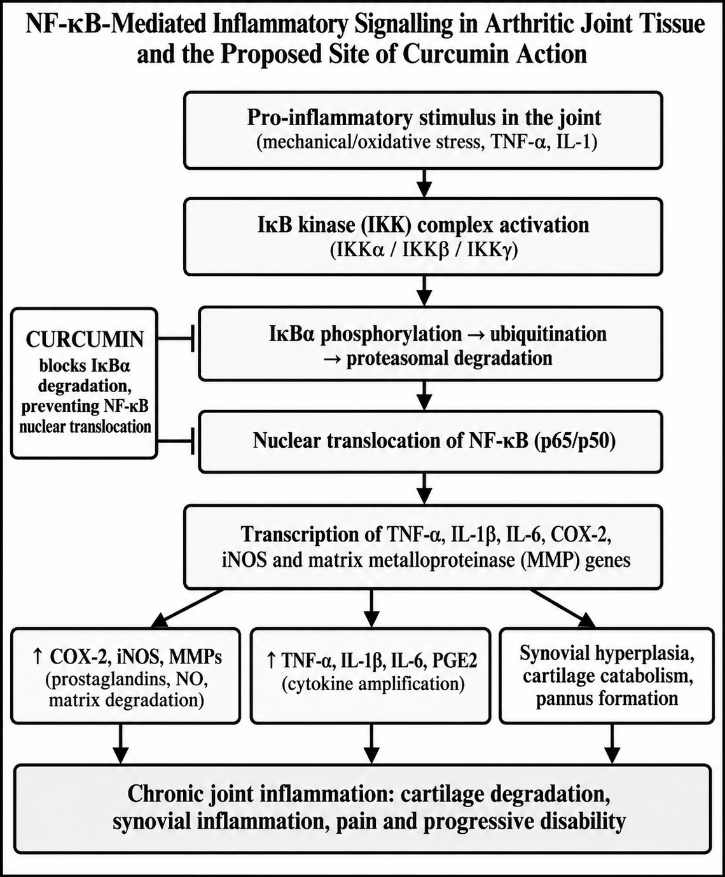
Current first-line pharmacotherapy for arthritis — non-steroidal anti-inflammatory drugs (NSAIDs), disease-modifying anti-rheumatic drugs (DMARDs) such as methotrexate, corticosteroids, and biologic agents targeting TNF-α or interleukins — is largely administered orally or parenterally. While effective in reducing inflammation, chronic use of these agents is frequently associated with gastrointestinal ulceration and bleeding (NSAIDs), hepatotoxicity and myelosuppression (methotrexate), osteoporosis and adrenal suppression (corticosteroids), and heightened susceptibility to opportunistic infection (biologics). These systemic adverse-effect profiles, coupled with the chronic, lifelong nature of arthritis management, create a clear unmet need for localised, non-invasive delivery alternatives capable of concentrating drug action at the affected joint while minimising systemic exposure. Curcumin (diferuloylmethane), the principal yellow curcuminoid isolated from the rhizome of Curcuma longa, has been extensively investigated for anti-inflammatory, antioxidant, anti-proliferative and chondroprotective activity relevant to this unmet need. Mechanistically, curcumin inhibits IκBα phosphorylation, thereby preventing NF-κB nuclear translocation, and concurrently down-regulates COX-2, lipoxygenase, iNOS and pro-inflammatory cytokine expression, while enhancing endogenous antioxidant defences (superoxide dismutase, glutathione) and preserving cartilage matrix integrity through inhibition of MMPs [1]. As a naturally derived, generally well-tolerated phytoconstituent with a long history of dietary use, curcumin offers a favourable safety profile relative to synthetic NSAIDs and DMARDs, further strengthening its rationale as a candidate for chronic, localised anti-arthritic therapy. This review synthesises the pharmacological and biopharmaceutical rationale for curcumin as an anti-arthritic candidate, traces the evolution of vesicular nanocarrier technology developed to enable its effective dermal delivery, and critically surveys the published literature on curcumin-loaded vesicular gels — with particular emphasis on the transethosomal platform — evaluated in experimental models of arthritis.
2Curcumin: pharmacology and biopharmaceutical limitations
Chemically, curcumin is 1,7-bis(4-hydroxy-3-methoxyphenyl)-1,6-heptadiene-3,5-dione, a symmetric diarylheptanoid (C21H20O6, molecular weight ≈368.38 g/mol) possessing an α,β-unsaturated β-diketone moiety responsible for its characteristic keto–enol tautomerism, intense yellow-orange colour and antioxidant activity. Turmeric oleoresin typically contains three principal curcuminoids — curcumin (the major component), demethoxycurcumin and bisdemethoxycurcumin — of which curcumin possesses the most extensively documented pharmacological activity. Table 1 summarises curcumin's principal physicochemical and pharmacological characteristics relevant to formulation design.
| Parameter | Description |
|---|---|
| Chemical name | 1,7-Bis(4-hydroxy-3-methoxyphenyl)-1,6-heptadiene-3,5-dione |
| Molecular formula / weight | C21H20O6; ≈368.38 g/mol |
| Category | Phytoconstituent; anti-inflammatory / antioxidant agent |
| Solubility | Practically insoluble in water; soluble in ethanol, DMSO, acetone and alkali |
| BCS classification | Class IV (low solubility, low permeability) [4] |
| Partition coefficient (log P) | ≈ 3.0 (lipophilic) |
| Melting point | ≈ 183°C |
| Mechanism of action | Inhibition of the IκBα/NF-κB pathway; suppression of COX-2, iNOS, TNF-α, IL-1β, IL-6, MMPs; antioxidant activity [1] |
| Oral bioavailability | Very low, owing to poor absorption, rapid first-pass metabolism (glucuronidation/sulfation) and rapid systemic elimination [3,4] |
| Regulatory/safety status | Generally Recognized as Safe (GRAS) status for dietary use in several jurisdictions |
Following oral administration, curcumin undergoes extensive first-pass metabolism in the intestinal mucosa and liver, predominantly via glucuronidation and sulfation, together with reduction to dihydro-, tetrahydro- and hexahydro-curcumin metabolites. Absorption is further limited by poor aqueous solubility and consequent low dissolution rate in gastrointestinal fluids. Reported oral bioavailability in rodent and human studies is extremely low, and plasma concentrations after even gram-level oral doses remain in the low nanomolar-to-micromolar range, insufficient to sustain systemic anti-inflammatory activity over a convenient dosing interval [3,4]. Oral doses in the gram range are frequently required to achieve pharmacologically meaningful plasma concentrations, which is neither practical nor economical for chronic arthritis management. These limitations have historically restricted curcumin's translation from a promising laboratory-validated anti-inflammatory agent into a clinically viable therapeutic product, and have motivated extensive pharmaceutical research into alternative delivery strategies capable of circumventing its inherent solubility and stability constraints [3,4].
Representative marketed and investigational curcumin products span oral nutraceutical soft-gelatin capsules, phytosome-based bioavailability-enhanced tablets and capsules, nanoemulsion-based oral liquids, and a small number of investigational topical gels explored for osteoarthritis-related joint pain; oral nutraceutical doses of curcumin/curcuminoids typically range from 500 mg to several grams per day, frequently co-administered with piperine or formulated as phytosome/nanoparticulate complexes to improve absorption. Beyond its anti-arthritic relevance, curcumin has additionally been investigated for anti-carcinogenic, hepatoprotective, neuroprotective, antimicrobial and wound-healing activity, reflecting its broad multi-target pharmacology; these applications, however, lie outside the direct scope of the present dermal anti-arthritic review. Against this backdrop, formulating curcumin as a topical/dermal transethosomal gel obviates the bioavailability limitations associated with the oral route altogether and delivers the drug directly to the inflamed peri-articular tissue, motivating the vesicular carrier strategies discussed in the sections that follow.
3Rationale for dermal/topical delivery and the skin barrier
Topical delivery directly to the peri-articular skin overlying an inflamed joint offers several advantages over the oral route: it circumvents hepatic first-pass metabolism and gastrointestinal degradation, it permits sustained localised drug concentration at the site of inflammation with minimised systemic exposure and associated adverse effects, and it enhances patient compliance owing to the non-invasive, self-administrable nature of gel-based dosage forms. The skin, however, is structurally optimised to function as a protective barrier: the outermost stratum corneum is composed of terminally differentiated, densely packed corneocytes embedded within a highly organised intercellular lipid matrix — ceramides, cholesterol and free fatty acids arranged in lamellar bilayers — which together constitute a formidable barrier that severely limits the passive permeation of hydrophobic, high-molecular-weight phytoconstituents such as curcumin when applied in conventional semisolid vehicles [6].
Overcoming this barrier without compromising skin integrity has long been recognised as the central challenge in topical/transdermal phytoconstituent delivery, and has motivated two broad, complementary strategies: chemical penetration enhancement, in which solvents, surfactants or fatty-acid enhancers transiently disorder the intercellular lipid packing, and vesicular/nanocarrier encapsulation, in which the drug is incorporated into a lipid-based nanostructure engineered to interact favourably with, and in some cases traverse, the stratum corneum lipid domains [6,9]. Vesicular nanocarrier systems occupy a particularly attractive middle ground between simple penetration enhancers, whose benefit is often modest and can be accompanied by skin irritation at effective concentrations, and highly invasive physical enhancement techniques such as microneedling or iontophoresis, which add cost, complexity and patient discomfort poorly suited to chronic, self-administered arthritis management. The remainder of this review traces how vesicular carrier design has progressively evolved — from rigid conventional liposomes to increasingly deformable, penetration-enhancing hybrid systems — specifically to address the stratum corneum barrier problem for lipophilic actives such as curcumin.
4Evolution of vesicular nanocarriers: from liposomes to transethosomes
Vesicular nanocarrier systems — liposomes, niosomes, transfersomes, ethosomes and, more recently, transethosomes — have been progressively developed to enhance dermal and transdermal drug delivery by disrupting the ordered lipid architecture of the stratum corneum. Conventional liposomes, composed only of phospholipids and cholesterol, self-assemble into concentric bilayer vesicles capable of entrapping both lipophilic (within the bilayer) and hydrophilic (within the aqueous core) actives, but their rigid, largely non-deformable bilayer confines them to the superficial skin layers, with poor transdermal flux [9]. Niosomes, formed from non-ionic surfactants rather than phospholipids, offer a lower-cost, more chemically stable alternative to liposomes but share the same fundamental limitation of rigid-bilayer, superficial deposition; an early factorial/response-surface optimisation of zidovudine niosomes nonetheless provided one of the first methodological templates for statistically optimised vesicular carrier development within Indian pharmaceutics research [26].
Transfersomes, formed by incorporating an edge activator (surfactant) such as Span 80, sodium cholate or Tween 80 into the phospholipid bilayer, represented the first major advance toward genuinely deformable vesicles: the edge activator destabilises rigid bilayer packing, conferring sufficient elasticity for transfersomes to squeeze through intercellular channels considerably narrower than their own diameter under the natural hydration gradient of the skin, without rupturing [10,12]. Design and evaluation of flexible membrane vesicles for topical capsaicin delivery demonstrated that such edge-activator-containing elastic vesicles significantly improve topical anti-inflammatory drug deposition relative to rigid liposomal carriers, establishing transfersomes as a genuine improvement over first-generation liposomes for topical anti-inflammatory applications [10]. Transfersomes, however, lack a dedicated penetration-enhancing solvent component and can remain susceptible to vesicle rupture under occlusive conditions.
Ethosomes, first described by Touitou and colleagues, took a complementary approach: rather than mechanically destabilising the bilayer with a surfactant, ethosomes incorporate a relatively high concentration of ethanol (typically 20–45% v/v) into the vesicle formulation. Ethanol simultaneously fluidises the phospholipid bilayer itself and interdigitates with, and transiently disorders, the stratum corneum's own intercellular lipid lamellae, producing markedly superior skin delivery of fluorescent probes and small-molecule actives relative to both conventional liposomes and simple hydroalcoholic solution, and establishing the foundational science underlying subsequent ethosomal and transethosomal carrier development [7]. Ethosomal formulations of lamivudine and paroxetine hydrochloride, among other actives, have confirmed the utility of the ethanol injection/cold method for preparing stable, high-entrapment-efficiency vesicles suitable for incorporation into topical gels [8,25]. A comprehensive review of ethosomal constituents and formulation techniques catalogued how phospholipid type, ethanol concentration and cholesterol content each independently influence ethosomal vesicle size, deformability and in vivo performance, and traced the platform's gradual progress toward clinical translation [9].
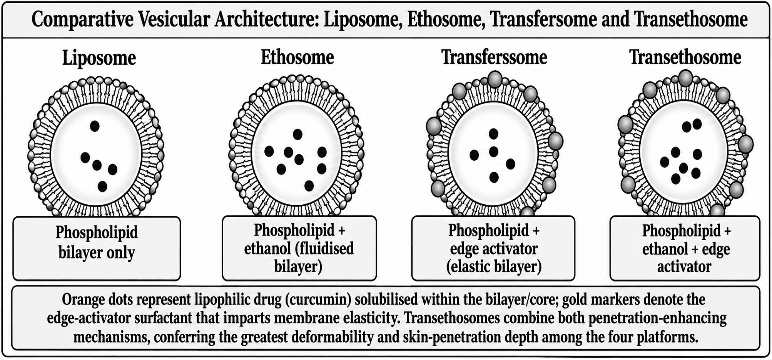
Transethosomes represent the rationally engineered hybrid of these two lineages, combining the ethanol-mediated bilayer fluidisation of ethosomes with the edge-activator-imparted elasticity of transfersomes within a single vesicle (Figure 2). This dual mechanism confers transethosomes with smaller vesicle size, higher deformability, superior entrapment efficiency for lipophilic actives, and markedly enhanced transdermal flux relative to liposomes, ethosomes or transfersomes evaluated individually, as demonstrated in several head-to-head comparative studies [11,14]. A comparative characterisation and skin-delivery study of transfersomes, ethosomes and transethosomes concluded explicitly that transethosomes combine the deformability of transfersomes with the penetration-enhancing solvent effect of ethosomes, translating into superior cutaneous drug delivery relative to either parent platform alone [11]. Systematic development of a transethosomal gel of piroxicam similarly reported superior drug retention, permeation, entrapment efficiency and elasticity for transethosomes compared with liposomal, ethosomal and transfersomal analogues prepared under matched conditions, providing a direct methodological precedent for comparative-screening formulation-development designs of the kind increasingly applied to curcumin [14].
All four vesicular platforms are conventionally prepared by variants of the thin-film hydration method or the ethanol injection/cold method. In thin-film hydration, the phospholipid (and cholesterol or edge activator, as applicable) is dissolved in a volatile organic solvent system, the solvent is removed under reduced pressure to deposit a thin lipid film, and the film is hydrated with an aqueous drug dispersion — with ethanol incorporated at the hydration stage for ethosomal and transethosomal batches — under continuous agitation, followed by probe or bath sonication to reduce vesicle size and narrow the size distribution. The ethanol injection/cold method instead disperses the phospholipid directly in ethanol before rapid injection into the aqueous drug-containing phase under stirring, offering a comparatively simpler, lower-shear alternative particularly well suited to ethanol-rich ethosomal and transethosomal compositions. Systematic, controlled variation of ethanol and edge-activator content and type across otherwise matched liposomal, ethosomal, transfersomal and transethosomal batches — rather than empirical, single-formulation development — is now the standard comparative-screening methodology by which the superiority of the transethosomal platform is established for a given active. Table 2 summarises the principal comparative attributes of the four vesicular systems reviewed in this section.
| Attribute | Liposome | Ethosome | Transfersome | Transethosome |
|---|---|---|---|---|
| Composition | Phospholipid + cholesterol | Phospholipid + ethanol (20–45%) | Phospholipid + edge activator | Phospholipid + ethanol + edge activator |
| Deformability | Low (rigid bilayer) | Moderate | High (elastic) | Very high (dual mechanism) |
| Skin penetration depth | Superficial (stratum corneum only) | Deep dermal layers | Deep, via intercellular channels | Deepest; combined solvent + elastic effect |
| Typical vesicle size | 100–1000 nm | 100–300 nm | 100–300 nm | 80–250 nm |
| Principal reported limitation | Poor transdermal flux [9] | Possible ethanol-related irritation at high concentration | Vesicle rupture risk under occlusion | Formulation complexity; requires multi-factor optimisation [9] |
5Quality by design in vesicular formulation optimisation
Traditional pharmaceutical formulation development relies on a one-factor-at-a-time (OFAT) trial-and-error approach, which is time-consuming, resource-intensive and often fails to capture interaction effects between formulation variables. Quality by Design (QbD), as endorsed by the International Council for Harmonisation (ICH Q8(R2), Q9 and Q10 guidelines), is a systematic, science- and risk-based approach that begins with predefined objectives — the Quality Target Product Profile (QTPP) — identifies Critical Quality Attributes (CQAs) and Critical Material/Process Attributes (CMAs/CPPs) through structured risk assessment, and employs Design of Experiments (DoE), commonly a Box–Behnken or central composite response-surface design, to establish a validated design space within which the desired product quality is consistently assured [23]. For vesicular nanocarrier systems specifically, the CQAs most commonly targeted are vesicle size, polydispersity index (PDI), zeta potential, entrapment efficiency and in vitro/ex vivo drug release, while the CMAs typically shortlisted through Ishikawa (fish-bone) risk assessment include phospholipid concentration, ethanol concentration and edge-activator type/concentration — precisely the variables that differentiate the four vesicular platforms discussed in Section 4. Figure 3 summarises this eight-step QbD workflow as applied to a curcumin transethosomal formulation.
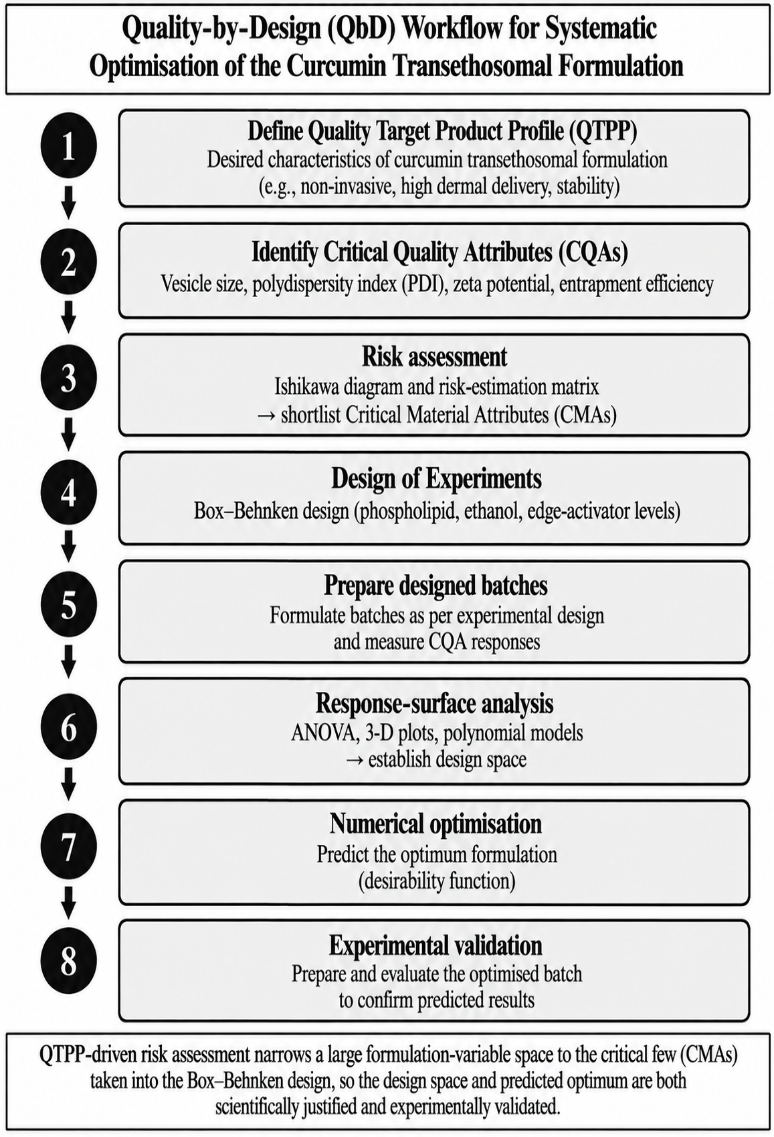
QbD-driven optimisation has been successfully applied to numerous curcumin-loaded nanocarrier systems, consistently yielding formulations with superior particle size, entrapment efficiency and stability compared with empirically optimised counterparts. A QbD-optimised magnetic metal-organic-framework–chitosan nanocarrier for curcumin, developed using a Box–Behnken design, achieved pH-responsive, non-Fickian (Korsmeyer–Peppas) release with markedly enhanced antimicrobial activity relative to free curcumin, illustrating the general power of systematic QbD optimisation for curcumin nanocarriers [20]. Statistical Box–Behnken optimisation has likewise been applied directly to transethosomal gel development: transethosomal gels of colchicine optimised via Box–Behnken design established design-of-experiments methodology as a robust tool for systematic transethosome development, characterising vesicle size, entrapment efficiency and ex vivo permeation as the principal response variables [24], while curcumin-loaded transethosomes prepared using Phospholipon 90G, ethanol and Span, and optimised through a thirteen-run Box–Behnken design, exhibited superior vesicle size, entrapment efficiency, drug retention and skin permeation relative to analogous liposomal, ethosomal and transfersomal gels of curcumin, and demonstrated preferential stability under refrigerated storage conditions [15]. Beyond transethosomes, design-of-experiments approaches have also been applied to alternative curcumin delivery routes, such as intranasal curcumin nanoemulsion optimisation with parallel toxicity assessment, illustrating the broad applicability of statistical optimisation techniques across curcumin nanocarrier platforms generally [22]. Response-surface analysis of such designs typically employs analysis of variance (ANOVA) to derive and validate second-order polynomial models relating each CQA to the independent formulation variables, together with lack-of-fit testing and coefficient-of-determination (R²) reporting, before a desirability-function-based numerical optimisation is used to identify a predicted optimum formulation for subsequent experimental validation — the closing step of the workflow shown in Figure 3.
6Curcumin-loaded vesicular systems in experimental arthritis: a literature synthesis
Building on the general vesicular-carrier and QbD literature summarised above, a growing body of published research has specifically evaluated curcumin- and related phytoconstituent-loaded vesicular gels in experimental models of arthritis, providing direct precedent for curcumin transethosomal gel development. This growing literature sits within a broader and rapidly expanding nanotechnology-based drug-delivery effort directed at osteoarthritis and rheumatoid arthritis, spanning nanoparticles, nanogels, exosomes and intra-articular injectable systems in addition to the topical vesicular platforms that are the focus of the present review [5].
Curcumin-loaded transfersomes (Cur-TF), fabricated via a modified thin-film hydration method and embedded in a Carbopol-934 gel, exhibited high encapsulation efficiency and sustained release, showed superior in vitro skin penetration relative to plain curcumin, and produced significant improvement in clinical, histological and radiographic arthritis scores with reduced pro-inflammatory cytokines through NF-κβ inhibition in a Complete Freund's Adjuvant (CFA)-induced rheumatoid arthritis model — directly linking transfersomal curcumin delivery to measurable anti-arthritic benefit in vivo [16]. An edge-activated ethosomal gel co-delivering curcumin and cyclosporine, formulated by the ethanol injection method, achieved a vesicle size of 93.3 nm and zeta potential of −29.2 mV; ex vivo studies on porcine ear skin showed 97% curcumin release over 18 hours following Hixson–Crowell kinetics, and the gel significantly increased the anti-inflammatory cytokine IL-10 while reducing IL-6, TNF-α and PGE2 in LPS-stimulated macrophages, with confirmed efficacy in a CFA-induced arthritic rat model [17]. Curcumin-loaded transethosomes (CRM-TE), formulated using Phospholipon 90G, ethanol and Span through a thirteen-run Box–Behnken design, exhibited superior vesicle size, entrapment efficiency, drug retention and skin permeation relative to analogous liposomal, ethosomal and transfersomal gels of curcumin, directly informing the comparative-screening approach central to the present review [15]. A transethosome-based topical delivery system engineered for dual therapeutic action and enhanced skin penetration confirmed that the combined ethanol–edge-activator composition of transethosomes substantially outperforms single-component vesicular carriers in both penetration depth and cutaneous retention, supporting the platform's suitability for chronic topical anti-inflammatory therapy beyond the specific disease indication studied [18].
Related phytoconstituent- and small-molecule-loaded transethosome studies further corroborate the platform's applicability to inflammatory joint disease. Nanotransethosomes loaded with mangiferin, optimised via Box–Behnken design (vesicle size 148.6 nm, entrapment efficiency 74.2%) and incorporated into a gel for transdermal delivery, demonstrated superior anti-arthritic potential compared with standard diclofenac gel in CFA-induced arthritic rats, confirmed by radiographic and histopathological analysis — providing a close structural and therapeutic precedent for curcumin transethosomal gel development, since mangiferin, like curcumin, is a poorly water-soluble polyphenolic phytoconstituent [19]. Ginger-extract-loaded transethosomes have likewise demonstrated effective transdermal permeation coupled with significant anti-inflammatory activity in a rat model, supporting the general applicability of transethosomal carriers for phytoconstituent delivery in inflammatory conditions [9]. A Carbopol-934-based transethosomal gel of glycyrrhizic acid, though developed for a dermatological rather than an arthritic indication, further reinforced Carbopol as a compatible gelling matrix for transethosomal dispersions, optimising phospholipid and ethanol ratios to achieve nanometric vesicles with high entrapment efficiency and favourable ex vivo permeation [21]. Carbopol's broader suitability as a gelling agent across oral, nasal, transdermal, topical and ophthalmic vesicular and non-vesicular delivery systems has been separately reviewed, consolidating the pharmaceutical rationale for its selection as the gelling matrix in curcumin transethosomal formulation strategies [27]. Table 3 consolidates the key formulation and outcome parameters reported across these representative studies.
| Study (vesicular system) | Model / method | Key reported outcome |
|---|---|---|
| Curcumin transfersomal gel (Cur-TF) [16] | Thin-film hydration; CFA-induced RA rat model | High EE%, sustained release; improved clinical/histological/radiographic scores via NF-κβ inhibition |
| Curcumin + cyclosporine ethosomal gel [17] | Ethanol injection; porcine ear skin ex vivo; CFA rat model | 93.3 nm, −29.2 mV; 97% release/18h; ↑IL-10, ↓IL-6/TNF-α/PGE2; confirmed anti-arthritic efficacy |
| Curcumin transethosomal gel (CRM-TE) [15] | Box–Behnken (13-run); vs liposome/ethosome/transfersome | Superior vesicle size, EE%, retention, permeation; preferential refrigerated stability |
| Dual-action transethosome (topical) [18] | Comparative penetration/retention study | Combined ethanol + edge-activator composition outperforms single-component vesicles |
| Mangiferin nanotransethosomal gel [19] | Box–Behnken; CFA-induced RA rat model | 148.6 nm, 74.2% EE; superior anti-arthritic potential vs diclofenac gel |
| Ginger-extract transethosomes [9] | Rat model | Effective transdermal permeation with significant anti-inflammatory activity |
| Glycyrrhizic acid transethosomal gel [21] | Box–Behnken; Carbopol 934 gel | Nanometric vesicles, high EE, favourable ex vivo permeation (skin-cancer indication) |
EE = entrapment efficiency.
7Analytical and evaluation framework for transethosomal gels
A rigorous, standardised evaluation framework has emerged across the transethosomal gel literature reviewed above, applicable to any newly developed curcumin transethosomal formulation. At the vesicular-dispersion stage, characterisation typically comprises vesicle size, polydispersity index and zeta potential by dynamic light scattering, vesicle morphology and lamellarity by transmission or scanning electron microscopy, and entrapment efficiency/drug content by validated UV-spectrophotometric or reverse-phase HPLC assay following separation of unentrapped drug by centrifugation, ultracentrifugation or dialysis. Drug–excipient compatibility is routinely confirmed by Fourier-transform infrared (FTIR) spectral comparison of pure drug, individual excipients and their physical mixtures, corroborated by differential scanning calorimetry (DSC) thermal analysis, to rule out chemical interaction prior to formulation development. In vitro drug release is most commonly assessed using the dialysis-bag technique or a Franz diffusion cell fitted with a synthetic membrane, with cumulative release data subsequently fitted to zero-order, first-order, Higuchi and Korsmeyer–Peppas mathematical models to elucidate the underlying release mechanism, indicated by the Korsmeyer–Peppas diffusional exponent 'n' (Fickian versus non-Fickian/anomalous diffusion).
At the final-gel stage, additional evaluation parameters include pH (targeted to the skin-compatible range of approximately 5.5–6.5 following Carbopol neutralisation with triethanolamine), rheological/viscosity behaviour across a range of shear rates (characterising Newtonian versus pseudoplastic/thixotropic flow), spreadability, extrudability and homogeneity, and drug-content uniformity across replicate samples. Short-term accelerated stability studies, conducted as per ICH Q1A(R2) guideline storage conditions, monitor vesicle size, entrapment efficiency, drug content, pH and viscosity over a defined observation period to identify the storage condition offering optimal formulation stability — refrigerated storage has been specifically reported to favour transethosomal stability in at least one curcumin transethosome study [15]. All in vitro experiments in this literature are typically performed in triplicate, with data expressed as mean ± standard deviation and statistical comparison between formulation groups (e.g., liposome vs. ethosome vs. transfersome vs. transethosome, or across stability time-points) performed using one-way analysis of variance (ANOVA) followed by Tukey's or Dunnett's post-hoc test, with p < 0.05 considered statistically significant; design-of-experiments data generated during Box–Behnken optimisation are separately analysed using response-surface regression, as described in Section 5.
Finally, preliminary in vitro anti-inflammatory potential is frequently screened using established, purely non-animal assay models — most commonly the protein (albumin) denaturation inhibition assay and the human red blood cell (HRBC) membrane stabilisation assay — benchmarked against a standard reference anti-inflammatory agent, providing an indicative, ethically streamlined marker of retained or enhanced anti-inflammatory activity for the formulated curcumin relative to the free drug, ahead of any subsequent ex vivo permeation or in vivo pharmacodynamic evaluation.
8Challenges, safety and translational considerations
Despite the consistent formulation-science advantages demonstrated for transethosomes across multiple actives, several challenges continue to constrain their translation into approved topical anti-arthritic products. Formulation complexity is a recurring theme: because transethosome performance depends simultaneously on phospholipid concentration, ethanol concentration and edge-activator type/concentration, robust optimisation genuinely requires a multi-factor statistical design (Section 5) rather than simple one-factor screening, and scale-up of ethanol-containing, sonication-dependent vesicular manufacturing processes from laboratory to pilot scale remains non-trivial. Ethanol, while central to the mechanism of penetration enhancement, is itself a potential skin irritant at higher concentrations and over prolonged, repeated topical application, so formulation optimisation must balance penetration-enhancement benefit against local tolerability, particularly for a chronic-use indication such as arthritis where the gel may be applied daily over months. Long-term physical and chemical stability of curcumin itself — which is prone to photodegradation and hydrolytic degradation at alkaline pH even when successfully vesicle-entrapped — must be confirmed under real-time as well as accelerated storage conditions before any translational claim can be made, and the preferential refrigerated-storage stability reported for at least one curcumin transethosome formulation may itself present a practical cold-chain consideration for eventual commercial distribution [15].
From a translational standpoint, it is also important to note that the majority of the anti-arthritic efficacy literature reviewed in Section 6 relies on the Complete Freund's Adjuvant-induced rat model, which, while well validated and widely used, does not fully recapitulate the chronicity, autoimmune character and joint-specific pathology of human rheumatoid arthritis; radiographic and histopathological improvement in this model is a necessary but not sufficient predictor of clinical benefit. Ex vivo permeation studies using excised animal (commonly porcine or rat) skin, while a valuable intermediate step, likewise cannot fully substitute for human skin permeation data given known interspecies differences in stratum corneum thickness and lipid composition. On the regulatory side, curcumin's long history of dietary use and GRAS status in several jurisdictions is a meaningful translational advantage relative to novel synthetic entities, but a topical herbal/phytoconstituent product intended for a chronic inflammatory indication such as arthritis would still be expected to satisfy the same pharmaceutical-quality, stability and, eventually, clinical-evidence requirements applied to any other locally acting topical product, rather than qualifying for an abbreviated pathway on the basis of the active's natural origin alone. A rigorous, purely in vitro/preformulation-stage formulation-development programme — of the kind increasingly adopted in recent QbD-optimised curcumin transethosome studies — therefore represents an appropriately staged and ethically conservative first phase of investigation, generating the mechanistic and physicochemical evidence base required to justify subsequent ex vivo and in vivo evaluation as a distinct, later-stage body of work.
9Conclusion
Curcumin possesses a well-characterised, multi-target anti-inflammatory and chondroprotective pharmacology directly relevant to both rheumatoid arthritis and osteoarthritis, acting principally through inhibition of the IκBα/NF-κB signalling axis, yet its translation into a clinically useful anti-arthritic product has long been constrained by its classification as a poorly soluble, poorly bioavailable BCS Class IV molecule. Dermal delivery directly to the inflamed peri-articular tissue circumvents this oral bioavailability problem, provided the substantial stratum corneum permeation barrier can be overcome. The vesicular nanocarrier lineage traced in this review — from rigid liposomes, through edge-activator-containing transfersomes and ethanol-containing ethosomes, to the hybrid transethosomal platform that combines both penetration-enhancing mechanisms — represents a rationally engineered, mechanistically well-supported solution to this barrier problem, and the growing published literature on curcumin- and related phytoconstituent-loaded vesicular gels evaluated in experimental arthritis models provides encouraging, if still preclinical, evidence of anti-arthritic benefit. Systematic, Quality-by-Design-based optimisation using Box–Behnken and related response-surface designs is increasingly the standard by which such formulations are developed and justified. A rigorously characterised, QbD-optimised curcumin-loaded transethosomal gel, evaluated through validated in vitro release, stability and non-animal anti-inflammatory assays, therefore represents a scientifically sound and timely contribution to this expanding formulation-science literature, and a reasoned foundation for subsequent ex vivo permeation and in vivo anti-arthritic evaluation as future work.
References
- [1]Toumi H, Almhdie-Imjabbar A, Ibrahim N, Lespessailles E. Curcumin in arthritis: molecular mechanisms, preclinical evidence, and clinical applications. Int J Mol Sci. 2026;27(11):4894.
- [2]GBD 2021 Rheumatoid Arthritis Collaborators. Global, regional, and national burden of rheumatoid arthritis, 1990–2020, and projections to 2050: a systematic analysis of the Global Burden of Disease Study 2021. Lancet Rheumatol. 2023.
- [3]Cui X, Wang R, Bian P, Wu Q, Seshadri VDD, Liu L. Evaluation of antiarthritic activity of nimbolide against freund's adjuvant induced arthritis in rats. Artif Cells Nanomed Biotechnol. 2019;47(1):3391–8.
- [4]Anand P, Kunnumakkara AB, Newman RA, Aggarwal BB. Bioavailability of curcumin: problems and promises. Mol Pharm. 2007;4(6):807–18.
- [5]A comprehensive review of nanotechnology based drug delivery systems for osteoarthritis treatment. Nanotechnol Rev. 2025.
- [6]Overcoming the skin permeation barrier: challenges and opportunities. Ther Deliv. 2015.
- [7]Touitou E, Dayan N, Bergelson L, Godin B, Eliaz M. Ethosomes—novel vesicular carriers for enhanced delivery: characterization and skin penetration properties. J Control Release. 2000;65(3):403–18.
- [8]Jain S, Tiwary AK, Sapra B, Jain NK. Formulation and evaluation of ethosomes for transdermal delivery of lamivudine. AAPS PharmSciTech. 2007;8(4):Article 111.
- [9]Abdulbaqi IM, Darwis Y, Khan NA, Assi RA, Khan AA. Ethosomal nanocarriers: the impact of constituents and formulation techniques on ethosomal properties, in vivo studies, and clinical trials. Int J Nanomedicine. 2016;11:2279–304.
- [10]Raza K, Singh B, Mahajan A, Negi P, Bhatia A, Katare OP. Design and evaluation of flexible membrane vesicles (FMVs) for enhanced topical delivery of capsaicin. J Drug Target. 2011;19(4):293–302.
- [11]Ascenso A, Raposo S, Batista C, Cardoso P, Mendes T, Praça FG, et al. Development, characterization, and skin delivery studies of related ultradeformable vesicles: transfersomes, ethosomes, and transethosomes. Int J Nanomedicine. 2015;10:5837–51.
- [12]Garg V, Singh H, Bimbrawh S, Singh SK, Gulati M, Vaidya Y, et al. Ethosomes and transfersomes: principles, perspectives and practices. Curr Drug Deliv. 2017;14(5):613–33.
- [13]Munir M. A comprehensive review on transethosomes as a novel vesicular approach for drug delivery through transdermal route. J Liposome Res. 2024;34(1):203–18.
- [14]Garg V, Singh H, Bhatia A, Raza K, Singh SK, Singh B, et al. Systematic development of transethosomal gel system of piroxicam: formulation optimization, in vitro evaluation, and ex vivo assessment. AAPS PharmSciTech. 2017;18(1):58–71.
- [15]Kaur P, Garg V, Bawa P, Sharma R, Singh SK, Kumar B, et al. Formulation, systematic optimization, in vitro, ex vivo, and stability assessment of transethosome based gel of curcumin. Asian J Pharm Clin Res. 2018;11(2):41–7.
- [16]Sana E, Zeeshan M, Ain QU, Khan AU, Hussain I, Khan S, et al. Topical delivery of curcumin-loaded transfersomes gel ameliorated rheumatoid arthritis by inhibiting NF-κβ pathway. Nanomedicine (Lond). 2021;16(10):819–37.
- [17]Gharat S, Momin M, Panchal U, Omri A. Novel ethosomal gel formulation for enhanced transdermal delivery of curcumin and cyclosporine: a preclinical approach to rheumatoid arthritis management. Drug Deliv. 2025;32(1):2512620.
- [18]Wang W, Tham PH, Ding C, Huang P, Li T, Luo J, et al. Transethosome-based topical administration systems with enhanced penetration and dual actions for treating EGFR-overexpressed cutaneous squamous cell carcinoma. Adv Funct Mater. 2024;34(24):2312838.
- [19]Adin SN, Gupta I, Rashid MA, Alhahoom Y, Aqil M, Mujeeb M. Nanotransethosomes for enhanced transdermal delivery of mangiferin against rheumatoid arthritis: formulation, characterization, in vivo pharmacokinetic and pharmacodynamic evaluation. Drug Deliv. 2023;30(1):2173338.
- [20]Hemida D, Shehata N, Elgiddawy N, Alfassam HE, Mahgoub SM, Mahmoud R. A QbD-optimized magnetic MOF-chitosan nanocarrier for targeted curcumin delivery and synergistic antimicrobial activity. RSC Adv. 2026;16(27):25144–73.
- [21]Yasmeen, Khan MA, Iqbal Z, Aqil M. Carbopol 934-based transethosomal gel of glycyrrhizic acid for the management of skin cancer. J Drug Deliv Sci Technol. 2024;97:105825.
- [22]Sood S, Jain K, Gowthamarajan K. Optimization of curcumin nanoemulsion for intranasal delivery using design of experiment and its toxicity assessment. Colloids Surf B Biointerfaces. 2014;113:330–7.
- [23]Yu LX, Woodcock J. Understanding pharmaceutical quality by design. AAPS J. 2014;16(4):771–3.
- [24]Abdulbaqi IM, Darwis Y, Assi RA, Khan NA. Transethosomal gels as carriers for the transdermal delivery of colchicine: statistical optimization, characterization, and ex vivo evaluation. Drug Des Devel Ther. 2018;12:795–813.
- [25]Pathan IB, Nandure H, Syed SM, Bairag S. Transdermal delivery of ethosomes as a novel vesicular carrier for paroxetine hydrochloride: in vitro evaluation and in vivo study. Marmara Pharm J. 2016;20:1–6.
- [26]Ruckmani K, Sankar V. Formulation and optimization of zidovudine niosomes. AAPS PharmSciTech. 2010;11(3):1119–27.
- [27]George A, Limbachiya V, Shrivastav PS. Current status and role of carbopols in oral, nasal, transdermal, topical and ophthalmic drug delivery systems. Next Mater. 2025;9.