Pharmacy
Curcumin-Loaded Nanostructured Lipid Carrier Gel for Skin-Targeted Anti-Inflammatory Therapy: A Short Review
Department of Pharmaceutics, S. N. College of Pharmacy, Babupur, Lucknow Road, Jaunpur, Uttar Pradesh, India (affiliated to Dr. A. P. J. Abdul Kalam Technical University, Lucknow, India)
Published October 2026
Abstract
Curcumin, the principal curcuminoid of Curcuma longa, is among the most thoroughly investigated natural anti-inflammatory agents, suppressing nuclear factor kappa B signalling and downregulating cyclo-oxygenase-2 and 5-lipoxygenase, yet its therapeutic use is obstructed not by pharmacology but by delivery: it is practically insoluble in water, chemically unstable in neutral and alkaline media, and so poorly and erratically absorbed after oral administration that systemic exposure is negligible. For a cutaneous inflammatory indication this failure is irrelevant if the drug can instead be concentrated directly within the skin. This short review brings together, from open literature, the pharmacology and delivery problem of curcumin, the structure and skin-targeting mechanisms of nanostructured lipid carriers (NLCs), representative quantitative precedent for curcumin and other drugs formulated as dermal NLC gels, and the use of Quality by Design (QbD) and the Box-Behnken design for their systematic optimisation. A testable framework is proposed for correlating a defined skin-targeting index, the ratio of drug retained in the viable epidermis and dermis to drug reaching the receptor compartment, with topical anti-inflammatory efficacy in the carrageenan-induced rat paw oedema model. Important gaps remain, notably the scarcity of studies that treat skin retention itself, layer by layer, as a Design-of-Experiments response rather than a post-hoc observation on a single optimised batch.
Keywords: curcumin; nanostructured lipid carrier; topical gel; dermal retention; skin targeting; quality by design; Box-Behnken design; ex vivo permeation; anti-inflammatory activity
1Introduction
The skin is the largest and most accessible organ of the body and is the natural target for the treatment of cutaneous inflammatory disease. Topical therapy places the drug where it is needed, avoids first-pass hepatic metabolism entirely, and in principle permits high local concentrations at a fraction of the systemic exposure required for an equivalent oral dose. A drug applied to the skin may traverse the stratum corneum by the intercellular route through the lipid lamellae, by the transcellular route across the corneocytes, or through the appendages, and the barrier properties of this fifteen-to-twenty-micrometre layer are set by a highly ordered, ceramide-rich lipid matrix organised in a classical brick-and-mortar arrangement, whose structure and role in cutaneous disease have been reviewed in detail by Bouwstra and Ponec [1].
An important distinction must be drawn between permeation and retention. For a transdermal product the objective is to maximise flux across the skin into the systemic circulation; for a dermatological product treating localised inflammation, drug that reaches the receptor compartment, and thence the systemic circulation, is drug lost rather than drug delivered, and the objective is instead to hold it within the viable epidermis and dermis, where the inflammatory process actually resides. Conventional gels, creams and ointments deliver the drug to the surface but deposit relatively little in the viable layers, so that frequent application and high drug loading are required to sustain any local effect, an inefficiency well documented in the broader review of lipid nanoparticles for improved topical application of drugs for skin disease by Schafer-Korting and colleagues [2]. A successful skin-targeted formulation must therefore do three things at once: hold the drug at the application site, promote its transfer into the upper skin layers, and release it there slowly, without driving an equivalent flux into the systemic circulation.
This short review was compiled from open online literature retrieved through standard bibliographic and full-text search of the pharmaceutical and biomedical databases ordinarily used for such a synthesis, using combinations of the terms curcumin, nanostructured lipid carrier, solid lipid nanoparticle, dermal, topical gel, skin retention, skin targeting, Quality by Design and Box-Behnken design, together with hand-searching of the reference lists of the most directly relevant papers to capture precedent that a keyword search alone would miss. Primary formulation and characterisation studies, classical methodological papers establishing the assays and kinetic models used, and narrative or systematic reviews of the lipid-nanoparticle platform were all included; studies concerned solely with intravenous, oral or parenteral lipid nanoparticle delivery, with no dermal or skin-retention component, were excluded unless they established a methodological or mechanistic point of direct relevance, such as the original description of the solid lipid nanoparticle platform itself. The review is organised to build the case for curcumin specifically in six stages: first the epidemiological and pharmacological rationale for a skin-targeted, non-systemic anti-inflammatory therapy; second curcumin's own delivery problem; third the nanostructured lipid carrier as a candidate solution, including its composition, process parameters and mechanisms of skin retention; fourth the Quality by Design framework proposed to optimise it; fifth the physicochemical characterisation, stability and release behaviour expected of the finished gel; and finally a framework for testing whether skin targeting, once achieved, actually translates into greater anti-inflammatory efficacy, together with a frank assessment of the gaps that remain in the existing literature.
2Cutaneous inflammation and the case for skin-targeted, non-systemic therapy
2.1Why local disease calls for local, non-systemic treatment
Localised cutaneous inflammatory conditions, whether arising from irritant or allergic contact, chronic inflammatory dermatoses, or inflammation secondary to injury or joint disease presenting at the skin, are conventionally managed with topical corticosteroids or non-steroidal anti-inflammatory formulations, both of which carry recognised local and, with prolonged or extensive use, systemic liabilities. A natural, mechanistically broad anti-inflammatory agent capable of being concentrated at the site of disease while remaining essentially undetectable systemically would in principle avoid both sets of liabilities, provided the formulation science can actually achieve that concentration, which is precisely the unmet requirement this review addresses.
2.2Curcumin's anti-inflammatory pharmacology
Curcumin's anti-inflammatory pharmacology is among the best characterised of any natural product. Aggarwal and Harikumar's comprehensive review documents its suppression of nuclear factor kappa B activation, its downregulation of cyclo-oxygenase-2 and 5-lipoxygenase, and its inhibition of the pro-inflammatory cytokines tumour necrosis factor-alpha, interleukin-1-beta and interleukin-6, effects demonstrated across neurodegenerative, cardiovascular, pulmonary, metabolic, autoimmune and neoplastic disease models and, by direct extension, relevant to cutaneous inflammation [3]. Sharma, Gescher and Steward's earlier account of curcumin's therapeutic story catalogued the preclinical and early clinical evidence supporting this broad anti-inflammatory and antioxidant profile, while noting even then that the central obstacle to translating this pharmacology into a marketed product was not efficacy but delivery [4].
2.3Experimental model
The carrageenan-induced rat paw oedema model, introduced by Winter, Risley and Nuss, remains the standard acute assay for topical and systemic anti-inflammatory activity, producing a reproducible, quantifiable inflammatory response following sub-plantar injection of the phlogistic agent and permitting direct, equal-applied-dose comparison between an optimised formulation, a plain drug gel, and a marketed comparator [5].
2.4Burden of disease and the treatment gap
Cutaneous inflammatory conditions, taken together, represent one of the most common reasons for presentation to both primary care and dermatology clinics worldwide, and their chronic, relapsing-remitting course means that many patients are exposed to anti-inflammatory therapy, whether corticosteroid or non-steroidal, over months or years rather than days. It is precisely this chronicity that converts a modest per-application systemic liability into a clinically meaningful cumulative one: cutaneous atrophy, telangiectasia, hypothalamic-pituitary-adrenal axis suppression and, with extensive body-surface-area application, measurable systemic absorption are all recognised consequences of prolonged topical corticosteroid use, while non-steroidal topical formulations carry their own, better-known risks of local irritation and, less commonly, systemic gastrointestinal and renal effects on repeated high-dose application. The unmet clinical need is therefore not for a more potent anti-inflammatory molecule, since several, including curcumin, are already pharmacologically well characterised, but for a delivery system capable of sustaining an adequate local concentration at the site of disease over the course of a chronic treatment regimen while keeping systemic exposure negligible, which is precisely the requirement a Quality-by-Design-optimised, skin-targeted NLC gel is intended to satisfy and that this review sets out to justify in detail.
3Curcumin: an ideal anti-inflammatory with an impossible delivery profile
Curcumin (diferuloylmethane) is the principal curcuminoid of the rhizome of Curcuma longa, a symmetrical diarylheptanoid comprising two phenolic, methoxy-substituted aromatic rings joined by an alpha,beta-unsaturated beta-diketone bridge. Priyadarsini's review of curcumin chemistry, from extraction to therapeutic agent, catalogues the keto-enol tautomeric equilibrium of this diketone bridge, the stepwise acid dissociation of the phenolic groups, and the resulting sensitivity of the molecule's stability and spectroscopic behaviour to pH, solvent and light, properties that bear directly on both its formulation and its analytical characterisation [6]. Three specific liabilities together render conventional dosage forms unworkable. Aqueous insolubility: curcumin is practically insoluble in water, its solubility being of the order of nanograms per millilitre at acidic and neutral pH, so that a conventional aqueous gel can present only a trivial fraction of the administered mass in dissolved, bioavailable form. Chemical instability: the molecule degrades rapidly in neutral and alkaline aqueous media, principally by hydrolytic cleavage of the beta-diketone bridge, and it is markedly photolabile, so that both the vehicle's pH and its opacity to light are formulation-critical variables in their own right. Failure of the oral route: Anand and colleagues' review of curcumin bioavailability documents poor intestinal absorption, extensive first-pass glucuronidation and sulphation in the gut wall and liver, and rapid systemic elimination, such that measured plasma and tissue concentrations after oral dosing remain far below those required for the pharmacological effects documented in vitro [7]. For a cutaneous indication, however, the target tissue can be reached directly, so the systemic pharmacokinetic obstacles responsible for oral failure are bypassed entirely, and the remaining problem becomes a formulation problem alone: getting a poorly soluble, chemically labile molecule to partition into, and remain within, the skin.
A further, formulation-relevant consequence of curcumin's structure is its pronounced lipophilicity, with a calculated octanol-water partition coefficient in the region of three, which favours partitioning into a lipid matrix and, in principle, into the lipid-rich stratum corneum, but which is of no practical benefit whatsoever if the drug cannot first be solubilised within a deliverable vehicle in the first place; lipophilicity and deliverability are not the same property, and curcumin illustrates the distinction more starkly than most natural products. Because the compound absorbs strongly in the visible region and exhibits concentration- and solvent-dependent fluorescence, ultraviolet-visible spectrophotometry and high-performance liquid chromatography with photodiode-array or fluorescence detection are both practicable for its quantification in formulation and permeation studies, provided the mobile phase and sample-handling protocol are designed to minimise the photodegradation and pH-dependent hydrolysis already noted, since an assay that does not itself protect the analyte from these two degradation pathways will systematically under-report recovery and can be mistaken for poor entrapment or poor skin penetration when the true cause is analytical degradation during sample work-up rather than a formulation failure. These analytical constraints are not a peripheral detail: every skin-targeting index reported in Section 8 depends on accurate, degradation-corrected quantification of curcumin recovered from each skin layer, so the validated stability of the analytical method is a precondition for the validity of the retention data it is used to generate.
4Nanostructured lipid carriers as skin-targeting vehicles
4.1From solid lipid nanoparticles to the second generation
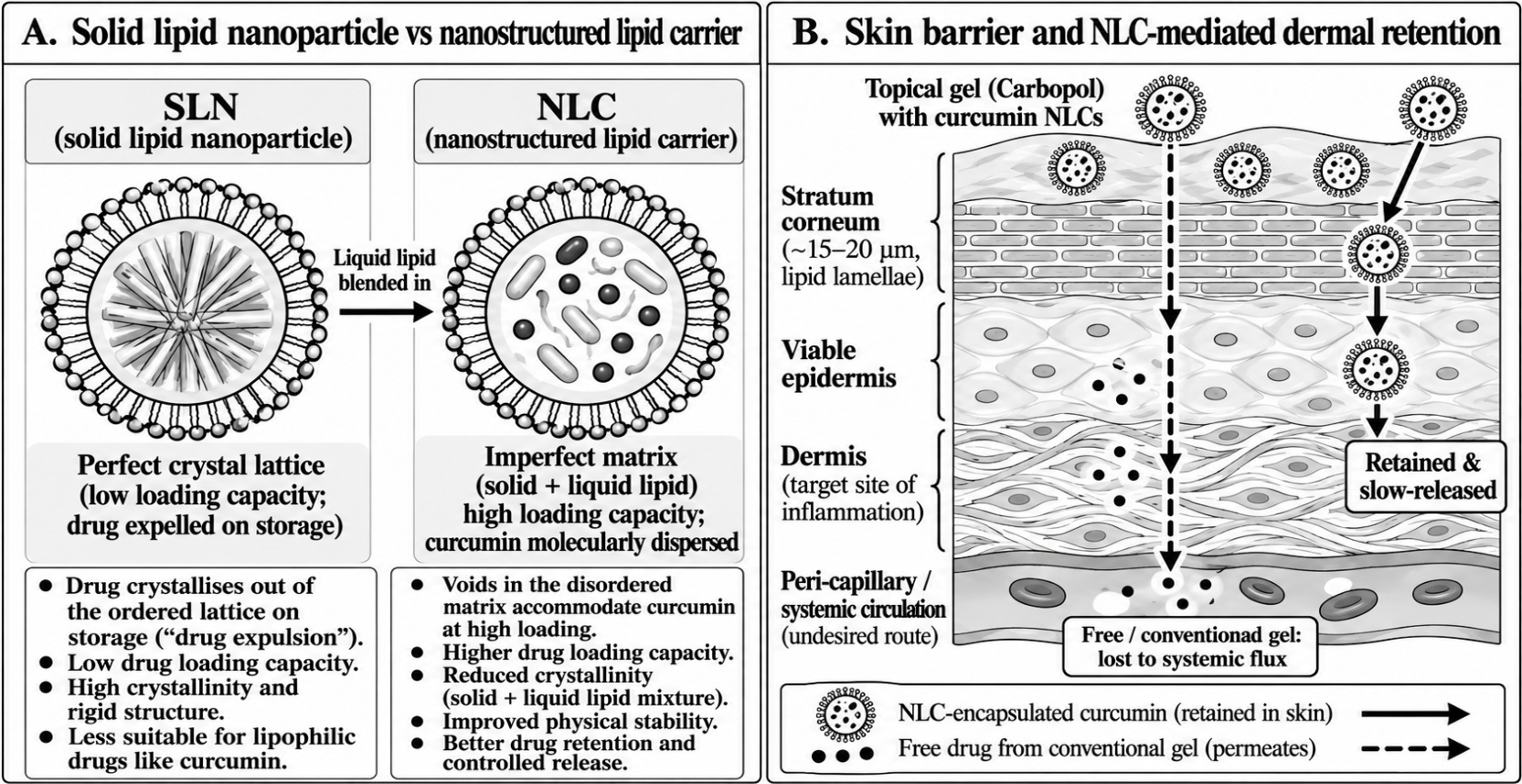
Lipid nanoparticles were introduced in the 1990s as an alternative to polymeric nanoparticles and emulsions, combining physiological, biodegradable lipids with a solid matrix capable of controlling drug release, and Mehnert and Mader's now-standard review of solid lipid nanoparticle (SLN) production, characterisation and application set out the original rationale for this first-generation carrier [8]. The SLN matrix, however, crystallises into a relatively ordered lattice on cooling, a structure that affords only limited loading capacity for a lipophilic guest molecule and that tends, on storage, to perfect itself further and expel entrapped drug, a limitation documented specifically by zur Muhlen-type release-mechanism studies and reviewed comprehensively by Muller, Mader and Gohla in their account of solid lipid nanoparticles for controlled drug delivery [9]. The nanostructured lipid carrier (NLC) is the second generation, devised specifically to remedy this defect. A liquid lipid is blended with the solid lipid before homogenisation, so that on cooling the matrix solidifies into a structurally imperfect lattice whose voids accommodate the drug at substantially higher loading and with markedly reduced expulsion on storage, a rationale set out in the foundational description of nanostructured lipid matrices for improved microencapsulation of drugs by Muller, Radtke and Wissing [10] and reviewed alongside the SLN and NLC platform generally by the same authors' account of both carrier types in cosmetic and dermatological preparation [11] and, more recently, by Naseri, Valizadeh and Zakeri-Milani's review of SLN and NLC structure, preparation and application, which formally distinguishes the imperfect, amorphous and multiple NLC types on the basis of the internal arrangement of the blended lipid phase [12].
4.2Mechanisms of skin retention
Five distinct, complementary mechanisms explain why lipid nanoparticles, and NLCs specifically, promote drug retention within the skin rather than simple pass-through permeation, mechanisms catalogued across the dermal lipid-nanoparticle literature and specifically reviewed by Pardeike, Hommoss and Muller for SLN and NLC cosmetic and pharmaceutical dermal products [13]. Occlusion and hydration: on drying, the nanoparticles form a continuous lipid film over the skin surface that reduces transepidermal water loss; the stratum corneum hydrates, its corneocytes swell, and the intercellular lipid channels widen, an occlusive effect shown by Wissing and Muller to increase as particle size decreases and to be quantifiable by standard in vitro occlusion assays [14]. Adhesion and contact area: nanometric particles adhere closely to the corneocyte surface and present a very large contact area relative to their mass, so that the concentration gradient driving partitioning into the stratum corneum is maximised at the point of application. Lipid exchange with the barrier: the matrix lipids are chemically similar to the intercellular lipids of the stratum corneum, with which they can fuse and mix, locally fluidising the lamellae and easing passage of the entrapped drug, a mechanism directly relevant to the skin barrier structure described by Bouwstra and Ponec [1] and by Elias's classical account of epidermal lipids, barrier function and desquamation [15]. Follicular accumulation: particles in the range of roughly one hundred to three hundred nanometres accumulate preferentially in the follicular openings, forming a depot that releases drug gradually over an extended period, an effect demonstrated for vitamin A-loaded SLN by Jenning and colleagues in their study of occlusive properties and upper-skin drug targeting [16] and for cetyl-palmitate NLC loaded with coenzyme Q10 by Teeranachaideekul and colleagues, who additionally examined the influence of liquid lipid content on particle structure and in vitro release [17]. Sustained release and protection of a labile drug: because the drug must first diffuse out of a solid lipid matrix, release into the skin is gradual rather than bolus, and entrapment within that matrix simultaneously shields a photolabile, hydrolytically unstable molecule such as curcumin from both light and water, addressing curcumin's chemical instability at the same time as its solubility.
4.3Incorporation into a gel vehicle
For application to the skin an aqueous nanoparticle dispersion is inconvenient in practice: it is of low viscosity, runs off the site of application, and is difficult to dose reproducibly. The optimised NLC dispersion is therefore proposed to be incorporated into a Carbopol hydrogel base, neutralised with triethanolamine, giving a semisolid of appropriate viscosity, spreadability and cosmetic acceptability while leaving the entrapped nanoparticles intact, an approach directly precedented by Calderon-Jacinto and colleagues' dual nanostructured lipid carrier/hydrogel system developed specifically for the topical delivery of curcumin [18] and by Rapalli and colleagues' curcumin-loaded NLC prepared by hot emulsification and probe sonication for enhanced skin-retained topical delivery, with reported optimisation, scale-up and in vitro characterisation, together with assessment of ex vivo skin deposition [19]. Souto and colleagues' broader review of SLN and NLC for topical, dermal and transdermal drug delivery situates both precedents within the wider platform, analysing the influence of lipid composition, surfactant choice and particle size on skin deposition across a large body of reported systems [20].
4.4Formulation composition and critical process parameters
The solid lipid component is generally selected from physiological, well-tolerated waxes and triglycerides, such as glyceryl monostearate, glyceryl palmitostearate, stearic acid or cetyl palmitate, chosen for their established dermal safety record and for melting behaviour compatible with hot-melt homogenisation; the specific choice influences both the degree of matrix imperfection achievable and the ultimate storage stability of the dispersion, and is itself frequently carried as a qualitative, screening-stage variable ahead of the quantitative Box-Behnken optimisation described in Section 6. The liquid lipid, commonly a medium-chain triglyceride oil or oleic acid, is the component principally responsible for converting an ordered SLN lattice into the imperfect NLC matrix described in Section 4.1, and its fraction within the total lipid phase is one of the three factors carried forward into the design of experiments precisely because it governs, simultaneously, drug loading capacity, matrix crystallinity and, through its influence on droplet and hence particle size, the follicular-accumulation mechanism set out in Section 4.2. Surfactant selection, typically a poloxamer, polysorbate or phospholipid, or a combination thereof, stabilises the nanoemulsion template against the high shear or ultrasonic energy input applied during manufacture and determines the final particle size distribution and zeta potential, both of which in turn influence physical stability on storage and the adhesion mechanism of skin retention.
Two manufacturing routes are in common use and are both applicable to the system proposed here. High-pressure homogenisation, either hot, in which the lipid phase is melted and homogenised above its melting point before cooling to recrystallise the nanoparticles, or cold, in which the drug-lipid mixture is solidified and milled before aqueous dispersion, is the more scalable route and the one generally preferred where eventual scale-up is a design consideration, as demonstrated for curcumin NLC specifically by Rapalli and colleagues [19]. Probe or bath sonication following melt-emulsification is a simpler, laboratory-scale alternative requiring less specialised equipment, and is the route reported by Calderon-Jacinto and colleagues for their curcumin NLC/hydrogel system [18]. Both routes expose curcumin transiently to elevated temperature and to shear or cavitational energy, so process temperature, homogenisation pressure or sonication amplitude, and cycle number or duration are all candidate critical process parameters requiring risk assessment under the Quality by Design framework set out in Section 6, in addition to the three quantitative formulation factors selected for the Box-Behnken design itself.
5Precedent: curcumin and other drugs formulated as dermal nanostructured lipid carrier gels
A substantial prior literature has already applied the NLC-gel platform to curcumin and to a range of structurally unrelated drugs requiring dermal or local delivery, summarised in Table 1, and the present proposal builds directly on this precedent rather than claiming either the platform or the drug-carrier combination to be novel. Sadegh Malvajerd and colleagues compared SLN and NLC formulations of curcumin directly, reporting preparation, optimisation and pharmacokinetic evaluation for a brain-delivery indication that nonetheless establishes the comparative loading and stability advantage of the NLC form for this specific drug [21], while Lakhani and colleagues prepared curcumin-loaded NLCs for ocular delivery with full design optimisation and characterisation, a different anatomical target sharing the same underlying formulation logic of concentrating a poorly soluble, labile drug at a local site [22]. Beyond curcumin, Elmowafy and colleagues demonstrated that incorporation of dapsone into an NLC markedly increased the quantity of drug delivered to the skin in both in vitro and in vivo studies [23], and Fatima and colleagues harnessed a similarly optimised lipid nanocarrier for the enhanced topical delivery of clindamycin phosphate, evaluated by ex vivo permeation [24]. Patwekar, Pedewad and Gattani developed and evaluated an NLC-based gel of isotretinoin, characterising the dispersion and subsequently the finished gel for pH, viscosity, spreadability and drug content in a workflow directly analogous to that proposed here [25], and Khurana, Jain and Bedi developed a controlled-release NLC gel of meloxicam, demonstrating prolonged release and enhanced anti-inflammatory activity relative to a conventional formulation of the same non-steroidal drug [26].
Clinical, rather than purely preclinical, precedent is also available. Kelidari and colleagues evaluated a spironolactone-loaded NLC gel for mild to moderate acne vulgaris in a randomised, double-blind, prospective trial, directly demonstrating that a Quality-by-Design-optimised NLC gel can be taken through to human efficacy testing [27], and Malik and Kaur explored the therapeutic potential of azelaic-acid-loaded NLCs for the same indication, relating lipid and surfactant composition to particle size, entrapment and skin deposition [28]. Kovacs and colleagues developed NLCs containing salicylic acid for dermal use explicitly on the basis of the Quality by Design method, presenting a full quality target product profile, critical quality attribute derivation and design-space justification that this review adopts as its own methodological template [29]. Ghasemiyeh and Mohammadi-Samani's broader review of SLN and NLC as novel drug delivery systems catalogues the applications, advantages and disadvantages of the platform across this entire body of work [30].
| Drug / system | Indication / route | Reported outcome | Ref. |
|---|---|---|---|
| Curcumin NLC/hydrogel | Topical, skin | Dual NLC populations (70-90 nm); enhanced skin deposition | [18] |
| Curcumin NLC | Skin-retained topical | Optimised, scaled-up; ex vivo skin deposition characterised | [19] |
| Curcumin SLN vs NLC | Brain (comparative) | NLC gave higher loading and improved pharmacokinetics than SLN | [21] |
| Curcumin NLC | Ocular | Design-optimised, fully characterised dispersion | [22] |
| Dapsone NLC | Topical, skin | Markedly increased skin delivery in vitro and in vivo | [23] |
| Clindamycin phosphate lipid nanocarrier | Topical, skin | Enhanced ex vivo permeation and deposition | [24] |
| Isotretinoin NLC gel | Topical, skin | Gel characterised for pH, viscosity, spreadability, drug content | [25] |
| Meloxicam NLC gel | Topical, local anti-inflammatory | Prolonged release; enhanced anti-inflammatory activity | [26] |
| Spironolactone NLC gel | Acne vulgaris (clinical) | Randomised, double-blind trial; effective vs. mild-moderate acne | [27] |
| Salicylic acid NLC | Dermal, QbD-based | Full QTPP/CQA/design-space workflow reported | [29] |
Three patterns emerge from Table 1 taken as a whole. First, the drugs formulated span a wide range of physicochemical properties and therapeutic classes, from a poorly soluble natural polyphenol to a sulphonamide antibacterial to a retinoid to a non-steroidal anti-inflammatory, yet the same core platform, an NLC dispersion subsequently incorporated into a gel, is reported to succeed across all of them, indicating that the mechanisms of skin retention set out in Section 4.2 are properties of the carrier rather than of any single drug, and lending confidence that the same platform is mechanistically appropriate for curcumin. Second, where a quantitative outcome is reported, it is overwhelmingly expressed as an increase in skin deposition, permeation flux or entrapment efficiency relative to a plain drug solution or conventional gel, rather than as a layer-resolved retention-versus-permeation ratio of the kind proposed in Section 8, confirming that the specific gap this review identifies, the absence of skin retention treated as a Design-of-Experiments response in its own right, is a gap across the precedent literature generally and not merely an omission specific to the curcumin studies. Third, only the salicylic acid system of Kovacs and colleagues [29] and, to a lesser extent, the spironolactone clinical trial of Kelidari and colleagues [27] report a complete Quality-by-Design workflow with an explicit design space, so that even among these ten representative precedents a fully QbD-optimised, skin-retention-focused curcumin NLC gel would occupy methodological ground that remains largely unclaimed.
6Quality by design as the development framework
Lipid nanoparticle formulations have traditionally been developed by varying one factor at a time, an approach that cannot detect interactions between formulation variables, consumes disproportionate material and time, and yields only a single acceptable composition rather than a characterised region of acceptable ones. Quality by Design (QbD), formalised for pharmaceutical development in the International Council for Harmonisation's guideline Q8(R2), replaces this with a systematic, risk-based framework, and Beg, Rahman and Kohli's review of QbD as a systematic tool for nanopharmaceutical product development sets out the sequence adopted here [31,32]: a prospective Quality Target Product Profile defining the performance the finished gel must deliver; Critical Quality Attributes, the measurable properties, here particle size, polydispersity index, entrapment efficiency and, unusually but deliberately, the skin-targeting index itself, that must lie within defined limits; a two-stage risk assessment, an Ishikawa cause-and-effect diagram enumerating every factor capable of influencing the Critical Quality Attributes followed by a risk-estimation matrix that grades each so that experimental effort is directed where it matters; a statistically designed set of experimental runs quantifying main effects, interactions and curvature simultaneously; and, from the resulting model, a delimited design space together with an explicit control strategy.
The Box-Behnken design, introduced by Box and Behnken as an economical, nearly rotatable three-level design for the study of quantitative variables, is proposed here for three factors, total lipid concentration, the fraction of liquid lipid within the lipid phase, and surfactant concentration, evaluated over seventeen randomised runs including three centre points [33]. This exact design logic, and the same three broad categories of formulation variable, is directly precedented by Kovacs and colleagues' Quality-by-Design-based development of dermal NLCs containing salicylic acid, whose reasoned derivation of Critical Quality Attributes and validated design space this review adopts as a methodological template rather than reinventing [29]. Analysis of variance, coefficient-of-determination assessment and lack-of-fit testing are proposed to select between linear, two-factor-interaction and full quadratic models for each response, with the results interpreted through response-surface, contour and perturbation plots and the design space itself delimited by an overlay plot combining the acceptable region for every Critical Quality Attribute simultaneously.
Model adequacy is judged by more than a single coefficient of determination. The predicted versus adjusted coefficient of determination should agree to within approximately 0.2, an insignificant lack-of-fit test indicates that the fitted polynomial adequately describes the response surface across the studied range, and an adequate-precision ratio comfortably above four confirms that the signal-to-noise ratio is sufficient for the model to be used for navigation of the design space rather than for empirical curve-fitting alone; a model failing any of these checks is revised, typically by removing a non-significant higher-order term, rather than accepted uncritically merely because its coefficient of determination appears numerically high. Because the skin-targeting index proposed in Section 8 is itself carried as a Critical Quality Attribute within this same Box-Behnken design, exactly the same model-building and validation discipline is applied to it as to the more conventional particle-size and entrapment-efficiency responses, so that the eventual optimised formulation is one in which retention has been fitted, validated and traded off against the other Critical Quality Attributes through the design space, rather than checked only as an afterthought on the single batch the design happens to favour on other grounds.
7Characterization, stability, gel incorporation and in vitro release
7.1Physicochemical and morphological characterization of the optimized NLC
The design-space-optimised batch identified in Section 6 is proposed to be characterised in full before proceeding to gel incorporation. Mean particle size, polydispersity index and zeta potential are determined by dynamic light scattering and electrophoretic light scattering, the latter serving as an indirect indicator of physical stability, since a sufficiently negative or positive zeta potential provides electrostatic repulsion between particles and reduces the likelihood of aggregation on storage. Entrapment efficiency and drug loading are determined after separation of unentrapped curcumin by ultracentrifugation or dialysis, with the entrapped fraction quantified by the validated, degradation-corrected assay discussed in Section 3, and morphology is examined by transmission electron microscopy or atomic force microscopy to confirm the discrete, broadly spherical particle morphology assumed by the dynamic-light-scattering measurement and to detect any aggregation not evident from size distribution data alone. Differential scanning calorimetry and powder X-ray diffraction are proposed to confirm the imperfect, amorphous or multiple character of the NLC matrix described by Naseri, Valizadeh and Zakeri-Milani [12], evidenced by a broadened or suppressed melting endotherm and diffraction pattern relative to the bulk solid lipid, and, critically, by the absence of a distinct curcumin melting endotherm, which would instead indicate that the drug remains molecularly dispersed or amorphously entrapped within the lipid matrix rather than recrystallised within it; recrystallisation of the drug within its own carrier would itself constitute a form of the drug-expulsion failure mode that motivated the shift from SLN to NLC in the first place. Fourier-transform infrared spectroscopy is used to check for any unexpected chemical interaction between curcumin and the lipid or surfactant excipients that might account for altered stability or release behaviour.
7.2Stability studies
Accelerated and long-term stability of both the optimised NLC dispersion and the finished gel are proposed to be assessed under conditions modelled on standard pharmaceutical stability practice, typically refrigerated storage at four degrees Celsius, room-temperature storage at twenty-five degrees Celsius and sixty per cent relative humidity, and accelerated storage at forty degrees Celsius and seventy-five per cent relative humidity, with sampling at intervals over at least three, and preferably six, months. Particle size, polydispersity index, zeta potential, entrapment efficiency and drug content are re-measured at each interval, since an increase in particle size or a fall in zeta potential over time is the earliest indicator of incipient aggregation, and any concurrent fall in entrapment efficiency signals drug expulsion from the matrix of the kind the NLC platform was specifically designed to resist. Because curcumin is both photolabile and hydrolytically unstable, as established in Section 3, a dedicated photostability arm, storage under defined light exposure against a light-protected control, is proposed in addition to the standard temperature-humidity conditions, and the gel base itself is checked separately for phase separation, syneresis, colour change and any drift in pH, since the Carbopol matrix's own stability is a precondition for reproducible dosing and cannot be assumed simply because the entrapped nanoparticles remain individually stable.
7.3Gel incorporation and in vitro release-kinetic modelling
Once optimised and characterised, the NLC dispersion is proposed to be incorporated into a Carbopol gel base and evaluated for appearance and homogeneity, pH, viscosity and rheological behaviour, spreadability, extrudability, drug content and centrifugation stability, with confirmation by light scattering that the entrapped nanoparticles remain intact through the gelling process, following the finished-gel evaluation approach reported for isotretinoin NLC gel by Patwekar and colleagues [25] and for meloxicam NLC gel by Khurana and colleagues [26]. In vitro release from the optimised gel and from a plain curcumin gel is proposed to be determined by the dialysis membrane technique over twenty-four hours, with the resulting profiles fitted to the zero-order, first-order, Higuchi and Korsmeyer-Peppas models. Higuchi's classical treatment of drug release from an insoluble matrix, in which the cumulative amount released is proportional to the square root of time when release is diffusion-controlled, remains the reference model for a lipid-matrix-entrapped drug [34], while the semi-empirical power-law relationship of Korsmeyer and colleagues allows the release exponent itself to identify the operative transport mechanism, Fickian diffusion, case-II relaxation, or an anomalous combination of the two, providing mechanistic rather than merely descriptive insight into how curcumin actually leaves the NLC matrix once incorporated into the gel [35].
8A framework for correlating skin targeting with anti-inflammatory efficacy
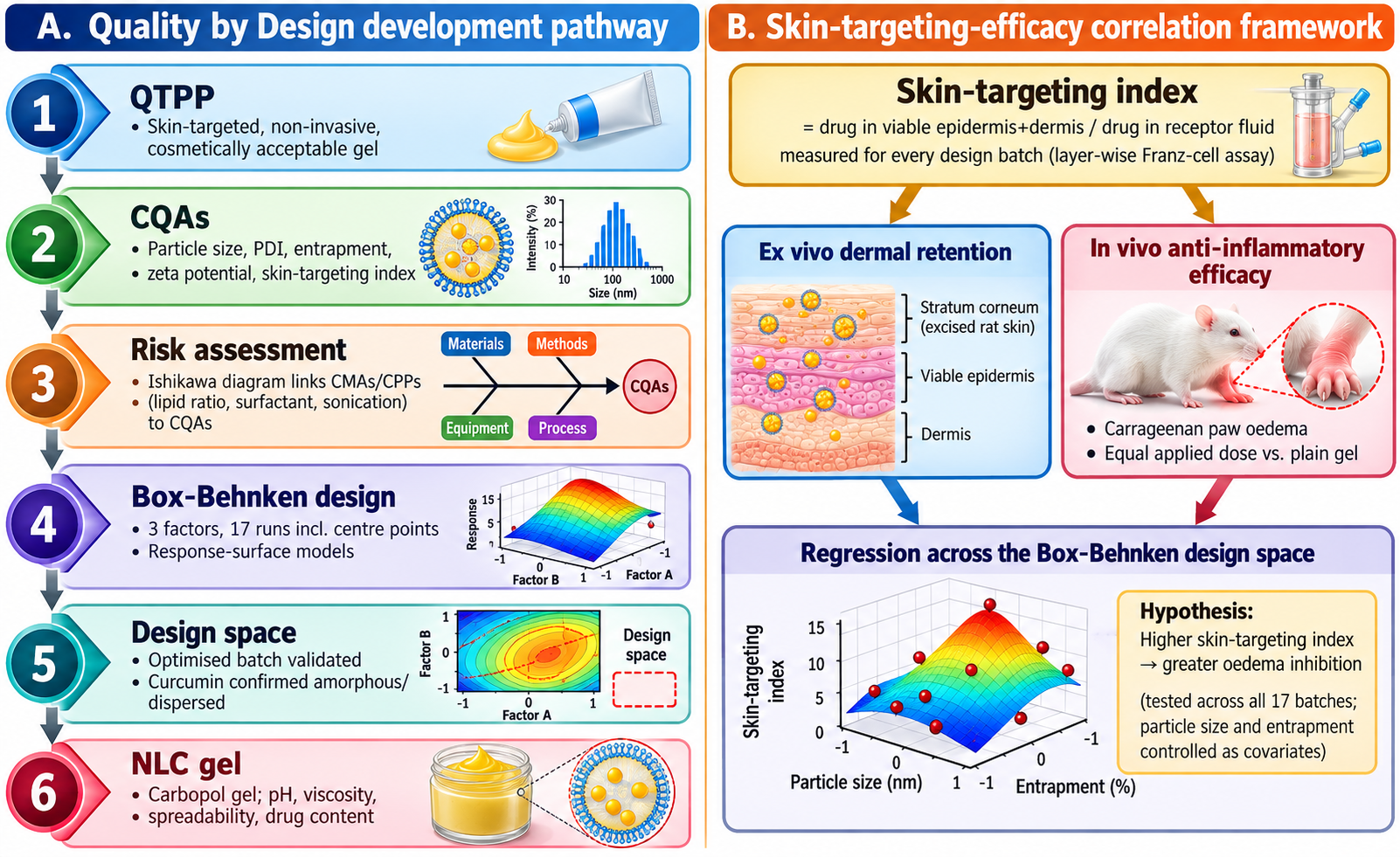
Published NLC-gel studies typically report particle size, entrapment efficiency and, at most, a single post-hoc measurement of skin permeation or retention for one optimised batch, rather than treating retention itself as a Design-of-Experiments response measured across the full experimental design. The framework proposed here, illustrated in Figure 2B, instead defines a skin-targeting index for every one of the seventeen Box-Behnken batches, calculated as the ratio of curcumin recovered from the viable epidermis and dermis to curcumin recovered from the receptor compartment of the Franz diffusion cell, and treats this index as a Critical Quality Attribute in its own right rather than as an incidental confirmatory measurement made only on the final optimised formulation.
The practical steps are as follows. Full-thickness rat abdominal skin is mounted in a Franz diffusion cell with the stratum corneum facing the donor compartment; at the conclusion of a twenty-four-hour permeation run, drug remaining on the skin surface is removed by washing, the stratum corneum is recovered by sequential tape stripping, and the remaining viable epidermis and dermis are homogenised and extracted separately, so that the site of accumulation is established rather than assumed, with mass balance against the applied dose confirming recovery within an acceptable range. From these layer-wise measurements the steady-state flux, apparent permeability coefficient, percentage of applied dose retained in each layer, enhancement ratio relative to a plain gel, and the skin-targeting index itself are all calculated for every design batch, and the resulting index is then regressed against the same three formulation factors, total lipid concentration, liquid lipid fraction and surfactant concentration, examined for the primary Critical Quality Attributes, so that the formulation region favouring retention over permeation can be identified directly from the design space rather than inferred from a single batch. The optimised batch identified by this analysis, together with a plain curcumin gel and a marketed comparator, is then carried forward to the carrageenan-induced rat paw oedema model at equal applied dose [5], testing the central hypothesis that a higher skin-targeting index translates into greater percentage inhibition of oedema; because particle size and entrapment efficiency can themselves independently influence both retention and pharmacodynamic outcome, both are proposed to be carried as covariates in the correlation rather than left as uncontrolled confounders.
Cutaneous safety is treated as a condition of success for this framework rather than as a supplementary observation. The Draize test, in its original formulation by Draize, Woodard and Calvery for the study of irritation and toxicity of substances applied topically to the skin, is proposed on shaved rat skin with scoring of erythema and oedema at twenty-four, forty-eight and seventy-two hours [36], followed by histopathological examination for epidermal thinning, inflammatory infiltrate or other barrier disruption; a formulation that achieves apparent skin targeting by damaging the barrier itself, rather than by the intended occlusion, adhesion, lipid-exchange and follicular mechanisms set out in Section 4.2, is not an acceptable outcome regardless of the magnitude of the skin-targeting index it produces.
9Challenges and future perspectives
Several challenges warrant scrutiny. First, the NLC-gel platform, and curcumin NLCs specifically, are not novel, and this review does not claim them to be [19,21]; the contribution proposed here lies in treating skin retention as an optimisation response rather than an outcome, not in the platform itself. Second, in the reported curcumin NLC studies the optimisation responses modelled were almost exclusively particle size and entrapment efficiency, with skin retention measured afterwards on a single batch if at all, so that the quantitative relationship between formulation composition and retention specifically remains largely uncharacterised across a design space, precisely the gap Section 8's framework is intended to close. Third, permeation and retention are commonly reported together in the literature as though both were straightforwardly desirable outcomes, when for a dermatological product intended to treat the skin itself, drug reaching the receptor compartment represents drug lost rather than drug delivered, and an explicit skin-targeting index of the kind proposed here is needed to separate the two rather than conflating them into a single, ambiguous permeation-enhancement figure. Fourth, drug retained in the skin is usually reported in the literature as a single aggregate figure, without separating the stratum corneum reservoir, which may simply reflect surface deposition rather than true dermal delivery, from the drug that has actually reached the viable epidermis and dermis where the inflammatory process resides; the layer-wise tape-stripping and homogenisation protocol proposed in Section 8 is designed specifically to avoid this ambiguity.
Fifth, a complete Quality by Design workflow, spanning a justified Quality Target Product Profile, a two-stage risk assessment and a validated design space, has been applied to dermal NLCs of other drugs, notably the salicylic acid system of Kovacs and colleagues [29], but not, so far as the present literature search establishes, to a curcumin NLC gel in which skin retention is itself one of the Critical Quality Attributes optimised. Sixth, pharmacodynamic confirmation at equal applied dose against a conventional gel, together with formal irritation testing and histopathological examination, is reported inconsistently across the curcumin NLC literature, so that even where a favourable physicochemical profile has been demonstrated, the translation into measurable, safety-confirmed anti-inflammatory benefit often remains assumed rather than shown. Future work extending the present framework should aim to replicate the skin-targeting-index correlation across multiple lipid and surfactant combinations, to determine whether the retention-efficacy relationship identified for one lipid system generalises to others, and to extend the accelerated-stability assessment beyond the standard six-month window to confirm that any gain in dermal retention is not offset by long-term physical or chemical instability of the optimised gel.
Translational and regulatory considerations deserve equal weight alongside these scientific gaps. Nanoparticulate dermal products are subject to closer scrutiny of batch-to-batch reproducibility than conventional semisolids, precisely because small shifts in particle size, polydispersity or entrapment efficiency, well within what might be dismissed as ordinary manufacturing variability for a simple gel, can measurably alter both the occlusion and follicular-accumulation mechanisms underlying skin retention and hence the clinical performance of the product; a Quality-by-Design control strategy of the kind set out in Section 6, in which critical process parameters are identified and controlled prospectively rather than discovered retrospectively through failed batches, is accordingly not merely good academic practice but a practical precondition for eventual scale-up, a point implicit throughout the International Council for Harmonisation's Q8(R2) guideline on pharmaceutical development [32] and echoed across the broader SLN and NLC literature reviewed by Ghasemiyeh and Mohammadi-Samani [30]. Reproducibility of the homogenisation or sonication step identified in Section 4.4 across laboratory, pilot and production scale is a further, frequently underestimated translational hurdle, since the shear and cavitational fields generated by bench-scale probe sonication are not trivially reproduced by production-scale high-pressure homogenisation, so that a formulation optimised at laboratory scale cannot be assumed, without dedicated scale-up studies, to retain the same particle-size distribution, entrapment efficiency or, by extension, skin-targeting index once manufactured at a scale suitable for clinical or commercial supply.
10Conclusion
Curcumin's anti-inflammatory pharmacology is firmly established and its systemic safety is well attested; the obstacle to its therapeutic use is one of delivery, and for a cutaneous indication the oral route's failure is simply irrelevant once the drug can be concentrated directly within the skin. The nanostructured lipid carrier is a mature, second-generation platform whose mechanisms of skin retention, occlusion, adhesion, lipid exchange and follicular accumulation, are well understood and independently precedented across a wide range of unrelated drugs, and whose combination with curcumin specifically has already been demonstrated to be both feasible and characterisable [19,21,22]. What remains comparatively undeveloped in the existing literature is the systematic, Design-of-Experiments-based optimisation of skin retention itself, rather than particle size and entrapment efficiency alone, and its explicit, quantitative correlation with anti-inflammatory efficacy measured under controlled, equal-dose conditions. A Quality-by-Design-optimised curcumin NLC gel, in which a defined skin-targeting index is treated as a Critical Quality Attribute from the outset, offers a mechanistically transparent route to close this gap, and combined ex vivo layer-wise retention analysis with in vivo carrageenan-oedema evaluation, together with formal irritation and histopathological safety confirmation, is proposed as the structure-activity exercise that would establish whether skin targeting, once deliberately engineered rather than incidentally observed, in fact delivers the greater local anti-inflammatory benefit it is designed to produce.
Acknowledgments
The authors thank the Department of Pharmaceutics, S. N. College of Pharmacy, Jaunpur, for providing the academic environment and library access that made this short review possible.
Author Contributions
S.S. (first author) collected the literature and drafted the manuscript. V.K.P. (second and corresponding author) conceived and supervised the work and critically revised the manuscript. Both authors have read and approved the final version.
Conflict of Interest
Conflict of interest. The authors declare that they have no conflict of interest.
References
- [1]Bouwstra JA, Ponec M. The skin barrier in healthy and diseased state. Biochim Biophys Acta. 2006;1758(12):2080–2095.
- [2]Schafer-Korting M, Mehnert W, Korting HC. Lipid nanoparticles for improved topical application of drugs for skin diseases. Adv Drug Deliv Rev. 2007;59(6):427–443.
- [3]Aggarwal BB, Harikumar KB. Potential therapeutic effects of curcumin, the anti-inflammatory agent, against neurodegenerative, cardiovascular, pulmonary, metabolic, autoimmune and neoplastic diseases. Int J Biochem Cell Biol. 2009;41(1):40–59.
- [4]Sharma RA, Gescher AJ, Steward WP. Curcumin: the story so far. Eur J Cancer. 2005;41(13):1955–1968.
- [5]Winter CA, Risley EA, Nuss GW. Carrageenin-induced edema in hind paw of the rat as an assay for antiinflammatory drugs. Proc Soc Exp Biol Med. 1962;111:544–547.
- [6]Priyadarsini KI. The chemistry of curcumin: from extraction to therapeutic agent. Molecules. 2014;19(12):20091–20112.
- [7]Anand P, Kunnumakkara AB, Newman RA, Aggarwal BB. Bioavailability of curcumin: problems and promises. Mol Pharm. 2007;4(6):807–818.
- [8]Mehnert W, Mader K. Solid lipid nanoparticles: production, characterization and applications. Adv Drug Deliv Rev. 2001;47(2–3):165–196.
- [9]Muller RH, Mader K, Gohla S. Solid lipid nanoparticles (SLN) for controlled drug delivery - a review of the state of the art. Eur J Pharm Biopharm. 2000;50(1):161–177.
- [10]Muller RH, Radtke M, Wissing SA. Nanostructured lipid matrices for improved microencapsulation of drugs. Int J Pharm. 2002;242(1–2):121–128.
- [11]Muller RH, Radtke M, Wissing SA. Solid lipid nanoparticles (SLN) and nanostructured lipid carriers (NLC) in cosmetic and dermatological preparations. Adv Drug Deliv Rev. 2002;54(Suppl 1):S131-S155.
- [12]Naseri N, Valizadeh H, Zakeri-Milani P. Solid lipid nanoparticles and nanostructured lipid carriers: structure, preparation and application. Adv Pharm Bull. 2015;5(3):305–313.
- [13]Pardeike J, Hommoss A, Muller RH. Lipid nanoparticles (SLN, NLC) in cosmetic and pharmaceutical dermal products. Int J Pharm. 2009;366(1–2):170–184.
- [14]Wissing SA, Muller RH. Cosmetic applications for solid lipid nanoparticles (SLN). Int J Pharm. 2003;254(1):65–68.
- [15]Elias PM. Epidermal lipids, barrier function, and desquamation. J Invest Dermatol. 1983;80(1 Suppl):44s-49s.
- [16]Jenning V, Gysler A, Schafer-Korting M, Gohla SH. Vitamin a loaded solid lipid nanoparticles for topical use: occlusive properties and drug targeting to the upper skin. Eur J Pharm Biopharm. 2000;49(3):211–218.
- [17]Teeranachaideekul V, Souto EB, Junyaprasert VB, Muller RH. Cetyl palmitate-based NLC for topical delivery of coenzyme Q10: development, physicochemical characterization and in vitro release studies. Eur J Pharm Biopharm. 2007;67(1):141–148.
- [18]Calderon-Jacinto R, Matricardi P, Gueguen V, Pavon-Djavid G, Pauthe E, Rodriguez-Ruiz V. Dual nanostructured lipid carriers/hydrogel system for delivery of curcumin for topical skin applications. Biomolecules. 2022;12(6):798.
- [19]Rapalli VK, Kaul V, Waghule T, Gorantla S, Sharma S, Roy A, Dubey SK, Singhvi G. Curcumin loaded nanostructured lipid carriers for enhanced skin retained topical delivery: optimization, scale-up, in-vitro characterization and assessment of ex-vivo skin deposition. Eur J Pharm Sci. 2020;152:105438.
- [20]Souto EB, Baldim I, Oliveira WP, Rao R, Yadav N, Gama FM, Mahant S. SLN and NLC for topical, dermal, and transdermal drug delivery. Expert Opin Drug Deliv. 2020;17(3):357–377.
- [21]Sadegh Malvajerd S, Azadi A, Izadi Z, Kurd M, Dara T, Dibaei M, et al. Brain delivery of curcumin using solid lipid nanoparticles and nanostructured lipid carriers: preparation, optimization, and pharmacokinetic evaluation. ACS Chem Neurosci. 2019;10(1):728–739.
- [22]Lakhani P, Patil A, Taskar P, Ashour E, Majumdar S. Curcumin-loaded nanostructured lipid carriers for ocular drug delivery: design optimization and characterization. Int J Pharm. 2018;546(1–2):192–205.
- [23]Elmowafy M, Shalaby K, Ali HM, Alruwaili NK, Salama A, Ibrahim MF, et al. Impact of nanostructured lipid carriers on dapsone delivery to the skin: in vitro and in vivo studies. Int J Pharm. 2019;572:118781.
- [24]Fatima N, Rehman S, Nabi B, Baboota S, Ali J. Harnessing nanotechnology for enhanced topical delivery of clindamycin phosphate. J Drug Deliv Sci Technol. 2019;54:101253.
- [25]Patwekar SL, Pedewad SR, Gattani S. Development and evaluation of nanostructured lipid carriers-based gel of isotretinoin. Part Sci Technol. 2018;36(7):832–843.
- [26]Khurana S, Jain NK, Bedi PMS. Development and characterization of a novel controlled release drug delivery system based on nanostructured lipid carriers gel for meloxicam. Life Sci. 2013;93(21):763–772.
- [27]Kelidari HR, Saeedi M, Hajheydari Z, Akbari J, Morteza-Semnani K, Akhtari J, et al. Spironolactone loaded nanostructured lipid carrier gel for effective treatment of mild and moderate acne vulgaris: a randomized, double-blind, prospective trial. Colloids Surf B Biointerfaces. 2016;146:47–53.
- [28]Malik DS, Kaur G. Exploring therapeutic potential of azelaic acid loaded NLCs for the treatment of acne vulgaris. J Drug Deliv Sci Technol. 2020;55:101418.
- [29]Kovacs A, Berko S, Csanyi E, Csoka I. Development of nanostructured lipid carriers containing salicylic acid for dermal use based on the quality by design method. Eur J Pharm Sci. 2017;99:246–257.
- [30]Ghasemiyeh P, Mohammadi-Samani S. Solid lipid nanoparticles and nanostructured lipid carriers as novel drug delivery systems: applications, advantages and disadvantages. Res Pharm Sci. 2018;13(4):288–303.
- [31]Beg S, Rahman M, Kohli K. Quality-by-design approach as a systematic tool for the development of nanopharmaceutical products. Drug Discov Today. 2019;24(3):717–725.
- [32]International Council for Harmonisation. ICH Harmonised Tripartite Guideline Q8(R2): Pharmaceutical Development. Geneva: ICH Steering Committee; 2009.
- [33]Box GEP, Behnken DW. Some new three level designs for the study of quantitative variables. Technometrics. 1960;2(4):455–475.
- [34]Higuchi T. Mechanism of sustained-action medication: theoretical analysis of rate of release of solid drugs dispersed in solid matrices. J Pharm Sci. 1963;52(12):1145–1149.
- [35]Korsmeyer RW, Gurny R, Doelker E, Buri P, Peppas NA. Mechanisms of solute release from porous hydrophilic polymers. Int J Pharm. 1983;15(1):25–35.
- [36]Draize JH, Woodard G, Calvery HO. Methods for the study of irritation and toxicity of substances applied topically to the skin and mucous membranes. J Pharmacol Exp Ther. 1944;82(3):377–390.