Pharmacy
Benzenesulfonamide Derivatives as Selective Carbonic Anhydrase Inhibitors: SAR and Antibacterial Potential
Department of Pharmaceutical Chemistry, S. N. College of Pharmacy, Babupur, Lucknow Road, Jaunpur 222132, Uttar Pradesh, India (affiliated to Dr. A. P. J. Abdul Kalam Technical University, Lucknow, India)
Published October 2026
Abstract
Carbonic anhydrases (CAs, EC 4.2.1.1) are ubiquitous zinc metalloenzymes that catalyse the reversible hydration of carbon dioxide to bicarbonate and a proton, a reaction central to respiration, pH homeostasis, ion transport and several pathological processes including glaucoma, epilepsy, tumour progression and bacterial survival in host tissue. The primary sulfonamide group (–SO2NH2) remains the most validated zinc-binding pharmacophore for CA inhibition, and the last two decades of medicinal chemistry have been dominated by the “tail approach,” in which a constant benzenesulfonamide zinc-anchor is decorated with a chemically diverse “tail” that projects into the enzyme’s variable rim and hydrophobic/hydrophilic halves, thereby tuning potency and isoform selectivity among the fifteen catalytically active human CA isoforms. This review synthesises the historical development, catalytic mechanism, and structure-based rationale of the tail approach, and critically discusses eight representative tail chemotypes — aromatic amide, ureido, Schiff base, azo, 1,2,3-triazole (click), reduced Schiff base, coumarin and thioureido — that have been most extensively explored for engineering selectivity between physiologically essential off-target isoforms (CA I, CA II) and tumour-associated or pathogen-derived isoforms (CA IX, CA XII, and bacterial β-/γ-class enzymes). Comparative isoform properties, in-silico/ADMET-guided design considerations, and the translational status of tail-modified sulfonamides — exemplified by the clinical-stage agent SLC-0111 — are summarised. We highlight persisting challenges in achieving absolute isoform selectivity, off-target physiological inhibition, and antimicrobial resistance pressure, and outline future directions including multi-tailed ligands, click-chemistry diversification and structure-guided antibacterial CA-inhibitor design, of direct relevance to the rational design of new tail-modified benzenesulfonamide derivatives.
Keywords: carbonic anhydrase inhibitors; benzenesulfonamide; tail approach; isoform selectivity; carbonic anhydrase IX; antibacterial agents; click chemistry; drug design
1Introduction
Carbonic anhydrases (CAs) are among the most catalytically efficient enzymes known, converting carbon dioxide and water to bicarbonate and a proton at rates approaching the diffusion limit [2]. Since Meldrum and Roughton first isolated and characterised the enzyme from erythrocytes in 1933 [1], eight evolutionarily independent CA gene families (α, β, γ, δ, ζ, η, θ and ι) have been identified across all domains of life, with the α-class predominating in vertebrates and comprising sixteen human isoforms, fifteen of which retain catalytic activity [2,3]. These isoforms differ markedly in tissue distribution, subcellular localisation (cytosolic, membrane-bound, mitochondrial and secreted) and physiological role, ranging from respiratory gas exchange and renal acid-base regulation to aqueous humour formation, gluconeogenesis and tumour pH regulation [3,4]. Because CA activity underlies such a broad spectrum of physiology and pathology, the enzyme has long been a validated pharmacological target, beginning with the serendipitous observation that sulfanilamide-based antibacterial agents produced metabolic acidosis through CA inhibition, an insight that directly seeded the development of acetazolamide and, subsequently, an entire pharmacopoeia of sulfonamide-based diuretics, antiglaucoma agents and anticonvulsants [4,7].
The therapeutic promise of CA inhibition is, however, inseparable from a central pharmacological problem: the sixteen human α-CA isoforms share a highly conserved active-site architecture built around a catalytic Zn2+ ion, so that classical inhibitors such as acetazolamide, methazolamide and ethoxzolamide inhibit most isoforms with comparable low-nanomolar affinity and essentially no selectivity [3,4]. Non-selective inhibition of physiologically essential isoforms (chiefly CA I and CA II, abundant in erythrocytes, gastrointestinal mucosa and the eye) is responsible for the well-documented side-effect profile of first-generation CA inhibitors, including paraesthesia, metabolic acidosis, renal calculi and taste disturbances [4,8]. Contemporary carbonic anhydrase drug design therefore aims to preserve high-affinity Zn2+ coordination through the primary sulfonamide zinc-binding group (ZBG) while re-engineering the remainder of the molecule to achieve isoform selectivity — the so-called “tail approach” pioneered by Supuran and co-workers [3,4,9]. This strategy has enabled selective targeting of the tumour-associated, hypoxia-induced isoforms CA IX and CA XII for anticancer therapy [10,11], and, more recently, of divergent bacterial β- and γ-CAs as a starting point for antibacterial agents that circumvent conventional resistance mechanisms [6]. The present review synthesises this body of work, situates the tail-approach concept within its historical and mechanistic context, and critically surveys the principal tail chemotypes reported to date, with a view toward informing the rational design of new tail-modified benzenesulfonamide carbonic anhydrase inhibitors.
2Carbonic anhydrase: classification, distribution and catalytic mechanism
Carbonic anhydrases catalyse the reaction CO2 + H2O ⇌ HCO3− + H+ through a two-step “ping-pong” zinc-hydroxide mechanism that is broadly conserved, with minor variations, across CA classes [2,5]. In the resting state, the active-site Zn2+ ion is tetrahedrally coordinated by three conserved histidine residues and a water molecule/hydroxide ion (Figure 1A) [2,3]. A proton-shuttling residue (typically His64 in α-CAs) deprotonates the zinc-bound water to generate the catalytically active zinc-hydroxide nucleophile, which attacks a CO2 molecule accommodated in an adjacent hydrophobic pocket to yield a zinc-bound bicarbonate intermediate [5]. Displacement of bicarbonate by an incoming water molecule regenerates the resting enzyme, while the proton generated is shuttled to bulk solvent, closing the catalytic cycle at rates approaching 106 s−1 for the fastest isoforms such as CA II [2,5]. This mechanistic economy — essentially diffusion-limited catalysis achieved with a single first-row transition-metal ion — makes CA one of the most extensively studied metalloenzyme systems in structural enzymology [5].
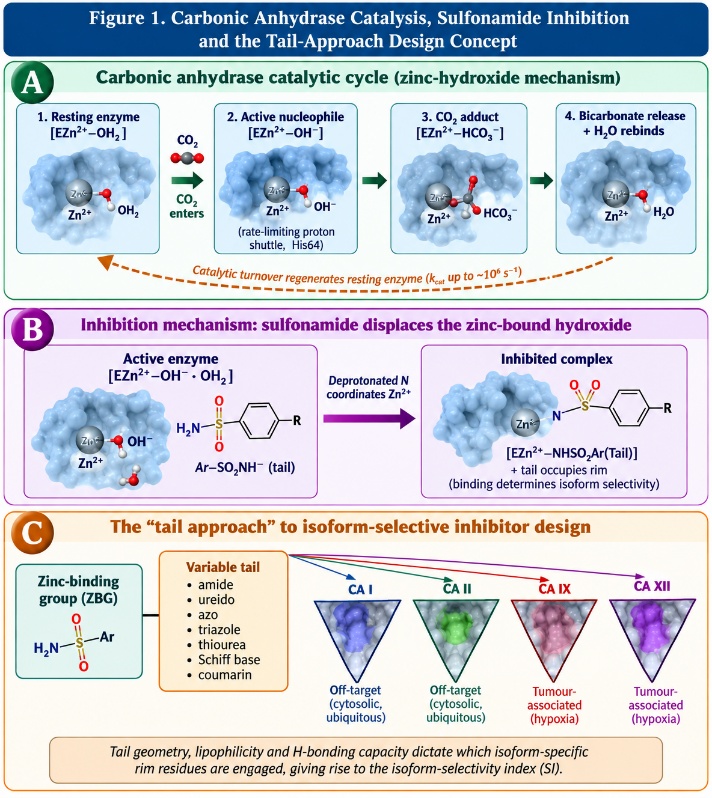
Eight evolutionarily unrelated CA gene families have been described: α (animals, algae, some bacteria), β (bacteria, fungi, plants, archaea), γ (archaea, bacteria), δ and ζ (marine diatoms), η (Plasmodium and other protozoa), θ (diatoms) and ι (dinoflagellates and diatoms) [6]. Despite catalysing an identical net reaction, these families are structurally unrelated and frequently employ different metal ions (Zn2+, Cd2+, Fe2+ or Co2+), a divergence exploited for selective targeting of pathogen CAs over the human α-class enzyme [6]. In humans, sixteen α-CA-encoding genes exist, of which CA I, II, III, VA, VB, VI, VII, IX, XII, XIII and XIV are catalytically active, while CA VIII, X and XI are catalytically inactive CA-related proteins [3]. The active isoforms are further subdivided by localisation into cytosolic (CA I, II, III, VII, XIII), mitochondrial (CA VA, VB), secreted (CA VI) and membrane-associated/transmembrane forms (CA IV, IX, XII, XIV) [3,4]. CA I and CA II — abundant, cytosolic and expressed almost ubiquitously — represent the principal physiological “off-target” isoforms whose inhibition drives most of the adverse-effect burden of non-selective inhibitors, whereas CA IX and CA XII are transmembrane isoforms with restricted normal-tissue expression but marked overexpression in hypoxic solid tumours under hypoxia-inducible factor-1α control, making them attractive, more selectively druggable oncology targets [10,11]. This heterogeneity among fifteen catalytically competent isoforms, despite a nearly invariant catalytic core, is the fundamental biological rationale underlying isoform-selective inhibitor design [3].
3Carbonic anhydrase as a validated drug target
The pharmacological exploitation of CA inhibition began in the 1940s–1950s with the recognition that the sulfonamide antibacterial sulfanilamide produced systemic metabolic acidosis and diuresis as an off-target consequence of CA inhibition, prompting synthesis of more potent benzenesulfonamide derivatives and culminating in acetazolamide as the first clinically used CA inhibitor [7,43]. Acetazolamide, and later methazolamide, dichlorphenamide, dorzolamide and brinzolamide, remain first-line or adjunct agents for glaucoma, where inhibition of ciliary-body CA (principally CA II and CA IV) reduces aqueous humour secretion and intraocular pressure; the transition from systemically acting sulfonamides to topically applied agents such as dorzolamide and brinzolamide was itself a landmark exercise in reducing off-isoform and systemic exposure while preserving local efficacy [43]. Beyond ophthalmology, CA inhibitors are established or investigational agents in idiopathic intracranial hypertension, altitude sickness and epilepsy, and as diuretics/adjuncts in congestive states [4,8].
The most active contemporary frontier is oncology. Solid tumours frequently develop hypoxic regions in which HIF-1α transcriptionally upregulates CA IX and, to a lesser extent, CA XII, which together with anion exchangers and monocarboxylate transporters constitute the principal machinery by which tumour cells export intracellular protons while acidifying the extracellular microenvironment — a phenotype promoting invasion, metastasis, chemoresistance and immune evasion [10,11]. Because CA IX and CA XII are minimally expressed in normal tissue outside the gastrointestinal tract, they are considered among the most tumour-selective cell-surface targets identified to date [10,11]. The clinical-stage compound SLC-0111, a ureido-substituted benzenesulfonamide CA IX/XII inhibitor developed through the tail approach, has completed Phase I evaluation in patients with advanced CA IX-expressing solid tumours, demonstrating a favourable safety profile and providing proof-of-concept that isoform-selective, tail-modified sulfonamides can be translated into the clinic [24,25]; recent work indicates that combining SLC-0111 with cisplatin potentiates antitumour activity in head-and-neck carcinoma models, reinforcing continued clinical interest in this chemotype [26]. Beyond oncology, growing recognition that several pathogens rely on β- or γ-class CAs lacking mammalian homologues has additionally positioned carbonic anhydrase as an emerging antibacterial and antifungal drug target, a theme developed further in Section 7 [6,9].
4The sulfonamide zinc-binding group and the “tail approach”
Virtually all clinically used CA inhibitors share a common pharmacophoric feature: a primary or, less commonly, secondary sulfonamide (–SO2NH2/–SO2NHR) or closely related zinc-binding group (ZBG) that, upon deprotonation, coordinates the active-site Zn2+ ion in tetrahedral geometry, displacing the catalytic zinc-hydroxide/water and switching off the enzyme (Figure 1B) [3,4]. X-ray crystallographic and mutagenesis studies have progressively revealed that the CA active-site cavity is cone-shaped, approximately 15 Å deep, and functionally divided into a hydrophobic half and a hydrophilic half, with considerable isoform-to-isoform variation concentrated toward the rim of the cavity, some 8–10 Å from the metal centre [3,14]. This structural insight underlies the “tail approach,” first systematically articulated by Supuran and co-workers, in which a constant benzenesulfonamide (or closely related ZBG-bearing scaffold) is functionalised — most commonly at the para position of the phenyl ring — with a chemically diverse “tail” appended through an amide, ureido, azo, imine or triazole linker (Figure 1C) [3,4,13]. Because the ZBG anchors the inhibitor rigidly to the Zn2+ ion in a manner conserved across isoforms, while the tail projects outward into the isoform-variable rim, systematic variation of tail length, geometry, charge and hydrogen-bonding capacity allows differential modulation of affinity for individual isoforms, in principle converting a non-selective ZBG into a selective drug [3,13,15].
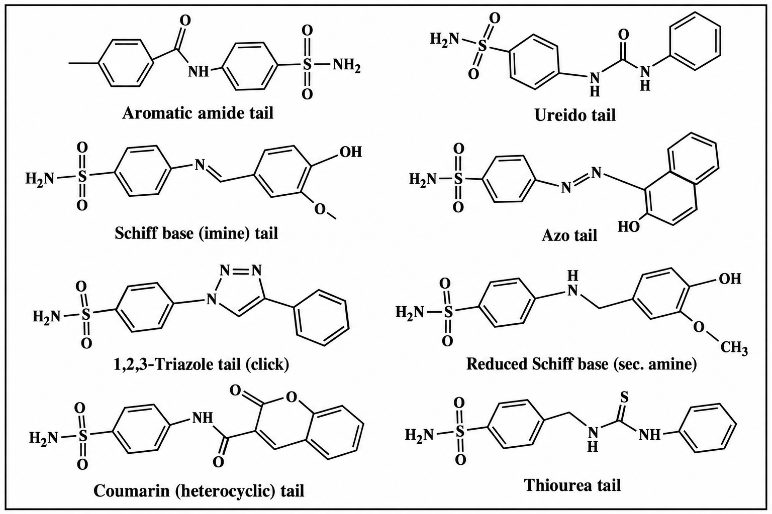
The tail approach has evolved considerably since its introduction. Early work established that even simple amide- or sulfonyl-linked aromatic tails could shift isoform-selectivity ratios by one to two orders of magnitude relative to the unsubstituted parent sulfonamide [15]. Subsequent “dual-tail” and “three-tail” strategies, in which two or three chemically distinct substituents are appended to a single or bis-functionalised benzenesulfonamide core, were designed to simultaneously occupy both halves of the active site or engage residues unique to the entrance rim of CA IX and CA XII, and have reported some of the highest selectivity indices achieved to date for tumour-associated over cytosolic isoforms [16,17,18]. Complementary crystallographic work mapping how different tail chemotypes occupy the entrance/rim of multiple isoforms has provided a structural rationale that increasingly allows selectivity to be designed prospectively rather than discovered empirically [3,14]. Table 1 summarises the principal tail chemotypes reviewed in this work, together with representative linkage chemistry, structural rationale and literature precedents, several of which are also illustrated as generic exemplars in Figure 2.
| Tail chemotype | Representative linkage | Structural / design rationale | Key precedent(s) |
|---|---|---|---|
| Aromatic amide | –C(=O)NH–Ar | Rigid, planar tail; π-stacking with hydrophobic rim residues; earliest tail class explored | [15] |
| Ureido | –NH–C(=O)–NH–Ar | Two H-bond donor/acceptor pairs engage rim + hydrophilic half; basis of clinical candidate SLC-0111 | [17,18,20,24] |
| Schiff base (imine) | –CH=N–Ar | Planar conjugated tail from aldehyde + sulfanilamide condensation; among earliest tail-type CAIs | [35,37] |
| Azo | –N=N–Ar | Extended chromophoric tail; diazo-coupling allows late-stage diversification | [38] |
| 1,2,3-Triazole (click) | CuAAC-derived triazole–Ar | Modular, high-yield, biocompatible conjugation; triazole is an H-bond-competent bioisostere | [19,29] |
| Reduced Schiff base | –CH2–NH–Ar | Flexible, non-planar linker; improves hydrolytic stability relative to the parent imine | [36] |
| Coumarin | Fused bicyclic lactone | Non-zinc “suicide” inhibition via hydrolysis; selective for IX/XII entrance-rim occupancy | [32,33,34] |
| Thioureido | –NH–C(=S)–NH–Ar | Thiocarbonyl analogue of ureido tail; altered H-bonding/lipophilicity; bacterial + antitumour activity | [40,41] |
5Representative tail chemotypes: structure–activity relationships
5.1Aromatic amide tails
Aromatic amide tails, formed by acylation of 4-aminobenzenesulfonamide with substituted benzoyl chlorides or analogous coupling chemistry, represent the historically earliest and structurally simplest tail class investigated within the modern tail-approach framework [15]. The planar amide linkage restricts rotational freedom and favours a semi-extended conformation that allows the appended aryl ring to engage in π-stacking and van der Waals contacts with hydrophobic rim residues, a binding mode first rationalised through comparative crystallography of multiple isoforms bound to congeneric amide-tailed sulfonamides [3]. While simple mono-substituted aromatic amide tails typically achieve only modest isoform-selectivity indices relative to CA II, they established the fundamental proof of concept that appending steric and electronic bulk beyond the ZBG could be tolerated without loss of nanomolar potency, providing the template from which all subsequent, more elaborate tail chemistries were developed [15].
5.2Ureido tails
The ureido tail — installed by reacting an aminobenzenesulfonamide with an aryl isocyanate to generate a 1,3-disubstituted urea linker — has proved one of the most consequential tail chemistries developed to date, because the urea carbonyl and both N–H donors permit simultaneous hydrogen bonding to rim residues while the appended aryl group projects further into solvent-exposed space [20]. Systematic evaluation of ureido-benzenesulfonamides across the panel of human isoforms demonstrated pronounced, structurally rationalisable selectivity for CA IX and CA XII over CA I and CA II, and this chemotype underlies the clinical candidate SLC-0111 (4-[[4-fluorophenyl]-ureido]-benzenesulfonamide), which showed potent antimetastatic activity in preclinical breast-cancer models and has since advanced through Phase I clinical evaluation and combination studies with cytotoxic chemotherapy [20,21,24,26]. More recent “three-tails” ureido/bis-ureido architectures, in which additional substituents are appended around the central urea to address both halves of the active-site cavity, have pushed CA IX/CA I and CA IX/CA II selectivity indices into the three- to four-digit range, among the most selective sulfonamide CA IX inhibitors reported to date [17,18].
5.3Schiff base and reduced Schiff base tails
Schiff base (imine) tails, generated by acid-catalysed condensation of sulfanilamide or related aminobenzenesulfonamides with aromatic aldehydes, were among the earliest tail-type modifications explored, predating the formal articulation of the tail-approach concept, and remain attractive owing to their one-step, atom-economical synthesis [35,37]. The planar, conjugated C=N linkage favours engagement with aromatic and polar rim residues and has yielded inhibitors with unusually balanced affinity across cytosolic and membrane-associated isoforms in several series, in addition to activity against bacterial, fungal and protozoan β-class enzymes [36]. Because the imine bond is susceptible to hydrolytic cleavage under physiological conditions, reduction of the Schiff base to the corresponding secondary amine (a “reduced Schiff base” tail) has been used as a bioisosteric strategy to improve aqueous stability and modulate tail flexibility while retaining much of the parent compound’s isoform-inhibition profile [36].
5.4Azo tails
Azo-linked tails, installed via diazotisation of an aminobenzenesulfonamide followed by electrophilic azo-coupling with electron-rich (hetero)aromatic partners, are synthetically convenient and generate extensively conjugated tail architectures whose chromophoric character has additionally been exploited for chromogenic or fluorescence-based CA activity assays [38]. Structurally more rigid and planar than the amide or ureido tail, azo-tailed benzenesulfonamides — exemplified by clinically used diuretic agents possessing an azo-sulfonamide architecture — demonstrate that this chemotype is compatible with potent, low-nanomolar CA inhibition, although reported isoform-selectivity data for purpose-designed azo-tailed anticancer or antibacterial CA inhibitors remain comparatively sparse, marking this as an underexplored area for further diversification [38].
5.51,2,3-Triazole (click-derived) tails
Copper(I)-catalysed azide–alkyne cycloaddition (“click”) chemistry provides a uniquely modular route to tail diversification: an alkynyl- or azido-functionalised benzenesulfonamide ZBG can be conjugated, in near-quantitative yield under mild aqueous conditions, to a very broad library of complementary azide or alkyne partners to generate 1,4-disubstituted 1,2,3-triazole tails [19]. Beyond synthetic convenience, the triazole ring is itself a competent hydrogen-bond acceptor and reasonable bioisostere for amide/ester linkages, so click-tailed benzenesulfonamides frequently retain, and in several cases improve, isoform-selectivity profiles achieved with more classical tail chemistries while dramatically shortening synthesis timelines [19]. This modularity has been particularly valuable for exploring bacterial and fungal β-/γ-CAs as antimicrobial targets, where click-tailed benzenesulfonamides bearing sugar, fluorescent or heterocyclic azide/alkyne partners have rapidly generated focused libraries against Mycobacterium tuberculosis and Vibrio cholerae carbonic anhydrases, several showing selective bacterial-enzyme inhibition over human off-target isoforms [29]. Click-tailing is therefore increasingly regarded not as one tail chemotype among several, but as a general synthetic platform through which the other tail chemistries discussed here could, in principle, be rapidly diversified and screened [3,19].
5.6Coumarin tails
Coumarins occupy a mechanistically distinct position among CA-inhibitor tail chemistries because, unlike sulfonamide-based tails, the coumarin scaffold is not itself a classical zinc-anchoring pharmacophore; instead, coumarin and thiocoumarin derivatives undergo CA-catalysed hydrolytic ring-opening within the active site to generate a 2-hydroxy-cinnamic-acid-type product that binds at the cavity entrance, occluding substrate access without directly coordinating the catalytic Zn2+ ion — a “non-zinc-mediated,” suicide-inhibition mechanism first elucidated through combined kinetic and X-ray crystallographic studies [32,33]. Because this binding mode occupies the rim/entrance region of greatest sequence divergence among isoforms, appropriately substituted (particularly 7,8-disubstituted) coumarins have achieved striking selectivity for CA IX and CA XII over CA I and CA II, in some cases exceeding selectivity ratios attainable with conventional sulfonamide tails [34]. Although coumarins are not “tails” in the strict sense of being appended to a separate ZBG, their inclusion in tail-approach reviews is now standard because they demonstrate that isoform-selective inhibition can be achieved by exploiting the same rim/entrance structural divergence, using an entirely orthogonal, non-zinc-binding chemotype [32,34].
5.7Thioureido tails
Thioureido tails, obtained by replacing the urea carbonyl of the ureido chemotype with a thiocarbonyl group through reaction of an aminobenzenesulfonamide with an aryl isothiocyanate, retain the two hydrogen-bond-donor architecture of the parent ureido tail while altering electronic distribution, lipophilicity and metal-coordinating propensity, given the well-documented affinity of sulfur-containing groups for transition-metal centres [39,41]. Selenoureido analogues, in which sulfur is further replaced by selenium, show that chalcogen identity at this position can be used as an additional, fine-grained lever for tuning isoform affinity and physicochemical properties without altering the overall tail pharmacophore [40]. Thioureido- and selenoureido-tailed benzenesulfonamides have demonstrated potent inhibition of both human tumour-associated and bacterial carbonic anhydrases, positioning this chemotype at the intersection of anticancer and antibacterial tail-approach design [40,41].
6Isoform selectivity: off-targets vs. tumour-associated isoforms
The therapeutic index of any tail-modified benzenesulfonamide ultimately depends on the ratio of its inhibition constants (Ki) against the physiologically dominant, “off-target” cytosolic isoforms — principally CA I and CA II — relative to the intended pharmacological target, most commonly CA IX/CA XII, or, in an antibacterial context, a pathogen-derived β- or γ-CA lacking any human counterpart [3,4]. Table 2 summarises the principal distinguishing features of these four representative isoforms, most frequently used as the selectivity benchmark panel in tail-approach medicinal chemistry programmes.
| Isoform | Location | Tissue distribution | Role | Relevance to design |
|---|---|---|---|---|
| CA I | Cytosolic | Erythrocytes, GI, eye | CO2/HCO3− buffering | Major off-target |
| CA II | Cytosolic | Erythrocytes, kidney, eye, bone | Fastest isoform; acid–base, aqueous humour | Off-target; wanted only in glaucoma |
| CA IX | Transmembrane | Low in normal GI; hypoxic tumours | HIF-1α-driven acidification; invasion | Primary oncology target (SLC-0111) |
| CA XII | Transmembrane | Kidney, GI (low); several tumours | Complements CA IX in tumour pH | Secondary target; close to CA II |
CA I and CA II are abundant, rapidly turned-over cytosolic enzymes expressed constitutively in erythrocytes, gastrointestinal epithelium, renal tubules and the ciliary body, where they participate in core physiological processes; inhibition of these isoforms is therapeutically desirable only in glaucoma (CA II, ciliary body) and is otherwise the principal driver of the adverse-effect profile of non-selective inhibitors [4]. By contrast, CA IX is essentially undetectable in most normal adult tissues but robustly induced by HIF-1α in hypoxic tumour cores, where it functions alongside CA XII to regulate extracellular acidification and facilitate survival, invasion and immune evasion [10,11]. Achieving a favourable selectivity index (typically Ki(CA II)/Ki(CA IX)) of several hundred- to thousand-fold is now a realistic and, for several ureido-, three-tail- and coumarin-based chemotypes, an already demonstrated design goal [17,18,34]. Nonetheless, complete isoform selectivity remains elusive for most chemotypes, and secondary screening against at least CA I, CA II, CA IX and CA XII — supplemented, where an antibacterial indication is pursued, by the relevant pathogen CA — is now regarded as an essential component of any rigorous tail-modified benzenesulfonamide discovery programme [3,23].
7Bacterial carbonic anhydrases as an emerging antibacterial target
Beyond human isoforms, the tail approach has increasingly been extended to β- and γ-class CAs expressed by clinically important bacterial pathogens, motivated by two converging observations: first, CA activity is essential for bacterial survival under the CO2/bicarbonate-limited or pH-variable conditions encountered during host infection; second, β- and γ-CAs are structurally unrelated to the human α-class enzyme, offering an intrinsic opportunity for pathogen-selective design that minimises off-target human isoform inhibition [6]. β-Carbonic anhydrases have been characterised from Mycobacterium tuberculosis, Vibrio cholerae, Helicobacter pylori, Brucella suis and other pathogens, and genetic or pharmacological CA inhibition has been shown in several cases to impair bacterial growth, acid resistance or biofilm formation, directly validating CA as an antibacterial target [27,28]. Because bacterial β-CAs frequently possess an active-site architecture and oligomeric assembly distinct from human α-CAs, tail-modified benzenesulfonamides have been systematically screened against human and bacterial isoform panels in parallel, allowing early identification of chemotypes with genuine pathogen-over-host selectivity [27,28,30].
Click-chemistry-derived triazole tails have proved particularly well suited to this effort because CuAAC modularity allows rapid generation of large, structurally diverse tail libraries for parallel screening against M. tuberculosis and V. cholerae β-CAs, with several click-tailed benzenesulfonamides showing selective, low-micromolar-to-nanomolar bacterial enzyme inhibition [29]. Chalcogen-containing tails, including selenazole- and thioureido-functionalised benzenesulfonamides, have likewise shown promising activity against bacterial α-, β- and γ-class CAs, illustrating that several tail chemotypes developed for oncology applications are directly repurposable for antibacterial discovery once re-screened against pathogen enzyme panels [30]. Given the accelerating global burden of antimicrobial resistance and the comparative scarcity of genuinely novel bacterial drug targets reaching clinical evaluation, carbonic anhydrase inhibition — and specifically tail-modified benzenesulfonamide chemistry — has been identified as a promising, mechanistically differentiated avenue for antibacterial drug discovery [6,31].
8Computational and in silico approaches
Structure-based and ligand-based computational methods have become integral to modern tail-approach medicinal chemistry, complementing rather than replacing experimental enzyme-inhibition and crystallographic studies. The steadily expanding set of high-resolution crystal structures of human CA isoforms in complex with tail-modified sulfonamides has enabled increasingly detailed structural annotation of isoform-specific rim and entrance residues, allowing molecular docking and structure-based virtual screening to prospectively rank candidate tail chemistries before synthesis [12,14]. Molecular docking, molecular dynamics and free-energy perturbation approaches are now routinely combined with QSAR and DFT calculations to rationalise observed selectivity trends and prioritise virtual tail libraries, of particular value for triazole/click tails where large numbers of building blocks can be computationally screened. In parallel, ADMET prediction and drug-likeness filtering, most commonly benchmarked against Lipinski’s “rule of five” (molecular weight ≤ 500 Da, calculated log P ≤ 5, ≤ 5 H-bond donors and ≤ 10 H-bond acceptors), are now standard early-stage filters applied to newly designed tail-modified benzenesulfonamide libraries [42]. Because several tail chemistries — particularly bis- and three-tailed ureido architectures and coumarin conjugates — carry substantial molecular weight and polar surface area, prospective in-silico ADMET triage is especially important in this chemical space. These computational tools do not obviate the need for direct enzyme-inhibition assays across the full isoform panel, but meaningfully narrow the design space and increasingly allow isoform selectivity to be engineered prospectively rather than discovered by trial-and-error synthesis.
9General structure–activity relationship trends
Synthesising the tail chemistries reviewed in Section 5 and Table 1, several structure-activity principles recur across otherwise disparate tail classes. First, tail length and flexibility must be balanced: overly short or rigid tails fail to reach the isoform-variable rim, while excessively long or flexible tails can incur an entropic penalty and paradoxically reduce potency [3,13]. Second, hydrogen-bond donor/acceptor pairs within the linker itself — as in the ureido and thioureido chemotypes — consistently correlate with higher selectivity indices than purely hydrophobic linkages such as simple aromatic amides, consistent with greater polarity and residue diversity at the rim relative to the hydrophobic mid-cavity [16,17]. Third, chemotypes amenable to combinatorial or “click” diversification have generated substantially larger structure-activity datasets than chemotypes requiring bespoke multistep synthesis, accelerating SAR refinement for those series [9,19]. Fourth, dual- and three-tail ligands demonstrate that combining a ureido linkage with a second substituent on the same or an adjacent ring can yield additive or synergistic selectivity gains beyond either tail alone, suggesting future design will increasingly favour multi-component tail architectures [16]. Finally, across nearly all chemotypes, electron-withdrawing terminal-ring substituents (halogens, trifluoromethyl, nitro) tend to enhance potency against tumour-associated isoforms modestly more than against CA I/II, a trend that continues to inform terminal-substituent choice in newly designed tail-modified benzenesulfonamide series [8,9].
10Challenges and future perspectives
Despite two decades of progress, several challenges constrain translation of tail-modified benzenesulfonamide chemistry into approved therapeutics. Absolute isoform selectivity — complete sparing of CA I and CA II while retaining nanomolar potency against CA IX, CA XII or a pathogen enzyme — has not yet been achieved for any reported chemotype, and even the most selective ureido- and three-tail-based compounds retain measurable off-target activity requiring comprehensive isoform-panel characterisation before advancement [3,4]. Physicochemical liabilities associated with several elaborate tail architectures, including high molecular weight, poor aqueous solubility and metabolic lability of labile linkages such as the unreduced Schiff-base imine, represent a recurring obstacle, only partially addressed by the bioisosteric and ADMET-guided strategies discussed above [23,36]. On the antibacterial front, translating in-vitro enzyme-inhibition and MIC data into validated in-vivo efficacy against clinically relevant pathogens remains comparatively early-stage relative to the oncology-focused literature [6,31]. A further consideration, of particular relevance to any translational carbonic anhydrase programme, is that a target and chemotype validated almost exclusively through academic medicinal chemistry literature can remain vulnerable to shifting patent, regulatory and commercial priorities long after the underlying enzymology has been robustly established; sustained clinical investment in isoform-selective CA inhibitors will likely depend on continued biomarker-driven patient selection (e.g., CA IX expression status) and clear differentiation from existing standard-of-care agents. Looking forward, the convergence of structure-based design, click-chemistry-enabled rapid tail diversification, multi-tailed ligand architectures and increasingly predictive computational modelling is likely to accelerate discovery of next-generation tail-modified benzenesulfonamide derivatives with improved selectivity, developability and, potentially, dual anticancer/antibacterial utility.
11Conclusion
Carbonic anhydrase inhibition has evolved, over nearly eight decades, from the serendipitous discovery of sulfonamide-induced metabolic acidosis to a mature, structure-guided medicinal chemistry discipline capable of engineering isoform selectivity across a family of sixteen closely related human metalloenzymes. The tail approach — retention of a constant, high-affinity benzenesulfonamide zinc-binding group combined with systematic diversification of an appended tail — has proved the single most productive strategy for achieving this selectivity, and the eight tail chemotypes reviewed here (aromatic amide, ureido, Schiff base, azo, triazole, reduced Schiff base, coumarin and thioureido) collectively illustrate how varied chemical space can be explored around an invariant pharmacophoric anchor. Ureido- and three-tail-based chemotypes have progressed furthest toward clinical translation, exemplified by SLC-0111, while triazole/click and thioureido/selenoureido tails offer particularly promising modularity for rapid, parallel exploration of both anticancer and antibacterial applications, including against bacterial β- and γ-class carbonic anhydrases lacking human counterparts. Continued integration of structure-based design, computational ADMET triage and multi-tailed ligand architectures is expected to further refine isoform selectivity and developability, positioning tail-modified benzenesulfonamide derivatives as a durable, still-expanding platform for future carbonic anhydrase-targeted drug discovery.
References
- [1]Meldrum NU, Roughton FJW. Carbonic anhydrase. Its preparation and properties. J Physiol. 1933;80(2):113–142.
- [2]Supuran CT. Structure and function of carbonic anhydrases. Biochem J. 2016;473(14):2023–2032.
- [3]Alterio V, Di Fiore A, D'Ambrosio K, Supuran CT, De Simone G. Multiple binding modes of inhibitors to carbonic anhydrases: how to design specific drugs targeting 15 different isoforms?. Chem Rev. 2012;112(8):4421–4468.
- [4]Supuran CT. Carbonic anhydrases: novel therapeutic applications for inhibitors and activators. Nat Rev Drug Discov. 2008;7(2):168–181.
- [5]Krishnamurthy VM, Kaufman GK, Urbach AR, et al. Carbonic anhydrase as a model for biophysical and physical-organic studies of proteins and protein-ligand binding. Chem Rev. 2008;108(3):946–1051.
- [6]Capasso C, Supuran CT. An overview of the alpha-, beta- and gamma-carbonic anhydrases from bacteria: can bacterial carbonic anhydrases shed new light on evolution of bacteria?. J Enzyme Inhib Med Chem. 2015;30(2):325–332.
- [7]Pastorekova S, Parkkila S, Pastorek J, Supuran CT. Carbonic anhydrases: current state of the art, therapeutic applications and future prospects. J Enzyme Inhib Med Chem. 2004;19(3):199–229.
- [8]Supuran CT. Carbonic anhydrase inhibitors. Bioorg Med Chem Lett. 2010;20(12):3467–3474.
- [9]Supuran CT, Scozzafava A. Carbonic anhydrases as targets for medicinal chemistry. Bioorg Med Chem. 2007;15(13):4336–4350.
- [10]Thiry A, Dogné JM, Masereel B, Supuran CT. Targeting tumor-associated carbonic anhydrase IX in cancer therapy. Trends Pharmacol Sci. 2006;27(11):566–573.
- [11]Neri D, Supuran CT. Interfering with pH regulation in tumours as a therapeutic strategy. Nat Rev Drug Discov. 2011;10(10):767–777.
- [12]Nocentini A, Supuran CT. Advances in the structural annotation of human carbonic anhydrases and impact on future drug discovery. Expert Opin Drug Discov. 2019;14(11):1175–1197.
- [13]Winum JY, Rami M, Scozzafava A, Montero JL, Supuran CT. Carbonic anhydrase IX: a new druggable target for the design of antitumor agents. Med Res Rev. 2008;28(3):445–463.
- [14]Looking toward the rim of the active site cavity of druggable human carbonic anhydrase isoforms. J Enzyme Inhib Med Chem. 2020.
- [15]A decade of tail-approach based design of selective as well as potent tumor-associated carbonic anhydrase inhibitors. Bioorg Med Chem. 2022.
- [16]Alterio V, Di Fiore A, D'Ambrosio K, De Simone G, Supuran CT. Carbonic anhydrase inhibitors with dual-tail moieties to match the hydrophobic and hydrophilic halves of the carbonic anhydrase active site. J Med Chem. 2014.
- [17]Sulfonamide inhibitors of human carbonic anhydrases designed through a three-tails approach: improving ligand/isoform matching and selectivity of action. J Med Chem. 2020.
- [18]The three-tails approach as a new strategy to improve selectivity of action of sulphonamide inhibitors against tumour-associated carbonic anhydrase IX and XII. J Enzyme Inhib Med Chem. 2022.
- [19]Wilkinson BL, Bornaghi LF, Houston TA, Innocenti A, Supuran CT, Poulsen SA. Carbonic anhydrase inhibition with benzenesulfonamides and tetrafluorobenzenesulfonamides obtained via click chemistry. ACS Med Chem Lett. 2014.
- [20]Pacchiano F, Carta F, McDonald PC, et al. Ureido-substituted benzenesulfonamides potently inhibit carbonic anhydrase IX and show antimetastatic activity in a model of breast cancer metastasis. J Med Chem. 2011;54(6):1896–1902.
- [21]Lou Y, McDonald PC, Oloumi A, et al. Targeting tumor hypoxia: suppression of breast tumor growth and metastasis by novel carbonic anhydrase IX inhibitors. Cancer Res.
- [22]Discovery of benzenesulfonamides with potent human carbonic anhydrase inhibitory and effective anticonvulsant action: design, synthesis, and pharmacological assessment. J Med Chem. 2017.
- [23]Pastorekova S, Supuran CT. Carbonic anhydrase inhibitors and their potential in a range of therapeutic areas. Expert Opin Ther Pat. 2018;28(10):709–712.
- [24]A Phase 1 study of SLC-0111, a novel inhibitor of carbonic anhydrase IX, in patients with advanced solid tumors. Am J Clin Oncol. 2020.
- [25]Phase I. clinical trials of SLC-0111, a novel inhibitor of carbonic anhydrase IX, in patients with advanced solid tumors. Cancer Res (AACR Abstract). 2020.
- [26]Inhibition of carbonic anhydrases IX/XII by SLC-0111 boosts cisplatin effects in hampering head and neck squamous carcinoma cell growth and invasion. J Exp Clin Cancer Res. 2022.
- [27]Vullo D, Del Prete S, Osman SM, et al. Sulfonamide inhibition studies of the β-carbonic anhydrase from the pathogenic bacterium Vibrio cholerae. Bioorg Med Chem Lett.
- [28]Nishimori I, Vullo D, Innocenti A, Scozzafava A, Mastrolorenzo A, Supuran CT. Carbonic anhydrase inhibitors: cloning, characterization, and inhibition studies of a new beta-carbonic anhydrase from Mycobacterium tuberculosis. J Med Chem.
- [29]Click-tailed benzenesulfonamides as potent bacterial carbonic anhydrase inhibitors for targeting Mycobacterium tuberculosis and Vibrio cholerae. Bioorg Med Chem. 2019.
- [30]Inhibition of bacterial α-, β- and γ-class carbonic anhydrases with selenazoles incorporating benzenesulfonamide moieties. J Enzyme Inhib Med Chem. 2019.
- [31]An overview of novel antimicrobial carbonic anhydrase inhibitors. Expert Opin Ther Pat. 2023.
- [32]Maresca A, Temperini C, Vu H, et al. Non-zinc mediated inhibition of carbonic anhydrases: coumarins are a new class of suicide inhibitors. J Am Chem Soc. 2009;131(8):3057–3062.
- [33]Maresca A, Supuran CT. Deciphering the mechanism of carbonic anhydrase inhibition with coumarins and thiocoumarins. J Med Chem. 2010;53(2):612–618.
- [34]Maresca A, Scozzafava A, Supuran CT. 7,8-Disubstituted- but not 6,7-disubstituted coumarins selectively inhibit the transmembrane, tumor-associated carbonic anhydrase isoforms IX and XII over the cytosolic ones i and II in the low nanomolar/subnanomolar range. Bioorg Med Chem Lett. 2010;20(24):7255–7258.
- [35]Scozzafava A, Menabuoni L, Mincione F, Briganti F, Mincione G, Supuran CT. Carbonic anhydrase inhibitors: synthesis of schiff bases of hydroxybenzaldehydes with aromatic sulfonamides, and their reactions with arylsulfonyl isocyanates. Eur J Med Chem / J Enzyme Inhib. 2000.
- [36]Inhibition studies of bacterial, fungal and protozoan β-class carbonic anhydrases with Schiff bases incorporating sulfonamide moieties. Bioorg Med Chem. 2015.
- [37]Carbonic anhydrase inhibitors: Schiff's bases of aromatic and heterocyclic sulfonamides and their metal complexes. J Enzyme Inhib Med Chem.
- [38]Sulfonamide diuretic azosemide as an efficient carbonic anhydrase inhibitor. J Mol Struct. 2022.
- [39]Carta F, Aggarwal M, Maresca A, et al. Dithiocarbamates strongly inhibit carbonic anhydrases and show antiglaucoma action in vivo. J Med Chem.
- [40]Discovery of new selenoureido analogues of 4-(4-fluorophenylureido)benzenesulfonamide as carbonic anhydrase inhibitors. ACS Med Chem Lett. 2017.
- [41]Design and synthesis of some new benzoylthioureido benzenesulfonamide derivatives and their analogues as carbonic anhydrase inhibitors. J Enzyme Inhib Med Chem. 2022.
- [42]Lipinski CA, Lombardo F, Dominy BW, Feeney PJ. Experimental and computational approaches to estimate solubility and permeability in drug discovery and development settings. Adv Drug Deliv Rev. 2001;46(1–3):3–26.
- [43]Supuran CT, Scozzafava A, Casini A. Carbonic anhydrase inhibitors: the development of topically acting carbonic anhydrase inhibitors as anti-glaucoma agents. Med Res Rev. 2003;23(2):146–189.