Predictive Analytics
Predictive Analytics for Construction Material Procurement, Cost Control and Schedule Performance in Saudi Giga-Projects
Published October 2026
Abstract
Unprecedented construction activity, tight delivery windows, complex interfaces, global sourcing, and exposure to volatile material markets characterize Saudi Arabia’s giga-project portfolio. These conditions make procurement, cost control, and schedule performance highly interrelated. This review critically discusses how predictive analytics can convert fragmented project, commercial, supply-chain, and progress data into forward-looking decisions for construction material procurement for Saudi giga-projects. An integrative review method integrates recent peer-reviewed evidence on machine learning, construction cost forecasting, schedule prediction, digital supply chains, building information modeling, digital twins, and Saudi project performance. The literature indicates that the predictive value is greatest when models combine material demand, price escalation, supplier reliability, lead times, inventory status, progress quantities, and schedule logic, rather than attempting to predict a single outcome in isolation. Ensemble learning and hybrid models regularly yield better forecasting precision, but their operational-level usefulness depends on data quality, temporal validity, explainability, and integration with procurement and project-control workflows. Saudi studies consistently identify material-price fluctuation, change orders, planning weaknesses, and delayed approvals as major cost and time pressures. Yet, direct evidence of analytics-enabled procurement in giga-project settings remains limited. The review suggests an integrated predictive-control architecture that links 5D BIM, enterprise resource planning, supplier data, market indicators and planning systems. It argues that predictive analytics in giga-project organizations should be seen as a governance capability rather than a standalone algorithm, marrying model outputs with human review, uncertainty ranges and auditable intervention thresholds. Future research directions encompass Saudi longitudinal datasets, cross-project transferability, causal evaluation of interventions, supplier-risk prediction, and explainable models that jointly optimize procurement cost, material availability, and schedule resilience.
Keywords: predictive analytics; construction procurement; material price forecasting; cost control; schedule performance; Saudi Arabia; giga-projects; BIM; digital twins; machine learning
1Introduction
Saudi Arabia’s Vision 2030 has accelerated a construction programme characterised by major capital commitments, compressed delivery expectations, and portfolios in which infrastructure, buildings, utilities, tourism assets, and urban systems are developed concurrently. In these environments, material procurement is not merely a back-office purchasing function; it is a central control mechanism linking design maturity, quantities, supplier capacity, logistics, cash flow, and critical-path execution. Studies conducted in Saudi Arabia continue to identify cost and schedule pressures, including material-price escalation, weak planning, change orders, and delays in payments or approvals (Alshihri et al., 2022; Aldossari, 2025; Alotaibi et al., 2025). In giga-projects, these interdependencies are intensified by competition among multiple packages for the same supplier capacity, exposure of imported inputs to international market fluctuations, and the possibility that late material arrival will cascade across tightly coupled work fronts.
Predictive analytics shifts project control from retrospective reporting toward probabilistic anticipation. In construction, machine-learning models have been applied to forecast final cost, delay risk, production duration, and other performance outcomes. Recent studies indicate the potential of ensemble algorithms and hybrid optimisation when relationships are nonlinear and interactive. In parallel, BIM, 5D cost modelling, digital twins, and digitalised supply chains provide data environments that can connect quantities, planned dates, actual progress, procurement commitments, and market signals more effectively than conventional monthly reporting (Ranjbar et al., 2021; Yevu et al., 2021; Omrany et al., 2023).
However, forecast accuracy does not automatically translate into improved project performance. Construction datasets are heterogeneous, incomplete, and sensitive to changes in scope, supplier behaviour, and contractual decisions. A model trained on completed projects may not transfer reliably to a giga-project that uses new construction methods, localisation requirements, or market conditions absent from the training data. Procurement decisions also involve trade-offs: early purchasing may protect the schedule but increase inventory and financing costs, whereas delayed ordering may conserve cash while increasing exposure to escalation or late delivery. Supplier selection similarly balances price, capacity, reliability, and lead-time uncertainty. The material-purchasing problem can therefore be framed as a joint supplier-selection, inventory, and ordering problem under uncertainty (Chen et al., 2023), reinforcing the need to connect prediction with optimisation rather than treat forecasts as isolated outputs.
There is also a Saudi dimension. While BIM adoption is growing, the maturity of its implementation, institutional coordination and data standardisation remain uneven (Algahtany et al., 2023; Alghuried, 2023). Saudi projects show that BIM can improve time and expense management, but benefits depend on organisational practices and sharing of reliable information (Alnaser et al., 2023; Almujibah, 2023; Alasmari et al., 2023). Thus, the review is not limited to predictive systems' ability to predict cost or delay, but focuses on organising predictive analytics around material procurement decisions that affect cost control and schedule performance in Saudi giga-projects.
The main contribution is an integrated interpretation of three often separated literatures: construction material procurement and supply-chain management; project cost and schedule analytics; and Saudi digital project-control practice. The review links these streams to determine where predictive analytics can supply actionable lead time before disruption, where evidence is lacking, and how a pragmatic architecture can embed predictions into procurement and project-control governance.
2Aim of the study
This review critically synthesises peer-reviewed evidence on predictive analytics for construction material procurement, cost control, and schedule performance and interprets that evidence for the specific context of Saudi giga-projects. It traces the decision chain from anticipated material demand and price movements through supplier selection, ordering, delivery, installation, cost exposure, and schedule consequences. It also considers the organisational and digital prerequisites required for predictions to support timely interventions rather than simply generate additional dashboards.
3Research objectives
The review has five objectives. First, it identifies predictive variables, data sources, and modelling methods relevant to material demand, prices, supplier performance, project cost, and schedule outcomes. Second, it examines how procurement decisions connect analytics with project performance. Third, it assesses the contribution of BIM, 5D BIM, digital twins, and digital supply-chain technologies to integrated predictive control. Fourth, it evaluates the contextual requirements for applying these approaches to giga-projects using Saudi-specific evidence on cost overruns, delays, BIM adoption, and project controls. Fifth, it defines research and implementation priorities for predictive analytics that are explainable, uncertainty-aware, and suitable for governance-based decision making.
4Research questions
The review addresses five research questions. (1) Which data and predictive techniques are most useful for anticipating material-procurement, cost, and schedule risks in large-scale construction projects? (2) How can predictions be translated into decisions on supplier selection, order timing, inventory management, and expediting to improve cost and schedule outcomes? (3) What digital integration is required to connect BIM quantities, project schedules, commercial systems, supplier information, and market indicators? (4) Which characteristics of Saudi construction projects constrain or facilitate the use of predictive analytics? (5) What research designs are required to demonstrate that predictive interventions themselves, rather than forecast accuracy alone, improve giga-project performance?
5Review methodology
The research problem spans construction management, supply-chain management, cost engineering, project controls, and digital engineering; an integrative review approach was therefore adopted. The review was structured around principles of transparent systematic searching while allowing analytical synthesis across empirical and review studies. Relevant literature was identified through Scopus, Web of Science, ScienceDirect, SpringerLink, Emerald Insight, the ASCE Library, and publisher platforms using combinations of terms related to predictive analytics, machine learning, construction cost, schedule prediction, material procurement, material price, construction supply chain, supplier selection, BIM, 5D BIM, digital twin, Saudi Arabia, giga-project, megaproject, delay, and cost overrun. Boolean combinations were used to capture both method-led and problem-led studies.
The review focused on peer-reviewed journal articles published between 2020 and 2025. The final reference set comprises 30 sources, all within that period. Studies were included when they directly addressed at least one of five areas: predictive construction cost or schedule models; material-price or procurement analytics; construction supply-chain digitalisation; BIM- or digital-twin-enabled control; or Saudi construction performance and digital adoption. Studies were excluded when they addressed generic artificial intelligence without clear construction relevance, focused solely on structural or safety prediction, were conference-only publications, or provided insufficient methodological detail for meaningful comparison.
A PRISMA-style numerical screening history is not reported because the underlying search export and de-duplication log were not retained in an auditable form. To avoid fabricating screening counts, methodological transparency is instead provided through explicit scope, search terms, inclusion and exclusion criteria, and a fixed reference set. During manuscript quality control, the reference list was checked for internal bibliographic consistency, DOI formatting, duplication, and citation-reference matching. Study quality was considered in relation to peer-review status, data provenance, appropriateness of modelling and validation methods, treatment of uncertainty, evidence of out-of-sample testing, decision relevance, and transferability. Empirical studies were used to examine operational mechanisms and limitations, while review articles were used to identify broader field-level patterns.
The synthesis was carried out in four stages. In the first stage, the studies were coded according to the decision they concerned: demand, price, supplier, cost, schedule, logistics, or integrated control. In the second stage, the types of analytics were classified as regression, tree-based learning, ensemble learning, neural or deep learning, hybrid optimization, probabilistic modelling, or digital-twin simulation. In the third stage, the enabling data infrastructures were mapped, these including BIM, 5D BIM, RFID/IoT, enterprise systems, and market indicators; in the fourth stage, Saudi evidence was used as a contextual filter to determine if approaches which have been demonstrated internationally are suitable in light of the local performance pressures. Because outcome measures, datasets, and validation criteria vary substantially across the included studies, the synthesis is interpretive rather than meta-analytic. Consequently, statements about model superiority are treated as context-dependent and are not generalised beyond the conditions under which the models were evaluated.
| Decision target | Typical predictors | Suitable methods | Operational action | Key caution |
|---|---|---|---|---|
| Material price | Historical price, commodity indices, FX, freight, source-country indicators | Time series, tree ensembles, hybrid models | Advance/defer order; lock price; scenario budget | Regime change and horizon sensitivity |
| Material demand | BIM quantities, design revisions, productivity, lookahead plan | Regression, gradient boosting, sequence models | Release requisition; adjust quantities; stage deliveries | Design maturity and coding consistency |
| Supplier delivery | Capacity, promised dates, fabrication milestones, prior reliability | Classification, survival/time-to-event, calibrated ensembles | Expedite; dual source; split order; escalate | Sparse supplier history and concept drift |
| Cost exposure | Committed cost, market forecasts, cash flow, changes, progress | 5D BIM, ensemble regression, simulation | Reforecast; contingency action; commercial strategy | False precision if uncertainty is hidden |
| Schedule impact | Required-on-site date, critical path, float, delivery forecast | Delay classifiers, schedule NLP, simulation/digital twin | Resequence; protect critical work; revise lookahead | Delivery lateness is not equal to schedule impact |
6Thematic literature review and critical analysis
The initial stage in applying predictive analytics to material procurement is to realise that procurement risk is multidimensional. In the case of construction supply chains, the networks involved are temporary and fragmented, with the flow of information and materials crossing organisational boundaries. Systematic reviews have shown that coordination, visibility and integration are continuous weaknesses, and research into digitalisation highlights various mechanisms—such as BIM, IoT, cloud platforms and blockchain—as ways of improving information continuity (Studer and de Brito Mello, 2021; Yevu et al., 2021; Yoon and Pishdad-Bozorgi, 2022). For giga-projects, this breaking up turns into a portfolio issue since one supplier might be providing a number of different packages, common logistics routes may restrict deliveries, and procurement commitments can transfer risk between contractors, programme managers and clients. Predictive analysis therefore needs to extend beyond unit prices to include supplier capacity, approval status, fabrication progress, transport lead times, and material consumption rates.
Forecasting material prices is a well-established approach. Liu et al. (2024) distinguish between causal models that use economic variables and time-series methods which rely on historical price series, and they point out that hybrid methods are suitable for volatile markets. Lederer et al. (2024) reach a similar conclusion, namely that the choice of model should depend on the data available and the forecast horizon rather than on current methodological trends.
Shiha and El-Adaway (2024) find that macroeconomic indicators of trading partners can improve the prediction of construction material prices, a finding that is particularly relevant for supply chains that are dependent on imports. In the case of Saudi giga-projects, this implies the need for a multi-layered forecasting approach which combines domestic price series with exchange rates, freight conditions, commodity benchmarks and indicators from the major source countries. A national inflation index is unlikely to account for exposure to steel, copper, facade systems, or specialist equipment obtained from different global markets. It is only the amount of work involved and the timing that give price forecasts any real value; 5D BIM connects the quantities that have been modelled with cost data and schedules, allowing the expected price changes to be expressed in terms of package-level exposure. According to Ranjbar et al. (2021), 5D BIM is able to assist with cash-flow risk analysis by taking into account the patterns of resource payments and the uncertainties involved. Other evidence relating to 5D BIM also leads to the wider conclusion that, in reality, organisational integration, disciplined data exchange, and alignment of the commercial workflow are just as important as the software's inherent capabilities. Studies carried out in Saudi Arabia back this up by showing that BIM can help reduce causes of delay and improve visibility regarding time and cost.
Nevertheless, the benefits of BIM depend on adoption barriers, governance structures, user capability, and the quality of implementation. Alasmari et al. (2023), for example, show in a Saudi case context that life-cycle cost benefits depend on effective BIM implementation rather than on the nominal availability of a model.
The attractiveness of nonlinear modelling is illustrated by research into machine-learning cost models. Sharma et al. (2022) found that ensemble models are effective at predicting construction costs as functions of time, resources, and environmental elements. Meharie et al. (2022) achieved better highway cost predictions by stacking a number of different models. Bakhshi et al. (2022) combined machine learning with metaheuristic optimisation in order to predict both the final cost and the time required. While these studies show that model ensembles are useful when the relationships are nonlinear and interactive, they also point out problems relating to transferability. The training data sets are usually small, specific to individual projects, or come from environments with different procurement arrangements. In a giga-project, structural breaks caused by changes to the scope, the introduction of new suppliers, or market shocks may render the learned relationships invalid. Model monitoring and regular retraining are therefore necessary operational requirements and not just optional technical improvements.
Schedule prediction should not be treated as a stand-alone extension of schedule logic analysis. Egwim et al. (2021) show the potential of ensemble learning for improving the prediction of construction delays. Amer et al. (2022) use deep-learning natural-language processing to identify and evaluate activity relationships. In later work, Amer et al. (2023) go on to carry out schedule augmentation and automatic revisions to the look-ahead. These contributions are highly relevant to procurement since a delay in the delivery of materials has an impact on the schedule via activity dependencies, float and sequencing. However, a two-week delay in delivery is not equally serious for all materials; the consequences depend on whether the related activity is critical, whether substitution is possible, and whether resequencing leads to downstream congestion. Therefore, predictive procurement should consider schedule sensitivity, not just the expected date of delivery.
Industrialised, modular construction serves as a suitable analogy for the logistics of giga-projects. According to Mohsen et al. (2022), production time was predicted by using real-time RFID data and machine learning, demonstrating the way in which operational sensor data is able to enhance the predictability of schedules. Lee and Lee (2021) developed a digital twin for modular logistics by combining BIM, GIS and IoT in order to predict possible risks and to estimate the arrival time. Digital twins are being used more and more in the construction industry, as indicated in the reviews by Omrany et al. (2023), although they do experience difficulties such as interoperability and the lack of lifecycle data. In the Saudi giga-projects, a similar kind of system could be used to connect the fabrication yards, the consolidation centres, the ports, the border clearance points, the laydown areas and the installation zones. The advantage is that procurement forecasts can be updated as physical events take place, thus lessening the reliance on static supplier reports.
The selection of suppliers and the process of placing orders are directed by both prescriptive and predictive logic. Chen et al. (2023) examine supplier selection, material buying, and inventory decisions together in cases where prices, capacities, and delay periods are uncertain. This is important since the lowest estimated purchase price might not result in the lowest project cost when late deliveries, expediting, storage, and interferences are taken into account.
The procurement system for a giga-project therefore ought to assess the expected total landed cost as well as the schedule-adjusted cost. The reliability scores for suppliers should incorporate measures such as historical on-time delivery, the number of quality rejections, response time, variation in production capacity, and exposure to financial as well as geopolitical risks. The predictive results can then be used to establish the optimisation rules for order splitting, framework agreements, safety stock, alternative sourcing and expediting. Research on construction performance in Saudi Arabia demonstrates the importance of context. Alshihri et al. (2022) identify material-price fluctuation among important contributors to cost overruns and show that cost and time risks are interrelated. Aldossari (2025) reports substantial cost and schedule growth in higher-education construction projects and identifies owner-, contractor-, labour-, and government-related factors. Alfalah et al. (2024) emphasise time performance as an important dimension of contractor assessment, while Mosly (2025) examines factors influencing construction costs in Saudi Arabia. Alotaibi et al. (2025) further indicate that project-control effectiveness depends on organisational, human, technological, and managerial-control factors. Collectively, these studies caution against treating analytics as a stand-alone technological solution.
If approvals are slow, responsibilities are unclear, data are not trusted, or corrective actions are not authorised, predictive outputs will have limited practical value. The same conclusion can be found in the wider AI literature. Abioye et al. (2021) and Baduge et al. (2022) note that there has been rapid growth in the use of AI in the construction sector but point out problems relating to data, integration and implementation. Regona et al. (2022) identified barriers to adoption, such as a lack of skills, organisational readiness and disjointed data.
This is significant since giga-projects typically have a large amount of data but endure poor semantic consistency; the various contractors may use different structures when coding materials, activities and cost accounts. Predictive integration therefore needs a common data model which links the work breakdown structure, the cost analysis structure, the procurement packages, the BIM objects and the supplier identifiers.
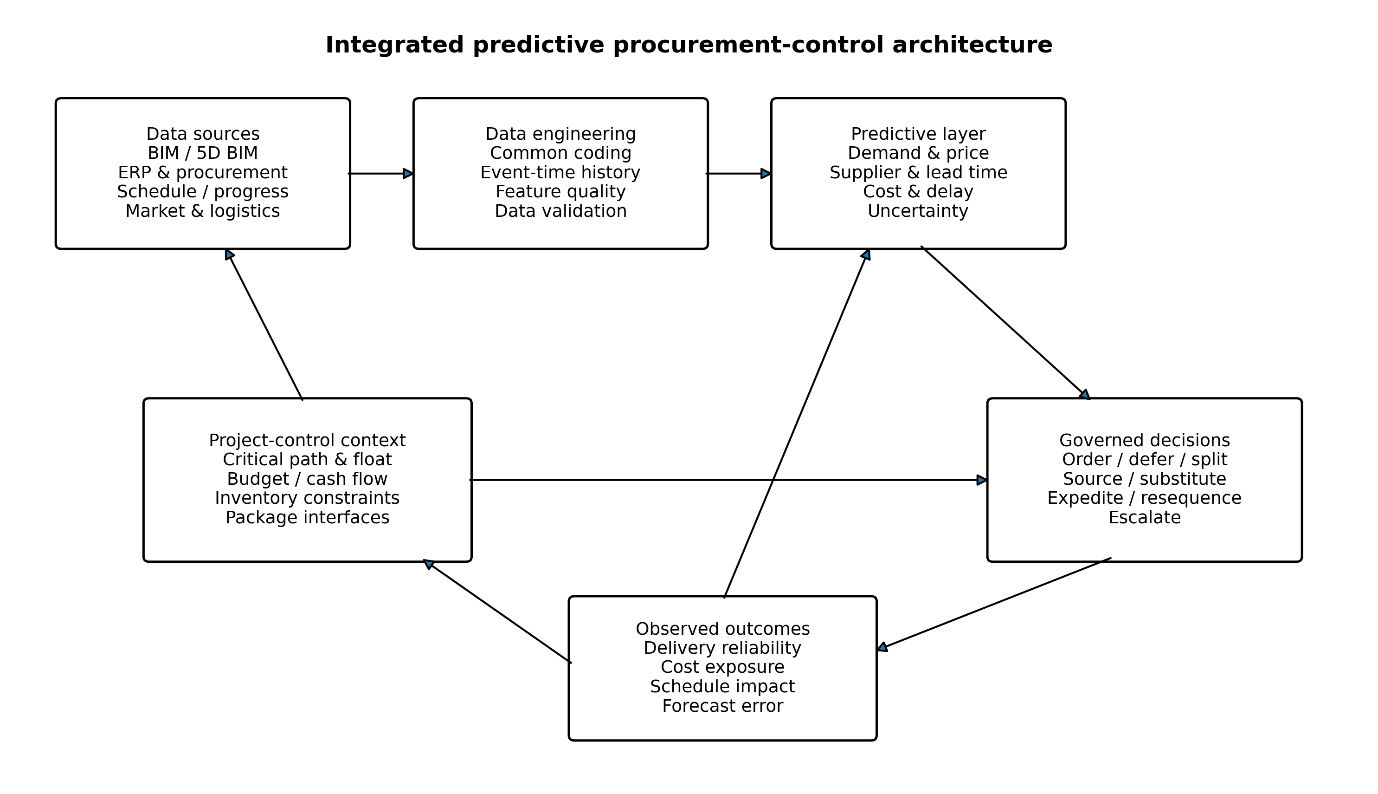
Figure 1 presents this integrated architecture. The process starts with data capture, continues with feature engineering and predictive systems, and concludes with governed interventions. Most important of all, the feedback loop sends the actual results from procurement and projects back into the model environment. If this loop is not present, then the predictive systems amount no more than static reporting; but with the loop in place, the models are able to learn from forecast errors, supplier deviations, and the effectiveness of the interventions.
The literature also highlights the importance of making uncertainty explicit. Point estimates can create false precision in unstable environments. Procurement teams should instead receive intervals, scenarios, or probability thresholds—for example, the probability that rebar prices will exceed a budget threshold during the purchase window or that a façade package will arrive after its latest safe date. Such outputs are more useful when they are linked to explicit decision rules. If a risk threshold is exceeded, the response may involve early purchasing, hedging, dual sourcing, or executive escalation. Explainability is equally important because commercial teams are unlikely to accept recommendations to change suppliers without a clear account of the factors driving the prediction.
Predictive procurement should ultimately be evaluated through business outcomes. Statistical measures such as RMSE, MAE, F1 score, and R-squared remain important, but they are insufficient on their own. A model can be statistically accurate yet operationally ineffective if its forecasts arrive too late to influence procurement commitments. Evaluation should therefore include escalation avoided, emergency-freight reduction, material-related delay days, working-capital effects, forecast lead time, intervention acceptance, and actual schedule recovery. For Saudi giga-projects, the larger opportunity is not simply to deploy more sophisticated algorithms but to establish a programme-level learning system that compares interventions across packages and projects.
A further problem concerns the synchronisation of the times of data streams. Procurement systems record the dates of requisition, tender, award and delivery; schedules record both the planned and actual dates of activity; BIM models record the quantities of objects and revisions; and finance systems record commitments, accruals and payments according to different calendars.
When these timestamp entries are combined, information regarding what was available on the prediction date is lost and the predictive features therefore become misleading. It follows that a strong data pipeline for a large-scale project should keep a history of the event times rather than overwriting the fields with the most recent value. This allows for genuine back-testing: the model predicts a future outcome based only on the information that was available at the time.
Failure to preserve event-time information can produce impressive validation statistics that deteriorate when a model is deployed. Model effectiveness should also be analysed by procurement class and forecast horizon. Commodity materials are often influenced by macroeconomic variables and market price series, whereas engineered equipment is more affected by supplier workload, design release, inspection status, and manufacturing milestones. Local ready-mix concrete therefore exhibits a different risk profile from imported façade systems or specialist electrical equipment.
A thirty-day warning model serves a different decision purpose from a six-month forecast. A portfolio analytics platform should therefore accommodate multiple specialised models within a common governance framework rather than force all packages into a single algorithm whose aggregate accuracy may conceal weak performance in critical categories. Validation should also recognise the asymmetric costs of errors: failing to flag a high-probability delay on a critical package can be far more damaging than falsely flagging a low-value item. Thresholds should therefore be defined by expected decision consequences rather than statistical balance alone. Cost-sensitive learning, probability calibration, and scenario analysis can support this approach.
The same idea holds true in the case of price forecasting: an error close to a contractual escalation threshold could be more significant than a bigger error involving a low-exposure item. In the end, predictive procurement should be connected with scenario planning. Instead of relying on a single forecast, the system should allow for the comparison of different options such as placing the order now, splitting the supply, changing the method of shipping or accepting a substitute. For each scenario we should assess the expected purchase cost, the logistics cost, the cost of holding inventory, the effect on the schedule, and the remaining uncertainty. This enables predictive analytics to become a structured discussion among the procurement, commercial, planning, and engineering teams, and it is especially valuable when decisions relating to giga-projects have ramifications across different packages. This common perspective helps to prevent functional optimisation that shifts risk to other parts of the programme.
7Discussion
The analysis indicates that predictive analytics delivers the greatest value when procurement, cost, and schedule are treated as a connected control problem. Much of the literature predicts a single outcome, such as final cost, delay class, material price, or arrival time. Giga-project control, however, requires a sequence of linked predictions. Quantities and production plans determine material demand; market and supplier models estimate purchasing and delivery risks; schedule logic translates delivery uncertainty into activity-level effects; and cost models convert procurement and delay scenarios into financial exposure. Decision makers can then compare actions such as buying, deferring, splitting, substituting, expediting, or resequencing.
The way in which BIM is now understood alters its role. While it is frequently seen as a visualisation or co-ordination tool, when it is used for forecasting control it acts as a structured source of quantities, object attributes and the current state of production. 5D BIM offers information relating to cost and schedule; ERP and procurement systems give details about commitments and supplier performance; data from IoT and logistics systems provide information on actual movement; and outside market data supply details on prices and macroeconomic conditions. The main challenge in this area is not so much about obtaining more data as it is about establishing reliable links between the various systems. Recent research into the adoption of BIM in Saudi Arabia shows that progress has been made, alongside organisational barriers which is able to undermine this adoption (Algahtany et al., 2023; Alghuried, 2023).
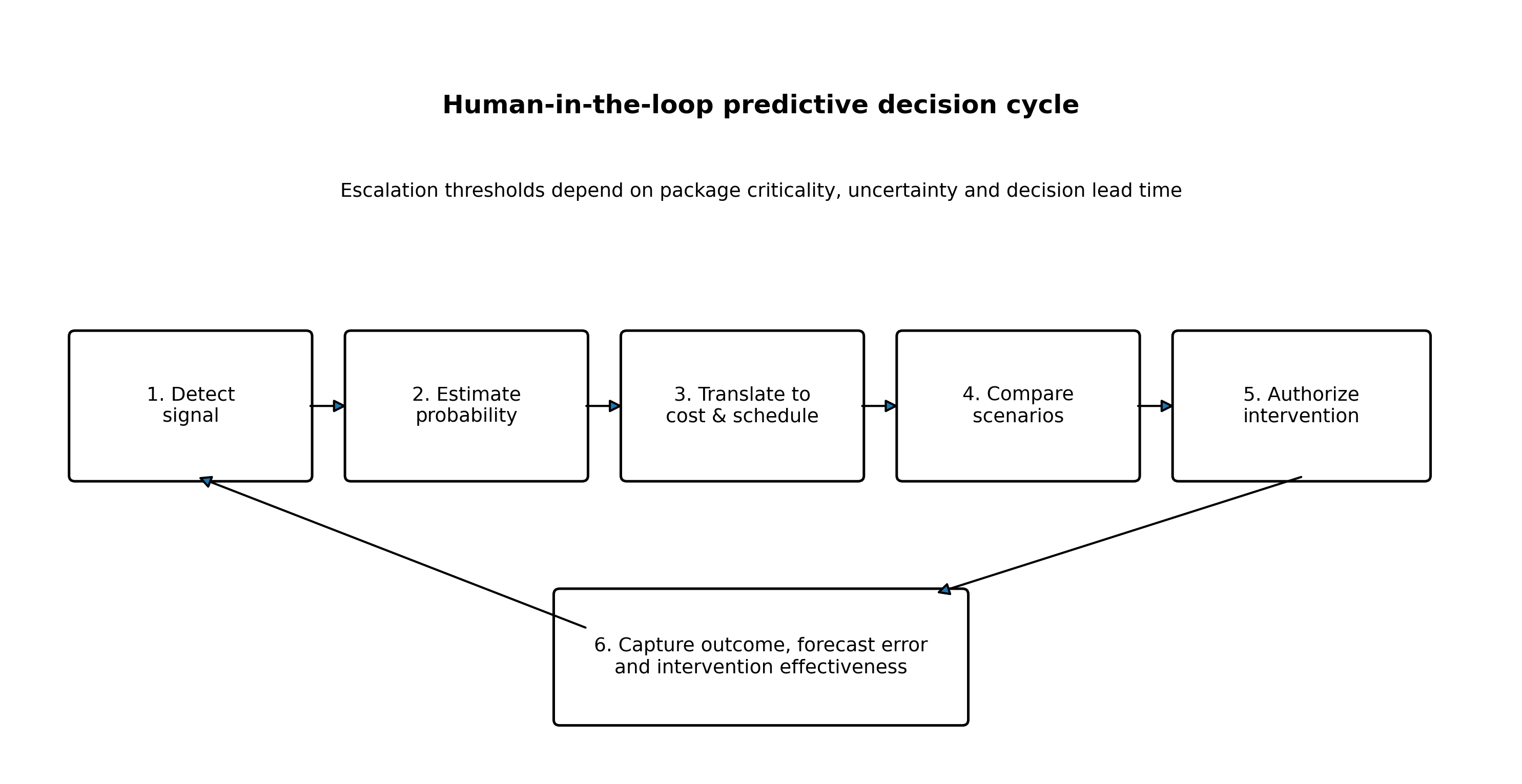
The evidence also supports a human-in-the-loop approach rather than fully autonomous procurement. Machine-learning models can identify patterns, but procurement decisions remain contractual, commercial, and strategic. A model may not know that a supplier is under negotiation, that a design change is imminent, or that regulators have not approved an alternative material. Human review is therefore essential, particularly for high-value or critical packages. A more defensible operating model is one in which predictions identify areas requiring attention, quantify exposure, and support scenario testing while accountable managers retain final decision authority.
The large-scale projects being carried out by Saudi Arabia might have one special benefit: because of the size of the portfolio it is possible to obtain a number of observations relating to different contractors and work packages. If data standards are brought into line, a programme will be able to create more detailed datasets than a normal single project. At the same time, the large scale also raises the possibility of data leakage, inconsistent definitions, and misleading comparisons; for instance, the term "late delivery" could mean a delay until arrival at port, a delay until arrival at site, or a delay compared to the required installation time. Governance therefore needs to be clear regarding the target variables and the timestamps.
Together with Table 2, Figure 2 shows an implementation maturity model. The pathway goes from descriptive visibility through to predictive integration and ends with prescriptive portfolio control. The order of the stages is significant; if the basic fields relating to procurement dates, quantity changes and supplier status are unreliable, then organisations should not move on to more complicated models. The level of analytical maturity is dependent upon operational data discipline.
| Maturity stage | Data condition | Analytics capability | Decision practice | Primary KPI |
|---|---|---|---|---|
| 1. Descriptive visibility | Basic dates, quantities and commitments are consistently captured | Dashboards and variance reporting | Reactive expediting and manual follow-up | Data completeness; status latency |
| 2. Diagnostic control | Common coding links cost, schedule and procurement | Root-cause and exception analysis | Structured weekly risk review | Forecast bias; recurring cause reduction |
| 3. Predictive integration | Event-time history and external market/supplier feeds | Price, demand, delivery and delay prediction with uncertainty | Threshold-based early warning and scenario review | Warning lead time; calibration; avoided disruption |
| 4. Prescriptive portfolio control | Cross-package and cross-project data standards | Optimization and digital-twin scenarios across shared constraints | Governed order, sourcing and resequencing recommendations | Risk-adjusted cost; material-related delay; intervention value |
8Research gaps and future research
Five research gaps are particularly important. First, peer-reviewed evidence explicitly examining predictive material procurement with datasets from Saudi giga-projects remains limited. Saudi studies provide evidence on cost, delay, BIM, and project-control conditions, while international studies provide most of the evidence on predictive methods; direct overlap between these streams is still underdeveloped. Future research should therefore establish longitudinal package-level datasets containing planned and actual approval, purchase, fabrication, shipping, delivery, and installation dates together with quantities, prices, and change events.
Second, research should move beyond isolated accuracy tests toward intervention studies. The relevant question is not only whether a model predicts a delay, but whether acting on its warning reduces delay or total cost. The causal value of early ordering, dual sourcing, or resequencing could be assessed through quasi-experimental designs, matched package comparisons, and controlled pilot deployments. Third, models must address regime change more effectively. Giga-projects operate under evolving regulations, changing supplier populations, design freezes, commodity shocks, and logistics disruptions.
Research should therefore concentrate on drift detection, transfer learning, and scenario stress testing rather than assume that the historical relationships are stationary. Fourth, more attention should be paid to explainable and uncertainty-aware methods. Procurement professionals will need reasons, confidence intervals, and sensitivity analysis—especially when it comes to important decisions. It would be interesting to compare explainable tree ensembles, probabilistic models and deep learning using the same decision metrics. Fifth, the existing literature fails to take into account the interactions between portfolios. Since several packages have to compete for cranes, laydown space, specialist labour, shipping slots, and supplier production capacity, future predictive systems should clearly incorporate these shared constraints in order that a measure taken to safeguard one package might not by accident delay another.
9Practical, managerial and policy implications
For project organisations, the first priority should be to establish a unified procurement-control dataset before investing heavily in complex algorithms. Essential fields include approved quantities, required-on-site dates, purchase-order dates, promised and revised delivery dates, supplier production milestones, actual deliveries, inventory balances, price history, change orders, and links to schedule activities and cost accounts. Governance arrangements should define update frequency, data ownership, and responsibility for correcting inconsistent records.
Managers should establish intervention thresholds according to risk and package criticality. Replaceable items may justify wider schedule buffers and less aggressive escalation than high-criticality materials. Forecasts should be reviewed in procurement and project-control meetings, with teams recording both the actions taken and the outcomes observed. This creates an auditable learning loop and prevents dashboarding from becoming passive reporting.
Owners of Saudi large-scale projects could use common coding standards and programme-level repositories of supplier performance across multiple packages. Shared historical data could support benchmarking and early-warning models, provided that access to commercially sensitive information is controlled through appropriate governance. Procurement policies should also consider total risk-adjusted cost rather than lowest purchase price alone.
Standardised digital procurement data can also support localisation planning and improve visibility of supply capacity for industrial-development policy. Predictive systems, however, should not operate as opaque mechanisms for excluding suppliers. Model governance should include explainability, periodic bias review, documented override procedures, and validation against current market conditions.
10Limitations
The variety of the evidence on which the review is based is a limitation. Since the studies differ in terms of the types of projects, the countries involved, the sizes of the samples, the algorithms used, and the validation criteria, a quantitative meta-analysis is not possible. As there is no direct evidence from Saudi Arabia regarding predictive procurement, the review makes use of international construction analytics and then interprets this information in the light of research into Saudi project performance. Additionally, the review focuses on literature published in journals and does not include confidential giga-project data sets, contract records or supplier databases which could have a material impact on the conclusions. Lastly, technology changes rapidly; although models and platforms will keep on evolving, the governance, integration and decision principles identified here are likely to stay relevant.
11Conclusion
Predictive analytics can materially strengthen construction-material procurement, cost control, and schedule performance in Saudi giga-projects when systems are designed around decisions rather than algorithms. The reviewed evidence shows that material prices, final cost, delay risk, production time, and logistics events can be forecast using contemporary analytical methods, while BIM, 5D BIM, and digital twins provide increasingly capable environments for data integration.
The most effective conceptual model involves linking these capabilities together in a feedback loop: the quantities and schedules generate demand for materials; data from outside sources and from suppliers are used to predict price and delivery risk; the logic of the schedule turns procurement uncertainty into time exposure; the cost models assess the financial impact; managers then select the appropriate interventions; and the actual results are used as feedback for future learning.
Saudi research indicates that project performance is shaped by material-price fluctuations, planning weaknesses, change orders, approval delays, and the effectiveness of project-control systems. It also shows that digital tools create value only when organisations possess the capability and governance required to implement them effectively. Predictive analytics should therefore be introduced as a programme-control capability supported by common data definitions, uncertainty-aware forecasts, explainable outputs, human decision authority, and measurable intervention outcomes.
Future research should examine whether predictive outputs lead to earlier and better procurement decisions, rather than focusing only on fit to historical data. Appropriate success criteria include fewer material-related delays, lower escalation and expediting costs, longer useful forecast lead times, better working-capital decisions, and more resilient schedule performance. In this sense, predictive analytics is not merely an additional forecasting tool; it is a practical means of coordinating material, money, and time across complex project portfolios.
References
- [1]Abioye SO, Oyedele LO, Akanbi L, Ajayi A, Davila Delgado JM, Bilal M, et al. (2021). Artificial intelligence in the construction industry: A review of present status, opportunities and future challenges. Journal of Building Engineering, 44, 103299. https://doi.org/10.1016/j.jobe.2021.103299
- [2]Alasmari E, Martinez-Vazquez P, Baniotopoulos C (2023). An analysis of the qualitative impacts of Building Information Modelling (BIM) on life cycle cost (LCC): A qualitative case study of the KSA. Buildings, 13(8), 2071. https://doi.org/10.3390/buildings13082071
- [3]Aldossari KM (2025). Cost and schedule performance in higher education construction projects in Saudi Arabia. Advances in Civil Engineering, 2025, 7448384. https://doi.org/10.1155/adce/7448384
- [4]Alfalah G, Aldajani S, Elshaboury N, Al-Sakkaf A, Alshamrani O (2024). Development of a performance assessment model for contractors in Saudi Arabian construction projects. Advances in Civil Engineering, 2024, 8780539. https://doi.org/10.1155/2024/8780539
- [5]Algahtany M, Radzi AR, Al-Mohammad MS, Rahman RA (2023). Government initiatives for enhancing Building Information Modeling adoption in Saudi Arabia. Buildings, 13(9), 2130. https://doi.org/10.3390/buildings13092130
- [6]Alghuried A (2023). Measuring the benefits and barriers of the implementation of BIM in sustainable practice in the construction industry of Saudi Arabia. Sustainability, 15(19), 14323. https://doi.org/10.3390/su151914323
- [7]Alnaser AA, Alsanabani NM, Al-Gahtani KS (2023). BIM impact on construction project time using system dynamics in Saudi Arabia’s construction. Buildings, 13(9), 2267. https://doi.org/10.3390/buildings13092267
- [8]Alotaibi R, Sohail M, Soetanto R (2025). Modelling project control system effectiveness in Saudi Arabian construction project delivery. Buildings, 15(18), 3426. https://doi.org/10.3390/buildings15183426
- [9]Alshihri S, Al-Gahtani K, Almohsen A (2022). Risk factors that lead to time and cost overruns of building projects in Saudi Arabia. Buildings, 12(7), 902. https://doi.org/10.3390/buildings12070902
- [10]Almujibah H (2023). Assessment of Building Information Modeling (BIM) as a time and cost-saving construction management tool: Evidence from two-story villas in Jeddah. Sustainability, 15(9), 7354. https://doi.org/10.3390/su15097354
- [11]Amer F, Hockenmaier J, Golparvar-Fard M (2022). Learning and critiquing pairwise activity relationships for schedule quality control via deep learning-based natural language processing. Automation in Construction, 134, 104036. https://doi.org/10.1016/j.autcon.2021.104036
- [12]Amer F, Jung Y, Golparvar-Fard M (2023). Construction schedule augmentation with implicit dependency constraints and automated generation of lookahead plan revisions. Automation in Construction, 152, 104896. https://doi.org/10.1016/j.autcon.2023.104896
- [13]Baduge SK, Thilakarathna S, Perera JS, Arashpour M, Sharafi P, Teodosio B, et al. (2022). Artificial intelligence and smart vision for building and construction 4.0: Machine and deep learning methods and applications. Automation in Construction, 141, 104440. https://doi.org/10.1016/j.autcon.2022.104440
- [14]Bakhshi R, Fard Moradinia S, Jani R, Vafaei Poor R (2022). Presenting a hybrid scheme of machine learning combined with metaheuristic optimizers for predicting final cost and time of project. KSCE Journal of Civil Engineering, 26(8), 3188–3203. https://doi.org/10.1007/s12205-022-1424-3
- [15]Chen Z, Hammad AWA, Waller ST, Haddad AN (2023). Modelling supplier selection and material purchasing for the construction supply chain in a fuzzy scenario-based environment. Automation in Construction, 150, 104847. https://doi.org/10.1016/j.autcon.2023.104847
- [16]Egwim CN, Alaka H, Toriola-Coker LO, Balogun H, Sunmola F (2021). Applied artificial intelligence for predicting construction projects delay. Machine Learning with Applications, 6, 100166. https://doi.org/10.1016/j.mlwa.2021.100166
- [17]Lee D, Lee S (2021). Digital twin for supply chain coordination in modular construction. Applied Sciences, 11(13), 5909. https://doi.org/10.3390/app11135909
- [18]Lederer L, Ellingerová H, Ďubek S, Bočkaj J, Ďubek M (2024). Construction price forecasting models in the construction industry: A comparative analysis. Buildings, 14(5), 1325. https://doi.org/10.3390/buildings14051325
- [19]Liu Q, He P, Peng S, Wang T, Ma J (2024). A survey of data-driven construction materials price forecasting. Buildings, 14(10), 3156. https://doi.org/10.3390/buildings14103156
- [20]Meharie MG, Mengesha WJ, Gariy Z, Mutuku RN (2022). Application of stacking ensemble machine learning algorithm in predicting the cost of highway construction projects. Engineering, Construction and Architectural Management, 29(7), 2836–2853. https://doi.org/10.1108/ECAM-02-2020-0128
- [21]Mohsen O, Mohamed Y, Al-Hussein M (2022). A machine learning approach to predict production time using real-time RFID data in industrialized building construction. Advanced Engineering Informatics, 52, 101631. https://doi.org/10.1016/j.aei.2022.101631
- [22]Mosly I (2025). Multivariate analysis of factors influencing construction costs in Saudi Arabia. Buildings, 15(5), 687. https://doi.org/10.3390/buildings15050687
- [23]Omrany H, Al-Obaidi KM, Husain A, Ghaffarianhoseini A (2023). Digital twins in the construction industry: A comprehensive review of current implementations, enabling technologies, and future directions. Sustainability, 15(14), 10908. https://doi.org/10.3390/su151410908
- [24]Regona M, Yigitcanlar T, Xia B, Li RYM (2022). Opportunities and adoption challenges of AI in the construction industry: A PRISMA review. Journal of Open Innovation: Technology, Market, and Complexity, 8(1), 45. https://doi.org/10.3390/joitmc8010045
- [25]Ranjbar AA, Ansari R, Taherkhani R, Hosseini MR (2021). Developing a novel cash flow risk analysis framework for construction projects based on 5D BIM. Journal of Building Engineering, 44, 103341. https://doi.org/10.1016/j.jobe.2021.103341
- [26]Sharma V, Zaki M, Jha KN, Krishnan NMA (2022). Machine learning-aided cost prediction and optimization in construction operations. Engineering, Construction and Architectural Management, 29(3), 1241–1257. https://doi.org/10.1108/ECAM-10-2020-0778
- [27]Shiha A, El-adaway IH (2024). Forecasting construction material prices using macroeconomic indicators of trading partners. Journal of Management in Engineering, 40(5). https://doi.org/10.1061/JMENEA.MEENG-6106
- [28]Studer WP, de Brito Mello LCB (2021). Core elements underlying supply chain management in the construction industry: A systematic literature review. Buildings, 11(12), 569. https://doi.org/10.3390/buildings11120569
- [29]Yevu SK, Yu ATW, Darko A (2021). Digitalization of construction supply chain and procurement in the built environment: Emerging technologies and opportunities for sustainable processes. Journal of Cleaner Production, 322, 129093. https://doi.org/10.1016/j.jclepro.2021.129093
- [30]Yoon JH, Pishdad-Bozorgi P (2022). State-of-the-art review of blockchain-enabled construction supply chain. Journal of Construction Engineering and Management, 148(2). https://doi.org/10.1061/(ASCE)CO.1943-7862.0002235