Complex Urban Development
Construction Logistics Optimization for Complex Urban Development and Infrastructure Projects Under Saudi Vision 2030
Published October 2026
Abstract
The importance of construction logistics in the delivery of dense urban developments, linear infrastructure, and the range of giga-projects outlined in Saudi Arabia’s Vision 2030 has been growing, since in these cases compressed timeframes, limited site areas, the need to import materials, the extreme climate conditions, and the fact that several projects are going on at the same time result in a number of closely linked logistics risks. This review gathers together evidence from peer-reviewed sources on urban construction logistics, construction supply-chain management, consolidation centres, Building Information Modelling (BIM), digital twins, off-site construction, resilience, transport decarbonisation and circular flows. The present paper employs an integrative review approach in order to compare different mechanisms, rather than combining incompatible effect sizes. The evidence shows that logistics performance improves as we move upstream from site expediting to coordinated demand planning, time-slot control, consolidation, visualised 4D logistics and data-led exception management. However, no single technology overcomes the problem of fragmented incentives: consolidation may shift costs between the various parties involved, internet platforms require a high degree of data discipline and interoperability, and just-in-time strategies may reduce storage but at the same time raise vulnerability to unreliable transport. The most credible optimisation model for achieving the objectives of Saudi Vision 2030 is therefore a multi-level system which includes common performance indicators covering strategic network design, tactical procurement and consolidation, and operational dispatch. The paper suggests a framework that is sensitive to the particular context and which focuses on logistics governance, digital visibility, resilient sourcing, low-emission transport, and reverse logistics. The areas that demand further research include freight data specific to Saudi Arabia, models for co-ordinating multiple projects, climate-aware routing, the fair distribution of logistics costs, and the long-term validation of control methods enabled by digital twins. The synthesis redefines construction logistics not as a mere support function at the site level but as a production system at the programme level, and the optimisation of which can ensure schedule reliability, urban mobility, carbon performance, and stakeholder value.
Keywords: construction logistics; urban development; infrastructure projects; Saudi Vision 2030; construction supply chain; consolidation centre; BIM; digital twin; logistics optimization
1Introduction
Rather than using up materials at the source, construction projects involve moving large quantities of components, equipment, labour support, packaging, and waste through temporary networks which terminate at different site interfaces. As a result, logistics becomes a major production issue rather than a mere transport function. In urban areas this problem is made worse by the competition for scarce road space, unloading windows, crane usage, laydown areas, and the public's tolerance. Research based on experimental evidence and reviews indicates that construction traffic can account for a significant portion of urban freight and that inadequate coordination of deliveries leads to congestion, emissions, delays, handling losses, and instability in the schedule [1–3]. Moreover, Sezer and Fredriksson demonstrate that transportation patterns vary according to the phase of a project and that logistics arrangements can help reduce impacts, provided that they are suited to the particular characteristics of the project [4,5].
The situation is even more difficult in the case of complicated urban development and infrastructure projects. One contractor might optimise its own deliveries even if this leads to increased congestion throughout the network, a strict just-in-time policy could reduce site stock even at the cost of a greater number of urgent trips, and a consolidation centre might achieve ecological improvements while passing on the associated costs or responsibilities to the suppliers. Research into logistics interventions in the public sector therefore stresses the importance of how the benefits and burdens are distributed if the initiatives are to be adopted [6]. Studies concerning service quality show that construction logistics should be designed with the temporary relationships involving multiple parties in mind, rather than being based on a standard warehouse service [7]. This is especially relevant in Saudi Arabia, since Vision 2030 is speeding up large-scale, simultaneous developments and infrastructure projects in different regions which have varied urban densities, long supply distances, hot climates, and a high degree of dependence on coordinated procurement.
Research into the construction supply chain has moved from a focus on isolated material control towards a more integrated approach that emphasises resilience, circularity and digitalisation. Systematic reviews have shown that logistics, information sharing, procurement integration, organisational relationships and resilience are interdependent capabilities [8–10]. The use of BIM and 4D modelling enables site logistics to be made visible in both space and time [11,12]. Meanwhile, digital supply chain technologies and digital twins allow visibility to be broadened beyond the site to include suppliers, transport and production [13,14]. Off-site construction introduces greater complexity since it involves the need for synchronised manufacturing, transport, storage, lifting and installation of large modules [15–17]. For this reason, the situation in Saudi Arabia calls for the combination of a number of different research areas which are usually examined separately.
This review, in the context of Saudi Vision 2030, looks at the ways in which these different areas can be combined into a practical optimisation approach for complicated urban and infrastructure projects. Instead of viewing technologies as independent solutions, it investigates how they work, the limitations they have, the trade-offs involved, and the kind of governance they demand. The outcome is a framework that brings together network, project, and site decisions, identifying in which cases the evidence is strong, in which cases the transferability to Saudi Arabia is questionable, and which research questions are most important for future giga-project delivery.
2Aim of the study
The study offers a detailed review of current research targeted at optimizing construction logistics and then combines this research into an integrated decision-making framework suitable for complicated urban development and infrastructure projects in the context of Saudi Vision 2030. It looks at the coordination of physical material flows, information flows, site interfaces, consolidation, off-site production, digital control, resilience, environmental performance, and reverse logistics. The study does not assume that practices which have proved effective in European or East Asian cities can be directly applied to projects in Saudi Arabia, but rather evaluates which mechanisms are robust, which rely on local institutions or the urban form, and how they can be adapted to the high-volume, multi-project, climate-exposed logistics environment typical of Saudi Arabia.
3Research objectives
The review has five specific objectives. The first of these is to identify the main causes of inefficiencies in the logistics aspect of dense urban construction and extensive infrastructure projects. The second aim is to compare various operational approaches, including consolidation centres, time-slot booking, off-site production, transport planning, and site logistics control. The third objective aims to evaluate the extent to which BIM, digital twins, IoT-enabled visibility, and blockchain-supported information architectures can improve coordination, without overemphasising the level of technology maturity. The fourth aim is to look at how the demands for resilience, decarbonisation and the circular economy alter the traditional focus on cost and time optimisation. The fifth and final objective is to draw out management and policy recommendations that are specific to Saudi Arabia for the programme owners, public authorities, contractors, logistics service providers and suppliers who are involved in projects under the Vision 2030 initiative.
4Research questions
The synthesis is based on four research questions: (RQ1) Which logistics constraints have the most serious adverse effects on schedule, cost, safety, and environmental performance in complex urban construction? (RQ2) Which combinations of consolidation, digital planning, transport control, and off-site logistics are supported by recent evidence, and under what conditions? (RQ3) How can logistics optimization incorporate resilience, carbon, circularity, and the allocation of cost among stakeholders rather than simply lowering direct transport cost? (RQ4) What governance and research adaptations are required for Saudi Vision 2030 projects delivered at programme scale under arid-climate conditions, rapid development, and simultaneous multi-project demand?
5Review methodology
We adopted an integrative review methodology because the field contains heterogeneous evidence, including systematic reviews, case studies, optimisation models, qualitative studies, transport analyses, and digital-technology frameworks. A narrow meta-analysis would not be appropriate because the outcomes and units of analysis vary substantially. The review is therefore based on a transparent, structured search-and-synthesis process, using careful comparison to identify mechanisms and boundary conditions.
The studies were carried out on the following databases: Scopus, Web of Science, ScienceDirect, SpringerLink, Taylor & Francis, the ASCE Library, Emerald Insight and MDPI. The key terms used were a combination of "construction logistics", "urban construction logistics", "construction supply chain", "construction consolidation centre", "site logistics planning", "construction transport", "BIM logistics", "digital twin construction supply chain", "off-site construction logistics", "modular construction transport", "construction supply chain resilience", "reverse logistics", "Saudi construction projects", "Vision 2030" and "NEOM". The primary period for publications was 2020 to 2025, although some earlier studies were included if they remained important for construction consolidation or for the review methodology. The final group of references comprises precisely 30 peer-reviewed journal or conference papers, with a focus on those published from 2020 onwards.
Only papers directly relevant to construction logistics, construction supply-chain coordination, urban-freight effects of construction, off-site or modular logistics, digital logistics control, supply-chain resilience, or the specific conditions of Saudi projects were included. Studies were excluded when logistics was only incidental, the evidence was promotional rather than scholarly, or the bibliographic information could not be independently verified. Because the review was not designed as a PRISMA census, no screening-count statistics are reported; the searches were iteratively refined to support an integrative synthesis. This avoids implying a level of screening precision that was not generated through a formal systematic-review database. The quality appraisal considered publication venue, methodological clarity, transparency of data or modelling assumptions, relevance of the unit of analysis, and the extent to which conclusions were supported by the reported evidence. For optimisation studies, decision variables and constraints were examined; for case studies, contextual transparency and transferability were assessed; for reviews, the search strategy and depth of synthesis were considered; and for technology studies, evidence of operational implementation was distinguished from conceptual novelty. The findings were organised into six themes: urban interface constraints, planning and consolidation, digital integration, off-site logistics and resilience, sustainability and circularity, and applicability to Saudi Vision 2030. The synthesis compared convergent evidence, contradictory findings, and context dependencies. All 30 references were checked against publisher pages, DOI records, or authoritative bibliographic sources, and DOI links are provided in the reference list. Peer-reviewed conference proceedings were permitted where they were directly relevant to the review question; they were not represented as journal articles.
6Thematic literature review and critical analysis
The literature indicates a gradual transition from a focus on local site optimization to integrated flow management. Nguyen and Le point out that there are six well-established clusters in the area of construction logistics and supply-chain research, with supply-chain integration situated in the middle [10]. This is important since individual interventions typically do not optimize one interface but instead transfer cost, inventory, or uncertainty to another. Table 1 provides a summary of the main lines of evidence and the conditions under which they lead to increased performance.
| Theme | Evidence synthesis | Optimization implication |
|---|---|---|
| Urban interface | Construction freight is operationally distinct; waiting, peak arrivals and city externalities matter [1,3,5,19]. | Optimize gate, unloading and city capacity together; do not use route distance as the sole objective. |
| Consolidation and control | CCCs and logistics setups can reduce trips, but suitability and cost allocation are context-dependent [2,4,6,20,21]. | Use phase-specific business cases, transparent charging, and service-level rules. |
| Digital integration | 4D BIM, digital supply chains and digital twins improve visibility when data and responsibilities are aligned [11–14,23,24]. | Standardize identifiers, timestamps and interfaces before advanced predictive control. |
| Off-site and resilience | Modular systems require synchronized production, transport, storage and lifting; uncertainty must be explicit [15–17,25,26]. | Use stochastic planning, critical buffers, alternative routes and qualified backup supply. |
| Sustainability and circularity | Transport, idling, reverse flows and recovery influence project carbon and resource efficiency [4,21,27–29]. | Optimize total system carbon and empty mileage, not truck fuel alone. |
6.1Urban interface constraints and construction transport
The logistics involved in urban construction are subject to two constraints: on the one hand, the project itself requires steady inbound deliveries, and on the other, the city needs to see a reduction in the number of heavy vehicles using its roads, lower levels of emissions, less noise, and safer roadways. Guerlain et al. demonstrate that construction freight has certain features relating to delivery and that consolidation can result in a decrease in the number of vehicle trips [1]. Muerza and Guerlain go a step further by putting forward a suitability framework instead of simply assuming that a consolidation centre is the best option [2]. Similarly, Haag and Jünger find that more measured datasets and greater integration with policy are required, since the effects on freight have so far been underrepresented in urban construction logistics [3]. There are other operational problems apart from the distance travelled. Sezer and Fredriksson [5] point out repeated delivery peaks, long turnaround times, and a lack of standardisation in transport data. Naz et al. say that there is a great deal of non-value-adding time in construction transport, explaining this largely in terms of failures in information, planning, loading, unloading, and coordination [19]. The studies show that route optimisation by itself is not sufficient. Whether or not a delivery proves to be valuable after it has arrived at the site depends on gate congestion, crane availability, the paperwork involved, the readiness for unloading, and the sequence of the crew.
Consequently, consolidation should be seen as a means for managing interfaces; it is able to protect against unreliable suppliers, combine deliveries, arrange the timing of deliveries and aid in last-mile control, but it also gives rise to requirements relating to handling, inventory and governance. Evidence from urban consolidation shows that supplier costs do not automatically fall and that new service agreements might be necessary [20]. Similarly, research into construction-specific arrangements involving public actors suggests that imposed logistics arrangements can lead to resistance in cases where contractors have to bear the costs and the surrounding communities reap most of the benefits [6]. Effective urban optimisation therefore has to clarify who pays, who controls capacity, how service levels are to be measured and how external benefits are to be valued.
6.2Planning, consolidation, and site logistics control
The planning of site logistics links the construction schedule with available space and the movement of materials. Whitlock et al. state that 4D BIM can be used to support layout planning, the coordination of common plant facilities, updates to the logistics plan, and joint effort [11]. The schedule has to be detailed enough to allow logistics decisions to be made. A visually detailed BIM model cannot make up for a schedule that fails to show the logic relating to delivery, unloading, movement and installation [12]. Kolarić et al. also point out that this is particularly the case with mega-projects, since the apparent complexity of the digital model may conceal poor quality of the operational data. The construction consolidation centres and the controlled booking systems deal with different parts of the same coordination issue. Consolidation helps to reduce the fragmentation of shipments while time-slot control safeguards the limited site and urban capacity. Research into sustainability indicates that the value of logistics arrangements varies according to the type and stage of the project, the distance involved, and the volume [4,21]. The result is that it is not appropriate for projects to apply a single logistics approach throughout their entire lifecycle. The various stages such as early earthworks, the construction of the structure, the installation of the facade, the MEP fit-out, commissioning and the removal of waste require different kinds of vehicles, different offloading resources and different storage arrangements. Hence, the logistics plan should be dynamic and adapted to the various production phases.
Service design is just as important; Gremyr et al. demonstrate that service blueprints can be used to modularize and prioritize logistics services [7]. Haglund and Janné argue that outsourced construction logistics require an explicit logistics strategy that defines responsibilities and interfaces [22]. Together, these findings challenge the assumption that appointing a third-party logistics provider automatically creates integration. Outsourcing can improve specialization, but effective coordination still depends on clear governance of priorities, data, escalation routes, and performance indicators by the client and main contractor.
6.3Digital integration: BIM, platforms, and digital twins
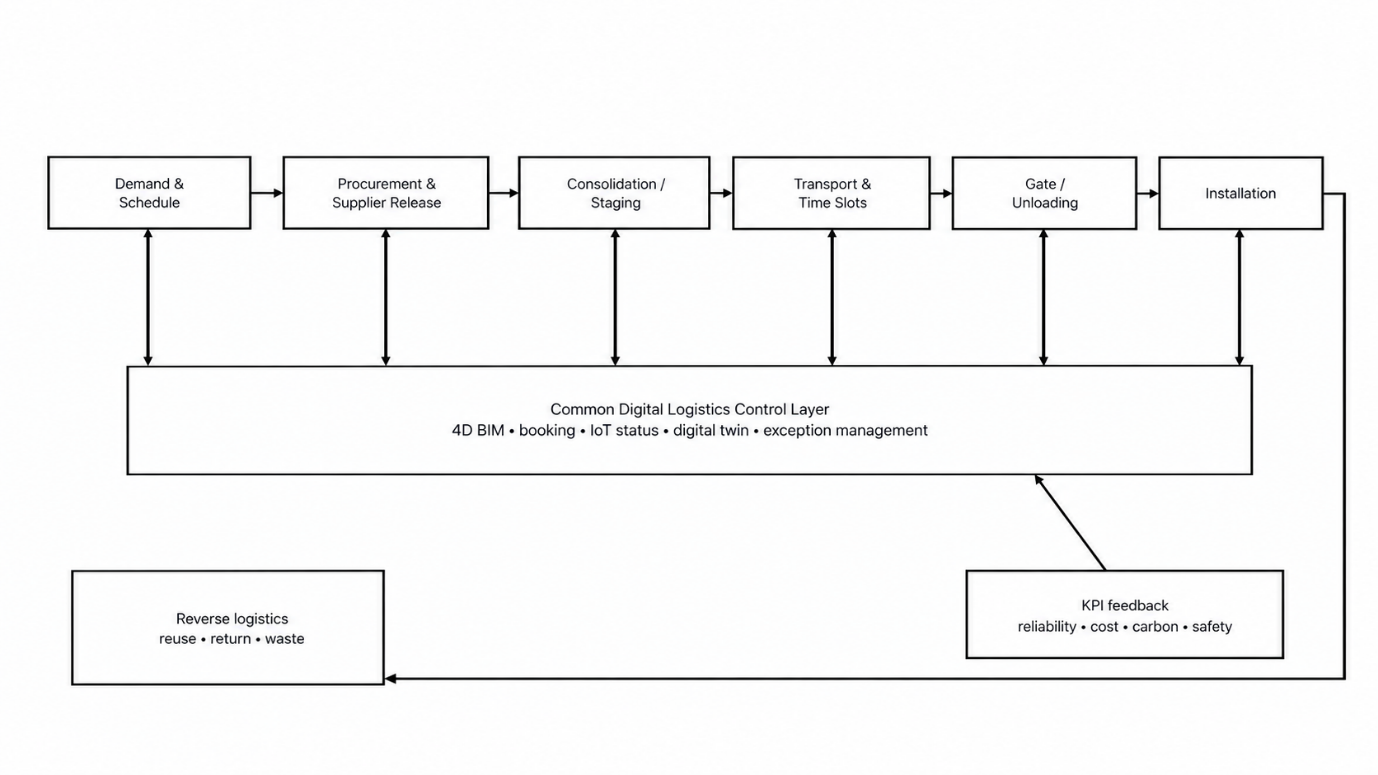
Studies of digitalization identify information fragmentation as a fundamental source of inefficiency in construction supply chains. Yevu et al. identify BIM, blockchain, IoT, and related technologies as mechanisms for information integration and more sustainable procurement processes [13]. Hijazi et al. explain the complementary roles of BIM and blockchain: BIM structures project information, while blockchain can strengthen traceability and trusted information exchange across organisational boundaries [23]. Yoon and Pishdad-Bozorgi similarly conclude that blockchain has value when it addresses defined collaboration and information-sharing problems rather than being adopted as a technology in isolation [24]. Digital twins extend integration from static information exchange towards continuous condition estimation, simulation, and feedback. Bakhshi et al. (2024) show that digital twins can address construction supply-chain challenges through integration, visibility, simulation, and decision support, while also requiring connected data sources and organisational readiness [14]. In logistics, this capability is relevant to detecting differences between planned and actual conditions, such as late supplier releases, transport delays, vehicle arrivals, gate queues, crane unavailability, defective components, or installation-sequence changes. The principal constraint is data discipline: digital services cannot reliably optimise events that are not consistently identified, timestamped, geo-referenced, and linked to schedule activities. For Saudi giga-projects, a practical digital architecture should therefore begin with common logistics identifiers, master data, booking standards, and interface protocols before advancing to predictive analytics. Figure 1 presents this logic as a closed-loop system connecting procurement, transport, consolidation, gate control, site handling, and reverse flows to a common planning and performance layer.
6.4Off-site construction, modular logistics, and resilience
Off-site construction has the advantage of lowering traffic on the construction site and enhancing production control; it does, however, transfer the risk to the coordination of manufacturing and transportation. Hussein et al. [15] point out that, although logistics is important for sustainable modular construction, it has been less extensively studied than production in off-site supply-chain modelling. Hsu et al. demonstrate that uncertainty must influence production, transport, and inventory decisions rather than be treated as a deterministic addition afterwards, by means of multi-stage stochastic programming [16]. When a module is transported, integrated decisions must be made regarding the assignment of trucks, the day of delivery, storage, geometry, and the handling constraints (Almashaqbeh and El-Rayes [17]). Zhu et al. also show that supply planning should balance carbon and economic objectives in the areas of procurement, prefabrication, and assembly [25].
The results have a direct bearing on Saudi projects which make use of precast, modular MEP, facade panels and volumetric elements for long-distance transport; the biggest modules may have to comply with restrictions relating to the route, permits, bridges, turning radius, wind and lifting. As a result, "just in time" turns into a closely linked production system instead of merely being an inventory policy; a delay at a factory or at a road checkpoint can stop the installation sequence that depends on cranes. The literature regarding resilience offers a contrast to models which are mainly concerned with efficiency. Liao et al. state that construction supply-chain resilience is a new priority and one which calls for organizational, managerial, and technical capabilities [9]. Zhang et al. [26] concentrate on disruption prediction, information sharing, response time, and contingency planning in the context of prefabricated supply chains. Hence, Saudi logistics optimization should involve having dual or qualified alternative sources of supply, establishing strategic buffers for critical long-lead items, ensuring route redundancy, providing for weather and heat contingencies, and maintaining visibility regarding the lead times of imported materials. The best system is not the one which has the lowest average inventory, but rather the one that achieves the required level of service reliability at an acceptable total cost and risk exposure.
6.5Sustainability, decarbonization, and circular logistics
The environmental effects of construction logistics involve fuel use, congestion, empty journeys, idling, failed deliveries, packaging, and the transport of waste. Sezer and Fredriksson [4] indicate that transport impacts can be considerable at the project level and that the way in which logistics are organised has an effect on emissions. Brusselaers et al. suggest that the logistics both on site and off site should be assessed, rather than considering transport as a separate activity [21]. Dhawan et al. [27] view the decarbonisation of transport as a systems issue that involves various stakeholders, planning and green transport. The aforementioned studies support multi-criteria optimisation which takes into account emissions and external costs as well as time and the direct logistics costs.
The second flow direction is due to circularity. Chen et al. [28] regard logistics network optimization, IoT tracking, BIM, and predictive analytics as the factors that enable circular construction supply chains. Wibowo et al. give reverse-logistics performance indicators for the building lifecycle, showing that it is necessary to measure return, reuse, recycling, and material recovery rather than disposal alone [29]. In Saudi cities, where large-scale development programmes cause both inbound material flows and outbound flows of excavated or demolished material to occur at the same time, reverse logistics can be combined with vehicle planning in order to reduce empty mileage and promote material reuse. In terms of analysis, it means that carbon reduction cannot consist simply in changing the fuel used by trucks. It is possible to achieve both operational and environmental benefits at the same time through fewer journeys, higher load factors, better booking, consolidation, shorter waiting times, coordinated backhauls, and material circularity. However, the location and the embodied impact of the consolidation facilities are also important. Logistics measures can only be considered sustainable when the benefits they produce for the whole system exceed the additional burdens in the form of handling, storage, facility use, and detours that they generate.
6.6Saudi Vision 2030 context and transferability
Saudi Arabia's construction sector is characterised by major development programmes, but the evidence base does not support the direct transfer of every European urban-logistics practice. Alenazi et al. [30] show that client-related delays remain material in contemporary Saudi construction projects and can adversely affect time and cost performance. Yusuf and Abdulmohsen [18] examine NEOM as a planned-city case and discuss the economic, sustainability, and implementation challenges associated with development at that scale. These Saudi-focused studies do not, by themselves, establish a complete construction-logistics model; rather, they provide contextual evidence that must be interpreted alongside international logistics research. Three transferability issues are especially important. First, project geography differs substantially: logistics for dense redevelopment in Riyadh are not equivalent to logistics for remote linear infrastructure or a new-city development. Second, where projects depend on imported materials and specialist equipment, port interfaces, customs processes, inland transport, and long lead times can create exposure not fully represented in European urban-logistics studies. Third, extreme heat, dust, and long travel distances can affect operating windows, vehicle and material performance, storage requirements, and worker safety. These contextual factors do not invalidate consolidation, BIM, or digital-twin approaches; they change the parameters and governance conditions under which those approaches should be applied. Table 2 translates the reviewed evidence into six optimisation levers for Vision 2030. The central implication is that project-by-project logistics planning may be insufficient where multiple giga-project packages compete for common suppliers, ports, highways, cranes, accommodation, and specialist transport. In such conditions, portfolio owners and public agencies may require programme-level visibility and common logistics rules where cumulative network effects are material.
| Vision 2030 lever | Decision focus | Recommended metric |
|---|---|---|
| Programme logistics governance | Shared rules, hubs, corridors, abnormal-load capacity | Cross-project delivery reliability; corridor utilization |
| Integrated 4D logistics planning | Schedule-space-material synchronization | Planned vs actual delivery/install variance |
| Consolidation and booking | Load combination, slot control, gate smoothing | Load factor; gate turnaround; missed-slot rate |
| Resilient sourcing and buffers | Critical materials, imports, alternative suppliers/routes | Disruption recovery time; critical-item service level |
| Digital visibility | Supplier-to-site status, exceptions, predictive alerts | Data completeness; exception detection-to-response time |
| Low-carbon and reverse logistics | Emission reduction, backhauls, reuse and recovery | kgCO2e per delivered unit; empty km; recovery rate |
7Discussion
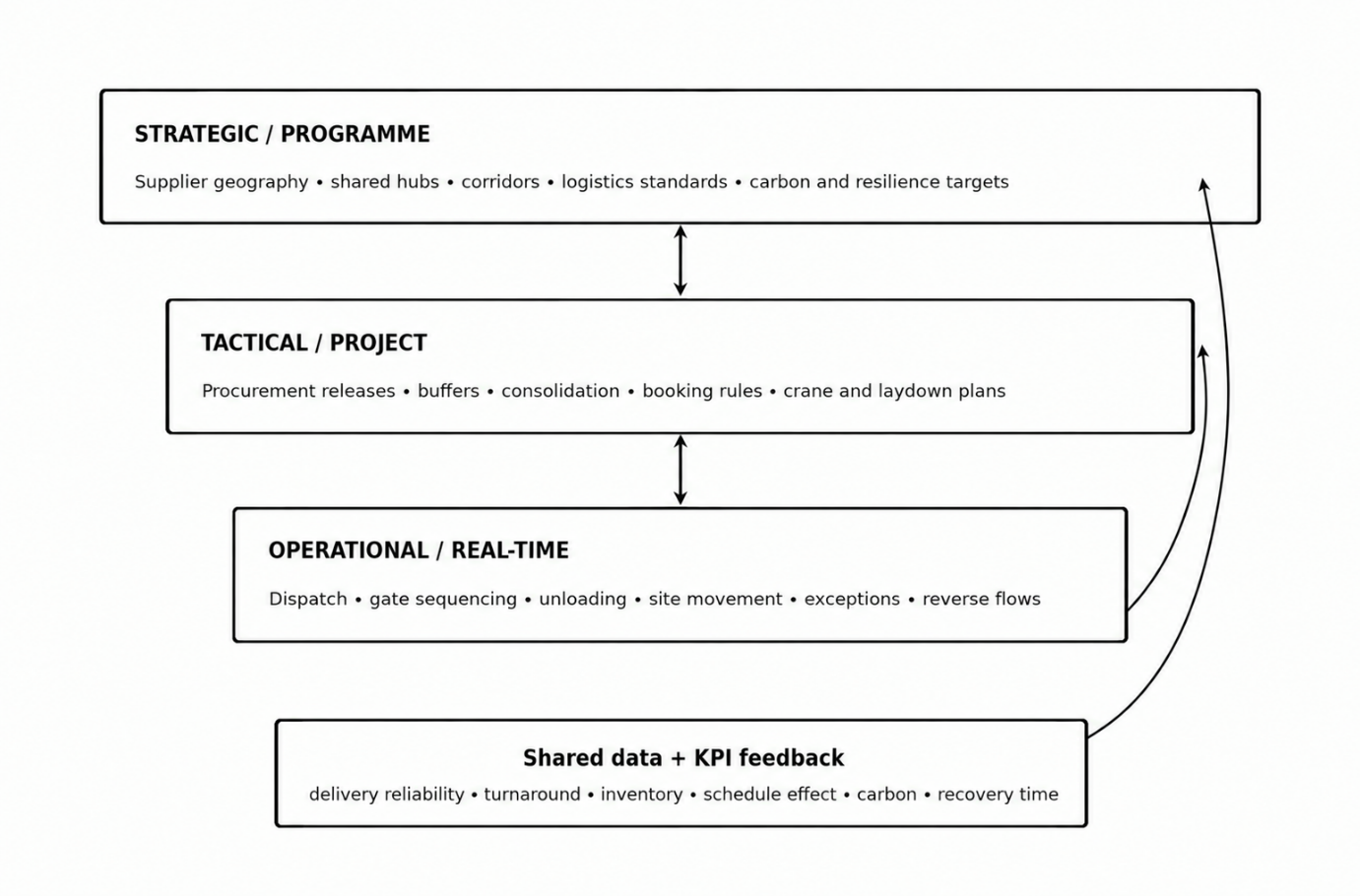
The evidence examined indicates that optimisation of construction logistics should be approached in a multi-level manner. Owners are responsible for carrying out strategic decisions regarding supplier location, the choice of logistics hubs, consolidation capacity, the off-site production strategy, the major transport corridors, and the governance arrangements. At the tactical level, the project teams convert the schedules into procurement releases, material call-offs, inventory policies, delivery slots, crane plans, and contingency buffers. At the operational level, the teams put into action and make adjustments to the vehicles, the gates, the unloading resources, the laydown areas, the vertical transport, the crews, and the reverse flows in real time. Problems do, however, occur when these different levels are optimised separately. The most frequently occurring situation is one in which visibility is linked to decision-making powers. Tools such as BIM, reservation platforms, IoT, digital twins, and supply-chain systems are valuable since they decrease the time lag between the appearance of a deviation and a coordinated response. However, visibility alone without proper governance can only expose conflicts. If a module is discovered to be late by means of a digital twin, then authority is needed in order to resequence the work, reallocate crane time, inform the downstream trades, and adjust the transport timetables; in the absence of data governance, the teams have to rely on reactive expediting. As regards Vision 2030, the digital and organisational structures must be designed together.
The literature also shows a fundamental compromise between efficiency and resilience. Although lean and just-in-time methods decrease the need for storage and handling, they raise vulnerability if transport or supplier reliability is low. On the other hand, robustness grows as a result of consolidation and the use of buffers, but so do the facilities, inventory and handling. Research into stochastic optimisation recommends that uncertainty should be modelled explicitly [16], as well as resilience studies are emphasising redundancy and reaction capabilities [9,26]. Instead, the Saudi projects should establish acceptable service-risk thresholds rather than try to minimise cost under average conditions. There is also a trade-off concerning project and city performance. While contractors tend to favour delivery arrangements that cut immediate handling costs, the authorities usually prefer to have fewer trips, less congestion, and upgraded public safety. Experience from public-actor logistics arrangements indicates that acceptance drops when cost allocation is seen as unfair [6]. The Vision 2030 authorities can handle this by introducing transparent charging systems, specifying logistics requirements based on performance, using shared hubs, and including contract clauses that share the savings and external costs among the beneficiaries. Figure 2 presents the proposed optimisation architecture, giving priority to programme governance and network design while placing real-time control below them, and linking all the layers together through KPI feedback. The architecture treats logistics data as a production-control asset and calls for the use of common metrics for example as delivery reliability, gate-to-gate turnaround, load factor, crane waiting, inventory days, schedule impact, carbon emitted per delivered unit, safety events, reverse-logistics recovery, and disruption recovery time. The use of these metrics prevents a narrow emphasis on transport price and makes the various trade-offs clear.
Another consequence relates to the way the optimisation objective is designed. Service levels for key materials should be used to express schedule reliability. Cost should comprise handling, inventory, delay exposure and shared-facility charges, not just freight rates. Environmental performance should cover vehicle kilometres, load factors, idling, fuel or energy use and reverse-logistics recovery. Vehicle-pedestrian conflict exposure, abnormal load movements, and lifting-interface congestion can be used to operationalise safety. Since these different factors cannot always be reduced to a single monetary value, multi-criteria decision methods are appropriate for making transparent trade-offs. For the Saudi programme owners, scenario testing should involve comparing normal operations with situations such as port disruption, supplier failure, heat restrictions, road closures and simultaneous demand peaks across projects. They can then subject the resulting policies to stress-testing in order to ensure that they meet the minimum service levels before awarding contracts. It also helps to determine which decisions are core and which remain the responsibility of the package teams. Programme governance is required for shared corridors, booking standards, hub capacity and common data definitions, while project control is needed for daily sequencing and short-term buffers. The responsibilities are clearly separated, which reduces the need for redundant coordination and local optimisation, and provides a clear basis for revising the logistics plans as the construction phases and network pressures change. This in turn enables trade-offs to be made among contractors, authorities, logistics providers and affected communities when allocating scarce transport capacity.
8Research gaps and future research
Five research gaps need to be addressed. First, there is a shortage of standardised Saudi construction-freight datasets. Credible baselines would require anonymised operational data on bookings, GPS traces, gate activity, load factors, waiting times, crane use, and delivery failures across different project types. Without such data, optimisation models risk relying on parameters derived from contexts with different road networks, supplier distances, labour arrangements, and climatic conditions. Second, much of the literature optimises individual projects, whereas Vision 2030 also creates interactions among simultaneous projects. Future models should therefore consider shared suppliers, consolidation hubs, port capacity, abnormal-load corridors, and synchronised demand peaks across project portfolios. Multi-agent simulation and stochastic network optimisation could be used to test such policies before implementation. Third, digital-twin research requires longitudinal operational validation. Studies should test whether real-time visibility produces measurable reductions in missed slots, work stoppages, buffer inventory, or carbon emissions after implementation, and compare those benefits with integration and data-governance costs. Fourth, climate-aware logistics needs dedicated research on heat-related operating constraints, dust effects, worker exposure, material sensitivity, and seasonal demand patterns. Fifth, research should explicitly examine distributional effects. A system-optimal solution may be commercially unacceptable if one actor bears the cost while another captures the benefit. Future work should test gain-sharing, congestion charging, hub-pricing arrangements, logistics-as-a-service models, and incentive structures that better align public authorities, clients, contractors, suppliers, and logistics providers. Circular logistics should be incorporated into these models by planning reuse and return flows rather than treating them as residual waste movements.
9Practical, managerial, and policy implications
During front-end planning, project owners should develop a logistics strategy before procurement packages and site constraints dictate inefficient flows. The tender documents should specify data standards, delivery booking rules, consolidation duties where warranted, critical-item resilience requirements, and measurable logistics KPIs. Major suppliers should be brought in early enough to validate lead times, packaging, modes of transport, route constraints, and off-site production capacity. The construction schedule should be part of the logistics plan and updated by phase for contractors. 4D BIM should include unloading zones, temporary roads, cranes, hoists, laydown areas, and changing access, but the model has to be linked to detailed call-offs and responsibilities. Daily control should be restricted to exceptions: late releases, capacity conflicts, missed slots, handling resources unavailable, and material-quality problems. Third-party logistics providers can add value if they focus more on coordination and data management than on transport brokerage.
The greatest opportunity for public authorities and owners of giga-project programs is above individual contracts. Shared logistics hubs, freight corridors, time-window policies, abnormal-load management, and digital booking standards can help to reduce the cumulative impacts of multiple projects on the same urban or regional network. Consolidation should not be prescribed as a one-size-fits-all policy but tested for suitability against volume, distance, project phase, urban sensitivity and facility location. Appraisals should incorporate carbon and community impacts, as well as the direct project cost. A Saudi implementation pathway: a staged practical approach. Projects should start with data and KPI standardization, followed by coordinated booking and 4D logistics, then bring in suppliers and hubs, and only then move towards predictive digital twins and program-wide optimization. This sequence lessens the risk of investing in sophisticated analytics before the underlying operational data is reliable.
10Limitations
The review is narrative in nature and not a statistical meta-analysis, so it does not aim to determine a universal effect size for any logistics intervention. Regarding geographical coverage, the body of evidence is uneven, since there is a great deal of research in Europe and East Asia while there are relatively few peer-reviewed logistics studies that focus on Saudi Arabia. Some technologies, for example digital twins and supply chains enabled by blockchain, are developing rapidly and their conceptual potential goes beyond the amount of long-term field validation that has been carried out. The review also omits confidential project data and non-peer-reviewed sector reports which might include important operational evidence from Saudi giga-projects. Finally, the restriction of 30 references meant that only a broad field could be selectively covered. Instead of undermining the argument for validating context-specificity before large-scale policy adoption, these shortcomings in fact support it.
11Conclusion
The construction logistics optimisation required for Saudi Vision 2030 should be understood as a problem spanning both production systems and urban or regional transport systems. The reviewed literature indicates that major performance losses arise not only from transport distance but also from fragmented planning, incomplete information, weak synchronisation between unloading and installation, unclear responsibility interfaces, and incentives that encourage local rather than system-wide optimisation. Consolidation centres, appointment booking, 4D BIM, off-site construction, digital twins, and reverse logistics should therefore be treated as complementary mechanisms rather than substitutes.
The best way to proceed is to use a layered approach, involving network design at the programme level to set up common rules and shared capacity, project-level planning to turn the schedules into decisions regarding procurement, buffering, consolidation and transport, and operational control to safeguard the installation flow by means of live data. Since the supply chains are long, there is a high level of climate exposure and the effects of a disruption are severe, resilience plus carbon considerations have to be included in the objective function for projects in Saudi Arabia, together with cost and schedule. Digitalisation proves effective whenever it reduces the time taken to detect and respond to issues, but it depends on the use of standardised identifiers, interoperable data and clearly defined decision rights. For the Vision 2030 initiative, the most practical priority should be to take logistics decisions earlier, coordinate them among different packages and projects, and consistently measure the outcomes of the system as a whole. Future efforts must include the development of Saudi freight datasets, testing multi-project optimisation, longitudinally validating digital-twin control, and designing fair commercial mechanisms for shared logistics. If these priorities are met, construction logistics will be able to move from being a reactive expediting function to becoming a strategic capability that protects programme certainty, urban mobility, sustainability and the long-term value of the infrastructure.
References
- [1]Guerlain C, Renault S, Ferrero F. Understanding construction logistics in urban areas and lowering its environmental impact: A focus on construction consolidation centres. Sustainability. 2019;11(21):6118. https://doi.org/10.3390/su11216118
- [2]Muerza V, Guerlain C. Sustainable construction logistics in urban areas: A framework for assessing the suitability of the implementation of construction consolidation centres. Sustainability. 2021;13(13):7349. https://doi.org/10.3390/su13137349
- [3]Haag P, Jünger HC. Turning a spotlight on construction logistics for a sustainable urban environment—a review of current policy concepts and literature. Frontiers in Built Environment. 2023;9:1202091. https://doi.org/10.3389/fbuil.2023.1202091
- [4]Sezer AA, Fredriksson A. Environmental impact of construction transport and the effects of building certification schemes. Resources, Conservation and Recycling. 2021;172:105688. https://doi.org/10.1016/j.resconrec.2021.105688
- [5]Sezer AA, Fredriksson A. Paving the path towards efficient construction logistics by revealing the current practice and issues. Logistics. 2021;5(3):53. https://doi.org/10.3390/logistics5030053
- [6]Eriksson V, Hulthén K, Sundquist V, Fredriksson A, Janné M. The role of public actors in construction logistics: effects on and of relational interfaces. Construction Management and Economics. 2021;39(10):791–806. https://doi.org/10.1080/01446193.2021.1970785
- [7]Gremyr I, Bäckstrand J, Fredriksson A, Gatenholm G, Halldórsson Á. Blueprinting construction logistics services for quality improvement. Construction Management and Economics. 2023;41(1):60–78. https://doi.org/10.1080/01446193.2022.2130384
- [8]Studer WP, de Brito Mello LCB. Core elements underlying supply chain management in the construction industry: A systematic literature review. Buildings. 2021;11(12):569. https://doi.org/10.3390/buildings11120569
- [9]Liao L, Yang C, Quan L. Construction supply chain management: A systematic literature review and future development. Journal of Cleaner Production. 2023;382:135230. https://doi.org/10.1016/j.jclepro.2022.135230
- [10]Nguyen DT, Le PL. Twenty-year application of logistics and supply chain management in the construction industry. Construction Management and Economics. 2022;40(10):796–834. https://doi.org/10.1080/01446193.2022.2110273
- [11]Whitlock K, Abanda FH, Manjia MB, Pettang C, Nkeng GE. 4D BIM for construction logistics management. CivilEng. 2021;2(2):325–348. https://doi.org/10.3390/civileng2020018
- [12]Kolarić S, Vukomanović M, Ramljak A. Analyzing the level of detail of construction schedule for enabling site logistics planning (SLP) in the Building Information Modeling (BIM) environment. Sustainability. 2022;14(11):6701. https://doi.org/10.3390/su14116701
- [13]Yevu SK, Yu ATW, Darko A. Digitalization of construction supply chain and procurement in the built environment: Emerging technologies and opportunities for sustainable processes. Journal of Cleaner Production. 2021;322:129093. https://doi.org/10.1016/j.jclepro.2021.129093
- [14]Bakhshi S, Ghaffarianhoseini A, Ghaffarianhoseini A, Najafi M, Rahimian F, Park C, et al. Digital twin applications for overcoming construction supply chain challenges. Automation in Construction. 2024;167:105679. https://doi.org/10.1016/j.autcon.2024.105679
- [15]Hussein M, Eltoukhy AEE, Karam A, Shaban IA, Zayed T. Modelling in off-site construction supply chain management: A review and future directions for sustainable modular integrated construction. Journal of Cleaner Production. 2021;310:127503. https://doi.org/10.1016/j.jclepro.2021.127503
- [16]Hsu PY, Aurisicchio M, Angeloudis P. Optimal logistics planning for modular construction using multi-stage stochastic programming. Transportation Research Procedia. 2020;46:245–252. https://doi.org/10.1016/j.trpro.2020.03.187
- [17]Almashaqbeh M, El-Rayes K. Minimizing transportation cost of prefabricated modules in modular construction projects. Engineering, Construction and Architectural Management. 2022;29(10):3847–3867. https://doi.org/10.1108/ECAM-11-2020-0969
- [18]Yusuf N, Abdulmohsen D. Saudi Arabia’s NEOM project as a testing ground for economically feasible planned cities: Case study. Sustainability. 2023;15(1):608. https://doi.org/10.3390/su15010608
- [19]Naz F, Fredriksson A, Kjellsdotter Ivert L. The potential of improving construction transport time efficiency—a freight forwarder perspective. Sustainability. 2022;14(17):10491. https://doi.org/10.3390/su141710491
- [20]Dreischerf AJ, Buijs P. How Urban Consolidation Centres affect distribution networks: An empirical investigation from the perspective of suppliers. Case Studies on Transport Policy. 2022;10(1):518–528. https://doi.org/10.1016/j.cstp.2022.01.012
- [21]Brusselaers N, Fufa SM, Mommens K. A sustainability assessment framework for on-site and off-site construction logistics. Sustainability. 2022;14(14):8573. https://doi.org/10.3390/su14148573
- [22]Haglund P, Janné M. Organizing construction logistics outsourcing: a logistics strategy perspective. Construction Innovation. 2024;24(7):223–238. https://doi.org/10.1108/CI-01-2023-0017
- [23]Hijazi AA, Perera S, Calheiros RN, Alashwal A. Rationale for the integration of BIM and blockchain for the construction supply chain data delivery: A systematic literature review and validation through focus group. Journal of Construction Engineering and Management. 2021;147(10):03121005. https://doi.org/10.1061/(ASCE)CO.1943-7862.0002142
- [24]Yoon JH, Pishdad-Bozorgi P. State-of-the-art review of blockchain-enabled construction supply chain. Journal of Construction Engineering and Management. 2022;148(2):03121008. https://doi.org/10.1061/(ASCE)CO.1943-7862.0002235
- [25]Zhu M, Dai J, Liu R, Xu J, Alwisy A. Two-period based carbon-economy equilibrium strategy for modular construction supply planning. Journal of Cleaner Production. 2021;290:125674. https://doi.org/10.1016/j.jclepro.2020.125674
- [26]Zhang C, He K, Zhang W, Jin T, Ao Y. Study on mechanism of factors affecting resilience of prefabricated building supply chain. Advances in Civil Engineering. 2023;2023:8870224. https://doi.org/10.1155/2023/8870224
- [27]Dhawan K, Tookey JE, GhaffarianHoseini A, GhaffarianHoseini A. Greening construction transport as a sustainability enabler for New Zealand: A research framework. Frontiers in Built Environment. 2022;8:871958. https://doi.org/10.3389/fbuil.2022.871958
- [28]Chen Q, Feng H, Garcia de Soto B. Revamping construction supply chain processes with circular economy strategies: A systematic literature review. Journal of Cleaner Production. 2022;335:130240. https://doi.org/10.1016/j.jclepro.2021.130240
- [29]Wibowo MA, Handayani NU, Mustikasari A, Wardani SA, Tjahjono B. Reverse logistics performance indicators for the construction sector: A building project case. Sustainability. 2022;14(2):963. https://doi.org/10.3390/su14020963
- [30]Alenazi E, Adamu Z, Al-Otaibi A. Exploring the nature and impact of client-related delays on contemporary Saudi construction projects. Buildings. 2022;12(7):880. https://doi.org/10.3390/buildings12070880