AI-assisted Personalized Learning
Smart Skill Hub: An AI-Driven Platform for Personalized Learning, Career Tracking, and Skill Development
Department of Computer Science and Engineering, Rajiv Gandhi Institute of Technology, Bengaluru, Karnataka, India
Published October 2026
Abstract
The rapid growth of software technologies has created a significant challenge for students and early-career developers: acquiring technical skills is no longer sufficient without continuously identifying skill gaps, following structured learning paths, demonstrating practical coding ability, maintaining a professional portfolio, and preparing effective resumes. Existing learning platforms generally address individual aspects of this process, resulting in fragmented workflows in which learners use multiple applications for learning, coding practice, resume creation, GitHub analysis, portfolio development, and career guidance. This paper presents Smart Skill Hub (SSH), an integrated AI-powered skill development and career readiness platform designed to unify these activities within a single ecosystem. Smart Skill Hub combines personalized skill profiling, skill-gap analysis, AI-generated learning roadmaps, educational video discovery, coding assessment, GitHub intelligence, AI-assisted resume analysis and generation, portfolio management, analytics, and an AI-based Smart Mentor. The platform uses a modern web architecture consisting of a React and TypeScript frontend, Node.js and Express backend services, MongoDB for persistent data storage, Firebase Authentication for identity management, and centralized Large Language Model services for intelligent features. A secure Docker-based coding execution environment is used to execute programming submissions with resource and network restrictions. The platform maintains a canonical representation of learner skills and profile information so that information can be reused consistently across learning, assessment, resume, portfolio, and mentoring workflows. Resume processing supports document extraction, structured profile generation, interactive A4 editing, multiple ATS-oriented templates, AI-assisted improvement, job-specific analysis, and selectable-text PDF generation. GitHub Intelligence analyses authenticated GitHub activity to derive development insights, while analytics provide learners and administrators with measurable information about activity and system usage. Smart Skill Hub demonstrates an integrated approach to student skill development by connecting learning, assessment, professional representation, and AI-based guidance in a unified platform. The resulting system is designed to reduce fragmentation, improve personalization, and provide students with a continuous workflow from identifying skills and gaps to developing, demonstrating, and presenting those skills.
Keywords: artificial intelligence; coding assessment; career development; personalized learning; skill gap analysis
1Introduction
The software industry is continuously evolving as new programming languages, frameworks, development tools, cloud technologies, artificial intelligence systems, and software engineering practices emerge. Students and early-career developers are therefore expected to continuously acquire new skills and demonstrate their practical capabilities. However, the process of becoming career-ready is often fragmented across several independent platforms.
A student may use one platform for learning programming concepts, another for coding practice, another for watching educational videos, another for maintaining a resume, another for creating a portfolio, and separate services for monitoring GitHub activity and obtaining career guidance. Although each platform may provide useful functionality, the learner is responsible for connecting the information manually.
This fragmented approach creates several problems. Learning resources may not be aligned with the student's actual skill gaps. Coding practice may not be connected to the learner's skill profile. Resume information may become outdated because it is maintained separately from project and skill information. GitHub activity may not be translated into meaningful development insights. Furthermore, students may not have a structured mechanism for understanding what they should learn next.
Smart Skill Hub (SSH) is proposed as an integrated solution to these problems. It combines learning, assessment, skill analysis, professional profile development, and AI-assisted career guidance within one platform.
The central objective of Smart Skill Hub is not merely to provide another learning portal. Instead, it creates a connected learner ecosystem in which information generated in one part of the platform can support other parts of the system.
For example:
- A learner's skills contribute to skill-gap analysis.
- Skill gaps contribute to a personalized learning roadmap.
- The roadmap can guide educational content discovery.
- Coding assessments provide evidence of practical capability.
- GitHub activity provides evidence of real-world development activity.
- Verified profile information can contribute to resume and portfolio generation.
- Resume analysis identifies areas requiring improvement.
- Analytics provide feedback about learning and development activity.
- Smart Mentor uses available learner context to provide personalized guidance.
Thus, Smart Skill Hub establishes a continuous workflow between learning, practice, assessment, professional presentation, and career guidance.
2Problem statement
Students frequently use multiple disconnected tools to manage their technical learning and career preparation. This results in several limitations:
- Fragmented Learning – Learners must manually search for resources across multiple platforms without a unified representation of their learning objectives.
- Limited Skill Awareness – Students may know the technologies they have studied but may not have a structured understanding of their current strengths and missing skills.
- Unstructured Learning Paths – Generic tutorials do not necessarily represent the sequence required for a particular career goal.
- Disconnected Coding Practice – Coding practice platforms often operate independently from a learner's broader skill profile.
- Difficulty Demonstrating Skills – Students may possess projects and coding experience but lack an organized method to present them professionally.
- Resume Preparation Challenges – Creating an ATS-compatible resume requires appropriate structure, concise descriptions, relevant keywords, formatting, and consistency.
- Limited GitHub Interpretation – GitHub contains useful evidence of development activity, but raw repositories, commits, languages, and contribution information are not always meaningful to students without interpretation.
- Lack of Personalized Guidance – Conventional learning systems generally provide content but do not maintain a complete contextual representation of the learner.
- Poor Visibility into Progress – Without centralized analytics, students may not know how consistently they are learning, practicing, or improving.
- Multiple Independent Career Tools – Students often need separate systems for resumes, portfolios, learning, coding assessments, analytics, and career guidance.
Smart Skill Hub addresses these limitations by integrating these capabilities into a unified system.
3Objectives
The primary objectives of Smart Skill Hub are:
- 1. To develop a centralized platform for student skill development and career readiness.
- 2. To create a structured learner skill profile that can be used across multiple platform services.
- 3. To identify technical skill gaps based on the learner's current profile and target career direction.
- 4. To generate personalized learning roadmaps.
- 5. To provide educational content discovery through an integrated learning environment.
- 6. To provide coding assessment and secure programming execution.
- 7. To analyze authenticated GitHub activity and generate meaningful development insights.
- 8. To provide AI-assisted resume analysis, creation, optimization, and tailoring.
- 9. To provide portfolio generation and management capabilities.
- 10. To provide personalized AI-based guidance through Smart Mentor.
- 11. To provide learner analytics for monitoring development activity.
- 12. To provide administrative analytics for system-level monitoring.
- 13. To maintain consistent learner information across skills, resumes, portfolios, learning, and mentoring.
- 14. To implement secure authentication and protected backend APIs.
- 15. To provide a scalable architecture capable of supporting future learning and career-related services.
4Proposed system
Smart Skill Hub is designed as a full-stack AI-powered platform that integrates several related activities within one learner ecosystem.
The system is organized around a canonical learner profile. Instead of storing independent versions of a student's information in every feature, important information such as skills, education, projects, experience, links, and profile details can be reused by different parts of the system.
The major capabilities include authentication, Skill Profile, Skill Gap Analysis, Personalized Learning Roadmap, EduTube, Coding Assessment, GitHub Intelligence, Resume AI, Portfolio Generator, My Analytics, Smart Mentor, Profile Details, Settings, and Administrative Analytics.
The platform is available as a responsive web application, while an Expo-based React Native mobile application is also designed to provide access to the same backend ecosystem.
5System architecture
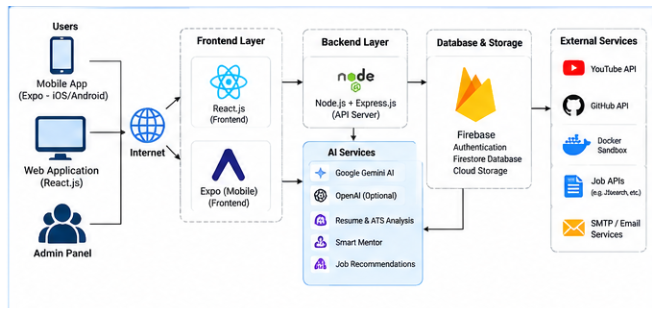
The overall architecture of the platform is shown in Figure 1.
6Technology stack
6.1Frontend
- React
- TypeScript
- Vite
- React Router
- Tailwind CSS
- Radix UI components
- Recharts
- Monaco Editor
- Responsive UI components
6.2Mobile application
- React Native
- Expo
- Expo Router
- TypeScript
- Firebase Authentication
- Native Google Sign-In for development/production builds
- Shared Smart Skill Hub backend APIs
6.3Backend
- Node.js
- Express
- JavaScript/ES Modules
- MongoDB
- Mongoose
- Firebase Admin SDK
- Groq SDK
- LangChain-related AI services
- Dockerode
- REST APIs
- WebSocket/Socket.IO capabilities where required
6.4Database
MongoDB Atlas is used as the primary persistent database for user profiles, skills, learning information, assessments, resumes, portfolios, GitHub-related analysis, learning history, saved content, and analytics.
Firebase UID is treated as the canonical identity for authenticated users.
6.5Authentication
Firebase Authentication provides email/password, Google, and configured GitHub authentication, together with email verification, password reset, and persistent authentication sessions. The backend verifies Firebase ID tokens before allowing protected operations.
6.6Artificial intelligence
Smart Skill Hub uses centralized AI services for skill analysis, skill-gap interpretation, learning roadmap generation, resume analysis and improvement, job tailoring, Smart Mentor responses, profile interpretation, and GitHub-related intelligence.
7Authentication and user management
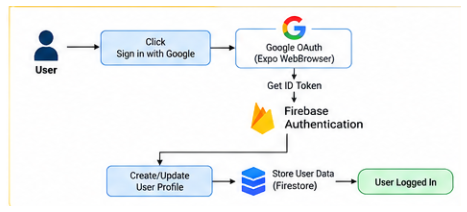
Authentication is implemented using Firebase Authentication; the Google sign-in flow is shown in Figure 2.
For email/password registration, the user creates a Firebase account, receives a verification email, verifies the email address, and then gains access to protected application functionality.
Password reset uses Firebase Admin-generated reset links integrated with the application's email service.
8Learner profile
The learner profile is a central component containing name, email, education, branch, course, semester, technical skills, projects, experience, certifications, achievements, GitHub, LinkedIn, portfolio information, and career interests.
This common profile reduces duplication and improves consistency between platform services.
9Skill profile
The Skill Profile provides a structured representation of technical capabilities across programming, frontend, backend, databases, cloud, DevOps, AI, machine learning, development tools, frameworks, and other technical categories.
The profile is used as an input to skill-gap analysis and learning roadmap generation.
10Skill gap analysis
Skill Gap Analysis compares current capabilities against requirements associated with a selected target direction (Figure 3).
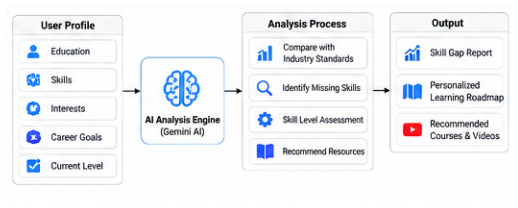
The system can identify existing strengths, missing skills, partially developed skills, recommended learning areas, and suggested progression.
11Personalized learning roadmap
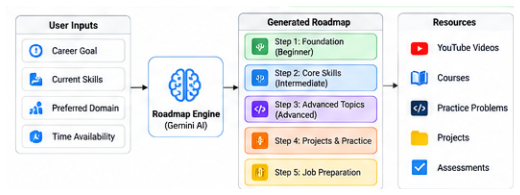
The Learning Roadmap converts skill information and identified gaps into an ordered learning path containing foundation concepts, programming skills, frameworks, backend/database concepts, tools, advanced concepts, projects, and assessment (Figure 4).
12EduTube
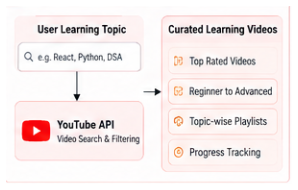
EduTube (Figure 5) provides integrated educational content discovery with search, category filtering, learning tracks, YouTube video discovery, playback, watch history, playback persistence, saved videos, playlists, notes, Continue Learning, and recommendations.
YouTube privacy-enhanced embedding can use youtube-nocookie.com.
Personalized mode can provide Continue Learning, recommended content, skill-gap learning, career-path learning, project-oriented learning, and curated learning tracks. Explicit YouTube search is performed only after the learner initiates a search.
13Coding assessment
Coding Assessment provides coding problems, a code editor, test cases, submission, execution, result reporting, and assessment history. It is connected to the broader learner ecosystem rather than operating as an isolated coding service.
14Secure code execution
Smart Skill Hub uses a Docker-based execution sandbox to execute student code with controlled resources; the coding assessment architecture is shown in Figure 6.
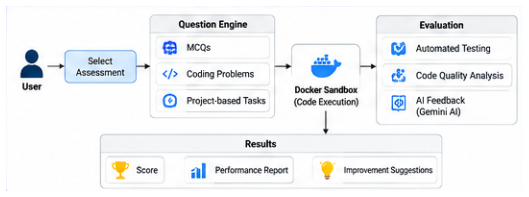
Security controls include container isolation, non-root execution, read-only filesystem where appropriate, disabled network access, memory limits, CPU restrictions, execution time limits, temporary filesystems, controlled input/output, and restricted container lifecycle.
15GitHub Intelligence
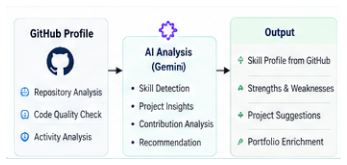
GitHub Intelligence analyzes authenticated GitHub information to provide development insights from repositories, programming languages, repository activity, contributions, project information, development patterns, and public profile information (Figure 7).
16Resume AI
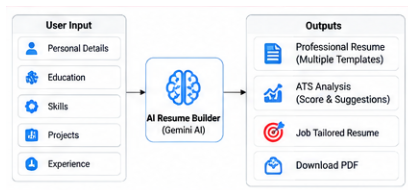
Resume AI provides resume import, document extraction, structured resume data, resume creation, editing, analysis, AI suggestions, ATS-oriented analysis, job-specific tailoring, versioning, and PDF export (Figure 8).
Supported imported formats can include PDF, DOCX, TXT, and RTF.
17Resume canonical data model
Resume AI separates resume data from visual templates. Structured information includes contact details, professional summary, education, experience, technical projects, skills, achievements, certifications, and links.
Templates act as presentation layers rather than independent resume databases, allowing the same content to be presented through different designs without duplicating the underlying data.
18Resume builder
The Resume Builder provides an interactive A4 editing environment with inline editing, section reordering, project reordering, drag-and-drop interactions, section visibility, template switching, zoom, A4 preview, autosave, undo/redo, accessibility controls, and AI-assisted editing.
19Resume templates
Smart Skill Hub provides:
- ATS Classic
- Modern Developer
- Minimal Clean
- Two-Column Compact
- Compact One-Page
Templates control typography, layout, section arrangement, spacing, visual hierarchy, column structure, and styling while using the same underlying resume information.
20Resume AI analysis
AI-assisted resume analysis can address clarity, relevance, structure, technical terminology, project descriptions, professional summary, skill presentation, keyword alignment, completeness, and job-specific relevance.
The platform should not invent skills, employment, project achievements, metrics, certifications, technologies, or professional experience. AI suggestions are intended to improve the user's actual information rather than fabricate qualifications.
21ATS-oriented analysis
Resume AI provides ATS-oriented analysis based on structured heuristics including contact information, section completeness, keyword relevance, formatting consistency, skill visibility, project clarity, experience clarity, readability, and job-description alignment.
ATS-related scores are analytical indicators and are not official scores from a particular commercial ATS vendor.
22Job tailoring
Resume AI can compare a resume with a target job description (Figure 9).
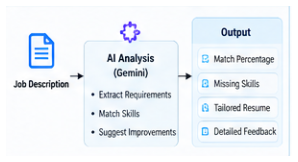
The system should not instruct users to falsely claim missing skills. It can distinguish between demonstrated skills, weakly demonstrated skills, absent skills, and areas that may require genuine learning.
23Resume export
Resume export is designed to preserve the visual structure of the selected template and provide A4 dimensions, selectable and searchable text, functional hyperlinks, correct section order, typography, spacing, template structure, and multi-page support where required.
24Portfolio generator
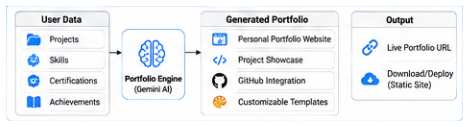
The Portfolio component (Figure 10) converts professional profile information into a structured developer portfolio containing personal introduction, technical skills, projects, education, experience, achievements, contact information, GitHub, LinkedIn, and portfolio links.
The portfolio generator is connected to the canonical profile so that information can remain consistent across the ecosystem.
25Smart Mentor
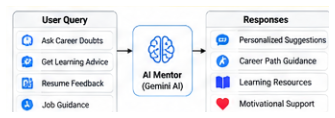
Smart Mentor (Figure 11) provides an AI-based conversational interface for personalized guidance using available learner contexts such as skills, skill gaps, learning roadmap, projects, resume information, career goals, and learning activity.
Possible interactions include learning questions, project guidance, skill improvement, roadmap clarification, resume suggestions, interview preparation, technical explanations, and career-development planning.
26Analytics
Smart Skill Hub provides learner-level and administrator-level analytics (Figure 12).
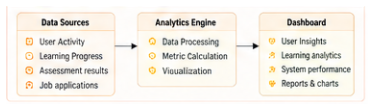
26.1My Analytics
Learner analytics can include learning activity, coding activity, assessment history, resume activity, portfolio activity, learning progress, and content engagement.
26.1.1Admin Analytics
Admin Analytics is restricted to authorized administrators and can provide system-level information such as user activity, platform usage, learning activity, assessment activity, feature usage, and system-level trends.
27Profile details and settings
Profile Details allows learners to manage personal and professional information including name, email, education, branch, semester, skills, social links, GitHub, LinkedIn, portfolio, and career information.
Settings provides application configuration rather than duplicating profile editing functionality.
28Mobile application
Smart Skill Hub is also designed as a mobile application using React Native and Expo. It uses the same backend rather than creating an independent backend or database (Figure 13).
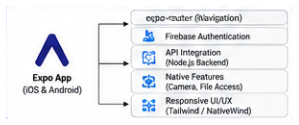
The mobile application provides mobile-native navigation, touch interactions, responsive layouts, safe-area handling, keyboard management, and mobile-specific components. Authentication uses Firebase, with native Google Sign-In used for Android/iOS development builds where native modules are required.
29Security architecture
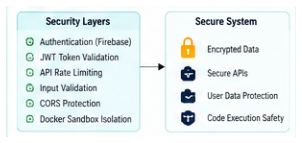
Security is important because the system processes user profiles, resumes, authentication information, uploaded documents, and arbitrary code submissions. The security architecture is shown in Figure 14.
29.1Authentication security
- Firebase Authentication
- Firebase ID token verification
- Protected API routes
- UID-based identity
- Email verification
- Password reset mechanisms
29.1.1Data isolation
User-specific resources are associated with authenticated identities. Backend operations verify ownership before returning or modifying private resources.
29.1.2API security
The backend can employ Helmet, CORS restrictions, rate limiting, payload-size limits, input validation, and authentication middleware.
29.1.3Code execution security
The Docker execution environment uses non-root containers, network restrictions, resource limits, temporary filesystems, controlled execution, and container isolation.
29.1.4File security
Uploaded resumes and documents should be processed through controlled backend services and should not be exposed through unrestricted public URLs.
30Data flow
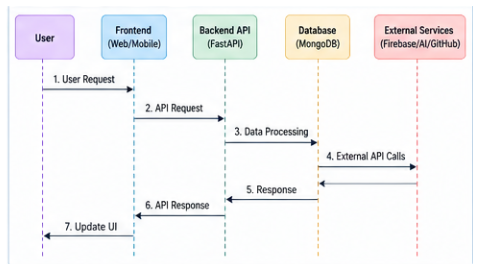
The data flow between the user, frontend, backend, database and external services is shown in Figure 15.
31AI integration architecture
Centralization provides consistent model configuration, common error handling, reusable prompt infrastructure, controlled token usage, easier maintenance, and feature-level AI integration.
AI output is treated as assistance rather than an authoritative replacement for user judgment.
32User workflow
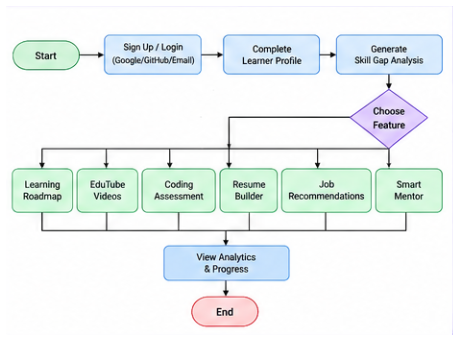
The workflow followed by a learner is shown in Figure 16.
33Administrative workflow
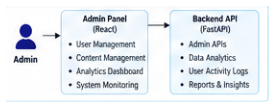
The administrative workflow is shown in Figure 17.
34User interface design
Smart Skill Hub follows a modern developer-oriented interface using a dark futuristic visual language, clear information hierarchy, responsive layouts, card-based information presentation, consistent navigation, contextual actions, accessible controls, loading states, empty states, error states, and mobile-friendly interactions.
The mobile interface uses native navigation patterns and touch-friendly controls rather than simply scaling down the desktop UI.
35Navigation structure
The navigation of Smart Skill Hub contains the following sections:
- Overview
- Smart Mentor
- Skill Profile
- Skill Gaps
- Learning Roadmap
- EduTube
- Coding Assessment
- GitHub Intelligence
- Resume AI
- Portfolios
- Profile Details
- My Analytics
- Settings
- Admin Analytics
The navigation presentation may differ between desktop web and mobile interfaces while preserving the same underlying capabilities.
36Performance considerations
36.1Frontend
- Component-based architecture
- Lazy loading where appropriate
- Controlled rendering
- Efficient API access
- Responsive layouts
- Optimized data fetching
36.1.1Backend
- REST API separation
- Database indexing where appropriate
- Controlled AI requests
- Authentication middleware
- Resource limits
36.1.2Coding sandbox
- Container lifecycle management
- CPU restrictions
- Memory restrictions
- Execution timeout
- Network isolation
36.1.3Mobile
- Native components
- Safe-area handling
- Keyboard-aware layouts
- Controlled navigation
- Avoidance of unnecessary background operations
37Error handling
The application provides controlled handling for authentication failures, network failures, invalid requests, missing resources, AI service errors, file processing errors, code execution errors, unauthorized requests, and expired authentication sessions.
User-facing errors should remain understandable while internal implementation details and sensitive information remain protected.
38Testing and validation
Testing is performed across frontend and backend components using unit testing, component testing, API testing, authentication testing, integration testing, protected-route validation, resume-processing validation, coding-sandbox validation, AI service testing, and UI workflow testing.
Important validation areas include:
- Authentication and authorization
- User ownership isolation
- Resume extraction
- Resume editing
- Resume export
- Skill-gap analysis
- Learning roadmap generation
- EduTube search and persistence
- Coding execution
- GitHub integration
- Portfolio functionality
- Analytics
- Mobile navigation
- Responsive layouts
39Results and findings
Smart Skill Hub provides an integrated environment in which several previously separate student-development activities can be connected through a common learner profile.
The implemented system demonstrates the following functional outcomes:
- Centralized student profile management
- Structured technical skill representation
- Skill-gap identification
- Personalized learning roadmap generation
- Educational video discovery
- Learning progress persistence
- Coding assessment and isolated execution
- GitHub development intelligence
- AI-assisted resume creation and analysis
- Multiple resume templates
- Interactive A4 resume editing
- Selectable and searchable PDF output
- Portfolio generation
- Learner analytics
- Administrative analytics
- Context-aware AI mentoring
- Secure Firebase authentication
- Protected backend APIs
- Mobile application architecture using the same backend
The integration of these capabilities reduces the need for learners to maintain independent information across unrelated platforms and establishes a reusable information flow in which learner data can support multiple features without repeatedly entering the same information.
40Discussion
Traditional learning platforms generally concentrate on content delivery, while coding platforms focus on programming practice and resume platforms focus on professional documents. Smart Skill Hub attempts to connect these activities through a common learner context.
For example, a student's skills can influence the identification of skill gaps. The resulting gaps can influence the learning roadmap. Learning activity can then become part of analytics. Projects and technical skills can contribute to resume and portfolio development. GitHub activity can provide additional evidence of practical development work. Smart Mentor can use the available context to provide more relevant guidance. This learner development cycle is shown in Figure 18.
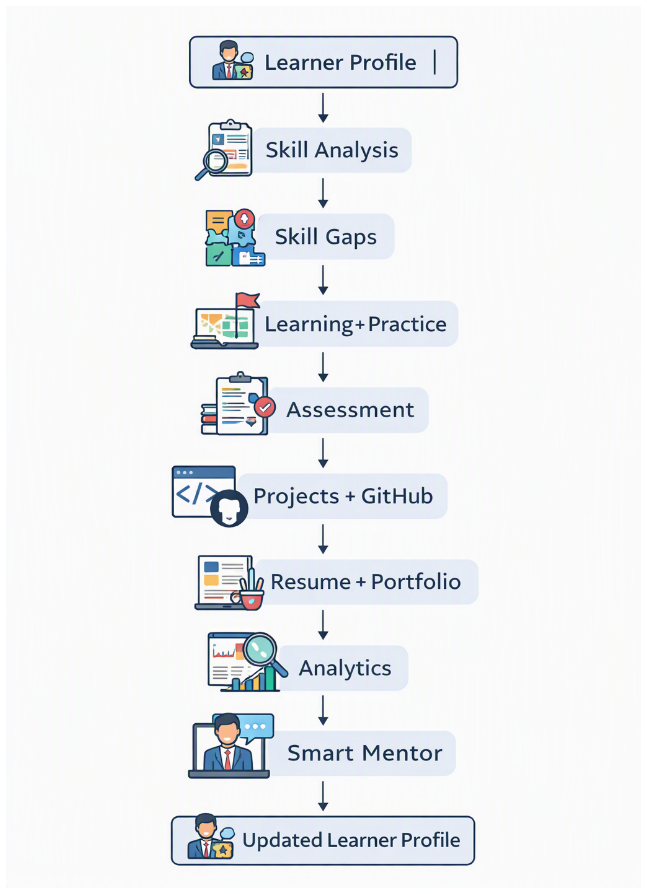
The cycle allows the platform to evolve with the learner instead of treating every interaction as an isolated transaction.
41Novelty and contribution
The primary contribution of Smart Skill Hub is the integration of multiple student-development workflows into one contextual platform.
41.1Unified learner context
A canonical learner representation is reused across skill analysis, learning, assessment, resumes, portfolios, analytics, and mentoring.
41.1.1Integrated skill-to-career workflow
The platform connects skill identification with learning, practical assessment, and professional presentation.
41.1.2AI-assisted resume ecosystem
Resume AI extends beyond static resume generation by supporting extraction, structured data, editing, analysis, tailoring, and export.
41.1.3Secure coding infrastructure
The coding assessment environment executes submitted code inside isolated containers rather than directly on the backend host.
41.1.4GitHub-based development intelligence
The system uses authenticated GitHub information as an additional source of evidence about practical development activity.
41.1.5Contextual AI mentor
Smart Mentor can use learner-specific information rather than functioning only as a generic question-answering interface.
41.1.6Cross-platform architecture
The same backend services can support both the responsive web application and the React Native mobile application.
42Limitations
- AI-generated recommendations depend on the quality and completeness of available learner information.
- AI-generated resume suggestions should be reviewed by the user before application.
- ATS analysis is heuristic and does not represent an official score from a specific recruitment system.
- External services such as GitHub, YouTube, AI providers, email services, and authentication services may introduce availability or API limitations.
- Coding execution requires careful resource management to prevent abuse.
- Mobile native authentication requires appropriate Android/iOS development-build configuration.
- Career recommendations cannot guarantee employment outcomes.
- Portfolio and resume information remains dependent on the accuracy of information supplied by the learner.
- AI systems may occasionally produce unsuitable suggestions and therefore require user verification.
43Future enhancements
Potential future enhancements include:
- Additional programming-language execution environments
- More advanced skill taxonomy
- Improved learning-resource recommendation
- More detailed coding performance analytics
- Interview simulation
- AI-generated project evaluation
- Additional resume formats
- DOCX export
- Expanded portfolio deployment options
- Advanced GitHub repository analysis
- Additional mobile functionality
- Offline mobile learning support
- More granular administrator analytics
- Additional AI model providers
- Improved multilingual support
- Advanced notification and reminder systems
These enhancements can be incorporated without changing the fundamental learner-centered architecture.
44Conclusion
Smart Skill Hub presents an integrated approach to student technical development and career preparation by connecting learning, skill analysis, coding practice, professional representation, analytics, and AI-assisted guidance within a single platform.
The system combines a React and TypeScript web application, React Native and Expo mobile architecture, Node.js and Express backend services, MongoDB persistence, Firebase Authentication, centralized AI services, GitHub integration, educational content discovery, an isolated Docker-based coding environment, and an AI-assisted resume and portfolio ecosystem.
A key aspect of the system is the use of a common learner context. Rather than treating learning, assessment, resumes, portfolios, GitHub activity, and mentoring as unrelated services, Smart Skill Hub connects them through structured learner information. This enables the platform to support a continuous workflow from identifying current capabilities and skill gaps to learning, practicing, demonstrating skills, preparing professional documents, and monitoring progress.
The system therefore provides a unified technological foundation for students seeking to develop technical skills and improve their career readiness. Its modular backend, reusable learner data model, secure execution environment, AI service architecture, and cross-platform client strategy also provide a foundation for continued development and expansion.
Appendix A: Major system components
The major components of the platform and their primary responsibilities are listed in Table 1.
| Component | Primary responsibility |
|---|---|
| Authentication | User identity and session management |
| Learner Profile | Centralized student information |
| Skill Profile | Technical skill representation |
| Skill Gaps | Identification of missing/weak skills |
| Learning Roadmap | Personalized learning sequence |
| EduTube | Educational content discovery and tracking |
| Coding Assessment | Programming practice and assessment |
| Docker Sandbox | Secure code execution |
| GitHub Intelligence | Development activity analysis |
| Resume AI | Resume extraction, creation and optimization |
| Resume Builder | Interactive resume editing |
| Portfolio | Professional portfolio generation |
| My Analytics | Learner activity analytics |
| Smart Mentor | Contextual AI guidance |
| Settings | Application configuration |
| Admin Analytics | Authorized system-level analytics |
Acknowledgment
The authors would like to express their sincere gratitude to the Department of Computer Science and Engineering, Rajiv Gandhi Institute of Technology, Bengaluru, for providing the academic environment and resources required to develop this project.
The authors also acknowledge the guidance and support provided by the project faculty, mentors, colleagues, and all individuals who contributed feedback during the development and evaluation of Smart Skill Hub.
References
- [1]Kumar S, Sharma R, Singh P. Artificial intelligence in education: Enhancing learning outcomes and student engagement. IEEE Access. 2022;10:112345–112356.
- [2]Smith J, Wang L. Personalized learning systems using machine learning techniques. International Journal of Educational Technology. 2021;15(3):45–58.
- [3]Brown M, Davis K, Wilson T. Resume classification and analysis using natural language processing. IEEE Transactions on Computational Intelligence. 2023;8(2):210–220.
- [4]Patel A, Mehta R. Skill recommendation systems based on collaborative filtering. In: Proceedings of the IEEE International Conference on Data Mining (ICDM); 2020. p. 134–139.
- [5]GitHub Inc. GitHub REST API documentation. 2024. https://docs.github.com/en/rest
- [6]MongoDB Inc. MongoDB Atlas documentation. 2024. https://www.mongodb.com/docs/atlas/
- [7]Google. Firebase Authentication documentation. 2024. https://firebase.google.com/docs/auth
- [8]Johnson N, Lee P. Cloud-based scalable architectures for educational platforms. IEEE Cloud Computing. 2022;9(4):30–39.
- [9]Gupta R, Verma S. Analyzing student performance using machine learning techniques. International Journal of Computer Applications. 2020;182(44):15–22.
- [10]Nguyen T, Zhao H. AI-based recommendation systems for online learning platforms. IEEE Transactions on Learning Technologies. 2021;14(3):256–267.