Distributed Solar Energy
Integration of Distributed Solar Energy into Saudi Smart Distribution Grids: Voltage Regulation, Hosting Capacity and Protection Challenges
Published October 2026
Abstract
The deployment of distributed solar photovoltaic generation is leading Saudi Arabia's distribution networks to move from a primarily one-way arrangement to a more actively managed system in which power, voltage and fault current can change direction at various stages of operation. This study looks at the technical integration of distributed solar energy into Saudi smart distribution grids by considering three closely related areas: voltage regulation, hosting capacity and protection. Synthetic data from 2020 to 2025 is examined with particular regard to the specific circumstances in Saudi Arabia, the latest grid-connection requirements, international research on distribution networks and advanced control techniques. The review argues that it is not feasible to control photovoltaic penetration by means of a single static capacity limit because the limiting factor varies according to the feeder impedance, the level of load coincidence, inverter behaviour, network topology, weather conditions, protection settings and the available flexibility. Even though smart inverters, on-load tap changers that are coordinated, battery storage, demand response and data-driven hosting-capacity tools can increase the amount of power that the network is able to take in, the benefits of these measures depend on interoperable settings and protection-aware operation. There are also additional design problems in Saudi Arabia due to high levels of irradiance, temperature, dust, the concentration of solar generation during the midday and the rapid growth in distributed resources. It is therefore proposed that a comprehensive planning framework be adopted in which the voltage, thermal, power quality and protection limits are jointly assessed across time-series scenarios, following which coordinated control and adaptive protection are put into place. The review also points out key areas that require further research, namely feeder-level data from Saudi Arabia, probabilistic hosting capacity, the interaction between inverters and protection systems, digital monitoring and field validation.
1Introduction
The electricity sector in Saudi Arabia is increasingly being shaped by the combination of large renewable-energy projects and distributed photovoltaic generation which is connected right at the point where demand is located. Although distributed solar power can help decrease dependence on the transmission system, contribute to diversifying the generation mix, and result in a more participatory electricity system, the impact of such systems on the distribution grid is fundamentally different from that of large-scale utility plants. Rooftop and behind-the-meter photovoltaic systems are scattered across low- and medium-voltage feeders, their output varies with the weather conditions, and their inverters interact directly with voltage control, protection, and power-quality equipment. Because of this, Saudi studies have moved past evaluating the solar potential and are now concentrating on the practical matters concerning interconnection, design, regulation, and operation [1-8]. The problem that emerges is not simply how much photovoltaic capacity can be installed all over the country, but rather how much can be connected at specific locations on the network without causing unacceptable voltage excursions, thermal loading, harmonic distortion, protection miscoordination, or a reduction in reliability.
From the standpoint of technical feasibility, traditional distribution networks were designed so that power flowed in a radial pattern from substations to end users. If there is a high level of distributed photovoltaics and the sunlight is intense while demand is low, the direction of power flow on the feeder can be reversed, causing the voltage further along the line to increase and altering the way voltage regulators, transformers and protective devices operate. The same feeder can have a different limiting situation during the evening peak periods, in summer when the demand for cooling is high, during cloudy transitions, or after a fault has been restored. The concept of hosting capacity is valuable precisely because it indicates how much distributed energy resources can be incorporated before a specific technical criterion is violated [11-15]. However, hosting capacity is conditional and not absolute; it depends on the performance index selected, the model resolution, the assumptions made about load and generation, the control functions, the way the sites are spaced, and the method used to represent uncertainty. A deterministic value obtained from a single peak condition may therefore be either too conservative or not secure enough.
Voltage regulation is generally the first limitation encountered on feeders which have a high share of photovoltaic generation, since voltage levels at remote locations rise, quick variations caused by changes in irradiance occur, there is a phase imbalance, and the interactions between the inverter's Volt/Var control, the on-load tap changers, and the capacitor banks all decrease the margin available for additional solar installations. According to recent literature, the constraints mentioned can be reduced by coordinating the use of storage, demand response, and advanced inverter functions, on the condition that the objectives of their control are aligned [10,16,17]. Likewise, the research carried out in Saudi Arabia concerning the design of residential PV systems emphasizes that the quality of interconnection depends on the strength of the grid at the point of common coupling, the power factor, the ride-through capability, the harmonic performance, and on the use of appropriately sized storage or control support [1].
The introduction of protection brings an extra degree of complexity. While inverter-based generation changes the magnitude, direction and duration of the fault current, network reconfiguration and bidirectional operation alter the electrical conditions that are assumed by relays and the fixed fuse settings. The variable output of renewable energy can also make relay coordination less predictable, especially as the number of distributed resources grows [23-25]. Power-quality problems are closely related rather than separate; harmonics, voltage distortion and switching behaviour can consume the hosting-capacity margin and make it more difficult to achieve satisfactory sensing or protection performance [26,29]. Consequently, a voltage-only hosting-capacity assessment might lead to approval for photovoltaic connections that turn out to be problematic when both protection and power quality are considered.
The review gives a comprehensive understanding of the different challenges encountered by Saudi smart distribution grids. Rather than treating voltage regulation, hosting capacity and protection as individual technical problems, it sees them as closely related issues that have to be dealt with together during both planning and operation. The analysis is grounded in evidence that is specific to Saudi conditions and draws on recent international research carried out between 2020 and 2025, with particular attention to the technical mechanisms which can be carefully transferred from one feeder to another without abandoning the local regulatory and operating conditions. The key idea is that Saudi distribution planning should shift from static interconnection checks to a more dynamic approach which is time-dependent, depends on detailed data and takes control into account. This shift will require good visibility of the feeders, clearly defined hosting-capacity criteria, coordinated smart-inverter settings, the use of storage where this adds value to the network, and protection schemes that are capable of adapting to changes in the network topology and to the behaviour of the resources.
2Aim, objectives and research questions
This review serves as a critical summary of the most up-to-date evidence relating to the integration of distributed solar energy into Saudi smart distribution grids, and it also seeks to establish a technically sound framework which links decisions regarding voltage regulation, hosting capacity and protection.
The review has five objectives. The first of these is to describe the present situation regarding distributed solar power in Saudi Arabia and the network conditions which make the technical integration of photovoltaics unique. The second aim is to evaluate the voltage rise, fluctuation, reactive power and the interaction between regulators that might limit the quantity of photovoltaics that can be incorporated. Thirdly, it compares the different hosting-capacity concepts and the methods employed to assess them when planning under conditions of uncertainty. Fourthly, it examines the protection coordination, fault current and power quality problems associated with distribution feeders that are dominated by inverters. Fifthly, it identifies a group of coordinated operational and planning measures which can increase the amount of photovoltaics that can be accommodated without transferring the risk from one technical area to another.
The synthesis is grounded in the following four research questions: What mechanisms have the greatest effect on voltage performance as the quantity of distributed solar power feeding into the grid in Saudi feeders increases? How should hosting capacity be assessed when solar output, load, topology and control settings change over time? In what way do inverter-based distributed generation systems modify the traditional assumptions regarding protection and the coordination margins? What planning and control strategies, when integrated, are able to increase the amount of usable photovoltaic capacity while at the same time maintaining voltage quality, equipment security and reliable fault clearing?
3Review methodology
A structured integrative review method was selected because the subject area covers a number of areas including power-system operation, distribution planning, inverter control, protection engineering, energy policy and the particular conditions concerning the deployment in Saudi Arabia. The aim of this approach was to achieve a critical synthesis rather than to carry out statistical pooling. The searches were concentrated on publications from 2020 to 2025 so that the evidence would show what the current situation is regarding inverter capabilities, modern hosting-capacity techniques, recent practices relating to interconnection in Saudi Arabia and existing smart-grid operations. The review places a preference on peer-reviewed journal articles and high-quality conference papers which describe clear technical methods; Saudi studies with a policy focus are only included if they are directly concerned with distributed photovoltaic deployment, the interconnection context or grid-development priorities.
The search strategy considered four groups of concepts: distributed or rooftop photovoltaic generation; distribution grids or active distribution networks; voltage regulation, hosting capacity or protection; and Saudi Arabia or other high-solar distribution scenarios. Examples of appropriate query combinations included “distributed photovoltaic” AND “hosting capacity”, “smart inverter” AND “voltage regulation”, “photovoltaic” AND “protection coordination”, “battery storage” AND “hosting capacity”, and “Saudi Arabia” AND “grid-connected residential PV”. The concepts were matched in a conceptual manner across Scopus, Web of Science, IEEE Xplore, ScienceDirect, IET and Google Scholar. To identify further recent studies, backward citation tracing was performed from key technical reviews, particularly in the fields of probabilistic hosting capacity, distribution-resource interconnection and protection.
Eligibility was determined by referring to the topic's relevance, the date of publication, the level of methodological transparency, and the direct value to at least one of the review's aspects. A study was included if it supplied quantitative data or an explanation of the effects of photovoltaics on voltage, thermal loading, hosting capacity, power quality or protection; if it had compared different methods for assessing hosting capacity; if it demonstrated that mitigation could be achieved by means of smart inverters, energy storage, demand response or reconfiguration; or if it presented evidence that was specific to Saudi Arabia with regard to the design and deployment of distributed PV systems. A study was excluded if the solar generation was only incidental, if the network model was not described adequately, if the publication was outside the specified date range, or if the claims could not be linked to a technical mechanism relevant to the integration of distributed energy into the distribution grid. The review was continuously updated until thematic saturation was achieved rather than being carried out as a fixed-number inventory of the evidence, and therefore a numerical screening process is not reported.
The appraisal examined whether or not each study had stated its network, its operating assumptions, its performance constraints and the criteria according to which it had been compared. For research into hosting capacity, particular attention was given to the way in which capacity was defined, the manner in which uncertainty was dealt with, the temporal resolution and the binding constraint. As for voltage-control studies, the appraisal investigated the control hierarchy, the measurement requirements, the inverter limits and the interactions with existing regulation. In the case of protection studies, emphasis was placed on the fault-current characteristics, the coordination logic, the dependence on topology and the validation conditions. The sources with a focus on Saudi Arabia were assessed by reference to the extent to which their assumptions directly matched the local grid codes, the climate, the tariffs, the load behaviour and the deployment practices.
The thematic approach was used; the evidence was first allocated to voltage regulation, hosting-capacity assessment, protection and power quality, and this also provided some flexibility. The cross-links were then examined in order to identify the mechanisms which modify the binding constraint. For example, reactive-power support may help to alleviate overvoltage but at the same time increases current and losses; storage can reduce reverse power but does so by bringing in new protection and state-of-charge problems; and network reconfiguration may redistribute voltage and thermal stress while at the same time altering the fault paths.
4Saudi distributed solar integration context
Saudi Arabia possesses significant solar resources and is at the same time advancing its renewable energy policy, displaying a growing interest in distributed generation, even though its distribution system has previously been designed for centralised supply. It has recently been demonstrated in Saudi literature that the viability of rooftop and distributed photovoltaic systems cannot be separated from tariff design, the features of the buildings, operational performance and the requirements specified at the point of connection [1-8]. Although the residential rooftop potential in Riyadh shows a substantial amount of technical resource availability, the economic outcomes will differ depending on the scale and the policy structure [4]. The more recent national studies distinguish between distributed generation and large-scale utility deployment and emphasise that the support measures, the grid procedures and the investment design influence both the rate and the way in which adoption takes place [3,5-7].
From the network's point of view, the circumstances in Saudi Arabia give rise to a special coincidence problem. Solar power generation is at its highest around midday, but residential demand is greatly influenced by air-conditioning and can reach its peak later in the day or exhibit strong seasonal variation. Even though high irradiance causes a large amount of photovoltaic output, high module temperature and dust can reduce the conversion efficiency and alter the expected level of production. Consequently, distributed systems may generate considerable local exports at certain times while supplying less power during the evening period of high demand. This mismatch over time is central to voltage rises, transformer loading and the economic value of storage; it also implies that the annual energy balance is a poor measure of the network's immediate stress.
The need to take into account the strength of the point-of-common-coupling, the power factor, the ability to ride through low voltage and the harmonic limits is demonstrated by the way grid-connected residential photovoltaic systems are designed in Saudi Arabia [1]. A feeder that is electrically weak will show greater voltage sensitivity for the same amount of injected power than one that is stiff. In low-voltage networks the voltage rise can be made even higher because of the presence of long radial lines, a high resistance-to-reactance ratio and uneven phase allocation. Connection decisions must therefore be based on location. If a single photovoltaic size threshold is used, strong feeders will be underutilised while at the same time presenting an excessive risk to weak ones.
The smart grid being developed in Saudi Arabia offers a variety of tools for coping with this diversity. Distribution planning can shift from a passive 'fit-and-forget' approach to one that is actively managed as a result of the use of advanced meters, feeder automation, intelligent inverters and storage. Yet the fact that digital capabilities are available does not by itself guarantee better accommodation; the operational value will depend on the quality of the data, the degree of telemetry coverage, the presence of control authority, the cybersecurity measures taken, the availability of interoperable settings, and on the clear assignment of responsibilities between the distribution utility and the customer-owned resources. The real objective is therefore not to connect as much solar capacity as possible at any cost, but rather to achieve a hosting capacity that is economically justified and at the same time keeps the equipment in good condition, ensures good voltage quality and guarantees the reliability of protection while making effective use of the Kingdom's solar resource.
5Voltage regulation under high distributed solar penetration
The most obvious technical result of a high level of photovoltaic generation is voltage regulation, since the export of active power causes the voltage to rise along resistive distribution feeders. When generation is high and local demand is low, the voltage at distant buses may go above the statutory or utility-imposed limits even though the substation voltage is still within acceptable limits. The extent of this effect varies according to the feeder impedance, the phase balance, the position of the transformer taps, the way the load is distributed and the location of the photovoltaic systems. Studies on hosting capacity always point out voltage magnitude as the main constraint, especially in low-voltage networks [11,12,15]. Research into residential design in Saudi Arabia also associates acceptable interconnection with grid strength and the point-of-common-coupling conditions [1].
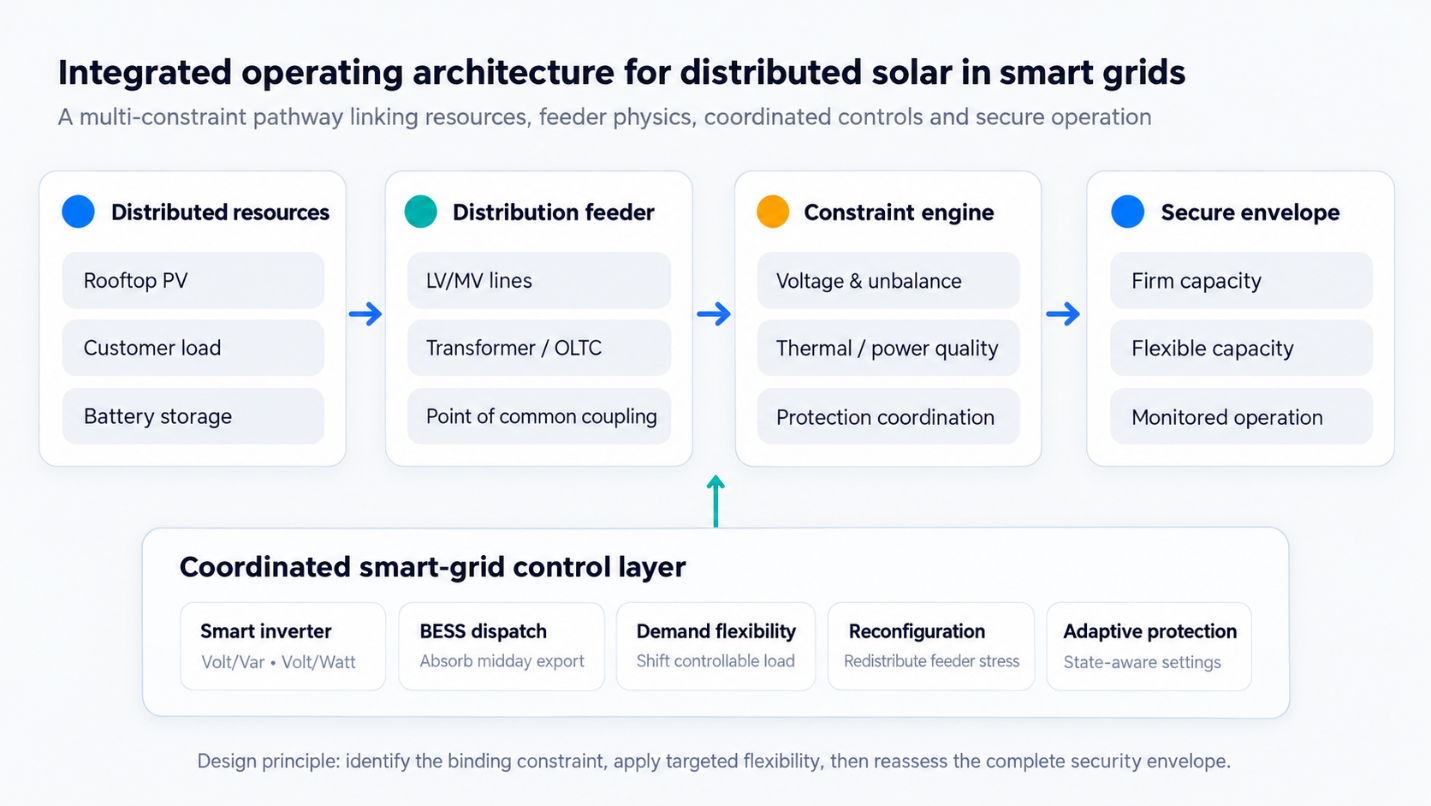
Standard voltage regulation makes use of substation tap changers, line regulators and switched capacitors which operate on fairly slow time scales. The amount and spread of changes introduced by distributed solar exceed the capabilities with which these devices were designed to cope. Repeated tap operations can speed up mechanical wear, and the behaviour of fixed capacitors may prove inappropriate in the event of reverse power flow. A control response which remedies a section of the feeder can at the same time make another situation worse if the local measurements are not coordinated. That is the reason why voltage management in an active distribution grid should be hierarchical: quick local action by inverters should deal with short-term deviations; coordinated control at the feeder level should look after ongoing conditions; and the slower utility devices should retain the overall voltage headroom [19].
The smart inverters form the initial flexible layer; under volt/var control, reactive power is absorbed or supplied in response to changes in local voltage, whereas with volt/watt control, active power is only reduced when the voltage is about to reach a critical level. Reviews of PV and battery systems enabled by smart inverters indicate that coordinated settings can enhance voltage stability and boost hosting capacity [10]. Yet the amount of reactive power that can be handled is limited by the inverter's apparent-power rating and by the instantaneous level of active power output. When solar production is at its highest, only minimal reactive power headroom will be left unless the inverter is over-sized. Moreover, vigorous absorption of reactive power can also lead to higher current levels, greater losses and increased thermal loading. These considerations explain why voltage control cannot be optimized separately from thermal and hosting-capacity objectives.
Battery energy storage provides flexibility in terms of active power. It is able to take in the excess power generated by photovoltaics during the day, reduce the flow of power in the reverse direction, and then discharge it later when demand increases. It has been found that when battery energy storage systems are controlled in coordination with on-load tap changers, the length of time during which voltage violations occur is reduced without causing unnecessary cycling of the batteries [17]. Moreover, robust allocation of batteries can also increase the hosting capacity in networks with unbalanced loads [20]. For Saudi feeders, the best value for storage is in cases where it at the same time alleviates voltage rise, transformer reverse power flow and the peak demand in the evening. Storage that is used only to deal with rare voltage events may be less economically viable than targeted inverter control or conventional reinforcement.
A complementary method involves shifting flexible consumption to take place during periods of high solar exposure. By altering the timing of residential energy use, the photovoltaic hosting capacity can be increased since this improves the local match between generation and demand [16]. Another possibility is network reconfiguration, which consists of modifying the feeder layout in order to redistribute the power flow and reduce voltage stress under conditions of renewable uncertainty [27].
Voltage fluctuations are also important apart from the steady-state increase. Quick changes in irradiance can lead to short-term voltage variations, especially in medium-voltage grids where a high amount of renewable energy is generated [30]. The geographic spread of many rooftop systems can help to reduce some of the total variability, but local cloud movement can still result in voltage ramps at the feeder level. The suitable response is therefore a multilayered control system incorporating local inverter functions, measurements at the feeder level, coordinated use of existing devices and selective deployment of storage. This coordination should involve deadbands and time delays in order to avoid control hunting. The aim is not to keep all nodes at the same voltage but rather to ensure that all nodes remain within safe limits while at the same time minimizing losses, excessive switching, curtailment and disruption to customers.
| Domain | Principal limiting mechanism | Diagnostic criteria | Priority response |
|---|---|---|---|
| Voltage regulation | Reverse power flow, high feeder R/X ratio, phase unbalance and regulator interaction; sensitivity is greatest on weak or long feeders. | Node Vmax/Vmin, violation duration, voltage unbalance, regulator/tap operations. | Coordinated Volt/Var and Volt/Watt control, OLTC coordination, selective BESS and demand shifting [1,10,16,17,19,30]. |
| Thermal loading | Reverse current, transformer duty and conductor ampacity can become binding after voltage is mitigated. | Transformer loading/aging, conductor current, reverse-flow duration, losses. | Targeted BESS/curtailment, dynamic monitoring, reconfiguration and selective reinforcement [18,20,27]. |
| Hosting capacity | The first active constraint varies with siting, solar/load coincidence, topology, controls and uncertainty. | Firm and flexible capacity, violation probability, seasonal/time-series security envelope. | Use transparent time-series and probabilistic studies; update maps as feeder data and controls change [11-15,21,22]. |
| Protection | Bidirectional fault contribution and inverter current limiting can erode fuse-relay or relay-relay coordination. | Coordination margin, clearing time, fault direction, sensitivity/selectivity and ride-through interaction. | Inverter-aware fault models, directional/adaptive settings and state-aware protection studies [9,23-25]. |
| Power quality | Aggregate inverter harmonics, flicker and imbalance can consume capacity even when voltage magnitude is acceptable. | THD, individual harmonic limits, flicker indices, voltage unbalance. | Monitoring, coordinated inverter settings and targeted harmonic mitigation [26,29]. |
6Hosting capacity as a planning and operating envelope
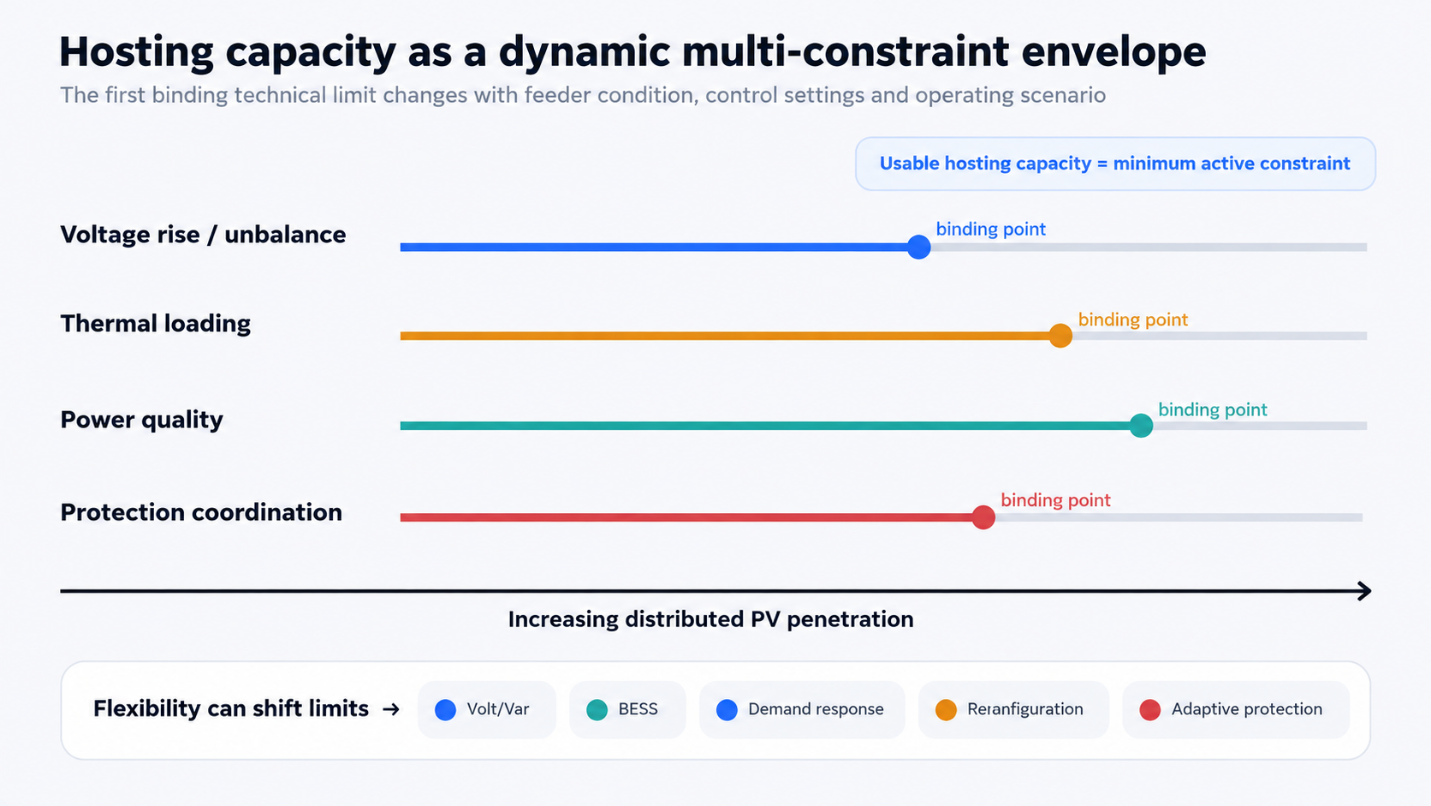
Hosting capacity offers a practical link between the goals of photovoltaic development and the physical characteristics of the feeders. Although it is usually seen as the quantity of distributed generation that can be connected before one or more of the predefined network criteria are breached, recent reviews highlight the fact that the outcome is highly dependent on the definition, the assumptions made, and the method used [11-15]. For the utilities in Saudi Arabia, this means that a hosting-capacity map should not be regarded as a fixed physical limit. Instead, it should be understood as an operating envelope that is influenced by location, time, uncertainty, control settings, and the level of accepted risk.
Deterministic methods are still appealing since they are transparent and easy to compute. They generally raise the level of photovoltaic penetration until a voltage, thermal, power quality or protection limit is exceeded. The disadvantage of these methods is that they depend on the scenario chosen; a worst-case scenario involving maximum generation and minimum load might be intentionally conservative, while a single study based on a typical day could fail to identify important combinations. Time-series methods enhance realism by showing the hourly or sub-hourly variations in both load and solar output. Stochastic and probabilistic methods go further by incorporating samples of the uncertain photovoltaic sizes, locations, demand patterns, and weather conditions. Reviews have demonstrated that each of these methods balances data requirements and computation against the level of realism and the representation of risk [11,12,15].
It is especially pertinent to carry out a probabilistic analysis of hosting capacity when thousands of customer systems are connected gradually. By using fast probabilistic techniques it is possible to lessen the computational demand when assessing a large number of scenarios without losing information about how often and how severely constraints are violated [21]. Moreover, machine-learning methods can then be used to estimate hosting capacity from the features of the feeders once adequate training data that are representative have been obtained [22]. These methods have potential for use in Saudi networks since, alternatively, detailed studies for each connection request could become too slow as the amount of distributed PV increases. Nevertheless, machine learning should be used to speed up engineering analysis and not to replace physical verification; models that have been trained on standard test feeders may not be able to be applied to Saudi feeder impedances, climate-influenced load patterns or local protection practices.
The constraint on the amount of power that can be hosted may change when measures to mitigate the problem are put in place. For instance, reactive control might be the first factor to reach its limit with regard to voltage, after which transformer loading, harmonic distortion or protection coordination become the main issues. Demand response can increase the capacity of a residential feeder by boosting consumption during the midday hours [16]. Storage too can enhance capacity, but the advantages it provides depend on its energy and power ratings, the way its state of charge is managed and the length of the period in question [20]. Power-quality filters can make use of extra capacity in cases where the limiting factor is harmonic distortion rather than voltage [29]. Together, these studies show that the outcome of having more hosting capacity is not due to a single technology; rather, it results from altering the constraint that is currently binding.
The hosting-capacity framework in Saudi Arabia should therefore take into account at least four groups of constraints: voltage and unbalance; thermal loading and transformer duty; power quality; and protection performance. Each of these constraints should be tested under typical seasonal and operational conditions. The framework also needs to differentiate between firm capacity and flexible capacity. Firm capacity refers to the amount of photovoltaic power that can be accepted without any action being required beyond the use of standard controls. Flexible capacity is additional generation that can be connected provided that enforceable inverter functions, curtailment, storage dispatch or demand flexibility are in place. Making this distinction makes the network value of smart controls apparent and allows for more transparent connection agreements.
It is just as important to have a good data governance approach. A hosting-capacity analysis needs as input validated feeder models, the parameters of the conductors and transformers, information on phase connectivity, historical voltage measurements, load profiles, the present locations of photovoltaic systems and the existing protection settings. Hosting capacity should be developed into a dynamic planning tool so that it is recalculated each time the topology, the load, the controls and the distributed resources change.
| Method | Strength | Main limitation | Recommended Saudi application |
|---|---|---|---|
| Deterministic | Transparent, reproducible and computationally light; useful for screening. | Highly dependent on selected worst-case or representative scenario. | Initial connection screening and identification of obvious voltage or thermal constraints [11,12,15]. |
| Time-series | Captures chronological solar/load coincidence, control action and duration of violations. | Requires validated profiles and larger computational effort. | Feeder planning where seasonal cooling demand and midday export vary materially [11,14]. |
| Stochastic / probabilistic | Represents uncertain PV size, location, weather, load and violation risk. | Results depend on probability models and sampling quality. | Portfolio-scale rooftop adoption and risk-based connection decisions [11,21]. |
| Optimization-based | Can co-optimize siting, controls, storage or reinforcement against technical limits. | May become computationally intensive and assumption-sensitive. | Evaluate least-cost flexibility versus reinforcement and BESS placement [14,20,28]. |
| Data-driven / machine learning | Fast approximation after training; suitable for repeated queries over many feeders. | Generalization is weak outside the training distribution without physical validation. | Accelerate studies after a representative Saudi feeder-data library is established [22]. |
| Dynamic / operational | Recalculates available capacity as topology, measurements and controllable flexibility change. | Depends on telemetry, communications, model governance and enforceable control actions. | Long-term target for smart grids using firm plus flexible connection envelopes [10,13,14]. |
7Protection, fault current and power-quality challenges
The protection philosophy becomes more complicated in the case where the distribution networks include a large amount of inverter-based generation. Traditional radial protection is based on the assumption of a main source located upstream, a fault current direction that can be predicted, and a current level high enough to cause fuses or overcurrent relays to operate within the required time coordination. Distributed photovoltaic inverters, however, can cause fault current to flow from positions downstream, change the direction of the current and alter the amount of current observed by individual devices. The fault current from inverters is also restricted by the semiconductor controls and may be only slightly above the rated current, whereas the fault current contribution from synchronous machines is generally much higher. Because of these features it is possible to have underreach, delayed clearing, sympathetic tripping or a loss of coordination between fuses and relays.
Studies carried out on distribution networks rich in renewable energy show that the operating time and coordination of relays may deteriorate because the presence of distributed generation alters both the magnitude and the direction of the fault current [25]. As a response, adaptive protection systems adjust their settings or logic whenever there are changes in the network topology and operating conditions. Examples of IoT-based schemes for active distribution systems demonstrate this general principle: protection can make use of the current system state to adjust thresholds and thus retain selectivity in bidirectional situations [24]. Even though the specific ways in which AC and DC networks implement these solutions differ, the conclusion for Saudi smart grids is obvious. With growing photovoltaic penetration and increasing feeder automation, protection settings should be based on credible generation states rather than being calculated once for a passive network and then left unaltered.
Protection also needs to be coordinated with the behaviour of inverters during voltage disturbances. Nowadays, grid-support requirements tend to ask distributed resources to stay connected during certain voltage disturbances rather than disconnect right away [9]. Although this enhances the level of system support it does alter the dynamics that occur after a fault and a disturbance. Where the inverter controls, the anti-islanding settings and the feeder protection are not coordinated, one requirement can negate another. The study of residential PV in Saudi Arabia shows how important it is to comply with low-voltage ride-through, power factor and power quality at the point of connection to the customer [1]. A forward-looking protection study should therefore base its model on the actual current-limiting and ride-through logic of certified inverters rather than treat all distributed generation as a conventional current source.
The need for hosting margin is affected by power quality since harmonic currents from power-electronic interfaces can build up, interact with the resonance of the network and cause voltage distortion. A multi-index assessment of renewable distributed generation explains why power quality should be considered as a system criterion rather than being evaluated merely at the level of individual devices [26]. Where voltage distortion is the limiting factor, harmonic mitigation can considerably increase the amount of distributed generation that a network is able to host [29]. This is particularly relevant in urban Saudi feeders which have a large number of inverter-based loads and generators, as the overall harmonic behaviour in such cases may differ from the results of compliance tests at the manufacturer level.
The issue of transformer and conductor stress also involves protection and reliability; reverse power flow and changing load patterns can affect the thermal workload of transformers. Where control systems are designed with a view to the equipment's limits, storage and curtailment can help reduce the excessive ageing caused by renewable energy penetration [18]. Nevertheless, a battery introduces another converter, another source of fault, and another protection interface. In a similar way, reconfiguration may alleviate heavily loaded components but does so by altering the fault paths and requiring changes to relay coordination [27]. Examples such as these highlight the importance of assessing mitigation measures across various technical areas before they are put into place.
It is possible to introduce a practical method of protection for the Saudi distribution networks in stages. When the level of photovoltaic penetration is low, the existing coordination studies should be revised to take into account the contribution of faults from distributed sources and the possibility of reverse flow. The transition should be based on evidence from the feeders themselves rather than on a general penetration rate. Protection readiness is therefore an aspect of hosting capacity: a feeder must not be regarded as capable of hosting more solar power if it can no longer guarantee secure and selective fault clearing.
8Integrated discussion: From static limits to coordinated smart-grid operation
The evidence under review indicates that voltage regulation, hosting capacity and protection are different ways of looking at the same integration problem. Hosting capacity refers to the available margin, voltage behaviour has a major influence on that margin and protection decides whether the resulting operating condition remains secure when faults occur. If the three are treated separately then technical displacement may result. For instance, vigorous reactive power control may deal with overvoltage but at the same time increases thermal loading; network reconfiguration might improve the voltage but thus invalidate the present relay coordination; storage can reduce reverse flow while adding converter interactions. The best course of action is therefore the one which enhances the overall security envelope, not simply the one that improves the most obvious metric.
For Saudi Arabia it makes sense to follow an integrated decision procedure. The first step should be to secure feeder observability and check the network model. The next step is to determine the baseline time-series hosting capacity by means of the voltage, thermal, power quality and protection criteria. Then the binding constraint should be identified according to location and season. After that, the least-cost mitigation suitable for that constraint should be evaluated, starting with the inverter functions already available and then moving on to operational flexibility before considering capital-intensive reinforcement [28]. The assessment should then be carried out again taking the mitigation into account and it must be verified that no other constraint has become critical. Finally, the validated flexibility should be turned into connection rules, operating settings and monitoring requirements.
This sequence also makes clear the role of smart-grid intelligence since its results must stay based on the constraints of the power system and on sound, verifiable engineering principles. Similarly, smart inverters should not be set up separately by project developers if uncoordinated settings could lead to interactions at the feeder level. A settings policy that applies across the whole utility, varying according to voltage level and feeder condition, is more in line with large-scale deployment. The same rule applies to the dispatch of storage and to demand response: local economic optimisation should take place within the network envelopes.
The Saudi solar policy and engineering practices could therefore be based on dynamic hosting capacity. Rather than approving a fixed amount of photovoltaics and then strengthening the network once violations have occurred, the utility could set both firm and controllable connection capacities, keep an eye on the actual situation and adjust the operating envelopes as the data become better. This method enables faster integration of renewables while maintaining clear technical boundaries. It also provides a structured route for testing advanced controls on certain feeders before they are widely deployed.
9Research gaps and future directions
The greatest gap in the available evidence is the lack of high-resolution, feeder-specific datasets from Saudi Arabia that link photovoltaic output, customer demand, voltage levels, power quality and protection performance. Further field studies need to be carried out in urban, suburban, industrial and long radial feeders so that the planning assumptions take into account the local impedance, climate and variety of loads rather than relying on general test systems. Probabilistic hosting-capacity models should include Saudi temperature conditions, the effect of dust, seasonal cooling demands and realistic patterns of rooftop PV adoption. Protection studies should reflect the certified fault behaviour of inverters, their ride-through logic and anti-islanding functions under different levels of penetration and different network topologies.
The second priority involves carrying out validation of coordinated control. Studies should evaluate smart inverters, BESS, demand-response, and reconfiguration strategies by means of common multi-constraint metrics, not just by stating that voltage has improved. Dynamic hosting-capacity maps must be tested with the help of advanced metering and feeder sensors, and uncertainty limits should be included to take into account both model and forecast errors. There should also be a specific examination of cybersecurity and communication failure modes since adaptive protection and coordinated voltage control rely on reliable data. Lastly, the techno-economic studies should show when operational flexibility is less expensive than conventional reinforcement and should clarify how the costs should be shared among utilities, customers, and aggregators.
10Practical, managerial and policy implications
Distribution utilities ought to view hosting capacity as an engineering service that is updated from time to time rather than as a single, one-off study. Standardized feeder models, verified phase connectivity, smart meter analytics and digital protection records should be considered to be basic investments. The connection procedures must specify the inverter support functions, the allowable curtailment, the ride-through behaviour and the monitoring requirements in a technically consistent manner for all projects.
For planners and regulators the important policy conclusion is that connection targets should be accompanied by network-readiness indicators; otherwise, speeding up the adoption of distributed solar could pass on cost and reliability risks to the distribution system. On the other hand, excessively conservative static limits can prevent economically worthwhile solar generation from being deployed. A transparent approach that takes into account multiple constraints offers a balanced solution by showing exactly where additional PV can be installed right away, where flexibility can release additional capacity, and where upgrades are necessary.
11Limitations
The review includes literature published between 2020 and 2025 and as a result gives more weight to more recent methods than to older fundamental studies. Since the evidence base consists of a large number of international test-feeder studies, the numerical gains in hosting capacity observed in them should not be directly applied to Saudi networks without first carrying out local validation. Publicly available feeder data from Saudi Arabia are still scarce, which prevents quantitative comparisons between different regions. For these reasons, the review focuses on mechanisms, the choice of methods and the logic of integration rather than suggesting a single national photovoltaic penetration threshold.
12Conclusion
The integration of distributed solar power in Saudi Arabia is at its core a problem relating to the coordination of the distribution system. Since a high level of photovoltaic generation alters voltage profiles, causes reverse power flow, increases the loading of equipment, changes fault-current behaviour and affects power quality, the connection capacity cannot be stated as a simple static percentage. The relevant literature indicates that there should be a move towards a multi-constraint, time-dependent assessment of hosting capacity together with coordinated smart inverter control, selective use of storage, demand flexibility and adapted protection measures. It is particularly important to make this transition in Saudi Arabia since the strong solar resources can lead to concentrated exports during the midday hours while demand influenced by the climate, the strength of the feeders and the spatial arrangement of the installations all vary considerably. A technically sound way to proceed is to determine the feeder constraint that is limiting, carry out the most cost-effective targeted mitigation, re-examine all the other constraints and then monitor the resulting operating envelope. Further advances will rely on feeder-level data, the use of probabilistic methods, realistic inverter models and on field verification of the coordinated voltage and protection arrangements. With this approach distributed solar generation can be expanded while at the same time maintaining reliability, the security of equipment and transparent interconnection decisions.
References
- [1]Alfaris FE, Al-Ammar EA, Ghazi GA, Al-Katheri AA. Design enhancement of grid-connected residential PV systems to meet the Saudi electricity regulations. Sustainability. 2024;16:5235. https://doi.org/10.3390/su16125235
- [2]Al-Hanoot AK, Mokhlis H, Mekhilef S, Alghoul M, Shareef H, Samatar AM. Distributed PV systems in Saudi Arabia: Current status, challenges, and prospects. Energy Strategy Reviews. 2024;55:101535. https://doi.org/10.1016/j.esr.2024.101535
- [3]Hassan A, El-Amin I. Formulation of billing policy for residential scale solar PV systems and its impact in the Kingdom of Saudi Arabia. Renewable Energy Focus. 2024;49:100568. https://doi.org/10.1016/j.ref.2024.100568
- [4]Lopez-Ruiz HG, Blazquez J, Vittorio M. Assessing residential solar rooftop potential in Saudi Arabia using nighttime satellite images: A study for the city of Riyadh. Energy Policy. 2020;140:111399. https://doi.org/10.1016/j.enpol.2020.111399
- [5]Elshurafa AM, Hasanov FJ, Hunt LC. Macroeconomic, energy, and emission effects of solar PV deployment at utility and distributed scales in Saudi Arabia. Energy Strategy Reviews. 2024;53:101423. https://doi.org/10.1016/j.esr.2024.101423
- [6]Islam MT, Ali A. Sustainable green energy transition in Saudi Arabia: Characterizing policy framework, interrelations and future research directions. Next Energy. 2024;5:100161. https://doi.org/10.1016/j.nxener.2024.100161
- [7]Al-Sharafi EA, Alhussein M, Ali A, Aurangzeb K. Rooftop solar PV policy assessment of global best practices and lessons learned for the Kingdom of Saudi Arabia. Sustainability. 2023;15:9630. https://doi.org/10.3390/su15129630
- [8]Sanfilippo A, Vermeersch M, Bermudez Benito V. Energy transition strategies in the Gulf Cooperation Council countries. Energy Strategy Reviews. 2024;55:101512. https://doi.org/10.1016/j.esr.2024.101512
- [9]Shi J, Ma L, Li C, Liu N, Zhang J. A comprehensive review of standards for distributed energy resource grid-integration and microgrid. Renewable and Sustainable Energy Reviews. 2022;170:112957. https://doi.org/10.1016/j.rser.2022.112957
- [10]Balogun OA, Sun Y, Gbadega PA. Coordination of smart inverter-enabled distributed energy resources for optimal PV-BESS integration and voltage stability in modern power distribution networks: A systematic review and bibliometric analysis. e-Prime - Advances in Electrical Engineering, Electronics and Energy. 2024;10:100800. https://doi.org/10.1016/j.prime.2024.100800
- [11]Qamar N, Arshad A, Mahmoud K, Lehtonen M. Hosting capacity in distribution grids: A review of definitions, performance indices, determination methodologies, and enhancement techniques. Energy Science & Engineering. 2023;11(4):1536–1559. https://doi.org/10.1002/ese3.1389
- [12]Zain Ul Abideen M, Ellabban O, Al-Fagih L. A review of the tools and methods for distribution networks' hosting capacity calculation. Energies. 2020;13:2758. https://doi.org/10.3390/en13112758
- [13]Benzerga A, Bahmanyar A, Derval G, Ernst D. A unified definition of hosting capacity, applications, and review. IEEE Access. 2025;13:7819–7836. https://doi.org/10.1109/ACCESS.2024.3521223
- [14]Mousa HHH, Mahmoud K, Lehtonen M. A comprehensive review on recent developments of hosting capacity estimation and optimization for active distribution networks. IEEE Access. 2024;12:18545–18593. https://doi.org/10.1109/ACCESS.2024.3359431
- [15]Mulenga E, Bollen MHJ, Etherden N. A review of hosting capacity quantification methods for photovoltaics in low-voltage distribution grids. International Journal of Electrical Power & Energy Systems. 2020;115:105445. https://doi.org/10.1016/j.ijepes.2019.105445
- [16]Son YJ, Lim SH, Yoon SG, Khargonekar PP. Residential demand response-based load-shifting scheme to increase hosting capacity in distribution system. IEEE Access. 2022;10:18544–18556. https://doi.org/10.1109/ACCESS.2022.3151172
- [17]Khan HA, Zuhaib M, Rihan M. Voltage fluctuation mitigation with coordinated OLTC and energy storage control in high PV penetrating distribution network. Electric Power Systems Research. 2022;208:107924. https://doi.org/10.1016/j.epsr.2022.107924
- [18]Queiroz H, Amaral Lopes R, Martins J. Automated energy storage and curtailment system to mitigate distribution transformer aging due to high renewable energy penetration. Electric Power Systems Research. 2020;182:106199. https://doi.org/10.1016/j.epsr.2020.106199
- [19]Nassif AB, Dong M. Characterizing the effect of conservation voltage reduction on the hosting capacity of inverter-based distributed energy resources. Electronics. 2020;9:1517. https://doi.org/10.3390/electronics9091517
- [20]Wang B, Zhang C, Dong ZY, Li X. Improving hosting capacity of unbalanced distribution networks via robust allocation of battery energy storage systems. IEEE Transactions on Power Systems. 2021;36(3):2174–2185. https://doi.org/10.1109/TPWRS.2020.3029532
- [21]Taheri S, Jalali M, Kekatos V, Tong L. Fast probabilistic hosting capacity analysis for active distribution systems. IEEE Transactions on Smart Grid. 2021;12:2000–2012. https://doi.org/10.1109/TSG.2020.3038651
- [22]Qammar N, Arshad A, Miller RJ, Mahmoud K, Lehtonen M. Machine learning based hosting capacity determination methodology for low voltage distribution networks. IET Generation, Transmission & Distribution. 2024;18(5):911–920. https://doi.org/10.1049/gtd2.12933
- [23]Valova R, Brown G. Distributed energy resource interconnection: An overview of challenges and opportunities in the United States. Solar Compass. 2022;2:100021. https://doi.org/10.1016/j.solcom.2022.100021
- [24]Nahas EW, Mansour DA, Abd el-Ghany HA, Dawoud SM, Azmy AM. A novel IoT-based adaptive protection scheme for active DC distribution systems incorporating networked microgrids. Electric Power Systems Research. 2025;238:111113. https://doi.org/10.1016/j.epsr.2024.111113
- [25]Aref M, Mossa MA, Abdelkarim E, Sayed K, Almalki MM, Ali AFM. Enhancement of the operating time of the overcurrent relay of the distribution network with high-level penetration of renewable energy sources. Results in Engineering. 2025;26:104859. https://doi.org/10.1016/j.rineng.2025.104859
- [26]Bajaj M, Singh AK, Alowaidi M, Sharma NK, Sharma SK, Mishra S. Power quality assessment of distorted distribution networks incorporating renewable distributed generation systems based on the analytic hierarchy process. IEEE Access. 2020;8:145713–145737. https://doi.org/10.1109/ACCESS.2020.3014288
- [27]Li H, Lekic A, Li S, Jiang D, Guo Q, Zhou L. Distribution network reconfiguration considering the impacts of local renewable generation and external power grid. IEEE Transactions on Industry Applications. 2023;59(6):7771–7788. https://doi.org/10.1109/TIA.2023.3307070
- [28]Almalaq A, Alqunun K, Refaat MM, Farah A, Benabdallah F, Ali ZM, et al. Towards increasing hosting capacity of modern power systems through generation and transmission expansion planning. Sustainability. 2022;14:2998. https://doi.org/10.3390/su14052998
- [29]Alhaider MM, Abdel Aleem SHE, Ali ZM, Zobaa AM. Harmonics management and hosting capacity enhancement: Optimal double-resistor damped double-tuned power filter with artificial hummingbird optimization. PLOS ONE. 2024;19:e0303207. https://doi.org/10.1371/journal.pone.0303207
- [30]Varetsky Y, Fedorczak-Cisak M, Kushka B. Studying voltage fluctuations in the MV distribution grid with a renewable energy source. Energies. 2025;18:4217. https://doi.org/10.3390/en18164217