Electrical Engineering Technology
Implementation of a Computerized Crime Tracking Information System in the Nigeria Police
1Department of Electrical Engineering Technology, School of Engineering, Anambra State Polytechnic, Mgbakwu, Awka North, Anambra State, Nigeria
2Department of Computer Science Technology, School of Science Technology, Anambra State Polytechnic, Mgbakwu, Awka North, Anambra State, Nigeria
Published October 2026
Abstract
This research work intends to automate the existing criminal records of the Nigeria police using Enugu criminal investigating department. The essence was to produce durable criminal records and avoid the loss of criminal records. A structured database management system (DBMS) was used in its development in order to eliminate redundancy in the compilation, its friendliness in responding to the user exhibits and also its reliability and efficiency in tracking down criminals. Another important feature of this system was that it provides user with the facilities for having the hard copies or print out of any relevant document as well as the facilities to communicate with the system. Tracking is the observing of persons or objects on the move and supplying a timely ordered sequence of respective location data to a model e.g. capable to serve for depicting the motion on a display capability. The traditional and age-old system of intelligence and criminal record maintenance has failed to live up to the requirements of the existing crime scenario. Manual processes neither provide accurate, reliable and comprehensive data round the clock nor does it help in trend prediction and decision support.
Keywords: crime; police; database; tracking; computerized
1Introduction
Man by nature is social, gregarious and cannot live in isolation. To maintain peace and harmony in the society, man has to fashion out conduct and some laws to govern the conduct of members of the society. When people appreciate these codes of conduct and laws, protection of lives and properties are guaranteed.
Generally, tracking is the observing of persons or objects on the move and supplying a timely ordered sequence of respective location data to a model e.g. capable to serve for depicting the motion on a display capability.
The traditional and age-old system of intelligence and criminal record maintenance has failed to live up to the requirements of the existing crime scenario. Manual processes neither provide accurate, reliable and comprehensive data round the clock nor does it help in trend prediction and decision support. It also results in lower productivity and ineffective utilization of manpower. The solution to this ever-increasing problem lies in the effective use of Information Technology. Crime Tracking Information System uses computer-generated records as an interface for integrating and accessing massive amounts of location-based information.
Crime tracking system allows police personnel to plan effectively for emergency response, determine mitigation priorities, analyse historical events, and predict future events. Crime tracking system helps identify potential suspects to increase investigators’ suspect base when no leads are evident. The ability to access and process information quickly while displaying it in a spatial and visual medium allows agencies to allocate resources quickly and more effectively. In the ‘mission-critical’ nature of law enforcement, information about the location of a crime, incident, suspect, or victim is often crucial to determine the manner and size of the response. Crime tracking software helps co-ordinate vast amounts of location-based data from multiple sources. It enables the user to layer the data and view the data most critical to the particular issue or mission.
It is used world over by police departments, both large and small, to provide solutions for crime analysis, criminal tracking, traffic safety, community policing, Intranet/Internet mapping, and numerous other tasks.
Crime tracking system helps crime officers determine potential crime sites by examining complex seemingly unrelated criteria and displaying them all in an interface. It also helps them map inmate populations, fixtures, and equipment to provide for the safety of inmates by separating gang members, identifying high-risk or potentially violent inmates, and identifying hazardous locations in an area. It reduces the potential for internal violence by providing better command and control. Traditionally, these activities have been supported by paper and pen. Police officers now have the ability to immediately generate crime reports directly relevant to the situation at hand. Police agencies collect vast amounts of data from many sources including called-for-services, arrests, first information reports and daily report. The same information provides a powerful decision-making tool for investigators, supervisors, and administrators.
1.1Statement of the problem
The Nigerian Police, which is used as a case study, has an existing criminal tracking system, but this system is not automated. The documentation of criminal records is done on paper and pen. The storage of these criminal records is not something to write home about.
Case files are dumped in heaps while some are kept on shelves. With the moldy nature of the state such important documents quickly get dusty and because of lack of proper storage, some criminal documents are seriously damaged by rats that feed on them. With this kind of situation, it becomes highly difficult if not impossible to track down known criminals, access past criminal history of a suspect and know the status of some concluded cases.
1.2Objectives of the study
The project intends to computerize the existing criminal tracking system at the Nigerian Police. Specifically, the project will accomplish the following:
- 1. Design and develop a central database system that would serve as statewide repository of criminal data. The smaller database system at the sub-police station will be networked to the central database to access criminal data on cases not handled at the local station. This database system will be updated by local police station within the state as well as the police headquarters (acting as criminal data collection centres).
- 2. The central database system will be resident on a server at the police headquarters and will be linked to both the local police station and the Central Criminal Registry via a client–server between station as well as Criminal Justice, aiding the rendering of criminal justice.
- 3. The database system will capture detailed information about crime suspect right from the time the crime was reported at the police down to the point the suspect appears before the court for prosecution and thereafter.
- 4. The system will possess features that will enable criminal data to be purged from the system, updated and queried.
2Literature review
2.1Brief history of the Nigerian Police Force
According to The Changing Old World (1967), the word police was derived from the Greek word ‘Polis’. This means part of non-ecclesiastical administration having to do with the safety, health and order of the state. The Greek proletarian meant the act of governing and regulating the welfare, security needs and order of the city-state in the interest of the public.
Though the idea of ‘police’ originated from the Greeks (The Changing Old World, 1967), it was the Romans who perfected the system. The Roman proletarian (as theirs was called) meant the same as the Greek proletarian. It symbolized power residing in central authority. It was this force in 20 BC that was used to keep the law and order in Rome as the Roman Legions (or army) were not allowed by law to step their foot in the capital.
In looking at the brief history of the police in Nigeria (The Changing Old World, 1967), we will concentrate on the area of Criminal Investigation Department (C.I.D) since this project is on crime tracking systems.
As the task of preventing and detecting crime are the duties of the police, I wish to discuss the origin of the crime investigation department of the Nigerian Police Force.
The Lagos Police Force formed a detective department in 1898 (Structure of Nigeria Police, 1971) and it consisted of one superintendent and 14 other ranks. From this came the present Central Criminal Investigation Department (C.I.D) which deals with criminal detection, investigation, prevention and solving of difficult crime. The department forms part of the force and is headed by an Assistant Inspector General of Police (A.I.G) who is responsible for all matters pertaining to crime cases.
The central criminal investigation department is situated at Alaghon Ikoyi Lagos. In addition to investigating difficult cases of crime from all over the country, it is the central authority for collection, compilation and recording of all crimes information.
2.2Organizational structure of the Nigerian Police
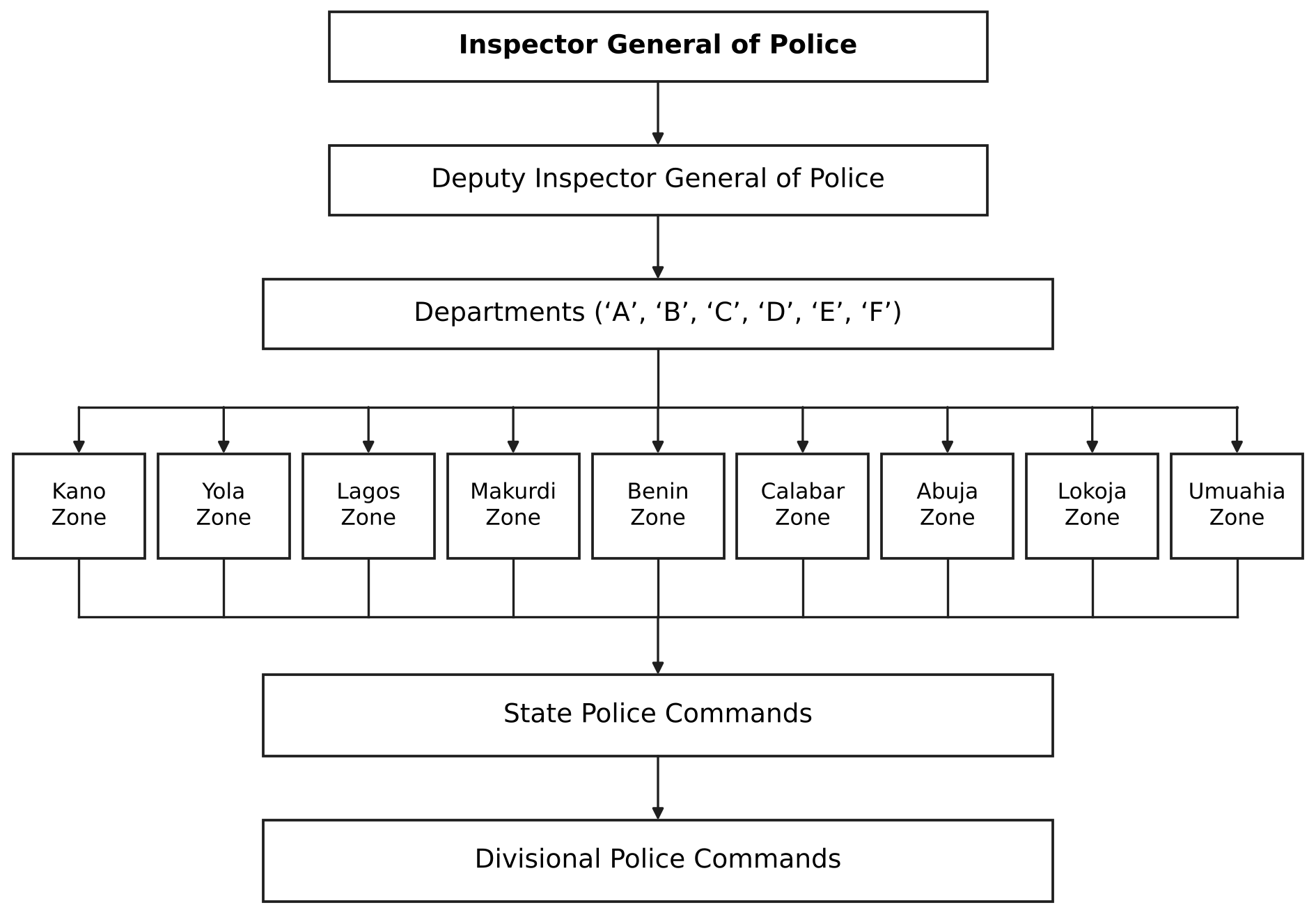
The organizational structure of the Nigeria Police (Figure 1) shows the various departments the police in Nigeria has starting from the rank of the inspector general of police down to the rank of the divisional police command and also its various zones, nine in total.
2.3Review of natural-law theory
Justifying the State's use of force to coerce compliance with its laws has proven a consistent theoretical problem. One of the earliest justifications involved the theory of natural law. This posits that the nature of the world or of human beings underlies the standards of morality or constructs them. Thomas Aquinas wrote in the 13th century: "the rule and measure of human acts is the reason, which is the first principle of human acts" (Aquinas, ST I-II, Q.90, A.I). He regarded people as by nature rational beings, concluding that it becomes morally appropriate that they should behave in a way that conforms to their rational nature. Thus, to be valid, any law must conform to natural law and coercing people to conform to that law is morally acceptable. In the 1760s William Blackstone (1979) described the thesis: "This law of nature, being co-eval with mankind and dictated by God himself, is of course superior in obligation to any other. It is binding over all the globe, in all countries, and at all times: no human laws are of any validity, if contrary to this; and such of them as are valid derive all their force, and all their authority, mediately or immediately, from this original." But John Austin (1790), an early positivist, applied utilitarianism in accepting the calculating nature of human beings and the existence of an objective morality. He denied that the legal validity of a norm depends on whether its content conforms to morality. Thus in Austinian terms a moral code can objectively determine what people ought to do, the law can embody whatever norms the legislature decrees to achieve social utility, but every individual remains free to choose what he or she will do. Similarly, Hart (1961) saw the law as an aspect of sovereignty, with lawmakers able to adopt any law as a means to a moral end.
Thus the necessary and sufficient conditions for the truth of a proposition of law simply involved internal logic and consistency, and that the state's agents used state power with responsibility. Ronald Dworkin (2005) rejects Hart's theory and proposes that all individuals should expect the equal respect and concern of those who govern them as a fundamental political right. He offers a theory of compliance overlaid by a theory of deference (the citizen's duty to obey the law) and a theory of enforcement, which identifies the legitimate goals of enforcement and punishment. Legislation must conform to a theory of legitimacy, which describes the circumstances under which a particular person or group is entitled to make law, and a theory of legislative justice, which describes the law they are entitled or obliged to make.
Indeed, despite everything, the majority of natural-law theorists have accepted the idea of enforcing the prevailing morality as a primary function of the law. This view entails the problem that it makes any moral criticism of the law impossible: if conformity with natural law forms a necessary condition for legal validity, all valid law must, by definition, count as morally just. Thus, on this line of reasoning, the legal validity of a norm necessarily entails its moral justice.
One can solve this problem by granting some degree of moral relativism and accepting that norms may evolve over time and, therefore, one can criticize the continued enforcement of old laws in the light of the current norms. People may find such law acceptable, but the use of State power to coerce citizens to comply with that law lacks moral justification. More recent conceptions of the theory characterize crime as the violation of individual rights.
Since society considers so many rights as natural (hence the term "right") rather than man-made, what constitutes a crime also counts as natural, in contrast to laws (seen as man-made). Adam Smith illustrates this view, saying that a smuggler would be an excellent citizen, "...had not the laws of his country made that a crime which nature never meant to be so."
Natural-law theory therefore distinguishes between "criminality" (which derives from human nature) and "illegality" (which originates with the interests of those in power). Lawyers sometimes express the two concepts with the phrases malum in se and malum prohibitum respectively. They regard a "crime malum in se" as inherently criminal; whereas a "crime malum prohibitum" (the argument goes) counts as criminal only because the law has decreed it so.
This view leads to a seeming paradox: one can perform an illegal act without committing a crime, while a criminal act could be perfectly legal. Many Enlightenment thinkers (such as Adam Smith and the American Founding Fathers) subscribed to this view to some extent, and it remains influential among so-called classical liberals and libertarians.
2.4Review of crime history
Some religious communities regard sin as a crime; some may even highlight the crime of sin very early in legendary or mythological accounts of origins — note the tale of Adam and Eve and the theory of original sin. What one group considers a crime may cause or ignite war or conflict. However, the earliest known civilizations had codes of law, containing both civil and penal rules mixed together, though not always in recorded form.
The Sumerians produced the earliest surviving written codes (Oppenheim, 1964). Urukagina (reigned c. 2380–2360 BC, short chronology) had an early code that has not survived; a later king, Ur-Nammu, left the earliest extant written law-system, the Code of Ur-Nammu (c. 2100–2050 BC), which prescribed a formal system of penalties for specific cases in 57 articles. The Sumerians later issued other codes, including the "code of Lipit-Ishtar". This code, from the 20th century BCE, contains some fifty articles, and scholars have reconstructed it by comparing several sources.
The Sumerian was deeply conscious of his personal rights and resented any encroachment on them, whether by his King, his superior, or his equal. No wonder that the Sumerians were the first to compile laws and law codes (Kramer, 1971).
Successive legal codes in Babylon, including the code of Hammurabi (c. 1790 BC), reflected Mesopotamian society's belief that law derived from the will of the gods (Skaist, 1994). Many states at this time functioned as theocracies, with codes of conduct largely religious in origin or reference.
Sir Henry Maine (1861) studied the ancient codes available in his day, and failed to find any criminal law in the "modern" sense of the word. While modern systems distinguish between offences against the "State" or "Community", and offences against the "Individual", the so-called penal law of ancient communities did not deal with "crimes" (Latin: crimina), but with "wrongs" (Latin: delicta). Thus the Hellenic laws (Garner, 1987) treated all forms of theft, assault, rape, and murder as private wrongs, and left action for enforcement up to the victims or their survivors. The earliest systems seem to have lacked formal courts.
The Romans systematized law and applied their system across the Roman Empire. Again, the initial rules of Roman Law regarded assaults as a matter of private compensation. The most significant Roman Law concept involved dominion (Daube, 1969). The pater familias owned all the family and its property (including slaves); the pater enforced matters involving interference with any property. The Commentaries of Gaius (written between 130 and 180 AD) on the Twelve Tables treated furtum (in modern parlance: "theft") as a tort.
Similarly, assault and violent robbery involved trespass as to the pater's property (so, for example, the rape of a slave could become the subject of compensation to the pater as having trespassed on his "property"), and breach of such laws created a vinculum juris (an obligation of law) that only the payment of monetary compensation (modern "damages") could discharge. Similarly, the consolidated Teutonic laws of the Germanic tribes (Guterman, 1990) included a complex system of monetary compensations for what courts would now consider the complete range of criminal offences against the person, from murder down.
Even though Rome abandoned its Britannic provinces around 400 AD, the Germanic mercenaries – who had largely become instrumental in enforcing Roman rule in Britannia – acquired ownership of land there and continued to use a mixture of Roman and Teutonic Law, with much written down under the early Anglo-Saxon kings (Attenborough, 1963). But only when a more centralized English monarchy emerged following the Norman invasion, and when the kings of England attempted to assert power over the land and its peoples, did the modern concept emerge, namely of a crime not only as an offence against the "individual", but also as a wrong against the "State" (Pennington, 1993).
This idea came from common law, and the earliest conception of a criminal act involved events of such major significance that the "State" had to usurp the usual functions of the civil tribunals, and direct a special law or privilegium against the perpetrator. All the earliest English criminal trials involved wholly extraordinary and arbitrary courts without any settled law to apply, whereas the civil (delictual) law operated in a highly developed and consistent manner (except where a King wanted to raise money by selling a new form of writ). The development of the idea that the "State" dispenses justice in a court only emerges in parallel with or after the emergence of the concept of sovereignty.
In continental Europe, Roman law persisted, but with a stronger influence from the Christian Church (Vinogradoff, 1909). Coupled with the more diffuse political structure based on smaller feudal units, various different legal traditions emerged, remaining more strongly rooted in Roman jurisprudence, but modified to meet the prevailing political climate.
In Scandinavia the effect of Roman law did not become apparent until the 17th century, and the courts grew out of the things — the assemblies of the people. The people decided the cases (usually with largest freeholders dominating). This system later gradually developed into a system with a royal judge nominating a number of the most esteemed men of the parish as his board, fulfilling the function of "the people" of yore.
From the Hellenic system onwards, the policy rationale for requiring the payment of monetary compensation for wrongs committed has involved the avoidance of feuding between clans and families. If compensation could mollify families' feelings, this would help to keep the peace. On the other hand, the institution of oaths also played down the threat of feudal warfare. Both in archaic Greece and in medieval Scandinavia, an accused person walked free if he could get a sufficient number of male relatives to swear him unguilty. (Compare the United Nations Security Council, in which the veto power of the permanent members ensures that the organization does not become involved in crises where it could not enforce its decisions.) These means of restraining private feuds did not always work, and sometimes prevented the fulfillment of justice. But in the earliest times the "state" did not always provide an independent policing force. Thus criminal law grew out what 21st-century lawyers would call torts; and, in real terms, many acts and omissions classified as crimes actually overlap with civil-law concepts.
The development of sociological thought from the 19th century onwards prompted some fresh views on crime and criminality, and fostered the beginnings of criminology as a study of crime in society. Nietzsche noted a link between crime and creativity – in The Birth of Tragedy he asserted: "The best and brightest that man can acquire he must obtain by crime". In the 20th century Michel Foucault in Discipline and Punish made a study of criminalization as a coercive method of state control.
2.5Tracking systems
According to the Oxford Dictionary, a tracking system detects someone or something by tracking the marks, signs or information left behind. It could be an electronic gadget or a software that uses previous information fed to it to say the state of a particular matter.
According to Inyiama’s write-up ‘Artificial Intelligence’ (2003), expert systems that are forms of tracking systems use either a knowledge base or a database structure as a brain box. The knowledge base or the database structures of tracking system stores and records information about the progress or development of a particular event and this captured information can be accessed in the course of time.
According to a lecture material presented by Ume (1990) to the Police College, a crime is defined as “a wrongdoing which affects the interest of the community as a whole and for which the offender is punished”. Some of these offences according to him range from simple offences, indictable offence, felony and misdemeanour. The Nigerian Police need information in order to combat crime. It is the duty of the police to bring such offenders to book. Through the statement of offence, an accused is charged in a trial before a court.
Mark (1982), in his book titled ‘policing a perplex society’ states that “politicians make laws, police enforce them, Lawyers man the trial and prisons deal with convicted offenders”.
Tamuno (1992), in his book titled Police in Modern Nigeria, stated that “Police Act section 24 authorizes any police officer and any person whom he may call to assist in arrest with or without warrant in the following cases:
Any person found committing any simple offences, felony, misdemeanor, or whom he reasonably suspects of having committed or about to commit any felony, misdemeanor, breach of peace.”
Tamuno (1992) also stated that sections 10, 26, 27, 28 and 30 of the Criminal Procedure Code state that any officer has the power to arrest with or without order from the magistrate, power to serve summons, power to release suspects on bail, power to take fingerprints, etc.
2.6Reasons for failures of some criminal tracking systems
From the study of the existing online criminal tracking system, the following were deduced as the problems facing online criminal tracking systems:
- Crime reports get little attention by officers and civilians.
- Police often refuse, neglect or “dodge” some criminal cases.
- There is the omission of important information when investigating a crime case.
- State identification unit has limited staffing and resources required to set up an online criminal tracking system.
- Most investigating police officers are not trained to effectively use the system.