Alert Generating Transport Management System
Implementation of a Computerized Alert Generating Transport Management System in Anambra State Polytechnic, Mgbakwu
1Department of Information Communication Technology, School of Science Technology, Anambra State Polytechnic, Mgbakwu, Awka North, Anambra State, Nigeria
2Department of Computer Science Technology, School of Science Technology, Anambra State Polytechnic, Mgbakwu, Awka North, Anambra State, Nigeria
Published October 2026
Abstract
Computerized Alert generating transport system is designed to meet the needs to produce a system that will eradicate the problems of manual or handwritten information about allocations of passenger, state of vehicles and improve the services through the use of computer. The methods of data collection adopted were through personal interview, questionnaires and research from magazine. The programming language and the design tools used were Visual Basic .NET, MySQL, data flow diagram and flowchart while Structured system analysis design methodology (SSADM) and Object oriented analysis and design methodology (OOADM) were implemented. This research was able to produce an efficient and effective system that reduces the huge paperwork and enhances security. This system will have a great effect on making the transport management system easier in the quality of care and to meet transport expectation.
Keywords: transport; management; system; alert; computerized
1Introduction
The free encyclopedia (2002) defines transportation management system as software that facilitates interactions between an organization's order management system and its warehouse management system or distribution center.
Data is a veritable resource that must be handled with great care and with high precision. This prompts organizations and establishments to find ways that can be used to make their data accurate and available when needed for use. In agreement with the above need, this project aims at developing a computer-based alert generating system for easy storage. The information handled in this project is that of land Transport department of G. Agofure motors Nigeria Limited (GAM).
This project will analyze the data collection from the organization, design the databases and its structures and then develop a computer Alert generating system using Quick Basic Programming Language. This will proffer solutions to the need of staff in the company, easy file system, leads to efficiency, low cost and better performances and more flexibility.
A good computer system should organize data in a progressive manner: fields, records, files and databases. The database best suited for such an organization is the relational database, which will be used in this project work.
A data is a collection of related files organized. In the manner that allows easy access, retrieval and use of that data or a database is simply organized information readily accessible and useful. We shall discover that a database is not just a collection of files, but records in each file must allow or make room for relationship with the records in other files. For example a distributional database might contain order, records that are someway linked to their corresponding customer and project records. In this file environment, data storage is built around the application that will use the file.
In a database environment application will be built around the integrated database. Accordingly the database is not necessarily dependent on the applications that will use it. In other words, given a database new applications can be built to share the database part of the advantages of a database, is the ability to share the same data across several applications and systems. A common misconception about the database approach is that you can build a single super database that can contain all data items of interest to an organization this notion, however desirable, is not currently practicable.
The reality of such a solution is that it would take time to build such a complex database practically, most organization builds several databases each one sharing data with several information system thus, there will be some redundancy between databases. However, this redundancy is both greatly reduced and ultimately controlled.
1.1Statement of the problem
The major problem the transport industries is not knowing when a trip is deterged or cancelled due to unforeseen circumstances most often when there is delay in take off or outright cancellation of trips, the passenger is not notified. This puts a lot of pressure on the management who would want to offer explanation to individual passengers. This problem would be solved by the introduction of a passenger alert system.
1.2Objectives of the study
The aim of this project is to develop a computer-based Alert generating system, in the transport management system using G. Agofure Transport Nigeria Limited (GAM) land transport as a case study with the following objectives:
- 1. Data creation for the transport management system.
- 2. To develop Alert generating system of data storage system using Quick Basic.
- 3. Integrating the developed Alert system with the data storage system access.
2Literature review
Duru (2003) states that a good transport network is necessary for economic, social, political and scientific growth of any nation. According to the past researchers on transport management, Rachel (1989) states that a company without a proper financial management will collapse and stand a test of time, so with proper care should be taken to see that management section stands firm for the effective management of the company. Transport Management System program for optimal shipment planning and execution first appeared commercially in the late 1980s with the advent of save shipping (led by Robert shag wart, as derived from the wasting housing acquisition of innovation.
Akinyokum (2003) said that Alert generating system could be in two ways:
- 1. Personal document: This deal with the document relate to a particular transport system. In order to treat passenger well, the manager would like to know accurate information about the passenger.
- 2. Impersonal document: The passengers’ identification is not really necessary.
Anthony (2003), in his contribution said that alert generating system have different purpose for the Transport maintains records to document individual movement status, to comply with legal requirement behaviours. Transport or vehicle record a particulars, available vehicle, their destination as well as other transportation can be stored in an easily retrieval manner in a computer memory. For instance, managers use such reports in a real time computer for passengers, moreover Alert Generating Transport Management System has also been found useful in collection and analysis of large quantities of statistics (Anigbogu 1994).
Bigelow (2005), defines transportation as a systematic documentation of a passengers trip. The term Alert generating transport management system is for both the physical folder for each individual in transportation and for the information which comprises the total of passenger history. Christopher (2009) said that if record keeping is as a core there is a risk that the documentation will fall short of the standard expected of professional. He said that good documentation of vehicle can be a very means of given substantial evidence of a particular trip. Therefore, having good quality Alert system refer back to enables the drive to give evidence to relate as precisely as possible what happened. Diamond (2008), contributed that maintaining good quality Alert system has both immediate and long – term benefits for staff. Computerizing Alert generating transport management system managers/drivers, for example, in respect of safety by promotion the early identification and appropriate trip of potentially violent of a passenger’s behaviours. He also said that using computer – base system. In Alert generating Transport management system will ensures that the professional and legal standing of staff will be undermined by absent. He finally concluded that good Alert system of a passenger promotes better communication as well as continuity, consistency, efficiency and reinforces professionalism within manager/staff. Odum (2002) defined transportation management system as a software that facilitates interactions between an organization's order management system and its warehouse management system or distribution center. A transportation management system (TMS) is a subset of supply chain management concerning transportation operations and may be part of an enterprise resource planning system (Nduka, 2009). A transportation management system is part of supply chain management centered on transportation logistics. A TMS enables interactions between an order management system and distribution center or a warehouse. Transportation Management reduces transportation cost and increases delivery reliability through collaboration across all modes and providers (Eluma, 2010).
Okorie (2000) states that transportation management allows companies to manage their international and domestic transportation, tackling supply chain complexity with integration to partner systems and a single control layer for monitoring the lifecycle of transportation. Bids are completed on the platform, contracts are awarded, execution is monitored, and changes made based on detailed analysis of transportation data. Shippers, suppliers, and logistics service providers all collaborate in the cloud with Transportation Management. Therefore, management system is the system involved in organizing and controlling a business so as to achieve a desired goal. It contains all the scheme involve in controlling a business and has various benefits which include:
- Provision of improved service to customers.
- Routine tasks are performed faster and cheaper.
- It helps in the improvement of a business.
- It enhances the growth of the business.
An automated established method involved in the control of the transport company is said to be vehicle transport management system which focuses at providing an organization involved in transportation business. The ways of making decision like various management system, vehicle management system will help in the growth of the business effectively, as this will provide the management the knowledge needed to run transport industry effectively. Most manual operation involve in the transport industry can be avoided as they replaced with automated establish method which are faster, well organize and producing result. The most important type of transportation that involves the use of motor vehicle is transport which has widely spread, is said to be one of the cheapest means of transportation. It is said to be fastest means of transport by land. Some of the vehicles used are not that expensive. Apart from its advantages, it has its disadvantages which include:
- It is prone to accident.
- It engages with vegetation encroachment.
- The cost of construction and maintenance of road is very high.
A good transport network is necessary for the economic, social, political, and scientific growth of any nation. Computer of 1990 advancing from their first TMS of 1988 remolds metals, later sold to logistic, and now part of Manhattan shipment (back by Wasserstein-paella and Motorola fund, one of early fallouts by early 1990s) and rover technologies, (as acquired by what was to become autistics as bases for TMS offering) early follows into the field included Wesley software (a load builder based point solution expanded by the other before it was covered to windows client server and by red prairie in 1996) inter transport logistics system ITLS. The earliest freight payment service provider (class, commercial traffic what is now data transact as now owned by Schneider logistics and others) did not seize the opportunity to expand vertically into reshipment optimization an planning from their base in post shipment freight audit and have remained in the now commoditized field of freight settlement or have expanded horizontally to handle other non freight non payable processing.
Management System Market, still highly under penetrated and highly rapidly growing has several tiers depending on the capabilities and focus. Tier International transport management system provider include shipper common wealth and its partner red praline, manugistics. Apres technologies, (acquired by oracle) Manhattan (via acquisition of original westing house sure shipping via earlier transaction) legally and others. To discuss mass transit in America is to discuss two central themes: how exactly will it benefit the community and who exactly is going to pay for it. Neither of these questions have an easy answer; neither of them is easily understood. The complexity of each theme expand exponentially, it seems with every new discussion some supporters rarely know the realities of mass transit planning and effects, instead choosing to blindly consider the environmental aspects, detractor often cannot look past the economics to understand the social benefits of the plan. Politicians, planners (city, country, and state) economics academics, environmentalist, commuters, business people and home owners all have a different stake in a policy that blithely affects them all differently and ostensibly in both the short and long terms. Ironically, they all claim to be fighting for the best interest of the community. Several studies have considered the impact of mass transit on society and infrastructure in America.
Litman (2005) compares rail transit in “larger rail, small rail the bus only” communities and finds that’s large rail cities in (those where rail transit is a major component of the transportation system) have lower traffic fatalities (30%) lower per capita consumer transportation, expenditures (14%) and lower transit operating cost per passenger-mile than do communities with bus only. using a comprehensive analysis framework, the author finds that rail service attracts discretionary riders (those who have a choice to drive or ride transit)because of its superiority to bus system and also that a higher percentage of rail riders will drive if no rail were available than bus drivers if no bus service were available. Moreover, Litman argues that the return of transit oriented development or smart growth is another benefit consisting of compact, walk able, mixed use center “which will allow those in the community to accomplish varied task in the same area as their light, rail stop, ranging from high density commercial centers to small sub urban village. Using Portland orenco station as a model, the author argues that the benefit comes from residents owing fewer cars and those that do own cars drive them less. Thus, the effects are both direct (less cars and driving) and indirect. Additionally, Litman (2005) argues that’ reducing just a few percent of vehicles on (the most congested corridor) can significantly reduce congestion costs. Litman also suggested that many criticisms of light rail are short sighted for instance; the author argues that while it seems clears that rail commuting would result in a longer commute than would automobile commute is slightly longer. It is less stressful, safer and multi-is not such a dangerous enterprise. Additionally, those who criticize the cost of initiating a mass transit rail system (expensive due to special factors) in favor of bus or automobile transport do so as a results of faulty analysis rail transit expenditures equal about 5% of total automobile facility cost. In the post 9/11 world, no mass transit analysis would be complete without a consideration of the terrorist attacks. Waugh (2004) argues that while terrorists have to strike American mass transit system, mass should take transit system are now frequent target of political violence and the united state should take the trait seriously. The appeal to terrorists lies not only in the potential of physical harm and death to mass transit users, but also in the “disruption of social and economic life of communities and even region” the problem however are numerous, firstly, the federal government have decided to focus mainly on protecting air travel from terrorism and the author argue that it may well take a major attack before attention is paid to mass transit. Secondly, although strict security measure could be put in place, the concern is that this will decrease the attractiveness of mass transit, and especially so to those who have access to other means of transportation. Thirdly, the cost of implementation, given the large coverage areas as mass transit is prohibitive Waugh concludes that “a strategy to address the terrorist threat to mass transit system has to begin a strategy for financing those efforts”. In wider ranging study, Zimmerman (2005) finds that although transport rail is geographically limited to two main points, (California and new York City), total transit ridership stood at “9 billion passenger trips” in health benefit of transit are related to air quality, translated into a reduction in carbon dioxide output by 7.4 million per year. In addition, transit uses less electricity then vehicular travel on roadways. This author also concludes that rail transit results in quicker commute and less stressful and safer commutes. However the author also noted that certain vulnerabilities also exist. For instance, the physical condition and the lack of investment to support regular up keep long been serious concerns, the age of both the transit infrastructure and the cars themselves have increase considerably. Security particularly against terrorist attack (chemical, biological etc) is another main consideration of the author, additionally an all hazard approach centers on accidents and natural on infrastructural upper which transit depends, specifically, weather related flooding, electrical power outage, download trees and ice has all affected mass transit in the past, more recently, information technology dependence has resulted in down time as well in a such a situation, those who have come to expect and rely upon mass transit are universally affected. The author argues that a critical factor in maintaining public confidence in transit after a failure is the system’s ability to recover after a disaster. Zimmerman concludes that a fundamental obstacle to greater investment in and use of transit is that individuals generally will choose modes of travel over rail transit. Finally Currie (2005) evaluates the passenger attractiveness of Bus Rapid Transit(BRT) compared to other transit modes (on street bus, light rail, and heavy rail) by studying passengers provided trip attributes research evidence. The author finds that “Bus rapid transit system can be as attractive in attracting passengers as heavy and light rail but that bus rapid transit has been shown to have significant cost advantages over rail, Bus rapid transit is a superior choice. Moreover the author argues that Bus rapid transit designs that minimize passenger transferring are more attractive to passengers but quality stations and interchange facilities and alleviate as this and that service frequency travel speeds and service coverage of bus rapid transit system will need to be as extensive as light and heavy rail system to match the patronage levels achieved by modes. Hess and Lambarch (2005) document the long transitions that mass transit has undergone from the post-World War II era to the modern day. The early days of mass transit saw funding made possible through fare box revenues, thus privately funding and progressed to an abrupt on set of federal funding in the 1960s the federal retreats in the 1980s; and the emergence of state and local funding as critical pieces of the funding rubric in the 1980s. Their analysis of 10 cities with mass transit infrastructure who have been forced to determine future sources of funding resulted in three main conclusions. First the characteristics of agency’s profile are influenced considerably by the revenue raising approach of the agency’s home state. In other words some state prefer raise and distribute revenue at the state level. Secondly, dedicated funding generally through taxes on sales properties and income that often require voter approval but provide reliable and ongoing sources of revenue” is an important factor, especially in non-federally funded operating budgets that are state centric. Finally, the increased competition for obtaining shrinking federal funds means those cities with accompanying stability leads to advantage to transit agencies when planning long term improvement. Seeking federal dollars these improvement or by passing federal funding altogether and instead pursuing capital development with local or state resources alone. Using a more traditional cost benefit frame work, Balaker and Kim (2006) examine the view of several leading economists towards mass transit. They find that there is general agreement that mass transit will have positive impact on home values but they are less optimistic about rail transit ability to achieve environmental improvement. Moreover economists as a whole are pessimistic about rail transit ability to reduce congestion and believe the more traditional method are more functional and cost demographic. In short, the cost of rail transit exceeds its benefit pointing primarily to demographic features such as suburbanization, the declining influence of central business districts, and increasing wealth as prohibitive factors to successful rail system. The author do note that however, these demographic factors as well as trend and policies, very greatly from one community to another and that with the right mix rail can be successful in an apparent attempt to researchers and planners along. Smith and Gihring (2001) produced an annotated bibliography of 76 entries that show that financing rail transit through a mechanism known as value-capture is viable solution. This anti-Lockean device calls for the reduction of subsides generated (locally or on Estate level) through higher taxes or reduced spending on public services and an increased dependence on a combination of farebox revenues and the capture of transit oriented development (TOD) develops for free riders in those land owners who happen to own property in close proximity to newly installed rail stations. The author argues that when the transit station opens, the owners land values rises. Since the benefit to the landowner was created by the individual land owner the public sector is justified in recapturing at least some of this betterment. In a study from Canada, Siemiaty (2006) evaluates. The efficacy of a design, Build finance operate private-public partnership plan to design mass transit. The argues that the model of private public partnership to balance the advantage of government control of the strategic of scarce resources in the protection of the broad public interest, with the benefit of infusing competitive force into the delivery of public service to increase efficiency. The perceived effect Siemiatycki, (2009) argues, is that in the field of urban transportation private public partnership can be seen as an attempt to redress issues of political interference, weak procedural accountability that escalating construction costs, and performance shortfall that become during the extended period that project were designed, financed, and operated primarily by the private sector in an analysis of this theoretical frame work that was put in Vancouver, British, Columbia, the author finds that the private–public partnership was wholly ineffective in reaching the stated objectives: the planning had more similarities than differences from earlier planning that were undertaken using the conventional planning methods. The author finds that the major problem lies in the ingrained power relations between the various parties whose eyes were focused on those providing the money not the plan that would provide the greatest public good. The conclusion was quite simply that the private–public partnership, at least in Vancouver, did not relieve cost overruns, nor did it result in more innovate system design (though to be the product of competitiveness). The author recognizes the limitation in generalizing results from a single case study and instead implores the readers to consider these questions when faced with their own scheme. In another singular case study, Li and Wachs (2004) consider the financial effects of federal transit subsidy policy on local transit investment decisions. In particular, how does federal transit investment subsidy policy influenced capital investment decision made by local government? The author argues that the financial aspect may be prohibiting the best interests of the community from coming to fruition. In particular, the authors argues that several factors, including the need to balance political interest, the financial constraint of local government at various levels, and the distinctive characteristics of the American political system “lead to a preference for “capital-intensive transit investments even when such investments may not be the most efficacious option. Thus, the city spends money in order to get money.
In 1971, Atlanta received federal transportation department finding reference in the case study, Atlanta voters chose buses as mode of rapid transit improvement with commute from residential to work areas as the target of research by Dajani, Egan, and McEloy (1975) and a response paper by (Talley and French, 1981). This variable as the primary measurement is referenced in other studies by Rannels (1957), Lave (1970) and Virma and Dhingra (2005) however, Virma and Dhingra state this measurement is not use in other studies and propose it as a new method to calculate cost effectiveness with economics of commuting as the primary reason for selecting a different mode of transportation, buses were also found to be the only variable solution for traffic congestion in India, Virma and Dhingra (2005) and in Asia, Europe, and South America Hensher (2007). Opposing the research that buses are the best solution, Lave (1970) finds that commuters will shift to mass transit vehicle in the short run but eventually find a job close to home to avoid the bus commute.
Lave (1970) further contends that researchers must look at behavioral implication for mode selection. Hensher (2007) nullifies his economic findings on the efficiency of buses stating the statement, “trains are sexy and buses are boring”. Europe heavily utilize light rail is proof of successful marketing of mass transit so much so that France built light rail for export China. Talley and French (1981) formula for cost effectiveness of the Atlanta bus system. They contend the original research failed to properly calculate time saved by commuters switching to the bus and did not consider the capital costs financed by the government in their formula. The original research also failed to include non-user costs through a tax increase. Talley and French (1981), concludes the original study was skewed by omitting less in benefits to encourage investment in the bus system.
3Methodology and system analysis
3.1Methodologies
A methodology for project is a combination of step by step methods and techniques for successful planning and delivery of project. The following are concepts of methodology.
3.1.1Structured system analysis and design methodology (SSADM)
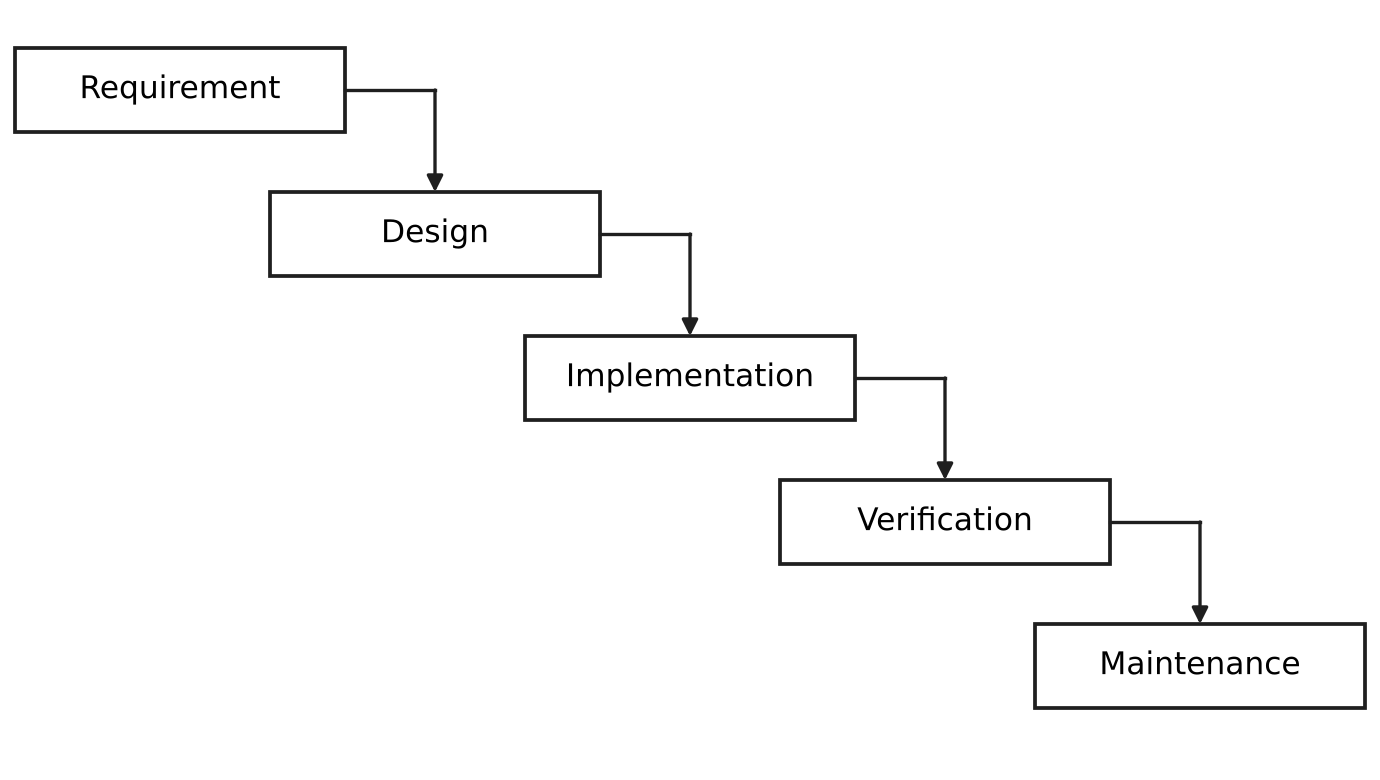
Structured system analysis and design methodology (SSADM) is a set of standards for system analysis and application design. It was a formal methodical approach to the analysis and design of information system software. The SSADM is an open methodology based on the waterfall model and can be thought to represent a pinnacle of the rigorous documented approach to the design.
3.1.1.1Objectives of SSADM
It was developed with the following objectives:
- To develop overall better quality systems.
- To ensure that project can successfully continue, should a loss of staff occur without a damaging effect on the project.
- To improve communication between participants in a project so an effective framework is in place.
3.1.1.2Benefits of SSADM
- Improvement of productivity: by encouraging on-time delivery meeting business requirement ensuring better quality using human resource effectively as well as trying to avoid bureaucracy.
- Time Line: SSADM allows us to plan, manage and control a project very well.
- Usability: Within SSADM special emphasis is put on the analysis of user needs.
- Cuts Cost: SSADM separates the logical and the physical system design, so that the system may not have to be implemented again with new hardware or software.
3.1.1.3SSADM techniques
The three most important techniques that are used in SSADM are as follows:
- 1. Logical data modeling: The process of identifying modeling and documenting the data requirement of the system being designed. The result is a data model containing entities (thing about which a school need to record information of a student) Attributes (facts about the entities and relationships) association between the entities.
- 2. Data flow modeling: This involves tracking the data flow in an information system. It clearly analyzes the process, data stores, data movement and external entities.
- 3. Entity behaviour modeling: This involves identifying and documenting the events in fluency each entities and the sequence in which these events happen.
3.1.1.4Characteristics of SSADM
- Dividing a project into small modules with well defined objective.
- Useful during requirements specification and system design stage.
- Diagrammatic representation and other useful modeling techniques.
- Simple and easily understood by clients and developers.
- Performing activities in a sequence.
3.1.1.5Stages of SSADM
- 1. Determining feasibility.
- 2. Investigating the current environment.
- 3. Determining business system options.
- 4. Defining requirement.
- 5. Determining technical system options.
- 6. Creating the logical design.
- 7. Creating the physical design.
3.1.2Object-oriented analysis and design methodology (OOADM)
This is a popular technical approach to analysis, designing of an application, system or business by applying the object oriented paradigm and usual modeling throughout the development life cycle to foster better stakeholder communication and product quality.
According to the popular guide unified process, OOAD in modern software engineering is best conducted in a literature and incremented way iteration by iteration, the output of OOAD activities design model for OOD / object oriented design and Analysis model for OOA (object oriented Analysis, respectively, well be refund and evolve continuously driven by key factor like risk and business value.
Object-oriented analysis (OOA): It deals with the design requirement and overall architecture of a system and is focused on describing what the system should do in terms of key object in the problem domain.
The primary tasks in object-oriented analysis (OOA) are to:
- Find the object
- Organize the object
- Describe how the objects interact
- Define the behaviour of the objects
- Define the internals of the objects.
Object-oriented design (OOD): This translates system architecture into programming constructs, such as interface classes and method descriptions.
Object-oriented programming (OOP): This implements the programming constructs.
3.1.3Overview
The software life cycle is typically divided into stages going from abstract descriptions of the problem to design then to code and testing and finally to deployment. The earliest stages of this process are analysis and design. The analysis phase is also often called requirements (Figure 1).
3.1.4Expert system
A computer program that uses artificial intelligence to solve problems within a specialized domain that ordinarily requires human expertise.
Artificial intelligence (AI) A code variety of method can be used to stimulate the performance of the expert in order to accomplish feats of apparent intelligence an expert system rules on two components.
3.1.5Prototyping
This is developing a parted implementation of the system to give the users a full for what the developer in has mind. The users then give feedback on what they think of the prototypes what work change more easily and efficiency. The three major types of prototyping are:
- Throw away
- Evolutionary
- Incremental
3.1.5.1Benefits of prototyping
- Encourages active participation by users and procedures.
- It provides proof of concept to attract funding.
- It delivers product quality easily.
- Development cost is reduced.
3.1.5.2Demerits of prototyping
- Possibility of causing system to be left unfinished.
- It implements systems before they are ready.
- It might prove to be inadequate for overall organization needs.
3.1.6Rapid application development (RAD)
This is a software development methodology that uses minimal planning in favour of rapid prototyping. The lack of extensive pre-planning generally allows software to be written faster and also modification easy. It involves method like iterative development and software prototyping.
The development process starts with the development of preliminary data model and business process models using structure technique. There are four phases involved in RAD:
- 1. Requirement planning phase: It combines the element system planning and analysis of system development life cycle (SDLC). Users, manages and its staff members discuss and degree on business needs, project scope, constraints and system requirement.
- 2. Users Design Phase: This phase user interact with system analyst and develop models and prototypes the represent all system processes, input and outputs. It’s a continuous interactive process that allow user to understand modify and eventually approve a working of the system that meet their needs.
- 3. Construction Phase: It focus on program and application development. However user continue to participate and can still suggest change or improvement on the system being develop.
- 4. Cut Over Phase: It is the last phase which include data conversion testing, change over, user training.
Therefore, for the betterment of this project, I’m going to focus on OOADM that is object oriented analyzing. The problem of the existing system in order to know problems at head throwing surveying, investigation and interview, design a solution to the problem that is a system flexible and equally implement the system for maximum functionality.
3.2System analysis
System Analysis is the process of collecting analyzing facts in respect to the existing operations, procedures and system in order to obtain a full picture of the situation prevailing so that an efficient computerized system may be designed and implemented if proved feasible. It can also be defined as the critical examination of an activity, procedure, method or technique to determine its purpose and how the necessary operations can best be achieved.
A system is a collection of mechanisms that together to achieve a purpose(s). A research methodology is defined as a series of well defined sequence or steps that should be followed in carrying out a research analysis (Tom, 2001).
3.3Data collection
During the research work, data needed for the project was gathered from various sources. In gathering and collecting necessary data and information needed for system analysis, two major fact-finding techniques were used in this work and they are:
- Primary source: This refers to the sources of collecting original data in which the researcher made use of empirical approach such as personal interview and questionnaires.
- Secondary source: The secondary data were obtained by the researcher from magazines, Journal, Newspapers, Library source and Internet downloads. The data collected from this means have been covered in the literature review.
3.4Organization and its environment
3.4.1The company (G. Agofure Motors)
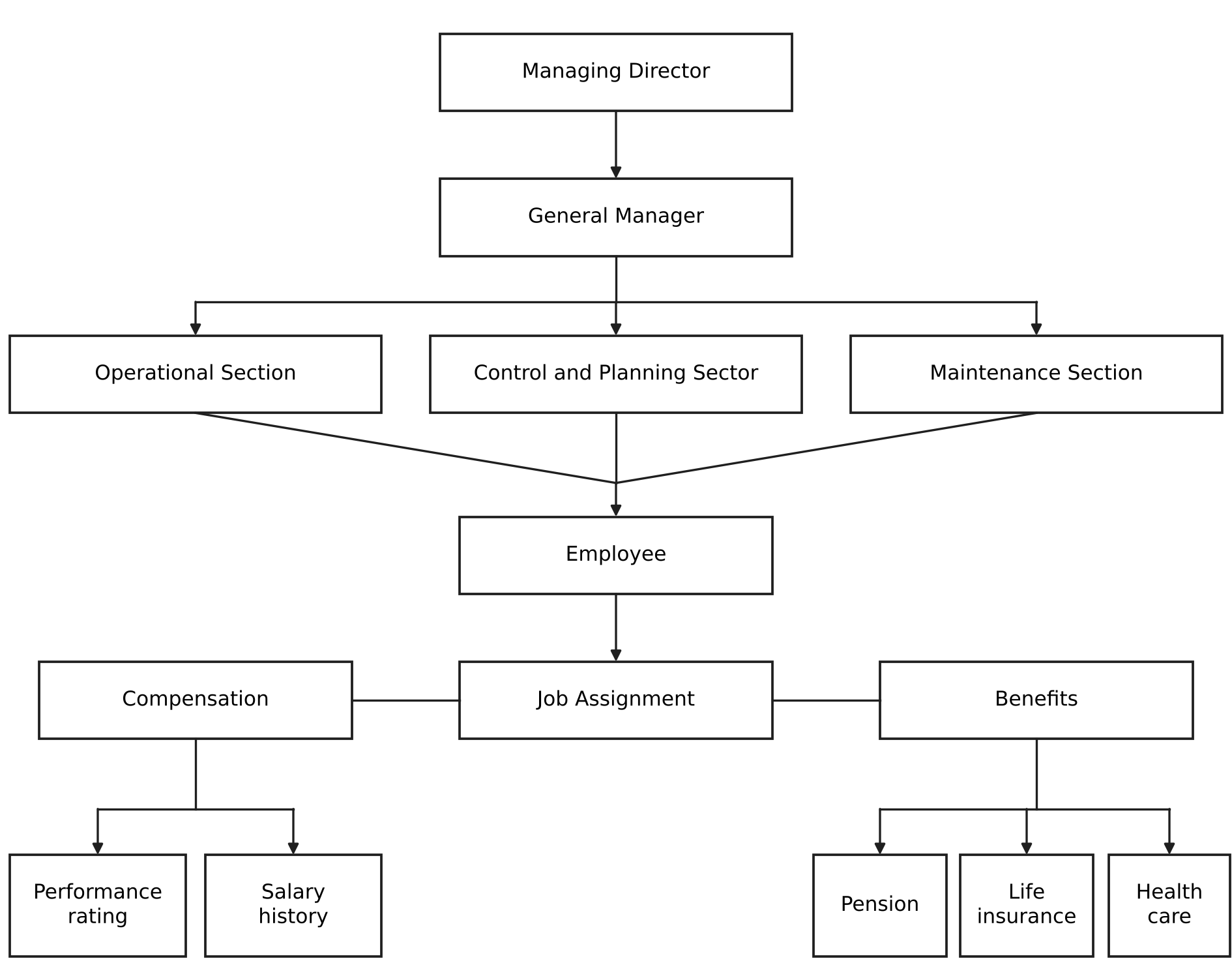
G. Agofure Motors Nigeria Limited is one of the well-known transport companies in the federation in land transport (Figure 2).
G.Agofure motors Nigeria limited was founded 20 years back to be precise 1995 it is a sole proprietor owned by Chief Godwin Agofure who spearheaded this venture after his tertiary institution. He is of Delta State Origin, a native of Urhobo. He quickly built an office at Uvwie Local Government (Effurun) Delta State, opposite Petroleum Training Institute (PTI), Warri. He started with three vehicles running only Port Harcourt routes, it all started like a joke. There was an agreement between the federal government of Nigeria and G. Agofure Transport Company, this agreement provided for a good participation by the government in the case of transport requirement of the country. The concept of government participation has proved very successful in Nigeria from the start, G.Agofure motors took on the challenge of transportation in the country within a short time, and the company became nationwide since the start of this company. It has made tremendous improvement in the transport industries, covering over 22 states in the country, having branches spread all over the country. To mention as at the year 1999 this company has three states, in the year 2000 the company has covered six states, in 2004 it covered nine state and by 2006 it succeeding covering 12 states with each of the state having up to 2 and 3 branches located in that state. During this covering of states period, the company felt it necessary to have as many vehicles to meet up with its transportation need, as such more vehicles were bought every quarter of the year to replace old once and to increase the number of good ones. Godwin Agofure motors Nigeria limited has grown to become one of the transport companies that is preferred by passengers all over the country for its reliability and low cost. It is being preferred by passenger for its speed limit, convenient way of passengers boarding the vehicles. G.Agofure crews are deployed on land throughout the nation for a wide variety of passengers boarding the vehicles. G.Agofure employs over 7,000 people, computerizing a skilled will train workforce of so many states in the nation. A basic principle that has served G.Agofure and clients well is the ability to recruit, train and promote employees from our regions of operation. Moreover, being dispersed over the nations transport producing regions help reduces the effect of regional economic cycles and so on. G.Agofure motors operates a fleet of 4,500 vehicles. We also provide vehicle services for joint and individual transport companies as well hiring of vehicles for ceremonies like marriage, obituary, political functions and so on. G.Agofure also provide petroleum services to efficiently manage the company, and also services other public and private companies with petroleum products with the addition of these advanced methods of meeting transport requirement over the next few years, G.Agofure continues the tradition of providing passengers cost effective high performance with a mission to profitable. Expansion and continued enhancement, the company has the focus of making more improvement as year goes by.
3.4.2Modus operandi of the present system
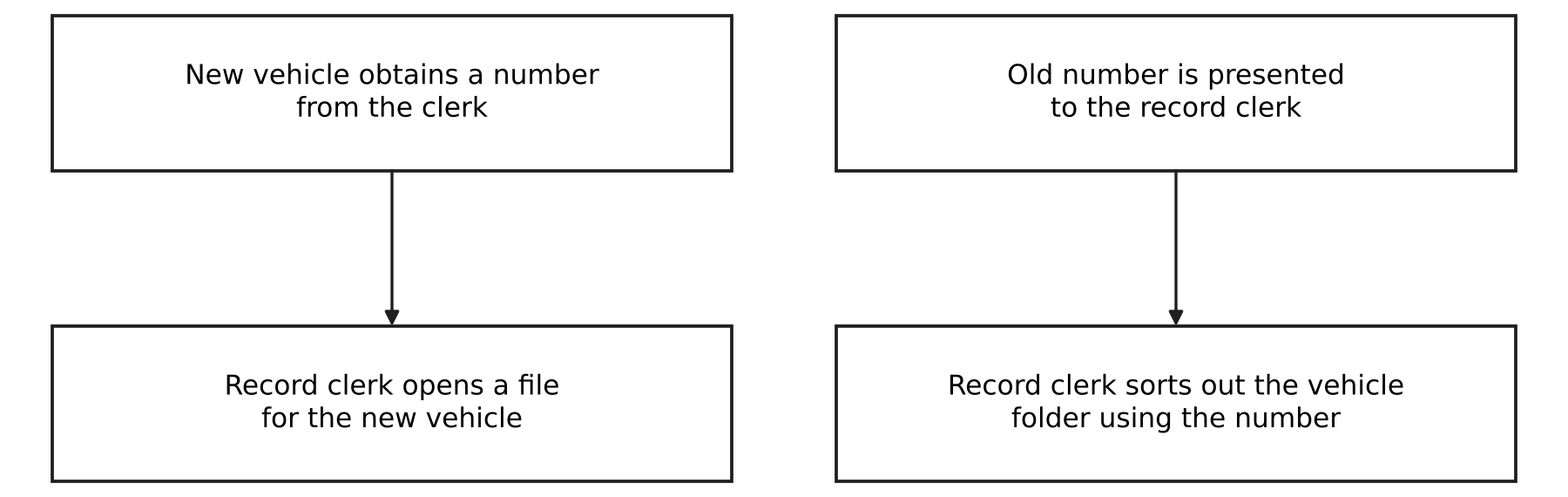
The present mode of operation in Godwin Agofure is all about manual process in other words, this transport is specialized in doing everything manually from investigation, we discovered that their manually method of processing, maintaining and storing information is causing a lot of problems hereby make the processing so slow. Therefore, there is a need to computerize the Alert generating system method of processing storing data process, maintain Transport information more easily without any fear of loss of vehicle folders, it will also enable them provided database management.
3.4.3Input analysis
This deals with the process used to feed data to the system for processing the following structure is used to feed into the system for processing. The input of the present system will have the following as input which will serve as data to be processed. It forms designs and collected from the management for routine documentation and processing. It is of utmost important to get original source of data documentation and the input medium to the computer after data have been collected (Table 1).
| Input field |
|---|
| Name |
| Seat Number |
| Ticket Number |
| Booking Date |
| Time of Departure |
| Destination |
| Vehicle Number |
3.4.4Process analysis
Once the inputs are counted the obtained data are processed properly for effective use.
Basic requirement identification such as input and output information needed. Initial prototype development including user interfaces.
- Review with customers.
- Enhancing and revising the prototype using a feedback from both specification and customer to improve the prototype.
3.4.5Output analysis
The output analysis is the result of the input, for design made up of data collected from the management. This results to information given to the management to the system, whereby the system gives an answer immediately (Table 2).
| Field | Entry |
|---|---|
| Passenger’s name | XXXXX |
| Vehicle Type | XXXXX |
| Sex | XXXXX |
| Seat Number | XXXXX |
| Time of Arrival | XXXXX |
| Ticket Number | XXXXX |
| Next of king | XXXXX |
| Telephone | XXXXX |
3.4.6Data flow diagram of the present system
Wikipedia, the free encyclopedia (2005) defines Data Flow Diagram (DFD) as a graphical representation of the "flow" of data through an information system. (Note: 'data' can be understood as any 'thing' (e.g.: raw materials, filed information, ideas, etc.) which is processed within the system).
According to Vick (2005), a data flow diagram shows the flow of data or information, and can be partitioned into single processes or functions or grouped together or decomposed into multiple processes. There can be physical DFD’s that represent the physical files and transactions, or they can be business DFD’s (also called logical or conceptual).
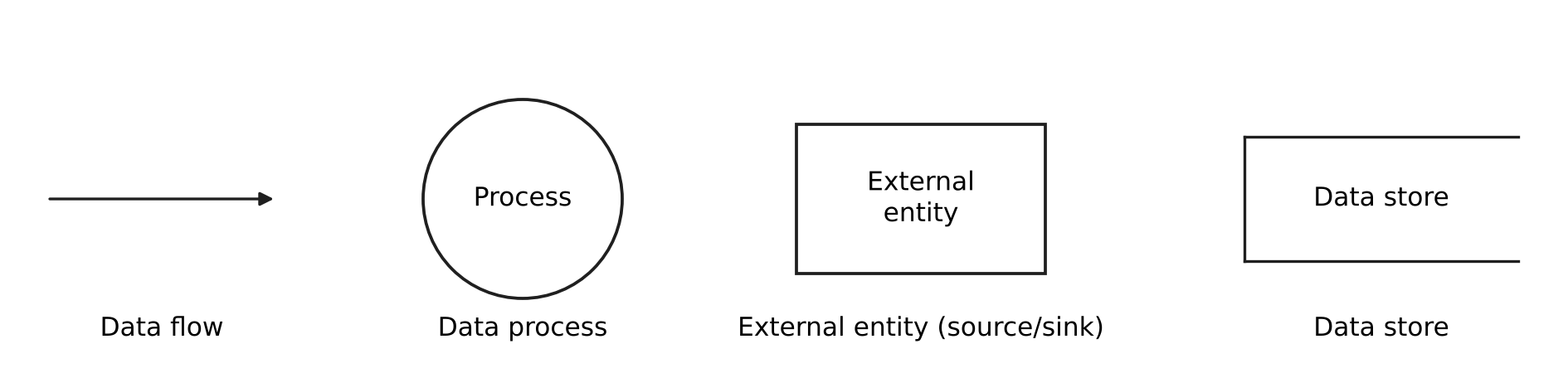
Four diagrammatical components are used to develop a DFD. These are (Figure 3):
- Data flow (represented by an arrow).
- Data process (represented by a circle or rounded rectangle).
- External entity (represented by a square or oval, also called a source/sink).
- Data store (represented by two parallel lines, sometimes connected by a vertical line).
The overall data flow diagram of the present system is shown in Figure 4.
3.4.7Problems of the present system
The existing methods of transport management system in G. Agofure transport system transaction are handwritten, such that all the information about allocation of passengers and state of vehicles is manual. The following problems were found within the system.
- Processing incoming and outgoing vehicle data information is a very big task.
- There is no backup of incoming and outgoing transport records in case of fire outbreak.
3.5The proposed system
The proposed system will be computer-aided and hence, an improvement of the existing system. It will redesign the existing system forms to include modified or additional data items. This will enable it perform the specific operation in order to achieve performance requirements of the new system. More printed reports and display formats for terminal will also be designed to include details of communication (interaction) between the computer and user located at different locations.
The new system will produce the desired information and reports needed at the right time, with acceptable degree of accuracy and in the form required, economically for records administration as well as for researchers.
It will also minimize the cost and the amount of time spent in data recording, source data preparation and processing. The design will also provide necessary control both manual and automated to help maintain the integrity of the database files.
It will also provide effective security measures in order to avoid loss of data from unauthorized users. The new system will maintain records for all the clients so that reports can easily be prepared on request by management.
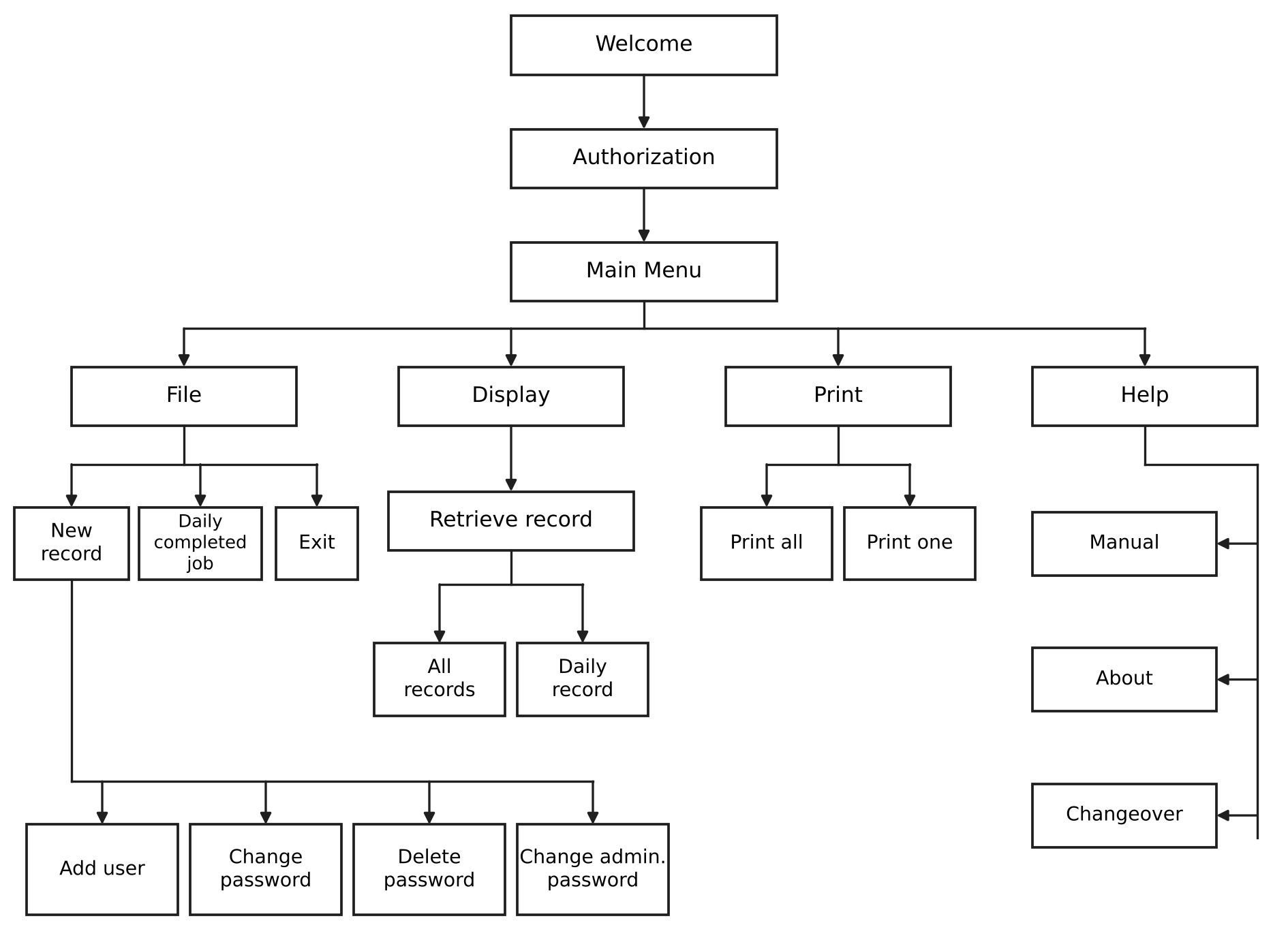
3.5.1High-level model of the proposed system
The high-level model of the proposed solution (Figure 5) is based on the weaknesses observed. To oppose the weakness of the present system, the following has to be carried out:
- Development of a system in order to avoid error in calculation of money collected by drivers of the vehicle from passengers.
- Development of system that is much improved in speed in relation to accessing and recording information on the management system.
- Development of a system that will help in the duplication of information for easier transfer and also in weekly representation of companies input and output.
- Development of system that will reduce the burden and problems of the management department.
4System design
System design is the process by which a new system is designed or developed after sorting out the problems associated with an existing system. It involves specifying the expected output and identifying the input required to achieve the goals intended. After proposing, a new system expected to replace the old one. The next step is to design the outline of the proposed system.
System design can be defined as the activity of proceeding from an identified set of requirement for a system to the design that meet those requirements. A distinction is sometimes drawn in between high level or architectural design, which is concerned with the main components of the system and their roles and interrelationship and detailed design which is concerned with the internal structure and operation of the individual components, the term system design is sometimes use to cover just the high level activity. Systems analysts begin an assignment by discussing the system problem with the managers and users to determine its exact nature. Defining the goals of the system and dividing the solution to individual steps and separate procedures, system analysts use techniques such as structured analysis, data modeling, information engineering, sampling and cost accounting to plan the system, they specify the input to be accessed by the system, design the processing steps and format the output to meet the user’s need. They may also prepare because benefit and return – on – investment analysis to help management decide whether implementing the proposed technology will be financially feasible.
4.1Objectives of the design
- 1. Data creation for the transport management system.
- 2. To develop Alert generating system of data storage system using Quick Basic.
- 3. Integrating the developed Alert system with the data storage system access.
4.2Data flow diagram of the new system
Wikipedia, the free encyclopedia (2005), defines dataflow diagram (DFD) as a graphical representation of the flow of data through an information system. In structured system analysis and design methodology, the purpose and the value of the dataflow diagram is primary for data recovery, not for process mapping, hence the name dataflow diagram. It is an excellent communication tool for analyst to model processes and functional requirement there are two types of DFD, the physical which represent the physical file and the logical, which represents the process or logical function (Figure 6).
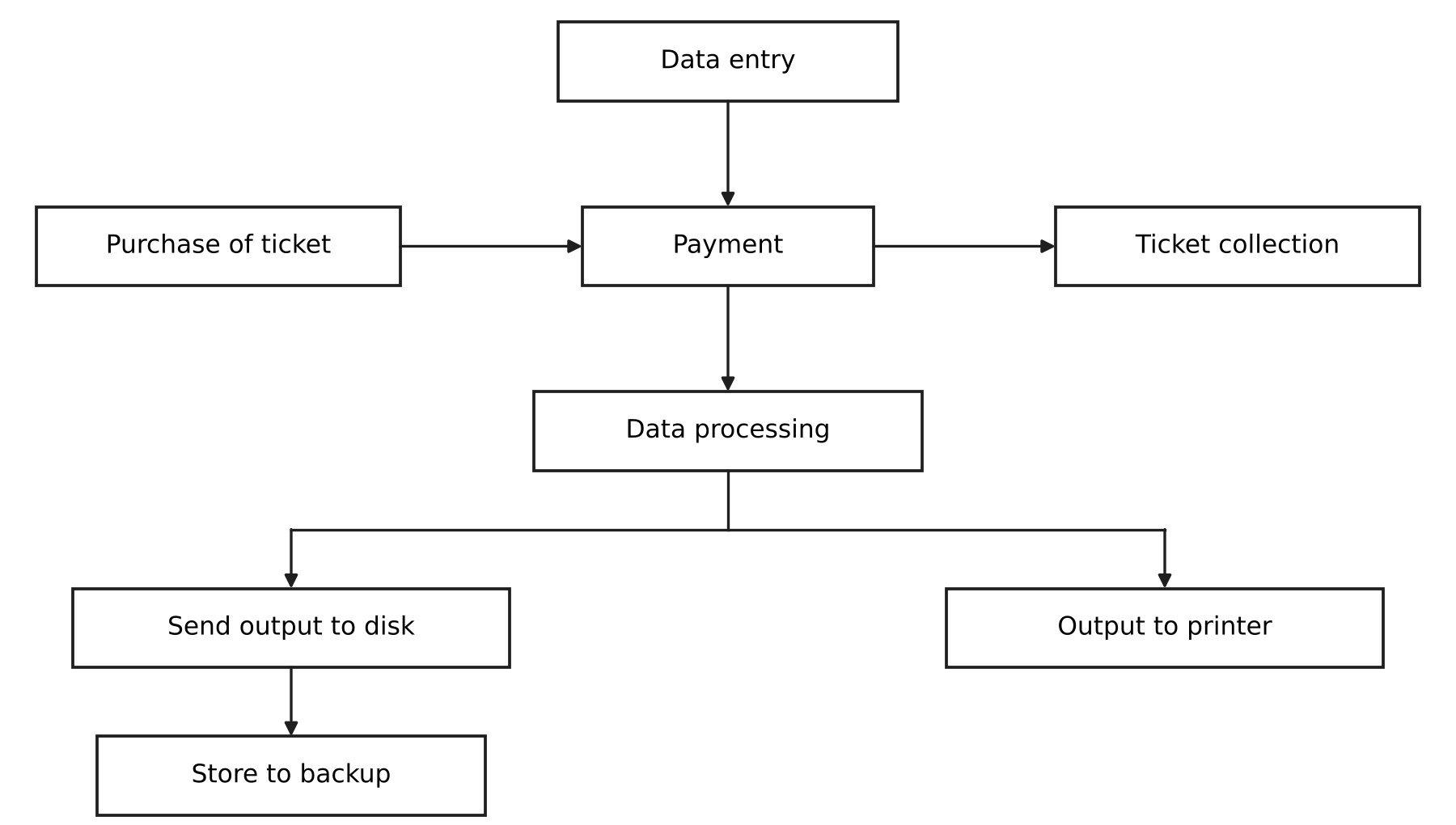
Figure 7 expands the data flow diagram to show all the processes and data stores.
4.3Database specification
Here, the basic structures of the tables composing the database for the project are shown along with information about primary and foreign keys (Table 3).
| S/N | Field name | Field type | Field width | Decimal |
|---|---|---|---|---|
| 1 | Park Name | Alpha Numeric | 20 | 0 |
| 2 | Park Number | Numeric | 7 | 0 |
| 3 | Number Of Car Loaded | Numeric | 15 | 0 |
| 4 | Amount Generated | Numeric | 10 | 0 |
| 5 | Amount Spent | Numeric | 8 | 0 |
| 6 | Date | Date | 5 | 0 |
| 7 | Balance | Numeric | 10 | 0 |
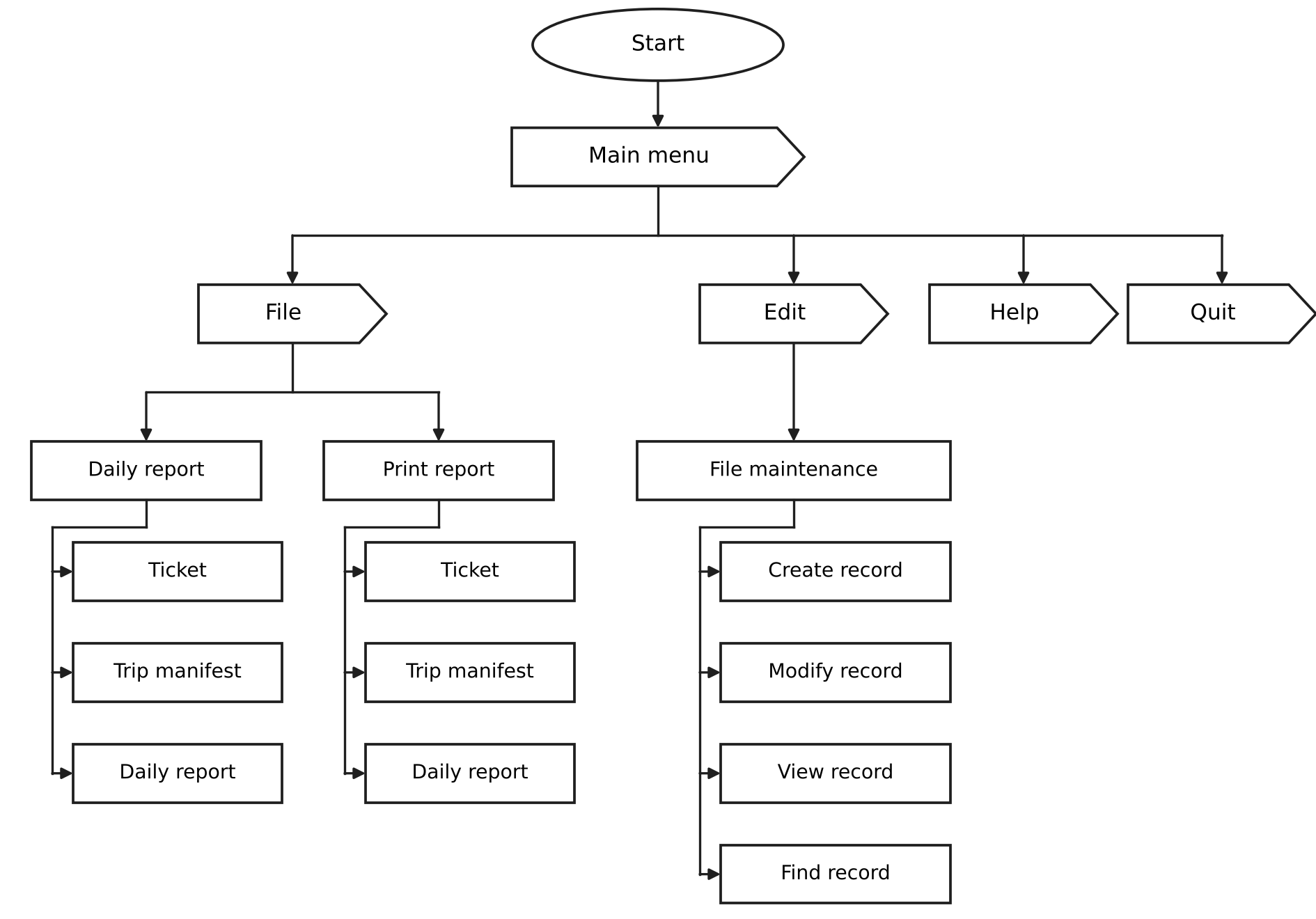
4.4Program module specification
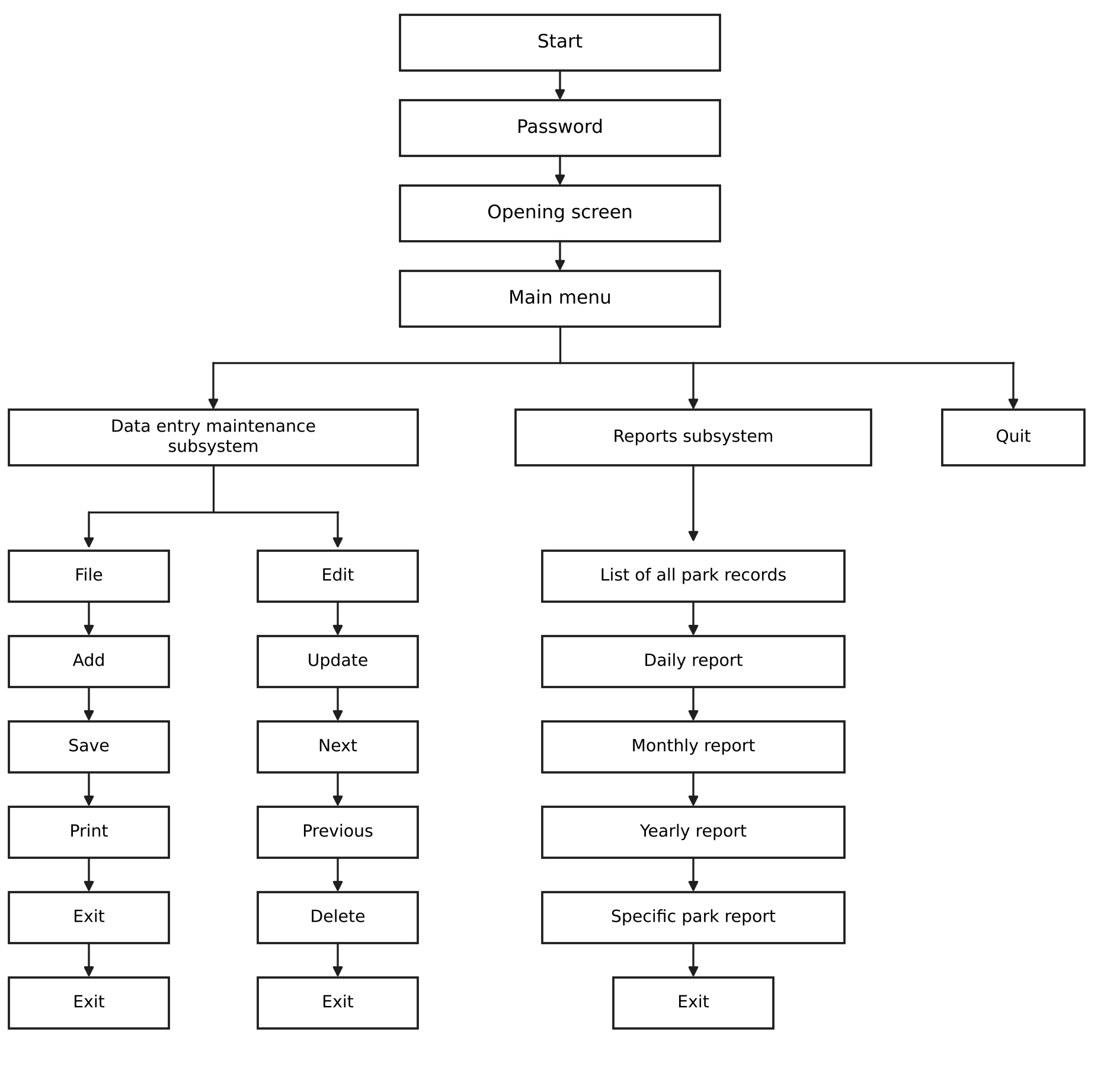
Program module can be seen as a logical, self-contained and discrete part of a larger program. This program consists of several modules, shown in Figure 8 for easy understanding of the flow of information in the system.
4.5Input and output specification
4.5.1Output specification
The output of the design is a comprehensive report of the program. It is the alert generating Transport Management System.
The output here is the reply to the passengers on whether a trip is cancelled or not (Table 4).
| Field | Entry |
|---|---|
| Passenger’s Name | XXXXXXXX |
| Vehicle type | XXXXXXXX |
| Sex | XXXXXXXX |
| Seat Number | XXXXXXXX |
| Time of Arrival | XXXXXXXX |
| Next of King | XXXXXXXX |
| Phone Number | XXXXXXXX |
| Alert | XXXXXXXX |
4.5.2Input specification
The word input entails the various data supplied to the system which are processed to give out an output. The input is supplied to the system using a computer; the inputs to the system are the names of passengers and their details (Table 5). A sample ticket alert slip is given in Table 6.
| Field | Entry |
|---|---|
| Name | XXXXXXXX |
| Seat Number | XXXXXXXX |
| Booking Date | XXXXXXXX |
| Time of Departure | XXXXXXXX |
| Destination | XXXXXXXX |
| Vehicle Number | XXXXXXXX |
| Field | Entry |
|---|---|
| Name | Joy |
| Seat Number | 04 |
| Sex | Female |
| Telephone | 070330341 |
4.6Algorithm
An algorithm is a set of logically arranged steps to perform a computation or a step by step procedure organized into the correct and logical sequence suitable for solving problems that can be transferred into the computer. The algorithm of the system is:
- 1. Start.
- 2. Enter the password.
- 3. If the password is correct go to step 4; otherwise go to step 2.
- 4. Display menu (1 = data entry, 2 = report, 3 = quit).
- 5. Check the menu option (1, 2, 3).
- 6. Option = 1: display data entry.
- 7. Option = 2: display report subsystem.
- 8. Option = 3: quit.
- 9. Stop.
4.7Flowcharts
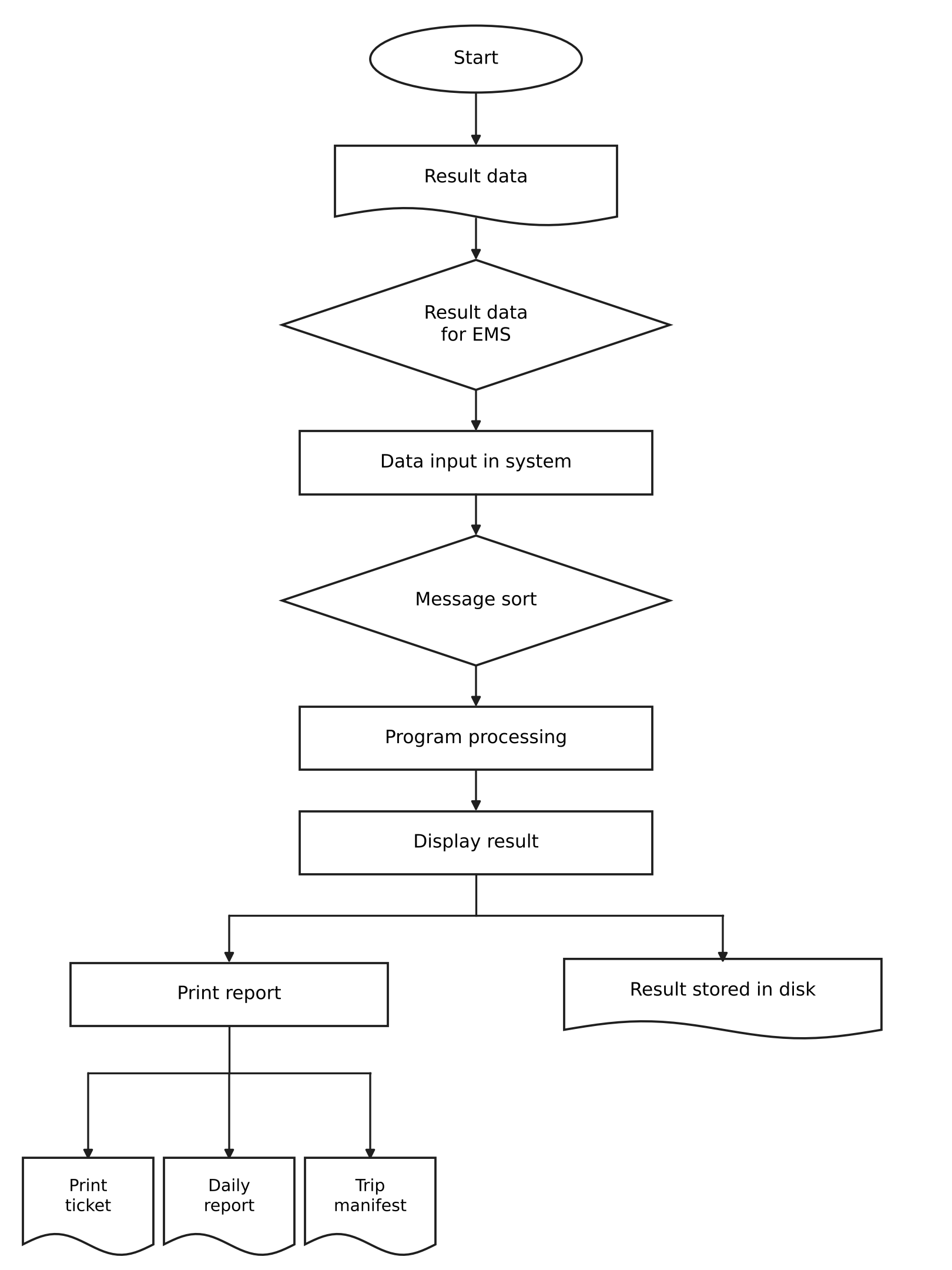
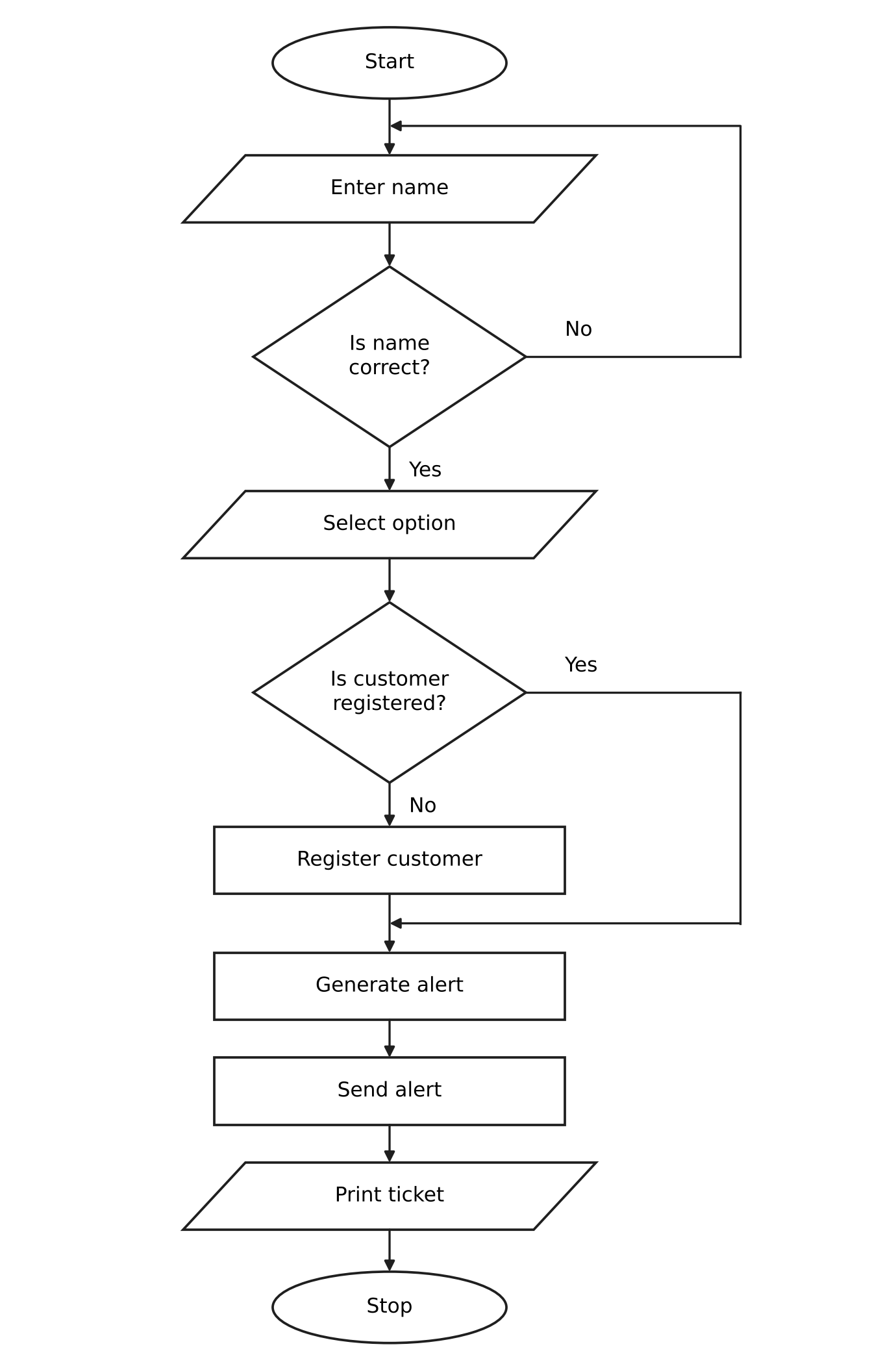
The system flowchart is shown in Figure 9 and the program flowchart in Figure 10.
4.8Data dictionary
A data dictionary is a database containing data about the entire database composing a database system. The content of data dictionary may be the best thought of as that is description of all other object (file program and so on) in the system, a particular data dictionary stores the entire various schemas and file specification and their location. The data dictionary is frequently integrated into the system. The data dictionary of this system is given in Table 7.
| Field name | Field type | Field size | Description | Datatype |
|---|---|---|---|---|
| Passenger name | Text | 16 | Ticket Number | Varchar |
| Sex | Text | 21 | Sex | Varchar |
| Content | Text | 20 | Phone number | Varchar |
4.9Choice of programming language platform
The choice of programming language is Visual Basic .NET (Visual Studio 2008) and the database used is MySQL. Visual Basic .NET is a high level programming language by Microsoft Corporation. It has elements of an object oriented language.
5Summary, conclusion and recommendation
5.1Summary
Transportation relies on effective human resource management to ensure that they hire and keep good employees and that they will be able to respond to conflicts between passengers and management. Human Resource Management Specialist initially determines the number and type of employees that a transportation system will need over its first few years of operation.
They are responsible for recreating new employees to replace those who learned for filling newly created positions. Alert human Resource Management division also trains or arranges for the training of its staff to encourage workers productivity, efficiency and satisfaction and to promote the overall success of the Transport Alert System.
5.2Conclusion
The object of this project was met by improving the manual application of carrying out day trip activities of corporate bodies, the private companies with the use of a machine called computer which is very advantageous over manual on several way the computer base high accuracy in carrying out its job and its consistency can be relied upon, so this makes it possible for Alert generating Transport System to translate information without having fear of losing of passengers in a particular trip.
The computer performs the most complex manipulation as long as the application is programmed to get the answers. Computers work at a very high speed. It also has the ability to access record directly and from remote location, thereby enable them to respond very quickly to a given situation, one item of input data can affect several different procedure. The file involved can all be stored in one particular physical location and the accessed together, that a decision will be made in the light of all the information. However in the case of manual system the item of data will go through many separate independent procedures.
5.3Recommendation
Having studied and designed a new system to help private Transportation’s Companies to have a good relational database transaction with the various companies name and addresses, there could be improvement to the names and addresses of this companies by including the name of top managers for a better relational database.
Finally, the staff working in the various departments should be trained on how to use the new system to avoid using it roughly.
References
- [1]Akinyokum K (2001). Transport management system. Benin: Ethiop Publishers, pp. 43–49.
- [2]Anigbogu H (1994). Introduction to computer and basic programming. Benin: Bikol Press, pp. 23–29.
- [3]Anthony A (2003). Management information system. New York: Oxford University Press, pp. 34–40.
- [4]Balaker C, Kim J (2006). Concept of data management and database design in transportation [Dissertation]. Pennsylvania: The State University, p. 123.
- [5]Bigelow W (2005). Data abstraction. London: Jet Publishers, pp. 11–20.
- [6]Christopher P (2009). Advance application package. New York: Watch Tower Bible and Tract Society, pp. 60–67.
- [7]Currie L (2005). Using information technology in meeting transportation goals of an organization. Journal of Computer-Based Instruction, 3(5).
- [8]Diamond I (2008). Transport management information system. London: DP Publications, pp. 77–84.
- [9]Duru F (2003). Transport system. http://www.lycos.com
- [10]Hensher S (2007). Booking operations in transportation. http://www.answer.com
- [11]Hess G, Lambarch M (2005). Prospect of electronic transportation: A system approach to transportation billing system. New York: Benjamin Cummings.
- [12]Lave U (1970). Concept of data management and database design in transportation. Journal of Computer-Based Instruction, 3(4).
- [13]Li W, Wachs I (2004). Information-processing theory and billing operations: The missing component in instructional design. Journal of Instructional Psychology, 2(5).
- [14]Litman AF (2005). Concept of transportation. Educational Commerce and Technology Journal, 1(2).
- [15]Rachel T (1989). Railway transportation. http://www.multiop.com
- [16]Siemiaty I (2006). Information technology in transportation. Owerri: Lords Professional Publishers.
- [17]Smith HW, Gihring B (2001). Computerized transportation system. http://www.en.wikipedia.org
- [18]Tony D (2005). System analysis. London: Green Hill Publisher, pp. 26–40.
- [19]Virma R (2005). Get the right mix of clicks and bricks. California: Varsity Business Publishers, p. 280.
- [20]Waugh D (2004). Transportation in Nigeria. http://www.en.wikipedia.org/wiki/transinnig
- [21]Zimmerman (2005). E-enterprise: Business models, architecture and components. Ibadan: Prime Press, p. 270.