Fault Diagonsis System
Implementation of a Computerized Automobile Fault Diagnosis System in Anambra State Polytechnic, Mgbakwu
Department of Computer Science Technology, School of Science Technology, Anambra State Polytechnic, Mgbakwu, Awka North, Anambra State, Nigeria
Published October 2026
Abstract
This report on Design and Implementation of an Automobile fault diagnosis system is a web-based application developed to solve the issue of Automobile fault. The report is motivated by the need to guide car owners and learners of motor mechanics in the maintenance and troubleshooting of automobile problems without having to resort to presumptions and conjectures. The system features a simple user-friendly interface that could allow you to search for solutions to faults developed by one’s Automobile. The methodology adopted is the Structured System Analysis Design Methodology (SSADM). The language used is PHP (Hypertext Preprocessor) for the server side development of the dynamic content, MySQL is used for the database design. The software is divided into two parts, the admin area and the user area. The developed software would ensure that automobile owners have proper assistance in time of crisis and will save them from the clutches of exploitative roadside mechanics.
Keywords: automobile; fault; system; diagnosis; computerized
1Introduction
In present time most households own at least one car. This figure shows that a car is very important to people’s lives as it completes the cycle of living. Given that we are in the era of computers and internet application, it would be nice if a web-based expert system can be developed to diagnose mechanical and other related faults in our vehicles.
Software for car faults diagnosis is a system that detects information about car faults and provides possible solutions to fixing the problem. It works by entering the type of fault your car is giving you, and then it will retrieve the information of the possible fault and also display the result of how you can solve the problem without the presence of an expert.
So, this web-based software is hoped to help those who are in need of guides to deal with their car problems. Although it might not give a complete guide and help as a human expert, namely mechanics, at least it can give temporary assistance to those who are in need of instant help, as a result of the limitation of time and distance.
Faults occur in vehicles or automobiles more often than not. This can be due to several reasons. The ability to detect and isolate these faults in complex technical systems such as automobiles is important in order to fulfill dependability requirements. Fault detection and isolation in automobiles is very important because it helps to maintain high vehicle operational efficiency, low exhaust emissions, high vehicle uptime, fuel consumption reduction or fuel economy, high vehicle safety and it guarantees efficient repair. These factors are very important because they help to reduce overall life-cycle cost of a vehicle.
With the help of a car, movement from one place to another has been made easy especially for those who are always mobile in their jobs. Cars simplify our lives and make time to be more valuable as we can save more time using the car. But at the same time, people who own cars definitely don’t want to have a problem with their cars as the troubleshooting of a car can be a nightmare to them, especially women. Some of those who own a car individually don’t know how to deal with their cars whenever it has a problem. All they know is to start the engine, drag the clutch if it is not automatic, press the pedal and brake when they need to. An even worse situation is that they don’t even know how to fill the fuel tank, and that is not good. They won’t know what to do when something happens to their cars. All they can do at best is, call the automobile repairer for help.
1.1Statement of the problem
In dealing with problems of a car and troubleshooting, automobile repairers are those who can help to solve them. The use of a computer expert system is beneficial in different ways. It gives a temporary and instant guide to car owners in different situations like:
- Assistance in the absence of automobile repairers.
- Being an alternative considering the distance of automobile repairers.
- Situations where automobile repairers diagnose wrongly, etc.
1.2Objectives of the study
The objectives of the study are:
- Developing a system for car maintenance and troubleshooting that is capable of assisting car owners in dealing with their car problems and troubleshooting them whenever time is limited and the human experts, also known as mechanics, are not available at that very time.
- Providing recommendations in cases of automobile breakdown.
- Providing maintenance advice to users in order to avoid future faults from occurring.
- Testing and validating the system’s performance.
- Helping automobile repairers diagnose serious faults and repair vehicles at a faster rate through the pre-diagnosis and advice of web-based software.
- Developing appropriate representation architecture to the proposed car failure and malfunction diagnosis assistance system.
2Literature review
The first diagnostic System for technical fault troubleshooting in motor vehicles was developed at MIT in the early 1970s. Kadarsah proposed and designed a decision model for car fault troubleshooting in which a system was utilized to help inexperienced mechanics and drivers. The model consisted of inference engine, Knowledge base, database, user interaction and adaptive mechanism. The Inference engine used backward chaining as a result of a small number of outputs with many possible inputs. In addition, the adaptive mechanism was utilized in the user interaction section in order to receive feedback about system troubleshooting result. The feedback results were stored in a database. The adaptive system then processed the stored data and extracted additional rules with the goal of improving the knowledge base. Car failure detection KBS was proposed by Ricardo Nurzal. In this system, car faults were divided into three states: Start-up state, Run-stable and Movement-state. A rule-based expert system shell (CLIPS) with a forward-chaining inference engine was used in the implementation. CLIPS stored the knowledge in rules form, which had logic-based representation as well as the production rules. The system interacts with the user through an interface and gave the troubleshooting result with illustration. The rule-based expert system contained 150 rules for car failure causes. However, improvement in the domain knowledge and applying adaptive technique for knowledge creation were required in such system. In the work of Peter Nabende and Tom Wanyama, Heavy Duty Diesel Engines (HDDEs) troubleshooting was proposed. As a result, employing an expert system in such domain was highly useful.
The HDDE fault troubleshooting System was able to successfully detect malfunctions in the engines and give recommendation of corrective actions. However, the proposed prototype was not promoted to be used as a complete application due to time and resources limitations. Further surveys were done for developing motor cultivator fault troubleshooting model. This model was based on the decision support system (DSS) in which the outcome represents the input to the DSS. The supplier selection for faulty component replacement was made by DSS based on the outcome. It proved to be a very useful tool for equipment servicing needs with low development cost. It increased the efficiency of labor and workers’ satisfaction.
2.1Theoretical background
In the development of the automobile system for detecting faults in cars, the technologies were used as follows:
HTML: HTML documents are text files that contain tags, which are used to mark up html elements, these documents are usually saved with the .html file extension, although some prefer .htm, which is a holdover from DOS file name limitation, which restricted you to eight characters for the filename and three for the extension.
<body>Automobile fault detection system</body>
In HTML, the use of forms was introduced as to help in storing information in the database.
CSS: CSS is the W3C standard for defining the visual presentation for the web pages.
The CSS is written as follows:
h1 {
  text-align: center;
  color: red
}
Here the p tag is the selector; the color code is the declaration of the color and text alignment.
PHP: PHP is the acronym of Hypertext Preprocessor. PHP was chosen as the choice of programming because of its flexibility and ease in developing the dynamic user’s interface. HTML and CSS were chosen for the development of the static user interface. Therefore, it is suitable for the researcher's work. The code is as follows:
<?php
if (!function_exists("GetSQLValueString")) {
  function GetSQLValueString($theValue, $theType, $theDefinedValue = "", $theNotDefinedValue = "")
  {
    if (PHP_VERSION < 6) {
      $theValue = get_magic_quotes_gpc() ? stripslashes($theValue) : $theValue;
    }
    $theValue = function_exists("mysql_real_escape_string") ? mysql_real_escape_string($theValue) : mysql_escape_string($theValue);
    switch ($theType) {
      case "text":
      $theValue = ($theValue != "") ? "'" . $theValue . "'" : "NULL";
      break;
      case "long":
      case "int":
      $theValue = ($theValue != "") ? intval($theValue) : "NULL";
      break;
      case "double":
      $theValue = ($theValue != "") ? doubleval($theValue) : "NULL";
      break;
      case "date":
      $theValue = ($theValue != "") ? "'" . $theValue . "'" : "NULL";
      break;
      case "defined":
      $theValue = ($theValue != "") ? $theDefinedValue : $theNotDefinedValue;
      break;
    }
    return $theValue;
  }
}
?>
This is an extract of the PHP code for the login of the admin, to be given an access login right.
2.2Review of related literature
2.2.1Troubleshooting of cars
Troubleshooting means to determine or analyze the cause or nature of a problem or situation. Motor vehicles are bound to develop fault(s) at one point in time and it is desirable to detect severe faults in order to protect the vehicle from damage. Early detection of faults can lead to avoidance of serious damage of the vehicle.
Troubleshooting can be divided into three parts: fault detection, fault isolation, and fault size estimation. It is important to determine if a fault has occurred or not (detection); when a fault is present, the location of the fault is needed (isolation); and we also desire to know where applicable the size of the fault (identification).
Another approach that is described in the literature that should apply to troubleshooting of motor vehicles would be Failure Mode and Effects Analysis.
When designing any troubleshooting system whether a hard copy service manual or an elaborate troubleshooting expert system, models of device failures are used to trace the root cause of the system and component failures.
2.2.2Future of automobile system
Automobile repairers are involved with the servicing, maintenance and repair of cars and light vehicles. The work is wide ranging and includes routine servicing in accordance with manufacturer’s recommended procedures and the testing and approval of the structural, mechanical and electrical systems of the vehicle. A vehicle may be due for a service after a certain number of kilometers or after a certain period of time, according to instructions set out by the vehicle manufacturers.
Mechanics also repair vehicle that have broken down or been involved in accidents. Servicing involves:
- Making routine checks according to a list;
- Finding faults or problems;
- Overhauling or replacing worn or faulty parts; and
- Using special equipment and road test to make sure the vehicle performs as it should.
Sometimes customers take their vehicles to mechanics to investigate a particular mechanical fault. Solving these problems may involve stripping down the affected part of the car in a workshop area, finding the faulty components and replacing them, and then putting all the parts together again. Mechanics tend to replace parts rather than repair them because this is quicker and therefore less costly.
Mechanics also deal with electrical and electronic systems, which are becoming more and more sophisticated on modern vehicles. For example, mechanics may connect laptop computers to a vehicle’s electronic control unit, using an on-screen menu to choose the part of the vehicle they want to investigate. The computer is able to find and report back information on the fault, for example, a break in circuit wiring. With older vehicles, mechanics use electrical testing equipment like voltmeters and ammeters to test electric circuits/components.
3System analysis and design
3.1Analysis of the proposed system
The proposed system is expected to overcome most of the deficiencies encountered in the present system.
The system will be easy to understand and use which makes it possible for every user of the system to use it without necessarily undergoing training. Also data is stored on centralized system making data retrieval fast, easy to modify and update. Therefore, with simply sending query to the database, information concerning a particular fault is made available including the solutions to such fault. This single ability of the system solves the problem of time. The problem of omission and duplication will be solved because the system follows a sequential method to create, read, and update every record and cannot jump this sequence.
The proposed system, web-based car fault diagnosis is considered an improvement of the existing system. This is because the tested system takes care of the main problems associated with cars.
In other words, the problems of delay, inefficiency and tedium in the current system have been completely taken care of, by the proposed system.
Therefore, it can be concluded that the proposed system provided a more efficient method of car repair.
3.2Design of the proposed system
3.2.1Database design
The database is designed with MySQL. Its tables are shown in Table 1 (admin registration) and Table 2 (user registration).
| S/N | Field name | Data type | Field length |
|---|---|---|---|
| 1 | Id | Int | 11 |
| 2 | Surname | varchar | 30 |
| 3 | First name | varchar | 30 |
| 4 | Least name | varchar | 30 |
| 5 | Age | date | |
| 6 | Gender | varchar | 8 |
| 7 | Phone No | varchar | 11 |
| 8 | User name | varchar | 30 |
| 9 | Password | varchar | 30 |
| 10 | varchar | 30 |
| S/N | Field name | Data type | Field length |
|---|---|---|---|
| 1 | Id | Int | 11 |
| 2 | Surname | varchar | 30 |
| 3 | First name | varchar | 30 |
| 4 | Least name | varchar | 30 |
| 5 | Age | date | |
| 6 | Gender | varchar | 8 |
3.2.2System software architecture
A system architecture or systems architecture is the conceptual model that defines the structure, behavior, and more views of a system (Figure 1). An architecture description is a formal description and representation of a system, organized in a way that supports reasoning about the structures and behaviors of the system.
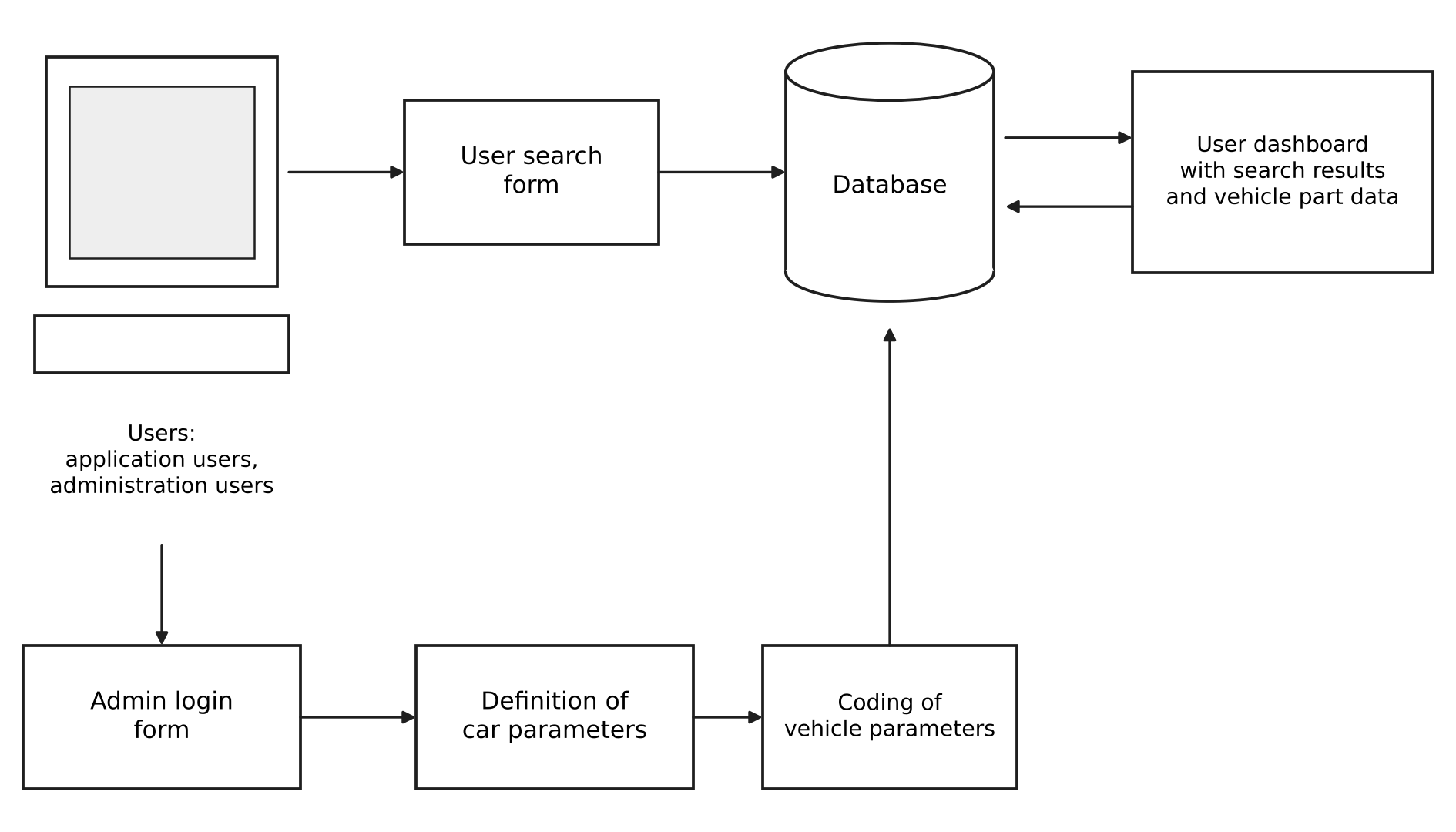
It presents a synthetic view including: the resolution of ambiguity to identify system goals and boundaries; the creative process of mapping form to function; and the analysis of complexity and methods of decomposition and re-integration. System architecture helps in setting of conventions, rules, and standards employed in a computer system's technical framework.
3.2.3The development tools
The development tools are the necessary requirement tools used during the design to enable us achieve the system design. The listed packages were used because of their features, accessibility and also because they are more effective:
- 1. MySQL database application;
- 2. PHP scripting language; and
- 3. HTML.
PHP scripting language: PHP is a scripting language a language that offers great programming capabilities to web application developers using integrated development environments.
However, this language was chosen for the development of this project; not only because it is the language the developer is most comfortable with; but because, it offers the following programming merits:
- 1. It makes the art of programming very approachable.
- 2. It is an object-oriented language that is easy to learn and understand.
- 3. It quickens the development of applications (Rapid Application Development).
PHP also, being a unified web development tool, aids in building powerful web applications with minimum coding. Here, mark-up codes for PHP server controls and PHP files are automatically generated; thus reducing the need for writing codes for each control and event handlers needed.
3.2.4Implementation of the architecture
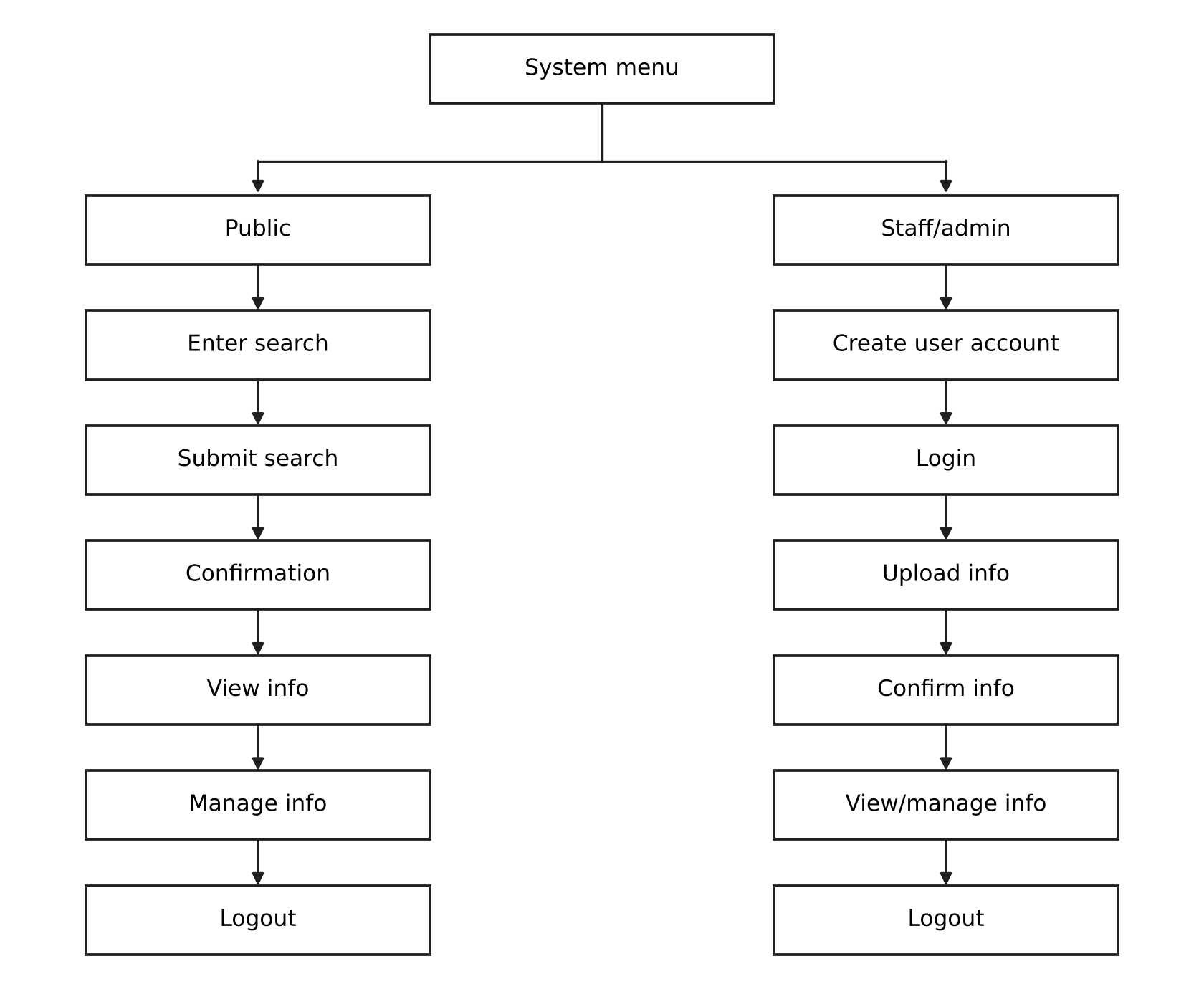
The implementation of the architecture is shown in Figure 2.
3.3Software testing
Software testing is a process of executing a program or application with the intent of finding the software bugs. It can also be stated as the process of validating and verifying that a software program or application or product:
- Meets the business and technical requirements that guided its design and development;
- Works as expected; and
- Can be implemented with the same characteristics.
The definition of software testing can be broken into the following parts:
- 1. Process: Testing is a process rather than a single activity.
- 2. All life cycle activities: 2) Testing is a process that takes place throughout the Software Development Life Cycle (SDLC). The process of designing tests early in the life cycle can help to prevent defects from being introduced in the code; this is sometimes referred to as “verifying the test basis via the test design”. The test basis includes documents such as the requirements and design specifications.
- 3. Static testing: It can test and find defects without executing code. Static Testing is done during verification process. This testing includes reviewing of the documents (including source code) and static analysis. This is useful and cost effective way of testing. For example: reviewing, walkthrough, inspection, etc.
- 4. Dynamic testing: In dynamic testing the software code is executed to demonstrate the result of running tests. It’s done during validation process. For example: unit testing, integration testing, system testing, etc.
- 5. Planning: We need to plan what we want to do. We control the test activities, we report on testing progress and the status of the software under test.
3.4Input and output specifications
The website is classified into two areas:
- The public area
- The staff/admin area
3.4.1The public area
- 1. System Profile: this is the page that enables the public to view the project profile info.
- 2. Search Page: this page enables the public to search for faults and see the possible solution.
3.4.2The admin area
The admin area and its functionalities are as follows:
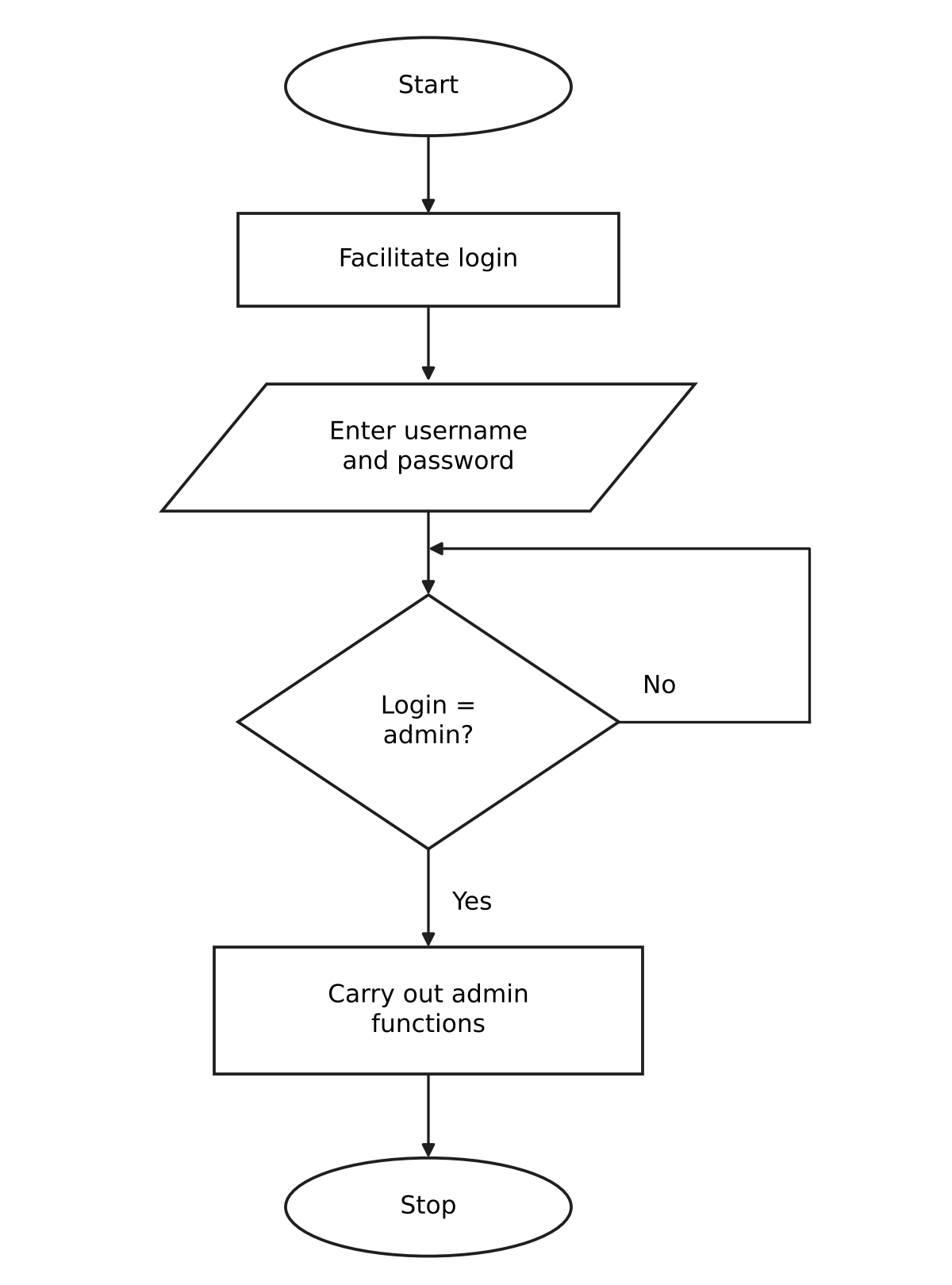
- 1. Login: this is the page that enables the admin to login into the secret page.
- 2. Staff Account: this page allows a particular staff to have access to a hidden page.
- 3. Admin Account: this page allows the creation of new access to other administrators thereby enabling them to have a login account.
- 4. Confirm Registration: this page allows the admin to view registration as well as staff and admin registration with the help of other navigated links placed on the pages.
- 5. Hidden: this is where the hidden pages are located which if no access is granted to any staff he/she cannot be allowed into the hidden pages.
- 6. Registration page: This page allows the registration of the students.
3.4.3Input and output format
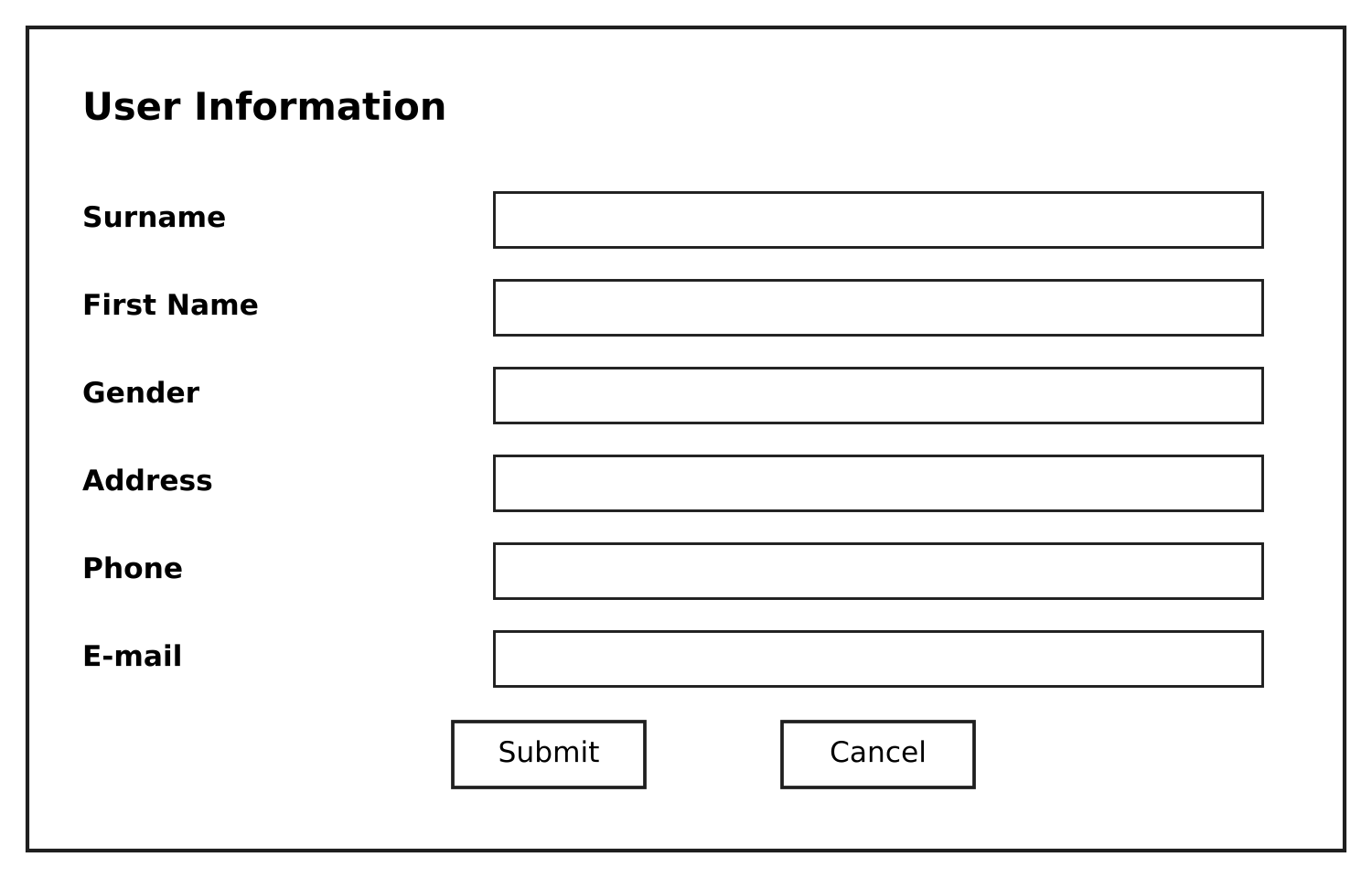
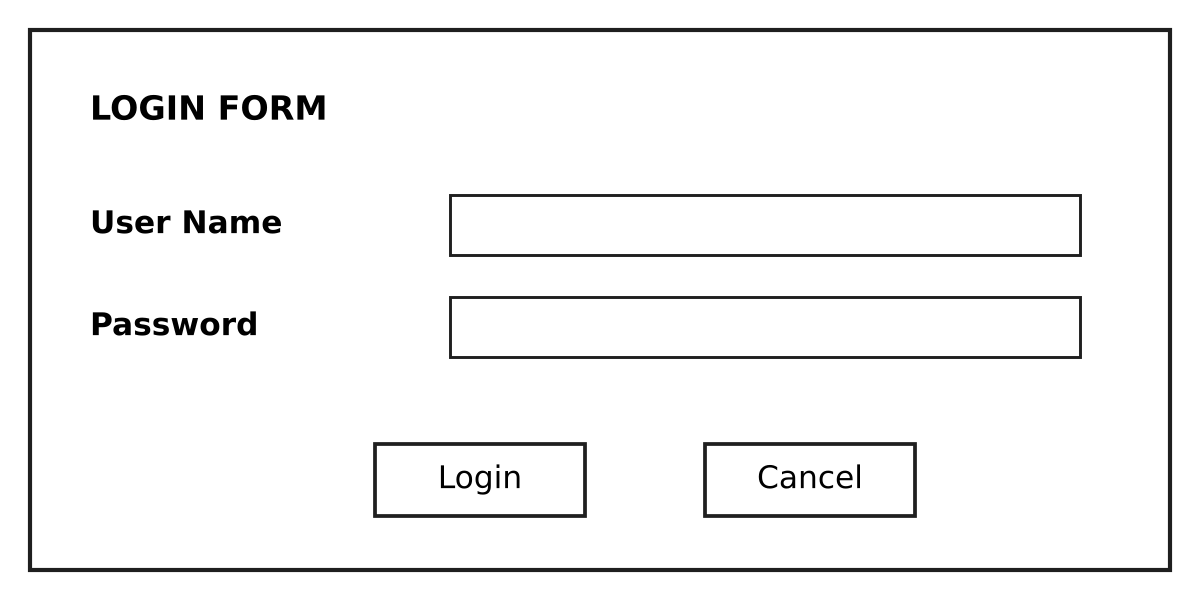
Input format. The form is based on the data that needs to be entered into the system. It will accept inputs either by keying in the inputs or by selection from already made inputs. Figure 3 shows the user information form and Figure 4 the login form designed for the new system.
Output format. The output for the new system will be obtained after the inputs have been made. The media through which output can be obtained from the system are Visual Display Unit (VDU) and printout from the printer. The system is designed to generate output on the following:
- User information;
- User registration; and
- Complaints.
3.4.4Program flowchart
The program flowchart is shown in Figure 5.
4Summary, conclusion and recommendation
4.1Summary
Car Fault diagnosis systems are designed to solve complex problems by reasoning about knowledge, represented primarily as if–then rules rather than through conventional procedural code. This study tries to review the impact of applying artificial intelligence into car fault detection system by creating a system that handles such. The study discussed the technology and application of the system.
4.2Conclusion
This proposed system (web application) will help Toyota, Nissan and Mercedes Benz vehicle users have a better understanding of their cars. It will contain all the common faults experienced daily by users of mentioned brand of vehicles, as well as provide solutions to those problems. Although, this software will provide solutions to some categories of problem. It may not have all the problems and solutions but the good news is that it is subject to improvement and enhancement, meaning that the web application administrators will continue working round the clock to keep it up-to-date in order to satisfy the needs of users.
4.3Recommendation
I recommend that the system should be integrated in order to help technicians, or users to detect a problem in a car and provide available solution to that.
References
- [1]Aiello JR, Svec CM (1993). Computer monitoring of work performance: Extending the social facilitation framework to electronic presence. Journal of Applied Social Psychology.
- [2]Alharbi S, Drew S (2014). Using the Technology Acceptance Model in understanding academics’ behavioural intention to use learning management systems. International Journal of Advanced Computer Science and Applications, 5.
- [3]Allen MW, Walker KL, Coopman SJ, Hart JL (2007). Workplace surveillance and managing privacy boundaries. Management Communication Quarterly.
- [4]Al-Zawahreh A, Al-Madi F (2012). The utility of equity theory in enhancing organizational effectiveness. European Journal of Economics, Finance and Administrative Sciences.
- [5]Awino ZB (2015). Organizational structure and performance of large manufacturing firms in Kenya: An empirical investigation. Journal of Business and Economics.
- [6]Ball B (n.d.). A summary of motivation theories.
- [7]Ball K (2010). Workplace surveillance: An overview. Labor in the Information Age.
- [8]Bhave DP (2013). The invisible eye? Electronic performance monitoring and employee job performance. Personnel Psychology.
- [9]Bohlander GW, Snell S (2010). Managing human resources. Cengage Learning.
- [10]Bryant S (1995). Electronic surveillance in the workplace. Canadian Journal of Communication.
- [11]Bulitia GM, K’Obonyo P, Ojera PB (2014). Human resource management practices and firm performance: A study of manufacturing firms in Kenya. International Journal of Management Excellence.
- [12]Burns N, Grove SK (2003). Understanding nursing research. Philadelphia: W.B. Saunders Company.
- [13]Chuttur M (2009). Overview of the Technology Acceptance Model: Origins, developments and future directions. Working Papers on Information Systems.
- [14]Ciocchetti CA (2011). The eavesdropping employer: A twenty-first century framework for employee monitoring. American Business Law Journal.
- [15]Coultrup S (2012). Effects of electronic monitoring and surveillance on the psychological contract of employees: An exploratory study. In: ASBBS Annual Conference. Las Vegas.
- [16]Davis FD (1991). User acceptance of information technology: System characteristics, user perceptions and behavioral impacts. Academic Press Limited.
- [17]Davis PS, Harveston PD (2000). Internationalization and organizational growth: The impact of Internet usage and technology involvement among entrepreneur-led family businesses. Family Business Review.
- [18]Dempsey J (2007). Introduction to private security. Cengage Learning.
- [19]DeTienne KB (1993). Big brother or friendly coach? The Futurist, p. 33.
- [20]DeTienne KB, Flint RD (1996). The bosses’ eyes and ears: The Privacy for Consumers and Workers Act. Labor & Employment Law.
- [21]East African Community (2011). East African Community facts and figures. Arusha.
- [22]Georgopoulos BS, Tannenbaum AS (1957). A study of organizational effectiveness. American Sociological Review, 22.
- [23]Ghasemaghaei M, Hassanein K, Turel O (2015). Impacts of big data analytics on organizations: A resource fit perspective.
- [24]Grant RA, Higgins CA, Irving RH (1988). The impact of computerized performance monitoring on service work: Testing a causal model. Information Systems Research.
- [25]Griffith TL (1993). Monitoring and performance: A comparison of computer and supervisor monitoring. Journal of Applied Social Psychology.
- [26]Grimmett D (2014). APSU JABR. Journal of Applied Business Research.
- [27]Haron M, Chellakumar JA (2012). Efficiency performance of manufacturing companies in Kenya. International Journal of Management and Business, 233.
- [28]Hartman LP (1998). Ethics: The rights and wrongs of workplace snooping. Journal of Business Strategy.
- [29]Hinds A (2012). Computer monitoring in the workplace and your privacy. Your Privacy.
- [30]Kaplan R, Norton DP (1996). The balanced scorecard: Translating strategy into action. Harvard Business Review Press.
- [31]Katz LM (2015). Monitoring employee productivity: Proceed with caution.
- [32]Kiplagat KK (2014). Role of inventory management on performance of manufacturing firms in Kenya – a case of New Kenya Cooperative Creameries. European Journal of Business Management, 336–341.
- [33]Labaree RV (2009). Qualitative methods - organizing your social sciences research paper: Types of research designs.
- [34]Levy M (1994). Electronic monitoring in the workplace. Power through the panopticon.
- [35]Lieven MD, Evens T, Stragier J (2011). Diffusion theory vs. today’s ICT environment. 175–202.
- [36]Losey MR (1994). Workplace privacy: Issues and implications. USA Today, 123. Society for the Advancement of Education.
- [37]Martin K, Freeman RE (2003). Some problems with employee monitoring. Journal of Business Ethics.
- [38]Mautner GE, Anderson NW, Haushild SE (2001). Privacy in the workplace.
- [39]McHardy C, Giesbrecht T, Brady P (2005). Workplace monitoring and surveillance. New Privacy Legislation in the Workplace: Issues of Surveillance and Monitoring.
- [40]Mishra JM, Crampton SM (1998). Employee monitoring: Privacy in the workplace? S.A.M. Advanced Management Journal.
- [41]Mitchell H (2002). Strategic worth of human resources: Driving organizational performance.
- [42]Muhi CJ (2003). Workplace e-mail and Internet use: Employees and employers beware. Monthly Labor Review.
- [43]Mwita I (2000). Performance management model: A systems-based approach to public service quality. International Journal of Public Sector Management.
- [44]Nebeker DM, Tatum C (1993). The effects of computer monitoring, standards, and rewards on work performance, job satisfaction, and stress. Journal of Applied Social Psychology.
- [45]Nirajan MP, Krishna PK, Rojas EM, Foster ET (2016). A case study on estimating labor productivity frontier. In: 52nd ASC Annual International Conference Proceedings. Associated Schools of Construction.
- [46]Niven PR (2010). Balanced scorecard step-by-step: Maximizing performance and maintaining results. John Wiley and Sons.
- [47]Nzuki DM, Odongo WO (2015). Adoption of enterprise resource planning systems in Kenya: A case of selected. International Journal of Business, Humanities and Technology.
- [48]Palm E (2007). The ethics of workplace surveillance. [Doctoral thesis]. Royal Institute of Technology.
- [49]Park SY (2009). An analysis of the Technology Acceptance Model in understanding university students’ behavioral intention to use e-learning. Educational Technology & Society.
- [50]Prakashan N (2003). Management information systems.
- [51]Pritchard RD (1969). Equity theory: A review and critique. Organizational Behavior and Human Performance.
- [52]Privacy Rights Clearinghouse (2016). Workplace privacy and employee monitoring.
- [53]Ramlall S (2004). A review of employee motivation theories and their implication for employee retention within organizations. Journal of American Academy of Business, Cambridge, 52–65.
- [54]Reddy K (2016). Advantages and disadvantages of employee monitoring.
- [55]Reilly SM (2010). The use of electronic surveillance and performance measures in the workplace: A qualitative investigation. [Thesis]. Durham University.
- [56]Rogers EM (2003). Diffusion of innovations (5th ed.). New York: The Free Press.
- [57]Rosenblat A, Kneese T, Boyd D (2014). Workplace surveillance. Data & Society Working Paper.
- [58]Rule J, Brantley P (1992). Computerized surveillance in the workplace: Forms and distributions. Sociological Forum, 405–423.
- [59]Sewell D (2005). When is a species declining? Optimizing survey effort to detect population changes in reptiles.
- [60]Shumake G (1992). Increasing productivity and profit in the workplace: A guide to office planning and design. John Wiley & Sons.
- [61]Stevens A, Lavin DO (2007). Stealing time. The temporal regulation of labor in neoliberal and Post-Fordist work regime. Democratic Communiqué.
- [62]The Week (2015). The rise of workplace spying. The Week.
- [63]U.S. Congress (1987). The electronic supervisor: New technology, new tensions (OTA-CIT-333). U.S. Congress.
- [64]Vorvoreanu M, Botan CH (2000). Examining electronic surveillance in the workplace: A review of theoretical perspectives and research findings.
- [65]Wakefield RL (2004). Computer monitoring and surveillance. The CPA Journal.
- [66]Weckert J (2005). Electronic monitoring in the workplace: Controversies and solutions. Idea Group Inc.
- [67]Yang Z (2006). Data envelopment analysis evaluation of Canadian resource companies. In: Portland International Conference on Management of Engineering and Technology.
- [68]Yerby J (2013). Legal and ethical issues of employee. Online Journal of Applied Knowledge Management.
- [69]Yuchtman E, Seashore SE (1967). A system resource approach to organizational effectiveness. American Sociological Review, 32.