Electronic Transcript Management
Implementation of an Electronic Transcript Management System in Anambra State Polytechnic, Mgbakwu
Department of Computer Science Technology, School of Science Technology, Anambra State Polytechnic, Mgbakwu, Awka North, Anambra State, Nigeria
Published October 2026
Abstract
This research is a computerized information management for transcript management which will help to overcome the undesirable problem associated with misplacement of student records, student's grades, slow and strenuous accessibility of student report and record, inaccurate record keeping and poor information management within the schools. Here the aims and objectives of the study will be easily retrieved with increased data security, and there will be reduction in the amount of resources, which will lower the cost of processing of student transcript, since information is stored in a database with reduced data redundancy. This will also prevent over-working of personnel and reduce the bulkiness of files and records. This program developed/designed will ensure easy flow of information in the school (Caritas University), and accurate information management in all schools. The methodology used in the design was Structured System Analysis and Design Methodology (SSADM) and the new system was designed with the Microsoft Visual Basic .NET framework programming language. The benefits of the design include increased speed of information processing, efficiency, reliability and security. The system when tested was confirmed to perform creditably.
Keywords: transcript; management; system; electronic; computerized
1Introduction
The need for transcript for further studies is becoming more rampant since many universities need current and final transcripts while other universities may only need those final transcripts of students who have been accepted. With respect to academic transcripts, today in our country it is very hard and very slow to process an academic transcript, especially in the state universities as well as very slow to transfer academic transcripts to other educational institutions. Furthermore, it consumes much time, like between ten months and four years to process and transfer the academic transcripts to other institutions. But in developed countries, like in the United States of America (USA), it takes a day to a week to send out an academic transcript to other schools. Many academic and non-academic staff are still ignorant of the negative consequences of delaying the students’ academic transcripts. One of the unintended consequences of these difficulties is that some have taken to forging documents, knowing full well forging documents is a crime.
Therefore, there is a need for universities to computerize all their records and update their systems to eradicate all delays resulting in sending supporting documents to enable students to achieve their academic goals. Since transcripts are an official record of a student's work, showing courses taken and grades obtained, it is essential and recommendable that the universities should respond appropriately to their former students' request for this all-important document. The late processing of students’ transcript is affecting the nation as well, take for example an engineering student who wants to improve his engineering skills and profile so that he would be more able and capable to increase our nation’s engineering productivity will be denied and frustrated by transcript delays. One of the reasons for such delays in transcript delivery is a result of poor record keeping and retrieval. Unfortunately, the emotional and economic cost of this challenge is rather incalculable: lost opportunities for further studies and good employment to mention just two. It is regrettable that many prospective graduate students have lost admission opportunities within and outside Nigeria as a result of their inability to obtain their transcripts to support their applications on time.
We therefore view this matter as a serious national problem and address it with the seriousness it deserves.
In some cases, students have had to pay the fees twice and use multiple contacts to secure the transcript, for instance, students who have travelled overseas need the intervention of friends and relatives to obtain their academic records and this will involve travelling very long distances. Thus, the sole purpose of securing the school documents becomes worrisome, stressful and time consuming. There is no guarantee that the transcript would be secured in the first, second, fifth or sixth attempt. If the transcript arrives, it may arrive with errors or incomplete, that is, a partial transcript is sent. All Nigerian universities must ensure proper records are kept and adding electronic records to their paper records is a viable option. Aside from the official fee to be paid to the school, facilitators within the school system might also need to be paid. Moreover, friends and relatives who spent their time going back and forth must also be compensated. Transcript (and postage) that ordinarily should cost no more than $50 may end up costing the requester upward of $200. And indeed, there is no guarantee that the requested documents will arrive, or arrive in a timely fashion.
Such is the frustration of obtaining transcript from some Nigerian institutions of higher learning. Many admissions in the Nigeria universities have been administered on papers over the years and students’ records are kept in files which over the years are liable to wear and tear. Many of such files are also liable to misplacement, rusting etc. It becomes a difficult thing to produce transcript as early as a student will expect which has made them to miss many opportunities such as overseas learning, job opportunities and promotion in their respective work places. In a bid to provide solution to such problems, storing such documents electronically will be of help in many ways. This will help in keeping the records for a long time without any alteration and for easy retrieval of records. We have come up with a fast way of computerizing the students’ records since the inception by first digitizing the records; capture the data into the database for transcript processing.
1.1Statement of the problem
The increasing frequency and sophistication of transcript forgeries and alterations today make it incumbent upon institutions to ensure that outgoing transcripts are uniquely identified and incoming transcripts are meticulously screened.
1.2Objectives of the study
The objectives of the study are:
- 1. Privacy and confidentiality.
- 2. Integrity: assuring that data are not modified without proper authority.
- 3. Consistency: ensuring that the data and behaviour we see today will be the same tomorrow.
- 4. Controlling access to resources.
2Literature review
The introduction of computer into information technology has massively improved the information need of organization; the success of this machine is dependent on the knowledge base. Therefore, one can be prompted to ask aloud "what is a computer?" Funk (2005) defined a computer as an electronic device that can perform automatically and at a high speed a sequence of logical operations according to instructions given to it in the form of a pre-arranged program.
Another author, Anigbogu (2010), defined a computer as an electronic device capable of accepting data and instructions, processing the data based on the instructions to generate result or output in such a manner that is yet to be equaled by any other known machine to mankind.
Similarly, another author, Chimezie (2009), defined it by saying that "computers are looked upon as obedient servants who are ever ready to free man from tedious procedures and produce results as compared with human computing time". Yet another author, Obilikwu (2007), defined computer as a machine that is capable of accepting input data, store and process the data based on instructions given by the computer user and in this way produce expected results, generally called output. These definitions of computer would lead us to answer the question "what is a program?". In his definition, Obilikwu (2005) defined a program as a sequence of instructions given to the computer to perform a specific operation. From Encarta Encyclopedia, computer program is a set of instructions that directs a computer to perform some processing function or combination of functions.
The above definitions of a computer clearly demonstrate the limitless area of operation of computer in as much as such a task is programmable, the computer is applicable in virtually all areas of human endeavour ranging from agriculture, education, business, sports, entertainment, medicine, construction and military etc.
French (2012), in his book titled Computer Science (fourth edition), relates the relevance of computer to management and stated that "a company needs information on which to base decisions concerning the current operations and future plans. It requires the information to be timely and accurate". He then cited the example of the use of computer in the area of management control to production and stated "production must be able to respond quickly to changes in demand and other circumstances to do so requires the provision of up to date information which is accurate and timely".
Aluko (2000), in a paper, stated that "in virtually any job whether clerical, technical, business or professional, whether it is a banking, medicine, education etc. Computers are useful tools" and that "computers are tools with which we calculate, measure, assess, store, retrieve, regulate and monitor information. Hence, the blood and life wire of any system is information. A typical system (Education, management etc) cannot survive without good management information system (MIS). Management information systems (MIS) are information systems, typically computer-based that are used within an organization. The concept of management information system is a complex variable although Murdick (2008) simplified it when he said "there is probably no more challenging and diversified subject than management theory, system theory and computer science". Computerization is a social process for providing access to and support for computer equipment to be used in activities such as teaching, accounting, writing, designing, circuits, file processing etc. Computerization entails social choices about the level of appropriate investment and control over equipment and expertise, as well as choices of equipments.
According to Dunlop and Kling (2001), by the early 1990s computing and telecommunications accounted for half of the capital investments made by private firms. However, Fergenbaum and McCorduck (2003) and Yourdon (2003) stated that the most fervent advocates of computerization have argued that the actual pace of computerization in schools, factories and homes is too slow.
According to Taylor (2000), computer-based education includes both computer-assisted instruction programs that interact with students in a dialogue and a broader array of educational computer applications such as simulations or instruction. In computer programming, there is major national push for extended application of computer-based education at educational levels. For example, in the mid-1980s several private colleges and universities required all their freshmen students to buy a specific kind of microcomputers, and others invested heavily in visions of "wired campus".
According to Kling (2003), computer-based education has been promoted with two different underlying ideologies in all levels of education. Some educators argue that computer-based instructional approaches can help fulfil the traditional values of progressive education: the stimulation of intellectual curiosity, initiative and democratic experience. For examples, Cyert (2004) has argued that computerized universities are qualitatively different than traditional universities. College students with microcomputers in their dorm room will be more stimulated to learn because they will have easy access to instructional materials and more interesting problems to solve.
Papert (2009) argues that in a new computer-based school culture, students will no longer simply be taught mathematics. These visions portray an enchanted social order transformed by advanced computing technologies. Other advocates are a bit less romantic, but not less enthusiastic.
For example, Cole (2002) argues that because of the insatiable desire of students for more and more information at a higher level of complexity and more sophisticated level of utilization, more effective means of communication must be used. Computers can provide a unique vehicle for this transmission.
King (2006) notes that others emphasize a labour - market pragmatism that we label "vocational matching." In this view people will need computer skills, such as programming, to compete in future labour markets and to participate in a highly automated society; a responsible school will teach some of these skills today.
According to Kling (2006), advocates of computer-based education promote a utopian image of computer-using schools as places where students learn in a cheerful, cooperative setting and where all teachers can be supportive, enthusiastic mentors.
Hence, it is important to note that computer based education goes a long way in helping the students as well as the staff to effectively make use of the computerized management system. It also helps in convincing the stakeholders of the importance and need for adopting the computerized transcript management system as it provides effective and accurate handling of student's files.
Therefore, a computerized transcript management system is usually a system, which is implemented with a computer to achieve the utmost efficiency and desired goals. In well developed countries, where education systems are computerized, personalized software that captures the entire education business process and makes all operation accessible via the web, thus allowing schools to effectively serve all stakeholders: students, lecturers, administrators and parents. But in this case (Transcript Management System) it provides functionalities including Grading, Records keeping, information management within the school, easy retrieval and data security.
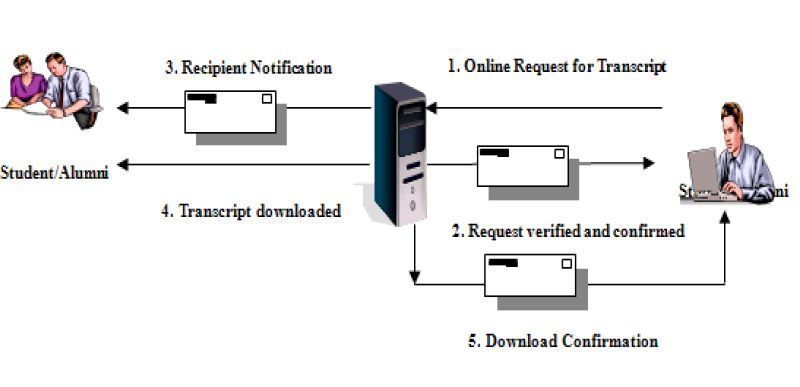
Not much has been written on academic transcript in Nigeria. However, Thomas (2001) studied and investigated the determinant factors involved in planning a good records retrieval system in a university environment. Specifically, their studies seek to identify the factors that inhibit effective document/records storage and retrieval in universities in Nigeria and thus proffer solutions to effectively address the problem. Black explained how an e-transcript will mark the end of paper transcript and how a secured electronic transcript can be produced in partnership with Avow Systems (Figure 1).
Altbach and Teichler (2001) examined the problems and management options of record keeping among universities in the South-West geo-political zone of Nigeria. Her findings revealed that negative attitude of staff, improper security of records, inadequate computer terminals, ineffective means of retrieving records, lack of record keeping policy, inadequate resources as well as lack of record retention and disposition schedule among others were identified as the associated problems. As a result, the following recommendations were made: only professionally trained staff in records management be employed over time and/or existing staff be sent for necessary training through in-service programmes. Induction programmes for new staff and refresher courses for old staff were also recommended as well as a full computerization of all records.
Nakpodia looked critically at the challenges of students’ records in tertiary institutions in Nigeria. Unlike Nakpodia the study used samples from Federal, State and Private Universities in the South-South geo-political zone of Nigeria. The findings revealed that the challenge encountered in the management of records was common to Federal, State and Private Universities in Nigeria. Iwhiwhu et al. discussed the management of staff records at Delta State University Library, Abraka, Nigeria. However, nothing concerning students’ academic record was mentioned, rather they concentrated on management of staff records in the library. While Olagboye, in his book, listed the following as school records:
- A register of admission and withdrawal;
- A register of attendance;
- A log-book;
- A cash book;
- A visitor’s book;
- A copy of education law;
- Scheme of work;
- Teacher’s record of work;
- School time-table;
- Corporal punishment book; and
- Counterfoils of transfer and leaving certificates, and minutes book of the Board of Governors.
Although, the subject matter of this paper is academic records, nevertheless, school records serve as a bank in which information is deposited and kept with the hope of retrieving and utilizing in the future. Proper keeping of school records could enhance planning process, serve as historical record, provide knowledge on students’ academic performance and facilitate schools’ financial administration. It will also provide a basis for advisory and counseling services.
2.1Definition of academic transcript
According to Attwood (2008), an academic transcript from a degree awarding body can also be referred to as an academic record, a diploma supplement, a statement of learning, a record of achievement or something else similar. It should list all the modules or subjects you studied in each year, the marks or grades you achieved for each module and the credit rating and level of each module. If your previous study pre-dates credit ratings, the transcript should clearly indicate the proportion of the qualification for which you successfully completed the assessment. It should be stamped or signed by the registry of your previous institution and be on original letter-headed paper. If you do not have an academic transcript you will need to contact your previous institution to request one.
An academic transcript from a professional body may be referred to as a notification of results, a summary of results, a notification of performance, a record of education & training or something else similar. It should list all the modules or subjects you studied in each year, the marks or grades you achieved for each module and the credit rating and level of each module. If the study was incomplete, the transcript should clearly indicate the proportion of the qualification for which you successfully completed the assessment. It should be stamped or signed by your previous institution and be on original letter-headed paper. If you do not have this information you will need to contact the professional body’s examinations or membership department to request it.
2.2Components of a transcript
Battisti and Portelli (2009) say that a transcript is an official record from your current or former institution outlining the marks or grades you have achieved during study. A degree certificate, or print from a student self-service system is not a transcript; an official transcript should show the official seal/logo of the issuing institution and/or an authenticating signature should be provided. A transcript should be easy to read and interpret. Titles, abbreviations, column headings, and general format should be periodically reviewed for clarity. If abbreviations are used, care should be taken to ensure that they are meaningful and intelligible.
According to AACRAO’s Academic Record and Transcript Guide, the elements of a transcript are as shown in Table 1.
| No. | Element | Status |
|---|---|---|
| Identification of the institution | ||
| 1 | Name | (E) |
| 2 | Location: City, State, ZIP | (E) |
| 3 | Accreditation Statement and Printed NBTE Seal | (O) |
| Identification of the student | ||
| 4 | Name | (E) |
| 5 | Address | (O) |
| 6 | Date of Birth | (O) (R)* |
| 7 | Place of Birth | (O) (R)* |
| 8 | Identification Number | (R) |
| Basis of admission | ||
| 9 | Secondary School Graduation or Equivalent | |
| 9a | Name, Location of School | (O) (E)* |
| 9b | Date of Graduation | (O) (E)* |
| 9c | High School Equivalency Examination | (O) |
| 9d | Individual Approval | (O) |
| 10 | Previous Education | |
| 10a | Name, Location of Institution | (E) |
| 10b | Period of Attendance | (O) |
| 10c | Degree or Certificate Received | (E) |
| 10d | Year Degree Conferred | (E) |
| Record of work pursued | ||
| 11 | Dates of Attendance | (E) |
| 12 | Course Identification | (E) |
| 13 | Amount of Credit | (E) |
| 14 | Term Grade and Grade Point Average | (E) |
| 15 | Term Grade Points | (R) |
| 16 | Cumulative Credits, Grade Points, Grade Point Average | (E) |
| 17 | Narrative Evaluation (if no grades recorded) | (E) |
| 18 | Notation of Type of Credit | (E) |
| 19 | Demonstrated Competencies | (E) |
| 20 | Transfer Credits Accepted | |
| 20a | Courses, Credits, and Grades | (O) |
| 20b | Credit Summary | (R) |
| Academic status | ||
| 21 | Good Standing | (O) |
| 22 | Academic Probation | (O) |
| 23 | Academic Suspension or Dismissal | (E) |
| Statement of graduation | ||
| 24 | Degree Received | (E) |
| 25 | Date Conferred | (E) |
| 26 | Program or Major | (E) |
| 27 | Minor | (R) |
| 28 | Honors and Distinctions | (E) |
| 29 | Professional Certification Requirements | (R) |
| Supplemental information for graduate students | ||
| 30 | Satisfactory Completion of Institutional Qualifying Examinations | (O) |
| 31 | Advancement and/or Admission of Candidacy | (O) |
| 32 | Title of Thesis and/or Dissertation | (O) |
| Last entry notation (a line that states “End of Transcript”, so that no one can add more entries) | (R) (E)* | |
* For correspondence schools.
2.3Transcript timing issues: delayed transcripts from institutions
According to Bourdieu (2009), an attempt to secure academic transcript from any Nigerian university or from other institutions of higher learning is full of challenges. And in fact, such difficult experiences are not limited to schools. Procuring medical records, police records/clearance or government documents can also be an uphill task. Although securing documents and transcripts may be easier if you live in Nigeria; attempting to do so from abroad can be annoying, traumatic and time consuming. The late process or transfer of the academic transcripts to other academic institution can sometimes be attributed to poor management, poor administrative policy and procedure. There are lots of graduates who completed either the bachelor’s degrees or the graduate programs in Nigeria, before relocating to USA. Today, these particular university graduates are confused about their goals academically in the USA because of the long wait for their transcripts from the universities in Nigeria. This project is bent at making things easier for students. One of the goals is to make it as easy and inexpensive as possible for both students and universities.
This problem is very common, thus delaying their pursuit of their dreams in the foreign countries they have migrated to. How many graduates have failed to secure employment or graduate school admission all because institutions failed to send complete and correct transcript in a timely manner? How many dreams have been cut short by the actions and inaction of these institutions or officers within those institutions? Millions of graduates have suffered untold hardship, humiliation, mockery and deprivation as a result of their inability to retrieve their transcripts from home. Although the Nigerian Universities System Database (NUCDB) has as one of the many goals to automate standard transcript generation system for each university, it is yet to fully actualize it. Presently, NUCDB is at the stage of providing full student bio data and course registration, management of minimum and maximum course units per student, etc., with University of Uyo making history as the first Nigerian university to implement the newly agreed NUCDB system.
2.4What is a record
Cohen and Miller (1993) said that records include all books, papers, maps, photographs, machine readable materials, or other documentary materials, regardless of physical form or characteristics, made or received by an agency as well as preserved or appropriate for preservation by that agency or its legitimate successor as evidence of the organization, functions, policies, decisions, procedures, operations, or other activities of the Government or because of the informational value in them. Several key terms, phrases, and concepts in this definition of records are defined as follows:
- 1. Documentary materials is a collective term for records, non-record materials, and personal papers that refers to all media containing recorded information, regardless of the nature of the media or the method(s) or circumstance(s) of recording.
- 2. Regardless of physical form or characteristics means that the medium may be paper, film, disk, or other physical type or form; and that the method of recording may be manual, mechanical, photographic, electronic, or any other combination of these or other technologies.
- 3. Made means the act of creating and recording information by agency personnel in the course of their official duties, regardless of the method(s) or the medium involved. The act of recording is generally identifiable by the circulation of the information to others or by placing it in files accessible to others.
- 4. Received means the acceptance or collection of documentary materials by agency personnel in the course of their official duties regardless of their origin (for example, other units of their agency, private citizens, public officials, other agencies, contractors, Government grantees) and regardless of how transmitted (in person or by messenger, mail, electronic means, or by any other method).
- 5. Preserved means the filing, storing, or any other method of systematically maintaining documentary materials by the agency. This term covers materials not only actually filed or otherwise systematically maintained but also those temporarily removed from existing filing systems.
- 6. Appropriate for preservation means documentary materials made or received which in the judgment of the agency should be filed, stored, or otherwise systematically maintained by an agency because of the evidence of agency activities or information they contain, even though the materials may not be covered by its current filing or maintenance procedures.
3Methodology and system analysis
3.1Data collection
During the research work, data needed for the project was gathered from various sources. In gathering and collecting necessary data and information needed for system analysis, two major fact-finding techniques were used in this work and they are:
- Primary source: This refers to the sources of collecting original data in which the researcher made use of empirical approach such as personal interview and questionnaires.
- Secondary source: The secondary data were obtained by the researcher from magazines, Journal, Newspapers, Library source and Internet downloads. The data collected from this means have been covered in the literature review.
3.1.1Study of manuals
Manuals and reports based on clearance were studied and a lot of information concerning the system in question was obtained. The clearance forms were gathered and information relating to clearance fee and other requirements were also obtained.
3.1.2Evaluation of forms
Some forms that are necessary and available were assessed. These include clearance form, fee receipts, etc. These forms help in the design of the new system.
3.2Modus operandi of the present system
In education, a transcript is an inventory of the courses taken and grades earned by a student throughout a course. A transcript (Cumulative Record File, CRF, Permanent Record, or simply Record) is a copy of a student's permanent academic record, which usually means all courses taken, all grades received, all honors received and degrees conferred to a student. A transcript may also contain the number of people in a class, and the average grade of the class. An official transcript is prepared and sent by the issuing school (usually by the Student Registrar or an equivalent) with an original signature of a school official. When students are thinking about changing schools, the cumulative transcripts usually get mailed from school to school.
A student record, also known as an education record, contains information directly related to a student, which means that the record is personally identifiable. Personal identifiers that relate a record to a student include student name, student ID/social security number, student address, parent/family member names, and a list of personal characteristics.
Education records are maintained in multiple media including handwriting, print, microfilm/fiche, computer’s main memory, magnetic tape, cassette, disk or diskette. Student/education records may be presented by the student, submitted on behalf of the student, or created by the University. These records are used to assist offices in their support of basic institutional objectives and to document student progress and achievement in the educational process of the University.
The processing of transcripts is mainly a manual process that involves movement of files from one location to another, and endless waiting for the authorization of the transcript, The crude process starts from application for transcript in the registrar office, and the movement to the university bank for payment.
3.2.1Input analysis
The input to the system is the payment forms for paying dues or levies. These forms are filled by students and submitted to the various offices for issuing of receipts.
3.2.2Process analysis
The payments made by the students are collected and analyzed to certify that the student has paid all the necessary fees due. Hence a certificate is issued to show that the student has paid all the fees.
3.2.3Output analysis
The output from the system is the certificate of clearance issued to the student stating that the student has fulfilled all financial obligations and is now free to pass out from the school.
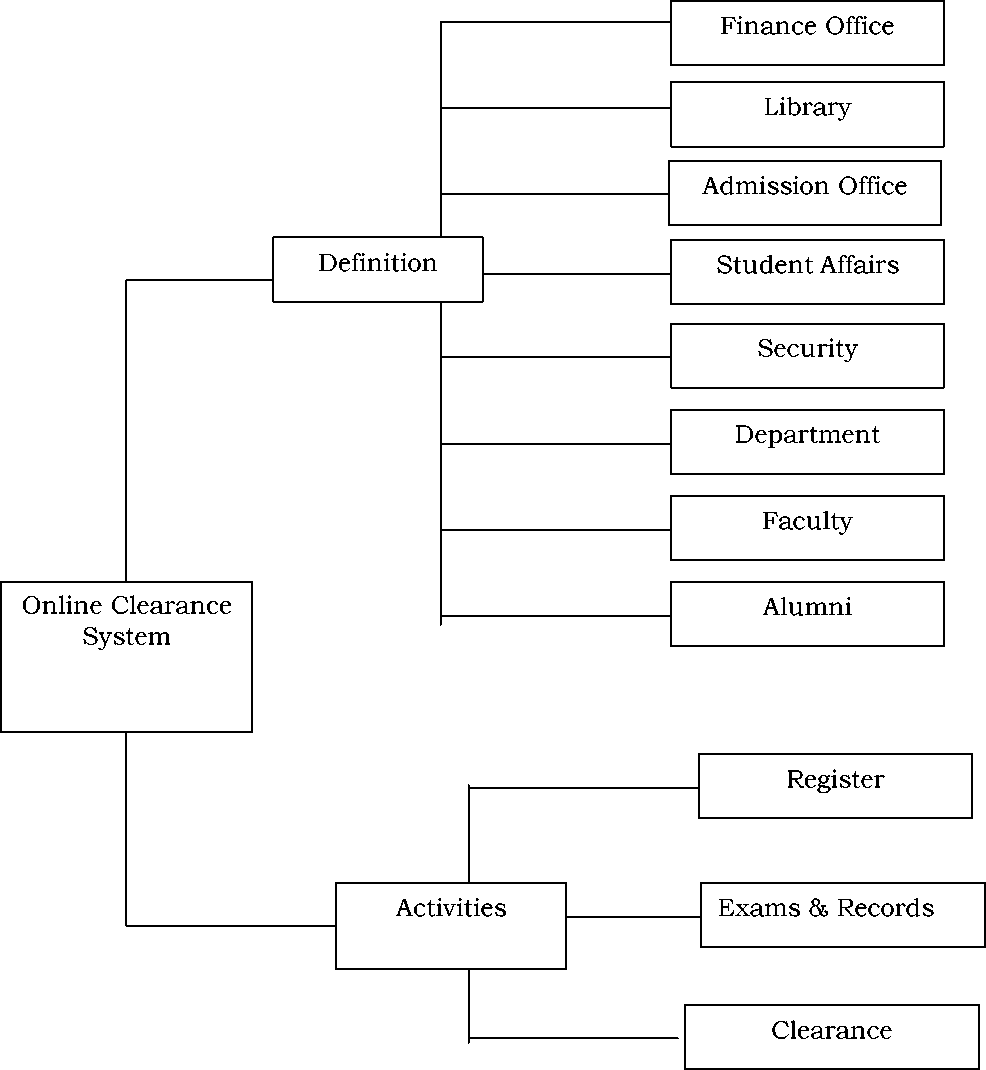
3.2.4Data flow diagram of the present system
The data flow diagram of the present system is shown in Figure 2.
3.3Problems of the present system
During the analysis of the existing transcript information system, some problems inherent in the system were observed. They are listed below:
- Monotonous storage of record.
- Bulkiness and heaviness of files.
- Misplacement of student grade record due to negligence on the part of workers.
- Slow and strenuous retrieval of records and report of students.
- The system is not cost effective.
- Inaccurate diagnosis due to wrong record keeping.
3.4Solution to the problems of the present system
Because of the problems inherent in the existing transcript system, the need for computerization becomes imperative. The benefits are listed below:
- Record and reports of students will be easily retrieved with increased data security.
- There will be reduction in the amount of resources, which in turn will lower the cost of medical service, since information will be stored in a database with reduced data redundancy.
- School personnel can attend to students without being overworked.
- There will be reduction in time used in retrieval of students’ files.
- Reduction in bulkiness of files and records.
- It will make available the storage room that was used for storage of files.
3.5The proposed system
A student transcript plays a crucial role in the process of admissions, evaluating credit and the graduation process. Transcript Management System (TMS) is an initiative undertaken by the department of Exam and Record, to streamline the existing Transcript process flow. This project will help to:
- 1. increase student satisfaction by providing them a real time status of their transcript processing;
- 2. save money (for both students and the university) by eliminating the need to order and process duplicate transcripts; and
- 3. maximize staff productivity by eliminating duplicate processing of transcript.
3.6Justification of the proposed system
A new transcript management system (TMS) will help to eliminate the inconsistent transcript processing flows and provide one flow for all transcripts. The project will overhaul current transcript processing and provide control reports that will help management carefully track transcript processing flows and provide information for student inquiries regarding transcripts they have provided.
3.7Advantages of the proposed system
- Requires less storage space.
- Easy to generate reports.
- Keeps the latest transcripts up to date.
- Allows you to back up records and keep them in a safe place in case of fire or theft.
- Problems with duplicate copies of the same records are generally avoided.
- Effective way to keep records.
4System design
This is the process of designing or building the new system after a detailed study of the objectives of schools. It is the stage in which the researcher actually plans the life cycle of a system and all the work associated with the various stages of the system life cycle. The main aim of this design is to achieve a new system that is better than the old system in terms of efficiency and service with the introduction of a computer aided system. The design will make extensive use of the menu driven approach, which routes program of interest and ensures that the user input is not inconsistent for easy access path information.
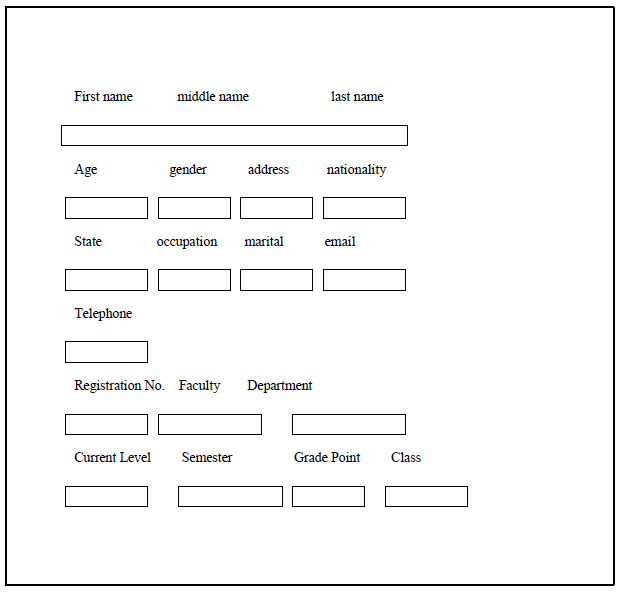
4.1Input design
This involves the steps of the algorithm that was used to design the input of the new system i.e. inputting data into the system (Figure 3).
4.2Output design
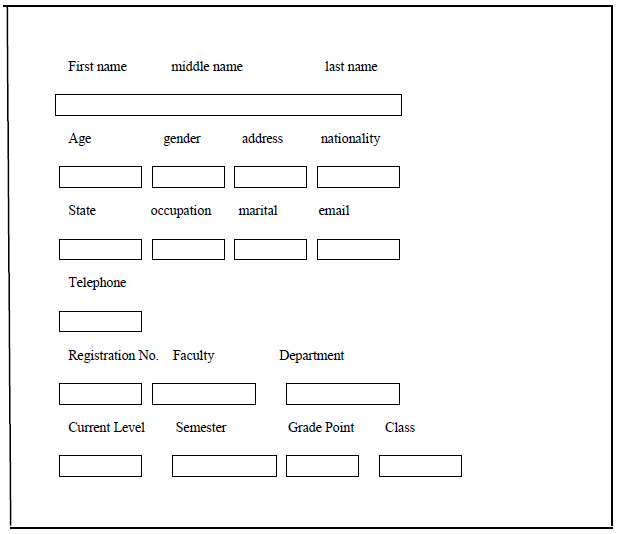
This design brings out the feedback of the result of any input that is being made in the system. The design is shown in just one form (Figure 4).
4.3Processing design
4.3.1Overall system
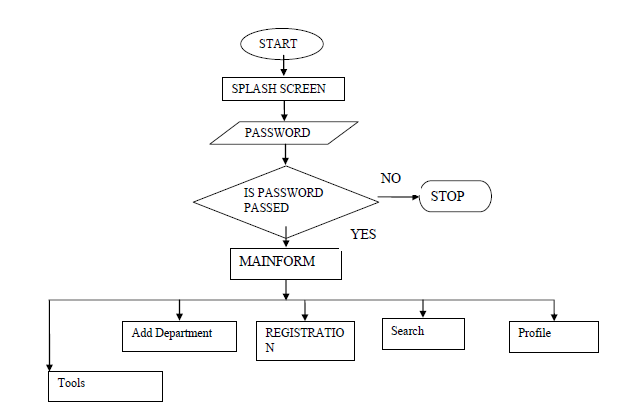
The need for an electronic information management system for the transcript process is of great importance, due to some of the problems that were encountered with the old system. In the course of this research, the author tried to develop a system that will counteract some of these problems, the system was built in Visual Basic.Net, a programming language that was judged best to solve most of the problems that were encountered in the old system. The new system was designed considering the evaluation of already existing process of information processing, the system was not meant to add or remove from the already existing process, but it was meant to improve the way that this information is processed, to enhance speed and accuracy in the system.
The overall system flowchart is shown in Figure 5.
4.3.2Input processing
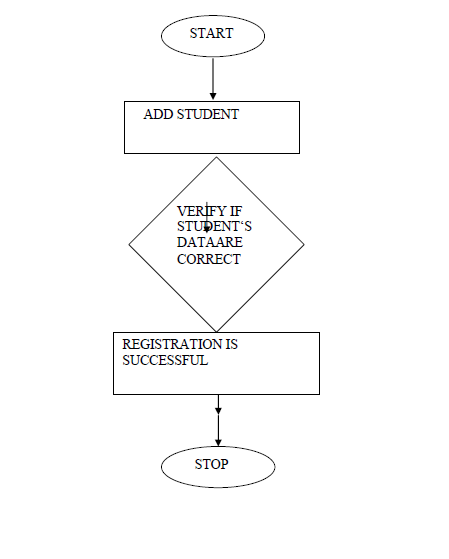
With respect to the input of data, it has to undergo certain degree of data processing before it can give the required output. With this at hand we can conclude that all input in this system needs to be processed.
The flowchart in Figure 6 shows the input processing.
4.3.3Output processing
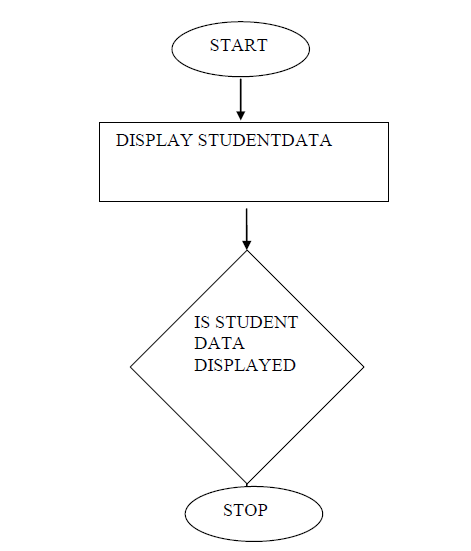
This is what is given out specifically when a particular data that is inputted into the computer are processed, hence for output process to be complete and to take place effectively the input must be fed into the computer for processing to effectively take place.
The flowchart in Figure 7 shows the processing order of the system output.
4.4Database design
This part actually portrays the database file that was used in this program in order to enhance and store information in the program, for this program to work effectively; there are many databases that are used specifically for managing of the information and data of the program.
The databases that are in the program are stipulated below:
- Department and faculty;
- Profile table;
- Semester record; and
- User data.
5System implementation
5.1Language implementation
The need for an electronic information management system is of great importance, due to some of the problems that were encountered with the old system. In the course of this research, the author tried to develop a system that will counteract some of these problems, the system was built in Visual Basic 6.0, a programming language that was judged best to solve most of the problems that were encountered in the old system. The new system was designed considering the evaluation of already existing process of information processing, the system was not meant to add or remove from the already existing process, but it was meant to improve the way that this information is processed.
5.2Input specification
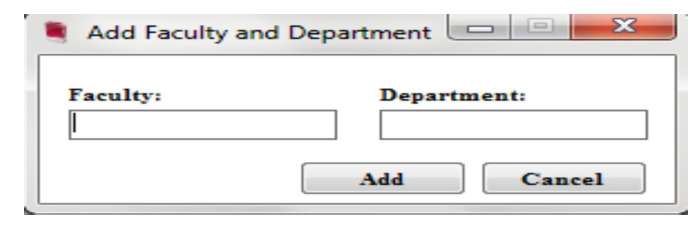
Hence in the input specification of the program, there are many functions that are specifically designed to handle the input processing of the program and ensure that it gets to database at any point in time after processing of the data. Some of the input specifications of this program are Add Department and Registration.
Add department form: This is a form used specifically for addition of new departments to the transcript system, and it also syncs the added departments with other processes (Figure 8).
5.3Output specification
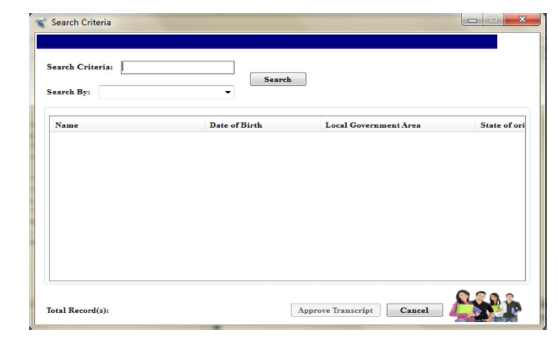
This has to do specifically with those controls and components that are responsible for the view of the result of the data stored in the database after processing, some of the components of the program that portray the output specification are Search, Profile and Approve.
Search form: This tool is designed specifically to enhance the searching capability of the software, and also making the detail clearer for better understanding (Figure 9).
6Summary, conclusion and recommendation
6.1Summary
This project work aimed at changing the way tertiary institutions communicate and exchanges information by: centralizing information environment for administration and academic services and replacing obsolete and time-consuming paper forms with modern electronic forms. The target audience is academic institutions aiming to remain at the forefront of technology by utilizing the most user-friendly and cost-effective pathway to act as an interface between the universities and the students. The main goal was to develop and implement a software-based paperless communication environment for students, faculty and staff. Most academic institutions face mounting technical and fiscal challenges to stay at the forefront of technology. These challenges require the development of technology that is flexible, expandable, easily maintained, and, of course, cost-efficient.
6.2Conclusion
Nowadays computers are used to manage daily works. School management uses computer to process academic assessments. For example, teachers store students’ marks and grades in computer software such as Microsoft Office.
However computers are merely used to store students’ assessments and there is no systematic place for analyzing and turning that data into information and knowledge. Therefore, this transcript System was developed to facilitate administration in managing students’ profile and academic assessments.
Nevertheless, the development and growth of our nation with regard to education mean that the processing of academic transcripts should be made as easy as it is in the United States of America. Academic institutions’ dependence on electronic-based technologies to improve efficiency in class offerings, academic records, and office documentation is increasing at a rapid pace. The resource constraints of most academic institutions require that the technology be flexible, expandable, easily maintained, and cost efficient.
6.3Recommendation
A transcript is a legal document and should be treated as such. But unfortunately, most registrars have found that if someone is determined to forge a transcript, they will find a way.
Listed below are recommendations for drafting transcripts:
- Use a colored ink signature plate, and indicate the color of ink on the plate or in the Key.
- Use a seal that is clear enough to be read and has a design not easily duplicated, such as the institutional emblem.
- Use a type font which cannot be easily reproduced.
- Use special paper, such as “banknote” or “safety weaves” papers, to prevent alterations and unauthorized copies.
- Print important certification statements, seals, headings, etc., in a special light blue ink which cannot be photocopied.
- Mark the envelope in which the transcript is mailed “Official Transcript.”
- Use a photocopier which reduces the type size 25%, thereby making alterations more easily recognizable.
As guidance in detecting possible “phony” transcripts, check that:
- Transcript was sent directly from the Office of the Registrar of the issuing institution.
- Envelope is postmarked in the city where the institution is located.
- Envelope has an institutional meter mark (except foreign) rather than a postage stamp.
- Transcript has a recent date of issue (usually within the last 10 days, except foreign).
- Clarity and authenticity of signature and seal is examined.
- Consistency in type font, format, etc., is checked.
- A file of detected forgeries should be maintained since experience indicates a high frequency of repetition. When discrepancies are detected, communicate directly with the registrar at the issuing institution.
References
- [1]Altbach PG, Teichler U (2001). Internationalisation and exchanges in a globalized university. Journal of Studies in International Education, 5(1), 5–25.
- [2]Attwood R (2008). Independents claim lion’s share of top achievers. Times Higher Education, 1859, 6.
- [3]Battisti F, Portelli A (1994). The apple and the olive tree: Exile, sojourners, and tourism in the university. In: Benmayor R, Skotnes A (eds), Migration and identity. Oxford: Oxford University Press, 35–51.
- [4]Bourdieu P (2009). Outline of a theory of practice. Cambridge: Cambridge University Press.
- [5]Cohen R, Miller MJ (1993). The age of migration. Basingstoke: Macmillan.
- [6]Delahaye JP (1993). Randomness, unpredictability and absence of order. In: Philosophy of probability. Springer, 145–167.
- [7]Elgesem D (1996). Privacy, respect for persons, and risk. New York: State University of New York Press.
- [8]Evangels P (2002). Mastering Visual Basic 6.0 (1st ed.). USA: Symbox Inc.
- [9]Fodor L, Terrell W (1992). What is computer ethics? Educational Media Resources.
- [10]Knuth D (2003). Transcript system. In: The art of computer programming, Vol. 2: Seminumerical algorithms (3rd ed.).
- [11]Kučera A (2000). On the use of diagonally nonrecursive functions. In: Studies in Logic and the Foundations of Mathematics. North-Holland, 219–239.
- [12]Thomas H, et al. (2001). Introduction to algorithms (2nd ed.). MIT Press/McGraw-Hill, 849–905.
- [13]William E, Joseph D (2000). Programming business application with Microsoft Visual Basic 6.0.