Construction Cost-Risk Predictive Analytics
Predictive Cost-Risk Analytics and Construction Supply Chain Resilience for Saudi Giga-Projects: A Framework for Early Warning, Forecasting and Procurement Decision-Making
Published October 2026
Abstract
Saudi Arabia’s giga-project portfolio concentrates exceptional capital, schedule pressure, supplier interdependence and exposure to volatile markets within programmes expected to deliver strategic outcomes under Vision 2030. Conventional cost control and procurement reporting are necessary but often backward-looking: they describe variance after commitments, disruptions or productivity losses have already materialised. This review develops an evidence-informed framework for predictive cost-risk analytics and construction supply chain resilience that shifts management attention towards earlier signals, probabilistic forecasts and procurement interventions. Thirty peer-reviewed sources published from 2020 to 2025 were synthesised across construction cost prediction, cost-risk modelling, digital twins, construction supply chain management, resilience, robust optimisation and Saudi digital transformation. The evidence indicates that useful early warning requires more than a single machine-learning model. It depends on a governed data architecture that connects quantities, schedules, commitments, supplier performance, market indices, logistics events and site progress; combines statistical, machine-learning and scenario-based forecasts; and translates risk states into explicit procurement responses. Supply chain resilience is strengthened when visibility is paired with options such as back-up sourcing, inventory buffers, package resequencing, alternative logistics and contract mechanisms. Digital twins can improve the temporal connection between physical progress, cost exposure and supply conditions, but fragmented data, inconsistent coding, model drift and weak organisational response can undermine technical capability. The review proposes a six-layer Predictive Cost-Risk and Resilient Procurement Framework comprising data integration, baseline intelligence, predictive modelling, early-warning governance, procurement decision support and outcome learning. For Saudi giga-projects, the framework supports earlier intervention, more defensible contingency allocation and more resilient procurement decisions without displacing professional judgement.
Keywords: predictive analytics; construction cost risk; supply chain resilience; giga-projects; procurement; digital twins; machine learning; Saudi Arabia; Vision 2030
1Introduction
Saudi Arabia’s construction transformation under Vision 2030 has created a delivery environment in which projects are larger, more interdependent and more exposed to global procurement conditions than conventional building programmes. Giga-projects combine complex design interfaces, compressed schedules, specialist international suppliers, local-content objectives, remote logistics, changing commodity prices and intense stakeholder scrutiny. Evidence from Saudi construction already shows that cost and time overruns are associated with multiple interacting risks rather than a single estimating error [2, 3]. The managerial problem is therefore not simply to produce a more accurate budget. It is to identify when the assumptions supporting that budget are weakening, quantify the likely cost consequence and provide decision-makers with enough lead time to alter procurement, sequencing or risk allocation.
Traditional project controls are dominated by deterministic baselines, periodic forecasts and variance reports. These tools remain essential for contractual and financial governance, yet they tend to be reactive when the underlying data are fragmented across cost systems, schedules, procurement registers, supplier correspondence, logistics platforms and site records. By the time a material price increase appears as an approved variation or a delayed package shifts the critical path, much of the opportunity for low-cost intervention may have disappeared. Saudi studies on cost deviation and overrun risk similarly emphasise that early-stage factors, procurement arrangements and project-specific uncertainty need to be assessed before adverse outcomes are fully visible [2–4].
Predictive analytics offers a different decision logic. Instead of asking only what has happened against the baseline, predictive cost-risk analytics asks what is likely to happen, with what uncertainty, and which drivers are changing the forecast. Machine-learning research demonstrates that nonlinear relationships among scope, resources, time and environmental variables can improve conceptual cost prediction and support optimisation [5–7]. However, technical accuracy alone is insufficient. Giga-project forecasts are affected by data drift, evolving scope, supplier behaviour, correlated delays and external shocks. A useful model must therefore communicate ranges, confidence and drivers rather than a single point estimate.
The supply chain adds another dimension. Construction supply chains are temporary, project-based networks that combine designers, contractors, manufacturers, logistics providers and specialist vendors. Their vulnerability increases when long-lead materials, concentrated supplier markets or remote delivery routes create single points of failure. Recent construction supply chain studies identify resilience, digital visibility and quantitative modelling as growing priorities [8–14]. Resilience does not mean eliminating uncertainty; it means preserving acceptable delivery performance when disruption occurs. This requires preparation, visibility, response options and learning.
Digital twins and connected project data can link these two agendas. A digital twin is valuable when it maintains a sufficiently current representation of project state and permits scenario analysis, prediction and feedback [15–19]. In construction, twin-enabled applications increasingly support progress monitoring, resource planning, risk analysis and decision-making, while Saudi research highlights both the benefits and implementation barriers of AI-enabled digital twins [1, 20–24]. The central opportunity is to treat the twin not as a visual model but as a data and decision layer connecting cost risk to supply chain conditions.
This review therefore integrates predictive cost analytics, supply chain resilience and procurement decision-making into one framework designed for Saudi giga-projects. It does not assume that algorithms should automate commercial decisions. Instead, it positions analytics as a governed early-warning capability that narrows attention, quantifies exposure and helps procurement teams evaluate feasible responses before cost risk becomes realised loss.
2Aim, objectives and review questions
The aim of this review is to develop a data-driven framework for predicting cost exposure and strengthening construction supply chain resilience in Saudi giga-projects through earlier warning, forecasting and procurement decision support.
Four objectives guide the synthesis. First, the review examines how construction cost and risk forecasting can move from static estimates to dynamic, uncertainty-aware prediction. Second, it identifies supply chain vulnerabilities and resilience strategies that materially affect cost and schedule exposure. Third, it evaluates how digital twins, integrated data and machine learning can improve visibility and scenario analysis across procurement and project controls. Fourth, it translates the evidence into governance principles and an implementation roadmap suitable for Saudi giga-project delivery.
Three research questions structure the analysis. RQ1 asks which project, market and supply chain data are most useful for predictive cost-risk monitoring. RQ2 asks how predictive outputs should be converted into resilient procurement actions. RQ3 asks which governance and learning mechanisms are required so that early-warning models remain reliable, explainable and operationally useful throughout long, evolving programmes.
3Review methodology
A structured integrative review was selected because the topic crosses construction economics, project controls, supply chain management, machine learning, digital twins and procurement governance. The evidence window was restricted to 2020-2025. Peer-reviewed journal articles were prioritised, with emphasis on construction-specific evidence and studies that linked prediction or digitalisation to a practical decision pathway. The Saudi digital-twin study [1] was used as a thematic and structural reference because it identifies local benefits, adoption barriers and the importance of data standardisation, analytics, decision support and implementation capability.
Search concepts combined construction cost prediction, cost risk, cost overrun, machine learning, predictive analytics, construction supply chain, resilience, disruption, procurement, digital twin, Saudi Arabia and giga-project. Studies were retained when they contributed directly to at least one of five themes: cost-risk prediction; construction supply chain resilience; quantitative supply chain modelling; digital-twin-enabled monitoring; or Saudi construction digitalisation. Sources were excluded from the final evidence set when they fell outside 2020-2025, lacked a resolvable DOI, or addressed technology without a credible connection to construction decision-making.
The final synthesis comprised 30 DOI-bearing references. Evidence was coded deductively under data foundation, predictive modelling, resilience strategy, digital-twin integration, procurement action and governance. A second inductive pass identified recurring mechanisms including leading indicators, forecast ranges, threshold design, supplier concentration, back-up sourcing, inventory buffers, alternative logistics, scenario stress testing, model recalibration and human review. Because the literature is heterogeneous in method and outcome definition, the review does not pool effect sizes or claim universal numerical benefits. Instead, it compares mechanisms, implementation conditions and decision implications.
4Cost risk in Saudi giga-project delivery
Cost risk in giga-projects is cumulative. Individual deviations in quantities, productivity, supplier pricing, exchange rates, logistics, design maturity or programme sequencing may appear manageable in isolation but become material when they interact across packages. Saudi research identifies client-related, contractor-related, contractual and project-management factors among the drivers of cost and time overruns [2]. Pre-tender cost deviation research also shows that estimation accuracy is influenced by interacting technical and managerial variables, indicating that risk needs to be represented explicitly rather than hidden inside a single contingency allowance [3].
Early-stage research is particularly relevant because information is limited when major commercial decisions are first made. Neural-network and hybrid estimating studies demonstrate that conceptual cost can be predicted from a smaller set of project descriptors, while cost-risk research shows that contract type, risk-management application, project duration and contract value can become useful early predictors [4–6]. These studies do not eliminate uncertainty; they demonstrate that uncertainty can be structured and modelled rather than treated as an undifferentiated percentage.
For giga-projects, the prediction problem evolves after award. Baseline quantities become committed purchase orders; market assumptions become supplier quotations; design maturity changes; actual productivity and delivery performance create new evidence. A model suitable for the concept stage may therefore become inappropriate during procurement or construction. Predictive cost-risk analytics should be designed as a sequence of models or model states whose inputs and decision horizons change over the project lifecycle.
A useful architecture distinguishes baseline risk from emerging risk. Baseline risk captures uncertainty known when budgets and procurement strategies are established: design maturity, market capacity, contract structure, geographic constraints and package complexity. Emerging risk captures deviations that become visible over time: tender spread, supplier deterioration, delayed approvals, rising commodity indices, low production output, late logistics milestones, abnormal change-order frequency or schedule slippage. The purpose of predictive monitoring is to combine these signals before they are fully reflected in final cost.
Machine-learning methods are attractive because construction cost relationships are nonlinear and contain interactions that conventional regression may not capture. Comparative research has shown strong performance from ensemble methods and gradient-boosted models for construction cost prediction [6, 7]. Yet accuracy metrics such as mean absolute percentage error should not be the only criterion for implementation. Procurement teams also require interpretability, stability under changing data, sensitivity to outliers and a clear relationship between model error and commercial consequence.
Forecasts should therefore be probabilistic where possible. A point forecast of final cost can imply false precision. Decision-makers benefit more from distributions, confidence ranges and scenario bands that reveal whether exposure is concentrated around the baseline or includes a significant adverse tail. This is especially important when major packages have asymmetric risk: a low-probability supply interruption may have modest probability but very high schedule and cost consequence.
Table 1 groups the principal signal families that a giga-project cost-risk model should monitor.
| Signal family | Illustrative data | Primary risk mechanism | Decision use |
|---|---|---|---|
| Project baseline & scope | BOQ quantities, design maturity, package complexity, approved changes | Quantity growth; scope uncertainty; incomplete design | Baseline risk and contingency exposure |
| Cost & commercial | Estimate, commitments, tender spread, payments, variations, cash flow | Budget erosion; price variance; claims exposure | Estimate-at-completion and package escalation |
| Schedule & progress | Critical path, milestone slippage, productivity, earned progress | Time-related preliminaries; resequencing; acceleration | Delay-cost coupling and lead-time warning |
| Procurement & supplier | Capacity, lead time, quality, expediting, delivery reliability | Supplier failure; production delay; concentration risk | Supplier risk scoring and alternative sourcing |
| Market & logistics | Commodity indices, exchange rates, freight, route status, geopolitical signals | Inflation; transport delay; import uncertainty | Scenario stress tests and early purchasing |
| Digital twin & site data | IoT location, equipment status, installed quantities, as-built progress | Mismatch between reported and physical state | Real-time validation and model recalibration |
5Construction supply chain resilience as a cost-control capability
Construction supply chain resilience has moved from a peripheral topic to a core delivery concern. Reviews of construction supply chain management identify resilience, digital integration and closed-loop modelling as important development areas [8, 9]. Empirical work also shows that resilience depends on capabilities such as visibility, resourcefulness and adaptation, not merely on post-disruption recovery [13, 14].
For giga-projects, resilience is economically important because supply disruptions translate into more than purchase-price variance. A late critical component can cause idle labour, resequencing, extended preliminaries, expediting, temporary works, storage changes and downstream claims. Cost-risk analytics should therefore treat supplier reliability, logistics lead time and material availability as financial variables rather than separate operational indicators.
Quantitative resilience research provides several practical mechanisms. Robust optimisation models for construction supply chains show how back-up sourcing, inventory and backordering can reduce exposure to uncertain demand and supplier capacity [10]. Scenario-based models similarly demonstrate the value of identifying back-up suppliers before disruption rather than negotiating alternatives after failure [12]. These strategies have costs. Dual sourcing can reduce volume leverage; buffers tie up cash and storage; alternative logistics may be more expensive. The appropriate decision is consequently risk-adjusted rather than cost-minimising in a deterministic sense.
The value of resilience is most visible when procurement options are compared under scenarios. For a long-lead package, a conventional analysis might select the lowest evaluated tender. A resilience-adjusted analysis would also test supplier capacity, geographic concentration, logistics dependency, substitute availability, production transparency and recovery time. The preferred option may carry a higher initial price but a lower expected disruption cost or a better downside profile.
Saudi Arabia adds local considerations. Blockchain readiness research in the Saudi construction supply chain highlights the importance of transparency, traceability and resilience in increasingly digital supply networks [15]. Giga-project procurement also combines localisation objectives with international sourcing. Localisation can improve responsiveness and domestic capability, but it may also introduce transition risk where supplier maturity or capacity is still developing. Predictive analytics should therefore avoid simplistic assumptions that local or international sourcing is inherently more resilient. The relevant question is which configuration provides the required capacity, quality, lead time, substitutability and recovery options.
Resilience should be measured dynamically. A supplier classified as low risk at award may deteriorate because of workload, cash flow, labour shortages, raw-material availability or geopolitical disruption. Conversely, a supplier initially considered high risk may improve after capacity expansion or local warehousing. Supplier risk scores therefore require periodic updating using delivery adherence, quality performance, production milestones, financial indicators, response times and external market signals.
6Data architecture for predictive early warning
Predictive analytics is constrained by the quality and alignment of its data. Giga-project organisations often possess substantial data volumes but low analytical coherence because systems use different identifiers, coding structures and update cycles. A schedule activity may not map cleanly to a procurement package; a purchase order may not map to the same cost code used in the budget; supplier progress may be reported as narrative text rather than structured milestones. Without integration, sophisticated modelling can amplify inconsistency rather than create intelligence.
The required data foundation should connect six domains. The first is scope and quantity data, including bills of quantities, design maturity and approved changes. The second is cost and commercial data, including estimates, commitments, forecasts, payment status and variation exposure. The third is schedule and progress data, including critical-path logic, production progress and site productivity. The fourth is procurement and supplier data, including tender returns, lead times, capacity, quality, expediting status and delivery reliability. The fifth is external market data, including commodity prices, freight conditions, exchange rates and geopolitical or regulatory changes. The sixth is sensor and digital-twin data where available, including location, equipment status and near-real-time physical progress.
Digital twin research provides a useful conceptual model for connecting physical and digital states. Foundational studies describe the twin as a continuously updated representation that can support prediction, optimisation and decision-making [16, 17]. Construction reviews show growing applications in progress monitoring, logistics, safety, facility management and project controls [18, 19]. The important implication for cost risk is temporal alignment: the model should know not only the latest value but when the value became known and whether it was available to the decision-maker at the forecast date.
This prevents data leakage. A predictive model trained using information that would only become available after the forecast date can appear accurate in testing but fail in operation. All features should therefore be time-stamped and governed according to an “available at prediction” rule. Forecast governance should also document source provenance, refresh frequency, missing-data treatment and transformations.
Saudi research on AI-enabled digital twins identifies data standardisation, IT infrastructure, data quality, skills, privacy and resistance to change as important adoption challenges [1, 20–22]. These barriers are directly relevant to predictive cost analytics. The model cannot compensate for late, inconsistent or strategically manipulated reporting. Data-quality controls should therefore be treated as part of commercial governance, with clear ownership for correcting missing mappings, delayed updates and unexplained outliers.
7Predictive modelling and early-warning logic
A giga-project early-warning system should combine multiple analytical methods rather than rely on one algorithm. Deterministic rules remain useful for explicit conditions such as an overdue fabrication milestone or a tender price exceeding a control threshold. Statistical trend models are useful for detecting deviation from historical behaviour. Machine-learning models can capture nonlinear interactions among cost, time and supply variables. Scenario simulation can then test the consequence of possible disruptions that have not yet occurred.
The analytical output should answer four questions: what is changing, how material could it become, how soon could it affect the project, and what can management still do about it? A high predicted cost variance with no feasible mitigation may require contingency or executive escalation. A moderate variance with several available sourcing options may require immediate procurement action. The same probability can therefore lead to different decisions depending on time-to-impact and controllability.
Thresholds should be governed rather than chosen only for statistical convenience. A model calibrated to maximise overall accuracy may suppress rare but expensive events. For critical packages, management may prefer higher sensitivity and accept more false alerts. Thresholds can also vary by package value, criticality and available response time. A warning should be considered useful when it creates actionable lead time, not merely when it correctly predicts an eventual overrun.
Digital twins strengthen this approach by enabling scenario analysis. Studies show that connected twins can support risk assessment, “what-if” analysis and decision support [1, 19, 23–25]. In a procurement context, scenarios could test the cost and schedule effect of supplier failure, late design release, freight disruption, commodity escalation or accelerated demand. Scenario outputs should not be treated as forecasts of what will happen; they are controlled stress tests showing how vulnerable the current plan is.
Explainability is essential. Commercial teams need to understand whether a risk score is driven by price escalation, poor supplier progress, design changes, critical-path exposure or other factors. Explanations also help identify spurious correlations and data-quality problems. Human review is particularly important where model recommendations could influence supplier treatment, contract strategy or award decisions.
8Procurement decision-making under predicted risk
Predictive analytics creates value only when it changes decisions. Procurement teams require a defined response library that links risk states to feasible interventions. Potential responses include early market engagement, package splitting or consolidation, alternate supplier qualification, framework agreements, buffer inventory, logistics resequencing, revised incoterms, hedging, advance purchase, supplier development, contingency drawdown or contract amendments.
The response should match the risk mechanism. A predicted commodity increase may justify earlier purchasing or price-locking. A capacity warning may justify dual sourcing or reserve production slots. A logistics bottleneck may justify route alternatives, regional warehousing or schedule resequencing. A supplier-performance decline may justify intensified expediting, recovery plans or substitution. Treating all warnings as a request for more contingency would waste the purpose of predictive intelligence.
Procurement decisions should also evaluate option value. Maintaining a prequalified back-up supplier can appear inefficient when the primary supplier performs well, but its value rises sharply when disruption occurs. Robust construction supply chain research demonstrates that the economics of back-up sourcing depend on unit price, transport cost, demand uncertainty and inventory policy [10, 12]. The analytical framework should therefore compare expected cost, downside cost, time-to-recover and strategic constraints rather than initial price alone.
Digital platforms can improve the speed of this analysis. Research on cyber-physical supply chain platforms shows how digital twins and integrated information flows can connect off-site production, logistics and on-site assembly [28]. Construction digital-twin project-management research also identifies procurement and resource management as promising applications [30]. For Saudi giga-projects, the practical objective is an integrated procurement cockpit in which the team can trace each warning to evidence, test alternatives and record the decision rationale.
9Governance, model risk and organisational response
The largest failure mode in early-warning systems is not necessarily inaccurate prediction. It is failure to act. Organisations can possess credible warnings but delay intervention because ownership is unclear, forecasts challenge optimistic narratives, or commercial consequences are politically difficult. Governance should therefore define who receives each class of warning, who validates it, who can authorize mitigation and how unresolved exposure is escalated.
Model governance requires version control, intended-use statements, validation datasets, performance thresholds and recalibration rules. Construction programmes evolve over years, and models can drift as design, suppliers, locations and economic conditions change. A model trained on early packages may not remain calibrated for later specialist systems. Monitoring should include forecast error by package type, calibration of prediction intervals, false-warning rates and subgroup performance.
Data governance is equally important. Supplier information, commercial rates and contract correspondence are sensitive. Access should follow role-based controls and audit trails. Where external data or automated text analysis is used, teams should document source reliability and legal constraints. Cybersecurity becomes part of cost-risk governance because compromised or unavailable project data can itself disrupt decision-making.
Human oversight should be designed into the workflow rather than added as a disclaimer. Professional judgement is needed to interpret abnormal conditions, understand contractual nuance and decide whether risk is genuinely controllable. Saudi research distinguishes supportive from autonomous uses of AI and highlights transparency and trust as important considerations [1]. For high-value procurement, the appropriate model is decision support: algorithms identify patterns and quantify exposure, while accountable professionals make and document the decision.
10Integrated framework for Saudi giga-projects
The proposed Predictive Cost-Risk and Resilient Procurement Framework contains six connected layers. Layer one captures project, market and supply-chain data. Layer two standardises identifiers, aligns time, validates quality and creates a common analytical environment. Layer three generates cost forecasts, risk distributions, supplier-disruption probabilities and scenario tests. Layer four converts these outputs into early-warning states governed by thresholds, confidence bands and materiality. Layer five links each warning to procurement options and escalation pathways. Layer six compares predicted risk with actual cost, delivery and supplier outcomes so that models and policies can be recalibrated.
Figure 1 presents this end-to-end architecture. Figure 2 expands the framework by showing how integrated data, predictive modelling and early-warning intelligence connect to procurement decisions and measurable project outcomes. Both figures emphasise feedback because a static model is unsuitable for a multi-year giga-project.
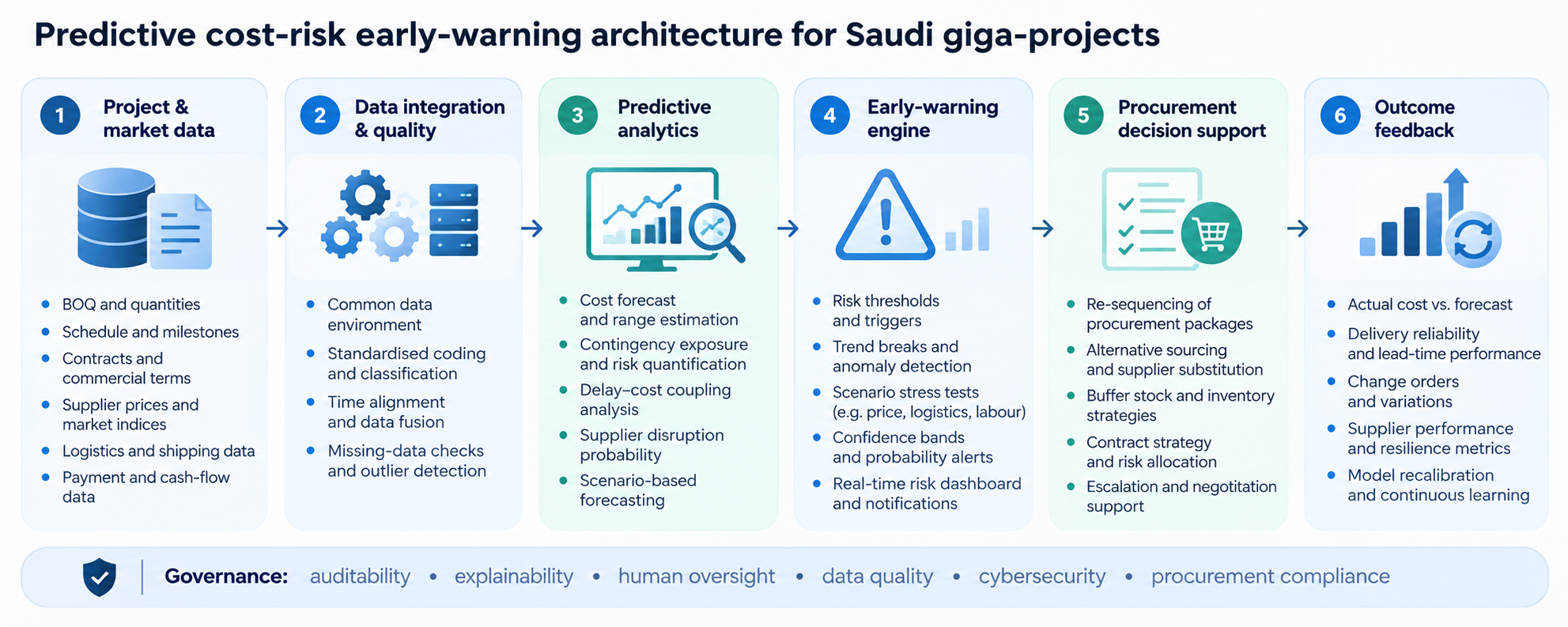
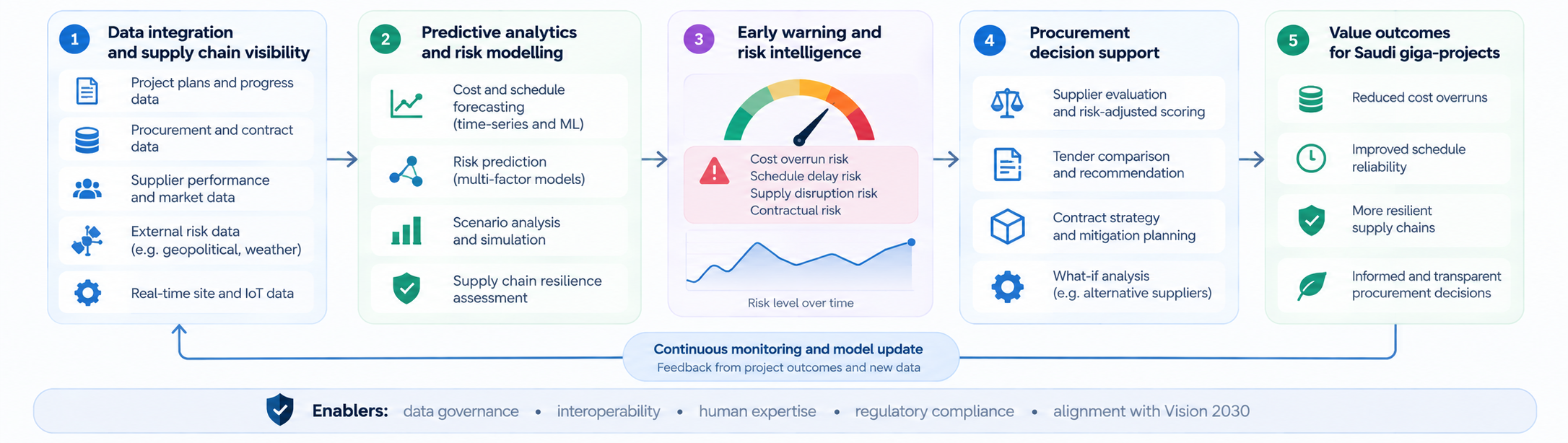
The framework separates prediction from intervention. A model can estimate a 40% probability of package delay, but the commercial response depends on the available mitigation, package criticality and time remaining. A resilient procurement system therefore requires a decision matrix that combines probability, impact, lead time and controllability. Low-probability but catastrophic risks may warrant pre-positioned options, whereas high-probability but low-impact risks may be managed through routine controls.
The framework also separates model uncertainty from project uncertainty. Model uncertainty reflects limitations in data and algorithm performance. Project uncertainty reflects the genuine unpredictability of markets, suppliers and construction conditions. Conflating them can create false confidence. Forecasts should communicate both, particularly when historical data are sparse or the project contains unprecedented technology.
Table 2 translates the framework into governance gates and measurable indicators.
| Gate | Core controls | Primary owner | Illustrative indicators |
|---|---|---|---|
| Data gate | Common codes; provenance; time stamps; missing-data rules; access control | Project controls + data governance | Data freshness; unmapped records; missingness |
| Model gate | Intended use; validation; error bands; calibration; explainability | Analytics lead + commercial owner | Forecast error; calibration; stability; drift |
| Warning gate | Materiality; probability; time-to-impact; package criticality | Project controls / risk committee | Lead time; false-alert rate; unresolved warnings |
| Procurement gate | Response library; option analysis; approvals; documented rationale | Procurement / commercial leadership | Mitigation cycle time; option value; contingency protected |
| Outcome gate | Actual cost; delivery; supplier performance; recovery and lessons | Programme governance | Cost variance; on-time delivery; recovery time; realised mitigation value |
11Implementation roadmap
Implementation should begin with a focused use case rather than an enterprise-wide artificial-intelligence programme. Suitable pilots include long-lead imported equipment, steel or façade packages, modular components, high-value MEP systems or materials exposed to volatile market conditions. The pilot should have a clear financial outcome, a responsible procurement team and enough historical or live data to evaluate whether early warning changes action.
Stage one establishes a common coding structure linking cost accounts, schedule activities, procurement packages and suppliers. Stage two creates descriptive visibility and data-quality controls. Stage three introduces baseline forecasting and simple leading indicators. Stage four adds machine learning or probabilistic models where these improve decision quality beyond transparent rules. Stage five embeds scenarios and response options into procurement governance. Stage six measures realised outcomes and updates thresholds, supplier profiles and models.
Success should be judged using operational metrics as well as predictive accuracy. Useful measures include forecast lead time, percentage of material warnings that trigger action, change in forecast error, contingency consumed, number of avoidable expedite events, supplier on-time delivery, recovery time after disruption and the financial value of mitigations. These indicators help distinguish an analytically impressive model from an operationally valuable system.
Capability development is essential. Saudi research consistently identifies skills, standards and organisational readiness as constraints on advanced construction digitalisation [1, 20, 21]. Project controls specialists need stronger data literacy; data scientists need commercial and contractual understanding; procurement teams need confidence in probabilistic reasoning; and leadership needs governance mechanisms for acting on uncomfortable predictions. Cross-functional teams are therefore more important than isolated analytics units.
12Research priorities
Future research should test integrated cost-risk models on Saudi giga-project data rather than transferring models from smaller, more stable projects without validation. Multicentre or cross-programme studies could compare which leading indicators generalise across infrastructure, buildings and industrial packages. Research should also examine whether combining schedule, procurement and supplier data materially improves prediction compared with cost history alone.
A second priority is causal evaluation of procurement interventions. Predicting disruption is not enough; research should determine whether actions such as dual sourcing, early purchasing or buffer inventory actually reduce total risk-adjusted cost after accounting for their own expense. Robust optimisation provides a useful foundation, but empirical validation in live projects is needed.
A third priority is model governance. Studies should report calibration, drift, confidence intervals and decision consequences rather than only accuracy. Digital-twin and AI research increasingly demonstrates technical feasibility [1, 23–30], but large-project governance requires evidence on trust, override behaviour, data provenance and organisational response.
Finally, Saudi-specific research should examine how localisation, supplier development and national industrial strategy interact with resilience. The strongest long-term outcome may not be the cheapest short-term procurement configuration, but a portfolio that increases domestic capacity while preserving credible alternatives for critical materials and systems.
13Conclusion
Predictive cost-risk analytics can strengthen giga-project delivery when it is treated as a decision capability rather than a forecasting product. The evidence reviewed here shows that construction cost can be modelled using machine learning and risk factors, supply chain resilience can be strengthened through visibility and pre-planned response options, and digital twins can provide a connected environment for monitoring and scenario analysis. None of these elements is sufficient in isolation.
For Saudi giga-projects, the central requirement is integration. Cost, schedule, procurement, supplier, market and site data must be aligned before models can generate trustworthy early warnings. Forecasts must express uncertainty and material drivers. Warnings must connect to specific procurement actions. Decisions must remain accountable to human professionals, and outcomes must feed back into model recalibration and supplier strategy.
The proposed framework therefore links data quality, predictive modelling, early-warning governance, resilient procurement and organisational learning in one closed loop. Its practical value lies in creating time: time to qualify an alternative supplier, adjust inventory, resequence packages, renegotiate commercial terms or protect contingency before disruption becomes irreversible cost. It supports clearer accountability across project controls, commercial, procurement, logistics and executive governance functions. In a Vision 2030 environment where construction scale and interdependence are unusually high, that decision lead time is a strategic form of resilience.
References
- [1]Alnaser AA, Elmousalami H. Benefits and challenges of AI-based digital twin integration in the Saudi Arabian construction industry: a correspondence analysis (CA) approach. Applied Sciences. 2025;15:4675. https://doi.org/10.3390/app15094675
- [2]Alshihri S, Al-Gahtani K, Almohsen A. Risk factors that lead to time and cost overruns of building projects in Saudi Arabia. Buildings. 2022;12:902. https://doi.org/10.3390/buildings12070902
- [3]Alsugair AM. Cost deviation model of construction projects in Saudi Arabia using PLS-SEM. Sustainability. 2022;14:16391. https://doi.org/10.3390/su142416391
- [4]Badawy M, Alqahtani F, Hafez H. Identifying the risk factors affecting the overall cost risk in residential projects at the early stage. Ain Shams Engineering Journal. 2022;13:101586. https://doi.org/10.1016/j.asej.2021.09.013
- [5]Badawy M. A hybrid approach for a cost estimate of residential buildings in Egypt at the early stage. Asian Journal of Civil Engineering. 2020;21:763–774. https://doi.org/10.1007/s42107-020-00237-z
- [6]Elmousalami HH. Comparison of artificial intelligence techniques for project conceptual cost prediction: a case study and comparative analysis. IEEE Transactions on Engineering Management. 2020;68:183–196. https://doi.org/10.1109/TEM.2020.2972078
- [7]Sharma V, Zaki M, Jha KN, Krishnan NMA. Machine learning-aided cost prediction and optimization in construction operations. Engineering, Construction and Architectural Management. 2022;29:1241–1257. https://doi.org/10.1108/ECAM-10-2020-0778
- [8]Liao L, Yang C, Quan L. Construction supply chain management: a systematic literature review and future development. Journal of Cleaner Production. 2023;382:135230. https://doi.org/10.1016/j.jclepro.2022.135230
- [9]Chen Z, Hammad AWA. Mathematical modelling and simulation in construction supply chain management. Automation in Construction. 2023;156:105147. https://doi.org/10.1016/j.autcon.2023.105147
- [10]Chen Z, Hammad AWA, Alyami M. Building construction supply chain resilience under supply and demand uncertainties. Automation in Construction. 2024;158:105190. https://doi.org/10.1016/j.autcon.2023.105190
- [11]Bakhshi S, Ghaffarianhoseini A, Ghaffarianhoseini A, et al. Digital twin applications for overcoming construction supply chain challenges. Automation in Construction. 2024;167:105679. https://doi.org/10.1016/j.autcon.2024.105679
- [12]Badkoubeh M, Ghannadpour SF. Designing a construction supply chain model using backup supplier aiming at optimizing resiliency against disruption. Journal of Civil Engineering and Management. 2024;30:614–631. https://doi.org/10.3846/jcem.2024.21450
- [13]Ekanayake EMAC, Shen G, Kumaraswamy M, Owusu EK, Xue J. Capabilities to withstand vulnerabilities and boost resilience in industrialized construction supply chains: a Hong Kong study. Engineering, Construction and Architectural Management. 2022;29:3809–3829. https://doi.org/10.1108/ECAM-05-2021-0399
- [14]Osunsanmi TO, Aigbavboa CO, Thwala WDD, Molusiwa R. Modelling Construction 4.0 as a vaccine for ensuring construction supply chain resilience amid COVID-19 pandemic. Journal of Engineering, Design and Technology. 2022;20:132–158. https://doi.org/10.1108/JEDT-07-2021-0384
- [15]Al Azmi N, Sweis G, Sweis R, Sammour F. Exploring implementation of blockchain for the supply chain resilience and sustainability of the construction industry in Saudi Arabia. Sustainability. 2022;14:6427. https://doi.org/10.3390/su14116427
- [16]Rasheed A, San O, Kvamsdal T. Digital twin: values, challenges and enablers from a modeling perspective. IEEE Access. 2020;8:21980–22012. https://doi.org/10.1109/ACCESS.2020.2970143
- [17]Fuller A, Fan Z, Day C, Barlow C. Digital twin: enabling technologies, challenges and open research. IEEE Access. 2020;8:108952–108971. https://doi.org/10.1109/ACCESS.2020.2998358
- [18]Shahzad M, Shafiq MT, Douglas D, Kassem M. Digital twins in built environments: an investigation of the characteristics, applications, and challenges. Buildings. 2022;12:120. https://doi.org/10.3390/buildings12020120
- [19]Madubuike OC, Anumba CJ, Khallaf R. A review of digital twin applications in construction. Journal of Information Technology in Construction. 2022;27:145–172. https://doi.org/10.36680/j.itcon.2022.008
- [20]Cheng JCP, Chen W, Chen K, Wang Q. Data-driven predictive maintenance planning framework for MEP components based on BIM and IoT using machine learning algorithms. Automation in Construction. 2020;112:103087. https://doi.org/10.1016/j.autcon.2020.103087
- [21]Zio E, Miqueles L. Digital twins in safety analysis, risk assessment and emergency management. Reliability Engineering & System Safety. 2024;246:110040. https://doi.org/10.1016/j.ress.2024.110040
- [22]Alnaser AA, Ali AH, Elmousalami HH, Elyamany A, Mohamed AG. Assessment framework for BIM-digital twin readiness in the construction industry. Buildings. 2024;14:268. https://doi.org/10.3390/buildings14010268
- [23]Daniel EI, Oshodi OS, Nwankwo N, Emuze FA, Chinyio E. Barriers to the application of digital technologies in construction health and safety: a systematic review. Buildings. 2024;14:2386. https://doi.org/10.3390/buildings14082386
- [24]Piras G, Muzi F, Tiburcio VA. Digital management methodology for building production optimization through digital twin and artificial intelligence integration. Buildings. 2024;14:2110. https://doi.org/10.3390/buildings14072110
- [25]Omrany H, Al-Obaidi KM, Husain A, Ghaffarianhoseini A. Digital twins in the construction industry: a comprehensive review of current implementations, enabling technologies, and future directions. Sustainability. 2023;15:10908. https://doi.org/10.3390/su151410908
- [26]Alnaser AA, Maxi M, Elmousalami H. AI-powered digital twins and Internet of Things for smart cities and sustainable building environment. Applied Sciences. 2024;14:12056. https://doi.org/10.3390/app142412056
- [27]Serugga J. Digital twins and AI decision models: advancing cost modelling in off-site construction. Eng. 2025;6:22. https://doi.org/10.3390/eng6020022
- [28]Yin L, Li T, Li G, Besklubova S, Zhong RY, Zhao S. Cyber-physical Internet based intelligent operation platform for off-site construction supply chain management. Enterprise Information Systems. 2024;18:2346743. https://doi.org/10.1080/17517575.2024.2346743
- [29]Granacher J, Van Nguyen T, Castro-Amoedo R, Maréchal F. Overcoming decision paralysis – a digital twin for decision making in energy system design. Applied Energy. 2022;306:117954. https://doi.org/10.1016/j.apenergy.2021.117954
- [30]Reja VK, Pradeep MS, Varghese K. Digital twins for construction project management (DT-CPM): applications and future research directions. Journal of the Institution of Engineers (India): Series A. 2024;105:793–807. https://doi.org/10.1007/s40030-024-00810-8