Artificial Intelligence
Artificial Intelligence in the Next Decade: Opportunities, Risks, and a Proposed Framework for Human-Centered AI Adoption
Department of Computer Science and Engineering, Malout Institute of Management and Information Technology (MIMIT), Malout, Punjab, India
Published October 2026
Abstract
Artificial Intelligence (AI) has evolved from rule-based systems into technologies capable of learning from data, generating content, understanding natural language, recognizing patterns, and performing increasingly complex tasks. Machine learning, deep learning, generative AI, multimodal AI, and emerging agentic AI are transforming healthcare, education, finance, agriculture, manufacturing, transportation, cybersecurity, business, and scientific research. At the same time, AI creates concerns involving privacy, algorithmic bias, explainability, cybersecurity, employment disruption, misinformation, data dependency, environmental impact, and excessive dependence on automated systems. This paper reviews the opportunities, risks, and future development of AI and proposes a Human-Centered AI Adoption Framework. The framework places data quality, privacy, fairness, security, transparency, human oversight, continuous monitoring, and accountability throughout the AI lifecycle. The central argument is that future AI adoption should strengthen human capabilities rather than remove human responsibility.
Keywords: AI ethics; artificial intelligence; generative AI; human-AI collaboration; responsible AI
1Introduction
Artificial Intelligence has become one of the most influential technologies of the modern digital era. AI enables computer systems to perform tasks traditionally associated with human intelligence, including learning, reasoning, prediction, language understanding, pattern recognition, and decision support. Early AI relied mainly on predefined rules, while modern systems increasingly learn from large datasets using machine learning and deep learning. Generative AI has further expanded this capability by producing text, images, audio, video, and software code.
AI is now used across many sectors. Healthcare applications include medical image analysis, disease prediction, drug discovery, patient monitoring, and clinical decision support. Education uses personalized learning, intelligent tutoring, automated assessment, predictive analytics, and AI-based assistants. Finance, agriculture, manufacturing, transportation, cybersecurity, and business also use AI for prediction, automation, optimization, and anomaly detection. However, the benefits of AI must be considered together with privacy, fairness, security, transparency, unequal access, and overdependence.
The emergence of agentic AI represents an important new direction. Instead of only responding to a prompt, an agentic system may plan, use tools, execute actions, evaluate results, and continue working toward a goal. This increased autonomy creates opportunities for productivity but also raises new requirements for monitoring, access control, accountability, and human intervention.
2Objectives of the study
The objectives of the study are:
- 1. To study the evolution of artificial intelligence.
- 2. To examine major applications of AI across different sectors.
- 3. To identify the major advantages of AI adoption.
- 4. To analyze technological, ethical, social, and economic challenges associated with AI.
- 5. To examine the future development of generative, multimodal, and agentic AI.
- 6. To analyze the importance of human-AI collaboration.
- 7. To propose a human-centered AI adoption framework.
- 8. To identify potential areas for future AI research.
3Research methodology
This paper follows a review-based conceptual research methodology. Existing literature on Artificial Intelligence, AI applications and challenges, human-centered and responsible AI, generative and agentic AI, ethical principles, and governance approaches was examined. The uploaded reference paper on AI applications, challenges, and future directions was also considered. No primary experimental dataset or software implementation was used. The study synthesizes existing knowledge and develops a conceptual framework for responsible AI adoption.
4Evolution of artificial intelligence
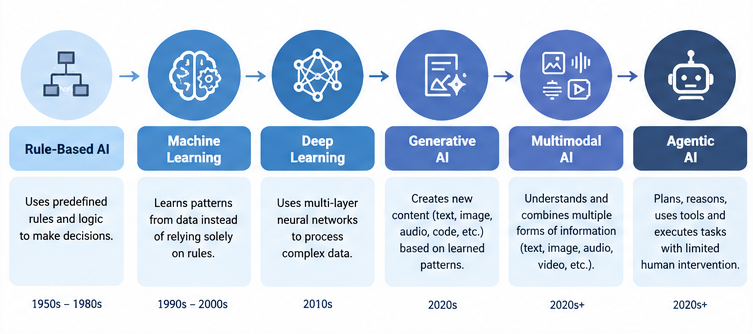
AI has developed through several technological stages. Rule-based AI used predefined instructions such as “IF condition, THEN action” and was effective for well-defined problems but had limited learning ability. Machine learning introduced data-driven pattern learning for classification, regression, recommendation, fraud detection, and predictive analytics. Deep learning uses multilayer neural networks and improved image recognition, speech recognition, natural language processing, medical image analysis, and autonomous systems.
Generative AI introduced the ability to create new content from learned patterns, including text, images, code, audio, and video. Multimodal AI combines information such as text, image, audio, video, and other data. The emerging agentic stage adds planning and action: a system can receive a human goal, plan tasks, use tools, act, evaluate outcomes, and continue when necessary. As autonomy increases, security, accountability, and human oversight become more important. The stages are summarized in Figure 1.
5Major applications of artificial intelligence
The major application areas are shown in Figure 2.
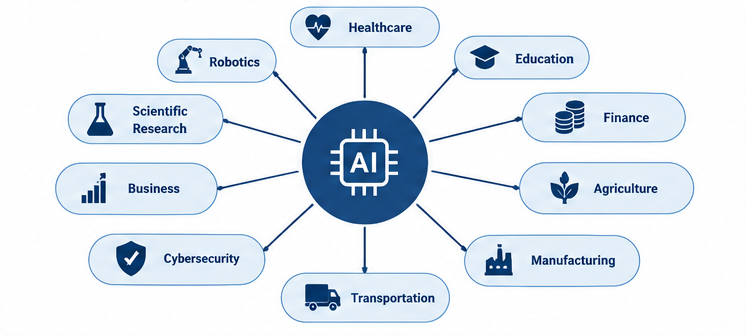
Healthcare: AI supports medical image analysis, disease prediction, drug discovery, patient monitoring, clinical decision support, and personalized treatment analysis. Human clinical responsibility remains essential. Education: AI supports adaptive learning, intelligent tutoring, automated assessment, student performance prediction, learning recommendations, and educational assistants. Finance: applications include fraud detection, credit-risk analysis, market analysis, customer support, forecasting, and transaction monitoring.
Agriculture: AI can assist with crop monitoring, disease identification, weather prediction, irrigation optimization, soil analysis, and yield prediction. Manufacturing: predictive maintenance, quality inspection, industrial robotics, production optimization, and supply-chain management are important uses. Transportation: AI supports traffic prediction, route optimization, driver assistance, autonomous vehicle research, and demand forecasting. Cybersecurity: AI can detect threats, analyze malware, identify anomalies, monitor networks, and support fraud prevention, although AI systems can themselves become attack targets.
Business and customer service use chatbots, recommendation systems, customer-support automation, document processing, sales forecasting, and business analytics. Across these sectors, AI is most valuable when it augments professional judgment and operates within appropriate governance and safety controls.
6Advantages of artificial intelligence
The main advantages are summarized in Figure 3 and listed below.
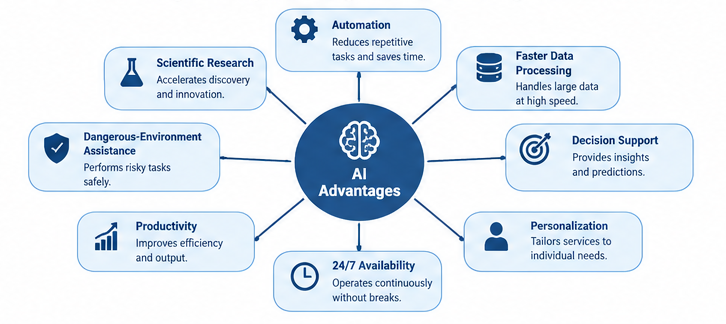
- Automation reduces repetitive and time-consuming work, allowing people to focus on creativity, judgment, communication, and strategy.
- Faster data processing enables large volumes of information to be analyzed quickly, supporting healthcare, finance, research, and cybersecurity.
- Improved decision support allows AI to identify patterns and generate predictions, while significant decisions should remain under responsible human control.
- Personalization enables services such as adaptive education, product recommendations, digital assistants, and healthcare support.
- Continuous availability supports customer service, monitoring, digital assistants, and security operations.
- AI can increase productivity and assist with tasks in dangerous environments such as disaster areas, hazardous industry, deep-sea operations, and some space-related activities.
- Scientific research can benefit from AI-assisted data analysis, pattern discovery, simulation, prediction, and drug discovery.
7Challenges and risks of artificial intelligence
The main challenges and risks are summarized in Figure 4.
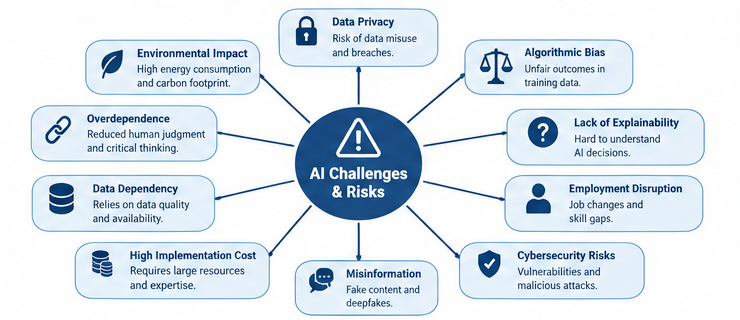
AI systems often require large amounts of data, creating privacy risks when personal or sensitive information is collected, stored, or processed improperly. Algorithmic bias may reproduce or amplify bias in training data, producing unfair outcomes in recruitment, lending, education, healthcare, or law enforcement. Explainability is also important because complex models may produce decisions that users cannot understand or challenge.
AI can transform employment by automating tasks and changing job roles, making reskilling increasingly important. Security risks include data poisoning, prompt injection, model manipulation, unauthorized access, data leakage, and malicious use. Generative AI can also produce realistic but incorrect or misleading content, including misinformation and manipulated media. Advanced systems may require large datasets, computing resources, skilled professionals, infrastructure, and continuous maintenance, creating high implementation costs.
AI performance depends strongly on data quality. Incomplete, outdated, or biased data can produce unreliable results. Excessive dependence on AI may weaken human critical thinking and judgment. Large AI systems can also have environmental costs through energy and hardware requirements. Sustainable AI therefore requires efficient models, efficient hardware, model compression, lower-energy computation, and responsible data-center practices.
8Ethical considerations
- Fairness: AI should avoid unjustified discrimination and should be evaluated for bias.
- Transparency: users should receive meaningful information about AI systems and their use.
- Accountability: organizations should clearly identify responsibility for AI-assisted decisions.
- Privacy: personal information should be collected and processed appropriately.
- Human Oversight: people should be able to monitor, question, and intervene in important decisions.
- Safety and Security: systems should be tested for failures, misuse, vulnerabilities, and attacks.
9Proposed human-centered AI adoption framework
The proposed framework is shown in Figure 5.
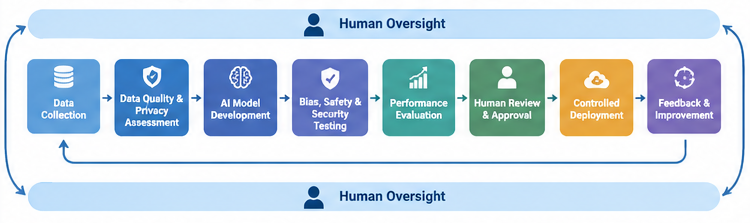
The proposed framework places human responsibility throughout the AI lifecycle rather than adding oversight only after deployment. Stage 1 involves collecting relevant data for the intended application. Stage 2 assesses data quality and privacy, including accuracy, completeness, bias, relevance, and privacy risks. Stage 3 develops or selects an appropriate AI model according to the application and required performance rather than simply choosing the most advanced technology.
Stage 4 tests bias, safety, security vulnerabilities, unexpected behavior, and reliability. Stage 5 evaluates performance using suitable measures before real-world use. Stage 6 requires human expert review and approval, especially for high-impact applications. Stage 7 introduces controlled deployment so system behavior can be observed. Stage 8 establishes continuous monitoring because data, user behavior, threats, and model performance can change. Stage 9 uses feedback and monitoring results to improve the system, creating a continuous cycle: Deploy → Monitor → Evaluate → Improve → Deploy.
10Future scope of artificial intelligence
Expected future directions are shown in Figure 6.
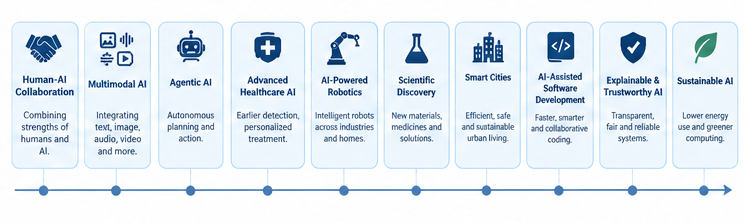
Future AI development is expected to emphasize human-AI collaboration. AI can provide analysis, recommendations, automation, and predictions, while humans contribute judgment, ethics, creativity, context, and accountability. Multimodal systems may combine text, image, audio, video, and sensor data to enable more natural interaction. Healthcare AI may support earlier disease detection, personalized treatment, drug discovery, continuous monitoring, and medical research.
AI-powered robotics may expand into healthcare, industry, agriculture, disaster response, and domestic assistance. AI can assist scientific discovery by identifying new materials, medicines, scientific patterns, engineering solutions, and climate-related solutions. Smart-city applications include traffic management, energy optimization, public safety, waste management, and infrastructure monitoring. AI-assisted software development can support code generation, debugging, testing, documentation, and maintenance, shifting developers toward design, review, testing, and management of AI-assisted work.
Agentic AI may increasingly plan tasks, use multiple tools, coordinate workflows, execute actions, monitor results, and adapt plans. This creates a strong need for access control, monitoring, accountability, and human intervention. Explainable and trustworthy AI will require research on reliability, fairness, safety, transparency, accountability, and human control. Sustainable AI will require improved computational efficiency and reduced environmental impact.
11Discussion and key findings
The analysis shows that AI provides significant opportunities but introduces complex challenges. Its benefits are visible in automation, data analysis, personalization, prediction, productivity, and assistance in difficult environments. These benefits cannot be separated from privacy, bias, explainability, cybersecurity, employment, misinformation, data quality, environmental impact, and overdependence. The transition from predictive AI to generative and agentic AI makes governance more important because newer systems can create content and increasingly perform actions. The key findings are:
- 1. AI has evolved from rule-based systems toward learning, generative, multimodal, and increasingly agentic systems.
- 2. AI provides substantial benefits across healthcare, education, finance, agriculture, manufacturing, transportation, cybersecurity, business, and research.
- 3. Privacy, bias, explainability, cybersecurity, employment disruption, misinformation, and environmental impact remain major challenges.
- 4. Generative AI has expanded AI from prediction and classification toward content creation.
- 5. Agentic AI is creating a transition from assistance toward AI-driven action.
- 6. Greater autonomy requires stronger governance, security, monitoring, and human oversight.
- 7. Human-centered AI provides a balance between technological innovation and human responsibility.
- 8. Continuous monitoring and feedback should be treated as essential parts of AI deployment.
A useful guiding principle is: AI Capability + Human Judgment + Ethical Governance = Responsible AI Adoption. The goal should not be maximum AI autonomy, but an appropriate balance between automation and human control.
12Conclusion
Artificial Intelligence is transforming how individuals, organizations, and societies interact with technology. Its applications range from healthcare and education to finance, agriculture, manufacturing, cybersecurity, scientific research, smart cities, and software development. AI offers automation, faster information processing, personalization, decision support, continuous operation, productivity improvement, and assistance in complex environments. At the same time, it introduces significant concerns involving privacy, bias, explainability, employment, cybersecurity, misinformation, data quality, environmental impact, and excessive dependence.
The future is expected to involve increasingly capable generative, multimodal, and agentic systems. These technologies may provide substantial benefits while increasing the importance of human oversight and governance. The proposed Human-Centered AI Adoption Framework addresses this need through data quality, privacy, model development, testing, human review, controlled deployment, continuous monitoring, and feedback. The central conclusion is that the future of AI should not be viewed simply as humans versus machines. A more useful direction is humans working with intelligent machines, with AI increasing human capabilities while preserving responsibility, autonomy, fairness, safety, and ethical control.
References
- [1]Ali ZA. Artificial intelligence in education: applications, challenges, and future directions – a critical review. International Journal of Ethical AI Application. p. 49–55.
- [2]Zawacki-Richter O, Marín VI, Bond M, Gouverneur F. Systematic review of research on artificial intelligence applications in higher education – where are the educators? International Journal of Educational Technology in Higher Education. 2019;16:39. https://doi.org/10.1186/s41239-019-0171-0
- [3]Luckin R, Holmes W, Griffiths M, Forcier LB. Artificial intelligence in education: promises and implications for teaching and learning.
- [4]Chen L, Chen P, Lin Z. Artificial intelligence in education: a review. IEEE Access. 2020;8:75264–75278. https://doi.org/10.1109/ACCESS.2020.2988510
- [5]Holmes W, Bialik M, Fadel C. Artificial intelligence in education: promises and implications for teaching and learning. Boston: Center for Curriculum Redesign; 2019.
- [6]Kasneci E, et al. ChatGPT for good? On opportunities and challenges of large language models for education. Learning and Individual Differences. 2023;103:102274. https://doi.org/10.1016/j.lindif.2023.102274
- [7]National Institute of Standards and Technology. Artificial intelligence risk management framework (AI RMF 1.0) (NIST AI 100-1). Gaithersburg, MD: NIST; 2023. https://doi.org/10.6028/NIST.AI.100-1
- [8]National Institute of Standards and Technology. Artificial intelligence risk management framework: generative artificial intelligence profile (NIST AI 600-1). Gaithersburg, MD: NIST; 2024. https://doi.org/10.6028/NIST.AI.600-1
- [9]UNESCO. Recommendation on the ethics of artificial intelligence. Paris: UNESCO; 2021.
- [10]Kumar N, Wei X, Zhang H. Agentic artificial intelligence as a new frontier in information systems: promise, peril, and research opportunities. Information & Management. 2026.
- [11]Göbels VP, Fischer-Pressler D, Guhl J, Manca T, Alischer N, Kutz J. Aligning AI with human values: design principles for human-centered AI. Procedia CIRP. 2026.
- [12]Kökciyan N. Enabling responsible AI with humans. Frontiers in Artificial Intelligence. 2026.
- [13]Human-centered AI: advancing ethical, transparent, and context-aware systems for sustainable development. Technology in Society. 2026.
- [14]Responsible artificial intelligence governance: a review and research framework. Journal of Strategic Information Systems. 2025.
- [15]Revisiting the six human-centered artificial intelligence grand challenges in the age of generative AI. International Journal of Human–Computer Interaction. 2026.