Education
Tripartite Arrangement in Human Resource Capability and Collaborative Competence Based: Enhance Action Plan in Public Service and Governance
Cebu Technological University, Main Campus, Cebu City, Philippines
Published October 2026
Abstract
Based on the findings, personnel from DPWH, PNP and DepEd demonstrate a strong human resource capability and collaborative competence, confirming that personnel possess the necessary skills and attitudes to work across agencies. The strongly agree rating on the level of collaborative competence of the personnel proves that better individual and organizational capacities directly lead to more effective inter-agency cooperation. However, issues and concerns were encountered in the harmonization of procedures, joint capacity development and shared resources limit potentials. It is therefore concluded that sustained, quality public service requires not only improving individual competencies but also aligning systems, processes and support mechanisms across agencies. A descriptive quantitative/qualitative research design was used, including a documentary analysis of survey questionnaires and a descriptive survey method, to achieve the overall objective of the study. This study assessed the implementation of the tripartite arrangement in human resource capability and collaborative competence of personnel in the selected government agencies of Mandaue City and Talisay City for the period CY 2026, as a basis for an enhanced action plan for Effective Public Service and Governance.
Keywords: public administration; human resource capability; collaborative competence; descriptive quantitative/qualitative and documentary research methods; DPWH; PNP; DepEd; Region 7; Cebu City; Philippines
1Introduction
1.1Rationale of the study
Global and National context of human resource and collaborative performance and competence stands as two of the most critical pillars of organizational success across sectors worldwide. In an increasingly interconnected and complex operational environment, the capacity of personnel to perform their individual roles effectively, combined with their ability to work synergistically with others, determines the extent to which institutions can deliver on their mandates. The United Nations Department of Economic and Social Affairs (2023) emphasizes that in public administrations and social services systems, workforce competence and collaborative capacity are not merely operational advantages. They are fundamental requirements for advancing sustainable service delivery.
In the Philippine context, this reality is particularly pronounced as the nation pursues its AmBisyon Natin 2040 vision of becoming a prosperous, predominantly middle-class society where no one left behind. Achieving this vision depends heavily on the quality of human resources both in public sectors, military and education system. The Philippine Development plan 2023-2028, explicitly identifies “building a capable, effective, and trusted public service” and “improving the quality and accessibility of education” as top strategic priorities. These goals cannot be realized without a workforce that possess both the technical and functional capabilities to perform their duties, as well as the collaborative competence to align their efforts with colleagues, other agencies, and community stakeholders.
The Civil Service Commission (CSC) of the Philippines has long recognized that human resource capability is the backbone of government service. Its Strategic Framework for the Civil Service (2023-2028) highlights the need to strengthen competency-based recruitment, training and career development to ensure public servants possess the right skills, knowledge and attitudes. Yet capability alone is insufficient. as government programs and educational initiatives become more multi-faceted requiring inputs from multiple units, agencies, and professions – the ability to collaborate effectively emerges an equally vital competency. Many of the country’s persistent challenges, from infrastructure implementation delays under the Department of Public Works and Highways (DPWH), Philippine National Police (PNP) and Department of Education, to learn the gaps in education, have roots not just in individual skills gaps, but in fragmented coordination and poor collaboration practices.
Public Sector and Inter-Agency Context. In public administration, particularly in agencies like DPWH, PNP and DepEd, where fiscal management, administrative compliance, community engagement and human resource capability ensures that designs are sound, budgets are prepared correctly and projects meet quality standards. However, these capabilities only produce desired results when engineers, police officers and DepEd personnel, administrative officers and field staff can collaborate across divisions. Inter-agency initiatives, such as: flood control projects of DPWH, projects of Department of Environmental and Philippine National Police, local government units and other disaster management agencies – demand high levels of collaborative competence to align plans, harmonize resource allocation and avoid duplication efforts.
Despite policy mandates for inter-agency collaboration and cooperation implementation remains a challenge. A 2024 CSC audit noted that while 78% of public sector personnel meet individual competency standards, only 42% demonstrate proficiency in cross-unit or cross agency collaboration. This gaps manifest project delays, budget under utilization or misalignment, conflicting technical requirements, and ultimately substandard public infrastructure and services.
Educational Sector Context – the K to 12 Basic Education sector face ongoing challenges related to learning outcomes, particularly in numeracy and literacy outcomes, as highlighted by the 2022 Programme for International Students Assessment (PISA) results. While efforts have directed at upgrading teacher capability through in-service training and professionalization programs, improvements in learning outcomes have been uneven. Philippine Institute for Development Studies (2023) suggests that even highly capable teachers struggle to maximize their impact when they lack opportunities or skills to collaborate effectively with the people within their environment.
Police Collaboration in Public Service and Education – a very critical dimension of collaborative competences, in application of human resource capability involves working effectively with law enforcement agencies particularly the Philippine National Police (PNP) in both public administration and education sectors, partnerships with police forces are no longer optional, they are essential to address complex challenges that, agencies like at cut across institutional mandates, legal jurisdictions and community interests. In public works administration like DPWH rely heavily on police support for project security, right of way implementation, traffic management during construction and enforcement of regulatory standards.
Therefore, the tripartite collaboration among the DPWH, PNP and DepEd stands as vital operational and strategic alliance that integrates infrastructure development, peace and order and human capital formation – three foundational pillars of community progress. this partnership is not merely administrative cooperation, it is a convergence of mandates that directly shapes public welfare, safety and national development.
1.2Theoretical/conceptual framework
Drawing on the most recent and relevant frameworks from 2021 to 2026, these theories explain the nature, drivers and outcomes of inter agency cooperation, and establish the link between individual professional capacity and collective institutional performance. The framework of the study is shown in Figure 1.
Collaborative Governance theory (Ansell & Gash, 2007; Emerson et al, 2012), builds trust shared understanding and clear communication – directly reflecting collaborative competence which brings multiple agencies together to address shared problems no single one can solve, through shared decision making and joint action.
Collaborative Public Value and New Public Governance (Ansell & Torfing 2021-2025: Osborne 2022). Dominant modern framework, replaces older New Public Management. Core premise: agencies do not deliver value alone - they act as interdependent platforms that co-create public value through shared goals and joint action. Success depends on rational capability and collaborative competence, not just technical compliance or hierarchy. Capability, technical contribution and the competence mastery and knowledge of other agencies mandates and aligning diverse priorities. This theory confirms that memoranda of agreement alone are insufficient, sustainable value emerges only when professionals possess both the capability to contribute and the competence to work across boundaries.
Adaptive Collaborative Governance Theory (Folke et al 2021, Kekez et al, 2022 Ticlau et al, 2025 ). This theory was developed to address the complexity and uncertainty such as natural disasters, post crisis recovery, or shifting development priorities. This theories holds that effective collaboration must be flexible, learning-driven, and iterative rather than rigid or rule bound. It emphasizes the ability to adjust plans in response to changing local conditions. This particularly relevant to Central Visayas where agencies must respond to typhoons, earthquakes, tourism dynamics, and seasonal work schedules. Wherein capability includes analytical judgement, operational agility and knowledge of local risks. Competence involves joint assessment, rapid decision making and mutual adaptation to sustain services and projects amid change. This explains why some partnerships endure crises while in others break down resilience depends on both professional skills and collaborative agility. The study’s necessity is further justified as to its multi- faceted legal approach which triangulate the governance reality in three different offices of the government. Which begins its Constitutional Foundations such as: Collaborative Public Value and New Public Governance (Ansell & Torfing 2021-2025: Osborne 2022). the primary duty of the government is to serve and protect the people that requires integrated action across agencies, Article II, Section 13- stated that it is the duty of the state to defend the right to quality education and promote youth welfare a joint mandate of DepEd, PNP for safety and DPWH for facilities of every school located within the areas of the Philippine soil. Article II, Section 23 – encourages people and sectors in nation building including inter-agency partnership as core governance practice. Article IX-B, Section 3: Civil Service shall be professional, merit based, and responsive basis for Human Resource Capability. Collaborative Public Value and New Public Governance (Ansell & Torfing 2021-2025: Osborne 2022)., established that all agencies shall cooperate and coordinate to achieve national goals to avoid duplication of responsibilities and duties and harmonies all programs of the government. It defines also the powers/functions of DPWH, DepEd and PNP of their duties and responsibilities to collaborate with each other. Civil Service Commission Strategic Framework (2023-2028)– mandates the whole of government approach to harmonize systems, integrate services, and reduce fragmentation. It requires also all agencies to align processes, share info, and work jointly for timely quality results. Civil Service Commission Strategic Framework (2023-2028) – Institutionalize competency and Access to Quality Education Act. mandated the DPWH to construct school buildings in coordination with DepEd and PNP to support for site security in relation with the right of way, traffic management and anti-illegal works. Further, Civil Service Commission Strategic Framework (2023-2028)– mandates adequate facilities and safe schools dependent on tripartite action. This set of collective theories confirms that Human Resource Capability and Collaborative Competence are inseparable and mutually reinforcing.
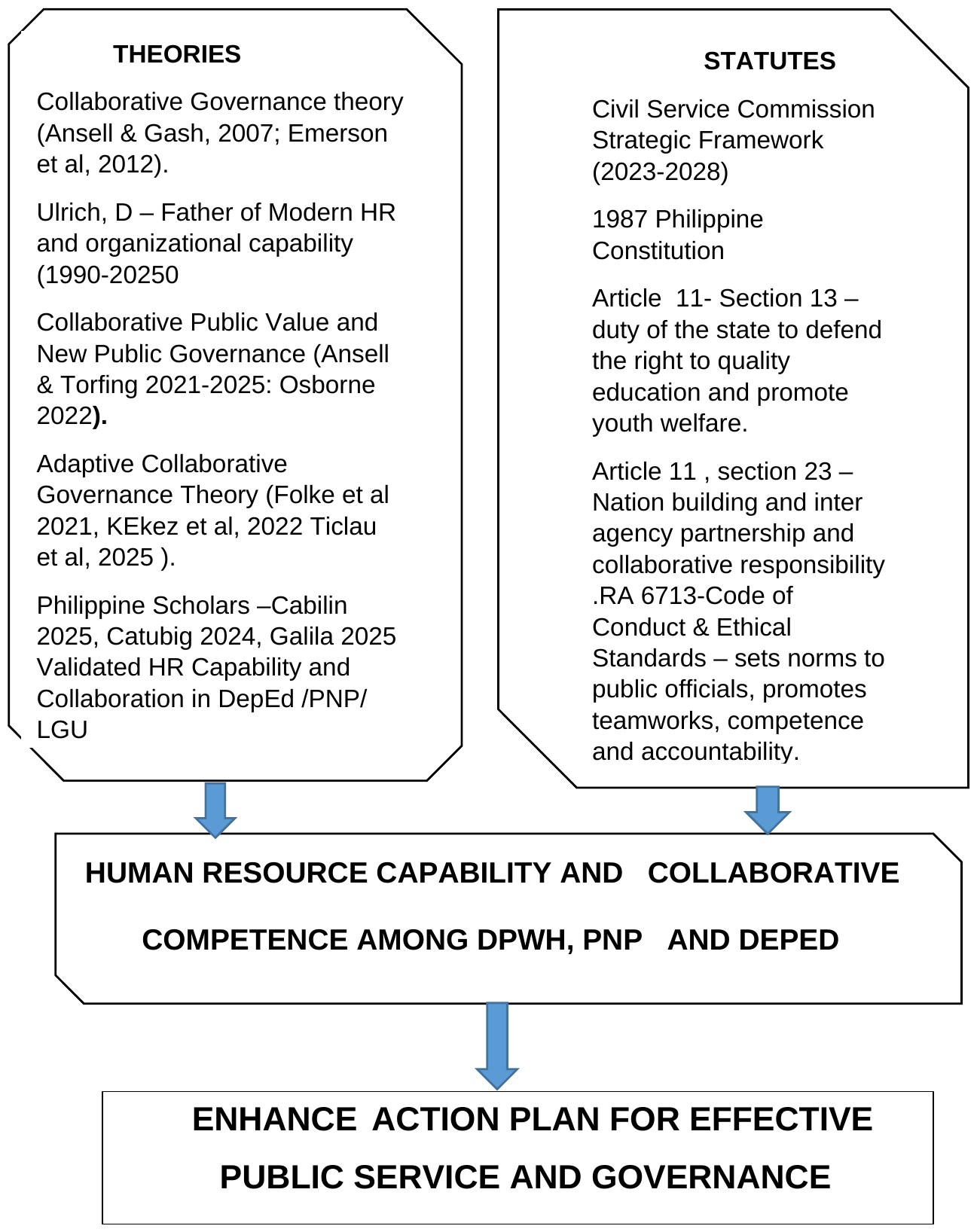
The theory of Philippine Scholars –they have developed indigenous frameworks, localized adaptations and context specific theories that fit the study on HR Capability and Collaborative Competence. Core and Local Theories. V. Enriquez (2025), Considered as the father of Filipino Psychology. Key Idea: pakipag Kapwa, a shared identity, where we are not separate from others. This explains the work of Bayanihan (collaborative and collective work), pakikisama, and pakipag ugnayan – the foundation of genuine collaboration in public service. Ugaddan et al (2026) Barangay Civil Service Competency Framework and Layugan (2024) Local emotional intelligence for public service.
2The problem
2.1Statement of the problem
This research assessed the implementation of Tripartite Arrangement in Human Resource Capability and Collaborative Competence of Personnel from the DPWH, PNP and DepEd in the identified cities in Cebu during the period Calendar Year 2026, as basis for Enhance Action Plan for Effective Public Service and Governance.
Specifically, it sought to answer the following questions:
- 1. What is the professional profile of the respondent groups as to: 1.1 age and gender; 1.2 civil status; 1.3 agency affiliation (DPWH, PNP and DepEd); 1.4 rank/designation; 1.5 length of service; 1.6 highest educational attainment; and 1.7 related training and seminars attended?
- 2. As perceived by the respondent groups, what is the extent of human resource capability of the personnel across the three agencies in terms of partner protocol awareness, joint program implementation, capability building with partners, resource sharing and accessibility, and safe environment planning?
- 3. What is the level of collaborative competence of the personnel working with partner agencies in terms of mutual trust, respect and recognition of each agency’s role and contributions; open, clear communication and responsible exchange of information across agencies; joint planning, harmonization of priorities and alignment of operational goals; and coordinated, adaptive response to changing conditions, emergencies or crises?
- 4. What are the issues and concerns encountered in the implementation of the tripartite partnership, as perceived by the respondents?
- 5. Based on the findings, what enhanced human resource capability and collaborative competence plan towards more effective public service and governance can be structured?
2.2Significance of the study
This study holds substantial value for public administration, governance, and service delivery, particularly in Cebu City. Its findings and outputs will directly benefit the following stakeholders:
- Civil Service Commission (CSC), NEDA and Regional Development Council (RDC7) – Will gain evidence-based insights to refine competency frameworks, inter-agency policies, and professional development standards. This study provides basis to formally integrate collaborative competence alongside technical capability in civil service regulations and performance evaluation systems.
- Local Government Units – will acquire data to strengthen convergence initiatives, resource alignment, and disaster resilience planning across the city/province. Results will guide the local chief executives in harmonizing infrastructure, safety and education priorities.
- Department of Public Works and Highways (DPWH) – Will understand how workforce capabilities and interagency relations impact project delivery, school facility construction and public satisfaction. It will guide the enhancement of technical training, site coordination mechanisms and client relations programs.
- Philippine National Police (PNP) – will obtain direction on strengthening community policing, school safety and infrastructure security partnerships. Findings will help refine training protocols that balance law enforcement with collaborative development goals.
- Department of Education (DepEd) – will identify how facility planning, safety measures and learning environment management can be optimized through stronger ties with infrastructure and security agencies. This supports the delivery of quality education and child protection mandates.
- Institutional Leaders and Personnel – Will be better equipped to assess performance Gaps, design targeted interventions and foster an organizational culture that values both professional excellence and inter-sectoral cooperation.
- Frontliner personnel, Engineers, Police officers and Educators – will gain awareness of their dual roles as technical specialists and collaborative partners. This study will validate their need and advocate for support systems that improved their work and professional relationships.
- Community and Public Welfare – People of Cebu, learners, parents and citizens. Are ultimately beneficiaries. Strengthened tripartite cooperation translates into safer schools, quality infrastructure, secure communities, and efficient used of public funds- directly improving quality of life and advancing development goals.
- Sectoral groups and Stakeholders – Will understand how integrated governance works, encouraging greater participation and trust in government institutions.
- Academe and Future Researchers – this study will serve as reference material and a foundation for further inquiry into human resource management,inter-agency relations, and public service performance in the Philippine setting. It contributes new empirical data specifically on the DPWH, PNP and DepEd convergence model, which remains under-researched, and provides updated theoretical validation for modern collaborative governance practices. Making sure people are competent, equipped and ready to do their jobs well.
3Research methodology
This section presents the research design, locale of the study, respondents, research instrument, data gathering procedures and statistical treatment of upgrading the data employed to systematically assess Human Resource Capability, Collaborative Competence and Tripartite Collaboration Effectiveness among DPWH, PNP and DepEd Mandaue and Talisay City.
3.1Design
This study utilizes the descriptive quantitative/qualitative research design, these include a documentary analysis taken from the survey questionnaires and descriptive survey method to achieve the overall objective in conducting this study. This also involved a common techniques and procedures, followed by a few minutes interview from the research respondents to obtain a sufficient data. The tool to be use in this research is a fact finding with adequate interpretation considering also that qualitative is utilize in acquiring data from personal interview, interrogation and instrumentation by using standard questions that starts with “what, who, where, when, why and how. Also included are the methods, environment, respondents, instruments, procedures and statistical data analysis. Further, also are survey questionnaires administered by purposive sampling to gather data on the Human Resource Capability, Collaborative Competence and Tripartite Collaboration Effectiveness among DPWH, PNP and DepEd in Cebu City. Results of the fact finding investigation conducted would greatly influence the end result of the study.
3.2Flow of the study
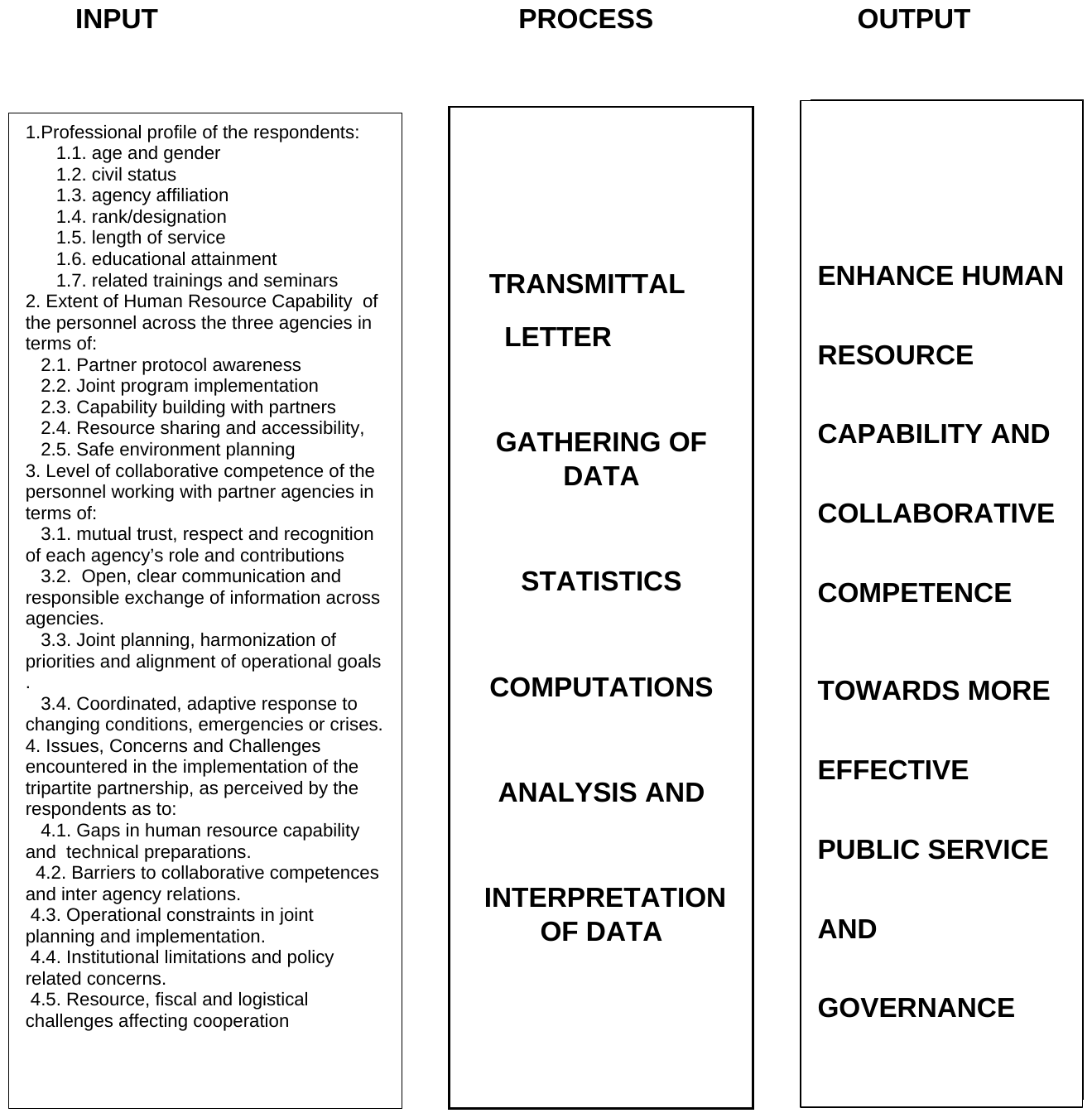
This study includes the INPUT – PROCESS - OUTPUT approach. The Input - provides data on the professional profiles of the respondents in terms of age and gender, civil status, agency affiliation, rank/designation, length of service, educational attainment, related trainings and seminars attended. Also is the extent of Human Resource Capability of the personnel across the three agencies in terms of these dimensions are the following: Partner protocol awareness, Joint program implementation, Capability building with partners, Resource sharing and accessibility, and Safe environment planning. Also were the level of collaborative competence of the personnel working with partner agencies in terms of: Mutual trust, respect and recognition of each agency’s role and contributions, Open, clear communication and responsible exchange of information across agencies, Joint planning, harmonization of priorities, and alignment of operational goals, Coordinated, adaptive response to changing conditions, emergencies or crises. Included also were the issues, concerns and challenges encountered in the implementation of the tripartite partnership, as perceived by the respondents as to: Gaps in human resource capability and technical preparation, Barriers to collaborative competence and inter agency relations, Operational constraints in joint planning and implementation on Institutional limitations and policy related concerns, resource, fiscal, and logistical challenges affecting cooperation. The Process considered were transmittal letter, gathering of data, statistics used, computation, data analysis and interpretation. Output of the study is the Enhance Human Resource Capability and Collaborative Competence toward more effective Public Service and Governance. The flow of the study is shown in Figure 2.
3.3Environment
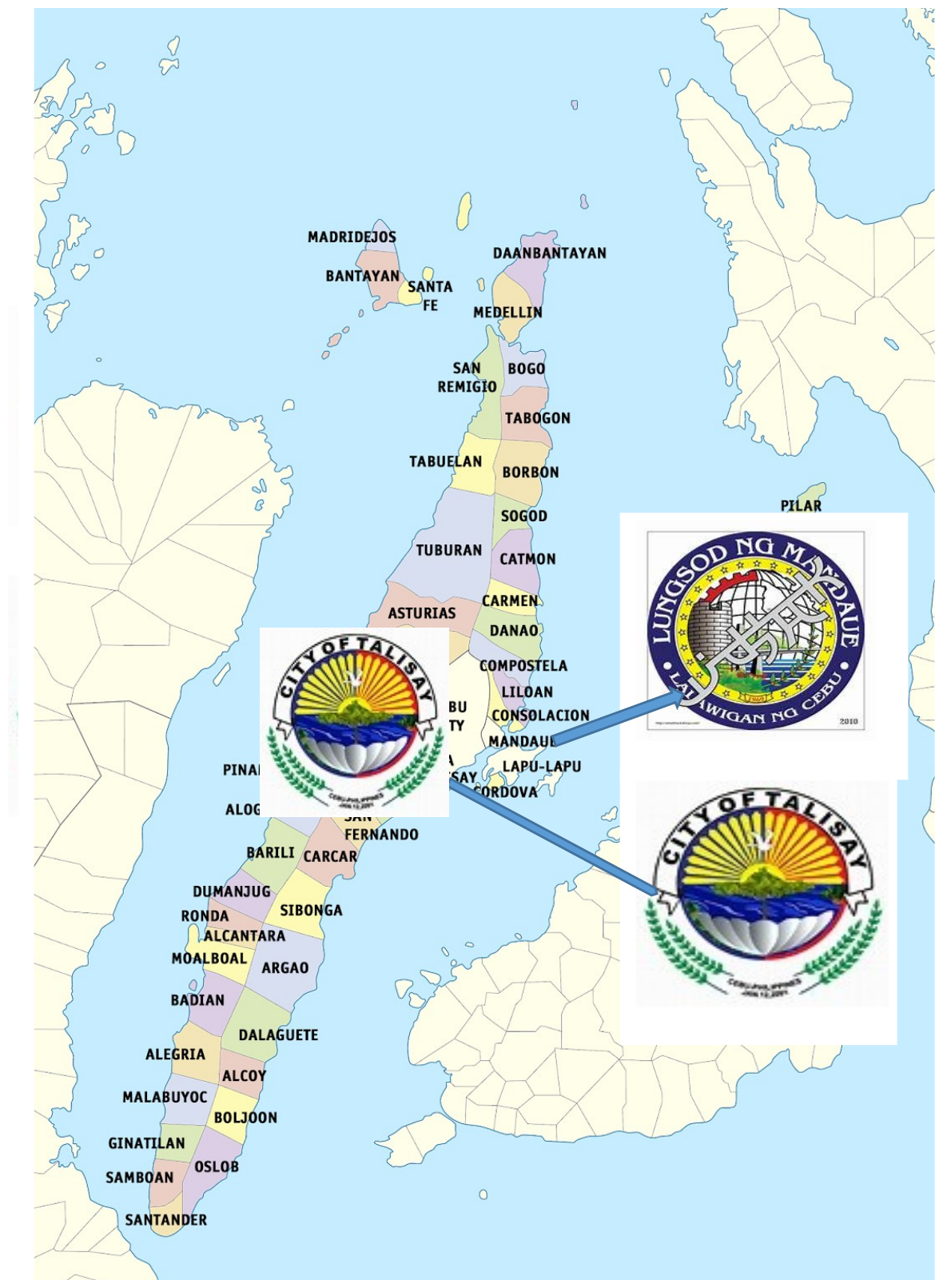
This study will be conducted in the two highly dynamic urban centers in Metro Cebu, the Mandaue City and Talisay City. These areas represent distinct yet interconnected environments where the tripartite collaboration of DPWH, PNP and DepEd operated amid rapid urbanization, economic activity, and evolving community needs. status and setting of Mandaue City. Highly urbanized City (HUC) independent from provincial administration. Area and Population 25.18 km2, 364,482 residents (2024)- dense, compact urban layout. Identity: known as Industrial Hub of Region 7 and Furniture capital of the Philippines, host 10,000+ industries and commercial establishments. It is strategically located between Cebu City and Mactan Island, connected via two bridges- gateway to northern Cebu and the airport. Hence, intense interconnection across boundaries – infrastructure, security and education issues often spills over into neighboring cities, requiring seamless cross agency and cross jurisdiction collaboration.
Whereas, Talisay City is a component city of Cebu Province, applying for highly urbanized city status. With an area of 39.87km2, with a population of 263,832 residents as of 2024, it is also the largest component city in Visayas. As to its identity, it is a major southern gateway to Metro Cebu, mix of residential, commercial, light industrial and coastal communities known for heritage and local culture. The location is bounded by metro Cebu facing Bohol strait, linking Cebu City to southern municipalities. Transition environment shifting from semi-rural to fully high urbanized, creating gaps between fast growing service demands and existing systems, coordination is critical to prevent service backlogs.
These environments presents a distinct operational realities that test Human Resource Capability and Collaborative Competence: Mandaue’s density and industrial intensity require precision and speed; whereas, Talisay’s expansion and transition demands foresights and adaptability.
Both settings validate that effective tripartite action is not just procedural, but must respond to the unique challenges and opportunities of the local landscape. Together these two cities form a continuous development corridor where boundaries and issues often overlap-making tripartite coordination not just beneficial, but essential to address shared mobility, safety, and service challenges across the region. These two cities evolved into economic anchors through strategic geography., historical development, infrastructure and evolving industry. Together forming the industrial and commercial backbone of southern Metro Cebu. Together: the basket of trade and Industry. Linked by national highways and coaster roads, they form an unbroken chain of factories, markets, warehouses, and businesses. Roads, bridges, energy, and port systems both, creating economies of scale that attract investment. So therefore as they say, Mandaue City feeds the world, Talisay City feeds the south, together they connect local production to global markets and provincial communities. The map of the study area is shown in Figure 3.
3.4Respondents
The group of respondents of the study were taken from the two highly urbanized cities of Cebu, the Mandaue City and Talisay City which connects from mainland Cebu to Mactan island via three (3) bridges the Mandaue Mactan Bridge or the Marcelo Fernan Bridge and the CCLEX the newly opened highway bridge connecting Cebu from Talisay City to Mactan island and the first bridge which was constructed during the time of Pres. Ferdinand E. Marcos, Sr sometime in 1968, all link to Domestic and International airport. These composed of personnel from DPWH, PNP and DepEd, Region 7.
The data collected on their professional profiles were segregated according to their age and gender, civil status, agency affiliated, rank/designation, length of service, educational attainment and related trainings and seminars attended. The researchers will distribute the survey questionnaires to the respondents in a snowball manner, it is a non-probability distribution sampling method by giving the questionnaires whom you meet that qualifies your criteria and ask them to refer you whom they know with same qualification, it is like a rolling snowball growing bigger as it goes until you reach your target sample size with no names appear. Subsequently, a random interview will be conducted right after the collection of the survey questionnaires in order to assess the veracity of the personnel as to three main functional areas, such as: Extent of Human Resource Capability of the three agencies, Level of collaborative competence of personnel working with the partner agencies and the issues, concern and challenges encountered in the implementation of the tripartite partnership, as perceived by the respondents, and an Enhance Resource Capability and Collaborative Competence towards more Effective Public Service and Governance as the output of the study.
Table 1 presents the respondents of the study.
| Office concerned | HR officers (M) | HR officers (F) | Personnel (M) | Personnel (F) | Total (f) | % |
|---|---|---|---|---|---|---|
| DPWH Talisay City and Mandaue City | 4 | 7 | 5 | 8 | 24 | 36.36 |
| PNP Talisay City and Mandaue City | 3 | 4 | 5 | 6 | 18 | 27.28 |
| DepEd Talisay and Mandaue City | 4 | 5 | 7 | 8 | 24 | 36.36 |
| Total | 11 | 16 | 17 | 22 | 66 | 100% |
3.5Instruments
The instruments used were the researcher’s self formulated and adopted questionnaires prepared after reading several references such as: journals, magazines, books and other educational and other informative materials supplemented with formal and informal interview. Informal in the sense that the offices given were distributed in a random manner where the respondents were given automatically when they come to the office and who were present during the researchers visit in their respective offices. Formally, when it was distributed during the staff conferences and other formal meetings. This tools gathered the status of the said offices in terms of: First Part is about the professional profile of the respondents in terms of 1.1, age and gender, 1.2. civil status. 1.3 agency affiliation, 1.4 rank/designation, 1.5. length of service. 1.6. educational attainment, and related trainings and seminars attended. Next was the extent of Human Resource Capability of personnel across the three agencies in terms of dimensions as to: 2.1. Partner protocol awareness, 2.2. Joint program implementation, 2.3. capability building with partners, 2.4. resource sharing and accessibility and 2.5. Safe environment planning.
Next was on the Level of Collaborative competence of the personnel working with partner agencies in terms of: 3.1. Mutual trust, respect and recognition of each agency’s role and contributions, 3.2 Open, clear communication and responsible exchange of information across agencies, 3.3. Joint planning, harmonization of priorities, and alignment of operational goals, 3.4. Coordinated, adaptive response to changing conditions, emergencies or crises? On the last part was on the issues, concerns and challenges encountered in the implementation of the tripartite partnership, as perceived by the respondents.
3.6Data gathering procedures
Prior to distribution of the survey questionnaires, the permission to conduct the research will be requested from the Dean of the Graduate School, CTU, main campus and the respective Human Resource Officers of the agency concerned. Once the appropriate permission is granted the researchers fielded the questionnaires to the respondents with the assistance of the human resource officers or administrative officers to accomplish the questionnaires and immediately retrieved after accomplishing except to those who were out of the office during the time of the survey. Data gathered from the questionnaires were tabulated, analyze and interpreted according to the different category of the respondents. A quantitative and qualitative analysis were used through the application of descriptive statistics.
3.7Statistical treatment
When all the pertinent data were collected, complied, tallied and tabulated they were subjected to statistical treatment in order to answer the questions of the study. The statistical methods used in this study were percentage, frequency distribution, and weighted mean. This statistical tools were also used to determined the professional profile such as length of service, highest educational attainment and related trainings and seminars attended.
- Percentage – provides clear, reliable and objective valid analysis and interpretation of the facts data gathered in this study.
- Weighted Mean – respondents perception on the status of legal assistance program provided by the respondent agencies as to its three functional areas using weighted mean. The total weighted scores will be dividing the total number of respondents. The sum of mean scores is divided by the number of items in the questionnaires.
Scoring Procedures –to measure the responses with regards to Human Resource Capability and Collaborative competence among the respondent agencies, was through weights assigned to every respondents response category with corresponding scale range. Further, statistical analysis was measured using the 4 point Likert Scale and computation to determine the status of the Human Resource Capability and Collaborative Competence provided by the concerned organizations, as follows:
- 4 (3.26–4.00), strongly agree: personnel consistently demonstrate strong knowledge, skills and positive working relationships;
- 3 (2.51–3.25), moderately agree: personnel generally possess the needed skills and practise cooperation, though not always consistently;
- 2 (1.76–2.50), less agree: personnel lack the necessary skills or knowledge, or show limited willingness to work together;
- 1 (1.00–1.75), disagree: personnel lack the necessary skills or knowledge, or show limited willingness to work together.
3.8Definition of terms
For better understanding and clarity of the study the following terms are operationally and conceptually define.
- Adaptive Collaborative Governance – An advance governance model that combines multi-stakeholder collaboration with continuous learning and flexible adjustments – so the network can quickly adapt plans, processes and roles when facing changing conditions, risks, or disruptions. It is collaboration that evolves over time, not a fixed on-time agreement. Or a dynamic partnership joint work between LGU, agencies, suppliers, and communities that stays open to new members or shifting roles.
- Capability building with partners – the mutual, continuous process of strengthening knowledge, skills, systems, and competences across all stakeholders LGU, staff, national agencies, suppliers, market groups and communities-through joint learning, training, and experience exchange. It is co-deployment not one sided teaching.
- Collaborative competence – it is the ability and willingness of personnel/units to work together, share resources and align actions towards common goals- across offices, agencies and stakeholders – to achieve shared objectives.
- Collaborative Public Value – shared purpose and collective benefit value created when multiple actors like LGU’s, national agencies, private suppliers, value-co-produce groups, and communities – work together to deliver public goods and services that meet the common welfare needs of the people. It is value co-produced through joint action, not by one agency alone.
- Collaborative Governance – a government approach where multiple-stakeholders, government agencies (local /National) private sectors, civil society organizations, and communities- jointly participate in planning, deciding, implementing, and evaluating public actions to solve a shared problems that no single actor can address alone. The government acts as a facilitator/coordinator, not the sole authority.
- Human Resource Capability – it refers to the collective and individual knowledge, skills, abilities, experience, attributes and potentials of an organization’s personnel that enable them to perform tasks, solve problems, and achieve organizational goals effectively.
- Joint program implementation – the coordinated execution of plans, activities and projects where multiple partners – LGU, national agencies, private organizations, market groups and communities- acts together, share tasks and combine resources to deliver services or achieve common goals, instead of working separately.
- Partner Protocol Awareness – clear understanding and recognition of formal agreements, rules, procedures, roles, and standard agreed upon by all partners (LGU, agencies, suppliers, vendors, communities) involved in collaboration work. It means knowing what is expected to keep cooperation orderly and effective.
- Resource sharing and accessibility – A combined practice of pooling and openly making available manpower, funds, facilities, equipment, information, emergency stocks, and logistics across all partners – so resources can be quickly and equitably used where and when they are needed, without unnecessary barriers.
- Strategic Framework – a clear, structured roadmap or logical model that shows how key elements work together to achieve a specific long-term goal, it links inputs, processes, actions and expected outcomes – serving as a guide for planning implementation and evaluation.
- Safe Environment Planning – the proactive, collaborative process of designing physical, operational and social conditions free from hazards, risks, and disruptions – ensuring secure, stable and reliable spaces/conditions for supply chain operations, personnel and communities. It integrates disaster safety, operational security, and hazard prevention.
- Enhance human resource capability and collaborative competence towards more effective public service and governance – strengthening and upgrading the full capacity of personnel to perform their roles effectively. It goes beyond just skills it includes Technical knowledge, job skills, and professional qualifications. Attitude, work values, and accountability. Systems support, training, tools and resource readiness. Being able to adapt, solve problems and delivery of quality public service. Making sure people are competent, equipped and ready to do their jobs well.
4Presentation of data, analysis and interpretation
This chapter presents the analysis and interpretations of data gathered from the questionnaires administered to the respondents. this portion shows Part 1 is on the personal profile of the respondents as to: age and gender, civil status, agency affiliation: DPWH, PNP and DepEd, rank/designation, length of service, Highest Educational Attainment, related trainings and seminars attended.
Part 2 – is on the Perception of the Respondents as to the extent of Human Resource Capability of the Personnel across the three agencies in terms of these dimensions Partner protocol awareness, Joint program implementation, capability building with partners, resource sharing and accessibility, and safe environment planning.
Part 3 was on the level of collaborative competence of the personnel working with partner agencies in term of: mutual trust, respect and recognition of each agency’s role and contributions, open, clear communications and responsible exchange of information across agencies, joint planning, harmonization of priorities and alignment of operational goals and coordinated, adaptive response to changing conditions, emergencies or crises. Part 4: is on the issues and concerns encountered in the implementation of the tripartite partnership, as perceived by the respondents. Part 5: concerns about the output of the study which was the Collaborative Competence towards more Effective Public Service and Governance.
4.1Professional profile of the respondents
4.1.1Age and gender
| Age | DPWH M | DPWH F | DPWH total | PNP M | PNP F | PNP total | DepEd M | DepEd F | DepEd total | f | % |
|---|---|---|---|---|---|---|---|---|---|---|---|
| 21–30 | 7 | 4 | 11 | 2 | 2 | 4 | 4 | 6 | 10 | 25 | 37.89 |
| 31–40 | 4 | 1 | 5 | 2 | 2 | 4 | 2 | 2 | 4 | 13 | 19.70 |
| 41–50 | 2 | 1 | 3 | 2 | 2 | 4 | 2 | 2 | 4 | 11 | 16.66 |
| 51–60 | 2 | 1 | 3 | 2 | 1 | 3 | 1 | 2 | 3 | 9 | 13.63 |
| 61 and above | 1 | 1 | 2 | 2 | 1 | 3 | 1 | 2 | 3 | 8 | 12.12 |
| Total | 16 | 8 | 24 | 10 | 8 | 18 | 10 | 14 | 24 | 66 | 100% |
Table 2 presents the age and gender of the respondents. The profile of the respondents reveals a predominantly young to middle aged workforce, with 36 males representing 54.55% and 30 females representing 45.45%, reflecting a nearly balanced gender distribution overall, though with agency-specific variations. As to age distribution 21-30 years old is the largest age group, comprising 25 respondents or 37.89%. this indicates that the workforce across the three agencies is dominated by early-career professionals, suggesting a strong infusion of young, energetic and digitally literate personnel who are likely adaptable to new technologies.
On 31-40 years old follows with 13 respondents or 19.70% representing early to mid career staff who bring growing experiences and operational familiarity. The older age brackets of 41–50 (16.66%), 51–60 (13.63%) and 61 and above (12.12%) forming a stable experience core that provides institutional memory, technical expertise and leadership continuity. Collectively, these groups ensure a balance mix of fresh perspectives and seasoned judgement.
4.1.2Gender distribution by agency
- DPWH – 16 males, 8 females (24 total). The higher proportion of males aligns with the historically male dominated nature of infrastructure and engineering work, though female participation remains substantial at 33.33% reflecting growing gender inclusions in technical public service roles.
- PNP – 10 males and 8 females a total of 18. The near parity signals the increasing integration of women in law enforcement and public safety roles, consistent with recent policies promoting gender equality in the uniformed service.
- DepEd – 10 males and 14 females the higher the share al of 24 respondents, females mirrors the well-established reality of the education sector being female majority, reflecting the vital role of women in teaching and educational administration. Implications: for Organization, Management and Policy:
1. Age diversity – Balance Workforce. The dominance of younger employees offers opportunities for innovation, digital adoption and agility, while in the presence of older, experience staff ensures mentorship, knowledge transfer and institutional stability. Programs that foster integrational collaboration will maximize these strengths.
2. Gender Balance – Inclusive Governance. The nearly equal overall gender distribution underscores progress in gender mainstreaming across public agencies. Policies should continue promoting equal opportunities, career advancement and work life-balance to retain and develop talent of all agencies. These demographic characteristics suggest that the respondents are well positioned to engage with modernization, digital governance and process improvement initiatives. The mix of youth and experienced combined with broad gender representation, supports the generalizability and relevance of the study of the current public service workforce.
4.1.3Civil status
| Civil status | Frequency | Percentage |
|---|---|---|
| Single | 24 | 36.37 |
| In a relationship | 8 | 12.12 |
| Married | 30 | 45.45 |
| Widower | 3 | 4.54 |
| Annulled | 1 | 1.52 |
| Total | 66 | 100% |
As shown in Table 3, married respondents form the largest group at 45.45% or 30 respondents, indicating a stable, mature workforce with established careers, reflecting strong institutional commitments and consistent service orientation. Single respondents follow closely at 36.37% or 24 respondents representing younger, adaptable personnel who bring flexibility and readiness for diverse operational duties.Those in a relationship 12.12 %, widowed at 4.54%, and annulled at 1.52% complete the profile, adding diverse life experiences and resilience to the workforce. Implication: the distribution shows a balanced workforce combining stability with agility. Highlighting the need for inclusive, family friendly policies that support work life-balance across all the three agencies. Ultimately, enhancing motivation and service performance. Majority of the respondents are married followed by single- a profile reflecting a mature yet dynamic workforce suitable for reliable, quality public service delivery.
4.1.4Agency affiliation and rank/designation
| Rank | Designation | f | % |
|---|---|---|---|
| DPWH | |||
| District Engineer | Head of District Office overseer of projects, contract implementation, quality compliance … etc | 2 | 3.03 |
| Assistant District Engineer | Assist DE, manages project implementation, site inspections and monitoring | 2 | 3.03 |
| Engineers 1,11,111,1V & V Project Managers | Manages project implementation, site inspections and monitoring, incharge of reporting Lead specific infra projects, monitor timeliness and budget standards | 7 | 10.60 |
| Administrative Officers | Records, procurement supply chain, workflow, and document management | 6 | 9.10 |
| Civil Works | Field inspection, material and compliance verification | 7 | 10.60 |
| Subtotal | 36.36 | ||
| PNP | |||
| Police Colonel & above | Command level, strategic leadership and planner | 2 | 3.03 |
| Police Lieutenant Colonel | Head of Provincial/city level ; Policy and Program managers | 2 | 3.03 |
| P/Major | Head District/ Division level. Incharge in strategic planning and compliance audit | 2 | 3.03 |
| Police Captain | unit Commander, Station Head, program implementation | 4 | 6.07 |
| Police Lieutenant | Junior officer, team command, operations planning | 8 | 12.12 |
| Subtotal | 27.28 | ||
| DepEd | |||
| Education Program Supervisor | Division level, instructional supervisors, quality assurance and standards implementors | 2 | 3.03 |
| Head Teacher/ Education Program Specialist | Department coordinator level, curriculum monitoring and compliance | 4 | 6.06 |
| School Principal 1-1V | Overall managers on policy implementation and resource allocation | 4 | 6.06 |
| Master Teacher 1- V | Mentoring, curriculum leadership, instructional supervision | 5 | 7.58 |
| Teacher 1 – V11 | Instruction delivery, classroom management, assessment, daily operations | 9 | 13.63 |
| Subtotal | 36.36 |
Table 4 presents the distribution of DPWH, PNP and DepEd respondents by rank and designation, reflecting the hierarchical yet operationally focused composition of personnel directly involved in infrastructure delivery, quality, compliance and project governance of the DPWH. On district engineers and assistant district engineers each account for 3.03%, 2 respondents apiece, while the largest group comprises of Engineers 1-V and project engineers at 10.60% for 7 respondents. Collectively, these positions represents the full spectrum of technical and supervisory leadership within the 2 district covered by this study.
The distribution of respondents across leadership, supervisory and technical levels demonstrates a well – represented and balance sample that encompasses the full operational hierarchy of DPWH district offices. All of which are directly involved in the core functions of infrastructure governance, compliance, monitoring and service delivery.This composition strengthens the validity and comprehensiveness of the study’s findings, as it integrates perspectives from policy-makers, overseers and implementer alike.
The PNP sample spans strategic command down to junior operational leadership, reflecting a complete hierarchy from Colonel to major (having 9.09 % combined) provide the strategic, policy, and compliance framework that guides organizational performance. From police captains with 6.07% down to police Lieutenants with 12.12 % which is the largest group from PNP and they represent operational action at the station and unit level, directly overseeing service needs of the community. Their substantial representation ensures the study that it captures both policy intent and on the ground realities, making the findings robust and reflective of actual police service performance.
DepEd samples presents a complete educational leadership and service continuum, from division level, quality assurance, down to classroom instruction. Teachers form the largest group of 13.63% representing the core workforce that directly delivers educational services and experiences operational realities daily. Master teachers has 7.58% provide instructional leadership and mentorship, bridging policy and classroom practice. School principals has 6.06% each which manage institutional implementation, resource allocation and report compliances from central to school level efficiency Education Program Supervisors (SPS) and division level 3.03% ensure alignment with national standards and division level policies. This multi-level representation captures the full educational ecosystem, making the findings relevant to standards implementation, operational efficiency and service quality across all DepEd functional level.
4.1.5Length of service
| Length of service | Frequency | Percentage |
|---|---|---|
| 5 years and below | 12 | 18.18 |
| 6–10 years | 10 | 15.15 |
| 11–15 years | 14 | 21.21 |
| 16–20 years | 23 | 34.85 |
| 21 years and above | 7 | 10.61 |
| Total | 66 | 100 |
Table 5 shows that the largest group is 16–20 years in service, at 34.85% or 23 respondents, followed by 11-15 years at 21.21% or 14 respondents, together forming a majority at 56.06%. this shows a highly experienced, seasoned workforce will deep institutional knowledge, mastery of processes and strong adherence to standards-critical for compliance, quality assurance and operational continuity. 5 years and below at 18.18% and 6-10 years or 15.15 % represent newer personnel who bring fresh perspectives and modern practices, while 21 years and above at 10.61% add, leadership and long term wisdom.
Implication: The distribution reflects a well-balanced workforce blending seasoned expertise with emerging talent. This mix supports knowledge transfer, sustained quality and continuous improvement across DPWH, PNP and DepEd – ideal for effective, forward looking public service delivery. Most respondents have 11-20 years of service indicating mature, experienced workforce complemented by newer and veteran personnel. A profile that ensures both reliability and innovation in public service.
4.1.6Educational attainment
| Educational attainment | Frequency | Percentage |
|---|---|---|
| Graduate Studies | 14 | 21.21 |
| Bachelor’s Degree | 37 | 56.06 |
| Non-bachelor’s Degree (Technical and Non- Technical) | 15 | 22.73 |
| Total | 66 | 100 |
As shown in Table 6, bachelor’s degree holders form the majority at 56.06 % or 37 respondents reflecting a highly qualified, professionally grounded workforce with the foundational academic preparation needed for technical, administrative and leadership roles across DPWH, PNP and DepEd. Graduate studies completers follow at 21.21% or 14 respondents, indicating a significant segment with advance expertise, specialized knowledge and research / analytical capacity – key for policy making quality assurance and strategic decision making. Non- Bachelor’s degree personnel at 22.73% or 15 respondents bring essential technical skills, operational proficiency and hands on experience particularly valuable in field work, inspection and frontline services.
Implication: Profile shows a well-educated, multi skilled workforce that balances advanced academic training with practical technical competence – a strong foundation for high-quality service, evidence based governance and continuous improvement in public service. Most respondents hold a Bachelor’s degree with over one-fifth having graduated education and nearly one quarter possessing technical qualifications. An educated, capable workforce well-equipped to deliver effective public service.
4.1.7Related training and seminars attended
| Training/seminar | Frequency | Percentage |
|---|---|---|
| Public Service Values Program (PSVP) Public Service Ethics, Accountability and Organizational Commitments | 30 | 14.15 |
| Competency Based Human Resource Management System (CBHRMS) Competency modelling profiling, and standards alignment | 25 | 11.79 |
| ORAOHRA Updates- Omnibus Rules on Appointment and HR actions, HR Policy compliance | 27 | 12.74 |
| Results-Based Performance Management System (RPMS) Performance planning, monitoring and evaluation | 18 | 8.49 |
| Digital Leadership Program (DiLP) Digital readiness and e-governance capacity | 12 | 5.66 |
| Leadership and Management Development Program (LMDP) Strategic thinking decision-making, people management | 9 | 4.25 |
| Team Building and Collaborative Problem Solving - Trust building, conflict resolution, collective and decision making | 32 | 15.09 |
| Effective Communication and Negotiation Skills -Resolution frameworks, constructive feedback, collaborative solutions | 9 | 4.25 |
| Conflict Management and Grievance Handling - Resolution frameworks, constructive feedback, collaborative solutions | 22 | 10.37 |
| Customer-First Service Excellence - Internal and External client focus, teamwork in public service | 28 | 13.21 |
| Total | 212 | 100 |
Table 7 presents the distribution of HR Capability and Collaborative Competence training attended by the 66 respondents, covering core public service values, HR systems, leadership, teamwork, and service excellence. The key findings were collaborative competencies were the most attended such as: Team Building and Collaborative Problem Solving rated at 15.09% or 32 times incurred rated highest among all trainings. This reflect a strong organizational focus on trust building, conflict resolution and collective decision making which is the foundation to effective teamwork and inter agency cooperation.
Customer-First Service Excellence which is rated at 13.21 or 28, demonstrates commitment to quality service delivery, client orientation, and internal-external stakeholder engagement across all three agencies. Conflict Management and Grievance Handling which rated at 10.37 or 22 times most attended seminar. Next is Conflict Management and Grievance Handling got a significant rate of 10.37% or has 22 attendees, this indicates preparedness to address workplace issues fairly and collaboratively, directly supporting operational harmony and grievance readiness. Another was Human Resource Capability - with a Strong Foundation on Public Service Values Program/PSVP rated at 14.15% or 30, high attendance underscores shared grounding in ethics, accountability and public service mission, shaping professional behavior and institutional integrity. ORAOHRA Updates rated at 12.74% or 27, reflects familiarity with HR policies, rules, and compliance standards, essential for consistent and transparent personnel management. Next was on Competency Based HR Management/ CBHRMS rated at 11.79 or 25, shows awareness of competency frameworks and standards alignment, linking personnel qualifications to role requirements and organizational goals.
4.2Extent of human resource capability of the personnel across the three agencies, as perceived by the respondents
This part of the study discusses the extent of Human Resource Capability and Collaborative Competence of Personnel from DPWH, PNP and DepEd as to partner protocol awareness, joint program implementation, capability building with partners, resource sharing and accessibility, safe environment planning and coordinated, adaptive response to changing conditions, emergencies or crises.
| Partner protocol awareness | AWM | DE |
|---|---|---|
| Fully familiar with all the memoranda of agreement (MOA’s) and partnership rules between agencies concerned? | 3.22 | A |
| Clearly understand the specific roles, duties and limits when working with the collaborative agency partners | 2.48 | MA |
| Everybody knows the proper steps for coordinating, reporting, and communicating with counter parts from other agencies? | 2.65 | A |
| Aware of agreed standards for coordinating, reporting, and communicating with counerparts from other agencies? | 2.56 | A |
| Knows the correct protocols for raising concerns or resolving issues and concerns in joint activities? | 3.35 | SA |
| Total | 2.85 | A |
Legend: 4 = 3.26–4.00, SA (strongly agree); 3 = 2.51–3.25, MA (moderately agree); 2 = 1.76–2.50, A (agree); 1 = 1.00–1.75, LA (less agree). AWM = average weighted mean; DE = descriptive equivalent.
Table 8 shows that respondents most agree on escalation and issue-resolution protocols in joint activities. This suggests that operational problem-solving mechanism are more visible and frequently used than formal partnership agreements or role definitions a practical strength that can be built upon. Collectively, Partner Protocol Awareness is rated Agree. Personnel are most aware of issue resolution protocols, but show limited understanding of partner agency role and boundaries, the weakest area. Knowledge of formal MOA’s, coordination procedures, and standards falls at an Agree level. This indicates that while personnel can address operational concerns, they lack a comprehensive grasp of the formal institutional framework governing tripartite collaboration. This implies that, the extent of partner protocol agreement among DPWH, PNP and DepEd personnel is moderately Agree. While respondents demonstrate adequate knowledge of issue-resolution protocols, awareness of formal MOAs, coordination standards, and especially the partner agency roles remains limited. This suggests the need for systematic information dissemination and cross agency orientations to strengthen the institutional foundation of the tripartite collaboration.
| Items | AWM | DE |
|---|---|---|
| Actions are properly aligns with agency’s tasks and schedules with the activities of partner agencies | 2.72 | MA |
| Actively participated in planning, carrying out, and monitoring joint programs with other agencies | 2.84 | MA |
| Clearly understand how each work contribute to the common goals of inter agency projects | 3.27 | SA |
| Everyone adjust list work methods to meet the requirements of collaborative operations? | 2.25 | A |
| Can be able to prepare and submit the required reports and outputs for join activities on time ? | 2.48 | MA |
| Total | 2.71 | MA |
Legend: 4 = 3.26–4.00, SA (strongly agree); 3 = 2.51–3.25, MA (moderately agree); 2 = 1.76–2.50, A (agree); 1 = 1.00–1.75, LA (less agree). AWM = average weighted mean; DE = descriptive equivalent.
Table 9 presents the extent of joint program implementation across DPWH, PNP and DepEd, yielding an overall AWM of 2.71, interpreted as Moderately Agree (MA). This means personnel generally recognize the value of joint work but practice it only to a limited degree- consistent, full collaboration is not yet established.Item 3 rated at AWM of 3.27 Strongly Agree on Clearly understand how each work contributes to the common goals of inter-agency projects. Personnel have a clear, strong grasp of shared objectives and how each agency’s role advances collective outcomes. This showed a high awareness and alignment of purpose, a solid foundation for effective tripartite work.
Item 4- has the lowest AWM of 2.25 as Agree that everyone adjusts its work methods to meet the requirements of collaborative operations. This falls in the Agree range, indicating limited practice. Personnel generally see the need to adapt but lack consistent willingness, skills or systems to modify workflows for partner agencies rigid internal procedures remain a key barrier. Other indicators: Active participation in planning implementation, monitoring resulted to 2.84 Moderately Agree, this involvement is acknowledge but irregular. Item1- alignment of tasks and schedules with partners at 2.72 Moderately Agree that some coordination occurs but full synchronization is rare. Item 5 - timely submission of joint reports at 2.48 -Agree -near the lower range; delays or incomplete outputs signal gaps in accountability and shared reporting systems.
Implications: the pattern is clear: Understanding is strong, but execution lags. Personnel know they should collaborate on goals, they strongly agree on, yet they still doing it, adjusting methods, aligning schedules, submitting reports remains limited. The 2.25 and 2.48 ratings reflect gaps in the necessary skills, confidence, or willingness to integrate operations fully. But they must synchronize and build a consistent mechanisms for synchronization for planning and accountability.
| Items | AWM | DE |
|---|---|---|
| Actively attended joint trainings, workshops or drills held together with personnel from other agencies? | 2.23 | A |
| willingness to share agency’s knowledge and best practices with the partner counterparts? | 3.52 | SA |
| Can easily adopt useful skills or approaches learned from DPWH, PNP and DepEd partners? | 3.26 | SA |
| Can apply what had learned from joint activities to improve the performance in collaborative work? | 3.21 | MA |
| Supportive efforts to fill common skills gaps among personnel across the three agencies? | 2.79 | MA |
| Total | 3.002 | MA |
Legend: 4 = 3.26–4.00, SA (strongly agree); 3 = 2.51–3.25, MA (moderately agree); 2 = 1.76–2.50, A (agree); 1 = 1.00–1.75, LA (less agree). AWM = average weighted mean; DE = descriptive equivalent.
Table 10 assesses joint capacity development practices across DPWH, PNP and DepEd, yielding an overall AWM of 3.002 described as Moderately Agree (MA). This means personnel generally support shared learning but actual participation and consistent implementation remain limited. Item 2 has a highest rating of AWM 3.52 or Strongly Agree, the willingness to share agency’s knowledge and best practices with the partner counterparts. Personnel demonstrate strong openness and positive attitude towards exchanging expertise. This reflects a high collaborative spirit, agencies are ready to contribute and learn from one another, serving as a vital foundation. Lowest rating was from item 1 with AWM of 2.23, as Agree. Actively attended joint trainings, workshops or drills held together with personnel from other agencies. This falls in the Agree range, indicating limited practice. Despite strong willingness to share, personnel lack sufficient opportunities, mechanisms or organized activities for joint training participation. Actual cross-agency learning events are few and poorly attended. Other indicators are all moderately agree. Item 3 -3.26, Adopting skills approaches from partners is exactly at the threshold of Strong Agree. Personnel can readily integrate new methods when exposed to them.
Item 4, which has AWM of 3.21 applying lessons to improve collaborative work, learned knowledge translates to better performance, showing practical value of shared learning. Item 5, with an AWM of 2.79, Supporting efforts to fill common skills gaps, moderately commitment, collective competency building is recognized but not systematically pursued.
Implications: the findings reveal a clear attitude action activities is low (Agree). Personnel are not lacking in motivation- rather, they lack organized, regular joint training programs, inter agency workshops and shared competency initiatives. Without structured opportunities, positive intent cannot translate to enhance collective capability. The three agencies must be institutionalize scheduled joint capacity building events, cross agency learning exchanges and coordinated skills development plans turning willingness into tangible, consistent competence.
| Items | AWM | DE |
|---|---|---|
| Knows exactly what resources (information, equipment facilities and man power) thus, agencies can share with partners ? | 2.35 | A |
| Can follow the agreed process when asking for or providing resources for joint work ? | 1.75 | LA |
| Ensure that shared resources are used properly and returned as agreed? | 1.74 | LA |
| Help avoid unnecessary delays when requesting or releasing shared resources? | 2.83 | MA |
| Budgetary or logistical support is shared or coordinated among agencies to sustain joint programs? | 1.98 | A |
| Total | 2.13 | A |
Legend: 4 = 3.26–4.00, SA (strongly agree); 3 = 2.51–3.25, MA (moderately agree); 2 = 1.76–2.50, A (agree); 1 = 1.00–1.75, LA (less agree). AWM = average weighted mean; DE = descriptive equivalent.
Table 11 presents the extent of resource sharing and accessibility among DPWH, PNP and DepEd, yielding an overall AWM of 2.13 described as Agree (1.76 - 2.50).This indicates that sharing of information, facilities, manpower, budget, and other resources is limited and not systematically practiced across the three agencies. Highest rating was on item 4 with AWM of 2.83 Moderately Agree. This is on “Help Avoid unnecessary delays when requesting or releasing shared resources”, Personnel demonstrate reasonable effort to process or provide resources promptly when needed this shows willingness to facilitate smooth coordination a positive trait that can be built upon. Item 3- with a rating of AWM of 1.74 “Ensure that shared resources are used properly and returned as agreed” and item 2 with AWM of 1.75 “Can follow the agreed process when asking for or providing resources for joint work”
These lowest scores reveal serious gaps: no clear, agreed procedures exist and accountability for the care, use, and return of shared resources is very weak. Personnel lack established protocols to follow, leading to inconsistent or improper handling of shared assets. Implications, the overall pictures shows that resource sharing is ad-hoc, unstructured and unreliable. While personnel try to avoid delays they lack clear guidelines and accountability mechanism of what available knowledge and coordinated funding to improve the three agencies. Recommendation: Create and disseminate a unified resource inventory listing shareable assets, expertise and facilities. Establish standardized procedures for request on releasing and returning shared resources, Formulate a clear agreements on responsibility, proper use and accountability and Develop coordinated budget of logistical frameworks to sustain joint programs.
| Items | AWM | DE |
|---|---|---|
| Can identify hazards, risks, or safety issues that may affect out joint activities? | 3.27 | SA |
| Follow all agreed safety and security rules for shared works sites and field operations | 3.20 | MA |
| Help Check that work areas, facilities and routes used for joint activities are safe and secured | 3.03 | MA |
| Aware all the emergency response plans as agreed upon by joint partners are all effective and in good conditions | 2.72 | MA |
| Actively suggest ways and means to make collaborative work environment safer for everyone? | 3.12 | MA |
| Total | 3.07 | MA |
Legend: 4 = 3.26–4.00, SA (strongly agree); 3 = 2.51–3.25, MA (moderately agree); 2 = 1.76–2.50, A (agree); 1 = 1.00–1.75, LA (less agree). AWM = average weighted mean; DE = descriptive equivalent.
Table 12, showed the safe environmental planning practices across DPWH, PNP and DepEd, yielding an overall AWM of 3.07 describe as Moderately Agree. This indicates that personnel generally observe and practice safety measures in joint activities, though full, consistent implementation is not yet achieved. Highest rating is from Item which has an AWM of 3.27 with a Strongly Agree interpretation. Personnel demonstrate strong awareness of potential dangers and risk factors in collaborative work. This sharp risk perception is a vital first line of defense, it shows that safety consciousness is well established among tripartite workforce. Lowest rating is on item -4 with an AWM =2.72 equivalent to Moderately Agree. While personnel recognizes risks, they are less certain about completeness, currency and effectiveness of agreed emergency response frameworks. This suggests that joint contingency plans may exist but are not widely known, reviewed or tested across agencies. Other findings: All Moderately Agree: item 2 had 3.20. Following agrees safety and security rules and shared sites compliance is high, showing commitment to establish protocols, Item 3 with AWM of 3.03, verifying that work areas, facilities, and routes are safe, proactive checks are performed but not yet universal or systematic. Next was on Item 5 -has 3.12 AWM. Suggesting ways to make the work environment safer, personnel are willing to contribute ideas, reflecting positive safety engagement.
Implications: the results reveal a strong foundation, personnel can see risks and follow rules, but the systems that prepare for and respond to emergencies are less visible or verified. Awareness exceeds confidence in the readiness of joint emergency plans.
4.3Level of collaborative competence of the personnel working with partner agencies
Collaborative competence serves as the interpersonal and relational foundation of effective tripartite partnership among DPWH, PNP and DepEd. Beyond systems, resources and plans the success of inter-agency cooperation ultimately depends on the attitudes, trust, mutual respect and unified of the personnel who implement joint initiatives. This section assesses the level of collaborative competence of the personnel working with partner agencies in terms of the dimensions in Table 13.
| Items | AWM | DE |
|---|---|---|
| Mutual trust, respect and recognition of each agency’s role and contributions: Fully trust the professional capacity and commitment of personnel from tripartite agencies involved | 3.40 | SA |
| Open, clear communication and responsible exchange of information across agencies: Communicate openly and share information honestly with counterparts from DPWH, PNP and DepEd. | 3.15 | MA |
| Joint planning, harmonization of priorities and alignment of operational goals: Work cooperatively as a single team rather than as separate agencies during joint tasks. | 2.90 | MA |
| Coordinated, adaptive response to changing conditions, emergencies or Crises: Working together across agencies while being flexible and quick to adjust. | 2.96 | MA |
| The ability of DPWH, PNP and DepEd to act as one synchronized, responsive team- maintening coordination while rapidly adapting methods, resources and priorities to address unexpected developments, urgent needs or critical events together. | 3.02 | MA |
| Total | 3.09 | MA |
Legend: 4 = 3.26–4.00, SA (strongly agree); 3 = 2.51–3.25, MA (moderately agree); 2 = 1.76–2.50, A (agree); 1 = 1.00–1.75, LA (less agree). AWM = average weighted mean; DE = descriptive equivalent.
Table 13, presents the five core dimensions of collaborative competence among DPWH, PNP and DepEd personnel, yielding an overall AWM of 3.09, describe as Moderately Agree. This means the tripartite workforce possesses a solid foundation for partnership, but full, seamless integration across all dimensions is not yet fully realized. Highest Dimension: Mutual Trust, Respect and Role Recognition with an AWM of 3.40 = Strongly Agree. This is the strongest pillar of the partnership. Personnel consistently demonstrate confidence in counterparts professional capacity and commitment, alongside genuine respect for each agency’s distinct mandate and contributions.
Conclusion: the collaborative competence of DPWH, PNP and DepEd personnel is moderately strong, with clear strengths in interpersonal relations and critical gaps in integrated planning and operational alignment. Mutual respect and trust are firmly established partners want to work together but the structural and procedural integration needed to turn goodwill into consistently superior performance is still emerging. The pattern is clear: relational readiness outpaces operational integration. Personnel trust and respect one another for a tripartite partnership to reach its full potential, strong and mutual regards into shared planning and synchronize response mechanism.
Ultimately, collaborative competence is more than a set of skills- it is a shared commitment to serve the public as one unified force, with trust and respect already firmly established, the path forward is clear: to build on this strong foundation by weaving together plans, systems and responses into a seamless tripartite partnership.
| Indicators | AWM | DE | Rank |
|---|---|---|---|
| Ensure that shared resources are used properly and returned as agreed? | 1.74 | LA | 1 |
| Can follow the agreed process when asking for or providing resources for joint work ? | 1.75 | LA | 2 |
| Budgetary or logistical support is shared or coordinated among agencies to sustain joint programs? | 1.98 | A | 3 |
| Actively attended joint trainings, workshops or drills held together with personnel from other agencies? | 2.23 | A | 4 |
| Total | 1.93 | A |
Legend: 4 = 3.26–4.00, SA (strongly agree); 3 = 2.51–3.25, MA (moderately agree); 2 = 1.76–2.50, A (agree); 1 = 1.00–1.75, LA (less agree). AWM = average weighted mean; DE = descriptive equivalent.
Table 14, presents the indicators on resource management, procedural compliance, support sharing and joint learning among DPWH, PNP and DepEd, yielding overall AWM of 1.93 described as Agree. This means practices in this areas are recognized but remain limited and inconsistent across the tripartite agencies.
Rank 1- Proper Use and Accountability of Shared Resources with an AWM of 1.74 - Less Agree (LA)- A critical concern Personnel report that shared facilities. Equipment and materials are not consistently monitored, tracked or returned as agreed, There are no clear accountability mechanism, usage, guidelines or monitoring systems in place.
Rank 2 - Procedural Compliance in Resource Requests with an AWM 1.75 Less Agree (LA). Closely following the lowest rank, this reveals that standardized procedures for requesting and releasing resources are largely absent or unknown. Personnel rely on informal arrangement rather establish protocols. This leads to confusion, delays and inconsistent handling, each agency may follow its own practice instead of a unified tripartite system.
Rank 3 - Budgetary and Logistical Support Coordination –AWM 1.98 Agree (A). Financial and logistical coordination is slightly better but still minimal. Agencies generally plan and fund separately rather than pooling or aligning resources for joint initiatives. Support is provided on an ad-hoc basis when possible, but there is no structured, sustained mechanism for shared budgeting or coordinated logistics, limiting the scale and continuity of collaborative programs.
Rank 4 – Highest Participation in Joint Capacity Building with AWM=2.23 Agree (A). This is the strongest indicator. Personnel do participate in inter-agency learning activities, showing willingness to engage, learn together and build shared understanding. Joint trainings and drills serve as important opportunities for relationship building and knowledge exchange. However, attendance does not yet translate into consistently applied practices back in daily operations.
Overall Implications: The ranking pattern reveals a clear gap: People are willing to learn together but lack systems to manage resources together. Joint participation is modesty practiced, yet the foundational frameworks, accountability, procedures and coordinated funding, are the weakest links. To improve the tripartite agencies must:
- 1. Established clear guidelines and accountability tools for resource use, tracking and return.
- 2. Issue the standard operating procedures (SOP) for requesting and sharing resources
- 3. Develop coordinated budget and logistical frameworks to sustain joint work.
- 4. Translate joint training participation into standardized, shared practices applied across all agencies.
Strengthening these foundational systems will turn limited, informal cooperation into reliable, institutional partnership.
4.4Issues and concerns encountered in the implementation of the tripartite partnership, as perceived by the respondents
| Indicators | Issues and concerns | Strategies |
|---|---|---|
| Rank 1 – AWM 1.74: Ensure that shared resources are used properly and returned as agreed | No formal tracking, monitoring or return system exist. Proper use, care and timely return of resources are not consistently observed or enforced. Personnel lack clear guidelines and accountability mechanism. | Formulate and disseminate standard guidelines on proper use and maintenance, and shared resources. Established a centralized logbook or digital tracking system for all shared items. Designate a resource custodian. |
| Rank 2 – AWM 1.75: Can follow the agreed process when asking for or providing resources for joint work. | Unified procedures are largely unknown or absent. Personnel rely only on informal agency specific practices. No standard norms, workflows or clear approval channels exist | Develop and Issue a Standard Operating Procedures (SOPs) for resource request and releases. Conduct information and orientation across all the three agencies. |
| Rank 3 – AWM 1.98: Budgetary or Logistical support is shared or coordinated among agencies to sustain joint programs. | Funding and logistics remain separate and agency based. There is no structured mechanism for aligning budgets, pooling resources or sustaining joint initiatives overtime. Support ad-hoc and inconsistent. | Create a Tripartite Resource Coordination Board. Integrate joint activity requirements into each agency’s annual work plan and budget proposal. Maintain a shared inventory of available facilities, equipment and logistics. |
| Rank 4 – AWM 2.23: Actively attended joint trainings and drills held together with personnel from other agencies. | Participation is present but does not consistently translate into daily practice. Attendance does not yet produce sustained application of shared knowledge or unified methods across agencies. | include post activity, follow up and monitoring to ensure learnings are applied. Established a cross agency mentorship or buddy system. Documents and institutionalized best practices from joint activities for wider adoption |
Table 15, present the overall joint planning and review strategies, Personnel must be equipped with knowledge and skills across all agencies, mutual trust and respect should firmly established. Partners must value one another professionally. However, unified team identity, synchronized joint planning, constructive conflict resolution and coordinated emergency responsiveness lag behind. Personnel cooperate as separate agencies rather than functioning as one integrated tripartite force. There must be a joint planning review meetings to address differences openly and strengthen communication.
5Summary of findings, conclusions and recommendations
This section presents the summary of findings, conclusions and recommendations of the study.
5.1Summary
The main purpose of this research is to assess the Implementation of Tripartite of Human Resource Capability and Collaborative Competence of Personnel from DPWH, PNP and DepEd in the identified cities in Cebu during the period CY 2026, as basis for Enhance Action Plan for Effective Public Service and Governance. This study utilizes the descriptive quantitative/qualitative research design, to include documentary analysis taken from survey questionnaires and interview which was done during the actual survey at DPWH, PNP and DepEd.
5.2Findings
Based on the data gathered the following were the findings of the study :
Resource Sharing and Accessibility: Practices are informal and inconsistent, no formal tracking, no SOPs or no accountability systems and logistical coordination exist. Personnel are willing to expedite requests, but rely merely on individual effort. The will to collaborate is strong, but the systems to sustain it are not. Goodwill, respect and willingness exist, but lack of unified policies, shared frameworks, aligned planning and accountability means cooperation remains genuine yet inconsistent and ad-hoc
5.3Conclusion
Based on the findings the following conclusions were drawn: Resource Management Systems are the weakest link. Shared resources lacks formal tracking, standard procedures and coordinated funding. Cooperation in this area depends on personal rather that institutional rules, making it inconsistent and unsustainable. Safety awareness is strong, but preparedness is incomplete. Personnel can identify hazards and follow rules, yet joint emergency plans are not fully understood, practiced or trusted leaving critical response gaps.
Mutual regard and professionalism are exemplary, but personnel remain more aligned with their own agency than the tripartite team. Joint planning, conflict resolution and unified identity have not yet taken its root.
5.4Recommendation
Based on the findings and conclusions of this study, the following Enhance Action Plan are recommended for a better Public Service and Governance are proposed to strengthen Human Resource Capability and Collaborative Competence across DPWH, PNP and DepEd. These measures aim to transform genuine goodwill and positive attitudes already present into a reliable, systematic and fully institutionalized tripartite cooperation turning the will to collaborate into consistent, high impact service delivery.
References
- [1]Armstrong M (2020). Armstrong’s handbook of human resource management practice. 15th ed. Kogan Page, London.
- [2]Bolman LG, Deal TE (2021). Reframing organizations: Artistry, choice, and leadership. 7th ed. Jossey-Bass, San Francisco, CA.
- [3]Civil Service Commission (CSC) (2025). Competency-based human resource management systems. Resolution No. 2600005. CSC, Quezon City.
- [4]Civil Service Commission (CSC) (2025). Omnibus rules and regulations on appointments and other human resource actions. Resolution No. 2500358. CSC, Quezon City.
- [5]Emerson K, Nabatchi T (2015). Collaborative governance regimes. Georgetown University Press, Washington, DC.
- [6]Lucia AD, Lepsinger R (1999). The art and science of competency models. Jossey-Bass, San Francisco, CA.
- [7]Noe RA (2023). Employee training and development. 8th ed. McGraw-Hill Education, New York.
- [8]Danao JCM (2026). Workforce capacity building and competency development in government agencies. Philippine Journal of Public Administration, 2(2), 112–125.
- [9]Berse KB, et al. (2025). Building a futures-ready bureaucracy: A core competency framework for the Philippine civil service. Philippine Journal of Public Administration. UP National College of Public Administration and Governance.
- [10]Civil Service Commission (CSC) (n.d.). Resolutions. https://www.csc.gov.ph/issuances/resolutions/
- [11]Civil Service Commission (CSC) (n.d.). Memorandum circulars. https://www.csc.gov.ph/memorandum-circulars
- [12]Department of Education (DepEd) (2021). Guidelines on the utilization of the Human Resource Development Fund (DepEd Order No. 03, s. 2021). https://www.deped.gov.ph/
- [13]Department of Public Works and Highways (DPWH) (2023). DPWH strategic plan 2023. https://www.dpwh.gov.ph/
- [14]Philippine National Police (PNP) (2025). Annual reports. https://www.pnp.gov.ph/