Digital Transformation and Employee Engagement
Digital Transformation and Employee Engagement in Healthcare Organizations: The Role of Digital Capability and Innovation
1Department of Management Studies, Comilla University, Cumilla, Bangladesh
2Humphrey School of Public Affairs, University of Minnesota, Minneapolis, MN, USA
3Tairunnessa Memorial Medical College, Gazipur, Bangladesh
4North South University, Dhaka, Bangladesh
5Dinajpur Medical College, Dinajpur, Bangladesh
Published October 2026
Abstract
Purpose: Healthcare organizations are undergoing sustained digital transformation, yet the workforce-level mechanisms through which this transformation translates into employee engagement remain theoretically underdeveloped. This paper develops a conceptual framework explaining how digital transformation shapes employee engagement among healthcare professionals through the dual pathways of perceived digital capability and innovative work behavior.
Design/methodology/approach: This is a conceptual paper. Drawing on dynamic capabilities theory, the Job Demands-Resources (JD-R) model, and the componential theory of organizational innovation, the paper synthesizes literature on digital transformation, employee engagement, and innovative work behavior in healthcare settings to propose an integrated model and a set of formal, testable propositions. The paper is positioned as a companion piece to a related framework addressing workplace stress, psychological safety, and well-being in the same healthcare workforce population, together constituting a cohort-based conceptual research pair.
Findings: The proposed framework positions perceived digital capability as a job resource that both directly predicts engagement and indirectly predicts it through innovative work behavior, with organizational innovation climate moderating the strength of this relationship. Technostress is identified as a countervailing job demand that can attenuate the otherwise positive digital capability-engagement relationship, reconciling mixed findings in the empirical digital-health literature.
Research limitations/implications: As a conceptual contribution, the framework and its propositions have not been empirically tested; the paper proposes a survey-based validation agenda using the same healthcare professional cohort addressed in the companion well-being paper.
Practical implications: The framework offers healthcare managers a diagnostic basis for sequencing digital transformation initiatives with workforce capability-building and innovation-climate investment, rather than treating technology rollout and engagement outcomes as independent.
Originality/value: The paper contributes a dual-pathway, moderated-mediation framework specific to the healthcare context, integrating digital capability and innovation climate as joint explanatory mechanisms linking digital transformation to engagement, an integration not yet made explicit in the existing healthcare management literature.
Keywords: digital transformation; employee engagement; digital capability; innovation; healthcare organizations; technostress
1Introduction
Healthcare organizations worldwide are undergoing sustained digital transformation, encompassing the adoption of electronic health records, telehealth platforms, clinical decision-support systems, and increasingly, artificial intelligence-enabled diagnostic and administrative tools (Kraus et al., 2021). These initiatives are typically justified on grounds of efficiency, quality, and patient safety, yet their success depends substantially on the healthcare workforce that must adopt, adapt to, and ultimately sustain them in daily practice (Konttila et al., 2019). A growing body of evidence indicates that digital transformation in healthcare produces mixed workforce outcomes: some studies report improved efficiency and professional satisfaction, while others document increased workload, technostress, and disengagement among clinical and administrative staff (Gomez-Morales et al., 2024).
This mixed empirical picture suggests that digital transformation does not translate into employee engagement directly or uniformly, but rather through intervening workforce-level mechanisms that remain underspecified in the existing healthcare management literature. Recent studies have examined digital transformational leadership and digital intensity in primary healthcare (Albahri et al., 2025), and the role of digital technologies in managerial support processes (Trenerry et al., 2024), but comparatively few have integrated the engagement literature's own theoretical apparatus, particularly the Job Demands-Resources (JD-R) model (Bakker and Demerouti, 2017) and the organizational innovation literature (Amabile, 1988; West and Farr, 1990), into a unified account of how digital transformation reaches the individual employee's engagement.
This paper addresses that gap by proposing a conceptual framework in which perceived digital capability and innovative work behavior serve as the dual, interrelated pathways linking organizational digital transformation to employee engagement among healthcare professionals, with organizational innovation climate as a contextual moderator and technostress as a countervailing demand. The framework is developed as a companion piece to a related conceptual paper addressing workplace stress, psychological safety, and mental well-being in the same described healthcare workforce population, together forming a cohort-based pair of conceptual contributions addressing complementary dimensions of the digitally transforming healthcare work experience.
The remainder of the paper proceeds as follows. The next section reviews the relevant literature on digital transformation in healthcare, employee engagement theory, digital capability, and innovation. The following section presents the proposed conceptual framework and a set of formal propositions. The paper then discusses theoretical and practical implications, followed by limitations, a proposed empirical validation agenda, and conclusions.
2Literature review
2.1Digital transformation in healthcare organizations
Digital transformation is defined as the process by which organizations alter their value creation paths by combining digital technologies with organizational, strategic, and cultural change (Vial, 2019). In healthcare, this process has accelerated markedly, encompassing electronic health records, telemedicine, remote monitoring, and increasingly, AI-assisted clinical and administrative tools (Kraus et al., 2021). A 2024 study of digital technologies in managerial support processes found that digital adoption improved administrative efficiency but required substantial parallel investment in staff capability development to realize these gains in practice, rather than efficiency following automatically from technology deployment alone (Trenerry et al., 2024). Similarly, a 2025 study of digital transformational leadership in primary healthcare entities found that digital intensity among frontline staff was mediated by leadership behaviors that actively built staff confidence and competence with new digital tools, rather than being a direct consequence of technology availability (Albahri et al., 2025). A separate 2025 study using the Diffusion of Innovation and Technology-Organization-Environment (TOE) models found that digital health technology adoption was associated with both improved healthcare worker performance and increased perceived workload, underscoring that digital transformation in healthcare carries simultaneously positive and negative workforce consequences (Alanazi et al., 2025).
2.2Employee engagement and the Job Demands-Resources model
Employee engagement, foundationally defined by Kahn (1990) as the harnessing of organization members' selves to their work roles, has been most extensively operationalized through Schaufeli and Bakker's (2004) tripartite construct of vigor, dedication, and absorption. The Job Demands-Resources (JD-R) model (Bakker and Demerouti, 2017) provides the dominant theoretical lens for explaining engagement's antecedents, positing that job resources, such as autonomy, feedback, and skill variety, initiate a motivational process leading to engagement, while job demands, when excessive, initiate a health-impairment process leading to strain and disengagement. Within this framework, a technology that enhances employees' sense of capability and control functions as a job resource, while one that increases workload, complexity, or role ambiguity functions as a job demand, meaning the same digital transformation initiative can plausibly operate as either, depending on how it is implemented and supported (Molino et al., 2020).
2.3Digital capability as a workforce-level resource
Digital capability, at the organizational level, has been conceptualized as a dynamic capability, an organization's capacity to sense, seize, and reconfigure resources in response to digital opportunities and threats (Warner and Wager, 2019). At the individual, workforce level, perceived digital capability, an employee's confidence in their ability to effectively use digital tools relevant to their role, has been shown in adjacent sectors to function as a personal resource that buffers against technology-related strain and supports engagement (Molino et al., 2020). Applied to healthcare specifically, this suggests that organizational digital transformation initiatives are more likely to translate into employee engagement when they are accompanied by deliberate capability-building, rather than technology deployment alone, a pattern consistent with the empirical findings of Trenerry et al. (2024) and Albahri et al. (2025) reviewed above.
2.4Innovation, innovative work behavior, and innovation climate
Amabile's (1988) componential theory of organizational innovation identifies individual skill, intrinsic motivation, and a supportive organizational context as the joint determinants of creative and innovative behavior at work. West and Farr (1990) extend this to the organizational level through the construct of innovation climate, the shared perception among employees that an organization supports and rewards experimentation and new ways of working. Innovative work behavior, the discretionary generation and application of new ideas by individual employees, has been linked both to job resources, consistent with JD-R theory, and to engagement itself, since engaged employees are more likely to invest discretionary effort in generating and championing new approaches (De Spiegelaere et al., 2014). This reciprocal relationship suggests that in a healthcare digital transformation context, perceived digital capability may support engagement not only directly, but indirectly by enabling employees to engage in the kind of innovative work behavior, adapting digital tools to local clinical workflows, for example, that itself reinforces engagement.
2.5Technostress as a countervailing demand
Set against this resource-oriented account, the technostress literature documents that digital technologies can simultaneously function as job demands, generating techno-overload, techno-complexity, and techno-insecurity that undermine well-being and engagement (Tarafdar et al., 2007). The 2025 TOE-model study of digital health technology adoption found measurable increases in perceived workload alongside performance gains, directly illustrating this dual-edged pattern in a healthcare-specific context (Alanazi et al., 2025). A complete account of digital transformation's relationship to healthcare employee engagement must therefore incorporate technostress as a countervailing force that can attenuate the otherwise positive relationship between digital capability and engagement, rather than treating digital transformation as a uniformly positive or negative influence.
2.6The research gap
Taken together, this literature establishes that digital transformation in healthcare has documented, but mixed, workforce consequences (Alanazi et al., 2025; Albahri et al., 2025); that employee engagement is well theorized through the JD-R model's resource-demand balance (Bakker and Demerouti, 2017); that digital capability functions as a plausible job resource (Molino et al., 2020; Warner and Wager, 2019); and that innovation climate and innovative work behavior offer a plausible second, related pathway (Amabile, 1988; West and Farr, 1990; De Spiegelaere et al., 2014). What remains absent is an integrated conceptual framework that brings these strands together to explain, specifically for the healthcare workforce, how and under what conditions digital transformation translates into engagement rather than disengagement. This paper develops such a framework.
3Proposed conceptual framework
Figure 1 presents the proposed framework, which models organizational digital transformation as an upstream contextual driver that shapes employee engagement among healthcare professionals through two interrelated pathways: a direct resource pathway via perceived digital capability, and an indirect pathway via innovative work behavior, with organizational innovation climate moderating the strength of the capability-engagement relationship.
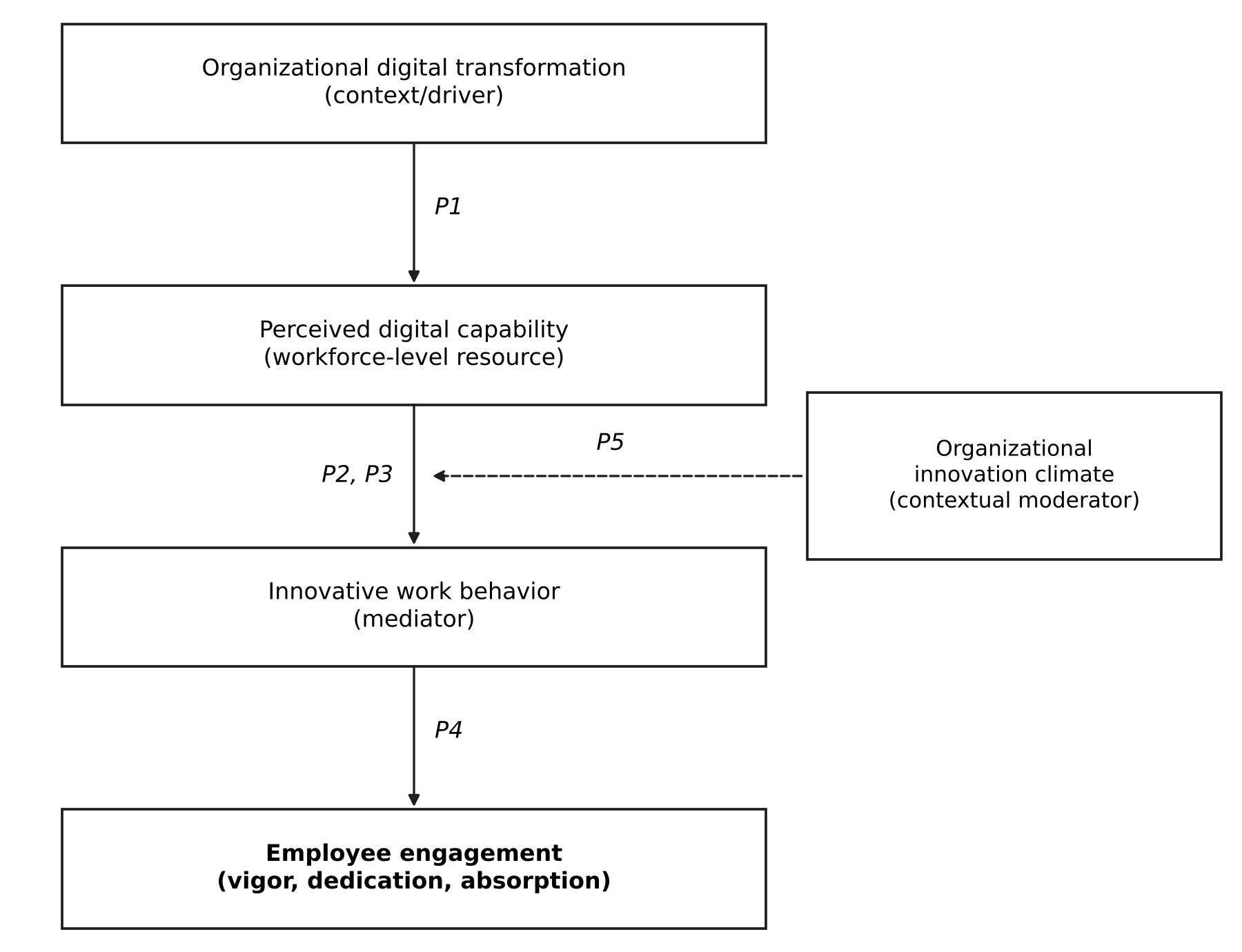
The framework rests on three core theoretical claims. First, consistent with dynamic capabilities theory (Warner and Wager, 2019), organizational digital transformation is the upstream condition that creates the opportunity for employees to develop perceived digital capability, but does not guarantee it; capability depends on how transformation is implemented, including training investment and leadership support (Albahri et al., 2025). Second, consistent with JD-R theory (Bakker and Demerouti, 2017), perceived digital capability functions as a personal job resource with both a direct motivational effect on engagement and an indirect effect through enabling innovative work behavior, since employees who feel capable with digital tools are better positioned to experiment with and adapt them (Amabile, 1988). Third, this capability-engagement relationship is not uniform across organizational contexts: it is strengthened where an organizational innovation climate legitimizes experimentation (West and Farr, 1990), and attenuated where technostress is high (Tarafdar et al., 2007), reconciling the mixed empirical findings reviewed above within a single contingent model.
Table 1 translates this framework into six formal propositions suitable for empirical testing.
| Prop. | Statement | Theoretical basis |
|---|---|---|
| P1 | Organizational digital transformation is positively associated with employees' perceived digital capability. | Dynamic capabilities theory (Warner and Wager, 2019) |
| P2 | Perceived digital capability is positively associated with employee engagement. | Job Demands-Resources theory (Schaufeli and Bakker, 2004) |
| P3 | Perceived digital capability is positively associated with innovative work behavior. | Componential theory of innovation (Amabile, 1988) |
| P4 | Innovative work behavior mediates the relationship between digital capability and employee engagement. | JD-R motivational process (Bakker and Demerouti, 2017) |
| P5 | Perceived organizational innovation climate strengthens the positive relationship between digital capability and employee engagement. | Climate for innovation theory (West and Farr, 1990) |
| P6 | The strength of the digital capability-engagement relationship is attenuated under conditions of high technostress. | Technostress / JD-R demands (Tarafdar et al., 2007; Bakker and Demerouti, 2017) |
4Discussion
4.1Theoretical implications
This framework contributes to the healthcare management literature in three ways. First, it extends JD-R theory (Bakker and Demerouti, 2017) to the specific context of healthcare digital transformation by identifying perceived digital capability as a distinct personal resource, rather than treating digital transformation generically as either a demand or a resource. Second, it integrates the innovation climate literature (West and Farr, 1990; Amabile, 1988) with the engagement literature by proposing innovative work behavior as a mediating mechanism, offering a theoretical account of why digital capability's effect on engagement may operate partly through employees' own innovative adaptation of digital tools, rather than through capability alone. Third, by incorporating technostress (Tarafdar et al., 2007) as a moderating countervailing demand, the framework offers a contingent, rather than uniformly positive, account of digital transformation's relationship to engagement, consistent with the mixed findings documented in recent healthcare-specific empirical studies (Alanazi et al., 2025).
4.2Practical implications
For healthcare managers and digital transformation leads, the framework suggests that technology rollout should not be sequenced independently of workforce capability-building and innovation-climate investment. Consistent with the findings of Trenerry et al. (2024) and Albahri et al. (2025), organizations that pair digital transformation initiatives with structured capability development, and that actively cultivate a climate in which frontline staff are encouraged to adapt and improve on standard digital workflows, are, per this framework, more likely to see transformation translate into engagement rather than technostress and disengagement. The framework further implies that technostress should be actively monitored during digital rollouts, since its presence is predicted to blunt the engagement benefits of capability-building even where that capability-building is otherwise effective.
5Limitations and proposed empirical validation agenda
As a conceptual contribution, the framework and its six propositions have not been empirically tested, and the relationships proposed are derived from theoretical synthesis rather than primary data. The paper proposes that future research test this framework using a cross-sectional or short-term longitudinal survey administered to a cohort of healthcare professionals across multiple hospital or clinical settings, using validated instruments for each construct: the Utrecht Work Engagement Scale for employee engagement (Schaufeli and Bakker, 2004), an adapted digital capability self-efficacy measure, the Innovative Work Behavior scale (De Spiegelaere et al., 2014), an organizational innovation climate measure (West and Farr, 1990), and the Technostress Creators scale (Tarafdar et al., 2007). Such a study would be well positioned to draw on the same healthcare professional cohort addressed by this paper's companion piece on workplace stress, psychological safety, and well-being, allowing the two frameworks' overlapping constructs, engagement, strain, and digital-era job demands, to be examined within a single integrated data collection effort in future empirical work.
6Conclusion
This paper has proposed a conceptual framework explaining how organizational digital transformation shapes employee engagement among healthcare professionals through the dual pathways of perceived digital capability and innovative work behavior, moderated by organizational innovation climate and attenuated by technostress. By integrating dynamic capabilities theory, the Job Demands-Resources model, and the componential theory of innovation within a single healthcare-specific framework, the paper offers both a theoretical contribution addressing a gap in the digital health workforce literature and a practical diagnostic tool for healthcare leaders managing digital transformation initiatives. Future empirical research, ideally conducted within the same healthcare professional cohort addressed by this paper's companion piece on workplace well-being, is needed to test the framework's propositions and refine its contingent, moderated-mediation structure.
References
- [1]Alanazi A, Alanazi M, Alrashidi S (2025). Impact of digital health technologies adoption on healthcare workers’ performance and workload: perspective with DOI and TOE models. BMC Health Services Research, 25, 1203.
- [2]Albahri OS, Albahri AS, Alamoodi AH (2025). The impact of digital transformational leadership on digital intensity among primary healthcare entities: a moderated mediation model. BMC Primary Care, 26, 14.
- [3]Amabile TM (1988). A model of creativity and innovation in organizations. Research in Organizational Behavior, 10, 123–167.
- [4]Bakker AB, Demerouti E (2017). Job demands–resources theory: Taking stock and looking forward. Journal of Occupational Health Psychology, 22(3), 273–285. https://doi.org/10.1037/ocp0000056
- [5]De Spiegelaere S, Van Gyes G, De Witte H, Niesen W, Van Hootegem G (2014). On the relation of job insecurity, job autonomy, innovative work behaviour and the mediating effect of work engagement. Creativity and Innovation Management, 23(3), 318–330. https://doi.org/10.1111/caim.12079
- [6]Kahn WA (1990). Psychological conditions of personal engagement and disengagement at work. Academy of Management Journal, 33(4), 692–724.
- [7]Konttila J, Siira H, Kyngäs H, Lahtinen M, Elo S, Kääriäinen M, et al. (2019). Healthcare professionals’ competence in digitalisation: A systematic review. Journal of Clinical Nursing, 28(5–6), 745–761. https://doi.org/10.1111/jocn.14710
- [8]Kraus S, Schiavone F, Pluzhnikova A, Invernizzi AC (2021). Digital transformation in healthcare: analyzing the current state-of-research. Journal of Business Research, 123, 557–567.
- [9]Molino M, Cortese CG, Ghislieri C (2020). The promotion of technology acceptance and work engagement in Industry 4.0: From personal resources to information and training. International Journal of Environmental Research and Public Health, 17(7), 2438. https://doi.org/10.3390/ijerph17072438
- [10]Schaufeli WB, Bakker AB (2004). Job demands, job resources, and their relationship with burnout and engagement: A multi-sample study. Journal of Organizational Behavior, 25(3), 293–315. https://doi.org/10.1002/job.248
- [11]Tarafdar M, Tu Q, Ragu-Nathan BS, Ragu-Nathan TS (2007). The impact of technostress on role stress and productivity. Journal of Management Information Systems, 24(1), 301–328. https://doi.org/10.2753/MIS0742-1222240109
- [12]Trenerry B, Chng S, Wang Y, Suhaila ZS, Lim SS, Lu HY, Oh PH (2024). Digital transformation in healthcare: assessing the role of digital technologies for managerial support processes. Technological Forecasting and Social Change, 209, 123723.
- [13]Vial G (2019). Understanding digital transformation: A review and a research agenda. The Journal of Strategic Information Systems, 28(2), 118–144. https://doi.org/10.1016/j.jsis.2019.01.003
- [14]Warner KSR, Wäger M (2019). Building dynamic capabilities for digital transformation: An ongoing process of strategic renewal. Long Range Planning, 52(3), 326–349. https://doi.org/10.1016/j.lrp.2018.12.001
- [15]West MA, Farr JL (1990). Innovation at work. In West MA, Farr JL (Eds.), Innovation and creativity at work: Psychological and organizational strategies (pp. 3–13). Chichester: Wiley.