Generative AI and Student Information Seeking
The Shift from Google Search to ChatGPT: How Generative AI Is Changing Students’ Information-Seeking Behaviour
Zeal Institute of Business Administration, Computer Application and Research (ZIBACAR), Pune, Maharashtra, India
Published October 2026
Abstract
The rapid spread of generative artificial intelligence (AI) tools such as ChatGPT is changing how students search for, understand, and verify academic information, a role long held by search engines such as Google. This study examines students’ self-reported information-seeking behaviour with Google Search and ChatGPT, covering frequency of use, purpose, first-source preference, reasons for adoption, trust, verification practice, and perceived change. A descriptive, quantitative survey was conducted using a 25-item structured Google Forms questionnaire administered to college and university students through convenience sampling (N = 200). Data were analysed using frequency and percentage analysis. Of the respondents, 73.5% use ChatGPT/AI at least once a day, and 61.2% name ChatGPT/AI as their first source for academic answers, compared with 30.6% for Google Search. Understanding concepts, faster answers, and easier explanations were the main reasons for use. Trust was conditional: 59.2% verify ChatGPT answers always or often, 59.2% have encountered incorrect or misleading output at least sometimes, and Google Search was the most common verification source (42.9%). In total, 93.9% reported at least some change in how they find information. The findings point to a hybrid, AI-assisted pattern rather than a replacement of search engines; however, they rest on self-reported data from a non-probability sample and cannot be generalised.
Keywords: generative AI; ChatGPT; Google Search; information-seeking behaviour; students; verification
1Introduction
1.1Background of the study
Students search for information to complete assignments, prepare for examinations, understand difficult concepts, and carry out research. For more than two decades, search engines such as Google have been the principal gateway to such information: a student enters keywords, scans a ranked list of pages, compares sources, and decides which to trust. Research on young people’s online behaviour has long observed that this process is often rapid and superficial, with little time devoted to evaluating what is found [1].
Generative AI has introduced a different pattern. ChatGPT, released by OpenAI in November 2022, allows users to pose questions in natural language, ask follow-up questions, and receive a direct, summarised response [2]. For students, this can shorten the path from question to explanation. Reviews of large language models in education describe both opportunities, such as personalised explanation, and risks, such as inaccurate output and over-reliance [3, 4]. Because these tools are also used for writing, summarising, problem-solving, and coding, their use extends well beyond looking up information.
1.2Statement of the problem
If students increasingly turn to ChatGPT first, their established habits of keyword searching, source comparison, and reliability judgement may change. At the same time, AI-generated answers can be incorrect or unsourced, and students may accept them without checking [5, 6]. It is therefore important to understand whether students prefer Google Search or ChatGPT, why they do so, how far they trust AI answers, and whether they verify them. This study addresses the question of how the growing use of ChatGPT is changing students’ information-seeking behaviour, and how AI-based seeking compares with traditional search using Google.
1.3Objectives of the study
The main objective is to examine how students’ information-seeking behaviour is changing with the use of ChatGPT in comparison with Google Search. The specific objectives are:
- 1. To describe students’ traditional information-seeking behaviour using Google Search.
- 2. To examine the frequency and purpose of ChatGPT/AI use for academic information.
- 3. To compare students’ first-source preference between Google Search and ChatGPT, and the factors influencing it (speed, ease of understanding, and convenience).
- 4. To analyse the level of trust students place in ChatGPT-generated information.
- 5. To study whether and how students verify ChatGPT answers.
- 6. To examine whether ChatGPT use is reducing reliance on Google Search, and to identify the benefits and limitations that students perceive.
1.4Significance of the study
The study offers students, teachers, and institutions an evidence base on how AI tools are actually used for academic information seeking, and on where verification habits are strong or weak. This can inform guidelines on responsible AI use and the teaching of information and digital literacy. For researchers, it provides a small descriptive dataset on the Google-to-ChatGPT transition that larger studies can extend. The remainder of the paper reviews the literature, describes the methodology, presents and discusses the results, and then sets out the findings and recommendations, limitations, future scope and conclusion.
2Review of literature
2.1Information-seeking behaviour of young people
The CIBER study of the “Google generation” reported that young people tend to skim and move quickly between sources, and often find it difficult to judge the quality of what they find [1]. Search-based seeking therefore provides a useful baseline: the effort of comparing results is also where evaluation skills are exercised.
2.2Generative AI in education
Kasneci et al. [4] review the use of large language models in education and discuss benefits for learners and teachers alongside concerns such as bias, over-reliance, and the need for critical thinking and digital literacy. Dwivedi et al. [3] bring together multidisciplinary perspectives on the opportunities, challenges, and implications of generative conversational AI, including accuracy, integrity, and responsible use. UNESCO’s guidance on generative AI in education and research similarly calls for a human-centred approach and for institutional measures governing its use [7].
2.3Accuracy, sources and verification
Generative language models can produce fluent text that is not factually grounded, a problem commonly termed hallucination [5]. Shah and Bender [6] argue that replacing search with language-model answers can weaken the visibility of sources and reduce users’ ability to judge information for themselves. These concerns make students’ verification practice, and not only their usage, central to understanding AI-based information seeking.
2.4Research gap
The literature reviewed above is largely conceptual or technology-focused. Less is available on how students themselves describe the move from Google Search to ChatGPT in everyday academic use, including what they ask first, what they trust, and what they check. This study provides a small-scale, survey-based description of those self-reported practices.
3Research methodology
3.1Research design
The study adopts a descriptive, quantitative survey design [8]. It characterises respondents’ use of Google Search and ChatGPT, their trust and verification practices, and their perceived change in behaviour. All findings are self-reported perceptions and behaviours; no objective performance measures or usage logs were collected.
3.2Population, sample and sampling
The target population is college and university students who use the Internet for academic or general information seeking. Respondents were selected through convenience sampling: the questionnaire was shared through online channels, and students who were accessible and willing completed it voluntarily. The analysis is based on N = 200 valid responses. Respondents differed in age, education level, and field of study (Table 1). Because the sample is non-probabilistic, the results describe these respondents only.
3.3Research instrument
Primary data were collected using a structured questionnaire of 25 closed-ended questions in Google Forms, organised into five sections of five questions each: (A) general information and Internet use, (B) Google Search behaviour, (C) ChatGPT/AI behaviour, (D) trust and verification, and (E) change in information-seeking behaviour. The questions were derived from the study objectives and used predefined response options.
3.4Data collection and analysis
Primary data were drawn from the Google Forms responses. Secondary sources (research papers, reports, and official publications) provided the background for Sections I and II. Responses were organised in tabular form and analysed using frequency counts and percentages, calculated as
where fi is the frequency of response category i, N is the number of valid responses to the item concerned, and pi is the resulting percentage. Results are presented in tables and charts. Cross-tabulation and the Chi-square test were not applied in this paper; associations between variables are therefore not tested, and no claim of statistical significance is made.
4Results
4.1Profile of respondents
| Characteristic | n | % |
|---|---|---|
| Age group | ||
| 18–21 years | 57 | 28.6 |
| 22–25 years | 86 | 42.9 |
| Above 25 years | 37 | 18.4 |
| Other / unclassified | 20 | 10.2 |
| Education level | ||
| Undergraduate | 86 | 42.9 |
| Postgraduate | 102 | 51.0 |
| Other level | 12 | 6.1 |
| Field of study | ||
| Computer Science / IT | 94 | 46.9 |
| Management / Commerce | 66 | 32.7 |
| Science / Engineering | 20 | 10.2 |
| Arts / Humanities | 20 | 10.2 |
Respondents were mainly young adults (71.4% aged 18–25); about half were postgraduate students, and nearly half studied Computer Science or IT (Table 1). The sample therefore leans toward technology-oriented higher-education students, who may adopt AI tools earlier than other groups. Academic Internet use was high, and Google Search was the main source of academic information before ChatGPT for 67.3% of respondents, followed by YouTube (18.4%).
4.2Google Search behaviour
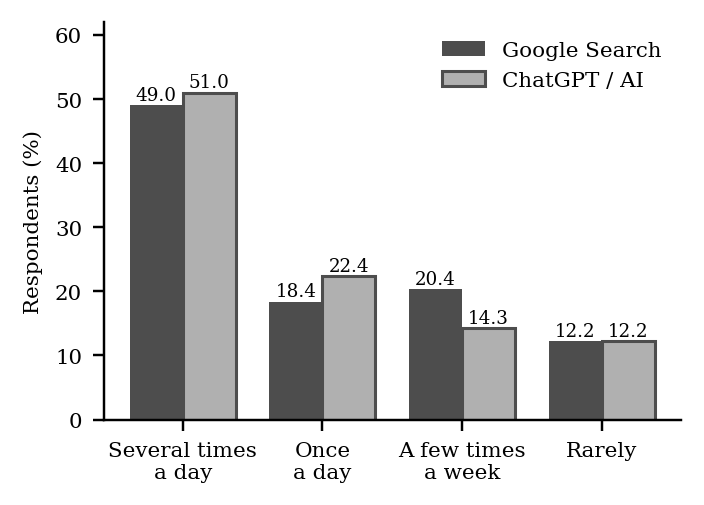
Google Search remains widely used: 49.0% of respondents use it several times a day for academic information and 18.4% once a day. It is used mainly for understanding concepts (42.9%) and finding solutions (34.7%). A majority (63.3%) check two to three results before accepting an answer, and 93.9% are satisfied or very satisfied with it. The time taken to find an answer varied: 32.7% take under two minutes, 28.6% two to five minutes, 30.6% five to ten minutes, and 8.2% more than ten minutes.
4.3ChatGPT/AI use and preference
Use of ChatGPT/AI is at least as frequent as use of Google Search (Figure 1): 51.0% use it several times a day and 22.4% once a day, so 73.5% use it at least daily. The main purposes were understanding concepts (36.7%), writing or summarising (24.5%), solving problems (20.4%), and coding (18.4%).
When looking for an academic answer, 61.2% use ChatGPT/AI first, against 30.6% for Google Search and 8.2% for books or teachers (Table 2). The main reasons for choosing ChatGPT over Google were faster answers (28.6%), easier-to-understand explanations (28.6%), a reduced need to visit multiple websites (22.4%), and personalised explanations (20.4%). Since adopting ChatGPT, 38.8% reported using Google less (18.4% decreased; 20.4% rarely use it now), 32.7% reported no change, and 28.6% reported using it more.
| Measure | Google (%) | ChatGPT/AI (%) |
|---|---|---|
| Use several times a day | 49.0 | 51.0 |
| Use at least once a day | 67.3 | 73.5 |
| First source for academic answers | 30.6 | 61.2 |
| Mainly relies on it (current behaviour) | 18.4 | 34.7 |
4.4Trust and verification
| Item | n | % |
|---|---|---|
| Completely or mostly trust | 114 | 57.1 |
| Trust only after verification | 78 | 38.8 |
| Do not trust | 8 | 4.1 |
| Verify always or often | 118 | 59.2 |
| Never verify | 20 | 10.2 |
| Found incorrect/misleading output (frequently or sometimes) | 118 | 59.2 |
| Verify mainly via Google Search | 86 | 42.9 |
| Would accept a confident, detailed answer directly | 53 | 26.5 |
Trust in ChatGPT is common but mostly conditional (Table 3). Only 10.2% completely trust it, and 59.2% have encountered incorrect or misleading output at least sometimes. Verification is frequent: 59.2% verify always or often, and Google Search is the leading verification source (42.9%), ahead of books or textbooks (24.5%) and academic websites or research papers (20.4%). Even so, 26.5% would accept a confident, detailed answer directly and 12.2% usually do not verify, which indicates a minority at risk of accepting errors.
4.5Perceived change in information seeking
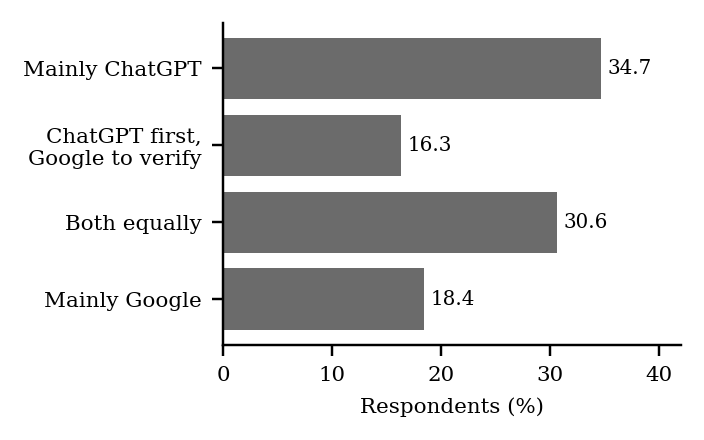
Overall, 49.0% said their method of finding information had changed moderately and 30.6% significantly, while 6.1% reported no change. When asked how much ChatGPT had changed the way they search for and use information, 46.9% answered moderately, 28.6% significantly, and 6.1% not at all; thus 93.9% reported at least some change. Current behaviour is mixed (Figure 2): 34.7% mainly use ChatGPT, 30.6% use both equally, 16.3% use ChatGPT first and Google to verify, and 18.4% mainly use Google. Respondents saw time saving (38.8%) and easier explanations (32.7%) as ChatGPT’s biggest advantages, and unreliable sources (36.7%) and incorrect information (20.4%) as its biggest limitations; 28.6% saw no major limitation.
5Discussion
The results suggest that, for these respondents, ChatGPT has become a first stop for academic questions, while Google Search retains an important role in discovering sources and checking answers. Almost half (46.9%) use both tools together, which is consistent with a hybrid pattern: ask ChatGPT, then check elsewhere. The reasons given for adoption, such as speed and easier explanations, match the benefits discussed in the literature [3, 4]. The concerns that students themselves raise, namely unreliable sources and incorrect information, match the issues of hallucination and source visibility noted in prior work [5, 6].
Two cautions apply. First, “change” is the respondents’ own perception; the survey has no pre-ChatGPT measurement, so it cannot show that ChatGPT caused any change, and the question on earlier sources is retrospective. Second, although verification is common, a sizeable minority accept confident answers or do not verify. Whether these habits affect learning quality was not measured and should not be inferred.
6Findings and recommendations
6.1Findings
- Google Search was the main academic source before ChatGPT (67.3%) and is still used daily by most respondents.
- ChatGPT/AI use is frequent (73.5% at least daily), and 61.2% use it first for academic answers.
- Faster answers and easier explanations are the main reasons for choosing ChatGPT.
- Trust is conditional: 59.2% verify often or always, mostly using Google Search, and 59.2% have encountered incorrect or misleading output.
- 93.9% perceive some change in their information seeking, and 46.9% use Google and ChatGPT together in some form. Among these respondents, ChatGPT appears to be changing search rather than replacing it.
6.2Recommendations
The following recommendations are suggested by the findings and were not directly tested in this study.
- Students: use ChatGPT as a support for understanding, and verify important information against textbooks, research papers, or Google Search.
- Teachers: teach source evaluation and the verification of AI output alongside AI use.
- Institutions: provide AI-literacy guidance covering academic honesty, plagiarism, data privacy, and the limits of AI answers.
- Students should avoid depending on AI in place of their own thinking, research, and writing.
7Limitations of the study
- The sample is small and was drawn by convenience sampling, so the results cannot be generalised to all students.
- The sample leans toward postgraduate and Computer Science/IT students.
- All data are self-reported and may be affected by recall and social-desirability bias.
- Only descriptive statistics were used; no associations were tested.
- The study captures perceptions and behaviour, not objective learning outcomes or the accuracy of the information used.
- ChatGPT and Google Search change quickly, so the findings reflect the period of data collection.
8Future scope
Future work could use larger and more diverse samples; test associations (for example, between trust and verification) with appropriate statistical tests; include other AI tools and search platforms; adopt longitudinal or observational designs; and measure verification accuracy and learning outcomes objectively.
9Conclusion
This survey examined how students use Google Search and ChatGPT for academic information. Respondents use ChatGPT frequently and often first, valuing its speed and clear explanations, yet they remain aware of its limits in accuracy and sourcing and commonly turn to Google Search and other sources to verify it. The emerging pattern is hybrid and AI-assisted rather than a simple replacement of search engines. Given the small convenience sample and self-reported data, these results are indicative only, but they point to the value of teaching verification and information-literacy skills alongside AI use.
References
- [1]Rowlands I, Nicholas D, Williams P, Huntington P, Fieldhouse M, Gunter B, et al. The Google generation: The information behaviour of the researcher of the future. Aslib Proceedings. 2008;60(4):290–310. https://doi.org/10.1108/00012530810887953
- [2]OpenAI. Introducing ChatGPT. OpenAI; 30 November 2022. https://openai.com/index/chatgpt/ (accessed 13 October 2026).
- [3]Dwivedi YK, Kshetri N, Hughes L, Slade EL, Jeyaraj A, Kar AK, et al. Opinion paper: “So what if ChatGPT wrote it?” Multidisciplinary perspectives on opportunities, challenges and implications of generative conversational AI for research, practice and policy. International Journal of Information Management. 2023;71:102642. https://doi.org/10.1016/j.ijinfomgt.2023.102642
- [4]Kasneci E, Sessler K, Küchemann S, Bannert M, Dementieva D, Fischer F, et al. ChatGPT for good? On opportunities and challenges of large language models for education. Learning and Individual Differences. 2023;103:102274. https://doi.org/10.1016/j.lindif.2023.102274
- [5]Ji Z, Lee N, Frieske R, Yu T, Su D, Xu Y, et al. Survey of hallucination in natural language generation. ACM Computing Surveys. 2023;55(12):1–38. https://doi.org/10.1145/3571730
- [6]Shah C, Bender EM. Situating search. In: Proceedings of the ACM SIGIR Conference on Human Information Interaction and Retrieval (CHIIR ’22); 2022. p. 221–232. https://doi.org/10.1145/3498366.3505816
- [7]Miao F, Holmes W. Guidance for generative AI in education and research. Paris: UNESCO; 2023. https://unesdoc.unesco.org/ark:/48223/pf0000386693
- [8]Creswell JW, Creswell JD. Research design: Qualitative, quantitative, and mixed methods approaches. 5th ed. Thousand Oaks, CA: SAGE; 2018.