Pharmacy
Development and Characterisation of a Box-Behnken Optimised Polymeric Matrix Transdermal Patch of Aripiprazole: Ex Vivo Permeation, Stability and Skin Tolerability
Department of Pharmaceutics, SHEAT College of Pharmacy, Varanasi, Uttar Pradesh, India (affiliated to Dr. A. P. J. Abdul Kalam Technical University, Lucknow, India)
Published October 2026
Abstract
Oral aripiprazole is limited by hepatic first-pass metabolism, CYP2D6-dependent exposure and the poor adherence that characterises long-term antipsychotic therapy. This study developed and characterised a polymeric matrix transdermal patch of aripiprazole by solvent casting. Preformulation work confirmed a lipophilic drug (log P 4.18 ± 0.09) that was compatible with all excipients, and a stability-indicating RP-HPLC method was validated (R² = 0.9999; recovery 99.6–100.2%; RSD ≤ 0.89%). Eight screening batches identified an HPMC K4M : ethyl cellulose N10 matrix as the most suitable base, and a 17-run, three-factor Box-Behnken design (polymer ratio, PEG 400 and oleic acid) was used for optimisation. The optimised patch (HPMC:EC 60:40, PEG 400 22% w/w, oleic acid 6% w/v) matched model predictions within 2.2% and showed drug content of 99.2 ± 0.4%, tensile strength of 4.08 ± 0.18 N/mm², folding endurance of 354 ± 18 and a surface pH of 6.28 ± 0.08. It released 73.4 ± 1.6% of the drug in 24 h by anomalous (non-Fickian) transport (Korsmeyer-Peppas n = 0.58) and, through excised rat skin, gave a steady-state flux of 17.8 ± 0.9 µg/cm²/h with an enhancement ratio of 1.93. Drug content remained at or above 95% after 6 months at 40 °C/75% RH and after 12 months at 25 °C/60% RH, although photostability testing showed that light protection is required. The patch was non-irritant in a reconstructed human epidermis model (viability 82.4 ± 4.1%) and in rabbits (primary irritation index 0.24). The findings support progression to in vivo pharmacokinetic evaluation.
Keywords: aripiprazole; transdermal patch; HPMC; ethyl cellulose; oleic acid; Box-Behnken design; skin permeation; stability; skin irritation
1Introduction
Aripiprazole is a second-generation antipsychotic whose clinical effect rests on high-affinity partial agonism at dopamine D2 receptors [1]. In placebo-controlled trials, 15 and 30 mg/day improved positive and total symptom scores in schizophrenia without the prolactin elevation seen with haloperidol [2], and once-daily doses of 10 or 15 mg are effective, with a low potential for weight gain [3]. Oral therapy nevertheless has recognised weaknesses. Aripiprazole is converted to an active metabolite, dehydroaripiprazole, and CYP2D6 genotype contributes to the variability in clearance, with poor metabolisers showing about 1.7-fold higher serum concentrations [4,5]. More fundamentally, more than one third of patients with schizophrenia are non-adherent in any given year, with consequent relapse and rehospitalisation [6]. Long-acting injectables reduce hospitalisation and relapse risk relative to oral therapy [7], but require injection and cannot be withdrawn once given.
A transdermal patch offers a non-invasive, removable alternative that avoids first-pass metabolism and supplies drug at a steady rate. First-generation patches suit small, lipophilic, low-dose drugs [8], and aripiprazole fits this profile: its molecular weight (448 Da) lies below the empirical 500 Da limit for skin penetration [9], its daily dose is 10–15 mg, and it is lipophilic, as confirmed here. Antipsychotics have begun to reach the clinic by this route, with asenapine and blonanserin patches among the first to report clinical trial results [10,11,12]. For aripiprazole itself, published skin-permeation work has been limited to Carbopol gels studied across human cadaver skin [13].
Matrix patches built from a hydrophilic polymer such as hydroxypropyl methylcellulose (HPMC) and a hydrophobic film-former such as ethyl cellulose (EC) allow release to be tuned through the polymer ratio, and HPMC/EC blends with PEG 400 have been characterised for other drugs [14,15]. Permeation enhancers can further raise flux by perturbing stratum corneum lipids [16]. A Box-Behnken design (BBD) offers an efficient route to such a multi-factor formulation within a quality-by-design framework [17,18,19]. This paper reports the preformulation, optimisation, characterisation, permeation, stability and tolerability of an HPMC:EC matrix patch of aripiprazole, with the aim of identifying a formulation suitable for pharmacokinetic evaluation.
2Materials and methods
2.1Materials and preformulation
Aripiprazole (≥ 99.5% by HPLC) was used with HPMC K4M, ethyl cellulose N10, PVP K30, Eudragit RL100, PEG 400, oleic acid and isopropyl myristate (IPM), all of pharmaceutical grade. Melting point, equilibrium solubility (shake-flask, 37 °C, 72 h) and the octanol/buffer partition coefficient (pH 7.4) were determined in triplicate. Compatibility with excipients was examined by DSC (25–300 °C, 10 °C/min), ATR-FTIR (4000–400 cm⁻¹) and PXRD (2θ 5–40°) on pure drug, binary mixtures and the drug:HPMC:EC ternary blend.
2.2HPLC method
Quantification used a C18 column (250 × 4.6 mm, 5 µm) with isocratic acetonitrile:20 mM ammonium acetate buffer pH 4.5 (65:35 v/v) at 1.0 mL/min and detection at 254 nm. The method was validated for linearity, accuracy, precision, specificity, LOD/LOQ and robustness [20], and its stability-indicating capacity was tested by acid, alkaline, oxidative, photolytic and thermal stress.
2.3Patch preparation and optimisation
Patches were prepared by solvent casting. Polymers were dissolved in ethanol:acetone (1:1 v/v), drug (10 mg per 10 cm²), PEG 400 and oleic acid were added, and the degassed solution was cast on a Teflon-coated plate at a wet thickness of 500 µm and dried at 40 ± 2 °C for 24 h. Eight screening batches (F1–F8) varied polymer type and ratio, plasticiser and enhancer. A three-factor, three-level BBD with 17 runs (five centre points) then varied HPMC:EC ratio (30:70–70:30), PEG 400 (10–30% w/w of polymer) and oleic acid (2.5–7.5% w/v). The responses were 24 h release (Y1), ex vivo flux (Y2), tensile strength (Y3), drug content (Y4) and folding endurance (Y5). Quadratic models were fitted in Design-Expert 13, and the optimum was located by desirability analysis and checked with three validation batches.
2.4Characterisation, release and permeation
The optimised patch (OPT-F) was evaluated for thickness, weight variation, content uniformity, folding endurance, tensile strength and elongation (texture analyser), surface pH, moisture content and uptake, water vapour transmission, peel adhesion, tack and SEM morphology. In vitro release used vertical Franz cells (3.14 cm², 15 mL receptor) [21] with a cellulose acetate membrane (MWCO 12–14 kDa), phosphate buffer pH 7.4 containing 0.5% SDS at 37 °C and 600 rpm, with sampling over 24 h and fitting to zero-order, first-order, Higuchi [22], Korsmeyer-Peppas [23] and Hixson-Crowell models. Ex vivo permeation used excised abdominal skin of Sprague-Dawley rats, accepted only when transepidermal water loss was below 15 g/m²/h and electrical resistance above 20 kΩ·cm² [24]. Flux, lag time and enhancement ratio (ER) were derived, and skin layers were analysed after 24 h by tape stripping and heat separation for mass balance.
2.5Stability and tolerability
OPT-F, packed in aluminium laminate pouches, was stored at 40 °C/75% RH for 6 months and 25 °C/60% RH for 12 months [25], and exposed to 1.2 million lux·h of D65 light with dark controls [26]. Skin irritation was assessed in the EpiDerm reconstructed human epidermis model by MTT assay, with viability ≥ 50% classed as non-irritant [27], and in New Zealand albino rabbits (n = 6; intact and abraded sites, 24 h occlusion) using Draize scoring and the primary irritation index (PII) [28,29]. Animal work had institutional ethics approval (IAEC/2024/018). Data are mean ± SD (n = 3 unless stated); groups were compared by one-way ANOVA with Tukey's test or Student's t-test (p < 0.05).
3Results and discussion
3.1Preformulation and analytical method
Aripiprazole melted at 139.4 ± 0.6 °C, in agreement with the pharmacopoeial range, and DSC showed a single sharp endotherm at 140.1 ± 0.4 °C (ΔHf 98.6 ± 1.2 J/g). Aqueous solubility was low (0.19 ± 0.02 mg/mL at pH 7.4) but high in ethanol:acetone (16.8 ± 0.9 mg/mL), which was therefore selected as the casting solvent, while 0.5% SDS was added to receptor fluid to maintain sink conditions. The log P of 4.18 ± 0.09 confirms the lipophilicity needed for partitioning into the stratum corneum (Table 1). No new thermal events appeared in any binary or ternary mixture and all principal FTIR bands, including the lactam C=O at 1672 cm⁻¹, were retained within ± 5 cm⁻¹, indicating compatibility. The drug:HPMC:EC blend showed a reduced enthalpy (68.4 ± 2.1 J/g) and PXRD peaks of Form III were attenuated in HPMC and PVP mixtures, consistent with partial amorphisation, which may raise thermodynamic activity in the matrix.
The HPLC method met all validation criteria (Table 1). Aripiprazole eluted at 6.74 min and the oxidative degradant dehydroaripiprazole at 7.42 min with a resolution of 4.2, confirming that the method is stability-indicating.
| Parameter | Result | Comment / acceptance criterion |
|---|---|---|
| Melting point | 139.4 ± 0.6 °C | Pharmacopoeial range 139–141 °C |
| DSC peak; ΔHf | 140.1 ± 0.4 °C; 98.6 ± 1.2 J/g | Single sharp endotherm (Form III) |
| Log P (octanol/PBS 7.4) | 4.18 ± 0.09 | Lipophilic; favours stratum corneum partitioning |
| Solubility, PBS pH 7.4 | 0.19 ± 0.02 mg/mL | 0.5% SDS added to receptor fluid |
| Solubility, ethanol:acetone (1:1) | 16.8 ± 0.9 mg/mL | Selected casting solvent |
| Ternary blend (drug + HPMC + EC), DSC | 137.5 ± 0.7 °C; 68.4 ± 2.1 J/g | No new peaks; partial amorphisation |
| HPLC linearity | 0.5–50 µg/mL; R² = 0.9999 | R² ≥ 0.999 |
| LOD / LOQ | 0.14 / 0.42 µg/mL | S/N 3 and 10 |
| Accuracy (80, 100, 120%) | 99.6 / 100.2 / 99.8% | 98.0–102.0% |
| Precision (RSD) | 0.62% intra-day; 0.89% inter-day | ≤ 2.0% |
| Specificity; retention time; tailing | Rs = 4.2; 6.74 min; 1.08 | Rs ≥ 2.0; tailing ≤ 2.0 |
3.2Screening and box-behnken optimisation
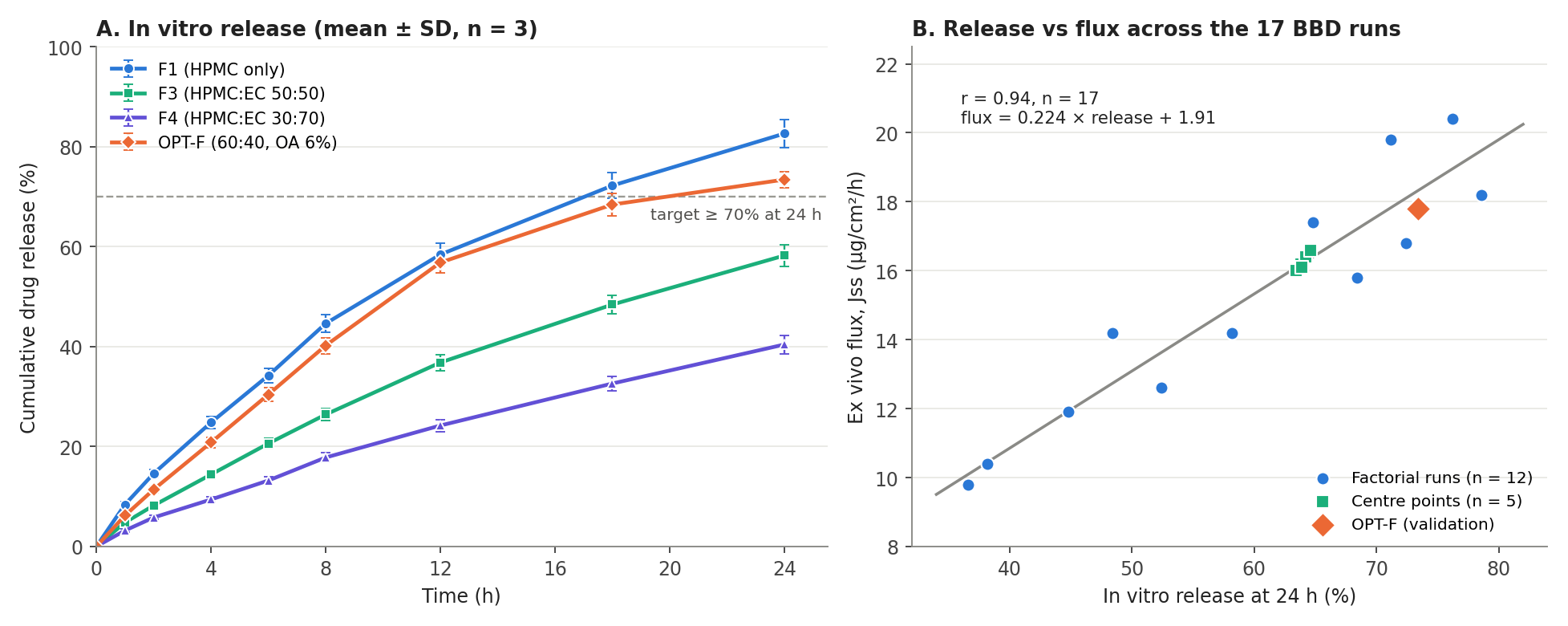
Among the screening batches, HPMC alone (F1) gave tacky films that released 82.6% of drug in 24 h, whereas EC-rich batches (F4, F8) released too slowly (40.4% for F4 at 24 h). HPMC:EC blends gave the best balance of flexibility, content uniformity (96.2–99.4%) and release, and the ternary PVP blend (F7) was excluded to keep the design space simple. This agrees with the behaviour of other HPMC/EC patches, in which an HPMC-rich blend favoured release [14], and with a wider literature on EC-based matrices [30].
The BBD gave significant quadratic models for all five responses (Table 2). R²adj ranged from 0.951 to 0.970 for release, flux, tensile strength and folding endurance and was 0.871 for drug content, with non-significant lack of fit (p = 0.16–0.32) for every response. Polymer ratio was the dominant factor for release and flux, higher HPMC content increasing both. PEG 400 reduced tensile strength while improving folding endurance, which is the expected plasticiser trade-off, and oleic acid raised flux, with a significant HPMC × oleic acid interaction. The direction of the polymer effect on tensile strength (EC-rich films stronger) differs from a tramadol HPMC/EC system in which more HPMC increased strength [15], a difference that most likely reflects polymer grade and plasticiser content.
| Run | HPMC:EC | PEG 400 (%) | OA (%) | Y1 (%) | Y2 (µg/cm²/h) | Y3 (N/mm²) | Y5 (folds) |
|---|---|---|---|---|---|---|---|
| 1 | 70:30 | 10 | 5.0 | 72.4 | 16.8 | 3.9 | 284 |
| 2 | 30:70 | 10 | 5.0 | 38.2 | 10.4 | 5.1 | 248 |
| 3 | 70:30 | 30 | 5.0 | 78.6 | 18.2 | 2.8 | 412 |
| 4 | 30:70 | 30 | 5.0 | 44.8 | 11.9 | 3.6 | 364 |
| 5 | 50:50 | 10 | 2.5 | 52.4 | 12.6 | 4.8 | 298 |
| 6 | 50:50 | 30 | 2.5 | 58.2 | 14.2 | 3.2 | 386 |
| 7 | 50:50 | 10 | 7.5 | 64.8 | 17.4 | 4.6 | 302 |
| 8 | 50:50 | 30 | 7.5 | 71.2 | 19.8 | 2.9 | 402 |
| 9 | 70:30 | 20 | 2.5 | 68.4 | 15.8 | 3.7 | 326 |
| 10 | 30:70 | 20 | 2.5 | 36.6 | 9.8 | 5.2 | 276 |
| 11 | 70:30 | 20 | 7.5 | 76.2 | 20.4 | 3.5 | 338 |
| 12 | 30:70 | 20 | 7.5 | 48.4 | 14.2 | 4.9 | 292 |
| 13–17 | 50:50 | 20 | 5.0 | 63.4–64.6 | 16.0–16.6 | 4.1–4.3 | 346–352 |
| OPT-F | 60:40 | 22 | 6.0 | 73.4 ± 1.6 | 17.8 ± 0.9 | 4.08 ± 0.18 | 354 ± 18 |
Desirability analysis (D = 0.864) located an optimum at HPMC:EC 60:40, PEG 400 22% w/w and oleic acid 6% w/v. Validation batches matched predictions with errors of 0.4–2.2% (release 73.4 vs 74.8%, flux 17.8 vs 18.2 µg/cm²/h, tensile strength 4.08 vs 4.12 N/mm², folding endurance 354 vs 362), well inside the 10% criterion, supporting the design space as a basis for control strategy [19].
Two practical lessons follow from the design. First, the three formulation variables acted on competing attributes: raising HPMC and oleic acid improved release and flux, whereas raising PEG 400 improved flexibility at the cost of strength, so no single factor could be pushed to its limit without breaching another criterion. Second, the narrow scatter of the five centre points (release 63.4–64.6%, flux 16.0–16.6 µg/cm²/h) shows that the casting process is reproducible at laboratory scale, which is a prerequisite for the model-based optimum to be meaningful.
3.3Physicochemical and mechanical properties
OPT-F met every pre-set criterion (Table 3). Films were uniform (thickness 286 ± 12 µm, CV 4.2%; weight RSD 2.3%) with a drug content of 99.2 ± 0.4% and an acceptance value of 4.8. Tensile strength (4.08 ± 0.18 N/mm²), elongation (42.6 ± 3.2%) and folding endurance (354 ± 18) indicate a film that can withstand handling, and a surface pH of 6.28 ± 0.08 is compatible with skin. Moisture content (2.84 ± 0.22%) and uptake (6.12 ± 0.48%) were low. SEM showed a smooth, homogeneous surface without drug crystals, consistent with the PXRD evidence of partial amorphisation, and a cross-section of about 280–290 µm matching micrometer readings. Peel adhesion was 12.8 ± 0.9 N/25 mm, but adhesion is a critical quality attribute of any patch [31], and it should be re-examined under prolonged wear on skin with a defined adhesive layer.
3.4In vitro release and kinetics
OPT-F released 73.4 ± 1.6% of aripiprazole over 24 h, meeting the target of at least 70% (Figure 1, panel A). Release rose with HPMC content in the order OPT-F > F3 > F4, and OPT-F released about 11% in the first 2 h before settling into near-linear release. The Korsmeyer-Peppas model gave the best fit (R² = 0.9912, n = 0.58), followed by Higuchi (0.9824), zero-order (0.9428), first-order (0.9186) and Hixson-Crowell (0.8842). An exponent between 0.45 and 0.89 denotes anomalous transport, a combination of Fickian diffusion and polymer relaxation or swelling [23], consistent with a hydrating HPMC network inside an EC skeleton. The Higuchi equation rests on specific assumptions and its fit should not be taken alone as proof of mechanism [32]. A comparable release range (51–89% in 24 h) was reported for HPMC/Eudragit patches containing an enhancer [33].
3.5Ex vivo permeation and skin retention
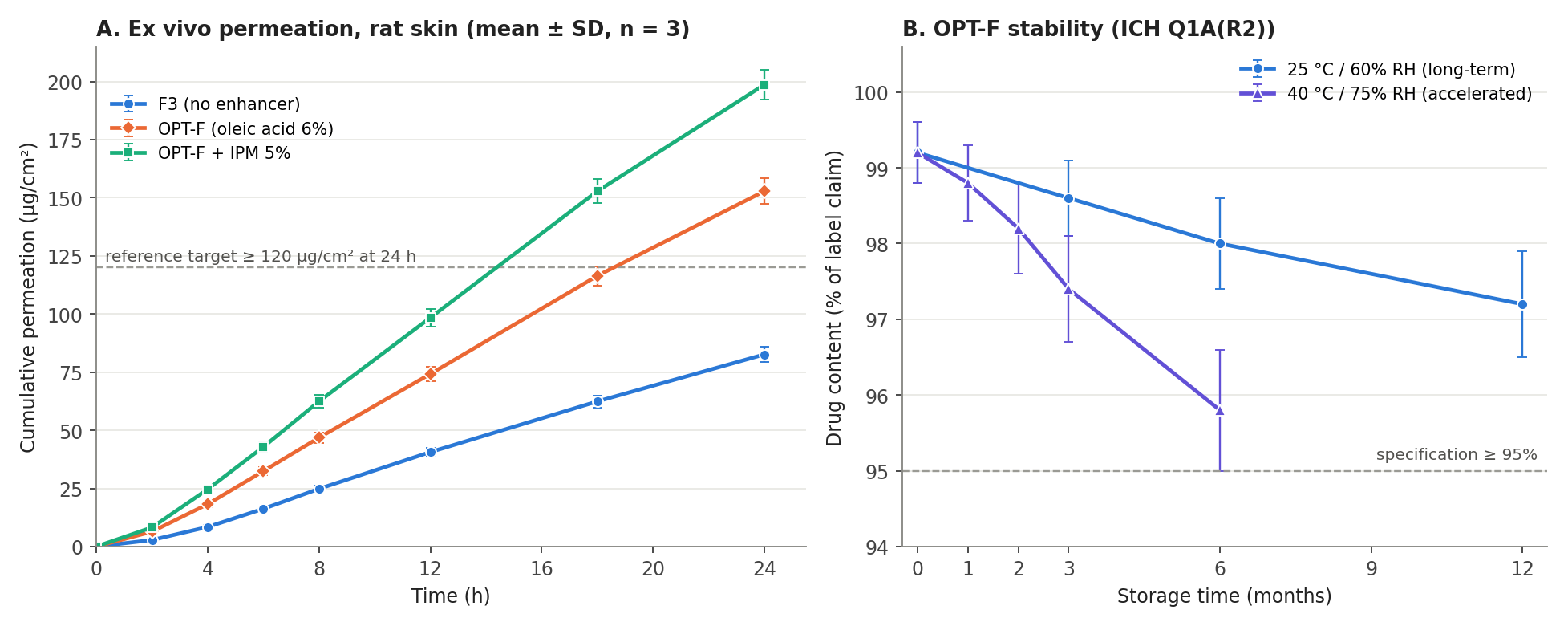
Through excised rat skin (transepidermal water loss 8.4 ± 1.2 g/m²/h; resistance 28.4 ± 2.6 kΩ·cm²), OPT-F delivered 152.8 ± 5.6 µg/cm² in 24 h compared with 82.6 ± 3.2 µg/cm² for the enhancer-free batch F3 (p < 0.001; Figure 2, panel A). The steady-state flux was 17.8 ± 0.9 versus 9.2 ± 0.6 µg/cm²/h, giving an enhancement ratio of 1.93, and lag time fell from 3.84 ± 0.28 to 2.14 ± 0.18 h. This is consistent with oleic acid forming a separate, fluid phase within stratum corneum lipids and disordering their packing [34,35]. It should be noted, however, that oleic acid ranked below several other fatty acids for aripiprazole in a gel across cadaver skin [13], so the enhancer choice has not been exhausted. In an exploratory comparator, adding 5% IPM raised flux to 24.6 ± 1.2 µg/cm²/h (ER 2.67) and shortened lag to 1.62 ± 0.14 h.
At the observed flux, a 20 cm² patch of OPT-F would deliver about 8.5 mg/day, which approaches but falls below the 10–15 mg/day oral range [3], whereas the IPM variant would deliver about 11.8 mg/day. This projection assumes sustained steady-state input and requires pharmacokinetic confirmation. Total skin retention was 31.6 ± 1.8 µg/cm² (stratum corneum 16.0, viable epidermis 9.4 and dermis 6.2 µg/cm²) against 22.8 ± 1.2 µg/cm² for F3, and recovery was 97.4 ± 2.4%. Drug held in the stratum corneum may act as a reservoir that sustains input between applications. Rat skin differs from human skin, and predictions from animal and ex vivo models to humans must be made with caution [36]; human or porcine skin and in vivo studies are therefore the logical next step.
| Attribute | Result | Criterion |
|---|---|---|
| Thickness; weight (10 cm²) | 286 ± 12 µm (CV 4.2%); 184.6 ± 4.2 mg | CV < 5%; RSD < 5% |
| Drug content; acceptance value | 99.2 ± 0.4%; 4.8 | 90–110%; AV ≤ 15 |
| Folding endurance; tensile strength; elongation | 354 ± 18; 4.08 ± 0.18 N/mm²; 42.6 ± 3.2% | ≥ 300; ≥ 3.5 N/mm²; ≥ 15% |
| Surface pH | 6.28 ± 0.08 | 5.5–7.0 |
| Moisture content; moisture uptake | 2.84 ± 0.22%; 6.12 ± 0.48% | < 5%; < 10% |
| WVTR; peel adhesion; loop tack | 18.4 ± 1.2 g/m²/day; 12.8 ± 0.9 N/25 mm; 3.6 ± 0.3 N | Peel ≥ 10 N/25 mm |
| Release at 24 h; Korsmeyer-Peppas n | 73.4 ± 1.6%; 0.58 (R² = 0.9912) | ≥ 70% |
| Permeation at 24 h; Jss; lag time; ER | 152.8 ± 5.6 µg/cm²; 17.8 ± 0.9 µg/cm²/h; 2.14 ± 0.18 h; 1.93 | Jss ≥ 15 µg/cm²/h |
| Skin retention; mass balance | 31.6 ± 1.8 µg/cm²; 97.4 ± 2.4% | Recovery ≥ 90% |
| 40 °C/75% RH, 6 months | Content 95.8 ± 0.8%; release 70.2 ± 2.2%; degradants 0.38% | ≥ 95%; ≥ 70%; ≤ 1.0% |
| 25 °C/60% RH, 12 months | Content 97.2 ± 0.7%; release 72.0 ± 2.0%; degradants 0.12% | ≥ 95%; ≥ 70%; ≤ 1.0% |
| Photostability (1.2 million lux·h) | Content 96.8 ± 0.6% (−2.4%); degradants 0.62%; yellowing | Change ≤ 5%; ≤ 1.0% |
| EpiDerm tissue viability | 82.4 ± 4.1% (oleic acid alone 74.6%; blank patch 94.2%) | ≥ 50% non-irritant |
| Draize PII (rabbit, n = 6) | 0.24 (blank patch 0.08) | 0–0.4 negligible |
3.6Stability and photostability
Under long-term conditions OPT-F was effectively unchanged over 12 months (Figure 2, panel B): drug content fell from 99.2 to 97.2%, 24 h release from 73.4 to 72.0% and total degradants reached only 0.12%. Under accelerated conditions content declined to 95.8 ± 0.8%, release to 70.2 ± 2.2% and tensile strength to 3.62 ± 0.24 N/mm², with degradants of 0.38%. Several attributes finished close to their limits, and folding endurance (302 ± 22) lay just above the minimum of 300, so the 6-month accelerated result should be regarded as passing narrowly. Mild yellowing, attributed to polymer discolouration, appeared from 2 months at 40 °C/75% RH. In the photostability study content fell by 2.4% and degradants reached 0.62%, within criteria, but the patch yellowed, so opaque packaging is essential. A provisional shelf life of up to 24 months is suggested, subject to real-time data.
3.7Skin tolerability and correlation
In the reconstructed epidermis model, OPT-F extract maintained tissue viability at 82.4 ± 4.1%, well above the 50% irritancy threshold, whereas the positive control (5% SDS) reduced viability to 14.8 ± 2.4%. The blank patch (94.2%) and oleic acid at 6% (74.6%) were also non-irritant. In rabbits, OPT-F produced a PII of 0.24, in the negligible category, with mild transient erythema (0.4) and oedema (0.2) at 24 h that had largely resolved by 72 h and no eschar, against 3.08 for the positive control (2% NaOH). Tolerability matters clinically, since application-site reactions occurred in about 14–15% of patients using an asenapine patch versus 4.4% with placebo [11]. EpiDerm with MTT alone has, however, shown a sensitivity of only 57% in an international validation study [37], so the in vitro result is best read alongside the in vivo data, and repeated-application and sensitisation studies in humans remain to be done.
Across the 17 runs, 24 h release and flux were strongly correlated (r = 0.94, n = 17, p < 0.001; flux = 0.224 × release + 1.91), supporting release testing as a screening tool for formulation ranking (Figure 1, panel B). It is a batch-level relationship and not a validated in vitro–in vivo correlation, which for patches requires plasma data [38].
4Conclusion
An HPMC:EC matrix patch of aripiprazole containing 22% PEG 400 and 6% oleic acid was optimised by Box-Behnken design and met its predefined targets for release (73.4 ± 1.6% in 24 h), flux (17.8 ± 0.9 µg/cm²/h), mechanical properties, stability and skin tolerability. Light sensitivity, the modest projected daily dose and the use of rat skin are the main limitations, and the next stages are permeation through human or porcine skin, evaluation of the isopropyl myristate combination and adhesive layer, and in vivo pharmacokinetic studies. If chemical enhancement proves insufficient to reach the required daily dose, physical barrier-disruption approaches such as microneedles, which have been reviewed extensively [39], offer a complementary route, although they would add device complexity and cost.
Conflict of interest
The authors declare that there is no conflict of interest.
Acknowledgement
The authors thank the Department of Pharmaceutics, SHEAT College of Pharmacy, Varanasi, for academic and laboratory support.
Author contributions
Arav Mishra: formulation development, experimental work, data analysis and drafting of the manuscript. Vishal Kumar Singh: conceptualisation, supervision and critical revision of the manuscript. Both authors have read and approved the final version.
References
- [1]Burris KD, Molski TF, Xu C, et al. Aripiprazole, a novel antipsychotic, is a high-affinity partial agonist at human dopamine D2 receptors. J Pharmacol Exp Ther. 2002;302(1):381–9. https://doi.org/10.1124/jpet.102.033175
- [2]Kane JM, Carson WH, Saha AR, McQuade RD, Ingenito GG, Zimbroff DL, et al. Efficacy and safety of aripiprazole and haloperidol versus placebo in patients with schizophrenia and schizoaffective disorder. J Clin Psychiatry. 2002;63(9):763–71.
- [3]Swainston Harrison T, Perry CM. Aripiprazole: a review of its use in schizophrenia and schizoaffective disorder. Drugs. 2004;64(15):1715–36. https://doi.org/10.2165/00003495-200464150-00010
- [4]Kim JR, Seo HB, Cho JY, Kang DH, Kim YK, Bahk WM, et al. Population pharmacokinetic modelling of aripiprazole and its active metabolite, dehydroaripiprazole, in psychiatric patients. Br J Clin Pharmacol. 2008;66(6):802–10. https://doi.org/10.1111/j.1365-2125.2008.03223.x
- [5]Hendset M, Hermann M, Lunde H, Refsum H, Molden E. Impact of the CYP2D6 genotype on steady-state serum concentrations of aripiprazole and dehydroaripiprazole. Eur J Clin Pharmacol. 2007;63(12):1147–51. https://doi.org/10.1007/s00228-007-0373-6
- [6]Haddad PM, Brain C, Scott J. Nonadherence with antipsychotic medication in schizophrenia: challenges and management strategies. Patient Relat Outcome Meas. 2014;5:43–62. https://doi.org/10.2147/PROM.S42735
- [7]Kishimoto T, Hagi K, Kurokawa S, Kane JM, Correll CU. Long-acting injectable versus oral antipsychotics for the maintenance treatment of schizophrenia: a systematic review and comparative meta-analysis of randomised, cohort, and pre-post studies. Lancet Psychiatry. 2021;8(5):387–404. https://doi.org/10.1016/S2215-0366(21)00039-0
- [8]Prausnitz MR, Langer R. Transdermal drug delivery. Nat Biotechnol. 2008;26(11):1261–8. https://doi.org/10.1038/nbt.1504
- [9]Bos JD, Meinardi MMHM. The 500 Dalton rule for the skin penetration of chemical compounds and drugs. Exp Dermatol. 2000;9(3):165–9. https://doi.org/10.1034/j.1600-0625.2000.009003165.x
- [10]Abruzzo A, Cerchiara T, Luppi B, Bigucci F. Transdermal delivery of antipsychotics: rationale and current status. CNS Drugs. 2019;33(9):849–65. https://doi.org/10.1007/s40263-019-00659-7
- [11]Citrome L, Walling DP, Zeni CM, Starling BR, Terahara T, Kuriki M, et al. Efficacy and safety of HP-3070, an asenapine transdermal system, in patients with schizophrenia: a phase 3, randomized, placebo-controlled study. J Clin Psychiatry. 2021;82(1):20m13602. https://doi.org/10.4088/JCP.20m13602
- [12]Iwata N, Ishigooka J, Kim WH, Yoon BH, Lin SK, Sulaiman AH, et al. Efficacy and safety of blonanserin transdermal patch in patients with schizophrenia: a 6-week randomized, double-blind, placebo-controlled, multicenter study. Schizophr Res. 2020;215:408–15. https://doi.org/10.1016/j.schres.2019.07.055
- [13]Hossain MA, Ahmed SU, Plakogiannis FM. Effect of vehicle systems, pH and enhancers on the permeation of highly lipophilic aripiprazole from Carbopol 971P gel systems across human cadaver skin. Drug Dev Ind Pharm. 2012;38(3):323–30. https://doi.org/10.3109/03639045.2011.602978
- [14]Latif MS, Azad AK, Nawaz A, Rashid SA, Rahman MH, Al Omar SY, et al. Ethyl cellulose and hydroxypropyl methyl cellulose blended methotrexate-loaded transdermal patches: in vitro and ex vivo. Polymers (Basel). 2021;13(20):3455. https://doi.org/10.3390/polym13203455
- [15]Nandi S, Mondal S. Fabrication and evaluation of matrix type novel transdermal patch loaded with tramadol hydrochloride. Turk J Pharm Sci. 2022;19(5):572–82. https://doi.org/10.4274/tjps.galenos.2021.43678
- [16]Williams AC, Barry BW. Penetration enhancers. Adv Drug Deliv Rev. 2004;56(5):603–18. https://doi.org/10.1016/j.addr.2003.10.025
- [17]Box GEP, Behnken DW. Some new three level designs for the study of quantitative variables. Technometrics. 1960;2(4):455–75. https://doi.org/10.1080/00401706.1960.10489912
- [18]Ferreira SLC, Bruns RE, Ferreira HS, Matos GD, David JM, Brandão GC, et al. Box-Behnken design: an alternative for the optimization of analytical methods. Anal Chim Acta. 2007;597(2):179–86. https://doi.org/10.1016/j.aca.2007.07.011
- [19]Yu LX. Pharmaceutical quality by design: product and process development, understanding, and control. Pharm Res. 2008;25(4):781–91. https://doi.org/10.1007/s11095-007-9511-1
- [20]International Council for Harmonisation. ICH Q2(R1): Validation of analytical procedures: text and methodology. Geneva: ICH; 2005.
- [21]Franz TJ. Percutaneous absorption. On the relevance of in vitro data. J Invest Dermatol. 1975;64(3):190–5. https://doi.org/10.1111/1523-1747.ep12533356
- [22]Higuchi T. Mechanism of sustained-action medication. Theoretical analysis of rate of release of solid drugs dispersed in solid matrices. J Pharm Sci. 1963;52(12):1145–9. https://doi.org/10.1002/jps.2600521210
- [23]Korsmeyer RW, Gurny R, Doelker E, Buri P, Peppas NA. Mechanisms of solute release from porous hydrophilic polymers. Int J Pharm. 1983;15(1):25–35. https://doi.org/10.1016/0378-5173(83)90064-9
- [24]Guth K, Schäfer-Korting M, Fabian E, Landsiedel R, van Ravenzwaay B. Suitability of skin integrity tests for dermal absorption studies in vitro. Toxicol In Vitro. 2015;29(1):113–23. https://doi.org/10.1016/j.tiv.2014.09.007
- [25]International Council for Harmonisation. ICH Q1A(R2): Stability testing of new drug substances and products. Geneva: ICH; 2003.
- [26]International Council for Harmonisation. ICH Q1B: Stability testing: photostability testing of new drug substances and products. Geneva: ICH; 1996.
- [27]OECD. Test No. 439: In vitro skin irritation: reconstructed human epidermis test method. OECD Guidelines for the Testing of Chemicals, Section 4. Paris: OECD Publishing; 2025. https://doi.org/10.1787/9789264242845-en
- [28]Draize JH, Woodard G, Calvery HO. Methods for the study of irritation and toxicity of substances applied topically to the skin and mucous membranes. J Pharmacol Exp Ther. 1944;82:377–90.
- [29]OECD. Test No. 404: Acute dermal irritation/corrosion. OECD Guidelines for the Testing of Chemicals, Section 4. Paris: OECD Publishing; 2015. https://doi.org/10.1787/9789264242678-en
- [30]Arora P, Mukherjee B. Design, development, physicochemical, and in vitro and in vivo evaluation of transdermal patches containing diclofenac diethylammonium salt. J Pharm Sci. 2002;91(9):2076–89. https://doi.org/10.1002/jps.10200
- [31]Wokovich AM, Prodduturi S, Doub WH, Hussain AS, Buhse LF. Transdermal drug delivery system (TDDS) adhesion as a critical safety, efficacy and quality attribute. Eur J Pharm Biopharm. 2006;64(1):1–8. https://doi.org/10.1016/j.ejpb.2006.03.009
- [32]Siepmann J, Peppas NA. Higuchi equation: derivation, applications, use and misuse. Int J Pharm. 2011;418(1):6–12. https://doi.org/10.1016/j.ijpharm.2011.03.051
- [33]Gannu R, Vishnu YV, Kishan V, Rao YM. Development of nitrendipine transdermal patches: in vitro and ex vivo characterization. Curr Drug Deliv. 2007;4(1):69–76. https://doi.org/10.2174/156720107779314767
- [34]Ongpipattanakul B, Burnette RR, Potts RO, Francoeur ML. Evidence that oleic acid exists in a separate phase within stratum corneum lipids. Pharm Res. 1991;8(3):350–4. https://doi.org/10.1023/A:1015845632280
- [35]Naik A, Pechtold LARM, Potts RO, Guy RH. Mechanism of oleic acid-induced skin penetration enhancement in vivo in humans. J Control Release. 1995;37(3):299–306. https://doi.org/10.1016/0168-3659(95)00088-7
- [36]Godin B, Touitou E. Transdermal skin delivery: predictions for humans from in vivo, ex vivo and animal models. Adv Drug Deliv Rev. 2007;59(11):1152–61. https://doi.org/10.1016/j.addr.2007.07.004
- [37]Spielmann H, Hoffmann S, Liebsch M, Botham P, Fentem JH, Eskes C, et al. The ECVAM international validation study on in vitro tests for acute skin irritation: report on the validity of the EPISKIN and EpiDerm assays and on the Skin Integrity Function Test. Altern Lab Anim. 2007;35(6):559–601.
- [38]Khire A, Vavia P. Bioavailability, bioequivalence, and in vitro-in vivo correlation of oxybutynin transdermal patch in rabbits. Drug Deliv Transl Res. 2014;4:105–15. https://doi.org/10.1007/s13346-013-0170-y
- [39]Alkilani AZ, McCrudden MTC, Donnelly RF. Transdermal drug delivery: innovative pharmaceutical developments based on disruption of the barrier properties of the stratum corneum. Pharmaceutics. 2015;7(4):438–70. https://doi.org/10.3390/pharmaceutics7040438