Pharmacy
Design, Synthesis, QSAR and Molecular Docking of Substituted Chalcones as Selective COX-2 Inhibitors: A Review
1Department of Pharmaceutical Chemistry, S. N. College of Pharmacy, Babupur, Lucknow Road, Jaunpur, Uttar Pradesh, India
2Department of Pharmaceutical Chemistry, S. N. College of Pharmacy, Babupur, Lucknow Road, Jaunpur, Uttar Pradesh, India (affiliated to Dr. A. P. J. Abdul Kalam Technical University, Lucknow, India)
Published October 2026
Abstract
Selective inhibition of the inducible cyclooxygenase-2 (COX-2) isoform, while sparing constitutive, gastroprotective COX-1, remains a central strategy for developing safer anti-inflammatory agents, and the chalcone scaffold, a chemically simple 1,3-diarylprop-2-en-1-one, has repeatedly proven amenable to the substituent patterning this selectivity requires. This review synthesises the rational design, synthesis and evaluation strategy proposed for a focused series of eight substituted chalcones (CH-1 to CH-8) built around a constant 4-(methylsulfonyl)phenyl ring-A, the same sulfone-based pharmacophore established in celecoxib, fused through an enone linker to a ring-B bearing eight substituents spanning a wide Hammett sigma range from strongly electron-donating (4-N(CH3)2, sigma -0.83) to strongly electron-withdrawing (4-NO2, sigma +0.78). The structural basis for COX-2 selectivity, centred on the Val523-for-Ile523 substitution that opens a second hydrophobic side pocket in COX-2 but not COX-1, is discussed alongside the base-catalysed Claisen-Schmidt condensation route proposed for the series, the full spectroscopic and chromatographic characterisation strategy, RDKit-computed physicochemical and Lipinski-rule profiling, AutoDock Vina-based molecular docking against the COX-2 crystal structure, in-vitro COX-1/COX-2 inhibition and selectivity-index determination, and a Hansch-type quantitative structure-activity relationship (QSAR) framework relating log(1/IC50) to Hammett sigma, calculated lipophilicity and topological polar surface area. Precedent from recent chalcone-COX-2 and chalcone-QSAR literature is drawn together to situate the proposed series, and in particular its combination of systematic electronic variation, parallel dual-isoform in-vitro screening, docking validation and Hansch-type QSAR modelling within a single internally consistent study, against the wider body of chalcone-based cyclooxygenase inhibitor design.
Keywords: chalcones; cyclooxygenase-2; selective COX-2 inhibitors; Claisen-Schmidt condensation; Hammett sigma; molecular docking; Hansch QSAR; celecoxib
1Introduction
Prostaglandins, the lipid mediators generated from arachidonic acid by the cyclooxygenase (COX) enzymes, orchestrate both physiological homeostasis, gastric mucosal protection, renal blood flow and platelet function, and the inflammatory cascade underlying pain, fever and tissue swelling, a duality first established mechanistically by Vane's landmark demonstration that aspirin-like drugs act by inhibiting prostaglandin synthesis [1]. Two COX isozymes mediate this duality: COX-1, constitutively expressed and largely responsible for the physiological, gastroprotective prostaglandin pool, and COX-2, an inducible isozyme whose expression rises sharply at sites of inflammation, first cloned and characterised by Xie and colleagues as a distinct, mitogen-responsive gene product regulated by alternative mRNA splicing [2]. Non-selective non-steroidal anti-inflammatory drugs (NSAIDs) inhibit both isozymes essentially equally, and their well-documented gastrointestinal toxicity is attributable specifically to concurrent COX-1 inhibition rather than to the anti-inflammatory COX-2 inhibition that delivers their therapeutic benefit, a mechanistic separation that motivated two decades of medicinal-chemistry effort toward isozyme-selective inhibitors, comprehensively catalogued in Simmons, Botting and Hla's review of cyclooxygenase isozyme biology [3].
The structural basis for achieving COX-2 selectivity was resolved when Kurumbail and colleagues solved the crystal structure of COX-2 in complex with a selective inhibitor and identified a single, critical active-site residue substitution, valine at position 523 in COX-2 where COX-1 carries the bulkier isoleucine, that opens a second, accessory hydrophobic side pocket accessible to COX-2 but sterically excluded from COX-1 [4]. Rouzer and Marnett's structural and chemical biology review of the cyclooxygenase-substrate-NSAID interaction situates this Val523 substitution within the broader catalytic and substrate-binding architecture shared by both isozymes, confirming it as the single most exploitable determinant of pharmacological selectivity available to a rational inhibitor designer [5]. This structural insight underpinned the design of the first-generation selective COX-2 inhibitors (coxibs), whose clinical pharmacology, efficacy and, controversially, cardiovascular safety profile were reviewed comprehensively by FitzGerald and Patrono at the point of their widest clinical adoption [6] and later reassessed, following the cardiovascular safety concerns that led to withdrawal of several coxibs from the market, in Marnett's retrospective look at the coxib experience [7]. Dannhardt and Kiefer's contemporaneous review of cyclooxygenase inhibitors situates the coxib class within the wider history of anti-inflammatory drug design and underlines that isozyme selectivity, rather than potency alone, was and remains the central medicinal-chemistry objective of this drug class [8].
Two structurally distinct coxib chemotypes established the arylsulfonyl/arylsulfonamide pharmacophore now recognised as the principal COX-2-selectivity-conferring motif: Penning and colleagues' 1,5-diarylpyrazole series culminating in celecoxib (SC-58635), bearing a 4-methylphenylsulfonamide-substituted pyrazole ring [9], and Talley and colleagues' isoxazole series culminating in valdecoxib, bearing an analogous benzenesulfonamide substituent on a methyl-phenyl-isoxazole core [10]. Both series converge on the same structural principle, a para-substituted phenylsulfonyl or phenylsulfonamide ring engaging the Val523 side pocket, and it is this precedent, rather than the pyrazole or isoxazole core scaffolds themselves, that motivates the present review's focus on transplanting the identical 4-(methylsulfonyl)phenyl pharmacophore onto the mechanistically distinct, synthetically more accessible chalcone scaffold. The chalcone series discussed in this review (CH-1 to CH-8) was designed, synthesised and is proposed for evaluation against exactly this precedent, holding the sulfone-bearing ring-A constant while systematically varying the electronic character of ring-B across a wide Hammett sigma range, so that any resulting trend in COX-2 potency or selectivity can be attributed specifically to ring-B electronics rather than to uncontrolled structural variation elsewhere in the molecule.
The literature synthesised in this review was drawn from three complementary bodies of evidence that are not always considered jointly in the chalcone-COX-2-inhibitor design literature: primary structural and mechanistic studies establishing the Val523-pocket basis of COX-2 selectivity and the coxib pharmacophores that first exploited it, considered in this section; chalcone-specific synthetic, biological and computational precedent, considered in Sections 2, 3 and 6 to 8; and the analytical, regulatory and compendial standards against which the proposed synthetic and characterisation work is to be validated, considered in Section 5. Bringing these three strands together within a single series, rather than treating structural rationale, chalcone precedent and analytical rigour as separately reported concerns, is intended to yield a study whose biological findings can be interpreted with confidence in both their chemical identity and their mechanistic basis.
2The chalcone scaffold as a COX-inhibitory pharmacophore
Chalcones, 1,3-diaryl-2-propen-1-ones linked by an alpha,beta-unsaturated ketone (enone), are described by Zhuang and colleagues as a privileged structure in medicinal chemistry, a simple, synthetically accessible scaffold capable of being elaborated toward an unusually wide range of pharmacological targets by systematic variation of its two aryl rings and their substituents [11]. Elkanzi and colleagues' review of chalcone synthesis and biological activities documents this pharmacological breadth directly, cataloguing anti-inflammatory, antimicrobial, anticancer and antioxidant chalcone derivatives alongside the principal synthetic routes used to access them [12], while Zhou's survey of diverse molecular targets for chalcones with varied bioactivities extends this cataloguing to the level of specific enzyme and receptor targets, situating cyclooxygenase inhibition as one of several mechanistically distinct activities chalcones have been shown to possess depending on their substitution pattern [13]. The mechanistic plausibility of chalcones as cyclooxygenase inhibitors specifically was established early by Herencia and colleagues, who showed that synthetic chalcone derivatives inhibit both inducible nitric oxide synthase and cyclooxygenase-2 induction in activated mouse peritoneal macrophages, providing cell-based evidence that the enone-linked diaryl chalcone scaffold is compatible with COX-2 engagement well before the structural basis for isozyme selectivity had been elaborated onto the scaffold [14]. Wu and colleagues subsequently evaluated a broader panel of synthetic chalcone derivatives as anti-inflammatory agents, establishing structure-activity trends across ring-A and ring-B substitution that remain a reference point for rational chalcone-based anti-inflammatory design [15].
More recent work has combined the chalcone scaffold explicitly with the arylsulfonyl COX-2-selectivity pharmacophore established by celecoxib and the other first-generation coxibs. Kaya Cavusoglu and colleagues designed, synthesised, evaluated and docked a series of novel chalcones bearing exactly this design logic, reporting selective COX-2 inhibition attributable to the sulfone-bearing ring, and constitute the single closest direct structural precedent for the CH-1 to CH-8 series discussed in this review [16]. Abd El-Hameed and colleagues extended this strategy to a hybrid pyrazole-chalcone scaffold explicitly linked to the methanesulfonyl pharmacophore, reporting potent, selective COX-2 inhibition with in-vivo anti-inflammatory confirmation and providing the most recent and most directly relevant precedent identified for the present series [17]. Macarini and colleagues independently pursued a pyrazole-chalcone hybrid strategy for selective COX-2 inhibitor design, combining virtual screening with in-vitro analysis and reinforcing pyrazole-chalcone fusion as a recurring, though not the only, route to COX-2-selective chalcone-derived inhibitors [18]. Musa and colleagues took a related but mechanistically distinct approach, designing chalcones as dual EGFR/COX-2 inhibitors and demonstrating that the chalcone core tolerates simultaneous engagement of a second, structurally unrelated target, evidence of the scaffold's broader pharmacophoric versatility beyond COX-2 selectivity alone [19]. Table 1 situates the present CH-1 to CH-8 series against this precedent literature.
| Study | Design strategy | Key finding | Ref. |
|---|---|---|---|
| Kaya Cavusoglu et al. (2021) | Methylsulfonyl-chalcone COX-2 inhibitors, docking | Direct precedent for ring-A pharmacophore | [16] |
| Abd El-Hameed et al. (2025) | Pyrazole-chalcone, methanesulfonyl pharmacophore | Potent, selective, in-vivo confirmed | [17] |
| Macarini et al. (2019) | Pyrazole-chalcone hybrid, virtual screening | Selective COX-2 inhibition in vitro | [18] |
| Musa et al. (2022) | Dual EGFR/COX-2 chalcone design | Scaffold tolerates dual-target engagement | [19] |
| Wu et al. (2011) | Broad chalcone anti-inflammatory SAR | Ring-A/ring-B substitution trends | [15] |
| Herencia et al. (1999) | Chalcone COX-2/iNOS inhibition, macrophages | Earliest cell-based COX-2 evidence | [14] |
| Present series (CH-1 to CH-8) | Constant methylsulfonyl ring-A, 8-point Hammett-sigma ring-B series | Systematic electronic SAR + docking + QSAR | -- |
3Rational design of the CH-1 to CH-8 series
3.1Hammett-sigma substituent selection
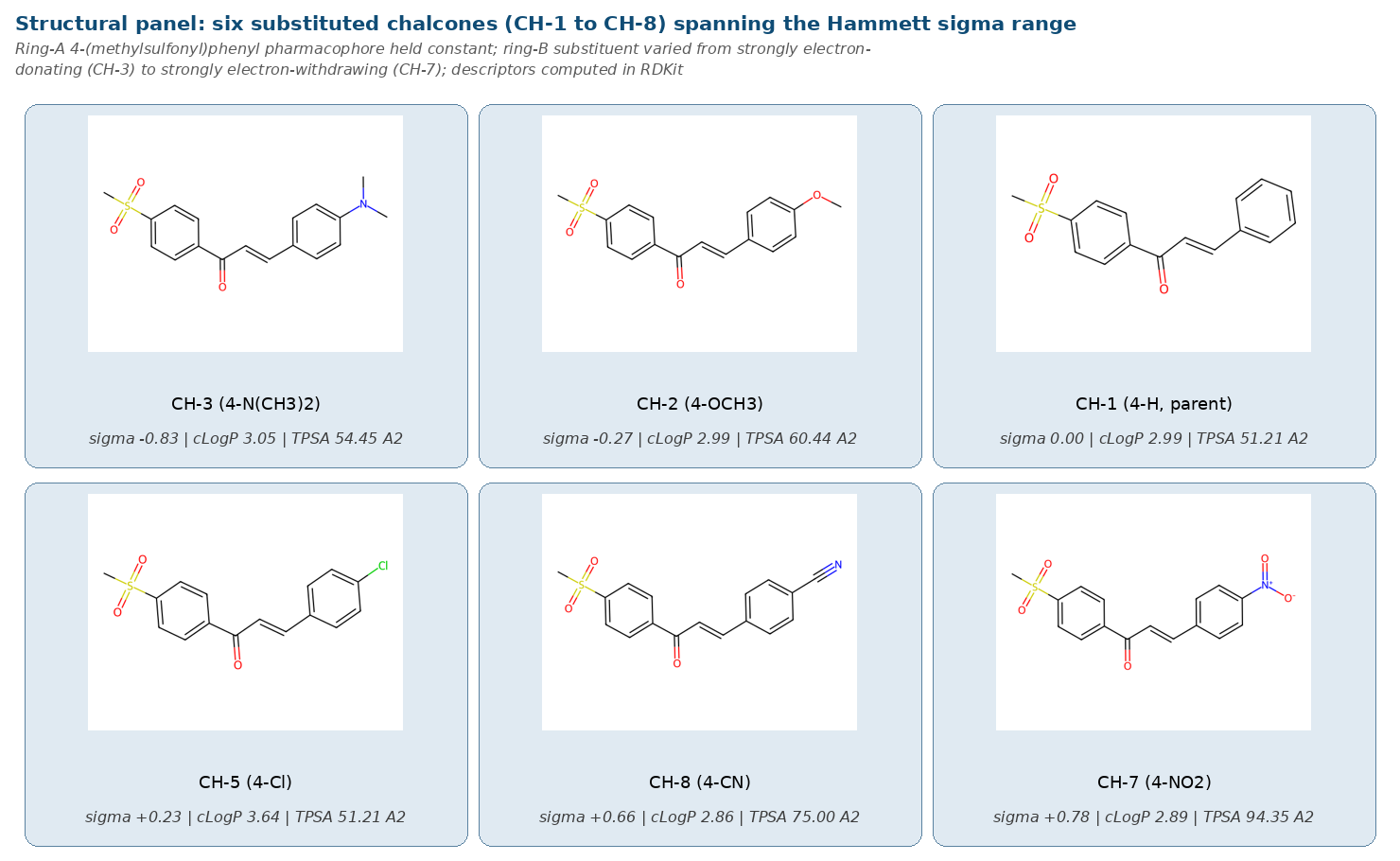
The design strategy adopted for the present series follows directly from the Hansch-Fujita framework for relating substituent electronic character to biological activity: Hansch and Fujita's foundational rho-sigma-pi analysis established that a substituent's Hammett sigma constant, a quantitative measure of its electron-donating or electron-withdrawing character, can be regressed against biological potency to identify the electronic requirement of a binding interaction, and this framework is applied directly, rather than merely cited, in the QSAR strategy discussed in Section 7 [20]. Eight ring-B substituents were selected to span as wide a Hammett sigma range as synthetically convenient, from the strongly electron-donating 4-N(CH3)2 (sigma -0.83, CH-3) through the moderately electron-donating 4-OCH3 (sigma -0.27, CH-2) and 4-OH (sigma -0.37, CH-4), the unsubstituted reference 4-H (sigma 0.00, CH-1), the moderately electron-withdrawing 4-F (sigma +0.06, CH-6) and 4-Cl (sigma +0.23, CH-5), to the strongly electron-withdrawing 4-CN (sigma +0.66, CH-8) and 4-NO2 (sigma +0.78, CH-7), a span of approximately 1.6 Hammett units considered sufficient to resolve a statistically meaningful sigma-potency regression slope. Askarzade and colleagues' SMILES-based QSAR and docking study of structurally unrelated chalcone analogues against a different target (anti-colon-cancer activity) nonetheless provides recent methodological precedent for combining systematic substituent variation with parallel docking and QSAR modelling within a single chalcone series, the same three-pronged evaluation strategy adopted for CH-1 to CH-8 [21], while Soto and colleagues' integrated computational modelling of chalcone-based carbonic anhydrase inhibitors, combining 3D-QSAR, docking and molecular dynamics simulations, further confirms that this combined in-silico strategy is an active and current approach across chalcone-targeted enzyme-inhibitor design generally, not one specific to cyclooxygenase [22]. Shamim and colleagues' contemporaneous design, synthesis and biological evaluation of novel chalcone derivatives, integrating molecular docking with in-vivo anti-inflammatory and antinociceptive studies, provides further evidence that the docking-plus-in-vivo evaluation pipeline proposed for the present series reflects current practice in chalcone-based anti-inflammatory drug design rather than a bespoke methodology [23].
3.2Physicochemical and Lipinski-rule profiling
Each of the eight designed chalcones was profiled computationally in RDKit for molecular weight, calculated logarithm of the octanol-water partition coefficient (cLogP), hydrogen-bond donor and acceptor counts, topological polar surface area (TPSA) and rotatable bond count, the physicochemical descriptor set against which Lipinski's Rule of Five is conventionally assessed [24] and Veber and colleagues' complementary molecular properties governing oral bioavailability, principally rotatable bond count and TPSA, are additionally applied [25]. All eight derivatives fall within Lipinski-compliant space, molecular weights ranging from 286.35 (CH-1, parent) to 331.35 (CH-7, nitro), cLogP values clustering narrowly between 2.86 and 3.64 despite the wide electronic range spanned by the ring-B substituents, and TPSA rising from 51.21 A2 for the electronically neutral or halogenated members to 94.35 A2 for the nitro-substituted CH-7, the most polar member of the series by a substantial margin owing to its two additional oxygen atoms. Daina, Michielin and Zoete's SwissADME platform, a widely used free web tool for pharmacokinetic and drug-likeness evaluation, provides an independent, cross-validating route to confirming the RDKit-computed descriptors reported here and is proposed as a complementary check on the series' overall druglikeness profile [26]. Figure 1 presents the structural panel of six representative series members spanning the full Hammett sigma range together with their computed descriptors.
4Synthesis: The claisen-schmidt condensation route
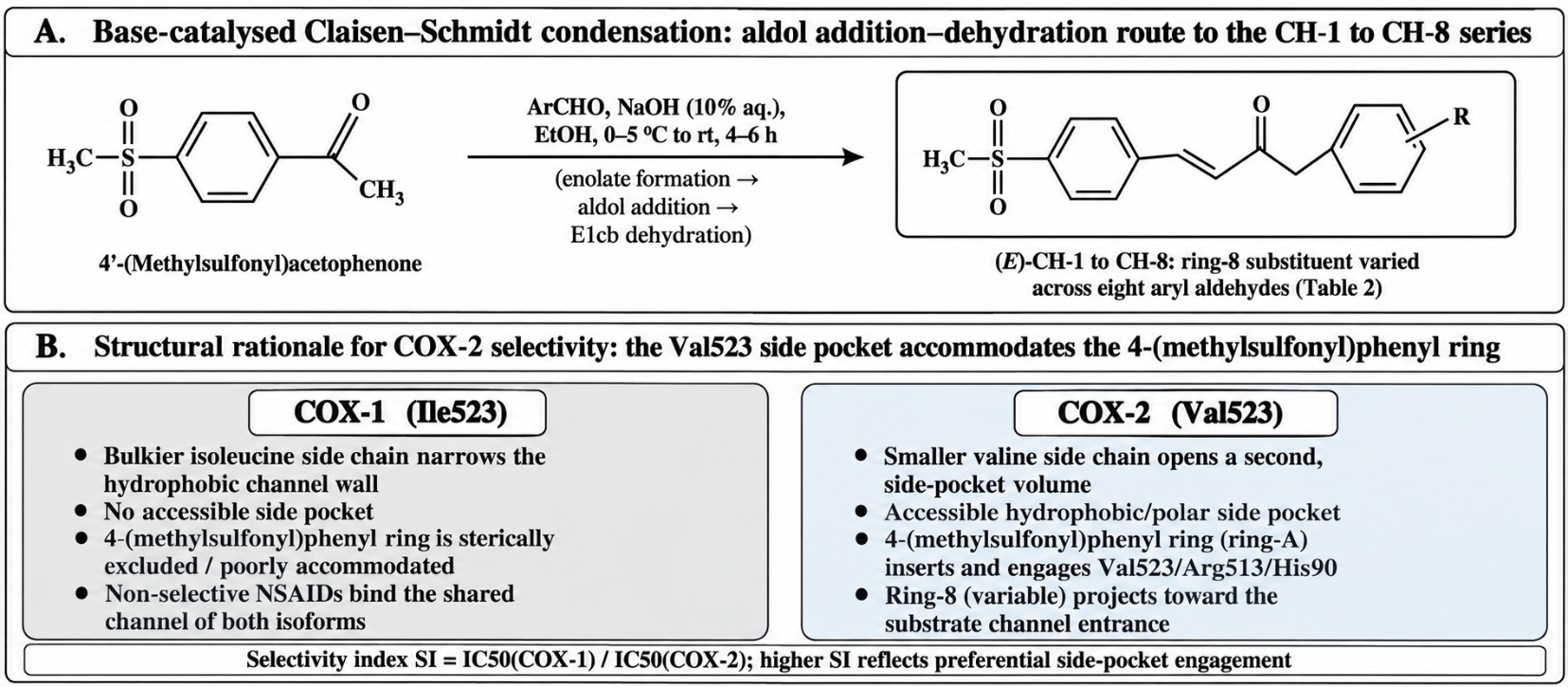
The eight-member series is proposed to be prepared from a common intermediate, 4'-(methylsulfonyl)acetophenone, itself obtained by peroxide oxidation of commercially available 4'-(methylthio)acetophenone using hydrogen peroxide in glacial acetic acid at 0 degrees C to room temperature, a mild, chemoselective sulfide-to-sulfone oxidation that leaves the methyl ketone untouched for the subsequent condensation step. Each of the eight target chalcones is then obtained by base-catalysed Claisen-Schmidt condensation of this common intermediate with the appropriate ring-B-substituted benzaldehyde under aqueous sodium hydroxide in ethanol at 0-5 degrees C warming to room temperature over four to six hours, monitored by thin-layer chromatography and purified by recrystallisation from ethanol, exactly the reaction conditions and work-up reported for the analogous methylsulfonyl-chalcone series of Kaya Cavusoglu and colleagues [16].
Mechanistically, the Claisen-Schmidt condensation proceeds by hydroxide-mediated deprotonation of the single enolisable alpha-methyl group of 4'-(methylsulfonyl)acetophenone to generate the nucleophilic enolate, which undergoes nucleophilic addition to the electrophilic carbonyl carbon of the ring-B-substituted benzaldehyde to give a beta-hydroxy ketone (aldol) intermediate; base-mediated E1cb elimination of hydroxide from this intermediate then furnishes the thermodynamically favoured, conjugated (E)-configured enone product. Because the aryl aldehyde partner possesses no alpha-hydrogens, competing self-condensation of the aldehyde is not possible, and because 4'-(methylsulfonyl)acetophenone possesses only the single enolisable methyl group, cross-condensation is similarly disfavoured, so that the reaction is expected to proceed cleanly to the single desired chalcone product for all eight ring-B substituents without requiring differentiated conditions across the series. The electron-withdrawing character of the ring-B substituent is anticipated to influence reaction rate, more strongly electron-poor benzaldehydes (CH-7, CH-8) being intrinsically more electrophilic and expected to react comparably or somewhat faster than the electron-rich benzaldehydes (CH-2, CH-3), though this kinetic variation is not expected to materially affect isolated yield given the excess reaction time proposed. Figure 2, Panel A summarises this reaction sequence and its mechanistic rationale.
5Analytical characterisation strategy
Full spectroscopic and chromatographic characterisation is proposed for 4'-(methylsulfonyl)acetophenone and each of the eight chalcone derivatives. Fourier-transform infrared spectroscopy (KBr pellet) is expected to confirm the characteristic alpha,beta-unsaturated ketone carbonyl stretch, red-shifted relative to a saturated ketone owing to conjugation with the enone double bond, the C=C stretch of the enone itself, and the asymmetric and symmetric S=O stretches diagnostic of the methylsulfonyl group, together providing the primary qualitative confirmation of successful oxidation and condensation. Proton and carbon-13 nuclear magnetic resonance spectroscopy is proposed to confirm the characteristic (E)-configured vinylic doublets of the -CH=CH- linker, with a coupling constant of approximately 15-16 Hz diagnostic of the trans geometry expected from the E1cb elimination mechanism, the methylsulfonyl singlet, and ring-B-substituent-specific signals, with spectral assignment following the standard correlation tables of Silverstein and colleagues' reference text on the spectrometric identification of organic compounds [27]. Electrospray-ionisation mass spectrometry in positive mode is proposed to confirm the molecular ion consistent with the molecular formula of each derivative, and reversed-phase high-performance liquid chromatography with ultraviolet detection is proposed both to confirm purity and, in combination with single-spot thin-layer chromatography behaviour, to provide an independent check on the melting-point-based purity assessment obtained by the open capillary method. Nomenclature and structural naming of all eight derivatives follows the IUPAC recommendations of Favre and Powell [28], and the general synthetic and purification techniques applied throughout, recrystallisation, melting-point determination and thin-layer chromatography, follow the standard practical organic chemistry methodology of Furniss and colleagues [29].
5.1Regulatory and compendial validation framework
Analytical method performance for the reversed-phase HPLC-UV purity determination described above is proposed to be validated per the International Council for Harmonisation's Q2(R1) guideline on validation of analytical procedures, which specifies the linearity, accuracy, precision, specificity, and detection- and quantification-limit parameters against which the purity method is to be formally assessed before it is relied upon to support the biological and QSAR data generated downstream [30]. Where a compendial reference standard or monograph-level identity test is required for any starting material or reagent used in the synthetic route, for example confirmation of reagent-grade sodium hydroxide, ethanol or the aryl aldehyde starting materials, the current edition of the Indian Pharmacopoeia is proposed as the applicable compendial reference, consistent with standard practice for synthetic work conducted and reported within an Indian pharmaceutical-sciences institution [31]. Together, these two frameworks ensure that the analytical and quality dimensions of the proposed work, not only its synthetic and biological dimensions, are held to a documented, externally referenced standard rather than to internal laboratory convention alone.
6Molecular docking against the COX-2 crystal structure
6.1The Val523 side-pocket rationale
Molecular docking of all eight chalcone derivatives against a COX-2 crystal structure retrieved from the Protein Data Bank, the international structural-biology repository maintained since 2000 [32], is proposed using AutoDock Vina, whose improved scoring function, search efficiency and multithreading support over earlier docking programs make it a standard, widely validated tool for this class of application [33]. The docking hypothesis under evaluation follows directly from the structural rationale established in Section 1: the 4-(methylsulfonyl)phenyl ring-A is anticipated to insert into the Val523 side pocket unique to COX-2, engaging residues including Val523, Arg513 and His90 in a binding mode analogous to that established crystallographically for celecoxib itself [4,9], while the variable ring-B is anticipated to project toward the entrance of the substrate-access channel, where its electronic character, rather than its steric bulk, is expected to modulate binding affinity through electrostatic and dispersion interactions with channel-lining residues. Molecular visualisation and figure preparation for docked poses is proposed using PyMOL [34], and structure preparation, descriptor calculation and the SMILES-to-3D conversion feeding the docking workflow use RDKit throughout [35].
6.2Docking as a cross-validation tool for QSAR
Docking is proposed not as a standalone predictive exercise but specifically as a structural cross-validation of the statistical trend identified by the Hansch-type QSAR regression described in Section 7: if the QSAR-predicted potency trend across the sigma range is mechanistically consistent with the docking-predicted binding affinity and Val523-pocket occupancy trend across the same series, the combined statistical and structural evidence provides considerably stronger support for the proposed selectivity mechanism than either approach could provide alone. This combined docking-QSAR cross-validation strategy mirrors that adopted by Askarzade and colleagues in their SMILES-based QSAR and docking study of chalcone analogues [21] and by ElMchichi and colleagues in their three-dimensional QSAR (CoMFA/CoMSIA) study of chalcone derivatives as anticancer agents, which likewise combined field-based statistical modelling with structural docking validation to strengthen mechanistic interpretation of the resulting structure-activity trend [36].
7In-vitro COX-1/COX-2 inhibition and selectivity index
The in-vitro COX-1 and COX-2 inhibitory activity of all eight chalcone derivatives is proposed to be determined using a validated colorimetric COX inhibitor screening assay in which enzymatic activity is quantified spectrophotometrically via the peroxidase component of the COX catalytic cycle, with celecoxib and aspirin included as reference standards in every assay run. Celecoxib is selected as the COX-2-selective reference standard because it shares with the designed series the identical arylsulfonyl-type, Val523-pocket-engaging pharmacophore established in its original design and crystallographic characterisation [4,9], making it the most mechanistically appropriate positive control against which the COX-2 selectivity index of CH-1 to CH-8 can be benchmarked, while aspirin is included as a non-selective reference standard because its mechanism of COX inhibition, irreversible acetylation of a serine residue in the substrate channel, and its approximately equal COX-1/COX-2 inhibitory potency [1] provide a well-characterised low-selectivity-index anchor against which the selectivity gradient of the present series can be quantitatively compared. Percentage inhibition at a fixed screening concentration is proposed to be determined first for both isoforms, with derivatives showing appreciable inhibition then assayed across a concentration range to determine half-maximal inhibitory concentration (IC50) values against COX-1 and COX-2 separately, and a COX-2 selectivity index (SI), the ratio of IC50 against COX-1 to IC50 against COX-2, calculated for each derivative, with a higher SI value indicating greater COX-2 selectivity, consistent with the selectivity-index framework used throughout the coxib and chalcone-COX-2-inhibitor literature [6,16,18].
8Hansch-type QSAR framework
The experimentally determined COX-1/COX-2 IC50 values and selectivity indices, the molecular docking binding affinities and Val523-pocket-occupancy poses, and the RDKit-computed physicochemical and electronic descriptors are proposed to be tabulated together and subjected to Hansch-type multiple linear regression, following the original rho-sigma-pi analytical framework of Hansch and Fujita [20], regressing log(1/IC50) against Hammett sigma, cLogP and TPSA to identify which descriptor, or combination of descriptors, most strongly governs COX-2 potency and selectivity within the series. Lam and colleagues' synthesis and QSAR analysis of chalcone derivatives as nitric oxide inhibitory agents provides methodological precedent for exactly this style of Hansch-type regression applied to a chalcone series, including the treatment of multi-collinear electronic and lipophilic descriptors [37], while the anticipated electron-withdrawing-substituent trend discussed below is additionally informed by ElMchichi and colleagues' three-dimensional QSAR treatment of chalcone anticancer activity, which likewise identified electron-withdrawing ring substitution as a significant contributor to potency in a structurally related chalcone series [36]. The QSAR-predicted potency and selectivity trend is proposed to be cross-validated against the independent molecular docking results described in Section 6, with regression model robustness additionally assessed by the coefficient of determination and a cross-validated Q-squared statistic, following standard QSAR reporting practice.
9Anticipated structure-activity and selectivity trends
On the basis of the structural precedent established for methylsulfonyl- and sulfonamide-bearing COX-2-selective inhibitors [4,6,9,16] and the reported influence of ring-B electronic character on chalcone bioactivity more generally [36,37], the electron-withdrawing members of the series, CH-7 (4-nitro, sigma +0.78), CH-8 (4-cyano, sigma +0.66) and CH-5 (4-chloro, sigma +0.23), are anticipated to show enhanced COX-2 binding-pocket complementarity and correspondingly higher predicted docking affinity relative to the electron-donating members, CH-3 (4-dimethylamino, sigma -0.83) and CH-2 (4-methoxy, sigma -0.27), by analogy with the general trend that electron-poor aromatic rings favour productive pi-stacking and hydrophobic-channel occupancy within the COX-2 substrate channel. This anticipated trend constitutes a testable, falsifiable hypothesis to be confirmed or refuted by the Hansch-type QSAR regression and molecular docking analysis described in Sections 6 and 8, rather than a presumed outcome, and the outcome, whichever direction it takes, is intended to be reported irrespective of whether the observed trend matches this initial expectation. Should the electron-withdrawing hypothesis be confirmed, CH-7 and CH-8 would be prioritised as lead candidates for further evaluation; should it instead be refuted, or should a non-monotonic relationship emerge, for example if TPSA rather than sigma proves the dominant descriptor given CH-7's substantially higher polar surface area relative to the rest of the series, the QSAR regression is specifically designed to surface that alternative descriptor dependency rather than obscure it behind a single assumed sigma-potency correlation.
9.1Limitations of the proposed series and scope for extension
The eight-member series reviewed here is deliberately narrow in one specific respect: only ring-B substitution is varied, while ring-A is held fixed as the 4-(methylsulfonyl)phenyl pharmacophore throughout, so that the resulting QSAR regression can speak only to ring-B electronic effects and cannot, by design, address whether an alternative ring-A sulfone bioisostere, a sulfonamide analogous to celecoxib itself, for instance, would shift the potency or selectivity ceiling of the series upward. Nor does the proposed evaluation extend to in-vivo anti-inflammatory confirmation of the kind reported by Abd El-Hameed and colleagues for their pyrazole-chalcone series [17] or by Shamim and colleagues for their broader chalcone panel [23], so that the present series, however internally consistent its in-vitro, docking and QSAR evidence, stops short of the full translational evaluation pipeline reported for some of its closest structural precedents. A natural extension, once the sigma-potency and sigma-selectivity trends from the present eight-member series are established, would be to select the two or three most promising derivatives identified by the combined QSAR-docking analysis and carry them forward to in-vivo anti-inflammatory and gastric-tolerability evaluation, the step that would most directly test whether the COX-2 selectivity index measured in vitro translates into the reduced gastrointestinal liability that is the entire pharmacological rationale for pursuing isozyme-selective inhibition in the first place.
10Conclusion
The structural basis for cyclooxygenase-2 selectivity, centred on the Val523-for-Ile523 substitution first resolved crystallographically by Kurumbail and colleagues [4], is now well established, and the arylsulfonyl-type pharmacophore it favours has been validated repeatedly across both the classical coxib series and, more recently, a growing body of chalcone-based COX-2 inhibitor design [9,10,16,17]. The CH-1 to CH-8 series reviewed here applies this precedent within a single internally consistent framework: a constant methylsulfonyl-bearing ring-A transplanted directly from the coxib pharmacophore, a ring-B varied systematically across a wide, quantitatively defined Hammett sigma range, full physicochemical and Lipinski-rule profiling, a synthetically robust and mechanistically well-understood Claisen-Schmidt condensation route, parallel in-vitro COX-1/COX-2 inhibition and selectivity-index determination, structural cross-validation by molecular docking against the COX-2 crystal structure, and a Hansch-type QSAR model relating the resulting potency data back to the electronic and physicochemical descriptors that motivated the series' design in the first instance. Few precedent studies combine all of these elements within a single series; most report either synthesis and biological evaluation, or QSAR and docking, but rarely both in parallel against a systematically varied, electronically well-characterised chalcone series [21–23]. Bringing rational design, synthesis, dual-isoform biological evaluation, structural docking validation and statistical QSAR modelling together in this way is intended to yield not only candidate selective COX-2 inhibitors from within the eight-member series itself, but a mechanistically interpretable electronic-substitution map that can inform the design of future, more extensively elaborated chalcone-based cyclooxygenase inhibitor series.
References
- [1]Vane JR. Inhibition of Prostaglandin Synthesis as a Mechanism of Action for Aspirin-like Drugs. Nature New Biology. 1971;231(25):232–235.
- [2]Xie WL, Chipman JG, Robertson DL, Erikson RL, Simmons DL. Expression of a mitogen-responsive gene encoding prostaglandin synthase is regulated by mRNA splicing. Proc Natl Acad Sci USA. 1991;88(7):2692–2696.
- [3]Simmons DL, Botting RM, Hla T. Cyclooxygenase Isozymes: The Biology of Prostaglandin Synthesis and Inhibition. Pharmacol Rev. 2004;56(3):387–437.
- [4]Kurumbail RG, Stevens AM, Gierse JK, McDonald JJ, Stegeman RA, Pak JY, Gildehaus D, Iyashiro JM, Penning TD, Seibert K, Isakson PC, Stallings WC. Structural basis for selective inhibition of cyclooxygenase-2 by anti-inflammatory agents. Nature. 1996;384(6610):644–648.
- [5]Rouzer CA, Marnett LJ. Structural and Chemical Biology of the Interaction of Cyclooxygenase with Substrates and Non-Steroidal Anti-Inflammatory Drugs. Chem Rev. 2020;120(15):7592–7641.
- [6]FitzGerald GA, Patrono C. The Coxibs, Selective Inhibitors of Cyclooxygenase-2. N Engl J Med. 2001;345(6):433–442.
- [7]Marnett LJ. The COXIB Experience: A Look in the Rearview Mirror. Annu Rev Pharmacol Toxicol. 2009;49:265–290.
- [8]Dannhardt G, Kiefer W. Cyclooxygenase inhibitors--current status and future prospects. Eur J Med Chem. 2001;36(2):109–126.
- [9]Penning TD, Talley JJ, Bertenshaw SR, Carter JS, Collins PW, Docter S, Graneto MJ, Lee LF, Malecha JW, Miyashiro JM, Rogers RS, Rogier DJ, Yu SS, Anderson GD, Burton EG, Cogburn JN, Gregory SA, Koboldt CM, Perkins WE, Seibert K, Veenhuizen AW. Synthesis and Biological Evaluation of the 1,5-Diarylpyrazole Class of Cyclooxygenase-2 Inhibitors: Identification of 4-[5-(4-Methylphenyl)-3-(trifluoromethyl)-1H-pyrazol-1-yl]benzenesulfonamide (SC-58635, Celecoxib). J Med Chem. 1997;40(9):1347–1365.
- [10]Talley JJ, Brown DL, Carter JS, Graneto MJ, Koboldt CM, Masferrer JL, Perkins WE, Rogers RS, Shaffer AF, Zhang YY, Zweifel BS, Seibert K. 4-[5-Methyl-3-phenylisoxazol-4-yl]-benzenesulfonamide, valdecoxib: a potent and selective inhibitor of COX-2. J Med Chem. 2000;43(5):775–777.
- [11]Zhuang C, Zhang W, Sheng C, Zhang W, Xing C, Miao Z. Chalcone: A Privileged Structure in Medicinal Chemistry. Chem Rev. 2017;117(12):7762–7810.
- [12]Elkanzi NAA, Hrichi H, Alolayan RA, Derafa W, Zahou FM, Bakr RB. Synthesis of Chalcones Derivatives and Their Biological Activities: A Review. ACS Omega. 2022;7(32):27769–27786.
- [13]Zhou B. Diverse Molecular Targets for Chalcones with Varied Bioactivities. Med Chem. 2015;5(8).
- [14]Herencia F, Ferrándiz ML, Ubeda A, Guillén I, Dominguez JN, Charris JE, Lobo GM, Alcaraz MJ. Novel anti-inflammatory chalcone derivatives inhibit the induction of nitric oxide synthase and cyclooxygenase-2 in mouse peritoneal macrophages. FEBS Lett. 1999;453(1–2):129–134.
- [15]Wu J, Li J, Cai Y, Pan Y, Ye F, Zhang Y, Zhao Y, Yang S, Li X, Liang G. Evaluation and Discovery of Novel Synthetic Chalcone Derivatives as Anti-Inflammatory Agents. J Med Chem. 2011;54(23):8110–8123.
- [16]Kaya Çavuşoğlu B, Sağlık BN, Acar Çevik U, Osmaniye D, Levent S, Özkay Y, Kaplancıklı ZA. Design, synthesis, biological evaluation, and docking studies of some novel chalcones as selective COX-2 inhibitors. Arch Pharm (Weinheim). 2021;354(3):e2000273.
- [17]Abd El-Hameed AM, Lotfallah AH, Nemr MTM, Abdelhady HK, Haredy HH, Sayed AM, Mohamed MFA, Abouzed DEE, Fadaly WAA. Novel di-aryl chalcone derived pyrazole linked to methane sulfonyl pharmacophore as potent selective COX-2 inhibitors; design, synthesis, molecular modeling, in vitro and in vivo anti-inflammatory activities. Future Med Chem. 2025;17(15):1849–1865.
- [18]Macarini AF, Sobrinho TUC, Rizzi GW, Corrêa R. Pyrazole-chalcone derivatives as selective COX-2 inhibitors: design, virtual screening, and in vitro analysis. Med Chem Res. 2019;28(8):1235–1245.
- [19]Musa A, Mostafa EM, Bukhari SNA, Alotaibi NH, El-Ghorab AH, Farouk A, Nayl AA, Ghoneim MM, Abdelgawad MA. EGFR and COX-2 Dual Inhibitor: The Design, Synthesis, and Biological Evaluation of Novel Chalcones. Molecules. 2022;27(4):1158.
- [20]Hansch C, Fujita T. p-σ-π Analysis. A Method for the Correlation of Biological Activity and Chemical Structure. J Am Chem Soc. 1964;86(8):1616–1626.
- [21]Askarzade A, Ahmadi S, Almasirad A. SMILES-based QSAR and molecular docking studies of chalcone analogues as potential anti-colon cancer. Sci Rep. 2025;15:6573.
- [22]Soto M, Cabezas D, Stambuk F, González C, Acosta A, Lorca M, Espinoza L, Díaz K, Olea AF, Mellado M, Mella J. Integrated computational modeling of chalcone-based inhibitors targeting carbonic anhydrase I and II: 3D-QSAR, molecular docking, and dynamics simulations. J Comput Aided Mol Des. 2026;40(1):123.
- [23]Shamim A, Nadeem H, Masaud SM, Hussain T, Bashir K, Alrokayan S, Haq I, Latif M, Imran M, Irshad N. Design, synthesis, and biological evaluation of novel chalcone derivatives: integrating molecular docking with in vivo anti-inflammatory and antinociceptive studies. RSC Adv. 2026;16(4):2996–3020.
- [24]Lipinski CA, Lombardo F, Dominy BW, Feeney PJ. Experimental and computational approaches to estimate solubility and permeability in drug discovery and development settings. Adv Drug Deliv Rev. 2001;46(1–3):3–26.
- [25]Veber DF, Johnson SR, Cheng HY, Smith BR, Ward KW, Kopple KD. Molecular properties that influence the oral bioavailability of drug candidates. J Med Chem. 2002;45(12):2615–2623.
- [26]Daina A, Michielin O, Zoete V. SwissADME: a free web tool to evaluate pharmacokinetics, drug-likeness and medicinal chemistry friendliness of small molecules. Sci Rep. 2017;7:42717.
- [27]Silverstein RM, Webster FX, Kiemle DJ, Bryce DL. Spectrometric Identification of Organic Compounds. 8th ed. Hoboken: John Wiley & Sons; 2014.
- [28]Favre HA, Powell WH. Nomenclature of Organic Chemistry: IUPAC Recommendations and Preferred Names 2013. Cambridge: Royal Society of Chemistry; 2013.
- [29]Furniss BS, Hannaford AJ, Smith PWG, Tatchell AR. Vogel's Textbook of Practical Organic Chemistry. 5th ed. Harlow: Longman Scientific & Technical; 1989.
- [30]ICH Harmonised Guideline. Validation of Analytical Procedures: Q2(R1). Geneva: International Council for Harmonisation of Technical Requirements for Pharmaceuticals for Human Use; 2005.
- [31]Indian Pharmacopoeia Commission. Indian Pharmacopoeia 2022. Ghaziabad: Indian Pharmacopoeia Commission, Government of India; 2022.
- [32]Berman HM, Westbrook J, Feng Z, Gilliland G, Bhat TN, Weissig H, Shindyalov IN, Bourne PE. The Protein Data Bank. Nucleic Acids Res. 2000;28(1):235–242.
- [33]Trott O, Olson AJ. AutoDock Vina: improving the speed and accuracy of docking with a new scoring function, efficient optimization, and multithreading. J Comput Chem. 2010;31(2):455–461.
- [34]DeLano WL. The PyMOL Molecular Graphics System. Schrödinger LLC; 2002. Available at: http://www.pymol.org.
- [35]Landrum G. RDKit: Open-Source Cheminformatics Software. Available at: https://www.rdkit.org (accessed 2026).
- [36]ElMchichi L, Belhassan A, Lakhlifi T, Bouachrine M. 3D-QSAR Study of the Chalcone Derivatives as Anticancer Agents. J Chem. 2020;2020:5268985.
- [37]Lam KW, Uddin R, Liew CY, Tham CL, Israf DA, Syahida A, Abdul Rahman MB, Ul-Haq Z, Lajis NH. Synthesis and QSAR analysis of chalcone derivatives as nitric oxide inhibitory agent. Med Chem Res. 2012;21(8):1953–1966.