Pharmacy
Phenolic 1,4-Dihydropyridines: Hantzsch Synthesis, Molecular Docking, and Antioxidant Potential: A Review
1Department of Pharmaceutical Chemistry, S. N. College of Pharmacy, Babupur, Lucknow Road, Jaunpur, Uttar Pradesh, India
2S. N. College of Pharmacy, Babupur, Lucknow Road, Jaunpur, Uttar Pradesh, India
Published October 2026
Abstract
1,4-Dihydropyridines (DHPs), classically accessed through the century-old Hantzsch multicomponent reaction, remain one of the most clinically productive pharmacophores in cardiovascular medicine, underlying L-type calcium-channel blockers such as nifedipine, amlodipine, felodipine and nimodipine. Because oxidative stress is mechanistically intertwined with hypertension, endothelial dysfunction and atherosclerosis, a growing body of work has explored hybridising the DHP core with naturally occurring phenolic units (vanillin, syringaldehyde, protocatechualdehyde and related lignin-derived aldehydes) to generate dual-acting molecules capable of simultaneous calcium-channel modulation and free-radical scavenging. This review consolidates the classical and contemporary (2012–2026) literature on Hantzsch DHP synthesis — including green, catalytic and microwave-assisted variants — on the structural biology of the CaV1.2 dihydropyridine receptor site as resolved by cryo-electron microscopy, on structure-based molecular docking as a rational pre-synthetic screening tool, and on the physicochemical basis of phenolic antioxidant activity (hydrogen-atom transfer, single-electron transfer–proton transfer and sequential proton-loss electron-transfer mechanisms). Reported phenolic-DHP and related heterocyclic hybrids combining antioxidant, anticancer, antidiabetic and antimicrobial activity are critically compared, and the structure–activity principles that should guide the rational design of new dual-acting calcium-channel-modulating antioxidant candidates are synthesised. The review concludes by identifying gaps — particularly the scarcity of studies pairing structure-based CaV1.2 docking with standardised tri-assay (DPPH/ABTS/FRAP) antioxidant profiling of a single matched phenolic-DHP series — and outlines a feasible experimental and computational workflow for future investigation.
Keywords: 1,4-dihydropyridine; Hantzsch reaction; calcium channel blocker; CaV1.2; molecular docking; phenolic antioxidant; DPPH/ABTS/FRAP; structure–activity relationship
1Introduction
1.1Cardiovascular disease, hypertension and the calcium-channel target
Cardiovascular diseases (CVDs) remain the leading cause of morbidity and mortality worldwide, and hypertension continues to be both the single largest contributor to the global CVD burden and one of the most common preventable risk factors for stroke, myocardial infarction and renal failure [28]. According to the World Health Organization's first Global Report on Hypertension, an estimated 1.28 billion adults aged 30–79 years worldwide live with hypertension, nearly two-thirds of them in low- and middle-income countries, yet fewer than one in five have their blood pressure adequately controlled — underscoring both the scale of unmet clinical need and the continuing relevance of pharmacological classes that act on the vasculature [28]. Among these, calcium-channel blockers (CCBs) occupy a central position because they act directly on vascular smooth muscle and cardiac tissue to reduce peripheral resistance and myocardial oxygen demand. Voltage-gated L-type calcium channels (CaV1.2) are composed of a pore-forming α1C subunit organised into four homologous domains (I–IV), each built from six transmembrane helices (S1–S6); a hydrophobic receptor site at the interface of the IIIS5–IIIS6 and IVS5–IVS6 helices, involving residues such as Phe1112 and Ser1115 of the α1C subunit, constitutes the dihydropyridine (DHP) binding pocket [22]. Dihydropyridine CCBs are generally favoured in modern antihypertensive regimens for their vascular selectivity and relatively favourable side-effect profile compared with non-dihydropyridine agents, which further sustains pharmaceutical-chemistry interest in expanding and diversifying this chemotype [22, 28].
1.2The 1,4-dihydropyridine pharmacophore and the Hantzsch reaction
The 1,4-dihydropyridine nucleus was first accessed by Hantzsch in 1882 through the acid/base-catalysed condensation of an aromatic aldehyde with two equivalents of a β-ketoester (typically ethyl acetoacetate) in the presence of ammonia, furnishing the symmetrically substituted diethyl 4-aryl-2,6-dimethyl-1,4-dihydropyridine-3,5-dicarboxylate skeleton [27]. The pharmacological potential of this scaffold remained unexploited for nearly a century until Loev and co-workers first described Hantzsch-type dihydropyridines as hypotensive agents [25], a discovery that culminated in the landmark disclosure by Bossert, Meyer and Wehinger of 4-aryl-dihydropyridines as a new class of highly active calcium antagonists, work that directly led to nifedipine and its congeners entering clinical practice [24]. Since then, the DHP core has been described as a genuine “privileged structure” in medicinal chemistry: substitution at the aryl ring (C-4), the ring nitrogen (N-1) and the two ester functions (C-3/C-5) is tolerated without loss of the essential pharmacophore, enabling generation of vast structural libraries with calcium-channel-modulating and, increasingly, additional pharmacological activities spanning antioxidant, anticancer, antimicrobial, antidiabetic, anti-inflammatory and neuroprotective domains [22, 34, 40].
1.3Oxidative stress and the rationale for phenolic hybridisation
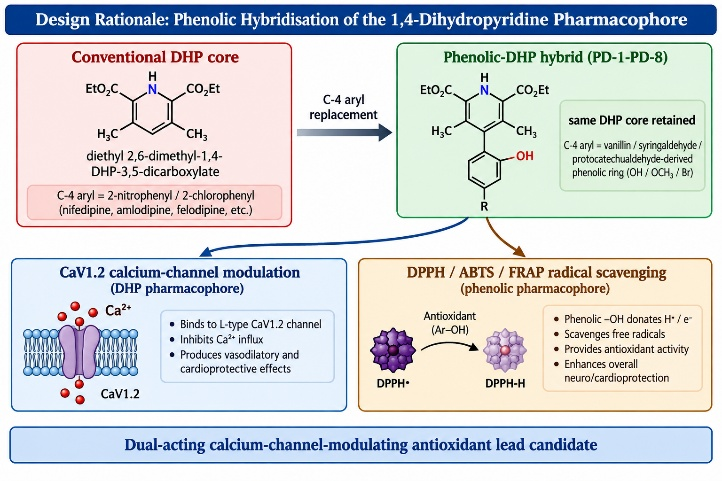
Reactive oxygen species (ROS) generated in excess of endogenous antioxidant capacity contribute mechanistically to endothelial dysfunction, vascular smooth-muscle remodelling and the progression of hypertension, atherosclerosis and ischaemia–reperfusion injury [8, 9]. Molecules that combine a validated cardiovascular pharmacophore with intrinsic free-radical-scavenging capacity are therefore of considerable translational interest, and antioxidant adjuncts such as vitamins C and E, flavonoids, coenzyme Q10 and related phenolics are increasingly discussed alongside conventional cardiovascular pharmacotherapy [1, 8, 10]. Naturally occurring phenolic aldehydes — vanillin, syringaldehyde, protocatechualdehyde, isovanillin and their alkoxy/halogenated analogues — are well-documented hydrogen-atom donors capable of quenching DPPH, ABTS and peroxyl radicals, and several recent reports have combined such phenolic units with dihydropyridine, pyran and dihydropyrimidinone scaffolds to obtain hybrid molecules with measurable antioxidant and anticancer activity [2, 16]. This convergence of two literatures — the classical DHP calcium-channel pharmacophore and the phenolic antioxidant pharmacophore — forms the central theme of the present review: replacement of the conventional nitrophenyl/chlorophenyl C-4 aryl group of marketed DHPs with a phenolic (hydroxy/methoxy-substituted) aryl group may plausibly deliver molecules capable of simultaneous calcium-channel modulation and antioxidant action, an idea for which the supporting synthetic, structural and mechanistic literature is critically reviewed below.
2The Hantzsch reaction: Classical mechanism and modern synthetic advances
The synthesis, purification and biological screening of dihydropyridine derivatives have been the subject of a substantial and continuously updated literature; a recent overview by Lago et al. collates synthesis conditions ranging from conventional heating to Lewis/Brønsted acid catalysis and solvent-free, microwave- and ultrasound-assisted methods, together with the anticancer, antimicrobial, anti-inflammatory and antioxidant biological activities reported for DHP derivatives, providing a systematic methodological reference point for the synthetic work discussed below [12].
2.1Classical four-component mechanism
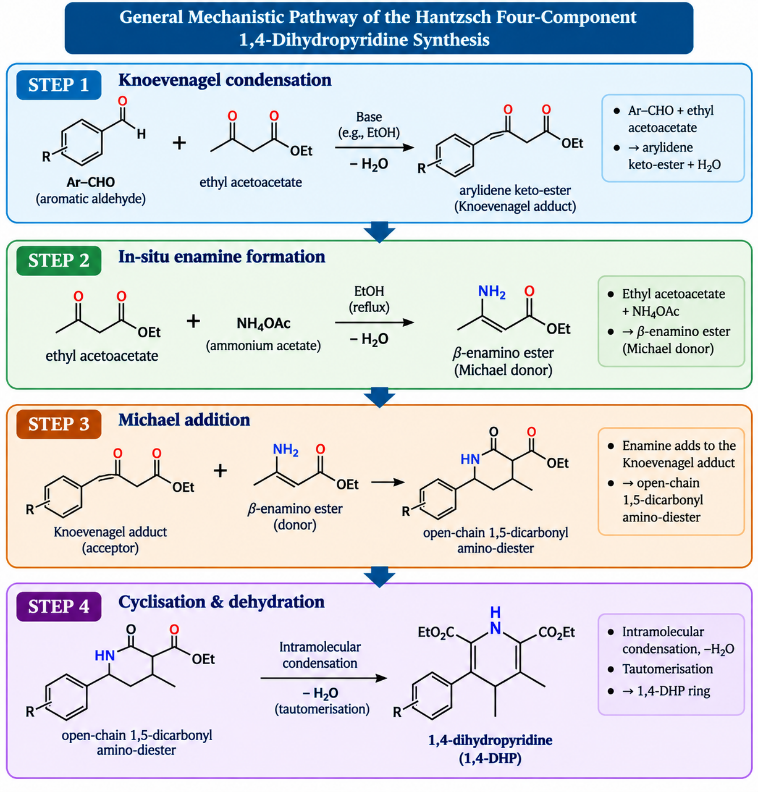
The Hantzsch dihydropyridine synthesis proceeds through a well-established four-step sequence (Figure 1): (i) Knoevenagel condensation of the aromatic aldehyde with one equivalent of ethyl acetoacetate to give an α,β-unsaturated keto-ester; (ii) in-situ conversion of a second equivalent of ethyl acetoacetate to the corresponding β-enamino ester using ammonium acetate as the nitrogen source; (iii) Michael addition of the enamine (acting as nucleophile) across the electrophilic alkene of the Knoevenagel adduct to generate an open-chain 1,5-dicarbonyl amino-diester intermediate; and (iv) intramolecular cyclisation of the enamine nitrogen onto the remaining ketone, followed by dehydration and tautomerisation, to close the six-membered ring and deliver the symmetrical diethyl 4-aryl-2,6-dimethyl-1,4-dihydropyridine-3,5-dicarboxylate [27, 34]. Because the aromatic aldehyde is incorporated intact at C-4 without further modification of its ring substituents, the electronic and steric character of the aldehyde chosen for the reaction is transmitted directly to the final DHP product; this feature is precisely what permits phenolic aldehydes bearing free hydroxyl and methoxy groups to be used as the C-4 aryl source without additional protecting-group chemistry, provided the reaction conditions (mildly basic, moderate temperature) are compatible with the phenolic –OH, which they generally are [4, 34].
2.2Catalytic, green and microwave-assisted variants
While the classical protocol (reflux in ethanol with ammonium acetate) remains widely used, the last decade has seen extensive methodological diversification aimed at improving yield, shortening reaction time and reducing environmental impact. Zhang et al. reported a catalyst-free, aqueous/ethanolic multicomponent protocol validated at undergraduate-teaching scale, confirming that the four-component condensation tolerates solvent- and catalyst-minimised “green chemistry” modification without loss of generality [4]. Borade et al. described a solvent-free Hantzsch synthesis employing magnetically recoverable MgFe2O4 nanoparticles as a heterogeneous, reusable catalyst, reporting markedly improved yields, shortened reaction times and straightforward magnetic catalyst recovery over multiple reaction cycles [11]. Pansuriya et al. used phenylboronic acid, Ph–B(OH)2, as a mild Lewis-acid catalyst for the synthesis of polysubstituted 1,4-DHPs subsequently evaluated for antioxidant activity and correlated with molecular docking against a human peroxidase enzyme [37]. Bandyopadhyay et al. demonstrated that bismuth nitrate pentahydrate under microwave irradiation accelerates the Hantzsch condensation to completion within one to three minutes under solvent-free conditions, illustrating the compatibility of the reaction with rapid, energy-efficient activation methods [39]. Sharma, Rajani and Patel extended the multicomponent approach to thiophene-containing aldehydes under green, ultrasound-assisted conditions, obtaining DHP derivatives with promising antimicrobial bioactivity and confirming tolerance of the reaction toward electron-rich heteroaryl aldehydes structurally analogous to the phenolic aldehydes central to the present review [18]. A comparative overview of representative synthetic methods is presented in Table 1. Irrespective of the specific catalytic or activation method chosen, purification of the crude Hantzsch product by recrystallisation from aqueous ethanol, or by column chromatography where required, follows standard practical organic chemistry protocols [29].
| Method / Catalyst | Conditions | Time / Yield | Key Advantage | Ref. |
|---|---|---|---|---|
| Classical acid/base (EtOH, reflux) | NH4OAc, EtOH, 78 °C | 4–8 h; 65–85% | Simple, reproducible, no special equipment | [27] |
| Catalyst-free green protocol | Aqueous/EtOH, RT–reflux | 2–6 h; 70–90% | Undergraduate-teaching scale, no catalyst residue | [4] |
| MgFe2O4 magnetic nanoparticles | Solvent-free, 80 °C | 20–45 min; 85–95% | Magnetically recoverable, reusable ≥5 cycles | [11] |
| Phenylboronic acid, Ph-B(OH)2 | EtOH, reflux, 20 mol% | 1–2 h; 80–92% | Mild Lewis-acid catalysis, good functional-group tolerance | [37] |
| Microwave / Bi(NO3)3·5H2O | Solvent-free, MW irradiation | 1–3 min; 88–96% | Dramatic rate acceleration, energy-efficient | [39] |
| Thiophene-based green MCR | EtOH/H2O, ultrasound | 30–60 min; 75–90% | Compatible with heteroaryl aldehydes | [18] |
Notwithstanding this methodological diversity, the fundamental four-component bond-forming logic (Figure 1) is conserved across all variants, and the choice of catalyst or activation method principally affects reaction rate, yield and atom economy rather than the regiochemical outcome. This robustness underlies the continued use of the classical reflux protocol — optionally benchmarked against a green or catalytic alternative — for the synthesis of new, structurally defined phenolic-substituted derivatives, as proposed for a designed series of eight compounds (PD-1 to PD-8) derived from pharmacologically relevant phenolic aldehydes such as vanillin, syringaldehyde and protocatechualdehyde [30].
3Structural landscape of the DHP pharmacophore and the CaV1.2 interaction
3.1The DHP core as a privileged structure
Triggle's influential review formally established the 1,4-dihydropyridine core as a “privileged structure” in medicinal chemistry, systematically cataloguing the substitution patterns at N-1, C-2/C-6, C-3/C-5 and C-4 that are tolerated without loss of calcium-channel activity [22]. Early quantitative structure–activity relationship (QSAR) work by Coburn et al. related the electronic and steric character of the C-4 aryl substituent to antagonist potency, establishing structure–activity principles that continue to inform rational DHP design more than three decades later [23]. More recent QSAR studies have combined density functional theory (DFT)-derived electronic descriptors with artificial neural network (ANN) modelling to predict calcium-channel-blocking activity across a DHP series, supporting the use of combined computational (DFT/ANN/docking) pre-screening before committing candidate molecules to synthesis [14]. Beyond the calcium channel, the DHP scaffold has proven amenable to engagement with a remarkably broad range of biological targets: DHP-substituted sulfonamides have been evaluated, with docking support, as paraoxonase-1 (PON1) inhibitors [13]; DHP–pyrazole hybrids have shown docking-supported activity against EGFR/HER2 in breast-cancer cell lines [35]; bis-thiazole-tethered DHP–pyridine hybrids have been docked as VEGFR tyrosine-kinase inhibitors [36]; and DHP derivatives bearing a mechanistic ROS-modulating rationale have been characterised as antidiabetic agents acting, in part, through interference with oxidative-stress pathways [38].
3.2Cryo-EM structures of CaV1.2 and the DHP binding site
The recent availability of high-resolution cryo-electron-microscopy structures of the human CaV1.2 channel has transformed DHP design from a largely retrospective, homology-model-guided exercise [19] into a prospective, structure-based discipline. Wei et al. resolved CaV1.2 in the absence and presence of the antirheumatic drug tetrandrine and the antihypertensive dihydropyridine benidipine, showing that tetrandrine acts as a pore blocker through hydrophobic interactions whereas benidipine occupies the domain III–IV fenestration site to allosterically inhibit the channel; the deposited structures (PDB entries 8HMB and related) provide an atomic-resolution template for structure-based docking of newly designed dihydropyridine ligands [6]. This represents a substantial advance over the homology-modelling approaches that preceded it, in which the receptor structure itself carried considerable uncertainty [19].
3.3Broader pharmacological versatility of the DHP scaffold
A comprehensive review by Anaikutti and Makam catalogued the construction of 1,4-DHPs using multicomponent, one-pot and green synthetic methodologies and summarised their calcium-channel-blocking, antioxidant, anticancer, anti-inflammatory, antimicrobial, antihypertensive, antidiabetic, anticoagulant and anticholinesterase activities, alongside a separate account of insecticidal applications of DHP–neonicotinoid hybrids, reinforcing the breadth of biological space accessible from a single synthetic entry point [34]. Sharma and Singh similarly reviewed the synthesis, utility and medicinal importance of 1,2- and 1,4-dihydropyridines, cataloguing the diverse catalytic conditions under which the core can be assembled and the corresponding spread of reported bioactivities [40]. This versatility strengthens the rationale for the present review's central hypothesis: because C-4 aryl substitution is so broadly tolerated across unrelated target classes, there is no obvious structural barrier to introducing a phenolic aryl group at this position specifically to add antioxidant character while retaining calcium-channel engagement, provided the substitution pattern is chosen with both pharmacophores in mind.
3.4Molecular docking as a rational pre-synthetic screening tool
AutoDock Vina, introduced by Trott and Olson, remains the most widely used docking engine in this literature owing to its improved scoring-function accuracy, efficient pose optimisation and multithreaded performance relative to earlier AutoDock versions [21]. In the specific context of calcium-channel pharmacology, docking has been used to rank candidate DHPs against homology or cryo-EM CaV1.2 models [14, 19], and, more broadly, to compare the binding of marketed dihydropyridine calcium-channel blockers (including benidipine) against off-target proteins implicated in diabetic complications such as aldose reductase (ALR2) and the receptor for advanced glycation end-products (RAGE), where benidipine was found to bind with particularly favourable efficiency [43]. Complementary docking of DHP-related and DHP-hybrid chemotypes has been reported against diverse targets, including human peroxidase (1PRX) in tandem with in-vitro DPPH/H2O2/NO antioxidant assays [37], PON1 alongside theoretical calculations [13], and antileishmanial and antibacterial targets in DHP series evaluated in parallel with docking studies [15]. Taken together, this body of work establishes molecular docking as a standard, low-cost adjunct to DHP synthetic programmes: it allows early computational triage of a designed series — for example, ranking predicted binding poses and energies of phenolic-substituted derivatives against the CaV1.2 domain III–IV DHP receptor site — before committing to full synthesis and biological testing [30].
4Phenolic antioxidants: Mechanisms and structure–Activity relationships
4.1Radical-scavenging mechanisms
Phenolic compounds neutralise reactive oxygen and nitrogen species chiefly through three thermodynamically distinct pathways: hydrogen-atom transfer (HAT), single-electron transfer followed by proton transfer (SET-PT), and sequential proton-loss electron transfer (SPLET) [41]. Which mechanism dominates depends on solvent polarity and on the O–H bond dissociation enthalpy, ionisation potential, proton affinity and electron-transfer enthalpy of the phenolic hydroxyl [41]. Density-functional-theory analysis of eighteen representative phenolic acids showed that SPLET is the thermodynamically preferred mechanism in polar protic media such as water and ethanol, whereas HAT dominates in the gas phase and in non-polar solvents, and confirmed that both methoxyl (–OCH3) and phenolic hydroxyl (–OH) substituents promote antioxidant activity by lowering the relevant bond dissociation enthalpies [41]. A complementary quantitative structure–property relationship (QSPR) study of phenolic acids and flavonoids using the oxygen-radical-absorbance-capacity (ORAC) assay found that the number and position of hydroxyl substituents exerted a stronger influence on antioxidant activity than classical “Bors criteria” ring-configuration descriptors, and specifically highlighted that catechol (ortho-dihydroxy) substitution stabilises the resulting phenoxyl radical through intramolecular hydrogen bonding [42].
4.2Structure–activity relationships relevant to phenolic-DHP hybrid design
Several structural themes recur across the phenolic-antioxidant literature and are directly transferable to the design of phenolic-substituted DHPs (Table 2). First, an ortho-catechol motif (as in protocatechualdehyde) is consistently associated with enhanced radical-scavenging capacity relative to a single isolated hydroxyl, owing to intramolecular hydrogen-bond stabilisation of the resulting phenoxyl radical [16, 38]. Second, methoxy substitution flanking a phenolic hydroxyl (as in vanillin and syringaldehyde) generally increases electron density on the aromatic ring and can stabilise the radical, although methylation of the hydroxyl group itself (removing the H-donor) is detrimental to activity, underscoring that the free phenolic –OH, not the methoxy group per se, is the principal radical-donating site [42, 41]. Third, electron-withdrawing substituents such as halogens (as in 5-bromovanillin) raise the O–H bond dissociation enthalpy and can attenuate intrinsic radical-scavenging capacity while simultaneously increasing lipophilicity and potentially membrane permeability — a trade-off that must be weighed against target-engagement considerations for a calcium-channel-active hybrid [7]. Direct experimental precedent for phenolic hybridisation of a dihydropyridine-type core exists in the work of da Costa Cabrera et al., who synthesised lipophilic 1,4-dihydropyridines bearing fatty-acid-derived side chains and demonstrated measurable in-vitro antioxidant activity for several series members, confirming that structural modification of the classical Hantzsch DHP core can introduce meaningful radical-scavenging capacity without abolishing the core scaffold [16].
4.3Standard in-vitro assays used to benchmark phenolic-DHP antioxidant activity
Three colorimetric assays dominate the DHP-hybrid antioxidant literature. The DPPH assay, originally described by Blois, measures the ability of a test compound to reduce the stable 2,2-diphenyl-1-picrylhydrazyl radical, monitored spectrophotometrically at 517 nm as the characteristic purple chromophore fades [26]. The ABTS assay of Re et al. instead pre-forms the blue-green ABTS radical cation (by oxidation with potassium persulfate) and follows its decolorisation at 734 nm on addition of the antioxidant, a format often considered more compatible with both hydrophilic and lipophilic antioxidants than DPPH [31]. The FRAP assay of Benzie and Strain measures the reducing, rather than radical-quenching, capacity of a compound by following the formation of a coloured Fe2+–TPTZ complex at 593 nm, and is mechanistically distinct in that it reports single-electron-transfer-based reducing power rather than direct radical scavenging [32]. Because DPPH, ABTS and FRAP interrogate different aspects of antioxidant chemistry (radical scavenging in organic versus aqueous media, and reducing power, respectively), reporting all three — as recommended for the phenolic-DHP series discussed in this review — provides a more complete antioxidant profile than any single assay, and is consistent with the poor cross-assay correlation repeatedly noted in the broader phenolic-antioxidant literature [41].
| Phenolic Aldehyde | Substitution Pattern | Structural Feature Relevant to Radical Scavenging | Ref. |
|---|---|---|---|
| 4-Hydroxybenzaldehyde | Single para-OH | Single phenolic O–H donor; moderate BDE-dependent HAT capacity | [41] |
| Vanillin | 4-OH, 3-OCH3 | OCH3 raises electron density on ring, stabilising phenoxyl radical | [2],[41] |
| Syringaldehyde | 4-OH, 3,5-di-OCH3 | Symmetrical di-methoxy flanking enhances radical delocalisation | [2] |
| Protocatechualdehyde | 3,4-di-OH (catechol) | Ortho-catechol motif enables intramolecular H-bond stabilisation of radical (Bors criterion) | [16],[38] |
| Isovanillin | 3-OH, 4-OCH3 | Positional isomer of vanillin; altered steric accessibility of O–H | [41] |
| 2,4-Dihydroxybenzaldehyde | 2,4-di-OH | Non-catechol diphenol; additional H-bond donor capacity | [22],[42] |
| 5-Bromovanillin | 4-OH, 3-OCH3, 5-Br | Electron-withdrawing Br modulates O–H BDE and lipophilicity | [7] |
| Ethylvanillin | 4-OH, 3-OC2H5 | Longer alkoxy chain increases lipophilicity without loss of H-donor | [41] |
5Phenolic–Dihydropyridine hybrids: Convergence of two pharmacophores
5.1Reported hybrid strategies beyond the DHP core
The design rationale for phenolic hybridisation of the dihydropyridine pharmacophore is summarised in Figure 2. The general strategy of appending a phenolic pharmacophore onto a privileged heterocyclic core has been explored across several scaffolds closely related to the DHP nucleus. Djafarou et al. designed, synthesised and evaluated a series of phenolic derivatives incorporating 4H-pyran, 1,4-dihydropyridine and 1,3-dihydropyrimidinone scaffolds for anticancer and antioxidant activity, demonstrating that appending catechol/guaiacol-type phenolic units onto these privileged heterocyclic cores markedly enhances radical-scavenging capacity while retaining favourable drug-likeness — a design logic directly analogous to the phenolic-DHP hybrids reviewed here [2]. Sazlı and Karataş carried out an in-silico design and computational elucidation of hypothetical resveratrol–curcumin hybrid molecules as potential cancer-pathway modulators, illustrating the broader use of computational hybridisation strategies for combining two phenolic natural-product pharmacophores, a strategy conceptually extendable to phenolic-dihydropyridine hybrids [5]. Peng et al. developed novel idebenone (a synthetic quinone antioxidant) derivatives that attenuated oxidative-stress injury and myocardial damage in experimental models, reinforcing the general principle that phenolic/quinone antioxidant hybridisation can afford cardioprotective chemical entities even outside the DHP scaffold [3].
5.2Case studies of phenolic/heteroaryl-substituted DHPs with reported antioxidant, anticancer or antimicrobial activity
Direct precedent for phenolic-DHP antioxidant hybrids includes the phenylboronic-acid-catalysed polysubstituted DHP series of Pansuriya et al., in which in-vitro DPPH, H2O2 and NO radical-scavenging assays were performed alongside docking against a human peroxidase enzyme, with several derivatives showing good-to-moderate inhibition correlating with predicted binding scores [37]. Kocak Aslan et al. combined synthesis with molecular modelling, DFT calculations and electron-paramagnetic-resonance (EPR) analysis of a 1,4-DHP series proposed as calcium-channel blockers, correlating frontier-orbital and radical-stability parameters with expected channel-blocking and antioxidant behaviour — a computational strategy directly transferable to the phenolic-DHP series proposed in this review [7]. Beyond antioxidant activity strictly defined, the DHP core hybridised with phenolic or heteroaryl fragments has shown activity against a striking range of targets: DHP–pyrazole hybrids against breast-cancer cell lines with EGFR/HER2/HERT798I docking support [35]; bis-thiazole-DHP–pyridine hybrids as VEGFR-TK inhibitors [36]; DHP-substituted sulfonamides as PON1 inhibitors [13]; and DHP derivatives evaluated concurrently for anticancer and antibacterial activity with ADME profiling [34]. Sidhom et al. reported a mechanistic study of synthesised 1,4-DHPs acting as an “antidiabetic sword against reactive oxygen species”, directly connecting DHP pharmacology to ROS-modulation in a manner conceptually aligned with the dual calcium-channel/antioxidant hypothesis central to phenolic-DHP hybrid design [38]. Collectively, this body of work confirms both the chemical feasibility of decorating the DHP core with phenolic or related electron-rich aryl/heteroaryl groups, and the plausibility that such hybrids can retain meaningful biological activity across multiple, sometimes unexpected, target classes.
5.3In-silico ADME and drug-likeness screening
Because dual-acting candidates must ultimately satisfy oral drug-likeness criteria in addition to target engagement, in-silico absorption-distribution-metabolism-excretion (ADME) screening is now considered a routine early step in DHP hybrid design. Lipinski's Rule of Five — molecular weight below 500, calculated logP below 5, no more than five hydrogen-bond donors and ten hydrogen-bond acceptors — remains the benchmark filter [33]. SwissADME, a freely available web tool developed by Daina, Michielin and Zoete, extends this filter with predictions of gastrointestinal absorption, blood–brain-barrier permeation, cytochrome P450 interactions and synthetic accessibility, and is widely used as a preliminary pharmacokinetic screen for newly designed DHP and phenolic-hybrid series before synthesis [17]. Reported computational screening of designed phenolic-substituted DHP libraries indicates that, despite the additional polar surface area introduced by phenolic hydroxyl and methoxy groups, molecular weights in the 340–460 g/mol range and topological polar surface areas below approximately 110 Ų are readily achievable while retaining zero Lipinski violations, supporting the general druggability of this hybrid class [30, 33].
6Structure–Activity considerations for dual-acting candidates
Integrating the calcium-channel and antioxidant literatures reviewed above yields several convergent design principles. (i) The C-4 aryl position tolerates extensive structural variation without loss of the core DHP conformation required for CaV1.2 engagement, making it the natural site for phenolic incorporation [22, 23]. (ii) Electron-donating substituents (hydroxy, methoxy) at the aryl ring, particularly in an ortho-catechol arrangement, favour both radical-scavenging capacity [16, 41] and, historically, have been compatible with calcium-channel activity when appropriately positioned [20, 23]. (iii) Steric bulk and electron-withdrawing substituents (e.g., bromo) can be used to fine-tune lipophilicity and membrane permeability but may attenuate intrinsic antioxidant potency, requiring a balance to be struck through parallel docking and DPPH/ABTS/FRAP evaluation [7, 41]. (iv) Structure-based docking against cryo-EM-resolved CaV1.2 [6] should be run in parallel with, rather than as a substitute for, DFT-based radical-stability calculations [7, 14], since the two properties are governed by different electronic features of the same aryl substituent. (v) Finally, in-silico ADME screening [17, 33] should be applied early, since several otherwise attractive phenolic substitution patterns (e.g., polyhydroxylated rings) can push topological polar surface area toward the upper boundary of oral druggability. A stepwise workflow combining rational design, Hantzsch synthesis (optionally green/catalytic, Table 1), spectral confirmation, CaV1.2 docking and tri-assay antioxidant evaluation therefore represents a scientifically coherent and experimentally feasible route to new dual-acting leads [30].
7Challenges and future perspectives
Despite the conceptual and preliminary experimental support reviewed above, several gaps remain. First, very few published studies combine structure-based docking against a cryo-EM CaV1.2 structure with standardised, triplicate DPPH/ABTS/FRAP antioxidant profiling of the same matched phenolic-DHP series; most existing antioxidant-DHP reports dock against unrelated targets (peroxidase, PON1, kinases) rather than the calcium channel itself [13, 35, 36, 37]. Second, reported in-vitro antioxidant assays for DHP-type molecules vary considerably in radical system (DPPH, ABTS, NO, H2O2, superoxide) and reference standard, complicating direct cross-study comparison [37, 41]. Third, while DFT/EPR studies have begun to connect frontier-orbital descriptors to both channel-blocking and radical-stability behaviour [7], genuinely predictive multitarget QSAR models spanning both pharmacological axes are still lacking. Addressing these gaps will require (a) synthesis of matched phenolic-DHP series differing systematically in hydroxyl/methoxy/halogen substitution pattern; (b) parallel CaV1.2 docking and tri-assay antioxidant evaluation of the same compounds; (c) DFT-derived bond-dissociation-enthalpy calculations to rationalise antioxidant SAR; and (d) eventual progression of the most promising leads to isolated vascular-tissue or cell-based pharmacological confirmation, subject to the appropriate institutional ethical approvals. Green and catalytic Hantzsch methodologies (Table 1) additionally offer an opportunity to make such expanded structure–activity campaigns more sustainable and scalable [4, 11, 39].
8Conclusion
The 1,4-dihydropyridine core synthesised via the Hantzsch reaction remains a chemically versatile and pharmacologically validated scaffold, and the growing literature on phenolic hybridisation of privileged heterocycles provides a credible rationale for designing phenolic-substituted DHPs as dual-acting calcium-channel-modulating antioxidants. Recent cryo-EM structures of CaV1.2 [6], mature docking methodology [21], and detailed mechanistic understanding of phenolic radical scavenging [41] together provide the structural and computational infrastructure needed to design, prioritise and rationalise such hybrids before committing to synthesis. Systematic application of this integrated workflow to a matched series of phenolic-DHP derivatives is expected to identify lead molecules of translational relevance to hypertension-associated oxidative vascular damage, while simultaneously closing an identifiable gap in the current literature.
References
- [1]Singh DD, Yadav DK, Shin D. Next-generation antioxidants in cardiovascular disease: mechanistic insights and emerging therapeutic strategies. Antioxidants. 2026;15(2):164.
- [2]Djafarou S, Alves E, Khodja IA, Seyhan G, Barut B, Harakat D, Mermer A, Pereira DM, Boulebd H. Design, synthesis and evaluation of anticancer and antioxidant properties of phenolic derivatives incorporating 4H-pyran/1,4-dihydropyridine/1,3-dihydropyrimidinone scaffolds. Eur J Med Chem. 2025;295:117803.
- [3]Peng Y, Guo Y, Yang X, Liu Y, Xu X, Chen J, Liu X, Xie Z, Yu Z, Wu D, Chen Z. Novel idebenone derivatives attenuated oxidative stress injury and myocardial damage. Front Chem. 2025;13:1544616.
- [4]Zhang Y, Ma X, Zhou X, Jiang K, Gu L, Li X, Zhu Y, Peng B. Green synthesis of 1,4-dihydropyridines through catalyst-free multicomponent Hantzsch reaction in an undergraduate teaching laboratory. J Chem Educ. 2025;102:1215–1222.
- [5]Sazlı N, Karataş D. In silico design and computational elucidation of hypothetical resveratrol–curcumin hybrids as potential cancer pathway modulators. Pharmaceuticals. 2025;18(10):1473.
- [6]Wei Y, Yu Z, Wang L, Li X, Li N, Bai Q, Wang Y, Li R, Meng Y, Xu H, Wang X, Dong Y, Huang Z, Zhang XC, Zhao Y. Structural bases of inhibitory mechanism of CaV1.2 channel inhibitors. Nat Commun. 2024;15:2772.
- [7]Kocak Aslan E, Lam K, Dengiz C, Denzinger K, Dicle Erdamar IY, Huang S, Zamponi GW, Wolber G, Gündüz MG. Synthesis, molecular modeling, DFT studies, and EPR analysis of 1,4-dihydropyridines as potential calcium channel blockers. J Mol Struct. 2024;1307:137983.
- [8]Jin S, Kang PM. A systematic review on advances in management of oxidative stress-associated cardiovascular diseases. Antioxidants. 2024;13(8):923.
- [9]Młynarska E, Hajdys J, Czarnik W, Fularski P, Leszto K, Majchrowicz G, Lisińska W, Rysz J, Franczyk B. The role of antioxidants in the therapy of cardiovascular diseases — a literature review. Nutrients. 2024;16(16):2587.
- [10]Kwon G, Gibson KM, Bi L. Cutting-edge insights into oxidative stress and antioxidant therapy in cardiovascular health. Antioxidants. 2024;13(9):1034.
- [11]Borade RM, Kale SB, Khirade PP, Jadhav KM, Pawar RP. Solvent-free synthesis of 1,4-dihydropyridine derivatives via Hantzsch reaction employing MgFe2O4 MNPs: an efficient and recyclable heterogeneous catalyst. J Inorg Organomet Polym Mater. 2024;34:1104–1120.
- [12]Lago AFS, Benedicto DFC, da Silva L, Thomasi SS. 1,4-Dihydropyridine derivatives: an overview of synthesis conditions and biological tests. Curr Org Chem. 2023;27:1567–1610.
- [13]Kaya MO, Demirci T, Ozdemir O, Calisir U, Sonmez F, Arslan M. Synthesis, inhibition effects, molecular docking and theoretical studies as paraoxonase-1 (PON1) inhibitors of novel 1,4-dihydropyridine substituted sulfonamide derivatives. Med Chem Res. 2023;32:841–855.
- [14]Aggoun S, Bouchlaleg L, Belaidi S, Nour H, Abchir O, Chtita S, AlMogren MM, Hochlaf M. QSAR studies and molecular docking analysis of 1,4-dihydropyridines as calcium channel blockers using DFT and ANN methods. Research Square [Preprint]. 2023.
- [15]Rezaei AR, Saberi S, Sepehri S. Synthesis, antileishmanial activity and molecular docking study of a series of dihydropyridine derivatives. Polycycl Aromat Compd. 2022;43:4640–4653.
- [16]da Costa Cabrera D, Santa-Helena E, Leal HP, de Moura RR, Nery LEM, Gonçalves CAN, Russowsky D, Montes D'Oca MG. Synthesis and antioxidant activity of new lipophilic dihydropyridines. Bioorg Chem. 2019;84:1–16.
- [17]Daina A, Michielin O, Zoete V. SwissADME: a free web tool to evaluate pharmacokinetics, drug-likeness and medicinal chemistry friendliness of small molecules. Sci Rep. 2017;7:42717.
- [18]Sharma MG, Rajani DP, Patel HM. Green approach for synthesis of bioactive Hantzsch 1,4-dihydropyridine derivatives based on thiophene moiety via multicomponent reaction. R Soc Open Sci. 2017;4:170006.
- [19]Shaldam MA, Elhamamsy MH, Esmat EA, El-Moselhy TF. 1,4-Dihydropyridine calcium channel blockers: homology modeling of the receptor and assessment of structure activity relationship. ISRN Med Chem. 2014;2014:203518.
- [20]Shahrisa A, Miri R, Esmati S, Saraei M, Mehdipour AR, Sharifi M. Synthesis and calcium channel antagonist activity of novel 1,4-dihydropyridine derivatives possessing 4-pyrone moieties. Med Chem Res. 2012;21:284–292.
- [21]Trott O, Olson AJ. AutoDock Vina: improving the speed and accuracy of docking with a new scoring function, efficient optimization, and multithreading. J Comput Chem. 2010;31(2):455–461.
- [22]Triggle DJ. 1,4-Dihydropyridines as calcium channel ligands and privileged structures. Cell Mol Neurobiol. 2003;23(3):293–303.
- [23]Coburn RA, Wierzba M, Suto MJ, Solo AJ, Triggle AM, Triggle DJ. 1,4-Dihydropyridine antagonist activities at the calcium channel: a quantitative structure-activity relationship approach. J Med Chem. 1988;31(11):2103–2107.
- [24]Bossert F, Meyer H, Wehinger E. 4-Aryldihydropyridines, a new class of highly active calcium antagonists. Angew Chem Int Ed Engl. 1981;20(9):762–769.
- [25]Loev B, Goodman MM, Snader KM, Tedeschi R, Macko E. Hantzsch-type dihydropyridine hypotensive agents. J Med Chem. 1974;17(9):956–965.
- [26]Blois MS. Antioxidant determinations by the use of a stable free radical. Nature. 1958;181:1199–1200.
- [27]Hantzsch A. Ueber die Synthese pyridinartiger Verbindungen aus Acetessigäther und Aldehydammoniak. Justus Liebigs Ann Chem. 1882;1:215–260.
- [28]World Health Organization. Global Report on Hypertension: The Race Against a Silent Killer. Geneva: World Health Organization; 2023.
- [29]Furniss BS, Hannaford AJ, Smith PWG, Tatchell AR. Vogel's Textbook of Practical Organic Chemistry. 5th ed. Harlow: Longman Scientific & Technical; 1989.
- [30]Yadav S, Chatterjee SJ. Hantzsch synthesis, molecular docking and antioxidant evaluation of novel phenolic substituted 1,4-dihydropyridine derivatives as potential calcium channel modulators (M.Pharm. synopsis). Jaunpur: S. N. College of Pharmacy, Dr. A.P.J. Abdul Kalam Technical University Lucknow; 2026.
- [31]Re R, Pellegrini N, Proteggente A, Pannala A, Yang M, Rice-Evans C. Antioxidant activity applying an improved ABTS radical cation decolorization assay. Free Radic Biol Med. 1999;26(9–10):1231–1237.
- [32]Benzie IFF, Strain JJ. The ferric reducing ability of plasma (FRAP) as a measure of “antioxidant power”: the FRAP assay. Anal Biochem. 1996;239(1):70–76.
- [33]Lipinski CA, Lombardo F, Dominy BW, Feeney PJ. Experimental and computational approaches to estimate solubility and permeability in drug discovery and development settings. Adv Drug Deliv Rev. 2001;46(1–3):3–26.
- [34]Anaikutti P, Makam P. 1,4-Dihydropyridine: synthetic advances, medicinal and insecticidal properties. RSC Adv. 2022;12(45):29253–29290.
- [35]Al-Mathkuri TSF, Al-Jubori HMS, Majed AA, Moker MH, Santali E, Alnajjar R. Synthesis, docking, molecular dynamics, and biological evaluation of new hybrid dihydropyridine–pyrazole derivatives against breast cancer. Chem Pap. 2025. https://doi.org/10.1007/s11696-025-04581-9
- [36]Al-Humaidi JY, Riyadh SM, Farag B, Zaki MEA, Abolibda TZ, Gomha SM. Synthesis of bis-thiazoles tethered 1,4-dihydropyridine and pyridine linkers via simple oxidation and their molecular docking as VEGFR-TK inhibitors. Curr Med Chem. 2025;32(9):1789–1802.
- [37]Pansuriya K, Lalpara JN, Hadiyal SD, Dhaduk BB, Dubal GG. Phenylboronic acid catalyzed synthesis of polysubstituted 1,4-dihydropyridine derivatives as promising antioxidant agents correlated with molecular docking. Results Chem. 2022.
- [38]Sidhom PA, El-Bastawissy E, Ibrahim MAA, Shawky AM, Salama A, El-Moselhy T. Mechanistic insight of synthesized 1,4-dihydropyridines as an antidiabetic sword against reactive oxygen species. J Med Chem. 2023;66:991–1010.
- [39]Bandyopadhyay D, Maldonado S, Banik BK. A microwave-assisted bismuth nitrate-catalyzed unique route toward 1,4-dihydropyridines. Molecules. 2012;17(3):2643–2653.
- [40]Sharma VK, Singh SK. Synthesis, utility and medicinal importance of 1,2- & 1,4-dihydropyridines. RSC Adv. 2017;7:2682–2732.
- [41]Chen J, Yang J, Ma L, Li J, Shahzad N, Kim CK. Structure-antioxidant activity relationship of methoxy, phenolic hydroxyl, and carboxylic acid groups of phenolic acids. Sci Rep. 2020;10:2611.
- [42]Platzer M, Kiese S, Tybussek T, Herfellner T, Schneider F, Schweiggert-Weisz U, Eisner P. Radical scavenging mechanisms of phenolic compounds: a quantitative structure-property relationship (QSPR) study. Front Nutr. 2022;9:882458.
- [43]Kazmi S, Challa S, Alaparthi MD, Devi M I, Nagamalla SS, Priya EJ. Molecular docking analysis of calcium channel blockers with ALR2 and RAGE. Bioinformation. 2023;19(1):28–33.