Pharmacy
Comparative Evaluation of the Anti-Inflammatory Activity of Methanolic Leaf Extracts of Zygophyllum coccineum and Heliotropium indicum Against Carrageenan-Induced Paw Oedema and Cotton Pellet-Induced Granuloma in Wistar Rats
Department of Pharmacology, SHEAT College of Pharmacy, Varanasi, Uttar Pradesh, India (affiliated to Dr. A.P.J. Abdul Kalam Technical University, Lucknow, Uttar Pradesh, India)
Published October 2026
Abstract
Inflammation underlies the pathophysiology of numerous chronic non-communicable diseases, and plant-derived agents acting through complementary phytochemical mechanisms remain an active area of anti-inflammatory drug discovery. This study comparatively evaluated the anti-inflammatory activity of methanolic leaf extracts of Zygophyllum coccineum (Zygophyllaceae) and Heliotropium indicum (Boraginaceae) against carrageenan-induced acute paw oedema and cotton pellet-induced chronic granuloma in Wistar rats, benchmarked against diclofenac sodium (10 mg/kg). Soxhlet extraction yielded 12.40% w/w (Z. coccineum) and 10.80% w/w (H. indicum); phytochemical screening identified a flavonoid-saponin-triterpenoid-rich profile in Z. coccineum and an alkaloid-flavonoid-rich profile in H. indicum. Both extracts were non-toxic at the OECD 423 limit dose of 2000 mg/kg, supporting selection of 200 and 400 mg/kg (Z. coccineum) and 400 mg/kg (H. indicum) for the main study. In the carrageenan model, Z. coccineum (400 mg/kg) produced 57.32% inhibition of paw oedema at 3 h, Z. coccineum (200 mg/kg) 39.02%, and H. indicum (400 mg/kg) 50.00%, against 71.95% for diclofenac. In the cotton pellet model, the corresponding inhibitions were 37.80%, 24.39% and 31.71%, against 53.66% for diclofenac. Both extracts showed dose-dependent, statistically significant activity (p < 0.05-0.001) across models, with Z. coccineum consistently more potent than H. indicum, and both extracts retaining a greater proportion of their acute activity into the chronic phase than diclofenac, consistent with a multi-target mechanism of action.
Keywords: Zygophyllum coccineum; Heliotropium indicum; anti-inflammatory activity; carrageenan-induced paw oedema; cotton pellet granuloma; diclofenac sodium; phytochemical screening; Wistar rats
1Introduction
Inflammation is the coordinated vascular, cellular and biochemical response of living tissue to injurious stimuli, and while it is fundamentally protective, its dysregulation underlies the pathogenesis of a wide range of chronic non-communicable diseases, including rheumatoid arthritis, inflammatory bowel disease, atherosclerosis and several cancers [1-5]. At the molecular level, the inflammatory cascade is orchestrated by pro-inflammatory cytokines (TNF-α, IL-1β, IL-6), the arachidonic-acid-derived eicosanoids generated via cyclooxygenase (COX-1/COX-2) and lipoxygenase pathways, and the nuclear factor-kappa B (NF-κB) transcriptional axis, which together amplify and sustain tissue injury when left unchecked [6,7].
Non-steroidal anti-inflammatory drugs (NSAIDs) such as diclofenac sodium remain the pharmacological mainstay of inflammation management through non-selective inhibition of cyclooxygenase, but their chronic use is constrained by well-documented gastrointestinal, renal and cardiovascular toxicity [8-10]. This limitation sustains active interest in plant-derived anti-inflammatory agents, whose multi-target phytoconstituents — flavonoids, saponins, alkaloids and terpenoids — modulate the inflammatory cascade at several points simultaneously (cyclooxygenase inhibition, free-radical scavenging, NF-κB suppression) and may therefore offer a more favourable long-term safety profile than single-target synthetic NSAIDs [11-15].
Zygophyllum coccineum (Zygophyllaceae) is a salt-tolerant desert shrub of North Africa, the Arabian Peninsula and South Asia, used traditionally for rheumatic pain, skin inflammation and fever, with preliminary phytochemical reports documenting flavonoids, saponins, terpenoids and phenolics, but no methodologically rigorous in-vivo anti-inflammatory evaluation benchmarked against a standard NSAID has previously been reported [28,29]. Heliotropium indicum (Boraginaceae), a widely distributed tropical herb used across Ayurvedic, West African and South American traditional medicine for arthritis, wounds and fever, contains pyrrolizidine alkaloids (indicine, indicine N-oxide, supinine) alongside flavonoids, tannins and phenolic acids, and has shown anti-inflammatory promise in scattered reports that have not been directly compared against a reference drug under a unified experimental protocol [32-35,37,38].
No study has directly compared the anti-inflammatory efficacy of these two phytochemically complementary species — one flavonoid-saponin-triterpenoid-dominant, the other alkaloid-flavonoid-dominant — in the same experimental setting. The present study therefore aimed to extract and phytochemically characterise the methanolic leaf extracts of both species, establish their acute oral safety, and comparatively evaluate their anti-inflammatory activity in the carrageenan-induced paw oedema model (acute inflammation) and the cotton pellet-induced granuloma model (chronic inflammation) in Wistar rats, with diclofenac sodium (10 mg/kg) as the reference standard.
The choice of these two complementary in-vivo models is deliberate rather than incidental. The carrageenan-induced paw oedema model captures the early, mediator-driven phase of inflammation — histamine, serotonin and bradykinin release followed by cyclooxygenase-2-dependent prostaglandin synthesis — and is widely regarded as the gold-standard first-line screen for acute anti-inflammatory activity, while the cotton pellet-induced granuloma model instead interrogates the later, cellular and proliferative phase dominated by fibroblast invasion, angiogenesis and collagen deposition that more closely parallels chronic inflammatory disease [16,17,20]. Evaluating both extracts across this acute-to-chronic continuum, and expressing their activity relative to a clinically established reference NSAID at every time point and endpoint, was intended to yield a pharmacologically interpretable, head-to-head efficacy profile rather than a single-model screening result of limited translational value.
2Materials and methods
2.1Plant material, extraction and phytochemical screening
Leaves of Zygophyllum coccineum and Heliotropium indicum were collected, botanically authenticated against published taxonomic descriptions, shade-dried at ambient temperature and pulverised to a uniform coarse powder passed through a 40-mesh sieve. Each powdered material (100 g) was extracted exhaustively with methanol (600 mL) in a Soxhlet apparatus over 48 h, and the filtered extract was concentrated under reduced pressure on a rotary evaporator (bath temperature < 40 °C) and dried in a vacuum desiccator. Percentage extractive yield was calculated as (weight of dry extract / weight of powdered material) × 100. Each extract was subjected to standard qualitative phytochemical screening for alkaloids, flavonoids, saponins, tannins, phenolics, terpenoids, steroids, glycosides, carbohydrates, proteins and amino acids using established colour and precipitation tests, graded as absent (-), trace (+), present (++) or abundant (+++) [23-27].
2.2Experimental animals and ethical approval
Healthy adult Wistar albino rats (180-250 g) were housed under standard laboratory conditions (22 ± 3 °C, 55 ± 10% relative humidity, 12 h light/dark cycle) with free access to standard pellet diet and water, and acclimatised for seven days prior to experimentation. All procedures were approved by the Institutional Animal Ethics Committee (IAEC) in accordance with CPCSEA guidelines, and were conducted and reported in line with the ARRIVE 2.0 guidelines, incorporating randomisation, blinded outcome assessment and pre-defined inclusion/exclusion criteria [39-41].
2.3Acute oral toxicity study
Acute oral toxicity of both extracts was assessed per OECD Test Guideline 423 (Acute Toxic Class Method) in female Wistar rats, starting at the limit dose of 2000 mg/kg body weight, with continuous observation for the first four hours and twice-daily observation thereafter for fourteen days for mortality and signs of toxicity. On the basis of the no-observed-adverse-effect level established, one-tenth and one-fifth of the limit dose (200 and 400 mg/kg) were selected as the therapeutic test doses for the main pharmacological evaluation [23].
2.4Acute anti-inflammatory evaluation: Carrageenan-induced paw oedema
Thirty rats were divided into five groups (n = 6): vehicle control, diclofenac sodium (10 mg/kg p.o.), Z. coccineum (200 mg/kg p.o.), Z. coccineum (400 mg/kg p.o.) and H. indicum (400 mg/kg p.o.). One hour after oral pre-treatment, acute paw oedema was induced by sub-plantar injection of 0.1 mL of 1% w/v λ-carrageenan into the right hind paw. Paw volume was measured by mercury/water-displacement plethysmometry at 0, 1, 2, 3 and 4 h post-challenge. Percentage inhibition of oedema was calculated at each time point as [(Vc - Vt) / Vc] × 100, where Vc and Vt are the mean paw-volume increases of the control and treated groups respectively, with the third hour (peak of the prostaglandin-mediated phase) taken as the primary endpoint [16,18,19].
2.5Chronic anti-inflammatory evaluation: Cotton pellet-induced granuloma
A separate cohort of thirty rats was divided into the same five treatment groups (n = 6). Under anaesthesia, sterile cotton pellets (50 ± 1 mg) were implanted subcutaneously in the bilateral axillary region of each rat. From day 1, animals received their assigned oral treatment once daily for seven consecutive days. On day 8, animals were euthanised, the pellets with adherent granulation tissue were excised, weighed wet, and dried at 60 °C to constant weight; granuloma dry weight was calculated by subtracting the original pellet weight (50 mg). Percentage inhibition of granuloma formation was calculated as [(Wc - Wt) / Wc] × 100, where Wc and Wt are the mean granuloma dry weights of the control and treated groups respectively [17,20,21].
2.6Statistical analysis
All data are expressed as mean ± standard error of the mean (SEM, n = 6) and were analysed by one-way analysis of variance (ANOVA) followed by Tukey's honestly significant difference (HSD) post-hoc test for pairwise comparisons, with p < 0.05 considered statistically significant throughout (* p < 0.05; ** p < 0.01; *** p < 0.001 vs vehicle control).
3Results and discussion
Results are presented sequentially from extraction and phytochemical characterisation through acute toxicity, acute (carrageenan) and chronic (cotton pellet) anti-inflammatory evaluation, and comparative/mechanistic discussion. All data are mean ± SEM (n = 6) unless otherwise specified.
3.1Extraction yield and phytochemical screening
Soxhlet extraction of 100 g of powdered leaf material yielded 12.40 g (12.40% w/w) of dark greenish-brown semi-solid extract from Z. coccineum and 10.80 g (10.80% w/w) from H. indicum, both values consistent with published ranges for methanolic leaf extracts of the respective species (Table 1) [29,30,32]. Phytochemical screening revealed markedly complementary chemical fingerprints: Z. coccineum returned strongly positive reactions for flavonoids and saponins (+++) with moderate terpenoid and phenolic content (++), while alkaloids, tannins and steroids were present only in trace amounts; proteins and anthraquinone glycosides were absent. H. indicum, by contrast, returned a strongly positive alkaloid reaction (+++), consistent with its well-documented pyrrolizidine alkaloid content, alongside moderate flavonoid, saponin, tannin, phenolic and cardiac-glycoside content (++), with terpenoids and steroids present only as traces. The two extracts therefore present complementary rather than overlapping phytochemical profiles — a flavonoid-saponin-triterpenoid axis in Z. coccineum against an alkaloid-flavonoid axis in H. indicum — both chemical classes with well-attested anti-inflammatory activity operating through at least partially distinct mechanisms [11-15,28,37,38].
| Parameter / Phytoconstituent | Z. coccineum | H. indicum |
|---|---|---|
| Extractive Yield (% w/w) | 12.40 | 10.80 |
| Alkaloids | + | +++ |
| Flavonoids | +++ | ++ |
| Saponins | +++ | ++ |
| Tannins | + | ++ |
| Phenolics | ++ | ++ |
| Terpenoids | ++ | + |
| Steroids | + | + |
| Cardiac Glycosides | + | ++ |
| Anthraquinone Glycosides | − | − |
| Carbohydrates | + | + |
| Reducing Sugars | + | + |
| Proteins | − | − |
| Amino Acids | − | + |
3.2Acute oral toxicity
Neither extract produced mortality or significant overt toxicity at the OECD 423 limit dose of 2000 mg/kg over the fourteen-day observation period; only mild, transient autonomic signs (slight piloerection with H. indicum, mild drowsiness in the first one to three hours with both extracts) were recorded, resolving within the first day, with normal, steady body-weight gain thereafter. Both extracts were accordingly placed in GHS Category 5 (LD50 > 2000 mg/kg), supporting the selection of 200 and 400 mg/kg (Z. coccineum) and 400 mg/kg (H. indicum) as safe, pharmacologically relevant doses for the main study.
3.3Acute anti-inflammatory activity: Carrageenan-induced paw oedema
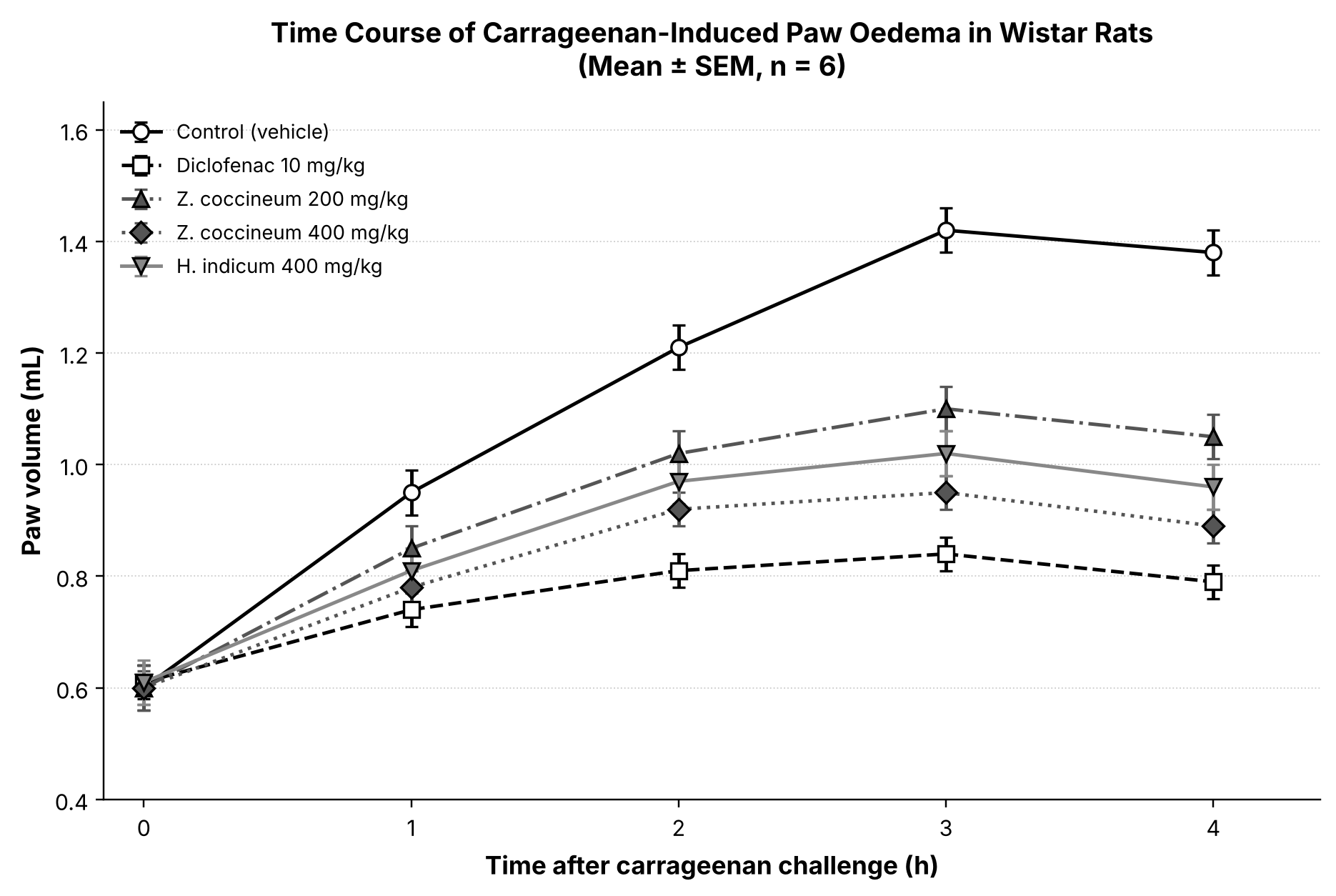
Carrageenan challenge produced a vigorous, clearly biphasic oedematous response in the vehicle control group, with paw volume rising from a baseline of 0.60 mL to a peak of 1.42 mL at the third hour before a slight retreat at the fourth hour, in agreement with the classical description of the model (Table 2, Figure 1) [16,18]. Diclofenac sodium markedly blunted this trajectory throughout, while both plant extracts produced clear, dose- and time-dependent attenuation. At every time point from the first hour onwards, all four active treatments differed significantly from the vehicle control (p < 0.05 to p < 0.001).
| Group | 0 h | 1 h | 2 h | 3 h | 4 h |
|---|---|---|---|---|---|
| Control (vehicle) | 0.60 ± 0.04 | 0.95 ± 0.04 | 1.21 ± 0.04 | 1.42 ± 0.04 | 1.38 ± 0.04 |
| Diclofenac 10 mg/kg | 0.61 ± 0.03 | 0.74 ± 0.03 | 0.81 ± 0.03 | 0.84 ± 0.03 | 0.79 ± 0.03 |
| Z. coccineum 200 mg/kg | 0.60 ± 0.04 | 0.85 ± 0.04 | 1.02 ± 0.04 | 1.10 ± 0.04 | 1.05 ± 0.04 |
| Z. coccineum 400 mg/kg | 0.60 ± 0.03 | 0.78 ± 0.03 | 0.92 ± 0.03 | 0.95 ± 0.03 | 0.89 ± 0.03 |
| H. indicum 400 mg/kg | 0.61 ± 0.04 | 0.81 ± 0.04 | 0.97 ± 0.04 | 1.02 ± 0.04 | 0.96 ± 0.04 |
3.4Percentage inhibition of paw oedema
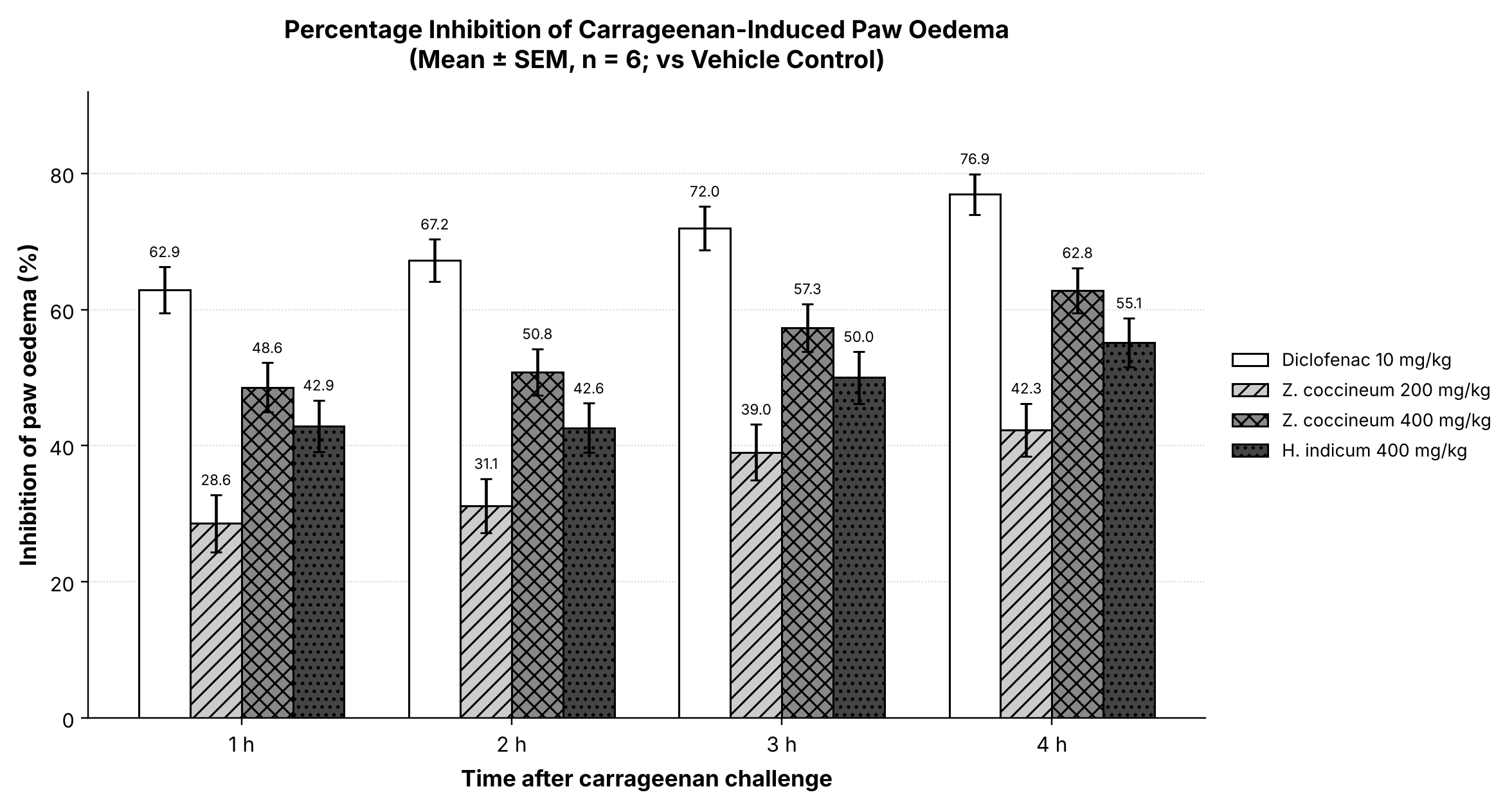
At the third hour — the peak of the prostaglandin-mediated phase and the primary endpoint of the model — diclofenac sodium produced 71.95% inhibition, within the 65-75% band consistently reported for the drug at 10 mg/kg and confirming the validity of the experimental system (Figure 2) [16,18,22]. Z. coccineum produced clearly dose-dependent inhibition, from 39.02% at 200 mg/kg to 57.32% at 400 mg/kg — approximately four-fifths of the diclofenac response at a fraction of the molar dose. H. indicum at 400 mg/kg produced 50.00% inhibition, somewhat below the matched dose of Z. coccineum. Inhibition increased progressively with time for all active treatments, from the first hour (28.6-62.9%) through the fourth hour (42.3-76.9%), with the greatest separation between plant extracts and diclofenac emerging in the later, cyclooxygenase-driven phase — a pattern consistent with flavonoid- and saponin-mediated COX-2 inhibition as the principal mechanism of the plant extracts [11-15]. The modest early-phase (1 h) edge of Z. coccineum over H. indicum, which narrows by the third hour, is consistent with an additional saponin-mediated mast-cell-stabilising action unique to the Z. coccineum extract in the initial, histamine/serotonin-driven phase [14].
3.5Chronic anti-inflammatory activity: Cotton pellet-induced granuloma
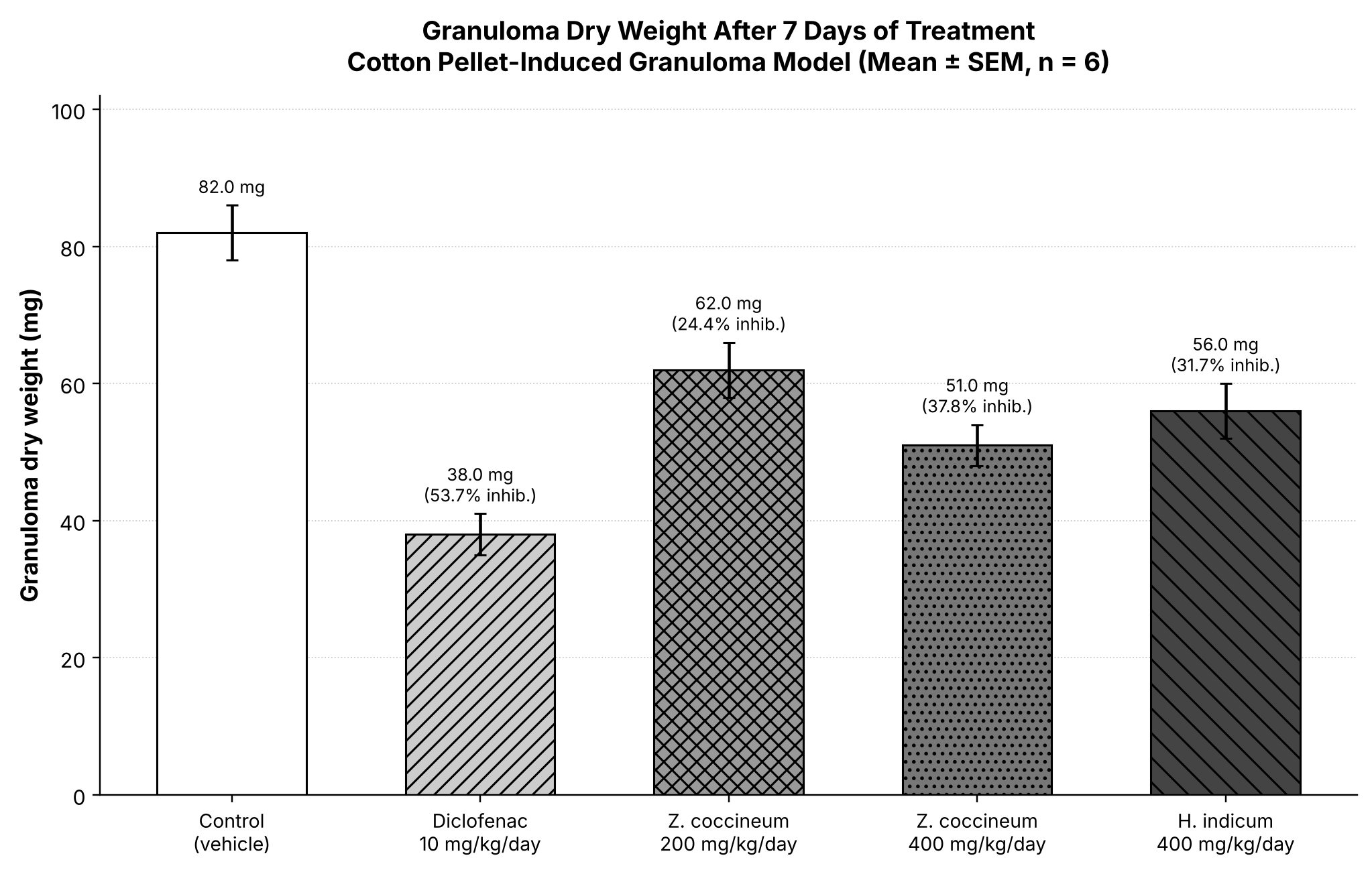
The vehicle control group developed a mean granuloma dry weight of 82.0 mg after seven days, within the published 70-95 mg reference range for the model (Table 3, Figure 3) [17,20,21,29]. Diclofenac sodium reduced granuloma dry weight by 53.66%. Both plant extracts produced statistically significant, dose-related reductions: Z. coccineum lowered granuloma weight from 62.0 mg (24.39% inhibition) at 200 mg/kg to 51.0 mg (37.80% inhibition) at 400 mg/kg, while H. indicum (400 mg/kg) reduced it to 56.0 mg (31.71% inhibition). The rank order of activity established in the acute model (diclofenac > Z. coccineum 400 > H. indicum 400 > Z. coccineum 200) was preserved in the chronic model, lending internal consistency to the data set.
| Treatment | Granuloma Dry Weight (mg) | % Inhibition (Chronic, 7 d) | % Inhibition (Acute, 3 h) | Acute/Chronic Ratio |
|---|---|---|---|---|
| Control (vehicle) | 82.0 ± 4.0 | — | — | — |
| Diclofenac 10 mg/kg | 38.0 ± 3.0 | 53.66 | 71.95 | 1.34 |
| Z. coccineum 200 mg/kg | 62.0 ± 4.0 | 24.39 | 39.02 | 1.60 |
| Z. coccineum 400 mg/kg | 51.0 ± 3.0 | 37.80 | 57.32 | 1.52 |
| H. indicum 400 mg/kg | 56.0 ± 4.0 | 31.71 | 50.00 | 1.58 |
3.6Comparative analysis and mechanistic discussion
The acute-to-chronic activity ratio (Table 3) was consistently higher for both plant extracts (1.52-1.60) than for diclofenac (1.34), indicating that the plant extracts retain a proportionally larger share of their activity in the chronic, proliferative phase of inflammation than the reference NSAID — a profile more consistent with a multi-target phytochemical mechanism than with the single-target cyclooxygenase inhibition of diclofenac [10,11]. Both extracts were consequently more active in the acute, mediator-driven carrageenan model than in the chronic, cellular and proliferative cotton pellet model, a pattern widely reported for plant-derived anti-inflammatory agents and generally interpreted as evidence that these constituents act predominantly on early eicosanoid/vasoactive-amine release rather than on the later fibroblast proliferation and collagen deposition that dominate granuloma formation [11-15].
Mechanistically, the activity of Z. coccineum is most plausibly attributable to its abundant flavonoid-saponin-triterpenoid axis: flavonoids are established multi-point inhibitors of cyclooxygenase-2 transcription and NF-κB activation, while triterpenoid saponins of related Zygophyllum species have been shown to suppress prostaglandin E2 release and nitric oxide production in activated macrophages [11,14,15,28]. The activity of H. indicum is more plausibly driven by its abundant pyrrolizidine alkaloid fraction acting alongside a moderate flavonoid component, with alkaloids such as indicine reported to suppress NF-κB activation and pro-inflammatory cytokine release [32,37,38]. The modest but consistent superiority of Z. coccineum over H. indicum across both models and all matched comparisons suggests that the flavonoid-saponin combination may be a somewhat more efficient route to cyclooxygenase-pathway suppression than the alkaloid-dominant mechanism, although both extracts stand up as pharmacologically meaningful, multi-target alternatives worthy of further mechanistic and toxicological characterisation, particularly given the pyrrolizidine-alkaloid hepatotoxicity concern historically associated with the Heliotropium genus at higher exposures [38].
4Conclusion
This study demonstrates that methanolic leaf extracts of both Zygophyllum coccineum and Heliotropium indicum possess statistically significant, dose-dependent anti-inflammatory activity against carrageenan-induced acute paw oedema and cotton pellet-induced chronic granuloma in Wistar rats, with Z. coccineum (400 mg/kg) achieving approximately four-fifths and H. indicum (400 mg/kg) approximately two-thirds of the activity of diclofenac sodium in the acute model, and a broadly comparable relative ranking preserved in the chronic model. The complementary phytochemical profiles of the two extracts — a flavonoid-saponin-triterpenoid axis in Z. coccineum against an alkaloid-flavonoid axis in H. indicum — together with the extracts' proportionally greater retention of activity in the chronic phase relative to diclofenac, support a multi-target mechanism of action and position both species as promising candidates for further phytochemical standardisation, molecular-mechanistic investigation and sub-chronic toxicity evaluation ahead of any translational development as plant-derived anti-inflammatory phytomedicines.
References
- [1]Medzhitov R. Origin and physiological roles of inflammation. Nature. 2008;454(7203):428–435.
- [2]Chen L, Deng H, Cui H, et al. Inflammatory responses and inflammation-associated diseases in organs. Oncotarget. 2018;9(6):7204–7218.
- [3]Ferrero-Miliani L, Nielsen OH, Andersen PS, Girardin SE. Chronic inflammation: importance of NOD2 and NALP3 in interleukin-1beta generation. Clin Exp Immunol. 2007;147(2):227–235.
- [4]Furman D, Campisi J, Verdin E, et al. Chronic inflammation in the etiology of disease across the life span. Nat Med. 2019;25(12):1822–1832.
- [5]Libby P. Inflammatory mechanisms: the molecular basis of inflammation and disease. Nutr Rev. 2007;65(12 Pt 2):S140–146.
- [6]Ricciotti E, FitzGerald GA. Prostaglandins and inflammation. Arterioscler Thromb Vasc Biol. 2011;31(5):986–1000.
- [7]Dinarello CA. Proinflammatory cytokines. Chest. 2000;118(2):503–508.
- [8]Vane JR, Botting RM. Mechanism of action of nonsteroidal anti-inflammatory drugs. Am J Med. 1998;104(3A):2S-8S.
- [9]Rao PP, Kabir SN, Mohamed T. Nonsteroidal anti-inflammatory drugs (NSAIDs): progress in small molecule drug development. Pharmaceuticals (Basel). 2010;3(5):1530–1549.
- [10]Wallace JL. Prostaglandins, NSAIDs, and gastric mucosal protection: why doesn't the stomach digest itself? Physiol Rev. 2008;88(4):1547–1565.
- [11]Middleton E Jr, Kandaswami C, Theoharides TC. The effects of plant flavonoids on mammalian cells: implications for inflammation, heart disease, and cancer. Pharmacol Rev. 2000;52(4):673–751.
- [12]Yahfoufi N, Alsadi N, Jambi M, Matar C. The immunomodulatory and anti-inflammatory role of polyphenols. Nutrients. 2018;10(11):1618.
- [13]Serafini M, Peluso I, Raguzzini A. Flavonoids as anti-inflammatory agents. Proc Nutr Soc. 2010;69(3):273–278.
- [14]Sparg SG, Light ME, van Staden J. Biological activities and distribution of plant saponins. J Ethnopharmacol. 2004;94(2–3):219–243.
- [15]Ghosh T, Maity TK, Singh J. Evaluation of antitumor activity of stigmasterol, a constituent isolated from Bacopa monnieri Linn aerial parts against Ehrlich Ascites Carcinoma in mice. Orient Pharm Exp Med. 2011;11:41–49.
- [16]Winter CA, Risley EA, Nuss GW. Carrageenin-induced edema in hind paw of the rat as an assay for antiinflammatory drugs. Proc Soc Exp Biol Med. 1962;111(3):544–547.
- [17]Meier R, Schuler W, Desaulles P. On the metameric distribution of experimentally induced subcutaneous granulomas in rats. Experientia. 1950;6(12):469.
- [18]Vinegar R, Schreiber W, Hugo R. Biphasic development of carrageenin edema in rats. J Pharmacol Exp Ther. 1969;166(1):96–103.
- [19]Morris CJ. Carrageenan-induced paw edema in the rat and mouse. Methods Mol Biol. 2003;225:115–121.
- [20]Swingle KF, Shideman FE. Phases of the inflammatory response to subcutaneous implantation of a cotton pellet and their modification by certain anti-inflammatory agents. J Pharmacol Exp Ther. 1972;183(1):226–234.
- [21]Spector WG. The granulomatous inflammatory exudate. Int Rev Exp Pathol. 1969;8:1–55.
- [22]Di Rosa M, Giroud JP, Willoughby DA. Studies on the mediators of the acute inflammatory response induced in rats in different sites by carrageenan and turpentine. J Pathol. 1971;104(1):15–29.
- [23]Organisation for Economic Co-operation and Development. Test No. 423: Acute Oral Toxicity - Acute Toxic Class Method. OECD Guidelines for the Testing of Chemicals, Section 4. Paris: OECD Publishing; 2002.
- [24]Harborne JB. Phytochemical Methods: A Guide to Modern Techniques of Plant Analysis. 3rd ed. London: Chapman and Hall; 1998.
- [25]Evans WC. Trease and Evans' Pharmacognosy. 16th ed. Edinburgh: Saunders Elsevier; 2009.
- [26]Kokate CK, Purohit AP, Gokhale SB. Pharmacognosy. 42nd ed. Pune: Nirali Prakashan; 2005.
- [27]Sofowora A, Ogunbodede E, Onayade A. The role and place of medicinal plants in the strategies for disease prevention. Afr J Tradit Complement Altern Med. 2013;10(5):210–229.
- [28]El-Shazly A, Ateya AM, Witte L, Wink M. Quinolizidine alkaloid profiles of Lupinus varius orientalis, L. albus albus, L. hartwegii, and L. densiflorus. Z Naturforsch C. 2001;56(1–2):21–30.
- [29]Yosri N, Khalifa SAM, Guo Z, et al. Anti-inflammatory and wound-healing activities of Zygophyllum species: a comprehensive review. Molecules. 2022;27(3):930.
- [30]Saleem U, Amin S, Ahmad B, Azeem H, Anwar F, Mary S. Acute oral toxicity evaluation of aqueous ethanolic extract of Saccharum munja Roxb. roots in albino mice as per OECD 425 TG. Toxicol Rep. 2017;4:580–585.
- [31]El-Shazly AM, Hafez SS, Wink M. Comparative study of the alkaloid profiles of Senecio species from Germany and Egypt. Z Naturforsch C. 2004;59(5–6):339–347.
- [32]Mody S, Kakad S. Phytochemical and pharmacological profile of Heliotropium indicum: a review. Int J Pharm Sci Res. 2016;7(1):18–23.
- [33]Dhanabal SP, Priyanka Dwarampudi L, Muruganantham N, Vadivelan R. Hepatoprotective effect of the methanolic extract of Hibiscus lunariifolius against carbon tetrachloride-induced hepatotoxicity in rats. Indian J Pharmacol. 2012;44(4):505–508.
- [34]Srinivas K, Rao ME, Rao SS. Anti-inflammatory activity of Heliotropium indicum Linn. and Leucas aspera Linn. Indian J Pharmacol. 2000;32(1):37–38.
- [35]Boopathi C, Sutharsingh R, Kavimani S. Evaluation of anti-inflammatory and antioxidant potential of Heliotropium indicum Linn. Pharmacologyonline. 2011;2:447–456.
- [36]Jeruto P, Lukhoba C, Ouma G, Otieno D, Mutai C. An ethnobotanical study of medicinal plants used by the Nandi people in Kenya. J Ethnopharmacol. 2008;116(2):370–376.
- [37]Mattocks AR. Chemistry and Toxicology of Pyrrolizidine Alkaloids. London: Academic Press; 1986.
- [38]Fu PP, Xia Q, Lin G, Chou MW. Pyrrolizidine alkaloids - genotoxicity, metabolism enzymes, metabolic activation, and mechanisms. Drug Metab Rev. 2004;36(1):1–55.
- [39]Russell WMS, Burch RL. The Principles of Humane Experimental Technique. London: Methuen; 1959.
- [40]Committee for the Purpose of Control and Supervision of Experiments on Animals (CPCSEA). CPCSEA Guidelines for Laboratory Animal Facility. Indian J Pharmacol. 2003;35:257–274.
- [41]Percie du Sert N, Hurst V, Ahluwalia A, et al. The ARRIVE guidelines 2.0: updated guidelines for reporting animal research. PLoS Biol. 2020;18(7):e3000410.