Energy Procurement Resilience in Pandemics
Maintaining Essential Energy Supplies during Pandemic Disruptions: A Procurement Resilience Framework
1Colossal Hub, Lagos State, Nigeria
2Nigeria Petroleum Development Company Ltd, Edo State, Nigeria
3PESO Energy Services Limited, Lagos, Nigeria
Published October 2020
Abstract
The COVID-19 pandemic exposed the fragility of the procurement and logistics systems that keep electricity, liquid fuels and gas flowing to hospitals, water utilities, emergency services and households. Unlike earlier supply shocks, the 2020 disruption combined a collapse in aggregate energy demand with localised spikes in critical demand, labour shortages at ports, depots and terminals, border controls that slowed crew changes and cargo clearance, and sharp price volatility that strained supplier finances. The result was a continuity gap: energy remained abundant at the global level while essential users faced delayed or interrupted deliveries at the local level. Conventional energy procurement, optimised for cost efficiency and for discrete, short-lived events, was not designed to close this gap. This conceptual paper develops a Procurement Resilience Framework (PRF) for maintaining essential energy supplies under pandemic conditions. Using a theory synthesis design, prior research published up to 2020 was thematically coded for disruption mechanisms, capabilities, enabling conditions and outcomes, and the resulting categories were organised into a conceptual model. The framework places a governance layer, which defines emergency procurement authority, an essential-user hierarchy and risk appetite, above four operational pillars. Emergency sourcing secures alternative supply through pre-qualified suppliers, framework agreements and volume-flexible contracts. Port delay mitigation keeps cargo moving through berth priority, alternate discharge options, pandemic-specific contract clauses and digital clearance. Inventory staging buys time through tiered and forward-positioned buffer stocks, storage capacity options and quality management. Fuel distribution continuity protects the last mile through priority allocation rules, reserve driver and depot capacity, alternate routing and safe delivery practices. Four cross-cutting enablers, namely end-to-end visibility, contractual flexibility, workforce protection and public-private coordination, support all pillars, and a learning loop allows arrangements to be revised as the disruption evolves. The paper advances eight testable propositions that link these capabilities to supply continuity, measured through availability, timeliness, cost containment and safety at essential-user sites. The propositions specify direct effects of governance, sourcing, port and inventory capabilities, a mediating role for distribution capabilities, moderating roles for visibility and coordination, diminishing returns to inventory, and improvement through learning across successive waves. A four-phase roadmap of preparation, response, recovery and adaptation translates the model into procurement actions. The framework offers utilities, national oil companies, fuel distributors, hospitals and public agencies a structured basis for designing and auditing pandemic-ready energy supply arrangements, and it highlights policy priorities such as recognising energy logistics workers as essential personnel. The model has not yet been tested empirically and is oriented mainly toward seaborne fuel and gas supply; it therefore sets out an agenda for case-based, survey and simulation research to validate and extend it.
Keywords: procurement resilience; energy security; COVID-19; emergency sourcing; port congestion; strategic inventory; fuel distribution; business continuity
1Introduction
Energy is the input on which every other essential service depends. Hospitals require uninterrupted power and diesel for standby generation; water treatment relies on pumping and chemical dosing; food cold chains, telecommunications and emergency transport all assume that fuel and electricity will be available when needed. When the World Health Organization declared COVID-19 a pandemic in March 2020, governments across the world designated energy supply as an essential activity precisely because its failure would compound the public health emergency.
Yet the procurement systems behind essential energy supply were not designed for a prolonged, global, simultaneous disruption. Most energy procurement practice has been optimised for cost efficiency under normal conditions (Okonkwo et al., 2018a; Okonkwo et al., 2019), with business continuity planning focused on discrete, local events such as refinery outages, storms or single-supplier failures. The pandemic presented a different pattern. In the oil market, lockdowns triggered what the International Energy Agency (IEA) described as the largest demand contraction in the history of the industry, with expected 2020 demand falling by roughly 9 million barrels per day relative to 2019 (IEA, 2020a). Onshore storage approached its limits, floating storage expanded rapidly, and on 20 April 2020 the front-month West Texas Intermediate futures contract settled below zero for the first time. At the same time, demand for specific products and services, such as diesel for emergency logistics, liquefied petroleum gas for household cooking and reliable power for intensive care units, remained inflexible or increased.
These conditions created a paradox for procurement teams: an oversupplied global market co-existed with localised shortages caused by blocked logistics, absent workers, delayed vessels and financially stressed intermediaries. Physical availability, not price, became the binding constraint in many locations. Ports introduced quarantine requirements and restricted crew changes, which delayed vessel turnaround (UNCTAD, 2020). Depots and terminals operated with reduced staff. Road tanker drivers faced border checks and health screening. Smaller distributors struggled with liquidity as price swings eroded working capital.
An early wave of pandemic scholarship documented these dynamics across sectors. Studies reported demand-supply mismatches, panic buying, labour shortages and transport bottlenecks in food, healthcare and consumer goods chains (Hobbs, 2020; Sharma et al., 2020; Xu et al., 2020; Zhu et al., 2020), and argued that supply chain models had long privileged leanness over resilience (Golan et al., 2020; van Hoek, 2020a). Others proposed theoretical toolboxes for pandemic research (Craighead et al., 2020) and showed how logistics-enabled service models can sustain essential services during lockdowns (Choi, 2020). Simulation studies demonstrated that the speed of epidemic propagation and the duration of closures shape ripple effects across global networks (Ivanov & Das, 2020), while decision-support work addressed demand management and resource allocation in healthcare supply chains (Govindan et al., 2020; Mehrotra et al., 2020). Pre-COVID research on epidemic logistics, including influenza food distribution and Ebola response planning, had already shown that disease dynamics and logistics decisions must be modelled together (Büyüktahtakın et al., 2018; Ekici et al., 2014; Liu & Zhang, 2016).
This paper responds to a practical and theoretical gap. Practically, energy buyers lacked an integrated model that connects upstream sourcing decisions with port operations, inventory positioning and last-mile distribution. Theoretically, supply chain resilience research has developed rich concepts of redundancy, flexibility, visibility and collaboration (Christopher & Peck, 2004; Sheffi & Rice, 2005; Pettit, Fiksel & Croxton, 2010), and early pandemic scholarship has highlighted the distinctive features of epidemic disruptions (Ivanov, 2020; Ivanov & Dolgui, 2020; Queiroz et al., 2020). However, these insights have not been synthesised for the specific case of essential energy, where products are hazardous, storage is capital intensive, logistics are concentrated in a small number of nodes, and failure has immediate public safety consequences. Energy-sector studies have examined supply chain risk in engineering, procurement and construction (EPC) and gas processing projects (Agbabiaka et al., 2019), inventory availability and plant uptime in energy facilities (Okonkwo et al., 2018b), port logistics and demurrage (Okonkwo et al., 2020) and contractual resilience to force majeure events (Uchechi et al., 2020), but these strands have rarely been integrated into a single pandemic-ready procurement model.
The energy security literature provides a complementary lens. Energy security has been conceptualised in terms of availability, accessibility, affordability and acceptability (Kruyt et al., 2009), extended into multi-dimensional assessment frameworks (Ang et al., 2015; Sovacool & Mukherjee, 2011), and redefined as the low vulnerability of vital energy systems (Cherp & Jewell, 2014; Winzer, 2012). This literature has paid most attention to national supply adequacy and price shocks, and less to the organisational procurement and logistics routines that turn national availability into delivered supply at essential sites. Early pandemic energy studies also signalled that COVID-19 could reshape both short-run energy operations and longer-run transition pathways (Gillingham et al., 2020; Hosseini, 2020; Kuzemko et al., 2020).
Against this background, this paper develops a Procurement Resilience Framework (PRF) for maintaining essential energy supplies during pandemics. The framework explains how a pandemic disrupts essential energy supply, organises the procurement capabilities that counter these disruptions around emergency sourcing, port delay mitigation, inventory staging and fuel distribution continuity, and derives testable propositions and an implementation roadmap. Consistent with established approaches to conceptual articles, the contribution rests on theory synthesis and framework development rather than empirical testing (Jaakkola, 2020). The remainder of the paper describes the methodology, synthesises the relevant literature, presents the conceptual model and its propositions, and then discusses implications, limitations and directions for future research.
2Methodology
This study adopts a conceptual research design. Conceptual papers develop new understanding by integrating and extending existing theory rather than by collecting primary data, and they are appropriate when a phenomenon is new, fast-moving or not yet observable at scale (Jaakkola, 2020). Both conditions applied to pandemic disruption of essential energy supply in 2020: the crisis was still unfolding, systematic operational data were not yet available, and relevant knowledge was dispersed across supply chain management, energy economics, maritime logistics, humanitarian operations and critical infrastructure research. The study therefore follows a theory synthesis approach, in which concepts from several literatures are combined into a single explanatory framework with explicit propositions.
2.1Identification and selection of sources
Sources were identified through keyword searches of academic databases, publisher platforms and institutional repositories, supplemented by backward tracing of references in key articles. Search terms combined disruption concepts (pandemic, COVID-19, epidemic, disruption, ripple effect, resilience, business continuity) with domain concepts (procurement, sourcing, supplier, port, shipping, demurrage, inventory, pre-positioning, strategic reserve, fuel distribution, petroleum, electricity, energy security). Sources were included when they were peer-reviewed articles, scholarly books or authoritative institutional reports; were published in 2020 or earlier; and addressed at least one of four domains: supply disruption and resilience, port and maritime logistics, inventory and pre-positioning, or downstream energy distribution. To reflect the operating context of emerging economies, the international literature was complemented by applied regional research on energy procurement, asset integrity, occupational safety, digital infrastructure, healthcare facilities and financial governance. The final corpus comprised 278 sources: 125 from the international literature and 153 from regional and applied research.
2.2Analysis and synthesis
The selected sources were analysed thematically. Each source was coded for the disruption mechanisms it described, the capabilities or interventions it examined, the enabling conditions it identified and the outcomes it reported. Codes were then grouped iteratively into higher-order categories. Disruption mechanisms were consolidated into four pandemic-specific drivers, and capabilities were mapped against the segment of the energy supply chain in which they act, from upstream sourcing to last-mile delivery. This mapping produced the four operational pillars, while recurring conditions that supported several pillars at once were classified as cross-cutting enablers.
2.3Framework development and proposition derivation
The conceptual model was developed abductively by moving between the coded literature and the observed features of the 2020 disruption. Relationships between constructs were specified where the literature provided consistent theoretical or empirical support, and these relationships were expressed as testable propositions. The implementation roadmap was derived from the readiness, response and recovery logic of resilience theory, extended with an adaptation phase. The model was assessed against three criteria commonly applied to conceptual work: internal consistency between constructs and propositions, parsimony in the number of components, and practical applicability for procurement decision-makers.
3Literature synthesis
This section synthesises the literature in two parts. The first examines how pandemics disrupt essential energy supply, drawing on pandemic, energy, maritime and regional applied research. The second reviews the theoretical foundations in supply chain risk management, resilience, pandemic viability and procurement that inform the conceptual model.
3.1Pandemic disruption mechanisms in essential energy supply
Pandemic disruptions differ from conventional supply shocks in four respects that matter for energy procurement. Ivanov (2020) notes that epidemic outbreaks are characterised by long duration, unpredictable scaling, and simultaneous disruption of supply, demand and logistics infrastructure. Each of these features has a specific expression in the energy sector.
3.1.1Demand shocks that are both deep and uneven
Aggregate energy demand fell sharply in 2020. The IEA estimated that global energy demand would decline by about 6 percent over the year, with oil and coal most affected and electricity demand in locked-down economies falling noticeably (IEA, 2020b). Transport fuels, especially jet kerosene and gasoline, saw the steepest declines. However, aggregate figures concealed sharp shifts in the composition and location of demand. Residential electricity use rose as people worked from home, healthcare facilities and data centres became more critical, and governments prioritised fuel for emergency services, freight and agriculture. For procurement teams, the problem was not simply less volume but different volume in different places, often at short notice.
Electricity system studies confirmed this compositional shift. Demand reductions in North America and Europe tracked case counts, mobility restrictions and the stringency of containment measures, while daily load profiles flattened and peaks moved (Abu-Rayash & Dincer, 2020; Bahmanyar et al., 2020; Ruan et al., 2020). In oil markets, COVID-19 news became a dominant driver of prices and volatility (Devpura & Narayan, 2020; Narayan, 2020), echoing longer-standing evidence that demand-driven and supply-driven oil shocks have distinct consequences and that oil prices remain difficult to forecast (Baumeister & Kilian, 2016; Hamilton, 2009; Kilian, 2008; Kilian, 2009). For essential users in emerging economies, these shocks interact with existing reliance on imported refined products and administered pricing (Siddig et al., 2014).
3.1.2Workforce absence at critical nodes
Energy supply chains depend on specialised workers at refineries, terminals, ports, depots, control rooms and tanker fleets. Illness, quarantine, caring responsibilities and social distancing rules reduced effective capacity at these nodes. Because many roles require certification, such as hazardous goods drivers, marine pilots and control room operators, substitutes could not be recruited quickly. Workforce disruption therefore acted as a capacity constraint independent of physical asset availability, underscoring the importance of deliberate capability building across distributed supply chain operations (Falemi et al., 2020) and of support models that balance remote and on-site work without sacrificing operational continuity (Anyanwu, 2020).
Safety management research from energy and industrial settings reinforces this point. Pandemic controls add to an already demanding safety regime in drilling, maintenance, lifting and construction work, where contractor governance, human error, heat stress, hazard reporting and leadership-driven safety culture determine whether operations can continue safely (Arumosoye & Obriki, 2018; Arumosoye & Obriki, 2019; Arumosoye & Obriki, 2020; Nwangwu et al., 2018; Obogo et al., 2019a; Obogo et al., 2019b; Obogo et al., 2019c; Obogo et al., 2020a; Obogo et al., 2020b; Obogo et al., 2020c; Obriki & Arumosoye, 2018; Obriki & Arumosoye, 2019; Obriki & Arumosoye, 2020). Comparable lessons emerge from aviation safety oversight, where adaptive safety management and predictive compliance monitoring have been proposed for resource-constrained settings (Adeyelu, 2018; Adeyelu, 2019; Adeyelu, 2020). For maritime operations specifically, quarantine and border rules turned seafarers into frontline workers whose welfare became a precondition for continued shipping (Doumbia-Henry, 2020). Workforce disruption is therefore both a health problem and a safety-critical capacity problem.
3.1.3Port and border restrictions
Maritime transport carries the large majority of internationally traded crude oil, refined products, liquefied natural gas and coal. During 2020, ports and states imposed quarantine periods on arriving vessels, restricted shore leave and crew changes, and added health documentation to clearance procedures (UNCTAD, 2020). These measures lengthened port stays, disrupted vessel schedules and increased demurrage exposure, a cost burden that is already significant for energy importers in emerging economies under normal conditions (Okonkwo et al., 2020). Land borders introduced checks that slowed cross-border tanker movements, which particularly affected landlocked and import-dependent countries.
Maritime research had long identified ports as points of concentrated vulnerability. Schedule unreliability caused by congestion and terminal delays propagates into hinterland supply chains and forces shippers to hold additional safety stock (Notteboom, 2006; Vernimmen et al., 2007). Port disruptions from strikes, accidents and natural hazards impose costs on multiple stakeholders and on nearby industry clusters (Lam & Su, 2015; Loh & Thai, 2015; Verschuur et al., 2020; Zhang & Lam, 2016), and formal vulnerability assessments show how failures in specific maritime functions reduce system throughput (Berle et al., 2011a; Berle et al., 2011b). Energy flows are particularly exposed because a small number of maritime chokepoints carry a large share of traded oil (Emmerson & Stevens, 2012), and the 2020 collapse in oil demand also unsettled tanker freight markets (Michail & Melas, 2020). In Nigeria, port reform improved productivity but infrastructure adequacy and service frequency remain central to port choice (Nwanosike et al., 2016; Ugboma et al., 2006), while legal and administrative barriers continue to complicate import and export activity (Jones & Ominyi, 2020).
3.1.4Financial stress and supplier fragility
Extreme price volatility affected the solvency of traders, small distributors and service providers. Falling prices reduced the value of inventory and receivables, while margin calls and tighter credit restricted liquidity. Suppliers that appeared reliable before the crisis could fail or withdraw from markets during it, and many invoked force majeure provisions whose scope and evidentiary requirements differed widely across contracts (Uchechi et al., 2020). For buyers, counterparty risk rose at the same moment that switching suppliers became harder because of logistics constraints.
Financial governance research highlights why such stress translates into supply risk. Weak budget compliance, reconciliation controls and statutory reporting reduce organisations’ ability to respond quickly and transparently to shocks (Bola-Sadipe et al., 2019; Dogbatsey & Ebhojie, 2018; Dogbatsey et al., 2019), while risk-based internal control, technology-enabled audit and integrated compliance strategies strengthen financial resilience (Akomolafe & Agu, 2018; Akomolafe & Agu, 2019a; Akomolafe & Agu, 2019b; Akomolafe & Agu, 2019c). Treasury and tax governance, transfer pricing risk and data-driven executive decision systems shape how multinational energy firms allocate liquidity across subsidiaries during crises (Lawal & Oduleye, 2018a; Lawal & Oduleye, 2018b; Lawal & Oduleye, 2019a; Lawal & Oduleye, 2019b), and fiscal measures such as finance bills can alter sector economics at short notice (Akinola et al., 2020). Bank capital adequacy rules and risk-weighted asset practices also shape how much credit lenders can extend to energy traders and distributors when risk perceptions rise (Mensah et al., 2019). Trade finance, distributorship finance and relationship banking models determine whether smaller fuel distributors retain access to working capital when prices swing (Agboada et al., 2018b; Agboada et al., 2020; Ezeako et al., 2019).
Two further features amplify these mechanisms. First, energy supply is interdependent with other critical infrastructures, so a failure can cascade through physical, cyber, geographic and logical linkages (Ouyang, 2014; Rinaldi et al., 2001). The users most exposed are essential services, especially health facilities. Diagnostic laboratories, hospitals and pharmacy-led primary care depend on reliable power and fuel for specimen storage, equipment and cold chains, and their infrastructure, design and financing models have been examined in resource-constrained settings (Aminu-Ibrahim et al., 2018; Aminu-Ibrahim et al., 2019; Aminu-Ibrahim et al., 2020; Ilodigwe & Adesemoye, 2019a; Ilodigwe & Adesemoye, 2019b; Ilodigwe & Adesemoye, 2020; Ogbete et al., 2018; Ogbete et al., 2019; Ogbete et al., 2020). Laboratory quality systems, infection detection, antimicrobial resistance surveillance and disease surveillance networks all assume uninterrupted energy (Abdulrazaq et al., 2019; Ekemezie et al., 2018; Yusuf & Abdulrazaq, 2018; Yusuf et al., 2020), as do pharmaceutical manufacturing and distribution systems that rely on risk-based decision-making and chain-of-custody integrity (Aneke & Adesemoye, 2019; Aneke & Adesemoye, 2020). Second, procurement and logistics now run on digital infrastructure that must itself remain available. Electric utilities face operational technology security risks (Adegbite et al., 2020), and enterprise security research covers insider threats, intrusion detection, security audit, privacy engineering and data availability (Akeju et al., 2018; Dosunmu & Ogundele, 2019; Dosunmu & Ogundele, 2020; Fadayomi et al., 2019; Okoruwa et al., 2020; Onche et al., 2020). Cloud identity, access management, data protection and infrastructure governance (Mbonu et al., 2018; Mbonu et al., 2019a; Mbonu et al., 2019b; Mbonu et al., 2020b; Mbonu et al., 2020c; Oshoba et al., 2019; Oshoba et al., 2020), together with scalable cloud architectures, resource allocation and directory services (Ahmed & Odejobi, 2018a; Ahmed & Odejobi, 2018b; Ahmed et al., 2019; Ahmed et al., 2020; Ladapo et al., 2018; Ladapo et al., 2019; Odejobi & Ahmed, 2018a; Odejobi et al., 2019), determine whether remote procurement teams can operate when offices close.
Together these mechanisms produce what this paper terms a continuity gap: a divergence between the global availability of energy and the local, timely delivery of the right product to essential users. Closing this gap is the core purpose of procurement resilience in a pandemic.
3.2Supply chain risk management
Supply chain risk management (SCRM) provides the starting point. Kleindorfer and Saad (2005) frame disruption risk management as a cycle of specifying sources of risk, assessing their likelihood and impact, and mitigating them through coordinated actions. Chopra and Sodhi (2004) emphasise that mitigation strategies must be tailored to specific risk categories because a strategy that reduces one risk, such as holding more inventory to protect against supply interruption, can increase another, such as obsolescence or holding cost. Tang (2006) distinguishes operational risks, which arise from routine uncertainty, from disruption risks, which arise from major natural or man-made events and require robust strategies that remain effective under severe conditions. Pandemics fall clearly into the disruption category but also persist long enough to transform operational conditions.
Subsequent work refined these foundations. Supply risk has been defined as the probability of inbound supply failure that prevents the buyer from meeting demand (Zsidisin, 2003), and supply chain risk management has been framed around risk sources, consequences, drivers and mitigation strategies (Ho et al., 2015; Jüttner et al., 2003; Manuj & Mentzer, 2008). Empirical evidence shows that disruptions produce large and persistent losses in shareholder value (Hendricks & Singhal, 2005), that supplier dependence and global sourcing raise supply-side vulnerability (Wagner & Bode, 2006), and that decoupling recurrent from disruption risks avoids over-reliance on cheap but unreliable suppliers (Chopra et al., 2007). Operations research models identify inventory, sourcing flexibility and network design as the main mitigation levers (Schmitt & Singh, 2012; Snyder et al., 2016; Tomlin, 2006), while proactive planning for catastrophic events and visibility-led confidence building help firms prepare (Christopher & Lee, 2004; Knemeyer et al., 2009; Simchi-Levi et al., 2014). In energy and engineering projects, data-driven risk evaluation and automated regulatory risk assessment extend these ideas to high-hazard settings (Gideon et al., 2019; Uchechi & Ominyi, 2020).
3.3Supply chain resilience
Resilience literature shifts attention from avoiding disruption to sustaining and restoring performance. Christopher and Peck (2004) define resilience as the ability of a system to return to its original state, or move to a new and more desirable state, after being disturbed, and identify supply chain re-engineering, collaboration, agility and a risk management culture as its building blocks. Sheffi and Rice (2005) argue that resilience is achieved by creating redundancy or increasing flexibility, with flexibility generally providing more value because it also improves performance in normal times. Ponomarov and Holcomb (2009) describe resilience as an adaptive capability that spans readiness, response and recovery. Pettit et al. (2010) conceptualise resilience as a balance between vulnerabilities and capabilities, warning that excessive capability investment erodes profitability while insufficient investment leaves firms exposed. Hohenstein et al. (2015) synthesise this literature and identify flexibility, redundancy, collaboration, visibility, agility and a supportive culture as the most frequently cited resilience elements.
Further reviews and empirical studies have consolidated these elements (Hosseini et al., 2019; Kamalahmadi & Parast, 2016; Tukamuhabwa et al., 2015). Resilience has been operationalised through validated scales and assessment tools (Ambulkar et al., 2015; Chowdhury & Quaddus, 2017; Pettit et al., 2013), and linked to visibility, relational competencies and mitigation processes (Brandon-Jones et al., 2014; Scholten et al., 2014; Wieland & Wallenburg, 2013). Evidence from the global financial crisis showed that flexibility, velocity, visibility and collaboration reduced vulnerability (Jüttner & Maklan, 2011), and global supply base studies identified the enhancers and reducers of supplier resiliency (Blackhurst et al., 2011). Firms may respond to disruption by buffering or by bridging with partners (Bode et al., 2011), and resilience practices moderate the link between perceived risk and actual disruption (Zsidisin & Wagner, 2010). Flexibility need not be large to be valuable (Tang & Tomlin, 2008), and agile, adaptable and aligned supply chains outperform those designed only for speed and cost (Lee, 2004; Sheffi, 2005).
3.4Pandemic-specific perspectives and viability
Early pandemic scholarship extended resilience theory. Ivanov (2020) used simulation to show that the timing of facility closures and reopening, the duration of disruption and the speed of propagation across supply chain stages are decisive for impact. Ivanov and Dolgui (2020) introduced the concept of the intertwined supply network and its viability, meaning the ability to survive in a changing environment by redesigning structures and replanning performance over long horizons. Queiroz et al. (2020) mapped a research agenda that emphasises adaptation, digitalisation, preparedness and recovery. These perspectives suggest that pandemic resilience is less about absorbing a single shock and more about continuously reconfiguring supply arrangements while the disruption persists.
This view builds on research into the ripple effect, the propagation of disruption across supply chain stages, which identifies redundancy, flexibility and digital risk analytics as means of containing it (Dolgui et al., 2018; Ivanov et al., 2019; Ivanov, 2017). Early COVID-19 studies added that emergency sourcing, resource sharing and product simplification restore service levels for essential goods (Paul & Chowdhury, 2020), and that firms shifted towards total cost of ownership, supplier collaboration and diversification (van Hoek, 2020b). For energy, the collapse in fuel demand and negative oil prices renewed interest in domestic fuel options and strategic storage as instruments of supply security (Chiaramonti & Maniatis, 2020).
3.5Procurement as a resilience lever
Procurement occupies a strategic position in this literature because it controls supplier selection, contract design, specification and relationship management. Kraljic (1983) argued that items with high supply risk and high business impact, which he termed strategic items, require dedicated supply strategies including long-term contracts, alternate sourcing and stockpiling. Essential energy is the archetypal strategic item for utilities, hospitals, transport operators and governments. Craighead et al. (2007) show that disruption severity depends on supply chain density, complexity and node criticality, and that recovery and warning capabilities moderate this severity. Within the energy sector specifically, strategic procurement optimisation (Okonkwo et al., 2018a), structured vendor governance and contract negotiation (Okonkwo et al., 2019) and project-level supply chain risk models (Agbabiaka et al., 2019) have been shown to influence cost, availability and delivery reliability. These insights justify a procurement-led framework that deliberately builds warning, response and recovery capabilities into the energy supply chain.
Public procurement scholarship adds that buyers must balance efficiency, accountability and policy goals within regulatory constraints (Thai, 2001), and contract theory shows that more flexible, cost-reimbursable arrangements suit complex and uncertain requirements because they ease adaptation after contract award (Bajari & Tadelis, 2001). In energy settings, statutory licensing and public bidding requirements, cross-border regulatory clearances and post-merger compliance integration all shape how quickly procurement can respond (Ominyi & Anichukwueze, 2020; Ominyi et al., 2020; Ominyi, 2020). Standardised legal workflows, financial exposure management and compliance training reduce disputes and support ethical conduct under pressure (Anichukwueze et al., 2019; Anichukwueze et al., 2020; Uchechi et al., 2018; Uchechi, 2018). Joint venture structures common in the energy sector also require multi-stakeholder governance alignment so that partners can agree emergency decisions (Eyetsemitan et al., 2020).
3.6Synthesis of the literature
Three principles emerge from the literature and shape the framework. First, resilience capabilities should be matched to the specific disruption mechanisms identified in Section 3.1 rather than applied generically. Second, flexibility-based capabilities, such as pre-qualified alternate suppliers and optional storage contracts, are preferable where they also create value in normal operations, while redundancy should be reserved for the most critical exposures. Third, because pandemics are prolonged and evolving, the framework must include governance and learning mechanisms that allow procurement arrangements to be redesigned during the disruption, consistent with the viability perspective.
4Conceptual model: The procurement resilience framework
The Procurement Resilience Framework (PRF) is presented in Figure 1. Pandemic disruption drivers act on a governance layer that sets emergency authority and priorities. The governance layer directs four operational pillars, each addressing a distinct segment of the energy supply chain. Four cross-cutting enablers support all pillars. The intended outcome is continuity of essential energy supply, defined across four dimensions: availability, timeliness, cost containment and safety. A learning feedback loop returns performance information to the governance layer so that arrangements can be revised as the disruption evolves.
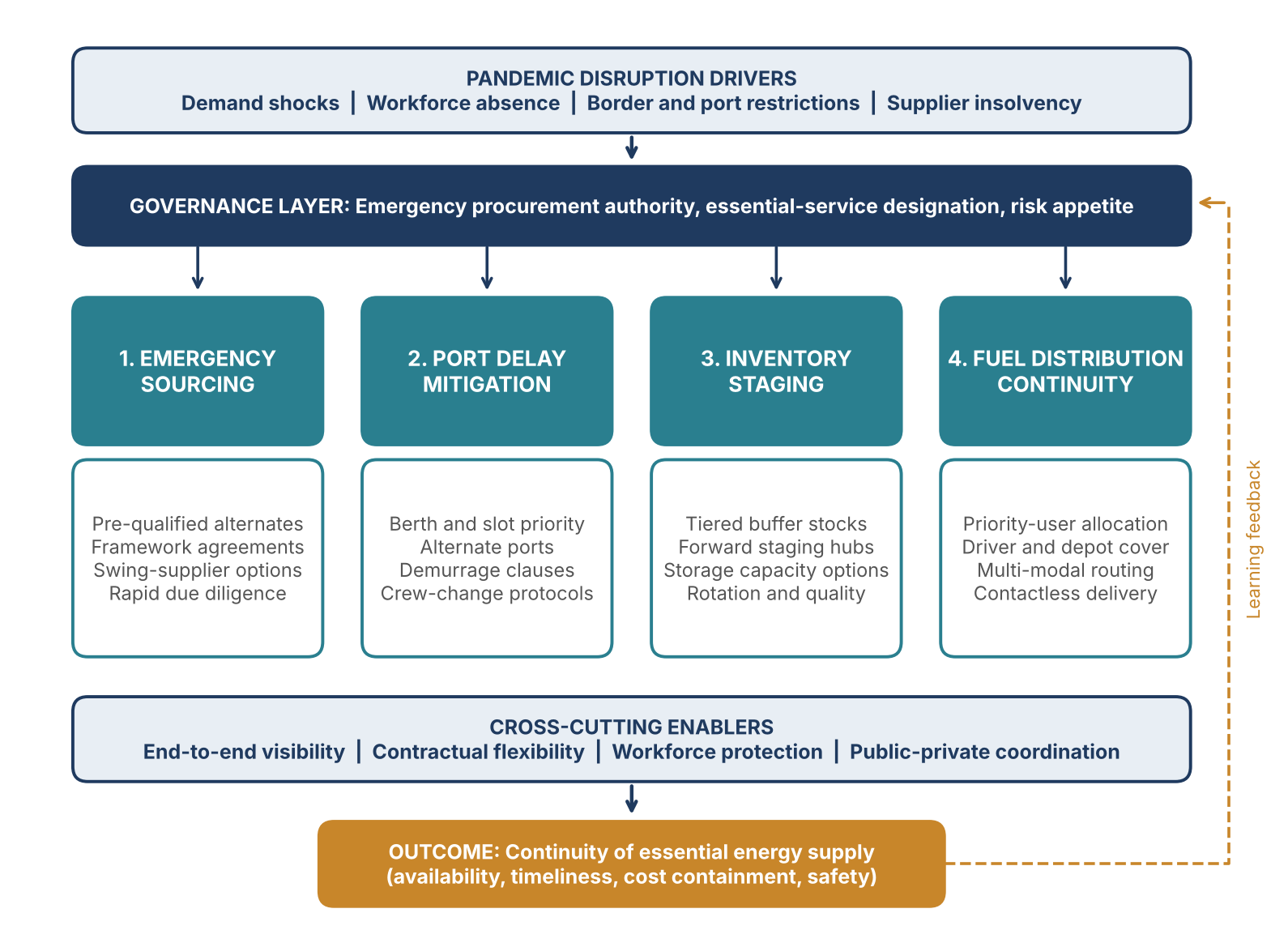
4.1Governance layer
Resilience fails when decisions cannot be made quickly. Normal procurement rules, including competitive tendering thresholds, multi-level approvals and standard credit limits, can delay action by weeks. The governance layer establishes in advance the conditions under which emergency procurement authority is activated, who holds it, which expenditure and credit limits apply, and how decisions are recorded for later audit. Experience in emerging energy markets shows that statutory bidding workflows can be streamlined without compromising compliance when reform is planned in advance rather than improvised (Uchechi et al., 2019). It also defines the essential-user hierarchy, a ranked list of users and sites that receive priority when supply is constrained, typically led by healthcare, water and sanitation, emergency services, food logistics and critical communications. Finally, it sets the organisation’s risk appetite, for example the minimum days of cover tolerated for each product and site, which translates into concrete triggers for the operational pillars.
Business continuity management, which evolved from IT disaster recovery into an organisation-wide discipline (Herbane, 2010), provides the procedural backbone for this layer, and institutional pressures shape how purchasing functions adopt continuity planning (Zsidisin et al., 2005). Disaster operations research emphasises that preparedness decisions taken before an event largely determine response performance (Altay & Green, 2006; Van Wassenhove, 2006). Standard operating procedures can act as change infrastructure that sustains new routines once the acute phase passes (Agboada et al., 2019), and digital transformation of operations management supports faster, better documented decisions (Agboada et al., 2018a).
4.2Pillar 1: Emergency sourcing
Emergency sourcing ensures that alternative supply can be activated quickly when a primary supplier, refinery, import route or trading counterparty fails. The central idea is to do the slow work of supplier qualification before the crisis so that only fast work remains during it. Key capabilities include:
- Pre-qualified alternate suppliers. Maintaining a panel of technically and financially vetted suppliers for each critical product and delivery point, with product specifications, safety documentation and know-your-customer checks already complete.
- Framework and call-off agreements. Establishing umbrella contracts with agreed terms, pricing formulas and quality standards that can be activated by a call-off order rather than a new tender. Disciplined vendor governance and pre-negotiated terms reduce both cost and activation time (Okonkwo et al., 2019).
- Swing-supply and volume-flex options. Negotiating rights to increase or decrease contracted volumes within agreed bands, which proved valuable in 2020 when demand fell overall but rose for specific products.
- Geographic and modal diversification. Avoiding dependence on a single refinery, terminal or import corridor for critical sites, and qualifying supply that can arrive by alternate routes such as pipeline, rail, coastal shipping or road.
- Rapid counterparty monitoring. Tracking supplier financial health and operational status during the disruption, so that buyers can shift volume before a supplier fails rather than after. Integrating geospatial data into enterprise resource planning (ERP) procurement processes helps buyers locate alternate suppliers relative to affected sites and corridors (Ahiaeke Patrick et al., 2020).
Emergency sourcing must be balanced against governance and integrity. Emergency procurement in 2020 created opportunities for price gouging and weakened controls in some sectors. The framework therefore couples speed with transparency: emergency awards should use pre-agreed pricing formulas, be recorded centrally and be subject to post-event review.
Research supports each of these capabilities. The optimal mix of inventory, dual sourcing and contingent rerouting depends on disruption length, frequency and supplier capacity (Tomlin, 2006), and modest flexibility yields substantial protection (Tang & Tomlin, 2008). Humanitarian logistics shows that supplier selection for framework agreements before a disaster improves post-event procurement speed and cost (Balcik & Ak, 2014), and that relief chains differ from commercial chains in ways that favour pre-established capability (Holguín-Veras et al., 2012; Kovács & Spens, 2007). Profitability analytics for procurement operations and environmental, social and governance criteria in supplier selection help buyers judge whether emergency awards remain good value and responsible (Akin-Oluyomi et al., 2020; Okojie & Abioye, 2020; Okojie et al., 2020).
4.3Pillar 2: Port delay mitigation
Ports and terminals are the critical chokepoints for imported energy. A delay of several days in berthing, discharge or clearance can exhaust inventories at downstream sites. Port delay mitigation focuses on keeping cargo moving through these nodes and on limiting the financial and physical consequences when it does not. Prior work on port logistics in emerging economies shows that demurrage can be substantially reduced through pre-arrival documentation, coordinated berth planning and closer alignment between procurement and logistics functions (Okonkwo et al., 2020). The reliability of marine terminal equipment, such as offshore loading buoys, also conditions how quickly cargo can be moved during a crisis (Obetta & Ninduwezuor-Ehiobu, 2018). Key capabilities include:
- Berth and slot prioritisation. Agreeing with port authorities and terminal operators, ideally through government designation of energy cargo as essential, that critical energy vessels receive berthing priority and expedited clearance.
- Alternate discharge ports. Pre-arranging the technical and commercial ability to divert cargoes to a secondary port, including compatible terminal infrastructure, customs arrangements and onward transport.
- Pandemic-adjusted contract terms. Reviewing laytime, demurrage and force majeure clauses so that the allocation of pandemic-related delay costs is clear in advance, reducing disputes and preserving supplier relationships (BIMCO and other industry bodies issued pandemic clauses during 2020 for this purpose). Clear liability allocation and dispute-prevention provisions are especially valuable in high-value energy contracts (Uchechi & Ominyi, 2019; Uchechi et al., 2020).
- Crew-change and health protocols. Coordinating with shipowners, port health authorities and agents on testing, quarantine and crew-change procedures, recognising that seafarers were unable to disembark for extended periods in 2020 and that crew welfare is a precondition of reliable shipping.
- Digital clearance and documentation. Using electronic bills of lading, digital customs submissions and remote inspection where regulations allow, to reduce person-to-person contact and processing time.
Policy and management studies offer guidance for these measures. Risk-based decision frameworks help port authorities rank cost-effective resilience investments (Mansouri et al., 2010), and combining risk, continuity and quality management improves port operational resilience (Loh & Thai, 2016). On the energy side, the integrity of offshore export and import infrastructure, including floating storage and offloading turret moorings, export buoys and corrosion-exposed marine equipment, determines whether cargo can move when it is most needed (Obetta & Ninduwezuor-Ehiobu, 2018; Obetta & Ninduwezuor-Ehiobu, 2019; Obetta et al., 2020).
4.4Pillar 3: Inventory staging
Inventory is the most direct buffer against disruption, but it is costly to hold and, for energy products, subject to safety, quality and regulatory constraints. The framework therefore treats inventory as a staged system rather than a single stockpile. Key capabilities include:
- Tiered buffer stocks. Defining minimum days of cover for each product at three tiers: strategic or national reserves, regional or primary terminals, and site-level storage at essential users such as hospital generator tanks. Targets are set according to the essential-user hierarchy and expected replenishment lead times under disruption. Linking inventory availability targets to the uptime requirements of the facilities they serve gives these targets an operational rationale (Okonkwo et al., 2018b).
- Forward staging hubs. Positioning inventory closer to essential users before anticipated constraints, for instance moving diesel to regional depots ahead of border restrictions, so that last-mile distances are short when logistics capacity is scarce.
- Storage capacity options. Securing contractual access to third-party tankage that can be activated as needed. In 2020, when storage became scarce and costly, organisations with pre-arranged options were better placed to accept deliveries and avoid supply interruptions.
- Rotation and quality management. Ensuring that staged stocks remain usable through rotation, testing and treatment, since products such as diesel can degrade during long storage and contaminated fuel can disable standby generators.
- Inventory visibility. Maintaining near real-time data on stock levels across tiers, so that replenishment and reallocation decisions are based on actual positions rather than estimates. Predictive analytics can improve demand forecasts and reduce inventory inefficiencies, which is particularly useful when demand patterns shift abruptly (Aifuwa et al., 2020).
Inventory staging also creates a link with the market environment. The 2020 contango structure, in which future prices exceeded spot prices, made storing product financially attractive for traders and raised storage costs. Buyers with storage options could exploit the same structure to build buffers at low cost, illustrating how resilience investment can be partially self-funding.
Humanitarian logistics provides the most developed models for this pillar. Facility location and stock pre-positioning models allocate emergency supplies under budget constraints and uncertain disaster scenarios (Balcik & Beamon, 2008; Rawls & Turnquist, 2010), and applied studies show that pre-positioned stock shortens response times (Duran et al., 2011). Relief inventories differ from commercial stocks in acquisition, storage and distribution (Balcik et al., 2016; Whybark, 2007). At the national level, dynamic programming models of strategic petroleum reserves derive fill and drawdown rules under uncertain supply interruptions (Teisberg, 1981). Inventory is only useful if storage assets remain fit for service, so risk-based inspection, reliability-centred maintenance, integrity management of fired equipment, non-destructive testing, corrosion control and predictive maintenance form part of inventory staging. Risk-based process engineering that links hazard evidence, barrier condition and maintenance decisions across natural gas wells, processing units, pipelines and storage assets offers a system-level basis for prioritising this work (Asibor & Isong, 2019; Adaramola et al., 2018; Atta et al., 2018; Atta et al., 2020; Obetta, 2018; Obetta, 2019; Obetta, 2020; Sunday et al., 2020). Predictive analytics also improves demand forecasts that set buffer levels (Aifuwa et al., 2020), and long-range production forecasting informs upstream availability assumptions (Nwangwu et al., 2020).
4.5Pillar 4: Fuel distribution continuity
The final pillar concerns the last mile: moving product from terminals and depots to essential users when labour, vehicles and access are constrained. Key capabilities include:
- Priority-user allocation rules. Translating the essential-user hierarchy into operational allocation rules for depots and fleets, including rationing protocols that specify how constrained volumes are shared and how exceptions are approved.
- Driver and depot workforce cover. Cross-training staff, maintaining reserve pools of certified hazardous goods drivers, arranging mutual aid with other distributors and, where necessary, engaging authorities to grant licence extensions or temporary permits.
- Multi-modal and alternate routing. Pre-planning alternative delivery routes and modes that avoid closed borders, checkpoints or congested corridors.
- Contactless and safe delivery. Adopting procedures such as electronic proof of delivery, scheduled drops and site health protocols that protect both drivers and recipients and keep delivery points open.
- Retail and network continuity. For fuel distributors, maintaining the minimum retail and wholesale network needed to serve essential users and communities, even when lower volumes make some outlets unprofitable in the short term.
Operations research on downstream petroleum logistics supports these capabilities. Multi-period replenishment heuristics plan tanker loading, routing and delivery timing to petrol stations (Cornillier et al., 2008), multimodal transport choices shape distribution centre location and cost (Kazemi & Szmerekovsky, 2015), and reviews identify gaps in downstream oil supply chain planning (Chima, 2007; Lima et al., 2016). Road network vulnerability analysis helps planners identify links whose closure would most raise delivery costs (Berdica, 2002; Jenelius et al., 2006; Mattsson & Jenelius, 2015). For household energy, scaling up liquefied petroleum gas depends on reliable production, distribution and pricing arrangements (Kojima, 2011; Puzzolo et al., 2019). Electricity continuity raises parallel issues: UAV-based inspection of power lines and pipeline corridors (Dagodzo & Ahiaeke Patrick, 2020; Dagodzo, 2018a; Dagodzo, 2018b), grounding design and voltage control in distribution networks (Adeniji et al., 2020; Oshevire et al., 2017), telecommunications quality for grid communications (Amayo & Popoola, 2017), and hybrid solar, microgrid and hydrogen options that diversify supply for essential users (Komi & Adeniji, 2020; Odejobi & Ahmed, 2018b; Shittu et al., 2019; Sunday & Omoegun, 2018; Sunday & Omoegun, 2019; Yeboah & Ike, 2020). Efficient building energy systems also reduce the load that must be secured at critical sites (Sunday et al., 2019).
4.6Cross-cutting enablers
Four enablers support all pillars and correspond closely to resilience elements identified in the literature (Hohenstein et al., 2015).
- End-to-end visibility. Integrated information on supplier status, vessel positions, port queues, inventory levels and delivery performance. Visibility enables early warning, one of the capabilities that Craighead et al. (2007) identify as reducing disruption severity. Agile digital supply chain architectures with embedded IT risk controls (Mbonu et al., 2020a) and chain-of-custody traceability approaches developed for other critical goods (Aneke & Adesemoye, 2019) offer transferable design patterns.
- Contractual flexibility. Contract terms that allow volumes, delivery points, timing and payment to be adjusted under defined conditions without renegotiation. Flexibility clauses convert uncertainty into managed options.
- Workforce protection. Health and safety measures, shift segregation, testing and support arrangements that keep critical staff available across the procurement and logistics chain. In a pandemic, people are the most constrained resource, so cross-trained and distributed talent pools are a resilience asset (Falemi et al., 2020).
- Public-private coordination. Structured engagement with energy regulators, ministries, port authorities and emergency management agencies to secure essential-service status, share information and coordinate allocation. Energy supply is a shared responsibility, and many critical levers, such as border exemptions and reserve releases, sit with government.
The literature supports each enabler. Agile digital supply chain architectures, ETL and data integration, platform governance in regulated healthcare environments and DevOps tooling provide the technical base for visibility (Badmus et al., 2018; Badmus et al., 2019a; Badmus et al., 2019b; Badmus et al., 2020; Mbonu et al., 2020a). Analytics for demand measurement, churn prediction, geomarketing and product management in regulated service markets illustrate how organisations sense shifting demand (Agyei et al., 2018; Agyei et al., 2019; Oziri et al., 2020; Sanni et al., 2020a; Sanni et al., 2020b; Sanni et al., 2020c; Seyi-Lande et al., 2020). Workforce enablers draw on research into recruitment, distributed talent development, industry-academia collaboration and IT support maturity (Akhigbe et al., 2020; Anyanwu, 2019; Nwangwu et al., 2019; Wikiri, 2019), and on wider evidence about cross-cultural communication, professional transitions, digital learning platforms and ICT-supported skills development, including offline-first designs that keep training and information systems usable where connectivity is intermittent and costly (Unamma et al., 2018; Boakye et al., 2020; Lilian et al., 2020; Ogbona et al., 2020; Orise & Niniola, 2020). Public-private coordination benefits from frameworks for efficient public infrastructure delivery and urban resilience planning (Nwafor et al., 2019a; Nwafor et al., 2019b).
The framework is summarised in Table 1, which links each pillar to the disruption mechanisms it addresses, its core capabilities and illustrative performance indicators.
| Pillar | Disruption addressed | Core capabilities | Illustrative indicators |
|---|---|---|---|
| Emergency sourcing | Supplier failure, refinery outages, trader insolvency, sudden demand shifts | Pre-qualified alternates; framework agreements; volume-flex options; counterparty monitoring | Time to activate alternate supply; share of critical volume with qualified alternates |
| Port delay mitigation | Quarantine delays, crew-change restrictions, reduced terminal staffing, slow clearance | Berth priority; alternate ports; pandemic contract clauses; digital clearance | Average waiting time at berth; demurrage cost per cargo; cargo diversion lead time |
| Inventory staging | Replenishment uncertainty, storage scarcity, regional access restrictions | Tiered buffers; forward hubs; storage options; rotation and quality control | Days of cover by tier and site; stock-out incidents; off-specification product rate |
| Fuel distribution continuity | Driver shortages, border checks, depot closures, shifting essential demand | Allocation rules; workforce reserves; alternate routing; contactless delivery | On-time delivery to essential users; fill rate for priority sites; delivery cycle time |
4.7Research propositions
Consistent with the conceptual nature of this paper, the framework is expressed as a set of propositions that can be examined in future empirical research. The dependent construct in each case is essential energy supply continuity, measured through availability, timeliness, cost containment and safety at essential-user sites during a pandemic.
The governance layer determines how quickly operational capabilities can be deployed. Pre-defined emergency authority and an agreed essential-user hierarchy reduce decision latency and prevent conflict over scarce supply.
P1. Organisations with pre-established emergency procurement authority and an essential-user hierarchy will achieve higher energy supply continuity during pandemic disruptions than organisations that develop these arrangements reactively.
Emergency sourcing reduces dependence on any single supplier or route and shortens the time required to replace failed supply.
P2. The proportion of critical energy volume covered by pre-qualified alternate suppliers and framework agreements is positively associated with supply continuity, and this relationship is stronger when primary supplier failure rates are high.
Port delay mitigation addresses the chokepoint at which pandemic health controls most directly interact with energy logistics.
P3. Pre-arranged berth prioritisation, alternate discharge options and pandemic-specific contract clauses reduce the effect of port delays on downstream stock-outs.
Inventory staging provides time, which is the resource most valuable when other capabilities are being activated.
P4a. Tiered, forward-positioned inventory is positively associated with supply continuity for essential users.
P4b. The positive effect of inventory staging on supply continuity diminishes beyond a threshold of days of cover, beyond which holding costs and quality risks outweigh additional protection.
Last-mile distribution determines whether upstream availability translates into delivered supply.
P5. Priority allocation rules and reserve workforce arrangements in fuel distribution mediate the relationship between upstream availability and delivered supply to essential users.
Enablers amplify the effectiveness of operational capabilities by providing information, options and coordination.
P6. End-to-end visibility and public-private coordination positively moderate the relationships between each operational pillar and supply continuity.
Finally, because pandemics evolve, the ability to learn and redesign arrangements during the disruption is itself a capability.
P7. Organisations that systematically review continuity performance and revise procurement arrangements during a prolonged disruption will show improving continuity over successive waves of the pandemic, compared with organisations that maintain static arrangements.
5Discussion
The framework extends existing knowledge in three ways. First, it contextualises general supply chain resilience theory for essential energy, a sector in which physical constraints such as hazardous handling, storage capital intensity and node concentration shape which resilience strategies are feasible. Second, it introduces the concept of the continuity gap to explain why global oversupply and local shortage co-existed in 2020, emphasising that procurement resilience in a pandemic is primarily about delivery to the right user at the right time. Third, it integrates the viability perspective into a procurement framework by treating governance and learning as explicit components rather than background conditions.
The model also clarifies how established resilience principles behave under pandemic conditions. Redundancy and flexibility remain the core levers, but in a pandemic their value depends on where they are located in the supply chain. Inventory held far from essential users offers little protection when ports, borders and depots are constrained, and alternate suppliers are of limited use if their cargo cannot be cleared or delivered. The four pillars therefore act as a chain whose weakest segment sets the level of continuity, which is why the propositions treat distribution capabilities as a mediator and visibility and coordination as moderators. The model further suggests that governance is not merely a background condition: the speed at which emergency authority can be exercised determines how quickly any operational capability is activated. Finally, the emphasis on learning between waves reflects the extended duration of pandemic disruption, which turns resilience from a one-off response into a continuing process of reconfiguration.
6Implications
6.1Implications for practice
For procurement leaders in utilities, national oil companies, fuel distributors, hospitals and public agencies, the framework provides a diagnostic tool. Organisations can assess their maturity in each pillar and enabler, identify the weakest links for their critical sites, and prioritise investments accordingly. The framework also highlights that many resilience capabilities are contractual rather than physical: framework agreements, flex clauses, storage options and pandemic clauses can be negotiated at relatively low cost and deliver significant protection. Finally, it underlines the importance of relationships. Suppliers, shipowners, port authorities and regulators are partners in continuity, and arrangements that share pandemic costs fairly are more likely to hold under stress.
6.2Implementation roadmap
The framework can be implemented through four phases aligned with the readiness, response and recovery logic of Ponomarov and Holcomb (2009), extended with an adaptation phase reflecting the viability perspective of Ivanov and Dolgui (2020). Table 2 summarises the key procurement actions in each phase.
| Phase | Objective | Key procurement actions |
|---|---|---|
| 1. Prepare | Build capabilities before disruption | Map critical sites and products; set essential-user hierarchy; qualify alternate suppliers; negotiate framework, flex and storage option contracts; agree pandemic clauses; define inventory targets and triggers; establish emergency authority and reporting. |
| 2. Respond | Protect essential supply in the acute phase | Activate crisis governance; confirm essential-service status with authorities; raise buffers at priority sites; call off alternate supply where needed; prioritise berths and expedite clearance; apply allocation rules; protect and redeploy critical workforce. |
| 3. Recover | Restore normal service levels efficiently | Rebalance inventory and release excess storage; normalise supplier mix; settle demurrage and force majeure claims fairly; review emergency awards for value and integrity; restore suspended delivery services. |
| 4. Adapt | Embed learning and redesign | Conduct after-action reviews; update risk registers and inventory targets; renegotiate contracts with lessons learned; invest in visibility systems; institutionalise public-private coordination mechanisms; test plans through scenario exercises. |
Two practical observations apply across phases. First, the phases overlap in a pandemic. Successive waves of infection meant that many organisations in 2020 were recovering in one region while responding in another, so the roadmap should be applied at the level of individual sites and supply corridors rather than the enterprise as a whole. Second, the cost of preparation should be assessed against the cost of failure at essential sites. A single hospital or water plant losing power can generate public health and reputational costs that far exceed the annual cost of maintaining alternate supplier panels or storage options.
6.3Implications for policy
Governments influence energy continuity through essential-service designations, border and port health policies, strategic reserve management and emergency regulatory relief. The framework suggests that policies should explicitly recognise energy logistics workers, including seafarers and tanker drivers, as essential personnel, provide clear and consistent health protocols at ports and borders, and coordinate reserve releases with private inventory positions. Import-dependent and landlocked economies may benefit from regional cooperation on transit corridors and shared storage.
7Limitations
As a conceptual paper, the framework has not been empirically validated, and its propositions require testing. Its components draw on the 2020 experience, which was still unfolding at the time of writing, and later evidence may reveal additional mechanisms. The framework is also oriented toward liquid fuels and gas imported by sea; power systems with domestic generation, and renewable energy supply chains dependent on equipment imports, may need adaptations.
8Future research
Future research could test the propositions through multi-case studies of utilities and fuel distributors, survey-based measurement of resilience capabilities and continuity outcomes, simulation models of inventory staging and port delay scenarios, and comparative studies across countries with different regulatory and market structures. Research on the cost-effectiveness of specific capabilities, such as the value of storage options relative to physical reserves, would be particularly useful to practitioners.
Future research could also draw on adjacent fields represented in the regional literature. Studies of agribusiness finance and entrepreneurial education (Michael & Ogunsola, 2019a; Michael & Ogunsola, 2019b) point to the role of local enterprises in last-mile fuel retail, while work on housing affordability, building envelope design and local building materials (Gil-Ozoudeh et al., 2018; Nwafor et al., 2018; Nwafor et al., 2019c) bears on the energy needs of essential facilities. Environmental risk models for subsurface contamination and climate-induced watershed vulnerability (Azeez & Badmus, 2018; Badmus & Olamide, 2019; Lamidi & Olamide, 2018) are relevant to the siting and protection of staged fuel inventories.
9Conclusion
The COVID-19 pandemic demonstrated that essential energy supply can be threatened even when energy is globally abundant. Disruptions to workforces, ports, borders and supplier finances opened a gap between availability and delivery that conventional, efficiency-oriented procurement was not designed to close. The Procurement Resilience Framework proposed here addresses this gap through a governance layer, four operational pillars of emergency sourcing, port delay mitigation, inventory staging and fuel distribution continuity, and four cross-cutting enablers. By pairing these elements with testable propositions and a phased roadmap, the paper offers both a practical guide for organisations responsible for keeping essential services powered and a foundation for empirical research on procurement resilience in the energy sector. The central lesson is that resilience must be built before it is needed: the arrangements that matter most during a pandemic are those negotiated, qualified and rehearsed in calmer times.
References
- [1]Abdulrazaq K, Yusuf HD, Osinem HE, Eribenne F (2019). A model for improving infection detection accuracy through integrated laboratory information systems. Iconic Research and Engineering Journals, 3(6), 650–675. https://doi.org/10.64388/IREV3I6-1723089
- [2]Abu-Rayash A, Dincer I (2020). Analysis of the electricity demand trends amidst the COVID-19 coronavirus pandemic. Energy Research & Social Science, 68, Article 101682. https://doi.org/10.1016/j.erss.2020.101682
- [3]Adaramola TS, Fadero S, Gideon EN (2018). Predictive maintenance and condition monitoring in critical power and energy infrastructure. Iconic Research and Engineering Journals, 2(5), 454–477. https://doi.org/10.64388/IREV2I5-1722489
- [4]Adegbite MP, Adebayo A, Ahmed MO (2020). Securing operational technology networks in electric utilities: A systematic review of NERC CIP compliance and architectural threat mitigation. International Journal of Engineering and Modern Technology, 6(3), 103–146. https://doi.org/10.56201/ijemt.vol.6.no3.2020.pg103.146
- [5]Adeniji IO, Shittu H, Opara IS, Shittu MA (2020). Grounding system design optimization for medium-voltage distribution networks in emerging power markets. Iconic Research and Engineering Journals, 3(11), 547–565. https://doi.org/10.64388/IREV3I11-1714040
- [6]Adeyelu OO (2018). A predictive compliance monitoring framework for detecting systemic safety risks through aviation consumer complaint data. Iconic Research and Engineering Journals, 1(8), 250–276. https://doi.org/10.64388/IREV1I8-1718478
- [7]Adeyelu OO (2019). An adaptive safety management system implementation model for aerodromes in developing economy contexts. Iconic Research and Engineering Journals, 3(4), 628–654. https://doi.org/10.64388/IREV3I4-1718479
- [8]Adeyelu OO (2020). An artificial intelligence-driven conceptual model for wildlife strike risk quantification and aircraft airworthiness impact assessment at high-traffic African airports. Iconic Research and Engineering Journals, 4(1), 339–368. https://doi.org/10.64388/IREV4I1-1718482
- [9]Agbabiaka J, Okonkwo CS, Ogunwole O, Mayo W, Okeke OT (2019). Supply chain risk management model for EPC and gas processing projects. Iconic Research and Engineering Journals, 3(2), 968–980. https://doi.org/10.64388/IREV3I2-1713124
- [10]Agboada P, Anene UN, Ezeako R, Okoli IE (2020). Partnership ecosystems in private banking: A review of advances in non-financial value-proposition design. International Journal of Engineering Technology Research & Management, 4(11), 96–115.
- [11]Agboada P, Ezeako R, Okoli IE, Ibeh AV (2018b). Distributorship and trade finance product design: A conceptual framework for new-to-bank growth in emerging markets. Iconic Research and Engineering Journals, 2(5), 552–578. https://doi.org/10.64388/IREV2I5-1723312
- [12]Agboada P, Ezeako R, Okoli IE, Uzondu CS (2018a). Digital transformation in operations management: A review of advances in automation, analytics, and process redesign. International Journal of Engineering Technology Research & Management, 2(11), 109–134.
- [13]Agboada P, Ezeako R, Okoli IE, Uzondu CS (2019). Standard operating procedures as change infrastructure: A conceptual framework for sustaining operational improvement. Iconic Research and Engineering Journals, 3(6), 706–730. https://doi.org/10.64388/IREV3I6-1723313
- [14]Agyei RK, Izuchukwu OT, Feboh D, Idowu A (2018). Integrated marketing communications and subscriber growth in a Sub-Saharan telecom sub-brand. International Journal of Marketing and Communication Studies, 3(2), 49–71. https://doi.org/10.56201/ijmcs.v3.no2.2018.pg49.71
- [15]Agyei RK, Izuchukwu OT, Feboh D, Idowu A (2019). Determinants of web-based payment portal adoption in Sub-Saharan Africa: A review and synthesis. International Journal of Computer Science and Mathematical Theory, 5(2), 56–79. https://doi.org/10.56201/ijcsmt.vol.5.no2.2019.pg56.79
- [16]Ahiaeke Patrick MC, Okonkwo CS, Mayo W, Okeke OT (2020). A GIS enabled framework for modern ERP procurement processes. International Journal of Multidisciplinary Research and Growth Evaluation, 1(5), 499–508. https://doi.org/10.54660/IJMRGE.2020.1.5.499-508
- [17]Ahmed KS, Odejobi OD (2018a). Conceptual framework for scalable and secure cloud architectures for enterprise messaging. IRE Journals, 2(1), 1–15.
- [18]Ahmed KS, Odejobi OD (2018b). Resource allocation model for energy-efficient virtual machine placement in data centers. IRE Journals, 2(3), 1–10.
- [19]Ahmed KS, Odejobi OD, Oshoba TO (2019). Algorithmic model for constraint satisfaction in cloud network resource allocation. IRE Journals, 2(12), 516–532.
- [20]Ahmed KS, Odejobi OD, Oshoba TO (2020). Predictive model for cloud resource scaling using machine learning techniques. Journal of Frontiers in Multidisciplinary Research, 1(1), 173–183.
- [21]Aifuwa SE, Oshoba TO, Ogbuefi E, Ike PN, Nnabueze SB, Olatunde-Thorpe J (2020). Predictive analytics models enhancing supply chain demand forecasting accuracy and reducing inventory management inefficiencies. International Journal of Multidisciplinary Research and Growth Evaluation, 1(3), 171–181. https://doi.org/10.54660/.IJMRGE.2020.1.3.171-181
- [22]Akeju B, Edivri J, Ogbole JI, Okoruwa PO, Fadayomi O, Abolaji TO (2018). Conceptual model for insider threat classification and risk modeling in complex digital systems. Iconic Research and Engineering Journals, 1(9), 476–492. https://doi.org/10.64388/IREV1I9-1713778
- [23]Akhigbe R, Wikiri M, Udeh CA (2020). Strategic recruitment and employee integration in emerging-market enterprises: A framework for building workforce capacity. International Journal of Multidisciplinary Research and Growth Evaluation, 1(5), 1265–1278. https://doi.org/10.54660/.IJMRGE.2020.1.5.1265-1278
- [24]Akin-Oluyomi OT, Atima ME, Akinleye OK, Akokodaripon DA (2020). Using Tableau and Excel for comprehensive profitability analysis in retail procurement operations. International Journal of Multidisciplinary Research and Growth Evaluation, 1(5), 385–393.
- [25]Akinola AS, Farounbi BO, Onyelucheya OP, Okafor CM (2020). Translating finance bills into strategy: Sectoral impact mapping and regulatory scenario analysis. Journal of Frontiers in Multidisciplinary Research, 1(1), 102–111.
- [26]Akomolafe O, Agu MU (2018). A conceptual model for enhancing internal audit quality through technology-enabled risk assessment frameworks. Iconic Research and Engineering Journals, 1(9), 458–475.
- [27]Akomolafe O, Agu MU (2019a). A conceptual framework for developing risk-based internal control models in the insurance and banking sectors. Iconic Research and Engineering Journals, 2(8), 335–354.
- [28]Akomolafe O, Agu MU (2019b). A review of data-driven risk evaluation models for emerging market financial institutions. Iconic Research and Engineering Journals, 3(6), 433–448.
- [29]Akomolafe O, Agu MU (2019c). Advances in financial resilience through integrated governance and compliance strategies. Iconic Research and Engineering Journals, 2(10), 607–620.
- [30]Altay N, Green WG III (2006). OR/MS research in disaster operations management. European Journal of Operational Research, 175(1), 475–493. https://doi.org/10.1016/j.ejor.2005.05.016
- [31]Amayo EB, Popoola TT (2017). Scientific study of telecommunication deployment in achieving quality network. International Journal of Trend in Research and Development, 4(5), 311–314.
- [32]Ambulkar S, Blackhurst J, Grawe S (2015). Firm's resilience to supply chain disruptions: Scale development and empirical examination. Journal of Operations Management, 33–34, 111–122. https://doi.org/10.1016/j.jom.2014.11.002
- [33]Aminu-Ibrahim AY, Ogbete JC, Ambali KB (2018). Developing sustainable diagnostic laboratory infrastructure models for emerging and resource constrained health systems. Iconic Research and Engineering Journals, 1(8), 118–132. https://doi.org/10.64388/IREV1I8-1713586
- [34]Aminu-Ibrahim AY, Ogbete JC, Ambali KB (2019). Capital project delivery models for high risk healthcare infrastructure in developing national health systems. Iconic Research and Engineering Journals, 2(10), 626–649. https://doi.org/10.64388/IREV2I10-1713588
- [35]Aminu-Ibrahim AY, Ogbete JC, Ambali KB (2020). Infrastructure driven expansion of diagnostic access across underserved and rural healthcare regions. International Journal of Multidisciplinary Research and Growth Evaluation, 1(5), 691–706. https://doi.org/10.54660/IJMRGE.2020.1.5.691-706
- [36]Aneke OB, Adesemoye AC (2019). Toward an integrated conceptual framework for traceability and chain-of-custody integrity in pharmaceutical distribution. Iconic Research and Engineering Journals, 3(4), 655–672.
- [37]Aneke OB, Adesemoye AC (2020). A conceptual framework for risk-based decision-making in good manufacturing practice environments. Iconic Research and Engineering Journals, 4(6), 325–341.
- [38]Ang BW, Choong WL, Ng TS (2015). Energy security: Definitions, dimensions and indexes. Renewable and Sustainable Energy Reviews, 42, 1077–1093. https://doi.org/10.1016/j.rser.2014.10.064
- [39]Anichukwueze CC, Osuji VC, Oguntegbe EE (2019). Global marketing law and consumer protection challenges: A strategic framework for multinational compliance. IRE Journals, 3(6), 325–333.
- [40]Anichukwueze CC, Osuji VC, Oguntegbe EE (2020). Designing ethics and compliance training frameworks to drive measurable cultural and behavioral change. International Journal of Multidisciplinary Research and Growth Evaluation, 1(3), 205–220.
- [41]Anyanwu KCE (2019). Developing a maturity model for standardizing IT support operations across geographically distributed multi-office organizations. Iconic Research and Engineering Journals, 3(5)., 580–598.
- [42]Anyanwu KCE (2020). Balancing cost and operational continuity in hybrid remote and on-site IT support for multi-branch SMEs. International Journal of Economics and Financial Management, 5(2), 132–148. https://doi.org/10.56201/ijefm.v5.no2.2020.pg132.148
- [43]Arumosoye OM, Obriki OD (2018). Development of an integrated heat stress risk conceptual model for industrial operations in extreme environments. Iconic Research and Engineering Journals, 1(12), 141–160. https://doi.org/10.64388/IREV1I12-1714415
- [44]Arumosoye OM, Obriki OD (2019). Systematic review of near-miss and hazard observation data utilization in industrial safety management. Iconic Research and Engineering Journals, 3(2), 981–999. https://doi.org/10.64388/IREV3I2-1714417
- [45]Arumosoye OM, Obriki OD (2020). A governance-oriented conceptual model for contractor safety performance in multi-contract industrial projects. International Journal of Multidisciplinary Research and Growth Evaluation, 1(5), 728–740. https://doi.org/10.54660/.IJMRGE.2020.1.5.728-740
- [46]Asibor E, Isong DE (2019). Risk-based process engineering framework for strengthening reliability across complex natural gas infrastructure systems. Iconic Research and Engineering Journals, 3(2), 1020–1060. https://doi.org/10.64388/IREV3I2-1723153
- [47]Atta S, Asomani E, Adenuga OM (2018). A systematic review of green corrosion inhibitors from agricultural extracts for mild steel protection in acidic and alkaline media. International Journal of Engineering and Modern Technology, 4(1), 64–97. https://doi.org/10.56201/ijemt.vol.4.no1.2018.pg64.97
- [48]Atta S, Tofah P, Kankam MA, Adenuga OM (2020). A critical review of NDT-based integrity management and corrosion risk assessment strategies for refinery process equipment. International Journal of Engineering and Modern Technology, 6(2), 19–46. https://doi.org/10.56201/ijemt.vol.6.no2.2020.pg19.46
- [49]Azeez LO, Badmus OB (2018). Data-driven framework for predicting subsurface contamination pathways in complex remediation projects. Iconic Research and Engineering Journals, 2(5), 312–335.
- [50]Badmus O, Olamide AL (2019). Advanced hydrological modeling approach for assessing climate-induced watershed vulnerability trends. Iconic Research and Engineering Journals, 3(5), 388–410.
- [51]Badmus O, Dosunmu AA, Ozowara DE (2018). A systematic review of CI/CD pipeline strategies in Salesforce DevOps: Tools, practices, and deployment outcomes. Iconic Research and Engineering Journals, 2(6).
- [52]Badmus O, Dosunmu AA, Ozowara DE (2019a). A conceptual model for ETL design and data integration in Salesforce-centric enterprise architectures. Iconic Research and Engineering Journals, 3(5).
- [53]Badmus O, Dosunmu AA, Ozowara DE (2019b). A governance framework for Salesforce platform management in regulated healthcare environments. Iconic Research and Engineering Journals, 3(6).
- [54]Badmus O, Dosunmu AA, Ozowara DE, Anunagba CO (2020). A comparative framework for Salesforce DevOps tooling: Evaluating Copado, Flosum, and Salesforce DX across enterprise deployment contexts. International Journal of Multidisciplinary Research and Growth Evaluation, 1(5), 1021–1031. https://doi.org/10.54660/.IJMRGE.2020.1.5.1021-1031
- [55]Bahmanyar A, Estebsari A, Ernst D (2020). The impact of different COVID-19 containment measures on electricity consumption in Europe. Energy Research & Social Science, 68, Article 101683. https://doi.org/10.1016/j.erss.2020.101683
- [56]Bajari P, Tadelis S (2001). Incentives versus transaction costs: A theory of procurement contracts. The RAND Journal of Economics, 32(3), 387–407. https://doi.org/10.2307/2696361
- [57]Balcik B, Ak D (2014). Supplier selection for framework agreements in humanitarian relief. Production and Operations Management, 23(6), 1028–1041. https://doi.org/10.1111/poms.12098
- [58]Balcik B, Beamon BM (2008). Facility location in humanitarian relief. International Journal of Logistics Research and Applications, 11(2), 101–121. https://doi.org/10.1080/13675560701561789
- [59]Balcik B, Bozkir CDC, Kundakcioglu OE (2016). A literature review on inventory management in humanitarian supply chains. Surveys in Operations Research and Management Science, 21(2), 101–116. https://doi.org/10.1016/j.sorms.2016.10.002
- [60]Baumeister C, Kilian L (2016). Forty years of oil price fluctuations: Why the price of oil may still surprise us. Journal of Economic Perspectives, 30(1), 139–160. https://doi.org/10.1257/jep.30.1.139
- [61]Berdica K (2002). An introduction to road vulnerability: What has been done, is done and should be done. Transport Policy, 9(2), 117–127. https://doi.org/10.1016/S0967-070X(02)00011-2
- [62]Berle Ø, Asbjørnslett BE, Rice JB (2011b). Formal vulnerability assessment of a maritime transportation system. Reliability Engineering & System Safety, 96(6), 696–705. https://doi.org/10.1016/j.ress.2010.12.011
- [63]Berle Ø, Rice JB Jr, Asbjørnslett BE (2011a). Failure modes in the maritime transportation system: A functional approach to throughput vulnerability. Maritime Policy & Management, 38(6), 605–632. https://doi.org/10.1080/03088839.2011.615870
- [64]Blackhurst J, Dunn KS, Craighead CW (2011). An empirically derived framework of global supply resiliency. Journal of Business Logistics, 32(4), 374–391. https://doi.org/10.1111/j.0000-0000.2011.01032.x
- [65]Boakye K, Ofori SD, Ogbona CS, Yeboah TJ, Bobga MA (2020). Integrating ICT and mathematical thinking: Exploring the effectiveness of digital tools in secondary mathematics instruction. Iconic Research and Engineering Journals, 4(4), 372–398. https://doi.org/10.64388/IREV4I4-1714179
- [66]Bode C, Wagner SM, Petersen KJ, Ellram LM (2011). Understanding responses to supply chain disruptions: Insights from information processing and resource dependence perspectives. Academy of Management Journal, 54(4), 833–856. https://doi.org/10.5465/amj.2011.64870145
- [67]Bola-Sadipe D, Aliliele C, Eboh EE (2019). Conceptual model for strategic accounting systems strengthening financial transparency and regulatory compliance. IRE Journals, 3(6), 535–564. https://doi.org/10.64388/IREV3I6-1715327
- [68]Brandon-Jones E, Squire B, Autry CW, Petersen KJ (2014). A contingent resource-based perspective of supply chain resilience and robustness. Journal of Supply Chain Management, 50(3), 55–73. https://doi.org/10.1111/jscm.12050
- [69]Büyüktahtakın E, des-Bordes E, Kıbış EY (2018). A new epidemics-logistics model: Insights into controlling the Ebola virus disease in West Africa. European Journal of Operational Research, 265(3), 1046–1063. https://doi.org/10.1016/j.ejor.2017.08.037
- [70]Cherp A, Jewell J (2014). The concept of energy security: Beyond the four As. Energy Policy, 75, 415–421. https://doi.org/10.1016/j.enpol.2014.09.005
- [71]Chiaramonti D, Maniatis K (2020). Security of supply, strategic storage and Covid19: Which lessons learnt for renewable and recycled carbon fuels, and their future role in decarbonizing transport? Applied Energy, 271, Article 115216. https://doi.org/10.1016/j.apenergy.2020.115216
- [72]Chima CM (2007). Supply-chain management issues in the oil and gas industry. Journal of Business & Economics Research, 5(6). https://doi.org/10.19030/jber.v5i6.2552
- [73]Choi TM (2020). Innovative "bring-service-near-your-home" operations under Corona-virus (COVID-19/SARS-CoV-2) outbreak: Can logistics become the Messiah? Transportation Research Part E: Logistics and Transportation Review, 140, Article 101961. https://doi.org/10.1016/j.tre.2020.101961
- [74]Chopra S, Sodhi MS (2004). Managing risk to avoid supply-chain breakdown. MIT Sloan Management Review, 46(1), 53–61.
- [75]Chopra S, Reinhardt G, Mohan U (2007). The importance of decoupling recurrent and disruption risks in a supply chain. Naval Research Logistics, 54(5), 544–555. https://doi.org/10.1002/nav.20228
- [76]Chowdhury MMH, Quaddus M (2017). Supply chain resilience: Conceptualization and scale development using dynamic capability theory. International Journal of Production Economics, 188, 185–204. https://doi.org/10.1016/j.ijpe.2017.03.020
- [77]Christopher M, Lee H (2004). Mitigating supply chain risk through improved confidence. International Journal of Physical Distribution & Logistics Management, 34(5), 388–396. https://doi.org/10.1108/09600030410545436
- [78]Christopher M, Peck H (2004). Building the resilient supply chain. The International Journal of Logistics Management, 15(2), 1–14.
- [79]Cornillier F, Boctor FF, Laporte G, Renaud J (2008). A heuristic for the multi-period petrol station replenishment problem. European Journal of Operational Research, 191(2), 295–305. https://doi.org/10.1016/j.ejor.2007.08.016
- [80]Craighead CW, Blackhurst J, Rungtusanatham MJ, Handfield RB (2007). The severity of supply chain disruptions: Design characteristics and mitigation capabilities. Decision Sciences, 38(1), 131–156.
- [81]Craighead CW, Ketchen DJ Jr, Darby JL (2020). Pandemics and supply chain management research: Toward a theoretical toolbox. Decision Sciences, 51(4), 838–866. https://doi.org/10.1111/deci.12468
- [82]Dagodzo D (2018a). A conceptual framework for UAV integration into national power grid inspection programs. Iconic Research and Engineering Journals, 2(5), 391–412. https://doi.org/10.64388/IREV2I5-1716082
- [83]Dagodzo D (2018b). A review of UAV applications in electrical transmission line inspection: Methods, technologies, and challenges. Iconic Research and Engineering Journals, 2(6), 234–254. https://doi.org/10.64388/IREV2I6-1716083
- [84]Dagodzo D, Ahiaeke Patrick MC (2020). UAV-based pipeline and corridor monitoring: A review of current practices and emerging technologies. Iconic Research and Engineering Journals, 3(10), 574–597. https://doi.org/10.64388/IREV3I10-1716084
- [85]Devpura N, Narayan PK (2020). Hourly oil price volatility: The role of COVID-19. Energy Research Letters, 1(2). https://doi.org/10.46557/001c.13683
- [86]Dogbatsey EA, Ebhojie O (2018). Budget compliance and statutory reporting in Sub-Saharan Africa: A systematic review of frameworks, gaps, and reform pathways. Zenodo. https://doi.org/10.5281/zenodo.20446859
- [87]Dogbatsey EA, Ebhojie O, Oyeleye AO (2019). Reconciliation control and financial workflow redesign in emerging market organizations: A conceptual framework. Zenodo. https://doi.org/10.5281/zenodo.20447103
- [88]Dolgui A, Ivanov D, Sokolov B (2018). Ripple effect in the supply chain: An analysis and recent literature. International Journal of Production Research, 56(1–2), 414–430. https://doi.org/10.1080/00207543.2017.1387680
- [89]Dosunmu AA, Ogundele PO (2019). Security audit and enterprise risk assessment frameworks for resilient information systems. Iconic Research and Engineering Journals, 3(5), 434–447. https://doi.org/10.64388/IREV3I5-1713225
- [90]Dosunmu AA, Ogundele PO (2020). Intrusion detection and prevention models for enhancing organizational cyber defense effectiveness. Iconic Research and Engineering Journals, 4(6), 310–324. https://doi.org/10.64388/IREV4I6-1713226
- [91]Doumbia-Henry C (2020). Shipping and COVID-19: Protecting seafarers as frontline workers. WMU Journal of Maritime Affairs, 19(3), 279–293. https://doi.org/10.1007/s13437-020-00217-9
- [92]Duran S, Gutierrez MA, Keskinocak P (2011). Pre-positioning of emergency items for CARE International. Interfaces, 41(3), 223–237. https://doi.org/10.1287/inte.1100.0526
- [93]Ekemezie UC, Ohunyon G, Sydney E (2018). Evaluating IDSR implementation in Benue State, Nigeria: DHIS2 data quality and surveillance capacity. Iconic Research and Engineering Journals, 2(6).
- [94]Ekici A, Keskinocak P, Swann JL (2014). Modeling influenza pandemic and planning food distribution. Manufacturing & Service Operations Management, 16(1), 11–27. https://doi.org/10.1287/msom.2013.0460
- [95]Emmerson C, Stevens P (2012). Maritime choke points and the global energy system: Charting a way forward (Briefing Paper EERG BP 2012/01). Chatham House.
- [96]Eyetsemitan RA, Ambali KB, Oyeleye AO, Fadayomi O (2020). Multi-stakeholder governance alignment in joint venture operations: A conceptual framework for coordinating business processes in highly regulated environments. Iconic Research and Engineering Journals, 4(4), 418–441. https://doi.org/10.64388/IREV4I4-1716955
- [97]Ezeako R, Okoli IE, Uzondu CS, Ibeh AV (2019). Relationship banking performance: A conceptual framework for portfolio growth and profitability acceleration. International Journal of Engineering Technology Research & Management, 3(11), 132–151.
- [98]Fadayomi O, Abolaji TO, Edivri J, Ogbole JI, Okoruwa PO, Akeju B (2019). Risk-based cybersecurity assurance and data availability: Limitations, advances and future research opportunities. Iconic Research and Engineering Journals, 2(12), 602–617. https://doi.org/10.64388/IREV2I12-1713779
- [99]Falemi A, Akhigbe R, Akin-Oluyomi OT (2020). A conceptual supply chain talent development model for capability building across distributed operations. International Journal of Multidisciplinary Research and Growth Evaluation, 1(5), 439–456. https://doi.org/10.54660/.ijmrge.2020.1.5.439-456
- [100]Gideon EN, Adaramola TS, Fadero S (2019). Reliability engineering and failure analysis in complex engineering systems. Iconic Research and Engineering Journals, 2(11), 703–727. https://doi.org/10.64388/IREV2I11-1722490
- [101]Gil-Ozoudeh IDS, Aransi AN, Nwafor MI, Uduokhai DO (2018). Socioeconomic determinants influencing the affordability and sustainability of urban housing in Nigeria. IRE Journals, 2(3), 164–169.
- [102]Gillingham KT, Knittel CR, Li J, Ovaere M, Reguant M (2020). The short-run and long-run effects of Covid-19 on energy and the environment. Joule, 4(7), 1337–1341. https://doi.org/10.1016/j.joule.2020.06.010
- [103]Golan MS, Jernegan LH, Linkov I (2020). Trends and applications of resilience analytics in supply chain modeling: Systematic literature review in the context of the COVID-19 pandemic. Environment Systems and Decisions, 40(2), 222–243. https://doi.org/10.1007/s10669-020-09777-w
- [104]Govindan K, Mina H, Alavi B (2020). A decision support system for demand management in healthcare supply chains considering the epidemic outbreaks: A case study of coronavirus disease 2019 (COVID-19). Transportation Research Part E: Logistics and Transportation Review, 138, Article 101967. https://doi.org/10.1016/j.tre.2020.101967
- [105]Hamilton JD (2009). Causes and consequences of the oil shock of 2007–08. Brookings Papers on Economic Activity, 2009(1), 215–283.
- [106]Hendricks KB, Singhal VR (2005). An empirical analysis of the effect of supply chain disruptions on long-run stock price performance and equity risk of the firm. Production and Operations Management, 14(1), 35–52. https://doi.org/10.1111/j.1937-5956.2005.tb00008.x
- [107]Herbane B (2010). The evolution of business continuity management: A historical review of practices and drivers. Business History, 52(6), 978–1002. https://doi.org/10.1080/00076791.2010.511185
- [108]Ho W, Zheng T, Yildiz H, Talluri S (2015). Supply chain risk management: A literature review. International Journal of Production Research, 53(16), 5031–5069. https://doi.org/10.1080/00207543.2015.1030467
- [109]Hobbs JE (2020). Food supply chains during the COVID-19 pandemic. Canadian Journal of Agricultural Economics, 68(2), 171–176. https://doi.org/10.1111/cjag.12237
- [110]Hohenstein NO, Feisel E, Hartmann E, Giunipero L (2015). Research on the phenomenon of supply chain resilience: A systematic review and paths for further investigation. International Journal of Physical Distribution & Logistics Management, 45(1/2), 90–117.
- [111]Holguín-Veras J, Jaller M, Van Wassenhove LN, Pérez N, Wachtendorf T (2012). On the unique features of post-disaster humanitarian logistics. Journal of Operations Management, 30(7–8), 494–506. https://doi.org/10.1016/j.jom.2012.08.003
- [112]Hosseini SE (2020). An outlook on the global development of renewable and sustainable energy at the time of COVID-19. Energy Research & Social Science, 68, Article 101633. https://doi.org/10.1016/j.erss.2020.101633
- [113]Hosseini S, Ivanov D, Dolgui A (2019). Review of quantitative methods for supply chain resilience analysis. Transportation Research Part E: Logistics and Transportation Review, 125, 285–307. https://doi.org/10.1016/j.tre.2019.03.001
- [114]Ilodigwe L, Adesemoye AC (2019a). A critical review of health insurance financing mechanisms and provider payment reform strategies for balancing coverage expansion and financial protection in emerging markets. International Journal of Health and Pharmaceutical Research, 5(2), 31–55. https://doi.org/10.56201/ijhpr.vol.5.no2.2019.pg31.55
- [115]Ilodigwe L, Adesemoye AC (2019b). From molecules to health systems: A conceptual model explaining why scientific innovation fails to improve patient outcomes without effective healthcare delivery infrastructure. International Journal of Health and Pharmaceutical Research, 5(2), 56–79. https://doi.org/10.56201/ijhpr.vol.5.no2.2019.pg56.79
- [116]Ilodigwe L, Adesemoye AC (2020). Advances in pharmacy-led delivery and access models for strengthening primary healthcare systems and expanding medicine availability in emerging markets. International Journal of Health and Pharmaceutical Research, 5(3), 78–96. https://doi.org/10.56201/ijhpr.vol.5.no3.2020.pg78.96
- [117]International Energy Agency (2020a). Oil market report: April 2020. IEA.
- [118]International Energy Agency (2020b). Global energy review 2020: The impacts of the Covid-19 crisis on global energy demand and CO2 emissions. IEA.
- [119]Ivanov D (2017). Simulation-based ripple effect modelling in the supply chain. International Journal of Production Research, 55(7), 2083–2101. https://doi.org/10.1080/00207543.2016.1275873
- [120]Ivanov D (2020). Predicting the impacts of epidemic outbreaks on global supply chains: A simulation-based analysis on the coronavirus outbreak (COVID-19/SARS-CoV-2) case. Transportation Research Part E: Logistics and Transportation Review, 136, 101922.
- [121]Ivanov D, Das A (2020). Coronavirus (COVID-19/SARS-CoV-2) and supply chain resilience: A research note. International Journal of Integrated Supply Management, 13(1), 90–102. https://doi.org/10.1504/IJISM.2020.107780
- [122]Ivanov D, Dolgui A (2020). Viability of intertwined supply networks: Extending the supply chain resilience angles towards survivability. A position paper motivated by COVID-19 outbreak. International Journal of Production Research, 58(10), 2904–2915.
- [123]Ivanov D, Dolgui A, Sokolov B (2019). The impact of digital technology and Industry 4.0 on the ripple effect and supply chain risk analytics. International Journal of Production Research, 57(3), 829–846. https://doi.org/10.1080/00207543.2018.1488086
- [124]Jaakkola E (2020). Designing conceptual articles: Four approaches. AMS Review, 10(1–2), 18–26.
- [125]Jenelius E, Petersen T, Mattsson LG (2006). Importance and exposure in road network vulnerability analysis. Transportation Research Part A: Policy and Practice, 40(7), 537–560. https://doi.org/10.1016/j.tra.2005.11.003
- [126]Jones BC, Ominyi M (2020). A review of legal barriers to import-export participation for Nigerian entrepreneurs. IIARD International Journal of Economics and Business Management, 6(4), 51–70. https://doi.org/10.56201/ijebm.vol.6.no4.2020.pg51.70
- [127]Jüttner U, Maklan S (2011). Supply chain resilience in the global financial crisis: An empirical study. Supply Chain Management: An International Journal, 16(4), 246–259. https://doi.org/10.1108/13598541111139062
- [128]Jüttner U, Peck H, Christopher M (2003). Supply chain risk management: Outlining an agenda for future research. International Journal of Logistics Research and Applications, 6(4), 197–210. https://doi.org/10.1080/13675560310001627016
- [129]Kamalahmadi M, Parast MM (2016). A review of the literature on the principles of enterprise and supply chain resilience: Major findings and directions for future research. International Journal of Production Economics, 171(Part 1), 116–133. https://doi.org/10.1016/j.ijpe.2015.10.023
- [130]Kazemi Y, Szmerekovsky J (2015). Modeling downstream petroleum supply chain: The importance of multi-mode transportation to strategic planning. Transportation Research Part E: Logistics and Transportation Review, 83, 111–125. https://doi.org/10.1016/j.tre.2015.09.004
- [131]Kilian L (2008). The economic effects of energy price shocks. Journal of Economic Literature, 46(4), 871–909. https://doi.org/10.1257/jel.46.4.871
- [132]Kilian L (2009). Not all oil price shocks are alike: Disentangling demand and supply shocks in the crude oil market. American Economic Review, 99(3), 1053–1069. https://doi.org/10.1257/aer.99.3.1053
- [133]Kleindorfer PR, Saad GH (2005). Managing disruption risks in supply chains. Production and Operations Management, 14(1), 53–68.
- [134]Knemeyer AM, Zinn W, Eroglu C (2009). Proactive planning for catastrophic events in supply chains. Journal of Operations Management, 27(2), 141–153. https://doi.org/10.1016/j.jom.2008.06.002
- [135]Kojima M (2011). The role of liquefied petroleum gas in reducing energy poverty (Extractive Industries for Development Series No. 25). World Bank.
- [136]Komi NM, Adeniji IO (2020). Co-optimizing technical performance and community affordability in smart solar microgrids for underserved regions. International Journal of Engineering and Modern Technology, 6(3), 173–212. https://doi.org/10.56201/ijemt.vol.6.no3.2020.pg173.212
- [137]Kovács G, Spens KM (2007). Humanitarian logistics in disaster relief operations. International Journal of Physical Distribution & Logistics Management, 37(2), 99–114. https://doi.org/10.1108/09600030710734820
- [138]Kraljic P (1983). Purchasing must become supply management. Harvard Business Review, 61(5), 109–117.
- [139]Kruyt B, van Vuuren DP, de Vries HJM, Groenenberg H (2009). Indicators for energy security. Energy Policy, 37(6), 2166–2181. https://doi.org/10.1016/j.enpol.2009.02.006
- [140]Kuzemko C, Bradshaw M, Bridge G, Goldthau A, Jewell J, Overland I, Scholten D, Van de Graaf T, Westphal K (2020). Covid-19 and the politics of sustainable energy transitions. Energy Research & Social Science, 68, Article 101685. https://doi.org/10.1016/j.erss.2020.101685
- [141]Ladapo OO, Dosunmu AA, Jooda D, Abolaji TO (2018). Lessons learned from offline assessment of security-critical systems: The case of Microsoft Active Directory. Iconic Research and Engineering Journals, 2(6), 277–299. https://doi.org/10.64388/IREV2I6-1717205
- [142]Ladapo OO, Jooda D, Dosunmu AA, Abolaji TO (2019). Implementation of Active Directory for efficient management of enterprise networks. Iconic Research and Engineering Journals, 3(4), 608–627. https://doi.org/10.64388/IREV3I4-1717206
- [143]Lam JSL, Su S (2015). Disruption risks and mitigation strategies: An analysis of Asian ports. Maritime Policy & Management, 42(5), 415–435. https://doi.org/10.1080/03088839.2015.1016560
- [144]Lamidi OBA, Olamide A (2018). Spatially explicit risk modeling framework for tracking subsurface contaminant migration in data-limited remediation sites. Iconic Research and Engineering Journals, 2(6), 178–198.
- [145]Lawal OA, Oduleye TE (2018a). A conceptual model for financial analytics driven enterprise value creation in technology firms. Iconic Research and Engineering Journals, 2(2).
- [146]Lawal OA, Oduleye TE (2018b). A review and conceptual framework for tax governance and cross-border compliance analytics. Iconic Research and Engineering Journals, 2(5).
- [147]Lawal OA, Oduleye TE (2019a). A conceptual risk assessment model for transfer pricing in multinational corporations. Iconic Research and Engineering Journals, 2(12).
- [148]Lawal OA, Oduleye TE (2019b). Conceptualizing data driven executive decision systems for strategic financial planning. Iconic Research and Engineering Journals, 3(3).
- [149]Lee HL (2004). The triple-A supply chain. Harvard Business Review, 82(10), 102–112.
- [150]Lilian IN, Liadi KO, Yeboah TJ, Apelehin AA (2020). Understanding cross-cultural communication: Identity, diversity, and global interaction. Gyanshauryam, International Scientific Refereed Research Journal, 3(4), 153–176. https://doi.org/10.32628/GISRRJ21352
- [151]Lima C, Relvas S, Barbosa-Povoa APFD (2016). Downstream oil supply chain management: A critical review and future directions. Computers & Chemical Engineering, 92, 78–92. https://doi.org/10.1016/j.compchemeng.2016.05.002
- [152]Liu M, Zhang D (2016). A dynamic logistics model for medical resources allocation in an epidemic control with demand forecast updating. Journal of the Operational Research Society, 67(6), 841–852. https://doi.org/10.1057/jors.2015.105
- [153]Loh HS, Thai VV (2015). Cost consequences of a port-related supply chain disruption. The Asian Journal of Shipping and Logistics, 31(3), 319–340. https://doi.org/10.1016/j.ajsl.2015.09.001
- [154]Loh HS, Thai VV (2016). Managing port-related supply chain disruptions (PSCDs): A management model and empirical evidence. Maritime Policy & Management, 43(4), 436–455. https://doi.org/10.1080/03088839.2015.1107921
- [155]Mansouri M, Nilchiani R, Mostashari A (2010). A policy making framework for resilient port infrastructure systems. Marine Policy, 34(6), 1125–1134. https://doi.org/10.1016/j.marpol.2010.03.012
- [156]Manuj I, Mentzer JT (2008). Global supply chain risk management strategies. International Journal of Physical Distribution & Logistics Management, 38(3), 192–223. https://doi.org/10.1108/09600030810866986
- [157]Mattsson LG, Jenelius E (2015). Vulnerability and resilience of transport systems: A discussion of recent research. Transportation Research Part A: Policy and Practice, 81, 16–34. https://doi.org/10.1016/j.tra.2015.06.002
- [158]Mbonu IS, Aliliele C, Iwuanyanwu U, Oluoha OM (2018). A conceptual framework for legal and ethical risk modeling in enterprise data protection governance systems. Iconic Research and Engineering Journals, 2(2), 207–226. https://doi.org/10.64388/IREV2I2-1714911
- [159]Mbonu IS, Aliliele C, Iwuanyanwu U, Uzoka E (2020b). A review of identity and access management integration strategies in hybrid and multi cloud environments. International Journal of Multidisciplinary Research and Growth Evaluation, 1(5), 795–810. https://doi.org/10.54660/.IJMRGE.2020.1.5.795-810
- [160]Mbonu IS, Aliliele C, Uzoka E, Oluoha OM (2019a). A review of comparative data protection regulations and secure cloud implementation strategies across jurisdictions. Iconic Research and Engineering Journals, 2(9), 482–501. https://doi.org/10.64388/IREV2I9-1714912
- [161]Mbonu IS, Iwuanyanwu U, Aliliele C, Uzoka E (2020a). A conceptual framework for agile supply chain digital transformation with embedded IT risk and ISO compliance controls. Iconic Research and Engineering Journals, 3(11), 566–593. https://doi.org/10.64388/IREV3I11-1714916
- [162]Mbonu IS, Iwuanyanwu U, Aliliele C, Uzoka E (2020c). Advances in infrastructure as code governance for secure terraform based enterprise cloud deployments. International Journal of Multidisciplinary Research and Growth Evaluation, 1(5), 811–828. https://doi.org/10.54660/.IJMRGE.2020.1.5.811-828
- [163]Mbonu IS, Iwuanyanwu U, Uzoka E, Oluoha OM (2019b). Advances in enterprise log analytics and automated incident response architectures using Python and SIEM platforms. Iconic Research and Engineering Journals, 3(2), 1000–1019. https://doi.org/10.64388/IREV3I2-1714915
- [164]Mehrotra S, Rahimian H, Barah M, Luo F, Schantz K (2020). A model of supply-chain decisions for resource sharing with an application to ventilator allocation to combat COVID-19. Naval Research Logistics, 67(5), 303–320. https://doi.org/10.1002/nav.21905
- [165]Mensah KO, Pedro O, Kinyanjui A, Okoli I, Agboada P (2019). A review of capital adequacy frameworks and risk weighted asset optimization in modern banking systems. Iconic Research and Engineering Journals, 3(6), 731–768. https://doi.org/10.64388/IREV3I6-1723267
- [166]Michael ON, Ogunsola OE (2019a). Determinants of access to agribusiness finance and their influence on enterprise growth in rural communities. Iconic Research and Engineering Journals, 2(12), 533–548.
- [167]Michael ON, Ogunsola OE (2019b). Strengthening agribusiness education and entrepreneurial competencies for sustainable youth employment in Sub-Saharan Africa. Iconic Research and Engineering Journals, 2(9), 416–431.
- [168]Michail NA, Melas KD (2020). Shipping markets in turmoil: An analysis of the Covid-19 outbreak and its implications. Transportation Research Interdisciplinary Perspectives, 7, Article 100178. https://doi.org/10.1016/j.trip.2020.100178
- [169]Narayan PK (2020). Oil price news and COVID-19: Is there any connection? Energy Research Letters, 1(1). https://doi.org/10.46557/001c.13176
- [170]Notteboom TE (2006). The time factor in liner shipping services. Maritime Economics & Logistics, 8(1), 19–39. https://doi.org/10.1057/palgrave.mel.9100148
- [171]Nwafor MI, Giloid S, Uduokhai DO, Aransi AN (2019a). Architectural interventions for enhancing urban resilience and reducing flood vulnerability in African cities. Iconic Research and Engineering Journals, 2(8), 321–334.
- [172]Nwafor MI, Uduokhai DO, Ifechukwu GO, Stephen D, Aransi AN (2018). Impact of climatic variables on the optimization of building envelope design in humid regions. Iconic Research and Engineering Journals, 1(10), 322–335.
- [173]Nwafor MI, Uduokhai DO, Ifechukwu GO, Stephen D, Aransi AN (2019b). Developing an analytical framework for enhancing efficiency in public infrastructure delivery systems. Iconic Research and Engineering Journals, 2(11), 657–670.
- [174]Nwafor MI, Uduokhai DO, Ifechukwu GO, Stephen D, Aransi AN (2019c). Quantitative evaluation of locally sourced building materials for sustainable low-income housing projects. Iconic Research and Engineering Journals, 3(4), 568–582.
- [175]Nwangwu CV, Duvbiama-Owasanoye OA, Onwumere A (2018). A framework for operational integrity in high-risk drilling: Balancing productivity and safety compliance. Iconic Research and Engineering Journals, 2(5), 436–453.
- [176]Nwangwu CV, Duvbiama-Owasanoye OA, Onwumere A (2019). A strategic review of the industry-academia collaboration model for modernizing technical learning centers. Iconic Research and Engineering Journals, 3(6), 565–583.
- [177]Nwangwu CV, Duvbiama-Owasanoye OA, Onwumere A (2020). High-fidelity reservoir forecasting: A technical review of multimodal modeling for long-term production estimates. Iconic Research and Engineering Journals, 4(5), 390–409.
- [178]Nwanosike FO, Tipi NS, Warnock-Smith D (2016). Productivity change in Nigerian seaports after reform: A Malmquist productivity index decomposition approach. Maritime Policy & Management, 43(7), 798–811. https://doi.org/10.1080/03088839.2016.1183827
- [179]Obetta PC (2018). A risk-based inspection concept for fitness-for-service assessment of ageing pressure vessels on offshore joint venture facilities. Iconic Research and Engineering Journals, 2(5), 497–520. https://doi.org/10.64388/IREV2I5-1722578
- [180]Obetta PC (2019). Reliability and integrity management of fired heaters, boilers and furnaces in upstream oil and gas: A review. Iconic Research and Engineering Journals, 3(5), 599–626. https://doi.org/10.64388/IREV3I5-1722580
- [181]Obetta PC (2020). A reliability-centered maintenance (RCM) concept for static mechanical equipment in offshore oil and gas operations. International Journal of Multidisciplinary Futuristic Development, 1(1), 74–91. https://doi.org/10.54660/IJMFD.2020.1.1.74-91
- [182]Obetta PC, Ninduwezuor-Ehiobu N (2018). A condition-based maintenance concept for CALM buoy bearings and swivels to improve offshore crude export availability. Iconic Research and Engineering Journals, 2(6), 385–410. https://doi.org/10.64388/IREV2I6-1722579
- [183]Obetta PC, Ninduwezuor-Ehiobu N (2019). Integrity assurance of FSO turret mooring systems: A review of inspection, monitoring and life-extension strategies. Iconic Research and Engineering Journals, 3(6), 599–629. https://doi.org/10.64388/IREV3I6-1722581
- [184]Obetta PC, Ninduwezuor-Ehiobu N, Olisakwe HC (2020). Corrosion management and material selection for crude oil export equipment in marine environments: A review. International Journal of Multidisciplinary Futuristic Development, 1(1), 92–110. https://doi.org/10.54660/IJMFD.2020.1.1.92-110
- [185]Obogo SF, Arumosoye OM, Obriki OD (2020a). Advances in internal QHSE audit systems for industrial engineering operations. Iconic Research and Engineering Journals, 4(4), 399–417. https://doi.org/10.64388/IREV4I4-1715499
- [186]Obogo SF, Arumosoye OM, Obriki OD (2020b). Conceptual risk management model for heavy lifting and crane installation engineering operations. Shodhshauryam, International Scientific Refereed Research Journal, 3(4), 122–144. https://doi.org/10.32628/SHISRRJ214441
- [187]Obogo SF, Arumosoye OM, Obriki OD (2020c). Critical review of occupational safety management systems in oil and gas maintenance projects. Shodhshauryam, International Scientific Refereed Research Journal, 3(4), 145–166. https://doi.org/10.32628/SHISRRJ214442
- [188]Obogo SF, Ozobu CO, Uduokhai DO (2019a). Advances in leadership driven safety culture transformation in large construction workforces. Iconic Research and Engineering Journals, 3(5), 507–523. https://doi.org/10.64388/IREV3I5-1715497
- [189]Obogo SF, Ozobu CO, Uduokhai DO (2019b). Development of a construction safety risk governance model for multi contractor high rise projects. Iconic Research and Engineering Journals, 2(9), 502–522. https://doi.org/10.64388/IREV2I9-1715495
- [190]Obogo SF, Uduokhai DO, Ozobu CO (2019c). Systematic review of hazard identification and risk control practices in urban construction projects. Iconic Research and Engineering Journals, 2(12), 666–681. https://doi.org/10.64388/IREV2I12-1715496
- [191]Obriki OD, Arumosoye OM (2018). Conceptual modeling of data-driven occupational safety risk control in large-scale energy infrastructure projects. Iconic Research and Engineering Journals, 1(7), 169–189. https://doi.org/10.64388/IREV1I7-1714414
- [192]Obriki OD, Arumosoye OM (2019). A conceptual framework linking management safety walkthrough frequency and coverage to safety culture outcomes in mega projects. Iconic Research and Engineering Journals, 2(8), 355–374. https://doi.org/10.64388/IREV2I8-1714416
- [193]Obriki OD, Arumosoye OM (2020). Conceptual framework for human error causation in high-risk construction and industrial activities. International Journal of Multidisciplinary Research and Growth Evaluation, 1(5), 715–727. https://doi.org/10.54660/.IJMRGE.2020.1.5.715-727
- [194]Odejobi OD, Ahmed KS (2018a). Performance evaluation model for multi-tenant Microsoft 365 deployments under high concurrency. IRE Journals, 1(11), 92–107.
- [195]Odejobi OD, Ahmed KS (2018b). Statistical model for estimating daily solar radiation for renewable energy planning. IRE Journals, 2(5), 1–12.
- [196]Odejobi OD, Hammed NI, Ahmed KS (2019). Approximation complexity model for cloud-based database optimization problems. IRE Journals, 2(9), 1–10.
- [197]Ogbete JC, Aminu-Ibrahim AY, Ambali KB (2018). Optimizing laboratory spatial planning strategies to improve diagnostic accuracy, safety, and clinical throughput. Iconic Research and Engineering Journals, 2(1), 87–113. https://doi.org/10.64388/IREV1I7-1713587
- [198]Ogbete JC, Aminu-Ibrahim AY, Ambali KB (2019). Regulatory compliant design systems for molecular and pathology laboratories in highly controlled environments. Iconic Research and Engineering Journals, 3(4), 607–631. https://doi.org/10.64388/IREV3I4-1713589
- [199]Ogbete JC, Aminu-Ibrahim AY, Ambali KB (2020). Sustainable materials selection and energy efficiency strategies for modern medical laboratory facilities. International Journal of Multidisciplinary Research and Growth Evaluation, 1(5), 674–690. https://doi.org/10.54660/IJMRGE.2020.1.5.674-690
- [200]Ogbona CS, Yeboah TJ, Bobga MA, Boakye K (2020). Coaching education and career transition pathways: Comparative perspectives from Nigeria and the United States. Iconic Research and Engineering Journals, 4(5), 367–384. https://doi.org/10.64388/IREV4I5-1714566
- [201]Okojie JS, Abioye RF (2020). Reconciling chemical safety with circular-economy targets: A decision framework for post-consumer recycled polymers in consumer-goods packaging balancing REACH compliance, lifecycle GHG footprint, and regulatory risk. International Journal of Multidisciplinary Research and Growth Evaluation, 1(5), 992–1006.
- [202]Okojie JS, Filani OM, Ihwughwavwe SI, Sakyi JK (2020). Sustainable procurement practices: ESG-integrated supply chain models for corporate responsibility and environmental performance. IRE Journals, 4(2).
- [203]Okonkwo CS, Agbabiaka J, Ogunwole O, Mayo W, Okeke OT (2020). Model for demurrage elimination and port logistics efficiency in emerging economies. International Journal of Multidisciplinary Research and Growth Evaluation, 1(5), 552–562. https://doi.org/10.54660/IJMRGE.2020.1.5.552-562
- [204]Okonkwo CS, Ogunwole O, Okeke OT (2018a). Framework for strategic procurement optimization in oil and gas operations. Iconic Research and Engineering Journals, 1(7), 153–168. https://doi.org/10.64388/IREV1I7-1713119
- [205]Okonkwo CS, Ogunwole O, Okeke OT (2018b). Model for inventory availability and plant uptime improvement in energy facilities. Iconic Research and Engineering Journals, 2(4), 160–172. https://doi.org/10.64388/IREV2I4-1713120
- [206]Okonkwo CS, Ogunwole O, Okeke OT, Mayo W (2019). Conceptual framework for cost reduction through contract negotiation and vendor governance. Iconic Research and Engineering Journals, 2(9), 468–482. https://doi.org/10.64388/IREV2I9-1713121
- [207]Okoruwa PO, Fadayomi O, Akeju B, Edivri J, Ogbole JI, Abolaji TO (2020). Conceptual model for privacy-centric security engineering in digital and cloud computing systems. International Journal of Scientific Research in Computer Science, Engineering and Information Technology, 7(5), 371–389.
- [208]Ominyi M (2020). Developing a conceptual framework for post-merger compliance integration in multi-jurisdictional banking transaction. IIARD International Journal of Banking and Finance Research, 6(3), 78–95. https://doi.org/10.56201/ijbfr.vol.6.no3.2020.pg78.95
- [209]Ominyi M, Anichukwueze CC (2020). A review of regulatory clearance frameworks for cross-border mergers and acquisitions in African financial markets. Journal of Accounting and Financial Management, 6(4), 73–99. https://doi.org/10.56201/jafm.vol.6.no4.2020.pg73.99
- [210]Ominyi M, Uchechi N, Anichukwueze CC, Jones BC (2020). Navigating high-value statutory compliance: Strategic frameworks for upstream licensing and public bidding. International Journal of Multidisciplinary Research and Growth Evaluation, 1(5), 1230–1246. https://doi.org/10.54660/.IJMRGE.2020.1.5.1230-1246
- [211]Onche VO, Ogbonna CS, Adegbite MP (2020). Information-security awareness and records confidentiality in Nigerian university registries: A behavioural assessment. International Journal of Multidisciplinary Research and Growth Evaluation, 1(5), 1032–1044. https://doi.org/10.54660/.IJMRGE.2020.1.5.1032-1044
- [212]Orise C, Niniola S (2020). Data-informed digital learning platforms: A conceptual framework for evidence-based educational technology in healthcare and STEM environments. International Journal of Multidisciplinary Research and Growth Evaluation, 1(5), 1078–1089. https://doi.org/10.54660/.IJMRGE.2020.1.5.1078-1089
- [213]Oshevire P, Eyenubo OJ, Amayo B (2017). Voltage control in the presence of distributed generation. ATBU Journal of Science, Technology and Education, 5(2), 165–173.
- [214]Oshoba TO, Hammed NI, Odejobi OD (2019). Secure identity and access management model for distributed and federated systems. IRE Journals, 3(4), 550–567.
- [215]Oshoba TO, Hammed NI, Odejobi OD (2020). Blockchain-enabled compliance and audit trail model for cloud configuration management. Journal of Frontiers in Multidisciplinary Research, 1(1), 193–201.
- [216]Ouyang M (2014). Review on modeling and simulation of interdependent critical infrastructure systems. Reliability Engineering & System Safety, 121, 43–60. https://doi.org/10.1016/j.ress.2013.06.040
- [217]Oziri ST, Arowogbadamu AAG, Seyi-Lande OB (2020). Predictive analytics applications in reducing customer churn and enhancing lifecycle value in telecommunications markets. International Journal of Multidisciplinary Futuristic Development, 1(2), 40–49.
- [218]Paul SK, Chowdhury P (2020). Strategies for managing the impacts of disruptions during COVID-19: An example of toilet paper. Global Journal of Flexible Systems Management, 21(3), 283–293. https://doi.org/10.1007/s40171-020-00248-4
- [219]Pettit TJ, Croxton KL, Fiksel J (2013). Ensuring supply chain resilience: Development and implementation of an assessment tool. Journal of Business Logistics, 34(1), 46–76. https://doi.org/10.1111/jbl.12009
- [220]Pettit TJ, Fiksel J, Croxton KL (2010). Ensuring supply chain resilience: Development of a conceptual framework. Journal of Business Logistics, 31(1), 1–21.
- [221]Ponomarov SY, Holcomb MC (2009). Understanding the concept of supply chain resilience. The International Journal of Logistics Management, 20(1), 124–143.
- [222]Puzzolo E, Zerriffi H, Carter E, Clemens H, Stokes H, Jagger P, Rosenthal J, Petach H (2019). Supply considerations for scaling up clean cooking fuels for household energy in low- and middle-income countries. GeoHealth, 3(12), 370–390. https://doi.org/10.1029/2019GH000208
- [223]Queiroz MM, Ivanov D, Dolgui A, Fosso Wamba S (2020). Impacts of epidemic outbreaks on supply chains: Mapping a research agenda amid the COVID-19 pandemic through a structured literature review. Annals of Operations Research. Advance online publication.
- [224]Rawls CG, Turnquist MA (2010). Pre-positioning of emergency supplies for disaster response. Transportation Research Part B: Methodological, 44(4), 521–534. https://doi.org/10.1016/j.trb.2009.08.003
- [225]Rinaldi SM, Peerenboom JP, Kelly TK (2001). Identifying, understanding, and analyzing critical infrastructure interdependencies. IEEE Control Systems Magazine, 21(6), 11–25. https://doi.org/10.1109/37.969131
- [226]Ruan G, Wu D, Zheng X, Zhong H, Kang C, Dahleh MA, Sivaranjani S, Xie L (2020). A cross-domain approach to analyzing the short-run impact of COVID-19 on the US electricity sector. Joule, 4(11), 2322–2337. https://doi.org/10.1016/j.joule.2020.08.017
- [227]Sanni JO, Ajiga D, Atima ME (2020a). Analytical models addressing measurement challenges of marketing return on investment in regulated services. International Journal of Multidisciplinary Research and Growth Evaluation, 1(5), 636–648. https://doi.org/10.54660/IJMRGE.2020.1.5.636-648
- [228]Sanni JO, Ajiga D, Atima ME (2020b). Data driven brand positioning frameworks resolving differentiation challenges in regulated professional markets. International Journal of Multidisciplinary Research and Growth Evaluation, 1(5), 649–660. https://doi.org/10.54660/IJMRGE.2020.1.5.649-660
- [229]Sanni JO, Ajiga D, Atima ME (2020c). Systematic review of product management strategies in mobile network rollouts across emerging markets. International Journal of Multidisciplinary Research and Growth Evaluation, 1(5), 661–673. https://doi.org/10.54660/IJMRGE.2020.1.5.661-673
- [230]Schmitt AJ, Singh M (2012). A quantitative analysis of disruption risk in a multi-echelon supply chain. International Journal of Production Economics, 139(1), 22–32. https://doi.org/10.1016/j.ijpe.2012.01.004
- [231]Scholten K, Sharkey Scott P, Fynes B (2014). Mitigation processes: Antecedents for building supply chain resilience. Supply Chain Management: An International Journal, 19(2), 211–228. https://doi.org/10.1108/SCM-06-2013-0191
- [232]Seyi-Lande OB, Arowogbadamu AAG, Oziri ST (2020). Geomarketing analytics for driving strategic retail expansion and improving market penetration in telecommunications. International Journal of Multidisciplinary Futuristic Development, 1(2), 50–60.
- [233]Sharma A, Adhikary A, Borah SB (2020). Covid-19's impact on supply chain decisions: Strategic insights from NASDAQ 100 firms using Twitter data. Journal of Business Research, 117, 443–449. https://doi.org/10.1016/j.jbusres.2020.05.035
- [234]Sheffi Y (2005). The resilient enterprise: Overcoming vulnerability for competitive advantage. MIT Press.
- [235]Sheffi Y, Rice JB Jr (2005). A supply chain view of the resilient enterprise. MIT Sloan Management Review, 47(1), 41–48.
- [236]Shittu H, Opara IS, Elumilade RA, Adeniji IO (2019). Hydrogen as a secondary energy carrier: Modeling its integration in national grids. Iconic Research and Engineering Journals, 3(1), 628–643. https://doi.org/10.64388/IREV3I1-1713909
- [237]Siddig K, Aguiar A, Grethe H, Minor P, Walmsley T (2014). Impacts of removing fuel import subsidies in Nigeria on poverty. Energy Policy, 69, 165–178. https://doi.org/10.1016/j.enpol.2014.02.006
- [238]Simchi-Levi D, Schmidt W, Wei Y (2014). From superstorms to factory fires: Managing unpredictable supply-chain disruptions. Harvard Business Review, 92(1–2), 96–101.
- [239]Snyder LV, Atan Z, Peng P, Rong Y, Schmitt AJ, Sinsoysal B (2016). OR/MS models for supply chain disruptions: A review. IIE Transactions, 48(2), 89–109. https://doi.org/10.1080/0740817X.2015.1067735
- [240]Sovacool BK, Mukherjee I (2011). Conceptualizing and measuring energy security: A synthesized approach. Energy, 36(8), 5343–5355. https://doi.org/10.1016/j.energy.2011.06.043
- [241]Sunday EA, Omoegun GO (2018). Integrating solar power solutions in small-scale manufacturing industries in Nigeria. International Journal of Scientific Research in Science, Engineering and Technology, 4(8), 832–853.
- [242]Sunday EA, Omoegun GO (2019). Optimizing electrical load distribution for hybrid solar installations in developing economies. International Journal of Scientific Research in Mechanical and Materials Engineering, 3(6), 27–47.
- [243]Sunday EA, Omoegun GO, Essien MA, Oluokun OA (2019). Thermodynamic efficiency and control strategies in residential air conditioning systems. International Journal of Scientific Research in Civil Engineering, 3(3), 52–76.
- [244]Sunday EA, Omoegun GO, Essien MA, Oluokun OA (2020). Transitioning from reactive to predictive maintenance in mechanical systems. International Journal of Scientific Research in Computer Science, Engineering and Information Technology, 6(6), 425–447.
- [245]Tang CS (2006). Perspectives in supply chain risk management. International Journal of Production Economics, 103(2), 451–488.
- [246]Tang C, Tomlin B (2008). The power of flexibility for mitigating supply chain risks. International Journal of Production Economics, 116(1), 12–27. https://doi.org/10.1016/j.ijpe.2008.07.008
- [247]Teisberg TJ (1981). A dynamic programming model of the U.S. strategic petroleum reserve. The Bell Journal of Economics, 12(2), 526–546. https://doi.org/10.2307/3003570
- [248]Thai KV (2001). Public procurement re-examined. Journal of Public Procurement, 1(1), 9–50. https://doi.org/10.1108/JOPP-01-01-2001-B001
- [249]Tomlin B (2006). On the value of mitigation and contingency strategies for managing supply chain disruption risks. Management Science, 52(5), 639–657. https://doi.org/10.1287/mnsc.1060.0515
- [250]Tukamuhabwa BR, Stevenson M, Busby J, Zorzini M (2015). Supply chain resilience: Definition, review and theoretical foundations for further study. International Journal of Production Research, 53(18), 5592–5623. https://doi.org/10.1080/00207543.2015.1037934
- [251]Uchechi N (2018). Mitigating enterprise financial exposure: Standardization of stamp duty policies and class action defense protocols. Iconic Research and Engineering Journals, 2(5), 521–551. https://doi.org/10.64388/IREV2I5-1722788
- [252]Uchechi N, Ominyi M (2019). Liability mitigation and dispute prevention in high-value energy service contracts. Iconic Research and Engineering Journals, 3(6), 676–705. https://doi.org/10.64388/IREV3I6-1722790
- [253]Uchechi N, Ominyi M (2020). Advances in automated risk assessment frameworks for regulatory deliverables in upstream energy operations. International Journal of Multidisciplinary Evolutionary Research, 1(2), 158–175. https://doi.org/10.54660/IJMER.2020.1.2.158-175
- [254]Uchechi N, Ominyi M, Jones BC (2018). Procedural standardization and workflow optimization in high-volume dispute resolution clinics: A systematic review. Iconic Research and Engineering Journals, 2(6), 420–452. https://doi.org/10.64388/IREV2I6-1722789
- [255]Uchechi N, Ominyi M, Anichukwueze CC, Jones BC (2019). Corporate policy advocacy and regulatory reform: Streamlining statutory bidding workflows in emerging energy markets. Iconic Research and Engineering Journals, 3(5), 672–709. https://doi.org/10.64388/IREV3I5-1722791
- [256]Uchechi N, Ominyi M, Anichukwueze CC, Jones BC (2020). Force majeure and contractual resilience in global energy supply chains: A systematic review. International Journal of Multidisciplinary Research and Growth Evaluation, 1(5), 1247–1264. https://doi.org/10.54660/.IJMRGE.2020.1.5.1247-1264
- [257]Ugboma C, Ugboma O, Ogwude IC (2006). An analytic hierarchy process (AHP) approach to port selection decisions: Empirical evidence from Nigerian ports. Maritime Economics & Logistics, 8(3), 251–266. https://doi.org/10.1057/palgrave.mel.9100160
- [258]Unamma UM, Okwesa IJ, Iwuanyanwu U, Ajiga D (2018). An offline-first design framework for digital learning in low-connectivity environments. Iconic Research and Engineering Journals, 2(3), 192–211. https://doi.org/10.64388/IREV2I3-1722627
- [259]United Nations Conference on Trade and Development (2020). Review of maritime transport 2020. United Nations.
- [260]van Hoek R (2020a). Research opportunities for a more resilient post-COVID-19 supply chain: Closing the gap between research findings and industry practice. International Journal of Operations & Production Management, 40(4), 341–355. https://doi.org/10.1108/IJOPM-03-2020-0165
- [261]van Hoek R (2020b). Responding to COVID-19 supply chain risks: Insights from supply chain change management, total cost of ownership and supplier segmentation theory. Logistics, 4(4), Article 23. https://doi.org/10.3390/logistics4040023
- [262]Van Wassenhove LN (2006). Humanitarian aid logistics: Supply chain management in high gear. Journal of the Operational Research Society, 57(5), 475–489. https://doi.org/10.1057/palgrave.jors.2602125
- [263]Vernimmen B, Dullaert W, Engelen S (2007). Schedule unreliability in liner shipping: Origins and consequences for the hinterland supply chain. Maritime Economics & Logistics, 9(3), 193–213. https://doi.org/10.1057/palgrave.mel.9100182
- [264]Verschuur J, Koks EE, Hall JW (2020). Port disruptions due to natural disasters: Insights into port and logistics resilience. Transportation Research Part D: Transport and Environment, 85, Article 102393. https://doi.org/10.1016/j.trd.2020.102393
- [265]Wagner SM, Bode C (2006). An empirical investigation into supply chain vulnerability. Journal of Purchasing and Supply Management, 12(6), 301–312. https://doi.org/10.1016/j.pursup.2007.01.004
- [266]Whybark DC (2007). Issues in managing disaster relief inventories. International Journal of Production Economics, 108(1–2), 228–235. https://doi.org/10.1016/j.ijpe.2006.12.051
- [267]Wieland A, Wallenburg CM (2013). The influence of relational competencies on supply chain resilience: A relational view. International Journal of Physical Distribution & Logistics Management, 43(4), 300–320. https://doi.org/10.1108/IJPDLM-08-2012-0243
- [268]Wikiri M (2019). Global technology talent development in emerging markets: A conceptual framework for preparing software professionals for international employment. Iconic Research and Engineering Journals, 3(5), 651–671. https://doi.org/10.64388/IREV3I5-1723088
- [269]Winzer C (2012). Conceptualizing energy security. Energy Policy, 46, 36–48. https://doi.org/10.1016/j.enpol.2012.02.067
- [270]Xu Z, Elomri A, Kerbache L, El Omri A (2020). Impacts of COVID-19 on global supply chains: Facts and perspectives. IEEE Engineering Management Review, 48(3), 153–166. https://doi.org/10.1109/EMR.2020.3018420
- [271]Yeboah BK, Ike PN (2020). Programmatic strategy for renewable energy integration: Lessons from large-scale solar projects. International Journal of Multidisciplinary Research and Growth Evaluation, 1(3), 306–315. https://doi.org/10.54660/.IJMRGE.2020.1.3.306-315
- [272]Yusuf HD, Abdulrazaq K (2018). A conceptual framework for strengthening diagnostic quality systems in resource-limited clinical laboratories. Iconic Research and Engineering Journals, 1(11), 145–179. https://doi.org/10.64388/IREV1I11-1723090
- [273]Yusuf HD, Abdulrazaq K, Osinem HE, Eribenne F (2020). Advances in antimicrobial resistance surveillance using multi-laboratory national reporting networks. International Journal of Multidisciplinary Evolutionary Research, 1(2), 176–194. https://doi.org/10.54660/IJMER.2020.1.2.176-194
- [274]Zhang Y, Lam JSL (2016). Estimating economic losses of industry clusters due to port disruptions. Transportation Research Part A: Policy and Practice, 91, 17–33. https://doi.org/10.1016/j.tra.2016.05.017
- [275]Zhu G, Chou MC, Tsai CW (2020). Lessons learned from the COVID-19 pandemic exposing the shortcomings of current supply chain operations: A long-term prescriptive offering. Sustainability, 12(14), Article 5858. https://doi.org/10.3390/su12145858
- [276]Zsidisin GA (2003). A grounded definition of supply risk. Journal of Purchasing and Supply Management, 9(5–6), 217–224. https://doi.org/10.1016/j.pursup.2003.07.002
- [277]Zsidisin GA, Wagner SM (2010). Do perceptions become reality? The moderating role of supply chain resiliency on disruption occurrence. Journal of Business Logistics, 31(2), 1–20. https://doi.org/10.1002/j.2158-1592.2010.tb00140.x
- [278]Zsidisin GA, Melnyk SA, Ragatz GL (2005). An institutional theory perspective of business continuity planning for purchasing and supply management. International Journal of Production Research, 43(16), 3401–3420. https://doi.org/10.1080/00207540500095613