Strategic Sourcing in Energy Supply Contracts
Strategic Sourcing and Contract Design for Reliable Fuel and Equipment Supply in Energy Operations
1Nigeria Petroleum Development Company Ltd, Edo State, Nigeria
2TotalEnergies Upstream Nigeria, Lagos, Nigeria
3Suncor Energy, Fort McMurray, Alberta, Canada
4Colossal Hub, Lagos State, Nigeria
Published November 2019
Abstract
Energy operations, including upstream oil and gas production, power generation, and midstream logistics, depend on the uninterrupted availability of two broad categories of inputs: fuels and consumables that are used continuously, and capital equipment and spare parts whose failure or late arrival can halt production. Interruptions in either category carry costs that are typically far larger than the purchase value of the input itself, arising from lost output, contractual penalties, safety exposure, and emergency procurement premiums. Despite this, procurement in the sector has often been managed as a transactional activity focused on unit price, and cost reduction programmes during periods of low commodity prices have in some cases weakened supply resilience. This paper examines how strategic sourcing and contract design can secure reliable fuel and equipment supply. It adopts an analytical review design, drawing on 233 sources published up to 2019 across purchasing and supply management, operations management, contract economics, corporate finance, and applied energy research, including regional work from West African energy and industrial settings. The analysis is organised around four decision areas: supplier qualification, pricing structures, contract terms, and delivery reliability. The review shows that purchases are best segmented by supply risk and value impact, and that the depth of supplier qualification should be proportionate to the cost of failure in each category. Suppliers should be assessed on technical capability, capacity, logistics access, financial strength, safety performance, information security, and resilience, with qualification treated as a continuing process rather than a one-time gate. Pricing mechanisms should match the volatility and observability of underlying costs: indexation suits commodity inputs with liquid reference markets, escalation formulas suit long-lead equipment, and incentive or availability-based payments suit services where supplier effort drives outcomes. Contract duration, volume tolerances, service levels, performance incentives, and structured review provisions protect relationship-specific investments and allow adjustment as conditions change, while formal terms and relational governance work best as complements. Delivery reliability emerges as a property of a designed system that combines supplier selection, buffer stocks, dual sourcing, supplier-managed and consignment inventory, quality verification, and monitoring, rather than as a characteristic of any single supplier. These findings are drawn together in a conceptual model in which the category position of a purchase shapes four interdependent design choices that jointly determine supply outcomes, moderated by the cost of failure, market volatility, and institutional context. The model yields practical guidance by purchase category and four propositions for empirical testing. For practitioners, the paper supports a shift in procurement performance measurement from unit price savings toward total cost of ownership and supply continuity. For policymakers, it highlights the risks of lowest-price tender rules in critical categories and the value of pairing local content requirements with supplier development and prompt payment. The review is analytical rather than systematic and its model has not yet been tested with data; priorities for further research include empirical studies of contract performance in emerging-market energy sectors, joint design of physical supply contracts and financial hedging, multi-tier supplier visibility, and the effects of digitalisation and the energy transition on sourcing strategy.
Keywords: strategic sourcing; contract design; supplier qualification; pricing mechanisms; supply reliability; energy operations; transaction cost economics; performance-based contracting
1Introduction
Energy operations are among the most supply-intensive activities in the modern economy. A thermal power plant consumes fuel continuously and cannot store more than a limited number of days of coal, gas, or liquid fuel on site. An offshore production platform relies on a long chain of vendors for drilling consumables, chemicals, rotating equipment, and critical spares, many of which have lead times measured in months. A remote mining or oilfield camp may depend entirely on diesel delivered by road or barge to run its generators. In each case, the cost of a supply failure is dominated not by the price of the missing item but by the value of lost production, penalties under offtake agreements, safety exposure, and reputational harm.
The regional literature on energy procurement points in the same direction. Okonkwo, Ogunwole, and Okeke (2018a) proposed a framework for strategic procurement optimisation in oil and gas operations that treats sourcing decisions as levers on operating performance rather than as isolated cost items. In a companion study, Okonkwo, Ogunwole, and Okeke (2018b) modelled the link between inventory availability and plant uptime in energy facilities, showing how stock-outs of critical materials translate directly into lost production. Agbabiaka, Okonkwo, Ogunwole, Mayo, and Okeke (2019) extended this reasoning to engineering, procurement, and construction (EPC) and gas processing projects, where supply chain risk must be managed across many interdependent vendors.
The policy context sharpens the problem. The International Energy Agency (2019a) projected continued growth in global energy demand alongside rising investment needs in both conventional and low-carbon supply, and its Africa Energy Outlook (International Energy Agency, 2019b) stressed that unreliable power and fuel supply remain a binding constraint on economic activity across the continent. Energy security has accordingly been reframed from a narrow concern with import dependence to a broader concern with the availability, affordability, and resilience of supply systems (Cherp & Jewell, 2014; Kruyt et al., 2009; Sovacool & Mukherjee, 2011; Winzer, 2012; Yergin, 2006). At the level of the individual operator, that resilience is built or lost largely through procurement.
Procurement in emerging energy markets also depends on the health of the local supplier base. Michael and Ogunsola (2019a) found that access to finance is a major determinant of enterprise growth in rural communities, and Michael and Ogunsola (2019b) argued that entrepreneurial competencies must be deliberately developed if local businesses are to compete for formal contracts. Both findings bear on local content policies that require energy operators to source from domestic firms, since thinly capitalised suppliers are more vulnerable to the payment delays and demand swings typical of the sector. The spread of electronic payment channels is part of the remedy: Agyei, Izuchukwu, Feboh, and Idowu (2019) reviewed the determinants of web-based payment portal adoption in Sub-Saharan Africa, and such portals increasingly carry supplier invoicing and settlement for energy operators.
Despite this, procurement in energy operations has often been treated as a transactional function focused on achieving the lowest unit price. The commodity price collapse of 2014–2016 intensified pressure on purchasing budgets across the oil and gas sector, and many operators renegotiated contracts and consolidated supplier bases in pursuit of cost reductions. By 2019, attention had shifted toward the durability of those savings and toward the resilience of supply chains that had been thinned during the downturn. The question of how to buy reliably, not only cheaply, has therefore become central.
This paper offers an analytical review of the research that bears on that question. Its purpose is to organise and assess what is known about four interdependent decisions: which suppliers to qualify and how; how prices should be structured; which contract terms best align supplier incentives with buyer needs; and how delivery reliability can be measured, designed, and enforced. The review draws on purchasing and supply management, operations research, transaction cost economics, and the applied energy literature. It is analytical rather than systematic: rather than counting studies, it evaluates the arguments and evidence underlying the main prescriptions and identifies where those prescriptions conflict or remain untested in energy settings. In doing so, the paper brings together strands of research that are usually treated separately, linking supplier qualification, pricing design, contract terms, and reliability levers in a single category-based framework and drawing in a body of recent conceptual work from West African energy and industrial settings that the mainstream purchasing literature has rarely engaged.
2Methodology
2.1Review design
The study is designed as an analytical literature review. Unlike a systematic review, which aims to identify and count all studies meeting a fixed protocol, an analytical review selects literature for its relevance to a defined set of questions and evaluates the arguments and evidence it contains. This design suits a topic that spans several disciplines with different methods and vocabularies, where the aim is to integrate insights rather than to estimate a pooled effect.
2.2Scope
The scope is deliberately limited to the buyer side of operational supply: fuels and consumables purchased for use in operations, and equipment, spares, and associated services purchased to maintain or expand operating assets. Large engineering, procurement, and construction contracts for new capital projects, and long-term sales contracts for energy products, are referred to only where their lessons transfer. The analysis distinguishes throughout between two supply archetypes that pose different problems: high-frequency, standardised, price-volatile inputs such as diesel, fuel oil, natural gas, and coal; and low-frequency, specialised, engineering-intensive inputs such as compressors, turbines, wellhead equipment, and critical spares.
2.3Source identification and selection
Sources were drawn from three streams. The first is the academic purchasing, supply chain, and operations literature, including work on supplier selection, supply chain contracting, inventory, and disruption risk. The second is the economics of contracts and corporate finance, particularly transaction cost economics, agency theory, empirical studies of long-term fuel and oilfield service contracts, and research on energy price volatility and hedging. The third is applied and institutional material, including industry quality standards, international trade terms, agency reports on energy markets, and regional research on procurement, asset integrity, safety, finance, and information systems in West African energy and industrial settings.
Literature was identified through keyword searches of academic databases and publisher platforms, backward citation tracking from foundational works, and a review of regional journals that publish applied research from emerging energy markets. Inclusion required that a source was published in or before 2019, was available in English, and addressed at least one of the four decision areas or a closely related capability, such as maintenance, quality verification, financial control, or information security, that bears on them. Opinion pieces without an analytical basis were excluded. The final set comprises 233 sources: 125 from the international literature and institutional publications and 108 from regional and cross-sector research.
2.4Analysis and synthesis
Each source was read for its main argument, method, setting, and findings, and coded against the four decision areas and the cross-cutting themes of risk allocation, relationship-specific investment, and cost of failure. Findings were then compared within each decision area to identify points of agreement, conflict, and untested assumptions in energy settings. Where evidence came from other industries, the review assessed whether the structural conditions behind it, such as asset specificity, demand intermittency, or price observability, also hold for fuel and equipment supply. The resulting synthesis is presented in Section 3, and the relationships it reveals are drawn together in the conceptual model in Section 4.
3Literature synthesis
The synthesis is organised in five parts. The first sets out the theoretical foundations that recur across the literature, and the remaining four examine the evidence on each decision area in turn.
3.1Theoretical foundations
3.1.1Portfolio segmentation
The most widely adopted organising idea in strategic sourcing is portfolio segmentation, first articulated by Kraljic (1983). Purchases are classified along two dimensions, the profit impact of the item and the supply risk associated with it, yielding four categories: non-critical, leverage, bottleneck, and strategic items. Each category calls for a different sourcing posture. Leverage items, where many suppliers compete for a significant spend, invite competitive tendering and aggressive pricing. Bottleneck items, where spend is small but supply is concentrated, call for securing continuity through stock, standardisation, or long-term arrangements. Strategic items, high in both impact and risk, call for partnership and joint planning.
Applied to energy operations, the framework reveals that a single category such as fuel can occupy different quadrants depending on context. Diesel delivered to an urban depot with many competing distributors is a leverage item; the same diesel delivered to an isolated site with one viable transporter is a bottleneck or strategic item. Specialised turbine spares are typically bottleneck items because only the original equipment manufacturer can supply them. Segmentation is therefore a starting point for analysis rather than a fixed label, and van Weele (2018) emphasises that positions should be reviewed as market structure changes.
Later work refined the portfolio logic. Choi and Krause (2006) showed that the complexity of a supply base, measured by the number, differentiation, and interrelationship of suppliers, raises transaction costs and supply risk while also supporting innovation, so rationalising suppliers involves trade-offs rather than pure gains. For strategic items, studies of Japanese and other partnership-based supply systems argued that deep, long-term supplier relationships can be a durable source of advantage (Dyer, 1996; Liker & Choi, 2004). Energy operators that rely on a few original equipment manufacturers for critical rotating equipment face exactly this choice between the efficiency of a concentrated supply base and the dependence it creates.
3.1.2Transaction cost economics
Transaction cost economics, developed most fully by Williamson (1985), explains the choice of governance structure by reference to asset specificity, uncertainty, and frequency. When one party must make investments that have little value outside the relationship, such as a power plant designed around a specific coal quality or a supplier building dedicated storage near a customer site, that party becomes exposed to opportunistic renegotiation. Long-term contracts, vertical integration, or relational governance arise to protect such investments. Joskow (1987) provided influential empirical support by showing that coal supply contracts between mines and power plants were longer where relationship-specific investments were greater, particularly for mine-mouth plants. Crocker and Masten (1991) showed that long-term natural gas contracts relied on price adjustment processes rather than fixed prices, a point developed in Section 3.3.
The theoretical roots lie in earlier work on appropriable quasi-rents and contractual governance (Klein, Crawford, & Alchian, 1978; Williamson, 1979), complemented by property rights theory, which explains why ownership of specific assets matters when contracts are incomplete (Grossman & Hart, 1986). A meta-analysis by Geyskens, Steenkamp, and Kumar (2006) found broad empirical support for the core predictions of transaction cost economics across many industries. The energy sector supplied several of the classic tests. Joskow (1985) showed that coal-burning plants located next to dedicated mines were more likely to be vertically integrated or bound by very long contracts, and Joskow (1988) found that coal contract prices were adjusted through base-price escalators and periodic renegotiation. In natural gas, Masten and Crocker (1985) explained take-or-pay provisions as an efficient means of adapting quantities while protecting producers, Crocker and Masten (1988) showed how unilateral options affect contract length, and Hubbard and Weiner (1986) linked contracting patterns to the regulatory environment. Goldberg and Erickson (1987) documented similar quantity and price adjustment mechanisms in long-term petroleum coke contracts. Relational contract theory adds that long-term exchange relies on norms of flexibility and solidarity as much as on written terms (Macneil, 1980), and Hart and Moore (2008) proposed that contracts serve as reference points against which parties judge fairness, so poorly designed terms can provoke costly retaliation even when they are legally enforceable.
3.1.3Total cost of ownership and the cost of failure
Total cost of ownership approaches, systematised by Ellram (1995), require buyers to consider all costs associated with acquiring, using, and disposing of an item, not only its price. For energy inputs, the decisive element is usually the cost of failure: lost output from an unplanned shutdown, emergency procurement premiums, and penalties. A spare costing a few thousand dollars may avert losses of millions per day. Once failure costs are included, the economics of supplier choice, stockholding, and contract incentives shift decisively toward reliability. Much of the later literature on supply risk can be read as an extension of this logic.
Reliability engineering research reinforces this logic. Gideon, Adaramola, and Fadero (2019) reviewed failure analysis methods for complex engineering systems and emphasised that the consequences of component failure, not its frequency alone, should govern how assets and their supporting inputs are managed. Adaramola, Fadero, and Gideon (2018) showed that predictive maintenance and condition monitoring in critical power and energy infrastructure change the timing and composition of spare parts demand, which in turn alters what buyers need from equipment suppliers. Total cost of ownership in energy operations is therefore inseparable from the maintenance strategy the procured equipment must support.
The operating cost side of total cost of ownership is equally relevant to equipment sourcing. Studies optimising the losses and weight of single-phase induction motors (Amayo, 2017; Amayo & Popoola, 2017a; Amayo, Ubeku, & Oshevire, 2015) illustrate that design choices made by the equipment supplier fix much of the energy consumed over the asset's life, so purchase decisions based on capital cost alone can lock in higher operating costs. Sunday, Omoegun, Essien, and Oluokun (2019) made a similar point for the thermodynamic efficiency and control of air conditioning systems, which are significant electrical loads at operating sites and camps. Degradation costs matter as well: Atta, Asomani, and Adenuga (2018) reviewed green corrosion inhibitors for mild steel protection, a reminder that the specification of materials and protective chemicals for tanks, pipework, and structures shapes maintenance costs and supply needs for years after purchase. Condition-based maintenance, reviewed by Jardine, Lin, and Banjevic (2006), allows these costs to be managed actively rather than accepted as fixed.
3.1.4Supply chain risk and resilience
A fourth foundation is the supply chain risk literature that grew rapidly in the 2000s. Chopra and Sodhi (2004) categorised risks into disruptions, delays, system failures, forecast errors, and others, and argued that mitigation must be tailored to the specific risk. Kleindorfer and Saad (2005) emphasised the specification, assessment, and mitigation of disruption risk, and Sheffi (2005) argued for redundancy and flexibility as complementary sources of resilience. Hendricks and Singhal (2005) found that publicly announced supply chain disruptions were associated with substantial and persistent declines in shareholder value, providing strong evidence that reliability is a first-order financial concern rather than an operational detail.
Applications to the energy sector are more recent. Agbabiaka et al. (2019) developed a supply chain risk management model for EPC and gas processing projects that combines risk identification, vendor exposure assessment, and mitigation planning, illustrating how general risk frameworks can be adapted to project-intensive energy settings.
The risk literature broadened considerably after 2005. Jüttner, Peck, and Christopher (2003) set out an early research agenda for supply chain risk management, and Christopher and Peck (2004) argued that resilience must be engineered into supply chains through flexibility, collaboration, and visibility. Ponomarov and Holcomb (2009) and Pettit, Fiksel, and Croxton (2010) developed conceptual frameworks that treat resilience as a balance between vulnerabilities and capabilities. Craighead, Blackhurst, Rungtusanatham, and Handfield (2007) showed that the severity of disruptions depends on supply chain density, complexity, and node criticality, all of which are high in energy operations. Tang (2006a, 2006b) reviewed quantitative risk models and proposed robust strategies that remain efficient under normal conditions while offering protection during disruptions. Empirical studies identified supplier failure, demand volatility, and catastrophic events as distinct risk sources with distinct consequences (Wagner & Bode, 2006, 2008), and reviews by Sodhi, Son, and Tang (2012), Ho, Zheng, Yildiz, and Talluri (2015), Snyder et al. (2016), and Ivanov, Dolgui, Sokolov, and Ivanova (2017) traced the growth of this literature and its modelling tools. Hallikas, Karvonen, Pulkkinen, Virolainen, and Tuominen (2004) described risk management processes for supplier networks, Schmitt and Singh (2012) quantified disruption risk in multi-echelon chains, and Blome and Schoenherr (2011) showed how supply risk management practices changed during the 2008 financial crisis, when supplier insolvency became a dominant concern. Sheffi and Rice (2005) summarised the practical implications as a choice between building redundancy and building flexibility.
3.2Supplier qualification
3.2.1From price to multi-criteria evaluation
Supplier selection is the most extensively studied topic in purchasing research. Dickson (1966) surveyed purchasing managers and found that quality, delivery, and performance history ranked above price among 23 criteria. Weber, Current, and Benton (1991) reviewed 74 articles and confirmed that price, delivery, and quality were the most frequently discussed criteria, while noting increasing attention to geographic location and production capacity. Ho, Xu, and Dey (2010) reviewed multi-criteria decision approaches published between 2000 and 2008 and found that quality was the most popular criterion, followed by delivery, price or cost, manufacturing capability, and service. Methodologically, the analytic hierarchy process (Saaty, 1980), data envelopment analysis, mathematical programming, and hybrid approaches dominated.
Methodological reviews document how these criteria are combined. De Boer, Labro, and Morlacchi (2001) classified supplier selection methods by decision stage, from problem formulation to final choice, and Chai, Liu, and Ngai (2013) systematically reviewed the decision-making techniques applied up to 2012. Fuzzy set theory (Zadeh, 1965) has been widely used to handle imprecise judgements, as in the fuzzy evaluation approach of Chen, Lin, and Huang (2006), while data envelopment analysis, originating with Charnes, Cooper, and Rhodes (1978), compares suppliers' relative efficiency in converting inputs into performance. For energy buyers, the practical value of these methods lies less in their mathematical sophistication than in forcing explicit, documented trade-offs between price, reliability, and risk.
For energy operations, the consistent message of this literature is that qualification should be structured and weighted, and that weights should reflect the cost of failure for the category. A practical difficulty is that many multi-criteria models are calibrated in manufacturing contexts with stable demand. Energy operations combine steady consumption with lumpy, failure-driven demand for spares and services, and qualification criteria need to reflect both regimes.
3.2.2Qualification dimensions in energy supply
Synthesising the general literature with industry practice, qualification for energy inputs can be organised into six dimensions, summarised in Table 1.
| Dimension | Typical evidence sought | Relevance by supply archetype |
|---|---|---|
| Technical capability and quality | Certification to ISO 9001 or API Spec Q1; product test records; fuel specification compliance; manufacturing audits | Critical for equipment; for fuel, focused on specification and contamination control |
| Capacity and scalability | Production or throughput capacity; storage; fleet size; ability to surge | Critical for continuous fuel supply and outage support |
| Logistics and access | Distance to site; transport modes; customs capability; depot network | Dominant for remote fuel supply; important for heavy equipment |
| Financial stability | Audited accounts; credit ratings; working capital; parent guarantees | Critical where prepayment or long lead times expose the buyer |
| Health, safety, environment, and compliance | Incident rates; safety management systems; anti-corruption and local content compliance | Universal; often a pass or fail gate |
| Resilience and continuity | Business continuity plans; sub-supplier mapping; alternative sources of feedstock | Increasingly emphasised for strategic and bottleneck items |
Source: Author synthesis based on Dickson (1966), Weber et al. (1991), Ho et al. (2010), and industry standards (American Petroleum Institute, 2013; International Organization for Standardization, 2015).
Two observations follow from this synthesis. First, qualification in energy is heavily gated: health, safety, and compliance criteria are frequently applied as thresholds before any weighting occurs, because a single serious incident can outweigh all other performance. Second, resilience has risen as an explicit criterion. Traditional models assessed whether a supplier could perform under normal conditions; resilience-oriented qualification asks whether the supplier can continue to perform when its own inputs, logistics, or finances are stressed. This requires visibility beyond the first tier, which the literature identifies as difficult to obtain.
Research on energy and heavy industry supports both points. Nwangwu, Duvbiama-Owasanoye, and Onwumere (2018) argued that operational integrity in high-risk drilling depends on balancing productivity with safety compliance, which implies that contractor qualification must test safety systems as rigorously as technical capacity. Obriki and Arumosoye (2018) modelled data-driven occupational safety risk control in large-scale energy infrastructure projects, and Arumosoye and Obriki (2019) reviewed how near-miss and hazard observation data can serve as leading indicators of safety performance. Such indicators offer buyers a more forward-looking basis for contractor evaluation than lagging incident rates. Where many contractors work on a single site, Obogo, Ozobu, and Uduokhai (2019b) showed that safety risk governance must be designed across the contractor population rather than contractor by contractor, an insight that applies to multi-vendor energy facilities.
Further studies from the same research programme enrich the safety dimension of qualification. Arumosoye and Obriki (2018) developed an integrated heat stress risk model for industrial operations in extreme environments, a hazard directly relevant to contractors working at hot, remote energy sites. Obogo, Ozobu, and Uduokhai (2019a) examined leadership-driven transformation of safety culture in large workforces, Obogo, Uduokhai, and Ozobu (2019) reviewed hazard identification and risk control practices in construction projects, and Obriki and Arumosoye (2019) linked the frequency and coverage of management safety walkthroughs to safety culture outcomes in mega projects. Adeyelu (2019) proposed an adaptive safety management system implementation model for developing economy contexts, and Adeyelu (2018) showed how complaint data can be mined for early warning of systemic safety risks. Together these studies suggest that buyers should qualify contractors on the maturity of their safety management systems and leadership practices, not only on historical incident statistics.
Financial and governance qualification draws on a separate body of work. Akomolafe and Agu (2019b) reviewed data-driven risk evaluation models for emerging market institutions, and Akomolafe and Agu (2019a) set out a framework for risk-based internal control; both offer structured ways to assess the financial resilience of a prospective supplier and the controls within the buyer that manage supplier exposure. Because suppliers increasingly connect to buyer systems for ordering, telemetry, and invoicing, the information security of suppliers has also become a qualification concern, and Dosunmu and Ogundele (2019) described security audit and enterprise risk assessment frameworks that can be extended to vendor assessment.
Audit quality and financial transparency on both sides of the relationship support these assessments. Akomolafe and Agu (2018) described technology-enabled risk assessment to improve internal audit quality, Bola-Sadipe, Aliliele, and Eboh (2019) modelled strategic accounting systems that strengthen financial transparency and regulatory compliance, and Dogbatsey and Ebhojie (2018) reviewed budget compliance and statutory reporting in Sub-Saharan Africa, which governs how state-owned utilities and national oil companies commit funds to supply contracts. Supplier banking relationships also matter for qualification, because a supplier's ability to obtain working capital and guarantees depends on them (Ezeako, Okoli, Uzondu, & Ibeh, 2019). The capital position of those banks matters as well: Mensah, Pedro, Kinyanjui, Okoli, and Agboada (2019) reviewed capital adequacy frameworks and risk-weighted asset optimisation, which shape how readily banks extend guarantees, letters of credit, and working capital to suppliers serving capital-intensive sectors such as energy.
Digital integration between buyers and suppliers has widened the scope of qualification to include information security and data protection. Insider threats (Akeju et al., 2018), weak identity and access management across federated systems (Oshoba, Hammed, & Odejobi, 2019), and poorly governed directory services (Ladapo, Dosunmu, Jooda, & Abolaji, 2018; Ladapo, Jooda, Dosunmu, & Abolaji, 2019) are all routes through which a supplier connection can expose an operator's systems. Fadayomi et al. (2019) reviewed risk-based cybersecurity assurance and its link to data availability, Mbonu, Iwuanyanwu, Uzoka, and Oluoha (2019) described log analytics and automated incident response, Okwesa, Ajiga, and Iwuanyanwu (2019) reviewed the automation of log collection and incident triage in security operations, which allows suspicious activity on supplier-facing systems to be detected and escalated quickly, and studies of legal and ethical risk in data protection governance (Mbonu, Aliliele, Iwuanyanwu, & Oluoha, 2018) and of comparative data protection regulation and secure cloud implementation (Mbonu, Aliliele, Uzoka, & Oluoha, 2019) show that the handling of operational and commercial data shared with suppliers carries legal as well as technical risk. Ahmed and Odejobi (2018a) set out scalable and secure cloud architectures for enterprise messaging, the type of platform increasingly used for supplier collaboration. Qualification questionnaires for digitally connected suppliers therefore need to test these controls alongside conventional criteria.
3.2.3Qualification as an ongoing process
A recurring theme is that qualification should not be a one-time gate. Supplier performance drifts, ownership changes, and financial conditions evolve. The literature on supplier development and evaluation recommends periodic requalification, scorecards linked to contract performance, and escalation paths for underperformance. In energy operations, joint qualification schemes shared among operators can reduce duplicated audit effort, though the review found little rigorous evaluation of their effectiveness up to 2019.
Akomolafe and Agu (2019c) argued that financial resilience is strengthened when governance and compliance processes are integrated rather than run in parallel, which supports linking supplier requalification to the buyer's wider risk governance cycle. At the process level, Agboada, Ezeako, Okoli, and Uzondu (2019) showed that standard operating procedures can act as change infrastructure that sustains operational improvements, suggesting that qualification and performance review routines should be codified rather than left to individual category managers.
Supplier development offers a complement to supplier switching. Krause, Scannell, and Calantone (2000) found that direct involvement by buying firms, such as training and site visits, improved supplier performance more than competitive pressure alone, and Krause, Handfield, and Tyler (2007) linked supplier development to commitment and social capital that sustain improvement. In energy markets with local content obligations, development extends to the skills base of the supplier workforce. Nwangwu, Duvbiama-Owasanoye, and Onwumere (2019) reviewed industry-academia collaboration for modernising technical learning centres, Wikiri (2019) set out a framework for developing technology talent in emerging markets, Unamma, Ashore-Onisemo, Iwuanyanwu, and Okwesa (2018a) reviewed digital inclusion and workforce-readiness interventions in emerging economies, which bear on the ability of local suppliers to use the digital ordering, invoicing, and reporting systems that operators increasingly require, and work on teacher competence and pedagogy in resource-constrained settings (Bobga, Boakye, Ogbona, & Yeboah, 2018; Yeboah, Bobga, Boakye, & Ogbona, 2019) underlines that training programmes must be adapted to the learners and institutions available. Operators that invest in vendor training and technical education can widen the pool of qualifiable local suppliers over time.
3.2.4Tension between qualification depth and competition
Rigorous qualification narrows the supplier pool, which can weaken price competition and create bottlenecks. This is a genuine trade-off rather than an oversight. Where qualification costs are high, as with critical rotating equipment, buyers effectively convert a leverage category into a strategic one. The literature suggests mitigating this through standardisation of specifications, which widens the qualifiable pool, and through framework agreements that qualify several suppliers in advance and allocate work among them competitively.
3.3Pricing structures
3.3.1The pricing problem in energy supply
Pricing design must allocate risk between buyer and supplier. Fuel prices are volatile and observable through public benchmarks, while the supplier controls logistics and service costs. Equipment costs depend on raw materials, labour, and engineering effort, some of which are observable through indices and some of which are not. The central analytical insight, rooted in agency theory and procurement economics, is that risk should generally be borne by the party best able to control or absorb it, and that prices should adjust automatically for costs that neither party controls but both can observe.
3.3.2Principal pricing mechanisms
| Mechanism | How it works | Risk allocation | Best suited to |
|---|---|---|---|
| Fixed price | Single price for the contract term or delivery | Supplier bears cost risk; buyer bears market opportunity risk | Short terms; well-defined equipment; stable input costs |
| Index-linked (cost plus margin or differential) | Price equals published benchmark plus agreed differential for logistics and service | Commodity risk passed to buyer; supplier bears service cost risk | Liquid fuels, natural gas, coal with liquid reference markets |
| Escalation formula | Base price adjusted by weighted indices for materials, labour, energy | Shared according to formula weights | Long-lead equipment; multi-year service contracts |
| Cost reimbursable | Buyer pays verified actual costs plus fee | Buyer bears most cost risk | Highly uncertain scope; emergency work |
| Incentive or target cost | Target price with sharing of overrun or underrun | Shared; strengthens supplier efficiency incentive | Complex services and projects with moderate uncertainty |
| Collars and caps | Index pricing bounded by floor and ceiling | Limits extreme outcomes for both parties | Volatile fuel where budget certainty matters |
Source: Author synthesis based on Crocker and Masten (1991), Bajari and Tadelis (2001), and Cachon (2003).
3.3.3Evidence on pricing mechanisms
Crocker and Masten (1991) showed that in long-term natural gas contracts, parties did not attempt to fix prices for the life of the agreement. Instead they relied on price adjustment mechanisms, including indexation, renegotiation provisions, and most-favoured-nation clauses, to keep prices near market levels and limit the incentive for either party to walk away. This finding has direct implications: a long-term fuel contract with a rigid price is likely to come under strain whenever the market moves far from the contract price, and supply reliability can suffer as a result. Indexation therefore serves reliability as well as fairness.
Bajari and Tadelis (2001) analysed the choice between fixed-price and cost-plus procurement. Fixed prices create strong incentives to reduce cost but require complete specification in advance and make changes expensive to negotiate. Cost-plus contracts accommodate change cheaply but weaken cost discipline. Their model predicts that more complex or uncertain projects will use cost-plus forms, an argument that maps well onto the distinction between standard equipment purchases and emergency or poorly specified maintenance work in energy operations.
The broader procurement economics literature supports this reasoning. McAfee and McMillan (1986) showed how competitive bidding interacts with incentive contracts when costs are uncertain, and Laffont and Tirole (1993) developed a general theory of incentives in procurement under asymmetric information, in which the optimal contract trades off cost-reducing incentives against the rents left to better-informed suppliers. Agency theory more generally predicts that outcome-based pay is efficient when outcomes are measurable and the agent can bear risk, and behaviour-based contracts are preferable otherwise (Eisenhardt, 1989).
The supply chain contracting literature, reviewed by Cachon (2003), shows that simple wholesale price contracts generally fail to coordinate supply chains, because the supplier does not internalise the buyer's cost of shortage. Mechanisms such as buyback, revenue sharing, quantity flexibility, and options contracts can restore coordination. In energy settings, quantity flexibility clauses, such as take-or-pay with permitted volume tolerances, and options to call additional volumes play a similar role, giving the buyer flexibility while compensating the supplier for holding capacity.
Specific mechanisms have been analysed in detail. Pasternack (1985) showed that return policies can coordinate a channel facing uncertain demand, Tsay (1999) examined quantity flexibility contracts in which the buyer may revise orders within agreed bands, Lariviere and Porteus (2001) analysed the inefficiency of price-only contracts, and Cachon and Lariviere (2005) set out the strengths and limits of revenue sharing. Barnes-Schuster, Bassok, and Anupindi (2002) showed how options contracts provide flexibility in supply, a structure closely related to call-off rights in fuel framework agreements.
Where liquid spot markets exist, as for many refined products, buyers can combine long-term contracts with spot purchases. Kleindorfer and Wu (2003) analysed how long-term contracts and short-term exchanges can be integrated in capital-intensive industries such as power, Wu, Kleindorfer, and Zhang (2002) derived optimal bidding and contracting strategies in such markets, and Seifert, Thonemann, and Hausman (2004) found that a mix of forward contracts and spot purchases is generally optimal for buyers. Martínez-de-Albéniz and Simchi-Levi (2005) framed the problem as a portfolio of procurement contracts with different prices and flexibility, and Haksöz and Seshadri (2007) reviewed operations in the presence of a spot market. For energy buyers, this literature suggests that a portfolio of term and spot supply, rather than a single contract type, best balances price and availability.
3.3.4Hedging and the boundary with physical contracts
Index-linked physical contracts transfer commodity price risk to the buyer, who may then manage it through financial instruments. Carter, Rogers, and Simkins (2006) found that jet fuel hedging was associated with higher firm value among US airlines, suggesting that managing input price exposure can create value for energy-intensive firms. The literature reviewed treats physical procurement and financial hedging largely separately, however. Few studies examine how pricing clauses in supply contracts and hedging programmes should be designed jointly, which is identified in Section 8 as a direction for further research.
The case for managing that exposure is grounded in both theory and evidence on energy price behaviour. Oil and gas prices are among the most volatile of all commodity prices (Pindyck, 2004; Regnier, 2007), and shocks differ in origin and persistence. Kilian (2009) showed that demand-driven and supply-driven oil price shocks have different economic effects, Hamilton (2009) analysed the causes and consequences of the 2007-08 price spike, and Baumeister and Kilian (2016) concluded that oil prices are likely to continue to surprise forecasters. Corporate finance theory explains why firms hedge: to reduce expected taxes and distress costs (Smith & Stulz, 1985) and to protect investment from shortfalls in internal funds (Froot, Scharfstein, & Stein, 1993). The evidence is mixed. Jin and Jorion (2006) found no clear value premium from hedging among oil and gas producers, Haushalter (2000) linked hedging to financing policy and basis risk, and Guay and Kothari (2003) found that derivative positions are often small relative to firm size. For fuel buyers, these findings caution that hedging is a complement to sound physical contracting rather than a substitute for it.
Decision support for pricing and budgeting is a related concern. Lawal and Oduleye (2019b) conceptualised data-driven executive decision systems for strategic financial planning, which provide a natural home for combining fuel price exposure, contract indexation, and hedging positions in a single view. For imported equipment and fuel, landed cost also depends on taxes, duties, and cross-border compliance, and Lawal and Oduleye (2018b) proposed analytics for tax governance and cross-border compliance that bear directly on total cost comparisons between local and foreign suppliers. Payment structures matter as well: Agboada, Ezeako, Okoli, and Ibeh (2018) examined distributorship and trade finance product design in emerging markets, and instruments such as letters of credit and supplier finance shape both the price a supplier can offer and its ability to fund long-lead orders.
Pricing between affiliated companies raises a further issue. Large energy groups often procure equipment and services through regional affiliates, and the prices charged between them are governed by transfer pricing rules; Lawal and Oduleye (2019a) set out a risk assessment model for transfer pricing in multinational corporations, and Lawal and Oduleye (2018a) linked financial analytics to enterprise value creation. Uchechi (2018) examined how standardised stamp duty policies and defence protocols can reduce enterprise financial exposure, a consideration in jurisdictions where contract execution attracts stamp duty that varies with contract value and structure.
3.4Contract terms
3.4.1Duration and commitment
Contract duration is the most studied term in the economics literature. Joskow (1987) found that coal contracts were longer where relationship-specific investments were larger, consistent with transaction cost predictions. Long contracts protect investments and stabilise supply but reduce the buyer's ability to switch suppliers as markets evolve. The practical balance in energy operations is often struck through medium-term framework agreements with renewal options, combined with long-term arrangements only where specific investments, such as dedicated storage, pipelines, or plant modifications, genuinely require them.
Studies from emerging energy markets add practical detail. Okonkwo, Ogunwole, Okeke, and Mayo (2019) proposed a framework for cost reduction through contract negotiation and vendor governance in which savings are sustained only when negotiated terms are backed by active governance of supplier performance. Uchechi, Ominyi, Anichukwueze, and Jones (2019) examined statutory bidding workflows in emerging energy markets and argued that streamlined, transparent tender processes reduce delay and dispute in contract award. For capital-intensive acquisitions, Aminu-Ibrahim, Ogbete, and Ambali (2019) compared project delivery models for high-risk infrastructure and showed that the choice of delivery model allocates design, schedule, and interface risk in ways that parallel the choice of equipment supply contract.
Evidence from the oilfield services sector is especially relevant. Corts and Singh (2004) found that repeated interaction between oil companies and drilling contractors made cost-plus (day-rate) contracts more likely than fixed-price (turnkey) contracts, consistent with relational governance substituting for incentive intensity. Kellogg (2011) showed that drilling productivity rises with the experience a specific producer and rig contractor accumulate together, giving a measurable value to relationship persistence. Osmundsen, Toft, and Dragvik (2006) analysed how incentive elements in drilling contracts interact with safety, and Osmundsen, Sørenes, and Toft (2010) evaluated new incentive schemes intended to promote drilling efficiency. Olsen and Osmundsen (2005) examined how endogenous risk should be shared in construction contracts. At the project level, Merrow (2011) and Flyvbjerg (2014) documented the frequent cost and schedule overruns of industrial megaprojects and traced many of them to contracting strategy and front-end definition.
3.4.2Key clauses for reliability
Beyond duration and price, several clause families determine whether a contract will deliver reliable supply in practice. These are summarised in Table 3.
| Clause family | Function | Design considerations |
|---|---|---|
| Volume commitments and tolerances | Define minimum and maximum quantities; take-or-pay or supply-or-pay obligations | Tolerances should match forecast uncertainty; symmetric obligations improve credibility |
| Delivery terms | Allocate transport cost, risk, and title transfer, often using Incoterms (International Chamber of Commerce, 2019) | Choice of delivery point determines who manages logistics risk; Incoterms 2010 in use, with Incoterms 2020 published in 2019 |
| Quality and specification | Define fuel specification or equipment standard; testing and rejection rights | Independent inspection and sampling protocols reduce disputes |
| Service levels and liquidated damages | Set measurable delivery targets and pre-agreed compensation for failure | Damages should reflect a genuine pre-estimate of loss; caps limit supplier exposure |
| Performance incentives | Bonuses or fee adjustments linked to availability, uptime, or on-time delivery | Metrics must be within supplier control and verifiable |
| Force majeure | Excuse performance for events beyond control | Narrow definitions and duty to mitigate protect the buyer |
| Inventory and consignment | Require supplier-held or consignment stock at or near site | Shifts holding cost; must be priced explicitly |
| Change, review, and dispute resolution | Mechanisms to adjust scope, price review, escalation, and arbitration | Structured renegotiation reduces opportunism when conditions change |
| Termination and step-in | Rights to exit or take over performance after failure | Credible exit options discipline supplier behaviour |
Source: Author synthesis based on Williamson (1985), Crocker and Masten (1991), Kim et al. (2007), and International Chamber of Commerce trade terms.
Several of these clause families are examined in the energy contracting literature. Uchechi and Ominyi (2019) analysed liability mitigation and dispute prevention in high-value energy service contracts, highlighting the importance of clear limitation of liability, indemnity, and escalation provisions in preventing costly disputes that can interrupt supply. On the financial side, Dogbatsey, Ebhojie, and Oyeleye (2019) proposed reconciliation controls and workflow redesign for emerging market organisations. In fuel supply, where volumes, prices, and quality adjustments must be reconciled for every delivery, such controls are a precondition for timely payment and therefore for supplier willingness to prioritise the buyer.
Dispute handling and compliance provisions also benefit from standardisation. Uchechi, Ominyi, and Jones (2018) reviewed procedural standardisation and workflow optimisation in high-volume dispute resolution, and Anichukwueze, Osuji, and Oguntegbe (2019) proposed a strategic framework for multinational compliance with differing legal regimes. Specification clauses for equipment intended for controlled environments, such as analytical laboratories at refineries or gas plants, can draw on regulatory-compliant design approaches (Ogbete, Aminu-Ibrahim, & Ambali, 2019). Environmental indemnities deserve particular attention in fuel supply, where spills and leaks at storage facilities can create long-tail liabilities; data-driven and spatially explicit models for predicting subsurface contaminant migration (Azeez & Badmus, 2018; Lamidi & Olamide, 2018) show how such liabilities can be assessed and therefore priced and allocated in contracts.
3.4.3Performance-based contracting
A significant development in equipment supply is the move from buying parts and repair services transactionally to contracting for outcomes such as equipment availability. Kim, Cohen, and Netessine (2007) modelled performance-based contracting in after-sales service supply chains and showed that such contracts can align supplier incentives with buyer availability goals more effectively than resource-based payments. Guajardo, Cohen, Kim, and Netessine (2012) found empirical evidence, in the context of aircraft engines, that performance-based contracts were associated with improved product reliability compared with time-and-materials contracts. Although these studies concern aerospace, the structural similarity with gas turbines, compressors, and other rotating equipment in energy operations is close, and long-term service agreements tied to availability were widespread among turbine manufacturers by 2019.
The asset integrity literature for offshore and upstream facilities illustrates what such outcomes depend on. Obetta (2018) developed a risk-based inspection concept for fitness-for-service assessment of ageing pressure vessels, and Obetta (2019) reviewed reliability and integrity management of fired heaters, boilers, and furnaces in upstream oil and gas. Obetta and Ninduwezuor-Ehiobu (2018) proposed condition-based maintenance for catenary anchor leg mooring (CALM) buoy bearings and swivels to improve crude export availability, and Obetta and Ninduwezuor-Ehiobu (2019) reviewed inspection, monitoring, and life-extension strategies for floating storage and offloading (FSO) turret mooring systems. Together these studies show that availability targets in a performance contract are meaningful only when inspection regimes, condition data, and spares provisioning are specified alongside them.
The literature also identifies limits. Performance contracts require reliable measurement, clear allocation of responsibility for failures caused by the operator, and sufficient contract length for suppliers to recover investments in reliability. They can increase dependence on the original equipment manufacturer, converting a bottleneck relationship into a deeper lock-in. Buyers must weigh improved availability against reduced flexibility and bargaining power.
Performance-based contracting has been studied extensively as part of the wider servitisation of manufacturing. Vandermerwe and Rada (1988) described the shift from products to bundles of products and services, Oliva and Kallenberg (2003) analysed how manufacturers manage that transition, and Baines, Lightfoot, Benedettini, and Kay (2009) reviewed the resulting literature. Cohen, Agrawal, and Agrawal (2006) showed that after-sales service can be more profitable than the original equipment sale, which helps explain manufacturers' interest in long-term service agreements. Ng, Maull, and Yip (2009) studied outcome-based contracts in defence, Hypko, Tilebein, and Gleich (2010) analysed their benefits and uncertainties from an agency perspective, and Selviaridis and Wynstra (2015) reviewed the field and noted that the allocation of performance risk and the measurement of outcomes remain the central design challenges.
3.4.4Formal and relational governance
Formal contracts are necessarily incomplete. The relational view (Dyer and Singh, 1998) argues that inter-firm relationships can generate rents through relation-specific assets, knowledge sharing, and effective governance that rests partly on trust rather than legal enforcement. In energy operations, where unanticipated events such as weather, outages, and regulatory change are common, the ability to adapt cooperatively is valuable. The literature generally treats formal and relational governance as complements: well-specified contracts reduce the scope for disputes, while relational norms handle the residual uncertainty. Contracts that are excessively punitive can undermine cooperation, whereas contracts with structured review and escalation processes tend to support it.
Empirical studies support the complementarity view. Poppo and Zenger (2002) found that formal contracts and relational governance tend to be used together and reinforce each other, Liu, Luo, and Liu (2009) found that both transactional and relational mechanisms curb opportunism in buyer-supplier relationships, and Cao and Lumineau (2015) confirmed the complementary relationship in a meta-analysis. Heide and John (1990) showed that joint action between buyers and suppliers increases with the specific investments each makes, and Cannon and Perreault (1999) identified distinct types of buyer-seller relationship that call for different governance. Communication is part of this governance: research on integrated communications in competitive Sub-Saharan markets (Agyei, Izuchukwu, Feboh, & Idowu, 2018) shows that consistent messaging across channels builds engagement, a principle that applies equally to how operators communicate forecasts, changes, and performance feedback to suppliers.
3.5Delivery reliability
3.5.1Defining and measuring reliability
Delivery reliability is commonly measured as on-time, in-full delivery, sometimes extended to on-time, in-full, and to specification. For fuel, relevant measures include stock days maintained at site, number of run-out events, and quality rejections. For equipment and spares, measures include lead time adherence, lead time variability, and, under performance contracts, equipment availability. A key lesson from the operations literature is that variability in lead time is often more damaging than its average, because buffers must be sized for the tail of the distribution.
Quality and custody integrity are part of reliability, since a delivery that arrives on time but is contaminated or short is a failed delivery. Aneke and Adesemoye (2019) proposed an integrated framework for traceability and chain-of-custody integrity in pharmaceutical distribution. Although developed for another sector, its emphasis on documented handovers, tamper evidence, and end-to-end traceability transfers closely to fuel custody transfer, where product is measured, sampled, and handed over several times between refinery or depot and site.
Verifying fuel quality depends on laboratory capability, which is often weak in the regions where energy operations are most supply-constrained. Research on diagnostic laboratory infrastructure in resource-constrained settings (Aminu-Ibrahim, Ogbete, & Ambali, 2018), laboratory spatial planning for accuracy and throughput (Ogbete, Aminu-Ibrahim, & Ambali, 2018), and quality systems in resource-limited laboratories (Yusuf & Abdulrazaq, 2018) offers transferable lessons for site and depot fuel testing facilities. Abdulrazaq, Yusuf, Osinem, and Eribenne (2019) showed that integrated laboratory information systems improve detection accuracy, and Ekemezie, Ohunyon, and Sydney (2018) found that data quality limitations constrain surveillance systems; both apply to the recording and reporting of fuel test results. Microbial contamination is a specific risk for stored diesel, and studies of the antimicrobial activity of plant extracts (Gbadamosi & Obogo, 2013) point to a wider search for biocide options. Automated inspection techniques such as template matching, developed in other imaging fields (Ejofodomi, Gideon, Oladipo, & Oshomah, 2014), can support visual inspection of delivered equipment and components.
3.5.2Reliability as a system property
The review finds that reliability is better understood as an outcome of system design than as a characteristic of a single supplier. Tomlin (2006) analysed the choice between mitigation strategies, such as holding inventory or sourcing from multiple suppliers, and contingency strategies, such as rerouting to a backup supplier after disruption. The optimal mix depended on the reliability and capacity of suppliers, the nature of disruptions, and the flexibility of backup sources. Frequent short disruptions favoured inventory, whereas rare long disruptions favoured dual sourcing or flexible backup capacity. This framing is directly applicable to energy operations, where fuel delivery interruptions are often short and frequent (weather, road closures, port congestion) while equipment supply disruptions are rare but long (factory failures, export restrictions).
Sheffi (2005) emphasised that resilience combines redundancy, such as safety stock and spare capacity, with flexibility, such as interchangeable components and multi-skilled suppliers. Chopra and Sodhi (2004) cautioned that mitigation choices interact: reducing one risk, such as inventory cost through lean stocking, may increase another, such as disruption exposure. Energy operators that cut inventories of critical spares during the 2014–2016 downturn were, in effect, trading carrying cost for disruption risk.
The sourcing literature offers specific guidance on redundancy. Treleven and Schweikhart (1988) set out the risks and benefits of single versus multiple sourcing, Berger, Gerstenfeld, and Zeng (2004) derived the optimal number of suppliers when suppliers face independent and common disruption risks, and Yu, Zeng, and Zhao (2009) compared single and dual sourcing under disruption risk and found that dual sourcing is preferred when disruption probability is high or the cost of shortage is large. For spare parts, the problem is distinctive because demand is intermittent and items are often expensive and slow-moving. Croston (1972) developed the forecasting method for intermittent demand that remains a reference point, Unamma, Ashore-Onisemo, Iwuanyanwu, and Okwesa (2018b) compared predictive forecasting approaches for allocating operational resources, a problem closely related to positioning spares and fuel stocks across sites, Sherbrooke (1968) introduced the METRIC model for multi-echelon control of repairable items, and reviews by Kennedy, Patterson, and Fredendall (2002), Huiskonen (2001), Syntetos, Babai, and Altay (2012), and Bacchetti and Saccani (2012) show that spare parts policies must reflect criticality, demand pattern, and supply lead time rather than generic stock rules.
3.5.3Levers for reliability
The literature supports a set of levers that can be combined according to the risk profile of each category:
- Strategic stockholding. Safety stocks of fuel and capital spares sized according to consumption, lead time variability, and the cost of run-out (Okonkwo et al., 2018b). Many jurisdictions also impose minimum fuel stock obligations on power generators.
- Dual or multiple sourcing. Splitting volumes among qualified suppliers to maintain a ready alternative, at the cost of reduced scale economies.
- Supplier-managed inventory and consignment. Placing responsibility for maintaining stock levels on the supplier, with visibility of consumption data (Waller, Johnson, & Davis, 1999). Vendor-managed inventory can dampen the demand amplification known as the bullwhip effect (Disney & Towill, 2003; Lee, Padmanabhan, & Whang, 1997), and consignment arrangements shift holding costs while keeping stock close to the point of use (Valentini & Zavanella, 2003).
- Standardisation and interchangeability. Reducing the variety of equipment and fuel specifications to widen the supply base and pool spares.
- Visibility and monitoring. Tracking tank levels, shipments, and order status to detect problems early. The review notes growing use of telemetry for remote fuel tanks by 2019, consistent with broader advances in automation and analytics in operations management (Agboada, Ezeako, Okoli, & Uzondu, 2018). Asset-side monitoring also informs procurement: unmanned aerial vehicle inspection of power lines and grid assets (Dagodzo, 2018a, 2018b) allows emerging defects to trigger spares orders before failure. Data from these sources is only useful when integrated with procurement systems, which raises the importance of data integration and governance across enterprise platforms (Badmus, Dosunmu, & Ozowara, 2018, 2019a, 2019b), IT support maturity across dispersed sites (Anyanwu, 2019), and adequate telecommunications coverage at remote locations (Amayo & Popoola, 2017b). Where connectivity is intermittent, offline-first system designs of the kind proposed by Unamma, Okwesa, Iwuanyanwu, and Ajiga (2018) for digital learning allow stock, delivery, and inspection data to be captured locally and synchronised when a connection becomes available. Optimisation models for constrained resource allocation (Ahmed, Odejobi, & Oshoba, 2019; Odejobi, Hammed, & Ahmed, 2019) and performance models for platforms under heavy load (Odejobi & Ahmed, 2018b) address the computational side of scheduling deliveries and managing stock across many sites, while energy-efficient allocation of computing resources (Ahmed & Odejobi, 2018b) reduces the power demand of the data centres that host these systems.
- Contractual incentives. Service levels, liquidated damages, and performance bonuses that make reliability financially material to the supplier.
Each lever carries a cost, and the literature consistently recommends selecting levers based on the expected cost of failure for each category rather than applying uniform policies across the purchasing portfolio.
Measurement frameworks help in making these choices. Beamon (1999) argued that supply chain performance should be measured across resources, output, and flexibility rather than cost alone, and Gunasekaran, Patel, and McGaughey (2004) proposed a framework of strategic, tactical, and operational measures that includes delivery reliability and responsiveness. Physical routes to site are a further source of risk. Hydrological modelling of climate-driven watershed vulnerability (Badmus & Olamide, 2019), architectural responses to urban flooding in African cities (Nwafor, Giloid, Uduokhai, & Aransi, 2019a), and remote sensing techniques for terrain interpretation (Dagodzo, 2018c) can inform the assessment of road and depot exposure to flooding and other hazards that interrupt fuel deliveries. On the demand side, voltage control in networks with distributed generation (Oshevire, Eyenubo, & Amayo, 2017) and statistical estimation of solar resources for renewable planning (Odejobi & Ahmed, 2018a) determine how far sites can reduce reliance on delivered fuel.
4Conceptual model
The synthesis shows that supplier qualification, pricing, contract terms, and delivery reliability are interdependent design choices rather than separate procurement tasks. Figure 1 summarises these relationships as a conceptual model. The position of a purchase in the supply risk and value impact matrix shapes each of the four choices. The choices interact: rigorous qualification makes longer and more trusting contracts possible, indexation reduces the pressure on long contracts when markets move, performance incentives make reliability commercially meaningful to suppliers, and reliability levers determine how far the buyer depends on any single supplier. Together they determine supply outcomes, measured as availability, quality, and total cost of ownership. Three contextual factors moderate these relationships: the cost of failure for the category, the volatility of input markets, and the institutional context, including payment practices, regulation, and the depth of the local supplier base.
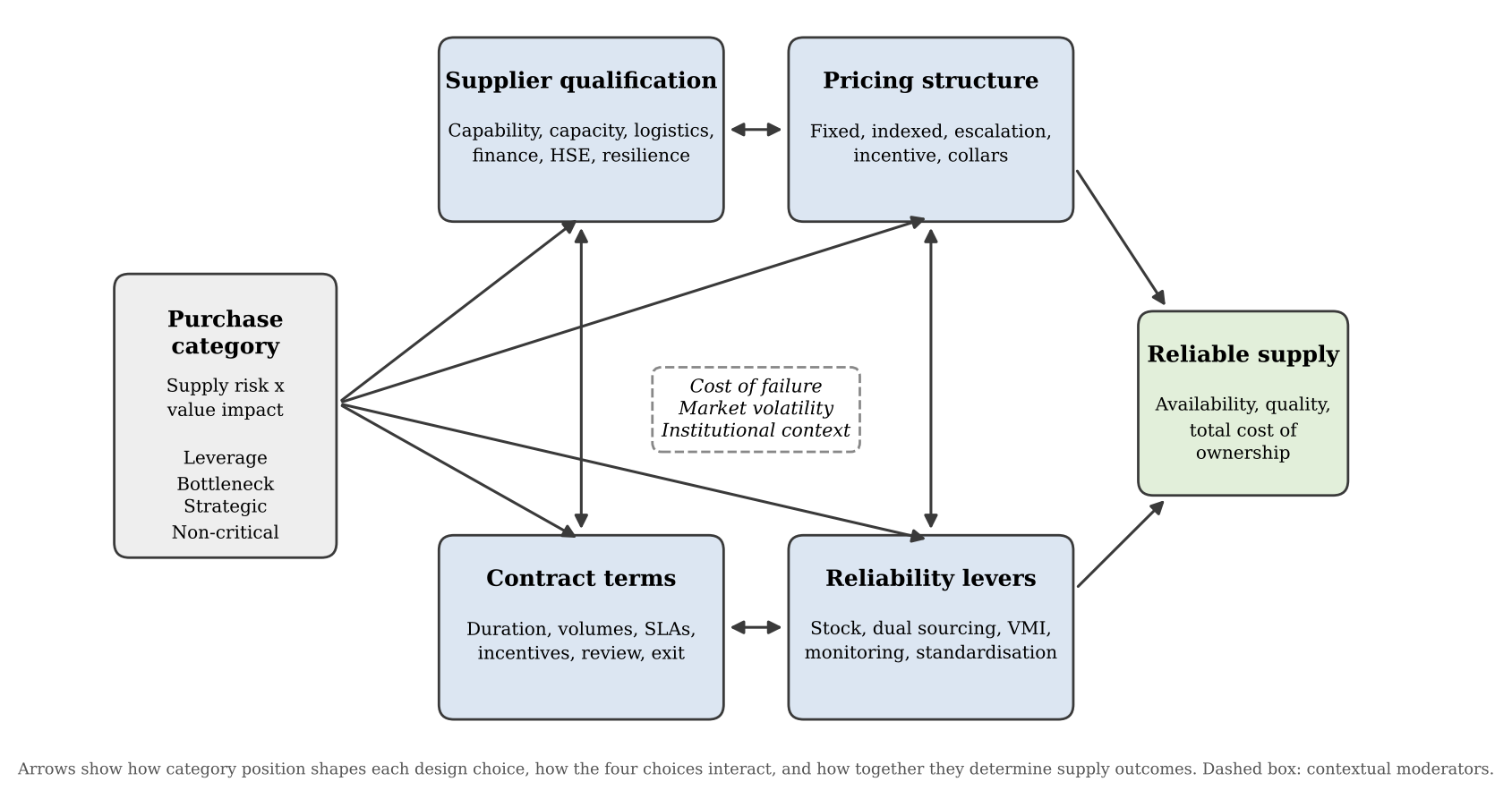
The model implies four propositions that can guide practice and be tested empirically. First, sourcing posture should follow the cost of failure rather than the purchase price. Second, pricing should pass through costs that are observable and uncontrollable by either party, while leaving controllable costs with the party that controls them. Third, contract terms should protect specific investments and anticipate change through structured adjustment rather than rigid fixed terms. Fourth, reliability should be designed through a portfolio of levers matched to the frequency and duration of likely disruptions. Table 4 translates the model into category-specific guidance.
| Category (example) | Qualification | Pricing | Contract terms | Reliability levers |
|---|---|---|---|---|
| Leverage (diesel at accessible sites; standard consumables) | Threshold gates plus price competition among many qualified bidders | Index plus competitive differential; periodic retender | Framework agreements of one to three years; service levels | Multiple suppliers; modest buffer stock |
| Bottleneck (OEM spares; remote fuel logistics) | Deep technical and resilience assessment | Escalation formulas; negotiated price lists | Longer terms; consignment stock; lead time commitments | Strategic stock; standardisation; develop alternatives |
| Strategic (primary plant fuel; turbine service) | Comprehensive including financial and continuity review | Index-linked with review clauses; incentive or availability fees | Long-term with price review, performance incentives, structured governance | Joint planning; dual supply where feasible; monitoring |
| Non-critical (office supplies; general tools) | Simplified | Catalogue or fixed price | Standard terms; e-procurement | Minimal; process efficiency |
Source: Author synthesis adapting Kraljic (1983) with evidence reviewed in Sections 3.2 to 3.5.
5Discussion
The synthesis points to a consistent theme: the literatures on supplier selection, contract economics, and supply chain risk developed largely in parallel, yet in energy operations their prescriptions converge on the same practical problem. Supplier selection research treats reliability as a supplier attribute to be assessed; contract economics treats it as an outcome of incentives and governance; and the risk literature treats it as a property of the supply network. The conceptual model in Section 4 suggests that these views are complementary. A well-qualified supplier can still fail under a contract that leaves it exposed to commodity price swings, and a well-designed contract cannot compensate for a supplier that lacks the logistics capacity to reach a remote site.
Several tensions also emerge. Deeper qualification improves reliability but narrows competition; long contracts protect specific investments but reduce flexibility; performance-based contracts align incentives but deepen dependence on original equipment manufacturers; and buffer stocks protect against disruption but tie up working capital that cost-focused procurement functions are pressed to release. These tensions explain why the literature offers few universal prescriptions and why category-based segmentation remains the most practical organising device. They also help explain why the cost reductions pursued during the 2014 to 2016 downturn in some cases weakened supply resilience: savings were achieved on the visible side of each trade-off while the risks accumulated on the other.
The regional literature reviewed here adds context that the mainstream purchasing literature has largely overlooked. Constraints on supplier finance, payment delays, weak laboratory and inspection infrastructure, flood-prone logistics routes, and local content obligations all shape how the general prescriptions apply in West African and similar settings. In these contexts, supplier development, payment discipline, and investment in quality verification may matter as much as contract design itself.
Lessons from adjacent sectors reinforce this point. Several findings from outside energy carry over to fuel and equipment sourcing. In health financing, Ilodigwe and Adesemoye (2019a) reviewed how provider payment reforms balance coverage expansion against financial protection, a problem that parallels the choice between fixed-price, cost-reimbursable, and performance-based payment discussed in Section 3.3. Ilodigwe and Adesemoye (2019b) argued that scientific innovation fails to improve outcomes without effective delivery systems, and the same is true of advanced equipment procured without the service, spares, and skills to keep it running. Michael and Ogunsola (2019a) and Aye and Tawose (2015, 2016) show, in different ways, that agricultural residues such as cassava peels already have productive uses as livestock feed and that rural enterprises depend on accessible finance; any move to source biomass fuels from such residues must account for these competing uses and for the financial fragility of small suppliers.
Construction and housing research offers parallel lessons on local sourcing and delivery. Nwafor, Uduokhai, Ifechukwu, Stephen, and Aransi (2019c) evaluated locally sourced building materials for low-income housing, an analogue for the qualification of local substitutes for imported equipment and materials. Nwafor, Uduokhai, Ifechukwu, Stephen, and Aransi (2019b) proposed a framework for efficiency in public infrastructure delivery, and Gil-Ozoudeh, Aransi, Nwafor, and Uduokhai (2018) analysed the socioeconomic determinants of affordability in urban housing, which shape energy demand in the communities that energy operations serve. Studies of building envelope design in humid climates (Nwafor, Uduokhai, Ifechukwu, et al., 2018) and of traditional and contemporary settlement morphology (Nwafor, Uduokhai, Giloid, & Aransi, 2018) are relevant to the design of camps and site facilities, whose energy loads determine fuel requirements. These connections are indirect, but they reinforce the review's central argument that reliable supply depends on the wider institutional and physical systems within which procurement operates.
6Implications
6.1Implications for practice
For energy operators, the review supports a shift in procurement performance measurement from unit price savings toward total cost of ownership and supply continuity. Savings achieved by dropping qualification requirements, eliminating buffer stocks, or imposing fixed prices on volatile inputs may prove illusory once disruption costs are counted. Category strategies grounded in segmentation, contract templates that embed indexation and review clauses, and supplier scorecards tied to reliability measures are all well supported by the literature.
In practical terms, operators can act on the conceptual model in four steps: segment purchases by supply risk and value impact and estimate the cost of failure for each category; set qualification depth and approved supplier numbers by category; select pricing mechanisms and contract terms from the options summarised in Tables 2 and 3 according to cost observability and specific investment; and assemble a reliability portfolio of stock, sourcing redundancy, supplier-managed inventory, and monitoring, reviewed against measured delivery performance.
6.2Implications for policy
For regulators and state-owned energy enterprises, the review suggests that procurement rules emphasising lowest price at tender can undermine supply reliability in critical categories. Allowing qualification-weighted evaluation, framework agreements, and indexation clauses within public procurement rules would let buyers apply the category-based approach. Local content policies are more likely to succeed when combined with supplier development, access to working capital, and prompt payment, since thinly capitalised local suppliers are most exposed to the delays and demand swings typical of the sector. Investment in shared quality verification capacity, such as fuel testing laboratories, would also strengthen reliability across the sector.
6.3Implications for theory
For research, the review indicates that supplier selection models, contract theory, and supply chain resilience frameworks are more powerful when combined than when applied separately. The conceptual model offers a basis for doing so in an industry setting where the cost of failure is high and observable, and where both continuous commodity inputs and lumpy, failure-driven equipment demand coexist.
7Limitations
The review has limitations of its own. It is analytical rather than systematic, so the selection of studies reflects judgement about relevance rather than a reproducible search protocol, and a different selection could shift the emphasis given to particular arguments. Much of the regional work it draws on is conceptual rather than empirical, which limits how far its propositions can be treated as established findings. The review is also confined to literature available by 2019 and to English-language sources, and it does not quantify effect sizes, so the relative importance of the four decision areas for reliability outcomes remains a matter of reasoned judgement. Finally, the conceptual model in Section 4 has not been tested empirically, and its propositions should be read as hypotheses rather than conclusions.
8Future research
Several directions for further research follow from the synthesis and from the limitations noted above:
- Empirical evidence in energy settings. Much of the evidence on supplier selection and performance contracting comes from manufacturing and aerospace. Regional contributions on energy procurement and contracting are growing (Agbabiaka et al., 2019; Okonkwo et al., 2018a, 2019; Uchechi & Ominyi, 2019), but they are largely conceptual. Rigorous empirical studies of contract performance in energy operations remain scarce, particularly in emerging markets such as sub-Saharan Africa, where infrastructure constraints, currency risk, and local content rules shape supply.
- Integration of physical and financial risk management. Pricing clauses in supply contracts and corporate hedging programmes are rarely analysed together, despite clear interactions.
- Multi-tier visibility. Resilience-oriented qualification depends on understanding sub-supplier risks, but methods for obtaining and verifying such information are underdeveloped.
- Dynamic qualification and digitalisation. The effects of real-time monitoring, digital supplier platforms, and data-driven requalification on reliability had not been robustly evaluated by 2019.
- Energy transition effects. Shifts toward gas, renewables, and battery storage alter the composition of critical inputs and the structure of supply markets, raising new questions about which categories are strategic and how contracts should adapt. Hybrid solar installations can reduce diesel dependence at remote and industrial sites (Sunday & Omoegun, 2018, 2019), while hydrogen as a secondary energy carrier would introduce entirely new fuel supply chains (Shittu, Opara, Elumilade, & Adeniji, 2019).
Empirical testing of the four propositions in Section 4, using contract-level data on prices, terms, and delivery performance from energy operators, would be a natural starting point.
9Conclusion
Reliable supply of fuel and equipment is a foundation of safe and profitable energy operations, and this review has argued that it is secured through deliberate design rather than through low purchase prices. Purchases should be segmented by supply risk and value impact. Suppliers should be qualified on capability, capacity, logistics, financial strength, compliance, and resilience, with the depth of qualification proportionate to the cost of failure. Pricing should allocate risk to the party best able to manage it, using indexation for observable commodity costs and incentive structures where effort matters. Contract terms should protect relationship-specific investments, provide structured mechanisms for adjustment, and make reliability financially material to suppliers. Delivery reliability should be designed as a system, combining stock, sourcing redundancy, flexibility, monitoring, and incentives in proportions matched to the nature of the risks faced.
The central conclusion is that strategic sourcing and contract design are not separate activities but parts of a single design problem. Decisions about whom to buy from, how to price, what to commit to, and how to secure delivery reinforce or undermine one another. Energy operators that treat them as an integrated system are better positioned to achieve supply that is both cost-effective and dependable.
References
- [1]Abdulrazaq K, Yusuf HD, Osinem HE, Eribenne F (2019). A model for improving infection detection accuracy through integrated laboratory information systems. Iconic Research and Engineering Journals, 3(6), 650–675. https://doi.org/10.64388/IREV3I6-1723089
- [2]Adaramola TS, Fadero S, Gideon EN (2018). Predictive maintenance and condition monitoring in critical power and energy infrastructure. Iconic Research and Engineering Journals, 2(5), 454–477. https://doi.org/10.64388/IREV2I5-1722489
- [3]Adeyelu OO (2018). A predictive compliance monitoring framework for detecting systemic safety risks through aviation consumer complaint data. Iconic Research and Engineering Journals, 1(8), 250–276. https://doi.org/10.64388/IREV1I8-1718478
- [4]Adeyelu OO (2019). An adaptive safety management system implementation model for aerodromes in developing economy contexts. Iconic Research and Engineering Journals, 3(4), 628–654. https://doi.org/10.64388/IREV3I4-1718479
- [5]Agbabiaka J, Okonkwo CS, Ogunwole O, Mayo W, Okeke OT (2019). Supply chain risk management model for EPC and gas processing projects. Iconic Research and Engineering Journals, 3(2), 968–980. https://doi.org/10.64388/IREV3I2-1713124
- [6]Agboada P, Ezeako R, Okoli IE, Ibeh AV (2018). Distributorship and trade finance product design: A conceptual framework for new-to-bank growth in emerging markets. Iconic Research and Engineering Journals, 2(5), 552–578. https://doi.org/10.64388/IREV2I5-1723312
- [7]Agboada P, Ezeako R, Okoli IE, Uzondu CS (2018). Digital transformation in operations management: A review of advances in automation, analytics, and process redesign. International Journal of Engineering Technology Research & Management, 2(11), 109–134.
- [8]Agboada P, Ezeako R, Okoli IE, Uzondu CS (2019). Standard operating procedures as change infrastructure: A conceptual framework for sustaining operational improvement. Iconic Research and Engineering Journals, 3(6), 706–730. https://doi.org/10.64388/IREV3I6-1723313
- [9]Agyei RK, Izuchukwu OT, Feboh D, Idowu A (2018). Integrated marketing communications and subscriber growth in a Sub-Saharan telecom sub-brand. International Journal of Marketing and Communication Studies, 3(2), 49–71. https://doi.org/10.56201/ijmcs.v3.no2.2018.pg49.71
- [10]Agyei RK, Izuchukwu OT, Feboh D, Idowu A (2019). Determinants of web-based payment portal adoption in Sub-Saharan Africa: A review and synthesis. International Journal of Computer Science and Mathematical Theory, 5(2), 56–79. https://doi.org/10.56201/ijcsmt.vol.5.no2.2019.pg56.79
- [11]Ahmed KS, Odejobi OD (2018a). Conceptual framework for scalable and secure cloud architectures for enterprise messaging. IRE Journals, 2(1), 1–15.
- [12]Ahmed KS, Odejobi OD (2018b). Resource allocation model for energy-efficient virtual machine placement in data centers. IRE Journals, 2(3), 1–10.
- [13]Ahmed KS, Odejobi OD, Oshoba TO (2019). Algorithmic model for constraint satisfaction in cloud network resource allocation. IRE Journals, 2(12), 516–532.
- [14]Akeju B, Edivri J, Ogbole JI, Okoruwa PO, Fadayomi O, Abolaji TO (2018). Conceptual model for insider threat classification and risk modeling in complex digital systems. Iconic Research and Engineering Journals, 1(9), 476–492. https://doi.org/10.64388/IREV1I9-1713778
- [15]Akomolafe O, Agu MU (2018). A conceptual model for enhancing internal audit quality through technology-enabled risk assessment frameworks. Iconic Research and Engineering Journals, 1(9), 458–475.
- [16]Akomolafe O, Agu MU (2019a). A conceptual framework for developing risk-based internal control models in the insurance and banking sectors. Iconic Research and Engineering Journals, 2(8), 335–354.
- [17]Akomolafe O, Agu MU (2019b). A review of data-driven risk evaluation models for emerging market financial institutions. Iconic Research and Engineering Journals, 3(6), 433–448.
- [18]Akomolafe O, Agu MU (2019c). Advances in financial resilience through integrated governance and compliance strategies. Iconic Research and Engineering Journals, 2(10), 607–620.
- [19]Amayo EB (2017). Multi algorithm of loss objective function of a single phase induction motor. International Journal of Development Research, 7(5), 12805–12810.
- [20]Amayo EB, Popoola TT (2017a). Multi algorithm of weight objective function of a single phase induction motor. International Journal of Trend in Research and Development, 4(2), 184–188.
- [21]Amayo EB, Popoola TT (2017b). Scientific study of telecommunication deployment in achieving quality network. International Journal of Trend in Research and Development, 4(5), 311–314.
- [22]Amayo EB, Ubeku E, Oshevire P (2015). Multi algorithm of a single objective function of a single phase induction motor. Journal of Multidisciplinary Engineering Science and Technology, 2(12), 3400–3403.
- [23]American Petroleum Institute (2013). Specification Q1: Specification for quality management system requirements for manufacturing organizations for the petroleum and natural gas industry (9th ed.). Washington, DC: API.
- [24]Aminu-Ibrahim AY, Ogbete JC, Ambali KB (2018). Developing sustainable diagnostic laboratory infrastructure models for emerging and resource constrained health systems. Iconic Research and Engineering Journals, 1(8), 118–132. https://doi.org/10.64388/IREV1I8-1713586
- [25]Aminu-Ibrahim AY, Ogbete JC, Ambali KB (2019). Capital project delivery models for high risk healthcare infrastructure in developing national health systems. Iconic Research and Engineering Journals, 2(10), 626–649. https://doi.org/10.64388/IREV2I10-1713588
- [26]Aneke OB, Adesemoye AC (2019). Toward an integrated conceptual framework for traceability and chain-of-custody integrity in pharmaceutical distribution. Iconic Research and Engineering Journals, 3(4), 655–672.
- [27]Anichukwueze CC, Osuji VC, Oguntegbe EE (2019). Global marketing law and consumer protection challenges: A strategic framework for multinational compliance. IRE Journals, 3(6), 325–333.
- [28]Anyanwu KCE (2019). Developing a maturity model for standardizing IT support operations across geographically distributed multi-office organizations. Iconic Research and Engineering Journals, 3(5)., 580–598.
- [29]Arumosoye OM, Obriki OD (2018). Development of an integrated heat stress risk conceptual model for industrial operations in extreme environments. Iconic Research and Engineering Journals, 1(12), 141–160. https://doi.org/10.64388/IREV1I12-1714415
- [30]Arumosoye OM, Obriki OD (2019). Systematic review of near-miss and hazard observation data utilization in industrial safety management. Iconic Research and Engineering Journals, 3(2), 981–999. https://doi.org/10.64388/IREV3I2-1714417
- [31]Atta S, Asomani E, Adenuga OM (2018). A systematic review of green corrosion inhibitors from agricultural extracts for mild steel protection in acidic and alkaline media. International Journal of Engineering and Modern Technology, 4(1), 64–97. https://doi.org/10.56201/ijemt.vol.4.no1.2018.pg64.97
- [32]Aye PA, Tawose OM (2015). Acceptability and utilization of graded levels of Gmelina arborea leaves and cassava peels concentrate by West African dwarf sheep. International Journal of Advances in Agriculture, 4(2), 415–422. https://doi.org/10.24297/jaa.v4i2.4272
- [33]Aye PA, Tawose OM (2016). Physiological responses of West African dwarf sheep fed graded levels of Gmelina arborea leaf and cassava peel concentrates under different management systems. Agriculture and Biology Journal of North America, 7(4), 185–195. https://doi.org/10.5251/abjna.2016.7.4.185.195
- [34]Azeez LO, Badmus OB (2018). Data-driven framework for predicting subsurface contamination pathways in complex remediation projects. Iconic Research and Engineering Journals, 2(5), 312–335.
- [35]Bacchetti A, Saccani N (2012). Spare parts classification and demand forecasting for stock control: Investigating the gap between research and practice. Omega, 40(6), 722–737.
- [36]Badmus O, Olamide AL (2019). Advanced hydrological modeling approach for assessing climate-induced watershed vulnerability trends. Iconic Research and Engineering Journals, 3(5), 388–410.
- [37]Badmus O, Dosunmu AA, Ozowara DE (2018). A systematic review of CI/CD pipeline strategies in Salesforce DevOps: Tools, practices, and deployment outcomes. Iconic Research and Engineering Journals, 2(6).
- [38]Badmus O, Dosunmu AA, Ozowara DE (2019a). A conceptual model for ETL design and data integration in Salesforce-centric enterprise architectures. Iconic Research and Engineering Journals, 3(5).
- [39]Badmus O, Dosunmu AA, Ozowara DE (2019b). A governance framework for Salesforce platform management in regulated healthcare environments. Iconic Research and Engineering Journals, 3(6).
- [40]Baines TS, Lightfoot HW, Benedettini O, Kay JM (2009). The servitization of manufacturing: A review of literature and reflection on future challenges. Journal of Manufacturing Technology Management, 20(5), 547–567. https://doi.org/10.1108/17410380910960984
- [41]Bajari P, Tadelis S (2001). Incentives versus transaction costs: A theory of procurement contracts. RAND Journal of Economics, 32(3), 387–407.
- [42]Barnes-Schuster D, Bassok Y, Anupindi R (2002). Coordination and flexibility in supply contracts with options. Manufacturing & Service Operations Management, 4(3), 171–207. https://doi.org/10.1287/msom.4.3.171.7754
- [43]Baumeister C, Kilian L (2016). Forty years of oil price fluctuations: Why the price of oil may still surprise us. Journal of Economic Perspectives, 30(1), 139–160. https://doi.org/10.1257/jep.30.1.139
- [44]Beamon BM (1999). Measuring supply chain performance. International Journal of Operations & Production Management, 19(3), 275–292.
- [45]Berger PD, Gerstenfeld A, Zeng AZ (2004). How many suppliers are best? A decision-analysis approach. Omega, 32(1), 9–15.
- [46]Blome C, Schoenherr T (2011). Supply risk management in financial crises: A multiple case-study approach. International Journal of Production Economics, 134(1), 43–57.
- [47]Bobga MA, Boakye K, Ogbona CS, Yeboah TJ (2018). Pedagogical strategies for teaching students with learning difficulties in resource-constrained schools. Iconic Research and Engineering Journals, 2(4), 173–194. https://doi.org/10.64388/IREV2I4-1714176
- [48]Bola-Sadipe D, Aliliele C, Eboh EE (2019). Conceptual model for strategic accounting systems strengthening financial transparency and regulatory compliance. IRE Journals, 3(6), 535–564. https://doi.org/10.64388/IREV3I6-1715327
- [49]Cachon GP (2003). Supply chain coordination with contracts. In A. G. de Kok & S. C. Graves (Eds.), Handbooks in Operations Research and Management Science: Vol. 11. Supply Chain Management (pp. 227–339). Amsterdam: Elsevier.
- [50]Cachon GP, Lariviere MA (2005). Supply chain coordination with revenue-sharing contracts: Strengths and limitations. Management Science, 51(1), 30–44. https://doi.org/10.1287/mnsc.1040.0215
- [51]Cannon JP, Perreault WD (1999). Buyer-seller relationships in business markets. Journal of Marketing Research, 36(4), 439–460. https://doi.org/10.1177/002224379903600404
- [52]Cao Z, Lumineau F (2015). Revisiting the interplay between contractual and relational governance: A qualitative and meta-analytic investigation. Journal of Operations Management, 33–34, 15–42. https://doi.org/10.1016/j.jom.2014.09.009
- [53]Carter DA, Rogers DA, Simkins BJ (2006). Does hedging affect firm value? Evidence from the US airline industry. Financial Management, 35(1), 53–86.
- [54]Chai J, Liu JNK, Ngai EWT (2013). Application of decision-making techniques in supplier selection: A systematic review of literature. Expert Systems with Applications, 40(10), 3872–3885. https://doi.org/10.1016/j.eswa.2012.12.040
- [55]Charnes A, Cooper WW, Rhodes E (1978). Measuring the efficiency of decision making units. European Journal of Operational Research, 2(6), 429–444.
- [56]Chen CT, Lin CT, Huang SF (2006). A fuzzy approach for supplier evaluation and selection in supply chain management. International Journal of Production Economics, 102(2), 289–301.
- [57]Cherp A, Jewell J (2014). The concept of energy security: Beyond the four As. Energy Policy, 75, 415–421. https://doi.org/10.1016/j.enpol.2014.09.005
- [58]Choi TY, Krause DR (2006). The supply base and its complexity: Implications for transaction costs, risks, responsiveness, and innovation. Journal of Operations Management, 24(5), 637–652.
- [59]Chopra S, Sodhi MS (2004). Managing risk to avoid supply-chain breakdown. MIT Sloan Management Review, 46(1), 53–61.
- [60]Christopher M, Peck H (2004). Building the resilient supply chain. The International Journal of Logistics Management, 15(2), 1–14. https://doi.org/10.1108/09574090410700275
- [61]Cohen MA, Agrawal N, Agrawal V (2006). Winning in the aftermarket. Harvard Business Review, 84(5), 129–138.
- [62]Corts KS, Singh J (2004). The effect of repeated interaction on contract choice: Evidence from offshore drilling. Journal of Law, Economics, and Organization, 20(1), 230–260. https://doi.org/10.1093/jleo/ewh031
- [63]Craighead CW, Blackhurst J, Rungtusanatham MJ, Handfield RB (2007). The severity of supply chain disruptions: Design characteristics and mitigation capabilities. Decision Sciences, 38(1), 131–156. https://doi.org/10.1111/j.1540-5915.2007.00151.x
- [64]Crocker KJ, Masten SE (1988). Mitigating contractual hazards: Unilateral options and contract length. RAND Journal of Economics, 19(3), 327–343.
- [65]Crocker KJ, Masten SE (1991). Pretia ex machina? Prices and process in long-term contracts. Journal of Law and Economics, 34(1), 69–99.
- [66]Croston JD (1972). Forecasting and stock control for intermittent demands. Operational Research Quarterly, 23(3), 289–303.
- [67]Dagodzo D (2018a). A conceptual framework for UAV integration into national power grid inspection programs. Iconic Research and Engineering Journals, 2(5), 391–412. https://doi.org/10.64388/IREV2I5-1716082
- [68]Dagodzo D (2018b). A review of UAV applications in electrical transmission line inspection: Methods, technologies, and challenges. Iconic Research and Engineering Journals, 2(6), 234–254. https://doi.org/10.64388/IREV2I6-1716083
- [69]Dagodzo D (2018c). Hydrothermal alteration interpretation of LANDSAT and ASTER data. Lambert Academic Publishing.
- [70]de Boer L, Labro E, Morlacchi P (2001). A review of methods supporting supplier selection. European Journal of Purchasing & Supply Management, 7(2), 75–89.
- [71]Dickson GW (1966). An analysis of vendor selection systems and decisions. Journal of Purchasing, 2(1), 5–17.
- [72]Disney SM, Towill DR (2003). The effect of vendor managed inventory (VMI) dynamics on the bullwhip effect in supply chains. International Journal of Production Economics, 85(2), 199–215.
- [73]Dogbatsey EA, Ebhojie O (2018). Budget compliance and statutory reporting in Sub-Saharan Africa: A systematic review of frameworks, gaps, and reform pathways. Zenodo. https://doi.org/10.5281/zenodo.20446859
- [74]Dogbatsey EA, Ebhojie O, Oyeleye AO (2019). Reconciliation control and financial workflow redesign in emerging market organizations: A conceptual framework. Zenodo. https://doi.org/10.5281/zenodo.20447103
- [75]Dosunmu AA, Ogundele PO (2019). Security audit and enterprise risk assessment frameworks for resilient information systems. Iconic Research and Engineering Journals, 3(5), 434–447. https://doi.org/10.64388/IREV3I5-1713225
- [76]Dyer JH (1996). Specialized supplier networks as a source of competitive advantage: Evidence from the auto industry. Strategic Management Journal, 17(4), 271–291.
- [77]Dyer JH, Singh H (1998). The relational view: Cooperative strategy and sources of interorganizational competitive advantage. Academy of Management Review, 23(4), 660–679.
- [78]Eisenhardt KM (1989). Agency theory: An assessment and review. Academy of Management Review, 14(1), 57–74.
- [79]Ejofodomi OA, Gideon EN, Oladipo GO, Oshomah ER (2014). Automated detection of architectural detection in mammograms using template matching. International Journal of Biomedical Science and Engineering, 2(1), 1–6. https://doi.org/10.11648/j.ijbse.20140201.11
- [80]Ekemezie UC, Ohunyon G, Sydney E (2018). Evaluating IDSR implementation in Benue State, Nigeria: DHIS2 data quality and surveillance capacity. Iconic Research and Engineering Journals, 2(6).
- [81]Ellram LM (1995). Total cost of ownership: An analysis approach for purchasing. International Journal of Physical Distribution and Logistics Management, 25(8), 4–23.
- [82]Ezeako R, Okoli IE, Uzondu CS, Ibeh AV (2019). Relationship banking performance: A conceptual framework for portfolio growth and profitability acceleration. International Journal of Engineering Technology Research & Management, 3(11), 132–151.
- [83]Fadayomi O, Abolaji TO, Edivri J, Ogbole JI, Okoruwa PO, Akeju B (2019). Risk-based cybersecurity assurance and data availability: Limitations, advances and future research opportunities. Iconic Research and Engineering Journals, 2(12), 602–617. https://doi.org/10.64388/IREV2I12-1713779
- [84]Flyvbjerg B (2014). What you should know about megaprojects and why: An overview. Project Management Journal, 45(2), 6–19. https://doi.org/10.1002/pmj.21409
- [85]Froot KA, Scharfstein DS, Stein JC (1993). Risk management: Coordinating corporate investment and financing policies. Journal of Finance, 48(5), 1629–1658. https://doi.org/10.1111/j.1540-6261.1993.tb05123.x
- [86]Gbadamosi IT, Obogo SF (2013). Chemical constituents and in vitro antimicrobial activities of five botanicals used traditionally for the treatment of neonatal jaundice in Ibadan, Nigeria. Nature and Science, 11(10), 130–135.
- [87]Geyskens I, Steenkamp JBEM, Kumar N (2006). Make, buy, or ally: A transaction cost theory meta-analysis. Academy of Management Journal, 49(3), 519–543. https://doi.org/10.5465/amj.2006.21794670
- [88]Gideon EN, Adaramola TS, Fadero S (2019). Reliability engineering and failure analysis in complex engineering systems. Iconic Research and Engineering Journals, 2(11), 703–727. https://doi.org/10.64388/IREV2I11-1722490
- [89]Gil-Ozoudeh IDS, Aransi AN, Nwafor MI, Uduokhai DO (2018). Socioeconomic determinants influencing the affordability and sustainability of urban housing in Nigeria. IRE Journals, 2(3), 164–169.
- [90]Goldberg VP, Erickson JR (1987). Quantity and price adjustment in long-term contracts: A case study of petroleum coke. Journal of Law and Economics, 30(2), 369–398. https://doi.org/10.1086/467141
- [91]Grossman SJ, Hart OD (1986). The costs and benefits of ownership: A theory of vertical and lateral integration. Journal of Political Economy, 94(4), 691–719. https://doi.org/10.1086/261404
- [92]Guajardo JA, Cohen MA, Kim SH, Netessine S (2012). Impact of performance-based contracting on product reliability: An empirical analysis. Management Science, 58(5), 961–979.
- [93]Guay W, Kothari SP (2003). How much do firms hedge with derivatives? Journal of Financial Economics, 70(3), 423–461. https://doi.org/10.1016/S0304-405X(03)00179-X
- [94]Gunasekaran A, Patel C, McGaughey RE (2004). A framework for supply chain performance measurement. International Journal of Production Economics, 87(3), 333–347.
- [95]Haksöz Ç, Seshadri S (2007). Supply chain operations in the presence of a spot market: A review with discussion. Journal of the Operational Research Society, 58(11), 1412–1429. https://doi.org/10.1057/palgrave.jors.2602401
- [96]Hallikas J, Karvonen I, Pulkkinen U, Virolainen VM, Tuominen M (2004). Risk management processes in supplier networks. International Journal of Production Economics, 90(1), 47–58.
- [97]Hamilton JD (2009). Causes and consequences of the oil shock of 2007–08. Brookings Papers on Economic Activity, 2009(1), 215–261.
- [98]Hart O, Moore J (2008). Contracts as reference points. Quarterly Journal of Economics, 123(1), 1–48.
- [99]Haushalter GD (2000). Financing policy, basis risk, and corporate hedging: Evidence from oil and gas producers. Journal of Finance, 55(1), 107–152. https://doi.org/10.1111/0022-1082.00202
- [100]Heide JB, John G (1990). Alliances in industrial purchasing: The determinants of joint action in buyer-supplier relationships. Journal of Marketing Research, 27(1), 24–36. https://doi.org/10.1177/002224379002700103
- [101]Hendricks KB, Singhal VR (2005). An empirical analysis of the effect of supply chain disruptions on long-run stock price performance and equity risk of the firm. Production and Operations Management, 14(1), 35–52.
- [102]Ho W, Xu X, Dey PK (2010). Multi-criteria decision making approaches for supplier evaluation and selection: A literature review. European Journal of Operational Research, 202(1), 16–24.
- [103]Ho W, Zheng T, Yildiz H, Talluri S (2015). Supply chain risk management: A literature review. International Journal of Production Research, 53(16), 5031–5069. https://doi.org/10.1080/00207543.2015.1030467
- [104]Hubbard RG, Weiner RJ (1986). Regulation and long-term contracting in U.S. natural gas markets. Journal of Industrial Economics, 35(1), 71–79.
- [105]Huiskonen J (2001). Maintenance spare parts logistics: Special characteristics and strategic choices. International Journal of Production Economics, 71(1–3), 125–133.
- [106]Hypko P, Tilebein M, Gleich R (2010). Benefits and uncertainties of performance-based contracting in manufacturing industries: An agency theory perspective. Journal of Service Management, 21(4), 460–489. https://doi.org/10.1108/09564231011066114
- [107]Ilodigwe L, Adesemoye AC (2019a). A critical review of health insurance financing mechanisms and provider payment reform strategies for balancing coverage expansion and financial protection in emerging markets. International Journal of Health and Pharmaceutical Research, 5(2), 31–55. https://doi.org/10.56201/ijhpr.vol.5.no2.2019.pg31.55
- [108]Ilodigwe L, Adesemoye AC (2019b). From molecules to health systems: A conceptual model explaining why scientific innovation fails to improve patient outcomes without effective healthcare delivery infrastructure. International Journal of Health and Pharmaceutical Research, 5(2), 56–79. https://doi.org/10.56201/ijhpr.vol.5.no2.2019.pg56.79
- [109]International Chamber of Commerce (2019). Incoterms 2020: ICC rules for the use of domestic and international trade terms (ICC Publication No. 723E). ICC.
- [110]International Energy Agency (2019a). World energy outlook 2019. IEA. https://doi.org/10.1787/caf32f3b-en
- [111]International Energy Agency (2019b). Africa energy outlook 2019. IEA.
- [112]International Organization for Standardization (2015). ISO 9001:2015 Quality management systems: Requirements. Geneva: ISO.
- [113]Ivanov D, Dolgui A, Sokolov B, Ivanova M (2017). Literature review on disruption recovery in the supply chain. International Journal of Production Research, 55(20), 6158–6174. https://doi.org/10.1080/00207543.2017.1330572
- [114]Jardine AKS, Lin D, Banjevic D (2006). A review on machinery diagnostics and prognostics implementing condition-based maintenance. Mechanical Systems and Signal Processing, 20(7), 1483–1510.
- [115]Jin Y, Jorion P (2006). Firm value and hedging: Evidence from U.S. oil and gas producers. Journal of Finance, 61(2), 893–919. https://doi.org/10.1111/j.1540-6261.2006.00858.x
- [116]Joskow PL (1985). Vertical integration and long-term contracts: The case of coal-burning electric generating plants. Journal of Law, Economics, & Organization, 1(1), 33–80. https://doi.org/10.1093/oxfordjournals.jleo.a036889
- [117]Joskow PL (1987). Contract duration and relationship-specific investments: Empirical evidence from coal markets. American Economic Review, 77(1), 168–185.
- [118]Joskow PL (1988). Price adjustment in long-term contracts: The case of coal. Journal of Law and Economics, 31(1), 47–83. https://doi.org/10.1086/467149
- [119]Jüttner U, Peck H, Christopher M (2003). Supply chain risk management: Outlining an agenda for future research. International Journal of Logistics: Research and Applications, 6(4), 197–210.
- [120]Kellogg R (2011). Learning by drilling: Interfirm learning and relationship persistence in the Texas oilpatch. Quarterly Journal of Economics, 126(4), 1961–2004. https://doi.org/10.1093/qje/qjr039
- [121]Kennedy WJ, Patterson JW, Fredendall LD (2002). An overview of recent literature on spare parts inventories. International Journal of Production Economics, 76(2), 201–215.
- [122]Kilian L (2009). Not all oil price shocks are alike: Disentangling demand and supply shocks in the crude oil market. American Economic Review, 99(3), 1053–1069. https://doi.org/10.1257/aer.99.3.1053
- [123]Kim SH, Cohen MA, Netessine S (2007). Performance contracting in after-sales service supply chains. Management Science, 53(12), 1843–1858.
- [124]Klein B, Crawford RG, Alchian AA (1978). Vertical integration, appropriable rents, and the competitive contracting process. Journal of Law and Economics, 21(2), 297–326. https://doi.org/10.1086/466922
- [125]Kleindorfer PR, Saad GH (2005). Managing disruption risks in supply chains. Production and Operations Management, 14(1), 53–68.
- [126]Kleindorfer PR, Wu DJ (2003). Integrating long- and short-term contracting via business-to-business exchanges for capital-intensive industries. Management Science, 49(11), 1597–1615. https://doi.org/10.1287/mnsc.49.11.1597.20583
- [127]Kraljic P (1983). Purchasing must become supply management. Harvard Business Review, 61(5), 109–117.
- [128]Krause DR, Handfield RB, Tyler BB (2007). The relationships between supplier development, commitment, social capital accumulation and performance improvement. Journal of Operations Management, 25(2), 528–545. https://doi.org/10.1016/j.jom.2006.05.007
- [129]Krause DR, Scannell TV, Calantone RJ (2000). A structural analysis of the effectiveness of buying firms' strategies to improve supplier performance. Decision Sciences, 31(1), 33–55.
- [130]Kruyt B, van Vuuren DP, de Vries HJM, Groenenberg H (2009). Indicators for energy security. Energy Policy, 37(6), 2166–2181.
- [131]Ladapo OO, Dosunmu AA, Jooda D, Abolaji TO (2018). Lessons learned from offline assessment of security-critical systems: The case of Microsoft Active Directory. Iconic Research and Engineering Journals, 2(6), 277–299. https://doi.org/10.64388/IREV2I6-1717205
- [132]Ladapo OO, Jooda D, Dosunmu AA, Abolaji TO (2019). Implementation of Active Directory for efficient management of enterprise networks. Iconic Research and Engineering Journals, 3(4), 608–627. https://doi.org/10.64388/IREV3I4-1717206
- [133]Laffont JJ, Tirole J (1993). A theory of incentives in procurement and regulation. MIT Press.
- [134]Lamidi OBA, Olamide A (2018). Spatially explicit risk modeling framework for tracking subsurface contaminant migration in data-limited remediation sites. Iconic Research and Engineering Journals, 2(6), 178–198.
- [135]Lariviere MA, Porteus EL (2001). Selling to the newsvendor: An analysis of price-only contracts. Manufacturing & Service Operations Management, 3(4), 293–305. https://doi.org/10.1287/msom.3.4.293.9971
- [136]Lawal OA, Oduleye TE (2018a). A conceptual model for financial analytics driven enterprise value creation in technology firms. Iconic Research and Engineering Journals, 2(2).
- [137]Lawal OA, Oduleye TE (2018b). A review and conceptual framework for tax governance and cross-border compliance analytics. Iconic Research and Engineering Journals, 2(5).
- [138]Lawal OA, Oduleye TE (2019a). A conceptual risk assessment model for transfer pricing in multinational corporations. Iconic Research and Engineering Journals, 2(12).
- [139]Lawal OA, Oduleye TE (2019b). Conceptualizing data driven executive decision systems for strategic financial planning. Iconic Research and Engineering Journals, 3(3).
- [140]Lee HL, Padmanabhan V, Whang S (1997). Information distortion in a supply chain: The bullwhip effect. Management Science, 43(4), 546–558.
- [141]Liker JK, Choi TY (2004). Building deep supplier relationships. Harvard Business Review, 82(12), 104–113.
- [142]Liu Y, Luo Y, Liu T (2009). Governing buyer-supplier relationships through transactional and relational mechanisms: Evidence from China. Journal of Operations Management, 27(4), 294–309. https://doi.org/10.1016/j.jom.2008.09.004
- [143]Macneil IR (1980). The new social contract: An inquiry into modern contractual relations. Yale University Press.
- [144]Martínez-de-Albéniz V, Simchi-Levi D (2005). A portfolio approach to procurement contracts. Production and Operations Management, 14(1), 90–114.
- [145]Masten SE, Crocker KJ (1985). Efficient adaptation in long-term contracts: Take-or-pay provisions for natural gas. American Economic Review, 75(5), 1083–1093.
- [146]Mbonu IS, Aliliele C, Iwuanyanwu U, Oluoha OM (2018). A conceptual framework for legal and ethical risk modeling in enterprise data protection governance systems. Iconic Research and Engineering Journals, 2(2), 207–226. https://doi.org/10.64388/IREV2I2-1714911
- [147]Mbonu IS, Aliliele C, Uzoka E, Oluoha OM (2019). A review of comparative data protection regulations and secure cloud implementation strategies across jurisdictions. Iconic Research and Engineering Journals, 2(9), 482–501. https://doi.org/10.64388/IREV2I9-1714912
- [148]Mbonu IS, Iwuanyanwu U, Uzoka E, Oluoha OM (2019). Advances in enterprise log analytics and automated incident response architectures using Python and SIEM platforms. Iconic Research and Engineering Journals, 3(2), 1000–1019. https://doi.org/10.64388/IREV3I2-1714915
- [149]McAfee RP, McMillan J (1986). Bidding for contracts: A principal-agent analysis. RAND Journal of Economics, 17(3), 326–338.
- [150]Mensah, Kofi Okyere, Pedro, Omotayo, Kinyanjui, Ann, Okoli, Ifeoma, & Agboada, Priscilla (2019). A review of capital adequacy frameworks and risk weighted asset optimization in modern banking systems. Iconic Research and Engineering Journals, 3(6), 731–768. https://doi.org/10.64388/irev3i6-1723267
- [151]Merrow EW (2011). Industrial megaprojects: Concepts, strategies, and practices for success. Wiley.
- [152]Michael ON, Ogunsola OE (2019a). Determinants of access to agribusiness finance and their influence on enterprise growth in rural communities. Iconic Research and Engineering Journals, 2(12), 533–548.
- [153]Michael ON, Ogunsola OE (2019b). Strengthening agribusiness education and entrepreneurial competencies for sustainable youth employment in Sub-Saharan Africa. Iconic Research and Engineering Journals, 2(9), 416–431.
- [154]Ng ICL, Maull R, Yip N (2009). Outcome-based contracts as a driver for systems thinking and service-dominant logic in service science: Evidence from the defence industry. European Management Journal, 27(6), 377–387.
- [155]Nwafor MI, Giloid S, Uduokhai DO, Aransi AN (2019a). Architectural interventions for enhancing urban resilience and reducing flood vulnerability in African cities. Iconic Research and Engineering Journals, 2(8), 321–334.
- [156]Nwafor MI, Uduokhai DO, Giloid S, Aransi AN (2018). Comparative study of traditional and contemporary architectural morphologies in Nigerian settlements. Iconic Research and Engineering Journals, 1(7), 138–152.
- [157]Nwafor MI, Uduokhai DO, Ifechukwu GO, Stephen D, Aransi AN (2018). Impact of climatic variables on the optimization of building envelope design in humid regions. Iconic Research and Engineering Journals, 1(10), 322–335.
- [158]Nwafor MI, Uduokhai DO, Ifechukwu GO, Stephen D, Aransi AN (2019b). Developing an analytical framework for enhancing efficiency in public infrastructure delivery systems. Iconic Research and Engineering Journals, 2(11), 657–670.
- [159]Nwafor MI, Uduokhai DO, Ifechukwu GO, Stephen D, Aransi AN (2019c). Quantitative evaluation of locally sourced building materials for sustainable low-income housing projects. Iconic Research and Engineering Journals, 3(4), 568–582.
- [160]Nwangwu CV, Duvbiama-Owasanoye OA, Onwumere A (2018). A framework for operational integrity in high-risk drilling: Balancing productivity and safety compliance. Iconic Research and Engineering Journals, 2(5), 436–453.
- [161]Nwangwu CV, Duvbiama-Owasanoye OA, Onwumere A (2019). A strategic review of the industry-academia collaboration model for modernizing technical learning centers. Iconic Research and Engineering Journals, 3(6), 565–583.
- [162]Obetta PC (2018). A risk-based inspection concept for fitness-for-service assessment of ageing pressure vessels on offshore joint venture facilities. Iconic Research and Engineering Journals, 2(5), 497–520. https://doi.org/10.64388/IREV2I5-1722578
- [163]Obetta PC (2019). Reliability and integrity management of fired heaters, boilers and furnaces in upstream oil and gas: A review. Iconic Research and Engineering Journals, 3(5), 599–626. https://doi.org/10.64388/IREV3I5-1722580
- [164]Obetta PC, Ninduwezuor-Ehiobu N (2018). A condition-based maintenance concept for CALM buoy bearings and swivels to improve offshore crude export availability. Iconic Research and Engineering Journals, 2(6), 385–410. https://doi.org/10.64388/IREV2I6-1722579
- [165]Obetta PC, Ninduwezuor-Ehiobu N (2019). Integrity assurance of FSO turret mooring systems: A review of inspection, monitoring and life-extension strategies. Iconic Research and Engineering Journals, 3(6), 599–629. https://doi.org/10.64388/IREV3I6-1722581
- [166]Obogo SF, Ozobu CO, Uduokhai DO (2019a). Advances in leadership driven safety culture transformation in large construction workforces. Iconic Research and Engineering Journals, 3(5), 507–523. https://doi.org/10.64388/IREV3I5-1715497
- [167]Obogo SF, Ozobu CO, Uduokhai DO (2019b). Development of a construction safety risk governance model for multi contractor high rise projects. Iconic Research and Engineering Journals, 2(9), 502–522. https://doi.org/10.64388/IREV2I9-1715495
- [168]Obogo SF, Uduokhai DO, Ozobu CO (2019). Systematic review of hazard identification and risk control practices in urban construction projects. Iconic Research and Engineering Journals, 2(12), 666–681. https://doi.org/10.64388/IREV2I12-1715496
- [169]Obriki OD, Arumosoye OM (2018). Conceptual modeling of data-driven occupational safety risk control in large-scale energy infrastructure projects. Iconic Research and Engineering Journals, 1(7), 169–189. https://doi.org/10.64388/IREV1I7-1714414
- [170]Obriki OD, Arumosoye OM (2019). A conceptual framework linking management safety walkthrough frequency and coverage to safety culture outcomes in mega projects. Iconic Research and Engineering Journals, 2(8), 355–374. https://doi.org/10.64388/IREV2I8-1714416
- [171]Odejobi OD, Ahmed KS (2018a). Statistical model for estimating daily solar radiation for renewable energy planning. IRE Journals, 2(5), 1–12.
- [172]Odejobi OD, Ahmed KS (2018b). Performance evaluation model for multi-tenant Microsoft 365 deployments under high concurrency. IRE Journals, 1(11), 92–107.
- [173]Odejobi OD, Hammed NI, Ahmed KS (2019). Approximation complexity model for cloud-based database optimization problems. IRE Journals, 2(9), 1–10.
- [174]Ogbete JC, Aminu-Ibrahim AY, Ambali KB (2018). Optimizing laboratory spatial planning strategies to improve diagnostic accuracy, safety, and clinical throughput. Iconic Research and Engineering Journals, 2(1), 87–113. https://doi.org/10.64388/IREV1I7-1713587
- [175]Ogbete JC, Aminu-Ibrahim AY, Ambali KB (2019). Regulatory compliant design systems for molecular and pathology laboratories in highly controlled environments. Iconic Research and Engineering Journals, 3(4), 607–631. https://doi.org/10.64388/IREV3I4-1713589
- [176]Okonkwo CS, Ogunwole O, Okeke OT (2018a). Framework for strategic procurement optimization in oil and gas operations. Iconic Research and Engineering Journals, 1(7), 153–168. https://doi.org/10.64388/IREV1I7-1713119
- [177]Okonkwo CS, Ogunwole O, Okeke OT (2018b). Model for inventory availability and plant uptime improvement in energy facilities. Iconic Research and Engineering Journals, 2(4), 160–172. https://doi.org/10.64388/IREV2I4-1713120
- [178]Okonkwo CS, Ogunwole O, Okeke OT, Mayo W (2019). Conceptual framework for cost reduction through contract negotiation and vendor governance. Iconic Research and Engineering Journals, 2(9), 468–482. https://doi.org/10.64388/IREV2I9-1713121
- [179]Okwesa, Ifeanyichukwu Jeffrey, Ajiga, Daniel, & Iwuanyanwu, Uzoamaka (2019). Automation of log collection and incident triage for security operations: A review. Iconic Research and Engineering Journals, 3(5), 627–650. https://doi.org/10.64388/irev3i5-1722629
- [180]Oliva R, Kallenberg R (2003). Managing the transition from products to services. International Journal of Service Industry Management, 14(2), 160–172. https://doi.org/10.1108/09564230310474138
- [181]Olsen TE, Osmundsen P (2005). Sharing of endogenous risk in construction. Journal of Economic Behavior & Organization, 58(4), 511–526. https://doi.org/10.1016/j.jebo.2003.09.019
- [182]Oshevire P, Eyenubo OJ, Amayo B (2017). Voltage control in the presence of distributed generation. ATBU Journal of Science, Technology and Education, 5(2), 165–173.
- [183]Oshoba TO, Hammed NI, Odejobi OD (2019). Secure identity and access management model for distributed and federated systems. IRE Journals, 3(4), 550–567.
- [184]Osmundsen P, Sørenes T, Toft A (2010). Offshore oil service contracts: New incentive schemes to promote drilling efficiency. Journal of Petroleum Science and Engineering, 72(3–4), 220–228. https://doi.org/10.1016/j.petrol.2010.03.021
- [185]Osmundsen P, Toft A, Dragvik KA (2006). Design of drilling contracts: Economic incentives and safety issues. Energy Policy, 34(15), 2324–2329. https://doi.org/10.1016/j.enpol.2005.04.011
- [186]Pasternack BA (1985). Optimal pricing and return policies for perishable commodities. Marketing Science, 4(2), 166–176.
- [187]Pettit TJ, Fiksel J, Croxton KL (2010). Ensuring supply chain resilience: Development of a conceptual framework. Journal of Business Logistics, 31(1), 1–21.
- [188]Ponomarov SY, Holcomb MC (2009). Understanding the concept of supply chain resilience. The International Journal of Logistics Management, 20(1), 124–143. https://doi.org/10.1108/09574090910954873
- [189]Poppo L, Zenger T (2002). Do formal contracts and relational governance function as substitutes or complements? Strategic Management Journal, 23(8), 707–725. https://doi.org/10.1002/smj.249
- [190]Regnier E (2007). Oil and energy price volatility. Energy Economics, 29(3), 405–427. https://doi.org/10.1016/j.eneco.2005.11.003
- [191]Saaty TL (1980). The Analytic Hierarchy Process. New York: McGraw-Hill.
- [192]Schmitt AJ, Singh M (2012). A quantitative analysis of disruption risk in a multi-echelon supply chain. International Journal of Production Economics, 139(1), 22–32.
- [193]Seifert RW, Thonemann UW, Hausman WH (2004). Optimal procurement strategies for online spot markets. European Journal of Operational Research, 152(3), 781–799. https://doi.org/10.1016/S0377-2217(02)00754-3
- [194]Selviaridis K, Wynstra F (2015). Performance-based contracting: A literature review and future research directions. International Journal of Production Research, 53(12), 3505–3540. https://doi.org/10.1080/00207543.2014.978031
- [195]Sheffi Y (2005). The Resilient Enterprise: Overcoming Vulnerability for Competitive Advantage. Cambridge, MA: MIT Press.
- [196]Sheffi Y, Rice JB (2005). A supply chain view of the resilient enterprise. MIT Sloan Management Review, 47(1), 41–48.
- [197]Sherbrooke CC (1968). METRIC: A multi-echelon technique for recoverable item control. Operations Research, 16(1), 122–141.
- [198]Shittu H, Opara IS, Elumilade RA, Adeniji IO (2019). Hydrogen as a secondary energy carrier: Modeling its integration in national grids. Iconic Research and Engineering Journals, 3(1), 628–643. https://doi.org/10.64388/IREV3I1-1713909
- [199]Smith CW, Stulz RM (1985). The determinants of firms' hedging policies. Journal of Financial and Quantitative Analysis, 20(4), 391–405. https://doi.org/10.2307/2330757
- [200]Snyder LV, Atan Z, Peng P, Rong Y, Schmitt AJ, Sinsoysal B (2016). OR/MS models for supply chain disruptions: A review. IIE Transactions, 48(2), 89–109. https://doi.org/10.1080/0740817X.2015.1067735
- [201]Sodhi MS, Son BG, Tang CS (2012). Researchers' perspectives on supply chain risk management. Production and Operations Management, 21(1), 1–13.
- [202]Sovacool BK, Mukherjee I (2011). Conceptualizing and measuring energy security: A synthesized approach. Energy, 36(8), 5343–5355. https://doi.org/10.1016/j.energy.2011.06.043
- [203]Sunday EA, Omoegun GO (2018). Integrating solar power solutions in small-scale manufacturing industries in Nigeria. International Journal of Scientific Research in Science, Engineering and Technology, 4(8), 832–853.
- [204]Sunday EA, Omoegun GO (2019). Optimizing electrical load distribution for hybrid solar installations in developing economies. International Journal of Scientific Research in Mechanical and Materials Engineering, 3(6), 27–47.
- [205]Sunday EA, Omoegun GO, Essien MA, Oluokun OA (2019). Thermodynamic efficiency and control strategies in residential air conditioning systems. International Journal of Scientific Research in Civil Engineering, 3(3), 52–76.
- [206]Syntetos AA, Babai MZ, Altay N (2012). On the demand distributions of spare parts. International Journal of Production Research, 50(8), 2101–2117.
- [207]Tang CS (2006a). Perspectives in supply chain risk management. International Journal of Production Economics, 103(2), 451–488. https://doi.org/10.1016/j.ijpe.2005.12.006
- [208]Tang CS (2006b). Robust strategies for mitigating supply chain disruptions. International Journal of Logistics: Research and Applications, 9(1), 33–45.
- [209]Tomlin B (2006). On the value of mitigation and contingency strategies for managing supply chain disruption risks. Management Science, 52(5), 639–657.
- [210]Treleven M, Schweikhart SB (1988). A risk/benefit analysis of sourcing strategies: Single vs. multiple sourcing. Journal of Operations Management, 7(3–4), 93–114.
- [211]Tsay AA (1999). The quantity flexibility contract and supplier-customer incentives. Management Science, 45(10), 1339–1358. https://doi.org/10.1287/mnsc.45.10.1339
- [212]Uchechi N (2018). Mitigating enterprise financial exposure: Standardization of stamp duty policies and class action defense protocols. Iconic Research and Engineering Journals, 2(5), 521–551. https://doi.org/10.64388/IREV2I5-1722788
- [213]Uchechi N, Ominyi M (2019). Liability mitigation and dispute prevention in high-value energy service contracts. Iconic Research and Engineering Journals, 3(6), 676–705. https://doi.org/10.64388/IREV3I6-1722790
- [214]Uchechi N, Ominyi M, Jones BC (2018). Procedural standardization and workflow optimization in high-volume dispute resolution clinics: A systematic review. Iconic Research and Engineering Journals, 2(6), 420–452. https://doi.org/10.64388/IREV2I6-1722789
- [215]Uchechi N, Ominyi M, Anichukwueze CC, Jones BC (2019). Corporate policy advocacy and regulatory reform: Streamlining statutory bidding workflows in emerging energy markets. Iconic Research and Engineering Journals, 3(5), 672–709. https://doi.org/10.64388/IREV3I5-1722791
- [216]Unamma, Uchechi Mary-Linda, Ashore-Onisemo, Funmilayo, Iwuanyanwu, Uzoamaka, & Okwesa, Ifeanyichukwu Jeffrey (2018a). Digital inclusion and workforce-readiness interventions in emerging economies: A review. International Journal of Scientific Research in Computer Science, Engineering and Information Technology. https://doi.org/10.32628/CSEIT12283141
- [217]Unamma, Uchechi Mary-Linda, Ashore-Onisemo, Funmilayo, Iwuanyanwu, Uzoamaka, & Okwesa, Ifeanyichukwu Jeffrey (2018b). Predictive forecasting for operational resource allocation: A comparative review. Iconic Research and Engineering Journals, 1(9), 493–508. https://doi.org/10.64388/irev1i9-1722628
- [218]Unamma, Uchechi Mary-Linda, Okwesa, Ifeanyichukwu Jeffrey, Iwuanyanwu, Uzoamaka, & Ajiga, Daniel (2018). An offline-first design framework for digital learning in low-connectivity environments. Iconic Research and Engineering Journals, 2(3). https://doi.org/10.64388/irev2i3-1722627
- [219]Valentini G, Zavanella L (2003). The consignment stock of inventories: Industrial case and performance analysis. International Journal of Production Economics, 81–82, 215–224.
- [220]van Weele AJ (2018). Purchasing and Supply Chain Management (7th ed.). Andover: Cengage Learning.
- [221]Vandermerwe S, Rada J (1988). Servitization of business: Adding value by adding services. European Management Journal, 6(4), 314–324.
- [222]Waller M, Johnson ME, Davis T (1999). Vendor-managed inventory in the retail supply chain. Journal of Business Logistics, 20(1), 183–203.
- [223]Weber CA, Current JR, Benton WC (1991). Vendor selection criteria and methods. European Journal of Operational Research, 50(1), 2–18.
- [224]Wikiri M (2019). Global technology talent development in emerging markets: A conceptual framework for preparing software professionals for international employment. Iconic Research and Engineering Journals, 3(5), 651–671. https://doi.org/10.64388/IREV3I5-1723088
- [225]Williamson OE (1979). Transaction-cost economics: The governance of contractual relations. Journal of Law and Economics, 22(2), 233–261. https://doi.org/10.1086/466942
- [226]Williamson OE (1985). The Economic Institutions of Capitalism. New York: Free Press.
- [227]Winzer C (2012). Conceptualizing energy security. Energy Policy, 46, 36–48. https://doi.org/10.1016/j.enpol.2012.02.067
- [228]Wu DJ, Kleindorfer PR, Zhang JE (2002). Optimal bidding and contracting strategies for capital-intensive goods. European Journal of Operational Research, 137(3), 657–676. https://doi.org/10.1016/S0377-2217(01)00093-5
- [229]Yeboah TJ, Bobga MA, Boakye K, Ogbona CS (2019). Professional development and teacher competence in managing exceptional learners: A Ghanaian perspective. Iconic Research and Engineering Journals, 2(12), 618–636. https://doi.org/10.64388/IREV2I12-1714177
- [230]Yergin D (2006). Ensuring energy security. Foreign Affairs, 85(2), 69–82. https://doi.org/10.2307/20031912
- [231]Yu H, Zeng AZ, Zhao L (2009). Single or dual sourcing: Decision-making in the presence of supply chain disruption risks. Omega, 37(4), 788–800.
- [232]Yusuf HD, Abdulrazaq K (2018). A conceptual framework for strengthening diagnostic quality systems in resource-limited clinical laboratories. Iconic Research and Engineering Journals, 1(11), 145–179. https://doi.org/10.64388/IREV1I11-1723090
- [233]Zadeh LA (1965). Fuzzy sets. Information and Control, 8(3), 338–353.