HSE Governance and Smart Leak Detection
Integrating HSE Governance with Intelligent Leakage Detection Systems for Sustainable Industrial Development in Saudi Arabia
Published October 2026
Abstract
Saudi Arabia’s industrial expansion under Vision 2030 increases the strategic importance of preventing loss of containment across oil and gas, petrochemical, water, utilities, and infrastructure assets. This review examines how health, safety, and environment (HSE) governance can be integrated with intelligent leakage detection so that sensing technologies become part of accountable risk management rather than isolated technical tools. An integrative review of peer-reviewed literature published during 2020–2025 synthesizes evidence on acoustic sensing, pressure and flow analytics, Industrial Internet of Things (IIoT), machine and deep learning, digital twins, risk-based inspection, dynamic risk analysis, human factors, and safety governance. The synthesis shows that intelligent systems can improve detection speed, localization, and predictive integrity assessment, but technical accuracy alone does not ensure safer outcomes. Governance quality determines whether alerts are validated, escalated, translated into barrier actions, documented, and learned from. The paper proposes an HSE-integrated architecture linking sensor assurance, contextual analytics, dynamic risk ranking, human authorization, emergency response, maintenance, and sustainability metrics. It argues that Saudi industrial operators should treat leakage intelligence as a safety-critical decision system with defined ownership, cybersecurity controls, model assurance, and lifecycle verification. Research priorities include Saudi field datasets, explainable and uncertainty-aware models, cross-asset interoperability, human–AI decision protocols, and evidence connecting intelligent detection to measurable reductions in environmental releases and major-accident risk.
Keywords: HSE governance; intelligent leakage detection; process safety; machine learning; IIoT; digital twins; risk-based inspection; Saudi Arabia; sustainable industrial development
1Introduction
Loss of containment is a persistent threat to sustainable industrial development because a small undetected release can develop into fire, explosion, toxic exposure, environmental contamination, water loss, production interruption, or reputational damage. In Saudi Arabia, this issue is especially consequential because industrial diversification is occurring alongside the continued strategic importance of hydrocarbons, petrochemicals, desalination, water networks, logistics, and large infrastructure. Environmental studies of the Kingdom’s manufacturing transition warn that industrial growth can intensify resource and emissions pressures unless development is paired with stronger environmental controls, while recent work on green transition similarly emphasizes the importance of innovation and regulation for long-term sustainability (Alfantookh et al., 2023; Zhou et al., 2025). Leakage prevention therefore sits at the intersection of asset integrity, worker protection, environmental stewardship, operational continuity, and national development objectives.
Leak detection technology has evolved from mass-balance and pressure-point methods toward sensor-rich and data-driven architectures. Conventional computational methods remain useful because they exploit process variables already available in control systems, but their performance can degrade for small leaks, transient operations, uncertain boundary conditions, and noisy data (Sekhavati et al., 2022). Acoustic approaches can provide higher sensitivity and localization, yet they are vulnerable to flow noise, structural transmission effects, and site-specific signal characteristics. Machine learning has improved discrimination of complex patterns in pipeline integrity data, although generalization, interpretability, class imbalance, and dependence on labeled failure examples remain unresolved (Rachman et al., 2021). Deep learning and edge-enabled IIoT can reduce response latency, while digital twins can combine physics, inspection history, and live measurements to represent changing risk states.
These advances create a governance problem as well as a technical opportunity. HSE management depends on clear accountability, competent decision-making, barrier assurance, emergency preparedness, learning, and independence from production pressure. Research on organizational safety shows that structural decentralization can weaken major-accident risk control when responsibility is fragmented, while petroleum-sector safety-climate evidence highlights the role of management and supervisory practices in shaping safety behavior (Monteiro et al., 2020; Almazrouei et al., 2021). Intelligent leakage systems may therefore fail organizationally even when their algorithms perform well: alerts can be ignored, thresholds can be tuned for convenience, sensors can drift without verification, models can be deployed beyond their validated operating envelope, and response ownership can remain ambiguous.
The central problem addressed in this review is the lack of an integrated account of how intelligent leakage detection should be embedded within HSE governance. Much of the leakage literature evaluates detection accuracy or localization error, whereas risk and safety literature examines integrity, dynamic risk, culture, and decision structures. The two streams are often weakly connected. This paper bridges them by treating leakage intelligence as a safety-critical socio-technical capability. It focuses on how detection evidence should move from sensing to diagnosis, risk evaluation, authorized action, maintenance, incident prevention, and organizational learning within Saudi industrial settings.
2Aim of the study
The study aims to develop a critical, evidence-based framework for integrating HSE governance with intelligent leakage detection systems in Saudi industrial and infrastructure projects, emphasizing how technical detection capability, risk-based asset management, human oversight, and sustainability objectives can be combined into a coherent incident-prevention system.
3Research objectives
The review has five objectives: (1) synthesize recent intelligent leakage detection methods and their operational strengths and limitations; (2) examine how risk-based inspection, dynamic risk analysis, and digital twins can convert detection data into prevention-oriented decisions; (3) identify HSE governance requirements for accountability, assurance, escalation, and learning; (4) evaluate the relevance of human factors, cybersecurity, and model uncertainty to safety-critical deployment; and (5) propose research and policy priorities for Saudi Arabia’s industrial development context.
4Research questions
The review addresses five research questions:
- RQ1: Which intelligent leakage detection approaches provide the most useful evidence for risk-informed HSE decisions?
- RQ2: How can leakage signals be integrated with integrity, consequence, and barrier information to support dynamic risk management?
- RQ3: Which governance mechanisms are required to make intelligent detection dependable in safety-critical operations?
- RQ4: What socio-technical and data limitations constrain deployment in Saudi industrial settings?
- RQ5: Which research, managerial, and policy actions would strengthen sustainable implementation?
5Review methodology
A structured integrative review design was adopted because the research question spans engineering detection, asset integrity, process safety, organizational governance, and sustainability rather than a single homogeneous intervention suitable for meta-analysis. Searches were conducted for literature published from January 2020 through December 2025, with database coverage centered on Scopus and Web of Science Core Collection and supplemented by ScienceDirect, IEEE Xplore, SpringerLink, Wiley Online Library, and publisher platforms. Representative Boolean strings combined leakage terms (“leak detection,” “loss of containment,” “pipeline leak,” “water leakage”) with intelligence terms (“machine learning,” “deep learning,” “IIoT,” “digital twin,” “acoustic,” “fiber optic”) and governance terms (“HSE,” “process safety,” “risk-based inspection,” “dynamic risk,” “safety culture,” “human factors,” “integrity management”). Saudi-specific searches added “Saudi Arabia,” “Vision 2030,” “industrial sustainability,” and “manufacturing.”
Inclusion required a peer-reviewed journal article or review with direct relevance to leakage detection, pipeline or network integrity, process-safety governance, intelligent monitoring, or Saudi industrial sustainability. Studies were prioritized when they reported a clear method, validation basis, governance implication, or critical synthesis. Exclusion criteria removed papers focused only on unrelated predictive maintenance, generic smart-city applications without leakage or safety relevance, non-peer-reviewed commentary, inaccessible bibliographic records, duplicate reports, and studies whose technical claims could not be connected to loss-of-containment prevention. Because this is an integrative review, no article-screening totals are reported; doing so without a fully auditable bibliographic export would create false precision.
Quality assessment considered five dimensions: methodological transparency, relevance to safety-critical operation, validation realism, treatment of uncertainty or limitations, and transferability to industrial decision-making. Detection studies were not judged solely by headline accuracy; field validation, noise robustness, sensor burden, false-alarm implications, and operating-condition sensitivity were also considered. Governance and risk studies were assessed for conceptual clarity and applicability to major-hazard organizations. Reference metadata and DOI links were checked against publisher pages or reliable bibliographic records, and only verified references were retained.
Synthesis followed a framework approach. Evidence was coded into four connected layers: sensing and detection; analytics and digital representation; risk and integrity decision-making; and HSE governance and organizational response. Contradictions were retained rather than averaged away. For example, deep models may outperform conventional classifiers in noisy environments, but their opacity can reduce decision confidence; digital twins can improve contextualization, yet model drift and cyber exposure create new assurance obligations. The method is therefore designed to explain conditions of effectiveness rather than rank technologies by a single performance measure.
The search process was iterative rather than mechanically exhaustive. Initial broad searches identified terminology used across disciplines; subsequent searches then targeted specific combinations such as acoustic leakage with deep learning, pipeline integrity with machine learning, digital twins with risk estimation, and organizational safety with process governance. Backward and forward citation checking was used selectively to confirm the relevance of influential recent papers and to identify closely related studies. The final evidence set was deliberately balanced across detection technologies and governance concepts so that the synthesis did not become dominated by one application domain, particularly water networks or laboratory acoustic experiments.
For synthesis, each retained study was summarized in an evidence matrix covering asset type, sensing or data source, analytical method, decision output, validation setting, stated limitations, and HSE relevance. Governance-oriented papers were mapped against accountability, management commitment, human factors, risk escalation, and learning. Saudi sustainability papers were used to contextualize industrial-development pressures rather than to infer leakage performance. This separation reduced category errors between technology efficacy and policy context. The review also distinguished demonstrated results from proposed architectures: a laboratory classifier, a field deployment, a review framework, and a digital-twin concept were not treated as equivalent levels of evidence.
6Thematic literature review and critical analysis
6.1From threshold alarms to intelligent leakage evidence
Traditional pipeline monitoring relies on pressure, flow, volume balance, negative pressure wave, and transient-model logic. These methods remain attractive because they can use existing instrumentation and are interpretable, but their performance depends strongly on hydraulic models, stable measurements, and appropriate thresholds (Sekhavati et al., 2022). A remote PLC/SCADA implementation combining volume balance, pressure analysis, and negative-pressure-wave localization illustrates the practical value of hybrid conventional logic for continuous monitoring (Aziz et al., 2021). The critical lesson is that “intelligence” should not automatically mean replacing established physics-based methods. In safety-critical systems, hybridization can preserve traceable cause-and-effect reasoning while using data-driven models to classify ambiguous events.
Acoustic sensing is particularly valuable for small leaks because escaping fluid generates distinctive broadband signatures. Yet industrial noise can resemble leak energy, making signal conditioning central to reliability. Xu et al. (2021) combined variational mode decomposition with support vector machines for an internal spherical detector, while Song and Li (2021) showed that convolutional networks could distinguish gas-leak signatures from internal flow noise in galvanized steel pipe. Ning et al. (2021) similarly used spectrum enhancement before convolutional classification, demonstrating that preprocessing and representation can be as important as classifier complexity. Ahmad et al. (2022) converted acoustic emissions into images for deep-learning diagnosis. More recently, Liu et al. (2025) demonstrated that deep time-delay estimation can improve localization robustness under low signal-to-noise conditions. Collectively, these studies support multisignal and noise-aware designs, but they also show why laboratory accuracy cannot be treated as a universal alarm probability.
Water-network research reinforces this point. Sousa et al. (2023) used pressure measurements with supervised and unsupervised learning, whereas Rajabi et al. (2023) used conditional generative adversarial networks to infer pressure patterns for detection and localization. Boujelben et al. (2023) moved classification to lightweight edge devices and retained server-side localization, reducing communication and computational burdens. These architectures are relevant to Saudi industrial utilities because water scarcity magnifies the environmental and economic value of early detection. However, process pipelines carrying hydrocarbons or toxic chemicals require stronger consequence-based governance than water-loss applications. Transferability should therefore concern data processing principles, not direct reuse of alert thresholds.
6.2IIoT, edge intelligence and sensor assurance
IIoT extends leakage management by connecting distributed sensors, gateways, analytics, maintenance systems, and operators. Spandonidis et al. (2022) demonstrated semi-supervised edge learning for oil-pipeline leakage, showing a route for operating where labeled failure data are limited. Misra et al. (2022) nevertheless emphasize that industrial safety applications of IIoT require attention to communication reliability, human exposure, interoperability, and system security. An HSE interpretation adds another requirement: every digital measurement used to justify a safety action must have known provenance, health status, and calibration context.
This creates a distinction between “more sensors” and “assured sensing.” High sensor density can increase fault coverage while simultaneously increasing maintenance burden, nuisance alarms, synchronization errors, and cyber-attack surface. Governance should therefore define critical sensor classes, proof-test intervals, redundancy philosophy, data-quality flags, and fallback modes. If a machine-learning model continues to issue confident predictions when one pressure transducer is frozen or an acoustic sensor has detached from the pipe, the problem is not merely algorithmic; it is a failed assurance boundary. HSE systems should require models to ingest sensor-health metadata and downgrade confidence when input integrity is uncertain.
Edge processing can improve response speed and reduce bandwidth, yet local models complicate version control. A fleet of distributed devices may run different parameter sets unless deployment is tightly governed. For Saudi mega-projects with multiple contractors, packaged equipment vendors, and operational technology domains, configuration management becomes a major safety issue. Model identity, training-data lineage, cybersecurity patch status, alarm logic, and change authorization should be managed as controlled safety information rather than ordinary software administration.
6.3Digital twins and dynamic risk integration
Digital twins offer a bridge between raw detection and risk-informed action because they can contextualize live measurements within asset geometry, degradation mechanisms, operating history, and consequence models. Priyanka et al. (2022) proposed a digital-twin structure combining machine learning and prognostics for oil-pipeline risk estimation. Li et al. (2022) integrated distributed fiber-optic sensing, physics-based assessment, and augmented reality for underground pipeline safety. Chen et al. (2022) identify data contextualization and automated anomaly detection as opportunities for subsea pipeline twins, but also emphasize data sharing and cybersecurity challenges. Mücke et al. (2023) further demonstrate how probabilistic digital twins can attach uncertainty to leak localization rather than issuing only deterministic points.
The value of these approaches is not visualization itself. Their safety contribution arises when they maintain a continuously updated relationship between observed evidence and the barriers that control loss of containment. A useful twin should answer: What failure mechanism is becoming more plausible? Which segment or component is implicated? How uncertain is the estimate? Which people, environment, or production assets are exposed? Which independent protection layers remain available? What action is proportionate to current risk? Without those questions, a digital twin can become an impressive dashboard disconnected from HSE control.
Dynamic risk analysis provides the conceptual mechanism for updating risk as conditions change. Raveendran et al. (2022) show how dynamic approaches extend static hazard analysis by incorporating temporal evidence into evolving risk estimates. This complements leakage analytics because an acoustic anomaly, corrosion growth estimate, and barrier impairment should not be considered independently. Their combination may justify escalation even when each signal alone remains below a conventional alarm threshold. Yet dynamic risk models require disciplined uncertainty treatment; otherwise, continuously changing numbers can create an illusion of precision.
6.4Risk-based inspection as the preventive decision layer
Leak detection is reactive if it begins only after containment is lost. Risk-based inspection (RBI) extends the system upstream by targeting degradation before release. Khan et al. (2021) describe the evolution of pipeline integrity management toward risk-based and data-rich approaches. Abubakirov et al. (2020) used dynamic Bayesian networks to optimize inspection intervals for corrosion, while Hameed et al. (2021) developed risk-based inspection planning for subsea pipelines and emphasized uncertainty in integrity decisions. Sözen et al. (2022) incorporated fatigue failure probabilities for internally defected pipelines, and Aditiyawarman et al. (2023) showed how artificial intelligence can support risk screening from inline-inspection data.
These studies suggest that intelligent leakage detection should be integrated with RBI rather than managed as a separate alarm project. Repeated low-confidence anomalies at one location can increase inspection priority even when no confirmed leak exists. Conversely, recent high-quality inspection evidence can change the interpretation of weak sensor anomalies. The integration should be bidirectional: integrity models inform detection thresholds, and detection history updates integrity risk. Such coupling is especially important in large Saudi facilities where inspection resources must be concentrated on equipment with the highest combined probability and consequence of failure.
A governance challenge remains: risk scores can obscure assumptions. The HSE function should require traceability from a risk ranking back to degradation data, consequence categories, model uncertainty, and decision criteria. Automated ranking may prioritize work, but deferral of a high-risk inspection should remain an explicit accountable decision with documented justification. This preserves the independent challenge function that major-hazard governance requires.
6.5Human factors, safety culture and decision rights
The final barrier between an intelligent alert and incident prevention is organizational action. Zarei et al. (2023) argue that artificial intelligence changes human-factor analysis because operators increasingly interact with algorithmic recommendations rather than only physical processes. Arunthavanathan et al. (2024) similarly distinguish automation from intelligence augmentation and stress the importance of human involvement in process-safety applications. This supports a governance model in which AI provides evidence, confidence, and recommended actions, while trained personnel retain defined authority for safety-critical decisions unless a separately validated protective function is designed for automatic shutdown.
Organizational structure and culture shape whether that authority is used effectively. Monteiro et al. (2020) show how fragmented decision structures can weaken operational safety, and Almazrouei et al. (2021) provide petroleum-sector evidence that safety climate requires credible management and supervisory practices. Subbarao et al. (2024) emphasize maintaining a sense of vulnerability so that apparently stable operation does not normalize weak signals. Intelligent leakage systems can strengthen that vigilance by making precursors visible, but they can also create automation bias, alarm fatigue, or false reassurance.
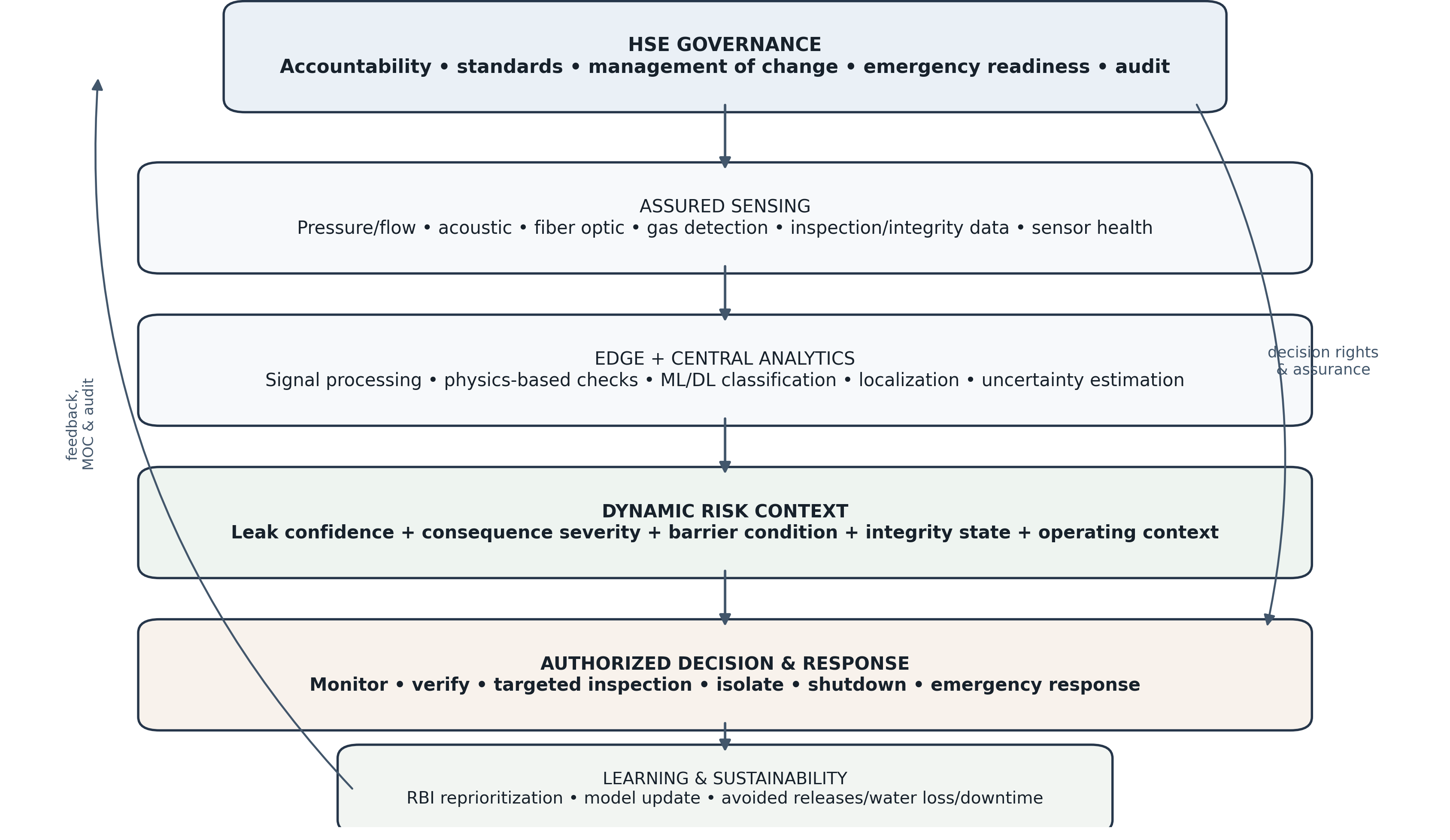
Accordingly, Figure 1 conceptualizes an HSE-integrated architecture in which governance requirements sit above the technical stack. Sensors feed edge and central analytics; analytics update a dynamic risk state; the risk state triggers verification, isolation, emergency response, or targeted inspection; and outcomes return to both the model and the management system. Table 1 compares major detection families from this governance perspective. The framework treats false negatives as major-hazard exposure and false positives as an operational burden that can erode trust. Both therefore require explicit performance monitoring rather than reliance on aggregate accuracy.
| Method family | Primary evidence | Strength for HSE use | Key limitation | Governance requirement |
|---|---|---|---|---|
| Process-model / pressure-flow | Pressure, flow, balance and transients | Interpretable; can use installed instrumentation | Sensitive to model error, operating transients and threshold tuning | Model validation, alarm rationalization, calibrated instruments and fallback logic |
| Acoustic / deep learning | Leak sound or acoustic-emission signatures | Sensitive to small leaks; supports classification and localization | Industrial noise, transferability and false-alarm sensitivity | Noise validation, confidence thresholds, field confirmation and performance trending |
| Fiber-optic / distributed sensing | Distributed strain, temperature or acoustic response | Long-range coverage and localization; useful for inaccessible assets | Installation cost, interrogator dependence and data volume | Coverage assurance, redundancy planning, calibration and lifecycle maintenance |
| IIoT / edge intelligence | Distributed sensor streams with local inference | Low latency; reduced communications burden; scalable monitoring | Device reliability, cyber exposure, model drift and heterogeneous protocols | Secure configuration, device health monitoring, version control and MOC |
| Digital twin / probabilistic fusion | Sensor data fused with physics, history and asset models | Contextualizes anomaly significance and uncertainty for decisions | Data synchronization, model validity and computational/cyber complexity | Defined validation envelope, uncertainty reporting, audit trail and human oversight |
7Integrating leakage intelligence across the project lifecycle
A major weakness in current practice is that leakage technology is often selected late, after piping layouts, instrumentation philosophies, operating envelopes, and maintenance strategies are substantially fixed. A stronger HSE approach begins during design. Hazard studies should identify credible release scenarios, expected signatures, required detection times, consequence-sensitive locations, and the independence needed between monitoring and protective functions. This makes detector selection risk based rather than technology led. For example, an acoustic method may be appropriate for small continuous leaks, while pressure-transient logic may better capture rapid releases; high-consequence segments may justify diverse sensing so that a common noise mechanism does not defeat every channel.
During construction and commissioning, baseline data should be treated as part of safety assurance. Clean acoustic fingerprints, pressure relationships, valve response times, sensor placement records, calibration certificates, and communication latency provide the reference against which future anomalies are interpreted. Commissioning should also include controlled fault injection or safe simulation where feasible, not merely confirmation that devices transmit values. This is important because machine-learning models can appear functional while never having experienced the combinations of noise, process transients, and equipment states that occur in service.
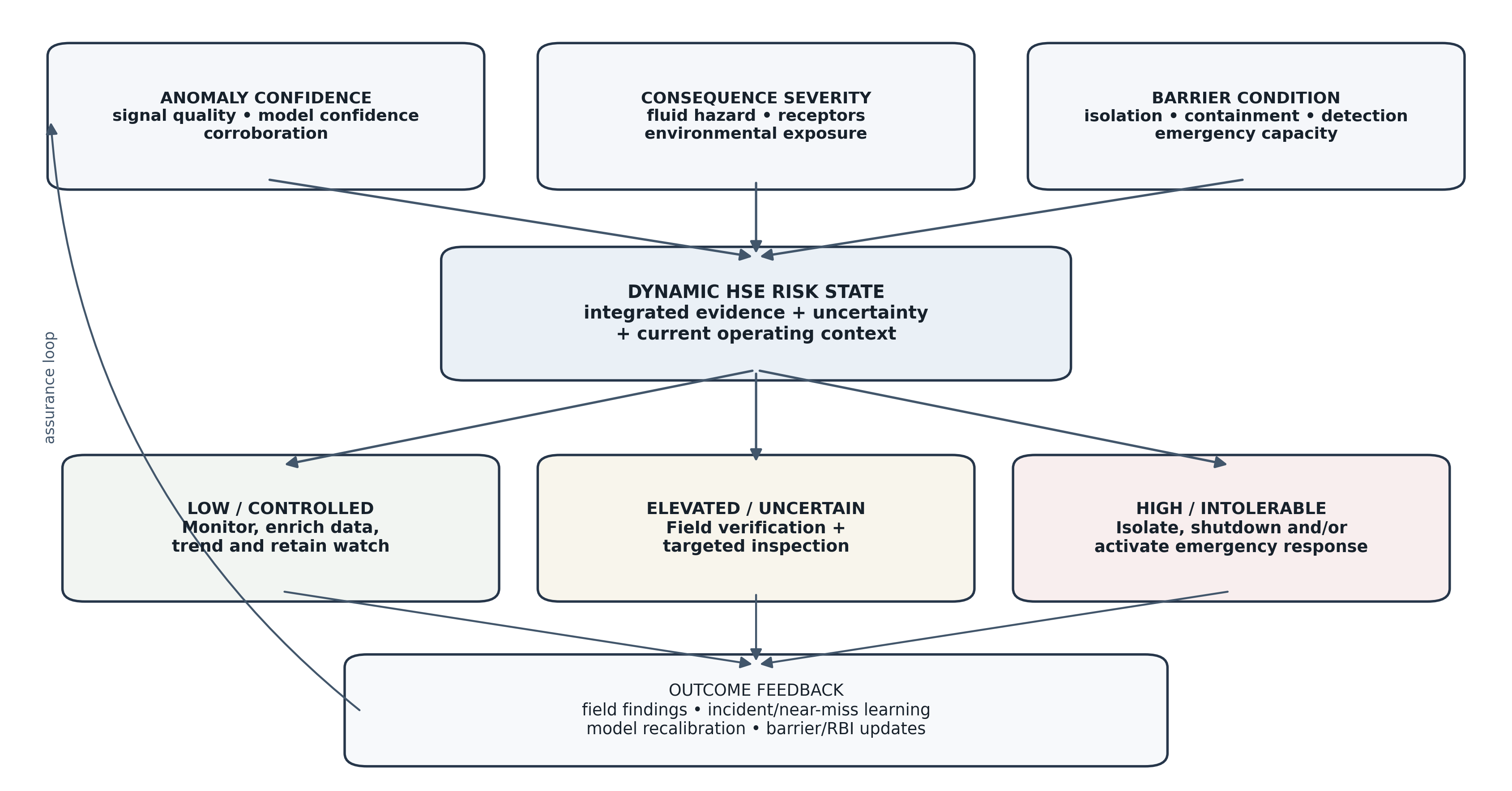
Operations require a tiered response philosophy. Low-confidence anomalies may trigger automated data-quality checks and intensified sampling. Persistent or corroborated anomalies can require operator verification and targeted inspection. High-risk states, particularly when consequence is severe or isolation barriers are impaired, should trigger predefined shutdown or emergency actions. The escalation pathway should be visible to operators and auditable after the event. Such design also reduces alarm fatigue because it separates informational anomalies from safety-significant states instead of presenting every model deviation as an equivalent alarm.
The maintenance phase should close the learning loop. Confirmed leaks, false alarms, inspection findings, and “no fault found” cases all contain information for model improvement, but retraining should be governed. Safety performance can deteriorate if a model silently adapts to recent data and forgets rare failure patterns. Retraining therefore needs versioned datasets, acceptance criteria, independent review, and rollback capability. The same principle applies to asset replacement: when pipe material, insulation, process fluid, or operating pressure changes, prior model validity should be reconsidered through management of change.
Finally, emergency management must not depend on the intelligent system remaining available. Cyber incidents, power loss, network segmentation, damaged sensors, or simultaneous process failures may disable parts of the digital architecture during the event that matters most. HSE governance should therefore preserve degraded-mode procedures, independent shutdown capability, manual confirmation methods, and clear command authority. Intelligent leakage detection should add resilience to established protection layers, not become a single digital point of failure.
8Discussion
The literature indicates that the strongest leakage-prevention strategy is not a single detector but a governed chain of evidence. Conventional process models contribute interpretability, acoustic and fiber-optic sensing contribute sensitivity and localization, machine learning contributes pattern recognition, digital twins contribute context, and RBI contributes prioritization. Their combined value depends on whether HSE governance converts technical confidence into proportionate action. This is the principal integration gap.
A useful distinction is between detection performance and prevention performance. Detection performance can be measured by sensitivity, specificity, localization error, latency, and false-alarm rate. Prevention performance concerns whether the organization acts before consequence escalation: time to validate an alert, time to isolate, barrier availability, exposure avoided, inspection findings, recurring alarm closure, and learning after near misses. An algorithm with high laboratory accuracy may contribute little if alarm ownership is unclear. Conversely, a moderately sophisticated system can materially reduce risk when its signals are embedded in disciplined operating procedures and asset-integrity workflows.
For Saudi Arabia, integration is also a sustainability issue. Manufacturing expansion can increase environmental pressure if industrial controls do not improve alongside capacity growth (Alfantookh et al., 2023), while the green-transition literature links innovation and supportive regulation with improved environmental outcomes (Zhou et al., 2025). Leakage governance provides a practical mechanism connecting those macro objectives to plant-level controls: fewer hydrocarbon releases, lower water loss, reduced emergency flaring or shutdown consequences, and longer asset life. Table 2 therefore maps governance functions to data, decisions, and sustainability outcomes.
| Governance function | Intelligent-system input | Required decision/action | Assurance indicator | Sustainability contribution |
|---|---|---|---|---|
| Leadership and accountability | Risk-state and performance dashboard | Assign decision rights; resolve unresolved high-risk conditions | Named accountable owner; overdue critical actions | Prevents normalization of leakage and unmanaged exposure |
| Sensor and data assurance | Sensor health, calibration and data-quality flags | Repair, isolate bad channels or activate degraded-mode controls | Critical-sensor availability; calibration compliance | Reduces false decisions and wasted intervention |
| Dynamic risk management | Leak confidence + consequence + barrier condition | Escalate monitoring, verification, isolation or emergency response | Validation time; risk-state closure time | Limits release duration and environmental consequence |
| Asset integrity / RBI | Detection history, inspection findings and degradation trends | Reprioritize inspection, repair, renewal and proof testing | Risk reduction per inspection; repeat-defect rate | Extends asset life and targets maintenance resources |
| Emergency preparedness | Confirmed release, location, inventory and receptor data | Activate isolation, shutdown, evacuation or containment plans | Time to isolate; drill/response performance | Reduces major-accident, community and ecological impact |
| Learning, MOC and cyber assurance | Model drift, false alarms, incidents, software/firmware changes | Retrain, revalidate, authorize change and update procedures | Model version traceability; drift closure; audit completion | Sustains dependable performance over the asset lifecycle |
Figure 2 presents a risk-escalation loop built on three inputs: anomaly confidence, consequence severity, and barrier health. This avoids the common mistake of escalating only on detector confidence. A moderate-confidence signal near a high-consequence receptor with impaired isolation barriers may deserve more urgent action than a high-confidence anomaly in a low-consequence segment. That principle aligns intelligent detection with established HSE logic rather than allowing model probability to become the sole decision criterion.
A further implication is that assurance maturity should determine how much decision authority an intelligent system receives. A model validated only on historical or simulated data should operate in advisory mode, whereas a system intended to trigger automatic isolation requires substantially stronger evidence regarding failure modes, latency, cybersecurity, redundancy, and safe-state behavior. This staged approach avoids equating algorithmic confidence with functional-safety integrity. It also supports gradual organizational learning: operators can compare recommendations with field findings, identify systematic false alarms, and build calibrated trust before automation is expanded. In large Saudi projects, where new assets, contractors, and digital platforms are commissioned rapidly, maturity-based deployment can prevent technology adoption from outpacing the organization’s capacity to assure it.
For Saudi industrial owners, this integration should be evaluated as an assurance capability, not merely a sensor upgrade: its value depends on transparent escalation rules, interoperable data, traceable model performance, competent human oversight, and evidence that digital alerts consistently improve containment, inspection, maintenance, and organizational learning.
9Research gaps and future research
Five research gaps are especially important. First, publicly available datasets seldom represent Saudi temperature extremes, dust, saline or corrosive conditions, intermittent utility operation, multilingual contractor environments, and the asset scales of industrial cities. Field datasets with carefully governed anonymization are needed. Second, model validation often emphasizes average classification performance rather than low-frequency, high-consequence conditions; future studies should report uncertainty, out-of-distribution behavior, false-negative scenarios, and performance under sensor degradation. Third, digital-twin research needs stronger evidence that continuously updated models improve incident-prevention decisions, not merely visualization.
Fourth, human–AI interaction requires controlled trials that examine alarm trust, automation bias, escalation behavior, and decision latency. Explainable outputs should be evaluated for operational usefulness rather than graphical attractiveness. Fifth, future research should connect leakage intelligence to sustainability accounting. This includes avoided release mass, water conserved, reduction in emergency interventions, asset-life extension, and risk-adjusted environmental performance. Cross-sector studies across petrochemicals, water, power, transport fuel, and industrial utilities would help determine which governance principles are universal and which must remain asset specific.
Finally, economic research should compare lifecycle costs of redundant sensing, edge computing, inspection savings, avoided downtime, and avoided releases, enabling operators to justify HSE digitalization through risk-adjusted value rather than technology budgets alone. Such evidence would improve procurement standards and cross-operator benchmarking across Saudi industrial sectors.
10Practical, managerial and policy implications
Industrial operators should govern intelligent leakage detection as a safety-critical lifecycle capability. Management should assign a single accountable owner for end-to-end performance while preserving independent HSE challenge. Sensor assurance, model validation, alarm rationalization, cybersecurity, maintenance integration, and emergency-response interfaces should be defined before commissioning rather than added after deployment. Performance dashboards should separate technical metrics from prevention metrics and should include unresolved critical alarms, model drift, sensor unavailability, verification time, isolation time, and repeat-event frequency.
Project organizations should specify interoperability and data ownership in contracts so that vendor algorithms do not become opaque safety dependencies. Changes to models, thresholds, training data, or edge-device firmware should pass formal management-of-change controls. High-consequence use cases should retain human authorization unless automatic protective action has been engineered and validated to safety-system standards.
At policy level, Saudi regulators and industrial-city authorities could encourage minimum assurance requirements for AI-supported HSE systems, including audit trails, uncertainty reporting, cybersecurity, human override, and periodic performance validation. Shared incident taxonomies and privacy-preserving data collaborations could accelerate learning across operators without requiring disclosure of commercially sensitive raw data. Such measures would help ensure that digitalization contributes simultaneously to industrial competitiveness, environmental protection, and major-accident prevention.
11Limitations
This review is integrative rather than a statistical meta-analysis, and the diversity of fluids, pipe materials, sensors, operating pressures, and validation protocols prevents direct numerical comparison across studies. The 2020–2025 window emphasizes recent digitalization but may omit older foundational methods. Saudi-specific peer-reviewed field evidence remains limited, so transferability from international studies is interpreted cautiously. Publication bias may also favor successful detection models over failed deployments or organizational implementation problems.
12Conclusion
Integrating HSE governance with intelligent leakage detection requires a shift from viewing detection as an instrumentation problem to treating it as a governed risk-control system. Recent research demonstrates substantial capability in acoustic analytics, deep learning, IIoT, digital twins, dynamic risk analysis, and risk-based inspection, but these technologies create value only when their outputs are trusted, contextualized, escalated, and acted upon. The proposed framework links assured sensing, intelligent diagnosis, consequence and barrier assessment, human authorization, maintenance, emergency response, and organizational learning.
For Saudi industrial development, this integration can support safer expansion while strengthening environmental stewardship and asset resilience. The priority is not maximum automation; it is dependable intelligence with accountable decisions. Operators should therefore design leakage systems around validated operating envelopes, data and cyber assurance, transparent risk logic, explicit decision rights, and measurable prevention outcomes. Future Saudi research should move beyond proof-of-concept accuracy toward long-duration field validation and evidence of avoided releases, improved inspection targeting, faster intervention, and reduced major-accident exposure.
References
- [1]Abubakirov R, Yang M, Khakzad N (2020). A risk-based approach to determination of optimal inspection intervals for buried oil pipelines. Process Safety and Environmental Protection, 134, 95–107. https://doi.org/10.1016/j.psep.2019.11.031
- [2]Aditiyawarman T, Soedarsono JW, Kaban APS, Riastuti R, Rahmadani H (2023). The study of artificial intelligent in risk-based inspection assessment and screening: A study case of inline inspection. ASCE-ASME Journal of Risk and Uncertainty in Engineering Systems, Part B: Mechanical Engineering, 9(1), 011204. https://doi.org/10.1115/1.4054969
- [3]Ahmad S, Ahmad Z, Kim CH, Kim JM (2022). A method for pipeline leak detection based on acoustic imaging and deep learning. Sensors, 22(4), 1562. https://doi.org/10.3390/s22041562
- [4]Alfantookh N, Osman Y, Ellaythey I (2023). Implications of transition towards manufacturing on the environment: Saudi Arabia’s Vision 2030 context. Journal of Risk and Financial Management, 16(1), 44. https://doi.org/10.3390/jrfm16010044
- [5]Almazrouei M, Khalid K, Davidson R (2021). Safety climate of UAE petroleum industry: A cross-validation using confirmatory factor analytic approach. Journal of Engineering, Design and Technology, 19(4), 943–965. https://doi.org/10.1108/JEDT-04-2020-0138
- [6]Arunthavanathan R, Sajid Z, Amin MT, Tian Y, Khan F, Pistikopoulos E (2024). Process safety 4.0: Artificial intelligence or intelligence augmentation for safer process operation? AIChE Journal, 70(7), e18475. https://doi.org/10.1002/aic.18475
- [7]Aziz N, Tanoli SAK, Nawaz F (2021). A programmable logic controller based remote pipeline monitoring system. Process Safety and Environmental Protection, 149, 894–904. https://doi.org/10.1016/j.psep.2021.03.045
- [8]Boujelben M, Benmessaoud Z, Abid M, Elleuchi M (2023). An efficient system for water leak detection and localization based on IoT and lightweight deep learning. Internet of Things, 24, 100995. https://doi.org/10.1016/j.iot.2023.100995
- [9]Chen BQ, Videiro PM, Guedes Soares C (2022). Opportunities and challenges to develop digital twins for subsea pipelines. Journal of Marine Science and Engineering, 10(6), 739. https://doi.org/10.3390/jmse10060739
- [10]Hameed H, Bai Y, Ali L (2021). A risk-based inspection planning methodology for integrity management of subsea oil and gas pipelines. Ships and Offshore Structures, 16(7), 687–699. https://doi.org/10.1080/17445302.2020.1747751
- [11]Khan F, Yarveisy R, Abbassi R (2021). Risk-based pipeline integrity management: A road map for the resilient pipelines. Journal of Pipeline Science and Engineering, 1(1), 74–87. https://doi.org/10.1016/j.jpse.2021.02.001
- [12]Li M, Feng X, Han Y (2022). Brillouin fiber optic sensors and mobile augmented reality-based digital twins for quantitative safety assessment of underground pipelines. Automation in Construction, 144, 104617. https://doi.org/10.1016/j.autcon.2022.104617
- [13]Liu R, Zayed T, Xiao R (2025). Acoustic leak localization for water distribution network through time-delay-based deep learning approach. Water Research, 268, 122600. https://doi.org/10.1016/j.watres.2024.122600
- [14]Misra S, Roy C, Sauter T, Mukherjee A, Maiti J (2022). Industrial Internet of Things for safety management applications: A survey. IEEE Access, 10, 83415–83439. https://doi.org/10.1109/ACCESS.2022.3194166
- [15]Monteiro GP, Hopkins A, Frutuoso e Melo PF (2020). How do organizational structures impact operational safety? Part 1 – Understanding the dangers of decentralization. Safety Science, 123, 104568. https://doi.org/10.1016/j.ssci.2019.104568
- [16]Mücke NT, Pandey P, Jain S, Bohté SM, Oosterlee CW (2023). A probabilistic digital twin for leak localization in water distribution networks using generative deep learning. Sensors, 23(13), 6179. https://doi.org/10.3390/s23136179
- [17]Ning F, Cheng Z, Meng D, Duan S, Wei J (2021). Enhanced spectrum convolutional neural architecture: An intelligent leak detection method for gas pipeline. Process Safety and Environmental Protection, 146, 726–735. https://doi.org/10.1016/j.psep.2020.12.011
- [18]Priyanka EB, Thangavel S, Gao XZ, Sivakumar NS (2022). Digital twin for oil pipeline risk estimation using prognostic and machine learning techniques. Journal of Industrial Information Integration, 26, 100272. https://doi.org/10.1016/j.jii.2021.100272
- [19]Rachman A, Zhang T, Ratnayake RMC (2021). Applications of machine learning in pipeline integrity management: A state-of-the-art review. International Journal of Pressure Vessels and Piping, 193, 104471. https://doi.org/10.1016/j.ijpvp.2021.104471
- [20]Rajabi MM, Komeilian P, Wan X, Farmani R (2023). Leak detection and localization in water distribution networks using conditional deep convolutional generative adversarial networks. Water Research, 238, 120012. https://doi.org/10.1016/j.watres.2023.120012
- [21]Raveendran A, Renjith VR, Madhu G (2022). A comprehensive review on dynamic risk analysis methodologies. Journal of Loss Prevention in the Process Industries, 76, 104734. https://doi.org/10.1016/j.jlp.2022.104734
- [22]Sekhavati J, Hashemabadi SH, Soroush M (2022). Computational methods for pipeline leakage detection and localization: A review and comparative study. Journal of Loss Prevention in the Process Industries, 77, 104771. https://doi.org/10.1016/j.jlp.2022.104771
- [23]Song Y, Li S (2021). Gas leak detection in galvanised steel pipe with internal flow noise using convolutional neural network. Process Safety and Environmental Protection, 146, 736–744. https://doi.org/10.1016/j.psep.2020.11.053
- [24]Sousa DP, Du R, da Silva Jr JMB, Cavalcante CC, Fischione C (2023). Leakage detection in water distribution networks using machine-learning strategies. Water Supply, 23(3), 1115–1126. https://doi.org/10.2166/ws.2023.054
- [25]Spandonidis C, Theodoropoulos P, Giannopoulos F (2022). A combined semi-supervised deep learning method for oil leak detection in pipelines using IIoT at the edge. Sensors, 22(11), 4105. https://doi.org/10.3390/s22114105
- [26]Subbarao NV, Senthilraja M, Sangeetha B (2024). Improving process safety culture through developing and maintaining the sense of vulnerability at all levels in the organization. Process Safety Progress, 43(1), 80–84. https://doi.org/10.1002/prs.12515
- [27]Sözen L, Yurdakul M, İç YT (2022). Risk-based inspection planning for internal surface defected oil pipelines exposed to fatigue. International Journal of Pressure Vessels and Piping, 200, 104804. https://doi.org/10.1016/j.ijpvp.2022.104804
- [28]Xu T, Zeng Z, Huang X, Li J, Feng H (2021). Pipeline leak detection based on variational mode decomposition and support vector machine using an interior spherical detector. Process Safety and Environmental Protection, 153, 167–177. https://doi.org/10.1016/j.psep.2021.07.024
- [29]Zarei E, Khan F, Abbassi R (2023). How to account artificial intelligence in human factor analysis of complex systems? Process Safety and Environmental Protection, 171, 736–750. https://doi.org/10.1016/j.psep.2023.01.067
- [30]Zhou Y, Wang Y, Wu Y, Wang T, Wang S, Zhou X, Imran M, Khan N, Bilal M (2025). Transitioning to green energy: Assessing environmental development and sustainability in the Saudi Arabia. Sustainable Futures, 9, 100596. https://doi.org/10.1016/j.sftr.2025.100596