Entertainment-Education in Health Messaging
Entertainment-Driven Health Communication and the Separation of Narrative, Music and Celebrity Effects
1Buckwyld Media Network, Lagos State, Nigeria
2Independent Researcher, Nigeria
Published May 2020
Abstract
Entertainment offers several ways to communicate health information, but narrative, music and celebrity involvement should not be treated as a single intervention. This conceptual analysis examines literature published through 2020 and develops a framework linking a specified vehicle to an explanatory mechanism and a measurable health action. Narrative theory, campaign meta-analysis and research on celebrity advice provide different forms of evidence. They support distinctions among audience exposure, attention, comprehension, intention and action, rather than a general claim of entertainment effectiveness. The proposed framework identifies the comparison needed to separate vehicle effects, records the enabling conditions for action and treats digital distribution as a delivery context. A component comparison is outlined for testing narrative and communicator contributions while holding health content constant. The main contribution is an assessment structure for distinguishing a communication response from a completed health behaviour. The framework has not been empirically validated, and the selected literature does not supply a pooled estimate for its combined components.
Keywords: entertainment-education; narrative persuasion; parasocial influence; celebrity health advocacy; music and health; digital media; health behavior; measurement
1Introduction
A health message delivered through a story raises a different evaluation question from a message delivered through a familiar public figure. A story offers characters, consequences and an unfolding situation. A public figure supplies a recognizable source. Music adds sound, repetition and associations with an audience or occasion. A programme combining these elements must decide whether its objective concerns comprehension, willingness to act or completion of an action. Otherwise, a favourable response to the production is easily mistaken for a health outcome [1–19].
This paper develops a component-specific evaluation framework. Its contribution is to separate the entertainment vehicle from the mechanism attributed to it and from the action the programme seeks. The separation matters even when programmes deliver the components together. A combined production is a legitimate intervention, but its evaluation should identify a package effect unless the design supports a narrower interpretation [20–23].
The scope is health communication rather than clinical music therapy, commercial celebrity marketing or treatment advice. Digital media enter as distribution and interaction settings. The analysis does not assume a digital platform strengthens narrative persuasion or makes celebrity advice more accurate. Those questions require comparisons of content, audiences and delivery conditions [24–42].
2Research method
2.1Framing question and evidence base
This paper addresses the following question. Which entertainment component is being evaluated, through which mechanism, and against which observable health action?
The analysis draws on selected conceptual, measurement and empirical literature published no later than 2020. Sources are used according to their intervention, setting and outcome. Conceptual sources inform definitions and proposed relationships. Empirical studies inform the problem or an adjacent mechanism, with their findings kept within the evaluated intervention and population. The synthesis is interpretive and does not follow a registered systematic review protocol or provide an exhaustive study census [43–47].
The analytical procedure separates the target construct, the observation used to represent it and the claim supported by that observation. The resulting framework specifies process records, outcome boundaries and a prospective evaluation question. Design recommendations are identified as proposals. No participant dataset, new clinical results or validated composite score is reported, and no pooled effect is estimated from unlike interventions [48–57].
The synthesis proceeds through three steps: define the communication or service task, identify the observation supported by each relevant source, and specify a comparison which would test the proposed relationship. Table 1 records construct boundaries; Table 2 operationalises a study or audit. Numerical illustrations demonstrate definitions and accounting only. They are not empirical results [58, 59].
2.2Synthesis and transfer limits
Narrative theory supplies explanatory constructs rather than a universal effect. Hinyard and Kreuter [1] discuss narrative communication as a health behaviour tool; Moyer-Gusé [60] develops an account of entertainment persuasion. Green and Brock [61] examine transportation in public narratives, while Murphy et al [62]. compare narrative and nonnarrative health messages. Together, these sources motivate measurement of identification, absorption and emotion. They do not justify treating any entertaining production as an effective intervention [60, 63–77].
Social cognitive theory links represented behaviour to modelling and perceived capability [78]. Theory-based intervention design also requires specification of the determinants a message intends to influence [79]. This combination changes the design question. The programme must show the audience an understandable action and identify the circumstances under which the action is possible. A moving story about seeking care provides weak evidence for service uptake if the audience lacks a route to care [80–91].
Campaign syntheses concern campaign outcomes across interventions and settings [92, 93]. Entertainment-education synthesis addresses a narrower but still heterogeneous field [94]. These sources inform outcome selection; none isolates the independent contribution of music, narrative and celebrity within the proposed framework. Brusse et al [95]. examine framing within entertainment-education, illustrating the importance of content variation within a format [96–100].
Parasocial interaction describes audience relationships with media figures [101]. Hoffman and Tan [2] examine celebrity medical advice through a meta-narrative analysis. The relevant distinction is between source influence and clinical accuracy. Recognition of a communicator is an exposure characteristic; acceptance of advice is a communication response; correctness of the advice requires a separate assessment. These three observations should not share a single effectiveness label [102–105].
A campaign outcome requires a specified behaviour, audience and communication activity. Snyder [42] reviews campaign effects on behaviour. Here, this distinction supports reporting whether an entertainment production changes a named action, rather than combining awareness and action in one success measure [106].
Comprehension also deserves a separate assessment. Sheridan et al [107]. review interventions for people with low health literacy, while Reyna et al [108]. examine numeracy in risk comprehension and decision making. A proposed entertainment evaluation should therefore test the meaning of its health advice and any numerical claims. Recall of a character or slogan does not answer those questions [58, 107–115].
Vraga and Bode [116] address correction of health misinformation on social media. For an entertainment programme distributed online, this literature motivates a documented correction process alongside audience evaluation. The proposed process records the disputed statement, the corrected information and the channels receiving the correction. This is a content-governance recommendation, not evidence of a clinical effect of entertainment [116, 118–123].
3Results and discussion
3.1Component framework and measurement specification
| Vehicle | Proposed mechanism | Measure | Interpretation boundary |
|---|---|---|---|
| Narrative | Transportation and identification | Exposure plus mechanism-specific scale | Engagement does not establish behaviour change |
| Music | Affect, repetition and recall | Recall and comprehension after known exposure | A memorable message does not establish an action |
| Celebrity | Perceived credibility and parasocial attachment | Source credibility and verified response | Popularity does not establish clinical expertise |
| Combined content | Multiple interacting mechanisms | Component comparison with equivalent exposure | Package effects do not identify a single mechanism |
The specification in Table 1 is analytical: its entries are proposed distinctions rather than empirical ratings or validated instrument properties.
3.1.1Components and intervention boundaries
The intervention specification should name the health topic, intended audience, requested action and delivery period. It should then describe the narrative element, musical element and communicator element separately. For narrative, record the character, decision and consequence represented. For music, record whether the health instruction appears in the lyrics, accompanies the performance or appears only in a linked resource. For celebrity involvement, distinguish personal experience, general encouragement and an explicit medical recommendation [124–164, 244, 247].
These distinctions affect the comparison. A programme comparing a celebrity story with an anonymous factual leaflet changes source, format and production at once. Any observed difference belongs to that contrast as a whole. A component comparison holds the health facts and requested action constant, changes a defined element and documents the remaining production differences. Complete isolation is difficult, but naming the contrast prevents an unsupported claim about the active ingredient.
3.1.2Outcomes and observation windows
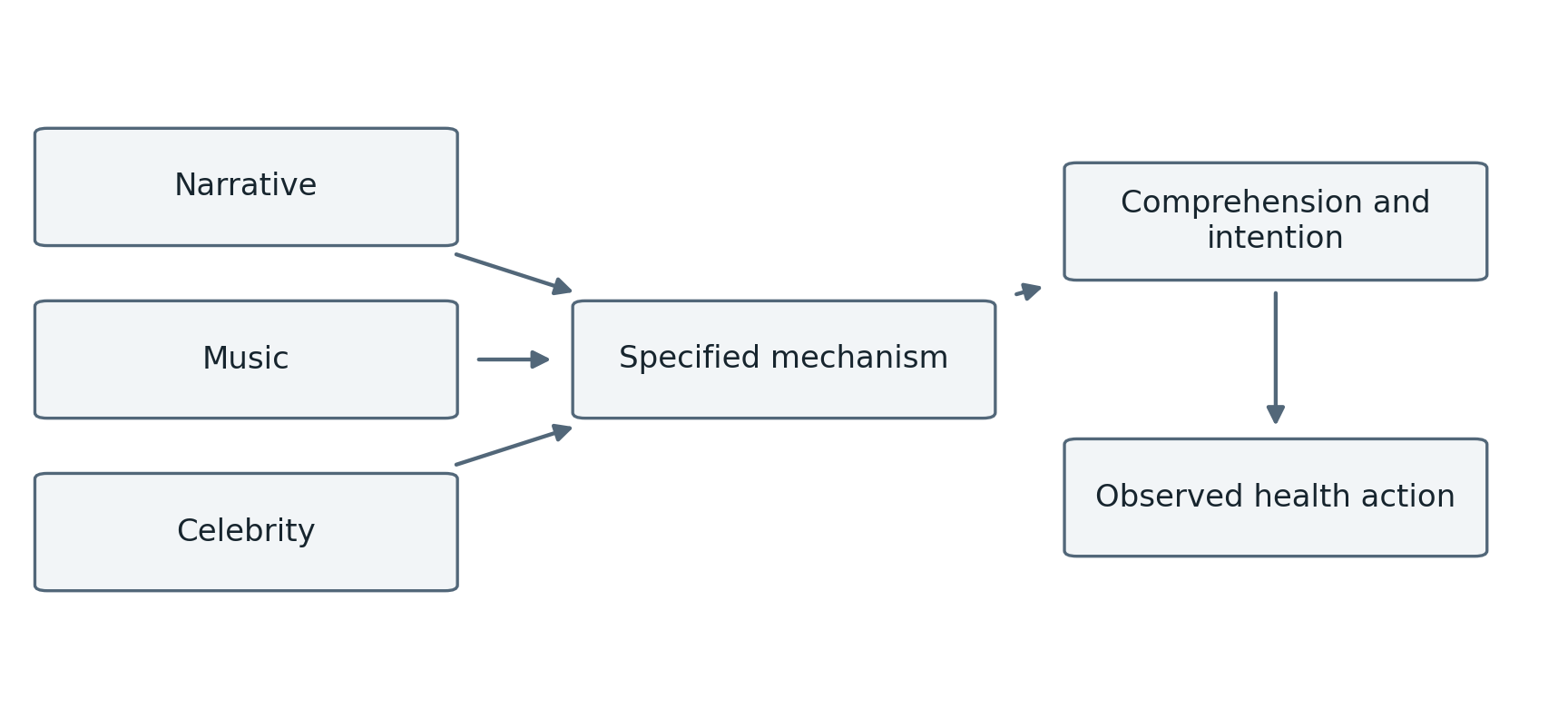
Figure 1 presents the proposed sequence, while Table 1 defines the interpretation boundaries. Exposure is recorded contact with the production. Attention is a separate observation, ideally measured directly or represented by a clearly identified proxy. Comprehension concerns specified facts, including the next practical step. Intention concerns a stated future action. Behaviour concerns a completed action within a prespecified period.
The outcome window should follow the behaviour. An immediate knowledge check addresses understanding soon after exposure. A later service record addresses completed contact or attendance. Neither observation replaces the other. Repeated exposure should be recorded where feasible, with a distinction between assigned delivery and reported consumption. If individual exposure cannot be linked reliably, report delivery statistics separately from participant outcomes [165–174].
3.1.3Component testing and interpretation
A feasible pilot would compare matched health content in narrative and informational formats. A second factor would vary communicator familiarity where a defensible manipulation is possible. Music should enter as an additional factor only if the sample and production budget support the comparison. The primary outcome and comparison must be chosen before examining the results. Random assignment estimates the effect of assignment under the study conditions, while consumption differences require additional interpretation.
Mechanism measurements belong between exposure and the action outcome, but timing alone does not establish mediation. A participant who identifies with a character might also have greater prior interest in the topic. Report associations between mechanism measures and outcomes as exploratory unless the design and assumptions support a causal mediation analysis. Missing follow-up should be shown by assigned group, because a favourable result among retained viewers is not an estimate for everyone offered the production [143, 175–178].
3.1.4Accuracy and audience protection
A clinical reviewer should check actionable health content before release. The production should distinguish a personal experience from advice applicable to the audience. Where the story compresses diagnosis, treatment or recovery, an accompanying explanation should identify the relevant boundaries. A communicator's exceptional recovery should not serve as a forecast for other people [179].
Distribution decisions also require an accessible route to the practical information. A linked page is insufficient for an audience without dependable access to that page. Provide language and format options, a route for questions and a process for correcting an inaccurate claim across the channels used. Record complaints and comprehension errors alongside favourable audience reactions. These observations assess harms and implementation conditions rather than simply promotional success [180–210].
3.1.5Fidelity, selection and an informative comparison
A production audit should record the content actually delivered. Narrative length, health information density, communicator prominence and the placement of the requested action might differ between versions. Retain the script or transcript and record revisions. Where a performer changes the intended wording, the delivered version is the intervention. Production fidelity therefore concerns content and access to that content, rather than simply whether distribution occurred [211].
Selection deserves separate attention in an audience recruited from followers of a public figure. Such a sample provides information about those followers, not the general service population. Recruitment through several routes should record the route and prior familiarity. An evaluator should distinguish response to a familiar person from response to the message, while avoiding a post hoc exclusion of participants who did not recognise the communicator [212–218].
A practical outcome might be requesting information from a named service. Record requests generated through all supported routes and use a clear linkage procedure. A request is a completed communication action, not receipt of care. If the intended outcome is attendance, record attendance and the opportunity to attend. If the intended outcome is a sustained behaviour, specify repeated observation and the competing influences expected during follow-up. The required evidence increases with the scope of the claim [219, 220].
An informative comparator should answer the programme's decision. Comparing a high-cost production with no message assesses the package against no delivery. Comparing matched-cost informational content assesses a format choice under the defined budget. Comparing versions with and without a celebrity assesses the contribution of that feature under the production conditions. Each contrast has a legitimate purpose, but none answers every question about entertainment.
An analysis plan should report assignment, receipt and retention separately. Analyse the primary assigned contrast before examining audience subgroups or mechanism correlations. Report uncertainty rather than ranking formats solely by a favourable point estimate. Prespecified subgroup questions require adequate data and a relevant comparison; a significant result in one group and a nonsignificant result in another does not establish a difference between groups.
Finally, the study should assess whether the production shifts belief in an unintended direction. A dramatic exceptional case might improve recall while creating an inaccurate expectation. A song might make a slogan memorable while leaving the qualifying information unclear. A trusted communicator might encourage action while audiences mistake a personal account for clinical advice. Testing understanding of the limits as well as the headline action produces a more defensible evaluation of the content [55].
3.1.6Falsifiable propositions and a component comparison
The framework yields three distinct propositions. First, a narrative version should improve understanding of the represented decision relative to a factual version containing the same health information. Second, a familiar communicator should change a source-related response when narrative structure and facts remain stable. Third, adding a musical element should change recall or attention without degrading understanding of the qualifications. These are proposed comparisons, not established effects. Narrative transportation, identification and parasocial interaction provide different theoretical starting points and require separate observations [61, 101, 117, 221–224].
An illustrative four-arm pilot would use factual information with an unfamiliar communicator, narrative information with an unfamiliar communicator, factual information with a familiar communicator, and narrative information with a familiar communicator. The design holds the requested action, clinical facts, duration and access instructions as stable as production permits. Assignment should precede exposure, and the evaluator should record recognition of the communicator without excluding unrecognising participants after assignment. Table 2 shows the comparisons. A larger effect for the combined version does not establish interaction unless the difference between the component effects is evaluated directly [225, 226, 245].
| Comparison | Feature varied | Primary observation | Interpretation |
|---|---|---|---|
| Narrative versus factual | Story structure | Understanding of the same decision | Format effect under matched content |
| Familiar versus unfamiliar | Communicator familiarity | Source credibility and recognition | Source effect under matched format |
| With versus without music | Musical delivery | Recall and understanding of conditions | Musical feature under documented production |
| Combined versus components | Joint offering | Prespecified interaction contrast | Interaction requires a direct comparison |
Source: Author-developed analytical example. Numerical values, where shown, are hypothetical and do not represent study observations.
Mechanism assessment should retain competing explanations. Identification concerns the character, transportation concerns absorption in the story, and source recognition concerns the communicator. A participant might understand the health information without identifying with the protagonist. Conversely, strong identification might accompany inaccurate risk expectations. Research on narrative processing and entertainment framing therefore informs a multidimensional assessment rather than a single entertainment score [62, 95]. Each scale or item should be selected for its intended construct and audience [182, 227–236].
Music requires a separate content specification. A repeated phrase might name the service accurately while omitting eligibility, timing or cost. The evaluation should test the action and its conditions together. An immediate recall advantage becomes operationally useful only if participants also locate the correct next step. A short factual clarification after the song is part of the delivered package and should be documented. Its contribution should not be attributed to music alone [237].
Consider an explicitly hypothetical result in which 60 of 100 assigned viewers understand the next step in the narrative arm and 45 of 100 understand the next step in the factual arm. The difference is 15 percentage points for comprehension under these illustrative numbers. If service attendance is 18 of 100 versus 17 of 100, the difference is one percentage point for attendance. Neither calculation supplies uncertainty, clinical benefit or evidence from a real programme. The example demonstrates why separate endpoints prevent an improvement in comprehension from becoming a claim about completed care.
The contribution relative to earlier narrative and campaign research is the explicit connection between a component contrast, a mechanism observation and an action opportunity. The model does not add another general persuasion theory. It specifies which observation would support the programme's practical decision. Campaign synthesis and behaviour theory remain the foundations for selecting a health action and its determinants [79, 92]. A production should advance to an outcome trial after accuracy, comprehension and delivery feasibility have been assessed [13, 238, 239].
Entertainment-based approaches to health communication rest on a long tradition of using stories, characters and popular media to convey information that audiences might otherwise ignore or resist. The premise is intuitive: people attend to narratives, become absorbed in them, and may accept messages embedded in a story more readily than messages delivered in an explicitly persuasive form. This tradition, often described as entertainment-education, has produced a substantial body of practical experience and a growing literature on the mechanisms that may explain its effects. The analytical difficulty is that entertainment-education combines several ingredients whose contributions are difficult to disentangle. A programme may use a compelling story, a popular song, a recognisable public figure, or all three, and each of these elements may influence the audience through a different psychological route. Without specifying which element is under examination and which mechanism is expected to operate, an evaluation cannot determine what produced an observed change or what should be replicated in future programmes.
Narrative persuasion offers one account of how stories influence beliefs and behaviour. When audiences become transported into a narrative, they may reduce the counter-arguing that accompanies explicit advocacy, experience emotions tied to the characters' circumstances, and form attitudes that align with the story's resolution. Identification with a character can further increase the audience's willingness to adopt the character's perspective and to model their behaviour. These constructs, including transportation, identification, emotional engagement and perceived realism, describe processes rather than outcomes, and they are typically measured with instruments that assess the audience's experience of the narrative rather than the health behaviour the programme ultimately seeks to change. A programme that reports high transportation scores has evidence that the audience engaged with the story; it does not yet have evidence that the audience understood the health information, intends to act on it, or has acted. Keeping this distinction clear is essential to interpreting narrative research and to designing evaluations that can support conclusions about behaviour.
Music occupies an ambiguous position in health communication because it functions simultaneously as entertainment, as an aid to memory and as a carrier of meaning. A song can make a phrase memorable and can associate a message with positive affect, which may increase recall and willingness to attend to repeated messages. However, the features that make a phrase memorable may not make it accurate, and a slogan that omits eligibility, timing, cost or qualifications can leave an audience with a confident but incomplete understanding. Music can also carry messages that are ambiguous or that vary in interpretation across cultural settings, so that the same lyric communicates differently to different audiences. These properties mean that the contribution of music to a health programme should be evaluated in terms of both recall and comprehension, and that the health content delivered musically should be tested for the accuracy and completeness of what audiences retain. Treating a memorable message as an effective one conflates two distinct questions and can lead to programmes whose reach exceeds their clarity.
Celebrity involvement is a third element whose effects are often assumed rather than measured. A familiar public figure can attract attention, lend credibility and reach audiences that other channels miss, and personal accounts of illness or recovery can be moving and motivating. But recognition of a communicator is an exposure characteristic, acceptance of their advice is a communication response, and the accuracy of that advice is a separate question entirely. A well-known figure may be admired for reasons unrelated to health expertise, and audiences may not distinguish between a personal experience and clinical guidance applicable to others. The literature on celebrity health advocacy has documented cases in which advice promoted by a public figure was incomplete or inconsistent with evidence, and it has emphasised the importance of clinical review before release. An evaluation that treats popularity as evidence of effectiveness will miss these distinctions; one that separates source influence from message accuracy and from behavioural outcome will capture them.
Digital distribution has altered the conditions under which entertainment-health programmes operate by changing how content is discovered, shared and discussed. Platforms allow a production to reach audiences at low marginal cost and to generate data about exposure and engagement that were unavailable to earlier broadcast programmes. They also create conditions in which content circulates beyond the intended audience, is recombined with other material, and is interpreted in contexts the producers did not anticipate. The same platform that extends reach can also amplify misunderstanding, since a memorable fragment may travel further than the qualification that accompanied it. Evaluators working in digital settings therefore need to distinguish between assigned delivery and reported consumption, to measure exposure in ways that reflect how content actually spreads, and to plan for correction processes that operate across the channels through which the content travels. These requirements add to the burden of evaluation, but they correspond to the reality of how health entertainment is now encountered.
Measurement challenges run through all of the preceding discussion. Exposure, attention, comprehension, intention and behaviour are distinct observations, and each requires a different instrument and a different observation window. An immediate knowledge check addresses comprehension soon after exposure, while a service record addresses completed action at a later point, and neither substitutes for the other. Mechanism measures such as transportation and identification belong between exposure and outcome, but their position in the sequence does not establish that they mediate the effect, because a participant who engages strongly with a story may also differ from others in ways that influence the outcome independently. Selection effects are a particular concern where audiences are recruited through the followers of a celebrity or through the audience of a popular programme, because such samples provide information about those audiences rather than about the general population. A defensible evaluation states its comparison in advance, reports uncertainty, analyses the primary contrast before exploring subgroups, and treats exploratory findings as exploratory.
Ethical and public-protection considerations accompany the effectiveness questions. Entertainment formats can compress complex clinical realities into narratives that emphasise dramatic outcomes, and audiences may generalise from an exceptional case to their own situation. A programme that improves recall while creating an inaccurate expectation has done harm as well as good, and an evaluation that measures only the headline action will not detect it. Producers and evaluators should therefore test comprehension of the limits of a message as well as its central claim, ensure that a clinical reviewer has examined actionable content, provide accessible routes to the practical information the programme recommends, and establish a process for correcting inaccurate claims across the channels used. These measures are part of the intervention rather than ancillary to it, and documenting them supports both accountability and learning. Taken together, the considerations raised in this review argue for an approach in which the entertainment vehicle, the mechanism attributed to it and the health action it seeks are specified separately, so that evaluation can answer the question the programme actually poses.
The relationship between entertainment and health communication is not new, but its evaluation has become more demanding as programmes have grown more sophisticated and as funders have asked for stronger evidence of effect. Early programmes were often evaluated by reach and audience reaction, on the reasonable assumption that a well-liked production would convey its message. As the field matured, it became clear that liking and learning are not the same, and that a production can be enjoyed for reasons unrelated to its health content. The analytical challenge is compounded when a programme combines several components, because each may be liked for different reasons and each may affect a different outcome. A song may be remembered while its message is forgotten, a celebrity may draw attention while a narrative fails to engage, and a narrative may engage deeply while the celebrity's presence adds little. Disentangling these possibilities requires that components and outcomes be specified separately and that the comparison be designed to isolate the contribution under study.
Theoretical accounts of narrative influence provide a vocabulary for describing mechanisms, but they also impose obligations on evaluation. If a programme claims that transportation explains its effect, it must measure transportation and demonstrate that it relates to the outcome in the expected way, not merely assert the connection. If it claims that identification drives behaviour, it must measure identification and consider whether identification is confounded with prior interest in the health topic. The framework proposed in this paper therefore treats mechanism measures as hypotheses to be tested rather than as established explanations, and it recommends that their relationship to outcomes be reported as exploratory unless the design and analysis support a stronger inference. This caution is not a rejection of mechanism research; it is a recognition that mechanisms are difficult to isolate in field settings and that over-claiming weakens rather than strengthens the case for entertainment-based approaches.
Selection is a persistent concern in entertainment-health evaluation because audiences are rarely formed at random. A production associated with a popular figure attracts that figure's followers, who may differ from the general population in ways that influence the outcomes a programme measures. A programme distributed through a particular platform reaches the users of that platform, whose characteristics may differ from those of the intended audience. A programme broadcast at a particular time reaches whoever is available then. These selection processes mean that comparisons between exposed and unexposed audiences are rarely clean, and that findings about a programme's effect may reflect the audience it attracted rather than the programme itself. Evaluators should therefore report how the audience was recruited, measure relevant characteristics before exposure where possible, and be cautious about generalising results to populations that were never reached. Where randomisation is feasible, it is the most reliable protection against selection, though it is often difficult to implement in media settings.
Comparison design determines what a programme can learn, and the choice of comparator should follow from the decision the evaluation is meant to inform. Comparing a high-cost production with no message assesses the package against no delivery and answers a question about whether the programme worked at all. Comparing matched-cost informational content with an entertainment production assesses a format choice under a defined budget and answers a question about whether entertainment is worth its cost relative to a simpler alternative. Comparing versions with and without a specific component assesses the contribution of that component and answers a question about which element to retain. Each of these comparisons is legitimate, but none answers every question, and a programme that intends to make decisions about format should choose a comparator that reflects the alternative it would actually use. Reporting which comparison was made, and why, allows readers to interpret the result correctly and prevents a favourable finding from being over-generalised.
Ethical considerations extend beyond accuracy to questions of representation and expectation. A production that depicts a health condition or a care experience shapes how audiences understand that condition, and a portrayal that is inaccurate, stereotyped or unrealistic can mislead even when its explicit message is sound. Programmes should therefore consider how the populations they depict are represented, whether the depicted experiences reflect the range of real experiences, and whether the production creates expectations that services cannot meet. A narrative in which a character recovers through a treatment that is unavailable to most viewers may inspire hope while setting up disappointment, and a story that emphasises individual effort may obscure the structural barriers that shape outcomes. These are matters of judgement rather than of measurement alone, but they can be examined through comprehension testing, audience feedback and review by people with relevant lived experience. Attending to them makes evaluation a tool for responsible production rather than merely a test of effectiveness.
Audience research provides a foundation for designing entertainment-based health communication, but it must be conducted with care. Formative research can identify the health topics that matter to an audience, the sources they trust, the language and imagery that resonate, and the practical obstacles they face in acting on health advice. Where this research is thorough, it reduces the risk of producing content that is technically sound but irrelevant to the audience's circumstances. Where it is superficial, it may reflect the assumptions of the programme team rather than the audience's realities. Formative research is also an opportunity to involve community members as advisers rather than only as respondents, which improves the quality of the resulting content and builds relationships that support later delivery. The cost of formative research is modest relative to the cost of producing and distributing content that fails to connect, and it should therefore be treated as an integral part of programme development rather than as an optional preliminary.
Reach and exposure measurement in entertainment settings presents specific challenges because content often circulates in ways that producers do not control. A production may be viewed in groups, shared and re-shared, excerpted and recombined, or encountered through a secondary account rather than directly. Each of these pathways affects who is exposed and how they interpret what they encounter. Producers should therefore measure exposure in ways that reflect the diversity of pathways, distinguish between assigned distribution and reported consumption, and acknowledge the uncertainty that accompanies indirect exposure. Where a programme relies on platform analytics, these should be interpreted with awareness of their limitations, since platform measures describe behaviour on a platform rather than comprehension or effect. Combining platform data with survey or interview evidence yields a more complete picture than either alone, and it allows the programme to relate exposure to the outcomes it intends to influence.
Behavioural outcomes in entertainment-health programmes are typically the hardest to measure and the easiest to overstate. A completed action, such as attending a screening or requesting information, can be observed directly where records exist, but many health behaviours are difficult to observe and are reported by participants whose recall may be imperfect or influenced by social desirability. Where an outcome cannot be observed directly, the programme should be explicit about the limits of self-report and should avoid presenting reported behaviour as equivalent to observed behaviour. It should also consider the observation window, since some behaviours occur soon after exposure while others require months to manifest. A programme evaluated too soon may find no effect because there has been no opportunity to act, while one evaluated too late may miss an effect that occurred and faded. Matching the observation window to the behaviour under study is a basic requirement that is often overlooked.
Scale and replication raise questions that go beyond the evaluation of any single production. A programme that succeeds in one setting may not succeed in another where the audience, the health system or the cultural context differs, and the features that made it effective may be difficult to transfer. Replication requires understanding which elements are essential and which are adaptable, which in turn requires an evaluation that specifies the components and the mechanisms rather than reporting only an overall result. Where a programme is scaled without this understanding, the results may disappoint and the original finding may be wrongly dismissed. The framework proposed in this paper supports replication by specifying the component, mechanism and action separately, so that a new setting can be compared with the original in terms of the elements that matter. This specification also allows programmes to adapt intelligently, retaining the components that carry the effect and adjusting those that reflect local circumstances.
Capacity for evaluation determines what a programme can learn and should be considered as part of programme planning rather than after production. Evaluations of entertainment-health programmes require skills in research design, measurement and analysis that are not always available within production teams, and they require resources that are often not included in programme budgets. Where capacity is limited, a programme may settle for measures that are easy to collect but uninformative, or it may abandon evaluation altogether. The framework recommends that evaluation capacity be assessed during planning, that appropriate expertise be engaged early rather than at the point of data collection and that the evaluation be designed to answer questions that the programme can act upon. Building capacity is an investment that benefits not only a single programme but the field, since well-designed evaluations contribute evidence that informs the work of others and supports the accumulation of knowledge about what works.
Taken as a whole, the argument of this paper is that entertainment-based health communication should be designed and evaluated with the same discipline that would be applied to any other intervention. Specifying the vehicle, the mechanism and the action; prespecifying the comparison; measuring each construct with an appropriate instrument; and attending to accuracy and accessibility are not optional refinements but the conditions under which a programme can learn what it has achieved. The framework is intended to support that discipline, and its value will be demonstrated through prospective application rather than assertion.
A programme that adopts this framework should expect to learn things it did not anticipate, because specifying components and mechanisms forces assumptions into the open where they can be examined. That is the framework's purpose. It is not a guarantee of effectiveness, but a means of ensuring that a programme's claims correspond to the evidence it has actually gathered, and that its next production benefits from what the last one revealed.
3.2Interpretation, evaluation, and limitations
The framework changes what an evaluator learns from a favourable production response. A high attention score supports a claim about attention. Better comprehension supports a claim about the information tested. A completed action supports an outcome claim for the population and observation period studied. This hierarchy avoids both inflated claims and premature dismissal of a format when the requested action was unavailable [248–267].
A null action result requires several possible explanations. The content might have failed to communicate the action, the action might have been irrelevant to the audience, the service might have been inaccessible or follow-up might have missed completed behaviour. These possibilities are competing explanations to investigate. They do not establish a particular failure mechanism from a single null result.
The analysis has three limitations. Source selection is interpretive, so the paper does not estimate the distribution of effects across all entertainment interventions. The component distinctions simplify productions in which sound, character and communicator interact. Finally, the framework specifies measurements without validating an instrument or demonstrating cost-effectiveness. Future evaluation should test a defined production in a defined audience and report both the communication response and the opportunity to perform the requested action [240, 241].
The proposed framework changes how entertainment-based health communication should be commissioned and evaluated. Separating the vehicle from the mechanism and from the intended action forces a programme to state, in advance, which question its evaluation will answer. A production that combines narrative, music and celebrity involvement delivers a package, and a favourable audience response to that package cannot identify which element produced the observed change. Evaluators should therefore decide whether their question concerns the package as delivered, a single component, or a mediating mechanism such as transportation, identification or source credibility, because each of these requires a different comparison. Conflating them produces claims the design cannot support. This position resonates with the wider literature on narrative persuasion, which has repeatedly shown that engagement, comprehension and behaviour are distinct outcomes responding to different features of a message. Treating them as interchangeable is the most common source of inflated effectiveness claims in entertainment-health research.
The framework also has implications for measurement. Narrative processing is typically assessed through constructs such as transportation and identification, while celebrity influence is captured through credibility and parasocial attachment, and music through recall and affect. These are separate instruments measuring separate constructs, and none of them substitutes for an outcome measure. A programme that reports a strong transportation score has evidence about engagement, not about behaviour change. The framework therefore recommends that mechanism measures be positioned between exposure and the action outcome while acknowledging that temporal ordering alone does not establish mediation. Associations between mechanism and outcome should be reported as exploratory unless the design supports a causal mediation analysis. This discipline protects both programme developers and funders from over-claiming and helps ensure that scarce resources are directed toward interventions whose effects can actually be attributed to the content being tested rather than to confounding production or audience factors.
From a design perspective, the framework suggests that component testing should be built into programme planning rather than added after distribution. A four-arm comparison of narrative versus factual content crossed with familiar versus unfamiliar communicator is feasible for many public-health budgets and yields interpretable evidence about which feature carries the effect. Music can be added as a further factor where sample size and production resources allow. The essential requirement is that the requested action, clinical facts, duration and access instructions be held constant so that the comparison isolates the component under study. Complete isolation is rarely achievable in real productions, where sound, character and communicator interact, but naming the contrast explicitly prevents unsupported claims about the active ingredient. This approach also encourages evaluators to prespecify the primary contrast and the analysis plan, reducing the risk that subgroup findings are presented as general effects when the data cannot sustain that interpretation.
Finally, the framework has ethical and public-protection implications that deserve attention alongside effectiveness. A dramatic exceptional case can improve recall while creating an inaccurate expectation about prognosis, and a memorable slogan can leave eligibility, timing or cost unclear. Testing comprehension of the limits of a message, not merely its headline action, produces a more defensible evaluation and reduces the risk of harm. A clinical reviewer should check actionable content before release, a linked resource should be genuinely accessible to the intended audience, and a clear route should exist for correcting inaccurate claims across the channels used. These governance measures are part of the delivered package and should be documented as such. The framework therefore contributes not only a measurement structure but also a practical checklist for responsible production. Its ultimate value will be demonstrated through prospective application to a defined production in a defined audience, reported transparently and with attention to both benefits and unintended consequences.
The framework also invites programme developers to think about timing and sequence when they combine entertainment components. Narrative, music and celebrity elements may each exert their influence at different points, with a familiar communicator shaping initial attention, a story sustaining absorption, and music supporting recall after exposure. An evaluation that measures outcomes at a single moment may therefore capture one component's effect while missing another's. Where resources permit, measurement should be repeated across a short window so that attention, comprehension and intention can be observed as they develop, and so that a relationship between a mechanism such as transportation and a later behaviour has time to appear. A design that follows participants only briefly may understate effects that emerge gradually. These considerations favour prespecified observation windows matched to the outcome each measure is intended to capture, rather than a single post-test applied to everything at once. They also reinforce the case for treating the framework's propositions as hypotheses whose timing and magnitude remain to be established through prospective study rather than as settled findings, and they caution evaluators against drawing firm conclusions from a single measurement occasion.
Finally, the framework's recommendations are intended to be cumulative rather than selective. Separating the vehicle from the mechanism and the action, prespecifying comparisons, choosing measures that match each construct, and treating accuracy and accessibility as parts of the intervention together produce an evaluation that can be interpreted and acted upon. Adopting only some of these practices leaves the central ambiguity unresolved, because a programme that measures mechanisms without prespecifying contrasts still cannot attribute effects, and one that tests components without checking accuracy still risks unintended harm. Programme teams should therefore treat the framework as an integrated discipline applied from planning through reporting, rather than as a menu of optional refinements. Where resources are constrained, the minimum requirement is that the programme state which component its evaluation concerns and choose measures appropriate to that stated question, so that its claims remain within the bounds its design can genuinely support.
4Conclusion
The central contribution of this paper is a framework that separates the entertainment vehicle, the mechanism attributed to it and the observable health action, and that specifies the comparison each question requires. Narrative, music and celebrity involvement are different design choices with different evaluation implications, and treating them as a single intervention obscures which element should be credited with any observed change. The framework argues that engagement, comprehension, intention and behaviour are distinct outcomes, and that a programme reporting a favourable audience response has evidence about that response rather than about health behaviour. It further recommends that component testing be planned in advance, that mechanism measures be interpreted cautiously, and that accuracy, accessibility and correction processes be treated as parts of the intervention rather than as afterthoughts. These recommendations are offered as proposals to be tested, not as validated rules. Their value depends on prospective evaluation of a defined production in a defined audience, with prespecified contrasts and transparent reporting of both the communication response and any completed health behaviour. Only such evaluation can establish whether the distinctions this framework draws improve the design and interpretation of entertainment-based health communication in practice. Prospective studies that specify component, mechanism, action and observation window will be needed to establish the framework's practical value.
References
- [1]Hinyard LJ, Kreuter MW. Using narrative communication as a tool for health behavior change: A conceptual, theoretical, and empirical overview. Health Education & Behavior. 2007;34(5):777–792. https://doi.org/10.1177/1090198106291963
- [2]Hoffman SJ, Tan C. Following celebrities' medical advice: Meta-narrative analysis. BMJ. 2013;347(dec17 14):f7151–f7151. https://doi.org/10.1136/bmj.f7151
- [3]Abbott LS, Elliott LT. Eliminating health disparities through action on the social determinants of health: A systematic review of home visiting in the United States, 2005–2015. Public Health Nursing. 2017;34(1):2–30. https://doi.org/10.1111/phn.12268
- [4]Akomolafe O, Olaogun BO, Adesuyi MO, Ndukwe VU, Sakyi JK. Predictive AI model for remittance liquidity optimization in international payment systems. International Journal of Multidisciplinary Research and Growth Evaluation. 2023;4(6):1301–1311. https://doi.org/10.54660/.IJMRGE.2023.4.6.1301-1311
- [5]Barello S, Castiglioni C, Bonanomi A, Graffigna G. The caregiving health engagement scale (CHE-s): Development and initial validation of a new questionnaire for measuring family caregiver engagement in healthcare. BMC Public Health. 2019;19(1):1562. https://doi.org/10.1186/s12889-019-7743-8
- [6]Carman KL, Dardess P, Maurer M, Sofaer S, Adams K, Bechtel C, et al. Patient and family engagement: A framework for understanding the elements and developing interventions and policies. Health Affairs. 2013;32(2):223–231. https://doi.org/10.1377/hlthaff.2012.1133
- [7]Centers for Disease Control and Prevention. An evaluation framework for community health programs. CDC; 2019. https://stacks.cdc.gov/view/cdc/13634
- [8]Dukhanin V, Topazian R, DeCamp M. Metrics and evaluation tools for patient engagement in healthcare organization- and system-level DecisionMaking: A systematic review. International Journal of Health Policy and Management. 2018;7(10):889–903. https://doi.org/10.15171/ijhpm.2018.43
- [9]Hoffman LC. Reconnecting the patient: Why telehealth policy solutions must consider the deepening digital divide. Journal of Law and Health. 2022;36(1):1–34. https://doi.org/10.18060/26409
- [10]Israel BA, Schulz AJ, Parker EA, Becker AB. REVIEW OF COMMUNITY-BASED RESEARCH: Assessing partnership approaches to improve public health. Annual Review of Public Health. 1998;19(1):173–202. https://doi.org/10.1146/annurev.publhealth.19.1.173
- [11]Mbonu IS, Iwuanyanwu U, Uzoka E, Oluoha OM. Advances in enterprise log analytics and automated incident response architectures using Python and SIEM platforms. Iconic Research and Engineering Journals. 2019;3(2):1000–1019. https://doi.org/10.64388/IREV3I2-1714915
- [12]Mbonu IS, Iwuanyanwu U, Aliliele C, Uzoka E. A review of VoIP forensic analytics models for financial fraud detection and regulatory compliance monitoring. International Journal of Multidisciplinary Research and Growth Evaluation. 2021;2(6):711–730. https://doi.org/10.54660/.IJMRGE.2021.2.6.711-730
- [13]Aifuwa SE, Oshoba TO, Ogbuefi E, Ike PN, Nnabueze SB, Olatunde-Thorpe J. Predictive analytics models enhancing supply chain demand forecasting accuracy and reducing inventory management inefficiencies. International Journal of Multidisciplinary Research and Growth Evaluation. 2020;1(3):171–181. https://doi.org/10.54660/.IJMRGE.2020.1.3.171-181
- [14]National Academies of Sciences, Engineering, and Medicine. Communities in action: Pathways to health equity. National Academies Press; 2017. https://doi.org/10.17226/24624
- [15]Olaogun BO, Adesuyi MO, Akomolafe O, Ndukwe VU, Sakyi JK. Macroeconomic impact model for blockchain-enabled payment adoption in emerging economies. International Journal of Multidisciplinary Research and Growth Evaluation. 2025;6(6):835–853. https://doi.org/10.54660/.IJMRGE.2025.6.6.835-853
- [16]Rural Health Information Hub. Types of evaluation in health promotion and disease prevention programs. RHIhub; 2024. https://www.ruralhealthinfo.org/toolkits/health-promotion/5/types-of-evaluation
- [17]Wang ML, Gallivan L, Richardson M, Bhatt A. Evaluation of a community health center patient navigation program. Preventive Medicine Reports. 2015;2:622–626. https://doi.org/10.1016/j.pmedr.2015.07.008
- [18]Wang S, Killedar A, Von Huben A, Norris S, Howell M. Evaluation of health equity frameworks in telehealth and digital health: A systematic review and narrative synthesis. Frontiers in Public Health. 2025;13:1690117. https://doi.org/10.3389/fpubh.2025.1690117
- [19]Williams SC, Morton DJ, Yendro S, Rogers J. Comparing public quality ratings for accredited and nonaccredited home health agencies. Home Health Care Management & Practice. 2018;30(1):20–27. https://doi.org/10.1177/1084822317737249
- [20]Center for Health Care Strategies. Community health workers offer critical supports for patients with complex health and social needs: An evidence review. CHCS; 2021. https://www.chcs.org/community-health-workers-offer-critical-supports-for-patients-with-complex-health-and-social-needs-an-evidence-review/
- [21]Eyetsemitan RA, Ambali KB, Oyeleye AO, Fadayomi O. An integrated lean-digital framework for scaling small business operations: Synthesizing SOP design, automation, compliance, and change management. International Journal of Multidisciplinary Research and Growth Evaluation. 2025;6(6):1341–1360. https://doi.org/10.54660/IJMRGE.2025.6.6.1341-1360
- [22]Provencher V, Clemson L, Cameron JI, Richardson J, Gitlin LN. Supporting at-risk older adults transitioning from hospital to home: Who benefits from an evidence-based intervention and how? Clinical Rehabilitation. 2020;34(5):673–684. https://doi.org/10.1177/0269215520905866
- [23]World Health Organization. WHO guideline on health policy and system support to optimize community health worker programmes. World Health Organization; 2020. https://www.who.int/publications/i/item/9789241550369
- [24]Aggarwal NK, Pieh MC, Dixon L, Guarnaccia P, Alegria M, Lewis-Fernández R. Clinician descriptions of communication strategies to improve treatment engagement by racial/ethnic minorities in mental health services: A systematic review. Patient Education and Counseling. 2016;99(2):198–209. https://doi.org/10.1016/j.pec.2015.09.002
- [25]Berthelsen C, Møller N, Kronborg H. Transitional care model for older adults with multiple chronic conditions: An integrative review. Journal of Clinical Nursing. 2024;33(4):1305–1320. https://doi.org/10.1111/jocn.16913
- [26]Boakye K, Ofori SD, Ogbona CS, Yeboah TJ, Bobga MA. Integrating ICT and mathematical thinking: Exploring the effectiveness of digital tools in secondary mathematics instruction. Iconic Research and Engineering Journals. 2020;4(4):372–398. https://doi.org/10.64388/IREV4I4-1714179
- [27]Daniel O, Dest A, Munson A, Pulley DV, Gallo J. Interventions to enhance patient and family engagement among adults with multiple chronic conditions: A systematic scoping review. Medical Care. 2020;58(4):362–370. https://doi.org/10.1097/MLR.0000000000001286
- [28]Das E, Nobbe T, Oliver MB. Moved to act: Examining the role of mixed affect and cognitive elaboration in accidental narrative persuasion. International Journal of Communication; 2017. https://ijoc.org/index.php/ijoc/article/view/7213
- [29]Eyetsemitan RA, Ambali KB, Oyeleye AO, Fadayomi O. Change management in small business digital transformation: A systematic review and lean change adoption framework. Gyanshauryam, International Scientific Refereed Research Journal. 2023;6(6):521–550. https://doi.org/10.32628/GISRRJ236648
- [30]Falvey JR, Sun N, Miller MJ, Pravdo A, Kodadek LM. Demystifying the digital divide: Disparities in telerehabilitation readiness among older adults in the United States. Archives of Physical Medicine and Rehabilitation. 2024;105(9):1651–1659. https://doi.org/10.1016/j.apmr.2024.05.021
- [31]Faux-Nightingale A, Philp F, Bateman J, Blagojevic-Bucknall M. Available tools to evaluate digital health literacy and engagement with eHealth resources: A scoping review. Heliyon. 2022;8(8):e10380. https://doi.org/10.1016/j.heliyon.2022.e10380
- [32]Fobellah AN. Navigating digital transformation: Auditing artificial intelligence-powered financial systems: A conceptual review. International Journal of Science and Research Archive. 2025;16(2):23–28. https://doi.org/10.30574/ijsra.2025.16.2.2274
- [33]Ike PN, Okojie JS, Nnabueze SB, Idu JOO, Filani OM, Ihwughwavwe SI. Digital twin-driven environmental compliance models for sustainable procurement in oil, gas, and utilities. International Journal of Advanced Multidisciplinary Research and Studies. 2025;5(5):562–576. https://doi.org/10.62225/2583049x.2025.5.5.4960
- [34]Keepnews D, Capitman JA. Measuring patient-level clinical outcomes of home health care. Journal of Nursing Scholarship. 2004;36(1):79–85. https://doi.org/10.1111/j.1547-5069.2004.04017.x
- [35]Michael ON, Ogunsola OE. Assessing the role of digital agriculture tools in shaping sustainable and inclusive food systems. Gyanshauryam, International Scientific Refereed Research Journal. 2021;4(4):154–181.
- [36]Miller SJ, Sly JR, Alcaraz KI, Ashing K, Baharetha H, Bhakta S, et al. Equity and behavioral digital health interventions: Strategies to improve benefit and reach. Translational Behavioral Medicine. 2023;13(6):400–405. https://doi.org/10.1093/tbm/ibad010
- [37]National Collaborating Centre for Methods and Tools. Overview of health communication campaigns. NCCMT; 2019. https://www.nccmt.ca/uploads/media/media/0001/01/0a95a486b0c8bd7bccb75dc0a6c8039d5e6a92ed.pdf
- [38]Okonkwo CS, Agbabiaka J, Mayo W, Okeke OT. Conceptual framework for digital supply chain governance in energy and infrastructure sectors. Gyanshauryam, International Scientific Refereed Research Journal. 2024;7(4):335–356. https://doi.org/10.32628/GISRRJ247423
- [39]Okonkwo CS, Agbabiaka J, Mayo W, Okeke OT. Review of digital supply chain models for cost control and operational continuity. International Journal of Advanced Multidisciplinary Research and Studies. 2024;4(6):2836–2846. https://doi.org/10.62225/2583049X.2024.4.6.5496
- [40]Peek ME, Harmon SA, Scott SJ, Eder M, Roberson TS, Tang H, et al. Culturally tailoring patient education and communication skills training to empower African-Americans with diabetes. Translational Behavioral Medicine. 2012;2(3):296–308. https://doi.org/10.1007/s13142-012-0125-8
- [41]Richardson S, Lawrence K, Schoenthaler AM, Mann D. A framework for digital health equity. npj Digital Medicine, 5(1), 119; 2022. https://doi.org/10.1038/s41746-022-00663-0
- [42]Snyder LB. Health communication campaigns and their impact on behavior. Journal of Nutrition Education and Behavior. 2007;39(2):S32–S40. https://doi.org/10.1016/j.jneb.2006.09.004
- [43]Adebayo A, Adegbite MP, Ahmed MO. Adversarial machine learning in critical infrastructure: A conceptual framework for threat modeling AI enabled OT systems. World Journal of Innovation and Modern Technology. 2022;6(1):184–234. https://doi.org/10.56201/wjimt.v6.no1.2022.pg184.234
- [44]Centers for Medicare MS. Discharge planning proposed rule focuses on patient preferences. CMS; 2024. https://www.cms.gov/newsroom/press-releases/discharge-planning-proposed-rule-focuses-patient-preferences
- [45]Haenssgen MJ, Charoenboon N, Zanello G. Trust in healthcare: Methodological and conceptual considerations. BMJ Global Health. 2024;9(5):e014640. https://doi.org/10.1136/bmjgh-2023-014640
- [46]Hendren S, Griggs JJ, Epstein RM, Humiston S, Rousseau S, Jean-Pierre P, et al. Study protocol: A randomized controlled trial of patient navigation-activation to reduce cancer health disparities. BMC Cancer. 2010;10:551. https://doi.org/10.1186/1471-2407-10-551
- [47]Roland KB, Milliken EL, Rohan EA, DeGroff A, White S, Melillo S, et al. Use of community health workers and patient navigators to improve cancer outcomes among patients served by federally qualified health centers: A systematic literature review. Health Equity. 2017;1(1):61–76. https://doi.org/10.1089/heq.2017.0001
- [48]Ahn S, Romo RD, Campbell CL. A systematic review of interventions for family caregivers who care for patients with advanced cancer at home. Patient Education and Counseling. 2020;103(8):1518–1530. https://doi.org/10.1016/j.pec.2020.03.012
- [49]American Heart Association. Mobile health interventions and remote monitoring for hypertension management. Circulation. 2022;146(Suppl_1):A12898. https://doi.org/10.1161/circ.146.suppl_1.12898
- [50]Armaou M, Stella A, Ramirez J. eHealth and mHealth interventions for ethnic minority and underserved populations: An umbrella review. International Journal of Community Well-Being. 2020;3(3):291–319. https://doi.org/10.1007/s42413-019-00055-5
- [51]Bitomsky L, Nißen M, Kowatsch T. Equity by design principles for digital health interventions. International Journal for Equity in Health. 2025;24:112. https://doi.org/10.1186/s12939-025-02645-6
- [52]Eyetsemitan RA, Oyeleye AO, Ambali KB, Fadayomi O. Data-driven process optimization in micro-enterprises: A conceptual framework for funnel analysis and bottleneck identification. International Journal of Multidisciplinary Research and Growth Evaluation. 2024;5(6):1950–1968. https://doi.org/10.54660/IJMRGE.2024.5.6.1950-1968
- [53]Joo JY, Liu MF. Culturally tailored interventions for ethnic minorities: A scoping review. Nursing Open. 2021;8(5):2078–2090. https://doi.org/10.1002/nop2.733
- [54]McCarthy MJ, Wilt K, Wilson J. Feasibility and utility of mobile health interventions for rural populations: A scoping review. JMIR mHealth and uHealth. 2024;12:e50224. https://doi.org/10.2196/50224
- [55]Mehta B, Singh JA, Ho K, Parks M, Nelson C, Ponce B. Race, discharge disposition, and readmissions after elective hip replacement: Analysis of a large regional dataset. Health Equity. 2019;3(1):468–475. https://doi.org/10.1089/heq.2019.0083
- [56]Nápoles AM, Stewart AL. Transcreation: An implementation science framework for community-engaged behavioral interventions to reduce health disparities. BMC Health Services Research. 2018;18(1):710. https://doi.org/10.1186/s12913-018-3521-z
- [57]Were MC, Sinha C, Catalani C. A systematic approach to equity assessment for digital health interventions: Case example of mobile personal health records. Journal of the American Medical Informatics Association. 2019;26(8–9):884–890. https://doi.org/10.1093/jamia/ocz071
- [58]Agu MU, Akomolafe O, Bello A. Advances in predictive financial risk assessment using Python-based forecasting systems. International Journal of Computer Science and Mathematical Theory. 2025;11(11):131–148. https://doi.org/10.56201/ijcsmt.vol.11.no11.2025.pg131.148
- [59]Centers for Disease Control and Prevention. Evidence of impact for community health workers. Community Preventive Services Task Force; 2019. https://hdsbpc.cdc.gov/s/article/Evidence-of-Impact-for-Community-Health-Workers
- [60]Moyer-Gusé E. Toward a theory of entertainment persuasion: Explaining the persuasive effects of entertainment-education messages. Communication Theory. 2008;18(3):407–425. https://doi.org/10.1111/j.1468-2885.2008.00328.x
- [61]Green MC, Brock TC. The role of transportation in the persuasiveness of public narratives. Journal of Personality and Social Psychology. 2000;79(5):701–721. https://doi.org/10.1037/0022-3514.79.5.701
- [62]Murphy ST, Frank LB, Chatterjee JS, Baezconde-Garbanati L. Narrative versus nonnarrative: The role of identification, transportation, and emotion in reducing health disparities. Journal of Communication. 2013;63(1):116–137. https://doi.org/10.1111/jcom.12007
- [63]Agency for Healthcare Research and Quality. Health literacy universal precautions toolkit: Address language differences (Tool 9). AHRQ; 2023. https://www.ahrq.gov/health-literacy/improve/precautions/tool9.html
- [64]Bekalu MA, Bigman CA, McCloud RF, Lin LK, Viswanath K. The relative persuasiveness of narrative versus non-narrative health messages in public health emergency communication: Evidence from a field experiment. Preventive Medicine. https://www.sciencedirect.com/science/article/pii/S0091743517304553; 2018. https://doi.org/10.1016/j.ypmed.2017.11.014
- [65]Grande GE, Austin L, Ewing G, O'Leary N, Roberts C. Assessing the impact of a carer support needs assessment tool (CSNAT) intervention in palliative home care: A stepped wedge cluster trial. BMJ Supportive & Palliative Care. 2017;7(3):326–334. https://doi.org/10.1136/bmjspcare-2014-000829
- [66]Griffith DM, Efird CR, Baskin ML, Webb Hooper M, Davis RE, Resnicow K. Cultural sensitivity and cultural tailoring: Lessons learned and refinements after two decades of incorporating culture in health communication research. Annual Review of Public Health. 2024;45:27–43. https://doi.org/10.1146/annurev-publhealth-060722-031158
- [67]Kaufman J, Ames H, Bosch-Capblanch X, Cartier Y, Cliff J, Glenton C, et al. The comprehensive 'communicate to vaccinate' taxonomy of communication interventions for childhood vaccination in routine and campaign contexts. BMC Public Health. 2017;17:456. https://doi.org/10.1186/s12889-017-4320-x
- [68]Lindsey TM. Empowered storytelling? An examination of narrative transportation and empowerment in storytelling and its impact on millennial consumers. Rutgers University; 2017. https://rucore.libraries.rutgers.edu/rutgers-lib/55830/PDF/1/play/
- [69]Moyer-Gusé E, Rader K, Lavis S. Transportation into an entertainment narrative about the MMR vaccine: An investigation of self-referencing and issue-related thoughts in narrative persuasion. Journal of Health Communication. 2022;27(8):585–592. https://doi.org/10.1080/10810730.2022.2138641
- [70]Rahmani B, Montano B, Groves DW, Sharot T. The persuasive effects of narrative entertainment: A meta-analysis of recent experiments. Behavioural Public Policy, 1–30; 2025. https://doi.org/10.1017/bpp.2025.100109
- [71]Ryan P. Integrated theory of health behavior change: Background and intervention development. Clinical Nurse Specialist; 2009. https://pmc.ncbi.nlm.nih.gov/articles/PMC2778019/
- [72]Schiavo R. Health communication: From theory to practice. Jossey-Bass; 2013. https://books.google.com/books?id=vYxHAQAAQBAJ
- [73]Shin YJ, Miller-Day M, Hecht ML, Krieger JL. Entertainment-education videos as a persuasive tool in the substance use prevention intervention 'keepin' it REAL'. Health Communication. 2018;33(7):896–906. https://doi.org/10.1080/10410236.2017.1321163
- [74]Slater MD. Theory and method in health audience segmentation. Journal of Health Communication. 1996;1(3):267–284. https://doi.org/10.1080/108107396128059
- [75]Wallerstein N, Duran B. Community-based participatory research contributions to intervention research: The intersection of Science and practice to improve health equity. American Journal of Public Health. 2010;100(S1):S40–S46. https://doi.org/10.2105/ajph.2009.184036
- [76]World Health Organization. Community engagement: A health promotion guide for universal health coverage in the hands of the people. World Health Organization; 2020. https://www.who.int/publications/i/item/9789240010529
- [77]Zhao X. Health communication campaigns: A brief introduction and call for dialogue. International Journal of Environmental Research and Public Health. 2020;17(18):6529. https://doi.org/10.3390/ijerph17186529
- [78]Bandura A. Health promotion by social cognitive means. Health Education & Behavior. 2004;31(2):143–164. https://doi.org/10.1177/1090198104263660
- [79]Fishbein M, Yzer MC. Using theory to design effective health behavior interventions. Communication Theory. 2003;13(2):164–183. https://doi.org/10.1111/j.1468-2885.2003.tb00287.x
- [80]Agency for Healthcare Research and Quality. Social determinants of health and practice improvement. AHRQ; 2022. https://www.ahrq.gov/sdoh/practice-improvement.html
- [81]Akanbi O, Ganiu OS, Sunday EA. A multi-agent AI framework for swarm intelligence in autonomous mobile robot (AMR) fleet coordination. International Journal of Scientific Research in Humanities and Social Sciences, 2(1), 81–109. Supply Chain Management, ESG Auditing, and Sustainable Procurement; 2025.
- [82]Alora Health. Mastering social determinants of health in home health. Alora Health; 2024. https://www.alorahealth.com/blog-home-health-sdoh/
- [83]Borah S, Aliliele KC, Rakshit S, Vajjhala NR. Applications of artificial intelligence in software testing. In P. K. Mallick et al. (Eds.), Cognitive informatics and soft computing (Lecture Notes in Networks and Systems, Vol. 375, pp. 727–736). Springer; 2022. https://doi.org/10.1007/978-981-16-8763-1_60
- [84]Center for Health Care Strategies. Screening for social determinants of health in populations with complex needs: Implementation considerations. CHCS; 2022. https://www.chcs.org/resource/screening-social-determinants-health-populations-complex-needs-implementation-considerations/
- [85]Davitt JK. Racial/ethnic disparities in access to Medicare home health care. Journal of Gerontological Social Work. 2010;53(7):591–610. https://doi.org/10.1080/01634372.2010.503984
- [86]Okonkwo CS, Agbabiaka J, Mayo W, Okeke OT. Model for predictive procurement planning to sustain operational uptime. International Journal of Scientific Research in Humanities and Social Sciences. 2024;1(2):909–928. https://doi.org/10.32628/IJSRSSH242772
- [87]Quintero Johnson JM, Harrison K, Quick BL. Understanding the effectiveness of the entertainment-education strategy: An investigation of how audience involvement, message processing, and message design influence health information recall. Journal of Health Communication. 2013;18(2):160–178. https://doi.org/10.1080/10810730.2012.688244
- [88]Rural Health Information Hub. Social determinants of health for rural people. RHIhub; 2024. https://www.ruralhealthinfo.org/topics/social-determinants-of-health
- [89]Updegraff JA, Rothman AJ. Message framing for health: Moderation by perceived susceptibility. In K. D. Brownell & L. M. Roberto (Eds.), Health behaviour change. Oxford University Press; 2015.
- [90]Wallace AS, Luther BL, Guo JW, Wang CY, Sisler S, Fortenberry JD. Integrating social determinants of health screening and referral during routine emergency department care. BMC Public Health. 2021;21:1506. https://doi.org/10.1186/s12889-021-11527-9
- [91]Welch V, Petkovic J, Simeon R, Presseau J, Gagnon D, Halko R, et al. Interactive social media interventions for health behaviour change, health outcomes, and health equity in the adult population. Cochrane Database of Systematic Reviews. 2018;2018(2):CD012932. https://doi.org/10.1002/14651858.CD012932.pub2
- [92]Snyder LB, Hamilton MA, Mitchell EW, Kiwanuka-Tondo J, Fleming-Milici F, Proctor D. A meta-analysis of the effect of mediated health communication campaigns on behavior change in the United States. Journal of Health Communication. 2004;9(sup1):71–96. https://doi.org/10.1080/10810730490271548
- [93]Anker AE, Feeley TH, McCracken B, Lagoe CA. Measuring the effectiveness of mass-mediated health campaigns through meta-analysis. Journal of Health Communication. 2016;21(4):439–456. https://doi.org/10.1080/10810730.2015.1095820
- [94]Shen F, Han JA. Effectiveness of entertainment education in communicating health information: A systematic review. Asian Journal of Communication. 2014;24(6):605–616. https://doi.org/10.1080/01292986.2014.927895
- [95]Brusse EDA, Fransen ML, Smit EG. Framing in entertainment-education: Effects on processes of narrative persuasion. Health Communication. 2017;32(12):1501–1509. https://doi.org/10.1080/10410236.2016.1234536
- [96]Allen J, Hutchinson AM, Brown R, Livingston PM. Quality care outcomes following transitional care interventions for older people from hospital to home: A systematic review. BMC Health Services Research. 2014;14:346. https://doi.org/10.1186/1472-6963-14-346
- [97]Amadi CE, Akanbi PO, Okwah MN, Mbakwem AC, Ajuluchukwu JN. Triglyceride-glucose index and reduced kidney function in hypertensive Nigerian adults: Independent association within the cardio-renal continuum. BMC Cardiovascular Disorders. Advance online publication; 2026. https://doi.org/10.1186/s12872-026-05985-5
- [98]American Hospital Association. Building a community health worker program: The key to better care, better outcomes, and lower costs. AHA; 2018. https://www.aha.org/system/files/2018-10/chw-program-manual-2018-toolkit-final.pdf
- [99]Doré A, Rebitschek FG, Morello K, Stierstädter E, Betsch C. A systematic review and meta-analysis of the effects of entertainment-education interventions on persuasive health outcomes. Scientific Reports. 2025;15. https://doi.org/10.1038/s41598-025-11012-y
- [100]Sood S, Riley AH, Birkenstock L. Entertainment-Education and Climate Change: Program Examples, Evidence, and Best Practices from around the World. Storytelling to Accelerate Climate Solutions, 17–46; 2024. https://doi.org/10.1007/978-3-031-54790-4_2
- [101]Horton D, Richard Wohl R. Mass communication and para-social interaction. Psychiatry. 1956;19(3):215–229. https://doi.org/10.1080/00332747.1956.11023049
- [102]Association of State and Territorial Health Officials. Community health workers: Evidence of their effectiveness. ASTHO; 2019. https://www.astho.org/globalassets/pdf/community-health-workers-summary-evidence.pdf
- [103]De Haes H, Bensing J. Endpoints in medical communication research, proposing a framework of functions and outcomes. Patient Education and Counseling. 2009;74(3):287–294. https://doi.org/10.1016/j.pec.2008.12.006
- [104]Li J, Qi M, Werner RM. Assessment of receipt of the first home health care visit after hospital discharge among older adults. JAMA Network Open. 2020;3(9):e2015470. https://doi.org/10.1001/jamanetworkopen.2020.15470
- [105]Nelson HD, Cantor A, Wagner J, Jungbauer R, Fu R, Stillman L, et al. Effectiveness of patient navigation to increase cancer screening in populations adversely affected by health disparities. Journal of General Internal Medicine. 2020;35(10):3026–3035. https://doi.org/10.1007/s11606-020-06020-9
- [106]Hagger MS, Chatzisarantis NLD. An integrated behavior change model for physical activity. Exercise and Sport Sciences Reviews. 2014;42(2):62–69. https://doi.org/10.1249/jes.0000000000000008
- [107]Sheridan SL, Halpern DJ, Viera AJ, Berkman ND, Donahue KE, Crotty K. Interventions for individuals with low health literacy: A systematic review. Journal of Health Communication. 2011;16(sup3):30–54. https://doi.org/10.1080/10810730.2011.604391
- [108]Reyna VF, Nelson WL, Han PK, Dieckmann NF. How numeracy influences risk comprehension and medical decision making. Psychological Bulletin. 2009;135(6):943–973. https://doi.org/10.1037/a0017327
- [109]Akomolafe O, Agu MU. A review of data-driven risk evaluation models for emerging market financial institutions. Iconic Research and Engineering Journals. 2019;3(6):433–448.
- [110]Mbonu IS, Aliliele C, Iwuanyanwu U, Uzoka E. A conceptual framework for risk based business intelligence architecture in financial technology platforms. International Journal of Multidisciplinary Research and Growth Evaluation. 2021;2(6):731–746. https://doi.org/10.54660/.IJMRGE.2021.2.6.731-746
- [111]McCarron TL, Noseworthy T, Moffat K, Wilkinson G, Zelinsky S, White D, et al. A co-designed framework to support and sustain patient and family engagement in health care decision making. Health Expectations. 2020;23(4):825–836. https://doi.org/10.1111/hex.13054
- [112]Mitra M, Long-Bellil L, Moura I, Miles A, Kaye HS. Advancing health equity and reducing health disparities for people with disabilities in the United States. Health Affairs. 2022;41(10):1379–1386. https://doi.org/10.1377/hlthaff.2022.00499
- [113]Mukhtar T, Ahmad S, Iqbal S. Digital health literacy: A systematic review of interventions. Journal of Medical Internet Research. 2025;27:e51112. https://doi.org/10.2196/51112
- [114]National Institute for Health and Care Excellence. Shared decision making (NICE Guideline NG197). NICE; 2021.
- [115]Okojie J, Ike P, Idu J, Nnabueze SB, Filani O, Ihwughwavwe S. Predictive analytics models for monitoring smart city emissions and infrastructure risk in urban ESG planning. International Journal of Multidisciplinary Futuristic Development. 2023;4(1):45–57. https://doi.org/10.54660/IJMFD.2023.4.1.45-57
- [116]Vraga EK, Bode L. Correction as a solution for health misinformation on social media. American Journal of Public Health. 2020;110(S3):S278–S280. https://doi.org/10.2105/ajph.2020.305916
- [117]Agency for Healthcare Research and Quality. Strategy 4: Care transitions from hospital to home: IDEAL discharge planning. AHRQ; 2020. https://www.ahrq.gov/patient-safety/patients-families/engagingfamilies/strategy4/index.html
- [118]European Centre for Disease Prevention and Control. A literature review on health communication campaign evaluation with relevance to the prevention and control of communicable diseases. ECDC; 2020. https://www.ecdc.europa.eu/sites/default/files/media/en/publications/Publications/Campaign-evaluation.pdf
- [119]Gram EG, Nelson LM, Bhatt JR. Addressing misleading medical information on social media. BMJ Evidence-Based Medicine. 2025;30(6):420–424. https://doi.org/10.1136/bmjebm-2024-113175
- [120]Hirschman KB, Shaid E, McCauley K, Pauly MV, Naylor MD. Continuity of care: The transitional care model. Online Journal of Issues in Nursing. 2015;20(3):Manuscript 1. https://doi.org/10.3912/OJIN.Vol20No03Man01
- [121]Kbaier D, Al-Shamaileh O, Al-Hasan A. Prevalence of health misinformation on social media: Systematic review. Journal of Medical Internet Research. 2024;26:e47631. https://doi.org/10.2196/47631
- [122]Neshan M, Padmanabhan S, Krishnan S. Screening tools to address social determinants of health in the United States: A systematic review. Journal of Clinical and Translational Science. 2024;8(1):e100. https://doi.org/10.1017/cts.2024.73
- [123]Urbanski DP, Amoako E, Bhatt A. Telehealth use among older adults receiving home health care services. JMIR Aging. 2026;9:e52147. https://doi.org/10.2196/52147
- [124]Adebayo A, Adegbite MP, Ahmed MO. AI augmented threat detection in industrial control systems: A systematic review of machine learning approaches for ICS anomaly detection. International Journal of Engineering and Modern Technology. 2023;9(3):287–340. https://doi.org/10.56201/ijcsmt.v9.no3.2023.pg287.340
- [125]Adeyelu OO, Dagodzo D. Advances in artificial intelligence and data-driven wildlife hazard monitoring and incident reduction at international airports in west Africa. International Journal of Scientific Research in Science and Technology. 2024;11(5):872–910. https://doi.org/10.32628/IJSRST52310285
- [126]Akanbi O, Sunday EA. A systematic review of AI-driven autonomous mobile robots (AMR) in scalable micro-fulfillment centers. International Journal of Advanced Multidisciplinary Research and Studies. 2025;5(6):2363–2379. https://doi.org/10.62225/2583049X.2025.5.6.6182
- [127]Akomolafe O, Olaogun BO, Adesuyi MO, Ndukwe VU, Sakyi JK. Smart contract automation model for supplier payment systems and performance benchmarking. International Journal of Multidisciplinary Research and Growth Evaluation. 2022;3(6):827–836. https://doi.org/10.54660/.IJMRGE.2022.3.6.827-836
- [128]Arumosoye OM, Obriki OD, Ozobu CO. Systematic review of predictive safety analytics applications in LNG projects with ESG implications. Global Journal of Engineering and Technology Review. 2026;2(2):61–73. https://doi.org/10.65150/EP-gjetr/V2E2/2026-05
- [129]Assistant Secretary for Planning and Evaluation. COVID-19 intensifies home care workforce challenges. ASPE. https://aspe.hhs.gov/reports/covid-19-intensifies-home-care-workforce-challenges; 2022. https://doi.org/10.1093/geroni/igac059.988
- [130]Balaban RB, Galbraith AA, Burns ME, Vialle-Valentin CE, Larochelle MR, Ross-Degnan D. A patient navigator intervention to reduce hospital readmissions among high-risk safety-net patients: A randomized controlled trial. Journal of General Internal Medicine. 2015;30(7):907–915. https://doi.org/10.1007/s11606-015-3185-x
- [131]Cené CW, Johnson BH, Wells N, Baker B, Davis R, Turchin A. A narrative review of patient and family engagement: The 'foundation' of the medical home. Medical Care. 2016;54(7):697–717. https://doi.org/10.1097/MLR.0000000000000548
- [132]Fashaw-Walters SA, Rahman M, Gee G, Mor V, White M, Thomas KS. Out of reach: Inequities in the use of high-quality home health agencies. Health Affairs. 2022;41(2):247–255. https://doi.org/10.1377/hlthaff.2021.01408
- [133]Fischer SM, Kline DM, Min S, Okuyama-Sasaki S, Sajatovic M, Bekelman DB. Patient navigator intervention to improve palliative care outcomes. JAMA Internal Medicine. 2024;184(4):383–391. https://doi.org/10.1001/jamainternmed.2023.8220
- [134]Health Information and Management Systems Society. Improving electronic patient portal use in groups with low utilization in a family medicine practice. HIMSS; 2023. https://www.himss.org/resources/improving-electronic-patient-portal-use-groups-low-utilization-family-medicine-practice/
- [135]Health Resources and Services Administration. Health workforce projections, 2023–2038. HRSA; 2025. https://bhw.hrsa.gov/data-research/projecting-health-workforce-supply-demand
- [136]International Organization for Standardization. Health informatics - Requirements for a home health care record (ISO Standard No. 13606–3); 2024.
- [137]Johannes BL, Kim H, Park J. Rural-urban differences in telehealth utilization and reasons for non-use among older adults. Journal of Rural Health. 2023;39(4):733–741. https://doi.org/10.1111/jrh.12735
- [138]Khoong EC, Lopez L, Karliner L. Addressing gaps in interpreter use: Time for implementation science informed multi-level interventions. Journal of General Internal Medicine. 2021;36(11):3532–3536. https://doi.org/10.1007/s11606-021-06823-4
- [139]Kim KK, Saggi MK, Fang Z, Ancker JS. Digital health equity frameworks and key concepts: A scoping review. Journal of the American Medical Informatics Association. 2025;32(5):855–868. https://doi.org/10.1093/jamia/ocaf024
- [140]Leff B, Ritchie CS, Rising KL, Cannon K, Hwang U. Addressing barriers to equitable telehealth for older adults. Frontiers in Medicine. 2025;12:1483366. https://doi.org/10.3389/fmed.2025.1483366
- [141]Mbonu IS, Aliliele C, Iwuanyanwu U, Uzoka E. A conceptual framework for AI enabled IT general controls and SOX audit automation processes. Gyanshauryam, International Scientific Refereed Research Journal. 2022;5(5):384–414. https://doi.org/10.32628/GISRRJ2256239
- [142]Merenstein Z, Shea JA, Grande D. Measuring trust in primary care. Milbank Quarterly. 2023;101(4):1187–1234. https://doi.org/10.1111/1468-0009.12666
- [143]Li J, Sterling MR, Kern LM. Hospital discharge planners need more information to support home health choice. Journal of the American Geriatrics Society. 2023;71(11):3512–3522. https://doi.org/10.1111/jgs.18505
- [144]Michael ON, Ogunsola OE. Development of predictive data models for enhancing crop resilience and climate adaptation in agrarian economies. International Journal of Advanced Multidisciplinary Research and Studies. 2023;3(1):1510–1527. https://doi.org/10.62225/2583049X.2023.3.1.5143
- [145]Mistry SK, Harris E, Harris M. Community health workers as healthcare navigators in primary care chronic disease management: A systematic review. Journal of General Internal Medicine. 2021;36(9):2755–2771. https://doi.org/10.1007/s11606-021-06667-y
- [146]National Academies of Sciences, Engineering, and Medicine. The future of nursing 2020–2030: Charting a path to achieve health equity. National Academies Press; 2021. https://doi.org/10.17226/25982
- [147]National Institute for Health Care Management. Rural health: Addressing barriers to care. NIHCM; 2024. https://nihcm.org/publications/rural-health-addressing-barriers-to-care
- [148]O'Hara A, Paterson L. Home care workforce retention strategies: A policy brief. Home Care Association; 2024. https://hcanys.org/for-members/data-research/hca-state-of-the-industry-reports/2025-state-of-the-industry
- [149]Obogo SF, Ozobu CO, Garba BMP, Adio SA. Predictive safety analytics model for early detection of high-risk construction activities. Global Journal of Engineering and Technology Review. 2026;2(3):92–109. https://doi.org/10.65150/EP-gjetr/V2E3/2026-03
- [150]Ogbete JC, Aminu-Ibrahim AY, Iwuanyanwu OC. Digital and BIM enabled coordination methods for delivering complex medical facility projects. International Journal of Advanced Multidisciplinary Research and Studies. 2025;5(6):1991–2010. https://doi.org/10.62225/2583049X.2025.5.6.5701
- [151]Ogundairo KM, Ayivi-Donkor SS. Machine learning approaches to customer acquisition and retention: A framework for predictive lifecycle management. IIARD International Journal of Economics and Business Management. 2023;9(10):210–246. https://doi.org/10.56201/ijebm.v9.no10.2023.pg210.246
- [152]Okoye SM, Mulcahy JF, Fabius CD, Burgdorf JG, Wolff JL. Neighborhood broadband and use of telehealth among older adults: Cross-sectional study of national survey data linked with Census data. Journal of Medical Internet Research. 2021;23(6):e26242. https://doi.org/10.2196/26242
- [153]Osokpo OH, Travers JL, Naylor MD. Leveraging the transitional care model intervention to improve outcomes. Journal of the American Medical Directors Association. 2025;26(8):105526. https://doi.org/10.1016/j.jamda.2025.105526
- [154]Patel M, Nguyen T. Insights into patient portal engagement leveraging observational electronic health data. American Journal of Managed Care. 2024;30(6):e182–e188. https://doi.org/10.37765/ajmc.2026.89870
- [155]Penn Leonard Davis Institute. Home health care workforce is not keeping up with community needs. LDI Research Update; 2024. https://ldi.upenn.edu/our-work/research-updates/home-health-care-workforce-not-keeping-up-with-community-needs/
- [156]Perera UGE, Lim A, Lang C. The effects of home health value-based purchasing on home health care quality in for-profit and nonprofit home health agencies. Medical Care Research and Review. 2021;79(3):404–414. https://doi.org/10.1177/10775587211008690
- [157]Quigley DD, Chastain AM, Kang JA, Bronstein D, Dick AW, Stone PW, et al. Systematic review of rural and urban differences in care provided by home health agencies in the United States. Journal of the American Medical Directors Association. 2022;23(10):1653.e1–1653.e13. https://doi.org/10.1016/j.jamda.2022.08.011
- [158]Saragosa M, Nizzer S, McKay S, Kuluski K. The hospital-to-home care transition experience of home care clients: An exploratory study using patient journey mapping. BMC Health Services Research. 2023;23:830. https://doi.org/10.1186/s12913-023-09899-2
- [159]Simpson A, Kelly P, Williams B. Measuring delivery and impact in community-based health programs: A four-pillar framework. BMC Public Health. 2025;25:981. https://doi.org/10.1186/s12889-025-21444-6
- [160]The Medicare Advocacy Project. Racial and ethnic health care disparities in Medicare. Medicare Advocacy; 2024. https://medicareadvocacy.org/medicare-info/health-care-disparities/
- [161]Tuan WJ, Mellott M, Arndt BG, Jones JK, Gilchrist VJ. Disparities in use of patient portals among adults in family medicine. Journal of the American Board of Family Medicine. 2022;35(3):559–569. https://doi.org/10.3122/jabfm.2022.03.210486
- [162]University of Michigan Institute for Healthcare Policy and Innovation. Black patients less likely to get referral for home health care after hospital stay. IHPI; 2024. https://ihpi.umich.edu/news-events/news/black-patients-less-likely-get-referral-home-health-care-after-hospital-stay
- [163]Yakusheva O. Racial and ethnic disparities in home health referral among adult Medicare patients. Journal of the American Geriatrics Society. 2024;72(3):743–752. https://doi.org/10.1111/jgs.18716
- [164]Zhang S, Zhou H, Zhu Y. Have we found a solution for health misinformation? A ten-year systematic review. International Journal of Medical Informatics. 2024;187:105460. https://doi.org/10.1016/j.ijmedinf.2024.105460
- [165]Basch E, Deal AM, Kris MG, Schrag D. Community health worker navigation and patient-reported outcomes. Journal of Clinical Oncology. 2023;41(31):4781–4791. https://doi.org/10.1200/JCO.23.01723
- [166]Chen AC, Fu CX, Grabowski DC. Claims-based vs agency-reported patient outcomes among home health agencies, 2013–2019. JAMA Network Open. 2024;7(4):e246813. https://doi.org/10.1001/jamanetworkopen.2024.6813
- [167]Masterson Creber R, Dodson JA, Bidwell J, Breathett K, Lyles C, Harmon Still C, et al.; American Heart Association Cardiovascular Disease in Older Populations Committee of the Council on Clinical Cardiology and the Council on Cardiovascular and Stroke Nursing; Council on Quality of Care and Outcomes Research; Council on Peripheral Vascular Disease. Telehealth and health equity in older adults with heart failure: A scientific statement from the American Heart Association. Circulation: Cardiovascular Quality and Outcomes. 2023;16(11). https://doi.org/10.1161/hcq.0000000000000123
- [168]Misra K, Keane M. Operationalizing equity: Measuring digital health access, literacy, and outcomes. HIMSS; 2024. https://www.himss.org/resources/operationalizing-equity-measuring-digital-health-access-literacy-and-outcomes/
- [169]More KR, Phillips LA, Hartman TK. Does messaging matter? A registered report on message framing and health behaviour. Journal of Behavioral and Experimental Economics. 2024;108:102146. https://doi.org/10.1016/j.socec.2023.102146
- [170]National Clinical Care Commission. Report to Congress on leveraging federal programs to break the cycle of diabetes. U.S. Department of Health and Human Services; 2021.
- [171]National Committee for Quality Assurance. Building better care transitions: A practical model for outcomes, equity and coordination. NCQA; 2024. https://www.ncqa.org/videos/building-better-care-transitions-a-practical-model-for-outcomes-equity-and-coordination/
- [172]Okonkwo CS, Agbabiaka J, Mayo W, Okeke OT. Supply chain automation framework using service management platforms. Shodhshauryam, International Scientific Refereed Research Journal. 2024;7(2):157–177. https://doi.org/10.32628/SHISRRJ2472157
- [173]Sanni JO. Artificial intelligence driven demand forecasting models addressing volatility in complex service organizations. Computer Science & IT Research Journal. 2026;7(1):1–26. https://doi.org/10.51594/csitrj.v7i1.2170
- [174]Yeboah TJ, Oloto AM. Conceptual models for monitoring IEP implementation fidelity and educational service delivery outcomes. International Journal of Scientific Research in Computer Science, Engineering and Information Technology. 2023;9(3):944–973.
- [175]AcademyHealth. Trust measures compendium. AcademyHealth; 2022. https://academyhealth.org/sites/default/files/publication/%5Bfield_date%3Acustom%3AY%5D-%5Bfield_date%3Acustom%3Am%5D/trust_measures_compendium.pdf
- [176]Centers for Medicare MS. Home health quality reporting program: Measures and reporting guidance. CMS; 2024. https://www.cms.gov/medicare/quality/home-health
- [177]Kaiser Family Foundation. Disparities in health measures by race and ethnicity among beneficiaries in Medicare Advantage: A review of the literature. KFF; 2024. https://www.kff.org/medicare/disparities-in-health-measures-by-race-and-ethnicity-among-beneficiaries-in-medicare-advantage-a-review-of-the-literature/
- [178]Organisation for Economic Co-operation and Development. Building trustworthy 21st century healthcare systems. In Does healthcare deliver? OECD Publishing; 2025. https://doi.org/10.1787/2139da94-en
- [179]Allen J, Hutchinson AM, Brown R, Livingston PM. User experience and care integration in transitional care for older people from hospital to home: A meta-synthesis. Qualitative Health Research. 2017;27(1):24–36. https://doi.org/10.1177/1049732316658267
- [180]Agency for Healthcare Research and Quality. AHRQ digital healthcare equity framework and implementation guide. AHRQ; 2023. https://digital.ahrq.gov/program-overview/research-stories/development-digital-healthcare-equity-framework
- [181]Ancker JS, Benda NC, Sharma MM, Johnson SB, Webber EC, Zikmund-Fisher BJ. Taxonomies for synthesizing the evidence on communicating numbers in health: Goals, format, and structure. Risk Analysis. 2022;42(12):2656–2670. https://doi.org/10.1111/risa.13875
- [182]Arumosoye OM, Obriki OD. Conceptual model for emergency response readiness and capability in energy and process facilities. International Journal of Scientific Research in Computer Science, Engineering and Information Technology. 2023;9(3):897–917. https://doi.org/10.32628/CSEIT25112791
- [183]Atakpa MI, Abetoh NF. A systematic review of machine learning advances in financial fraud detection for banking systems. International Journal of Scientific Research in Computer Science, Engineering and Information Technology. 2022;8(2):771–801. https://doi.org/10.32628/CSEIT23906220
- [184]Atakpa MI. A review of predictive analytics models for anti-money laundering detection in commercial banking systems. International Journal of Scientific Research in Computer Science, Engineering and Information Technology. 2021;7(2):778–804. https://doi.org/10.32628/CSEIT2064813
- [185]Dagodzo D, Ahiaeke Patrick MC. An integrated framework for UAV, LiDAR, and GIS in infrastructure corridor management. International Journal of Scientific Research in Computer Science, Engineering and Information Technology. 2021;7(5):497–524. https://doi.org/10.32628/CSEIT217566
- [186]Dagodzo D, Ahiaeke Patrick MC. A review of right-of-way encroachment detection methods using geospatial technologies. International Journal of Scientific Research in Computer Science, Engineering and Information Technology. 2022;8(1):638–667. https://doi.org/10.32628/CSEIT2281226
- [187]Dagodzo D, Ahiaeke Patrick MC. A framework for integrating drone operations into enterprise GIS systems for utility companies. International Journal of Scientific Research in Computer Science, Engineering and Information Technology. 2023;9(4):924–957. https://doi.org/10.32628/CSEIT23564536
- [188]Dagodzo D, Ahiaeke Patrick MC. A review of UAV regulatory frameworks in developing economies: Progress, gaps, and recommendations. International Journal of Scientific Research in Computer Science, Engineering and Information Technology. 2023;9(4):958–994. https://doi.org/10.32628/CSEIT23564537
- [189]Dagodzo D, Ahiaeke Patrick MC. A framework for national-scale UAV deployment in power infrastructure: Lessons from developing economies. International Journal of Scientific Research in Computer Science, Engineering and Information Technology. 2025;11(4):779–824. https://doi.org/10.32628/CSEIT251116286
- [190]Dagodzo D, Ahiaeke Patrick MC, Aliliele C. AI and deep learning for vegetation classification in power corridor management: A review. International Journal of Scientific Research in Computer Science, Engineering and Information Technology. 2022;8(1):668–698. https://doi.org/10.32628/CSEIT2281227
- [191]Eruchalu CN, Pichardo MS, Bharadwaj M, Rodriguez CB, Rodriguez JA, Bergmark RW, et al. The expanding digital divide: Digital health access inequities during the COVID-19 pandemic in New York City. Journal of Urban Health. 2021;98(2):183–186. https://doi.org/10.1007/s11524-020-00508-9
- [192]Kellam SG. Developing and maintaining partnerships as the foundation of implementation and implementation science: Reflections over a half century. Administration and Policy in Mental Health. 2012;39(4):317–320. https://doi.org/10.1007/s10488-011-0402-3
- [193]Lee RM, Torres CH, Daly JG, Thomas A, Castro FG. Community partner coauthorship for increased implementation science impact: Strengthening capacity and engagement. Journal of Clinical and Translational Science. 2024;8(1):e128. https://doi.org/10.1017/cts.2024.574
- [194]Mbonu IS, Aliliele C, Iwuanyanwu U, Uzoka E. Advances in artificial intelligence techniques for secure software testing and automated regression control mechanisms. International Journal of Scientific Research in Computer Science, Engineering and Information Technology. 2021;7(5):468–496. https://doi.org/10.32628/CSEIT217565
- [195]Okonkwo CS, Mayo W, Okeke OT. Conceptual model for asset lifecycle management and inventory visibility. International Journal of Scientific Research in Computer Science, Engineering and Information Technology. 2023;10(1):809–824. https://doi.org/10.32628/CSEIT2391568
- [196]Oyeleye AO, Eyetsemitan RA, Ambali KB, Fadayomi O. Reducing client onboarding cycle time in small professional services firms: A lean Six Sigma process redesign framework. Gyanshauryam, International Scientific Refereed Research Journal. 2022;5(2):467–498. https://doi.org/10.32628/GISRRJ225357
- [197]Perez LG, Merle JL, Smith JD, Dopp AR, Huebschmann AG. IM4Equity: An implementation science meta-framework for community-engaged partnerships to advance health equity. BMC Health Services Research. 2025;25(1):437. https://doi.org/10.1186/s12913-025-12537-8
- [198]Rural Health Information Hub. Healthcare access in rural communities. RHIhub; 2024. https://www.ruralhealthinfo.org/topics/healthcare-access
- [199]Rural Health Information Hub. Telehealth and health information technology in rural healthcare. RHIhub; 2024. https://www.ruralhealthinfo.org/topics/telehealth-health-it
- [200]Seun A, Ajayi A, Elumilade RA, Bobga MA, Yeboah TJ, Ofori SD, et al. PearlAI: Hyperpersonalization and hyperlocalization as new AI affordances in basic education. International Journal of Scientific Research in Computer Science, Engineering and Information Technology. 2024;10(6):2553–2568. https://doi.org/10.32628/CSEIT25113574
- [201]Seun A, Ajayi A, Yeboah TJ, Ofori SD, Elumilade RA, Apelehin AA, et al. The PearlAI framework: Leveraging artificial intelligence to transform education in Africa. International Journal of Scientific Research in Computer Science, Engineering and Information Technology. 2024;10(3):1120–1132. https://doi.org/10.32628/CSEIT25113581
- [202]Sánchez V, Sanchez-Youngman S, Dickson E, Burgess E, Haozous E, Trickett E, et al. CBPR implementation framework for community-academic partnerships. American Journal of Community Psychology. 2021;68(1–2):3–17. https://doi.org/10.1002/ajcp.12506
- [203]The Colorado Trust. Health equity and language access: Building language access in Colorado's health system. The Colorado Trust; 2015. https://www.coloradotrust.org/wp-content/uploads/2015/03/CT_LanguageAccessBrief_final-1.pdf
- [204]U.S. Department of Health and Human Services. Providing language services to diverse populations: Lessons from the field. CMS Office of Minority Health; 2022. https://www.cms.gov/About-CMS/Agency-Information/OMH/Downloads/Lessons-from-the-Field-508.pdf
- [205]U.S. Government Accountability Office. Why health care is harder to access in rural America. GAO; 2024. https://www.gao.gov/blog/why-health-care-harder-access-rural-america
- [206]University of Minnesota Rural Health Research Center. Barriers to health care access for rural Medicare beneficiaries. UMN RHRC; 2021. https://rhrc.umn.edu/wp-content/uploads/2021/01/UMN-RHC-Access-to-Care-PB_1.20.pdf
- [207]Villalobos A, Blachman-Demner D, Monje J. Community and partner engagement in dissemination and implementation research at the national institutes of health. Implementation Science Communications. 2023;4:118. https://doi.org/10.1186/s43058-023-00462-y
- [208]Weitzman Institute. Language access and healthcare equity: Bridging the gap for limited English proficiency patients. Weitzman Institute; 2023. https://www.weitzmaninstitute.org/language-access-and-healthcare-equity-bridging-the-gap-for-limited-english-proficiency-lep-patients/
- [209]Wolff JL, Dukhanin V, Burgdorf JG, DesRoches CM. Shared access to patient portals for older adults: Implications for privacy and equity. JMIR Aging. 2022;5(2):e34628. https://doi.org/10.2196/34628
- [210]Yoon E, Hur S, Curtis LM. Disparities in patient portal use among adults with chronic conditions. JAMA Network Open. 2024;7(2):e240680. https://doi.org/10.1001/jamanetworkopen.2024.0680
- [211]Kaboli P, Rosenblatt RA, Ackermann RT. Health care access from the rural perspective: A narrative review. Journal of Rural Health. 2026;42(1):e70012. https://doi.org/10.1111/jrh.70012
- [212]Adegbite MP, Adebayo A, Ahmed MO. An AI driven security operations architecture for utility sector SOCs: Integrating threat intelligence, behavioral analytics, and automated response. International Journal of Engineering and Modern Technology. 2024;10(11):197–256. https://doi.org/10.56201/ijemt.v10.no11.2024.pg197.256
- [213]Knowles M, Crowley AP, Vasan A, Kangovi S. Community health worker integration with and in health care and public health: A review. Annual Review of Public Health. 2023;44:363–381. https://doi.org/10.1146/annurev-publhealth-071521-031648
- [214]National Association of Chronic Disease Directors. Evaluating the effectiveness of public health communications campaigns. NACCHO; 2022. https://www.naccho.org/uploads/downloadable-resources/Webinar-2-Evaluation-Part-I.pdf
- [215]Rosa WE, Izumi S, Sullivan-Marx E. Community-based participatory research: A lifeline to person-centred care. Frontiers in Public Health. 2025;13:1693459. https://doi.org/10.3389/fpubh.2025.1693459
- [216]Sanni JO, Attah A. Market research frameworks addressing entry barriers within highly regulated industrial service sectors. International Journal of Scientific Research in Computer Science, Engineering and Information Technology. 2023;10(2):904–930. https://doi.org/10.32628/CSEIT2342439
- [217]Sun M, Qian Y, Liu L, Wang J, Zhuansun M, Xu T, et al. Transition of care from hospital to home for older people with chronic diseases: A qualitative study of older patients' and health care providers' perspectives. Frontiers in Public Health. 2023;11:1128885. https://doi.org/10.3389/fpubh.2023.1128885
- [218]Wellsky C, Barnhart A. Five proven strategies to evaluate public health campaigns. KW2 Communications; 2023. https://kw2marketing.com/articles/five-proven-strategies-public-health-campaigns
- [219]Feinberg IZ, Owen-Smith A, O'Connor MH, Ogrodnick MM, Rothenberg R, Eriksen MP. Strengthening culturally competent health communication. Health Security. 2021;19(S1):S-41-S-49. https://doi.org/10.1089/hs.2021.0048
- [220]Westra BL, Solomon D, Ashley DM. Use of the Omaha System data to validate Medicare required outcomes in home care. Journal of Healthcare Information Management. 2006;20(4):76–84.
- [221]Igartua JJ, Vega Casanova J. Identification with characters, elaboration, and counterarguing in entertainment-education interventions through audiovisual fiction. Journal of Health Communication. 2016;21(3):293–300. https://doi.org/10.1080/10810730.2015.1064494
- [222]Berry JG, Hall M, Dumas H, Simpser E, Whitford K, O'Neill M. Pediatric hospital discharges to home health and postacute facility care: A national study. JAMA Pediatrics. 2016;170(4):326–333. https://doi.org/10.1001/jamapediatrics.2015.4836
- [223]Institute of Medicine. Crossing the quality chasm: A new health system for the 21st century. National Academies Press; 2001. https://doi.org/10.1136/bmj.323.7322.1192
- [224]Rennke S, Ranji SR. Transitional care strategies from hospital to home: A review for the neurohospitalist. The Neurohospitalist. 2015;5(1):35–42. https://doi.org/10.1177/1941874414540683
- [225]Ogbete JC, Aminu-Ibrahim AY, Iwuanyanwu OC. Integrating healing-centered design principles into diagnostic and laboratory facility planning. International Journal of Scientific Research in Computer Science, Engineering and Information Technology. 2025;11(6):516–553. https://doi.org/10.32628/CSEIT251117149
- [226]Ogundairo KM, Ayivi-Donkor SS. Telemetry-driven value realization: Infusing economic evaluation algorithms directly into enterprise data pipelines. International Journal of Economics and Financial Management. 2023;8(8):195–232. https://doi.org/10.56201/ijefm.v8.no8.2023.pg195.232
- [227]Aliliele C, Mbonu IS, Iwuanyanwu U. A conceptual framework for continuous cloud misconfiguration monitoring and enterprise risk mitigation strategies. International Journal of Scientific Research in Computer Science, Engineering and Information Technology. 2023;9(10):373–394. https://doi.org/10.32628/CSEIT2361071
- [228]Aliliele C, Mbonu IS, Iwuanyanwu U. A review of API governance and risk prioritization frameworks in modern financial institutions. International Journal of Scientific Research in Computer Science, Engineering and Information Technology. 2023;9(10):395–433. https://doi.org/10.32628/CSEIT2361072
- [229]Aliliele C, Mbonu IS, Iwuanyanwu U. Advances in predictive analytics models for student retention and institutional risk management systems. International Journal of Advanced Multidisciplinary Research and Studies. 2023;3(6):2692–2711. https://doi.org/10.62225/2583049X.2023.3.6.5990
- [230]Bello A, Akomolafe O, Agu MU. A conceptual framework for data-driven procurement risk management in multinational enterprises. International Journal of Advanced Multidisciplinary Research and Studies. 2023;3(6):2307–2316. https://doi.org/10.62225/2583049X.2023.3.6.5363
- [231]Eboh EE, Aliliele C. Predictive analytics systems for investment risk monitoring in SME FinTech companies and cross-border capital markets. International Journal of Scientific Research in Computer Science, Engineering and Information Technology. 2025;11(2):3969–4010. https://doi.org/10.32628/CSEIT25113398
- [232]Mbonu IS, Iwuanyanwu U, Aliliele C, Uzoka E. A conceptual framework for agile supply chain digital transformation with embedded IT risk and ISO compliance controls. Iconic Research and Engineering Journals. 2020;3(11):566–593. https://doi.org/10.64388/IREV3I11-1714916
- [233]Mbonu IS, Iwuanyanwu U, Aliliele C, Uzoka E. A review of data protection impact assessment models in multi cloud financial infrastructure systems. International Journal of Scientific Research in Computer Science, Engineering and Information Technology. 2022;8(1):589–623. https://doi.org/10.32628/CSEIT25442
- [234]Obriki OD, Arumosoye OM. Conceptual modeling of data-driven occupational safety risk control in large-scale energy infrastructure projects. Iconic Research and Engineering Journals. 2018;1(7):169–189. https://doi.org/10.64388/IREV1I7-1714414
- [235]Oloto AM, Yeboah TJ. Developing conceptual risk assessment models for special education documentation and accountability systems. International Journal of Scientific Research in Computer Science, Engineering and Information Technology. 2025;11(4):691–734. https://doi.org/10.32628/CSEIT251116283
- [236]Sunday EA, Omoegun GO, Essien MA, Oluokun OA. Transitioning from reactive to predictive maintenance in mechanical systems. International Journal of Scientific Research in Computer Science, Engineering and Information Technology. 2020;6(6):425–447. Autonomous Mobile Robotics and Warehouse Automation.
- [237]Schwartz ML, Kosar CM, Mroz TM, Kumar A, Rahman M. Quality of home health agencies serving traditional Medicare vs Medicare advantage beneficiaries. JAMA Network Open. 2019;2(9):e1910622. https://doi.org/10.1001/jamanetworkopen.2019.10622
- [238]Kuluski K, Kokorelias KM, Peckham A. Twelve principles to support caregiver engagement in health care systems and health research. Patient Experience Journal. 2019;6(2):97–105. https://doi.org/10.35680/2372-0247.1350
- [239]Lyles CR, Nguyen OK, Khoong EC, Aguilera A, Sarkar U. Multilevel determinants of digital health equity: A literature synthesis to advance the field. Annual Review of Public Health. 2023;44:383–405. https://doi.org/10.1146/annurev-publhealth-071521-023913
- [240]Sanni JO, Ajiga D, Atima ME. Systematic review of product management strategies in mobile network rollouts across emerging markets. International Journal of Multidisciplinary Research and Growth Evaluation. 2020;1(5):661–673. https://doi.org/10.54660/IJMRGE.2020.1.5.661-673
- [241]Willis N, Hill S, Kaufman J, Lewin S, Kis-Rigo J, De Castro Freire SB, et al. 'Communicate to vaccinate': The development of a taxonomy of communication interventions to improve routine childhood vaccination. BMC International Health and Human Rights. 2013;13:23. https://doi.org/10.1186/1472-698X-13-23
- [242]Sanni JO, Atima ME. Analytics driven go to market frameworks addressing compliance sustainability complexity. International Journal of Multidisciplinary Research and Growth Evaluation. 2021;2(6):647–660. https://doi.org/10.54660/.ijmrge.2021.2.6.647-660
- [243]Akomolafe O, Agu MU, Bello A. A conceptual model for advancing risk governance through data-driven compliance analytics in financial institutions. Journal of Accounting and Financial Management. 2025;11(11):211–228. https://doi.org/10.56201/jafm.vol.11.no11.2025.pg211.228
- [244]Merritt MW, Williams RB. Community health worker navigation for patients with cancer: It is time to scale up. CHW Central. https://chwcentral.org/resources/community-health-worker-navigation-for-patients-with-cancer-it-is-time-to-scale-up/; 2023. https://doi.org/10.1200/jco.23.01723
- [245]Mikels JA, Taing GH, Ressler RB. The central role of affect in health message framing. Journal of Health Communication. 2020;25(10):758–766. https://doi.org/10.1080/10810730.2020.1838001
- [246]Obriki OD, Arumosoye OM. Conceptual framework for proactive hazard identification using digital safety data streams. Gyanshauryam, International Scientific Refereed Research Journal. 2023;6(3):457–481. https://doi.org/10.32628/GISRRJ236336
- [247]Van Houtven CH, Smith VA, Lindquist JH, Chapman JG, Oddone EZ, Weinberger M, et al. Family caregiver skills training to improve experiences of care: A randomized clinical trial. Journal of General Internal Medicine. 2019;34(10):2111–2118. https://doi.org/10.1007/s11606-019-05209-x
- [248]Okwesa IJ, Unamma UML, Ashore-Onisemo F, Oyesiji SO. Predictive analytics in banking: Regulatory reporting, supervision, and portfolio oversight, advances and future opportunities. Int J Res Publ Rev. 2026;7(9).
- [249]Unamma UML, Okwesa IJ, Iwuanyanwu U, Ajiga D. An offline-first design framework for digital learning in low-connectivity environments. Iconic Res Eng J. 2018;2(3):192–211. https://doi.org/10.64388/IREV2I3-1722627
- [250]Okwesa IJ, Oyesiji SO, Umar A. Digital transformation of workforce and scheduling systems. Shodhshauryam Int Sci Refereed Res J. 2023;6(6).
- [251]Ayivi-Donkor SS. Financial brand architecture optimization: Portfolio analysis and economic value. Gulf J Adv Bus Res. 2026;4(3):145–164.
- [252]Okoli I, Kinyanjui A, Mensah KO, Agboada P, Pedro O. Data-driven auditing in payroll and receivables: Predictive models for enhancing accuracy in financial statement validation. Int J Sci Res Comput Sci Eng Inf Technol. 2022;8(5):851–889. https://doi.org/10.32628/CSEIT23902204
- [253]Pedro O, Kinyanjui A, Okoli I, Mensah KO, Agboada P. Advances in digital lending profitability and financial inclusion strategies in emerging markets. Int J Sci Res Comput Sci Eng Inf Technol. 2024;10(4):1207–1243. https://doi.org/10.32628/CSEIT251116287
- [254]Okoli I, Pedro O, Kinyanjui A, Mensah KO, Agboada P. Predictive loan default analytics: Machine learning for early-warning detection and recovery optimization in commercial lending portfolios. Shodhshauryam Int Sci Refereed Res J. 2022;5(5):535–585. https://doi.org/10.32628/SHISRRJ225897
- [255]Mensah KO, Kinyanjui A, Okoli I, Agboada P, Pedro O. Advances in asset liability management and interest rate risk modeling in retail and investment banking. IRE J. 2023;6(9):583–618. https://doi.org/10.64388/IREV6I9-1723268
- [256]Mensah KO, Pedro O, Kinyanjui A, Okoli I, Agboada P. A conceptual model for integrated enterprise risk management and capital allocation in financial institutions. IRE J. 2019;3(1):684–719. https://doi.org/10.64388/IREV3I1-1723266
- [257]Mensah KO, Pedro O, Kinyanjui A, Okoli I, Agboada P. A review of capital adequacy frameworks and risk weighted asset optimization in modern banking systems. IRE J. 2019;3(6):731–768. https://doi.org/10.64388/IREV3I6-1723267
- [258]Mensah KO, Kinyanjui A, Okoli I, Agboada P, Pedro O. A conceptual model for regulatory compliance cost efficiency and sustainable financial performance. Int J Technol. 2025;1(2):329–349.
- [259]Kinyanjui A, Okoli I, Pedro O, Mensah KO, Agboada P. From audit associate to senior: A leadership-oriented study on driving reporting accuracy and efficiency gains in complex audit environments. Int J Multidiscip Res Growth Eval. 2024;5(6):2130–2149. https://doi.org/10.54660/IJMRGE.2024.5.6.2130-2149
- [260]Mensah KO, Kinyanjui A, Pedro O, Okoli I, Agboada P. Advances in AI driven credit risk modeling and predictive loan default analytics in commercial banking. Int J Multidiscip Res Growth Eval. 2022;3(6):1258–1280. https://doi.org/10.54660/IJMRGE.2022.3.6.1258-1280
- [261]Kinyanjui A, Pedro O, Okoli I, Mensah KO, Agboada P. A review of ESG integration and climate risk disclosure effects on bank valuation and financial stability. Int J Multidiscip Res Growth Eval. 2021;2(6):1244–1267. https://doi.org/10.54660/IJMRGE.2021.2.6.1244-1267
- [262]Asibor E, Ninduwezuor-Ehiobu N, Olisakwe HC. Integrating HAZOP, reliability analysis, and risk-based decision-making into critical energy infrastructure design. Int J Sci Res Comput Sci Eng Inf Technol. 2023;9(1):958–999. https://doi.org/10.32628/CSEIT2391574
- [263]Asibor E, Isong DE. Risk-based process engineering framework for strengthening reliability across complex natural gas infrastructure systems. IRE J. 2019;3(2):1020–1060. https://doi.org/10.64388/IREV3I2-1723153
- [264]Asibor E, Isong DE. Flare-gas recovery technologies for advancing energy security, environmental performance, and resource efficiency. IRE J. 2020;4(1):369–410. https://doi.org/10.64388/IREV4I1-1723154
- [265]Asibor E, Olisakwe HC. Methane emissions reduction strategies for safer and more efficient petroleum production operations. Int J Multidiscip Res Growth Eval. 2022;3(4):739–763. https://doi.org/10.54660/IJMRGE.2022.3.4.739-763
- [266]Asibor E, Olisakwe HC, Isong DE, Uwagboe FM, Amarahobu C. Techno-economic framework for converting routinely flared gas into marketable energy products and feedstocks. Int J Res Publ Rev. 2026;7(9):3255–3283. https://doi.org/10.55248/gengpi.07.0926.3004
- [267]Asibor E. Artificial intelligence applications for detecting process failures across oil and gas facilities. Int J Technol. 2025;1(2):350–373.