Offshore Oil and Gas Project Risk Controls
Cost, Schedule and Safety Risk Management in Offshore Oil and Gas Capital Projects: An Integrative Review of Project Controls and Engineering Decision Frameworks
1Independent Researcher, Nigeria
2The Treasurers, Lagos, Nigeria
3Prime Startups, Lagos, Nigeria
4TotalEnergies EP Nigeria Limited, Lagos, Nigeria
5Department of Mechanical Engineering, Faculty of Engineering, Nnamdi Azikiwe University, Awka, Anambra State, Nigeria
Published April 2022
Abstract
Offshore oil and gas capital projects must deliver cost, schedule and safety performance together, yet the research behind each objective has developed separately. This integrative review synthesizes 415 peer-reviewed journal and conference articles published between 1984 and 2022 on cost and schedule performance, project governance and decision frameworks, safety risk management in project execution, and digital and sustainability enablers of project controls. Records were identified through publisher platforms, scholarly search and reference-list chaining and coded by domain, sector, method and cross-domain integration. The evidence base is dominated by governance and decision frameworks (168 studies) and safety risk management (138), followed by digital and sustainability enablers (78) and cost and schedule performance (31). Only 47 studies, 11.3 percent, address oil, gas or offshore projects directly, and none of the digital studies do so. Only 14 studies, 3.4 percent, connect two or more of cost, schedule and safety in a single analysis, and most of these concern the cost of accidents or the effect of production pressure on safety. The review finds consistent evidence that optimism bias, weak front-end governance and contractual misalignment drive overruns, and that schedule pressure and contractor arrangements shape safety outcomes, but little evidence on how these mechanisms interact. An integrative framework linking governance gates, a shared risk model and a common data layer is proposed, with a research agenda for offshore projects.
Keywords: offshore capital projects; project controls; cost overrun; safety climate; leading indicators; project governance; integrative review
1Introduction
Offshore oil and gas capital projects are judged on three outcomes that are rarely managed as one: whether they are delivered within budget, whether they reach first oil on schedule, and whether they are built, installed and commissioned without serious harm to people. Benchmarking of industry megaprojects has shown that a large share of oil and gas projects overrun their budgets or schedules, and that the causes lie mainly in front-end definition, governance and execution practice [1–3]. Studies of megaprojects across sectors confirm that overruns are systematic rather than random [4–6], and reviews of construction cost overrun research have argued that the field has become repetitive and superficial in its treatment of causes [7, 8]. At the same time, the construction, fabrication, installation and commissioning phases of these projects expose large workforces to high hazards, and studies of offshore workforces have linked safety climate and management practice to safety performance [9, 10].
The research that addresses these outcomes has developed in largely separate communities. Cost and schedule performance has been studied through cost overrun analysis, estimating accuracy, optimism bias and reference class forecasting [11–13]. Governance and decision frameworks have been studied through project governance, stage-gate processes, decision analysis, real options, portfolio management and contracting strategy [14–18]. Safety risk management has been studied through safety culture and climate, leading indicators, permit-to-work systems and the effects of production pressure [19–22]. Digital technologies such as building information modelling, digital twins and machine learning, and sustainability and ESG considerations, have more recently been proposed as enablers of better project controls [23–25], alongside growing greenhouse gas disclosure and ESG compliance obligations for energy and infrastructure enterprises [26]. Each body of work has its own journals, methods and evidence base.
The separation matters because cost, schedule and safety are causally linked during execution. Schedule pressure has been associated with unsafe behaviour and with under-reporting of accidents [22, 27, 28], accidents impose direct and indirect costs on projects [29–31], and contracting arrangements shape both commercial behaviour and safety climate among contractors [32–35]. Decisions taken at governance gates about scope, schedule targets and contracting therefore affect all three outcomes, but the evidence that would allow decision makers to anticipate these effects is scattered. Oil and gas offshore projects add specific features, including remote fabrication, marine installation, simultaneous operations and commissioning of hydrocarbon systems, which make generalization from building and infrastructure research uncertain [36–38]. Frameworks developed for these settings, such as risk-based process engineering for the reliability of natural gas infrastructure and operational integrity in high-risk drilling, where productivity has to be balanced against safety compliance, show that the tension between output and safety is already recognized in oil and gas operations [39, 40].
This paper reports an integrative review of cost, schedule and safety risk management in offshore oil and gas capital projects. It addresses four questions: What is the size and composition of the evidence base across the four domains of cost and schedule, governance and decision frameworks, safety risk management and digital and sustainability enablers? How much of it concerns oil, gas and offshore projects directly? What does it show about the mechanisms that drive each outcome? And how much of it examines the interactions between cost, schedule and safety? The review follows integrative review methods [41, 42] and is reported with reference to established guidance for evidence-informed management reviews [43, 44]. The paper then sets out the background, the review methods, the results, the discussion and research agenda, and the conclusions.
2Background
This section describes the decision points in the life cycle of an offshore capital project, the reasons for treating cost, schedule and safety as interdependent outcomes and the rationale for an integrative rather than a systematic or narrative review. It draws on the literature on large engineering projects, which has emphasized that their outcomes are shaped by institutional arrangements, governance and early strategic choices as much as by execution [45–47], and on the safety literature, which has shown that organizational conditions created upstream of the work shape the safety of those who perform it [48–50]. These perspectives together motivate a review that crosses the boundaries between project management, decision analysis and safety science.
2.1Decision points in offshore capital projects
Offshore capital projects pass through appraisal, concept selection, front-end engineering, sanction, execution and start-up, with formal decision gates between phases [15, 51, 52]. At each gate the owner commits resources on the basis of cost and schedule estimates, risk assessments and contracting strategy [53–55]. Supply chain choices made in the same period, including the allocation of supply risk in EPC and gas processing projects, the resilience of supply to gas processing plants and the optimization of procurement in oil and gas operations, also set the exposure of the project to cost and schedule risk [56–58]. The front end, before sanction, is where governance structures, decision quality and the realism of estimates are determined [47, 59, 60], and the execution phase is where contractors’ performance, schedule pressure and safety management determine outcomes [61–63]. Field development decisions also involve optimization of production systems and the valuation of flexibility, such as staged development and subsea tiebacks, which affect both value and risk [64–66]. Organizational theory has long recognized that the uncertainty of Norwegian offshore projects required administrative arrangements suited to that uncertainty [67].
2.2Cost, schedule and safety as interdependent outcomes
The traditional iron triangle of cost, time and quality has been criticized for omitting outcomes such as benefits and safety [68–70], and project success is now understood as multidimensional [71, 72]. For capital projects, safety is both an outcome in its own right and a determinant of cost and schedule: serious incidents stop work, trigger investigations and impose direct and indirect costs [73–75]. Conversely, cost and schedule pressures influence safety through job demands, resource allocation and the informal practices that workers adopt to meet targets [28, 76, 77]. Conceptual models of human error causation in high-risk construction and industrial activities, and of the recurrence of unsafe behaviours in high-hazard worksites, locate much of this influence in the organizational conditions that targets create [78, 79]. Studies linking construction safety with quality performance and with overall project performance suggest that the same management practices support all of these outcomes [80, 81]. A review that treats cost, schedule and safety separately cannot detect these interactions.
2.3Rationale for an integrative review
Reviews in management and engineering vary in purpose and method, from narrative reviews to systematic reviews, meta-analyses and meta-narrative reviews [82–84]. Systematic reviews aim for exhaustive identification and appraisal of studies addressing a narrow question [43, 85, 86], whereas integrative reviews combine diverse empirical and conceptual literatures to generate new frameworks and perspectives on a broad topic [41, 42, 44]. The present topic spans four research communities with different methodologies, so an integrative approach is appropriate, consistent with guidance on balancing systematic and narrative strengths [87], on conceptual contributions [88], on review purpose and structure [89, 90] and on knowledge diffusion reviews in organizational settings [91]. Grey literature such as industry and regulator reports was retained as context [92].
3Methods
This section describes the design of the review, the search strategy, the eligibility criteria, the screening process, the coding of studies and the approach to synthesis and quality appraisal. The review followed the stages of problem identification, literature search, data evaluation, data analysis and presentation described by Whittemore and Knafl [42], with the structure recommended by Torraco for integrative reviews [41] and the transparency principles of evidence-informed management reviews [43, 44]. Reporting of the search and selection follows the logic of review flow diagrams used in systematic reviews, adapted to an integrative design [85, 86]. The four methodological choices that most affect the results, namely the domain structure, the use of reference-list chaining, the treatment of grey literature and the keyword-based coding, are described in the subsections that follow so that their influence on the findings can be judged [44, 92].
3.1Review design
The review was organized around the four domains introduced above. Cost and schedule covers studies of overruns, estimating accuracy, optimism bias, reference class forecasting and schedule pressure. Governance and decision frameworks covers project and megaproject governance, stage-gates, decision analysis and quality, real options, portfolio management, contracting, owner roles, partnering, alliancing, learning and benchmarking. Safety risk management covers safety culture and climate, leading and lagging indicators, contractor safety, safety leadership, permit to work, management of change, simultaneous operations, work pressure and the costs of accidents. Digital and sustainability enablers covers building information modelling, digital twins, machine learning for cost and schedule forecasting, and sustainability and ESG in project management. Domains were defined in advance and refined during preliminary scoping, in the manner recommended for integrative reviews that span heterogeneous literatures [41, 42, 82]. Practice-oriented frameworks were allocated by their primary object: models of contractor safety governance and internal QHSE audit systems were coded to safety risk management, and frameworks for liability and dispute prevention in energy service contracts were coded to governance and decision frameworks [35, 93, 94].
3.2Search strategy
Records were identified in October 2022 through publisher platforms and scholarly search, using combinations of domain and context terms, and through reference-list chaining from the bibliographies of included reviews and highly cited studies [43, 92]. Table 1 lists the search concepts for each domain. Searches were run separately for each domain and sub-topic so that prolific topics did not crowd out less studied ones [44, 85]. Each candidate record was retained only after its title, authors, year and venue had been confirmed against a publisher page, an indexed record or the reference list of a published article [89, 92].
| Domain | Practice and topic terms | Context terms |
|---|---|---|
| Cost and schedule | cost overrun; schedule delay; estimate accuracy; optimism bias; reference class forecasting; schedule pressure | capital project; megaproject; oil and gas; offshore; construction |
| Governance and decision frameworks | project governance; stage-gate; decision analysis; decision quality; real options; portfolio management; project management office; contracting strategy; EPC; alliance; partnering; owner capabilities; lessons learned; benchmarking | oil and gas; field development; megaproject; engineering project |
| Safety risk management | safety culture; safety climate; leading indicators; lagging indicators; contractor safety; safety leadership; permit to work; management of change; simultaneous operations; production pressure; cost of accidents | construction; oil and gas; offshore; process industry |
| Digital and sustainability enablers | building information modelling; 4D BIM; 5D BIM; digital twin; machine learning; artificial intelligence; cost forecasting; delay prediction; sustainability; ESG | construction; capital project; infrastructure; energy |
3.3Eligibility criteria
Table 2 summarizes the eligibility criteria. Peer-reviewed journal articles and conference papers were eligible if they examined cost, schedule or safety performance, or the governance, decision, contracting, digital or sustainability practices that influence them, in capital projects in oil and gas, energy, infrastructure, construction or cross-sector settings [41, 42]. Building and infrastructure studies were included because preliminary scoping showed that they hold most of the empirical research on safety climate, leading indicators and digital project controls that is applied in oil and gas projects [95–97]. Books, standards and institutional reports were retained as context but excluded from the quantitative synthesis, and review methodology references were excluded from the evidence base [82, 92].
| Criterion | Included | Excluded from synthesis |
|---|---|---|
| Publication type | Peer-reviewed journal articles and conference papers | Books, standards and reports (retained as context) |
| Topic | Cost, schedule or safety performance in capital projects, and practices that influence them | Topics without a link to project outcomes |
| Sector | Oil and gas and offshore; energy, infrastructure and public projects; construction and building; cross-sector project management | None |
| Date | All years to October 2022 | None |
| Verification | Bibliographic details confirmed | Records whose details could not be confirmed |
| Method references | Not applicable | Review and synthesis methodology references |
3.4Screening and selection
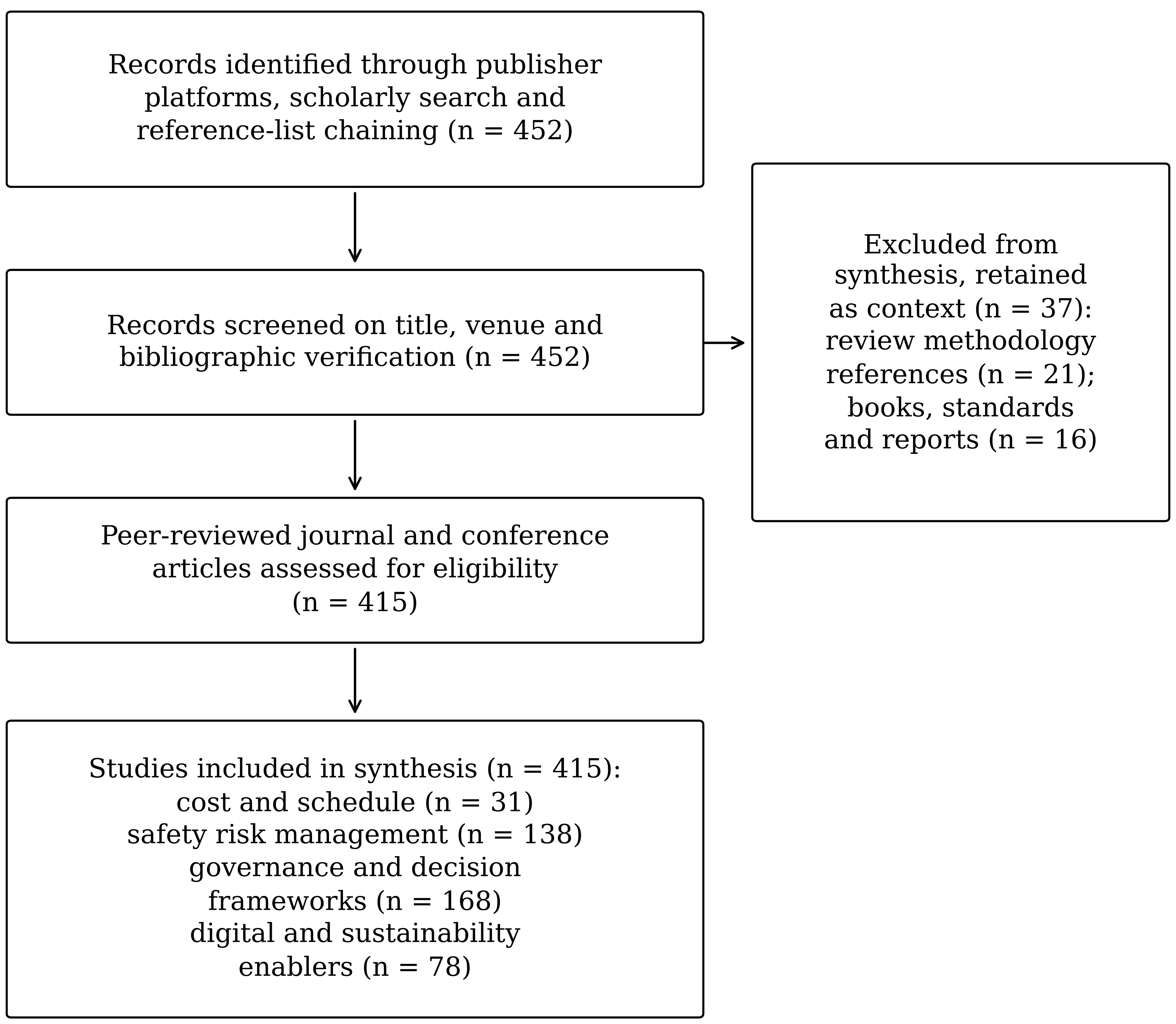
Figure 1 shows the flow of records. The searches and reference-list chaining identified 452 records, all of which were screened against the criteria. Of these, 21 were review methodology references and 16 were books, standards or reports, and these 37 records were excluded from the synthesis but cited where they inform interpretation. The remaining 415 peer-reviewed articles were assessed for eligibility and included. As in reviews that combine targeted searching with reference-list chaining, records were screened for topical relevance before they were recorded, so no further exclusions arose at the eligibility stage [85, 92]. Duplicate records were removed during merging of the domain searches, and records appearing in more than one domain search were assigned to a single domain according to their primary topic [42].
3.5Coding
Each included study was coded on five variables. The domain was assigned as cost and schedule, governance and decision frameworks, safety risk management, or digital and sustainability enablers. The sector was coded as oil, gas and offshore; energy, infrastructure and public projects; construction and building; or general and cross-sector. The research method was coded as review, quantitative modelling, empirical survey or analysis, case study, or conceptual. The publication period was coded in four bands. Finally, each study was flagged as cross-domain if it analysed two or more of cost, schedule and safety together. Coding used keyword rules applied to titles, topic labels and venues, which is suited to mapping a large and heterogeneous literature, and the rules were checked against a sample of records before final coding [44, 98, 99].
3.6Synthesis and appraisal
The synthesis combined a descriptive analysis of the coded variables with thematic synthesis within each domain. Thematic synthesis followed the approach of Thomas and Harden, in which findings are coded, organized into descriptive themes and then developed into analytical themes that go beyond the primary studies [100], drawing on thematic analysis methods [101], critical reviews of qualitative synthesis methods [102] and frameworks for transferring knowledge into action [103]. Because the studies range from conceptual frameworks to meta-analyses, no single quality appraisal instrument was applied; instead, the strength of evidence for each mechanism was judged by the number, method and setting of supporting studies, consistent with integrative review practice [41, 42, 86]. The analytical themes were then combined into the integrative framework presented in the discussion [88, 89].
4Results
This section reports the characteristics of the evidence base and the thematic synthesis within each domain. It first describes the distribution of studies by domain, period, sector and method; then synthesizes the evidence on cost and schedule, governance and decision frameworks, safety risk management and digital and sustainability enablers; and finally examines the studies that connect cost, schedule and safety. Counts refer to the 415 included studies; books, standards and reports are cited where they inform interpretation [42, 92]. Throughout, findings from oil, gas and offshore projects are distinguished from findings in other sectors, because the transferability of evidence is one of the questions the review addresses [1, 2, 9].
4.1Characteristics of the evidence base
The 415 included studies were published between 1984 and 2022. Governance and decision frameworks is the largest domain with 168 studies, followed by safety risk management with 138, digital and sustainability enablers with 78 and cost and schedule with 31. Table 3 and Figure 2 show their distribution by period. Governance research grew strongly in the 2010s, when megaproject governance, portfolio management and relational contracting became prominent [17, 104, 105]. Safety research has a long base in the safety climate literature from the 1990s and 2000s [19, 106, 107] and grew further through work on leading indicators in the 2010s [20, 108, 109]. Digital and sustainability research is the most recent, with 31 of its 78 studies published from 2020 to 2022, reflecting the growth of digital twin and machine learning research [97, 110, 111].
| Domain | Before 2000 | 2000 to 2009 | 2010 to 2019 | 2020 to 2022 | Total |
|---|---|---|---|---|---|
| Cost and schedule | 0 | 10 | 18 | 3 | 31 |
| Governance and decision frameworks | 13 | 40 | 93 | 22 | 168 |
| Safety risk management | 3 | 33 | 74 | 28 | 138 |
| Digital and sustainability enablers | 0 | 7 | 40 | 31 | 78 |
| Total | 16 | 90 | 225 | 84 | 415 |
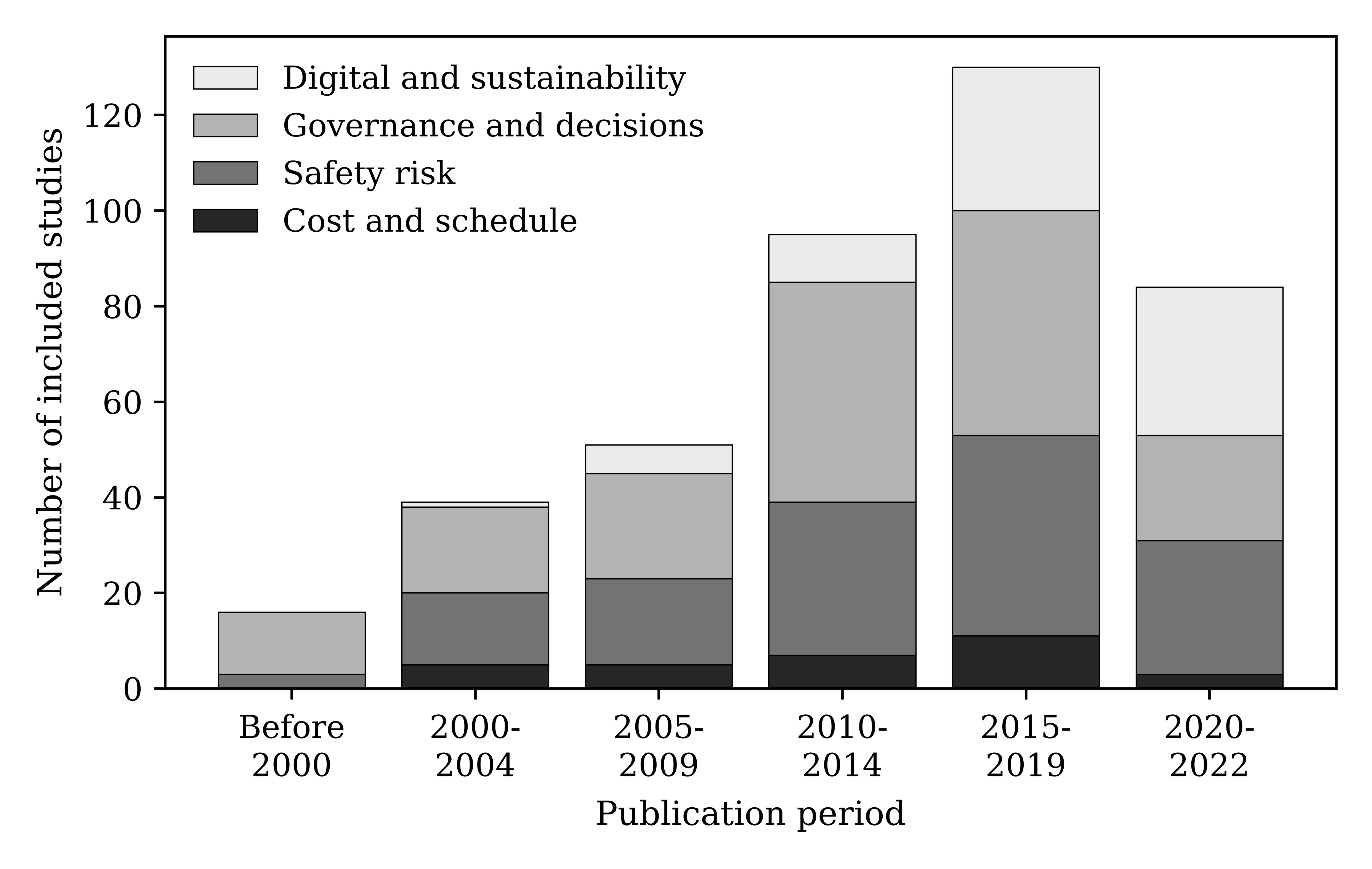
Table 4 and Figure 3 show the sectoral distribution. Only 47 studies, 11.3 percent, address oil, gas or offshore projects directly. Of these, 21 concern safety, mostly safety climate and culture in oil and gas and offshore workforces [112–114], 23 concern governance and decisions, including real options for field development, stage-gate practice and supply chain risk in EPC and gas processing projects [51, 56, 115, 116], three concern cost and schedule [58, 117, 118] and none concern digital and sustainability enablers. Construction and building projects contribute 156 studies and cross-sector project management 166. Most of what is known about project controls, digital tools and safety indicators in offshore projects is therefore inferred from other sectors [95–97].
| Domain | Oil, gas and offshore | Energy, infrastructure and public projects | Construction and building | General and cross-sector | Total |
|---|---|---|---|---|---|
| Cost and schedule | 3 | 9 | 10 | 9 | 31 |
| Governance and decision frameworks | 23 | 22 | 31 | 92 | 168 |
| Safety risk management | 21 | 4 | 67 | 46 | 138 |
| Digital and sustainability enablers | 0 | 11 | 48 | 19 | 78 |
| Total | 47 | 46 | 156 | 166 | 415 |
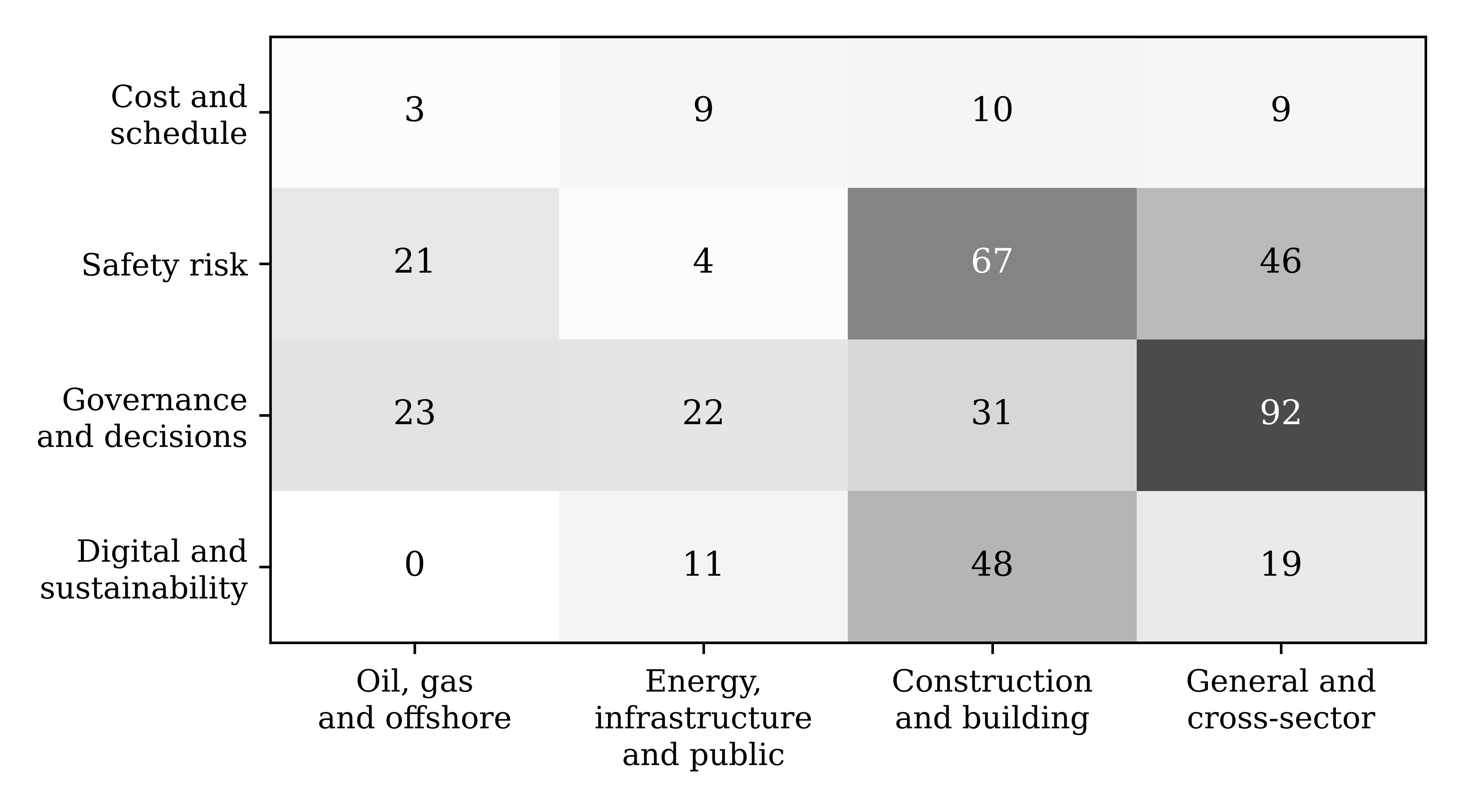
Table 5 shows the distribution of research methods. Conceptual studies are the largest group, 198 of 415, concentrated in governance research. Empirical surveys and analyses, 87 studies, are concentrated in safety research, where safety climate questionnaires and indicator studies predominate [119–121]. Quantitative modelling, 61 studies, is concentrated in the digital domain, where machine learning cost and delay prediction dominates [24, 111, 122], and in governance, where real options valuation is the main quantitative method [115, 123, 124]. Reviews account for 47 studies and case studies for 22.
| Domain | Case study | Conceptual | Empirical | Quantitative modelling | Review | Total |
|---|---|---|---|---|---|---|
| Cost and schedule | 1 | 19 | 1 | 9 | 1 | 31 |
| Governance and decision frameworks | 5 | 98 | 31 | 16 | 18 | 168 |
| Safety risk management | 14 | 57 | 44 | 7 | 16 | 138 |
| Digital and sustainability enablers | 2 | 24 | 11 | 29 | 12 | 78 |
| Total | 22 | 198 | 87 | 61 | 47 | 415 |
4.2Cost and schedule performance
The 31 cost and schedule studies address three themes: the size and causes of overruns, the behavioural biases that produce optimistic estimates and the reference class forecasting methods proposed to correct them, and the accuracy of estimating together with the effects of schedule pressure. The domain is drawn mainly from transport, energy and building projects, with only three studies set in oil and gas, two of which concern optimism in production forecasting and the economic consequences of schedule acceleration [117, 118] while the third addresses strategic procurement optimization [58]. The themes are synthesized below in turn, with attention to the mechanisms that the governance and safety domains also invoke [6, 125].
4.2.1Overruns and their causes
The cost and schedule literature agrees that overruns are common and persistent. Flyvbjerg and colleagues showed that cost underestimation in public works is systematic and asked whether it reflects error or deception [12], and later analyses identified the causes of overrun in transport infrastructure [11] and set out what decision makers should know about cost overrun [6]. Odeck examined the size and determinants of road construction overruns [126], Rosenfeld conducted root-cause analysis of construction cost overruns [127], and Love and colleagues reviewed the landscape of overruns in transport infrastructure [8]. Ahiaga-Dagbui and Smith criticized cost overrun research as superficial and stagnant [7], and Eden and colleagues described how project costs grow through systemic interactions between disruptions [128]. In energy, Callegari and colleagues analysed the relationship between size and overruns in energy megaprojects [3], and Ansar and colleagues documented large overruns in hydropower [129]. Dahlin and Bengtsson-Sjörs compared client and contractor perspectives on cost and time overruns [130], and Caffieri and colleagues examined cost control through production planning in major capital projects [131]. Nwafor and colleagues proposed an analytical framework for improving efficiency in public infrastructure delivery systems, treating delivery performance as the product of institutional and procedural design [132].
4.2.2Optimism bias and reference class forecasting
Behavioural explanations of overruns emphasize optimism and strategic misrepresentation. Lovallo and Kahneman described how optimism undermines executives’ decisions [133], Kahneman and colleagues proposed methods for checking big decisions [134] and examined the conditions under which intuitive expertise can be trusted [135], and Klein proposed the project premortem [136]. Flyvbjerg reviewed the top behavioural biases in project management [125]. Groupthink remains a recognized decision bias [137]. In oil and gas, Bratvold and colleagues showed that production forecasts are persistently optimistic and overconfident [138], and Nesvold and Bratvold proposed methods for debiasing probabilistic forecasts [117].
Reference class forecasting, derived from Kahneman and Tversky’s outside view, was introduced to project management by Flyvbjerg [13]. Its statistical basis has been examined [139], and it has been applied to hydroelectric dams [140], project portfolios with empirical evaluation [141], and Turkish public construction and building projects [142, 143], and combined with earned value management and exponential smoothing [144].
4.2.3Estimating accuracy and schedule pressure
Estimating accuracy has been studied through data mining of overruns [145], cognition and learning in estimation [146], comparisons of estimation methods for building projects [147] and correlated cost risk models [148]. Schedule pressure in oil developments has been shown to have economic costs: Nandurdikar and Kirkham found that chasing schedules in oil developments led to production shortfalls and lower value [118]. Genetic algorithm methods for resource scheduling of construction projects [149–151] illustrate the optimization tools available for schedule management, but the cost and schedule domain contains few studies specific to offshore projects. The one oil and gas framework on procurement optimization addresses the cost of supply rather than schedule [58]. The evidence on schedule pressure therefore comes mainly from the safety domain, discussed under work pressure and safety, where production pressure has been linked to unsafe behaviour and under-reporting [22, 27].
4.3Governance and decision frameworks
The 168 governance and decision studies form the largest domain. They cover project and megaproject governance, stage-gate and decision processes, real options and flexibility valuation, portfolio management and project management offices, contracting, alliancing, partnering and owner roles, and learning and benchmarking. Twenty-three concern oil and gas, concentrated in real options valuation of field developments, in stage-gate and decision practice and in supply chain risk and resilience for gas processing [51, 57, 115, 116]. Most of the remainder is conceptual or cross-sector, which reflects the theoretical orientation of project governance research [14, 152]. The domain is nonetheless where the decisions that set cost, schedule and safety conditions for execution are examined, so it supplies the link between front-end choices and execution outcomes [45, 47]. The six themes are synthesized below.
4.3.1Project and megaproject governance
The governance of large engineering projects was examined by Miller and Lessard, who showed that institutional arrangements and strategic shaping of risks determine outcomes [45], and by Floricel and Miller, who analysed strategizing for anticipated risks and turbulence [46]. Project governance has since been conceptualized through governance mechanisms in project-based organizations [153], the management of project management [154], organizational enablers of governance and governmentality [152], a book-length treatment [14] and its role in strategy implementation [155]. Studies have examined governance structures and risk management in major infrastructure [156], systems engineering for governance in complex projects [157], the normalization of deviance [158], megaproject governance frameworks [159] and governance schemes for public investment projects [52]. Megaproject governance research has addressed risk and uncertainty [160], polycentric organizing [161], institutional complexity [162], dynamic governance [163], organizational behaviour [104], the success and performance of megaprojects [71, 164], megaproject risk identification [165], the past and present of megaprojects [166] and project temporalities [167]. Complexity in large engineering projects has been measured through technical, organizational and environmental dimensions [168], structural and dynamic complexity have been contrasted [169] and the contingency approach to project types has been developed [170].
4.3.2Stage-gates, decision analysis and decision quality
Stage-gate processes were developed for new product development [15] and adapted to oil and gas projects, where their benefits and failure modes have been examined [51]. Front-end governance of major public projects [47], the link between the front end and operations [59], information-feed to megaproject decisions [60] and why oil and gas project decisions are not always made as they should be [54] have been studied. Decision analysis provides the normative basis for these decisions [171, 172], with oil and gas applications set out in texts on making good decisions [55]. Decision quality has been defined [173], decision makers’ skills examined [174] and team commitment in integrated project delivery related to decision dynamics [175]. Project controls and performance management have been studied through nudges [176], tensions between control and flexibility [177], the emphasis on control over flexibility in project management [178], flexibility in complex infrastructure projects [179], the dominant project management discourse in the light of overruns [180] and stakeholder-related risks [181]. Systemic risk assessment [182] and risk management effectiveness across industries [183] connect governance with risk.
4.3.3Real options and flexibility
Real options analysis values managerial flexibility in oil and gas investments. Ekern applied option pricing to petroleum projects [184], and Smith and colleagues integrated option pricing with decision analysis for risky projects and oil properties and reported lessons from practice [16, 185, 186]. Binomial decision trees [124], technical uncertainty [187], least-squares Monte Carlo valuation [115], two-factor price models for abandonment [123], the value of waiting in exploration [188] and the effects of oil price uncertainty and carbon taxes [189] extend the approach. Field development applications include staged development with optional wells [190], mature offshore fields solved by stochastic programming [116], flexible subsea tiebacks [65], cluster development of marginal UK discoveries [66] and optimization methods for field development and production systems [64].
4.3.4Portfolio management and project management offices
Project portfolio management allocates resources across projects and has been examined through integrated selection frameworks [191], new product portfolio practices [192], decision support for selection [193], the resource allocation syndrome [194], the role of single-project management [195], portfolio control in different contexts [196], the gap between enacted and espoused practice [197], business strategy [198], the roles of portfolio offices [199], internal stakeholders [200], management quality [201], practice in context [17], uncertainties in portfolios [202], success factors beyond selection [203], decision-making quality and agility [204] and portfolio risk management [205]. Project management offices have been studied through their features and performance [206], their organizational role [207, 208], their transitions [209] and portfolio steering committees [210].
4.3.5Contracting, alliancing, partnering and owner roles
Contracting strategy determines how risk and incentives are allocated between owner and contractors. Studies have addressed the choice of contracting method [211–213], contract management theory [18, 214], the effect of contract types and incentives [34], risk-based delivery selection [215], integrated project delivery [216], performance of design-build and related methods [217], incentive and disincentive contracts on industrial projects [218, 219] and contracting for oil and gas processing facilities [53]. In energy markets, studies have addressed liability mitigation and dispute prevention in high-value energy service contracts [94], force majeure and contractual resilience in global energy supply chains through a systematic review [220], the streamlining of statutory bidding workflows through corporate policy advocacy [221] and the reduction of contract errors in engineering teams through cross-functional legal education [222]. Partnering has been studied in 280 construction projects [223] and critically reviewed [224–228], and partnering in international EPC projects has been linked to performance and contractor capability [229, 230]. Alliance contracting has been defined, assessed for motivation and trust in an oil industry alliance and in public projects, and theorized [33, 105, 231–241], with gainshare and painshare optimization [242]. Relational contracting has been defined and its practices examined [243–247], and joint risk management through relational contracting proposed [248]. Owner roles and capabilities have been examined through principal-agent communication [249], the domains of project organizing [250], owner capabilities in infrastructure and social infrastructure [251, 252], owner challenges in UK government projects [253], incentive mechanisms for owner risk management [254] and dynamic capabilities on Heathrow Terminal 5 [255]. Owner-contractor collaboration, trust and supply chain integration have been studied extensively [61, 62, 256–259], and supply chain risk management and resilience frameworks have been proposed for EPC and gas processing projects [56, 57].
4.3.6Learning, lessons learned and benchmarking
Lessons learned are widely recommended but often not acted upon. Reviews of project learning methods [260], studies of whether organizations learn lessons from projects [261, 262], practitioner perspectives on causal approaches [263], lessons learned practice in construction and EPC [264, 265], double-loop learning [266], lessons learned from lessons learned [267] and the systemic lessons learned knowledge model [268, 269] document the problem. Project learning in project-based organizations has been examined through organizational routines [270], holistic views [271], learning flows [272], and interorganizational projects [273], and knowledge management systems provide the conceptual foundation [274]. Project capabilities and operational outcomes [275, 276] and benchmarking for partnering and complex projects [277, 278] complete this theme, and an organizational learning-based maturity model has been proposed for continuous improvement of safety performance [279]. Performance measurement in megaprojects has been reviewed [280], the reasons why projects fail have been examined in oil and gas [63], and Kassem and colleagues assessed external risk factors for oil and gas projects [281].
4.4Safety risk management
The 138 safety studies cover safety culture and climate, the oil, gas and offshore safety literature, leading and lagging indicators, contractor safety, leadership and programmes, permit to work, management of change and simultaneous operations, work pressure, and the costs of accidents. This domain contains more oil and gas evidence than any other, with 21 studies, and more empirical survey research, reflecting the long tradition of safety climate measurement [9, 19, 95]. Its focus on the workforce and the worksite means that it connects naturally with project execution, although few studies examine project-level decisions directly [282, 283]. The seven themes are synthesized below.
4.4.1Safety culture and safety climate
Safety culture has been conceptualized as an organizational property and debated as philosopher’s stone or man of straw [284], reviewed in theory and practice [49], analysed through its paradoxes [48] and modelled [285]. Safety climate, the shared perceptions of safety policies and practices, was measured on construction sites by Dedobbeleer and Béland [106], and its common features were identified by Flin and colleagues [107]. Neal, Griffin and colleagues linked organizational climate, safety climate, motivation and behaviour [286–288], and meta-analyses by Clarke and by Christian and colleagues confirmed relationships between climate and safety performance [289, 290]. Zohar reflected on thirty years of research [19], and the Nordic Safety Climate Questionnaire provided a widely used instrument [119]. In construction, safety climate has been studied in road construction [291], union and non-union workforces [292], site environments [293], Hong Kong [294–296], perceived accident risk [297], company measurement [298], group-level climate [299], error management and communication [300], Chinese companies [301], multilevel surveys [302], the literature [95], indicators [303], resilience [304], safety performance [120], corporate safety culture [305] and interaction models [306]. Studies of safety consciousness [307] and safety behaviour antecedents [308] extend this work.
4.4.2Safety climate and culture in oil, gas and offshore work
The oil and gas and offshore literature is the largest sector-specific component of the evidence base. Mearns and colleagues examined human and organizational factors in offshore safety and the relationship between safety climate, management practice and performance offshore [9, 10]. Studies have examined safety compliance offshore [114], safety culture regulation in Norway [309], the actual safety performance of Malaysian offshore platforms [310], major accident prevention through hydrocarbon leak case studies [311], occupational health hazards [312], leadership and communication [313], safety compliance and climate in Norway [112], safety climate and participation in the petroleum industry [314], climate and compliance relationships [113], process safety culture in China [315] and health, safety and environment culture in the United Arab Emirates [316]. Conceptual frameworks have also addressed operational integrity in high-risk drilling [40] and risk-based process engineering for natural gas infrastructure [39]. Salas and Hallowell assessed the predictive validity of leading indicators in oil and gas [317].
4.4.3Leading and lagging indicators
The measurement of safety performance has shifted from lagging indicators such as injury rates toward leading indicators. Kjellén revisited the safety measurement problem [318], Mearns asked whether leading performance indicators can deliver [319], and conceptual work addressed organizational indicators [320, 321], system safety [322], competency and effectiveness indicators [323], management system performance [324], occupational health and safety performance [121, 325, 326], problems with observation reporting [327], quantitative dominance [328] and construction safety performance indicators [329]. In construction, Hinze and colleagues identified leading indicators [20], Hallowell and colleagues developed proactive safety control [108], and studies examined causal relations between lead and lag indicators [330], worker safety performance [331], systems approaches [332], monitoring of construction safety conditions [333], temporal analysis on a large infrastructure project [109], case studies in Tennessee [334], machine learning [335], critical success factors [336], Internet of Things frameworks [337], safety prediction methods [338], predictors of serious injuries and fatalities [339] and systematic reviews [96]. Process safety leading indicators [340, 341] extend this to process settings. Under-reporting of injuries undermines lagging indicators [342].
4.4.4Contractor safety, leadership and programmes
Contractor arrangements are central to project safety. Lingard and colleagues showed how safety climate varies across subcontracting levels and how perceptions of supervisors mediate climate effects [32, 343]. Contractor safety assessment programmes, safety maturity and safety prequalification have been studied [344–346], and associations between leading and lagging indicators in contractor programmes tested [347]. Governance-oriented models of contractor safety in multi-contract industrial projects [35] and of construction safety risk governance in multi-contractor high-rise projects [348] treat the contracting structure itself as a safety variable. Safety leadership through verbal communication, recognition programmes and supervisory influence [349–351], safety management practices and worker engagement [352], safety programme effectiveness [353], best practices in safety management [354], conceptualization of construction project safety management [282], safety standards across countries [355] and safety in the Olympic Park and the CityCenter projects [283, 356] illustrate the practices that support safety on large projects. Further work has examined leadership-driven safety culture transformation in large construction workforces [357], the link between the frequency and coverage of management safety walkthroughs and safety culture in megaprojects [358], workforce safety training models [359], internal QHSE audit systems [93], the institutionalization of life-preserving safety practices in project-based organizations [360] and hazard identification and risk control in urban construction, reviewed systematically [361]. Hollnagel’s distinction between Safety-I and Safety-II offers a complementary perspective on how safety is achieved in normal work [50].
4.4.5Permit to work, management of change and simultaneous operations
Permit-to-work systems control hazardous work and are particularly important during commissioning and simultaneous operations. Studies have proposed more effective permit systems [21], web-based hazardous work management [362], electronic permits at Qatargas [363], human error analysis of permit systems [364], permits as a risk control strategy in mining [365] and identification of permit disconformities and fault creators in commissioning [38, 366]. Management of change has been addressed through integrated safety during change in the chemical industry and lessons from staff reductions [367, 368]. Industry recommended practice on simultaneous operations provides guidance for offshore projects in which construction, commissioning and production overlap [37], and operational risk assessment of offshore transport barges illustrates installation-phase risk [36]. Heavy lifting, crane installation and rigging, which dominate module installation and hook-up, have been addressed through conceptual risk management and risk pathway models [369, 370].
4.4.6Work pressure and safety
Work pressure links schedule targets to safety outcomes. Job demands and resources affect safety behaviour and outcomes, as shown in studies and a meta-analysis of the job demands-resources model [76, 77, 371, 372]. Production pressure has been associated with poorer safety performance in construction [22] and with pressure to reduce accident reporting [27], and workers manage production pressures through dangerous informality [28]. Conceptual work explains why unsafe behaviours recur in high-hazard worksites [79] and how operational integrity can be maintained when drilling productivity competes with safety compliance [40]. Safety-related stress [373] and the interaction of psychological capital with work pressure [374] add individual-level perspectives. Together these studies suggest that schedule targets set at governance gates reach the worksite as job demands, and that their safety effect depends on the resources and safety climate available to absorb them [76, 288].
4.4.7Costs of accidents and the business case for safety
The costs of accidents provide the economic link between safety and project performance. Studies have estimated the costs of occupational injuries in US construction [73], the costs to Britain of workplace injuries [74], the true costs of construction accidents in South Africa and Australia [29, 30], the costs in Oman and the Gulf Cooperation Council [75, 375] and the cost-benefit of accident prevention [31]. Safety investment has been related to the social costs of accidents [376], safety performance [377] and the interaction with safety culture and project hazard [378]. Building information modelling has been applied to safety risk management in modular construction [379], and digital twins to workforce safety [380].
4.5Digital and sustainability enablers
The 78 studies in this domain address building information modelling for cost and schedule, digital twins, machine learning for cost and schedule forecasting, and sustainability and ESG in project management. It is the most recent domain, with two in five of its studies published from 2020 to 2022, and the most quantitative, with machine learning models predominant [24, 111, 122]. None of its studies is set in an oil, gas or offshore project, so its relevance to offshore project controls rests on transfer from construction, infrastructure and energy settings [97, 381]. Its studies also rarely evaluate the effect of digital tools on realized cost, schedule or safety outcomes, focusing instead on prediction accuracy or conceptual development [110, 111]. The four themes are synthesized below.
4.5.1Building information modelling for cost and schedule
Building information modelling and its 4D and 5D extensions link design models with schedule and cost. Early feasibility studies of 4D CAD [382], workspace interference management [383], contractor coordination [384], workspace management with industry foundation classes [385], surveys of 4D BIM use [386], virtual reality for constructability [387], site logistics for engineer-to-order systems [388], acceptance in EPC projects in China [389], integrated project delivery-based 4D processes [390], mobile crane simulation [391], schedule generation [392], environmental planning [393], progress monitoring [394] and earned duration-based decision support [395] represent 4D research. 5D BIM has been examined through the integration of quantity surveyors [396] and machine learning classification of material costs [397]. Broader BIM research has addressed facilities management [398], transformation of construction [399], integrated MEP management [400], augmented reality [401] and adoption by public clients [402]. Big data [403] and artificial intelligence in the architecture, engineering and construction industry [404] provide the data foundation.
4.5.2Digital twins
Digital twins have been reviewed in production systems and manufacturing [405, 406], introduced as a means of mitigating emergent behaviour in complex systems [407], and examined for buildings [408], construction information systems [409], infrastructure connectivity [410], semantic construction twins [411], civil infrastructure [412, 413], intelligent buildings [23], built assets [414], construction management [381], concept to practice [110], design change propagation [415], and the AEC-FM industry [97]. Digital twins for circular construction [416] and embodied carbon estimation [417] connect digital tools with sustainability. Across these studies a digital twin is distinguished from a static building information model by a two-way link with the physical asset that is refreshed with sensor and progress data, which is the property that makes it relevant to construction progress monitoring and workforce safety [380, 381].
4.5.3Machine learning for cost and schedule forecasting
Machine learning has been applied extensively to construction cost estimation and forecasting. Evolutionary fuzzy and hybrid neural networks for conceptual estimates and cash flow [418–421], principal component analysis with support vector machines [422], interval estimation of cost at completion [423], optimized award price prediction [424], cost index forecasting [425], economic variable models [426], gradient boosting [24], support vector models for bridges [427], highway cost items [428], stacking ensembles [111], and early-stage estimates [429] represent this work. Machine learning for schedule includes S-curve estimation [430], logistics delay prediction [431], hybrid delay risk prediction [432] and comparisons of algorithms for delay risk [122]. Other project control applications include contractor classification [433], dispute prediction in public-private partnerships [434] and labour productivity prediction [435].
4.5.4Sustainability and ESG in project management
Sustainability has entered project management through the triple bottom line [436], corporate sustainability strategies [437], sustainability assessment of industries and construction projects [438, 439] and sustainable project life cycle management [440]. Silvius and colleagues reviewed sustainability in project management, examined its consideration in decision making, proposed it as a school of thought and explored project managers’ intentions to address it [25, 441–443], and others reviewed project management as a route to sustainability [444], examined the introduction of sustainability into the project management function [445, 446], stakeholder theory [447] and sustainable project management frameworks [448]. ESG research has reviewed progress [449], integrated ESG data into investment decisions [450], evaluated energy projects from a sustainability perspective [451, 452] and reviewed greenhouse gas disclosure and ESG compliance obligations for energy and infrastructure enterprises under evolving regulatory regimes [26].
4.6Evidence connecting cost, schedule and safety
Only 14 of the 415 studies, 3.4 percent, analyse two or more of cost, schedule and safety together. Table 6 classifies them. Seven concern the costs of accidents or the cost-benefit of safety investment [29–31, 73, 75, 375, 376]. Two concern the effect of production pressure on safety and accident reporting [22, 27]. Three concern cost and time overruns together [3, 130, 217], one examines the iron triangle as a success criterion [68] and one shows the economic cost of chasing schedules in oil developments [118]. None models how a governance or contracting decision affects cost, schedule and safety simultaneously, and none is set in an offshore project. Safety and project performance have been related through quality and safety management practices [80, 81], but these studies were not flagged as cross-domain because they do not measure cost or schedule directly.
| Type of connection | Number of studies | Principal finding | Representative studies |
|---|---|---|---|
| Cost of accidents and safety investment | 7 | Accidents impose direct and indirect costs well above insured costs; safety investment reduces social costs | [29, 30, 376] |
| Production pressure and safety | 2 | Production pressure is associated with poorer safety performance and under-reporting of accidents | [22, 27] |
| Cost and schedule overruns together | 3 | Cost and time overruns share drivers; perspectives of owners and contractors differ | [3, 130, 217] |
| Success criteria spanning cost and time | 1 | Cost, time and quality are incomplete criteria of success | [68] |
| Schedule acceleration and value in oil developments | 1 | Chasing schedules reduced production attainment and value | [118] |
| Total | 14 |
5Discussion
This section interprets the findings, presents an integrative framework derived from the thematic synthesis, sets out a research agenda for offshore oil and gas capital projects and considers the limitations of the review. The discussion is guided by the purpose of integrative reviews, which is to generate new perspectives on a topic by combining literatures that have developed separately [41, 42], and by the observation from large engineering project research that outcomes emerge from the interaction of institutional, organizational and technical factors rather than from any single practice [45, 46, 168]. It also reflects the safety science view that hazards at the worksite are shaped by organizational conditions created far from it, including the targets and contracts set by project governance [48, 50].
5.1Principal findings
Four findings stand out. First, the evidence base is large but unevenly distributed across domains: governance and decision frameworks and safety risk management account for 74 percent of studies, while cost and schedule performance, which project controls are intended to deliver, accounts for only 7 percent of the studies in this review. Second, only about one in nine studies concerns oil, gas or offshore projects, and the oil and gas evidence is concentrated in safety climate and in real options valuation, while digital project controls have not been studied in offshore projects at all [97, 112, 115]. Third, the methods used differ by domain, with conceptual work in governance, questionnaire surveys in safety and machine learning models in the digital domain, which makes evidence difficult to combine [14, 19, 24]. Fourth, only 3.4 percent of studies connect cost, schedule and safety, and those that do mostly quantify one direction of influence, such as the cost of accidents or the effect of production pressure, rather than the joint effect of a decision on all three outcomes [22, 29, 118].
Within domains, the evidence is consistent on several mechanisms. Optimism bias and strategic misrepresentation contribute to overruns, and reference class forecasting can correct estimates when suitable reference classes exist [12, 13, 140]. Weak front-end governance and decision processes allow unrealistic targets to pass decision gates [47, 51, 54]. Contracting arrangements that align incentives and build trust, such as alliances and relational contracts, are associated with better performance, although the evidence is mainly from infrastructure [34, 239, 246]. Safety climate is consistently related to safety behaviour and outcomes [289, 290], leading indicators are increasingly used though their predictive validity remains contested [96, 317, 328], and production pressure is associated with poorer safety and under-reporting [22, 27].
5.2An integrative framework
Figure 4 presents an integrative framework that combines the analytical themes of the review. At the top, governance and decision gates set the targets, contracting strategy and risk appetite for the project, using decision quality principles and reference class forecasting to test the realism of estimates [13, 15, 173]. In the middle, cost and schedule controls and safety risk management are connected through an integrated project risk register and model that represents the drivers they share: schedule pressure, change, complexity and contractor capability [22, 32, 128, 168]. At the base, a common digital and data layer, comprising 4D and 5D models, digital twins, machine learning forecasts, incident and progress data and ESG metrics, supplies all three functions with consistent information [26, 111, 381, 395]. A learning loop through lessons learned and benchmarking feeds evidence from completed projects back into the reference classes and risk models used at the next gate [1, 268, 278, 279].
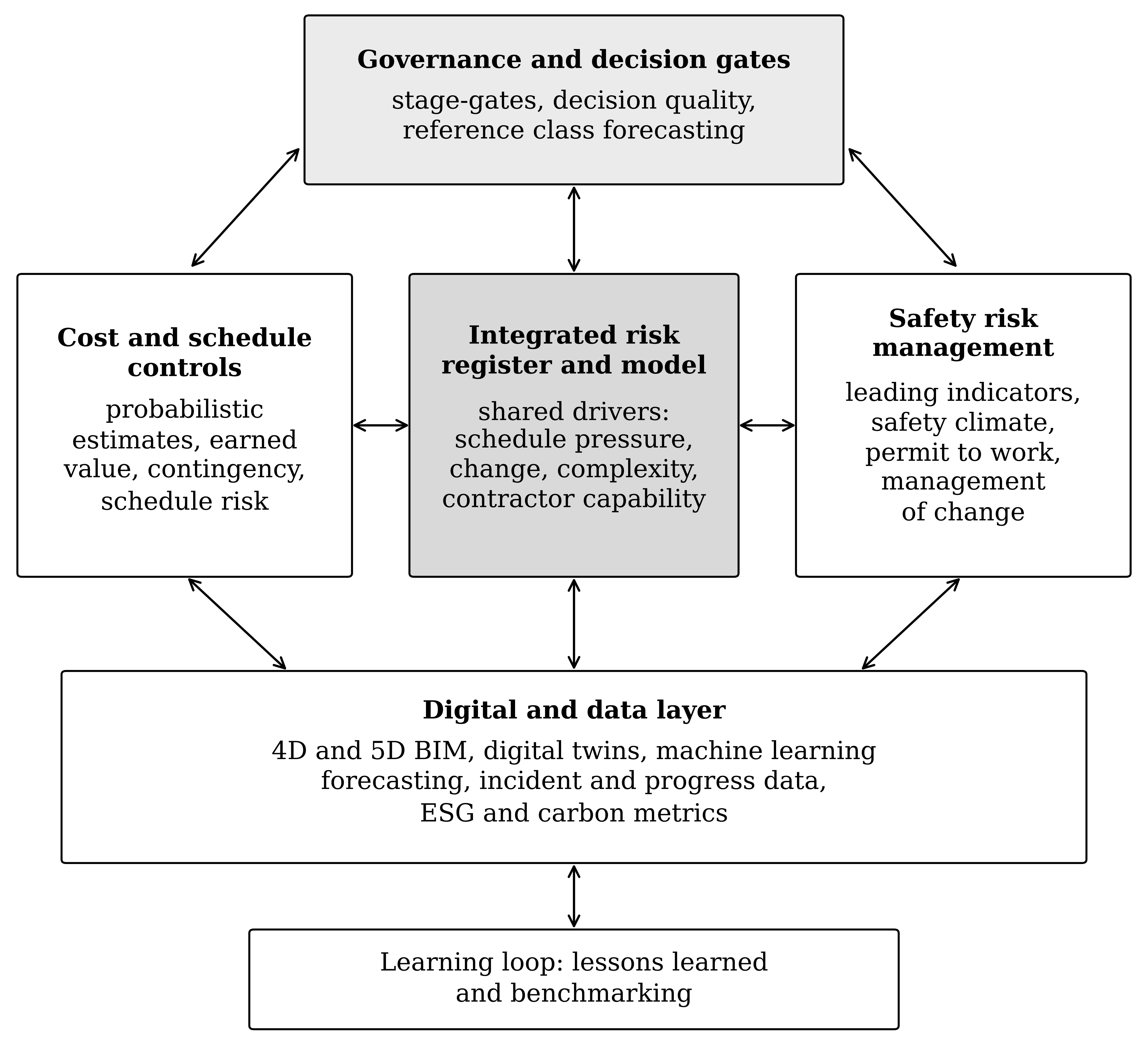
The framework differs from existing approaches in two respects. It treats schedule pressure, change and contractor capability as shared drivers that must appear in both the cost and schedule risk model and the safety risk assessment, so that a decision to accelerate the schedule is evaluated for its safety consequences as well as its value [28, 76, 118]. And it places leading safety indicators alongside earned value and schedule performance indicators in the same control dashboard, so that deterioration in safety climate or permit compliance is visible to the same decision makers who review cost and schedule performance [108, 109, 176, 358]. Both features follow from the evidence that the three outcomes are causally linked, and both are absent from the reviewed literature [80, 81].
5.3Research agenda
Table 7 sets out a research agenda for offshore oil and gas capital projects. The highest priority is to generate offshore-specific evidence on how cost, schedule and safety interact, for example by analysing whether schedule recovery measures during fabrication, hook-up and commissioning are followed by changes in incident rates and permit violations [37, 38, 118]. A second priority is to evaluate digital project controls in offshore projects, where digital twins and 4D models have been proposed but not studied [97, 381, 389]. A third is to test leading safety indicators for their ability to predict serious incidents in offshore construction and commissioning, building on work in onshore oil and gas and infrastructure [109, 317, 339]. A fourth is to examine how reference class forecasting and decision quality practices can be applied at oil and gas decision gates with reference classes drawn from industry benchmarking [2, 54, 139].
| Gap | Research need | Suggested approach |
|---|---|---|
| Few offshore-specific studies | Evidence on cost, schedule and safety in offshore fabrication, installation and commissioning | Multi-project case studies and operator benchmarking data |
| Little cross-domain evidence | Joint effects of schedule pressure, change and contracting on cost, schedule and safety | Longitudinal analysis linking project controls data with incident and leading-indicator data |
| No offshore digital project controls studies | Value of 4D and 5D models, digital twins and machine learning forecasting offshore | Pilot implementations with controlled comparison |
| Uncertain predictive validity of leading indicators | Prediction of serious incidents during construction and commissioning | Prospective studies across multiple offshore projects |
| Limited use of the outside view | Reference class forecasting at oil and gas decision gates | Construction of reference classes from benchmarking databases |
| Contracting evidence mainly from infrastructure | Effect of alliance and relational contracting on offshore safety and cost | Comparative studies of contracting models in offshore developments |
| ESG weakly integrated in project appraisal | Carbon and social metrics in offshore project decisions | Decision-analytic studies of ESG trade-offs at sanction |
5.4Limitations
The review has several limitations. Records were identified through publisher platforms, scholarly search and reference-list chaining rather than a fixed set of bibliographic databases, which suits a review spanning several research communities but may have missed poorly indexed studies [85, 92]. The domain allocation reflects the topics searched, so the relative sizes of the domains partly reflect search effort as well as the size of each literature; in particular, the small cost and schedule domain should not be read as evidence that cost and schedule research is scarce in general. Coding was performed on bibliographic records using keyword rules rather than full texts, and the cross-domain flag is conservative because it relies on titles [44, 98]. Quality appraisal was not scored because of methodological heterogeneity [42, 86]. Finally, the conclusions about offshore projects rest partly on evidence transferred from construction and infrastructure, whose applicability offshore is itself uncertain [95, 239].
6Conclusion
This integrative review synthesized 415 studies of cost, schedule and safety risk management in capital projects, with a focus on offshore oil and gas. The evidence base is dominated by governance and decision frameworks and by safety risk management, with smaller literatures on digital and sustainability enablers and on cost and schedule performance. Only about one in nine studies concerns oil, gas or offshore projects, none of the digital studies does so, and only one in thirty connects cost, schedule and safety in a single analysis.
Within domains, the evidence consistently shows that optimism bias and weak front-end governance drive overruns, that aligned contracting and owner capabilities support performance, that safety climate and leadership shape safety outcomes, and that production pressure undermines safety and its reporting. What the evidence does not show is how these mechanisms interact in offshore projects, where fabrication, marine installation, simultaneous operations and commissioning create distinctive conditions.
The integrative framework proposed here links governance gates, a shared risk model that carries the drivers common to cost, schedule and safety, and a common digital and data layer, closed by a learning loop. Its central implication for practice is that decisions on schedule targets, acceleration and contracting should be evaluated for their safety consequences as well as their cost and schedule value, and that leading safety indicators should sit alongside earned value in project control. The research agenda identifies the offshore-specific, cross-domain evidence needed to put that implication on a firmer empirical basis.
References
- [1]Merrow EW. Oil and gas industry megaprojects: Our recent track record. Oil and Gas Facilities. 2013;1(2):38–42. https://doi.org/10.2118/153695-PA
- [2]Rui Z, Peng F, Ling K, Chang H, Chen G, Zhou X. Investigation into the performance of oil and gas projects. Journal of Natural Gas Science and Engineering. 2017;38:12–20. https://doi.org/10.1016/j.jngse.2016.11.049
- [3]Callegari C, Szklo A, Schaeffer R. Cost overruns and delays in energy megaprojects: How big is big enough? Energy Policy. 2018;114:211–220. https://doi.org/10.1016/j.enpol.2017.11.059
- [4]Flyvbjerg B. What you should know about megaprojects and why: An overview. Project Management Journal. 2014;45(2):6–19. https://doi.org/10.1002/pmj.21409
- [5]Flyvbjerg, B. (Ed.). The oxford handbook of megaproject management. Oxford University Press. 2017.
- [6]Flyvbjerg B, Ansar A, Budzier A, Buhl S, Cantarelli C, Garbuio M, et al. Five things you should know about cost overrun. Transportation Research Part A: Policy and Practice. 2018;118:174–190. https://doi.org/10.1016/j.tra.2018.07.013
- [7]Ahiaga-Dagbui DD, Smith SD, Love PED, Ackermann F. Spotlight on construction cost overrun research: Superficial, replicative and stagnated. Proceedings of the 31st Annual ARCOM Conference, Lincoln, UK. 2015;863–872.
- [8]Love PED, Smith J, Simpson I, Regan M, Olatunji O. Understanding the landscape of overruns in transport infrastructure projects. Environment and Planning B: Planning and Design. 2015;42(3). https://doi.org/10.1068/b130102p
- [9]Mearns K, Whitaker SM, Flin R. Safety climate, safety management practice and safety performance in offshore environments. Safety Science. 2003;41:641–680. https://doi.org/10.1016/S0925-7535(02)00011-5
- [10]Mearns K, Flin R, Gordon R, Fleming M. Human and organizational factors in offshore safety. Work & Stress. 2001;15:144–160.
- [11]Flyvbjerg B, Holm MKS, Buhl SL. What causes cost overrun in transport infrastructure projects? Transport Reviews. 2004;24(1):3–18.
- [12]Flyvbjerg B, Holm MKS, Buhl SL. Underestimating costs in public works projects: Error or lie? Journal of the American Planning Association. 2002;68:279–295.
- [13]Flyvbjerg B. From nobel prize to project management: Getting risks right. Project Management Journal. 2006;37(3):5–15.
- [14]Müller R. Project governance. Gower Publishing. 2017.
- [15]Cooper RG. Perspective: The stage-gate idea-to-launch process: Update, what’s new, and nexgen systems. Journal of Product Innovation Management. 2008;25:213–232.
- [16]Smith JE, Nau RF. Valuing risky projects: Option pricing theory and decision analysis. Management Science. 1995;41(5):795. https://doi.org/10.1287/mnsc.41.5.795
- [17]Martinsuo M. Project portfolio management in practice and in context. International Journal of Project Management. 2013;31:794–803.
- [18]Turner JR. Contracting for project management. Gower Publishing. 2003.
- [19]Zohar D. Thirty years of safety climate research: Reflections and future directions. Accident Analysis & Prevention. 2010;42(5). https://doi.org/10.1016/j.aap.2009.12.019
- [20]Hinze J, Thurman S, Wehle A. Leading indicators of construction safety performance. Safety Science. 2013;51(1):23–28.
- [21]Iliffe RE, Chung PWH, Kletz TA. More effective permit-to-work systems. Process Safety and Environmental Protection. 1999;77(2):69–76.
- [22]Han S, Saba F, Lee S, Mohamed Y, Peña-Mora F. Toward an understanding of the impact of production pressure on safety performance in construction operations. Accident Analysis & Prevention. 2014;68:106–116. https://doi.org/10.1016/j.aap.2013.10.007
- [23]Deng M, Menassa CC, Kamat VR. From BIM to digital twins: A systematic review of the evolution of intelligent building representations in the AEC-FM industry. Journal of Information Technology in Construction. 2021;26:58–83. https://doi.org/10.36680/j.itcon.2021.005
- [24]Chakraborty D, Elhegazy H, Elzarka H, Gutierrez L. A novel construction cost prediction model using hybrid natural and light gradient boosting. Advanced Engineering Informatics. 2020;46:101201.
- [25]Silvius AJG, Schipper RPJ. Sustainability in project management: A literature review and impact analysis. Social Business. 2014;4(1):63–96. https://doi.org/10.1362/204440814X13948909253866
- [26]Ominyi M, Anichukwueze CC. Reviewing greenhouse gas disclosure and ESG compliance obligations for energy and infrastructure enterprises under evolving regulatory regimes. International Journal of Economics and Financial Management. 2022;7(6):94–124. https://doi.org/10.56201/ijefm.v7.no6.2022.pg94.124
- [27]Probst TM, Graso M. Pressure to produce = pressure to reduce accident reporting? Accident Analysis & Prevention. 2013;59:580–587. https://doi.org/10.1016/j.aap.2013.07.020
- [28]Oswald D, Sherratt F, Smith S. Managing production pressures through dangerous informality: A case study. Engineering, Construction and Architectural Management. 2019;26(11):2581–2596. https://doi.org/10.1108/ECAM-11-2018-0475
- [29]Haupt TC, Pillay K. Investigating the true costs of construction accidents. Journal of Engineering, Design and Technology. 2016;14(2):373–419.
- [30]Allison R, Hon C, Xia B. Construction accidents in australia: Evaluating the true costs. Safety Science. 2019;120:886–896. https://doi.org/10.1016/j.ssci.2019.07.037
- [31]Ikpe E, Hammon F, Oloke D. Cost-benefit analysis for accident prevention in construction projects. Journal of Construction Engineering and Management. 2012;138(8):991–998.
- [32]Lingard HC, Cooke T, Blismas N. Safety climate in conditions of construction subcontracting: A multi-level analysis. Construction Management and Economics. 2010;28(8):813–825.
- [33]Laan A, Voordijk H, Dewulf G. Reducing opportunistic behaviour through a project alliance. International Journal of Managing Projects in Business. 2011;4(4):660–679.
- [34]Suprapto M, Bakker HLM, Mooi HG, Hertogh MJCM. How do contract types and incentives matter to project performance? International Journal of Project Management. 2015. https://doi.org/10.1016/j.ijproman.2015.08.003
- [35]Arumosoye OM, Obriki OD. A governance-oriented conceptual model for contractor safety performance in multi-contract industrial projects. International Journal of Multidisciplinary Research and Growth Evaluation. 2020;1(5):728–740. https://doi.org/10.54660/.IJMRGE.2020.1.5.728-740
- [36]Abdussamie N, Zaghwan A, Daboos M, Elferjani I, Mehanna A, Su W. Operational risk assessment of offshore transport barges. Ocean Engineering. 2018;156:333–346. https://doi.org/10.1016/j.oceaneng.2018.03.006
- [37]Working Together for Safety. Recommended practice: Simultaneous operations (recommendation 045E/2021, rev 00). Samarbeid for Sikkerhet. 2021.
- [38]Sarkheil H, Azimi Y, Jafari Aghdash J. An innovative permit to work system disconformities identification (PTWDI) in the commissioning and start-up phases of south pars gas complex, iran. International Journal of Occupational Hygiene. 2017;9(1):1–8.
- [39]Asibor E, Isong DE. Risk-based process engineering framework for strengthening reliability across complex natural gas infrastructure systems. Iconic Research and Engineering Journals. 2019;3(2):1020–1060. https://doi.org/10.64388/IREV3I2-1723153
- [40]Nwangwu CV, Duvbiama-Owasanoye OA, Onwumere A. A framework for operational integrity in high-risk drilling: Balancing productivity and safety compliance. Iconic Research and Engineering Journals. 2018;2(5):436–453.
- [41]Torraco RJ. Writing integrative literature reviews: Guidelines and examples. Human Resource Development Review. 2005;4(3):356–367. https://doi.org/10.1177/1534484305278283
- [42]Whittemore R, Knafl K. The integrative review: Updated methodology. Journal of Advanced Nursing. 2005;52(5):546–553. https://doi.org/10.1111/j.1365-2648.2005.03621.x
- [43]Tranfield D, Denyer D, Smart P. Towards a methodology for developing evidence-informed management knowledge by means of systematic review. British Journal of Management. 2003;14(3):207–222. https://doi.org/10.1111/1467-8551.00375
- [44]Snyder H. Literature review as a research methodology: An overview and guidelines. Journal of Business Research. 2019;104:333–339. https://doi.org/10.1016/j.jbusres.2019.07.039
- [45]Miller R, Lessard DR. The strategic management of large engineering projects: Shaping institutions, risks, and governance. MIT Press. 2000.
- [46]Floricel S, Miller R. Strategizing for anticipated risks and turbulence in large-scale engineering projects. International Journal of Project Management. 2001;19:445–455.
- [47]Klakegg OJ, Williams T, Shiferaw AT. Taming the “trolls”: Major public projects in the making. International Journal of Project Management. 2016;34(2):282–296.
- [48]Reason J. Safety paradoxes and safety culture. Injury Control and Safety Promotion. 2000;7(1). https://doi.org/10.1076/1566-0974(200003)7:1;1-V;FT003
- [49]Guldenmund FW. The nature of safety culture: A review of theory and practice. Safety Science. 2000;34(1–3):215–257.
- [50]Hollnagel E. Safety-i and safety-II: The past and future of safety management. Ashgate. 2014.
- [51]Walkup GW, Ligon BJ. The good, bad, and ugly of stage-gate project management process as applied in the oil and gas industry. SPE Annual Technical Conference and Exhibition, San Antonio, Texas. 2006.
- [52]Samset KF, Volden GH, Olsson N, Kvalheim EV. Governance schemes for major public investment projects: A comparative study of principles and practices in six countries (concept report no. 47). Ex ante akademisk forlag. 2016.
- [53]Berends TC. Engineering and construction projects for oil and gas processing facilities: Contracting, uncertainty and the economics of information. Energy Policy. 2007;35:4260–4270.
- [54]Newman D, Begg S, Welsh M. Why are decisions for oil and gas projects not always made the way they “should” be? APPEA Journal. 2018;58(1):130–158. https://doi.org/10.1071/AJ17106
- [55]Bratvold RB, Begg SH. Making good decisions. Society of Petroleum Engineers. 2010.
- [56]Agbabiaka J, Okonkwo CS, Ogunwole O, Mayo W, Okeke OT. Supply chain risk management model for EPC and gas processing projects. Iconic Research and Engineering Journals. 2019;3(2):968–980. https://doi.org/10.64388/IREV3I2-1713124
- [57]Ogunwole O, Okonkwo CS, Agbabiaka J, Mayo W, Okeke OT. Supply chain resilience framework for critical infrastructure and gas processing plants. Shodhshauryam, International Scientific Refereed Research Journal. 2021;4(4):444–461. https://doi.org/10.32628/SHISRRJ214462
- [58]Okonkwo CS, Ogunwole O, Okeke OT. Framework for strategic procurement optimization in oil and gas operations. Iconic Research and Engineering Journals. 2018;1(7):153–168. https://doi.org/10.64388/IREV1I7-1713119
- [59]Artto K, Ahola T, Vartiainen V. From the front end of projects to the back end of operations: Managing projects for value creation throughout the system lifecycle. International Journal of Project Management. 2016;34(2):258–270. https://doi.org/10.1016/j.ijproman.2015.05.003
- [60]Eweje J, Turner R, Müller R. Maximizing strategic value from megaprojects: The influence of information-feed on decision-making by the project manager. International Journal of Project Management. 2012;30(6):639–651.
- [61]Suprapto M, Bakker HLM, Mooi HG. Relational factors in owner-contractor collaboration: The mediating role of teamworking. International Journal of Project Management. 2015;33(6):1347–1363.
- [62]Suprapto M, Bakker HLM, Mooi HG, Moree W. Sorting out the essence of owner-contractor collaboration in capital projects delivery. International Journal of Project Management. 2015;33(3):664–683.
- [63]Whitfield S. Taking a closer look at why projects fail. Oil and Gas Facilities. 2014;3(5):18–24.
- [64]Khor CS, Elkamel A, Shah N. Optimization methods for petroleum fields development and production systems: A review. Optimization and Engineering. 2017;18:907. https://doi.org/10.1007/s11081-017-9365-2
- [65]Lin J, de Weck O, de Neufville R, Yue HK. Enhancing the value of offshore developments with flexible subsea tiebacks. Journal of Petroleum Science and Engineering. 2013;102:73. https://doi.org/10.1016/j.petrol.2013.01.003
- [66]Abdul-Salam Y, Kemp A, Phimister E. Unlocking the economic viability of marginal UKCS discoveries: Optimising cluster developments. Energy Economics. 2021;97.
- [67]Stinchcombe AL, Heimer C. Organizational theory and project management: Administering uncertainty in norwegian offshore oil. Norwegian University Press. 1985.
- [68]Atkinson R. Project management: Cost, time and quality, two best guesses and a phenomenon, its time to accept other success criteria. International Journal of Project Management. 1999;17(6):337–342. https://doi.org/10.1016/S0263-7863(98)00069-6
- [69]Ika LA, Pinto JK. The “re-meaning” of project success: Updating and recalibrating for a modern project management. International Journal of Project Management. 2022;40(7):835–848. https://doi.org/10.1016/j.ijproman.2022.08.001
- [70]Zwikael O, Meredith J. Evaluating the success of a project and the performance of its leaders. IEEE Transactions on Engineering Management. 2019;68(6):1745–1757. https://doi.org/10.1109/TEM.2019.2925057
- [71]Turner JR, Xue Y. On the success of megaprojects. International Journal of Managing Projects in Business. 2018;11(3):783–805.
- [72]Patanakul P, Kwak YH, Zwikael O, Liu M. What impacts the performance of large-scale government projects? International Journal of Project Management. 2016;34(3):452–466. https://doi.org/10.1016/j.ijproman.2015.12.001
- [73]Waehrer GM, Dong XS, Miller T, Haile E, Men Y. Costs of occupational injuries in construction in the United States. Accident Analysis & Prevention. 2007;39(6):1258–1266.
- [74]Health and Safety Executive. The costs to britain of workplace injuries and work-related ill health in 2006/07 (research report RR897). HSE Books. 2011.
- [75]Umar T. Cost of accidents in the construction industry of oman. Proceedings of the Institution of Civil Engineers: Municipal Engineer. 2017;170(2):68–73. https://doi.org/10.1680/jmuen.16.00032
- [76]Nahrgang JD, Morgeson FP, Hofmann DA. Safety at work: A meta-analytic investigation of the link between job demands, job resources, burnout, engagement, and safety outcomes. Journal of Applied Psychology. 2011;96(1):71–94. https://doi.org/10.1037/a0021484
- [77]Bronkhorst B. Behaving safely under pressure: The effects of job demands, resources, and safety climate on employee physical and psychosocial safety behavior. Journal of Safety Research. 2015;55:63–72. https://doi.org/10.1016/j.jsr.2015.09.002
- [78]Obriki OD, Arumosoye OM. Conceptual framework for human error causation in high-risk construction and industrial activities. International Journal of Multidisciplinary Research and Growth Evaluation. 2020;1(5):715–727. https://doi.org/10.54660/.IJMRGE.2020.1.5.715-727
- [79]Obriki OD, Arumosoye OM. Conceptual framework explaining recurrence mechanisms of unsafe behaviors in high-hazard worksites. Shodhshauryam, International Scientific Refereed Research Journal. 2022;5(3):380–402. https://doi.org/10.32628/SHISRRJ225489
- [80]Wanberg J, Harper C, Hallowell MR, Rajendran S. Relationship between construction safety and quality performance. Journal of Construction Engineering and Management. 2013;139(10):04013003. https://doi.org/10.1061/(ASCE)CO.1943-7862.0000732
- [81]Cheng EWL, Kelly S, Ryan N. Use of safety management practices for improving project performance. International Journal of Injury Control and Safety Promotion. 2015;22(1):33–39. https://doi.org/10.1080/17457300.2013.844715
- [82]Grant MJ, Booth A. A typology of reviews: An analysis of 14 review types and associated methodologies. Health Information & Libraries Journal. 2009;26(2):91–108. https://doi.org/10.1111/j.1471-1842.2009.00848.x
- [83]Baumeister RF, Leary MR. Writing narrative literature reviews. Review of General Psychology. 1997;1(3):311–320. https://doi.org/10.1037/1089-2680.1.3.311
- [84]Wong G, Greenhalgh T, Westhorp G, Buckingham J, Pawson R. RAMESES publication standards: Meta-narrative reviews. BMC Medicine. 2013;11:20. https://doi.org/10.1186/1741-7015-11-20
- [85]Rojon C, Okupe A, McDowall A. Utilization and development of systematic reviews in management research: What do we know and where do we go from here? International Journal of Management Reviews. 2021;23(2):191–223. https://doi.org/10.1111/ijmr.12245
- [86]Davis J, Mengersen K, Bennett S, Mazerolle L. Viewing systematic reviews and meta-analysis in social research through different lenses. SpringerPlus. 2014;3:511. https://doi.org/10.1186/2193-1801-3-511
- [87]Collins JA, Fauser BCJM. Balancing the strengths of systematic and narrative reviews. Human Reproduction Update. 2005;11(2):103–104. https://doi.org/10.1093/humupd/dmh058
- [88]MacInnis DJ. A framework for conceptual contributions in marketing. Journal of Marketing. 2011;75(4):136–154. https://doi.org/10.1509/jmkg.75.4.136
- [89]Palmatier RW, Houston MB, Hulland J. Review articles: Purpose, process, and structure. Journal of the Academy of Marketing Science. 2018;46(1):1–5. https://doi.org/10.1007/s11747-017-0563-4
- [90]Webster J, Watson RT. Analyzing the past to prepare for the future: Writing a literature review. MIS Quarterly. 2002;26.
- [91]Greenhalgh T, Robert G, Macfarlane F, Bate P, Kyriakidou O. Diffusion of innovations in service organizations: Systematic review and recommendations. The Milbank Quarterly. 2004;82(4):581–629. https://doi.org/10.1111/j.0887-378X.2004.00325.x
- [92]Adams RJ, Smart P, Huff AS. Shades of grey: Guidelines for working with the grey literature in systematic reviews for management and organizational studies. International Journal of Management Reviews. 2017;19(4):432–454.
- [93]Obogo SF, Arumosoye OM, Obriki OD. Advances in internal QHSE audit systems for industrial engineering operations. Iconic Research and Engineering Journals. 2020;4(4):399–417. https://doi.org/10.64388/IREV4I4-1715499
- [94]Ngonadi U, Ominyi M. Liability mitigation and dispute prevention in high-value energy service contracts. Iconic Research and Engineering Journals. 2019;3(6):676–705. https://doi.org/10.64388/IREV3I6-1722790
- [95]Schwatka NV, Hecker S, Goldenhar LM. Defining and measuring safety climate: A review of the construction industry literature. Annals of Occupational Hygiene. 2016;60:537–550.
- [96]Xu J, Cheung C, Manu P, Ejohwomu O. Safety leading indicators in construction: A systematic review. Safety Science. 2021;139:105250. https://doi.org/10.1016/j.ssci.2021.105250
- [97]Hosamo HH, Imran A, Cardenas-Cartagena J, Svennevig PR, Svidt K, Nielsen HK. A review of the digital twin technology in the AEC-FM industry. Advances in Civil Engineering. 2022;2022:2185170. https://doi.org/10.1155/2022/2185170
- [98]Hosseini MR, Martek I, Zavadskas EK, Aibinu AA, Arashpour M, Chileshe N. Critical evaluation of off-site construction research: A scientometric analysis. Automation in Construction. 2018;87:235–247. https://doi.org/10.1016/j.autcon.2017.12.002
- [99]Toorajipour R, Sohrabpour V, Nazarpour A, Oghazi P, Fischl M. Artificial intelligence in supply chain management: A systematic literature review. Journal of Business Research. 2021;122:502–517. https://doi.org/10.1016/j.jbusres.2020.09.009
- [100]Thomas J, Harden A. Methods for the thematic synthesis of qualitative research in systematic reviews. BMC Medical Research Methodology. 2008.
- [101]Braun V, Clarke V. Using thematic analysis in psychology. Qualitative Research in Psychology. 2006;3(2):77–101. https://doi.org/10.1191/1478088706qp063oa
- [102]Barnett-Page E, Thomas J. Methods for the synthesis of qualitative research: A critical review. BMC Medical Research Methodology. 2009;9.
- [103]Ward V, House A, Hamer S. Developing a framework for transferring knowledge into action: A thematic analysis of the literature. Journal of Health Services Research & Policy. 2009;14(3):156–164. https://doi.org/10.1258/jhsrp.2009.008120
- [104]Li Y, Lu Y, Cui Q, Han Y. Organizational behavior in megaprojects: Integrative review and directions for future research. Journal of Management in Engineering. 2019;35(4). https://doi.org/10.1061/(ASCE)ME.1943-5479.0000691
- [105]Lahdenperä P. Towards a coherent theory of project alliancing: Discovering the system’s complex mechanisms yielding value for money. Construction Economics and Building. 2017;17(2):41–61. https://doi.org/10.5130/ajceb.v17i2.5292
- [106]Dedobbeleer N, Béland F. A safety climate measure for construction sites. Journal of Safety Research. 1991;22(2):97–103.
- [107]Flin R, Mearns K, O’Connor P, Bryden R. Measuring safety climate: Identifying the common features. Safety Science. 2000;34(1–3):177–192.
- [108]Hallowell MR, Hinze JW, Baud KC, Wehle A. Proactive construction safety control: Measuring, monitoring, and responding to safety leading indicators. Journal of Construction Engineering and Management. 2013;139(10).
- [109]Lingard H, Hallowell M, Salas R, Pirzadeh P. Leading or lagging? Temporal analysis of safety indicators on a large infrastructure construction project. Safety Science. 2017;91:206–220.
- [110]Agrawal A, Fischer M, Singh V. Digital twin: From concept to practice. Journal of Management in Engineering. 2022;38(3). https://doi.org/10.1061/(ASCE)ME.1943-5479.0001034
- [111]Meharie MG, Mengesha WJ, Gariy ZA, Mutuku RNN. Application of stacking ensemble machine learning algorithm in predicting the cost of highway construction projects. Engineering, Construction and Architectural Management. 2022;29(7):2836–2853.
- [112]Kvalheim SA, Dahl Ø. Safety compliance and safety climate: A repeated cross-sectional study in the oil and gas industry. Journal of Safety Research. 2016;59:33–41. https://doi.org/10.1016/j.jsr.2016.10.006
- [113]Benson C, Argyropoulos CD, Dimopoulos C, Varianou Mikellidou C, Boustras G. Analysis of safety climate factors and safety compliance relationships in the oil and gas industry. Safety Science. 2022;151:105744. https://doi.org/10.1016/j.ssci.2022.105744
- [114]Dahl Ø, Olsen E. Safety compliance on offshore platforms: A multi-sample survey on the role of perceived leadership involvement and work climate. Safety Science. 2013;54:17–26. https://doi.org/10.1016/j.ssci.2012.11.003
- [115]Willigers BJA, Bratvold RB. Valuing oil and gas options by least-squares Monte Carlo simulation. SPE Projects, Facilities & Construction. 2009;4:146.
- [116]Bakker SJ, Kleiven A, Fleten SE, Tomasgard A. Mature offshore oil field development: Solving a real options problem using stochastic dual dynamic integer programming. Computers & Operations Research. 2021;136:105480. https://doi.org/10.1016/j.cor.2021.105480
- [117]Nesvold E, Bratvold RB. Debiasing probabilistic oil production forecasts. Energy. 2022;258:124744. https://doi.org/10.1016/j.energy.2022.124744
- [118]Nandurdikar NS, Kirkham PM. The economic folly of chasing schedules in oil developments and the unintended consequences of such strategies. SPE Annual Technical Conference and Exhibition. 2012.
- [119]Kines P, Lappalainen J, Mikkelsen KL, Olsen E, Pousette A, Tharaldsen J, et al. Nordic safety climate questionnaire (NOSACQ-50): A new tool for diagnosing occupational safety climate. International Journal of Industrial Ergonomics. 2011;41(6):634–646.
- [120]Alruqi WM, Hallowell MR, Techera U. Safety climate dimensions and their relationship to construction safety performance: A meta-analytic review. Safety Science. 2018;109:165–173. https://doi.org/10.1016/j.ssci.2018.05.019
- [121]Shea T, De Cieri H, Donohue R, Cooper B, Sheehan C. Leading indicators of occupational health and safety: An employee and workplace level validation study. Safety Science. 2016;85:293–304.
- [122]Gondia A, Siam A, El-Dakhakhni W, Nassar AH. Machine learning algorithms for construction projects delay risk prediction. Journal of Construction Engineering and Management. 2020;146(1):04019085. https://doi.org/10.1061/(ASCE)CO.1943-7862.0001736
- [123]Jafarizadeh B, Bratvold RB. Two-factor oil-price model and real option valuation: An example of oilfield abandonment. SPE Economics & Management. 2012;4:158. https://doi.org/10.2118/162862-PA
- [124]Brandão LE, Dyer JS, Hahn WJ. Using binomial decision trees to solve real-option valuation problems. Decision Analysis. 2005;2:69. https://doi.org/10.1287/deca.1050.0040
- [125]Flyvbjerg B. Top ten behavioral biases in project management: An overview. Project Management Journal. 2021;52(6):531–546.
- [126]Odeck J. Cost overruns in road construction: What are their sizes and determinants? Transport Policy. 2004;11(1):43–53.
- [127]Rosenfeld Y. Root-cause analysis of construction-cost overruns. Journal of Construction Engineering and Management. 2014;140(1).
- [128]Eden C, Ackermann F, Williams T. The amoebic growth of project costs. Project Management Journal. 2005;36(1):15–27.
- [129]Ansar A, Flyvbjerg B, Budzier A, Lunn D. Should we build more large dams? The actual costs of hydropower megaproject development. Energy Policy. 2014;69:43–56. https://doi.org/10.1016/j.enpol.2013.10.069
- [130]Dahlin P, Pesämaa O. Drivers of cost and time overruns: A client and contractor perspective. Organization, Technology & Management in Construction: An International Journal. 2021;13(1):2374–2382.
- [131]Caffieri JJ, Love PED, Whyte A, Ahiaga-Dagbui DD. Planning for production in construction: Controlling costs in major capital projects. Production Planning & Control. 2018;29(1):41–50. https://doi.org/10.1080/09537287.2017.1376258
- [132]Nwafor MI, Uduokhai DO, Gil-Ozoudeh IDS, Aransi AN. Developing an analytical framework for enhancing efficiency in public infrastructure delivery systems. Iconic Research and Engineering Journals. 2019;2(11):657–670. https://doi.org/10.64388/IREV2I11-1712239
- [133]Lovallo D, Kahneman D. Delusions of success: How optimism undermines executives’ decisions. Harvard Business Review. 2003;81(7):56–63.
- [134]Kahneman D, Lovallo D, Sibony O. Before you make that big decision. Harvard Business Review. 2011;89(6):50–60.
- [135]Kahneman D, Klein G. Conditions for intuitive expertise: A failure to disagree. American Psychologist. 2009;64(6):515–526.
- [136]Klein G. Performing a project premortem. Harvard Business Review. 2007;85(9):18–19.
- [137]Esser JK. Alive and well after 25 years: A review of groupthink research. Organizational Behavior and Human Decision Processes. 1998;73(2–3):116–141.
- [138]Bratvold RB, Mohus E, Petutschnig D, Bickel E. Production forecasting: Optimistic and overconfident: Over and over again. SPE Reservoir Evaluation & Engineering. 2020.
- [139]Bordley RF. Reference class forecasting: Resolving its challenge to statistical modeling. The American Statistician. 2014;68(4):221–229. https://doi.org/10.1080/00031305.2014.937544
- [140]Awojobi O, Jenkins GP. Managing the cost overrun risks of hydroelectric dams: An application of reference class forecasting techniques. Renewable and Sustainable Energy Reviews. 2016;63:19–32. https://doi.org/10.1016/j.rser.2016.05.006
- [141]Batselier J, Vanhoucke M. Practical application and empirical evaluation of reference class forecasting for project management. Project Management Journal. 2016;47(5):36–51. https://doi.org/10.1177/875697281604700504
- [142]Bayram S, Al-Jibouri S. Application of reference class forecasting in turkish public construction projects: Contractor perspective. Journal of Management in Engineering. 2016;32(3):05016002. https://doi.org/10.1061/(ASCE)ME.1943-5479.0000421
- [143]Bayram S, Al-Jibouri S. Cost forecasting using RCF: A case study for planning public building projects costs in turkey. International Journal of Construction Management. 2018;18(5):405–417. https://doi.org/10.1080/15623599.2017.1333399
- [144]Batselier J, Vanhoucke M. Improving project forecast accuracy by integrating earned value management with exponential smoothing and reference class forecasting. International Journal of Project Management. 2017;35(1):28–43. https://doi.org/10.1016/j.ijproman.2016.10.003
- [145]Ahiaga-Dagbui DD, Smith SD. Dealing with construction cost overruns using data mining. Construction Management and Economics. 2014;32(7–8).
- [146]Ahiaga-Dagbui DD, Smith SD. Rethinking construction cost overruns: Cognition, learning and estimation. Journal of Financial Management of Property and Construction. 2014;19(1):38–54.
- [147]Bayram S, Al-Jibouri S. Efficacy of estimation methods in forecasting building projects’ costs. Journal of Construction Engineering and Management. 2016;142(11):05016012. https://doi.org/10.1061/(ASCE)CO.1943-7862.0001183
- [148]Okmen O, Öztas A. Construction cost analysis under uncertainty with correlated cost risk analysis model. Construction Management and Economics. 2010;28(2):203–212.
- [149]Senouci AB, Eldin NN. Use of genetic algorithms in resource scheduling of construction projects. Journal of Construction Engineering and Management. 2004;130(6):869–877. https://doi.org/10.1061/(ASCE)0733-9364(2004)130:6(869)
- [150]Kandil A, El-Rayes K. Parallel genetic algorithms for optimizing resource utilization in large-scale construction projects. Journal of Construction Engineering and Management. 2006;132(5):491–498. https://doi.org/10.1061/(ASCE)0733-9364(2006)132:5(491)
- [151]Long LD, Ohsato A. A genetic algorithm-based method for scheduling repetitive construction projects. Automation in Construction. 2009;18(4):499–511. https://doi.org/10.1016/j.autcon.2008.11.005
- [152]Müller R, Pemsel S, Shao J. Organizational enablers for governance and governmentality of projects: A literature review. International Journal of Project Management. 2014;32:1309–1320.
- [153]Turner JR, Keegan A. Mechanisms of governance in the project-based organization: Roles of the broker and steward. European Management Journal. 2001;19(3):254–267.
- [154]Too EG, Weaver P. The management of project management: A conceptual framework for project governance. International Journal of Project Management. 2014;32(8):1382–1394.
- [155]Musawir A, Abd-Karim SB, Mohd-Danuri MS. Project governance and its role in enabling organizational strategy implementation: A systematic literature review. International Journal of Project Management. 2020;38(1):1–16.
- [156]Guo F, Chang-Richards Y, Wilkinson S, Li TC. Effects of project governance structures on the management of risks in major infrastructure projects: A comparative analysis. International Journal of Project Management. 2014;32(5):815–826.
- [157]Locatelli G, Mancini M, Romano E. Systems engineering to improve the governance in complex project environments. International Journal of Project Management. 2014;32(8):1395–1410.
- [158]Pinto JK. Project management, governance, and the normalization of deviance. International Journal of Project Management. 2014;32(3):376–387.
- [159]Brunet M. Making sense of a governance framework for megaprojects: The challenge of finding equilibrium. International Journal of Project Management. 2021;39(4):406–416.
- [160]Sanderson J. Risk, uncertainty and governance in megaprojects: A critical discussion of alternative explanations. International Journal of Project Management. 2012;30(4):432–443.
- [161]Gil N, Pinto JK. Polycentric organizing and performance: A contingency model and evidence from megaproject planning in the UK. Research Policy. 2018;47(4):717–734.
- [162]Qiu Y, Chen H, Sheng Z, Cheng S. Governance of institutional complexity in megaproject organizations. International Journal of Project Management. 2019;37(3):425–443.
- [163]Li Y, Han Y, Luo M, Zhang Y. Impact of megaproject governance on project performance: Dynamic governance of the nanning transportation hub in China. Journal of Management in Engineering. 2019;35(3):05019002. https://doi.org/10.1061/(ASCE)ME.1943-5479.0000681
- [164]Denicol J, Davies A, Krystallis I. What are the causes and cures of poor megaproject performance? A systematic literature review and research agenda. Project Management Journal. 2020;51(3):328–345.
- [165]Sanchez-Cazorla A, Alfalla-Luque R, Irimia-Dieguez AI. Risk identification in megaprojects as a crucial phase of risk management: A literature review. Project Management Journal. 2016;47(6):75–93.
- [166]Söderlund J, Sankaran S, Biesenthal C. The past and present of megaprojects. Project Management Journal. 2017;48(6):5–16.
- [167]Brookes N, Sage D, Dainty A, Locatelli G, Whyte J. An island of constancy in a sea of change: Rethinking project temporalities with long-term megaprojects. International Journal of Project Management. 2017;35(7):1213–1224. https://doi.org/10.1016/j.ijproman.2017.05.007
- [168]Bosch-Rekveldt M, Jongkind Y, Mooi H, Bakker H, Verbraeck A. Grasping project complexity in large engineering projects: The TOE (technical, organizational and environmental) framework. International Journal of Project Management. 2011;29(6):728–739.
- [169]Brady T, Davies A. Managing structural and dynamic complexity: A tale of two projects. Project Management Journal. 2014;45(4):21–38. https://doi.org/10.1002/pmj.21434
- [170]Shenhar AJ. One size does not fit all projects: Exploring classical contingency domains. Management Science. 2001;47(3):394–414.
- [171]Thomas H. Strategic decision analysis: Applied decision analysis and its role in the strategic management process. Strategic Management Journal. 1984;5(2):139–156.
- [172]Howard RA. Decision analysis: Practice and promise. Management Science. 1988;34(6):679–695.
- [173]Spetzler C, Winter H, Meyer J. Decision quality: Value creation from better business decisions. John Wiley & Sons. 2016.
- [174]Keeney RL. Making better decision makers. Decision Analysis. 2004;1(4):193–204.
- [175]Manata B, Garcia AJ, Mollaoglu S, et al. The effect of commitment differentiation on integrated project delivery team dynamics: The critical roles of goal alignment, communication behaviors, and decision quality. International Journal of Project Management. 2021;39(3):259–269.
- [176]Bukoye OT, Ejohwomu O, Roehrich J, Too J. Using nudges to realize project performance management. International Journal of Project Management. 2022;40(8):886–905.
- [177]Szentes H, Eriksson PE. Paradoxical organizational tensions between control and flexibility when managing large infrastructure projects. Journal of Construction Engineering and Management. 2016;142(4):05015017. https://doi.org/10.1061/(ASCE)CO.1943-7862.0001081
- [178]Lenfle S, Loch C. Lost roots: How project management came to emphasize control over flexibility and novelty. California Management Review. 2010;53(1):32–55.
- [179]Eriksson PE, Larsson J, Pesämaa O. Managing complex projects in the infrastructure sector: A structural equation model for flexibility-focused project management. International Journal of Project Management. 2017;35(8):1512–1523.
- [180]Williams T. Assessing and moving on from the dominant project management discourse in the light of project overruns. IEEE Transactions on Engineering Management. 2005;52(4):497–508.
- [181]Xia N, Zhong R, Wu C, Wang X, Wang S. Assessment of stakeholder-related risks in construction projects: Integrated analyses of risk attributes and stakeholder influences. Journal of Construction Engineering and Management. 2017;143(8):04017030. https://doi.org/10.1061/(ASCE)CO.1943-7862.0001322
- [182]Ackermann F, Eden C, Williams T, Howick S. Systemic risk assessment: A case study. Journal of the Operational Research Society. 2007;58(1):39–51.
- [183]Zwikael O, Ahn M. The effectiveness of risk management: An analysis of project risk planning across industries and countries. Risk Analysis. 2011;31(1):25–37.
- [184]Ekern S. An option pricing approach to evaluating petroleum projects. Energy Economics. 1988;10(2):91–99.
- [185]Smith JE, McCardle KF. Valuing oil properties: Integrating option pricing and decision analysis approaches. Operations Research. 1998;46(2):198–217.
- [186]Smith JE, McCardle KF. Options in the real world: Lessons learned in evaluating oil and gas investments. Operations Research. 1999;47(1):1. https://doi.org/10.1287/opre.47.1.1
- [187]Armstrong M, Galli A, Bailey W, Couët B. Incorporating technical uncertainty in real option valuation of oil projects. Journal of Petroleum Science and Engineering. 2004;44:67. https://doi.org/10.1016/j.petrol.2004.02.006
- [188]Jafarizadeh B, Bratvold RB. Oil and gas exploration valuation and the value of waiting. The Engineering Economist. 2015;60:245. https://doi.org/10.1080/0013791X.2015.1045647
- [189]Abdul-Salam Y. A real options analysis of the effects of oil price uncertainty and carbon taxes on the optimal timing of oil field decommissioning. The Energy Journal. 2022;43(6):25–46. https://doi.org/10.5547/01956574.43.6.yabd
- [190]Fedorov S, Hagspiel V, Lerdahl T. Real options approach for a staged field development with optional wells. Journal of Petroleum Science and Engineering. 2021;205:108837. https://doi.org/10.1016/j.petrol.2021.108837
- [191]Archer NP, Ghasemzadeh F. An integrated framework for project portfolio selection. International Journal of Project Management. 1999;17:207–216.
- [192]Cooper RG, Edgett SJ, Kleinschmidt EJ. New product portfolio management: Practices and performance. Journal of Product Innovation Management. 1999;16:333–351.
- [193]Ghasemzadeh F, Archer NP. Project portfolio selection through decision support. Decision Support Systems. 2000;29:73–88.
- [194]Engwall M, Jerbrant A. The resource allocation syndrome: The prime challenge of multi-project management? International Journal of Project Management. 2003;21:403–409.
- [195]Martinsuo M, Lehtonen P. Role of single-project management in achieving portfolio management efficiency. International Journal of Project Management. 2007;25:56–65.
- [196]Müller R, Martinsuo M, Blomquist T. Project portfolio control and portfolio management performance in different contexts. Project Management Journal. 2008;39(3):28–42.
- [197]Blichfeldt BS, Eskerod P. Project portfolio management - there’s more to it than what management enacts. International Journal of Project Management. 2008;26:357–365.
- [198]Meskendahl S. The influence of business strategy on project portfolio management and its success: A conceptual framework. International Journal of Project Management. 2010;28:807–817.
- [199]Unger BN, Gemünden HG, Aubry M. The three roles of a project portfolio management office: Their impact on portfolio management execution and success. International Journal of Project Management. 2012;30:608–620.
- [200]Beringer C, Jonas D, Kock A. Behavior of internal stakeholders in project portfolio management and its impact on success. International Journal of Project Management. 2013;31:830–846.
- [201]Jonas D, Kock A, Gemünden HG. Predicting project portfolio success by measuring management quality: A longitudinal study. IEEE Transactions on Engineering Management. 2013;60:215–226.
- [202]Martinsuo M, Korhonen T, Laine T. Identifying, framing and managing uncertainties in project portfolios. International Journal of Project Management. 2014;32:732–746.
- [203]Kaiser MG, El Arbi F, Ahlemann F. Successful project portfolio management beyond project selection techniques: Understanding the role of structural alignment. International Journal of Project Management. 2015;33:126–139.
- [204]Kock A, Gemünden HG. Antecedents to decision-making quality and agility in innovation portfolio management. Journal of Product Innovation Management. 2016;33:670–686.
- [205]Teller J, Kock A. An empirical investigation on how portfolio risk management influences project portfolio success. International Journal of Project Management. 2013;31:817–829.
- [206]Dai CX, Wells WG. An exploration of project management office features and their relationship to project performance. International Journal of Project Management. 2004;22(7):523–532.
- [207]Aubry M, Hobbs B, Thuillier D. A new framework for understanding organisational project management through the PMO. International Journal of Project Management. 2007;25(4):328–336.
- [208]Hobbs B, Aubry M. A multi-phase research program investigating project management offices (PMOs): The results of phase 1. Project Management Journal. 2007;38(1):74–86.
- [209]Aubry M, Müller R, Hobbs B, Blomquist T. Project management offices in transition. International Journal of Project Management. 2010;28(8):766–778.
- [210]Mosavi A. Exploring the roles of portfolio steering committees in project portfolio governance. International Journal of Project Management. 2014;32:388–399.
- [211]Gordon CM. Choosing appropriate construction contracting method. Journal of Construction Engineering and Management. 1994;120(1):196–210. https://doi.org/10.1061/(ASCE)0733-9364(1994)120:1(196)
- [212]Love PED, Skitmore M, Earl G. Selecting a suitable procurement method for a building project. Construction Management and Economics. 1998;16(2):221–233. https://doi.org/10.1080/014461998372501
- [213]Alhazmi T, McCaffer R. Project procurement system selection model. Journal of Construction Engineering and Management. 2000;126(3):176–184. https://doi.org/10.1061/(ASCE)0733-9364(2000)126:3(176)
- [214]Turner JR, Simister SJ. Project contract management and a theory of organization. International Journal of Project Management. 2001;19(8):457–464.
- [215]Tran DQ, Molenaar KR. Risk-based project delivery selection model for highway design and construction. Journal of Construction Engineering and Management. 2015;141(12):04015041. https://doi.org/10.1061/(ASCE)CO.1943-7862.0001024
- [216]Mesa HA, Molenaar KR, Alarcón LF. Exploring performance of the integrated project delivery process on complex building projects. International Journal of Project Management. 2016;34(7):1089–1101. https://doi.org/10.1016/j.ijproman.2016.05.007
- [217]Sullivan J, Asmar ME, Chalhoub J, Obeid H. Two decades of performance comparisons for design-build, construction manager at risk, and design-bid-build: Quantitative analysis of the state of knowledge on project cost, schedule, and quality. Journal of Construction Engineering and Management. 2017;143(6):04017009. https://doi.org/10.1061/(ASCE)CO.1943-7862.0001282
- [218]Bubshait AA. Incentive/disincentive contracts and its effects on industrial projects. International Journal of Project Management. 2003;21(1):63–70.
- [219]Meng X, Gallagher B. The impact of incentive mechanisms on project performance. International Journal of Project Management. 2012;30(3):352–362.
- [220]Uchechi N, Ominyi M, Anichukwueze CC, Jones BC. Force majeure and contractual resilience in global energy supply chains: A systematic review. International Journal of Multidisciplinary Research and Growth Evaluation. 2020;1(5):1247–1264. https://doi.org/10.54660/.IJMRGE.2020.1.5.1247-1264
- [221]Uchechi N, Ominyi M, Anichukwueze CC, Jones BC. Corporate policy advocacy and regulatory reform: Streamlining statutory bidding workflows in emerging energy markets. Iconic Research and Engineering Journals. 2019;3(5):672–709. https://doi.org/10.64388/IREV3I5-1722791
- [222]Anichukwueze CC, Ominyi M, Uzougbo NS, Jones BC. Cross-functional legal education as risk mitigation: Empirical analysis of contract error reduction in engineering teams. International Journal of Engineering and Modern Technology. 2022;8(5):142–180. https://doi.org/10.56201/ijemt.v8.no5.2022.pg142.180
- [223]Larson E. Project partnering: Results of study of 280 construction projects. Journal of Management in Engineering. 1995;11(2):30–35. https://doi.org/10.1061/(ASCE)0742-597X(1995)11:2(30)
- [224]Bresnen M, Marshall N. Partnering in construction: A critical review of issues, problems and dilemmas. Construction Management and Economics. 2000;18(2):229–237. https://doi.org/10.1080/014461900370852
- [225]Alderman N, Ivory C. Partnering in major contracts: Paradox and metaphor. International Journal of Project Management. 2007;25(4):386–393. https://doi.org/10.1016/j.ijproman.2007.01.002
- [226]Bygballe LE, Jahre M, Swärd A. Partnering relationships in construction: A literature review. Journal of Purchasing and Supply Management. 2010;16(4):239–253. https://doi.org/10.1016/j.pursup.2010.08.002
- [227]Eriksson PE. Partnering: What is it, when should it be used, and how should it be implemented? Construction Management and Economics. 2010;28(9):905–917. https://doi.org/10.1080/01446190903536422
- [228]Aarseth W, Andersen B, Ahola T, Jergeas G. Practical difficulties encountered in attempting to implement a partnering approach. International Journal of Managing Projects in Business. 2012;5(2):266–284.
- [229]Du L, Tang W, Liu C, Wang S, Wang T, Shen W, et al. Enhancing engineer-procure-construct project performance by partnering in international markets: Perspective from Chinese construction companies. International Journal of Project Management. 2016;34(1):30–43. https://doi.org/10.1016/j.ijproman.2015.09.003
- [230]Wang T, Tang W, Du L, Duffield CF, Wei Y. Relationships among risk management, partnering, and contractor capability in international EPC project delivery. Journal of Management in Engineering. 2016;32(6):04016017. https://doi.org/10.1061/(ASCE)ME.1943-5479.0000459
- [231]Bresnen M, Marshall N. Motivation, commitment and the use of incentives in partnerships and alliances. Construction Management and Economics. 2000;18(5):587–598. https://doi.org/10.1080/014461900407392
- [232]Green R. Measuring goodwill trust between groups of people: Three years of an oil industry alliance. Strategic Change. 2003;12:367–379.
- [233]Yeung JFY, Chan APC, Chan DWM. The definition of alliancing in construction as a wittgenstein family-resemblance concept. International Journal of Project Management. 2007;25(3):219–231. https://doi.org/10.1016/j.ijproman.2006.10.003
- [234]Love PED, Mistry D, Davis PR. Price competitive alliance projects: Identification of success factors for public clients. Journal of Construction Engineering and Management. 2010;136(9):947–956. https://doi.org/10.1061/(ASCE)CO.1943-7862.0000208
- [235]Davis P, Love P. Alliance contracting: Adding value through relationship development. Engineering, Construction and Architectural Management. 2011;18(5):444–461. https://doi.org/10.1108/09699981111165167
- [236]Lahdenperä P. Making sense of the multi-party contractual arrangements of project partnering, project alliancing and integrated project delivery. Construction Management and Economics. 2012;30(1):57–79. https://doi.org/10.1080/01446193.2011.648947
- [237]Lloyd-Walker BM, Mills AJ, Walker DHT. Enabling construction innovation: The role of a no-blame culture as a collaboration behavioural driver in project alliances. Construction Management and Economics. 2014;32(3):229–245. https://doi.org/10.1080/01446193.2014.892629
- [238]Walker DHT, Lloyd-Walker BM. Collaborative project procurement arrangements. Project Management Institute. 2015.
- [239]Walker DHT, Harley J, Mills A. Performance of project alliancing in australasia: A digest of infrastructure development from 2008 to 2013. Construction Economics and Building. 2015;15(1):1–18. https://doi.org/10.5130/ajceb.v15i1.4186
- [240]Hietajärvi AM, Aaltonen K, Haapasalo H. Managing integration in infrastructure alliance projects: Dynamics of integration mechanisms. International Journal of Managing Projects in Business. 2017;10(1):5–31. https://doi.org/10.1108/ijmpb-02-2016-0009
- [241]Engebø A, Lædre O, Young B, Larssen PF, Lohne J, Klakegg OJ. Collaborative project delivery methods: A scoping review. Journal of Civil Engineering and Management. 2020;26(3):278–303. https://doi.org/10.3846/jcem.2020.12186
- [242]Hosseinian SM, Carmichael DG. Optimal gainshare/painshare in alliance projects. Journal of the Operational Research Society. 2013;64(8):1269–1278. https://doi.org/10.1057/jors.2012.146
- [243]Rahman MM, Kumaraswamy MM. Relational contracting and teambuilding: Assessing potential contractual and noncontractual incentives. Journal of Management in Engineering. 2008;24:48–63.
- [244]Gil N. Developing cooperative project client-supplier relationships: How much to expect from relational contracts? California Management Review. 2009;51(2):144–169.
- [245]Yeung JFY, Chan APC, Chan DWM. Defining relational contracting from the wittgenstein family-resemblance philosophy. International Journal of Project Management. 2012;30(2):225–239. https://doi.org/10.1016/j.ijproman.2011.06.002
- [246]Ling FYY, Ke Y, Kumaraswamy MM, Wang S. Key relational contracting practices affecting performance of public construction projects in China. Journal of Construction Engineering and Management. 2014;140(1):04013034. https://doi.org/10.1061/(ASCE)CO.1943-7862.0000781
- [247]Ning Y, Ling FYY. The effects of project characteristics on adopting relational transaction strategies. International Journal of Project Management. 2015;33(5):998–1007. https://doi.org/10.1016/j.ijproman.2014.12.006
- [248]Rahman MM, Kumaraswamy MM. Joint risk management through transactionally efficient relational contracting. Construction Management and Economics. 2002;20(1):45–54. https://doi.org/10.1080/01446190110089682
- [249]Müller R, Turner JR. The impact of principal-agent relationship and contract type on communication between project owner and manager. International Journal of Project Management. 2005;23:398–403.
- [250]Winch GM. Three domains of project organising. International Journal of Project Management. 2014;32(5):721–731. https://doi.org/10.1016/j.ijproman.2013.10.012
- [251]Winch G, Leiringer R. Owner project capabilities for infrastructure development: A review and development of the “strong owner” concept. International Journal of Project Management. 2016;34(2):271–281. https://doi.org/10.1016/j.ijproman.2015.02.002
- [252]Gulino ML, Sergeeva N, Winch G. Owner capabilities in social infrastructure projects: Towards an expansion of the dynamic capabilities’ framework. International Journal of Managing Projects in Business. 2020;13(6):1263–1282. https://doi.org/10.1108/IJMPB-10-2019-0254
- [253]Winch G, Cha J. Owner challenges on major projects: The case of UK government. International Journal of Project Management. 2020;38(3):177–187. https://doi.org/10.1016/j.ijproman.2020.03.001
- [254]Zhu J, Hertogh M, Zhang J, Shi Q, Sheng Z. Incentive mechanisms in mega project-risk management considering owner and insurance company as principals. Journal of Construction Engineering and Management. 2020;146(10):04020120. https://doi.org/10.1061/(ASCE)CO.1943-7862.0001915
- [255]Davies A, Dodgson M, Gann D. Dynamic capabilities in complex projects: The case of london heathrow terminal 5. Project Management Journal. 2016;47(2):26–46. https://doi.org/10.1002/pmj.21574
- [256]Eriksson PE. Partnering in engineering projects: Four dimensions of supply chain integration. Journal of Purchasing and Supply Management. 2015;21(1):38–50. https://doi.org/10.1016/j.pursup.2014.08.003
- [257]Pinto JK, Slevin DP, English B. Trust in projects: An empirical assessment of owner/contractor relationships. International Journal of Project Management. 2009;27(6):638–648.
- [258]Smyth H, Gustafsson M, Ganskau E. The value of trust in project business. International Journal of Project Management. 2010;28(2):117–129.
- [259]Lau E, Rowlinson S. The implications of trust in relationships in managing construction projects. International Journal of Managing Projects in Business. 2011;4(4):633–659.
- [260]Schindler M, Eppler MJ. Harvesting project knowledge: A review of project learning methods and success factors. International Journal of Project Management. 2003;21(3):219–228.
- [261]Williams T. How do organizations learn lessons from projects: And do they? IEEE Transactions on Engineering Management. 2008;55(2):248–266.
- [262]Swan J, Scarbrough H, Newell S. Why don’t (or do) organizations learn from projects? Management Learning. 2010;41(3):325–344.
- [263]Stockholm G. Insight from hindsight: A practitioner’s perspective on a causal approach to performance improvement. Safety Science. 2011;49(1):39–46.
- [264]Carrillo P, Ruikar K, Fuller P. When will we learn? Improving lessons learned practice in construction. International Journal of Project Management. 2013;31(4):567–578.
- [265]Carrillo P. Lessons learned practices in the engineering, procurement and construction sector. Engineering, Construction and Architectural Management. 2005;12(3):236–250.
- [266]Henderson JR, Ruikar KD, Dainty AR. The need to improve double-loop learning and design-construction feedback loops: A survey of industry practice. Engineering, Construction and Architectural Management. 2013;20(3):290–306.
- [267]Rhodes L, Dawson R. Lessons learned from lessons learned. Knowledge and Process Management. 2013;20(3):154–160.
- [268]Duffield SM, Whitty SJ. Developing a systemic lessons learned knowledge model for organisational learning through projects. International Journal of Project Management. 2015;33(2):311–324.
- [269]Duffield SM, Whitty SJ. Application of the systemic lessons learned knowledge model for organisational learning through projects. International Journal of Project Management. 2016;34(7):1280–1293.
- [270]Bresnen M, Goussevskaia A, Swan J. Organizational routines, situated learning and processes of change in project-based organizations. Project Management Journal. 2005;36(3):27–41.
- [271]Chronéer D, Backlund F. A holistic view on learning in project-based organizations. Project Management Journal. 2015;46(3):61–74.
- [272]Wiewiora A, Chang A, Smidt M. Individual, project and organizational learning flows within a global project-based organization: Exploring what, how and who. International Journal of Project Management. 2020;38(1):201–214.
- [273]Iftikhar R, Ahola T, Butt A. Learning from interorganizational projects. International Journal of Managing Projects in Business. 2022;15(1):102–120.
- [274]Alavi M, Leidner DE. Review: Knowledge management and knowledge management systems: Conceptual foundations and research issues. MIS Quarterly. 2001;25(1):107–136.
- [275]Davies A, Brady T. Explicating the dynamics of project capabilities. International Journal of Project Management. 2016;34(2):314–327. https://doi.org/10.1016/j.ijproman.2015.04.006
- [276]Zerjav V, Edkins A, Davies A. Project capabilities for operational outcomes in inter-organisational settings: The case of london heathrow terminal 2. International Journal of Project Management. 2018;36(3):444–459. https://doi.org/10.1016/j.ijproman.2018.01.004
- [277]Li H, Cheng EWL, Love PED, Irani Z. Co-operative benchmarking: A tool for partnering excellence in construction. International Journal of Project Management. 2001;19(3):171–179. https://doi.org/10.1016/S0263-7863(99)00033-2
- [278]Merrow EW, Nandurdikar N. Leading complex projects: A data-driven approach to mastering the human side of project management. Wiley. 2018.
- [279]Arumosoye OM, Obriki OD. Organizational learning-based conceptual maturity model for continuous safety performance improvement. International Journal of Multidisciplinary Research and Growth Evaluation. 2021;2(1):970–980. https://doi.org/10.54660/.IJMRGE.2021.2.1.970-980
- [280]He Q, Tian Z, Wang T. Performance measurement methods in megaprojects: An analytical review. International Journal of Project Management. 2022;40(6):634–645.
- [281]Kassem MA, Khoiry MA, Hamzah N. Assessment of the effect of external risk factors on the success of an oil and gas construction project. Engineering, Construction and Architectural Management. 2020;27(9):2767–2793.
- [282]Sunindijo RY, Zou PXW. Conceptualizing safety management in construction projects. Journal of Construction Engineering and Management. 2013;139(9):1144–1153.
- [283]Healey N, Sugden C. Safety culture on the olympic park (research report RR942). Health and Safety Executive. 2012.
- [284]Cox S, Flin R. Safety culture: Philosopher’s stone or man of straw? Work & Stress. 1998;12(3):189–201.
- [285]Cooper MD. Towards a model of safety culture. Safety Science. 2000;36:111–136.
- [286]Neal A, Griffin MA, Hart PM. The impact of organizational climate on safety climate and individual behavior. Safety Science. 2000;34(1–3):99–109.
- [287]Griffin MA, Neal A. Perceptions of safety at work: A framework for linking safety climate to safety performance, knowledge, and motivation. Journal of Occupational Health Psychology. 2000;5(3):347. https://doi.org/10.1037/1076-8998.5.3.347
- [288]Neal A, Griffin MA. A study of the lagged relationships among safety climate, safety motivation, safety behavior, and accidents at the individual and group levels. Journal of Applied Psychology. 2006;91(4). https://doi.org/10.1037/0021-9010.91.4.946
- [289]Clarke S. The relationship between safety climate and safety performance: A meta-analytic review. Journal of Occupational Health Psychology. 2006;11(4):315–327. https://doi.org/10.1037/1076-8998.11.4.315
- [290]Christian MS, Bradley JC, Wallace JC, Burke MJ. Workplace safety: A meta-analysis of the roles of person and situation factors. Journal of Applied Psychology. 2009;94(5):1103–1127. https://doi.org/10.1037/a0016172
- [291]Glendon AI, Litherland DK. Safety climate factors, group differences and safety behaviour in road construction. Safety Science. 2001;39(3):157–188.
- [292]Gillen M, Baltz D, Gassel M, Kirsch L, Vaccaro D. Perceived safety climate, job demands, and coworker support among union and nonunion injured construction workers. Journal of Safety Research. 2002;33(1):33–51. https://doi.org/10.1016/S0022-4375(02)00002-6
- [293]Mohamed S. Safety climate in construction site environments. Journal of Construction Engineering and Management. 2002;128(5):375–384.
- [294]Siu OL, Phillips DR, Leung TW. Safety climate and safety performance among construction workers in Hong Kong: The role of psychological strains as mediators. Accident Analysis & Prevention. 2004;36(3):359–366. https://doi.org/10.1016/S0001-4575(03)00016-2
- [295]Fang D, Chen Y, Wong L. Safety climate in construction industry: A case study in Hong Kong. Journal of Construction Engineering and Management. 2006;132(6):573–584.
- [296]Fung IWH, Tam CM, Tung KCF, Man ASK. Safety cultural divergences among management, supervisory and worker groups in Hong Kong construction industry. International Journal of Project Management. 2005;23(7):504–512.
- [297]Meliá JL, Mearns K, Silva SA, Lima ML. Safety climate responses and the perceived risk of accidents in the construction industry. Safety Science. 2008;46(6):949–958.
- [298]Choudhry RM, Fang D, Lingard H. Measuring safety climate of a construction company. Journal of Construction Engineering and Management. 2009;135(9):890–899.
- [299]Lingard HC, Cooke T, Blismas N. Group-level safety climate in the australian construction industry: Within-group homogeneity and between-group differences in road construction and maintenance. Construction Management and Economics. 2009;27(4):419–432.
- [300]Cigularov KP, Chen PY, Rosecrance J. The effects of error management climate and safety communication on safety: A multi-level study. Accident Analysis & Prevention. 2010;42(5):1498–1506. https://doi.org/10.1016/j.aap.2010.01.003
- [301]Zhou Q, Fang D, Mohamed S. Safety climate improvement: Case study in a Chinese construction company. Journal of Construction Engineering and Management. 2011;137(1):86–95.
- [302]Chen Q, Jin R. Multilevel safety culture and climate survey for assessing new safety program. Journal of Construction Engineering and Management. 2013;139(7):805–817.
- [303]Niu M, Leicht RM, Rowlinson S. Developing safety climate indicators in a construction working environment. Practice Periodical on Structural Design and Construction. 2017;22(4):04017019. https://doi.org/10.1061/(ASCE)SC.1943-5576.0000340
- [304]Chen Y, McCabe B, Hyatt D. A resilience safety climate model predicting construction safety performance. Safety Science. 2018;109:434–445. https://doi.org/10.1016/j.ssci.2018.07.003
- [305]Molenaar KR, Park JI, Washington S. Framework for measuring corporate safety culture and its impact on construction safety performance. Journal of Construction Engineering and Management. 2009;135(6):488–496.
- [306]Fang D, Wu H. Development of a safety culture interaction (SCI) model for construction projects. Safety Science. 2013;57:138–149.
- [307]Meng X, Chan AH, Lui LK, Fang Y. Effects of individual and organizational factors on safety consciousness and safety citizenship behavior of construction workers: A comparative study between Hong Kong and mainland China. Safety Science. 2021;135:105116.
- [308]Xia N, Xie Q, Griffin MA, Ye G, Yuan J. Antecedents of safety behavior in construction: A literature review and an integrated conceptual framework. Accident Analysis & Prevention. 2020;148:105834. https://doi.org/10.1016/j.aap.2020.105834
- [309]Elvik R, Nævestad TO, Hesjevoll IS. Regulating the intangible: Searching for safety culture in the norwegian petroleum industry. Accident Analysis & Prevention. 2021;159:106282.
- [310]Tang DKH, Dawal SZM, Olugu EU. Actual safety performance of the malaysian offshore oil platforms: Correlations between the leading and lagging indicators. Journal of Safety Research. 2018;66:9–19.
- [311]Almeida, A. G. de, & Vinnem, J. E. Major accident prevention illustrated by hydrocarbon leak case studies: A comparison between brazilian and norwegian offshore functional petroleum safety regulatory approaches. Safety Science. 2020;121:652–665.
- [312]Benson C, Dimopoulos C, Argyropoulos CD, Varianou Mikellidou C, Boustras G. Assessing the common occupational health hazards and their health risks among oil and gas workers. Safety Science. 2021;140:105284. https://doi.org/10.1016/j.ssci.2021.105284
- [313]Naji GMA, Isha ASN, Alazzani A, Brough P, Saleem MS, Mohyaldinn ME, et al. Do leadership, organizational communication, and work environment impact employees’ psychosocial hazards in the oil and gas industry? International Journal of Environmental Research and Public Health. 2022;19:4432. https://doi.org/10.3390/ijerph19084432
- [314]Saedi AM, Majid AA, Isa Z. Relationships between safety climate and safety participation in the petroleum industry: A structural equation modeling approach. Safety Science. 2020;121:240–248.
- [315]Gao Y, Fan Y, Wang J, Li X, Pei J. The mediating role of safety management practices in process safety culture in the Chinese oil industry. Journal of Loss Prevention in the Process Industries. 2019;57:223–230.
- [316]Almazrouei M, Khalid K, Abdallah S, Davidson R. Assessing the health, safety, and environment culture in the United arab emirates oil and gas industry. Journal of Engineering, Design and Technology. 2020;18(2):495–512.
- [317]Salas R, Hallowell M. Predictive validity of safety leading indicators: Empirical assessment in the oil and gas sector. Journal of Construction Engineering and Management. 2016;142(10):04016052. https://doi.org/10.1061/(ASCE)CO.1943-7862.0001167
- [318]Kjellén U. The safety measurement problem revisited. Safety Science. 2009;47(4):486–489.
- [319]Mearns K. From reactive to proactive - can LPIs deliver? Safety Science. 2009;47(4):491–492.
- [320]Kongsvik T, Almklov P, Fenstad J. Organisational safety indicators: Some conceptual considerations and a supplementary qualitative approach. Safety Science. 2010;48(10):1402–1411.
- [321]Øien K, Utne IB, Herrera IA. Building safety indicators: Part 1 - theoretical foundation. Safety Science. 2011;49(2):148–161.
- [322]Reiman T, Pietikäinen E. Leading indicators of system safety - monitoring and driving the organizational safety potential. Safety Science. 2012;50(10):1993–2000.
- [323]Biggs HC, Biggs SE. Interlocked projects in safety competency and safety effectiveness indicators in the construction sector. Safety Science. 2013;52:37–42. https://doi.org/10.1016/j.ssci.2012.03.014
- [324]Podgórski D. Measuring operational performance of OSH management system - a demonstration of AHP-based selection of leading key performance indicators. Safety Science. 2015;73:146–166.
- [325]Sinelnikov S, Inouye J, Kerper S. Using leading indicators to measure occupational health and safety performance. Safety Science. 2015;72:240–248.
- [326]Sheehan C, Donohue R, Shea T, Cooper B, De Cieri H. Leading and lagging indicators of occupational health and safety: The moderating role of safety leadership. Accident Analysis & Prevention. 2016;92:130–138.
- [327]Oswald D, Sherratt F, Smith S. Problems with safety observation reporting: A construction industry case study. Safety Science. 2018;107:35–45. https://doi.org/10.1016/j.ssci.2018.04.004
- [328]Oswald D. Safety indicators: Questioning the quantitative dominance. Construction Management and Economics. 2020;38(1):11–17.
- [329]Shaikh AY, Osei-Kyei R, Hardie M. A critical analysis of safety performance indicators in construction. International Journal of Building Pathology and Adaptation. 2020;39(3):547–580. https://doi.org/10.1108/IJBPA-03-2020-0018
- [330]Dyreborg J. The causal relation between lead and lag indicators. Safety Science. 2009;47(4):474–475.
- [331]Rajendran S. Enhancing construction worker safety performance using leading indicators. Practice Periodical on Structural Design and Construction. 2013;18(1):45–51. https://doi.org/10.1061/(ASCE)SC.1943-5576.0000137
- [332]Leveson N. A systems approach to risk management through leading safety indicators. Reliability Engineering & System Safety. 2015;136:17–34. https://doi.org/10.1016/j.ress.2014.10.008
- [333]Guo BHW, Yiu TW. Developing leading indicators to monitor the safety conditions of construction projects. Journal of Management in Engineering. 2016;32(1).
- [334]Akroush NS, El-Adaway IH. Utilizing construction leading safety indicators: Case study of tennessee. Journal of Management in Engineering. 2017;33(5):06017002. https://doi.org/10.1061/(ASCE)ME.1943-5479.0000546
- [335]Poh CQX, Ubeynarayana CU, Goh YM. Safety leading indicators for construction sites: A machine learning approach. Automation in Construction. 2018;93:375–386.
- [336]Alruqi WM, Hallowell MR. Critical success factors for construction safety: Review and meta-analysis of safety leading indicators. Journal of Construction Engineering and Management. 2019;145(3).
- [337]Costin A, Wehle A, Adibfar A. Leading indicators: A conceptual IoT-based framework to produce active leading indicators for construction safety. Safety. 2019;5(4):86.
- [338]Hallowell MR, Bhandari S, Alruqi W. Methods of safety prediction: Analysis and integration of risk assessment, leading indicators, precursor analysis, and safety climate. Construction Management and Economics. 2020;38(4):308–321.
- [339]Erkal EDO, Hallowell MR, Bhandari S. Practical assessment of potential predictors of serious injuries and fatalities in construction. Journal of Construction Engineering and Management. 2021;147(10):04021129.
- [340]Kenan S, Kadri S. Process safety leading indicators survey - february 2013: Center for chemical process safety white paper. Process Safety Progress. 2014;33(3):247–258.
- [341]Schmitz, P., Swuste, P., Reniers, G., & Nunen, K. v. Predicting major hazard accidents in the process industry based on organizational factors: A practical, qualitative approach. Process Safety and Environmental Protection. 2021;148:1268–1278.
- [342]Probst TM, Brubaker TL, Barsotti A. Organizational injury rate underreporting: The moderating effect of organizational safety climate. Journal of Applied Psychology. 2008;93(5):1147–1154. https://doi.org/10.1037/0021-9010.93.5.1147
- [343]Lingard H, Cooke T, Blismas N. Do perceptions of supervisors’ safety responses mediate the relationship between perceptions of the organizational safety climate and incident rates in the construction supply chain? Journal of Construction Engineering and Management. 2012;138(2):234–241.
- [344]Sparer EH, Murphy LA, Taylor KM, Dennerlein JT. Correlation between safety climate and contractor safety assessment programs in construction. American Journal of Industrial Medicine. 2013;56(12):1463–1472. https://doi.org/10.1002/ajim.22241
- [345]Karakhan AA, Rajendran S, Gambatese J, Nnaji C. Measuring and evaluating safety maturity of construction contractors: Multicriteria decision-making approach. Journal of Construction Engineering and Management. 2018;144:04018054.
- [346]Liu KH, Tessler J, Murphy LA, Chang CC, Dennerlein JT. The gap between tools and best practice: An analysis of safety prequalification surveys in the construction industry. New Solutions. 2019;28(4):683–703. https://doi.org/10.1177/1048291118813583
- [347]Manjourides J, Dennerlein JT. Testing the associations between leading and lagging indicators in a contractor safety pre-qualification database. American Journal of Industrial Medicine. 2019;62(4):317–324.
- [348]Obogo SF, Ozobu CO, Uduokhai DO. Development of a construction safety risk governance model for multi contractor high rise projects. Iconic Research and Engineering Journals. 2019;2(9):502–522. https://doi.org/10.64388/IREV2I9-1715495
- [349]Kines P, Andersen LPS, Spangenberg S, Mikkelsen KL, Dyreborg J, Zohar D. Improving construction site safety through leader-based verbal safety communication. Journal of Safety Research. 2010;41(5):399–406. https://doi.org/10.1016/j.jsr.2010.06.005
- [350]Sparer EH, Herrick RF, Dennerlein JT. Development of a safety communication and recognition program for construction. New Solutions. 2015;25(1):42–58. https://doi.org/10.1177/1048291115569025
- [351]Fang D, Wu C, Wu H. Impact of the supervisor on worker safety behavior in construction projects. Journal of Management in Engineering. 2015;31:04015001. https://doi.org/10.1061/(ASCE)ME.1943-5479.0000355
- [352]Wachter JK, Yorio PL. A system of safety management practices and worker engagement for reducing and preventing accidents: An empirical and theoretical investigation. Accident Analysis & Prevention. 2014;68:117–130. https://doi.org/10.1016/j.aap.2013.07.029
- [353]Aksorn T, Hadikusumo BHW. Measuring effectiveness of safety programmes in the thai construction industry. Construction Management and Economics. 2008;26(4):409–421. https://doi.org/10.1080/01446190801918722
- [354]Choudhry RM, Fang D, Ahmed SM. Safety management in construction: Best practices in Hong Kong. Journal of Professional Issues in Engineering Education and Practice. 2008;134(1):20–32. https://doi.org/10.1061/(ASCE)1052-3928(2008)134:1(20)
- [355]Raheem AA, Hinze JW. Disparity between construction safety standards: A global analysis. Safety Science. 2014;70:276–287. https://doi.org/10.1016/j.ssci.2014.06.012
- [356]Gittleman JL, Gardner PC, Haile E, Sampson JM, Cigularov KP, Ermann ED, et al. [Case study] CityCenter and cosmopolitan construction projects, las vegas, nevada: Lessons learned from the use of multiple sources and mixed methods in a safety needs assessment. Journal of Safety Research. 2010;41(3):263–281. https://doi.org/10.1016/j.jsr.2010.04.004
- [357]Obogo SF, Ozobu CO, Uduokhai DO. Advances in leadership driven safety culture transformation in large construction workforces. Iconic Research and Engineering Journals. 2019;3(5):507–523. https://doi.org/10.64388/IREV3I5-1715497
- [358]Obriki OD, Adegbuji OM. A conceptual framework linking management safety walkthrough frequency and coverage to safety culture outcomes in mega projects. Iconic Research and Engineering Journals. 2019;2(8):355–374. https://doi.org/10.64388/IREV2I8-1714416
- [359]Obriki OD, Obogo SF, Arumosoye OM. Advances in workforce safety training models for operational risk reduction. Gyanshauryam, International Scientific Refereed Research Journal. 2022;5(6):349–382. https://doi.org/10.32628/GISRRJ225638
- [360]Obriki OD, Arumosoye OM. Conceptual model for institutionalizing life-preserving safety practices across project-based organizations. International Journal of Multidisciplinary Research and Growth Evaluation. 2021;2(1):961–969. https://doi.org/10.54660/.IJMRGE.2021.2.1.961-969
- [361]Obogo SF, Uduokhai DO, Ozobu CO. Systematic review of hazard identification and risk control practices in urban construction projects. Iconic Research and Engineering Journals. 2019;2(12):666–681. https://doi.org/10.64388/IREV2I12-1715496
- [362]Neill M. Web-based solutions for hazardous work management: A case study. SPE International Conference on Health, Safety, and Environment in Oil and Gas Exploration and Production. 2004.
- [363]Burrows R. Implementing an electronic permit to work system in qatargas. SPE International Health, Safety & Environment Conference. 2006.
- [364]Jahangiri M, Hoboubi N, Rostamabadi A, Keshavarzi S, Hosseini AA. Human error analysis in a permit to work system: A case study in a chemical plant. Safety and Health at Work. 2016;7(1):6–11.
- [365]Pillay M, Tuck M. Permit-to-work systems as a health and safety risk control strategy in mining: A prospective study in resilience engineering. International Conference on Applied Human Factors and Ergonomics. 2017.
- [366]Sarkheil H, Azimi Y, Jafari Aghdash J. Fault creator cases analysis based on Bayesian method in current permit to work system to optimize the protection layers and risk management, during commissioning and start-up phases of gas refinery plant. International Journal of Occupational Hygiene. 2019;11(2):71–84.
- [367]Gort J, Zwetsloot GIJM. An integrated approach towards safety during change in the chemical process industry. 11th Loss Prevention and Safety Promotion in the Process Industry Conference, Prague. 2004.
- [368]Zwetsloot GIJM, Gort J, Steijger N, Moonen C. Management of change: Lessons learned from staff reductions in the chemical process industry. Safety Science. 2006;769–789.
- [369]Obogo SF, Arumosoye OM, Obriki OD. Conceptual risk management model for heavy lifting and crane installation engineering operations. Shodhshauryam, International Scientific Refereed Research Journal. 2020;3(4):122–144. https://doi.org/10.32628/SHISRRJ214441
- [370]Arumosoye OM, Obriki OD. Conceptual risk pathway model for lifting and rigging operations in heavy industrial construction. Gyanshauryam, International Scientific Refereed Research Journal. 2022;5(5):346–369. https://doi.org/10.32628/GISRRJ2256237
- [371]Hansez I, Chmiel N. Safety behavior: Job demands, job resources, and perceived management commitment to safety. Journal of Occupational Health Psychology. 2010;15:267–278. https://doi.org/10.1037/a0019528
- [372]Li F, Jiang L, Yao X, Li Y. Job demands, job resources and safety outcomes: The roles of emotional exhaustion and safety compliance. Accident Analysis & Prevention. 2013;51:243–251. https://doi.org/10.1016/j.aap.2012.11.029
- [373]Wang D, Xia N. How safety-related stress affects workers’ safety behavior: The moderating role of psychological capital. Safety Science. 2018;103:247–259. https://doi.org/10.1016/j.ssci.2017.11.020
- [374]Saleem MS, Isha ASNB, Benson C, Awan MI, Naji GMA, Yusop YB. Analyzing the impact of psychological capital and work pressure on employee job engagement and safety behavior. Frontiers in Public Health. 2022;10:1086843. https://doi.org/10.3389/fpubh.2022.1086843
- [375]Umar T, Umeokafor N. A review of the costs of accident in GCC construction. Proceedings of the Joint CIB W099 & W123 Annual International Conference 2021, Glasgow. 2021;274–282.
- [376]Tang SL, Ying KC, Chan WY, Chan YL. Impact of social safety investments on social costs of construction accidents. Construction Management and Economics. 2004;22(9):937–946.
- [377]Teo EAL, Feng Y. The indirect effect of safety investment on safety performance for building projects. Architectural Science Review. 2011;54(1):65–80.
- [378]Feng Y, Teo EAL, Ling FYY, Low SP. Exploring the interactive effects of safety investments, safety culture and project hazard on safety performance: An empirical analysis. International Journal of Project Management. 2014;32(6):932–943.
- [379]Chatzimichailidou M, Ma Y. Using BIM in the safety risk management of modular construction. Safety Science. 2022;154:105852. https://doi.org/10.1016/j.ssci.2022.105852
- [380]Hou L, Wu S, Zhang GK, Tan Y, Wang X. Literature review of digital twins applications in construction workforce safety. Applied Sciences. 2021;11(1):339. https://doi.org/10.3390/app11010339
- [381]Salem T, Dragomir M. Options for and challenges of employing digital twins in construction management. Applied Sciences. 2022;12(6):2928. https://doi.org/10.3390/app12062928
- [382]Koo B, Fischer M. Feasibility study of 4D CAD in commercial construction. Journal of Construction Engineering and Management. 2000;126(4):251–260. https://doi.org/10.1061/(ASCE)0733-9364(2000)126:4(251)
- [383]Moon H, Kim H, Kim C, Kang L. Development of a schedule-workspace interference management system simultaneously considering the overlap level of parallel schedules and workspaces. Automation in Construction. 2014;39:93–105. https://doi.org/10.1016/j.autcon.2013.06.001
- [384]Trebbe M, Hartmann T, Dorée A. 4D CAD models to support the coordination of construction activities between contractors. Automation in Construction. 2015;49:83–91. https://doi.org/10.1016/j.autcon.2014.10.002
- [385]Kassem M, Dawood N, Chavada R. Construction workspace management within an industry foundation class-compliant 4D tool. Automation in Construction. 2015;52:42–58. https://doi.org/10.1016/j.autcon.2015.02.008
- [386]Gledson BJ, Greenwood DJ. Surveying the extent and use of 4D BIM in the UK. Journal of Information Technology in Construction. 2016;21:57–71.
- [387]Boton C. Supporting constructability analysis meetings with immersive virtual reality-based collaborative BIM 4D simulation. Automation in Construction. 2018;96:1–15. https://doi.org/10.1016/j.autcon.2018.08.020
- [388]Bortolini R, Formoso CT, Viana DD. Site logistics planning and control for engineer-to-order prefabricated building systems using BIM 4D modeling. Automation in Construction. 2019;98:248–264. https://doi.org/10.1016/j.autcon.2018.11.031
- [389]Gong P, Zeng N, Ye K, König M. An empirical study on the acceptance of 4D BIM in EPC projects in China. Sustainability. 2019;11(5):1316. https://doi.org/10.3390/su11051316
- [390]Elghaish F, Abrishami S. Developing a framework to revolutionise the 4D BIM process: IPD-based solution. Construction Innovation. 2020;20(3):401–420. https://doi.org/10.1108/CI-11-2019-0127
- [391]Tak AN, Taghaddos H, Mousaei A, Bolourani A, Hermann U. BIM-based 4D mobile crane simulation and onsite operation management. Automation in Construction. 2021;128:103766. https://doi.org/10.1016/j.autcon.2021.103766
- [392]Doukari O, Seck B, Greenwood D. The efficient generation of 4D BIM construction schedules: A case study of the nanterre 2 CESI project in france. Frontiers in Built Environment. 2022;8:998309. https://doi.org/10.3389/fbuil.2022.998309
- [393]Jupp J. 4D BIM for environmental planning and management. Procedia Engineering. 2017;180:190–201. https://doi.org/10.1016/j.proeng.2017.04.178
- [394]Golparvar-Fard M, Peña-Mora F, Arboleda CA, Lee S. Visualization of construction progress monitoring with 4D simulation model overlaid on time-lapsed photographs. Journal of Computing in Civil Engineering. 2009;23(6):391–404. https://doi.org/10.1061/(ASCE)0887-3801(2009)23:6(391)
- [395]Ayman HM, Mahfouz SY, Alhady A. Integrated EDM and 4D BIM-based decision support system for construction projects control. Buildings. 2022;12(3):315. https://doi.org/10.3390/buildings12030315
- [396]Mayouf M, Gerges M, Cox S. 5D BIM: An investigation into the integration of quantity surveyors within the BIM process. Journal of Engineering, Design and Technology. 2019;17(3):537–553. https://doi.org/10.1108/JEDT-05-2018-0080
- [397]Banihashemi S, Khalili S, Sheikhkhoshkar M, Fazeli A. Machine learning-integrated 5D BIM informatics: Building materials costs data classification and prototype development. Innovative Infrastructure Solutions. 2022;7(3):215.
- [398]Becerik-Gerber B, Jazizadeh F, Li N, Calis G. Application areas and data requirements for BIM-enabled facilities management. Journal of Construction Engineering and Management. 2012;138(3):431–442. https://doi.org/10.1061/(ASCE)CO.1943-7862.0000433
- [399]Ashworth A. The impact of building information modelling: Transforming construction. Construction Management and Economics. 2012;30(2):183–185. https://doi.org/10.1080/01446193.2012.655250
- [400]Hu ZZ, Tian PL, Li SW, Zhang JP. BIM-based integrated delivery technologies for intelligent MEP management in the operation and maintenance phase. Advances in Engineering Software. 2018;115:1–16. https://doi.org/10.1016/j.advengsoft.2017.08.007
- [401]Sidani A, Dinis FM, Duarte J, Sanhudo L, Calvetti D, Baptista JS, et al. Recent tools and techniques of BIM-based augmented reality: A systematic review. Journal of Building Engineering. 2021;42:102500. https://doi.org/10.1016/j.jobe.2021.102500
- [402]Gurevich U, Sacks R. Longitudinal study of BIM adoption by public construction clients. Journal of Management in Engineering. 2020;36(4):05020008. https://doi.org/10.1061/(ASCE)ME.1943-5479.0000797
- [403]Bilal M, Oyedele LO, Qadir J, Munir K, Ajayi SO, Akinade OO, et al. Big data in the construction industry: A review of present status, opportunities, and future trends. Advanced Engineering Informatics. 2016;30(3):500–521. https://doi.org/10.1016/j.aei.2016.07.001
- [404]Darko A, Chan APC, Adabre MA, Edwards DJ, Hosseini MR, Ameyaw EE. Artificial intelligence in the AEC industry: Scientometric analysis and visualization of research activities. Automation in Construction. 2020;112:103081. https://doi.org/10.1016/j.autcon.2020.103081
- [405]Negri E, Fumagalli L, Macchi M. A review of the roles of digital twin in CPS-based production systems. Procedia Manufacturing. 2017;11:939–948. https://doi.org/10.1016/j.promfg.2017.07.198
- [406]Kritzinger W, Karner M, Traar G, Henjes J, Sihn W. Digital twin in manufacturing: A categorical literature review and classification. IFAC-PapersOnLine. 2018;51(11):1016–1022. https://doi.org/10.1016/j.ifacol.2018.08.474
- [407]Grieves M, Vickers J. Digital twin: Mitigating unpredictable, undesirable emergent behavior in complex systems. In F.-J. Kahlen, S. Flumerfelt, & A. Alves (Eds.), Transdisciplinary perspectives on complex systems (pp. 85–113). Springer. 2017;85–113.
- [408]Khajavi SH, Motlagh NH, Jaribion A, Werner LC, Holmstrom J. Digital twin: Vision, benefits, boundaries, and creation for buildings. IEEE Access. 2019;7:147406–147419. https://doi.org/10.1109/ACCESS.2019.2946515
- [409]Sacks R, Brilakis I, Pikas E, Xie HS, Girolami M. Construction with digital twin information systems. Data-Centric Engineering. 2020;1:e14. https://doi.org/10.1017/dce.2020.16
- [410]Shirowzhan S, Tan W, Sepasgozar SME. Digital twin and CyberGIS for improving connectivity and measuring the impact of infrastructure construction planning in smart cities. ISPRS International Journal of Geo-Information. 2020;9(4):240. https://doi.org/10.3390/ijgi9040240
- [411]Boje C, Guerriero A, Kubicki S, Rezgui Y. Towards a semantic construction digital twin: Directions for future research. Automation in Construction. 2020;114:103179. https://doi.org/10.1016/j.autcon.2020.103179
- [412]Callcut M, Cerceau Agliozzo JP, Varga L, McMillan L. Digital twins in civil infrastructure systems. Sustainability. 2021;13(20):11549. https://doi.org/10.3390/su132011549
- [413]Jiang F, Ma L, Broyd T, Chen K. Digital twin and its implementations in the civil engineering sector. Automation in Construction. 2021;130:103838. https://doi.org/10.1016/j.autcon.2021.103838
- [414]Camposano JC, Smolander K, Ruippo T. Seven metaphors to understand digital twins of built assets. IEEE Access. 2021;9:27167–27181. https://doi.org/10.1109/ACCESS.2021.3058009
- [415]Chen L, Whyte J. Understanding design change propagation in complex engineering systems using a digital twin and design structure matrix. Engineering, Construction and Architectural Management. 2022;29(8):2950–2975. https://doi.org/10.1108/ECAM-08-2020-0615
- [416]Mêda P, Calvetti D, Hjelseth E, Sousa H. Incremental digital twin conceptualisations targeting data-driven circular construction. Buildings. 2021;11(11):554. https://doi.org/10.3390/buildings11110554
- [417]Chen C, Zhao Z, Xiao J, Tiong R. A conceptual framework for estimating building embodied carbon based on digital twin technology and life cycle assessment. Sustainability. 2021;13(24):13875. https://doi.org/10.3390/su132413875
- [418]Cheng MY, Tsai HC, Hsieh WS. Web-based conceptual cost estimates for construction projects using evolutionary fuzzy neural inference model. Automation in Construction. 2009;18(2):164–172.
- [419]Cheng MY, Tsai HC, Sudjono E. Conceptual cost estimates using evolutionary fuzzy hybrid neural network for projects in construction industry. Expert Systems with Applications. 2010;37(6):4224–4231.
- [420]Cheng MY, Roy AFV. Evolutionary fuzzy decision model for cash flow prediction using time-dependent support vector machines. International Journal of Project Management. 2011;29(1):56–65.
- [421]Cheng MY, Hoang ND, Wu YW. Cash flow prediction for construction project using a novel adaptive time-dependent least squares support vector machine inference model. Journal of Civil Engineering and Management. 2015;21(6):679–688.
- [422]Son H, Kim C, Kim C. Hybrid principal component analysis and support vector machine model for predicting the cost performance of commercial building projects using pre-project planning variables. Automation in Construction. 2012;27:60–66.
- [423]Cheng MY, Hoang ND. Interval estimation of construction cost at completion using least squares support vector machine. Journal of Civil Engineering and Management. 2014;20(2):223–236.
- [424]Chou JS, Lin CW, Pham AD, Shao JY. Optimized artificial intelligence models for predicting project award price. Automation in Construction. 2015;54:106–115.
- [425]Wang X, Ashuri B. Forecasting construction cost index in the short-, mid-, and long-terms using k nearest neighbor and perfect random tree ensembles. Construction Management and Economics. 2017;35(6):349–364.
- [426]Rafiei MH, Adeli H. Novel machine-learning model for estimating construction costs considering economic variables and indexes. Journal of Construction Engineering and Management. 2018;144(12):04018106.
- [427]Juszczyk M. On the search of models for early cost estimates of bridges: An SVM-based approach. Buildings. 2020;10(1):2.
- [428]Mahdavian A, Shojaei A, Salem M, Yuan JS, Oloufa AA. Data-driven predictive modeling of highway construction cost items. Journal of Construction Engineering and Management. 2021;147(3):04020180.
- [429]Miranda SL, Del Rey Castillo E, Gonzalez V, Adafin J. Predictive analytics for early-stage construction costs estimation. Buildings. 2022;12(7):1043.
- [430]Chao LC, Chien CF. Estimating project s-curves using polynomial function and neural networks. Journal of Construction Engineering and Management. 2009;135(3):169–177. https://doi.org/10.1061/(ASCE)0733-9364(2009)135:3(169)
- [431]Asadi A, Alsubaey M, Makatsoris C. A machine learning approach for predicting delays in construction logistics. International Journal of Advanced Logistics. 2015;4(2):115–130. https://doi.org/10.1080/2287108X.2015.1059920
- [432]Yaseen ZM, Ali ZH, Salih SQ, Al-Ansari N. Prediction of risk delay in construction projects using a hybrid artificial intelligence model. Sustainability. 2020;12(4):1514. https://doi.org/10.3390/su12041514
- [433]Elazouni AM. Classifying construction contractors using unsupervised-learning neural networks. Journal of Construction Engineering and Management. 2006;132(12):1242–1253. https://doi.org/10.1061/(ASCE)0733-9364(2006)132:12(1242)
- [434]Chou JS, Lin C. Predicting disputes in public-private partnership projects: Classification and ensemble models. Journal of Computing in Civil Engineering. 2013;27(1):51–60. https://doi.org/10.1061/(ASCE)CP.1943-5487.0000197
- [435]Heravi G, Eslamdoost E. Applying artificial neural networks for measuring and predicting construction-labor productivity. Journal of Construction Engineering and Management. 2015;141(10):04015032. https://doi.org/10.1061/(ASCE)CO.1943-7862.0001006
- [436]Elkington J. Cannibals with forks: The triple bottom line of 21st century business. Capstone Publishing. 1997.
- [437]Baumgartner RJ, Ebner D. Corporate sustainability strategies: Sustainability profiles and maturity levels. Sustainable Development. 2010;18(2):76–89. https://doi.org/10.1002/sd.447
- [438]Labuschagne C, Brent AC, van Erck RPG. Assessing the sustainability performances of industries. Journal of Cleaner Production. 2005;13(4):373–385. https://doi.org/10.1016/j.jclepro.2003.10.007
- [439]Yu WD, Cheng ST, Ho WC, Chang YH. Measuring the sustainability of construction projects throughout their lifecycle: A taiwan lesson. Sustainability. 2018;10(5):1523. https://doi.org/10.3390/su10051523
- [440]Labuschagne C, Brent AC. Sustainable project life cycle management: The need to integrate life cycles in the manufacturing sector. International Journal of Project Management. 2005;23(2):159–168. https://doi.org/10.1016/j.ijproman.2004.06.003
- [441]Silvius AJG, Kampinga M, Paniagua S, Mooi H. Considering sustainability in project management decision making: An investigation using q-methodology. International Journal of Project Management. 2017;35(6):1133–1150. https://doi.org/10.1016/j.ijproman.2017.01.011
- [442]Silvius G. Sustainability as a new school of thought in project management. Journal of Cleaner Production. 2017;166:1479–1493. https://doi.org/10.1016/j.jclepro.2017.08.121
- [443]Silvius AJG, de Graaf M. Exploring the project manager’s intention to address sustainability in the project board. Journal of Cleaner Production. 2019;208:1226–1240. https://doi.org/10.1016/j.jclepro.2018.10.115
- [444]Marcelino-Sádaba S, González-Jaen LF, Pérez-Ezcurdia A. Using project management as a way to sustainability. from a comprehensive review to a framework definition. Journal of Cleaner Production. 2015;99:1–16. https://doi.org/10.1016/j.jclepro.2015.03.020
- [445]Martens ML, Carvalho MM. The challenge of introducing sustainability into project management function: Multiple-case studies. Journal of Cleaner Production. 2016;117:29–40. https://doi.org/10.1016/j.jclepro.2015.12.039
- [446]Martens ML, Carvalho MM. Key factors of sustainability in project management context: A survey exploring the project managers’ perspective. International Journal of Project Management. 2017;35(6):1084–1102. https://doi.org/10.1016/j.ijproman.2016.04.004
- [447]Uribe DF, Ortiz-Marcos I, Uruburu Á. What is going on with stakeholder theory in project management literature? A symbiotic relationship for sustainability. Sustainability. 2018;10(4):1300. https://doi.org/10.3390/su10041300
- [448]Armenia S, Dangelico RM, Nonino F, Pompei A. Sustainable project management: A conceptualization-oriented review and a framework proposal for future studies. Sustainability. 2019;11(9):2664. https://doi.org/10.3390/su11092664
- [449]Li TT, Wang K, Sueyoshi T, Wang DD. ESG: Research progress and future prospects. Sustainability. 2021;13(21).
- [450]In SY, Rook D, Monk A. Integrating alternative data (also known as ESG data) in investment decision making. Global Economic Review. 2019;48(3):237–260.
- [451]Büyüközkan G, Karabulut Y. Energy project performance evaluation with sustainability perspective. Energy. 2017;119:549–560.
- [452]Ramezanzade M, Karimi H, Almutairi K, Xuan HA, Saebi J, Mostafaeipour A, et al. Implementing MCDM techniques for ranking renewable energy projects under fuzzy environment: A case study. Sustainability. 2021;13(22).