Maternal Health
Bridging the Know–Do Gap: Integration of Obstetric Emergency Knowledge and Care-Seeking Readiness among Pregnant Women in Ilorin, Nigeria
1Africa Centre of Excellence in Public Health and Toxicological Research (ACE-PUTOR), University of Port Harcourt, Nigeria
2University of Maiduguri, Maiduguri, Borno State, Nigeria
3Alex Ekwueme Federal University Ndufu-Alike Ikwo, Ebonyi State, Nigeria
Published October 2026
Abstract
In Nigeria, there has been a rising awareness among pregnant women about danger signs, but they are still arriving at health facilities at the last minute. This paper combines both the quantitative and the qualitative aspects of a sequential explanatory mixed methods research to explain the difference between the knowledge and action of pregnant women who attended antenatal care services in Ilorin, Kwara State. Three hundred and eleven women, selected by multi-stage sampling procedures, were surveyed at a teaching hospital and a cottage hospital and qualitative data were obtained through in-depth interviews with 20 respondents. Each of the survey indicators of recognition, intended first recourse, sources of information, decision making, travel time and financial readiness was compared to four themes of the interview and each of the comparisons was evaluated as confirmation, expansion or discordance. While 90.7% of women correctly identified an obstetric emergency, only 41.5% identified facial or leg swelling as a danger sign, while 25.7% would initially go to a chemist or a traditional birth attendant or stay at home, or pray at a prayer house. Only 10.3% had the ability to choose to go to a health care provider independently, 60.8% reported no health insurance and 60.8% reported no knowledge of costs in the event of an emergency. The explanations of these figures through interviews were spiritual attribution of complications, herbal first-line remedies, husband's authority, elders' authority, cash deposits and lack of night transportation. There was discordance in decision making – the majority of women who reported “joint” decisions said that they needed their husband's permission to make decisions, which means that surveys underestimate gatekeeping. Readiness to act, rather than knowledge, is the weak link. Antenatal programmes should be family based, include spiritual explanations and include support for emergency transport and financial protection.
Keywords: antenatal care; emergency obstetric care; know–do gap; mixed methods; Three Delays
1Introduction
Maternal mortality is generally preventable with appropriate and timely management. Nigeria is one of the countries with the highest proportion of maternal deaths in the world [1]. The majority of these deaths are preventable as the complications that cause them can be treated if care is sought in time, and the Three Delays model identifies the problems with deciding to seek care, reaching a health center and receiving treatment [2]. Antenatal care (ANC) programmes tackle the first delay primarily through educating women on danger signs.
Research in various towns in Nigeria has demonstrated that this teaching has led to awareness but not readiness. Women in Benin City and Oyo State might have reported various complications, but with few preparations for an emergency situation, this was called a “know–do” gap [3, 4]. Women in Enugu and Ebonyi States had realized the hospitals offer emergency services but they did not save for this service [5, 6]. The religious interpretation of complications and male decision-making control have been linked to delay in qualitative work [7, 8]. This is seldom the case with survey and interview data, however, which are typically reported separately, making it difficult to determine just how much of the figures produced by the survey can be attributed to beliefs and household power.
The Health Belief Model assumes that individuals will take action when they believe that they are vulnerable to a health threat, the threat is serious, and the benefits of action are greater than barriers [9]. The PEN-3 cultural model adds that beliefs and family relationships can nurture or block such action [10]. The know–do gap is suggested to be created at the intersection of knowledge and culture (cultural meaning) and the home arena (household authority) in the process of deciding.
This is a synthesis of the two strands of a mixed study that was conducted in Ilorin, Kwara state. Its aim was to: (1) compare knowledge about obstetric emergencies to first action plans, and beliefs about which facilities can manage emergencies; (2) describe the autonomy in decision making, physical access and financial readiness; and (3) using a joint display to explain quantitative patterns with qualitative findings and to identify when the two are in conflict or agreement.
2Methodology
2.1Design
A sequential explanatory mixed-methods design was used, in which a cross-sectional survey was followed by in-depth interviews [11]. The strands were connected at sampling, as interview participants were selected from survey respondents, and merged at interpretation through a joint display [12]. The survey determinants of knowledge and the full qualitative analysis are reported in companion papers; this paper presents the integration and the survey indicators of readiness to act that those papers do not analyse.
2.2Setting and participants
The study took place at Kwara State University Teaching Hospital (KWASUTH), a tertiary centre providing comprehensive emergency obstetric care (EmOC), and Adewole Cottage Hospital, a secondary facility, both in Ilorin West Local Government Area. Pregnant women attending ANC were eligible; women in acute distress or labour and unbooked women were excluded. The survey sample of 311 was calculated with Cochran's formula [13] and drawn by multi-stage sampling, with proportional allocation by facility (272 and 39) and systematic random selection from daily registers. Twenty women (10 per facility) were then chosen by purposive maximum-variation sampling across age, education, parity and survey knowledge scores, until no new codes emerged.
2.3Quantitative measures
A structured questionnaire measured knowledge of 18 danger signs and of six EmOC services. For this analysis, the main indicators were: women's own definition of an obstetric emergency; facilities they believed could manage an emergency immediately (multiple response); where they would go first if a danger sign occurred now; main source of information; travel time to the nearest EmOC facility; health insurance status; knowledge of emergency costs; knowledge of the nearest 24-hour facility; and who decides on care-seeking during pregnancy. The EmOC awareness scale had a Cronbach's α of 0.670. Data were analysed descriptively in IBM SPSS Statistics version 27.
2.4Qualitative strand
Semi-structured interviews of 30–45 minutes, conducted in English or Yoruba, explored perceived causes of complications and barriers at each of the Three Delays. Transcripts were analysed using Braun and Clarke's thematic analysis [14], producing 36 codes, 12 sub-themes and four themes: knowledge and awareness; perceptions and cultural beliefs; socio-cultural decision-making dynamics; and economic, transport and health-system constraints.
2.5Integration
Survey indicators and interview themes were arranged by domain in a joint display. For each domain the fit was judged as confirmation (both strands tell the same story), expansion (the interviews explain or extend the survey result) or discordance (the strands disagree) [12], and a meta-inference was written.
Ethics
Ethical approval was granted by the University of Port Harcourt Research Ethics Committee, with permission from the Kwara State Ministry of Health and both hospitals. All participants gave written or thumb-printed consent, and data were anonymised.
Results
From knowing to intending to act
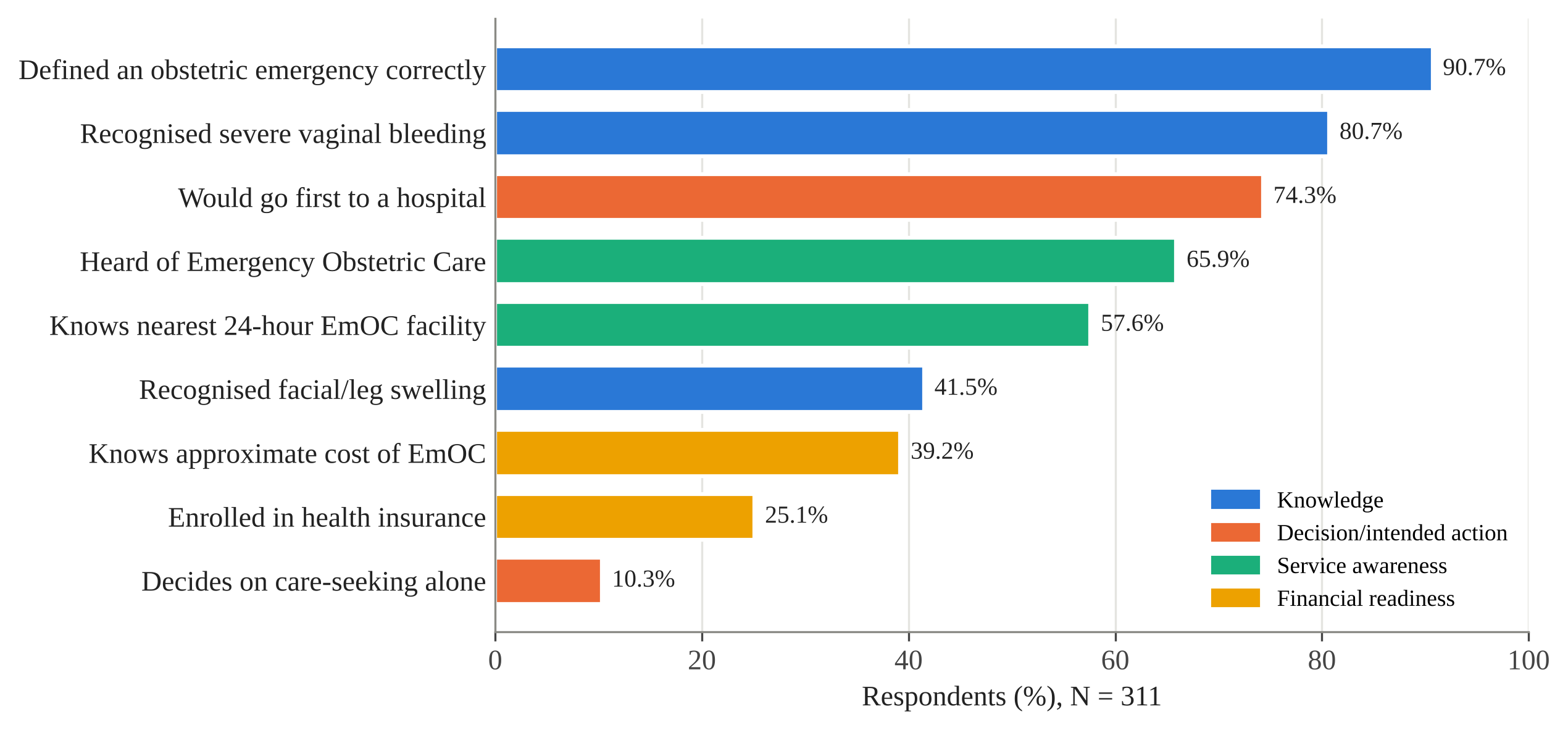
Women were mostly aged 25–34 years (59.2%), married (85.2%) and Muslim (74.0%), and 47.9% had tertiary or postgraduate education. Knowledge was high for the definition of an emergency but uneven sign by sign (Figure 1). Overall, 90.7% considered an obstetric emergency to be a serious problem that requires urgent medical attention and 80.7% identified severe vaginal bleeding as an obstetric emergency. But only 41.5% had noticed swelling of their face or legs, which is an early symptom of pre-eclampsia. The readiness indicators declined: 57.6% knew the closest 24-hour facility for EmOC, 39.2% knew the approximate cost of accessing EmOC, 25.1% had health insurance and 10.3% were able to authorize themselves to seek care. These indicators are derived from the same number of 311 women and are not a sequence of measures, but rather are separate measures.
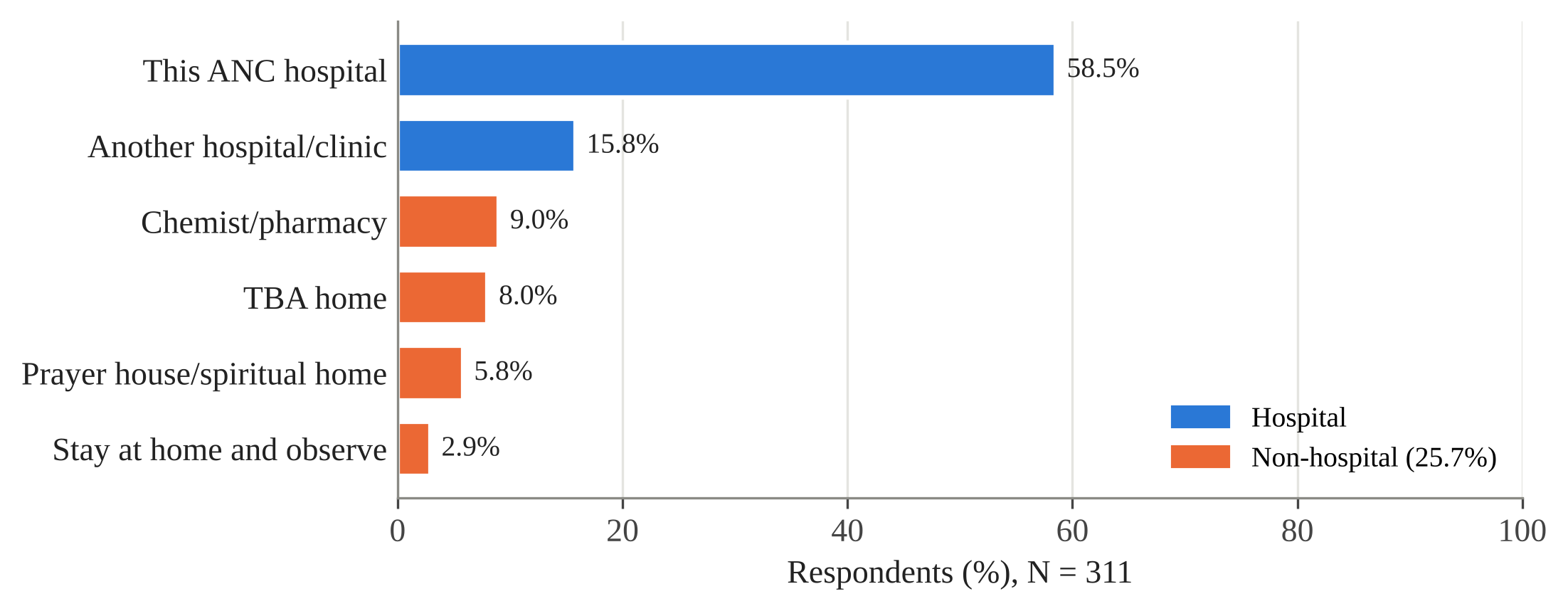
If a danger sign did occur, 74.3% would proceed to a hospital while 25.7% would take alternative routes: a chemist (9.0%), a traditional birth attendant (TBA) home (8.0%), a prayer house (5.8%) or go home to observe (2.9%) (Figure 2). The same pattern was seen for beliefs about capability: 88.1% said that government hospitals could manage an emergency immediately, 51.8% said so of primary health centres, 19.9% of chemists, 17.4% of TBA homes and 10.0% of prayer houses.
The interviews showed that this choice reflected beliefs about cause rather than a lack of knowledge about hospitals. Women described bleeding as an emergency but treated headache or fever as minor:
“Severe bleeding is what everyone fears. If blood is rushing out, you don't ask questions, you go to hospital. But if it is just headache or fever, we drink tea and rest first.” (P4, Adewole, 31 years, secondary education)
Where a complication was seen as spiritual, a prayer house or herbal remedy appeared to be the logical first response. A participant at the cottage hospital also explained why she did not see her own facility as the place to go:
“We know hospital has blood bank and operation, but here at cottage hospital, if problem is too big, they will write paper and transfer you to teaching hospital because they don't have blood bank here.” (P15, Adewole, 34 years, tertiary education)
Competing sources of information
Health workers and ANC talks were the main source of information for 56.0% of women, followed by family or friends (13.8%), radio or television (10.0%) and social media (9.6%); 7.7% had never received information and 2.9% relied on religious leaders. In interviews, ANC talks were valued, but women described advice from mothers-in-law that contradicted it, and community explanations that the clinic had to correct:
“It is only at clinic ANC talks that I learnt convulsion is caused by high blood pressure in pregnancy. In our area, people say it is spiritual attack from enemies.” (P13, Adewole, 25 years, secondary education)
“My mother-in-law also tells me what to avoid, but sometimes what she says is different from what nurses say at health center. She believes drinking herbal tea prevents complications.” (P19, KWASUTH, 32 years, postgraduate education)
Who decides, how far and how to pay
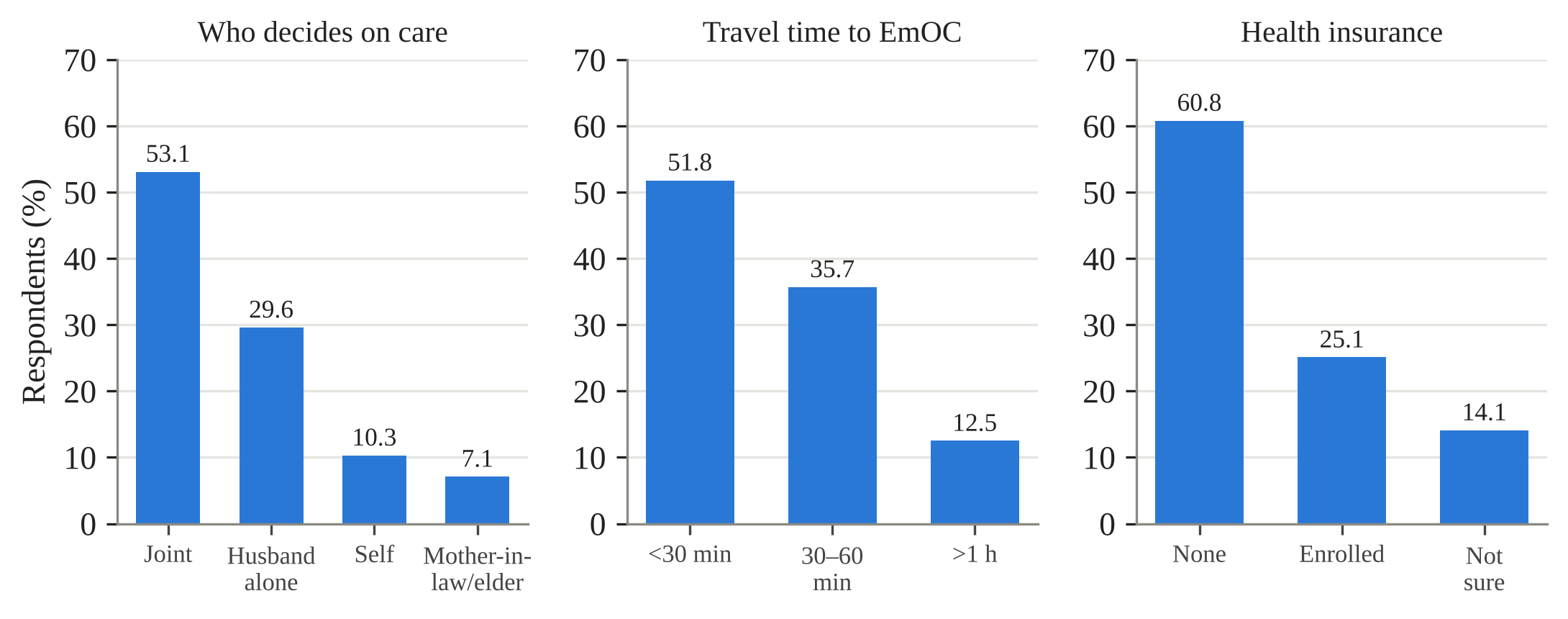
Just over half of the women (53.1%) said decisions about care were made jointly, 29.6% said their husband decided alone, 7.1% said a mother-in-law or elder decided, and 10.3% decided themselves (Figure 3). More than a third (36.7%) therefore had no personal authority to seek care. Travel time to an EmOC facility was 30 minutes or more for 48.2% of women and more than one hour for 12.5%. Most women (60.8%) were uninsured and a further 14.1% did not know their status; 60.8% had no idea what emergency care would cost.
Interviews added detail that the survey categories could not capture. Women explained that husbands controlled the money as well as permission, and that waiting for an unreachable husband stopped everyone at home from acting. At night, distance in minutes meant little when no taxi or ambulance was available, and on arrival, cash deposits and the purchase of drugs were required before treatment.
“I know they do operation and give blood in big hospital, but many women don't know exact care until emergency happens. We just pray not to need operation.” (P10, Adewole, 27 years, secondary education)
Joint display and meta-inferences
Table 1 brings the two strands together. Four domains showed expansion, two showed confirmation and one, decision-making, showed partial discordance. The survey recorded joint decision-making for most women, but 17 of the 20 interviewees described needing their husband's approval before leaving home, including some who would probably have described their household's decisions as joint.
| Domain | Survey finding | Interview finding | Fit | Meta-inference |
|---|---|---|---|---|
| Recognition | 90.7% defined an emergency correctly; bleeding recognised by 80.7%, swelling by 41.5% | Bleeding seen as an emergency (18/20); headache and swelling seen as normal discomforts | Expansion | Knowledge is selective: non-bleeding signs are normalised, not unknown |
| First recourse | 25.7% would go first to a non-hospital option; 17.4% saw TBA homes as able to manage emergencies | Spiritual attribution (15/20); herbal remedies first (12/20); endurance norms (13/20) | Expansion | Non-hospital recourse follows beliefs about cause, not ignorance of hospitals |
| Information | 56.0% learned mainly from health workers; 13.8% from family; 7.7% never informed | ANC talks valued (14/20), but mothers-in-law and peers give conflicting advice | Expansion | ANC messages compete with household advice that surveys under-record |
| Decision-making | 36.7% lacked personal authority; 53.1% reported joint decisions | Husband's approval required (17/20); elders overrule (14/20) | Discordance (partial) | Surveys reporting “joint” decisions probably understate male and elder gatekeeping |
| Physical access | 48.2% ≥ 30 min from EmOC; 12.5% > 1 h | No night transport or ambulance; drivers refuse bleeding women (16/20) | Expansion | Travel time understates night-time access failure |
| Financial readiness | 60.8% uninsured; 60.8% unaware of costs | Cash deposits and out-of-pocket costs the main barrier (19/20) | Confirmation | Financial unreadiness is the most consistent barrier across both strands |
| Facility capability | 57.6% knew nearest 24-h facility; 51.8% believed PHCs can manage emergencies | Cottage hospital seen as a referral point; shortages and staff delays (15/20) | Confirmation | Women overrate primary-level capacity, and referral adds delay |
ANC: antenatal care; EmOC: Emergency Obstetric Care; PHC: primary health centre; TBA: traditional birth attendant. Interview counts are participants whose accounts contributed to the sub-theme.
Discussion
The weakest link in the chain from danger to treatment is not that women know when something is dangerous, but that they can act in response to the danger. When it came to recognising subtle signs and deciding, travelling and paying, fewer women accomplished each step, although almost all women could define each as an emergency. The interviews told of these losses.
First, the recognition was selective. The hypertensive signs were re-defined as normal everyday complaints, which is in line with findings from Nigerian and Rwandan studies that knowledge is based on bleeding [4, 15, 16]. From the perspective of the health belief model, swelling and headache are not serious from the perceived side, and do not prompt action [9]. Second, the 25% of women who would first seek non-hospital care were doing so out of belief, not lack of knowledge, of hospital services. This is consistent with the findings on religious and ancestral influences on recourse in Nigeria [7, 17] and other parts of Africa [19]. These beliefs are negative nurturers that reframe the problem prior to a woman's arrival at a clinic through the PEN-3 lens [10].
Thirdly, the partial disagreement in decision making is of methodological significance. The category survey, “joint decision,” suggests joint decision-making, but in reality the husband's approval and, of course, his money is still required. The study might therefore have underestimated men's gatekeeping in northern Nigeria and Kogi State because they used survey instruments to measure the gatekeeping. In contrast, Ethiopian research indicates that the husbands' involvement in planning can lead to faster care [21]. Fourth, financial inadequacy was the consistent result in both strands, as reported in the other two States of Ebonyi State [5] and Rivers State [6] and supported by the fact that knowledge of danger signs does not guarantee the use of services [23].
These results suggest that interventions are needed beyond health education. Non-bleeding signs should be given equal consideration during ANC and husbands should be included, and mothers-in-law if possible. Programmes should involve religious leaders to ensure that early hospital care is seen to be congruent with religion. All aspects of birth-preparedness counselling should involve the actual cost of care and a plan for transport at night. Systemic-level: A no deposit policy for obstetric emergencies, more health insurance coverage, and operating an ambulance service would overcome the obstacles that women cannot navigate with knowledge.
There are some limitations to this study. Both strands were sampled from women already attending ANC, who have a higher level of awareness about health and are more deeply engaged in service provision than women who are not attending ANC. The majority of the survey respondents were from the teaching hospital. The first resorts suggested may not actually be the ones women would go to in an emergency. Household and facility delays could be further explained using interviews with the husbands, elders and health workers. The integration is descriptive and no causal pathway is tested.
Conclusion
Most pregnant women in Ilorin are aware of what obstetric emergencies are but are not able to act on that knowledge. The proportion of women reaching timely care decreases as women choose to go to different places for care due to selective recognition, spiritual explanations, household authority, distance at night and point-of-care costs. It is evident from the combination of the survey and interview findings that family centred and faith sensitive ANC, coupled with transport and financial protection is a necessary intervention to close the know–do gap.
Acknowledgment
The authors thank the women who took part in the study and the management and staff of KWASUTH and Adewole Cottage Hospital.
References
- [1]World Health Organization. Trends in maternal mortality 2000 to 2020: Estimates by WHO, UNICEF, UNFPA, World Bank Group and UNDESA/Population Division. Geneva: World Health Organization; 2023.
- [2]Thaddeus S, Maine D. Too far to walk: Maternal mortality in context. Social Science & Medicine. 1994;38(8):1091–1110. https://doi.org/10.1016/0277-9536(94)90226-7
- [3]Ohenhen V, Oshomoh SA, Akpojaro E, Enobakhare E, Ovenseri C, Eboreime E. Birth preparedness and complication readiness: Evaluating the “know-do” gap among women receiving antenatal care in Benin City, Nigeria. Journal of Biosocial Science. 2023;55(6):1086–1100. https://doi.org/10.1017/S0021932022000475
- [4]Famutimi EO, Olagunju OS, Olajide AO, Adejumo PO. Knowledge and perception of obstetric danger signs among antenatal women in Oyo West Local Government Area, Nigeria: A cross-sectional study. Journal of Nursing Reports in Clinical Practice. 2026;4(5):287–297. https://doi.org/10.32598/JNRCP.2026.1369
- [5]Ilo IJ, Okolie S, Ndubuka CC, Ehiemere IO, Ekechukwu END. Factors preventing translation of knowledge to practice of birth preparedness and complication readiness among expectant mothers in Oji-River, Enugu. Teikyo Medical Journal. 2022;45(9):7421–7430.
- [6]Onoh RC, Egede JO, Lawani LO, Ekwedigwe KC, Aja LO, Anozie BO. Birth preparedness and complication readiness among women of reproductive age group in Abakaliki, Southeast Nigeria. Nigerian Journal of Clinical Practice. 2020;23(3):362–370. https://doi.org/10.4103/njcp.njcp_670_18
- [7]Opara UC, Iheanacho PN, Petrucka P. Cultural and religious structures influencing the use of maternal health services in Nigeria: A focused ethnographic research. Reproductive Health. 2024;21:188. https://doi.org/10.1186/s12978-024-01933-8
- [8]Oguntunde O, Nyenwa J, Yusuf F, Dauda AG, Oyeniyi R, Findley S. Factors associated with the knowledge of obstetric danger signs, and perceptions of the need for obstetric care amongst married young women in northern Nigeria. African Journal of Primary Health Care & Family Medicine. 2021;13(1):a2557. https://doi.org/10.4102/phcfm.v13i1.2557
- [9]Rosenstock IM. Historical origins of the health belief model. Health Education Monographs. 1974;2(4):328–335. https://doi.org/10.1177/109019817400200403
- [10]Airhihenbuwa CO. Health and culture: Beyond the Western paradigm. Thousand Oaks, CA: Sage; 1995.
- [11]Creswell JW, Plano Clark VL. Designing and conducting mixed methods research. 3rd ed. Thousand Oaks, CA: Sage; 2018.
- [12]Fetters MD, Curry LA, Creswell JW. Achieving integration in mixed methods designs—principles and practices. Health Services Research. 2013;48(6 Pt 2):2134–2156. https://doi.org/10.1111/1475-6773.12117
- [13]Cochran WG. Sampling techniques. 3rd ed. New York: John Wiley & Sons; 1977.
- [14]Braun V, Clarke V. Using thematic analysis in psychology. Qualitative Research in Psychology. 2006;3(2):77–101. https://doi.org/10.1191/1478088706qp063oa
- [15]Oni OO, Bello OO, Ajayi AA. Determinants of adequate knowledge of postpartum warning signs and complications among parturients in Ibadan, Nigeria: A cross sectional study. BMC Pregnancy and Childbirth. 2025;25:894. https://doi.org/10.1186/s12884-025-08058-1
- [16]Uwiringiyimana E, et al. Pregnant women’s knowledge of obstetrical danger signs: A cross-sectional survey in Kigali, Rwanda. PLOS Global Public Health. 2022;2(11):e0001084. https://doi.org/10.1371/journal.pgph.0001084
- [17]Mustapha AA, Akpor OA, Muhammad F. Religion and pregnancy: Post-partum mothers religious beliefs and practices in an urban area in Southwestern Nigeria. Annals of the Romanian Society for Cell Biology. 2021;25(4):4692–4702.
- [18]Biralo PK, Nnadi NO, Uriah SS, Dan-Jumbo A. Religion, socio-cultural factors and maternal mortality in Bori, Ogoni, Rivers State. Greener Journal of Medical Sciences. 2023;13(2):126–132. https://doi.org/10.15580/GJMS.2023.2.091123103
- [19]Felisian S, Mushy SE, Tarimo EA, Kibusi SM. Sociocultural practices and beliefs during pregnancy, childbirth, and postpartum among indigenous pastoralist women of reproductive age in Manyara, Tanzania: A descriptive qualitative study. BMC Women’s Health. 2023;23:123. https://doi.org/10.1186/s12905-023-02277-4
- [20]Olowolafe AS, Eleojo YM, Oladoyinbo OT, Ademola SA, Abdullahi LA, Kalesanwo EO. Factors influencing husband’s involvement in birth preparedness and complication readiness among women attending ante-natal clinic in General Hospital Alloma, Ofu Local Government Area, Kogi State. International Journal of Research Publication and Reviews. 2023;4(10):21–29.
- [21]Yemata GA, Dessibellew G, Alle A, Tafere Y, Bayabil AW, Dagnaw EH. Husband participation in birth preparedness and complication readiness and its predictors among men whose wife was admitted for an obstetric referral at South Gondar zone: A multicenter cross-sectional study. Heliyon. 2023;9(5):e15348. https://doi.org/10.1016/j.heliyon.2023.e15348
- [22]Aguma OC, Ihudiebube-Splendor CN, Altraide OB, Peretomode E. Birth preparedness and complication readiness knowledge and practice among pregnant women in selected primary health care centers in Port Harcourt, Rivers State. African Journal of Health, Nursing and Midwifery. 2020;3(4):23–34.
- [23]Shewiyo EJ, Manongi R, Mahande MJ. Does knowledge of danger signs influence use of maternal health services among rural women? Findings from Babati Rural district, Northern Tanzania. PAMJ One Health. 2021;4:4. https://doi.org/10.11604/pamj-oh.2021.4.4.25206