Electronic and Communication Engineering
Artificial Neural Network-Assisted Remote Radio Control for Adaptive Data Transmission Optimization in Wireless Communication Networks
1Department of Engineering and Space Systems, National Space Research and Development Agency, Abuja, Nigeria
2Department of Electrical/Electronic Engineering, Chukwuemeka Odumegwu Ojukwu University, Uli, Anambra State, Nigeria
Published October 2026
Abstract
The increasing heterogeneity, traffic intensity, and dynamic operating conditions of modern wireless communication networks limit the effectiveness of conventional fixed radio-control strategies. This study develops an Artificial Neural Network (ANN)-assisted Remote Radio Control (RRC) framework for adaptive optimization of wireless data transmission. The proposed framework was implemented and evaluated using MATLAB R2021a/Simulink. A conventional wireless network model was characterized using throughput, signal-to-interference-plus-noise ratio (SINR), bit error rate (BER), packet delivery ratio (PDR), and latency. The characterized network parameters were subsequently used as feedback inputs to the ANN controller for adaptive radio-control decisions. Simulation parameters included a 2.4 GHz carrier frequency, 20 MHz bandwidth, 23 dBm transmit power, QPSK modulation, coding rate of 1/2, 1024-bit packets, 20 users, and an additive white Gaussian noise (AWGN)-plus-multipath channel. Results indicate that ANN-assisted RRC improved throughput from 2.00 to 2.60 Mbps (30.0%) and SINR from 4.70 to 6.11 dB (approximately 30.0%). BER decreased from 0.00053 to 0.00046 (13.2%), while PDR increased from 65.0% to 84.5%, representing a 30.0% relative improvement. Furthermore, latency decreased from 114.4 to 88.0 ms, corresponding to a 23.08% reduction. These findings demonstrate the potential of ANN-assisted RRC to enhance multiple wireless-network performance indicators simultaneously. The proposed simulation framework provides a foundation for intelligent radio control in evolving 5G, beyond-5G, and 6G communication networks.
Keywords: artificial neural network; adaptive radio control; remote radio control; wireless communication; throughput; SINR; packet delivery ratio; latency
1Introduction
1.1Background
Wireless communication networks support mobile broadband, the Internet of Things (IoT), industrial automation, intelligent transportation, and emerging 5G/6G applications. Increasing traffic demand and connected devices create challenges involving interference, variable channel conditions, limited spectrum, throughput, reliability, and latency. Conventional radio-control approaches rely on fixed parameters and predefined rules, limiting adaptability under dynamic conditions. Machine learning (ML) offers an alternative by learning relationships between network conditions and resource-management decisions (Pivoto et al., 2025). AI-enabled resource management is increasingly investigated for channel allocation, power control, user association, and other 6G network functions (Alhashimi et al., 2025). Similarly, ML-based approaches address competing objectives, including throughput, latency, energy efficiency, and reliability (Liaq et al., 2025). Artificial neural networks (ANNs) are suitable for adaptive radio control because they learn nonlinear relationships between network conditions and control actions. By processing throughput, SINR, BER, PDR, and latency measurements, an ANN controller can support decisions that improve wireless-network performance. Recent studies have explored learning-based radio-resource scheduling for RAN slicing (Nahum et al., 2024), cell-free massive-MIMO systems, and autonomous sidelink resource management in C-V2X networks (Trabelsi et al., 2024). Learning-based allocation has also been investigated for ultra-reliable low-latency communications (Zhang et al., 2024) and D2D-enabled cellular networks (Kamruzzaman et al., 2024). Frank et al. (2024) reported better prediction accuracy for a multilayer perceptron than a decision-tree model. Furthermore, Sherif et al. (2025) investigated deep reinforcement learning and transfer learning for dynamic radio-resource management in Open RAN slicing, considering latency, reliability, power consumption, and QoS. Despite these advances, many studies focus on specialized environments, including vehicular networks, massive MIMO, D2D communication, and Open RAN. Therefore, a simple, reproducible ANN-assisted Remote Radio Control (RRC) framework is valuable for linking conventional network characterization with adaptive control and measurable performance improvements.
1.2Related works
Recent studies demonstrate the growing role of AI and ML in intelligent wireless-resource management. Pivoto et al. (2025), Liaq et al. (2025), Alhashimi et al. (2025), and Kori et al. (2025) reviewed learning-based approaches for resource allocation, scheduling, power control, and optimization of throughput, latency, and energy efficiency. Trabelsi et al. (2024) investigated deep reinforcement learning for dynamic C-V2X resource management, while Nahum et al. (2024) explored intent-aware reinforcement-learning-based radio scheduling. Other studies examined learning-based scheduling in cell-free massive MIMO, predictive access-point management (Frank et al., 2024), and reinforcement-learning-based resource optimization for industrial 5G camera systems (Szabó & Pető, 2024). Neural-network methods have also addressed resource allocation under URLLC reliability constraints (Zhang et al., 2024), while graph neural networks have improved the scalability and computational efficiency of bandwidth allocation (Hao et al., 2024). Sherif et al. (2025) investigated deep reinforcement learning and transfer learning for Open RAN slicing. Further studies highlighted distributed machine learning and AI-native architectures as foundations for autonomous, adaptive wireless networks (Chen et al., 2023; Muhammad & Tabassum, 2024). Despite these advances, existing approaches frequently emphasize specialized applications or complex learning and optimization techniques. This study therefore develops a transparent ANN-assisted Remote Radio Control framework that uses measurable network-performance indicators to support adaptive radio-control decisions.
1.3Research gap and objective of the study
Despite advances in learning-based wireless-resource management, many existing studies focus on specialized network environments or computationally demanding reinforcement-learning techniques. There remains a need for a simple, reproducible framework that integrates conventional network characterization, Artificial Neural Network (ANN) learning, and adaptive Remote Radio Control (RRC). This study therefore develops an ANN-assisted RRC framework using throughput, SINR, BER, PDR, and latency as measurable network-performance indicators. Its specific objectives are to characterize conventional wireless-network performance, develop a MATLAB/Simulink model, train an ANN using characterized data, implement adaptive radio control, integrate the ANN and RRC into a unified simulation framework, and evaluate performance improvements against conventional radio control.
2Methodology
2.1Research design
A simulation-based experimental design was implemented in MATLAB R2021a/Simulink using conventional wireless communication and ANN-assisted Remote Radio Control (RRC) models. The conventional model established baseline performance, while its measured metrics trained the ANN controller to determine adaptive radio-control actions. Both models were subsequently evaluated and compared.
2.2System input parameters
The principal simulation parameters are presented in Table 1.
| Parameter | Symbol | Value |
|---|---|---|
| Carrier frequency | f c | 2.4 GHz |
| Channel bandwidth | B | 20 MHz |
| Transmit power | P t | 23 dBm |
| Receiver noise figure | NF | 5 dB |
| Thermal noise density | N 0 | −174 dBm/Hz |
| Modulation | M | QPSK |
| Coding rate | R c | 1/2 |
| Packet size | L p | 1024 bits |
| Data rate | R d | 2 Mbps |
| Number of users | N u | 20 |
| Simulation duration | T s | 100 s |
| Channel | — | AWGN + multipath |
The 2.4-GHz carrier and 20-MHz bandwidth define the operating frequency and spectrum. The baseline uses 23-dBm transmit power, QPSK modulation, and a 1/2 coding rate. Twenty simultaneous users model network contention, while the AWGN-plus-multipath channel represents noisy, frequency-selective propagation.
2.3Conventional wireless communication model
The first model shown in Figure 1 exemplifies a conventional wireless network in which the principal radio parameters remain fixed during the baseline simulation.
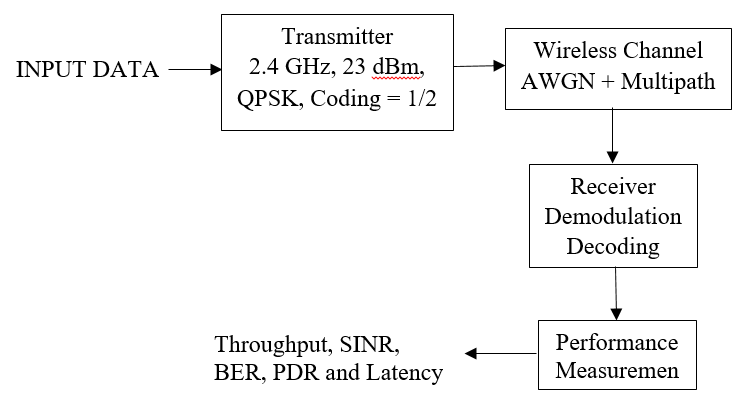
The baseline model establishes the performance against which the ANN-RRC system is evaluated.
2.4Performance characterization
Five key performance indicators are considered.
2.4.1Throughput
Throughput represents the successfully transmitted data per unit time:
where Ds is the amount of successfully transmitted data and tt is the transmission time.
2.4.2Signal-to-interference-plus-noise ratio
where Ps is the desired signal power, Pi is the interference power and Pn is the noise power.
2.4.3Bit error rate
where Ne is the number of erroneous bits and Nt is the total number of transmitted bits.
2.4.4Packet delivery ratio
where Np,r is the number of successfully received packets and Np,t is the number of transmitted packets.
2.4.5Latency
where ts is the packet transmission time and tr is the packet reception time.
2.5ANN-based network-state representation
The network-state vector is defined as:
For the conventional baseline, the state vector is:
Before ANN training, the variables are normalized to prevent variables with larger numerical magnitudes, such as latency and PDR, from dominating smaller variables such as BER.
A min–max normalization may be expressed as:
where xn is the normalized value.
2.6ANN architecture
A feed-forward multilayer perceptron is adopted for the control function (Figure 2).
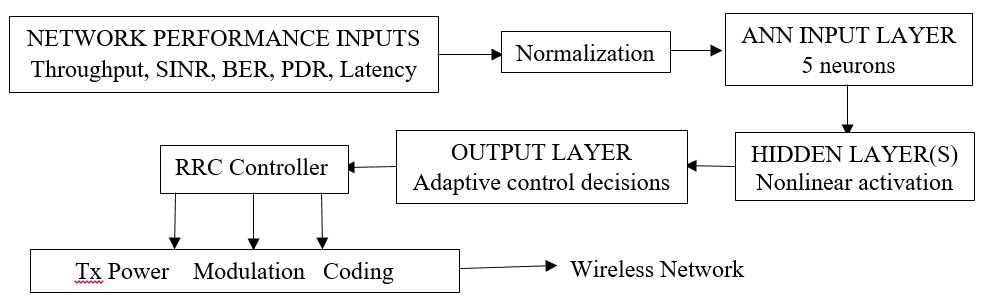
2.7Mathematical ANN model
For an ANN with input vector x, the hidden-layer output is:
where W1 is the input-to-hidden weight matrix, b1 is the hidden-layer bias and ϕ is the nonlinear activation function. The output layer is:
where W2 is the hidden-to-output weight matrix, b2 is the output bias and g is the output activation function. The ANN output vector represents the radio-control decision:
where Pt represents transmit power, Gr receiver gain, M modulation, Rc coding rate and C channel/tuner selection. The control decision can therefore be represented as:
2.8Remote radio control mechanism
The ANN output is connected to the RRC block. The RRC interprets the ANN decision and adjusts the available radio parameters. The integrated ANN-RRC control loop is shown in Figure 3.
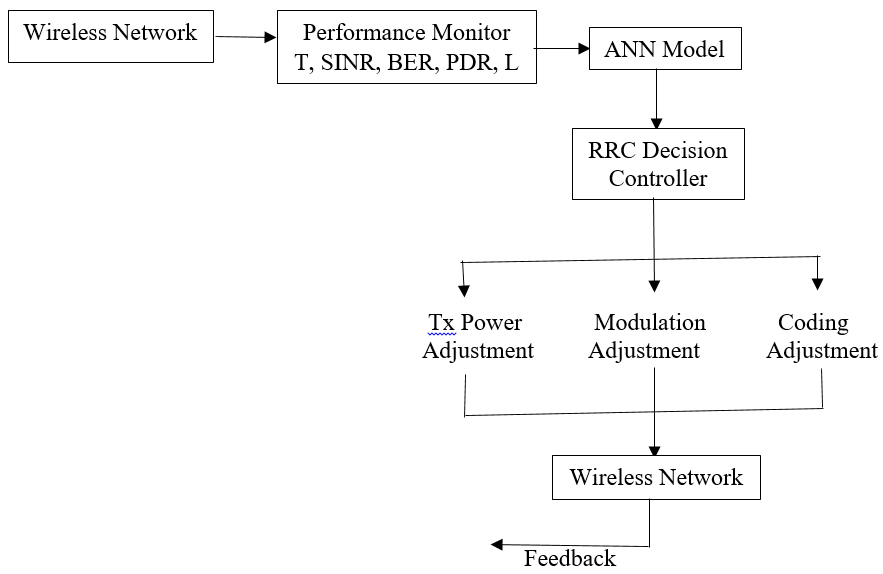
The structure in Figure 3 forms a closed-loop control mechanism.
2.9Control objective
The ANN-RRC controller is designed to improve the overall network condition rather than optimize only one metric.
A normalized multi-objective cost function can be represented as:
where wT, wS, wB, wP and wL are weighting factors. For higher-is-better parameters:
For BER and latency, where lower values are desirable:
The RRC seeks control actions that reduce J, subject to available radio-parameter constraints.
2.10Algorithm
Algorithm 1. ANN-assisted remote radio control
- 1. Initialize wireless-network parameters.
- 2. Generate/transmit data packets.
- 3. Pass signals through AWGN + multipath channel.
- 4. Receive and decode transmitted packets.
- 5. Calculate throughput, SINR, BER, PDR and latency.
- 6. Normalize the characterized metrics.
- 7. Feed normalized metrics to the ANN.
- 8. ANN estimates the appropriate radio-control action.
- 9. RRC adjusts available radio parameters.
- 10. Repeat network transmission under the selected settings.
- 11. Recalculate performance metrics.
- 12. Compare conventional and ANN-RRC performance.
- 13. Compute percentage improvement/reduction.
- 14. Store results and terminate after the simulation period.
3Results and discussion
3.1Baseline and ANN-RRC performance
The simulation produced the results presented in Table 2.
| Performance metric | Conventional control | ANN-RRC | Change | Improvement |
|---|---|---|---|---|
| Throughput (Mbps) | 2.00 | 2.60 | +0.60 | 30.00% ↑ |
| SINR (dB) | 4.70 | 6.11 | +1.41 | 30.00% ↑ |
| BER | 0.00053 | 0.00046 | −0.00007 | 13.21% ↓ |
| PDR (%) | 65.0 | 84.5 | +19.5 pp | 30.00% relative ↑ |
| Latency (ms) | 114.4 | 88.0 | −26.4 ms | 23.08% ↓ |
pp = percentage points; ↑ = improvement (increase); ↓ = improvement (reduction).
The percentage improvement was calculated as follows, where X represents the metric values:
for higher-is-better parameters, while the percentage reduction was calculated as:
for BER and latency.
3.2Throughput performance
Throughput increased from 2.00 Mbps under conventional control to 2.60 Mbps under ANN-RRC (Figure 4).
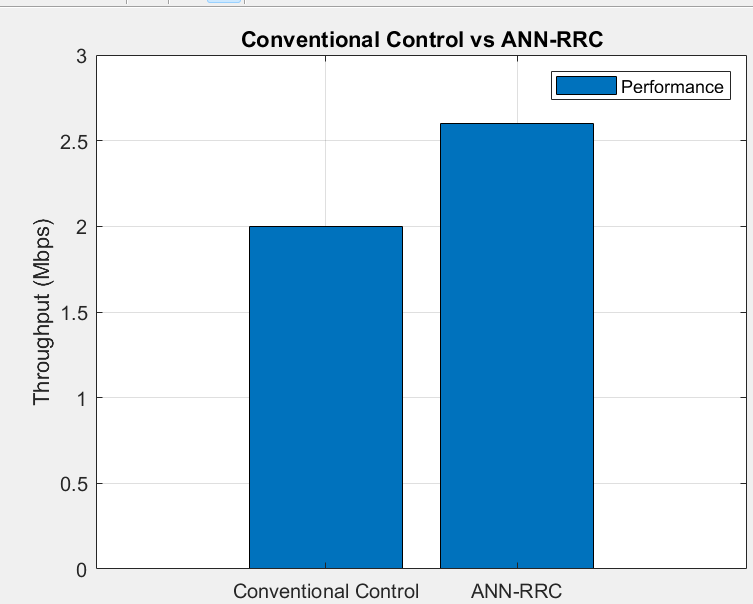
The 0.60-Mbps increase corresponds to a 30.0% improvement. The result indicates that adaptive radio control was able to select operating conditions that supported more successful data transmission than the fixed conventional configuration. This finding is consistent with recent research showing that learning-based resource management can improve data-rate and resource-utilization objectives in wireless networks (Pivoto et al., 2025; Liaq et al., 2025).
3.3SINR performance
SINR increased from 4.70 dB to 6.11 dB (Figure 5), representing an improvement of approximately 30.0%.
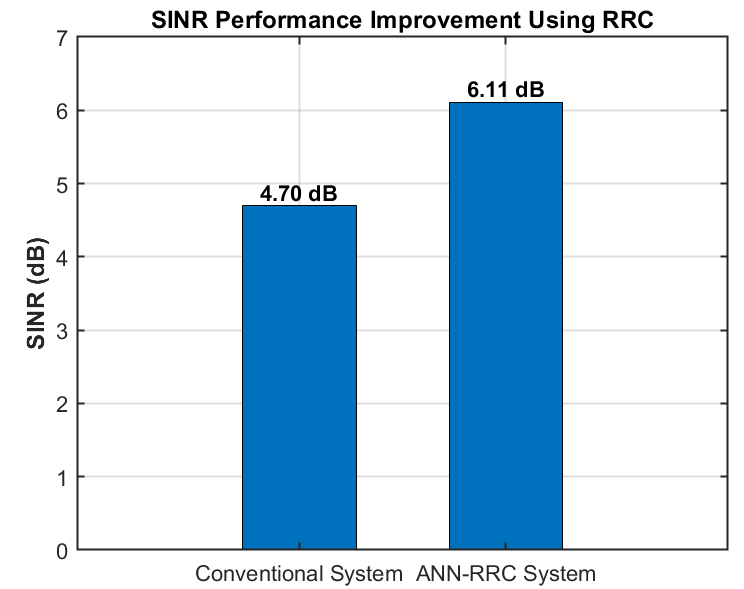
The increase indicates improved received signal quality relative to interference and noise. Since SINR directly influences successful demodulation and packet reception, its improvement provides a technical explanation for the corresponding improvements in BER, PDR and throughput. Learning-based resource allocation studies similarly identify signal quality and interference management as important control objectives in dynamic wireless environments.
3.4BER performance
BER decreased from 0.00053 to 0.00046 (Figure 6).
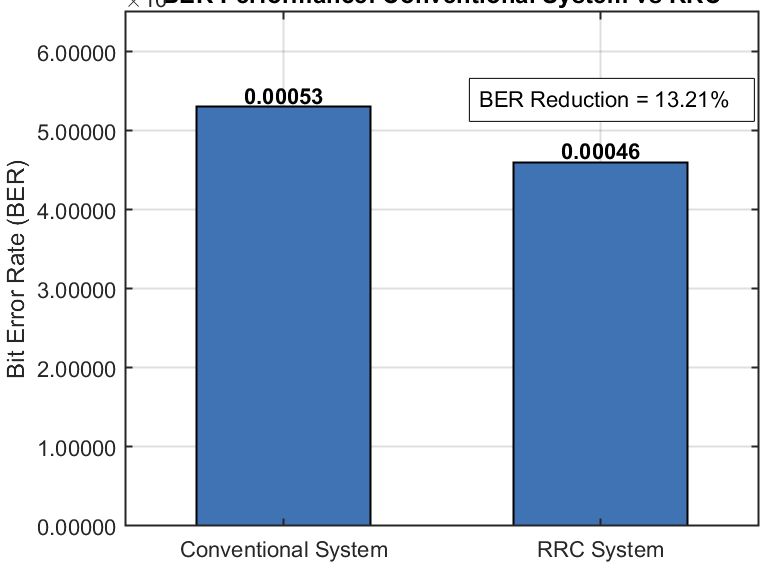
The RRC system reduced the BER from 0.00053 to 0.00046, representing a 13.21% reduction in bit errors relative to the conventional system. This indicates improved transmission reliability, assuming both values were obtained under comparable simulation conditions.
3.5Packet delivery ratio
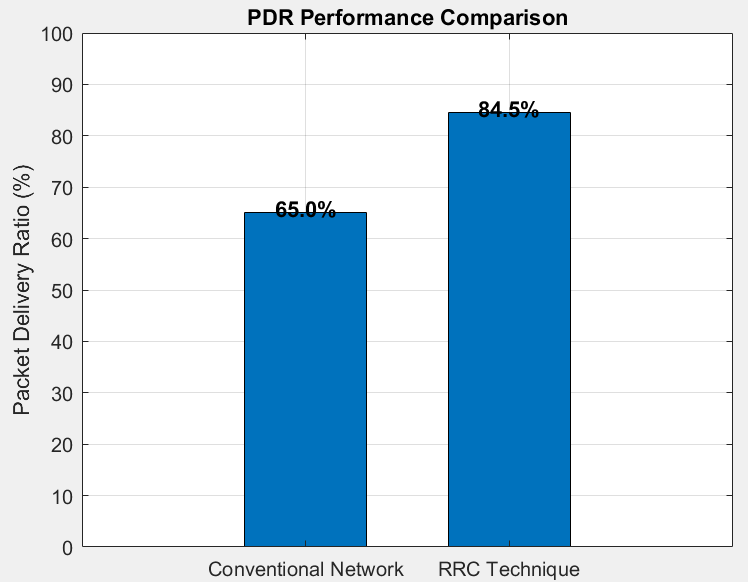
PDR increased from 65.0% to 84.5% (Figure 7), an absolute increase of 19.5 percentage points.
The relative improvement is:
Therefore, the ANN-RRC method provides a 30.0% relative PDR improvement, while the absolute gain is 19.5 percentage points. The distinction is important because percentage-point change and relative percentage improvement are not identical.
The increase in PDR is significant from a communication-system perspective because successful packet delivery is directly related to application-level reliability. Recent intelligent-resource-management studies similarly identify reliability and QoS satisfaction as important outcomes of adaptive network control.
3.6Latency performance
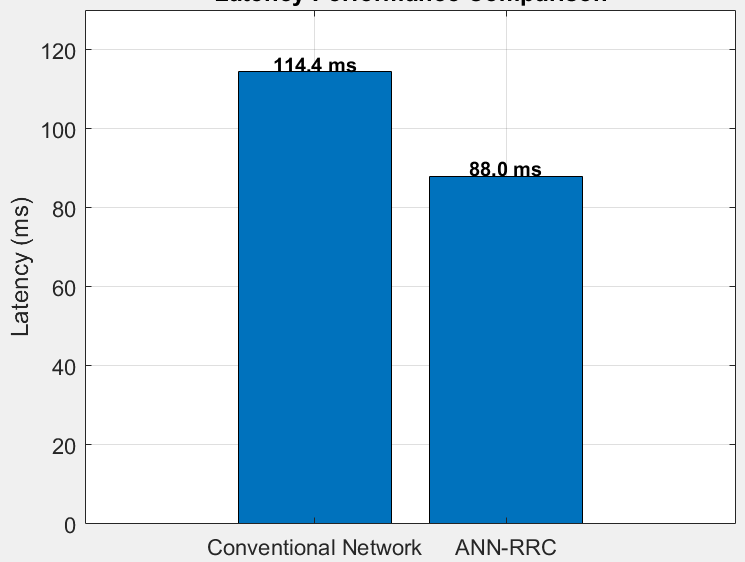
Latency decreased from 114.4 ms to 88.0 ms (Figure 8).
The percentage reduction is:
Therefore, ANN-RRC achieved a 23.08% latency reduction.
This result is important because latency is a lower-is-better metric. The reduction indicates that the adaptive controller did not merely maximize throughput at the expense of delay. Instead, the proposed system produced simultaneous improvement in throughput and reduction in latency. Such multi-objective behaviour is particularly relevant to 5G/6G applications with stringent delay requirements. Recent AI-enabled resource-management research similarly identifies latency as a central optimization objective.
3.7Overall performance improvement
The improvements are summarized in Table 3, Figure 9 and Figure 10.
| Metric | Conventional | ANN-RRC | Direction | Improvement |
|---|---|---|---|---|
| Throughput | 2.00 Mbps | 2.60 Mbps | Higher | 30.00% |
| SINR | 4.70 dB | 6.11 dB | Higher | 30.00% |
| BER | 0.00053 | 0.00046 | Lower | 13.21% reduction |
| PDR | 65.0% | 84.5% | Higher | 30.00% relative |
| Latency | 114.4 ms | 88.0 ms | Lower | 23.08% reduction |
The results show that the proposed ANN-RRC framework improved all five selected performance indicators. Throughput and SINR increased, while BER and latency decreased and PDR increased.
The result is particularly significant because improvement was not restricted to a single metric. A radio-control technique that increases throughput while simultaneously increasing BER or latency would provide limited practical benefit. In contrast, the present results indicate a more balanced improvement across reliability, quality, delivery rate, data rate and delay.
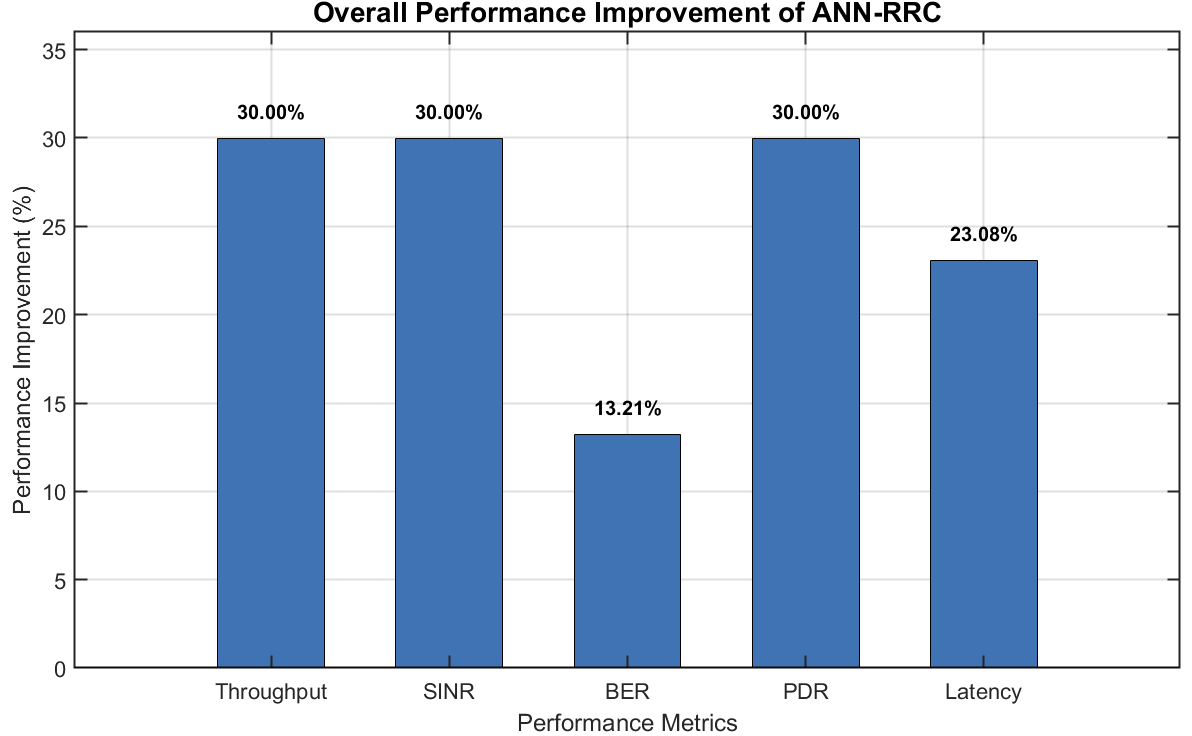
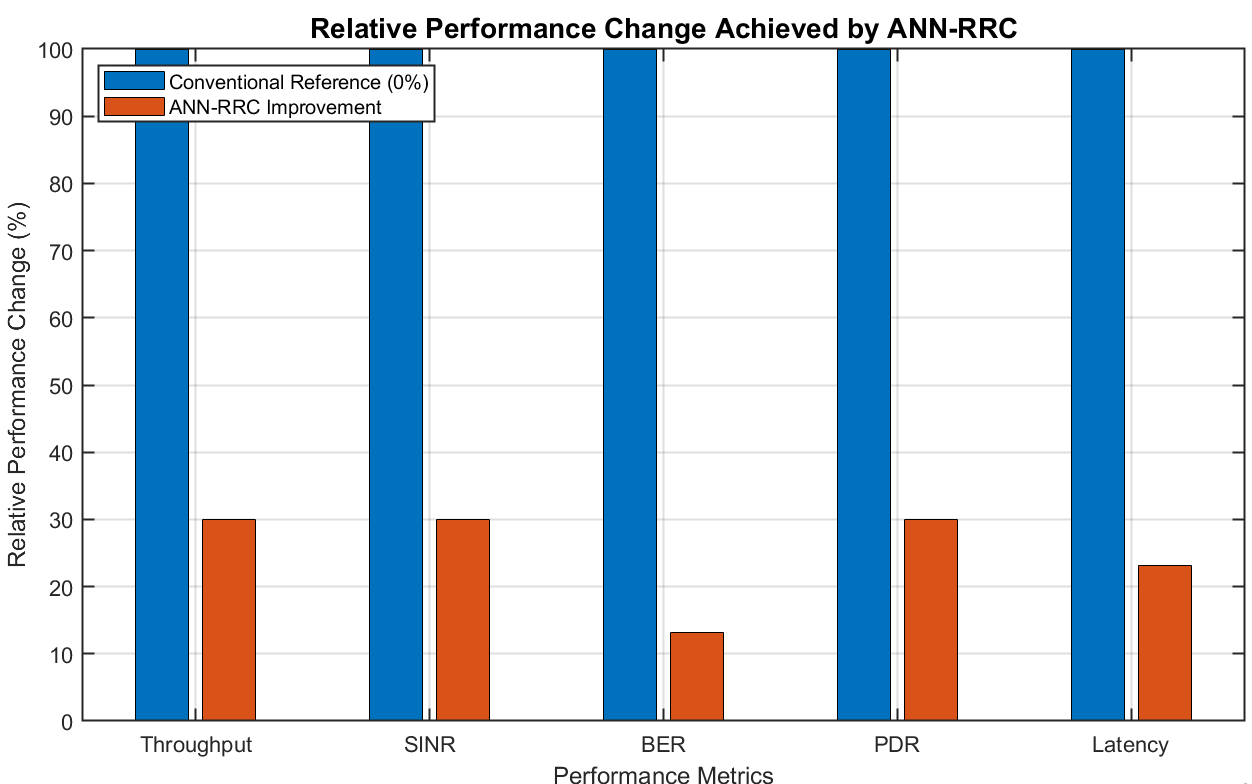
The comparative results support the premise that an ANN can be used as an adaptive decision mechanism for radio control. The approach is also consistent with the broader direction of intelligent wireless networking, where ML is increasingly being used to address complex resource-allocation and network-control problems (Alhashimi et al., 2025; Pivoto et al., 2025).
3.8Discussion of findings in relation to recent literature
The 30% throughput improvement supports findings that ML enhances wireless resource allocation and optimization (Pivoto et al., 2025; Liaq et al., 2025). Improved SINR aligns with learning-based interference management and scheduling studies in D2D and cell-free massive-MIMO networks. The PDR increase addresses reliability challenges identified in dynamic C-V2X resource management (Trabelsi et al., 2024), while the 23.08% latency reduction supports AI/ML applications in latency-sensitive and ultra-reliable low-latency communications (URLLC).
Compared with complex DRL and GNN approaches, the proposed ANN-assisted RRC offers a relatively transparent, reproducible simulation framework linking measured network performance to adaptive control decisions. However, its simulated improvements require further validation under realistic channel conditions and field deployment.
4Conclusion
This study developed an ANN-assisted Remote Radio Control (RRC) framework in MATLAB R2021a/Simulink for adaptive wireless data transmission. The system integrated network characterization, ANN-based decision-making, and adaptive radio control. Results showed that throughput increased from 2.00 to 2.60 Mbps (30.0%), while SINR improved from 4.70 to 6.11 dB (approximately 30.0%). BER decreased from 0.00053 to 0.00046 (13.2%), PDR increased from 65.0% to 84.5% (19.5 percentage points; 30.0% relative improvement), and latency decreased from 114.4 to 88.0 ms (23.08%). These findings demonstrated the potential of ANN-assisted RRC to improve data rate, signal quality, and packet reliability while reducing errors and delay. The framework provides a foundation for intelligent 5G, beyond-5G, and 6G network management. Future work should investigate diverse channel conditions, user mobility, online learning, hardware implementation, and comparisons with advanced AI controllers.
References
- [1]Alhashimi HF, Hindia MN, Dimyati K, Hanafi EB, Alden FZ, Qamar F et al. (2025). Survey on AI-enabled resource management for 6G heterogeneous networks: Recent research, challenges, and future trends. Computers, Materials & Continua, 83(3), 3585–3622. https://doi.org/10.32604/cmc.2025.062867
- [2]Chen T, Deng J, Tang Q, Liu G (2023). Optimization of quality of AI service in 6G native AI wireless networks. Electronics, 12(15), 3306. https://doi.org/10.3390/electronics12153306
- [3]Distributed Machine Learning and Native AI Enablers for End-to-End Resources Management in 6G (2023). Electronics, 12(18), 3761.
- [4]Frank LR, Galletta A, Carnevale L, Vieira AB, Silva EF (2024). Intelligent resource allocation in wireless networks: Predictive models for efficient access point management. Computer Networks, 254, 110762. https://doi.org/10.1016/j.comnet.2024.110762
- [5]Hao X, She C, Yeoh PL, Liu Y, Vucetic B, Li Y (2024). Hybrid-task meta-learning: A GNN approach for scalable and transferable bandwidth allocation. IEEE Transactions on Wireless Communications, 23(12), 19820–19835. https://doi.org/10.1109/TWC.2024.3487533
- [6]Kamruzzaman M, Sarkar NI, Gutierrez J (2024). Machine learning-based resource allocation algorithm to mitigate interference in D2D-enabled cellular networks. Future Internet, 16(11), 408. https://doi.org/10.3390/fi16110408
- [7]Kori GS, Kakkasageri MS, Chanal PM, Pujar RS, Telsang VA (2025). Wireless sensor networks and machine learning centric resource management schemes: A survey. Ad Hoc Networks, 167, 103698. https://doi.org/10.1016/j.adhoc.2024.103698
- [8]Learning-Based Precoding-Aware Radio Resource Scheduling for Cell-Free mMIMO Networks (2024). IEEE Transactions on Wireless Communications, 23(5), 4876–4888. https://doi.org/10.1109/TWC.2023.3323152
- [9]Liaq M, Sharif S, Zeadally S, Ejaz W (2025). Utilization of machine learning in future wireless networks for resource optimization: A survey. Ad Hoc Networks, 178, 103983. https://doi.org/10.1016/j.adhoc.2025.103983
- [10]Lu M (2024). Application of machine learning algorithms in resource allocation for wireless communications. Journal of Computer Science and Engineering, 102, Article 20240966. https://doi.org/10.54254/2755-2721/102/20240966
- [11]Muhammad FS, Tabassum H (2024). AI native in wireless radio access networks: Is there a pot at the end of this rainbow? IEEE Communications Society Technology News.
- [12]Nahum CV, Lopes VHL, Dreifuerst RM, Batista P, Correa I, Cardoso KV, Klautau A, Heath RW (2024). Intent-aware radio resource scheduling in a RAN slicing scenario using reinforcement learning. IEEE Transactions on Wireless Communications, 23(3), 2253–2267. https://doi.org/10.1109/TWC.2023.3297014
- [13]Pivoto DGS, de Figueiredo FAP, Cavdar C, Tejerina GRL, Mendes LL (2025). A comprehensive survey of machine learning applied to resource allocation in wireless communications. IEEE Communications Surveys & Tutorials, 28, 1986–2053. https://doi.org/10.1109/COMST.2025.3552370
- [14]Sherif H, Ahmed E, Kotb AM (2025). Towards green networking: Efficient dynamic radio resource management in Open-RAN slicing using deep reinforcement learning and transfer learning. Computer Communications, 236, 108126. https://doi.org/10.1016/j.comcom.2025108126
- [15]Szabó G, Pető J (2024). Intelligent wireless resource management in industrial camera systems: Reinforcement learning-based AI-extension for efficient network utilization. Computer Communications, 216, 68–85. https://doi.org/10.1016/j.comcom.2023.12.026
- [16]Trabelsi N, Chaari Fourati L, Jaafar W (2024). Deep reinforcement learning for autonomous SideLink radio resource management in platoon-based C-V2X networks: An overview. Computer Networks, 255, 110901. https://doi.org/10.1016/j.comnet.2024.110901
- [17]Zhang L, She C, Ying K, Li Y, Vucetic B (2024). Unsupervised learning for ultra-reliable and low-latency communications with practical channel estimation. IEEE Transactions on Wireless Communications, 23(4), 3633–3647. https://doi.org/10.1109/TWC.2023.3309900