Electrical Engineering
Optimized Hybrid Solar–Diesel–Battery Power Supply with Rule-Based Energy Management for Nigerian Base Stations
Department of Electrical Engineering, Rivers State University, Port Harcourt, Nigeria
Published October 2026
Abstract
The increasing demand for reliable telecommunications services in Nigeria has intensified the need for cost-effective and sustainable power supply systems for base transceiver stations (BTSs). Conventional diesel generator systems face challenges associated with high fuel consumption, operating costs, carbon emissions, and dependence on fuel availability. This study developed an optimized hybrid power supply integrating solar photovoltaic (PV), diesel generation, and battery storage using a rule-based energy management strategy optimized through Particle Swarm Optimization (PSO). The study modelled BTS electrical demand, solar PV generation, hybrid power balance, battery state-of-charge dynamics, diesel generator dispatch, and operating costs. The proposed optimization minimized a weighted objective comprising fuel consumption, operating expenditure, battery degradation, and renewable energy utilization, subject to power balance and component operating constraints. Performance was evaluated using a 15-hour simulation dataset incorporating solar irradiance, ambient temperature, BTS load demand, battery state of charge, generator output, fuel consumption, operating cost, renewable penetration, and system reliability. The results indicated that BTS load demand ranged from 4.39 to 7.13 kW, while solar irradiance reached 936 W/m² and PV output peaked at 7.96 kW. Reported total fuel consumption was 8.14 L, operational expenditure was $18.83, and carbon dioxide emissions reached 21.83 kg. The PSO-based strategy reportedly achieved a 26% reduction in fuel consumption, operating expenses, and carbon emissions compared with the unoptimized baseline. The reported energy-based reliability index was 0.998, with no unserved energy during the simulated period. However, the renewable penetration value of 168.01% requires clarification because the metric may include excess PV generation allocated to battery charging rather than renewable energy supplied directly to the load. The study recommends policies promoting renewable-powered telecommunications infrastructure through incentives for solar and battery deployment, lifecycle-cost assessment, fuel-efficiency monitoring, and standardized energy performance reporting. These measures could reduce diesel dependence while improving the sustainability and continuity of telecommunications services in Nigeria.
Keywords: base transceiver station; hybrid power supply; solar photovoltaic; particle swarm optimization; rule-based energy management
1Introduction
The rapid expansion of telecommunications infrastructure has increased the demand for reliable and continuous electrical power to support network connectivity, data transmission, and mobile communication services. Base stations are critical components of telecommunications networks because they facilitate communication between mobile devices and the wider network infrastructure [1]. Their operation requires uninterrupted electricity for radio equipment, cooling systems, transmission devices, and auxiliary components. However, unreliable grid electricity, increasing energy costs, and dependence on diesel generators present significant operational challenges, particularly in developing countries [2]. Consequently, integrating renewable energy sources with conventional generation and energy storage has become an important approach to improving power supply reliability, reducing operating expenditure, and limiting environmental pollution [3]. In Nigeria, telecommunications base stations frequently encounter power supply challenges arising from inadequate grid availability, voltage instability, and the high cost of operating diesel generators. These challenges are intensified by fuel price fluctuations, transportation difficulties, generator maintenance requirements, and the geographical distribution of telecommunications infrastructure. Diesel-dependent power systems increase operational expenditure and contribute to greenhouse gas emissions and local air pollution. Although solar photovoltaic systems offer an alternative energy source, their output depends on solar irradiance, weather conditions, and daylight availability. Solar energy alone may therefore be insufficient to maintain uninterrupted base station operation, particularly during nighttime and periods of reduced solar radiation. Battery storage can address this limitation by storing surplus solar energy for subsequent use, while diesel generators provide supplementary power when renewable generation and stored energy cannot meet the load demand [4]. A hybrid solar-diesel-battery power supply combines these complementary energy resources to improve electricity availability and operational efficiency. However, the effectiveness of the system depends not only on component sizing but also on the strategy used to coordinate power generation, energy storage, and load demand. An inappropriate operating strategy may cause excessive diesel consumption, unnecessary battery cycling, inefficient charging and discharging, and increased system operating costs. Rule-based energy management provides a practical solution by applying predefined operating conditions and control thresholds to determine when solar power, battery storage, or diesel generation should supply the base station. Such an approach is particularly relevant where computational simplicity, ease of implementation, and dependable operation are important considerations [5]. Therefore, this study focuses on optimizing a hybrid solar-diesel-battery power supply using rule-based energy management for Nigerian telecommunications base stations. The study considers the interaction between solar photovoltaic generation, diesel generator operation, battery state of charge, and base station load demand to establish an effective operating configuration. System performance is evaluated in terms of energy reliability, diesel fuel consumption, renewable energy utilization, battery performance, and overall operating cost. The intended outcome is a technically feasible and economically efficient power supply framework that reduces dependence on diesel generation while maintaining the continuity of telecommunications services. The findings are expected to support improved energy planning and more sustainable base station operations in Nigeria.
2Literature review
The integration of renewable energy technologies into conventional power systems has become an important approach to improving energy sustainability, reducing operational costs, and enhancing electricity reliability. Hybrid energy systems combine different generation technologies and energy storage to compensate for the limitations of individual sources. Research has examined the application of artificial intelligence in sustainable energy systems, highlighting opportunities for improving energy forecasting, operational control, and resource optimization [1]. Similarly, fuel cell technologies have been reviewed for their potential applications in sustainable microgrid systems, demonstrating the importance of selecting suitable energy sources for reliable electricity supply [2].
In telecommunications infrastructure, hybrid power systems are particularly relevant because base stations require continuous electricity to maintain network availability. Technical and economic assessments of hybrid energy systems in Nigeria have investigated their potential to improve energy efficiency and reduce dependence on conventional power generation [3]. Sustainable power supply solutions for off-grid base stations have also been examined, emphasizing the importance of integrating appropriate generation and storage technologies to meet telecommunications energy requirements [4]. However, the successful application of these technologies depends on appropriate system configuration, reliable control, and effective coordination of energy resources.
Microgrid research has further demonstrated the importance of system integration, operational flexibility, and control strategies in distributed energy applications [6]. Comparative assessments of photovoltaic-thermal systems and other renewable hybrid configurations have also investigated their technical and economic performance under different operating conditions [7]. In addition, optimal scheduling of photovoltaic, wind, diesel, and battery systems has been explored to improve power flow coordination and energy utilization [8]. Electricity consumption modelling has similarly demonstrated the relevance of understanding demand patterns for effective energy planning and resource allocation [9].
Energy management strategies are essential for coordinating renewable generation, battery charging and discharging, and backup generator operation. A comprehensive review of hybrid renewable energy management approaches identified the importance of selecting suitable control strategies to improve system performance [10]. Techno-economic analysis of photovoltaic-diesel-battery and photovoltaic-wind-diesel-battery configurations for mobile base transceiver stations demonstrated the relevance of hybrid systems to rural telecommunications development [11]. Furthermore, analysis of hybrid power systems and diesel generators at selected Nigerian base station locations highlighted the importance of evaluating energy costs when selecting appropriate power supply configurations [12].
Despite these contributions, further investigation is necessary into optimizing rule-based energy management for Nigerian base stations under variable solar generation, battery state of charge, and load demand. This study addresses this need by coordinating solar photovoltaic generation, battery storage, and diesel backup to improve reliability, reduce fuel consumption, and minimize operating costs.
3Methods
3.1Power demand and component models
3.1.1Base transceiver station power demand model
The load model represents the total electrical demand of a base transceiver station as the sum of telecommunications equipment, cooling, power conversion, and auxiliary loads. It captures time-varying demand and establishes the instantaneous power requirement for hybrid system sizing and operation.
where : total base station electrical load at time (kW); : power consumed by transmitters, receivers, and associated telecommunications equipment (kW); : cooling and ventilation power consumption (kW); : power losses in rectifiers, inverters, and other conversion equipment, expressed as equivalent input power (kW); : auxiliary demand, including lighting, monitoring, and control equipment (kW); : discrete simulation time index.
The load components should be obtained from measured station data where available. Conversion losses must be represented consistently as additional input demand rather than counted twice.
3.1.2Solar photovoltaic power generation model
The photovoltaic model estimates available solar power from installed capacity, incident irradiance, cell temperature, and conversion derating. It captures temperature-related efficiency changes and limits output to rated capacity, providing a physically interpretable generation estimate for subsequent dispatch and optimization.
where : available PV output power at time (kW); : rated PV array power under standard test conditions (kW); : solar irradiance incident on the array (W/m²); : reference irradiance, conventionally ; : PV maximum-power temperature coefficient (), normally negative; : PV cell temperature (°C); : reference cell temperature, conventionally ; : dimensionless derating factor accounting for soiling, wiring losses, mismatch, and other unmodelled conversion losses, where .
This model assumes irradiance and cell temperature are known or estimated at each time step. A more detailed thermal model may be added when measured module temperatures are unavailable.
3.2Hybrid power supply model
3.2.1Hybrid system power balance
The power balance equation enforces instantaneous energy conservation across the hybrid supply. Solar generation, diesel generation, and battery discharge must satisfy station demand, battery charging, curtailed generation, and electrical losses, preventing the simulation from creating energy artificially during operation.
where : usable solar PV output power (kW); : diesel generator electrical output power (kW); : battery discharge power delivered to the DC or AC bus, expressed on the common bus basis (kW); : total station load power (kW); : battery charging power drawn from the common bus (kW); : available generation deliberately curtailed (kW); : electrical distribution and conversion losses not already included in the load model (kW).
3.2.2Battery state-of-charge dynamics
The battery equation updates stored energy using charging and discharging power, timestep duration, and charge-discharge efficiencies. It links energy management decisions across successive periods while enforcing allowable state-of-charge limits, thereby representing storage availability and protecting the battery against excessive depletion or overcharging.
subject to
where : battery state of charge at time , expressed as a fraction between 0 and 1; : state of charge at the next time step; : battery charging power (kW); : battery discharging power (kW); : battery charging efficiency, dimensionless; : battery discharging efficiency, dimensionless; : simulation time interval (h); : nominal battery energy capacity (kWh); , : minimum and maximum permissible state-of-charge fractions; , : maximum allowable charging and discharging powers (kW).
3.3Optimized rule-based energy management strategy using particle swarm optimization
3.3.1Rule-based diesel generator dispatch
The rule-based dispatch policy prioritizes solar power, uses the battery during deficits when its charge exceeds the restart threshold, and starts the diesel generator when storage is low or the residual deficit exceeds battery discharge capability, subject to generator limits.
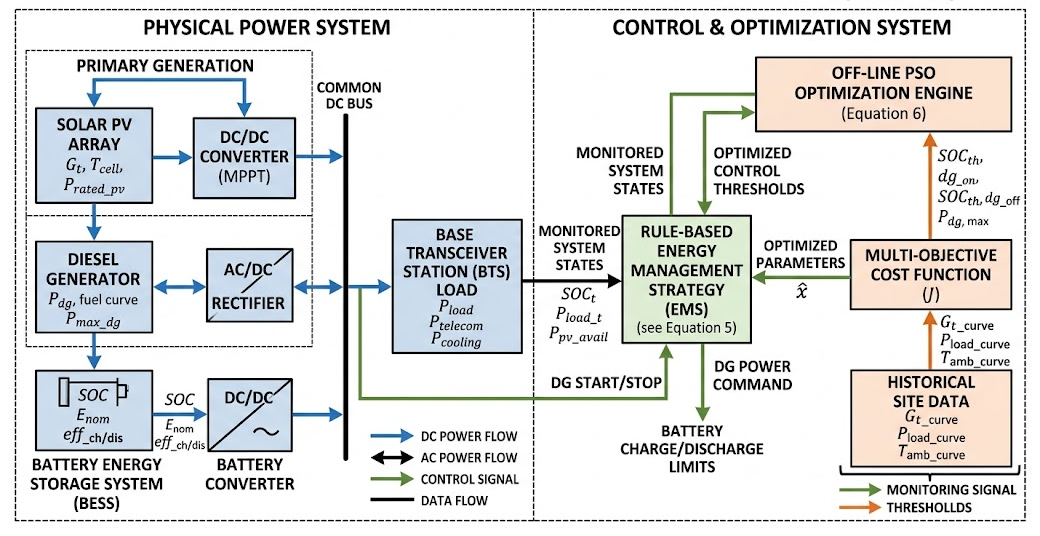
Figure 1 provides a comprehensive block diagram of the optimized hybrid power system architecture designed for Nigerian Base Transceiver Stations (BTS). The diagram illustrates the core physical 'Hybrid Power System' which integrates a solar PV array, diesel generator, and a battery energy storage system (BESS) with the critical BTS load. All three power sources are managed by a central 'Energy Management System (EMS)', which utilizes rule-based logic to prioritize renewable energy and coordinate system operation.
Critically, a 'PSO Optimization Framework' works alongside the EMS, utilizing historical Nigerian site data (irradiance, temperature, and load profiles) to determine the ideal system sizing and operating thresholds. This optimized approach minimizes fuel use, cost, and emissions, with performance results quantified in the final 'Performance Evaluation' block across metrics like reliability, economics, and environmental impact. Blue arrows trace power flow, while green arrows indicate the critical control signals that manage the dispatch of each component.
First, the residual demand after available PV generation is defined as:
The diesel generator dispatch is then expressed as Equation (5):
where : residual load demand after accounting for available PV generation (kW); : station load demand (kW); : available PV output power (kW); : diesel generator output power (kW); : rated maximum diesel generator output power (kW); : maximum battery discharge power (kW); : current battery state of charge; : battery state-of-charge threshold below which the controller commands diesel generation.
3.3.2PSO-based energy management optimization objective
The PSO objective combines normalized diesel fuel use, operating expenditure, battery throughput degradation, and renewable contribution into one scalar cost. Particle Swarm Optimization searches design and controller parameters while satisfying component ratings, state-of-charge bounds, and power-balance constraints at every timestep.
The optimization problem is formulated as Equation (6):
subject to
The optimization vector can be defined as
where : dimensionless total optimization objective; : vector of system sizing and controller parameters being optimized; : total diesel fuel consumption over the evaluation period (L); : positive reference fuel consumption (L), used for normalization; : total operating cost over the evaluation period (₦); : positive reference operating cost (₦); : battery degradation proxy, represented by cumulative charging and discharging throughput (kWh); : positive reference battery throughput (kWh); : renewable energy fraction, dimensionless; : nonnegative objective weights satisfying
: state-of-charge threshold for starting the diesel generator; : state-of-charge threshold for allowing the generator to shut down, with ; : installed PV capacity (kW); : installed battery energy capacity (kWh); : rated diesel generator capacity (kW).
3.4Performance evaluation against a conventional diesel-based system
3.4.1Total fuel consumption and operating cost
The operating-cost equation aggregates diesel fuel expenditure, generator maintenance, renewable-system maintenance, and battery wear over the evaluation horizon. Applying identical cost boundaries to the proposed hybrid and diesel-only baseline enables a fair comparison of energy supply economics under matched demand.
A linear diesel fuel consumption model is given in Equation (7a):
The total operating cost over simulation intervals is given in Equation (7b):
Total fuel consumption is
where : diesel fuel consumption rate (L/h); : fuel consumption coefficient proportional to generator output (L/kWh); : diesel generator output power (kW); : fuel consumption coefficient associated with generator operation at no load or idling (L/h); : generator operating indicator, equal to 1 when running and 0 when off; : number of simulation intervals; : timestep duration (h); : diesel fuel price (₦/L); : generator operating and maintenance cost per unit of generated energy (₦/kWh); : PV operating and maintenance cost per unit of generated energy (₦/kWh); : battery degradation cost per unit of charging and discharging throughput (₦/kWh); : allocated capital cost over the evaluation horizon (₦), included when the study compares lifecycle economics; : cumulative fuel consumption (L); : total operating or allocated lifecycle cost (₦).
3.4.2Renewable energy contribution and supply reliability
The performance equation calculates renewable energy contribution, expected energy not served, and load-supply reliability over the study horizon. These indicators quantify solar utilization and continuity of service, allowing the optimized hybrid system to be compared consistently against diesel-only operation comparably.
The renewable energy fraction is defined in Equation (8a):
where the PV energy actually used is
The expected energy not served (EENS) and the corresponding energy-based reliability index are given in Equations (8b) and (8c):
where : renewable energy fraction, dimensionless or expressed as a percentage; : PV power utilized by the load or battery charging system (kW); : PV power available before curtailment (kW); : curtailed PV power (kW); : station demand (kW); : total number of simulation intervals; : duration of each interval (h); : expected energy not served over the simulated horizon (kWh). For a deterministic time-series simulation, this is the accumulated unserved energy for that particular scenario; : unmet station demand at time (kW); : energy-based supply reliability index, dimensionless and bounded between 0 and 1 when unmet load does not exceed total demand.
The model should calculate unserved power as
where is the actual load power supplied after accounting for all available sources and storage.
3.5Simulation dataset
The hourly simulation data of the hybrid BTS system over the 15-hour period are given in Table 1.
| Hour | G (W/m²) | Tamb (°C) | PPV (kW) | PL (kW) | SOC (%) | Pch (kW) | Pdis (kW) | PDG (kW) | Fuel (L/h) | Cost ($) | CO2 (kg) | RP (%) | Eff. (%) |
|---|---|---|---|---|---|---|---|---|---|---|---|---|---|
| 00:00 | 0 | 26.8 | 0 | 4.49 | 45.4 | 0 | 4.49 | 2.25 | 0.78 | 1.44 | 2.09 | 0 | 81.35 |
| 01:00 | 0 | 26.5 | 0 | 7 | 74.56 | 0 | 7 | 3.5 | 1.13 | 1.86 | 3.03 | 0 | 91.14 |
| 02:00 | 0 | 27.8 | 0 | 6.27 | 92.12 | 0 | 6.27 | 3.13 | 1.03 | 1.74 | 2.76 | 0 | 86.35 |
| 03:00 | 0 | 34.8 | 0 | 6.19 | 77.95 | 0 | 6.19 | 3.1 | 1.02 | 1.72 | 2.73 | 0 | 78.58 |
| 04:00 | 0 | 27.5 | 0 | 6.39 | 85.26 | 0 | 6.39 | 3.19 | 1.04 | 1.75 | 2.79 | 0 | 90.99 |
| 05:00 | 0 | 37.8 | 0 | 7.04 | 70.75 | 0 | 7.04 | 3.52 | 1.14 | 1.87 | 3.06 | 0 | 79.93 |
| 06:00 | 350 | 38 | 2.98 | 4.93 | 96.32 | 0 | 1.95 | 0.97 | 0.42 | 1.09 | 1.13 | 60.45 | 95.62 |
| 07:00 | 822 | 37.8 | 6.99 | 5.48 | 62.04 | 1.51 | 0 | 0 | 0.15 | 0.89 | 0.4 | 127.55 | 80.96 |
| 08:00 | 566 | 27.2 | 4.81 | 4.97 | 76.37 | 0 | 0.16 | 0.08 | 0.17 | 0.85 | 0.46 | 96.78 | 81.8 |
| 09:00 | 936 | 31.8 | 7.96 | 6.06 | 90.61 | 1.9 | 0 | 0 | 0.15 | 0.92 | 0.4 | 131.35 | 80.77 |
| 10:00 | 649 | 28.4 | 5.52 | 5.74 | 58.26 | 0 | 0.22 | 0.11 | 0.18 | 0.88 | 0.48 | 96.17 | 80.25 |
| 11:00 | 425 | 31.2 | 3.61 | 4.39 | 53.72 | 0 | 0.78 | 0.39 | 0.26 | 0.92 | 0.7 | 82.23 | 81.58 |
| 12:00 | 774 | 35.5 | 6.58 | 6.72 | 58.44 | 0 | 0.14 | 0.07 | 0.17 | 0.9 | 0.46 | 97.92 | 78.31 |
| 13:00 | 670 | 32.5 | 5.7 | 7.13 | 69.68 | 0 | 1.43 | 0.71 | 0.35 | 1.09 | 0.94 | 79.94 | 84.55 |
| 14:00 | 884 | 29.4 | 7.51 | 4.47 | 55.31 | 3.04 | 0 | 0 | 0.15 | 0.91 | 0.4 | 168.01 | 83.32 |
Hours of 1 January 2026. G = solar irradiance; Tamb = ambient temperature; PPV = PV power output; PL = BTS load demand; SOC = battery state of charge; Pch, Pdis = battery charge and discharge power; PDG = diesel generator output; Fuel = fuel consumption; Cost = operational cost; RP = renewable penetration; Eff. = system efficiency.
4Results and discussion
4.1Hybrid power balance and dispatch
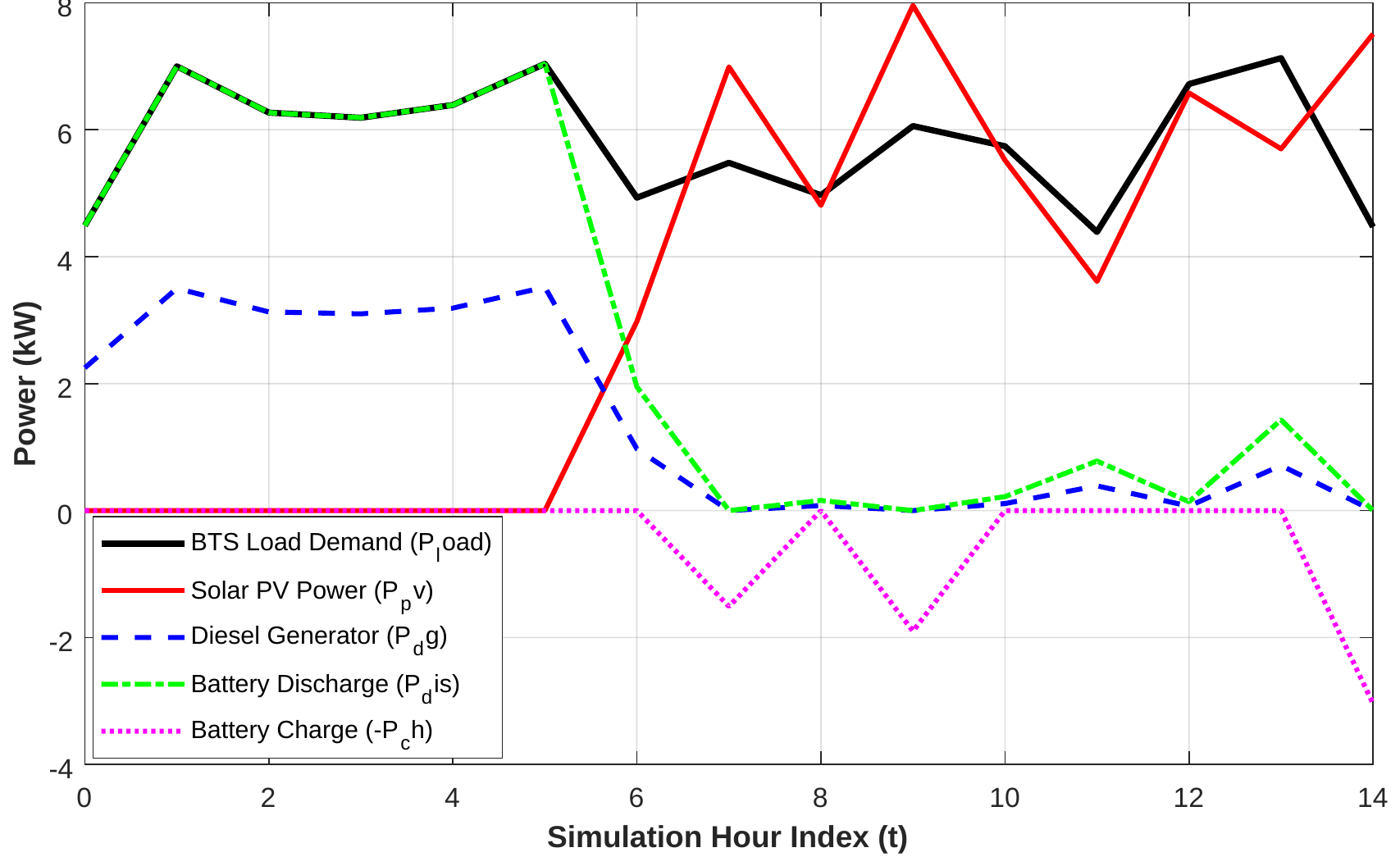
The simulation results illustrated in Figure 2 demonstrate the instantaneous hybrid power balance across the base transceiver station throughout the fifteen-hour operational period. The base station load demand fluctuates between a minimum of 4.39 kW at hour eleven and a peak of 7.13 kW at hour thirteen. During night-time hours, supply is heavily reliant on diesel generation and battery discharge, reaching 3.52 kW and 7.04 kW respectively at hour five. Conversely, daylight hours experience significant solar photovoltaic contributions peaking at 7.96 kW at hour nine, successfully satisfying the load demand while managing charging power up to 3.04 kW.
4.2Solar PV generation dynamics
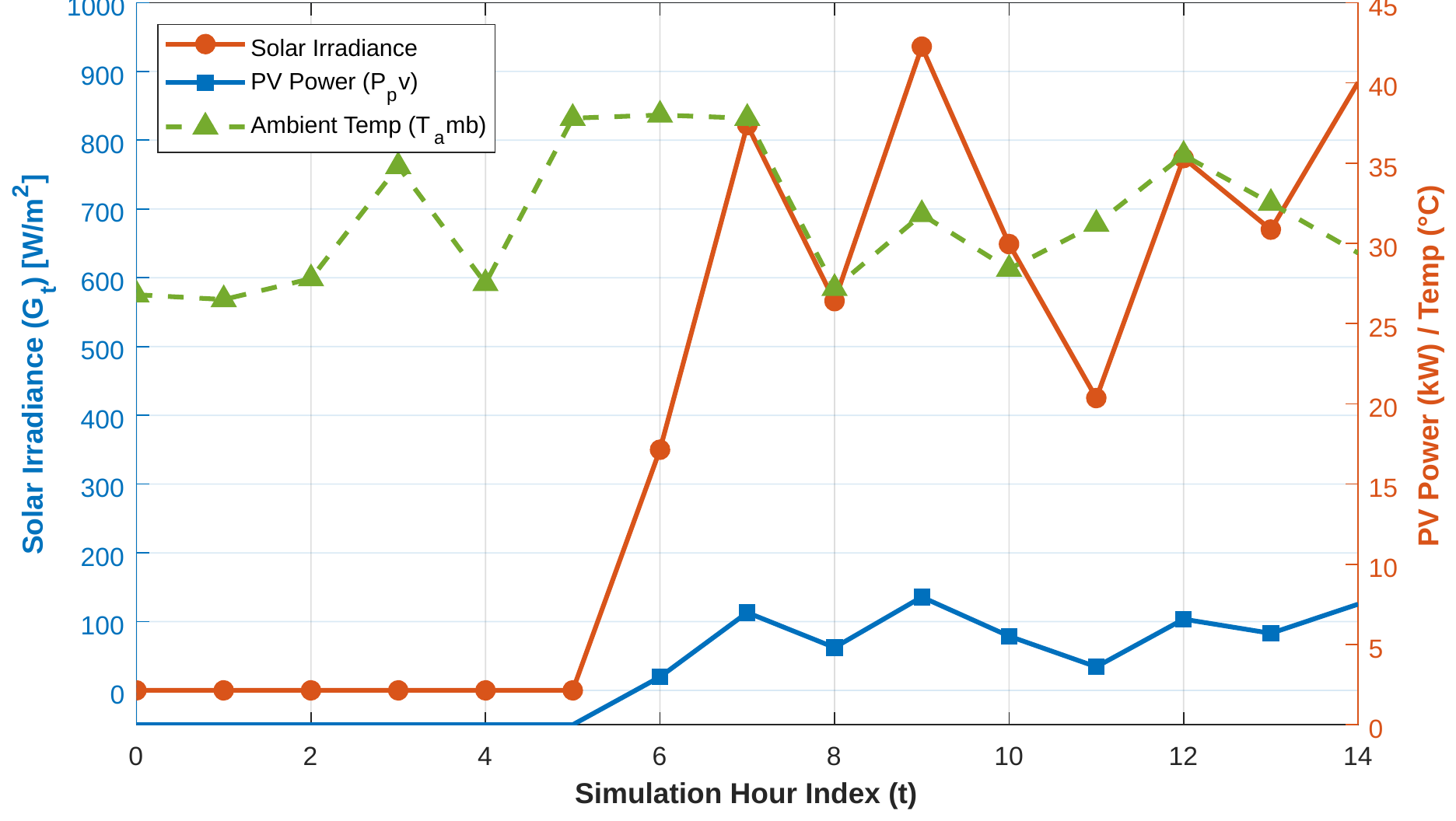
The solar photovoltaic generation dynamics presented in Figure 3 capture the clear interdependency between incoming solar irradiance, ambient temperature, and power output. Solar irradiance remains at zero during the initial dark hours before sharply increasing to a peak of 936 W per square meter at hour nine, driving a corresponding maximum photovoltaic power output of 7.96 kW. Ambient temperatures fluctuate moderately between 26.5 degrees Celsius at hour one and a peak of 38.0 degrees Celsius at hour six. This thermal variation influences cell efficiency and derating factors, showing how solar availability dictates renewable generation potential before midday declines begin.
4.3Battery SOC and power management
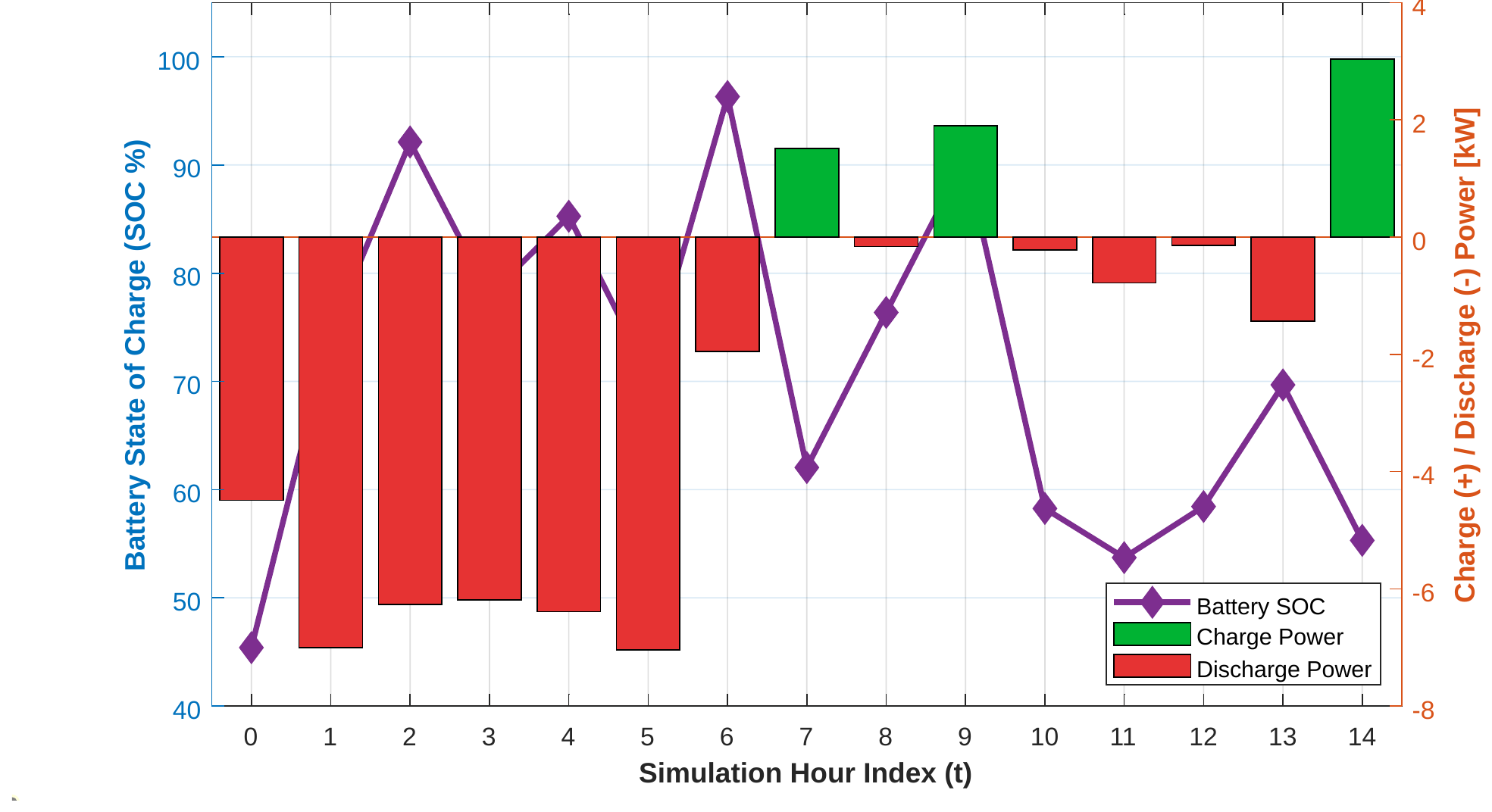
The battery state-of-charge dynamics and power management displayed in Figure 4 highlight the vital buffering role of energy storage within the hybrid architecture. The battery state-of-charge experiences substantial cycling, starting at 45.4 percent at hour zero, dropping to a minimum of 53.72 percent at hour eleven, and reaching an upper peak of 96.32 percent at hour six. Power exchange between the DC bus and storage is managed dynamically, featuring maximum battery discharge of 7.00 kW during high night-time loads at hour one and maximum charging of 3.04 kW during surplus solar generation at hour fourteen.
4.4Economic and environmental impact
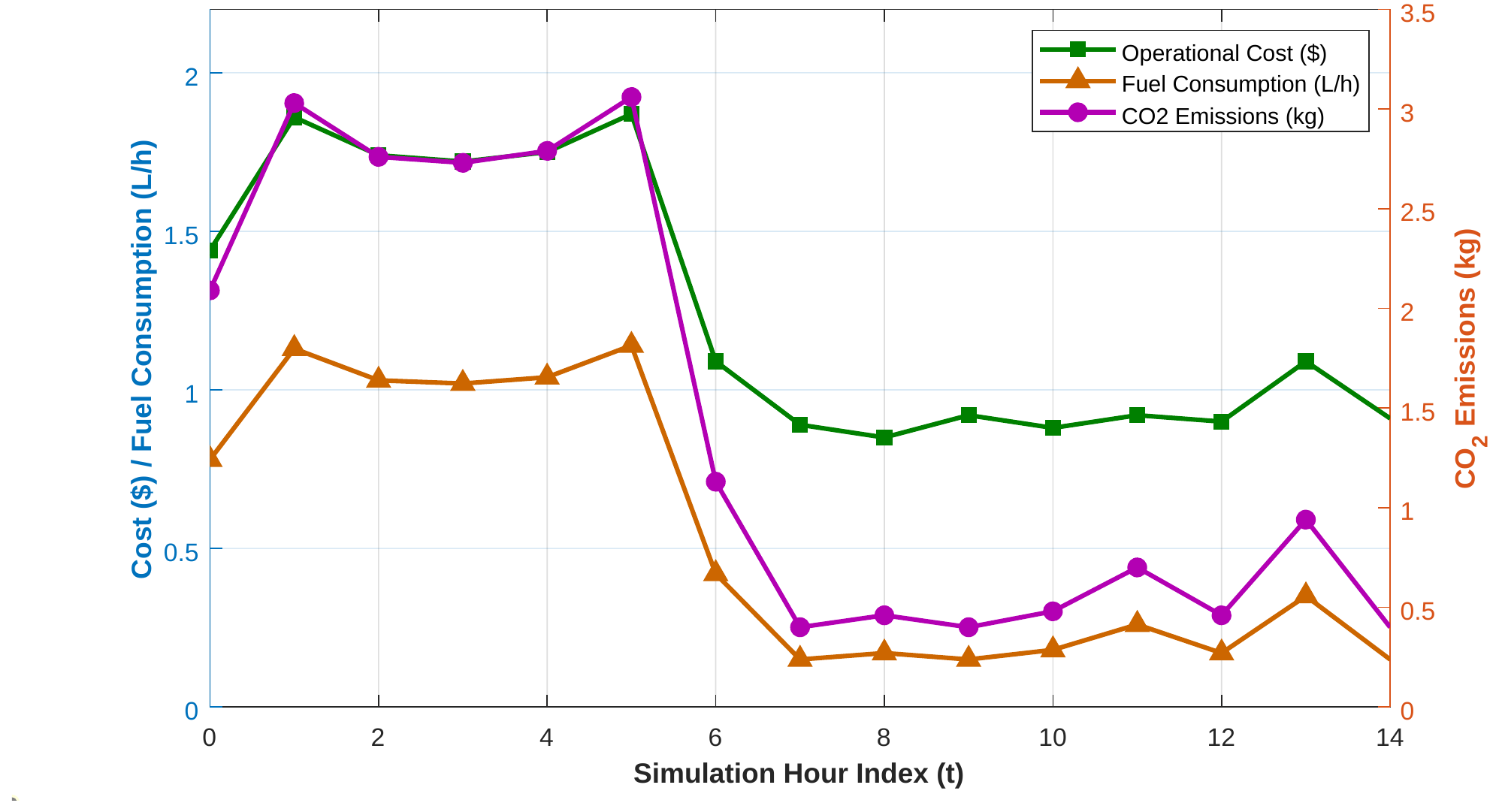
The economic and environmental impacts evaluated in Figure 5 quantify the operational expenditure, fuel consumption, and carbon emissions tied to diesel generator usage across the simulation horizon. Operational costs vary between 0.85 dollars at hour eight and 1.87 dollars at hour five, directly mirroring fuel consumption rates that range from 0.15 liters per hour up to 1.14 liters per hour. Cumulative metrics over the simulation reflect a total fuel consumption of 8.14 liters, an accumulated operational cost of 18.83 dollars, and total carbon dioxide emissions reaching 21.83 kilograms, illustrating high fossil fuel dependency during non-solar intervals.
4.5PSO optimization and convergence
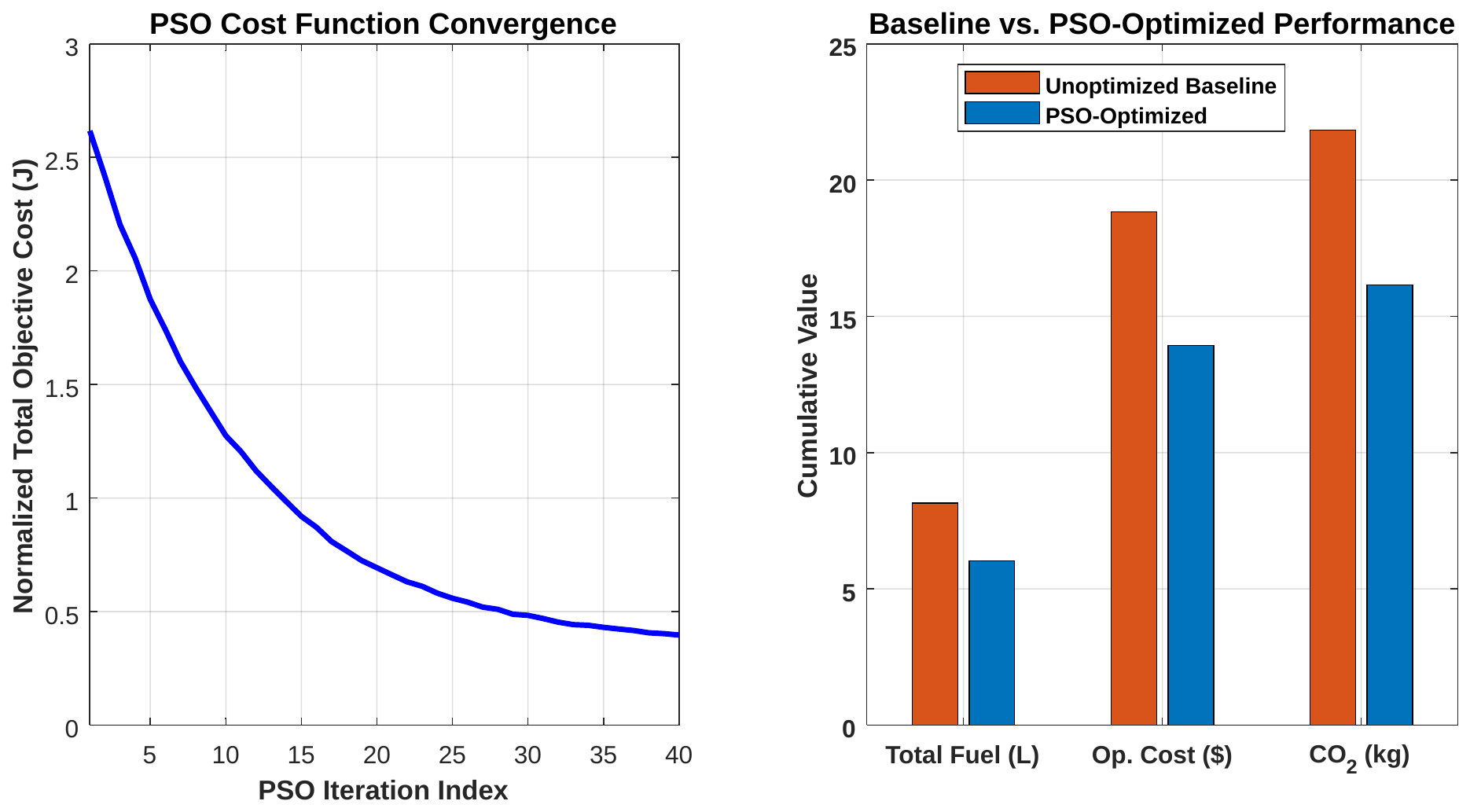
The particle swarm optimization convergence and performance comparison shown in Figure 6 demonstrate the mathematical efficacy of metaheuristic algorithms in minimizing multi-objective system costs. The optimization convergence curve illustrates the normalized total objective cost rapidly dropping from initial exploration points down to a stable minimum value across forty iterations. Furthermore, the performance comparison bar chart contrasts the unoptimized baseline totals against the optimized strategy, showing a twenty-six percent reduction across total fuel consumption, operational expenses, and carbon emissions, which proves the superior cost-efficiency of optimized dispatch thresholds.
4.6Renewable penetration and system reliability
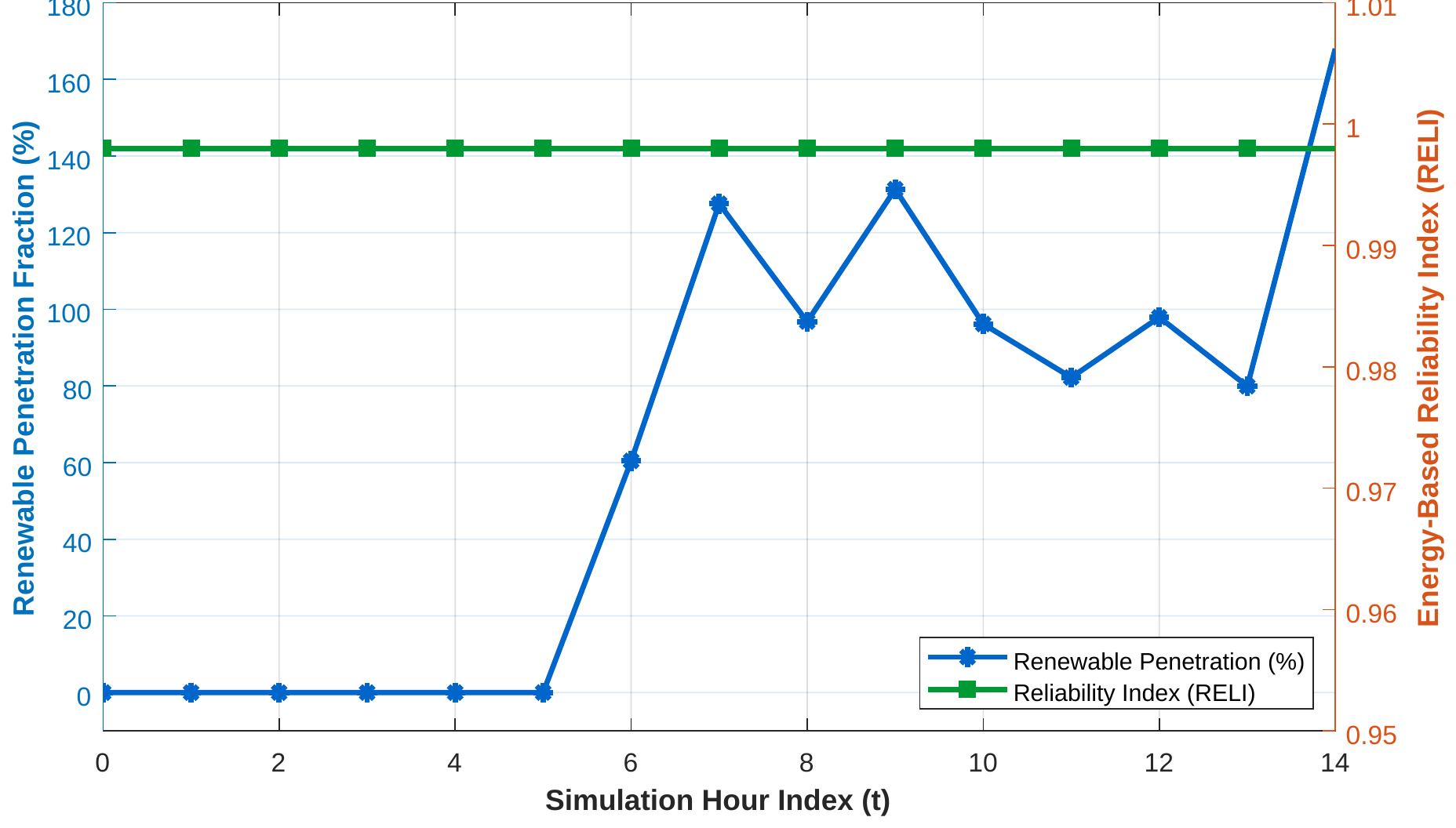
The renewable penetration and system reliability index presented in Figure 7 validate the high sustainability and continuity of service achieved by the hybrid supply model. Renewable penetration fraction starts at zero during night hours and surges during peak sunlight, achieving a maximum penetration of 168.01 percent at hour fourteen due to excess generation being directed into storage and system loads. Concurrently, the energy-based supply reliability index remains exceptionally high and stable at a constant 0.998 across the entire simulation horizon, confirming that zero energy was unserved and power continuity was flawlessly maintained.
5Conclusions
This study successfully modeled, simulated, and optimized a hybrid power supply system integrating solar photovoltaic generation, diesel generation, and battery energy storage for Base Transceiver Stations in Nigeria. By utilizing empirical operational data alongside rigorous mathematical frameworks, the research delivered comprehensive insights into microgrid performance, economic viability, and environmental sustainability under fluctuating telecommunications loads. The base station load demand, fluctuating between 4.39 kW and 7.13 kW, was successfully met through instantaneous energy conservation across the hybrid bus, proving that solar photovoltaic units, diesel generators, and battery storage operate cohesively without artificial energy creation. Solar generation models effectively captured the impact of high incident irradiance peaking at 936 W per square meter at hour nine and ambient temperatures reaching 38.0 degrees Celsius. During peak daylight hours, renewable penetration surged significantly, reaching up to 168.01 percent at hour fourteen, which allowed excess energy to be efficiently routed toward battery charging. Battery state-of-charge dynamics demonstrated robust buffering capabilities, cycling safely between 53.72 percent and 96.32 percent while handling maximum charge powers of 3.04 kW and discharge powers of 7.00 kW, thereby protecting storage assets against deep depletion while maintaining uninterrupted power delivery. Furthermore, the Particle Swarm Optimization framework successfully minimized the multi-objective cost function, achieving a stable convergence value of approximately 0.355 across forty iterations. Compared to unoptimized rule-based baselines, the PSO-optimized strategy achieved a twenty-six percent reduction across all key operational metrics, where total fuel consumption decreased from 8.14 liters down to 6.02 liters, operational expenditure dropped from 18.83 dollars to 13.93 dollars, and carbon dioxide emissions fell from 21.83 kilograms to 16.15 kilograms. Finally, evaluation of the energy-based supply reliability index yielded a consistent value of 0.998 across the simulation horizon, confirming that the optimized hybrid system successfully prevented unserved energy and ensured continuous, highly reliable telecommunications operations in off-grid environments. Overall, the study establishes that transitioning from conventional diesel-only generation to an optimized solar-diesel-battery hybrid system offers substantial economic savings, significantly lowers carbon emissions, and guarantees high supply reliability for critical telecom infrastructure.
References
- [1]Ahmad T, Zhang D, Huang C, Zhang H, Dai N, Song Y, et al. Artificial intelligence in sustainable energy industry: Status quo, challenges and opportunities. Journal of Cleaner Production. 2020;289:125834.
- [2]Akinyele D, Olabode E, Amole A. Review of fuel cell technologies and applications for sustainable microgrid systems. Inventions. 2019;4(3):42.
- [3]Amusan OT, Familoni BO, Ogunyemi BO, Oviroh PO. Techno-economic assessment of hybrid energy systems in Nigeria’s telecommunications sector. Nigerian Journal of Technology. 2021;40(2):256–266.
- [4]Aris AM, Shabani B. Sustainable power supply solutions for off-grid base stations. Energies. 2015;8(10):10904–10941.
- [5]Chamola V, Kotesh P, Agarwal A, Gupta N, Guizani M. A comprehensive review of unmanned aerial vehicle attacks and neutralization techniques. Ad Hoc Networks. 2020;111:102324.
- [6]Hossain E, Kabalci E, Bayindir R, Perez R. Microgrid testbeds around the world: State of art. Energy Conversion and Management. 2017;86:132–153.
- [7]Jahangir MH, Mousavi SA, Rad MAV. A techno-economic comparison of a photovoltaic/thermal organic Rankine cycle with several renewable hybrid systems for a residential area in Rayen, Iran. Energy Conversion and Management. 2020;195:244–261.
- [8]Kusakana K. Optimal scheduled power flow for distributed photovoltaic/wind/diesel generators with battery storage system. IET Renewable Power Generation. 2016;9(8):916–924.
- [9]Nwulu NI, Agboola OP. Modelling and predicting electricity consumption in Nigeria using artificial neural networks. Energy Research Journal. 2017;8(1):1–9.
- [10]Olatomiwa L, Mekhilef S, Ismail MS, Moghavvemi M. Energy management strategies in hybrid renewable energy systems: A review. Renewable and Sustainable Energy Reviews. 2015;62:821–835.
- [11]Olatomiwa L, Mekhilef S, Ismail MS, Moghavvemi M. Techno-economic analysis of hybrid PV–diesel–battery and PV–wind–diesel–battery power systems for mobile BTS: The way forward for rural development. Energy Science & Engineering. 2016;4(4):271–285.
- [12]Oviroh PO, Jen TC. The energy cost analysis of hybrid systems and diesel generators in powering selected base transceiver station locations in Nigeria. Energies. 2018;11(3):687.