BIM-Based Structural Retrofit Analysis
Digital Structural Engineering for Resilient Saudi Infrastructure: Integrating ETABS, SAP2000 and BIM-Based Analysis for Retrofit and Expansion Projects
Published October 2026
Abstract
Expansion and adaptation of existing Saudi infrastructure require credible analysis of changing structural capacity without sacrificing construction safety or operational continuity. This critical review examines how ETABS, SAP2000 and building information modelling can be combined for the assessment, strengthening and extension of buildings and associated civil assets. Thirty DOI-linked publications from 2020–2025 were synthesised through an evidence-led thematic method covering model exchange, existing-condition intelligence, nonlinear response, construction staging, monitoring and organisational implementation. The reviewed evidence indicates that digital integration is valuable only when geometric and analytical models remain distinguishable, transfers are verified, and uncertainty in as-built conditions is explicitly retained. A proposed assurance framework links survey evidence, controlled model translation, independent structural checks, stage-specific design and measured performance. The paper contributes practical decision gates for Saudi retrofit programmes and identifies unanswered questions concerning interface validation, model ownership and locally calibrated performance benchmarks. Findings are interpretative rather than the results of a new simulation or field trial.
Keywords: digital structural engineering; ETABS; SAP2000; building information modelling; structural retrofit; staged construction; Saudi Arabia; infrastructure resilience
1Introduction
Saudi infrastructure development increasingly involves changing the function, capacity and connectivity of assets that cannot simply be demolished and rebuilt. Hospitals, public buildings, transport facilities, industrial structures and urban developments may require additional floors, adjoining extensions, more demanding equipment or upgraded lateral resistance while their original systems remain in service. These interventions raise a different engineering problem from greenfield design: the existing structure is a partly observed physical system whose historical assumptions, degradation and alterations must be reconciled with a proposed future configuration. Digital structural engineering should therefore be evaluated by its contribution to defensible decisions, not by the number of software applications connected to a project.
Structural analysis platforms and building information modelling (BIM) fulfil complementary functions. ETABS is commonly deployed for building-oriented global response, storey behaviour and design checks; SAP2000 offers flexible modelling of frames, bridges and irregular structural systems. BIM environments organise geometry, attributes, coordination and changes across disciplines. Neither an attractive federated model nor a successful file export establishes engineering validity. Shoieb and colleagues [1] and Wu and colleagues [2] show why translation between analysis environments requires explicit examination of structural semantics. Studies of actual BIM exchanges similarly report losses or altered assumptions that may be inconspicuous in three-dimensional views [3–5].
The central argument advanced here is that resilient retrofit and expansion depend on a controlled sequence of evidence, analysis, intervention and verification. Digital models can support that sequence by exposing uncertain information, tracing decisions and comparing alternatives. They may also conceal uncertainty when nominal members are treated as surveyed facts or when incompatible stiffness assumptions cross software boundaries. The review consequently concentrates on trustworthy structural reasoning at the boundaries between existing assets, new works and digital representations, rather than on software capabilities considered in isolation.
2Aim, objectives and research questions
The study aims to develop a critical, evidence-informed framework for using coordinated BIM, ETABS and SAP2000 workflows to make retrofit and expansion decisions more reliable under the technical and institutional conditions of Saudi Arabia. Its first objective is to distinguish design intent, surveyed geometry, physical condition and analytical idealisation. Its second is to examine how interoperability affects material, load, connectivity and restraint assumptions. Its third is to connect structural options with construction-stage stability and operational constraints. Its fourth is to establish verification responsibilities and a research agenda for monitored, uncertainty-aware implementation.
Three questions organise the synthesis. Which information must survive transfer from a BIM environment into a valid structural model? How should engineering teams evaluate temporary as well as completed load paths when strengthening or expanding a retained structure? What evidence is needed before digital results can be relied upon for approval, construction and subsequent asset management? These questions are deliberately different from measuring the comparative speed of individual programmes. Efficiency matters, but not at the expense of demonstrable structural safety.
3Review design and evidence appraisal
A structured critical narrative review was used because the field spans analytical modelling, information management, intervention design and construction management, with heterogeneous research methods and outcome measures. Relevant peer-reviewed literature dated 2020–2025 was identified through targeted scholarly searches using combinations of BIM interoperability, ETABS, SAP2000, finite element modelling, structural retrofit, digital twin, staged construction, structural monitoring and Saudi construction adoption. DOI records and publisher or institutional bibliographic descriptions were cross-checked for source identity, date and topical relevance. Thirty unique publications form the referenced evidence set; no fieldwork, stakeholder survey or structural simulation was undertaken for this article.
Studies were considered directly informative when they investigated structural model translation, existing-condition capture, performance assessment, strengthening decisions, scheduling constraints or monitored response. Saudi adoption studies were retained to contextualise implementation, rather than treated as proof of structural performance. The evidence was interpreted through five themes: trustworthy inputs, model interoperability, retrofit mechanics, construction sequencing and asset feedback. Each study was examined for its investigation setting, technical contribution and limits on transferability. Laboratory validation was distinguished from practice-wide effectiveness, and software-specific observations were not presumed universal across releases or settings.
This synthesis is not a pooled effect estimate. Different papers measure exchange accuracy, scheduling quality, damage recognition or organisational factors, which cannot be responsibly combined into a single improvement percentage. The approach instead uses explicit engineering inference: an observed failure mode or successful integration is assessed for its implications in Saudi retrofit applications, with proposed controls described as recommendations. The principal limitations are uneven reporting of real retrofit projects, inconsistent terminology for digital twins and sparse comparative validation of fully integrated ETABS–SAP2000–BIM workflows.
Source appraisal also considered the difference between demonstrated outcomes and proposed architectures. For example, a case study showing reliable transfer of a limited number of attributes does not establish reliable exchange of nonlinear material definitions, staged-construction states or project-specific design combinations. Similarly, a sensing demonstration on a test frame cannot be generalised to an occupied multistorey structure without evidence on installation, maintenance and environmental variability. The synthesis consequently treats each reported result at its original scale. Its recommendations arise from comparing failure mechanisms and assurance requirements across domains, rather than assigning unsubstantiated statistical strength to the entire evidence set.
4Analytical models, information exchange and accountability
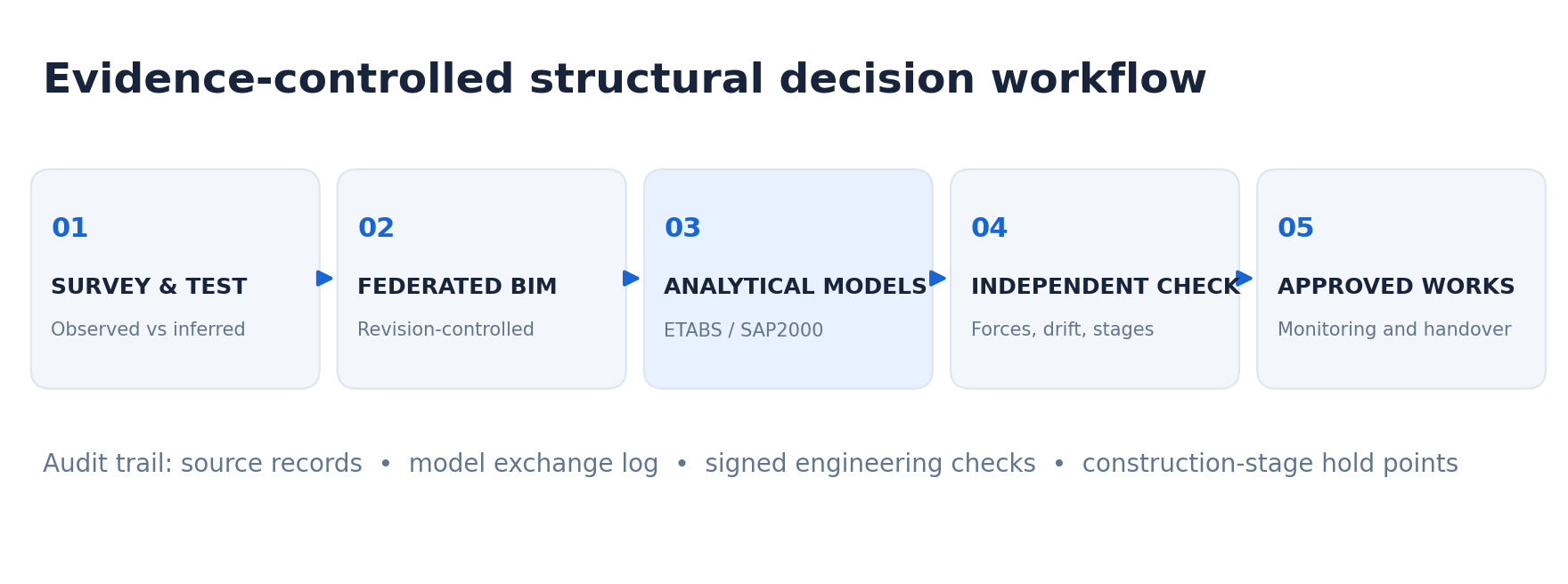
BIM and analysis models represent different abstractions of the same asset. A BIM beam may contain architectural finishes, manufacturing metadata and accurate external dimensions; an analytical beam requires a justified centreline, section properties, stiffness, connection release and load tributary. Successful exchange therefore requires more than preserving visual geometry. Shoieb et al. [1] assessed multiple analysis applications, including ETABS and SAP2000, against attributes needed for computational execution. Wu et al. [2] examined invariant object signatures intended to identify corresponding elements despite different software structures. These contributions indicate that an exchange protocol must record what each attribute means, where it originated and whether its interpretation survived transfer.
Comparative investigations reinforce this warning. Sampaio and Gomes [3] observed limitations in bidirectional architectural–structural transfers. İlipınar et al. [4] compared IFC and application-programming-interface routes involving widely used structural platforms, observing information loss and differing reliability across pathways. Huda and Roesdiana [5] reported changes to restraints and dimensions in a Revit–ETABS case study, illustrating how a model can appear successfully transferred while important design variables are altered. These studies are context-bound, but their collective finding is robust: interoperability is a verification problem rather than a one-off file-conversion task.
A practical workflow should maintain separate but linked representations: the surveyed asset model, the design-coordination model, the global analytical model and any detailed local finite element model. Unique element identifiers should survive transformations, while a transfer register records units, coordinates, releases, local axes, diaphragms, section offsets, springs, masses and loading conventions. Engineer-approved mapping rules should be version controlled. Automated comparisons can detect missing objects and altered attributes; independent checks of reactions, periods, deformations and representative member forces can reveal subtler changes. None of these checks removes the need to review the appropriateness of the modelling assumptions themselves.
The ETABS–SAP2000 relationship is strongest when each programme is selected for an analytical question and the boundary conditions between their models are explicit. ETABS can support a building-wide understanding of drift, irregularity and load redistribution following an extension. SAP2000 can be used for irregular support systems, transfer arrangements and component-level alternatives where its available formulations are appropriate. Results should not be equated automatically: differences may arise from meshing, effective stiffness, mass sources, nonlinear hinges, constraints or solver settings. For bridge substructures, Shishlov et al. [6] demonstrate the wider importance of linking BIM information with nonlinear finite element analysis rather than reducing all decisions to geometric exchange.
Gartoumi et al. [7] also address structural-project interoperability, while Ursini et al. [8] trace measured geometry towards dynamic finite element modelling of existing heritage assets. Together these studies support a layered model architecture. An authoritative BIM repository may retain coordinates and documentation, but a signed analytical model must preserve engineering assumptions independently. Model ownership should be assigned by discipline, and handover should include the analytical basis, unresolved discrepancies and a reproducible results package. Figure 1 sets out this proposed chain of responsibility.
Validation should be undertaken using representative benchmark states before production modelling begins. The benchmark set may comprise a gravity-only frame, a lateral-force-resisting bay, a transfer level and a deliberately released connection. For each case, the team can establish agreed analytical outputs before exporting data, then compare models using identical actions and load combinations. Disagreement warrants classification as a geometry, parameter, connectivity, solver or interpretation issue. Such fault isolation is preferable to tuning stiffness values until headline displacement results happen to match. Discrepancy acceptance limits must reflect their safety significance, because small percentage changes in global response can mask decisive changes in a critical local action.
5Existing-condition intelligence and retrofit appraisal
Structural retrofit begins with an evidence deficit. Existing drawings may omit later modifications, conceal deterioration or use material grades that no longer describe actual behaviour. A disciplined condition-assessment plan combines available records with geometry surveys, reinforcement location, material testing, crack mapping, foundation investigation and targeted non-destructive evaluation. The purpose is not to populate every field in BIM. It is to identify uncertainties capable of changing the selected retrofit strategy or the safety of construction. Information should be labelled observed, tested, inferred or assumed, with confidence and inspection dates retained alongside each affected element.
Digital reconstruction can increase traceability but does not substitute for evidence. Ursini et al. [8] show how scan-derived geometry can support finite element modelling while revealing continuing interoperability obstacles. Musella et al. [9] discuss BIM-linked digital representation of seismic damage, demonstrating a route from observed defects towards rehabilitation information. Zhang et al. [12] combine point clouds, image-detected cracks and finite element assessment of reinforced-concrete beams, highlighting the mechanical consequences of representing existing damage. These examples support selective model enrichment: add fidelity where it changes capacity estimates, not merely where information can be collected.
Retrofitting and expansion should be evaluated against a defined performance objective. Alternatives may include local strengthening, member replacement, external bracing, added shear walls, selective foundation upgrading or partial separation of old and new blocks. Each option changes stiffness, strength, ductility, foundation demand, diaphragm transfer and construction invasiveness differently. Caterino et al. [10] present a BIM-supported decision framework for seismic retrofit, demonstrating that competing criteria require a structured comparison. A single pass–fail strength check is insufficient if an intervention transfers unacceptable forces to retained columns or creates irregular lateral behaviour elsewhere.
For Saudi projects, relevant stressors include high ambient temperatures, thermal movement, aggressive coastal exposures, variable soil conditions and differences between older design documentation and current performance expectations. These are design considerations, not claims about the condition of a particular site. The appropriate seismic, wind, load and materials provisions must be established for the project location and approval route. Sensitivity analyses should test uncertain stiffness, support settlement, material strengths and connection assumptions. Where a result changes classification or strengthening demand under plausible assumptions, further investigation should be preferred over artificial precision.
Integrated sustainability can inform the choice among technically acceptable options. Kulthanaphanich et al. [11] examine combined energy and seismic retrofit through a BIM-linked lifecycle framework, showing how retrofit comparisons can extend beyond initial construction quantities. The transferable implication is not that the same solution should be used in Saudi Arabia, but that structural adequacy, downtime, embodied impacts, cost and future adaptability should be evaluated together. A strengthening scheme that minimises steel tonnage may still perform poorly if it necessitates prolonged closure, difficult maintenance or repeated invasive works.
The decision to investigate an uncertain feature can itself be prioritised. A practical ranking asks whether additional evidence could change the design: would confirming a foundation depth remove the need for underpinning, would measuring connection reinforcement alter the admissibility of an extension, or would characterising concrete strength reverse the ranking of strengthening systems? Investigations with high decision value should precede detailed digital elaboration. This avoids spending resources on visually complete models while retaining major uncertainty at structural interfaces. The same discipline should determine when a highly refined finite element model is warranted and when conservative hand calculations offer a clearer and more reliable answer.
5.1Practical case illustration: structural rehabilitation and retrofitting of King Abdulaziz International Airport Terminal 4, Jeddah
The structural rehabilitation and transformation of Terminal 4 (South Terminal) at King Abdulaziz International Airport (KAIA), Jeddah, represents a significant practical example of the engineering challenges associated with restoring and modernising ageing transportation infrastructure in Saudi Arabia. According to the project practitioner's account, the rehabilitation programme addressed substantial structural deterioration, foundation-related distress, persistent groundwater infiltration and deficiencies arising from evolving engineering standards and operational requirements. The principal objective extended beyond conventional structural repairs to encompass comprehensive condition assessment, identification of deterioration mechanisms, development of technically justified strengthening solutions and enhancement of the terminal's long-term structural reliability. The intervention was intended to support the transformation of the existing facility into a structurally resilient and operationally efficient airport terminal capable of accommodating an anticipated annual passenger capacity of approximately 15 million. This undertaking illustrates the importance of integrating engineering investigations, advanced analytical modelling and performance-based rehabilitation strategies when upgrading critical infrastructure assets.
Structural Assessment and Material Investigations. The rehabilitation programme commenced with extensive structural inspections, laboratory testing, durability evaluations and geotechnical investigations to establish the existing condition of the facility. Particular attention was directed towards identifying concrete deterioration, reinforcement corrosion, structural damage associated with aggressive environmental exposure and the consequences of persistent groundwater infiltration. The investigations also examined inadequate historical dewatering provisions, elevated groundwater levels, foundation settlement and the effects of sustained operational loading on structural performance. Visual assessments, material sampling, load-path evaluations and engineering investigations were undertaken to distinguish underlying deterioration mechanisms from their observable consequences. This approach facilitated the identification of structural vulnerabilities requiring targeted intervention and provided an engineering basis for determining appropriate strengthening measures. The project demonstrates the importance of evidence-led assessments in establishing reliable structural rehabilitation strategies for existing infrastructure.
Advanced Structural Analysis and Digital Modelling. Advanced structural analysis and finite element modelling formed an important component of the engineering assessment and rehabilitation process. The project practitioner's involvement included reviewing and validating analytical models prepared to investigate structural behaviour under existing and anticipated loading conditions. These evaluations addressed structural load paths, residual load-bearing capacities, member utilisation ratios, foundation behaviour, structural redundancy and potential load redistribution associated with proposed modifications. Nonlinear structural assessment techniques were considered alongside serviceability evaluations, strength verification, progressive strengthening scenarios and settlement-related investigations. Particular emphasis was placed on assessing structural responses to revised occupancy requirements and the additional loading demands associated with terminal modernisation. Analytical verification helped inform the selection of rehabilitation solutions by considering structural adequacy, constructability and operational requirements. The approach reflects the wider principles of digital structural engineering discussed in this review, particularly the need to validate analytical assumptions and evaluate structural interventions against realistic existing conditions.
Development of Structural Rehabilitation and Strengthening Strategies. Following the assessment phase, several complementary strengthening techniques were evaluated and implemented to address identified deficiencies. Carbon fibre-reinforced polymer (CFRP) systems were employed to enhance the flexural and shear capacities of deficient reinforced concrete members while limiting additional structural dead loads. Concrete jacketing was extensively utilised to improve the load-bearing capacities of existing members and accommodate increased structural demands. Micropile foundation strengthening provided an additional intervention for areas affected by foundation-related distress and inadequate subsurface load-transfer capacity. The micropile systems were intended to transfer additional loads arising from structural jacketing to competent supporting strata while reducing the need for extensive excavation and limiting disturbance to the existing soil equilibrium. Structural steel retrofitting was also undertaken through steel plate strengthening, section enlargement, framing modifications, load redistribution measures and reinforcement or replacement of overstressed structural elements. Additional beams, transfer members and columns were introduced where necessary to accommodate revised functional requirements and enhance structural redundancy. Collectively, these interventions illustrate how integrated strengthening approaches can address multiple deterioration mechanisms while supporting the continued functionality of existing infrastructure.
Application of International Rehabilitation Codes and Engineering Standards. The rehabilitation programme incorporated established international structural assessment, repair and strengthening provisions to support engineering decisions. The project account identifies the application of ACI 562 for the assessment, repair and rehabilitation of existing concrete structures; relevant ACI 437 provisions for structural strength evaluation; ACI 364 guidance concerning the evaluation of concrete structures before rehabilitation; applicable ACI 318 requirements; and relevant American Institute of Steel Construction (AISC) provisions. These standards supported the assessment of existing structural capacities, identification of rehabilitation requirements and technical evaluation of proposed strengthening methods. Their application was particularly relevant because the terminal's original design assumptions and construction practices required reassessment against contemporary structural performance expectations. The integration of recognised rehabilitation principles with analytical verification provided a systematic basis for considering structural safety, durability, serviceability and long-term infrastructure performance.
Engineering Leadership, Technical Review and Multidisciplinary Coordination. The project also demonstrates the importance of professional engineering judgement and multidisciplinary collaboration in the successful implementation of complex structural rehabilitation programmes. As part of the consulting team, the practitioner contributed to reviewing structural design philosophies, evaluating alternative strengthening methodologies, assessing material suitability, examining contractor proposals and reviewing proposed rehabilitation procedures. Particular consideration was given to construction feasibility, structural durability, operational continuity and the long-term performance of the strengthened facility. Effective implementation required coordination among structural engineers, geotechnical specialists, materials engineers, construction contractors, airport representatives and relevant regulatory stakeholders. The technical review process supported informed decision-making concerning structural modifications and their potential effects on existing facilities. This experience highlights the importance of integrating engineering analysis with practical construction considerations, particularly where rehabilitation activities must be planned around the operational requirements of critical transportation infrastructure.
Project Outcomes and Relevance to Saudi Infrastructure Resilience. The practitioner-reported rehabilitation outcomes indicate that the combined application of structural investigations, analytical assessments, foundation enhancement, CFRP strengthening, concrete jacketing, steel retrofitting and strategic structural modifications contributed to improved structural reliability and long-term durability. The KAIA Terminal 4 rehabilitation programme provides a relevant illustration of how ageing infrastructure can be assessed and upgraded through coordinated engineering interventions rather than complete structural replacement. Its broader significance lies in demonstrating the relationship between forensic structural investigations, model-supported engineering decisions, targeted strengthening and lifecycle-oriented infrastructure management. These principles are consistent with Saudi Arabia's wider objectives for infrastructure modernisation, transportation capacity enhancement and sustainable asset utilisation under Vision 2030. As the project information is drawn from a practitioner account rather than an independently documented field investigation undertaken for this review, the example is presented as an illustrative engineering application, not as quantitative validation of the proposed ETABS–SAP2000–BIM integration framework. Nevertheless, the experience offers practical insight into the engineering decisions and multidisciplinary coordination required to rehabilitate complex infrastructure under demanding structural and operational conditions.
6Expansion interfaces, nonlinear response and construction staging
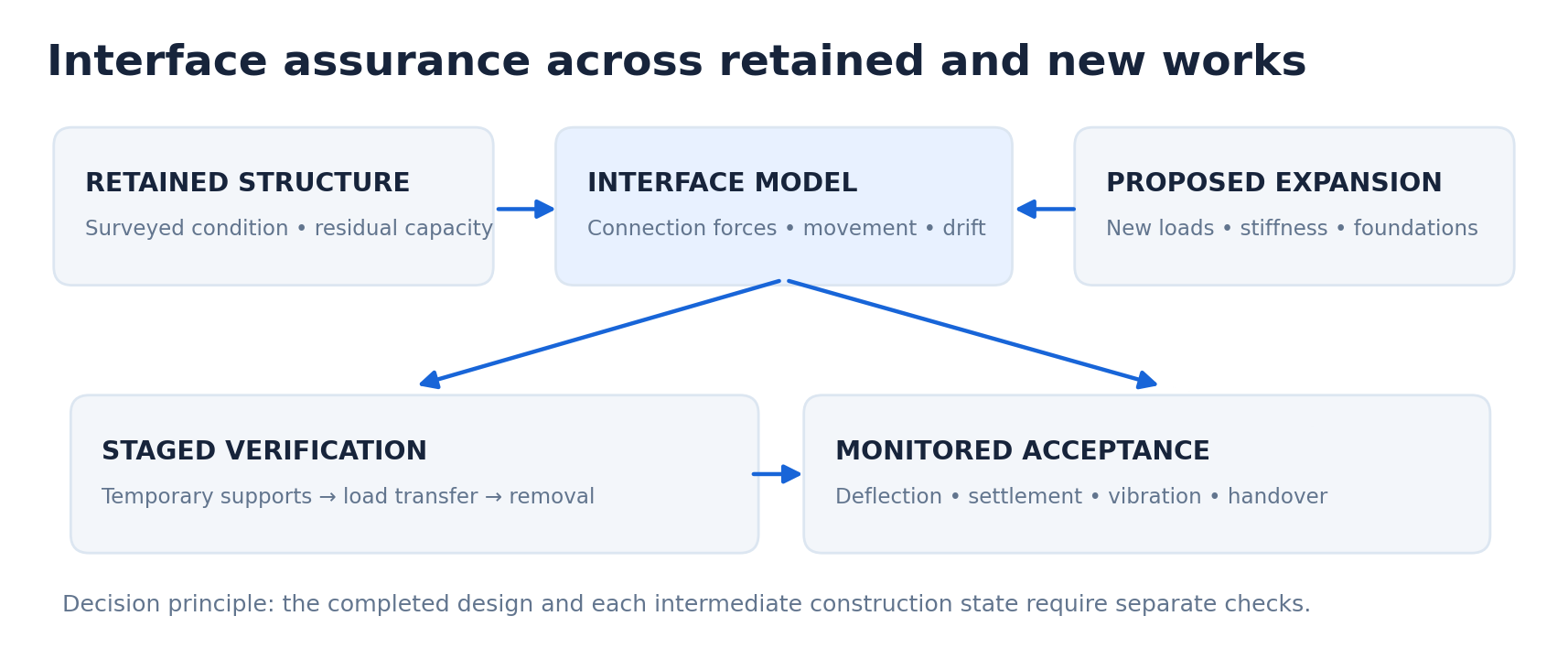
Existing-to-new integration introduces interactions that neither original design model necessarily captured. Additional floors alter gravity loading, overturning and modal characteristics; adjacent additions may introduce diaphragm continuity, differential movement or torsional coupling. At a connection between retained and new systems, engineers must determine whether composite behaviour is intended, whether movement is permitted and how forces pass through reinforcement, anchors, bearings and foundations. The governing question is not simply whether the completed structure meets utilisation ratios, but whether every credible interim and final configuration possesses a safe and demonstrable load path.
A global analytical model should first establish the intervention’s system effects: changes in stiffness distribution, support reactions, lateral drift, load sharing and robustness under credible accidental or abnormal actions. Detailed checks can then address local shear transfer, anchorage, punching, interface slip, cracked-section stiffness and second-order effects. Where nonlinear models are warranted, their constitutive assumptions require calibration or bounded sensitivity. Structural digital twin studies reinforce the role of measured behaviour in constraining analytical idealisations. Chen et al. [13] use Bayesian model updating for prestressed-concrete girders; their evidence supports careful inference from measurements but does not itself validate a particular building-retrofit connection.
Construction stages create temporary structures with their own risks. Removal of walls, cutting of openings, installation of transfer beams and progressive engagement of new frames change the loading system before the permanent design is achieved. Each critical stage should therefore have documented boundary conditions, temporary support reactions, movement limits and contingency measures. The digital construction sequence should include not only activities but also a structural state identifier linked to an analysis model. Stage approvals should be based on buildable details, inspection evidence and verified conditions rather than calendar progress alone.
Shen et al. [18] show that three-dimensional structural assembly constraints can support optimisation of sequencing, while Jung et al. [19] demonstrate how schedule semantics can be linked more consistently to modelled components. These are relevant mechanisms for coordination, yet neither automatically establishes the stability of a retrofit with unknown existing restraints. Safe construction still depends on engineered temporary works, physical inspection and explicit stop criteria. Figure 2 presents a two-track interface concept in which the retained structure and proposed addition converge only after their independent assumptions and the connecting works have been checked.
A stage-gate approach is especially useful where an asset must remain occupied. Gate one confirms existing capacity and permissible operational restrictions. Gate two approves temporary works and enabling activities. Gate three checks interface installation, including anchorage preparation and survey tolerances. Gate four verifies the combined system after load transfer; gate five records measured response during recommissioning. The proposed sequence is not a substitute for statutory approval or competent professional judgement. It is a means of ensuring that digital information follows physical changes and that unresolved discrepancies block progression rather than being carried invisibly into later models.
Independent checks should follow structural action, not the graphical boundaries of the extension. A new wing may modify the force demand in an existing core even where the shared model contains no visible connection. Differential settlement can affect a nominally separated structure through buried services, foundations or architectural restraint; thermal movement can compromise a connection designed exclusively for gravity transfer. The design team should formulate explicit interface scenarios including fully connected, partially restrained and isolated conditions where physically plausible. Comparing their consequences helps expose model sensitivity and identifies the details that require the most robust construction quality control.
7Structural monitoring and the limits of digital twins
A digital twin should not be defined by a three-dimensional viewer alone. For structural engineering purposes, the term is most useful where a maintained analytical representation receives observations from an identifiable physical asset and supports explicit decisions. Hu et al. [14] combine BIM, wireless sensing, signal processing and structural understanding in a monitoring framework; Sun et al. [15] extend model–data integration towards full-field virtual sensing. These studies suggest a feedback architecture, but the availability of continuous data does not resolve parameter identifiability or establish a unique explanation for anomalous behaviour.
For retrofit projects, monitoring should be linked to specific hypotheses and decision thresholds. Measurements may target differential settlement, tilt, joint opening, vibration, member strain or changes in modal response after intervention. A baseline must be acquired before disruptive works where practicable. Sensor calibration, environmental correction, time synchronisation and spatial coverage should be documented. Alarm thresholds need physically interpretable relationships to design limits and expected construction effects. Data anomalies must be distinguished from sensor faults, temperature effects and genuine damage before imposing operational restrictions or initiating strengthening.
Computer vision and physics-based inference can help where instrumentation is constrained. Zheng et al. [16] propose vision-linked structural reliability assessment in a digital twin, while Jiang et al. [17] connect structural simulation and graphical representations of earthquake damage. However, simulation realism must not be confused with predictive certainty. Virtual response estimates depend on the model class, assumptions about loading and the quality of measurements. Their appropriate role in safety-critical applications is to support expert interpretation, compare hypotheses and prioritise inspection, with uncertainty visible to decision-makers.
Robotic inspection broadens access to difficult locations and can complement a conventional survey. Tian et al. [20] review intelligent robotic systems for structural health monitoring, and Wang et al. [21] demonstrate BIM-linked warning and information integration for timber heritage. Liang et al. [28] survey aerial monitoring in construction; Scuro et al. [29] address sensor-based condition monitoring in masonry. These contributions show a diverse evidence base, but they should not be used to infer that a commercially available drone or dashboard can certify structural adequacy. Acceptance requires appropriate inspection resolution, independent verification and a clear escalation path when signals conflict.
8Saudi delivery conditions and implementation governance
Digital structural engineering will be constrained by organisational practices as much as by computational capability. Saudi construction studies repeatedly identify skill availability, contractual arrangements, awareness and coordination as material adoption barriers. Alaboud and Alshahrani [22] investigate interactions among adoption conditions, while Algahtany et al. [23] identify government and organisational initiatives that could strengthen BIM capability. Alghuried [24] examines reported sustainability-related benefits and barriers, and Almujibah [25] presents project-level time and cost considerations from Jeddah. These findings contextualise deployment; they do not quantify savings for the retrofit projects examined conceptually in this review.
The implementation challenge is particularly acute where different consultants control the BIM environment, global analysis, temporary works and monitoring package. Al-Mohammad et al. [26] examine critical implementation factors, including agreement between stakeholders and appropriate guidance. Alshibani et al. [27] emphasise the significance of expertise and communication as barriers. A viable Saudi project protocol should therefore nominate an information manager, engineer of record, independent checker and site verification authority, with clear interfaces among them. Model approvals must be distinguished from construction instructions: a coordination sign-off cannot be allowed to authorise an unchecked structural change.
An achievable implementation path begins with a limited pilot on a defined intervention, such as a new opening, transfer system or local floor extension. The project team should establish exchange test cases, version conventions, a discrepancy log and a small set of engineering performance indicators. Early measures should include percentage of critical analytical attributes verified, unresolved interface queries, stage-gate nonconformities and turnaround time for controlled revisions. Once validated, the workflow can be extended to larger portfolios. Software procurement alone is a weak indicator of maturity; measured improvements in traceability and avoided design conflicts are more defensible.
Procurement should require editable analytical deliverables, documented modelling assumptions and a usable as-built record, rather than only rendered BIM files. Employers should specify how existing evidence will be classified, who accepts transferred analytical information, and which tolerances trigger reassessment. Digital competence needs investment across design offices, supervision teams and asset owners. Training should cover not only software operation but also model scepticism, staged construction mechanics and interpretation of uncertain data. The resulting governance model is compatible with long-term national modernisation objectives without claiming that a particular platform is mandatory or that integration by itself ensures resilience.
9Discussion: an assurance-led integration framework
The synthesis supports a five-part framework. First, establish an evidence register that distinguishes observed conditions from assumptions. Second, create controlled links between BIM and analysis environments, checking information fidelity before using exchanged models. Third, evaluate retrofit alternatives against system response, local mechanics and stakeholder constraints. Fourth, analyse the sequence of intervention, including temporary supports and access conditions. Fifth, update the asset record using approved as-built changes and monitoring evidence. This order is a safety logic, not a requirement to use one software package for every question.
Table 1 translates the reviewed evidence into engineering checks and distinguishes the capacities of ETABS, SAP2000 and BIM. Table 2 sets out failure modes and corresponding acceptance evidence. The framework’s main contribution is the insistence that no digital representation silently inherits authority from another. A geometrically correct BIM object may carry an unverified restraint; a converged nonlinear analysis may represent an untested material; a sensor dashboard may display precise values with unknown calibration. Confidence arises from triangulated evidence and independent scrutiny, rather than any single numerical output.
Existing published studies seldom test all components as one longitudinal workflow for an occupied retrofit in Saudi Arabia. It would be premature to claim measured national reductions in structural risk, closure duration or lifecycle cost. Comparative pilots should examine models before and after transfer, quantify errors in key engineering outputs and record stage-specific discrepancies. A useful trial would include blind peer checks, sensitivity to unknown as-built conditions and outcomes after physical loading or controlled commissioning. Transparent negative findings, such as failed mappings or rejected assumptions, are as valuable as successful demonstrations.
Figueiredo et al. [30] offer a sustainability decision framework linked to BIM, reinforcing the value of explicit criteria rather than unexplained composite scores. Yet the critical lesson of this review is hierarchical: structural safety and compliance are threshold requirements, not preferences to be traded against short programmes or attractive visualisation. Once admissible alternatives are established, multicriteria comparison can incorporate downtime, embodied impacts and adaptability. Engineering judgement remains accountable for the selected solution, with digital tools serving as traceable instruments of analysis and communication.
A useful assurance dossier is intentionally concise. It should contain the scope and condition baseline; a schedule of unresolved engineering assumptions; the comparison of original and transferred analytical inputs; selected design combinations and governing checks; temporary-works drawings; inspection and testing plans; and records of stage approvals. Its purpose is to preserve the reasoning behind authorisation when personnel or contractors change. Automated data exchange can populate this dossier, but it cannot replace the accountable review of unexpected differences. The same dossier supplies a defensible starting point for future alteration, reducing the likelihood that subsequent engineers mistake provisional design information for verified as-built knowledge.
Because retrofit approvals concern physical structures rather than software representations, every project needs an explicit route for suspending works, correcting assumptions, repeating calculations and documenting the evidence that permits safe construction to resume.
| Workflow stage | BIM contribution | ETABS / SAP2000 analysis contribution | Minimum independent control |
|---|---|---|---|
| Existing conditions | Store geometry, evidence status and test records | Establish credible structural idealisations | Compare key dimensions and material data with surveys |
| Alternative design | Coordinate proposed alterations and interfaces | Check drift, reactions, stability and local demand | Confirm modelling assumptions and code basis |
| Transfer and revision | Maintain identities, changes and data provenance | Regenerate and interrogate analytical models | Check supports, loads, masses and representative results |
| Construction staging | Link work packages and structural state identifiers | Analyse temporary and final load paths | Approve temporary works and stage-specific hold points |
| Asset handover | Record verified as-built information | Update models against accepted observations | Archive baseline, limits and engineering sign-off |
| Potential failure mode | Engineering consequence | Evidence required before progression |
|---|---|---|
| Incorrect support or diaphragm transfer | Unrealistic stiffness, distribution and drift | Element-level translation audit; reaction comparison |
| Unknown retained material or reinforcement | Misstated capacity and brittle failure risk | Targeted tests, uncertainty bounds and sensitivity checks |
| Unverified old–new connection behaviour | Interface slip, overstress or differential movement | Connection calculation, buildability inspection and staged checks |
| Temporary load path omitted | Instability during demolition or strengthening | Approved sequential models and temporary-works design |
| Sensor drift or incomplete baseline | Misleading interpretation of physical response | Calibration, environmental correction and escalation protocol |
| Poor revision ownership | Construction based on superseded assumptions | Signed change record linking BIM, analysis and site instruction |
10Research priorities and limitations
A research programme should first examine model transfer as an engineering measurement problem. Controlled ETABS–SAP2000–BIM benchmark cases need disclosed geometry, mass, load combinations, boundary conditions and expected outputs, including both linear and nonlinear responses. Evaluations should report where error enters, how it propagates and whether automated checking can detect it before design approval. A second priority is uncertainty-aware evaluation of existing assets, linking inspection reliability with changes in retrofit decisions. Such studies should distinguish actual deterioration from plausible but unverified assumptions.
A third priority concerns staged construction under continued operation. Researchers should connect activity-level scheduling to stage-dependent analytical states and monitored response, then assess whether decisions remain safe under delays, partial load transfer and unexpected support conditions. A fourth is local deployment research across different Saudi climatic regions and asset classes. This should document technical capabilities and institutional arrangements together, because evidence generated within highly resourced pilots may not transfer to routine maintenance contracts. Published results ought to include validation failures, revision effort and data ownership arrangements.
This review is necessarily limited by the selected publication period, heterogeneity of source methods and the absence of a primary field investigation. Its assurance framework is a reasoned synthesis, not an empirically validated standard. ETABS and SAP2000 configurations, applicable codes and information schemas evolve, so all project procedures must be checked against the versions actually used. A future multicentre study could determine whether the proposed controls improve measurable engineering outcomes without imposing disproportionate coordination costs.
11Conclusions
Digital structural engineering can strengthen Saudi retrofit and expansion practice when it improves the reliability of engineering information across a changing physical asset. The evidence reviewed does not support treating BIM exchange as a guarantee of analytical equivalence, nor does it justify replacing site investigation with elaborate models. The strongest approach maintains traceability from measured conditions to analysis assumptions, evaluates alternative interventions at global and local scales, and verifies temporary as well as completed structural states.
A combined ETABS–SAP2000–BIM workflow is therefore most defensible when each application has a stated purpose, transfers are independently checked, and monitoring is tied to clear performance questions. Saudi implementation additionally requires skilled teams, contractual clarity and accountable approval routes. The framework proposed here offers project teams an auditable pathway from initial evidence to monitored handover. Its effectiveness should now be tested through openly documented, representative retrofit projects rather than presumed from software integration alone.
References
- [1]Shoieb K, Serror MH, Marzouk M. Web-based tool for interoperability among structural analysis applications. Journal of Construction Engineering and Management. 2020;146(6):04020058. https://doi.org/10.1061/(ASCE)CO.1943-7862.0001840
- [2]Wu J, Sadraddin HL, Ren R, Zhang J, Shao X. Invariant signatures of architecture, engineering, and construction objects to support BIM interoperability between architectural design and structural analysis. Journal of Construction Engineering and Management. 2021;147(1). https://doi.org/10.1061/(ASCE)CO.1943-7862.0001943
- [3]Sampaio AZ, Gomes AM. BIM interoperability analyses in structure design. CivilEng. 2021;2(1):174–192. https://doi.org/10.3390/civileng2010010
- [4]İlipınar D, Ay BÖ, Pekeriçli MK. Comparison of data integration methods in BIM tools for structural engineering: An evaluation through structural analysis tools. Gazi University Journal of Science. 2025;38(3):1062–1078. https://doi.org/10.35378/gujs.1380649
- [5]Huda S, Roesdiana T. Evaluation of BIM interoperability for structural analysis and design of multi-storey buildings. Jurnal Pensil. 2025;14(3):415–428. https://doi.org/10.21009/jpensil.v14i3.56385
- [6]Shishlov AS, Costin AM, Davidson MT. Integration of building information modeling interoperability into nonlinear finite element analysis of bridge substructures. Transportation Research Record. 2023;2677(10). https://doi.org/10.1177/03611981231160172
- [7]Gartoumi KI, Zaki S, Aboussaleh M. Building information modelling (BIM) interoperability for architecture and engineering (AE) of the structural project: A case study. Materials Today: Proceedings. 2023. https://doi.org/10.1016/j.matpr.2023.05.408
- [8]Ursini A, Grazzini A, Matrone F, Zerbinatti M. From scan-to-BIM to a structural finite elements model of built heritage for dynamic simulation. Automation in Construction. 2022;142:104518. https://doi.org/10.1016/j.autcon.2022.104518
- [9]Musella C, Serra M, Menna C, Asprone D. Building information modeling and artificial intelligence: Advanced technologies for the digitalisation of seismic damage in existing buildings. Structural Concrete. 2021;22(5):2761–2774. https://doi.org/10.1002/suco.202000029
- [10]Caterino N, Nuzzo I, Ianniello A, Varchetta G, Cosenza E. A BIM-based decision-making framework for optimal seismic retrofit of existing buildings. Engineering Structures. 2021;242:112544. https://doi.org/10.1016/j.engstruct.2021.112544
- [11]Kulthanaphanich Y, Permata R, Lin SY. Life cycle assessment of integrated energy and seismic retrofits for existing buildings. Journal of Building Engineering. 2025;108:112967. https://doi.org/10.1016/j.jobe.2025.112967
- [12]Zhang C, Shu J, Zhang H, Ning Y, Yu Y. Estimation of load-carrying capacity of cracked RC beams using 3D digital twin model integrated with point clouds and images. Engineering Structures. 2024;310:118126. https://doi.org/10.1016/j.engstruct.2024.118126
- [13]Chen D, Kim CW, Yoshida E, Sim C. Enhancing structural damage evaluation of PC girder bridges through digital twinning Bayesian model updating. Engineering Structures. 2024;321:118974. https://doi.org/10.1016/j.engstruct.2024.118974
- [14]Hu X, Olgun G, Assaad RH. An intelligent BIM-enabled digital twin framework for real-time structural health monitoring using wireless IoT sensing, digital signal processing, and structural analysis. Expert Systems with Applications. 2024;article 124204. https://doi.org/10.1016/j.eswa.2024.124204
- [15]Sun L, Sun H, Zhang W, Li Y. Hybrid monitoring methodology: A model-data integrated digital twin framework for structural health monitoring and full-field virtual sensing. Advanced Engineering Informatics. 2024;60:102386. https://doi.org/10.1016/j.aei.2024.102386
- [16]Zheng Y, Chen S, Cai E, Wang F, Qu Z, et al. Computer vision-based reliability analysis in digital twinning for structural dynamic safety assessment. Engineering Structures. 2025;326:119532. https://doi.org/10.1016/j.engstruct.2024.119532
- [17]Jiang J, Xiong C, Xu Z, et al. Game engine-empowered digital twin for seismic damage simulation of buildings. Engineering Structures. 2025;330:119839. https://doi.org/10.1016/j.engstruct.2025.119839
- [18]Shen Z, Wu J, Cao Y. A dual-adaptive directed genetic algorithm for construction scheduling. Journal of Building Engineering. 2024;96:110659. https://doi.org/10.1016/j.jobe.2024.110659
- [19]Jung Y, Hockenmaier J, Golparvar-Fard M. Transformer language model for mapping construction schedule activities to uniformat categories. Automation in Construction. 2024:105183. https://doi.org/10.1016/j.autcon.2023.105183
- [20]Tian Y, Chen C, Sagoe-Crentsil K, Zhang J, Duan W. Intelligent robotic systems for structural health monitoring: Applications and future trends. Automation in Construction. 2022;139:104273. https://doi.org/10.1016/j.autcon.2022.104273
- [21]Wang J, You H, Qi X, Yang N. BIM-based structural health monitoring and early warning for heritage timber structures. Automation in Construction. 2022;144:104618. https://doi.org/10.1016/j.autcon.2022.104618
- [22]Alaboud N, Alshahrani A. Adoption of building information modelling in the Saudi construction industry: An interpretive structural modelling. Sustainability. 2023;15(7):6130. https://doi.org/10.3390/su15076130
- [23]Algahtany M, Radzi AR, Al-Mohammad MS, Rahman RA. Government initiatives for enhancing building information modeling adoption in Saudi Arabia. Buildings. 2023;13(9):2130. https://doi.org/10.3390/buildings13092130
- [24]Alghuried A. Measuring the benefits and barriers of the implementation of BIM in sustainable practice in the construction industry of Saudi Arabia. Sustainability. 2023;15(19):14323. https://doi.org/10.3390/su151914323
- [25]Almujibah H. Assessment of building information modeling (BIM) as a time and cost-saving construction management tool: Evidence from two-story villas in Jeddah. Sustainability. 2023;15(9):7354. https://doi.org/10.3390/su15097354
- [26]Al-Mohammad MS, Haron AT, Rahman RA, Alhammadi Y. Factors affecting BIM implementation in Saudi Arabia: A critical analysis. International Journal of Building Pathology and Adaptation. 2025;43(5):951–976. https://doi.org/10.1108/IJBPA-09-2021-0122
- [27]Alshibani A, Aldossary MS, Hassanain MA, Hamida H, Aldabbagh H, Ouis D. Investigation of the driving power of the barriers affecting BIM adoption in construction management through ISM. Results in Engineering. 2024;24:102987. https://doi.org/10.1016/j.rineng.2024.102987
- [28]Liang H, Lee SC, Bae W, Kim J, Seo S. Towards UAVs in construction: Advancements, challenges, and future directions for monitoring and inspection. Drones. 2023;7(3):202. https://doi.org/10.3390/drones7030202
- [29]Scuro C, Lamonaca F, Porzio S, Milani G, Olivito RS. Internet of Things (IoT) for masonry structural health monitoring (SHM): Overview and examples of innovative systems. Construction and Building Materials. 2021;290:123092. https://doi.org/10.1016/j.conbuildmat.2021.123092
- [30]Figueiredo K, Pierott R, Hammad AWA, Haddad A. Sustainable material choice for construction projects: A life cycle sustainability assessment framework based on BIM and fuzzy-AHP. Building and Environment. 2021;196:107805. https://doi.org/10.1016/j.buildenv.2021.107805