AI in Software Development
A Survey-Based Study on the Adoption of Generative AI in Software Development: Opportunities, Challenges and User Perspectives
Zeal Institute of Business Administration, Computer Application and Research (ZIBACAR), Pune, Maharashtra, India
Published October 2026
Abstract
Generative AI (GenAI) is increasingly used in software development for coding, debugging, documentation, and learning. This study examines its adoption, benefits, challenges, security concerns, dependence, learning support, and future impact. Survey responses from 21 programming students and professionals were analyzed using frequencies, percentages, and average ratings. Of the respondents, 95.2% reported daily or frequent use and 95.2% used ChatGPT. Debugging and error fixing was the most common task (71.4%). Respondents reported benefits such as better problem-solving and faster development, but also identified bugs, security issues, architectural complexity, and privacy concerns. Overall, GenAI is viewed as a useful assistant, but human review, testing, and responsible use remain essential. The findings are exploratory due to the small sample size.
Keywords: generative AI; software development; ChatGPT; AI-assisted programming; code generation; user perspectives
1Introduction
Generative AI (GenAI) refers to AI systems that can create content such as text, code, explanations, and documentation. Tools like ChatGPT, GitHub Copilot, Claude, and Google Gemini support programmers in coding, debugging, learning, and problem-solving.
GenAI allows users to describe requirements in natural language and receive suggested solutions, reducing repetitive work and supporting unfamiliar tasks. However, AI-generated code may contain bugs, security issues, or incomplete logic and therefore requires human verification.
This study examines how programming students and professionals use GenAI, its benefits and limitations, and concerns related to security, dependence, verification, learning, and the future of software-development jobs.
2Background and literature review
Previous research shows that Generative AI can improve productivity and support software development, but human judgment remains important. Noy and Zhang (2023) reported productivity benefits from GenAI, while Barke et al. (2023) showed that developers actively guide and evaluate AI-generated suggestions. Vaithilingam et al. (2022) highlighted the importance of understanding users’ actual experience with AI coding tools.
Pearce et al. (2022) identified security weaknesses in AI-generated code, showing that generated code requires proper review and testing. Overall, research indicates that GenAI can support coding, debugging, and learning, but human verification, security awareness, and responsible use remain essential.
3Research gap
Existing studies discuss the capabilities, productivity effects, usability, and security implications of AI-assisted programming. However, there is value in examining the combined user perspective across adoption frequency, tools used, development tasks, perceived code quality, benefits, limitations, privacy concerns, dependence, learning, verification, and future job expectations. The present study addresses this gap through a small survey of programming students and professionals and provides an exploratory snapshot of their experiences.
4Problem statement
The increasing use of Generative AI in software development provides opportunities for faster coding, debugging, learning, and problem-solving. At the same time, users may face inaccurate or insecure generated code, difficulty applying AI to complex architecture, privacy concerns, and over-dependence. Therefore, there is a need to understand how programming-related users adopt GenAI, what benefits they experience, what challenges they face, and how they perceive its role in the future of software development.
5Research objectives
- 1. To study the adoption and use of Generative AI tools in software development.
- 2. To identify the major opportunities and benefits of using Generative AI for programming.
- 3. To identify the challenges and concerns faced while using Generative AI in software development.
- 4. To analyse users’ perspectives regarding the usefulness, accuracy, and reliability of GenAI tools.
- 5. To analyse survey responses and identify common usage patterns and perceptions.
6Research methodology
6.1Research design
The study follows a quantitative, descriptive, survey-based research design. Primary data were collected using a structured Google Forms questionnaire. The questionnaire focused on respondent background, frequency of GenAI use, tools used, software-development tasks, perceived quality, benefits, challenges, security and privacy, dependence, time savings, learning, verification, future job impact, and recommendation.
6.2Sample and data collection
A total of 21 valid responses were available in the supplied dataset. The respondents included MCA students, Computer Science students/graduates, programming professionals, and one professional software developer. The sample was obtained through the survey instrument and represents a convenience/voluntary response sample; therefore, it should be interpreted as an exploratory sample rather than a statistically representative sample of all developers.
6.3Data analysis
Responses were analysed using frequency counts, percentages, and mean ratings where numerical scales were used. For multiple-response questions, each selected option was counted independently; consequently, percentages for such questions can sum to more than 100%. Charts were prepared to make the major patterns easier to interpret.
6.4Research process
The research followed these steps: questionnaire preparation → data collection → data cleaning → descriptive analysis → charts/tables → interpretation → findings → conclusion.
7Data analysis and results
7.1Respondent profile
The largest group was MCA students (11; 52.4%), followed by other programming professionals (5; 23.8%) and Computer Science graduates/students (4; 19.0%). This indicates that the sample is particularly relevant to the student and early-career programming perspective. The responses are summarized in Table 1.
| Role / background | n | % |
|---|---|---|
| MCA Student | 11 | 52.4 |
| Other Programming Professional | 5 | 23.8 |
| Computer Science Graduate/Student | 4 | 19.0 |
| Professional Software Developer | 1 | 4.8 |
7.2Frequency of GenAI use
Daily use was reported by 12 respondents (57.1%), while 8 (38.1%) reported frequent use. Together, 20 respondents (95.2%) use GenAI daily or frequently. Only one respondent reported occasional use. This indicates a high level of adoption within the sample. The responses are summarized in Table 2.
| Frequency | n | % |
|---|---|---|
| Daily | 12 | 57.1 |
| Frequently | 8 | 38.1 |
| Occasionally | 1 | 4.8 |
7.3Generative AI tools used
ChatGPT was the most frequently selected tool, used by 20 respondents (95.2%). Google Gemini was selected by 13 (61.9%), Claude by 11 (52.4%), and GitHub Copilot by 7 (33.3%). Because respondents could select multiple tools, these percentages represent tool usage rather than exclusive categories. The responses are summarized in Table 3.
| Tool | n | % |
|---|---|---|
| ChatGPT | 20 | 95.2 |
| Google Gemini | 13 | 61.9 |
| Claude | 11 | 52.4 |
| GitHub Copilot | 7 | 33.3 |
Multiple responses allowed; percentages sum to more than 100%.
7.4Software development tasks supported by GenAI
Debugging and error fixing was the most common use, selected by 15 respondents (71.4%). Writing new code, code explanation/documentation, and learning new programming languages or concepts were each selected by 11 respondents (52.4%). Unit-test writing was selected by only two respondents, suggesting comparatively lower use for that task in this sample. The responses are summarized in Table 4.
| Task | n | % |
|---|---|---|
| Debugging and error fixing | 15 | 71.4 |
| Writing new code | 11 | 52.4 |
| Code explanation and documentation | 11 | 52.4 |
| Learning new programming languages or concepts | 11 | 52.4 |
| Writing unit tests | 2 | 9.5 |
Multiple responses allowed; percentages sum to more than 100%.
7.5Perceived quality and accuracy of AI-generated code
The mean quality/accuracy rating was 3.62 out of 5. A rating of 4 was given by 12 respondents (57.1%). Ratings of 3 or above were given by 18 respondents (85.7%). This indicates generally positive perceptions, but not universal confidence in AI-generated code. The responses are summarized in Table 5.
| Rating | n | % |
|---|---|---|
| 2 | 3 | 14.3 |
| 3 | 4 | 19.0 |
| 4 | 12 | 57.1 |
| 5 | 2 | 9.5 |
7.6Benefits of using GenAI
Better problem-solving assistance was the most common benefit (14 respondents; 66.7%), followed by increased development speed (13; 61.9%). Reduced routine work and an easier learning curve were also frequently reported. The results suggest that respondents value GenAI both as a productivity aid and as a learning/problem-solving assistant. The responses are summarized in Table 6.
| Benefit | n | % |
|---|---|---|
| Better problem-solving assistance | 14 | 66.7 |
| Increased development speed | 13 | 61.9 |
| Reduced routine and repetitive tasks | 10 | 47.6 |
| Easier learning curve for new technologies | 10 | 47.6 |
| Improved code structure | 8 | 38.1 |
Multiple responses allowed; percentages sum to more than 100%.
7.7Challenges and limitations
The most frequently reported challenge was that generated code may contain bugs or security flaws (14 respondents; 66.7%). Difficulty with complex architectural logic was next (13; 61.9%). These findings reinforce the idea that GenAI output is useful as assistance but requires contextual understanding and validation. The responses are summarized in Table 7.
| Challenge | n | % |
|---|---|---|
| Generated code contains bugs or security flaws | 14 | 66.7 |
| Difficulty with complex architectural logic | 13 | 61.9 |
| Lack of understanding of the underlying codebase | 10 | 47.6 |
| Privacy and data security concerns | 8 | 38.1 |
| Over-reliance leading to reduced problem-solving skills | 6 | 28.6 |
Multiple responses allowed; percentages sum to more than 100%.
7.8Security and privacy concerns
Fifteen respondents (71.4%) were at least moderately concerned about security and privacy, while 6 respondents were neutral. This indicates that data protection remains a significant issue for users considering AI-assisted programming. The responses are summarized in Table 8.
| Concern level | n | % |
|---|---|---|
| Neutral | 6 | 28.6 |
| Moderately Concerned | 10 | 47.6 |
| Extremely Concerned | 5 | 23.8 |
7.9Perceived dependence on GenAI
Nine respondents (42.9%) reported significant dependence and five (23.8%) reported some dependence. Thus, 14 respondents (66.7%) perceived at least some dependence. This is important because convenience and productivity gains may also create a risk of reduced independent problem-solving if AI is used without sufficient understanding. The responses are summarized in Table 9.
| Dependence | n | % |
|---|---|---|
| Not very dependent | 2 | 9.5 |
| Neutral | 5 | 23.8 |
| Somewhat dependent | 5 | 23.8 |
| Yes, significantly dependent | 9 | 42.9 |
7.10Satisfaction with time saved
The mean time-saving satisfaction rating was 3.62 out of 5. Ratings of 4 or 5 were given by 12 respondents (57.1%), indicating that most respondents experienced noticeable time-saving benefits, although a small number reported low satisfaction. The responses are summarized in Table 10.
| Rating | n | % |
|---|---|---|
| 1 | 2 | 9.5 |
| 2 | 1 | 4.8 |
| 3 | 6 | 28.6 |
| 4 | 6 | 28.6 |
| 5 | 6 | 28.6 |
7.11Support for learning complex algorithms and code patterns
GenAI was reported to help with understanding complex algorithms and code patterns always by 9 respondents (42.9%) and often by 7 (33.3%). Therefore, 16 respondents (76.2%) reported that GenAI often or always supports learning. The responses are summarized in Table 11.
| Response | n | % |
|---|---|---|
| Sometimes | 5 | 23.8 |
| Often | 7 | 33.3 |
| Always | 9 | 42.9 |
7.12Independent review, testing and verification
Thirteen respondents (61.9%) review, test, and verify AI-generated code most of the time, while six (28.6%) do so always. Only two respondents (9.5%) selected sometimes. This is a positive practice because it shows that most respondents do not treat AI-generated output as automatically reliable. The responses are summarized in Table 12.
| Verification frequency | n | % |
|---|---|---|
| Sometimes | 2 | 9.5 |
| Most of the time | 13 | 61.9 |
| Always | 6 | 28.6 |
7.13Perceived impact on future software-development jobs
Twelve respondents (57.1%) believe GenAI will significantly transform developer roles, while five (23.8%) believe it will completely replace developers. Only four (19.0%) expect it to remain a minor assistant tool. The responses therefore show strong expectations of substantial change in software-development work. The responses are summarized in Table 13.
| Perceived impact | n | % |
|---|---|---|
| Will serve as a minor assistant tool | 4 | 19.0 |
| Will significantly transform developer roles | 12 | 57.1 |
| Will completely replace developers | 5 | 23.8 |
7.14Recommendation to students and junior developers
Eleven respondents (52.4%) recommend adoption and four (19.0%) strongly recommend it. Thus, 15 respondents (71.4%) recommend GenAI to students and junior developers, while six respondents remain neutral. No respondent selected a negative recommendation in the supplied response categories. The responses are summarized in Table 14.
| Recommendation | n | % |
|---|---|---|
| Neutral | 6 | 28.6 |
| Recommend | 11 | 52.4 |
| Strongly Recommend | 4 | 19.0 |
7.15Summary of key findings
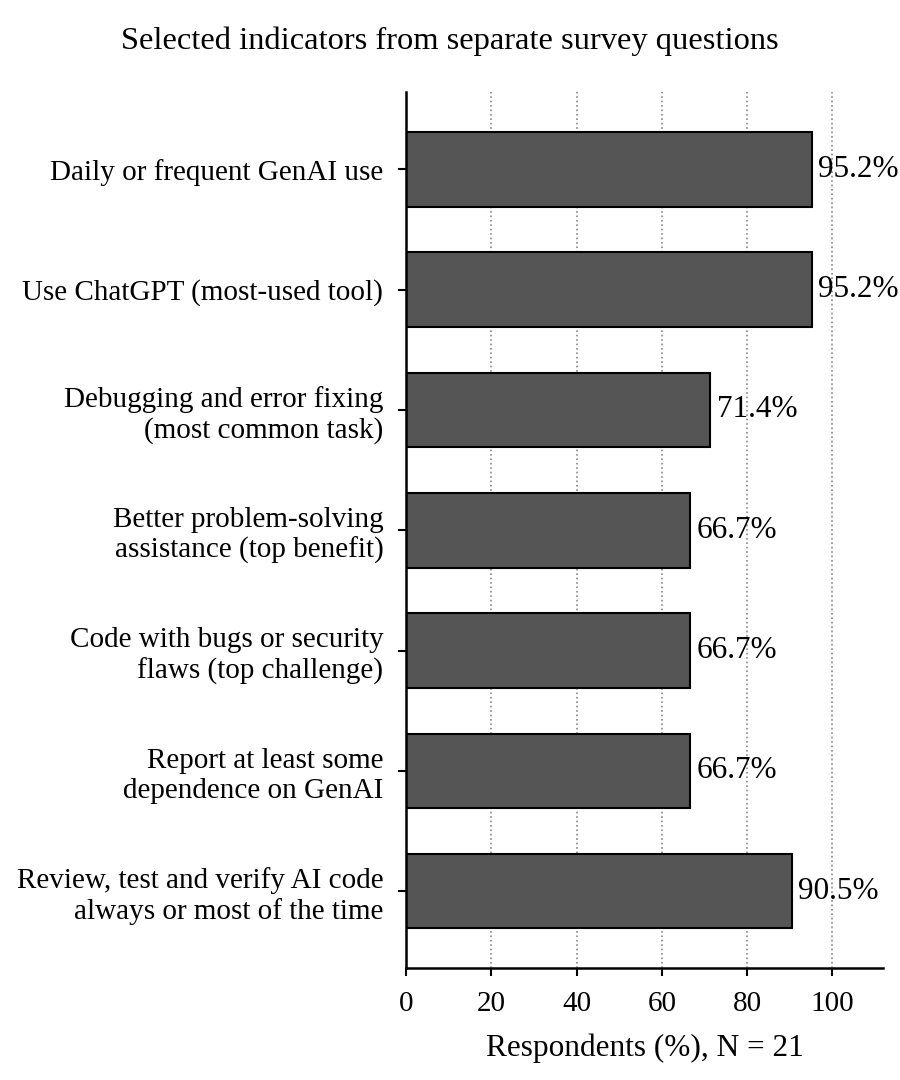
Figure 1 summarises selected indicators drawn from the tables above. Each bar comes from a separate survey question.
8Discussion
The survey shows that GenAI has become part of regular coding and academic work for most respondents, with ChatGPT being the most used tool. Debugging is the most common application, showing the usefulness of AI for identifying and solving programming problems.
However, generated bugs and security flaws were also the most reported limitation. The average ratings for code quality and time savings were both 3.62/5, indicating positive but not complete trust.
Dependence is also important, with 66.7% reporting some level of dependence, while 90.5% reported regularly verifying AI-generated code. This shows that users may rely on AI for assistance while still maintaining human review.
Overall, respondents expect GenAI to significantly transform software-development roles. The findings suggest that GenAI is a useful development assistant, but human judgment, verification, and technical skills remain essential.
9Implications of the study
- Education: Use GenAI as a learning assistant while requiring students to understand and test generated code.
- Development: Treat AI output as a suggestion and perform proper code review, testing, and security checks.
- Organizations: Establish clear policies for AI use, privacy, and proprietary code.
- Training: Focus on verification, debugging, architecture, and independent problem-solving along with prompt writing.
10Limitations
- Small sample: Only 21 responses were collected, limiting generalization.
- Sample bias: MCA students form a large part of the sample.
- Self-reported data: Responses may reflect personal perceptions or recall.
- Descriptive study: The research does not establish causal relationships.
11Conclusion
This study examined GenAI adoption in software development based on 21 responses. GenAI is frequently used, especially ChatGPT, for debugging, coding, explanation, and learning. Respondents reported benefits such as faster development and better problem-solving, with an average rating of 3.62/5 for code quality and time savings.
However, bugs, security, privacy, architectural complexity, and AI dependence remain important concerns. Overall, GenAI is best viewed as an assistant rather than a replacement for human programming skills and judgment. Larger studies are needed to validate these findings.
12Future scope
- Conduct surveys with larger and diverse groups.
- Compare GenAI use across experience levels and programming domains.
- Compare AI tools based on usefulness, accuracy, and security.
- Study changes in productivity, dependence, and coding skills over time.
- Evaluate actual coding performance alongside user perceptions.
- Study organizational GenAI policies and data-privacy practices.
Appendix A: Survey variables
- Respondent background
- GenAI usage frequency
- AI tools used
- Development tasks
- Code quality
- Benefits
- Challenges
- Security and privacy
- AI dependence
- Time savings
- Learning support
- Code verification
- Future job impact
- Recommendation of GenAI
References
- [1]Barke S, James MB, Polikarpova N (2023). Grounded Copilot: How programmers interact with code-generating models. Proceedings of the ACM on Programming Languages, 7(OOPSLA1), 85–111. https://doi.org/10.1145/3586030
- [2]GitHub (2024). GitHub Copilot documentation. GitHub.
- [3]Google (2024). Gemini documentation. Google.
- [4]Noy S, Zhang W (2023). Experimental evidence on the productivity effects of generative artificial intelligence. Science, 381(6654), 187–192. https://doi.org/10.1126/science.adh2586
- [5]OpenAI (2023). GPT-4 technical report. arXiv:2303.08774.
- [6]Pearce H, Ahmad B, Tan B, Dolan-Gavitt B, Karri R (2022). Asleep at the keyboard? Assessing the security of GitHub Copilot’s code contributions. In: 2022 IEEE Symposium on Security and Privacy (SP), 754–768. https://doi.org/10.1109/SP46214.2022.9833571
- [7]Peng S, Kalliamvakou E, Cihon P, Demirer M (2023). The impact of AI on developer productivity: Evidence from GitHub Copilot. arXiv:2302.06590.
- [8]Vaithilingam P, Zhang T, Glassman EL (2022). Expectation vs. experience: Evaluating the usability of code generation tools powered by large language models. In: CHI Conference on Human Factors in Computing Systems Extended Abstracts, 1–7. https://doi.org/10.1145/3491101.3519665