Business Economics
Consumer Perception, Brand Management and Willingness to Pay for Packaged Ghee
Department of Banking, Economics and Finance, Bundelkhand University, Jhansi, Uttar Pradesh, India
Published October 2026
Abstract
This study aimed to assess whether management skills can convert a home-grown product into a factory-produced item. It specifically examines consumer perceptions of ghee brand management, focusing on brand awareness, perceived quality, brand trust, price sensitivity, brand choice responses, and willingness to pay (WTP) for a 500-gram package. The analysis utilised a dataset of 800 observations encompassing ten variables. The study used descriptive statistics, frequency analysis, Pearson correlation, multiple linear regression, and one-way ANOVA. Additionally, we applied qualitative frequency coding to open-ended responses.
The findings reveal high mean scores for brand awareness (3.72/5) and brand trust (3.69/5), followed by perceived quality (3.50/5). In contrast, price sensitivity recorded a lower mean score of 3.14/5. The mean WTP stands at ₹643.81 per 500g, with a standard deviation of ₹186.45. In the regression model, brand trust is positively correlated with WTP and reaches statistical significance at the 5% level, while awareness, perceived quality, and price sensitivity do not emerge as statistically significant predictors in the multivariate framework. The overall explanatory power is modest (R2 = 0.011), suggesting that WTP is influenced by additional factors not captured in the questionnaire. Open-ended responses highlighted the importance of branding and visibility, digital positioning, management and distribution strategies, brand storytelling, and product attributes such as taste and purity. These results support a well-rounded brand management approach, emphasising that product credibility and consumer trust can be enhanced through effective positioning, distribution, and communication rather than relying solely on promotional efforts.
Keywords: Ghee; Brand Management; Brand Awareness; Perceived Quality; Brand Trust; Price Sensitivity; Willingness to Pay; Consumer Behaviour; India
1Introduction
Ghee holds a unique place in the Indian market through its culinary heritage. It is an essential food item suited to the Indian climate. It is a frequently purchased food item due to its taste, purity, and tradition. For many years, the manufacturing and industrial sectors have been attempting to shift it from home-grown to factory-made. Packaged ghee is rapidly outcompeting domestic ghee through branded communications, packaging, distribution, digital visibility, and differentiated positioning. The management challenge for ghee producers is not limited to manufacturing quality; it also includes building a credible brand identity and converting consumer knowledge and trust into willingness to pay. The conceptual foundation of this study is based on consumer-based brand equity. Keller's framework considers brand awareness and brand image/associations as central components of consumer-based brand equity and suggests that brand knowledge can alter consumer responses to marketing activity. Aaker's brand-equity framework similarly identifies attributes related to awareness, perceived quality, associations, and loyalty as important sources of value. FSSAI standards (Food Safety and Standards Authority of India, 2020) identify ghee as a milk-fat product and specify composition requirements, including a minimum milk-fat level of 99.5% and a maximum moisture content of 0.5%.
Given this background, this research uses 800 consumer observations conducted by the researcher to examine the relationship between brand perception and WTP for a 500-g pack of ghee.
2Research problem
The primary research question seeks to determine whether enhancing the brand value of ghee is merely a management strategy. Can principles from economics, commerce, and management effectively convert a domestically produced and consumed commodity into a factory-manufactured product? The study aims to identify which aspects of consumer perception are most pertinent to ghee brands and whether these measured factors relate to consumers' willingness to pay. Additionally, it explores how consumers articulate strategic approaches for transforming a local commodity into a branded factory product.
3Objectives of the study
The primary objective of this study is to assess consumer perceptions regarding ghee, focusing on brand awareness, perceived quality, brand trust, and price sensitivity. To achieve this, the study aims to:
- 1. Analyse the distribution of consumers' brand-choice responses across three distinct positions.
- 2. Estimate the average willingness to pay for a 500-gram pack of ghee.
- 3. Investigate the relationship between the measured perception variables and willingness to pay (WTP).
- 4. Evaluate whether different awareness groups significantly differ in their WTP.
- 5. Identify key strategic themes within consumers' open-ended responses.
- 6. Derive evidence-based recommendations for ghee brand management.
4Research questions
Five key questions stemming from the study are as follows:
- 1. What levels of consumer awareness, perceived quality, brand trust, and price sensitivity are present?
- 2. What is the average willingness to pay (WTP) for a 500-gram pack of ghee?
- 3. Are there correlations between awareness, perceived quality, trust, and price sensitivity in relation to WTP?
- 4. Do WTP levels differ significantly across various awareness categories?
- 5. Which brand-management strategies are most commonly cited by respondents?
5Hypotheses
The hypotheses for our study are as follows:
H1: There is a significant association between brand awareness and the willingness to pay for ghee.
H2: Perceived quality is significantly associated with the willingness to pay for ghee.
H3: Brand trust is significantly associated with the willingness to pay for ghee.
H4: Price sensitivity is significantly associated with the willingness to pay for ghee.
H5: The mean willingness to pay varies significantly across different levels of brand awareness.
6Conceptual framework
The conceptual framework suggests that brand awareness, perceived quality, brand trust, and price sensitivity serve as consumer-level explanatory variables, while willingness to pay for a 500-gram pack is the primary economic outcome. Brand choice responses and open-ended strategic perspectives offer complementary insights into brand positioning and management.
Conceptual pathway: Brand Awareness + Perceived Quality + Brand Trust + Price Sensitivity → Consumer Brand Response → Willingness to Pay. Brand choice responses and qualitative strategic perspectives are considered supplementary evidence rather than components of a singular composite index.
7Review of literature
Brand management literature has increasingly moved from a product-centred perspective towards a consumer-centred perspective. A brand is not merely a name, symbol, logo or packaging element; rather, it represents a set of meanings, associations, expectations and experiences held by consumers. Consequently, successful brand management depends on the ability of a firm to create, communicate and sustain distinctive value in the minds of consumers.
Food safety and authenticity represent important dimensions of consumer confidence in packaged food markets. Consumers often cannot independently verify whether a food product meets all desired safety and quality standards before consumption. Consequently, certifications, labels, traceability information and institutional assurances can function as trust signals.
Aaker (1991) conceptualized brand equity as a collection of assets and liabilities associated with a brand name or symbol that can add to or subtract from the value provided by a product or service. He argues that awareness can influence consumer decision-making by providing familiarity and reducing perceived uncertainty.
The framework emphasises dimensions such as brand awareness, perceived quality, brand associations and brand loyalty. From this perspective, awareness is an important starting point because consumers cannot develop meaningful associations with a brand unless they are able to recognise or recall it.
Keller (1993) further developed the consumer-based brand equity perspective and defined customer-based brand equity in terms of the differential effect of brand knowledge on consumer responses to marketing. He explains that brand awareness is an essential component of brand knowledge. Consumers are more likely to consider brands that are accessible in memory when making purchase decisions.
His framework conceptualises brand knowledge through brand awareness and brand image, with brand equity emerging when consumers possess favourable, strong and unique brand associations.
Steenkamp and van Trijp (1989) developed a methodology for estimating the maximum price consumers are willing to pay in relation to perceived quality and consumer characteristics. Their work is particularly relevant to the present research because it establishes a conceptual connection between perceived quality and price valuation. Research specifically related to ghee provides additional evidence.
Intodia and Deodhar (2001), in their hedonic price analysis of ghee, reported that consumers were willing to pay a premium for branded ghee compared with non-branded ghee and that flavour was an important quality attribute. Their findings indicate that branding and product attributes can jointly influence the economic valuation of ghee.
A critical review by Kaur et al. (2021) says that consumers often rely on trusted cues and information to evaluate food quality and other attributes that cannot be directly observed. Packaging labels, certifications, origin information and traceability can contribute to consumer trust, while producers, retailers, government agencies and third-party institutions can also influence trust formation.
Temperini et al. (2017) empirically examined consumer trust in food quality and willingness to pay premium prices for food products carrying national park brands. Their study of 227 Italian consumers found that product origin, naturalness, quality certification and branding influenced consumer confidence and purchasing behaviour. The study is particularly relevant because it explicitly links food-quality trust with willingness to pay a premium.
More recent research also reinforces the relationship between food-related trust and WTP. Maitiniyazi et al. (2026), in a review of research on food safety perceptions and willingness to pay, reported that trust in certified foods, perceived safety and quality concerns are among the factors associated with consumers’ willingness to pay for safer food products.
Moon et al. (2022) investigated food quality, usefulness, convenience, brand trust and willingness to pay in the context of Starbucks and examined their structural relationships using survey data.
Research published in the Journal of Retailing and Consumer Services examined the relationships among perceived taste, perceived quality, brand trust and willingness to buy. The findings indicated positive relationships among perceived taste, quality and brand trust, while brand trust also predicted willingness to buy.
Modern brand management extends beyond the intrinsic characteristics of a product. Packaging, advertising, celebrity endorsement, digital communication and brand storytelling can influence consumers’ perceptions and associations.
From the customer-based brand equity perspective, Keller (1993) argues that brands acquire value through the associations stored in consumers’ memory. Accordingly, communication activities can contribute to brand differentiation when they establish strong and meaningful associations.
In food markets, however, communication operates alongside credibility-related cues. Consumers may notice attractive packaging or advertising, but their long-term evaluation can depend on whether the actual product experience confirms the promise communicated by the brand. This distinction is especially important in categories such as ghee, where claims relating to purity, authenticity and quality can substantially affect consumer confidence.
The open-ended responses in the present dataset provide empirical support for this broader view. Respondents repeatedly mention packaging, celebrity advertising, digital marketing, brand story, visibility and management as mechanisms through which a relatively undifferentiated food product can acquire brand value. These qualitative observations complement the established brand-equity literature.
Willingness to pay is conceptually distinct from perceived quality. A consumer may perceive a product as high quality but still be unwilling to pay a substantial premium because of income constraints, competing products, reference prices or price sensitivity.
Steenkamp and van Trijp (1989) explicitly connected maximum willingness to pay with perceived quality and consumer characteristics, demonstrating the importance of examining consumer valuation rather than relying exclusively on attitudinal measures.
The present study therefore uses WTP for a 500-g pack as an economically interpretable dependent variable. This allows the research to move beyond the conventional question of whether consumers “like” a brand and examine the extent to which brand perceptions are associated with monetary valuation.
Intodia and Deodhar (2001) specifically examined quality attributes and hedonic pricing in the Indian ghee market. Their findings indicated that consumers were willing to pay a premium for branded ghee relative to non-branded ghee and that flavour was among the important attributes valued by consumers.
Kaur et al. (2021) emphasise that food packaging labels, certifications, geographical origin and traceability can contribute to consumer trust by reducing information asymmetry.
Temperini et al. (2017) similarly found that food quality certification and origin-related information can influence consumer confidence and willingness to pay.
Recent research in India also demonstrates the relevance of perceived quality and price in food purchasing behaviour. A 2024 study of Indian consumers of organic food products examined the relationships among attitude, perceived value, perceived quality and perceived price using survey data from 308 respondents. The study demonstrates the relevance of perceived quality and price-related perceptions in explaining food purchase intentions.
For ghee brands, these findings imply that brand communication should not be separated from verifiable product information. Trust is more likely to be sustainable when promotional claims are supported by transparent quality information and consistent product performance.
This finding has particular relevance to ghee because taste and perceived purity are frequently used by consumers as direct indicators of product quality. The present dataset’s open-ended responses similarly contain repeated references to taste and purity. Thus, the quantitative construct of perceived quality and the qualitative responses concerning taste and purity provide complementary perspectives.
These studies provide a strong theoretical rationale for including brand trust in the present research. In particular, the empirical finding in the current dataset that brand trust is statistically associated with WTP is consistent with the broader literature connecting consumer confidence with economic valuation of food brands.
This study is especially important for the present research because it provides category-specific evidence from the Indian ghee market. It suggests that the economic value of ghee is not determined exclusively by physical product characteristics; brand reputation and perceived quality can also influence market valuation.
However, the earlier ghee research primarily used hedonic price analysis, whereas the present study uses consumer survey data to examine the relationship between brand perceptions and stated WTP. The two approaches are therefore complementary.
8Research methodology
This study employs a quantitative, cross-sectional, and exploratory-descriptive methodology, further augmented by qualitative content coding applied to responses from an open-ended survey question. The empirical analysis is derived from a provided CSV dataset that includes 800 individual responses.
The evaluation is conducted on a refined dataset consisting of N = 800 records, with complete information across all ten designated variables (no missing values). Due to the absence of contextual information such as demographic profiles, sampling frameworks, data collection dates, geographic locations, recruitment methods, or response rates, this study does not claim to operate within a formal probability-sampling framework.
8.1Variables and measurement
Table 1 lists the variables used in the analysis, their measurement scales and their roles.
| Measure | Scale | Role |
|---|---|---|
| Awareness | 1–5 | Predictor |
| Quality Perception | 1–5 | Predictor |
| Brand Trust | 1–5 | Predictor |
| Price Sensitivity | 1–5 | Predictor |
| WTP for 500 g | INR | Dependent variable |
| Choice positions | Nominal | Supplementary choice response |
| Strategy view | Nominal text | Qualitative response |
8.2Statistical techniques
Descriptive statistics (mean, standard deviation, median and range), frequency and percentage distributions, Pearson correlations, multiple linear regression and one-way ANOVA were used. The open-ended responses were coded by exact response category because the dataset contains eight recurring response statements. Statistical significance is evaluated at α = 0.05. The four Likert variables were not combined into a single index because the empirical inter-item reliability was extremely low (Cronbach's α≈0.017), and their conceptual directions are not identical; treating them as separate constructs is therefore methodologically more defensible.
9Data quality and descriptive results
All 800 records were complete for the variables used in the analysis. The Likert measures are bounded between 1 and 5. WTP values range from ₹350 to ₹950.
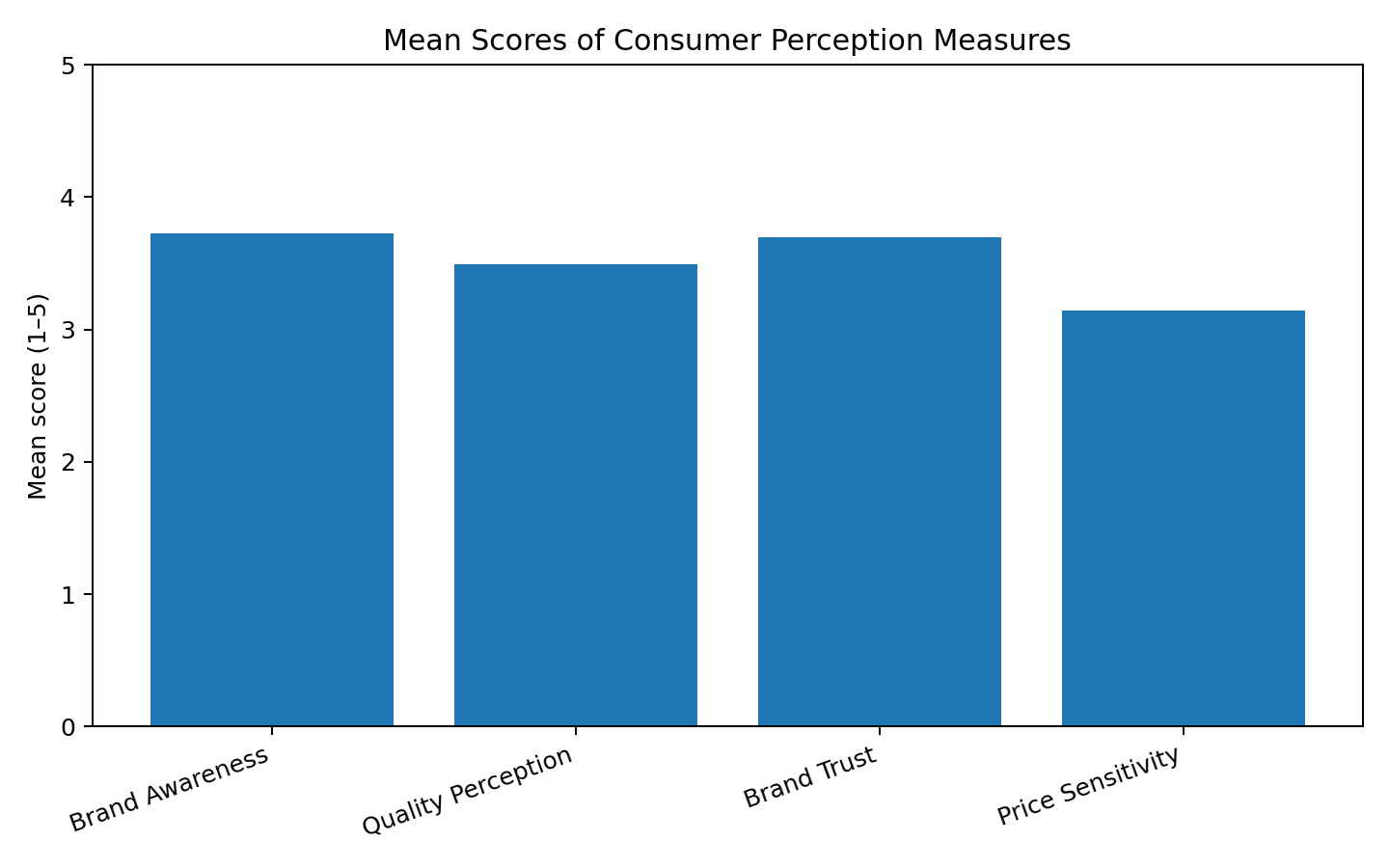
Table 2 summarizes the descriptive statistics, and Figure 1 shows the mean score of each perception measure.
| Measure | N | Mean | SD | Median | Min | Max |
|---|---|---|---|---|---|---|
| Brand awareness | 800 | 3.72 | 1.16 | 4 | 1 | 5 |
| Quality perception | 800 | 3.50 | 1.14 | 4 | 1 | 5 |
| Brand trust | 800 | 3.69 | 1.10 | 4 | 1 | 5 |
| Price sensitivity | 800 | 3.14 | 1.21 | 3 | 1 | 5 |
| WTP (₹ per 500 g) | 800 | 643.81 | 186.45 | 650 | 350 | 950 |
9.1Likert response distributions
Table 3 shows the response distribution of the four Likert measures.
| Score | Brand awareness | Quality perception | Brand trust | Price sensitivity | ||||
|---|---|---|---|---|---|---|---|---|
| n | % | n | % | n | % | n | % | |
| 1 | 41 | 5.12 | 47 | 5.88 | 36 | 4.50 | 85 | 10.62 |
| 2 | 91 | 11.38 | 117 | 14.62 | 94 | 11.75 | 159 | 19.88 |
| 3 | 155 | 19.38 | 192 | 24.00 | 147 | 18.38 | 232 | 29.00 |
| 4 | 274 | 34.25 | 281 | 35.12 | 325 | 40.62 | 205 | 25.62 |
| 5 | 239 | 29.88 | 163 | 20.38 | 198 | 24.75 | 119 | 14.88 |
| Total | 800 | 100.00 | 800 | 100.00 | 800 | 100.00 | 800 | 100.00 |
9.2Willingness to pay
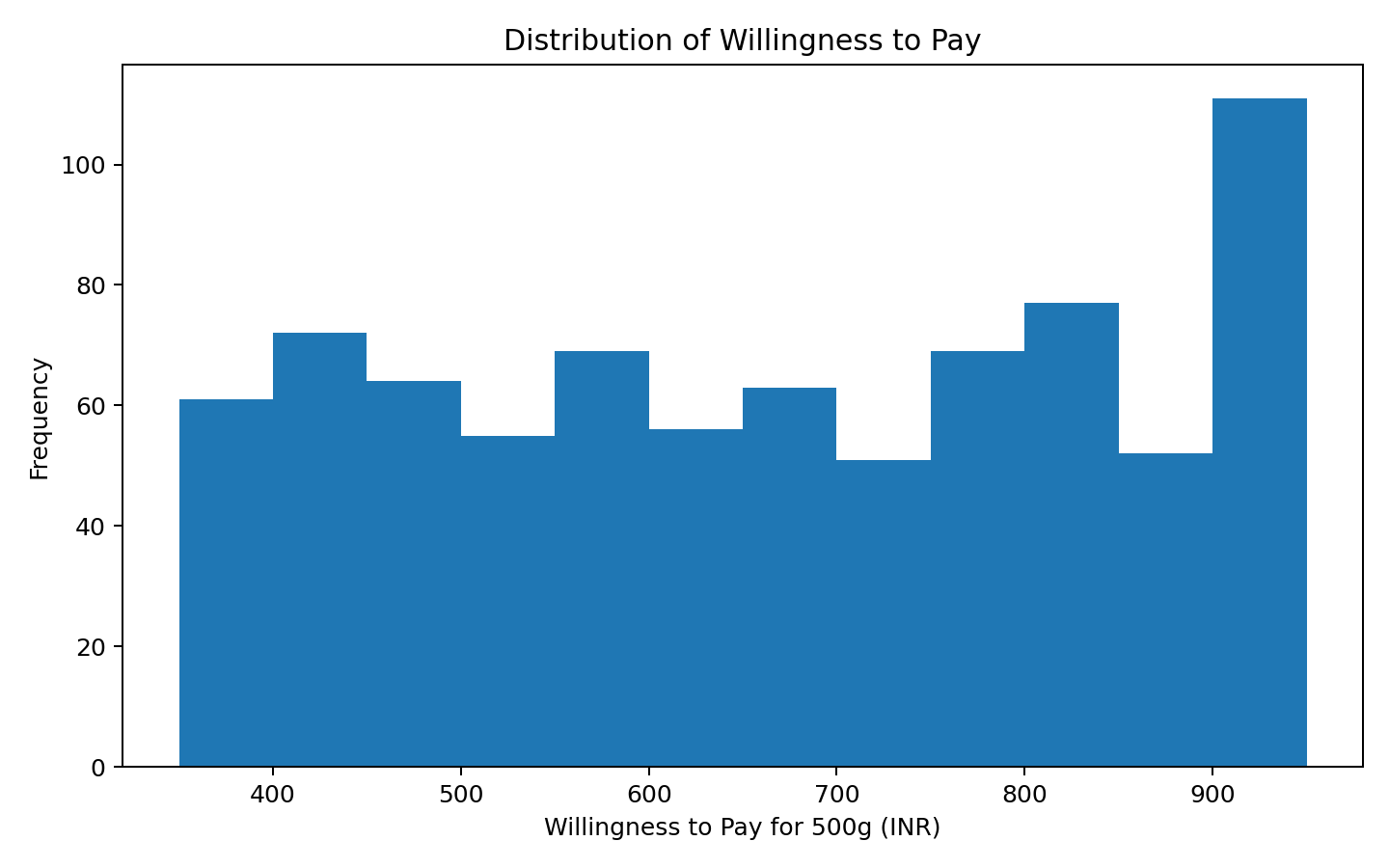
The mean WTP is ₹643.81; the median is ₹650; the standard deviation is ₹186.45. The observed range is ₹350–₹950. Figure 2 shows the distribution.
9.3Brand choice responses
Table 4 and Figure 3 show the distribution of brand-choice responses across the three choice positions.
| Response | Choice 1 (%) | Choice 2 (%) | Choice 3 (%) |
|---|---|---|---|
| A | 51.12 | 46.50 | 29.12 |
| B | 28.62 | 34.62 | 41.50 |
| Neither | 20.25 | 18.88 | 29.38 |
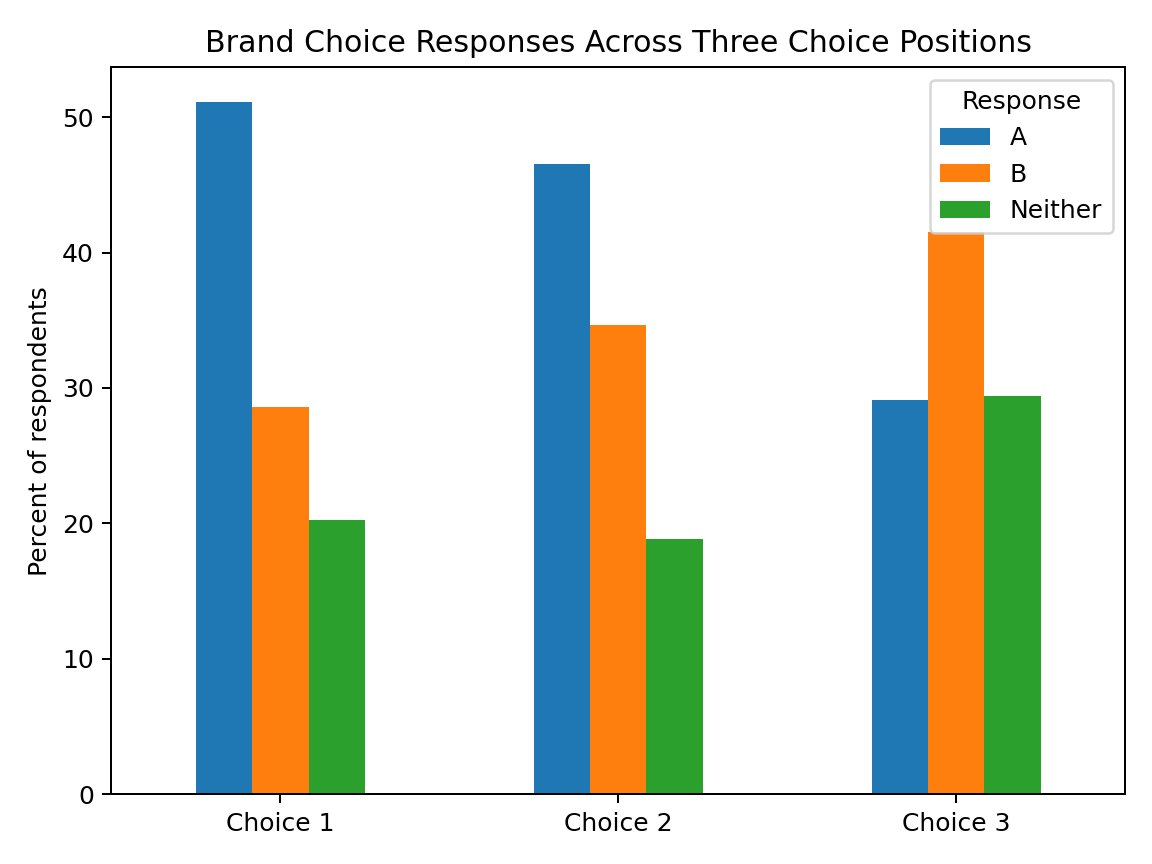
Choice 1 records the largest share for A (51.1%), followed by B (28.6%) and Neither (20.3%). In Choice 2, A represents 46.5%, B 34.6% and Neither 18.9%. In Choice 3, B represents 41.5%, Neither 29.4% and A 29.1%. These are descriptive response patterns only; because the dataset does not define what brands A and B represent, no substantive brand-market conclusion should be attached to the labels without the questionnaire's brand definitions.
10Correlation analysis
Table 5 presents the Pearson correlation matrix of the four perception measures and WTP.
| Variable | (1) | (2) | (3) | (4) | (5) |
|---|---|---|---|---|---|
| (1) Brand awareness | 1.000 | ||||
| (2) Quality perception | 0.000 | 1.000 | |||
| (3) Brand trust | −0.011 | −0.010 | 1.000 | ||
| (4) Price sensitivity | −0.009 | 0.024 | 0.029 | 1.000 | |
| (5) WTP | 0.033 | 0.039 | 0.082 | −0.031 | 1.000 |
The correlations between the four perception variables and WTP are small in magnitude: awareness (r = 0.033), perceived quality (r = 0.039), brand trust (r = 0.082) and price sensitivity (r = −0.031). Among the four predictors, the largest bivariate association with WTP is observed for brand trust, but the effect remains small.
11Multiple regression analysis
A multiple linear regression was estimated with WTP for 500 g as the dependent variable and awareness, perceived quality, brand trust and price sensitivity as predictors. Table 6 reports the estimates.
| Predictor | B | SE | t | p |
|---|---|---|---|---|
| Constant | 564.429 | 40.807 | 13.832 | < 0.001 |
| Brand awareness | 5.484 | 5.695 | 0.963 | 0.336 |
| Quality perception | 6.601 | 5.762 | 1.146 | 0.252 |
| Brand trust | 14.255 | 5.973 | 2.387 | 0.017 |
| Price sensitivity | −5.335 | 5.454 | −0.978 | 0.328 |
Note: Dependent variable: WTP for a 500-g pack (₹). R2 = 0.011; adjusted R2 = 0.006; F = 2.156, p = 0.072.
The model has R2 = 0.011 and adjusted R2 = 0.006; the overall F-test is 2.156 with p = 0.072. Brand trust is statistically significant (B = 14.26, p = 0.017) in the multivariate model. Awareness, perceived quality and price sensitivity are not statistically significant at the 5% level. The low R² indicates that the four measured constructs explain only a small proportion of variation in WTP.
Accordingly, H3 is supported within this sample/model at the 5% level, while H1, H2 and H4 are not supported by the regression evidence. These statements refer only to statistical evidence in the supplied dataset and should not be interpreted as causal effects.
12ANOVA: WTP across awareness levels
Table 7 reports mean WTP by awareness score.
| Awareness score | n | Mean WTP (₹) | SD (₹) |
|---|---|---|---|
| 1 | 41 | 629.27 | 188.74 |
| 2 | 91 | 629.67 | 171.59 |
| 3 | 155 | 637.74 | 190.98 |
| 4 | 274 | 652.55 | 188.82 |
| 5 | 239 | 645.61 | 186.72 |
One-way ANOVA yields F = 0.389, p = 0.816. Therefore, the null hypothesis of equal mean WTP across the five awareness categories is not rejected at α = 0.05. H5 is not supported by this test.
The result is consistent with the broader regression finding that awareness, by itself, is not a strong statistical predictor of WTP in this dataset.
13Open-ended strategy analysis
Table 8 lists the frequency of each strategy statement.
| Statement | Frequency | % |
|---|---|---|
| Branding and visibility are more important than a product's basic characteristics. | 110 | 13.75 |
| Digital marketing and proper positioning are essential for branding a commodity. | 108 | 13.50 |
| Consumers are willing to pay more for a brand name if management is right. | 107 | 13.38 |
| If management and distribution networks are strong, a product automatically becomes a big brand. | 105 | 13.12 |
| I believe that the taste and purity of ghee are what matter; everything else is a marketing game. | 101 | 12.62 |
| In today's world, the brand story sells more than quality. | 101 | 12.62 |
| Excellent packaging and celebrity endorsements can elevate any ordinary ghee to a premium one. | 86 | 10.75 |
| Corporate management and advertising style determine which ghee will dominate the market. | 82 | 10.25 |
| Total | 800 | 100.00 |
The most frequent statement emphasises branding and visibility (110 responses; 13.75%). Digital marketing and positioning follow closely (108; 13.50%). Management and willingness to pay for a brand name also appear frequently (107; 13.38%). Distribution and management (105; 13.13%) and product attributes such as taste and purity (101; 12.63%) are also prominent. Brand story (101; 12.63%), packaging/celebrity advertising (86; 10.75%) and corporate management/advertising (82; 10.25%) complete the observed response set.
Because these responses were supplied as predefined recurring textual statements in the CSV, the analysis is best described as categorical content-frequency analysis rather than an open-ended inductive qualitative study. Future research can use verbatim interviews and independent coders to generate richer thematic evidence.
14Integrated findings
- Consumer awareness is relatively high, with a mean of 3.72/5; 64.1% of respondents selected 4 or 5.
- Quality perception has a mean of 3.50/5; 55.5% selected 4 or 5.
- Brand trust has a mean of 3.69/5; 65.4% selected 4 or 5.
- Price sensitivity has a mean of 3.14/5, indicating greater dispersion than the other perception measures.
- Average WTP for 500 g is ₹643.81, with substantial dispersion (SD ₹186.45).
- Brand trust has a small positive bivariate relationship with WTP and remains statistically significant in the multivariate regression.
- The four-predictor regression explains only 1.1% of WTP variation, indicating that additional factors such as income, household size, actual purchase frequency, competing prices, pack size, distribution access and sensory evaluation may matter.
- Consumers' strategy statements repeatedly emphasise branding/visibility, digital positioning, management, distribution, brand story, packaging and product attributes.
The findings of the study align with the established principles of brand equity, illustrating how brand knowledge and associations significantly impact consumer reactions to marketing strategies. However, the data reveal that the relationship between brand awareness and consumers' willingness to pay (WTP) is not as straightforward as one might assume. In fact, awareness has only a weak correlation with WTP, and the analysis of variance (ANOVA) among different awareness groups yields no significant results. In contrast, trust emerges as a critical factor; it registers the highest positive coefficient among the various predictors and shows significance in the regression analysis. This indicates that consumers’ perceptions of credibility may play a more vital role in determining the economic value they attribute to a ghee brand than mere awareness does.
Additionally, qualitative feedback from consumers underscores the dual importance of visibility and brand positioning while emphasising that elements such as taste and purity remain paramount. This insight holds strategic importance for food products, where successful communication can attract consumer attention, but enduring brand value must be rooted in reliable product performance and clear quality indicators. Regulatory standards serve as an essential external benchmark for defining product identity and formulation; thus, compliance should be viewed as a baseline requirement rather than a substitute for effective brand differentiation.
15Managerial implications for Ghee brand management
- Build trust before premium pricing: communicate traceability, quality controls, authenticity and consistent product performance.
- Use digital marketing for positioning rather than visibility alone; the message should explain why the brand is different.
- Strengthen distribution availability because repeated purchase requires convenient access in addition to advertising.
- Use packaging as an information and trust device: clear product identity, legally required information and credible quality communication should be prioritised.
- Develop a brand story that connects tradition and modern quality assurance without making unsupported health or purity claims.
- Use celebrity or influencer communication cautiously; it can increase attention, but the dataset does not establish that it independently creates WTP.
- Segment pricing and pack sizes using actual purchase behaviour and income data in future research; the present dataset cannot identify economically distinct consumer segments.
- Treat brand trust as a strategic KPI and track it alongside awareness, repeat purchase, complaints, distribution reach and WTP.
16Theoretical implications
The findings suggest that the constructs commonly used in brand-equity thinking should not automatically be collapsed into a single score. In this dataset, the four Likert variables show very low internal consistency when treated as a common scale (α≈0.017). This supports construct-specific analysis. The evidence also indicates that consumer awareness and economic willingness to pay are not interchangeable outcomes: awareness can be high while its statistical relationship with WTP remains weak.
17Limitations
The study has the following limitations:
- The supplied dataset contains no demographic variables, geographic identifiers, income information, household characteristics or purchase-frequency measures.
- The file does not document the sampling frame, recruitment process, response rate, field dates or survey administration mode; therefore, population-level generalisation should be avoided.
- Brand labels A and B are not defined in the dataset, so their market identities cannot be interpreted.
- The WTP variable is an observed stated amount and may differ from actual purchase behaviour.
- The open-ended responses are categorical recurring statements, limiting the depth of qualitative interpretation.
- The regression has low explanatory power, showing that important determinants of WTP are absent from the questionnaire.
- Cross-sectional observational data do not establish causality.
18Conclusion
Our research findings indicate that company strategy plays a more important role in the marketing and branding of ghee than for a typical factory product. This empirical investigation, which included responses from 800 consumers, shows that managing a ghee brand involves more than simply creating awareness. This large dataset reveals excellent scores in both brand awareness and consumer trust, as well as a high quality perception rating. Specifically, participants expressed a willingness to pay an average of ₹643.81 for a 500-gram package of ghee. Among the various factors examined, brand trust emerged as a key element, demonstrating statistical significance in a multivariate model examining willingness to pay. Despite this, the model's low explanatory power suggests that the complexity of consumer willingness to pay is influenced by multiple factors, extending beyond the four measured perceptions.
The results support an integrated branding approach for ghee, where high product quality and consumer trust serve as the fundamental elements. This foundation should be carefully complemented by strategic positioning, compelling digital communication, attractive packaging, an engaging brand story, and effective distribution channels to improve both visibility and accessibility. The most important finding from this study is that successful brand-building depends on the synergy between product credibility and market communication efforts, indicating that no single marketing tool can achieve success in this competitive field. Thus, we can conclude that even today, in India, the mentality of first purchasing ghee from the factory remains a crucial factor in selling ghee.
References
- [1]Aaker DA (1991). Managing brand equity: Capitalizing on the value of a brand name. Free Press.
- [2]Food Safety and Standards Authority of India (2020). Food Safety and Standards (Food Products Standards and Food Additives) Regulations: Standard for milk fat products/ghee. FSSAI.
- [3]Food Safety and Standards Authority of India (2026). Food Safety and Standards regulations and notifications. FSSAI. https://www.fssai.gov.in/food-law/regulations
- [4]Intodia V, Deodhar SY (2001). Quality attributes and hedonic price analysis of ghee (Working Paper No. 2001-09-04). Indian Institute of Management Ahmedabad.
- [5]Kaur S, Dhir A, Talwar S, Alrasheedy M (2021). Systematic review of consumer trust in food and the food system. Food Quality and Preference, 93, 104258.
- [6]Keller KL (1993). Conceptualizing, measuring, and managing customer-based brand equity. Journal of Marketing, 57(1), 1–22. https://doi.org/10.1177/002224299305700101
- [7]Maitiniyazi S, Bulibuli A, Ahmadi Kaliji S (2026). Building trust in sustainable food systems: Chinese consumers’ food safety perceptions and willingness to pay. Frontiers in Sustainable Food Systems, 10, 1796577. https://doi.org/10.3389/fsufs.2026.1796577
- [8]Moon J, Song M, Lee WS, Shim JM (2022). Structural relationship between food quality, usefulness, ease of use, convenience, brand trust and willingness to pay: The case of Starbucks. British Food Journal, 125(1), 65–81. https://doi.org/10.1108/BFJ-07-2021-0772
- [9]Steenkamp JBEM, van Trijp HCM (1989). A methodology for estimating the maximum price consumers are willing to pay in relation to perceived quality and consumer characteristics. Journal of International Food & Agribusiness Marketing, 1(2), 7–24. https://doi.org/10.1300/J047v01n02_02
- [10]Temperini V, Limbu Y, Jayachandran C (2017). Consumers’ trust in food quality and willingness to pay more for national parks’ brands: Preliminary evidence from Italy. Journal of International Food & Agribusiness Marketing, 29(2), 120–138. https://doi.org/10.1080/08974438.2016.1266569