Public Health
Maternal Mortality and Its Determinants: A Review of Trends and Risk Factors in Nigeria, 2015–2025: A Systematic Review and Meta-Analysis
Ahmadu Bello University, Zaria, Nigeria
Published October 2026
Abstract
Background: Maternal mortality remains a major public health challenge in Nigeria despite efforts toward achieving Sustainable Development Goal 3.1 by 2030. This is so as a result of socioeconomic, demographic, and health-system disparities that continue to persist. This study was designed to determine trends and the pooled magnitude of maternal mortality in Nigeria from 2015–2025, identify key determinants and risk factors, and synthesize evidence-based recommendations for reducing maternal deaths.
Methods: A systematic review and meta-analysis was conducted in accordance with PRISMA 2020 guidelines. PubMed and Consensus were searched for eligible Nigerian studies, including cross-sectional, cohort, case-control, and surveillance/registry-based studies. Thirty-seven studies were narratively synthesized by determinant category. Eligible quantitative estimates were pooled using a random-effects model, with heterogeneity assessed using the I² statistic.
Results: Maternal mortality remained high and heterogeneous across settings. The pooled facility-based maternal mortality ratio was approximately 1,753 deaths per 100,000 live births (95% CI: 1,086–2,830; I² = 94.3%), compared with a population-based sisterhood estimate of 430 per 100,000. Postpartum haemorrhage had a 4.8% case-fatality rate, while pooled mortality among women with pre-eclampsia/eclampsia was 6.04%. Major determinants included inadequate antenatal care, informal setting delivery, delayed referral, low socioeconomic status, limited education, and health-system weaknesses.
Conclusion: Maternal mortality in Nigeria remains unacceptably high and is driven by interacting demographic, socioeconomic, and health-system factors. Strengthening quality antenatal and emergency obstetric care, referral systems, financial protection, skilled maternity services, and maternal death surveillance is essential for accelerating progress toward SDG 3.1.
Keywords: maternal mortality; maternal mortality ratio; determinants; risk factors; Nigeria; systematic review; meta-analysis
1Introduction
1.1Background of the study
Maternal mortality is one of the major unsolved public health issues especially in developing countries such as Nigeria. Of the estimated 287,000 maternal deaths worldwide in 2020, mostly due to pregnancy complications, over 70 percent occurred in sub-Saharan Africa alone (WHO, 2023).
The literature explores the topic from different angles; however, there is still a gap that needs to be filled by a comprehensive synthesis of recent findings. This study therefore aims to fill the gap by conducting a systematic review of peer reviewed scholarly literature post 2015 with the goal of determining the basic factors associated with rising maternal mortality in Nigeria to enhance violence free policy measures rooted in well-founded arguments.
Maternal mortality is one of the most important health problems in Nigeria a country which contributes a small share of the world's population yet accounts for nearly twenty percent of maternal mortality globally (WHO, 2023).
A collection of socioeconomic and systemic factors, in conjunction with direct medical causes, seems to perpetuate maternal mortality in Nigeria. As for medical issues, post-partum haemorrhage, hypertensive disorders, unsafe abortion, and other infections like sepsis remain leading drivers of death among pregnant women (Adinma & Adinma, 2015). Furthermore, for the underlying medical risks, there are severe austerity challenges that include lack of education and extremely limited access to skilled health services (Badamasi, 2021; Fawole & Adeoye, 2015).
Cultural practices and beliefs are equally important: the majority of women still prefer to use traditional birth attendants because of the culture, hospital phobia, or the costs associated with formal health care services. This strongly predisposes them to the risk of delay of complete evidence of emergency obstetric care services (Olawade et al., 2023). The issue is made worse by geographical discrepancies. Northern Nigeria consistently records more maternal mortality compared to the south. This can be attributed to limited education, early marriage, antenatal care, and poorer health care systems (Meh et al., 2019). There is a gap in the literature from within Nigeria which focuses on systematic reviews of recent studies, with the goal of developing tailored solutions useful in reducing maternal mortality in Nigeria.
1.2Statement of the problem
By the year 2030, the Sustainable Development Goal (SDG) target 3.1 aims to reduce the maternal mortality ratio (MMR) to under 70 per 100,000 live births. Current trajectories will miss the goal by a wide margin. The global maternal mortality ratio dropped to roughly 197 deaths per 100,000 live births but the rate of reduction has stalled severely since 2015, leaving the world off track for sustainable development goal targets. (WHO, 2023)
The World Health Organization estimated 287,000 women died due to maternal cause globally, which equates to one death every two minutes. The majority of those fatalities occurred in low- and middle-income nations especially Nigeria. (WHO, 2023)
A systematic study of maternal mortality rates across 133 nations, showed them to have either stagnated or seen substantial increment during 2016 to 2020. (Sharma et al., 2026)
1.3Justification of the study
The study on maternal mortality rate (MMR) in Nigeria is justified because the country accounts for nearly the third for maternal mortality making Nigeria one of the most challenging places in the world. Statistics reveal a high maternal mortality ratio estimated around 512 to 993 deaths per 100,000 live births depending on the region and reporting standard. Pregnancy and child birth remain the most determinants for reoccurring maternal mortality in Nigeria(World Bank Group, 2023).
This study is important because it will synthesize existing evidence on the magnitude, causes, risk factors, and determinants of maternal deaths across Nigeria.
1.4Broad objective
To review the trends and determinants of maternal mortality in Nigeria from 2015–2025.
1.4.1Specific objectives
- 1. To determine the trends and pooled magnitude of maternal mortality in Nigeria from 2015–2025
- 2. To identify key determinants and risk factors associated with maternal mortality in Nigeria.
- 3. To synthesize recommendations for reducing maternal mortality in Nigeria based on current evidence.
1.5Research questions
- 1. What are the trends and pooled magnitude of maternal mortality in Nigeria from 2015–2025
- 2. What are the determinants and risk factors of maternal mortality in Nigeria.
- 3. What are the current recommendations for reducing maternal mortality in Nigeria.
2Literature review
2.1Conceptual review
2.1.1The concept of maternal mortality
Maternal mortality is regarded as one of the leading causes of death globally. A significant number of women develop complications during and following pregnancy and childbirth (Cresswell et al., 2025). It may be subdivided into two: direct obstetric deaths and indirect obstetric deaths as presented in(World Health Organization, 2012). Direct obstetric deaths are due to complications arising from the pregnancy while indirect obstetric deaths are due to complications arising from pre-existing conditions which may be aggravated during pregnancy. Direct causes include haemorrhage, eclampsia, sepsis, obstructive labour while indirect causes include cardiovascular diseases, anaemia and post-operative complications (Tasneem et al., 2019). Akaba et al. (2021) estimate that 94% of maternal deaths are due to direct causes and 6% are due to indirect causes indicating that direct causes constitute a major part of maternal mortality.
2.1.2Measurement of maternal mortality
Maternal mortality data can be gotten from National Civil Registration and Vital Statistics (CRVS) system, population-based household surveys, reproductive age mortality survey etc. (World Health Organization, 2022) and measured using the Maternal Mortality Ratio (MMR). The WHO defines it as the number of maternal deaths during a given time period per 100,000 live births during the same period.
2.2Trends in maternal mortality
Globally, maternal mortality is declining but continues to present as a challenge with a global MMR of 197 deaths per 100,000 live births and an estimated 260,000 women dying during pregnancy and childbirth in 2023 as presented in The Sustainable Development Goals Report, 2026.
The World Health Organisation (WHO) estimates that about 92% of maternal deaths occurred in Low-Middle-Income-Countries (LMICs) with most of them preventable. Sub-Saharan Africa alone accounted for about 70% of estimated global maternal deaths (WHO, 2023)
2.3Trends in maternal mortality in Nigeria, 2015–2025
Nigeria is making gradual improvements in the reduction of maternal mortality in line with the WHO Sustainable Development Goals (SDG) 3, however it remains one of the countries in Sub-Saharan Africa where maternal mortality remains a challenging issue. The Sustainable Development Goals Extended Report, 2024 report shows the decline from 814 deaths per 100,000 births in 2015 to about 525 deaths per 100,000 in 2019, however this still falls significantly below the SDG 3 target of less than 70 deaths per 100,000 births.
Studies show a disparity between the Northern and other parts of Nigeria (Meh et al., 2019). Southern Nigeria showed a decline while the North demonstrated an increase in the rate of maternal mortality. This increase was due to a combination of clinical, socioeconomic and health system deficiencies (Andrew, 2025). Maternal mortality data for 2023 appeared unavailable and disparities were observed in the northern region (Oweibia et al., 2025).
2.4Theoretical framework
The Three Delays Model proposed by Thaddeus and Maine in 1994 remains a dominant framework in understanding maternal mortality and was used to analyse the factors that influence maternal mortality rate. They argued maternal deaths resulted not only from biological complications but others interwoven factors. They proposed that there are three main factors that result in maternal mortality (Thaddeus & Maine, 1994) First is delay in decision to seek health care, second is delay in identifying and reaching the health facility and finally, delay in provision of adequate care. The first delay is the time taken for a woman to recognize danger signs and may be due to factors such as sociocultural beliefs, poor sensitivity to bodily changes, financial constraints or inaccessibility to health facilities. The second delay is the time taken for the woman to get to the hospital and is affected by distance, road infrastructure, affordability of transportation while the third delay is the time taken before she receives quality attention after arriving at the hospital. This may be influenced by staff shortages, lack of medical supplies and weak facility management.
2.5Determinants and risk factors of maternal mortality in Nigeria
2.5.1Socio-demographic factors
There are certain individual and family factors that influence the rate of maternal mortality. Maternal age (<18 or >35 years) has been shown to be a risk factor in maternal mortality. Teenage pregnancies and pregnancies in women older than 35 have been associated with increased risk of complications such as preeclampsia (Souza et al., 2024) Genetic disorders such as sickle cell anaemia and haemophilia have been studied to also increase the risk (De Montalembert & Deneux-Tharaux, 2015; Oteng-Ntim et al., 2015). Lifestyle factors such as poor diet, low physical activity and risk exposure to environmental toxins have shown increased risk. Absence or low involvement of a partner or support is also a major factor in the increased risk of maternal mortality.
2.5.2Clinical and obstetric factors
Across several studies, clinical and obstetric factors have shown to be a leading factor in maternal mortality. Postpartum haemorrhage, hypertensive disorder in pregnancy, sepsis, complications of unsafe abortion, ectopic pregnancy and prolonged labour have been shown to be major factors in maternal mortality (Olawade et al., 2023; Tasneem et al., 2019).
2.5.3Socio-economic and socio-cultural factors
Maternal mortality is affected by economic and cultural perceptions present in a society. Lower education, rural residency, lower income level, lack of food security and lack of private insurance have been revealed to cause increased risk of maternal mortality (Shaukat et al., 2026). Bad cultural beliefs, practices and attitudes such as men's control over their wives are also determinants that affect maternal mortality (Adgoy, 2018).
2.5.4Health-system factors
The ignorance of danger signs during pregnancy, delay in receiving medical attention, substandard care and poor access to healthcare due to non-availability of essential drugs, inadequate medical practitioners negatively affect the rate of maternal mortality (Souza et al., 2024).
2.6Gaps in literature
- Limited number of studies employing rigorous meta-analytic pooling of Nigerian specific determinant across multiple primary studies as opposed to narrative and systematic reviews (Tasneem et al., 2019).
- Absence of a direct, nationally representative MMR since 2013, with the NDHS 2023-24 cycle weakening independent verification of SDG 3.1 progress (Oweibia et al., 2025).
3Methodology
3.1Research design
This study adopted a systematic review and meta-analysis design, guided by the PRISMA 2020 statement (Page et al., 2021), because existing evidence on maternal mortality determinants in Nigeria is dispersed across heterogeneous facility-based studies, population surveys, and surveillance reports (Olamijulo et al., 2022; Wright et al., 2024). This design enables systematic identification, appraisal, and synthesis of this evidence into pooled estimates and a consolidated set of risk factors, directly addressing the study's three objectives.
3.2Review protocol and registration
A written protocol specifying the review question, PICOS framework, eligibility criteria, search strategy, and synthesis plan was developed prior to screening, with decisions on grey literature, duplicate datasets, and NDHS/MICS classification resolved through group consultation.
This review was not prospectively registered on PROSPERO. This is acknowledged as a limitation, as prospective registration reduces the risk of post-hoc changes to eligibility criteria or outcomes.
The review adheres to the PRISMA 2020 reporting standard throughout (Page et al., 2021).
3.3Research question
Derived from the study's objectives, the review question was: What are the trends, pooled magnitude, and determinants of maternal mortality among women of reproductive age in Nigeria, 2015–2025? The PICOS framework structured this question and informed the eligibility criteria (Table 1).
| Element | Specification |
|---|---|
| Population (P) | Women of reproductive age (15–49 years) in Nigeria, including pregnant, labouring, and postpartum women (up to 42 days post-termination). |
| Exposure (I) | Sociodemographic, health-system, clinical, and behavioural determinants of maternal mortality. |
| Comparator (C) | Where reported; not mandatory for inclusion. |
| Outcome (O) | Maternal death and/or maternal mortality ratio (MMR) per 100,000 live births. |
| Study design (S) | Cross-sectional, cohort, case-control, and surveillance/registry-based studies, 2015–2025. |
3.4Eligibility criteria
Eligible studies reported maternal death counts or an MMR (or extractable numerator/denominator data) among women of reproductive age in Nigeria, using a cross-sectional, cohort, case-control, or surveillance/registry-based design, published (or reporting data collected) between 2015 and 2025, in English. Both peer-reviewed articles and quality-appraised grey literature were eligible. Studies addressing only fatal/neonatal outcomes, case reports, or non-Nigeria-specific data were excluded. Where publications shared an identical cohort, the most complete, then largest, then most recent version was retained. Nigeria Demographic and Health Survey (NDHS/MICS) sisterhood-method estimates were included as primary studies where their outcome data were extractable (Wright et al., 2024), and were labelled as indirect estimates distinct from facility-based ones (Umaru et al., 2025).
3.5Information sources
PubMed and Consensus (which aggregates Scopus, Semantic Scholar, and ArXiv content) were searched, yielding 114 records. Scopus, AJOL, and Google Scholar were not separately searched within this review's timeline; this scope limitation is noted among the limitations.
3.6Search strategy
The search combined PICOS-derived terms using Boolean logic: (“maternal mortality” OR “maternal death” OR “maternal mortality ratio”) AND (“Nigeria”) AND (“determinants” OR “risk factor” OR “trend”), restricted to 2015–2026. Records were compiled into a structured screening log with automated PRISMA-count aggregation; duplicates were reconciled manually given the manageable record volume.
3.7Study selection process
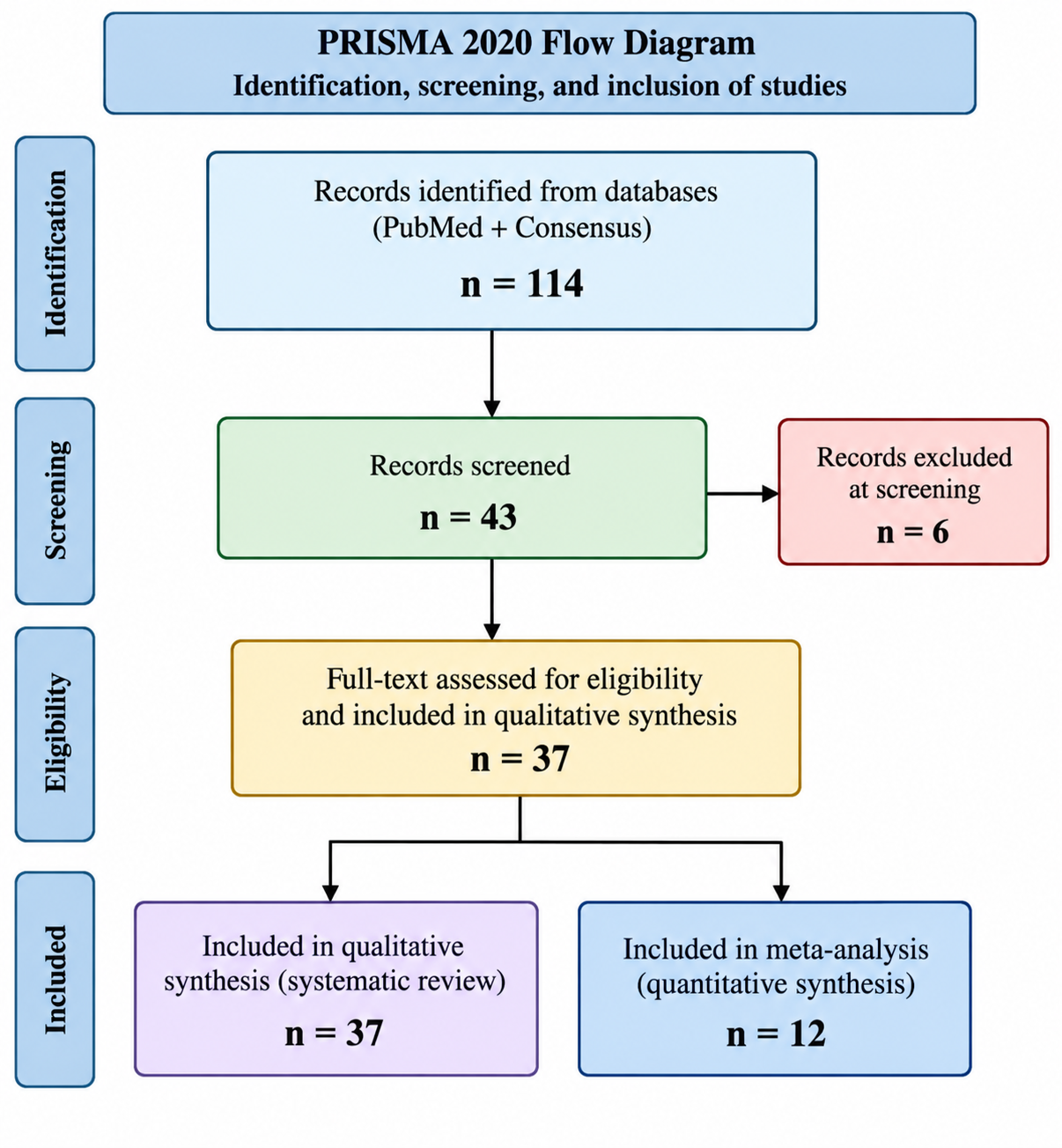
Screening followed PRISMA's identification, screening, eligibility, and inclusion stages, conducted by one of the team members rather than two fully independent reviewers (noted as a limitation). The outcome of study selection is summarised in Table 2 and Figure 1.
| PRISMA Stage | n |
|---|---|
| Records identified (PubMed + Consensus) | 114 |
| Records screened | 43 |
| Excluded at screening | 6 |
| Full-text assessed / included (qualitative synthesis) | 37 |
| Included in meta-analysis (quantitative) | 12 |
3.8Data extraction
A standardized form captured study design, population, outcome data, and determinant effect estimates for all 37 included studies. Extracted data were cross-checked against full text via PubMed Central where accessible; 8 of 9 studies prioritized for verification were confirmed this way (Meh et al., 2019; Waziri et al., 2024), with one prior citation correction made. Unreported items were marked [NOT REPORTED] rather than estimated.
3.9Assessment of methodological quality and risk of bias
The Appraisal tool for Cross-Sectional Studies AXIS (Downes et al., 2016) was applied to the majority cross-sectional studies, the Newcastle-Ottawa Scale (Wells et al., 2000) to cohort studies, and a narrative quality description to MPDSR case-review studies (Sageer et al., 2019), which do not fit standard appraisal tools. Disagreements were resolved by team discussion.
3.10Data synthesis
All 37 studies are synthesized narratively by determinant category. Studies reporting a usable death numerator and population denominator (Oladipo & Akinwaare, 2023) proceed to quantitative pooling; studies measuring a proxy outcome (e.g., facility delivery) contribute to the narrative synthesis only.
3.11Meta-analysis and statistical methods
MMR estimates will be pooled using the Freeman-Tukey double arcsine transformation under a random-effects model (DerSimonian & Laird, 1986), given anticipated heterogeneity across facility-based and population-based sources. Heterogeneity will be assessed using I² and Cochran's Q (Higgins et al., 2003). Planned subgroups include geopolitical zone and data-source type (facility vs. sisterhood-method); a sensitivity analysis will exclude studies with identified data-quality concerns. Pooling will be conducted in R statistical software using the ‘metafor’ package.
3.12Assessment of publication bias
Publication bias will be assessed via funnel plot and Egger's test (Egger et al., 1997) where the number of pooled studies permits; if fewer than approximately 10 studies are pooled, this will be stated as a limitation rather than reporting an under-powered test.
3.13Assessment of certainty of evidence
The certainty of the pooled evidence will be rated using the GRADE approach (Guyatt et al., 2008), considering risk of bias, inconsistency, indirectness, imprecision, and publication bias.
3.14Software
Screening and extraction were managed using a custom Excel-based screening log and extraction matrix with automated PRISMA-count formulas. Given the manageable record volume (114 records), deduplication was performed manually rather than through dedicated reference-management software. The meta-analysis was conducted in R statistical software.
3.15Ethical considerations
As this review synthesizes previously published, de-identified, aggregate data, no separate primary ethical approval was required; it relies on the ethical approvals obtained by each primary study's authors. All sources are attributed with their original DOI or PMID.
4Results
4.1Study selection
4.2Study characteristics and synthesis results
4.2.1Pooled magnitude of the maternal mortality ratio (MMR) in Nigeria, 2015–2025
Table 3 lists the studies that estimated maternal mortality directly.
| Study | ID | Setting/method | Maternal deaths | Denominator | MMR/estimate |
|---|---|---|---|---|---|
| Trends and causes of maternal death at the Lagos University teaching hospital, Lagos, Nigeria (2007-2019) | CNS-2 (Olamijulo et al., 2022) | Facility, Lagos | 483 | 17,948 live births | Reported period MMR ≈2,674/100,000 |
| Trends and patterns of maternal deaths from 2015 to 2019, associated factors and pregnancy outcomes in rural Lagos, Nigeria | CNS-5 (Oladipo & Akinwaare, 2023) | Facility/rural Lagos | 96 | ≈5,836 derived | 1,645/100,000 |
| Maternal mortality statistics and risk factors at a tertiary hospital in Makurdi, Nigeria | CNS-7 (Hemabh-Hilekaan et al., 2019) | Tertiary hospital | 26 | 2,325 live births | ≈1,118/100,000 |
| A population-based estimation of maternal mortality in Lagos State, Nigeria using the indirect sisterhood method | 38664731 (Wright et al., 2024) | Indirect sisterhood/population | 120 sister deaths | Sisterhood denominator | 430/100,000 (95% CI 360–510) |
The maternal mortality ratio was calculated as:
The pooled facility-based MMR was approximately 1,753 maternal deaths per 100,000 live births (95% CI ≈ 1,086–2,830; I² ≈ 94.3%). The sisterhood estimate from the Lagos study was 430 per 100,000.
4.2.2Complication-specific maternal mortality and case fatality
Table 4 summarises complication-specific maternal mortality.
| Study | ID | Clinical condition | Outcome | Quantitative finding |
|---|---|---|---|---|
| Burden and outcomes of postpartum haemorrhage in Nigerian referral-level hospitals | 38686455 (Adebayo et al., 2024) | PPH | Maternal death among PPH cases | 104/2,169 ≈ 4.8% CFR |
| Determinants of obstructed labour and associated outcomes in referral hospitals in Nigeria | 38616567 (Adelaiye et al., 2024) | Obstructed labour | Maternal death among obstructed-labour cases | 31/1,186 ≈ 2.6% CFR |
| Prevalence and maternofoetal outcomes of preeclampsia/eclampsia among pregnant women in Nigeria: a systematic review and meta-analysis | 39363380 (Kokori et al., 2024) | Preeclampsia /Eclampsia | Maternal mortality among PE/E patients | Pooled mortality ≈ 6.04% (95% CI 3.67–8.89%) |
| Risk factors and outcomes associated with pregnancy-related acute kidney injury in a high-risk cohort of women in Nigeria | 38051496 (Waziri et al., 2024) | Pregnancy Related AKI | Maternal mortality by AKI severity | Stage 3 AOR 6.12 (1.09–34.34) |
| Analysis of Caesarean Deliveries (CD) at a Tertiary Hospital in Northeastern Nigeria: A 5-Year Review | 42471883 (Umaru et al., 2025) | Caesarean delivery | Maternal death among caesarean deliveries | 21/2,707 ≈ 0.78% CFR |
The measure is primarily the case fatality rate (CFR):
4.2.3Determinants, risk factors and proxy pathways
The direct determinants reported are summarised in Table 5.
| Study | ID | Determinant | Effect |
|---|---|---|---|
| Levels and determinants of maternal mortality in northern and southern Nigeria | CNS-1 (Meh et al., 2019) | Community wealth — North | ≈ AOR 0.14 |
| Levels and determinants of maternal mortality in northern and southern Nigeria | CNS-1 (Meh et al., 2019) | Secondary/higher education — North | ≈ AOR 0.53 |
| Levels and determinants of maternal mortality in northern and southern Nigeria | CNS-1 (Meh et al., 2019) | Low media exposure — North | ≈ AOR 1.39 |
| Levels and determinants of maternal mortality in northern and southern Nigeria | CNS-1 (Meh et al., 2019) | Community wealth — South | ≈ AOR 0.38 |
| Levels and determinants of maternal mortality in northern and southern Nigeria | CNS-1 (Meh et al., 2019) | Traditional contraception — South | ≈ AOR 1.75 |
| Risk factors and outcomes associated with pregnancy-related acute kidney injury in a high-risk cohort of women in Nigeria | 38051496 (Waziri et al., 2024) | Stage 3 AKI | AOR 6.12 (1.09–34.34) |
| Trends and patterns of maternal deaths from 2015 to 2019, associated factors and pregnancy outcomes in rural Lagos, Nigeria | CNS-5 (Oladipo & Akinwaare, 2023) | Booking status | AOR 0.36 (0.21–0.64) |
4.2.4Determinants of severe obstetric complications
These are indirect pathways to maternal mortality.
The risk factors for obstructed labour and postpartum haemorrhage are given in Table 6 and Table 7.
| Risk factor | Effect |
|---|---|
| Age <20 years | OR 2.03 |
| No education | OR 1.88 |
| Unemployment | OR 1.94 |
| Nulliparity | OR 2.11 |
| No ANC | OR 3.34 |
| ANC in informal setting | OR 8.18 |
| Risk factor | Effect |
|---|---|
| No formal education | AOR 2.2 |
| Multiple pregnancy | AOR 2.7 |
| Maternal age >35 | AOR 1.7 |
| Referral status | AOR 2.4 |
| Antepartum haemorrhage, vaginal delivery | AOR 11.7 |
| Antepartum haemorrhage, caesarean delivery | AOR 3.7 |
4.2.5Health-service and socioeconomic determinants
Table 8 gives a thematic summary of the other studies.
| Theme | Factors assessed | Overall direction of evidence | Relationship with maternal mortality |
|---|---|---|---|
| ANC utilisation | Booking, timing, number of contacts, source of ANC | Inadequate/late ANC associated with poorer maternal pathways | Increased risk |
| Delivery care | Home birth, facility delivery, skilled attendance | Non-facility/informal delivery associated with poorer outcomes | Increased risk |
| Referral/access | Referral status, transport, distance, emergency access | Delayed/inadequate referral associated with severe complications | Increased risk |
| Socioeconomic | Wealth, education, employment, financial barriers | Lower socioeconomic position generally associated with adverse outcomes | Increased risk |
| Information/social | Media exposure, awareness, decision-making | Poor information/access associated with poorer service utilisation | Increased risk |
| Health system | Quality of care, MPDSR, emergency readiness | System weaknesses contribute to delayed recognition/treatment | Increased risk |
5Discussion of findings
5.1Introduction
This systematic review and meta-analysis combined empirical evidence on trends, size, clinical drivers and socio-ecological determinants of maternal deaths in Nigeria from 2015–2025. This section brings together data from population-based surveys, regional surveillance systems and tertiary hospital audits to provide a context for the main findings as they relate to the wider reality of public health in sub-Saharan Africa. The discussion compares the quantitative results to existing literature, explains underlying mechanism pathways in the context of the Three Delays Model, and outlines the clinical and public health implications, as well as methodological strengths and limitations, and identifies important research gaps for guiding policy and intervention.
5.2Summary of principal findings
The combined evidence shows that Nigeria continues to have a high burden of maternal mortality with significant structural heterogeneity at geographic, care, and clinical levels:
- 1. Pooled Magnitude and Disparity in Metrics: The meta-analysis showed an enormous difference between the facility-based maternal mortality ratio and the population-based. Pooled tertiary facility data yielded an MMR of approximately 1,753 maternal deaths per 100,000 live births (95% CI: 1,086–2,830; I^2 = 94.3%). In contrast, other indirect estimates that used, for example, sisterhood methodology in Lagos State, reported a lower ratio of 430 deaths per 100,000 live births (95% CI: 360–510).
- 2. Clinical Drivers & Case Fatality Rates (CFR): Direct obstetric complications continue to be the most common cause of maternal mortality. Postpartum Haemorrhage (PPH) had higher CFR of 4.8% in referral hospitals compared to Obstructed Labour with 2.6%. The pooled maternal mortality rate for Preeclampsia/Eclampsia was 6.04% (95% CI: 3.67 – 8.89%). Mortality risk significantly increased by severe clinical end-organ complications mainly Pregnancy-Related Acute Kidney Injury (PRAKI) (AOR = 6.12, 95% CI: 1.09–34.34).
- 3. Socio-Ecological and Health System Determinants: Maternal education (secondary/above) and community wealth (Northern Nigeria: AOR = 0.53; Southern Nigeria: AOR = 0.38) were found to be significant protective factors. Major predictors of adverse maternal outcomes were unbooked status, no ANC or having received ANC but in informal/faith-based setting (OR = 8.18 for obstructed labour).
5.3Comparison with other studies and global targets
5.3.1Facility-based vs. population-based discrepancies
The pooled tertiary facility MMR is much higher than the estimates reported by international organizations like the WHO, UNICEF and the World Bank estimates (~512–814 per 100,000 live births). This finding is consistent with the results by Akaba et al. and Olamijulo et al. which showed a high referral bias. Tertiary health care centres in Nigeria are mainly end-line services that receive cases of delayed referral and moribund clients, late obstetric emergencies and unbooked clients with delays at lower health care system tiers. (Akaba et al., 2021; Olamijulo et al., 2022)
Urban community-level estimates of sisterhood, however, are closer to the population-based estimate of 430 per 100,000 found in Lagos (Wright et al., 2024). The lack of a nationwide community trend, in the form of an updated, nationally representative NDHS household survey, however, means that independent verification of trends at a national level is dependent on local models (Oweibia et al., 2025).
5.3.2Progress toward SDG 3
The Sustainable Development Goal (SDG) Target 3.1 is set to achieve a global maternal mortality ratio of less than 70 per 100,000 live births by 2030. The results validate the fact that Nigeria's path is still not on course. The nation-wide pooled burden is almost 25 times higher than the SDG target, and while localized urban reductions have been seen over the 2015–2025 decade, trends have been stagnating across broader Low- and Middle-Income Countries (LMICs). (Cresswell et al., 2025).
5.3.3Clinical determinants in the sub-Saharan context
The proportion of direct obstetric causes (Postpartum Haemorrhage (PPH) and Hypertensive Disorders of Pregnancy (HDP)) is similar to that observed worldwide in analyses by the WHO(Cresswell et al., 2025; Tasneem et al., 2019). The high case fatality rates of preeclampsia/eclampsia (6.04%) and PPH (4.8%) show that these are not only present in countries across the globe, but also have additional systemic issues in relation to their management in the event of their occurrence in Nigeria.
5.4Interpretation through the Three Delays Model
The findings of this review can be mapped directly to the Three Delays Model (Thaddeus & Maine, 1994), as shown in Table 9.
| Delay | Contributing factors identified |
|---|---|
| First delay: decision to seek care | Low educational status (AOR 2.2 for PPH); low media exposure (AOR 1.39); cultural reliance on traditional birth attendants / informal ANC (OR 8.18); financial barriers and lack of autonomy |
| Second delay: reaching a health facility | Referral status (AOR 2.4 for PPH); geographic disparities (North vs. South divide); inadequate emergency transport and physical distance |
| Third delay: receiving adequate care | Tertiary hospital referral bias (pooled MMR 1,753/100,000); inadequate blood banking, intensive care and emergency dialysis (AKI AOR 6.12); staffing shortages and delayed surgical interventions |
- 1. Low formal education (Adelaiye et al., 2024), low media exposure (Meh et al., 2019), and socio-cultural norms are some of the factors that influence First Delay (Decision to Seek Care). The high risk of obstructed labour among women who attended ANC in informal settings exposed them to more than eight times the risk of developing obstructed labour, illustrating the impact of late recognition of obstetric risk factors on delaying timely decision making.
- 2. Referral status was found to be a strong independent predictor of mortality (Adebayo et al., 2024). Geographic barriers are exacerbated by poor road infrastructure, lack of organized ambulance systems, and high out-of-pocket transport costs, especially in rural and Northern areas (Meh et al., 2019).
- 3. Institutional health-system deficiencies are shown by the high CFRs in acute kidney injury (Waziri et al., 2024) and PPH. Blood products, anti-hypertensives (such as magnesium sulphate), suitable surgical suites and intensive care space are often in short supply at the tertiary level, creating easily avoidable problems that can lead to death.
5.5Clinical and public health implications
The synthesis of the evidence in this review highlights areas of critical concern for clinical management and health policy-making in Nigeria:
5.5.1Clinical implications
- 1. Preparing for PPH in the facilities, including active management of the third stage, heat-stable uterotonics, and non-pneumatic anti-shock garment, should be standardized from primary to secondary level to prevent the onset of PPH until they can be taken for referral.
- 2. Association with maternal mortality underscores the importance of regular blood pressure, proteinuria and renal function testing in women with PRAKI to facilitate early nephrology co-management.
5.5.2Public health and policy implications
- 1. Universal ANC Coverage and Integration: Health systems should give a financial incentive for women to book early at primary health care in order to increase the likelihood of their attendance and availability.
- 2. Geographic and Socioeconomic Targeting: Female literacy programs, poverty alleviation, and community-based health insurance schemes must take into account the North-South vulnerability gradient (Meh et al., 2019), while eliminating out-of-pocket financial barriers.
- 3. Institutionalization of MPDSR audits: MPDSR audits should be institutionalized at community levels, in addition to tertiary hospitals, for continuous quality improvement, free of fear of retribution.
5.6Strengths and limitations of the study
5.6.1Strengths
- 1. Methodological Rigor: The review followed PRISMA 2020 guidelines and used uniform appraisal instruments (AXIS, Newcastle-Ottawa Scale) to assess methodological quality.
- 2. The study integrates general population-level data on sisterhood and clinical facility audits for deeper insight into the general trends and specific clinical risk factors.
- 3. Quantitative Pooling: Applied Freeman-Tukey double arcsine transformations to primary studies with severe heterogeneity to manage severe heterogeneity across primary studies.
5.6.2Limitations
- 1. The information sources included were limited to PubMed and Consensus databases, which did not allow full manual indexing of Embase, and may therefore not have captured the localized grey literature.
- 2. Single-Reviewer Screening: A primary investigator rather than a dual independent screening process did the screening of the title, abstract and full-text; this may have resulted in selection bias.
- 3. High Statistical Heterogeneity: High I^2 (>90%) in meta-analysis pooling is indicative of significant variations in resources used by the hospitals, geographical distribution, and severity of patients studied between primary studies.
- 4. Not Prospective Protocol Registered on PROSPERO: The review protocol was not prospectively registered in PROSPERO, which could lead to methodological changes after the review.
5.7Conclusion, research gaps and recommendations
5.7.1Conclusion
The mortality rate due to childbirth is still a major public health issue in Nigeria in 2015–2025. Pooled facility mortality ratio and case fatality rates illustrate those preventable direct obstetric causes of death, namely PPH, HDP, and obstructed labour are still responsible for deaths as a result of delayed care-seeking and institutional bottlenecks. To make substantive strides towards SDG 3, we need to tackle clinical quality of care and comprehensive social determinants of health.
5.7.2Identified research gaps
- 1. Poor Representative Community-Level Data: Absence of prospective, population-based studies to examine primary maternal mortality across rural geopolitical areas beyond major cities.
- 2. Implementation Science on Referral Networks: Lack of empirical evidence of impact of formal emergency transportation and communication networks in rural areas on Second Delay mortality.
- 3. Economic Evaluations: Some cost-effectiveness studies for subsidizing user fees at facility level and compared to community-based maternal health insurance at the community level.
5.7.3Recommendations
The recommendations are summarised in Table 10.
| Target level | Actionable recommendation |
|---|---|
| Policy & Governance | Subsidize universal maternal health coverage and ANC. |
| Enforce mandatory MPDSR reporting nationwide. | |
| Health Systems | Upgrade primary healthcare centres with basic EmOC. |
| Establish dedicated emergency obstetric referral networks. | |
| Clinical Practice | Mandate standardized PPH and Eclampsia care bundles. |
| Routine screening for pregnancy-related kidney injury. | |
| Community | Expand female educational and economic empowerment. |
| Engage traditional/faith leaders to promote facility care. |
For health policy makers:
- Eliminate point of care financial barriers – full subsidy for maternal healthcare services (antenatal care, emergency caesarean sections, and blood transfusion services).
- Focus on investment in healthcare facilities and skilled midwives in the Northern and rural parts of the country that have lesser access to them.
For healthcare facility administrators:
- Maintain adequate emergency blood bank supplies and basic intensive care facilities in all secondary and tertiary hospitals for all the 24 hours of the day.
- Establish agreed-upon clinical care protocols for preeclampsia/eclampsia and PPH across multiple disciplines.
For future researchers:
- Perform multi-centre cohort studies of prospective patients with standardized ICD-MM classification to record accurate and specific direct versus indirect cause of death.
- Explore the digital health and tele-obstetric interventions to overcome first and second Delays in hard-to-reach communities.
References
- [1]Adebayo T, Adefemi A, Adewumi I, Akinajo O, Akinkunmi B, Awonuga D, Aworinde O, Ayegbusi E, Dedeke I, Fajolu I, Imam Z, Jagun O, Kuku O, Ogundare E, Oluwasola T, Oyeneyin L, Adebanjo-Aina D, Adenuga E, Adeyanju A, … Adesina O (2024). Burden and outcomes of postpartum haemorrhage in Nigerian referral-level hospitals. BJOG: An International Journal of Obstetrics and Gynaecology, 131(S3), 64–77. https://doi.org/10.1111/1471-0528.17822
- [2]Adelaiye S, Wanonyi I, Adanikin A, Mairiga A, Kadas A, Morrupa J, Lavin T, Lamara A, Yahaya I, Tukur J, Chama C (2024). Determinants of obstructed labour and associated outcomes in referral hospitals in Nigeria. BJOG: An International Journal of Obstetrics and Gynaecology, 131(S3), 55–63. https://doi.org/10.1111/1471-0528.17826
- [3]Adgoy ET (2018). Key social determinants of maternal health among African countries: a documentary review. MOJ Public Health, 7(3), 62–65. https://doi.org/10.15406/MOJPH.2018.07.00219
- [4]Adinma JIB, Adinma ED (2015). Profile of maternal mortality and maternal health services in Nigeria. Journal of Biomedical Investigation, 10(1), 49–60. https://journals.unizik.edu.ng/jbi/article/view/2258
- [5]Akaba GO, Nnodu OE, Ryan N, Peprah E, Agida TE, Anumba DOC, Ekele BA (2021). Applying the WHO ICD-MM classification system to maternal deaths in a tertiary hospital in Nigeria: A retrospective analysis from 2014–2018. PLoS ONE, 16(1 January). https://doi.org/10.1371/journal.pone.0244984
- [6]Andrew KE (2025). A comparative analysis of maternal mortality in Federal Medical Centre Mubi and primary health care centers in Mubi North and Mubi South Local Government Areas of Adamawa State. Wukari International Studies Journal, 9(8), 201–217. https://doi.org/10.64633/WISSJ.V9I8.15
- [7]Badamasi HA (2021). Health-related determinants of maternal mortality in Nigeria: A scoping review [Thesis]. Novia University of Applied Sciences. https://www.theseus.fi/bitstream/handle/10024/502798/THESIS%20Health%20related%20determinants%20of%20maternal%20mortality.pdf?sequence=2
- [8]Cresswell JA, Alexander M, Chong MYC, Link HM, Pejchinovska M, Gazeley U, Ahmed SMA, Chou D, Moller AB, Simpson D, Alkema L, Villanueva G, Sguassero Y, Tunçalp Ö, Long Q, Xiao S, Say L (2025). Global and regional causes of maternal deaths 2009–20: a WHO systematic analysis. The Lancet Global Health, 13(4), e626–e634. https://doi.org/10.1016/S2214-109X(24)00560-6
- [9]De Montalembert M, Deneux-Tharaux C (2015). Pregnancy in sickle cell disease is at very high risk. Blood, 125(21), 3216–3217. https://doi.org/10.1182/blood-2015-04-638288
- [10]DerSimonian R, Laird N (1986). Meta-analysis in clinical trials. Controlled Clinical Trials, 7(3), 177–188. https://doi.org/10.1016/0197-2456(86)90046-2
- [11]Downes MJ, Brennan ML, Williams HC, Dean RS (2016). Development of a critical appraisal tool to assess the quality of cross-sectional studies (AXIS). BMJ Open, 6(12). https://doi.org/10.1136/BMJOPEN-2016-011458
- [12]Egger M, Smith GD, Schneider M, Minder C (1997). Bias in meta-analysis detected by a simple, graphical test. BMJ (Clinical Research Ed.), 315(7109), 629–634. https://doi.org/10.1136/BMJ.315.7109.629
- [13]Fawole OI, Adeoye IA (2015). Women’s status within the household as a determinant of maternal health care use in Nigeria. African Health Sciences, 15(1), 217–225. https://doi.org/10.4314/ahs.v15i1.28
- [14]Guyatt GH, Oxman AD, Vist GE, Kunz R, Falck-Ytter Y, Alonso-Coello P, Schünemann HJ (2008). GRADE: an emerging consensus on rating quality of evidence and strength of recommendations. BMJ (Clinical Research Ed.), 336(7650), 924–926. https://doi.org/10.1136/BMJ.39489.470347.AD
- [15]Hemabh-Hilekaan SK, et al. (2019). Maternal mortality statistics and risk factors at a tertiary hospital in Makurdi, Nigeria. International Journal of Reproduction, Contraception, Obstetrics and Gynecology, 8(8), 3140. https://doi.org/10.18203/2320-1770.ijrcog20193525
- [16]Higgins JPT, Thompson SG, Deeks JJ, Altman DG (2003). Measuring inconsistency in meta-analyses. BMJ : British Medical Journal, 327(7414), 557. https://doi.org/10.1136/BMJ.327.7414.557
- [17]Kokori E, Aderinto N, Olatunji G, Komolafe R, Babalola EA, Isarinade DT, Moradeyo A, Muili AO, Yusuf IA, Omoworare OT (2024). Prevalence and materno-fetal outcomes of preeclampsia/eclampsia among pregnant women in Nigeria: a systematic review and meta-analysis. European Journal of Medical Research, 29(1), 482. https://doi.org/10.1186/s40001-024-02086-x
- [18]Meh C, Thind A, Ryan B, Terry A (2019). Levels and determinants of maternal mortality in northern and southern Nigeria. BMC Pregnancy and Childbirth, 19(1). https://doi.org/10.1186/s12884-019-2471-8
- [19]Oladipo IA, Akinwaare MO (2023). Trends and patterns of maternal deaths from 2015 to 2019, associated factors and pregnancy outcomes in rural Lagos, Nigeria: a cross-sectional study. The Pan African Medical Journal, 44, 185. https://doi.org/10.11604/pamj.2023.44.185.37567
- [20]Olamijulo JA, Olorunfemi G, Okunola H (2022). Trends and causes of maternal death at the Lagos University teaching hospital, Lagos, Nigeria (2007–2019). BMC Pregnancy and Childbirth, 22(1). https://doi.org/10.1186/s12884-022-04649-4
- [21]Olawade DB, Wada OZ, Ojo IO, Odetayo A, Joel-Medewase VI, David-Olawade AC (2023). Determinants of maternal mortality in south-western Nigeria: Midwives’ perceptions. Midwifery, 127. https://doi.org/10.1016/j.midw.2023.103840
- [22]Oteng-Ntim E, Meeks D, Seed PT, Webster L, Howard J, Doyle P, Chappell LC (2015). Adverse maternal and perinatal outcomes in pregnant women with sickle cell disease: systematic review and meta-analysis. Blood, 125(21), 3316–3325. https://doi.org/10.1182/BLOOD-2014-11-607317
- [23]Oweibia M, Elemuwa CO, Egberipou T, Timighe GC, Sylvanus P, Wilson TR (2025). Maternal and Child Health Trends in Nigeria: A Scoping Review of NDHS 2018 vs. NDHS 2023. https://doi.org/10.1101/2025.05.18.25327864
- [24]Page MJ, McKenzie JE, Bossuyt PM, Boutron I, Hoffmann TC, Mulrow CD, Shamseer L, Tetzlaff JM, Akl EA, Brennan SE, Chou R, Glanville J, Grimshaw JM, Hróbjartsson A, Lalu MM, Li T, Loder EW, Mayo-Wilson E, McDonald S, … Moher D (2021). The PRISMA 2020 statement: An updated guideline for reporting systematic reviews. In BMJ (Vol. 372). BMJ Publishing Group. https://doi.org/10.1136/bmj.n71
- [25]Sageer R, Kongnyuy E, Adebimpe WO, Omosehin O, Ogunsola EA, Sanni B (2019). Causes and contributory factors of maternal mortality: Evidence from maternal and perinatal death surveillance and response in Ogun state, Southwest Nigeria. BMC Pregnancy and Childbirth, 19(1). https://doi.org/10.1186/s12884-019-2202-1
- [26]Sharma B, Smith R, E Pennell C (2026). Global Trends in Maternal Mortality and Efforts to Improve Maternal Outcomes Through Sociomedical Interventions. Reproductive Sciences, 33(5), 950. https://doi.org/10.1007/S43032-026-02086-8
- [27]Shaukat S, Horney J, Ji X, Hoch C, Covington L (2026). Association Between Social Determinants of Health and Cardiovascular Risk in Pregnant Women, United States. Preventing Chronic Disease, 23, E01. https://doi.org/10.5888/PCD23.250298
- [28]Souza JP, Day LT, Rezende-Gomes AC, Zhang J, Mori R, Baguiya A, Jayaratne K, Osoti A, Vogel JP, Campbell O, Mugerwa KY, Lumbiganon P, Tunçalp Ö, Cresswell J, Say L, Moran AC, Oladapo OT (2024). A global analysis of the determinants of maternal health and transitions in maternal mortality. In The Lancet Global Health (Vol. 12, Number 2, pp. e306–e316). Elsevier Ltd. https://doi.org/10.1016/S2214-109X(23)00468-0
- [29]Tasneem S, Nnaji A, Artac M (2019). Causes of maternal mortality in Nigeria: A systematic review. International Journal of Health Management and Tourism, 200–210. https://doi.org/10.31201/ijhmt.633942
- [30]Thaddeus S, Maine D (1994). Too far to walk: Maternal mortality in context. Social Science & Medicine, 38(8), 1091–1110. https://doi.org/10.1016/0277-9536(94)90226-7
- [31]The Sustainable Development Goals Extended Report 2024 (n.d.).
- [32]The Sustainable Development Goals Report (n.d.).
- [33]Umaru I, Maisaratu AB, Kaitafi MT, Kadas S (2025). Analysis of Caesarean Deliveries (CD) at a Tertiary Hospital in Northeastern Nigeria: A 5 Year Review. Niger Med J, 66(5), 1768–1776. https://doi.org/10.71480/nmj.v66i5.795
- [34]Waziri B, Umar IA, Magaji A, Umelo CC, Nalado AM, Wester CW, Aliyu MH (2024). Risk factors and outcomes associated with pregnancy-related acute kidney injury in a high-risk cohort of women in Nigeria. Journal of Nephrology, 37(3), 587–596. https://doi.org/10.1007/S40620-023-01822-6
- [35]Wells GA, Shea B, O’Connell D, Peterson J, Welch V, Losos M, Tugwell P (2000). The Newcastle-Ottawa Scale (NOS) for assessing the quality of nonrandomised studies in meta-analyses. Ottawa Hospital Research Institute.
- [36]WHO (2023). Maternal mortality. World Health Organization. https://www.who.int/news-room/fact-sheets/detail/maternal-mortality
- [37]World Bank Group (2023). Maternal mortality ratio (modeled estimate, per 100,000 live births) - Nigeria | Data. Maternal Mortality Ratio. https://data.worldbank.org/indicator/SH.STA.MMRT?locations=NG
- [38]World Health Organization (2012). Code in ICD MM. The WHO Application of ICD-10 to Deaths during Pregnancy, Childbirth and Puerperium: ICD MM, 1. http://www.who.int/reproductivehealth/publications/monitoring/9789241548458/en/
- [39]World Health Organization (2022). Maternal mortality measurement: Guidance to improve national reporting. World Health Organization.
- [40]Wright KO, Fagbemi T, Omoera V, Johnson T, Aderibigbe AA, Baruwa B, Oludara F, Ogboye O, Imosemi D, Omololu O, Odugbemi B, Adeyemi O, Omosun A, Akinola I, Akinyinka M, Balogun M, Abe J, Sadiku B, Banke-Thomas A, Fabamwo AO (2024). A population-based estimation of maternal mortality in Lagos State, Nigeria using the indirect sisterhood method. BMC Pregnancy and Childbirth, 24(1). https://doi.org/10.1186/s12884-024-06516-w