Concrete Technology
Structural Resilience of Reinforced Concrete Systems under Extreme Loading: A Critical Review of Blast Response, Fibre-Based Enhancement, Damage Assessment, Post-Damage Recovery and Data-Driven Prediction
Department of Civil Engineering, Pimpri Chinchwad College of Engineering and Research (affiliated to Savitribai Phule Pune University), Ravet, Pune, Maharashtra, India
Published October 2026
Abstract
Accidental explosions in industrial facilities and deliberate attacks on buildings have made blast resilience an increasingly important consideration for reinforced-concrete (RC) structures. Resilience extends beyond resisting the initial pulse: it includes limiting local damage, preventing disproportionate collapse, assessing residual capacity and restoring function. This review examines these stages for RC systems. It first summarises how blast loads are characterised through scaled distance, pressure and impulse, and how explicit-dynamics finite-element analysis and pressure–impulse diagrams are used to predict member and frame response. It then considers material-level enhancement, particularly fibre-reinforced and ultra-high-performance fibre-reinforced concrete, which reduce spalling and increase energy absorption. Damage assessment, progressive-collapse analysis and robustness are discussed next, followed by post-event recovery, including the potential and limits of bio-mediated self-healing. Finally, the review examines data-driven methods, from ML surrogates of blast response to vision-based damage detection. Key findings are that material improvements do not by themselves guarantee structural resilience, that numerical predictions must be verified and validated, that crack sealing is not structural repair, and that data-driven tools must be trained on relevant dynamic data. A five-stage resilience framework is proposed to connect these elements.
Keywords: reinforced concrete; blast loading; explicit dynamics; fibre-reinforced concrete; progressive collapse; damage assessment; structural resilience
1Introduction
Reinforced-concrete structures may be exposed to explosions from industrial accidents, gas leaks or deliberate attacks. Unlike earthquake or wind loading, blast loading rises to its peak in microseconds and decays within milliseconds. The structural response is governed by inertia, strain-rate effects in concrete and steel, local breach and spalling, and the ability of the structure to redistribute load if a key member fails [1].
Industrial facilities, where accidental explosions are a credible hazard, are commonly built as conventional steel or pre-engineered building systems, and comparative studies of these systems have focused mainly on structural weight and construction cost [2]; how their blast performance compares with that of RC frames remains far less examined. RC frames are widely used for control rooms, process buildings and protective structures because of their mass and robustness, yet their resilience depends on detailing, material properties and redundancy as much as on member size.
The concept of resilience was formalised for communities exposed to earthquakes as the ability to reduce the probability of failure, the consequences of failure and the time to recovery [3], and later quantified analytically through functionality–time curves [4]. For a structure exposed to blast, resilience can be understood as a sequence of capabilities: resisting the initial load, limiting damage, maintaining stability, assessing residual capacity and recovering function. This review follows that sequence. The review approach is described first, followed by blast load characterisation and numerical analysis, fibre-based enhancement, damage assessment, and progressive collapse and robustness. Post-damage recovery and self-healing and data-driven prediction and inspection are then considered, and finally a resilience framework and research priorities are proposed.
2Review approach
This is a critical narrative review. Journal articles and reviews were identified through Google Scholar and Scopus-indexed journals using combinations of blast, explosion, reinforced concrete, explicit dynamics, pressure–impulse, fibre-reinforced concrete, UHPFRC, progressive collapse, robustness, damage assessment, self-healing and machine learning. Studies were selected if they described mechanisms, analysis methods or validation clearly. Only sources with verifiable bibliographic details and digital object identifiers were retained. Design codes are referred to only in general terms because their applicability depends on jurisdiction and threat scenario.
3Blast loading and numerical analysis
3.1Load characterisation
A free-air or surface explosion produces a shock front with a peak overpressure that decays rapidly with distance, followed by a negative phase. The demand on a structure is commonly expressed through the scaled distance, Z = R/W1/3, where R is the stand-off distance and W the equivalent TNT charge mass. Reflected pressure on a surface facing the blast can be several times the incident pressure and depends on the angle of incidence. For design and assessment, the load is described by its peak pressure and impulse, the integral of pressure over time [1]. Close-in detonations produce highly non-uniform loads; experiments on one-way RC slabs under close-in blast by Wang et al. showed that, at a fixed stand-off, increasing the charge mass changes the damage mode from overall flexural cracking to local spalling and punching failure [5].
3.2Member response and pressure–impulse diagrams
Member response depends on the ratio of load duration to the member’s natural period. Short-duration loads act impulsively, so impulse governs damage; long-duration loads act quasi-statically, so peak pressure governs. Pressure–impulse (P–I) diagrams express this by plotting iso-damage curves in pressure–impulse space. Shi et al. derived P–I diagrams for RC columns numerically, using residual axial load capacity as the damage criterion, and showed how column dimensions, concrete strength and reinforcement ratio shift the curves [6]. P–I diagrams are a practical bridge between detailed analysis and rapid assessment.
3.3Explicit-dynamics finite-element analysis
Explicit finite-element analysis tracks the highly nonlinear, time-dependent response of structures under blast, including cracking, crushing, spalling and element failure. Its reliability depends heavily on the concrete material model. The model developed by Malvar et al. for DYNA3D accounts for pressure dependence, strain-rate enhancement and damage, and remains widely used for blast and impact simulation [7].
At frame level, Gudadappanavar et al. used explicit-dynamics analysis to assess RC frame response under TNT blast and examined how stand-off distance, charge weight and angle of incidence influence displacement and damage [8]. Such parametric studies identify the most vulnerable members and the combinations of threat parameters that govern design. At panel level, Lin et al. showed that numerical models can reproduce the effects of panel thickness, reinforcement ratio and charge mass on displacement and damage when the concrete model is properly calibrated [9]. Their conclusions, however, rest on assumptions about material models, strain-rate effects, mesh size, element erosion and boundary conditions. Mesh sensitivity checks, energy-balance monitoring and validation against experiments or benchmark problems are essential before results are used for design decisions [1].
4Fibre-based enhancement
4.1Mechanisms under high strain rate
Under blast and impact, the main failure modes of RC members are flexural and shear cracking, spalling of the rear face, scabbing and breach. Fibres resist all of these by bridging cracks and dissipating energy through pull-out. A review of impact resistance of fibre-reinforced concrete found that fibres consistently increase impact energy absorption and reduce fragmentation, with steel fibres most effective and hybrid systems combining benefits at different scales [10]. Esaker et al. reported similar trends and stressed the strong influence of test method and specimen geometry on reported results [11].
4.2UHPFRC and synthetic fibres
Ultra-high-performance fibre-reinforced concrete (UHPFRC) combines very high compressive strength with high fibre contents and strain-hardening tensile behaviour. Yoo and Banthia reviewed its mechanical and structural behaviour under impact and blast and showed that UHPFRC members sustain much smaller deflections and less damage than conventional RC members under the same loads [12]. Synthetic fibres such as polypropylene offer a lower-cost alternative for controlling cracking and spalling. A systematic review of PP fibre-reinforced concrete summarised their effects on mechanical and durability performance [13]; their low modulus, however, limits their contribution to post-cracking load capacity compared with steel fibres.
4.3Limits of material-level evidence
Improvements in material tests do not translate automatically into structural resilience. Strain-rate effects, member size, reinforcement detailing and support conditions all influence blast response. Material enhancement should therefore be evaluated through a hierarchy: material tests at relevant strain rates, member tests or validated simulations, and assessment at the system level for redistribution and collapse.
5Damage assessment and residual capacity
After an explosion, engineers must decide whether a structure is safe to approach, occupy or repair. Damage can range from cosmetic cracking to concrete loss, exposed or buckled reinforcement and loss of axial capacity in columns. Residual capacity is the key quantity: Shi et al. used it as the basis of their damage index for columns [6], and the same concept underlies rapid assessment.
Visual inspection alone can be misleading. Severe internal damage may exist behind an apparently intact surface, while extensive surface spalling may leave adequate core capacity. Assessment should combine visual survey, non-destructive testing, geometric measurement and structural analysis, with decisions tied to defined damage states. Computer-vision methods are beginning to support this process. Spencer et al. reviewed vision-based inspection and monitoring of civil infrastructure [14], and Cha et al. showed that convolutional neural networks can detect concrete cracks in images with high accuracy [15]. Such tools can speed up surveys, but they detect surface features and must be combined with engineering assessment of residual capacity.
6Progressive collapse and robustness
Local damage becomes catastrophic when it triggers disproportionate collapse. Ellingwood and Dusenberry reviewed design approaches for abnormal loads and progressive collapse, distinguishing indirect methods based on tying and continuity from direct methods based on alternate load paths and specific local resistance [16]. Starossek and Haberland clarified the terminology, distinguishing progressive collapse (a chain reaction of failures) from disproportionate collapse (consequences out of proportion to the initiating event) [17]. Marjanishvili described a staged analysis procedure for progressive collapse, from linear static to nonlinear dynamic analysis, with increasing accuracy and effort [18]. Adam et al. surveyed two decades of research and practice and concluded that robustness depends on redundancy, ductility and continuity, and that the dynamic effects of sudden member loss must be considered [19].
For blast-exposed RC frames, the link between local damage and global stability is critical. A column that loses axial capacity must be bridged by beams and slabs acting in catenary or flexural action. Detailing that provides continuous reinforcement and ductile connections therefore contributes to resilience as much as member strength.
7Post-damage recovery and self-healing
Recovery involves stabilisation, detailed inspection, repair or strengthening, verification and a decision about re-occupancy. Repair options range from crack injection and patch repair to section enlargement, jacketing and fibre-reinforced overlays, chosen according to damage depth, reinforcement condition and required remaining life.
Bacterial self-healing offers a complementary, long-term contribution. Bacteria-based concrete can precipitate calcite that seals fine cracks [20], and recent work on Bacillus subtilis-based self-repairing concrete reported improved mechanical performance and chemical durability [21]. For blast-damaged structures, such materials may help seal fine residual cracks and limit subsequent ingress of water and chlorides. They cannot repair crushed concrete, buckled reinforcement or damaged connections, and they should not be regarded as structural repair. Healing is limited to fine cracks and requires moisture and time [22]. Reviews of self-healing concrete for damage management of structures reach the same conclusion: self-healing reduces maintenance and extends service life but is not a substitute for repair of structurally significant damage [23]. The appropriate role of self-healing is therefore in durability recovery after the structural repair has restored capacity.
8Data-driven prediction and inspection
Data-driven methods can support several stages of resilience. Surrogate models trained on simulation or test data can predict member response rapidly; Almustafa and Nehdi developed an ML model that predicts the response of RC slabs under blast [24]. Such models can screen many threat scenarios or design alternatives quickly, but they inherit the assumptions of their training data and must not be used outside the parameter ranges they were trained on.
Methodological lessons from material-property prediction transfer directly. Reviews of ML for cement and mortar properties emphasise that models must be validated on independent data and that high accuracy on random splits can be misleading [25]. Experience with ML prediction of freeze–thaw damage in sustainable concrete similarly shows the value of linking damage mechanisms to data-driven prediction, and the need for consistent damage definitions [26]. For blast applications, inputs should include charge weight, stand-off distance, pressure and impulse, member geometry, reinforcement and material properties, and validation should hold out entire structural configurations rather than individual simulation runs. Explainability methods can help verify that a surrogate responds sensibly to these inputs [27].
9A resilience framework and research priorities
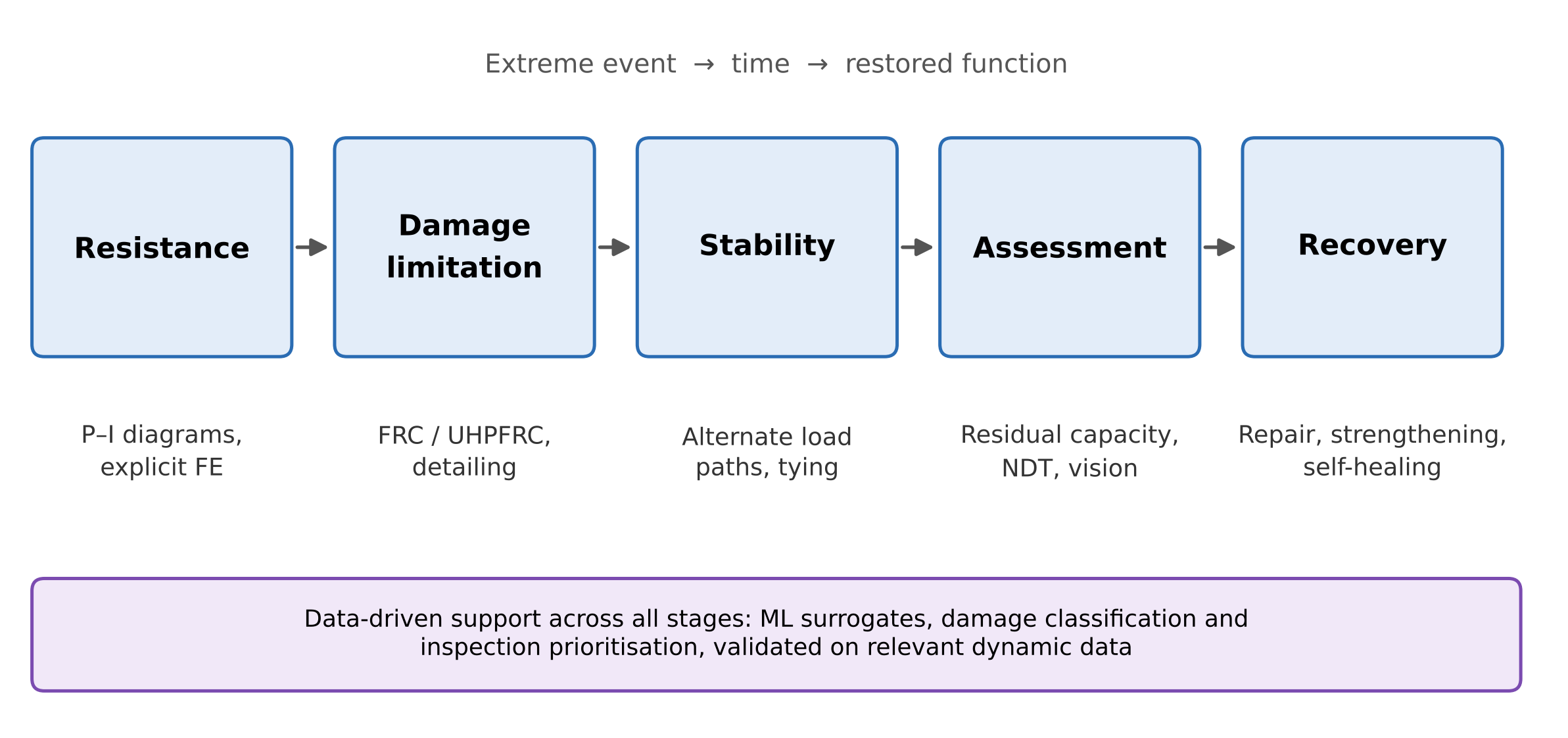
Figure 1 proposes a five-stage framework that connects the topics reviewed, and Table 1 summarises its elements. Each stage has its own performance measures and supporting methods: resistance (peak pressure and impulse capacity, P–I diagrams, explicit analysis), damage limitation (spalling and breach control through fibre-reinforced or UHPFRC materials), stability (alternate load paths and progressive-collapse analysis), assessment (residual capacity, inspection and vision-based detection) and recovery (repair, durability restoration and self-healing). Data-driven tools can support every stage, provided they are trained and validated on relevant data.
| Stage | Performance measure | Supporting methods | Key evidence gap |
|---|---|---|---|
| Resistance | Peak displacement, support rotation | Scaled-distance loads, P–I diagrams, explicit FE | Validation of frame-level models |
| Damage limitation | Spalling, breach, crack width | FRC and UHPFRC, detailing | Member tests of low-cost fibre systems |
| Stability | Prevention of disproportionate collapse | Alternate load path, tying, nonlinear dynamic analysis | Link between blast damage and collapse analysis |
| Assessment | Residual capacity, damage state | NDT, structural analysis, vision-based detection | Datasets linking visible damage to capacity |
| Recovery | Restored capacity and durability | Repair, strengthening, self-healing materials | Long-term performance of repaired members |
Five research priorities follow. (i) Experimental datasets are needed that link material-level fibre performance to RC member response under blast. (ii) Explicit-dynamics studies should report material models, mesh convergence, energy balance and validation transparently. (iii) Post-event datasets should connect inspection observations to measured residual capacity. (iv) The boundary between durability-oriented crack sealing and structural repair should be defined clearly. (v) ML surrogates should be validated across structural configurations and threat scenarios, with uncertainty estimates that support safe decisions.
10Conclusions
- 1. Blast resilience of RC structures is a multi-stage capability that extends from resisting the initial load to restoring function; peak strength alone is an inadequate measure.
- 2. Scaled distance, pressure and impulse define the blast demand, and P–I diagrams and explicit-dynamics analysis predict member and frame response. Numerical results require verification and validation.
- 3. Fibre-reinforced and UHPFRC materials reduce spalling and increase energy absorption, but material-level improvements must be confirmed at member and system level.
- 4. Damage assessment must focus on residual capacity rather than visible damage; vision-based tools can accelerate inspection but do not replace structural assessment.
- 5. Robustness depends on redundancy, ductility and continuity; progressive-collapse analysis links local blast damage to global stability.
- 6. Bacterial self-healing can restore durability of finely cracked concrete after structural repair but is not a structural repair method.
- 7. ML surrogates and data-driven inspection can support every stage of resilience if trained on relevant dynamic data and validated independently.
11CRediT authorship contribution statement
Swarup Taware: Investigation, Data curation, Visualization, Writing – original draft. Anand B. Kudoli: Conceptualization, Methodology, Supervision, Validation, Writing – review and editing.
12Declaration of competing interest
The authors declare that they have no known competing financial interests or personal relationships that could have appeared to influence the work reported in this paper.
Funding
This research did not receive any specific grant from funding agencies in the public, commercial, or not-for-profit sectors.
Data availability
No new data were generated in this review. All information discussed is available in the cited literature.
Declaration of generative AI use
During the preparation of this work, the authors used ChatGPT solely for language editing and grammar checking. After using this tool, the authors reviewed and revised the content as necessary and take full responsibility for the content of the publication.
References
- [1]Hao H, Hao Y, Li J, Chen W. Review of the current practices in blast-resistant analysis and design of concrete structures. Adv Struct Eng. 2016;19(8):1193–223. https://doi.org/10.1177/1369433216656430
- [2]Londhe PM, Ambekar RV, Dhumal PR, Chipade AM, Barkale AD, Sasane NB. A comparative analysis of conventional steel building and pre-engineered building systems: a case study approach. E3S Web Conf. 2024;559:04030. https://doi.org/10.1051/e3sconf/202455904030
- [3]Bruneau M, Chang SE, Eguchi RT, Lee GC, O’Rourke TD, Reinhorn AM, et al. A framework to quantitatively assess and enhance the seismic resilience of communities. Earthq Spectra. 2003;19(4):733–52. https://doi.org/10.1193/1.1623497
- [4]Cimellaro GP, Reinhorn AM, Bruneau M. Framework for analytical quantification of disaster resilience. Eng Struct. 2010;32(11):3639–49. https://doi.org/10.1016/j.engstruct.2010.08.008
- [5]Wang W, Zhang D, Lu F, Wang SC, Tang F. Experimental study on scaling the explosion resistance of a one-way square reinforced concrete slab under a close-in blast loading. Int J Impact Eng. 2012;49:158–64. https://doi.org/10.1016/j.ijimpeng.2012.03.010
- [6]Shi Y, Hao H, Li ZX. Numerical derivation of pressure–impulse diagrams for prediction of RC column damage to blast loads. Int J Impact Eng. 2008;35(11):1213–27. https://doi.org/10.1016/j.ijimpeng.2007.09.001
- [7]Malvar LJ, Crawford JE, Wesevich JW, Simons D. A plasticity concrete material model for DYNA3D. Int J Impact Eng. 1997;19(9–10):847–73. https://doi.org/10.1016/S0734-743X(97)00023-7
- [8]Gudadappanavar B, Selvakumar M, Yeole MM, Hosur VA, Dibdalli Y, Morales-Verdejo C, et al. Explicit-dynamics assessment of reinforced concrete frame response under TNT blast: stand-off, charge weight and incidence angle effects. SSRG Int J Civ Eng. 2026;13(3):255–73. https://doi.org/10.14445/23488352/IJCE-V13I3P119
- [9]Lin X, Zhang YX, Hazell PJ. Modelling the response of reinforced concrete panels under blast loading. Mater Des. 2014;56:620–8. https://doi.org/10.1016/j.matdes.2013.11.069
- [10]Yoo DY, Banthia N. Impact resistance of fiber-reinforced concrete – a review. Cem Concr Compos. 2019;104:103389. https://doi.org/10.1016/j.cemconcomp.2019.103389
- [11]Esaker M, Thermou GE, Neves LC. Impact resistance of concrete and fibre-reinforced concrete: a review. Int J Impact Eng. 2023;180:104722. https://doi.org/10.1016/j.ijimpeng.2023.104722
- [12]Yoo DY, Banthia N. Mechanical and structural behaviors of ultra-high-performance fiber-reinforced concrete subjected to impact and blast. Constr Build Mater. 2017;149:416–31. https://doi.org/10.1016/j.conbuildmat.2017.05.136
- [13]Kudoli AB, Patil RS, Yeole MM. Recent advances in polypropylene fibre-reinforced concrete: a systematic review on mechanical characteristics and durability performance. J Mines Met Fuels. 2025;73:2887–96. https://doi.org/10.18311/jmmf/2025/49411
- [14]Spencer BF Jr, Hoskere V, Narazaki Y. Advances in computer vision-based civil infrastructure inspection and monitoring. Engineering. 2019;5(2):199–222. https://doi.org/10.1016/j.eng.2018.11.030
- [15]Cha YJ, Choi W, Büyüköztürk O. Deep learning-based crack damage detection using convolutional neural networks. Comput-Aided Civ Infrastruct Eng. 2017;32(5):361–78. https://doi.org/10.1111/mice.12263
- [16]Ellingwood BR, Dusenberry DO. Building design for abnormal loads and progressive collapse. Comput-Aided Civ Infrastruct Eng. 2005;20(3):194–205. https://doi.org/10.1111/j.1467-8667.2005.00387.x
- [17]Starossek U, Haberland M. Disproportionate collapse: terminology and procedures. J Perform Constr Facil. 2010;24(6):519–28. https://doi.org/10.1061/(ASCE)CF.1943-5509.0000138
- [18]Marjanishvili SM. Progressive analysis procedure for progressive collapse. J Perform Constr Facil. 2004;18(2):79–85. https://doi.org/10.1061/(ASCE)0887-3828(2004)18:2(79)
- [19]Adam JM, Parisi F, Sagaseta J, Lu X. Research and practice on progressive collapse and robustness of building structures in the 21st century. Eng Struct. 2018;173:122–49. https://doi.org/10.1016/j.engstruct.2018.06.082
- [20]Jonkers HM, Thijssen A, Muyzer G, Copuroglu O, Schlangen E. Application of bacteria as self-healing agent for the development of sustainable concrete. Ecol Eng. 2010;36(2):230–5. https://doi.org/10.1016/j.ecoleng.2008.12.036
- [21]Guddad MV, Selvakumar M, Basavanagowda GM, Yeole MM, Firake DB, Dibdalli Y, et al. Microbially induced calcite precipitation (MICP)-based bio-mediated self-repairing concrete incorporating Bacillus subtilis: mechanical performance and chemical durability enhancement. SSRG Int J Civ Eng. 2026;13(8):362–74. https://doi.org/10.14445/23488352/IJCE-V13I8P122
- [22]Vijay K, Murmu M, Deo SV. Bacteria based self healing concrete – a review. Constr Build Mater. 2017;152:1008–14. https://doi.org/10.1016/j.conbuildmat.2017.07.040
- [23]De Belie N, Gruyaert E, Al-Tabbaa A, Antonaci P, Baera C, Bajare D, et al. A review of self-healing concrete for damage management of structures. Adv Mater Interfaces. 2018;5(17):1800074. https://doi.org/10.1002/admi.201800074
- [24]Almustafa MK, Nehdi ML. Machine learning model for predicting structural response of RC slabs exposed to blast loading. Eng Struct. 2020;221:111109. https://doi.org/10.1016/j.engstruct.2020.111109
- [25]Kudoli AB, Bala A. A comprehensive review of machine learning and traditional models for predicting the physical and mechanical properties of cement and cement mortar. J Mines Met Fuels. 2025;73:2923–31. https://doi.org/10.18311/jmmf/2025/49408
- [26]Vishwanath KN, Yeole MM, Ananthi A, Parameswari D, Ramya ST, Vijayakumar M. Freeze–thaw resistance of sustainable concrete: experimental investigation, damage mechanisms, and AI/ML-based performance prediction. Int J Artif Intell Mach Learn. 2026;6(13s):218–30. https://doi.org/10.51483/IJAIML.6.13s.2026.218-230
- [27]Lundberg SM, Erion G, Chen H, DeGrave A, Prutkin JM, Nair B, et al. From local explanations to global understanding with explainable AI for trees. Nat Mach Intell. 2020;2(1):56–67. https://doi.org/10.1038/s42256-019-0138-9