Corrosion Inhibition
Assessment of the Corrosion Inhibition Behaviour of Aqueous Leaf Extracts from Yam, Maize and Cassava on Mild Steel in Sulphuric Acid (H2SO4) Medium
1Physics Advanced Research Centre, Sheda Science and Technology Complex (SHESTCO), Federal Ministry of Innovation, Science and Technology (FMIST), FCT-Abuja, Nigeria
2Chemistry Advanced Research Centre, Sheda Science and Technology Complex (SHESTCO), Federal Ministry of Innovation, Science and Technology (FMIST), FCT-Abuja, Nigeria
Published October 2026
Abstract
The corrosion inhibition performance of aqueous leaf extracts of yam (Dioscorea rotundata), maize (Zea mays), and cassava (Manihot esculenta) on mild steel exposed to 0.5 and 1.0 M sulphuric acid (H2SO4) was investigated using the gravimetric weight-loss method. Mild-steel specimens were weighed before immersion and exposed to uninhibited acid solutions and corresponding solutions containing 15 cm³ of the respective aqueous leaf extracts. The specimens were removed at 168 h intervals over a total exposure period of 672 h, cleaned, dried, and reweighed to determine mass loss and corrosion rate. In both acid concentrations, addition of the plant extracts substantially reduced the measured corrosion rates relative to the uninhibited controls. In 0.5 M H2SO4, the corrosion rates at 672 h were 0.00006, 0.00009, and 0.00008 mm yr−1 for yam, maize, and cassava extracts, respectively, compared with 0.00026 mm yr−1 for the control. The corresponding values in 1.0 M H2SO4 were 0.00012, 0.00016, and 0.00009 mm yr−1, respectively, compared with 0.00041 mm yr−1 for the control. The results demonstrate that the aqueous extracts possess corrosion-inhibiting activity and that their performance depends on both the botanical source and acid concentration. The observed inhibition is consistent with the ability of phytochemical constituents, including phenolic compounds, flavonoids, tannins, alkaloids, saponins, and other oxygen- and nitrogen-containing compounds, to adsorb at the metal–electrolyte interface and reduce access of corrosive species to the steel surface. The findings support the potential use of locally available plant leaves as inexpensive and renewable sources of corrosion inhibitors for acidic industrial environments.
Keywords: aqueous leaf extract; green corrosion inhibition; mild steel; sulphuric acid; yam, maize and cassava leaves
1Introduction
Corrosion is an electrochemical process through which metallic materials progressively deteriorate as a consequence of interactions with their surrounding environment. It represents a persistent materials-engineering challenge because corrosion can reduce the service life, mechanical integrity, reliability, and economic value of metallic components used in construction, manufacturing, transportation, chemical processing, petroleum production, and other industrial sectors. Mild steel is particularly important because of its relatively low cost, availability, ease of fabrication, and useful mechanical properties. Nevertheless, its susceptibility to corrosion, especially in acidic environments, limits its long-term performance. Recent reviews continue to identify corrosion control and the development of environmentally compatible inhibitors as important areas of materials research. Related studies broaden this evidence across plant species and corrosive environments. Abdelaziz et al. (2021) investigated Arbutus unedo leaf extract in hydrochloric acid, while Ahmad Reza et al. (2021), Burhagohain and Sharma (2022), Fazal et al. (2022), Mungwari et al. (2025), and Thacker and Ram (2025) reviewed plant-derived inhibitors in acidic, oil-and-gas, CO₂-corrosion, and broader corrosion-control settings. In sulfuric-acid media, Golshani et al. (2023) studied Dracocephalum extract in 0.5 M H2SO4, and Chu et al. (2025) investigated extracts from three genera in the Asteraceae family for Q235 steel. Kumar et al. (2022, 2023) also examined plant-based inhibitors for mild steel. Emmanuel et al. (2026) reported Agave sisalana extract as an inhibitor in 1 M H2SO4, with a maximum inhibition efficiency of 96.03% at 750 mg L−1, while Ibrahim et al. (2026) investigated Chrysanthemum indicum extract for API 5L X70 steel in 0.5 M H2SO4. The increasing interest in plant-derived corrosion inhibitors has been associated with the search for alternatives to conventional synthetic inhibitors, particularly because plant extracts contain diverse phytochemicals capable of interacting with metal surfaces and reducing corrosion in acidic environments (Emmanuel, 2024).
Acidic solutions are widely employed in industrial operations such as acid cleaning, pickling, descaling, oil-well acidizing, and removal of corrosion products. Sulphuric acid is particularly important in these processes because of its strong acidity and extensive industrial use. However, contact between steel and concentrated or moderately concentrated acidic solutions accelerates anodic dissolution of iron and associated cathodic reactions. Consequently, the use of corrosion inhibitors is an established approach for reducing metal dissolution during acid treatment.
Conventional organic and inorganic inhibitors can be effective, but concerns relating to toxicity, environmental persistence, cost, and handling have stimulated increasing interest in green corrosion inhibitors. Plant-derived materials have received particular attention because they are renewable and may contain numerous naturally occurring compounds capable of interacting with metallic surfaces. Recent reviews als have documented the growing application of plant extracts as corrosion inhibitors for ferrous metals and mild steel, particularly in acidic environments (Salleh et al., 2021).
Plant extracts contain chemically diverse constituents, including phenolic compounds, flavonoids, tannins, alkaloids, glycosides, saponins, terpenoids, carbohydrates, organic acids, and other oxygen-, nitrogen-, or sulphur-containing compounds. Many of these compounds contain functional groups and heteroatoms that can interact with metallic surfaces. Adsorption of such molecules can reduce the number of active sites available for electrochemical reactions and contribute to the formation of a protective film. Maizia et al. (2023) supported this mechanistic interpretation through weight-loss measurements, potentiodynamic polarization, electrochemical impedance spectroscopy (EIS), Fourier-transform infrared spectroscopy (FTIR), scanning electron microscopy (SEM), and computational methods.
Bilar and Christopher (2020) also reported inhibition of mild-steel corrosion in 0.5 M H2SO4 and 1 M HCl using eucalyptus leaf extract. Similarly, Odidika et al. (2020) investigated and reported that Commelina benghalensis leaf extract effectively inhibited mild-steel corrosion in 1 M H2SO4, with inhibition efficiency increasing with extract concentration and reaching 91.91% at 2.0 g/L. The inhibitory effect was attributed to phytochemical constituents such as alkaloids, flavonoids, tannins, saponins and phenolic compounds, which can adsorb onto the metal surface and impede corrosion reactions. Oyewole et al. (2021) also reported that Corchorus olitorius stem extract significantly inhibited mild-steel corrosion in 0.5 M H2SO4, with an optimized inhibition efficiency of 94.34%. Anadebe et al. (2021) also investigated bitter-kola leaf extract as an anticorrosion additive for mild steel in 1.2 M H2SO4, providing further evidence of the potential of Nigerian plant resources for acidic corrosion control.
The use of plant extracts is not restricted to leaves only. Studies have shown that stems, roots, fruits, bark, seeds, flowers, and agricultural residues are also very important. Rice straw extract, for instance, has also been evaluated for mild-steel protection in 1.5 M H2SO4, demonstrating the potential of agricultural biomass as a source of green corrosion inhibitors. Oyewole et al. (2022) demonstrated that rice straw extract could substantially inhibit mild-steel corrosion in 1.5 M H2SO4, achieving a validated inhibition efficiency of 86.42%, which the authors attributed to adsorption of bioactive constituents and formation of a protective film on the steel surface.
Karki et al. (2022) reported that alkaloids extracted from Acacia catechu bark significantly inhibited mild-steel corrosion in 1 M H2SO4, achieving 93.96% inhibition efficiency at 1000 ppm after 3 h at 28 °C. The inhibition was associated with adsorption of the plant-derived alkaloids onto the steel surface, demonstrating the potential of phytochemical-rich materials as environmentally benign alternatives to conventional corrosion inhibitors. Neem leaf extract has also been evaluated using gravimetric and electrochemical techniques. The performance of plant extracts is influenced by extract concentration, extraction solvent, temperature, immersion time, acid type and concentration, steel composition, surface condition, and phytochemical composition. Plant-derived extracts have demonstrated significant potential as environmentally benign inhibitors of mild-steel corrosion in acidic environments. Karthikeyan et al. (2021) investigated Annona squamosa extract as a corrosion inhibitor for mild steel in 0.5 M H2SO4 using weight-loss, potentiodynamic polarization, and electrochemical impedance spectroscopy techniques. Their results showed that inhibition efficiency increased with increasing extract concentration but decreased with increasing temperature. Electrochemical measurements indicated that the extract acted predominantly as a cathodic inhibitor, while SEM and AFM observations supported the formation of an adsorbed protective layer on the mild-steel surface. These findings provide direct evidence that phytochemical constituents present in plant extracts can interact with and protect mild steel in sulfuric-acid environments. Ezugha and Aralu (2023) evaluated methanol leaf extract of Solanum macrocarpon as a green corrosion inhibitor for mild steel in 0.5 M H2SO4 using a gravimetric method. The inhibition efficiency increased with increasing extract concentration and reached an optimum value of 95% at 0.5% w/v and 303 K. The authors attributed the protective effect to phytochemical constituents containing polar functional groups and heteroatoms capable of interacting with the mild-steel surface. Their thermodynamic analysis further suggested that the adsorption process was predominantly physical. This finding demonstrates the effectiveness of plant leaves as potential environmentally benign corrosion inhibitors in sulfuric-acid media.
Yam, maize, and cassava are important crops in Nigeria and other tropical regions. Their leaves are comparatively inexpensive and readily available, but their potential as corrosion inhibitors has received considerably less attention than that of several other plant species. The investigation of these agricultural resources is therefore relevant from both scientific and sustainability perspectives.
Yam (Dioscorea rotundata) is an important tropical food crop whose leaves contain diverse organic constituents. Maize (Zea mays) is one of the world's major cereal crops, while cassava (Manihot esculenta) is widely cultivated in tropical and subtropical regions because of its adaptability to drought and marginal soils. Cassava is also processed into starch, flour, tapioca, animal feed, beverages, and other value-added products.
The use of these locally available leaves as corrosion inhibitors could contribute to the development of inexpensive and renewable alternatives to conventional inhibitor systems. Previous work by Idenyi et al. (2015a), Idenyi et al. (2015b), Idu et al. (2016), Ifeanyichukwu et al. (2023), and Ifeanyichukwu and Nwifior (2024) has provided an initial basis for investigating plant-derived inhibitors in related environments.
2Research aim and objectives
The aim of the study is to investigate and compare the corrosion inhibition behaviour of aqueous leaf extracts of yam, maize and cassava on mild steel in 0.5 and 1.0 M H2SO4 using the weight-loss method.
To achieve the above aim, the objectives are to:
- 1. Evaluate the effect of a fixed volume (15 cm³) of each aqueous leaf extract on the corrosion of mild steel in 0.5 and 1.0 M H2SO4.
- 2. Evaluate the corrosion behaviour of mild steel in each aqueous leaf extract over an exposure period of 672 h.
- 3. Compare the inhibition behaviour of the three extracts at the two acid concentrations.
3Materials and methods
3.1Materials
The materials investigated were mild-steel coupons and aqueous extracts prepared from leaves of yam (Dioscorea rotundata), maize (Zea mays), and cassava (Manihot esculenta). Analytical-grade sulphuric acid and distilled water were used for preparation of the test solutions.
The experimental design consisted of uninhibited control solutions and inhibited solutions containing 15 cm³ of each plant leaf extract. Two concentrations of sulphuric acid, 0.5 M and 1.0 M H2SO4, were investigated.
3.2Preparation of plant extracts
Fresh leaves of yam, maize, and cassava were collected, cleaned to remove adhering dirt and foreign materials, and processed to obtain aqueous extracts. The extracts were subsequently used as the green corrosion-inhibitor media.
3.3Preparation of mild-steel specimens
Mild-steel coupons were prepared, cleaned, dried, and weighed before immersion. The initial mass of each specimen was recorded using a precision weighing balance. The coupons were then immersed in the respective test media.
For each acid concentration, uninhibited control specimens were exposed to H2SO4 without plant extract, whereas inhibited specimens were exposed to the same acid concentration containing 15 cm³ of yam, maize or cassava leaf extract.
3.4Immersion procedure
The specimens were exposed for a total period of 672 h. Measurements were obtained at 168, 336, 504, and 672 h. At each exposure interval, specimens were removed from the test solution, appropriately cleaned to remove corrosion products and residual inhibitor, dried, and weighed.
The mass loss was calculated from:
where Wi is the initial mass of the specimen and Wf is its final mass after exposure.
The corrosion rate was determined using:
where K is the appropriate conversion constant, ΔW is the mass loss, ρ is the metal density, A is the exposed surface area and t is the exposure time.
3.5Inhibition efficiency
The inhibition efficiency was calculated using:
where CR0 is the corrosion rate of the uninhibited control and CRi is the corrosion rate in the presence of the plant extract.
4Results and discussion
4.1Corrosion behaviour in 0.5 M H2SO4
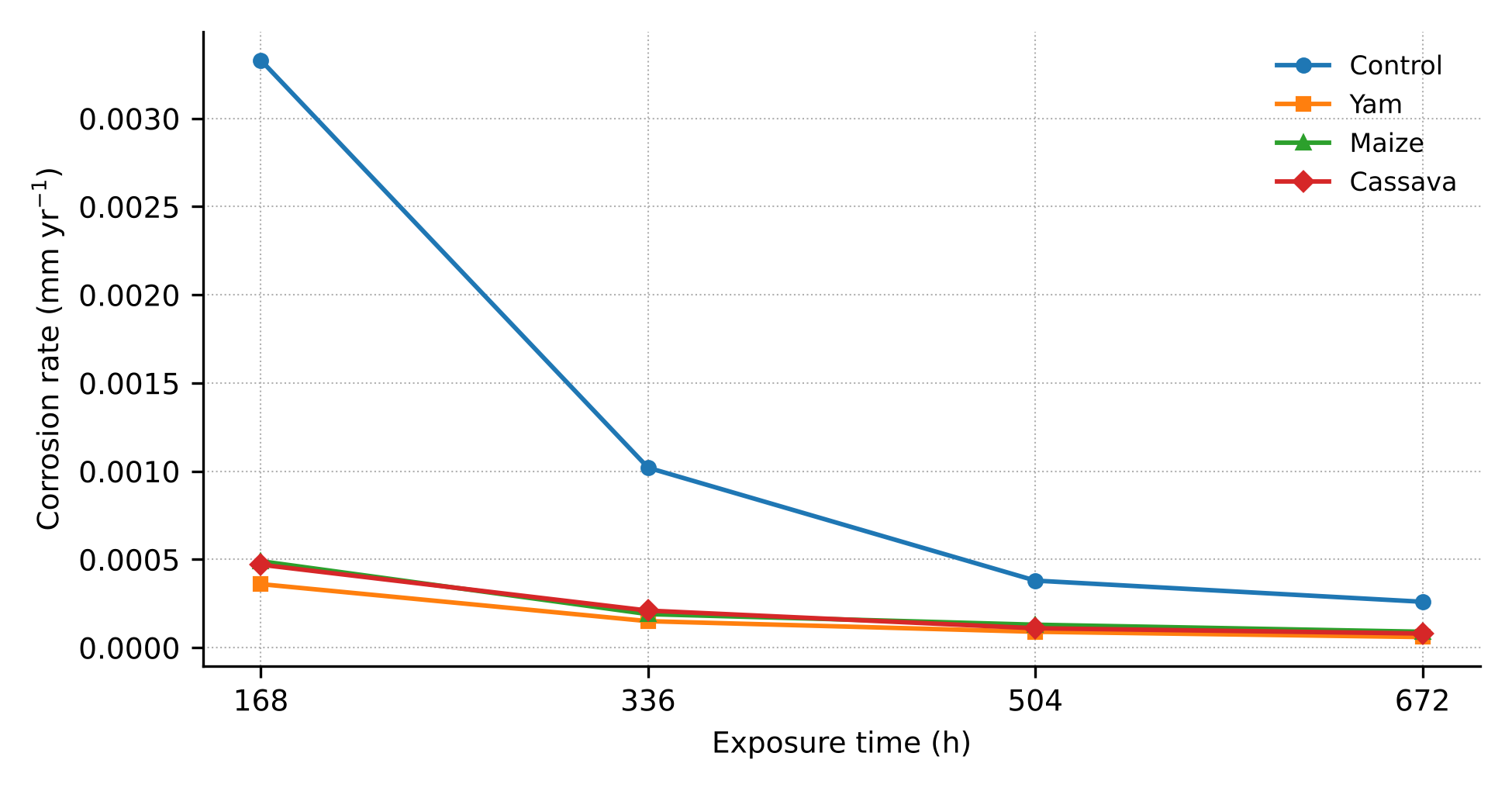
The mass-loss and corrosion-rate data for mild steel exposed to 0.5 M H2SO4 in the absence and presence of 15 cm³ of yam, maize and cassava leaf extracts are presented in Table 1.
The control specimens exhibited substantially greater corrosion rates than the specimens exposed to the plant extracts. At 168 h, the corrosion rate of the control was 0.00333 mm yr−1, compared with 0.00036, 0.00049, and 0.00047 mm yr−1 for yam, maize, and cassava extracts, respectively. This corresponds to calculated inhibition efficiencies of approximately 89.2%, 85.3%, and 85.9%, respectively.
At 672 h, the control corrosion rate was 0.00026 mm yr−1, while the corresponding rates for yam, maize, and cassava were 0.00006, 0.00009, and 0.00008 mm yr−1. On this basis, the calculated inhibition efficiencies were approximately 76.9%, 65.4%, and 69.2%, respectively.
Plant extracts have attracted considerable attention as green corrosion inhibitors because of their diverse phytochemical constituents which can adsorb onto metallic surfaces and form protective films that reduce the rate of anodic metal dissolution and cathodic reactions. Holla et al. (2024), in a review of more than 40 plant extracts used for corrosion protection of different steels, reported that compounds such as alkaloids, flavonoids, phenols, tannins, glycosides, and other heteroatom-containing constituents contribute to corrosion inhibition through adsorption and surface-film formation. The review also emphasized that inhibition performance depends on factors including extract concentration, temperature, plant species, phytochemical composition, extraction procedure, and exposure conditions. These observations therefore support the investigation of locally available plant leaves, such as yam, maize, and cassava, as potential sustainable inhibitors for mild steel in sulphuric-acid media.
The yam extract produced the lowest corrosion rate at all four exposure times (168, 336, 504 and 672 h). Yam therefore exhibited the most consistent inhibition in 0.5 M H2SO4.
| Medium | Exposure time (h) | Initial mass (g) | Final mass (g) | Mass loss (g) | CR (mm yr−1) |
|---|---|---|---|---|---|
| Control | 168 | 9.55 | 6.74 | 2.81 | 0.00333 |
| Control | 336 | 9.49 | 7.76 | 1.73 | 0.00102 |
| Control | 504 | 9.38 | 8.42 | 0.96 | 0.00038 |
| Control | 672 | 9.42 | 8.53 | 0.89 | 0.00026 |
| Yam | 168 | 9.29 | 8.99 | 0.3 | 0.00036 |
| Yam | 336 | 9.5 | 9.24 | 0.26 | 0.00015 |
| Yam | 504 | 9.62 | 9.4 | 0.22 | 0.00009 |
| Yam | 672 | 9.79 | 9.59 | 0.2 | 0.00006 |
| Maize | 168 | 9.37 | 8.96 | 0.41 | 0.00049 |
| Maize | 336 | 9.31 | 8.99 | 0.32 | 0.00019 |
| Maize | 504 | 9.96 | 9.63 | 0.33 | 0.00013 |
| Maize | 672 | 9.04 | 8.74 | 0.3 | 0.00009 |
| Cassava | 168 | 9.55 | 9.15 | 0.4 | 0.00047 |
| Cassava | 336 | 9.14 | 8.78 | 0.36 | 0.00021 |
| Cassava | 504 | 9.68 | 9.4 | 0.28 | 0.00011 |
| Cassava | 672 | 9.32 | 9.06 | 0.26 | 0.00008 |
4.2Corrosion behaviour in 1.0 M H2SO4
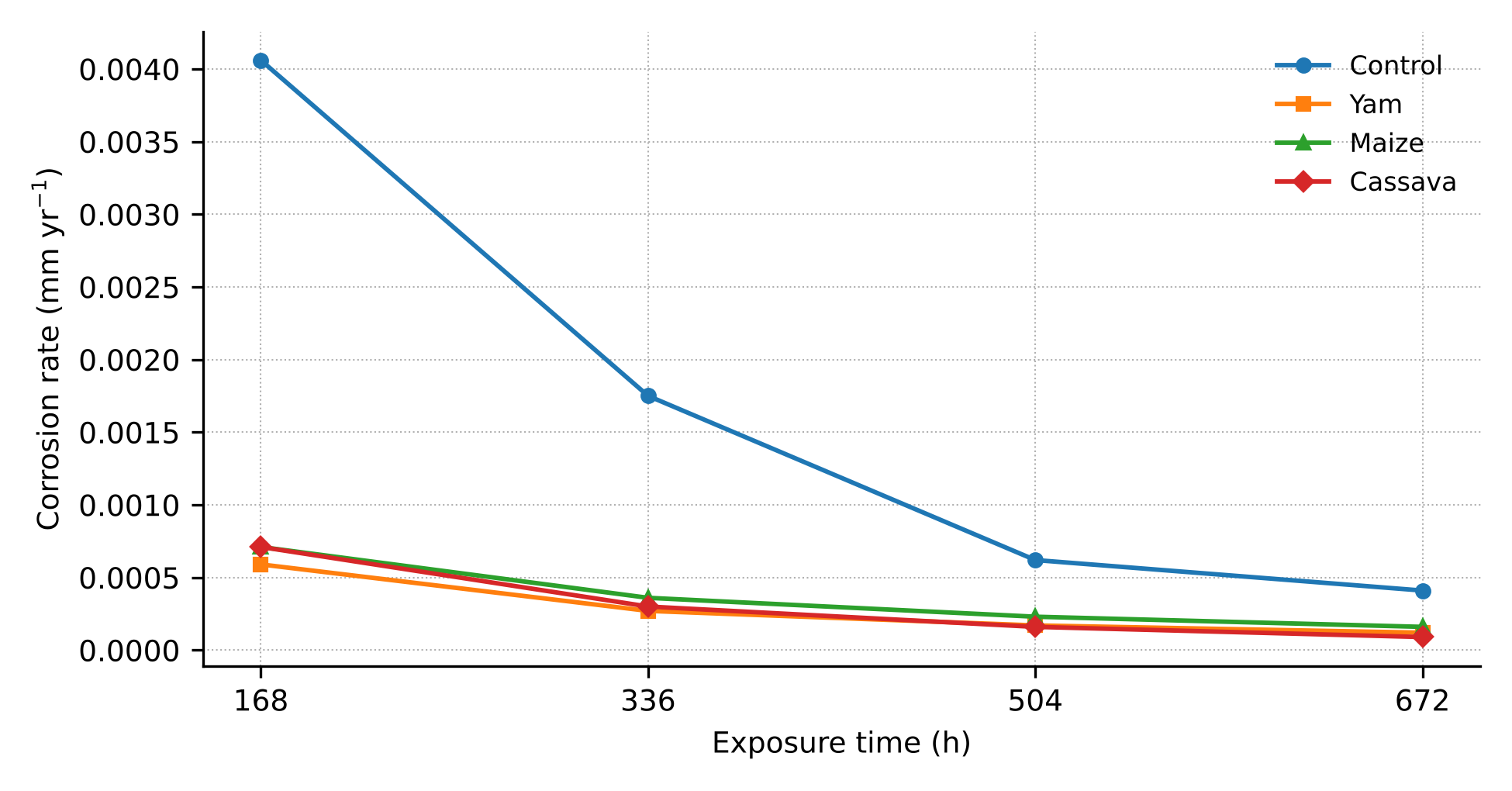
The results obtained in 1.0 M H2SO4 are presented in Table 2. Increasing the acid concentration generally produced a more aggressive environment, as reflected by the corrosion rates measured for the inhibited specimens.
At 168 h, the corrosion rate was 0.00406 mm yr−1 for the control, compared with 0.00059, 0.00071, and 0.00071 mm yr−1 for yam, maize, and cassava extracts, respectively. The corresponding calculated inhibition efficiencies were approximately 85.5%, 82.5%, and 82.5%.
At 672 h, the corrosion rates were 0.00012, 0.00016, and 0.00009 mm yr−1 for yam, maize, and cassava, respectively. Using the control value of 0.00041 mm yr−1, the calculated efficiencies are approximately 70.7%, 61.0%, and 78.0%, respectively.
Consequently, the data at 672 h indicate that cassava exhibited the lowest corrosion rate in 1.0 M H2SO4, whereas yam showed the lowest rates at the earlier exposure intervals. The results therefore indicate that yam showed strong and relatively consistent inhibition, while cassava displayed particularly strong long-term inhibition in the 1.0 M H2SO4 condition. Similarly, the relative effectiveness of botanical inhibitors can vary with acid concentration, immersion time, extract concentration, temperature, and plant chemistry. Maizia et al. (2023), for example, reported that aqueous nettle (Urtica dioica L.) extract significantly reduced the corrosion of mild steel in 0.5 M H2SO4, with inhibition efficiency increasing with extract concentration and reaching approximately 90–95% at 4 g L−1. The authors attributed the inhibition to adsorption of phytochemical constituents onto the steel surface, resulting in the formation of a protective film that suppresses both anodic metal dissolution and cathodic reactions. Their electrochemical and surface analyses further indicated that the extract acted as a mixed-type inhibitor and that both physical and chemical interactions contributed to the adsorption process (Maizia et al., 2023).
| Medium | Exposure time (h) | Initial mass (g) | Final mass (g) | Mass loss (g) | CR (mm yr−1) |
|---|---|---|---|---|---|
| Control | 168 | 9.42 | 5.99 | 3.43 | 0.00406 |
| Control | 336 | 9.85 | 6.9 | 2.95 | 0.00175 |
| Control | 504 | 9.63 | 8.06 | 1.57 | 0.00062 |
| Control | 672 | 9.88 | 8.4 | 1.48 | 0.00041 |
| Yam | 168 | 9.02 | 8.52 | 0.5 | 0.00059 |
| Yam | 336 | 9.17 | 8.72 | 0.45 | 0.00027 |
| Yam | 504 | 9.36 | 8.92 | 0.44 | 0.00017 |
| Yam | 672 | 9.76 | 9.36 | 0.4 | 0.00012 |
| Maize | 168 | 9.4 | 8.8 | 0.6 | 0.00071 |
| Maize | 336 | 9.36 | 8.76 | 0.6 | 0.00036 |
| Maize | 504 | 9.4 | 8.82 | 0.58 | 0.00023 |
| Maize | 672 | 9.58 | 9.04 | 0.54 | 0.00016 |
| Cassava | 168 | 9.55 | 8.95 | 0.6 | 0.00071 |
| Cassava | 336 | 9.54 | 9.04 | 0.5 | 0.0003 |
| Cassava | 504 | 9.49 | 9.09 | 0.4 | 0.00016 |
| Cassava | 672 | 9.34 | 9.03 | 0.31 | 0.00009 |
4.3Comparative inhibition performance of the three leaf extracts
The observed corrosion-rate reductions demonstrate that all three leaf extracts exerted inhibitory effects in both acidic environments. The protective behaviour can reasonably be associated with adsorption of phytochemical constituents on the mild-steel surface.
Recent research provides strong support for this interpretation. Studies involving Lepidium didymium, Solanum macrocarpon, Urtica dioica, Dracocephalum, and other botanical extracts have demonstrated the formation of protective interfacial layers and reductions in corrosion rates in sulphuric-acid solutions. Plant-derived extracts have also demonstrated substantial corrosion-inhibition performance in sulfuric acid media. Kaur et al. (2023) investigated the aerial-part extract of Lepidium didymium as an eco-friendly inhibitor for mild steel in 1 M H2SO4 using weight-loss, SEM, and spectroscopic techniques. The extract achieved a maximum inhibition efficiency of 91.16% at 2500 mg/L, which was attributed to the formation of a protective film on the steel surface and the adsorption of phytochemical constituents containing heteroatoms and multiple bonds. These findings support the potential of plant-derived materials as sustainable alternatives to conventional synthetic corrosion inhibitors.
The performance of the extracts may be related to differences in their phytochemical composition. Molecules containing hydroxyl, carbonyl, ether, amine, aromatic, and other functional groups can interact with the steel surface. Adsorption may occur through physical interactions, chemical interactions, or a combination of both, depending on the molecular structure, acid environment, temperature, and surface condition. Recent reviews also emphasized that the adsorption of phytochemical constituents onto metal surfaces can produce a protective barrier film that blocks active corrosion sites and reduces the interaction between the metal surface and aggressive ionic species in the electrolyte, thereby suppressing both anodic metal dissolution and cathodic reactions (Sharma et al., 2024).
The present results are also consistent with earlier investigations by Idenyi et al. (2015a), Idenyi et al. (2015b), Idu et al. (2016), Ifeanyichukwu et al. (2023), and Ifeanyichukwu and Nwifior (2024), which reported corrosion-inhibiting behaviour for plant-derived materials.
The results obtained here extend the literature by considering three agriculturally important Nigerian plant leaves within the same experimental framework. Such comparative investigations are useful because the performance of a plant extract cannot be assumed solely from the behaviour of another botanical species.
Figure 1 and Figure 2 show the variation of corrosion rate (mm yr−1) with exposure time (h) for mild steel in 0.5 M H2SO4 and 1.0 M H2SO4 without and with 15 cm³ of aqueous leaf extracts of yam, maize and cassava, respectively.
4.4Effect of exposure time
For most inhibited systems, the corrosion rate decreased as the exposure period increased. This behaviour may reflect progressive surface coverage by adsorbed phytochemical molecules and the resulting development of a protective layer. Similar time-dependent behaviour has been reported for other plant-derived corrosion inhibitors. Hussein and Khadom (2024) demonstrated the effectiveness of okra (Abelmoschus esculentus) leaf extract as a green corrosion inhibitor for N80 steel in 1.0 M H2SO4. The extract exhibited mixed-type inhibition, with the maximum inhibition efficiency reaching 96% at 30 °C and 100 mL/L. Adsorption analysis indicated Langmuir-type physical adsorption, while FTIR, UV, SEM, AFM and optical microscopy provided evidence of protective-layer formation on the steel surface. These findings demonstrate the potential of leaf-derived phytochemicals to suppress steel corrosion in sulfuric acid through adsorption and formation of a protective barrier.
However, corrosion inhibition is not necessarily controlled by exposure time alone. Changes in extract constituents, dissolution of adsorbed species, alteration of surface films, acid concentration, and depletion or transformation of inhibitor molecules may affect long-term performance. Therefore, the reduction in measured corrosion rate observed in the present work should not automatically be interpreted as evidence that inhibition efficiency continuously increases with time.
4.5Mechanism of inhibition
The inhibition mechanism proposed for the present plant extracts is adsorption. Plant-derived compounds can accumulate at the steel/electrolyte interface and occupy active corrosion sites. This adsorption decreases the effective area available for electrochemical reactions and creates a barrier between the metal surface and the acidic electrolyte.
Recent experimental studies have shown that green corrosion inhibitors can behave as mixed-type inhibitors by suppressing both anodic metal dissolution and cathodic reactions. For example, neem (Azadirachta indica) leaf extract increased the charge-transfer resistance and decreased the double-layer capacitance of mild steel in acidic medium, while polarization measurements indicated mixed-type inhibition, suggesting the adsorption of phytochemical constituents onto the steel surface and the formation of a protective film (Alberts et al., 2023).
Similarly, Piper chaba extract exhibited a corrosion inhibition efficiency of 86.53% at 1 g/L in 2 M H2SO4. The adsorption of the extract onto mild steel followed the Langmuir isotherm, while density functional theory (DFT) calculations and molecular dynamics (MD) simulations supported the experimental findings and provided molecular-level evidence for the interaction and adsorption of phytochemical constituents on the steel surface (Joshi et al., 2025).
The precise inhibition mechanism of the yam, maize, and cassava leaf extracts cannot be established conclusively from weight-loss measurements alone. Although gravimetric measurements can demonstrate corrosion-rate reduction and quantify inhibition efficiency, they do not directly identify the adsorbed species or distinguish reliably between anodic, cathodic, and mixed-type inhibition. Complementary techniques, including FTIR and GC–MS for phytochemical identification, SEM/EDS for surface-morphological and elemental characterization, and potentiodynamic polarization and electrochemical impedance spectroscopy (EIS) for electrochemical assessment, would therefore be required to elucidate the dominant adsorption processes and inhibition mechanism.
5Comparison with recent literature
The present findings are consistent with a substantial body of research demonstrating the potential of plant-derived materials as environmentally friendly corrosion inhibitors for steel in acidic media. Earlier gravimetric work by Bilar and Christopher (2020) showed that aqueous Eucalyptus leaf extract inhibited mild-steel corrosion in 0.5 M H2SO4, with inhibition efficiency increasing with extract concentration. Karthikeyan et al. (2021) similarly investigated Annona squamosa extract in 0.5 M H2SO4 and combined weight-loss, polarization, electrochemical impedance spectroscopy (EIS), atomic force microscopy (AFM), and scanning electron microscopy (SEM) measurements to demonstrate inhibition and adsorption of extract constituents on the steel surface. Oyewole et al. (2021) also reported substantial corrosion inhibition by Corchorus olitorius stem extract in 0.5 M H2SO4. Other studies have extended this approach to different plant species and acid concentrations. Anadebe et al. (2021) investigated bitter-kola leaf extract as an anticorrosion additive for mild steel in 1.2 M H2SO4, while subsequent studies have examined Solanum macrocarpon leaves in sulfuric-acid media and Lepidium didymium extract in 1 M H2SO4. More recent work on Urtica dioica (nettle) extract and other plant-derived inhibitors has further demonstrated that phytochemical constituents can substantially reduce steel corrosion through adsorption and protective-film formation.
The mechanistic interpretation of these findings is supported by recent reviews. Sharma et al. (2024) specifically reviewed phytochemicals as eco-friendly corrosion inhibitors for mild steel in sulfuric acid and highlighted the ability of heteroatom-containing biomolecules, including polyphenols, flavonoids, tannins, alkaloids, and related constituents, to interact with metal surfaces and impede corrosion reactions.
Collectively, the literature demonstrates that corrosion-inhibition performance depends on several factors, including plant species, phytochemical composition, extract concentration, acid concentration, exposure time, temperature, extraction procedure, and the nature of the steel substrate. The present study extends this body of knowledge by comparatively evaluating aqueous leaf extracts of yam, maize, and cassava against mild-steel corrosion in 0.5 and 1.0 M H2SO4 using a gravimetric approach. The use of these readily available agricultural resources is particularly relevant to the development of locally accessible and potentially sustainable corrosion-control materials. However, because the present investigation is based on weight-loss measurements, the precise adsorption mechanism and the relative contributions of anodic and cathodic inhibition cannot be established conclusively without complementary electrochemical and surface-characterization techniques.
5.1Limitations and recommendations for further research
Although the gravimetric results demonstrate clear reductions in corrosion rate, further investigations would strengthen the scientific evidence.
First, inhibitor concentration should be expressed not only as extract volume but also as extract mass per unit volume (e.g., g L−1) to facilitate comparison with published studies.
Second, phytochemical characterization using FTIR, GC-MS/LC-MS, total phenolic content, and total flavonoid content would help identify compounds potentially responsible for inhibition.
Third, SEM/EDS analysis should be conducted to compare the surface morphology and elemental composition of uninhibited and inhibited steel specimens.
Fourth, electrochemical techniques, particularly potentiodynamic polarization and electrochemical impedance spectroscopy (EIS), should be employed to determine corrosion potential, corrosion current density, charge-transfer resistance, and double-layer capacitance.
Fifth, suitable adsorption isotherms, including Langmuir, Temkin, and Freundlich models, could be evaluated where the experimental concentration range is sufficient.
Finally, temperature-dependent experiments should be conducted to determine activation energy and thermodynamic parameters and to assess the stability of the protective inhibitor film.
6Conclusion
The present study demonstrates that aqueous leaf extracts of yam (Dioscorea rotundata), maize (Zea mays), and cassava (Manihot esculenta) reduce the corrosion rate of mild steel in 0.5 and 1.0 M H2SO4. Addition of 15 cm³ of each extract produced substantially lower corrosion rates than the corresponding uninhibited controls.
In 0.5 M H2SO4, yam generally showed the lowest corrosion rates, while cassava and maize also exhibited appreciable inhibition. In 1.0 M H2SO4, yam showed strong inhibition at earlier exposure periods, whereas cassava produced the lowest corrosion rate at 672 h. Overall, all three extracts demonstrated corrosion-inhibiting potential, although their relative effectiveness varied with acid concentration and exposure time.
The inhibition may be associated with the adsorption of phytochemical constituents on the mild-steel surface, forming a protective barrier that limits contact between the metal and acidic medium. The renewable and low-cost nature of these plant materials makes them promising candidates for further investigation as environmentally compatible corrosion inhibitors.
However, these findings represent a preliminary gravimetric assessment. Further studies involving concentration optimization, electrochemical measurements, phytochemical characterization, and surface analysis are required to establish the inhibition mechanism and assess their potential for practical application.
References
- [1]Abdelaziz S, Benamira M, Messaadia L, Boughoues Y, Lahmar H, Boudjerda A (2021). Green corrosion inhibition of mild steel in HCl medium using leaves extract of Arbutus unedo L. plant: An experimental and computational approach. Colloids and Surfaces A: Physicochemical and Engineering Aspects, 619, 126496. https://doi.org/10.1016/j.colsurfa.2021.126496
- [2]Ahmad Reza N, Akhmal NH, Fadil NA, Mohd Taib MF (2021). A review on plants and biomass wastes as organic green corrosion inhibitors for mild steel in acidic environment. Metals, 11(7), 1062. https://doi.org/10.3390/met11071062
- [3]Alberts IG, Emmanuel JI, Ngasoh FO, Bello A, Onwualu AP, Anye VC (2023). Neem leaf extract as corrosion prevention and inhibition agent for mild steel in acid medium. In 2023 2nd International Conference on Multidisciplinary Engineering and Applied Science (ICMEAS) (pp. 1–6). IEEE. https://doi.org/10.1109/ICMEAS58693.2023.10429861
- [4]Anadebe VC, Nnaji PC, Okafor NA, Ezeugo JO, Abeng FE, Onukwuli OD (2021). Evaluation of bitter kola leaf extract as an anticorrosion additive for mild steel in 1.2 M H2SO4 electrolyte. South African Journal of Chemistry, 75. https://doi.org/10.17159/0379-4350/2021/v75a2
- [5]Bilar A, Christopher B (2020). Investigation of the inhibitive effect of aqueous extract of eucalyptus leaves on mild steel in acidic media. Journal of Chemical Society of Nigeria, 45(5), 890–896. https://doi.org/10.46602/jcsn.v45i5.524
- [6]Burhagohain P, Sharma G (2022). Plant extract as green corrosion inhibitor for mild steel in oil and gas industry: A review. International Journal of Oil, Gas and Coal Technology, 31(2), 184–210. https://doi.org/10.1504/IJOGCT.2022.125381
- [7]Chu TS, Mai WJ, Li HZ, Wei BX, Xu YQ, Liao BK (2025). Insights into the corrosion inhibition performance of plant extracts of different genera in the Asteraceae family for Q235 steel in H2SO4 medium. International Journal of Molecular Sciences, 26(2), 561. https://doi.org/10.3390/ijms26020561
- [8]Emmanuel JK (2024). Corrosion protection of mild steel in corrosive media, a shift from synthetic to natural corrosion inhibitors: A review. Bulletin of the National Research Centre, 48, 26. https://doi.org/10.1186/s42269-024-01181-7
- [9]Emmanuel M, Fugo J, Karungamye P (2026). From farm waste to rust fighter: Turning Agave sisalana extracts into a high-performance green corrosion inhibitor. Extreme Materials, 2(2), 100028. https://doi.org/10.1016/j.exm.2026.100028
- [10]Ezugha SI, Aralu CC (2023). Evaluation of adsorption and corrosion inhibition properties of Solanum macrocarpon leaves extract on mild steel in sulphuric acid solutions. SN Applied Sciences, 5, 381. https://doi.org/10.1007/s42452-023-05594-3
- [11]Fazal BR, Becker T, Kinsella B, Lepkova K (2022). A review of plant extracts as green corrosion inhibitors for CO2 corrosion of carbon steel. npj Materials Degradation, 6, 5. https://doi.org/10.1038/s41529-021-00201-5
- [12]Golshani Z, Arjmand F, Amiri M, Hosseini SMA, Fatemi SJ (2023). Investigation of Dracocephalum extract based on bulk and nanometer size as green corrosion inhibitor for mild steel in different corrosive media. Scientific Reports, 13, 913. https://doi.org/10.1038/s41598-023-27891-y
- [13]Holla BR, Mahesh R, Manjunath HR, Anjanapura VR (2024). Plant extracts as green corrosion inhibitors for different kinds of steel: A review. Heliyon, 10(14), e33748. https://doi.org/10.1016/j.heliyon.2024.e33748
- [14]Hussein SA, Khadom AA (2024). Okra leaves extract as green corrosion inhibitor for steel in sulfuric acid: Gravimetric, electrochemical, and surface morphological investigations. Results in Chemistry, 8, 101566. https://doi.org/10.1016/j.rechem.2024.101566
- [15]Ibrahim HE, Atia MF, Rashwan SM, Reda M, Fouda AS (2026). Chrysanthemum indicum extract as a sustainable inhibitor for acid-induced corrosion of API 5L X70 steel. Discover Electrochemistry, 3, 82. https://doi.org/10.1007/s44373-026-00170-x
- [16]Idenyi NE, Nwofe PA, Idu HK (2015a). Journal of Applied Sciences Research, 11(22), 158–163.
- [17]Idenyi NE, Nwofe PA, Agbo PE, Idu HK (2015b). Effects of Psidium guajava (guava) and Moringa oleifera leaves extract on the corrosion susceptibility of mild steel in an acidic medium. Australian Journal of Basic and Applied Sciences, 9(35), 245–250.
- [18]Idu HK, Nwofe PA, Kalu PN, Idenyi NE (2016). Moringa oleifera and Psidium guajava leaves extract as low-cost, eco-friendly inhibitors of corrosion on mild steel in an acidic media. American-Eurasian Journal of Scientific Research, 11(3), 177–182.
- [19]Ifeanyichukwu BJ, Nwifior K (2024). Inhibition characteristics of locally sourced maize leaf extracts as a corrosion inhibitor in selected media. International Journal of Research and Sustainable Development, 10(1), 7–16.
- [20]Ifeanyichukwu BJ, Idu HK, Idenyi NE (2023). Inhibitive effect of locally Dioscorea spp. leaf extracts as a green corrosion inhibitor in selected media. Journal of Materials and Environmental Science, 14(6), 702–710.
- [21]Joshi V, Bachhar V, Singh P, Duseja M, Haldhar R, Katin KP, Berdimurodov E, Shukla RK (2025). Rheological and anticorrosion study of Piper chaba extract and coating for mild steel in 2M H2SO4. Colloids and Surfaces A: Physicochemical and Engineering Aspects, 708, 135989. https://doi.org/10.1016/j.colsurfa.2024.135989
- [22]Karki R, Bajgai AK, Khadka N, Thapa O, Mukhiya T, Oli HB, Bhattarai DP (2022). Acacia catechu bark alkaloids as novel green inhibitors for mild steel corrosion in a one molar sulphuric acid solution. Electrochem, 3(4), 668–687. https://doi.org/10.3390/electrochem3040044
- [23]Karthikeyan S, Syed Abuthahir SS, Samsath Begum A, Vijaya K (2021). Corrosion inhibition of mild steel in 0.5 M H2SO4 solution by plant extract of Annona squamosa. Asian Journal of Chemistry, 33(9), 2219–2228. https://doi.org/10.14233/ajchem.2021.23386
- [24]Kaur J, Saxena A, Reddy VP, Sathiaraj D, Agrawal M, Saxena KK (2023). Lepidium didymium plant extract as eco-friendly corrosion inhibitor for steel in acidic medium. Indian Journal of Engineering and Materials Sciences, 30(2), 256–264. https://doi.org/10.56042/ijems.v30i2.1627
- [25]Kumar H, Yadav P, Kumari R, Sharma R, Sharma S, Singh D, Dahiya H, Kumar P, Bhardwaj S, Kaur P (2023). Highly efficient green corrosion inhibitor for mild steel in sulfuric acid: Experimental and DFT approach. Colloids and Surfaces A: Physicochemical and Engineering Aspects, 675, 132039. https://doi.org/10.1016/j.colsurfa.2023.132039
- [26]Kumar H, Yadav V, Kumari A (2022). Adsorption, corrosion inhibition mechanism, and computational studies of Azadirachta indica extract for protecting mild steel: Sustainable and green approach. Journal of Physics and Chemistry of Solids, 165, 110690. https://doi.org/10.1016/j.jpcs.2022.110690
- [27]Maizia R, Zaabar A, Djermoune A, Amoura D, Martemianov S, Thomas A, Alrashdi AA, Makhloufi L, Lgaz H, Dib A, Chafiq M, Ko YG (2023). Experimental assessment and molecular-level exploration of the mechanism of action of nettle (Urtica dioica L.) plant extract as an eco-friendly corrosion inhibitor for X38 mild steel in sulfuric acidic medium. Arabian Journal of Chemistry, 16, 104988. https://doi.org/10.1016/j.arabjc.2023.104988
- [28]Mungwari CP, Obadele BA, King'ondu CK (2025). Phytochemicals as green and sustainable corrosion inhibitors for mild steel and aluminium: Review. Results in Surfaces and Interfaces, 18, 100374. https://doi.org/10.1016/j.rsurfi.2024.100374
- [29]Odidika CC, Ajiwe VIE, Eboagu CN, Ekwunife CM, Awuzie CI (2020). Corrosion inhibition and adsorption properties of Commelina benghalensis leaves extract on mild steel in 1 M H2SO4 solution. Science Journal of Analytical Chemistry, 8(2), 86–92. https://doi.org/10.11648/j.sjac.20200802.18
- [30]Oyewole O, Abayomi TS, Oreofe TA, Oshin TA (2022). Anti-corrosion using rice straw extract for mild steel in 1.5 M H2SO4 solution. Results in Engineering, 16, 100684. https://doi.org/10.1016/j.rineng.2022.100684
- [31]Oyewole O, Oshin TA, Atotuoma BO (2021). Corchorus olitorius stem as corrosion inhibitor on mild steel in sulphuric acid. Heliyon, 7(4), e06840. https://doi.org/10.1016/j.heliyon.2021.e06840
- [32]Salleh SZ, Yusoff AH, Zakaria SK, Taib MAA, Abu Seman A, Masri MN, Mohamad M, Mamat S, Ahmad Sobri S, Ali A, Teo PT (2021). Plant extracts as green corrosion inhibitor for ferrous metal alloys: A review. Journal of Cleaner Production, 304, 127030. https://doi.org/10.1016/j.jclepro.2021.127030
- [33]Sharma S, Solanki AS, Thakur A, Sharma A, Kumar A, Sharma SK (2024). Phytochemicals as eco-friendly corrosion inhibitors for mild steel in sulfuric acid solutions: A review. Corrosion Reviews, 42(6), 727–742. https://doi.org/10.1515/corrrev-2024-0018
- [34]Thacker HH, Ram VR (2025). Green corrosion inhibitors derived from plant extracts and drugs for mild steel in acid media: A review. Results in Surfaces and Interfaces, 18, 100364. https://doi.org/10.1016/j.rsurfi.2024.100364