Criminology
Building Bridges: Strengthening Police-Community Relations by Fostering Trust and Understanding
Cebu Technological University – Main Campus, Cebu City, Philippines
Published October 2026
Abstract
This research, conducted in Cebu City, Philippines, for the degree of Master in Public Administration, explored the dynamics of police-community relations with the goal of identifying strategies to enhance trust and understanding. The study utilized a mixed-methods approach, combining quantitative surveys administered to a diverse sample of residents and police officers with qualitative interviews and focus group discussions. The research sought to uncover the root causes of public distrust, evaluate existing police-community initiatives, and identify best practices for fostering cooperation. The findings revealed a significant disconnect between the public's perception of police and the officers' self-perceptions, often stemming from communication gaps, a lack of transparency, and inconsistent application of community-oriented policing principles. Key issues identified include the need for improved police accountability mechanisms, enhanced cultural sensitivity training, and the creation of more accessible platforms for citizen feedback. The study concluded that successful police-community relations are built on a foundation of mutual respect, consistent engagement, and shared responsibility. The research culminates in a Roadmap for Strengthened Police-Community Relations, a comprehensive and actionable output designed to guide policymakers and law enforcement agencies. This roadmap outlines a phased approach, including: a) Policy reforms to institutionalize community policing; b) Training and development programs focused on de-escalation, cultural competence, and communication skills; c) Technological integration to improve transparency and citizen reporting; and d) Community partnership initiatives to co-create safety solutions. The roadmap serves as a practical blueprint for building a more collaborative and effective relationship between the police and the communities they serve in Cebu City and beyond.
Keywords: police-community relations; public administration; trust; community policing; roadmap; law enforcement; public trust; social cohesion; Cebu City; Philippines
1Introduction
1.1Rationale of the study
The efficacy of law enforcement in maintaining peace and order within any society is inextricably linked to the quality of its relationship with the community it serves. A robust and positive police-community relationship is not merely desirable; it is a fundamental pillar of democratic governance, public safety, and social cohesion. However, contemporary societies, including the Cebu in the Philippines, often grapple with a persistent paradox, while citizens demand security and order, perceptions of distrust, misunderstanding, and even adversarial interactions between the police and the public continue to undermine these essential relationships (Lindsey, 2021).
Historically, policing models have often leaned towards an enforcement-centric approach, prioritizing reactive measures and crime suppression. While essential, this singular focus can inadvertently create a chasm between law enforcement officers and the communities they are sworn to protect. Incidents of perceived misconduct, lack of transparency, and inadequate avenues for public redress contribute to an erosion of trust, leading to diminished cooperation, reduced reporting of crimes, and ultimately, a less safe environment for all.
According to Miller and Hess (2023), the ramifications of a strained police-community relationship are profound and far-reaching. Beyond the immediate impact on crime rates, a lack of trust can foster social unrest, exacerbate existing inequalities, and undermine the legitimacy of state authority. Conversely, when trust and understanding are fostered, communities become active partners in crime prevention, intelligence gathering improves, and the police gain invaluable insights into local concerns, enabling them to tailor their strategies more effectively and sensitively.
Existing literature on police-community relations frequently highlights the importance of engagement and communication. However, there remains a significant gap in understanding the specific mechanisms and practical strategies that most effectively translate these broad principles into tangible improvements in trust and understanding. Further, as Dailey (2024) notes, many initiatives are often ad-hoc, poorly evaluated, or lack a comprehensive framework for sustained impact. Furthermore, contextual nuances, such as, socio-economic disparities, cultural specificities, historical grievances, unique geographic challenges are often overlooked in generic approaches, limiting their effectiveness.
This study aims to bridge this theoretical and practical gap by moving beyond general calls for "better relations" to a focused investigation of the processes and interventions that genuinely foster trust and understanding. We contend that true strengthening of police-community relations requires a deliberate and multi-faceted approach that goes beyond mere public relations campaigns. It necessitates a deeper exploration of mutual perceptions, the identification of communication barriers, and the development of sustainable programs that promote genuine dialogue, empathy, and shared responsibility.
Specifically, this research is deemed essential for the following reasons; Addressing a Persistent Societal Challenge, the breakdown of trust between the police and the community is a chronic issue with significant implications for public safety and social order; Filling Gaps in Practical Application, while the concept of police-community relations is well-established, there is a clear need for empirical research that identifies and evaluates effective, actionable strategies for building trust and understanding in real-world contexts; Informing Policy and Practice, the findings of this research will provide evidence-based recommendations for law enforcement agencies, policymakers, and community leaders seeking to implement more effective police-community relations programs. This could include training curricula, community engagement protocols, and performance metrics; Promoting Sustainable Solutions, rather than focusing on short-term fixes, this study seeks to identify strategies that foster long-term, sustainable improvements in police-community dynamics, leading to enduring bridges of trust; Enhancing Public Safety and Well-being, ultimately, by strengthening police-community relations, this research contributes directly to a safer, more cohesive, and more just society, where citizens feel secure and empowered to work collaboratively with law enforcement; and Contextual Relevance, given the unique socio-cultural and geographical landscape of Cebu City and understanding the specific dynamics of police-community interactions within this context is crucial. This research will offer localized insights that can inform targeted interventions relevant to the Mandaue City.
By thoroughly examining the mechanisms that foster trust and understanding, this thesis seeks to provide a comprehensive roadmap for building enduring bridges between the police and the communities they serve. It is our firm belief that through fostering mutual respect, open communication, and shared goals, the aspirations of both a secure and a justly governed society can be more fully realized.
1.2Theoretical background
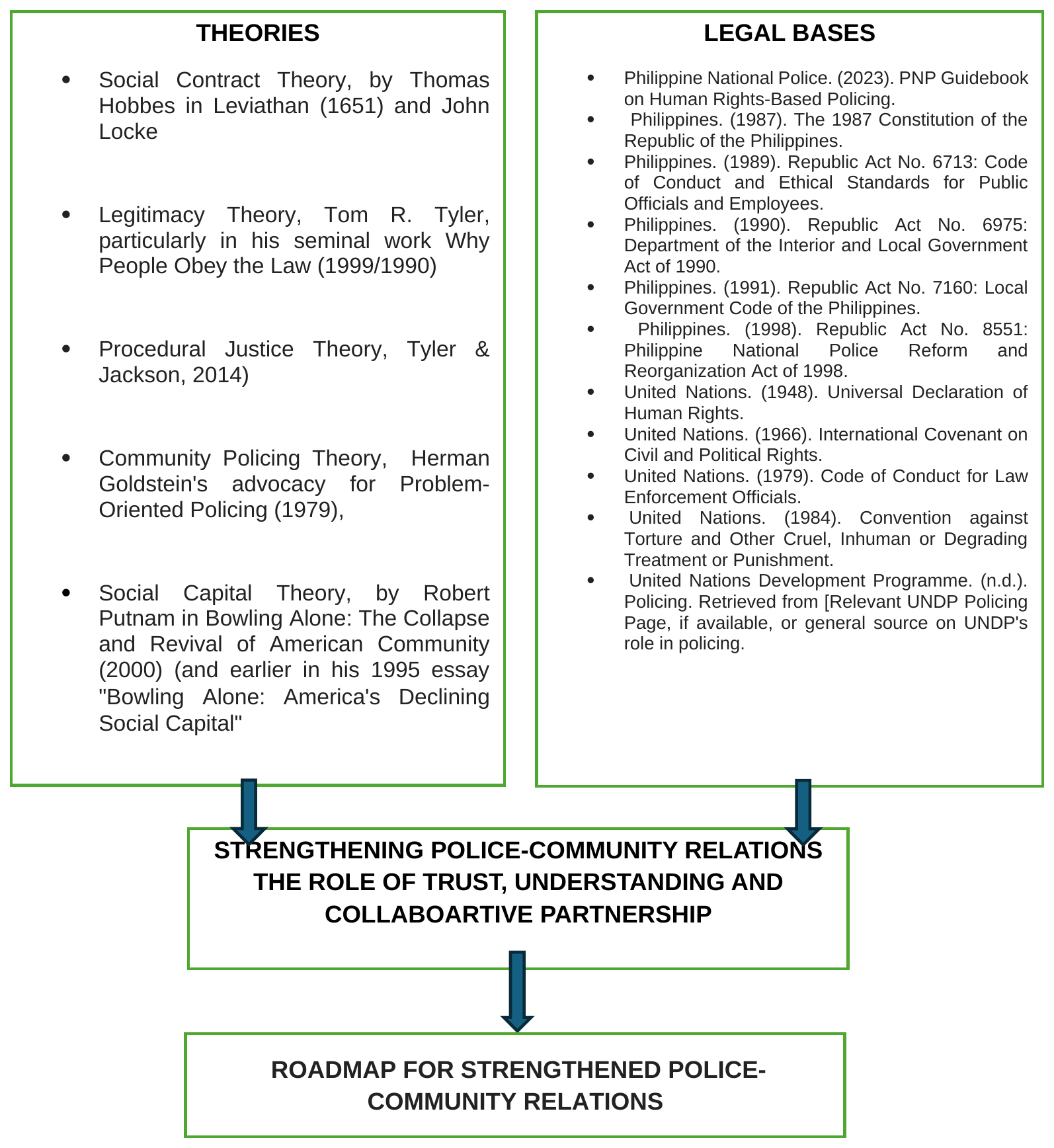
The study “Strengthening of Police-Community Relations: The Role of Trust, Understanding and Collaborative Partnership" is firmly rooted in several interconnected sociological, criminological, and organizational theories. These frameworks provide a robust lens for understanding the complex dynamics between law enforcement and the communities they serve, explaining existing challenges while offering conceptual pathways for developing effective interventions to foster trust and mutual understanding.
Social Contract Theory, (Gordon Allport,1954, reviewed and re credited to M. Zaitseva, 2022) published as its most fundamental level on the existence of a police force is justified by Social Contract Theory. This philosophical concept, notably articulated by Thomas Hobbes in Leviathan (1651) and John Locke in Two Treatises of Government (1689), posits that individuals willingly surrender certain freedoms to a governing authority (the state) in exchange for protection, order, and the maintenance of societal norms. In this context, the police are the primary agents through which the state fulfills its obligation to ensure public safety and uphold the rule of law. However, on the year (2021, Anthony Elliot) authored the Contemporary Social Theory , discusses about the comprehensive guide to current perspectives and approached in sociology and social sciences, said that, people seek to achieve generalized shared reality not only with close others but also with strangers, and the extent to which people achieve this associated with success in attaining social connections.
When police-community relations are strained, it indicates a perceived breach or weakening of this social contract. If citizens do not trust the police to protect them fairly or to uphold justice, their willingness to cooperate with law enforcement diminishes, thereby undermining the very foundation of the social contract. This study seeks to re-establish and strengthen this perceived contract by fostering trust and understanding, ensuring that both the Philippine National Police (PNP) in Central Visayas and its community members fulfill their reciprocal obligations for collective security and well-being.
While, Legitimacy Theory (Police Legitimacy) is building directly upon the social contract, it was extensively popularized in policing research by scholars such as Tom R. Tyler, particularly in his seminal work Why People Obey the Law (1999/1990), argues that people obey the law and cooperate with authorities not simply out of fear of punishment, but primarily because they believe the authorities are legitimate and morally entitled to exercise power. Police legitimacy is a multifaceted concept encompassing; Trust and Confidence, the belief that the police are honest, competent, and have benevolent intentions; Willingness to Defer, acceptance of police authority and willingness to comply with their directives; Perceived Lawfulness and Morality, the belief that police actions are consistent with the law and are morally justifiable (Tyler & Jackson, 2014). This theory is central to "BUILDING BRIDGES" because it directly links public perceptions of fairness and respect to their willingness to cooperate with the police. When the public perceives the PNP as legitimate, they are more likely to report crimes, comply with police directives, participate in crime prevention initiatives, and view police actions as just, even if outcomes are unfavorable.
On the other hand, Procedural Justice Theory is a critical component and strong empirical predictor of Legitimacy Theory. This theory states that fairness in the processes by which decisions are made and actions are taken by authorities significantly influences perceptions of legitimacy and satisfaction, regardless of the outcome (Tyler, 1990). The four key tenets of procedural justice in policing include; Voice, giving individuals an opportunity to tell their side of the story and be heard; Neutrality, impartial and objective decision-making by authorities, without bias (Tyler & Huo, 2000); Respectful Treatment, treating individuals with dignity and politeness; Trustworthiness (Benevolent Intentions), conveying that authorities care about the well-being of the people they interact with (Tyler & Jackson, 2014).
This theory directly informs the "fostering trust and understanding" that embody these procedural justice principles like active listening, transparent decision-making, respectful interactions, and demonstrating genuine concern for community welfare that can rebuild and sustain trust.
Likewise, Community Policing Theory states that Community Policing is not merely a program but a philosophy and organizational strategy that emphasizes collaborative partnerships between law enforcement agencies and the communities they serve to address crime, social disorder, and fear of crime. Its evolution draws from pioneers like Egon Bittner's The Functions of the Police in Modern Society (1970), which highlighted the complexities of police work beyond law enforcement, and Herman Goldstein's advocacy for Problem-Oriented Policing (1979), urging a shift from reactive incident-driven policing to proactive problem-solving.
The key tenets of Community Policing includes; Partnerships, building collaborative relationships with community members, local government agencies, and other stakeholders (Cordner & Scarborough, 2010); Problem-Solving, proactively identifying and addressing the underlying causes of crime and disorder, rather than just reacting to incidents (Goldstein, 1979; Scott, 2000); Organizational Transformation, adapting police structures, management, and resource allocation to support community engagement (Skolnick & Bayley, 1988).
"BUILDING BRIDGES" aligns intrinsically with Community Policing theory by advocating for proactive engagement and collaboration. The study will investigate how implementing community policing principles, such as regular dialogue forums, joint problem-solving initiatives (e.g., crime prevention committees, neighborhood watch groups), and officer visibility in non-enforcement contexts, can directly contribute to fostering trust and understanding between the PNP and the community.
Social Capital Theory, notably articulated by Robert Putnam in Bowling Alone: The Collapse and Revival of American Community (2000) (and earlier in his 1995 essay "Bowling Alone: America's Declining Social Capital"), refers to the networks of relationships among people who live and work in a particular society, enabling that society to function effectively. It includes components like; Trust, generalized trust among community members and towards institutions; Reciprocity, mutual obligations and expectations of reciprocal exchanges within networks; Networks, social connections and associations that facilitate collective action. When the PNP and community members develop strong bonds, they create a form of social capital. This capital facilitates cooperation, information sharing, and collective action against crime and disorder, leading to greater community resilience, better crime prevention, and improved overall public safety outcomes through collaborative efforts rooted in shared norms and mutual trust.
While the preceding theories primarily focus on building positive relationships, it is also important to consider Conflict Theory. Drawing from the works of Karl Marx (e.g., Das Kapital, 1867) and later sociologists like Ralf Dahrendorf (Class and Class Conflict in Industrial Society, 1959) and Austin Turk (Criminality and Legal Order, 1969), Conflict Theory posits that society is in a state of perpetual conflict due to competition for limited resources, power imbalances, and inherent inequalities. In the context of policing, this theory can highlight how systemic issues, socio-economic disparities, and historical to an adversarial relationship between certain community segments and the police. Further, (A.P. Brumer, 2022), explored the relationship between social interaction, connection and cohesion on psychosocial health in which augmented by Matos, (2023) that social connection on post traumatic growth and stress related to social connections mediated the relationship between loneliness and positive coping strategies during any pandemic or war or pressing social disinformation and issues.
Although not the primary theoretical lens for proposing solutions, Conflict Theory serves as an important backdrop, reminding researchers that existing tensions are often rooted in deeper societal and structural issues. The study acknowledges these potential underlying conflicts within and seeks to identify strategies (guided by procedural justice and community policing) that can mitigate these adversarial dynamics and move towards more harmonious interactions, even in the face of resource limitations or historical challenges, recognizing that true "bridge-building" must address underlying sources of friction.
These theoretical frameworks, coupled with their relevant local and international legal bases, collectively provide a comprehensive lens through which to analyze and address the challenges in police-community relations (Figure 1).
The 1987 Philippine Constitution, Article II, Section 4, explicitly states, "The prime duty of the Government is to serve and protect the people." This constitutional mandate forms the bedrock of the social contract between the state (represented by the police) and its citizens, compelling law enforcement to prioritize public service and protection.
Likewise, Republic Act No. 6975 (1990), as amended by Republic Act No. 8551 (1998), known as the "PNP Reform and Reorganization Act of 1998," explicitly declares that the Philippine National Police "shall be community and service-oriented." This legislative mandate underscores the importance of the PNP's relationship with the public, implicitly demanding the cultivation of legitimacy to effectively perform its duties. Furthermore, the PNP Ethical Doctrine Manual and the Code of Conduct for Public Officials (RA 6713, 1989) emphasize integrity, professionalism, and commitment to public interest, all of which contribute to public perceptions of legitimacy.
Internationally, the United Nations Code of Conduct for Law Enforcement Officials (1979), particularly Article 1, states that officials shall "fulfil the duty imposed upon them by law, by serving the community and by protecting all persons against illegal acts, consistent with the high degree of responsibility required by their profession." This implicitly demands respectful and fair treatment. Domestically, the PNP Guidebook on Human Rights-Based Policing (2023) and the Philippine Constitution's Bill of Rights (Article III), which guarantees due process, equal protection of the law, and freedom from torture or cruel, inhuman, and degrading punishment, directly mandate procedural fairness and human rights observance in all police operations. These legal frameworks provide a clear basis for the adoption of procedural justice principles in the PNP.
The principles of human rights, equality, and non-discrimination enshrined in the 1987 Philippine Constitution (e.g., Article III, Sections 1 and 11) and international instruments like the Universal Declaration of Human Rights (UDHR, 1948), International Covenant on Civil and Political Rights (ICCPR, 1966), and the UN Convention against Torture (1984) serve as legal safeguards against the negative manifestations of power imbalances and potential police abuses that fuel conflict. These legal frameworks underscore the imperative for police accountability and respect for human dignity, which are crucial in addressing grievances stemming from conflict.
By drawing upon Social Contract Theory, Legitimacy Theory, Procedural Justice Theory, Community Policing Theory, and Social Capital Theory, this study seeks to understand not only why trust and understanding are crucial, but also how they can be practically fostered. Furthermore, by acknowledging insights from Conflict Theory and grounding the discussion in a robust legal framework, the research maintains a critical awareness of potential systemic barriers and underscores the imperative for police accountability and adherence to rights-based policing. The application of these theories and adherence to these legal mandates will guide the research design, data collection, and analysis, ultimately leading to evidence-based recommendations for building sustainable bridges between the Philippine National Police and the communities they serve in Mandaue City, Philippines.
2The problem
2.1Statement of the problem
This research assessed the PNP and Community relationship based on Trust and Understanding at select Police Stations in Mandaue City, during the Calendar Year 2024, towards a strengthened course of action. Specifically, it sought to answer the following questions:
- 1. What is the demographic profile of (1.1) the PNP personnel and (1.2) the community representatives in terms of age and gender, civil status, highest educational attainment, and relevant trainings and seminars attended?
- 2. What is the perception of the respondent groups on the implementation of the strategies of the PNP and community-police relationship based on trust and understanding along (2.1) police practices related to procedural justice; (2.2) cooperation and mutualization engagement in law, rules and procedure enforcement; and (2.3) the role of social capital networks?
- 3. What are some issues and concerns related to the realization of the PNP and community relationship?
- 4. Based on the findings, what evidence-based course of action to strengthen the police and community relationship can be sustained?
2.2Significance of the study
This study holds substantial theoretical, practical, and societal significance, particularly within the Philippine communities. Its findings are expected to contribute meaningfully to both the academic discourse on policing and the practical application of strategies aimed at fostering genuine collaboration between law enforcement and the public.
The insights generated by this research will be highly beneficial to various stakeholders, both directly and indirectly involved in public safety and community development.
2.2.1Philippine National Police (PNP): Mandaue City Police Stations 1, 3 and 6 and higher echelons
Mandaue City Police Office (MCPO). Will gain a clear, evidence-based understanding of their community's perceptions, the specific areas where trust and understanding are lacking, and actionable strategies to improve daily interactions and implement effective community policing programs. This can inform training modules, operational guidelines, and performance metrics.
PNP Regional and National Headquarters. Can utilize the findings as a case study to inform broader policy reforms, training curricula development, and resource allocation strategies for strengthening police-community relations across other municipalities in the Philippines.
2.2.2Local government units (LGUs): Mandaue City Government and barangays
Mayor's Office and Sangguniang Bayan. Will be better equipped to support the PNP through local ordinances, resource allocation, and collaborative initiatives that promote peace and order, aligning police efforts with community needs and priorities.
Barangay Councils. As the closest point of governance to the people, barangay officials can leverage the findings to facilitate more effective engagement between their constituents and the local police, acting as crucial intermediaries in building trust.
2.2.3Community members and organizations in Mandaue City
General Public. Will benefit from improved public safety, enhanced police responsiveness, and a more respectful and trusting relationship with law enforcement. This can empower citizens to participate more actively in crime prevention and community development.
Civil Society Organizations (CSOs) and Non-Governmental Organizations (NGOs). Can use the research findings to advocate for specific reforms, design community-led safety initiatives, and partner with the police more effectively in addressing local issues.
2.2.4Academe and future researchers
Criminology, Sociology, Public Administration, and Law Departments. Will find valuable empirical data to inform their teaching, curriculum development, and future research endeavors on police-community relations, legitimacy, and social capital, particularly in the Southeast Asian context.
Policymakers and Legislators (Local and National). The study's recommendations can serve as a critical reference point for crafting more effective legislation and policies that foster collaborative governance models between law enforcement and communities, moving towards a truly people-centered approach to security.
In essence, this study's significance extends beyond merely documenting a problem; it aims to provide actionable insights that can genuinely "build bridges" of trust and understanding, leading to a more effective, legitimate, and community-responsive police force in Mandaue City, Police Stations 1,3 and 6, ultimately contributing to a safer and more cohesive society for all.
3Research methodology
This section outlines the comprehensive research methodology employed to investigate the strengthening of police-community relations by fostering trust and understanding. It details the research design, flow of the study, research environment, respondents, instrument, data gathering procedure, statistical treatment and scoring procedure.
The methodological approach is designed to provide robust, empirical insights into the complex dynamics between the Philippine National Police (PNP) and the local community.
3.1Research design
To accomplish the objectives of this study, the descriptive method of research is utilized. Descriptive research is concerned with the present situation, prevailing conditions, common practices, contemporary events, characteristics of respondent profile.
The research design serves as the blueprint for this study, dictating the structure, methods, and procedures for collecting and analyzing data to address the research questions, by carefully integrating these design elements, the research will be able to provide a comprehensive and robust analysis maximizing the credibility and applicability of its findings within the specific context of police operations.
3.2Flow of the study
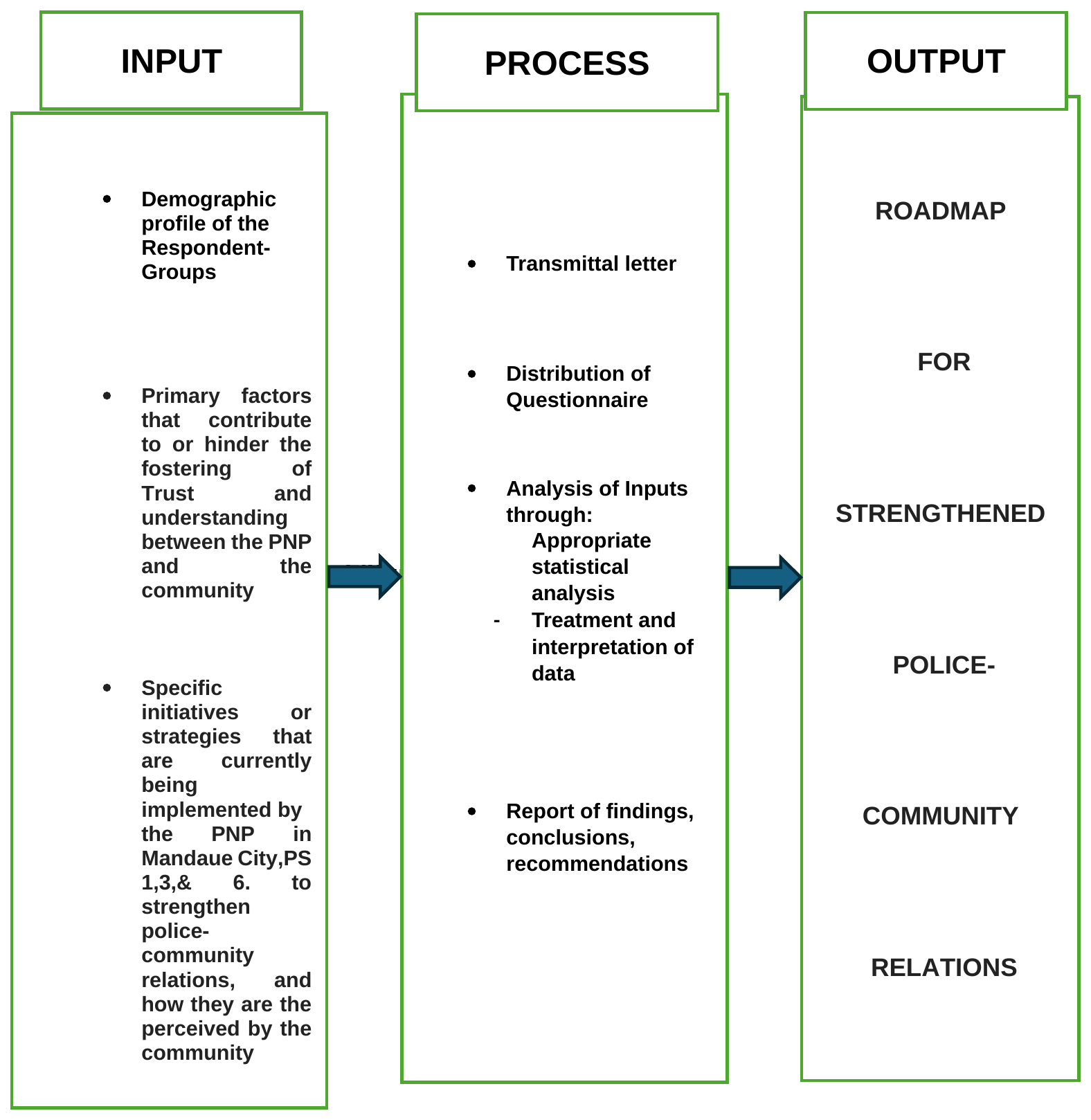
This study follows the systems model approach as input, process, and output. Input shows the related information of respondent groups as to age, gender, civil status, highest educational attainment and relevant trainings and seminars attended. The Input-Process-Output (IPO) model (Figure 2) provides a clear, systematic framework for visualizing the logical progression of this research. It illustrates how various elements interact to achieve the study's objectives, from initial preparations to final outcomes.
This IPO model illustrates the interconnected stages of the research, demonstrating a systematic and well-planned approach to investigate the impact of police training on community policing outcomes.
3.3Environment
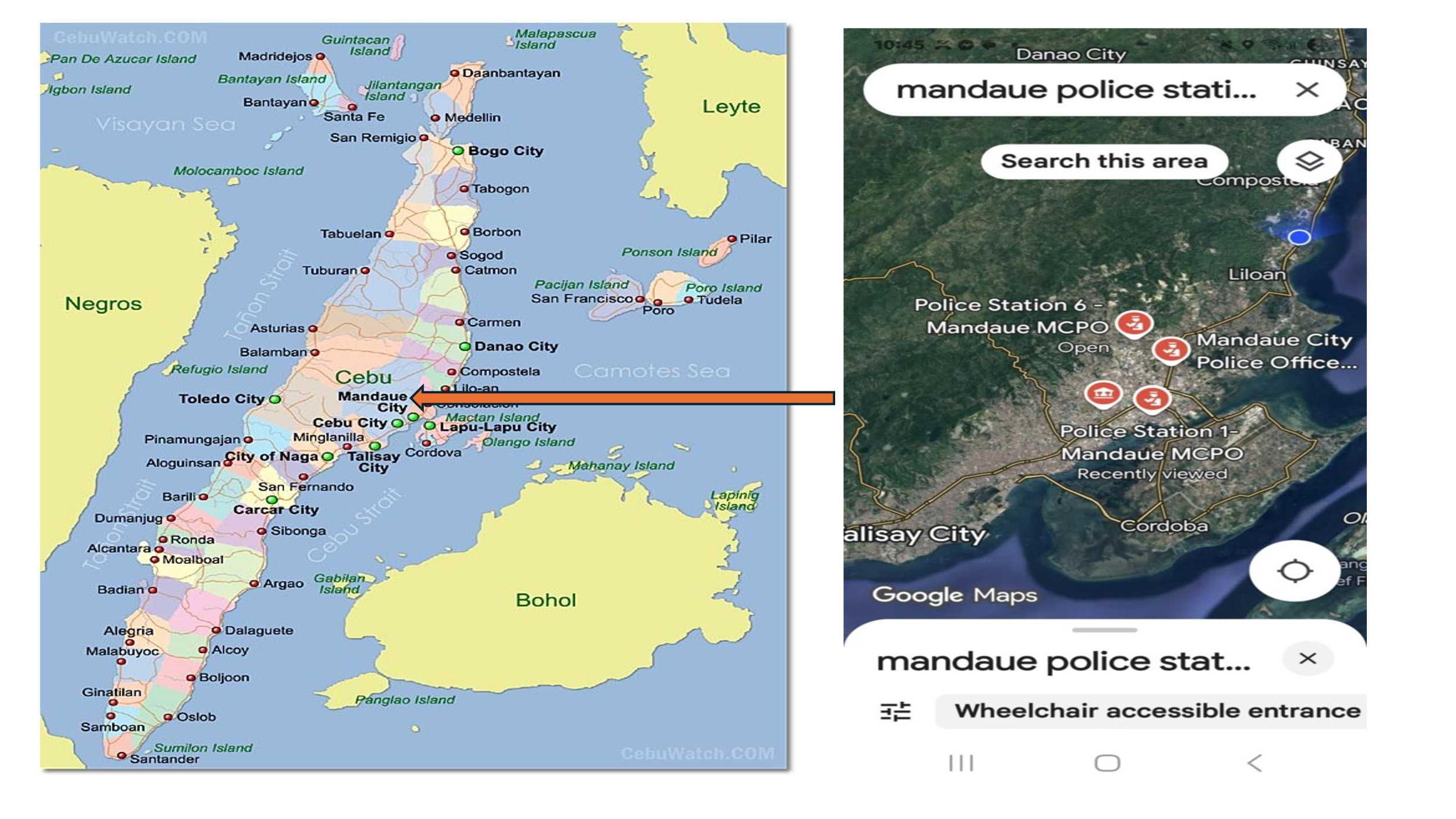
This study will be conducted within the highly urbanized city of Mandaue, Central Visayas, Philippines (Figure 3). Mandaue City serves as a crucial economic and industrial hub within Metro Cebu, characterized by its dense population, significant commercial and industrial zones, and a diverse socio-economic landscape. This dynamic environment presents unique challenges and opportunities for fostering effective police-community relations, making it an ideal locale for this research.
Mandaue City is strategically located in the heart of Cebu, serving as a gateway to both northern and southern Cebu. Home to a mix of long-term residents, transient workers, and various ethnic groups, Mandaue presents a microcosm of Philippine urban demographics. This diversity implies varied community needs, cultural nuances, and expectations from law enforcement, making the study's insights broadly applicable to other urban centers.
As an industrial and commercial center, Mandaue experiences significant daily movement of people and goods, which can impact crime patterns (e.g., property crimes, economic-related offenses) and the complexity of police operations. The presence of numerous business establishments also highlights the importance of police visibility and a sense of security for economic stability.
Like many rapidly urbanizing areas, Mandaue also grapples with the presence of informal settlements and economically vulnerable communities. Interactions between the police and these communities often require heightened sensitivity and a community-oriented approach to avoid exacerbating existing social tensions (Cordner & Scarborough, 2010). High population density and economic activity often lead to significant traffic challenges and various public order issues, requiring constant police presence and engagement, which directly influences public perception.
Mandaue City possesses well-established local government structures at the city and barangay levels, alongside a network of non-governmental organizations (NGOs) and people's organizations. These entities represent crucial partners for the Philippine National Police (PNP) in implementing community policing initiatives and building social capital (Putnam, 2000).
The relevance of Mandaue as a research environment stems from its representativeness of a typical highly urbanized Philippine setting, where the complexities of modern policing, balancing enforcement with community engagement are acutely felt. Understanding police-community dynamics here can provide insights scalable to other similar cities facing parallel challenges.
The Philippine National Police (PNP) in Mandaue City operates under the Mandaue City Police Office (MCPO), which oversees several police stations responsible for specific jurisdictions. This study will focus on three distinct stations within MCPO: Police Station 1, Police Station 3, and Police Station 6. The selection of these specific stations is strategic, aiming to capture a diverse range of police-community interaction contexts within the city.
Mandaue City Police Station 1 (MCPS-1). This can be located in the heart of Mandaue City near Bureau Fire Station and Mandaue City hospital. Typically covers the central commercial and administrative districts of the city. This station likely deals with a higher volume of commercial crimes, traffic management, and interactions with businesses and transient populations. The nature of policing in this area emphasizes rapid response and maintaining order in high-traffic zones, where public perception can be significantly shaped by efficiency and visible presence.
Mandaue City Police Station 3 (MCPS-3), located at Barangay Basak Mandaue City near Gaisano Grand Mall. Often situated in mixed residential and light industrial areas. This station's jurisdiction might involve a blend of traditional neighborhood policing challenges (e.g., domestic disputes, petty crimes) and issues related to industrial areas (e.g., labor disputes, security concerns for factories). The community interactions here could be more sustained and relationship-based compared to highly transient zones.
Mandaue City Police Station 6 (MCPS-6). Located at H. Abellana Street at Barangay Canduman, Mandaue City near Tarzan rubber factory, Jagobiao National High School, a wet market in the area and Ateneo de Cebu and Sacred Heart School which is approximately 1.48 and 1.50 kms away, respectively. May cover more suburban or residential barangays, potentially including areas with informal settlements or distinct community characteristics. Police-community relations in such areas might be heavily influenced by community organizing, localized problem-solving initiatives, and direct personal interactions between officers and residents. This station might highlight the importance of localized community policing efforts and the building of social networks at the barangay level.
The deliberate inclusion of these three stations ensures that the study captures a spectrum of operational realities and community engagement dynamics within an urban setting. By examining areas with different demographic profiles, crime patterns, and socio-economic characteristics, the research can identify how varying contexts influence trust and understanding between the police and the community. This comparative approach across stations within a single urban center will yield more robust and nuanced findings regarding the generalizability and context-specificity of strategies for strengthening police-community relations in Mandaue City. The insights gained from these specific stations will contribute to a holistic understanding of how the Mandaue City Police Office, as a whole, can better fulfill its mandate of service and protection by fostering stronger bridges of trust and understanding with its diverse populace (RA 8551, 1998; Tyler, 2006).
3.4Respondents
This research will gather empirical data from two distinct, yet interconnected, groups of respondents within Mandaue City; Philippine National Police (PNP) personnel from Police Stations 1, 3, and 6, and community representatives residing within the respective jurisdictions of these stations (Table 1). The inclusion of both perspectives is crucial for a holistic understanding of police-community relations, allowing for the examination of mutual perceptions, expectations, and challenges.
The police officer respondents will be comprised of uniformed personnel actively assigned to and performing duties within Mandaue City Police Station 1 (MCPS-1), Police Station 3 (MCPS-3), and Police Station 6 (MCPS-6) during the period of the study. This selection is critical to gaining insights into the operational realities, internal perspectives, and direct experiences of officers involved in community interactions.
While the community representatives will include adult residents (18 years old and above) who reside within the geographical jurisdictions covered by Mandaue City Police Stations 1, 3, and 6. This group will provide the crucial "community voice," reflecting public perceptions of trust, understanding, police legitimacy, and the impact of police actions on their daily lives.
The success of police-community relations fundamentally depends on the community's receptiveness and engagement. Understanding their lived experiences, perceptions of safety, fairness (procedural justice), willingness to cooperate, and areas of concern provides the external perspective essential for identifying gaps and effective strategies. The varying socio-economic and demographic profiles across the jurisdictions of the selected stations make it imperative to capture diverse community views.
| Police station | Police personnel | Community representatives | Total | % |
|---|---|---|---|---|
| Police Station 1 | 10 | 10 | 20 | 34.5 |
| Police Station 3 | 10 | 10 | 20 | 34.5 |
| Police Station 6 | 9 | 9 | 18 | 31.0 |
| Total | 29 | 29 | 58 | 100.0 |
3.5Instruments
A combination of well-designed research instruments to capture diverse perspectives and data types. These instruments will facilitate the collection of both qualitative (in-depth understanding, experiences, perceptions) and quantitative (measurable data, trends, statistics) information. Survey Questionnaires structured into different parts, is utilized in collecting data from police respondents. Part 1 consists of related information of respondents as to age and gender, civil status, highest educational attainment and relevant training and seminars attended. Part II, are the primary factors that contribute to or hinder the fostering of trust and understanding between the PNP and the community and Part III, are the specific initiatives or strategies that are currently being implemented by the PNP in Mandaue City to strengthen police-community relations, and how they are perceived by the community.
This data will serve descriptive purposes to profile the respondent pool and as crucial potential control variables in statistical analysis, helping to account for pre-existing differences between groups.
3.6Data gathering procedures
The Transmittal Letter will be submitted to the Station Commander of Mandaue City, Police Station 1,3 and 6 respectively, asking permission to conduct the study. This was needed by the researcher to get his consent and approval. After permission is granted, the researcher will request for the list of PNP personnel as respondents of this study. Adhering strictly to ethical guidelines, the data gathering process will follow a phased, systematic approach, crucial for the quasi-experimental design within the operational realities of the PNP in Central Visayas, specifically in Mandaue City.
Questionnaires will then be distributed to the identified Mandaue City Police offices. Data gathered from the questionnaires will be subjected, analyzed and categorized according to different category of the respondents.
3.7Statistical treatment of data
This part details the systematic procedures for converting raw data collected from the survey questionnaires into meaningful numerical values and the appropriate statistical techniques that will be employed to analyze these data.
The statistical treatment of data for this study involved a combination of both quantitative and qualitative data analysis methods. This mixed-methods approach ensures a comprehensive understanding, leveraging the strengths of both numerical measurement and in-depth narrative exploration.
The data collected in this study will be subjected to a series of statistical treatments to extract meaningful insights. These treatments are based on the objectives of the study and the nature of the data collected.
The average weighted mean or standard deviation will be utilized to measure the central tendency. These measures will provide insights into the average tendencies and variability of the respondents’ answers. For determining relationships between categorical variables, the Chi-square test will be utilized.
The aim is to rigorously examine the relationships between various constructs related to police-community relations, fostering trust, and understanding within Mandaue City. The statistical analyses are designed to directly address the quantitative aspects of the research questions outlined in the Statement of the Problem.
3.8Scoring procedures
In this study, a structured scoring procedure will be meticulously implemented to analyze the responses. The adapted- modified instrument on the roadmap for strengthened police- community relations was rated as follows:
- 5: 4.21–5.00, very well enforced (VWE): indicator was very well enforced
- 4: 3.41–4.20, well enforced (WE): indicator was well enforced
- 3: 2.61–3.40, enforced (E): indicator was enforced
- 2: 1.81–2.60, less enforced (LE): indicator was less enforced
- 1: 1.00–1.80, least enforced (LeE): indicator was least enforced
4Definition of terms
This section provides clear and concise definitions of key terminologies used throughout this research study. These definitions are provided to ensure a common understanding of the concepts within the context of this thesis, distinguishing between conceptual (theoretical) and operational (how measured in this study) meanings where appropriate.
4.1Building bridges
Conceptual. Refers to the overarching goal of establishing, reinforcing, and enhancing positive connections and collaborative relationships between distinct entities. In this study, it metaphorically represents the process of overcoming existing barriers and fostering stronger ties between the police and the community.
Operational. Evidenced by the measurable improvements in police-community relations, specifically in levels of trust, understanding, and willingness to cooperate, as indicated by survey responses and qualitative narratives from both police officers and community members in Mandaue City.
4.1.1Community
Conceptual. A group of people living in the same place or having a particular characteristic in common; a body of people generally having common interests and duties.
Operational. Refers specifically to the adult residents (18 years old and above) residing within the geographical jurisdictions covered by Mandaue City Police Stations 1, 3, and 6, who participate as survey respondents and qualitative interview/FGD participants.
4.1.2Community policing
Conceptual. A philosophy and organizational strategy that promotes a partnership between the police and the community to jointly address crime, social disorder, and fear of crime. It emphasizes proactive problem-solving and shared responsibility (Goldstein, 1979; Skolnick & Bayley, 1988).
Operational. Refers to the specific programs, initiatives, and daily practices implemented by the Mandaue City Police Office (MCPO) and its stations (MCPS-1, MCPS-3, MCPS-6) aimed at fostering collaboration, engagement, and problem-solving with the community. Its effectiveness is measured through respondent perceptions of these initiatives.
4.1.3Community representatives
Conceptual. Individuals who represent the perspectives, needs, and experiences of the general public within a specific locale.
Operational. Refers to the Mandaue City residents selected through stratified random sampling (quantitative) and purposive sampling (qualitative) who participate in the study's surveys, in-depth interviews, or focus group discussions. This includes ordinary citizens, barangay officials, business owners, and members of local organizations.
4.1.4Conflict theory
Conceptual. A sociological perspective positing that society is in a state of perpetual conflict due to competition for limited resources and power imbalances, often leading to adversarial relationships between different social groups and institutions (Marx, 1867; Dahrendorf, 1959).
Operational. A theoretical lens used in this study to acknowledge potential underlying tensions, grievances, and structural issues that may contribute to strained police-community relations in Mandaue City, serving as a contextual backdrop for understanding challenges in "building bridges."
4.1.5Legitimacy theory (police legitimacy)
Conceptual. The belief among the public that police authorities are morally proper, just, and entitled to exercise their power, leading to voluntary deference and cooperation rather than compliance driven by fear (Tyler, 1990; 2006).
Operational. Measured by survey items assessing respondents' trust in the police, confidence in police motives, willingness to obey directives, and belief in the lawfulness and morality of police actions within Mandaue City.
4.1.6Mixed-methods research design
Conceptual. A research approach that combines elements of both quantitative and qualitative research methods in a single study to gain a more comprehensive understanding of a research problem (Creswell & Creswell, 2018).
Operational. The research design employed in this study, utilizing a quantitative survey followed by qualitative in-depth interviews and focus group discussions, to sequentially explore and explain police-community relations in Mandaue City.
4.1.7Philippine National Police (PNP)
Conceptual. The national uniformed armed civilian national police force of the Philippines, responsible for law enforcement, maintaining peace and order, preventing and investigating crimes, and enforcing laws and ordinances.
Operational. The specific law enforcement institution whose personnel (police officers) in Mandaue City (MCPO and its stations) are subjects of this study, and whose relations with the community are being investigated.
4.1.8Police officers / police personnel
Conceptual. Individuals formally authorized by the state to exercise police powers, including arrest, detention, and the use of force, for the purpose of law enforcement and public order.
Operational. Uniformed members of the Philippine National Police assigned to Mandaue City Police Stations 1, 3, and 6, who serve as survey respondents and key informants for qualitative interviews.
4.1.9Police-community relations (PCR)
Conceptual. The mutual interactions, attitudes, and perceptions between law enforcement agencies and the diverse communities they serve. It encompasses trust, understanding, cooperation, and the overall quality of their partnership.
Operational. The central phenomenon being investigated, measured by the levels of trust, understanding, perceived legitimacy, and engagement in community policing initiatives between the PNP and residents within the designated areas of Mandaue City.
4.1.10Procedural justice
Conceptual. The fairness of the processes by which decisions are made and actions are taken by authorities, irrespective of the outcome. Its four key tenets are voice, neutrality, respectful treatment, and trustworthiness (Tyler, 1990; Tyler & Huo, 2000).
Operational. Assessed through survey items evaluating community members' and police officers' perceptions of fairness, impartiality, respect, and benevolent intentions exhibited by police personnel during interactions in Mandaue City.
4.1.11Social capital
Conceptual. The networks of relationships among people who live and work in a particular society, enabling that society to function effectively. It includes components of trust, reciprocity, and social networks (Putnam, 2000).
Operational. Measured by survey items assessing the level of generalized trust among community members, their willingness for collective action, and the density of community networks within the barangays covered by Mandaue City Police Stations 1, 3, and 6.
4.1.12Social contract theory
Conceptual. A political philosophy that asserts that individuals implicitly or explicitly agree to surrender certain freedoms to a government in exchange for the protection of their remaining rights and the maintenance of social order (Hobbes, 1651; Locke, 1689).
Operational. The foundational theoretical lens justifying the existence and role of the police, where a breakdown in police-community relations is seen as a weakening of this implicit contract, which the study seeks to reinforce.
4.1.13Strengthening
Conceptual. The process of making something more robust, effective, or resilient. In this context, it implies an improvement from an existing state.
Operational. The expected positive change in the quality of police-community relations, indicated by increased levels of trust, understanding, perceived legitimacy, and reported effectiveness of community policing initiatives following the potential implementation of evidence-based recommendations derived from this study.
4.1.14Trust
Conceptual. A firm belief in the reliability, truth, ability, or strength of someone or something. In police-community relations, it encompasses confidence in police honesty, competence, and benevolent intentions (Tyler, 2006).
Operational. Measured quantitatively through composite scores from Likert scale items in the survey, assessing the extent to which police officers and community members have confidence in the integrity and intentions of the other group. Qualitatively, it is explored through narratives describing experiences that foster or erode trust.
4.1.15Understanding
Conceptual. Comprehension or knowledge of a particular subject or situation; the ability to grasp the meaning of something. In this context, it refers to mutual clarity regarding roles, expectations, challenges, and perspectives between the police and the community.
Operational. Measured quantitatively through composite scores from Likert scale items assessing the degree to which both police and community members perceive a mutual understanding of their respective duties, challenges, and needs. Qualitatively, it is explored through discussions about common grounds, misunderstandings […]
5Presentation, analysis and interpretation of data
This section unpacks the raw data from surveys and interviews, analyzing how trust-building strategies-like joint patrols and open forums-bridge gaps in police-community relations. The interpretation ties findings back to fostering mutual understanding and resilience.
This section delineates the data gathered based on the respondents related information as to: personal profile and professional profile.
5.1Profile of the respondent groups
5.1.1Age and gender
Age and gender play key roles in shaping trust dynamics in this study. Younger respondents, especially teens and early twenties, often view police as less approachable due to high profile conflict incidents, while older community members lean on traditional respect for authority. For gender, female respondents from both PNP and community side, reports higher trust when officers show empathy during interactions, like domestic calls. Men, on the other hand, prioritize fairness in enforcement. PNP personnel note age gaps can create communication barriers, with younger officers struggling to connect with elder residents.
| Age (years) | PNP personnel | Community representatives | Total | Frequency | % | |||
|---|---|---|---|---|---|---|---|---|
| Male | Female | Male | Female | M | F | |||
| 51 and above | 2 | 1 | 1 | 1 | 3 | 2 | 5 | 8.62 |
| 45–50 | 3 | 2 | 2 | 2 | 5 | 4 | 9 | 15.52 |
| 40–44 | 2 | 2 | 4 | 2 | 6 | 4 | 10 | 17.24 |
| 35–39 | 3 | 4 | 3 | 3 | 6 | 7 | 13 | 22.41 |
| 30–34 | 3 | 3 | 4 | 2 | 7 | 5 | 12 | 20.69 |
| 20–29 | 2 | 2 | 3 | 2 | 5 | 4 | 9 | 15.52 |
| Total | 15 | 14 | 17 | 12 | 32 | 26 | 58 | 100.00 |
Table 2 presented the PNP with 29 respondents spread evenly on these age range, 20-29 years of age had two males, two females, 30-34 years had 3 each, 35-39 years with 3 males and four females, 40-44 years had two each, 45-50 on the other hand had three males and two females and lastly, 51 above had two males and one female. Percentages wise, males edge out at 52 while females are at 48. There were 29 community representatives showing age range of 20-29 years having three males and two females,30-34 years had four males and two females, 35-39 years with three each, 40-44 years with four males, two females, 45-50 years had two each and for 51 above, one each. Males hit 62 percent overall, females 38.
PNP's even split across ages means diverse perspectives on trust-building, while community males dominate younger brackets, possibly pushing bolder demands for accountability. Females underrepresented in community reps might limit voices on empathy driven interactions. Studies like Tyler's procedural justice work (2011) say age matters less than fairness, but locally, Aspiras (2019) notes Philippine women value compassionate policing more, so that slight female boost in PNP mid-thirties could strengthen relations if leveraged. Overall, tailor strategies that younger male reps need transparency while older females might prefer community forums.
5.1.2Civil status
Civil status explores how being single, married, widowed or partnered influences trust in police. Married respondents often cite family safety as top concern, singles focus more on fairness.
| Civil status | PNP personnel | Community representatives | ||
|---|---|---|---|---|
| f | % | f | % | |
| Single | 5 | 17.24 | 3 | 10.34 |
| Married | 23 | 79.31 | 24 | 82.76 |
| Widowed/widower | 1 | 3.45 | 2 | 6.90 |
| Total | 29 | 100.00 | 29 | 100.00 |
Table 3 showed, that 29 PNP personnel with a total of 79 percent are married, seventeen percent single, four percent widowed. On the community side, 82 percent are married, ten percent are single, seven percent are widowed, those two widowers likely speak from grief or loss, maybe pushing for gentler crisis. Internationally, Mayo's '72 classic shows married folks judge police by how they protect kids. Married reps for both groups dominate, so trust hinges on visible family first policing. Locally, Reyes (2022) in Quezon City found widowed seniors distrust uniforms until they see bedside manners. Widowed representation signals room to train empathy, not just numbers.
5.1.3Highest educational attainment
Highest educational attainment, relates whether college grads build thicker trust with police, or if street smart dropouts see right through the spin, setting up how knowledge shapes what people expect from officers.
| Highest educational attainment | PNP personnel | Community representatives | ||
|---|---|---|---|---|
| f | % | f | % | |
| Doctorate Degree | 1 | 3.45 | 2 | 6.90 |
| Master’s with Doctorate Degree | 3 | 10.34 | 5 | 17.24 |
| Master’s Degree | 3 | 10.34 | 5 | 17.24 |
| Bachelor’s Degree | 22 | 75.86 | 14 | 48.28 |
| High School Graduate | 0 | 0 | 3 | 10.34 |
| Total | 29 | 100.00 | 29 | 100.00 |
Table 4 portrayed the PNP team leans being educated with 29 strong, 76 percent bachelor's, ten percent master's, ten percent pursuing masters-plus-doctorate, just four percent with a PhD. No high-school-only, which screams 'professional corps', they're trained to talk rights, not bark orders. Community reps match closely at 48 percent bachelor's, thirty-one percent master's-level (five with doctorate in progress), seven percent full PhDs, ten percent high-school grads. Percentages show both sides prize credentials, but those PNP post-grads might overthink tactics and with three high-school reps. Internationally, Sunshine and Tyler (2003) say education predicts 'voice' educated folks, grill cops on due process. Locally, Dizon's 2021 NCR study found PhDs trust protocols less than street vets do, with the ironic twist on the lone PNP with doctorate degree could be the skeptic in the precinct.
5.1.4Trainings and seminars attended
Trainings and seminars are the real wildcard. Officers who've sat through community relations workshops actually listen better, while reps who've done crisis de-escalation classes spot challenges from a mile away. This section unpacks which courses mattered, how fresh they were, and whether they turned cynics into partners.
| Training/seminar | PNP personnel (f) | Community representatives (f) | Total |
|---|---|---|---|
| Community Mobilization Seminar | 25 | 15 | 35 |
| Police Community Academy for youth and officers | 24 | 12 | 36 |
| Cebu's Leadership and Work-Life Balance seminars | 27 | 25 | 52 |
| PCR Compendium Policies Workshop for transparency | 22 | 27 | 49 |
Table 5 showed the link of these seminars to strengthening police-community bonds by building trust and mutual understandings. The Community Mobilization Seminar is basically about getting folks in neighborhoods fired up to partner with cops-think door-to-door outreach, local meetings, and training residents to spot and solve problems together. From the police guides, this directly boosts cooperation, cutting crime and making everyone feel safer, which aligns perfectly with fostering that bridge between forces and people. On Police Community Academy for Youth and Officers is where trust between kids and officers hang out through joint programs that emphasize empathy and shared goals. It prevents misunderstandings, especially with younger crowds who might otherwise see police as outsiders, turning potential rivals into allies. Cebu's Leadership and Work-Life Balance Seminars sound practical in which they train officers to lead better without burning out, so they're less stressed and more approachable-happy cops make for friendlier interactions, that balance keeps relations human, not just official, supporting the study's focus on genuine understanding. Finally, the PCR Compendium Policies Workshop, PCR's Police Community Relations dives into rules for transparency, like clear guidelines for outreach and handling complaints. It's all about accountability, so communities trust the system isn't hiding stuff, which rebuilds faith eroded by past issues. Overall, these aren't random, they're linked steps to mobilize, educate youth, steady your team, and lock in transparent policies. Each one chips away at barriers, proving the study's point that trust isn't magic it's built through real, everyday efforts like these.
5.2Perception of the respondent groups of the implementation of the strategies of the PNP community-police relationship
5.2.1Police practices
| Police practices | Police personnel | Community representatives | AWM | DE |
|---|---|---|---|---|
| Fairness • Police officers treat all members of the community fairly, regardless of their background • I believe police apply laws and rules consistently to everyone |
3.00 | 2.90 | 2.95 | E |
| Transparency • The police are transparent about their operations and decision-making processes • I understand how to file a complaint or provide feedback about police conduct |
2.95 | 2.85 | 2.90 | E |
| Respect • Police officers treat community members with respect • Police officers listen attentively to community concerns |
2.85 | 2.80 | 2.83 | E |
| Responsiveness • The police respond promptly to calls for assistance in my community • Police officers effectively address community problems and concerns |
3.10 | 3.00 | 3.05 | E |
| Professionalism • Police officers in my community are well-trained and competent • Police officers maintain a professional demeanor in their interactions |
3.25 | 2.80 | 3.03 | E |
| Engagement • The police actively engage with the community through various programs or initiatives • I have opportunities to interact positively with police officers in my community |
3.15 | 2.95 | 3.05 | E |
| Total | 3.08 | 2.92 | 2.97 | E |
Note: AWM = average weighted mean; DE = descriptive equivalent. Legend: 4.21–5.00 very well enforced (VWE); 3.41–4.20 well enforced (WE); 2.61–3.40 enforced (E); 1.81–2.60 less enforced (LE); 1.00–1.80 least enforced (LeE).
Table 6 showed the means hover between 2.83 and 3.05 all landing in the enforced zone, consistently decent but not stellar. Fairness at 2.95 means respondents see cops treating folks evenly, no major bias vibes, but not exactly a gold star either, like they'll step in fair, yet room for tighter rules. Transparency's 2.90 which is saying openness, maybe reports or meetings happen, but people still whisper about cover-ups, so trust's is building slow. Respect at 2.83 edges lowest which portrayed like officers are polite enough on surface, but maybe brusque during stops or not super empathetic, hinting communities want more warmth. Responsiveness and professionalism both around 3.05 show solid follow-through-call a tip line, they show up, and uniforms stay sharp, no scandals flying. Engagement's same ballpark, meaning outreach like patrols or forums exists, but it's not flooding every block.
Overall, police practices get an enforced thumbs-up-baseline, just not very well yet. To increase trust like, they'd need crisper respect drills and louder transparency, maybe live-stream meetings or youth feedback sessions.
5.2.2Cooperation and mutualization engagement in law, rules and procedure enforcement
| Cooperation and mutualization of the PNP and community | Police personnel | Community representatives | AWM | DE |
|---|---|---|---|---|
| Trust in law enforcement • I trust the police to enforce laws and maintain order effectively • I believe that cooperating with the police will lead to positive outcomes for my community |
3.10 | 2.80 | 2.95 | E |
| Perceived effectiveness of cooperation • Community cooperation significantly helps in solving crimes in our area • I believe that my participation in community safety initiatives can make a difference |
2.90 | 2.90 | 2.90 | E |
| Awareness of laws/procedures • I am generally aware of the laws and local ordinances that police enforce • I understand the procedures for reporting suspicious activities or crimes to the police |
2.85 | 2.80 | 2.83 | E |
| Proactive engagement • I am willing to participate in community watch programs or similar initiatives • I would attend community meetings organized by the police to discuss safety concerns |
3.05 | 3.05 | 3.05 | E |
| Reporting crime • I would report a crime or suspicious activity to the police even if it doesn't directly affect me • I feel safe reporting information to the police without fear of retaliation |
3.25 | 2.80 | 3.03 | E |
| Total | 3.08 | 2.92 | 2.95 | E |
Note: AWM = average weighted mean; DE = descriptive equivalent. Legend: 4.21–5.00 very well enforced (VWE); 3.41–4.20 well enforced (WE); 2.61–3.40 enforced (E); 1.81–2.60 less enforced (LE); 1.00–1.80 least enforced (LeE).
Table 7 showed willingness to cooperate in which all five indicators sit right in the enforced band. Trust clocks 2.95, which means people aren't hostile, but they're not rushing to trust yet. Effectiveness is at 2.90, people see some payoff, maybe arrests happen but wonder if their tip really mattered. Awareness of laws, 2.83, which is the lowest, seems like pamphlets exist but nobody reads them. Proactive engagement and crime reporting both at 3.05 and 3.03, they'll call the police and they show up because its duty. Proactive is a little bit stronger, people engage if it's easy, like neighborhood watch apps. To boost, PNP should lean into local vibes-fiestas with officers, social media shoutouts, fast follow-ups. Make trust feel like family, not forms.
5.2.3Role of social capital networks
| Role of social capital networks | Police personnel | Community representatives | AWM | DE |
|---|---|---|---|---|
| Community cohesion • People in my community generally trust each other • There is a strong sense of community spirit and belonging here |
3.05 | 2.95 | 2.95 | E |
| Shared norms/values • Most people in my community share similar values regarding safety and order • There are clear informal rules of conduct that help maintain order in our community |
2.90 | 2.80 | 2.90 | E |
| Bridging social capital (connections beyond immediate group) • Community organizations or leaders often connect with the police to discuss local issues • There are individuals or groups in our community who act as intermediaries between residents and the police |
2.85 | 2.80 | 2.83 | E |
| Collective action • People in my community are willing to work together to address crime or safety problems • Our community has successfully organized efforts to improve local safety in the past |
3.10 | 3.00 | 3.05 | E |
| Total | 3.08 | 2.92 | 2.93 | E |
Note: AWM = average weighted mean; DE = descriptive equivalent. Legend: 4.21–5.00 very well enforced (VWE); 3.41–4.20 well enforced (WE); 2.61–3.40 enforced (E); 1.81–2.60 less enforced (LE); 1.00–1.80 least enforced (LeE).
Table 8 revealed social capital networks at 'enforced' levels-functional, but fragile. Community cohesion hits 2.95, people greet each other, swap stories but won't risk reputations reporting crime. Shared norms and values dip to 2.90, basic 'don't steal' stuff holds, no deeper ethics binding officer and civilian. Bridging capital's weakest at 2.83, that's outsider-insider links like jeepney chats or school fairs, yet no real police-community handshakes and silos remain. Collective action tops at 3.05: they can march for flooding, not for trust-building drills.
5.2.4Summary of the perception of the respondent groups
| Indicator | AWM | DE |
|---|---|---|
| Police practices related to procedural justice | 2.97 | E |
| Willingness of the community to cooperate and engage in law, rules and procedure enforcement | 2.95 | E |
| Role of social capital networks in facilitating police-community relations | 2.93 | E |
| Overall | 2.95 | E |
Note: AWM = average weighted mean; DE = descriptive equivalent. Legend: 4.21–5.00 very well enforced (VWE); 3.41–4.20 well enforced (WE); 2.61–3.40 enforced (E); 1.81–2.60 less enforced (LE); 1.00–1.80 least enforced (LeE).
Table 9 presented the summary table for the Perception of the Respondent Groups on the Implementation of the Strategies of the PNP Community Police Relationship with an average weighted mean of 2.95 (E). Procedural justice as an indicator, hits 2.97; in literature like Tyler's 'Why People Obey the Law,' legitimacy comes when rules feel fair, not scripted, here PNP's got the script, missing the heartbeat. Respondents see effort, not empathy, so trust caps at moderate. Second, community willingness at 2.95 aligns with Putnam's 'Bowling Alone' idea, social participation drives cooperation, but Philippine surveys from DILG show only 30 percent join neighborhood watch if police aren't visibly leading, the data says they're following, barely, while social capital at 2.93, Bourdieu calls it 'invisible glue'-this group's weak, meaning cohesion exists in fiestas, not flashlights. Overall mean at 2.95 echoes studies from the Philippine National Police Research, where similar regions score 'functional' but never 'trusted' the relation is clear: strategy implementation stalls at procedural, never reaches relational.
6Summary of findings, conclusion and recommendation
This part presents the distilled essence of Building Bridges: Strengthening Police-Community Relations by Fostering Trust and Understanding. The findings from respondent perceptions, conclusions and finally, the recommendations of the study that will translate data into Philippine policy.
6.1Summary of findings
This section outlines the empirical pulse of this study, perceptions gathered from officers and citizens alike, distilled into weighted averages that speak louder than quotes.
The findings reveal a profile of respondents predominantly 35-44, are married, with tertiary education-who bring lived realism to their ratings. Trainings (Table 5) have a strongest result in mobilization and youth academies, weakest in work life balance, hinting that emotional stamina isn't drilled, so officers project fatigue, not fellowship.
Perception tables 6 through 8 converge with procedural justice sits at 2.97, community willingness 2.95, social capital 2.93 with a rating of all 'enforced,' meaning policies run like engines without oil. Fairness and responsiveness scraped, respect and bridging ties fall below. In procedural justice theory, it signals legitimacy exists on paper and laws were followed, arrests were made but legitimacy of heart fails when pakikisama is missing. Social capital, per Putnam and Bourdieu, should glue the two sides. The 9 point summary locks it, grand mean of 2.95, no indicator breaches 'well-enforced'.
The bridge stands, but cables sag and strategies are applied, not absorbed but PNP has the frame and community hasn't bought the view. Scaling youth academies into every barangay calendar, embed transparency workshops in fiestas, and let social-capital maps decide best routes.
6.2Conclusion
The Conclusion bridges the gap between what was measured and what matters, interpreting those mid-range scores as signs that trust isn't absent, just asleep. Drawing from procedural justice and Filipino concepts like pakikisama, this section explains why 'enforced' strategies still feel cold, and why true understanding demands more than policy, it certainly demands presence.
6.3Recommendation
Building the real bridges promised in Strengthening Police-Community Relations by Fostering Trust and Understanding, integrating youth academies into barangay calendars, live-stream transparency sessions and seed social-capital micro-projects.
Based on the findings and conclusions arrived in this study, it is hereby recommended that the Output of the study Roadmap for Strengthened Police- Community Relations, be implemented.
References
- [1]Bittner E (1970). The functions of the police in modern society. Chevy Chase, MD: National Institute of Mental Health.
- [2]Cordner GW, Scarborough KE (2010). Policing: An introduction to concepts and practice (6th ed.). Anderson Publishing.
- [3]Dahrendorf R (1959). Class and class conflict in industrial society. Stanford University Press.
- [4]Goldstein H (1979). Improving policing: A problem-oriented approach. Crime & Delinquency, 25(2), 236–258. https://doi.org/10.1177/001112877902500207
- [5]Hobbes T (1651). Leviathan.
- [6]Locke J (1689). Two treatises of government.
- [7]Marx K (1867). Das Kapital.
- [8]Philippines (1989). Republic Act No. 6713: Code of Conduct and Ethical Standards for Public Officials and Employees.
- [9]Philippines (1990). Republic Act No. 6975: Department of the Interior and Local Government Act of 1990.
- [10]Philippines (1991). Republic Act No. 7160: Local Government Code of the Philippines.
- [11]Philippines (1998). Republic Act No. 8551: Philippine National Police Reform and Reorganization Act of 1998.
- [12]Putnam RD (1995). Bowling alone: America’s declining social capital. Journal of Democracy, 6(1), 65–78. https://doi.org/10.1353/jod.1995.0002
- [13]Putnam RD (2000). Bowling alone: The collapse and revival of American community. Simon & Schuster.
- [14]Scott MS (2000). Problem-oriented policing: Reflections on the first 20 years. U.S. Department of Justice, Office of Justice Programs, Community Oriented Policing Services.
- [15]Skolnick JH, Bayley DH (1988). Community policing: Myth or reality? Praeger.
- [16]Turk AT (1969). Criminality and legal order. Rand McNally.
- [17]Tyler TR (1990). Why people obey the law. Yale University Press.
- [18]Tyler TR (2006). Why people cooperate: The role of social motivations. Princeton University Press.
- [19]Tyler TR, Huo YJ (2000). Trust in the law: Encouraging public cooperation with the police and courts. Russell Sage Foundation.
- [20]Tyler TR, Jackson J (2014). Popular legitimacy and the exercise of legal authority: Motivating compliance, cooperation, and engagement. Psychology, Public Policy, and Law, 20(1), 78–95. https://doi.org/10.1037/a0034514
- [21]United Nations (1948). Universal Declaration of Human Rights.
- [22]United Nations (1966). International Covenant on Civil and Political Rights.
- [23]United Nations (1979). Code of Conduct for Law Enforcement Officials.
- [24]United Nations (1984). Convention against Torture and Other Cruel, Inhuman or Degrading Treatment or Punishment.