Green Computing
Impact of Technology on the Environment: A Secondary-Research Study for MCA
Master of Computer Applications, Zeal Institute of Business Administration, Computer Application & Research, Pune, India
Published October 2026
Abstract
Technology has become part of almost every daily task, and the way it interacts with the natural world is tangled. Satellites, renewable-energy equipment and software can all be used to safeguard natural habitats. Yet building and running them takes heavy electricity, draws on finite mineral deposits and, once devices wear out, leaves a growing pile of discarded electronics. The question taken up here is what present-day technology does to the environment, assessed against the yardstick of lasting sustainability instead of immediate pollution figures. Gains and losses are set side by side. Electronic waste and the electricity consumed by digital infrastructure receive closer attention, mostly through Indian examples, and the paper ends with practical suggestions for keeping the damage down. The method is a descriptive, exploratory reading of existing literature. The review leans on five key texts, namely two scholarly journal articles, a pair of reports by global organisations and one regulation of the Indian government, published between 2021 and 2025. Nothing was surveyed and nothing was tested in an experiment. Four findings stand out. Discarded electronics are accumulating far faster than formal recycling can absorb them. Electricity consumption is being pushed upward by AI workloads and the data centres that host them. Studies of the ICT sector’s carbon emissions reach quite different totals. Machine learning and related tools, on the other hand, can help other industries emit less. Overall, technology has no fixed verdict attached to it. Whether it ends up helping or hurting the planet is settled by what people decide when they design a product, manufacture it, supply its power, use it every day, get rid of it and write the rules around it.
Keywords: artificial intelligence; carbon emissions; e-waste; green computing; sustainability
1Introduction
Here, the word technology covers the machines, tools and digital systems people develop to deal with practical problems. Nowadays that mostly means computers, mobile phones, the internet, cloud platforms, sensors and AI, plus the electricity networks and factories that support them. Paying bills, attending classes, buying groceries, applying for official documents and streaming entertainment can all be done on a screen today. Indian users have joined this shift in very large numbers, helped along by the Digital India programme and the quick uptake of mobile payment apps.
The benefits are obvious: time is saved, information travels further and work gets done faster. The environmental picture, however, is mixed. Technology helps scientists follow climate change, helps engineers build clean-energy systems and helps farmers use water and fertiliser sparingly [4]. But every gadget also has a material life story. Its metals are mined, its parts are assembled in factories, it draws electricity whenever it is switched on, and it ends up as waste when it is discarded. Because a digital service feels weightless, it is easy to assume it costs the planet little, and the evidence says otherwise [2].
Three trends explain why the topic needs attention now. Connected devices keep multiplying, and so does demand for heavy services such as video streaming and AI. Meeting climate targets means cutting greenhouse-gas output sharply in a few years. India, meanwhile, is expanding as a digital market at great speed and is also among the countries that generate the most electronic waste [1]. Sustainable technology tries to reduce these pressures through better design, cleaner energy sources and recycling, and that is the reason it merits a closer look.
Research problem. Fast-growing technology helps the environment in some ways and harms it in others, and how to balance these effects is still an open question. The study therefore looks at two connected matters: how modern technology bears on sustainability, and what could be done to widen its benefits while narrowing its harms.
2Problem statement
Technology tends to be celebrated as progress, but it also imposes costs that ordinary users rarely notice. Three problem areas stand out in the existing research:
- Electronic waste. the volume of discarded electronics is rising much faster than the volume that is recorded as recycled anywhere in the world [1].
- Energy and emissions. data centres, networks and AI systems need a constant power supply [3], and the information and communication technology (ICT) sector produces a noticeable portion of greenhouse gases [2].
- Governance and measurement gaps. figures for the digital footprint are far from consistent [2], and the positive side of technology materialises only with solid policy behind it, such as the rule that makes manufacturers responsible for the e-waste they create (extended producer responsibility, EPR) [5].
Put simply, a technology intended to serve sustainability can end up adding to environmental damage if it is poorly planned and lacks sensible policy direction.
3Aim of the study
The aim is to use the existing body of research to understand how modern technology affects the environment, and to show how its use could be pointed toward more sustainable outcomes.
4Research objectives
- 1. To document the environmental benefits that technology is able to deliver.
- 2. To study the environmental damage linked to technological progress, with special attention to e-waste in India.
- 3. To evaluate how much electricity and carbon digital technologies, including AI, account for.
- 4. To recommend practical actions for governments, companies, institutions and individual users that would lessen technology’s environmental footprint.
5Research questions
- RQ1 (Objective 1). In what ways does technology help to protect or restore the environment?
- RQ2 (Objective 2). Which environmental harms does technology cause, and how severe is the e-waste problem in India and globally?
- RQ3 (Objective 3). What is the energy and carbon cost of digital technologies, and what makes it so difficult to pin down?
- RQ4 (Objective 4). Which steps can governments, businesses, organisations and individuals take to limit these effects?
6Literature review
6.1Electronic waste
For worldwide e-waste statistics, the principal reference is the 2024 edition of the Global E-waste Monitor [1]. It tracks the quantity generated, the proportion that enters formal collection and recycling, and the expected trend through 2030. India’s answer to the problem is the 2022 e-waste regulation [5], built on the principle of Extended Producer Responsibility (EPR). Producers are assigned recycling targets, and compliance is demonstrated by means of certificates.
6.2Carbon footprint of digital technology
Freitag et al. [2] examined a series of earlier estimates of ICT emissions and observed that they disagree because each relies on its own methods and assumptions. Their assessment places the sector between roughly 1.8% and 2.8% of worldwide greenhouse-gas emissions around the year 2020, and they urge more uniform reporting. All the studies accept that the ICT footprint is considerable; what they dispute is its current size and its likely growth.
6.3Energy demand of data centres and AI
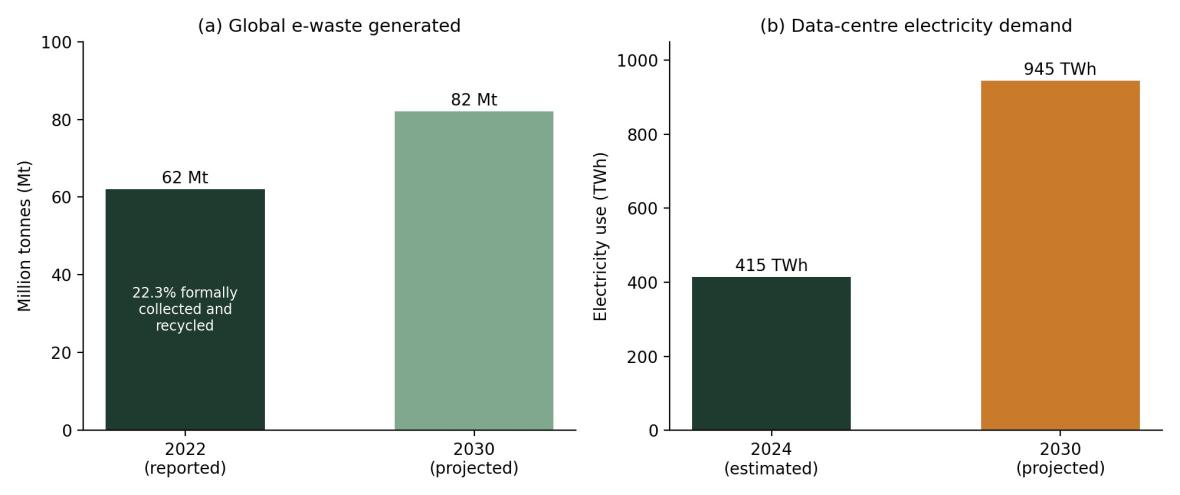
The International Energy Agency [3] calculates that data centres used about 415 TWh of electricity in 2024 and expects roughly 945 TWh by 2030, a rise in which AI plays a leading part. When demand grows faster than efficiency improves, better efficiency alone may fall short.
6.4Machine learning for sustainability
Rolnick et al. [4] outline where machine learning can lower emissions: power systems, transport, buildings, farming, and the observation of land and forests. They stress that the tools produce results only when supported by good policy and sensible decisions. Taken together, [3] and [4] reveal AI’s two faces, since it can reduce emissions in other fields while increasing its own demand for power.
7Research gap
Existing work usually concentrates on a single side of the issue, either the gains (AI applied to climate problems, for instance) or the costs (e-waste, or the power used by data centres). Estimates of ICT emissions are inconsistent [2], and there are few concise papers that a student can follow which bring together benefits, harms, e-waste and policy. Papers that tie worldwide evidence to Indian examples are rarer still. The present study attempts to bridge this gap by combining findings from different areas in one balanced framework, without claiming to offer new measurements.
8Research methodology
Design. This is a descriptive, exploratory study that draws solely on secondary research.
Sources. Five principal sources were consulted: the ITU and UNITAR e-waste report [1], two peer-reviewed journal articles [2], [4], the International Energy Agency report [3] and an Indian government regulation [5].
Selection. The sources were chosen for three reasons: they come from established publishers or institutions, their content can be verified, and they address technology and the environment directly. Newer publications, dated 2021 to 2025, were given priority.
Analysis. The material was organised under themes (benefits, harms, e-waste, energy and carbon, and remedies), compared between sources, and then condensed into tables and figures. In method, this is a qualitative thematic synthesis.
Scope and limitations. Global trends form the scope, with India supplying examples. Because no primary data were collected and no statistical testing was done, the conclusions can be no more reliable or up to date than the published material they build on.
9Positive impact of technology on the environment
According to [4], machine learning and other digital technologies support the environment in several fields:
- Smart grids and renewables. predicting how much solar and wind power will be produced, and matching supply to demand more precisely.
- Buildings and transport. adjusting heating, cooling and delivery routes so that less energy is wasted.
- Precision farming. readings from sensors and satellites let farmers apply water, fertiliser and pesticide only where a crop actually needs them.
- Monitoring and remote sensing. forests, air quality, oceans and floods can be observed from orbit or by ground sensors, which gives decision-makers solid evidence.
- Digital services. online forms, e-governance and digital payments can reduce paper use and journeys, although the saving must be compared with the energy used by the devices and data centres involved [2].
These gains are real but not guaranteed. Whether they are significant depends on whether the savings exceed the footprint of the digital tools that deliver them [2].
10Negative impact of technology on the environment
Electronic waste. Discarded devices form one of the quickest-growing categories of waste in the world [1]; it is discussed in detail in the section on the impact of e-waste.
Energy and carbon. A measurable slice of global emissions comes from the ICT sector [2], and electricity use in data centres is projected to rise steeply as AI spreads [3].
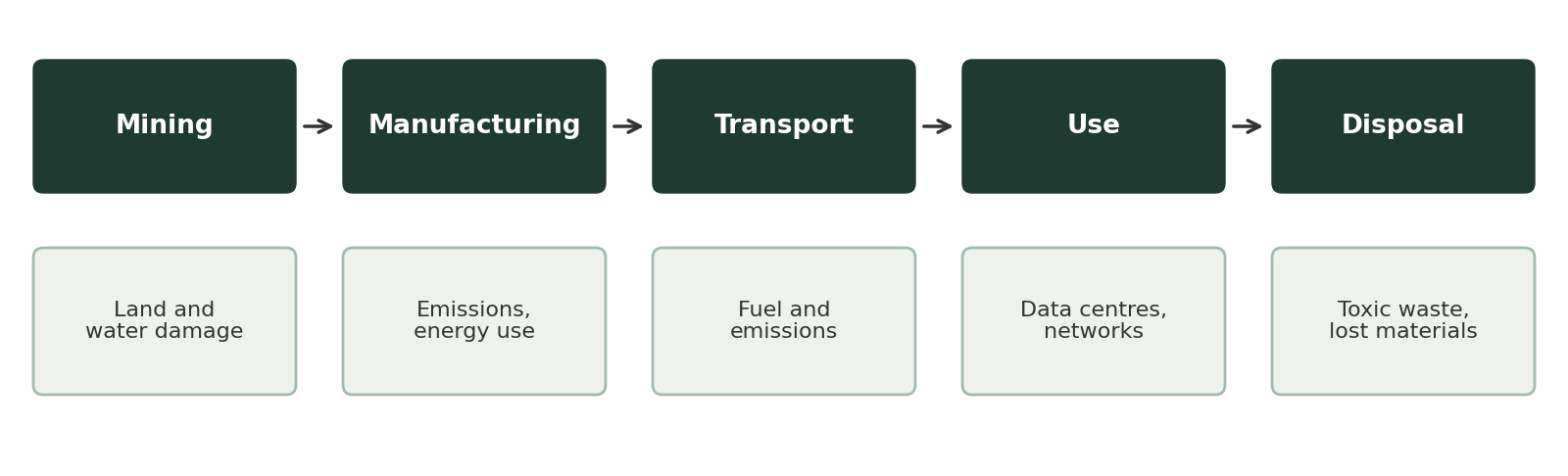
Mining and manufacturing. Phones, batteries and clean-energy equipment all depend on metals and minerals. Extracting them, producing the equipment and transporting it damage land and water and release emissions that the end user seldom sees. Looking only at the electricity consumed while a device is running therefore leaves out much of the story (Figure 1).
Pollution. Where electronics are broken down in informal workshops, hazardous substances may seep into the air, the soil and water [1].
Rebound effects. A saving made through efficiency can disappear if cheaper and more convenient digital services lead people to consume more of them [2].
11Impact of e-waste
Worldwide picture. About 62 million tonnes of e-waste were produced across the globe in 2022, according to the Global E-waste Monitor 2024. That is 82% above the 2010 level. Only around 22.3% was documented as having been collected and recycled through formal channels. By 2030, the yearly total is projected to be near 82 million tonnes [1] (Figure 2(a)).
Health and pollution risks. Discarded electronics contain useful materials, but also dangerous ones, including lead, mercury and fire-retardant chemicals. Careless treatment can foul soil and groundwater and put informal recycling workers at risk [1].
The Indian situation. India is counted among the leading e-waste producers [1]. Its response, in effect from April 2023, is the E-Waste (Management) Rules, 2022, under which producers are given targets and must hold EPR certificates [5]. The main obstacle is the extensive informal sector, which deals with a large share of discarded electronics outside official channels. For the rules to work, they need firm enforcement and a way to bring informal workers into the formal system.
Handling waste well. The recommended hierarchy is to reduce first, then repair, reuse and finally recycle, recovering metals safely. Users can prolong the life of their devices and take old ones to authorised collection centres, while manufacturers can make products that are modular, easy to repair and recyclable.
12Technology and carbon emissions
How big is the footprint?. Freitag et al. [2] set the ICT sector at about 1.8 to 2.8% of worldwide greenhouse-gas emissions around 2020, and they demonstrate that the numbers differ because researchers draw system boundaries and choose methods differently.
Data centres and AI. IEA estimates [3] show data centres consuming about 415 TWh in 2024, with the figure heading toward roughly 945 TWh in 2030 (Figure 2(b)). AI is a leading cause of the increase.
Savings made in other sectors. Renewable generation, smart grids, efficient buildings and machine-learning optimisation can all reduce emissions elsewhere [4]. Whether the overall effect is beneficial depends on whether these savings exceed the extra digital footprint, and that footprint is difficult to quantify [2].
13Green technology and the role of AI
Green technology is any technology built to limit damage to nature or to help nature recover. Typical approaches are green computing (making economical use of computing resources and handling design and disposal responsibly), energy-saving hardware, renewable-powered data centres, lean software and algorithms, and circular-economy habits such as repair, reuse and recycling.
AI is a good example of why a balanced view is needed. It can fine-tune power networks, spot environmental change and assist precision farming [4], yet training and operating large models raises electricity demand [3]. Every AI application should therefore be assessed individually, by setting its benefit against its own energy cost.
14Case studies
Case 1: India’s e-waste rules and EPR. Background: a great deal of e-waste is produced in India, and a large part of it is processed informally [1]. Policy tool: the E-Waste (Management) Rules, 2022, which introduce EPR certificates and recycling targets [5]. Benefit: manufacturers take on the duty of paying for, and making sure of, proper recycling. Lesson: the legal framework is already there, yet its real effect on formal collection should be checked against official figures, and strict enforcement together with the inclusion of informal workers remains vital.
Case 2: Machine learning in power systems and buildings. Background: renewable output fluctuates and large buildings use energy unevenly, which complicates electricity management. Technology: machine-learning methods for forecasting and control [4]. Benefit: supply and demand are better matched and less energy goes to waste. Lesson: AI can lower emissions in other sectors, but the saving has to be compared with the electricity AI itself consumes [3].
Case 3: Rising data-centre demand. Background: cloud services and AI are expanding quickly. Evidence: the electricity used by data centres climbs from about 415 TWh in 2024 to an expected 945 TWh in 2030 [3]. Lesson: efficiency measures and clean power must keep pace with demand, and companies need to report their footprints openly [2].
15Comparative analysis
The paper generates no new numerical data. Table 1 and Table 2 simply pull together what the cited sources [1]–[5] report.
| Technology / Area | Benefit | Drawback | Route to sustainability |
|---|---|---|---|
| Renewables and smart grids [4] | Low emissions in operation; closer supply-demand match | Demand for minerals; land needed | Reclaiming materials from old panels and batteries |
| Data centres and cloud [3] | Shared computing is efficient | Large power and cooling load | Clean electricity; better cooling |
| AI [3], [4] | Optimisation and monitoring | Power consumption | Leaner models; footprint disclosure |
| Consumer electronics [1] | Wider access to services | Waste; emissions from manufacture | Repair, longer use, EPR |
| Precision agriculture [4] | Lower use of water and inputs | Waste from sensors and devices | Cheap, long-lasting devices |
| Source | Effect on environment | Main cause | Possible remedy |
|---|---|---|---|
| E-waste [1] | Toxic pollution; materials lost | Short product lifespans; poor collection | EPR [5]; repair; formal recycling |
| Data centres [3] | Power use; emissions | Expanding cloud and AI demand | Renewable energy; efficiency |
| ICT sector [2] | Greenhouse-gas output | Making and running devices | Uniform reporting; cleaner supply chains |
16Discussion
Nothing in the reviewed studies supports the view that technology is purely harmful or purely helpful. It clearly helps with monitoring, optimisation and the integration of clean energy [4], and it clearly hurts through e-waste [1] and mounting data-centre demand [3]. The balance between the two is set by design, the energy source, the length of time a product stays in use and its treatment when it is finally discarded. These same factors help explain why researchers report different figures: their boundaries and assumptions are not the same [2].
Sustainable development should not simply move problems from one place to another. Governments make the rules, as India’s 2022 regulation shows [5]. Technology firms determine product design, the power source for data centres and how openly footprints are disclosed. Buyers influence demand through what they purchase, repair and throw out. For a computer-science student, the practical point is that efficiency is useful but insufficient. Software and system decisions ought to be evaluated by total demand and by where the energy comes from, and rebound effects should always be borne in mind.
17Recommendations
- Governments. apply the e-waste rules strictly, support formal recycling while bringing informal workers in [5], introduce reporting standards for data-centre energy and emissions, and encourage renewable power and the right to repair.
- Technology companies. power data centres with clean energy, raise efficiency, release footprint figures for major products and AI models, and build devices that can be modularly repaired and recycled.
- Educational institutions and organisations. include green computing and sustainable software engineering in teaching, procure efficient or refurbished equipment, keep devices in service for longer and pass old ones to authorised recyclers.
- Consumers. repair instead of replacing, keep devices for as long as possible, give old ones to authorised collection points and cut back on needlessly data-heavy habits.
18Conclusion
This paper went through published research and official reports to understand what modern technology does to the environment. On the positive side, it supports sustainability through smarter energy systems, precision farming and environmental monitoring [4]. On the negative side, e-waste is growing much faster than formal recycling, with only about 22.3% formally collected and recycled [1], and data centres and AI are expected to push electricity demand up sharply [3]. Since studies measure these effects differently [2], conclusions need to be treated with care.
Returning to the research questions: technology offers important environmental benefits, but its costs, especially e-waste and rising energy demand, are equally serious. Governments, firms, institutions and consumers all share responsibility for reducing them. India shows both sides: EPR-based e-waste rules on the one hand [5], and heavy e-waste volumes and a sizeable informal recycling sector on the other [1]. The central lesson is that technology has no built-in environmental character. Responsible design, clean energy, longer product lifespans, firm regulation and well-informed users can turn it into a real asset for sustainable development.
19Limitations and future scope
The study depends wholly on secondary data from five sources, and no primary data were gathered. Published figures vary in method and date, and can become outdated fast; some Indian data are also scarce. Later research could look into the life-cycle footprint of AI models in Indian conditions, quantify the carbon impact of data centres in India, test how effective EPR is in practice, and use primary data to compare formal and informal e-waste flows.
References
- [1]Baldé CP, et al. The Global E-waste Monitor 2024. Geneva and Bonn: International Telecommunication Union (ITU) and United Nations Institute for Training and Research (UNITAR); 2024.
- [2]Freitag C, Berners-Lee M, Widdicks K, Knowles B, Blair GS, Friday A. The real climate and transformative impact of ICT: a critique of estimates, trends, and regulations. Patterns. 2021;2(9):100340. https://doi.org/10.1016/j.patter.2021.100340
- [3]International Energy Agency. Energy and AI. Paris: IEA; 2025.
- [4]Rolnick D, et al. Tackling climate change with machine learning. ACM Comput Surv. 2023;55(2):42. https://doi.org/10.1145/3485128
- [5]Ministry of Environment, Forest and Climate Change. E-Waste (Management) Rules, 2022. New Delhi: Government of India; 2022.