Corrosion Science and Green Corrosion Inhibitors
Corrosion Inhibition Potential of Bambusa vulgaris Leaves Extract on Mild Steel in H2SO4 Solution
Department of Industrial Chemistry, Faculty of Physical Sciences, Bamidele Olumilua University of Education, Science and Technology, Ikere-Ekiti, Ekiti State, Nigeria
Published October 2026
Abstract
Corrosion of mild steel in acidic environments is a major concern in industrial applications, creating a need for effective and environmentally compatible corrosion inhibitors. This study investigated the corrosion inhibition potential of ethanolic Bambusa vulgaris leaves extract on mild steel in 1.0 M H2SO4. Mild steel coupons were subjected to weight-loss measurements at varying extract concentrations (0.2–1.0 g/L) and temperatures of 303–333 K. Inhibition efficiency and corrosion rate were determined from the weight-loss data, while scanning electron microscopy (SEM) was used to examine surface morphology and atomic absorption spectroscopy (AAS) was employed to determine dissolved iron concentrations. At 303 K, inhibition efficiency increased from 71.33% at 0.2 g/L to 84.00% at 1.0 g/L, while the corrosion rate decreased from 8.0 × 10⁻⁴ g h−1 cm−2 for the blank to 1.3 × 10⁻⁴ g h−1 cm−2 at 1.0 g/L extract. Increasing temperature reduced inhibition efficiency and increased corrosion rate across the investigated concentrations. SEM revealed comparatively smoother surfaces in the presence of the extract, while dissolved Fe decreased from 11.37 ppm in the blank to 9.97 ppm at 1.0 g/L extract. The results indicate that B. vulgaris leaves extract inhibits mild steel corrosion through adsorption of its constituents at the metal–solution interface, forming a protective layer that reduces metal dissolution. The extract therefore demonstrates potential as a plant-derived corrosion inhibitor for mild steel in acidic media.
Keywords: Bambusa vulgaris; mild steel; corrosion inhibition; plant extract; weight-loss method; scanning electron microscopy; atomic absorption spectroscopy
1Introduction
Corrosion is a natural physicochemical process that causes the deterioration of metallic materials through chemical or electrochemical interactions with their surrounding environment (Baskar et al., 2023; Kumar et al., 2026). It is a major problem in industrial systems where metals are continuously exposed to aggressive media, particularly acidic environments (Finšgar & Jackson, 2014; Kumar et al., 2026). The resulting degradation can lead to loss of material, reduction in service life and increased maintenance requirements (Ekerenam et al., 2025). Mild steel is particularly susceptible to corrosion in acidic solutions (Lebkiri et al., 2025), making corrosion control an important consideration in its industrial applications (Kiey et al., 2023).
Mild steel is widely employed in engineering and industrial applications because of its favourable mechanical properties, availability and relatively low cost (Uddin, 2024). However, its exposure to acidic media such as sulfuric acid can accelerate metal dissolution and consequently reduce its durability (Palanivelu et al., 2025). Corrosion inhibitors are therefore commonly introduced into aggressive environments to reduce the rate of metallic degradation (Puzikova et al., 2025). Their effectiveness generally depends on their ability to interact with the metal surface and reduce the reactions responsible for corrosion (Al-Amiery & Shaker, 2026).
Conventional corrosion inhibitors, particularly organic compounds, can provide effective protection through adsorption onto metallic surfaces (Chen et al., 2022). Organic inhibitor molecules containing heteroatoms and other functional groups can interact with the metal surface and form a protective layer that limits contact between the metal and the corrosive medium (Km et al., 2024; Goyal et al., 2018). However, concerns regarding the toxicity, cost and environmental persistence of some conventional inhibitors have encouraged the development of more environmentally compatible alternatives. Plant-derived materials have consequently received increasing attention as potential green corrosion inhibitors because of their natural origin, biodegradability and availability (Bandeira et al., 2025; Verma et al., 2021).
Several studies have demonstrated the corrosion-inhibiting potential of plant extracts in acidic media (Al-Otaibi et al., 2012; Obiukwu et al., 2015; Thacker & Ram, 2024; Yousif et al., 2025). Bamboo-derived materials, in particular, have attracted attention because of their ability to reduce corrosion through adsorption of their organic constituents on metal surfaces (Nzyoki et al., 2026; Li et al., 2013). Li et al. reported that bamboo leaf extract inhibited the corrosion of steel in both HCl and H2SO4 solutions, with inhibition efficiency increasing with extract concentration and adsorption following the Langmuir model (Li et al., 2013). Other studies have also reported the effectiveness of bamboo leaves and bamboo-derived extracts in reducing mild-steel corrosion (Zhu et al., 2021), with the protective behaviour attributed to the formation of an adsorbed layer on the metal surface. (Edyanto et al., 2025) These findings indicate the potential of bamboo-derived materials as plant-based corrosion inhibitors.
Despite the reported effectiveness of bamboo-derived extracts, corrosion inhibition behaviour is influenced by the plant species, extract composition, corrosive medium, inhibitor concentration and experimental conditions. Previous investigations have considered different bamboo species and different acidic environments, while information on the corrosion-inhibiting performance of Bambusa vulgaris leaves extract specifically in 1 M H2SO4 remains limited. In addition, combining weight-loss measurements with surface examination and dissolved-metal analysis can provide complementary evidence of the protective effect of the extract. Thus, further investigation is required to establish the inhibition behaviour of B. vulgaris leaves extract under controlled acidic conditions.
The present study therefore investigates the corrosion inhibition potential of Bambusa vulgaris leaves extract on mild steel in 1 M H2SO4 solution. The effect of extract concentration and temperature on corrosion behaviour was evaluated using the weight-loss method, while scanning electron microscopy (SEM) was used to examine changes in the mild-steel surface. Atomic absorption spectroscopy (AAS) was additionally employed to determine dissolved metal ion concentrations. The study evaluates the ability of B. vulgaris leaves extract to reduce mild-steel corrosion and assesses its potential as a plant-based corrosion inhibitor.
2Experimental
2.1Materials and reagents
Mild steel coupons of dimensions 3 cm × 4 cm and thickness of 0.36 cm were used as the test specimens. The coupons were obtained from the Mechanical Engineering Department of the Federal University of Technology, Akure. Ethanol was used for extraction and degreasing, while acetone was used for drying the coupons. A 1 M H2SO4 solution was employed as the corrosive medium. The Bambusa vulgaris leaves used for the preparation of the inhibitor extract were collected from Ajelagun, along Ijare Road, Ikere-Ekiti, Ekiti State, Nigeria.
2.2Mild steel coupon preparation
The mild steel sheets were mechanically cut into coupons measuring 3 cm × 4 cm. The coupons were used as obtained without further mechanical polishing. Prior to use, they were degreased in absolute ethanol, dried in acetone, weighed using an electronic balance and stored in moisture-free desiccators until required for the corrosion experiments. This method was adapted from Ezugha and Aralu (2023)
2.3Preparation of Bambusa vulgaris leaf extract
Fresh Bambusa vulgaris leaves were collected, air-dried and ground into powder, after which the powdered material was sieved. Fifty grams of the powdered leaves was transferred into an amber bottle containing 3000 mL of ethanol. The container was properly sealed and allowed to stand for one week with occasional shaking. The mixture was subsequently filtered, and the filtrate was concentrated using a water bath to remove the ethanol. The resulting thick extract was air-dried for one week until a uniform mass was obtained. Extract concentrations of 0.2, 0.4, 0.6, 0.8, and 1.0 g/L were prepared in 1 M H2SO4.
2.4Weight-loss corrosion experiment
Weight-loss measurements were carried out by adapting the procedure from Alaneme et al. (2015). It was carried out by immersing the mild steel coupons in 100 mL of the test solutions contained in 250 mL beakers. The experiments were conducted at 30 °C and 50 °C for 4 h, while the concentration of B. vulgaris extract was varied. After immersion, the coupons were removed, cleaned, dried, and reweighed. The difference between the initial and final weights was used to determine the weight loss and evaluate the effect of the extract on the corrosion process. The weight-loss data are given in Table 1.
2.5Corrosion inhibitor efficiency
The inhibition efficiency of the B. vulgaris leaf extract was determined from the weight-loss measurements. The inhibition efficiency (IE%) was calculated using Equation (1):
where W1 is the weight loss of the mild steel coupon in the presence of the inhibitor and W2 is the weight loss in the uninhibited solution (Orubite & Oforka, 2004).
2.6Atomic absorption spectroscopy
Atomic absorption spectroscopy (AAS) was used to determine the concentration of dissolved metal ions remaining in the test solutions after the gravimetric corrosion experiments. The analysis provided an additional measure of metal dissolution in the absence and presence of B. vulgaris leaf extract. The concentration of dissolved Fe was determined from the analysed solutions using an Atomic Absorption Spectrophotometer (PG Instrument Model AA990), and expressed in mg/L (ppm).
2.7Scanning electron microscopy
Scanning electron microscopy (SEM) was employed to examine changes in the surface morphology of the mild steel coupons following exposure to the acidic medium. The surface morphology of coupons immersed in 1 M H2SO4 in the absence and presence of B. vulgaris extract was examined using a backscattered electron detector. The SEM observations were used to assess the extent of surface deterioration and the formation of protective deposits associated with the inhibitor.
2.8Determination of corrosion inhibitor efficiency
The rate of corrosion of steel coupons was evaluated by measuring their weight loss before and after being immersed in a specific test solution. The weight loss data obtained from the experiment was then used to calculate the corrosion rate. To assess the effectiveness of a particular chemical in inhibiting corrosion, a comparison was made between the corrosion rates observed in the presence and absence of the chemical. The inhibition efficiency (IE%) was calculated with Equation (1) as a percentage to quantify the extent to which the chemical inhibited or reduced the corrosion rate. By analyzing the weight loss data and calculating the corrosion rate, the researchers were able to determine the inhibition efficiency of the chemical under investigation. This information provides valuable insights into the effectiveness of the chemical as a corrosion inhibitor for the steel coupons in the test solution.
| Temp (K) | Conc. (g/L) | Initial weight | Length | Breadth | Height | Final weight | Average weight loss | IE (%) | CR |
|---|---|---|---|---|---|---|---|---|---|
| 303 | Blank | 11.70 | 9.06 | 0.06 | 0.04 | 11.54 | 0.16 | – | 0.0843 |
| 0.2 | 9.16 | 6.04 | 0.06 | 0.05 | 9.04 | 0.12 | 25 | 0.0617 | |
| 0.4 | 10.69 | 6.06 | 0.06 | 0.05 | 10.59 | 0.10 | 38 | 0.0225 | |
| 0.6 | 12.54 | 7.05 | 0.04 | 0.03 | 12.46 | 0.08 | 50 | 0.0220 | |
| 0.8 | 10.87 | 8.06 | 0.05 | 0.06 | 10.81 | 0.06 | 63 | 0.0202 | |
| 1.0 | 11.35 | 6.05 | 0.05 | 0.05 | 11.32 | 0.03 | 81 | 0.0003 | |
| 313 | Blank | 10.20 | 6.05 | 0.05 | 0.03 | 11.02 | 0.18 | – | 0.0370 |
| 0.2 | 12.50 | 9.06 | 0.06 | 0.05 | 12.35 | 0.15 | 17 | 0.0253 | |
| 0.4 | 11.40 | 6.06 | 0.05 | 0.04 | 11.28 | 0.12 | 33 | 0.0168 | |
| 0.6 | 10.70 | 4.06 | 0.04 | 0.05 | 11.60 | 0.10 | 45 | 0.0124 | |
| 0.8 | 9.50 | 7.06 | 0.03 | 0.03 | 9.42 | 0.08 | 56 | 0.0112 | |
| 1.0 | 11.80 | 5.05 | 0.05 | 0.04 | 11.74 | 0.06 | 67 | 0.0005 | |
| 323 | Blank | 11.80 | 8.06 | 0.05 | 0.05 | 11.60 | 0.20 | – | 0.0350 |
| 0.2 | 9.50 | 7.05 | 0.06 | 0.05 | 9.33 | 0.17 | 15 | 0.0309 | |
| 0.4 | 10.75 | 6.06 | 0.05 | 0.04 | 10.61 | 0.14 | 30 | 0.0278 | |
| 0.6 | 12.60 | 9.06 | 0.04 | 0.04 | 12.49 | 0.11 | 45 | 0.0197 | |
| 0.8 | 11.70 | 6.04 | 0.06 | 0.05 | 11.62 | 0.08 | 60 | 0.0094 | |
| 1.0 | 10.35 | 6.05 | 0.06 | 0.04 | 10.30 | 0.05 | 75 | 0.0002 | |
| 333 | Blank | 9.56 | 6.05 | 0.05 | 0.04 | 9.32 | 0.24 | – | 0.0449 |
| 0.2 | 11.50 | 8.06 | 0.04 | 0.06 | 11.29 | 0.21 | 13 | 0.0247 | |
| 0.4 | 10.70 | 7.05 | 0.05 | 0.05 | 10.52 | 0.18 | 25 | 0.0211 | |
| 0.6 | 12.54 | 6.06 | 0.06 | 0.06 | 12.39 | 0.15 | 38 | 0.0124 | |
| 0.8 | 11.80 | 9.06 | 0.05 | 0.04 | 11.68 | 0.12 | 50 | 0.0045 | |
| 1.0 | 10.20 | 6.04 | 0.104 | 0.03 | 10.11 | 0.09 | 63 | 0.0001 |
3Results and discussion
3.1Effect of extract concentration on inhibition efficiency
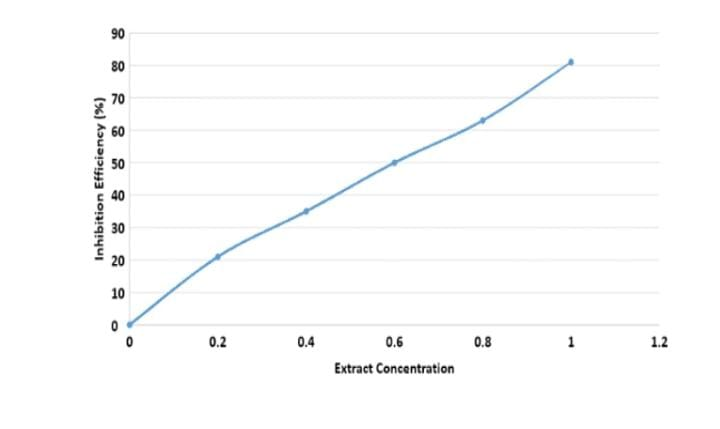
The inhibition efficiency of Bambusa vulgaris leaves extract increased progressively with increasing extract concentration in 1.0 M H2SO4. At 303 K, the inhibition efficiencies obtained for 0.2, 0.4, 0.6, 0.8 and 1.0 g/L extract were 71.33, 75.33, 78.67, 80.67 and 84.00%, respectively (Figure 1). Thus, the highest inhibition efficiency at this temperature was obtained at 1.0 g/L. The increase in inhibition efficiency with extract concentration indicates that a greater amount of the extract constituents became available for adsorption on the mild steel surface. The adsorbed constituents can form a protective layer at the metal–solution interface, thereby reducing the contact between the steel surface and the aggressive acidic medium. The progressive increase from 71.33% at 0.2 g/L to 84.00% at 1.0 g/L therefore suggests concentration-dependent inhibition by the B. vulgaris extract. This observation agrees with previous reports on plant-derived corrosion inhibitors, in which increasing inhibitor concentration enhanced surface coverage and consequently reduced the corrosion reaction. The result also supports the adsorption-based inhibition mechanism proposed in the present study.
3.2Effect of extract concentration on the corrosion rate of mild steel
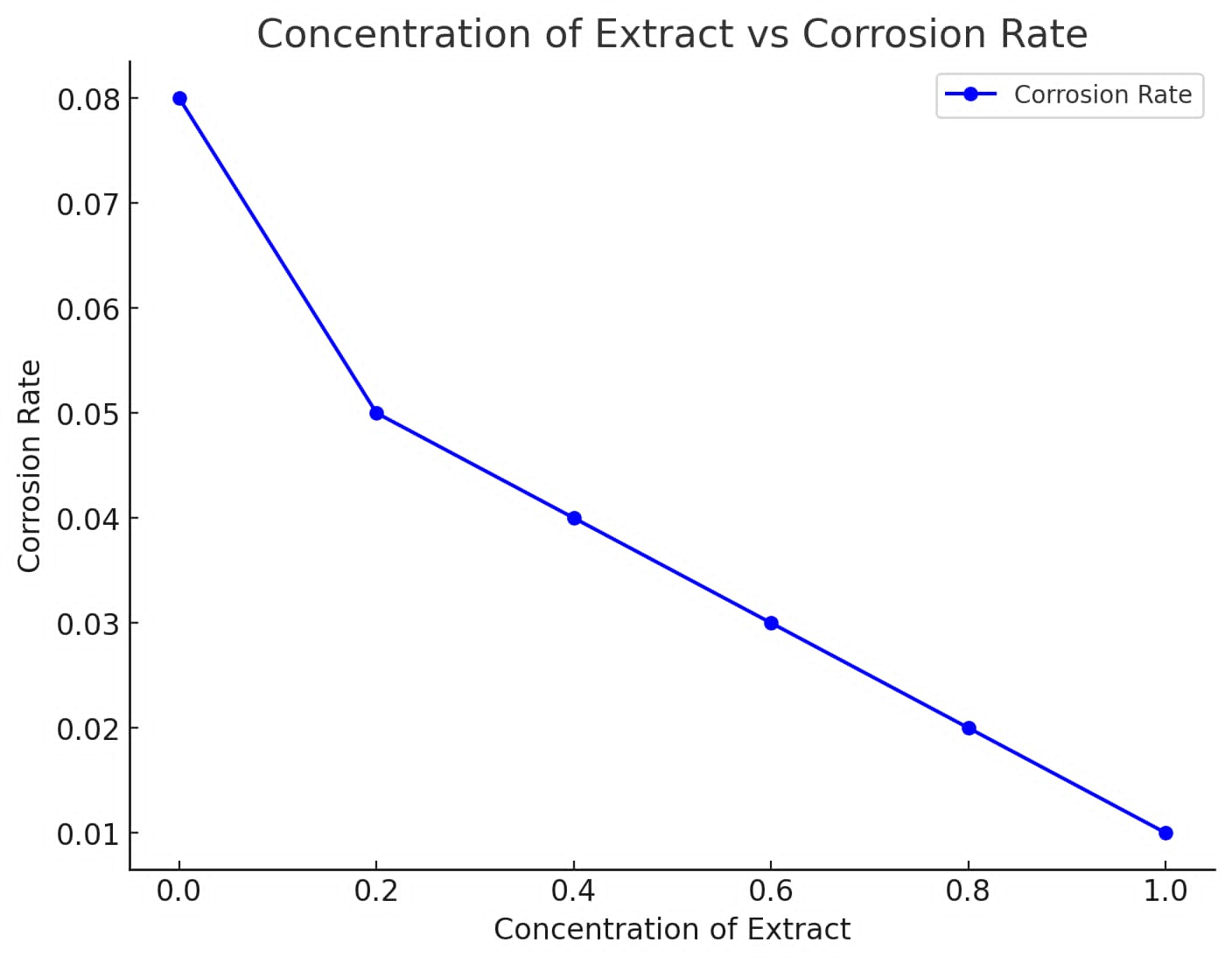
The corrosion rate of mild steel decreased as the concentration of Bambusa vulgaris extract increased. At 303 K, the corrosion rates for the blank, 0.2, 0.4, 0.6, 0.8 and 1.0 g/L solutions were 8.0 × 10⁻⁴, 2.1 × 10⁻⁴, 2.0 × 10⁻⁴, 1.8 × 10⁻⁴, 1.5 × 10⁻⁴ and 1.3 × 10⁻⁴ g h−1 cm⁻2, respectively. The uninhibited solution exhibited the highest corrosion rate, whereas the solution containing 1.0 g/L extract produced the lowest value. This corresponds with the increase in inhibition efficiency observed with increasing extract concentration. The reduction in corrosion rate can be attributed to adsorption of the extract constituents onto the mild steel surface, producing a protective barrier that restricts the interaction of the metal with the acidic medium. The result is consistent with the observation reported by Wabbane and Okafor, that increased inhibitor concentration enhances adsorption of inhibitor constituents on the metal surface and consequently reduces corrosion.
3.3Effect of temperature on inhibition efficiency
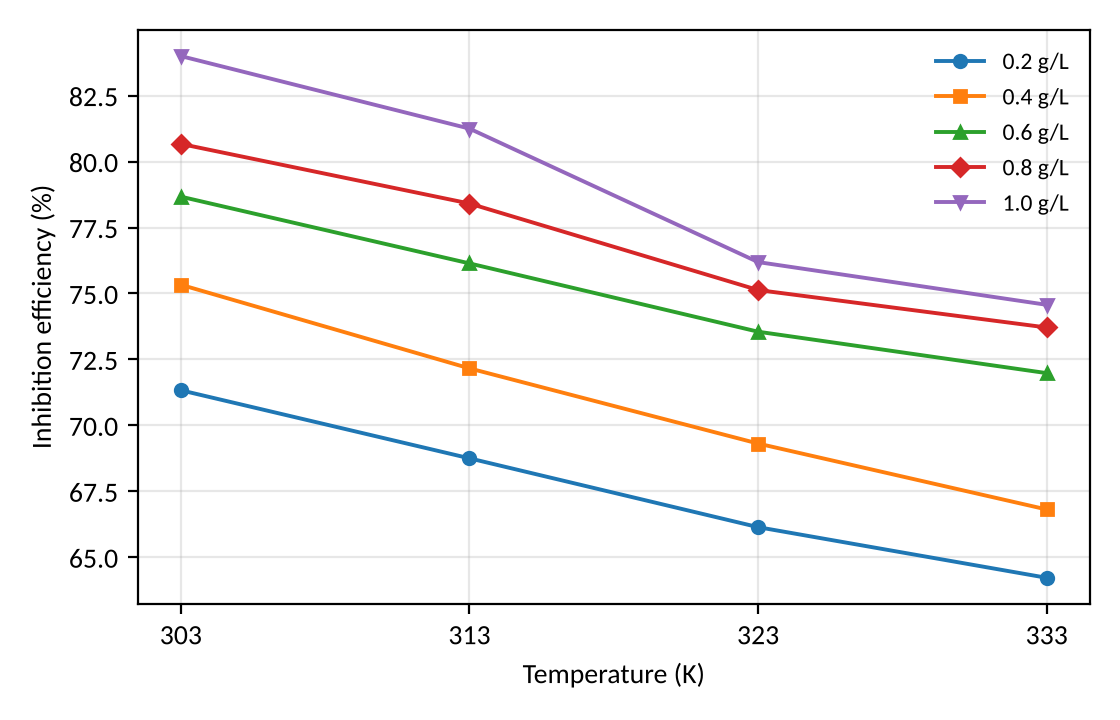
The inhibition efficiency of Bambusa vulgaris extract decreased with increasing temperature for all investigated extract concentrations. At 0.2 g/L, the inhibition efficiency decreased from 71.33% at 303 K to 68.75, 66.14 and 64.22% at 313, 323 and 333 K, respectively. For 0.4 g/L, the corresponding values were 75.33, 72.16, 69.31 and 66.81%. At 0.6 g/L, the values were 78.67, 76.14, 73.55 and 71.98%, while 0.8 g/L gave 80.67, 78.41, 75.13 and 73.71%, respectively. The highest concentration, 1.0 g/L, showed inhibition efficiencies of 84.00, 81.25, 76.19 and 74.57% at 303, 313, 323 and 333 K, respectively (Figure 3). The reduction in inhibition efficiency with increasing temperature suggests a decrease in the stability of the protective layer formed by the extract constituents on the mild steel surface. Increased thermal energy may promote desorption of some adsorbed constituents, resulting in reduced surface coverage and greater exposure of the metal to the acidic medium. Despite this decrease, the inhibited systems retained higher protection at increasing extract concentrations, indicating that concentration remained an important factor governing the extent of surface protection.
3.4Effect of temperature on the corrosion rate
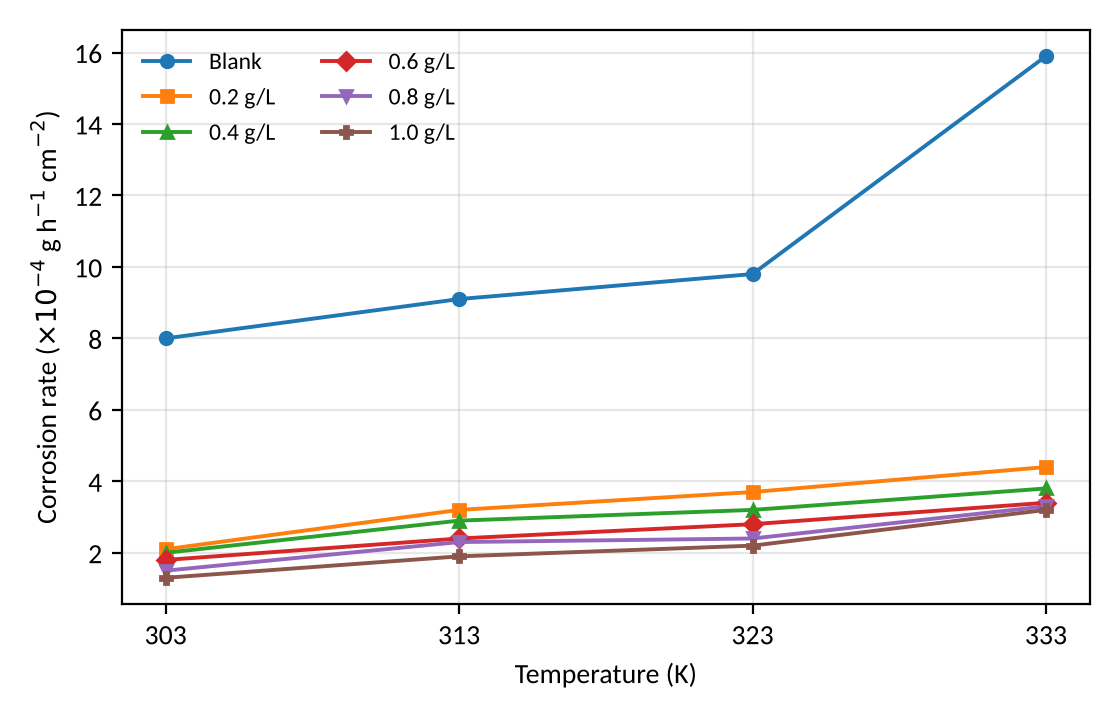
An increase in corrosion rate was observed with increasing temperature in both the uninhibited and inhibited systems. For the blank solution, the corrosion rate increased from 8.0 × 10⁻⁴ g h−1 cm⁻2 at 303 K to 9.1 × 10⁻⁴, 9.8 × 10⁻⁴ and 1.59 × 10⁻³ g h−1 cm⁻2 at 313, 323 and 333 K, respectively. A similar temperature-dependent increase occurred in the inhibited systems. At 0.2 g/L extract, the corrosion rate increased from 2.1 × 10⁻⁴ to 4.4 × 10⁻⁴ g h−1 cm⁻2 between 303 and 333 K. At 0.4, 0.6, 0.8 and 1.0 g/L, the corresponding increases were from 2.0 × 10⁻⁴ to 3.8 × 10⁻⁴, 1.8 × 10⁻⁴ to 3.4 × 10⁻⁴, 1.5 × 10⁻⁴ to 3.3 × 10⁻⁴, and 1.3 × 10⁻⁴ to 3.2 × 10⁻⁴ g h−1 cm⁻2, respectively. The increase in corrosion rate with temperature can be attributed to the enhanced rate of corrosion reactions in the acidic medium. In the inhibited systems, increased temperature may additionally weaken the interaction between adsorbed extract constituents and the metal surface, resulting in partial desorption and reduced protection. Nevertheless, the corrosion rates of the inhibited systems remained below that of the blank, indicating that the extract continued to provide protection against acid-induced corrosion.
3.5Scanning electron microscopy analysis
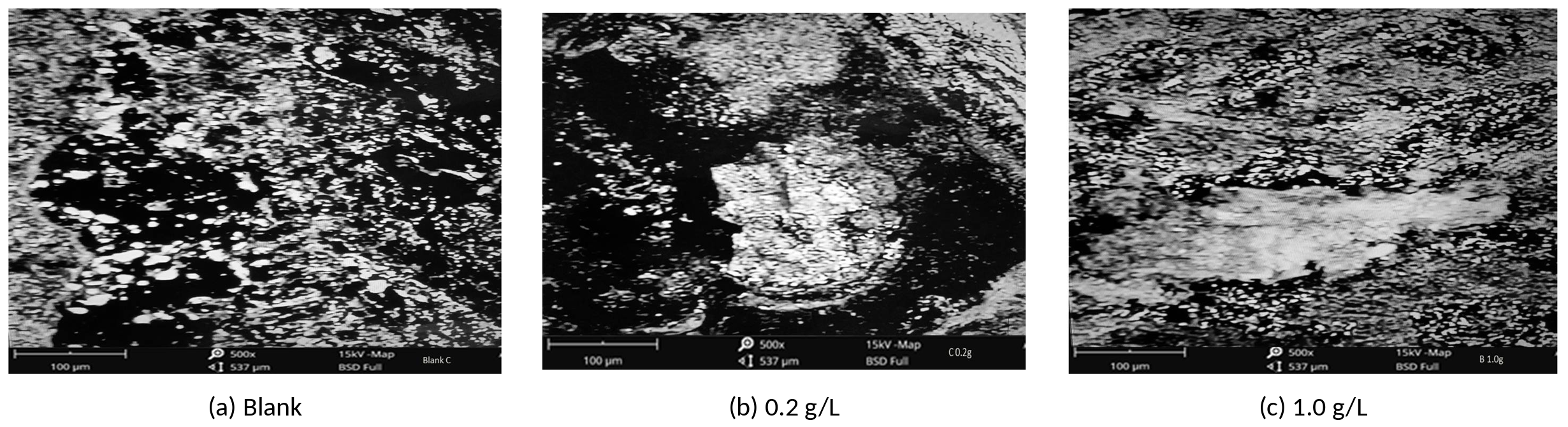
The surface morphology of the mild steel coupons was examined using a scanning electron microscope after exposure to 1.0 M H2SO4 in the absence and presence of Bambusa vulgaris leaf extract. SEM images of the uninhibited surface and surfaces exposed to the minimum (0.2 g/L) and highest (1.0 g/L) extract concentrations are presented in Figure 5(a–c). The uninhibited mild steel surface exhibited substantial deterioration and a relatively rough morphology, indicating the aggressive action of the acidic medium. In contrast, the surface exposed to 0.2 g/L extract showed comparatively reduced surface deterioration, while the coupon treated with 1.0 g/L extract exhibited a smoother surface with visible deposits or particles. The progressive improvement in surface morphology with increasing extract concentration indicates the formation of a protective layer on the mild steel surface. This layer is attributed to the adsorption of constituents of Bambusa vulgaris leaf extract at the metal–solution interface, which limits direct contact between the steel surface and the acidic medium. The SEM observations therefore provide morphological evidence supporting the weight-loss results, where increasing extract concentration produced higher inhibition efficiency and lower corrosion rate.
3.6Atomic absorption spectroscopy analysis
The AAS results showed a progressive reduction in dissolved iron with increasing B. vulgaris extract concentration. The blank solution contained the highest Fe concentration of 11.37 ± 0.02 ppm, while the concentration decreased to 10.62 ± 0.003 ppm in the presence of 0.2 g/L extract and further to 9.97 ± 0.00 ppm at 1.0 g/L. Relative to the blank, the dissolved Fe concentration decreased by approximately 6.6% at 0.2 g/L and 12.3% at 1.0 g/L extract (Table 2). This reduction indicates decreased dissolution of iron from the mild steel surface as the inhibitor concentration increased. The AAS results therefore complement the gravimetric and SEM findings. The lower concentration of dissolved Fe at higher extract concentration is consistent with the observed reduction in corrosion rate and the formation of a comparatively protected surface. Collectively, the results indicate that Bambusa vulgaris leaves extract reduces mild steel corrosion in 1.0 M H2SO4 through adsorption of its constituents at the metal–solution interface.
| Sample code | Fe (ppm) |
|---|---|
| B (blank) | 11.37 ± 0.02 |
| Sample B (0.2 g/L) | 10.62 ± 0.003 |
| Sample C (1.0 g/L) | 9.97 ± 0.00 |
4Conclusions
Ethanolic extract of Bambusa vulgaris leaves demonstrated effective inhibition of mild steel corrosion in 1.0 M H2SO4. Inhibition efficiency increased with increasing extract concentration, reaching 84.00% at 1.0 g/L and 303 K, while the corrosion rate decreased correspondingly. Increasing temperature reduced inhibition efficiency and increased corrosion rate, indicating a reduction in the stability of the protective layer at elevated temperature. SEM examination showed comparatively smoother surfaces in the presence of the extract, while AAS revealed a progressive reduction in dissolved Fe concentration from 11.37 ppm in the blank to 9.97 ppm at 1.0 g/L extract. The combined weight-loss, SEM and AAS results support an adsorption-based inhibition mechanism in which constituents of B. vulgaris extract form a protective layer at the metal–solution interface. These findings demonstrate the potential of B. vulgaris leaves extract as a plant-derived corrosion inhibitor for mild steel in acidic environments.
Acknowledgement
I acknowledge my supervisors, Dr. Timothy Esan and Dr. Oluwafemi Adebayo of the Department of Pure and Industrial Chemistry at Bamidele Olumilua University of Education, Science and Technology Ikere Ekiti, for overseeing this research project.
References
- [1]Al-Amiery A, Shaker LM (2026). Green and hybrid corrosion inhibitors from adsorption mechanisms to deployable performance. Discover Electrochemistry, 3(1). https://doi.org/10.1007/s44373-026-00141-2
- [2]Al-Otaibi MS, Al-Mayouf AM, Khan M, Mousa A, Al-Mazroa S, Alkhathlan H (2012). Corrosion inhibitory action of some plant extracts on the corrosion of mild steel in acidic media. Arabian Journal of Chemistry, 7(3), 340–346. https://doi.org/10.1016/j.arabjc.2012.01.015
- [3]Alaneme KK, Olusegun SJ, Adelowo OT (2015). Corrosion inhibition and adsorption mechanism studies of Hunteria umbellata seed husk extracts on mild steel immersed in acidic solutions. Alexandria Engineering Journal, 55(1), 673–681. https://doi.org/10.1016/j.aej.2015.10.009
- [4]Anupama KK, Ramya K, Joseph A (2016). Electrochemical and computational aspects of surface interaction and corrosion inhibition of mild steel in hydrochloric acid by Phyllanthus amarus leaf extract (PAE). Journal of Molecular Liquids, 216, 146–155. https://doi.org/10.1016/j.molliq.2016.01.019
- [5]ASTM International (2021). ASTM G31-21: Standard guide for laboratory immersion corrosion testing of metals. ASTM International. https://doi.org/10.1520/G0031-21
- [6]Bandeira RM, Lima FP, Nunes MS, Santos ECD, Júnior JRDS, De Matos JME, Feitosa CM, Rai M, Bhattarai S, Mulmi DD (2025). The green plant-based corrosion inhibitors—a sustainable strategy for corrosion protection. Surface Science and Technology, 3(1). https://doi.org/10.1007/s44251-025-00084-7
- [7]Baskar P, Annadurai S, Panneerselvam S, Prabakaran M, Kim J (2023). An Outline of Employing Metals and Alloys in Corrosive Settings with Ecologically Acceptable Corrosion Inhibitors. Surfaces, 6(4), 380–409. https://doi.org/10.3390/surfaces6040027
- [8]Chen L, Lu D, Zhang Y (2022). Organic compounds as corrosion inhibitors for carbon steel in HCL solution: A comprehensive review. Materials, 15(6), 2023. https://doi.org/10.3390/ma15062023
- [9]Chigondo M, Chigondo F (2016). Recent natural corrosion inhibitors for mild steel: An overview. Journal of Chemistry, 2016, Article 6208937. https://doi.org/10.1155/2016/6208937
- [10]Edyanto NF, Embong Z, Jafery KM, Rahim M, Basir MSM (2025). Bamboo leaves extract as corrosion inhibitor for mild steel. https://periodical.uthm.edu.my/index.php/ekst/article/view/18573
- [11]Ekerenam OO, Ikeuba AI, Njoku CN, Njoku DI, Emori W, Nwokolo IK, Etim IN, Okonkwo BO, Udoh II, Daniel EF, Uzoma PC, Awonusi BO, Kolawole SK, Etim IP, Olanrele OS (2025). Advancements in corrosion studies and protective measures for copper and copper-based alloys in varied environmental conditions. Results in Engineering, 26, 105257. https://doi.org/10.1016/j.rineng.2025.105257
- [12]Ezugha SI, Aralu CC (2023). Evaluation of adsorption and corrosion inhibition properties of Solanum Macrocarpon leaves extract on mild steel in sulphuric acid solutions. SN Applied Sciences, 5(12). https://doi.org/10.1007/s42452-023-05594-3
- [13]Finšgar M, Jackson J (2014). Application of corrosion inhibitors for steels in acidic media for the oil and gas industry: A review. Corrosion Science, 86, 17–41. https://doi.org/10.1016/j.corsci.2014.04.044
- [14]Fiori-Bimbi MV, Alvarez PE, Vaca H, Gervasi CA (2015). Corrosion inhibition of mild steel in HCl solution by pectin. Corrosion Science, 92, 192–199. https://doi.org/10.1016/j.corsci.2014.12.002
- [15]Goyal M, Kumar S, Bahadur I, Verma C, Ebenso EE (2018). Organic corrosion inhibitors for industrial cleaning of ferrous and non-ferrous metals in acidic solutions: A review. Journal of Molecular Liquids, 256, 565–573. https://doi.org/10.1016/j.molliq.2018.02.045
- [16]Holla BR, Mahesh R, Manjunath HR, Anjanapura VR (2024). Plant extracts as green corrosion inhibitors for different kinds of steel: A review. Heliyon, 10(14), e33748. https://doi.org/10.1016/j.heliyon.2024.e33748
- [17]Hussin MH, Rahim AA, Ibrahim MNM, Brosse N (2016). The capability of ultrafiltrated alkaline and organosolv oil palm (Elaeis guineensis) fronds lignin as green corrosion inhibitor for mild steel in 0.5 M HCl solution. Measurement, 78, 90–103. https://doi.org/10.1016/j.measurement.2015.10.007
- [18]International Organization for Standardization (ISO) (2017). ISO 8407:2017: Corrosion of metals and alloys—Removal of corrosion products from corrosion test specimens. International Organization for Standardization. https://www.iso.org/standard/63897.html
- [19]Karki R, et al. (2022). Acacia catechu bark alkaloids as novel green inhibitors for mild steel corrosion in a one molar sulphuric acid solution. Corrosion and Materials Degradation, 3(4), 44. https://doi.org/10.3390/cmd3040044
- [20]Kiey SAA, El-Sayed AA, Khalil AM (2023). Controlling corrosion protection of mild steel in acidic environment via environmentally benign organic inhibitor. Colloids and Surfaces a Physicochemical and Engineering Aspects, 683, 133089. https://doi.org/10.1016/j.colsurfa.2023.133089
- [21]Km S, Praveen B, Devendra BK (2024). A review on corrosion inhibitors: Types, mechanisms, electrochemical analysis, corrosion rate and efficiency of corrosion inhibitors on mild steel in an acidic environment. Results in Surfaces and Interfaces, 16, 100258. https://doi.org/10.1016/j.rsurfi.2024.100258
- [22]Kumar N, Anunay P, Kumar S, Meena LK, Singh D (2026). An overview on emerging green organic corrosion inhibitors: sustainable solution for oil and gas industrial applications. RSC Advances, 16(5), 3909–3948. https://doi.org/10.1039/d5ra08166a
- [23]Langmuir I (1918). The adsorption of gases on plane surfaces of glass, mica and platinum. Journal of the American Chemical Society, 40(9), 1361–1403. https://doi.org/10.1021/ja02242a004
- [24]Lebkiri A, Amri AE, Amri AE, Kharbouch O, Bouzikri S, Merimi C, Jebli A, Mortadi K, Amri AE, Amri AE, Ouakki M, Berisha A, Kaya S, Hsissou R, Hbaiz EM, Habsaoui A (2025). Enhanced corrosion inhibition of mild steel in acidic environments using essential oils of broad-leaved cattail: A comprehensive of electrochemical and theoretical studies. Journal of Molecular Structure, 1354, 144771. https://doi.org/10.1016/j.molstruc.2025.144771
- [25]Li X, Deng S, Fu H (2012). Inhibition of the corrosion of steel in HCl, H₂SO₄ solutions by bamboo leaf extract. Corrosion Science, 62, 163–175. https://doi.org/10.1016/j.corsci.2012.05.008
- [26]Li X, Deng S, Fu H, Xie X (2013). Synergistic inhibition effects of bamboo leaf extract/major components and iodide ion on the corrosion of steel in H3PO4 solution. Corrosion Science, 78, 29–42. https://doi.org/10.1016/j.corsci.2013.08.025
- [27]McCafferty E (2010). Introduction to corrosion science. Springer. https://doi.org/10.1007/978-1-4419-0455-3
- [28]Medupin RO, Ukoba KO, Yoro KO, Jen TC (2023). Sustainable approach for corrosion control in mild steel using plant-based inhibitors: A review. Materials Today Sustainability, 22, 100373. https://doi.org/10.1016/j.mtsust.2023.100373
- [29]Niu H, Gu J, Zhang Y (2024). Bacterial persisters: molecular mechanisms and therapeutic development. Signal Transduction and Targeted Therapy, 9(1), 174. https://doi.org/10.1038/s41392-024-01866-5
- [30]Nzyoki K, Chepngeno D, Maena K, Okello VA, Ndunda E, Shikuku V (2026). Recent advances in the synthesis and application of bamboo-based carbonaceous materials for environmental remediation: A review. Advances in Bamboo Science, 16, 100256. https://doi.org/10.1016/j.bamboo.2026.100256
- [31]Obiukwu O, Opara I, Grema LU (2015). Corrosion Inhibition of mild steel by various plant extracts in acid media. Research Journal of Applied Sciences Engineering and Technology, 10(10), 1197–1205. https://doi.org/10.19026/rjaset.10.1888
- [32]Orubite K, Oforka N (2004). Inhibition of the corrosion of mild steel in hydrochloric acid solutions by the extracts of leaves of Nypa fruticans Wurmb. Materials Letters, 58(11), 1768–1772. https://doi.org/10.1016/j.matlet.2003.11.030
- [33]Palanivelu S, Avudaiappan S, Maureira-Carsalade N (2025). Corrosion behaviour of mild steel in diverse environments: a comparative study of hot-rolled and cold-rolled specimens. Journal of King Saud University - Engineering Sciences, 37(6). https://doi.org/10.1007/s44444-025-00038-2
- [34]Patel NS, Jauhari S, Mehta GN (2009). Inhibitive effect by acid extract of Ficus exasperata leaves on the sulphuric acid corrosion of mild steel. Journal of Chemistry, 6, Article 413421. https://doi.org/10.1155/2009/413421
- [35]Patel S, Jauhari N, Mehta GN (2010). Green approach to corrosion inhibition of mild steel in hydrochloric acid and sulphuric acid solutions by the extract of Murraya koenigii leaves. Materials Chemistry and Physics, 122(1), 114–122. https://doi.org/10.1016/j.matchemphys.2010.02.066
- [36]Prabakaran M, Kim SH, Kalaiselvi K, Hemapriya V, Chung IM (2016). Highly efficient Ligularia fischeri green extract for the protection against corrosion of mild steel in acidic medium: Electrochemical and spectroscopic investigations. Journal of the Taiwan Institute of Chemical Engineers, 59, 553–562. https://doi.org/10.1016/j.jtice.2015.08.023
- [37]Puzikova D, Khussurova G, Leontyeva X, Kholkin O, Kenzin N, Zhurinov M, Peshaya S (2025). Review of organic corrosion inhibitors: application with respect to the main functional group. Journal of Saudi Chemical Society, 29(4). https://doi.org/10.1007/s44442-025-00021-1
- [38]Rezende-Júnior LM, De Sousa Andrade LM, Leal ALAB, De Souza Mesquita AB, De Araújo Dos Santos ALP, De Sousa Lima Neto J, Siqueira-Júnior JP, Nogueira CES, Kaatz GW, Coutinho HDM, Martins N, Da Rocha CQ, Barreto HM (2020). Chalcones Isolated from Arrabidaea brachypoda Flowers as Inhibitors of NorA and MepA Multidrug Efflux Pumps of Staphylococcus aureus. Antibiotics, 9(6), 351. https://doi.org/10.3390/antibiotics9060351
- [39]Roy P, Karfa P, Adhikari U, Sukul D (2014). Corrosion inhibition of mild steel in acidic medium by polyacrylamide grafted guar gum with various grafting percentage: Effect of intramolecular synergism. Corrosion Science, 88, 246–253. https://doi.org/10.1016/j.corsci.2014.07.039
- [40]Sharma S, Solanki AS, Thakur A, Sharma A, Kumar A, Sharma SK (2024). Phytochemicals as eco-friendly corrosion inhibitors for mild steel in sulfuric acid solutions: A review. Corrosion Reviews, 42(6), 727–742. https://doi.org/10.1515/corrrev-2024-0018
- [41]Silva J, Rocha JE, Da Cunha Xavier J, De Freitas TS, Coutinho HDM, Bandeira PN, De Oliveira MR, Da Rocha MN, Marinho EM, Marinho EM, De Kassio Vieira Monteiro N, Ribeiro LR, De Menezes RRPPB, Marinho MM, Teixeira AMR, Santos HSD, Marinho ES, Marinho ES (2022). Antibacterial and antibiotic modifying activity of chalcone (2E)-1-(4′-aminophenyl)-3-(4-methoxyphenyl)-prop-2-en-1-one in strains of Staphylococcus aureus carrying NorA and MepA efflux pumps: In vitro and in silico approaches. Microbial Pathogenesis, 169, 105664. https://doi.org/10.1016/j.micpath.2022.105664
- [42]Singh AK, Mohapatra S, Pani B (2016). Corrosion inhibition effect of Aloe vera gel: Gravimetric and electrochemical study. Journal of Industrial and Engineering Chemistry, 33, 288–297. https://doi.org/10.1016/j.jiec.2015.10.014
- [43]Singh DK, Kumar S, Udayabhanu G, John RP (2016). 4(N,N-dimethylamino)benzaldehyde nicotinic hydrazone as corrosion inhibitor for mild steel in 1 M HCl solution: An experimental and theoretical study. Journal of Molecular Liquids, 216, 738–746. https://doi.org/10.1016/j.molliq.2016.02.012
- [44]Siqueira MMR, De Tarso Cavalcante Freire P, Cruz BG, De Freitas TS, Bandeira PN, Santos HSD, Nogueira CES, Teixeira AMR, Pereira RLS, Da Cunha Xavier J, Campina FF, Barbosa CRDS, De Araújo Neto JB, Da Silva MMC, Siqueira-Júnior JP, Coutinho HDM (2020). Aminophenyl chalcones potentiating antibiotic activity and inhibiting bacterial efflux pump. European Journal of Pharmaceutical Sciences, 158, 105695. https://doi.org/10.1016/j.ejps.2020.105695
- [45]Stern M, Geary AL (1957). Electrochemical polarization: I. A theoretical analysis of the shape of polarization curves. Journal of the Electrochemical Society, 104(1), 56–63. https://doi.org/10.1149/1.2428496
- [46]Thacker H, Ram V (2024). Green corrosion inhibitors derived from plant extracts and drugs for mild steel in acid media: A review. Results in Surfaces and Interfaces, 18, 100364. https://doi.org/10.1016/j.rsurfi.2024.100364
- [47]Uddin MN (2024). Analysis of the mechanical characteristics of mild steel using different heat treatment. World Journal of Advanced Research and Reviews, 21(2), 1611–1616. https://doi.org/10.30574/wjarr.2024.21.2.0230
- [48]Umoren SA, Eduok UM (2016). Application of carbohydrate polymers as corrosion inhibitors for metal substrates in different media: A review. Carbohydrate Polymers, 140, 314–341. https://doi.org/10.1016/j.carbpol.2015.12.038
- [49]Verma C, Ebenso EE, Quraishi MA, Hussain CM (2021). Recent developments in sustainable corrosion inhibitors: design, performance and industrial scale applications. Materials Advances, 2(12), 3806–3850. https://doi.org/10.1039/d0ma00681e
- [50]Yousif QA, Malhotra SS, Bedair MA, Ansari A, Hadi AK (2025). Safflower plant extract as a sustainable corrosion inhibitor for carbon steel in acidic media: a combined electrochemical and computational study. RSC Advances, 15(26), 21006–21025. https://doi.org/10.1039/d5ra03333k
- [51]Zakeri L, Bahmani A, Aghdam ASR (2022). Plant extracts as sustainable and green corrosion inhibitors for protection of ferrous metals in corrosive media: A mini review. Corrosion Communications, 5, 25–38. https://doi.org/10.1016/j.corcom.2022.03.002
- [52]Zhu L, Fan J, Huang H, Guo L, Zhu M, Zheng X, Obot IB (2021). Inhibitive effect of different solvent fractions of bamboo shoots extract on the corrosion of mild steel in 0.5 mol/L H2SO4 solution. Journal of Molecular Structure, 1243, 130852. https://doi.org/10.1016/j.molstruc.2021.130852