Agricultural Extension
Assessment of Awareness and Constraints to the Utilization of Climate-Smart Agriculture Technologies among Arable Crop Farmers in Taraba State, Nigeria
1Department of Agricultural Extension and Rural Development, Modibbo Adama University, Yola, Adamawa State, Nigeria
2Department of Agricultural Economics, Modibbo Adama University, Yola, Adamawa State, Nigeria
Published October 2026
Abstract
The study assessed awareness and constraints to the utilization of climate-smart agriculture technologies among arable-crop farmers in Taraba State, Nigeria. The specific objectives were to examine the awareness levels of arable farmers on climate-smart agriculture technologies; and identify the constraints faced in the utilization of CSA technologies among arable crop farmers in the study area. A multi-stage sampling technique was used to select 282 respondents from seven local government areas. Primary data were collected through structured questionnaire and analyzed using descriptive statistics and measurement scale. The findings showed that respondents were generally aware of most listed CSA technologies and practices, as all mean scores were above the benchmark, indicating a high level of awareness. The major constraints affecting the utilization of CSA technologies reveal that poor infrastructure was the most severe constraint, with the highest mean score of 4.54. Limited access to credit and funding ranked second with a mean score of 4.46. The high cost of CSA inputs and technologies was also a major constraint, with a mean score of 4.22. Poor market access for CSA-related produce had a mean score of 4.14. Gender-based barriers to technology adoption also had a mean score of 4.14. Climate variability and unpredictability had a mean score of 4.14. The study concludes that the awareness of CSA utilization is strong due to high levels of awareness. However, structural, financial, and institutional barriers continue to hinder optimal utilization of these technologies. It is therefore recommended that Government/ Non-Governmental Organization should invest in rural infrastructure that promote CSA adoption and utilization. Financial institutions and the government should provide farmer-friendly credit schemes with low interest rates and minimal collateral requirements.
Keywords: Climate Smart Agriculture; Utilization; Farmers’ Awareness; Constraints; Arable Crop farmers; Taraba State
1Introduction
Climate change is largely driven by human activities, particularly the emission of greenhouse gases such as carbon dioxide and methane. According to Oyawole et al. (2019), its major effects include rising global temperatures, sea-level rise, changing rainfall patterns, and the increasing occurrence of extreme weather events such as droughts, floods, and storms. Climate change has consequently become one of the most pressing global challenges, with significant implications for agricultural production, particularly in vulnerable regions such as sub-Saharan Africa (Thornton and Herrero, 2022). In response to these challenges, Climate-Smart Agriculture (CSA) has emerged as an approach that seeks to achieve three interrelated objectives: sustainably increasing agricultural productivity, strengthening adaptive capacity and resilience to climate change, and reducing greenhouse gas (GHG) emissions where possible. The contribution of a climate-smart agricultural technology is therefore assessed in relation to its potential to advance these three objectives. Interventions ranging from climate information services to improved field management practices can contribute to achieving these goals (Khatri-Chhetri et al., 2019).
Africa is particularly vulnerable to climate change because of its dependence on climate-sensitive economic activities, especially agriculture. Paul et al. (2021), drawing on climate change evidence, highlighted the increasing temperatures and occurrence of extreme weather events across the continent, including heatwaves, droughts, and floods. These changes have serious implications for farmers who depend largely on rain-fed agricultural systems. Changes in rainfall distribution, prolonged dry spells, and rising temperatures can disrupt planting schedules, reduce soil moisture, and negatively affect crop and livestock productivity. In this regard, CSA offers opportunities to help farmers manage climate-related risks, improve the resilience of agricultural production systems, and sustain their livelihoods under changing climatic conditions (Ouédraogo et al., 2019).
Agriculture remains an important source of livelihood for a substantial proportion of Nigeria's population, particularly those living in rural communities (Udemezie, 2019). Arable crop farming involves cultivating land to produce crops such as cereals, legumes, roots and tubers, and other food crops. The agricultural sector continues to provide employment and income-generating opportunities for many Nigerians. Pelemo et al. (2024) associated the increase in the number of people engaging in farming, including young people, with challenges such as unemployment and limited opportunities for alternative livelihoods. Rural areas are particularly important to agricultural production because they provide much of the land used for crop cultivation and other farming activities. However, despite the large population engaged in agriculture, Nigeria continues to face challenges relating to food insecurity and poverty (Elum and Okorodudu, 2021). These challenges underscore the need to improve agricultural productivity, strengthen farmers' resilience, and promote sustainable agricultural practices.
The productivity of arable crop farmers is increasingly threatened by the adverse effects of climate change, including temperature fluctuations, flooding, prolonged droughts, and the increased incidence of pests and diseases (Musafiri et al., 2022). Unpredictable rainfall patterns and rising temperatures can disrupt farming operations, reduce crop yields, and increase the risk of crop failure. Climate conditions also influence crop selection, planting dates, and the length of the growing season, thereby affecting agricultural productivity (Adebayo and Ojogu, 2019). Furthermore, high temperatures combined with inadequate rainfall can intensify water stress in crops and negatively affect livestock production, including poultry, small ruminants, and other livestock species. These challenges are particularly severe in sub-Saharan Africa, where widespread poverty, dependence on subsistence agriculture, land degradation, desertification, and limited adaptive capacity increase the vulnerability of farming households to climate-related shocks (Jacob, 2021).
Given these challenges, the adoption of Climate-Smart Agriculture has become an important strategy for improving the sustainability and resilience of agricultural production systems. CSA encompasses a range of agricultural technologies and management practices designed to increase productivity, strengthen farmers' capacity to adapt to climate change, and, where feasible, reduce greenhouse gas emissions. These practices can help farmers manage climate-related risks, improve the efficiency of resource use, and maintain agricultural production under changing environmental conditions (Zheng et al., 2024). However, the effectiveness of CSA depends partly on farmers' awareness of the available technologies, their understanding of the associated benefits, and their ability to overcome the constraints that may hinder adoption and continued use.
In Taraba State, agriculture constitutes a major livelihood activity, with many rural households engaged in arable crop farming and livestock production. However, agricultural activities in the state are increasingly exposed to climate-related challenges, including irregular rainfall, prolonged dry spells, flooding, and land degradation. These conditions can reduce crop yields, threaten the livelihoods of smallholder farmers, and worsen food insecurity. Edeh et al. (2023) highlighted climate-related pressures on agricultural productivity and rural livelihoods, underscoring the importance of adaptation measures in vulnerable farming communities. In this context, CSA technologies offer opportunities to improve agricultural resilience, enhance resource management, and reduce farmers' vulnerability to the adverse effects of climate change.
Despite the potential benefits of CSA, the extent to which arable crop farmers are aware of and utilize these technologies in Taraba State requires careful assessment. Limited awareness, inadequate access to agricultural information and extension services, and insufficient institutional support may constrain farmers' ability to identify and use appropriate climate-smart technologies. Understanding farmers' awareness levels is important because awareness can influence their knowledge of available technologies and their capacity to make informed decisions regarding their use. Similarly, identifying the constraints faced by farmers is necessary for developing appropriate interventions to improve access to, and utilization of, CSA technologies.
It is against this background that this study was conducted to assess awareness and constraints relating to the utilization of climate-smart agricultural technologies among arable crop farmers in Taraba State, Nigeria. Specifically, the study sought to examine the level of awareness of CSA technologies among arable crop farmers and identify the constraints they face in utilizing these technologies in the study area.
2Methodology
2.1Study area
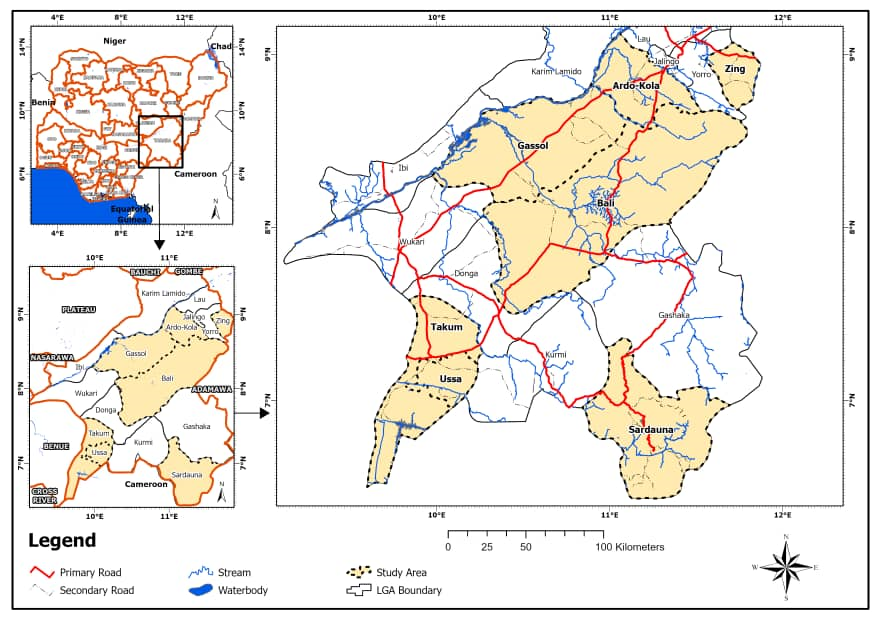
The study was conducted in Taraba State, located in the northeastern region of Nigeria. It is one of Nigeria’s largest by land area, with extensive tracts of agricultural land, forests, and mountainous regions. It lies between latitude $6{o}$`<!-- -->`{=html}30 to $9{o}$`<!-- -->`{=html}36’ N and the longitude $9{o}$`<!-- -->`{=html}10’ to $11{o}$`<!-- -->`{=html}50’ E’ of the Greenwich meridian (Figure 1). Taraba has a total land area of 54,473 km2 and a population of 2,294,800persons (NPC, 2006). However, using Taraba’s mean annual growth rate of about 3.0% on this amount and projecting from the 2006 census of 2.3 million citizens to 2025 using the exponential population growth model, Taraba’s population in 2025 would be projected at 4,023,428 people. The State’s monthly temperature ranges from 21°C to 30°C (Bashir et al., 2025). The area has two distinct seasons: the dry and rainy seasons. The rainy season starts in April and ends in October, while the dry season starts in November and ends in April. The average annual rainfall is between 800 mm and 2000 mm, while the maximum temperature is about $34{o}$C is recorded in April, while the lowest mean temperature of $20{o}$C is recorded in January and December.
The state is ethnically diverse, with several indigenous groups, including the Jukun, Mumuye, Tiv, Fulani, and Kuteb. The population density varies significantly across the state, with higher concentrations in urban areas like Jalingo. Agriculture remains the dominant occupation in Taraba State, with a significant portion of the population engaged in farming.
2.2Sampling procedure and sample size
The study was conducted across all four ADP zones: Zone I, Zone II, Zone III, and Zone IV. All the farmers in the selected zone constitute the target population for the study. A multi-stage sampling procedure was employed to select the respondents for the study. In the first stage, two LGAs in each ADP Zone (except the Sardauna Zone IV, which stands alone due to its location on the Mambila Plateau) were purposively selected for the study based on their arable crop production to make a total of seven (7) LGAs. In the second stage, two wards were proportionately selected randomly from each Local Government Area based on the relative level of arable crop production in that area. The third stage involves identifying arable-crop farmers in each selected ward using the snowball sampling technique, which is appropriate when the study population is not registered. The final stage involves the random selection of arable-crop farmers from each ward using the Yamane (1967) formula at 5% margin of error. Consequently, a total of 282 respondents were proportionately drawn from the field survey sampling frame of 952 farmers and administered to the respondents; however, four questionnaires were discarded due to incomplete information, only 278 were successfully analyzed (Table 1).
The Yamane (1967) formula is given as:
Where:
n = Sample size
N = Population under study
e = Margin of error (5% or 0.05)
1= Constant
Therefore, a total of 282 respondents were selected proportionately for this study (Table 1), as calculated in Equation (2).
| ADP zone | LGA | Ward | Sample frame | Sample size |
|---|---|---|---|---|
| Zone I | Ardo-kola | Alim Gora | 67 | 20 |
| Ardo-kola | 80 | 24 | ||
| Zing | Yakoko | 70 | 21 | |
| Zing Ai | 56 | 17 | ||
| Zone II | Bali | Suntai | 84 | 25 |
| Bali A | 60 | 18 | ||
| Gassol | Mutum Biu | 87 | 26 | |
| Gunduma | 87 | 26 | ||
| Zone III | Ussa | Jenuwa | 68 | 20 |
| Kwanbai | 62 | 18 | ||
| Takum | Tikari | 45 | 13 | |
| Yukuben | 42 | 12 | ||
| Zone IV | Sardauna | Gembu | 65 | 19 |
| Nguroje | 79 | 23 | ||
| Total | 7 LGAs | 14 wards | 952 farmers | 282 |
Note: Field survey, 2025.
2.3Methods of data analysis
The methods of data analysis for this study include descriptive statistics and measurement scale. A three (3) point rating scale was used to measure objective I, examine the awareness level of arable crop farmers on CSA technologies in the study area. The response categories were not aware, somewhat aware and aware, assigned scores of 1,2 and 3 respectively. Descriptive statistics, including frequency, percentage and mean scores were used to summarize the responses. The three-point Likert-type scale is shown as follows;
where x̄ = Mean Score
∑ = Summation
f = frequency of the respondents
nr = Number of responses to the items
The decision rule is computed based on the assigned weight of the responses as follows;
Based on the computed score, responses with a mean score less than 2.0 were rejected, while scores of 2.0 or higher were accepted.
In terms of constraints faced with the utilization of CSA technologies and practices, responses were graded from “Very severe constraints (5)”, “Severe constraints (4)”, ‘’Moderate constraints’’ (3)”, “Minor constraints (2)” and “Not a constraint (1)”. The five-point Likert-type scale is shown as follows;
The mean score was computed with Equation (3).
The decision rule is computed based on the assigned weight of the responses as follows;
Based on the computed score, any response with a mean score below 3.0 had low utilization constraints, while 3.0 and above was considered high utilization constraints of CSA technologies.
3Results and discussion
3.1Awareness level of climate smart arable crop production technologies and practices
Awareness of climate smart agricultural practices is important in influencing farmers’ adoption and use of these technologies. Farmers who understand the benefits of these practices are more likely to adopt them to improve productivity and mitigate climate change impacts. Table 2 presents respondents' awareness and knowledge of climate-smart agricultural (CSA) technologies and practices for arable crop production in the study area. The findings showed that respondents were generally aware of most listed CSA technologies and practices, as all mean scores were above the benchmark, indicating a high level of awareness. The results showed the highest level of awareness for the use of improved seed varieties, with a mean score of 2.73. This indicates that most farmers recognized improved seed varieties as an important climate-smart practice to increase yields and withstand harsh weather conditions. Early planting and changing planting dates also had a mean score of 2.56, while the use of drought-tolerant crop varieties had a mean score of 2.52. This suggests that respondents were aware of these practices, possibly because of frequent sensitization by extension agents, government programmes, and non-governmental organizations.
Furthermore, the use of weather or climate information for planning had a mean score of 2.50, while the application of minimum or zero tillage had a mean score of 2.49. Rainwater harvesting had a mean score of 2.47; Intercropping, 2.42; crop rotation, 2.41; and the use of organic fertilizers and compost, 2.40. This indicates that respondents had good awareness and knowledge of these practices and their benefits. In addition, soil erosion control measures had a mean score of 2.34; efficient water use, such as controlled irrigation, had a mean score of 2.23; and mulching to conserve soil moisture had a mean score of 2.19. This shows that respondents had moderate awareness of these practices. Lastly, agroforestry (integrating trees with crops) had the lowest mean score of 2.06, though it was still considered a good level of awareness. This reveals that, although respondents were somewhat aware of agroforestry practices, they were the least known among the listed CSA technologies and practices.
This finding is consistent with Bashir et al. (2025), who studied rice farmers' awareness of climate smart agriculture practices in Taraba State, Nigeria, and reported that most respondents were aware of CSA, while a few were not. This indicates that awareness, as a stimulant and the first element in the innovation adoption process, has been created on Climate-Smart Agricultural practices, though weak, with most having no awareness, implying low knowledge of CSA in the study area. In contrast, Tiamiyu et al. (2017) found that a large proportion of agricultural stakeholders in Northern Nigeria were unaware of most CSA practices, resulting in low uptake in the region.
| CSA Technologies and Practices | Not Aware | Somewhat Aware | Aware | Mean | Remark |
|---|---|---|---|---|---|
| Use of drought-tolerant crop varieties | 5(1.80) | 122(43.88) | 151(54.32) | 2.52 | A |
| Early planting and changing planting dates | 1(0.36) | 120(43.17) | 157(56.47) | 2.56 | A |
| Mulching to conserve soil moisture | 14(5.04) | 195(70.14) | 69(24.82) | 2.19 | A |
| Crop rotation | 9(3.24) | 145(52.16) | 124(44.60) | 2.41 | A |
| Agroforestry (integrating trees with crops) | 18(6.47) | 225(80.94) | 35(12.59) | 2.06 | A |
| Use of organic fertilizers and compost | 2(0.72) | 161(57.91) | 115(41.37) | 2.40 | A |
| Application of minimum or zero tillage | 6(2.16) | 128(46.04) | 144(51.80) | 2.49 | A |
| Efficient water use (e.g., control irrigation) | 12(4.32) | 188(67.63) | 78(28.06) | 2.23 | A |
| Soil erosion control measures (e.g., terracing) | 3(1.08) | 175(62.95) | 100(35.97) | 2.34 | A |
| Use of weather/climate information for planning | 2(0.72) | 133(47.84) | 143(51.44) | 2.50 | A |
| Intercropping (mixed farming) | 6(2.16) | 147(52.88) | 125(44.96) | 2.42 | A |
| Integrated pest and disease management | 2(0.72) | 118(42.45) | 158(56.83) | 2.56 | A |
| Use of improved seed varieties | 1(0.36) | 73(26.26) | 204(73.38) | 2.73 | A |
| Use of post-harvest technologies | 1(0.36) | 117(42.09) | 160(57.55) | 2.57 | A |
| Rainwater harvesting | 2(0.72) | 141(50.72) | 135(48.56) | 2.47 | A |
| Gross mean | 2.43 |
Note: Field survey, 2026. A = aware; figures in parentheses are percentages.
3.2Constraints faced in the utilization of climate-smart arable crop production technologies
The Utilization of climate-smart agricultural (CSA) technologies among arable crop farmers is often hindered by socio-economic, institutional and environmental challenges. Identifying these constraints is important because they determine the extent to which farmers can utilize and sustain the use of climate-smart practices. Therefore, the major constraints affecting the utilization of climate-smart arable crop production technologies among respondents in Table 3 reveal that poor infrastructure, such as bad roads and inadequate storage facilities, was the most severe constraint, with the highest mean score of 4.54. The results showed that 62.95% of respondents considered it a very severe constraint, while 29.86% considered it a major constraint. This suggests that inadequate infrastructure limits market access, increases post-harvest losses, and discourages the use of climate-smart technologies.
Limited access to credit and funding ranked second with a mean score of 4.46. The findings showed that 58.99% of the respondents considered it a very severe constraint, while 32.37% considered it a major constraint. This suggests that many farmers lack the financial resources needed to acquire CSA inputs and technologies. The high cost of CSA inputs and technologies was also a major constraint, with a mean score of 4.22. The result indicated that 50.72% of the respondents viewed it as a major constraint, while 35.97% viewed it as a very severe constraint. This implies that the cost of acquiring improved seeds, irrigation systems, and other technologies may discourage farmers from utilizing them. Poor market access for CSA-related produce had a mean score of 4.14 and was considered an important constraint. The findings revealed that 47.48% considered it a major constraint, and 34.17% considered it a very severe constraint. This may reduce farmers’ motivation to invest in climate-smart production if profitable markets are not readily available.
Gender-based barriers to technology adoption also had a mean score of 4.14. The result showed that 57.91% of respondents considered it a major constraint, and 28.78% considered it a very severe constraint. This suggests that unequal access to productive resources and information may hinder some farmers, especially women, from utilizing CSA technologies. Climate variability and unpredictability had a mean score of 4.14. The findings revealed that 59.71% of respondents considered it a major constraint, while 27.70% considered it very severe. This indicates that uncertain weather conditions may make it difficult for farmers to plan and effectively implement CSA practices.
| Constraint Factors | Not a constraint | Minor constraint | Moderate constraint | Severe constraint | Very severe constraint | Mean | Remark |
|---|---|---|---|---|---|---|---|
| Lack of awareness and understanding of CSA practices | 11(3.96) | 13(4.68) | 81(29.14) | 148(53.24) | 25(8.99) | 3.58 | C |
| Inadequate access to extension services and training | 3(1.08) | 6(2.16) | 54(19.42) | 139(50.00) | 76(27.34) | 4.00 | S |
| Limited access to credit and funding | 4(1.44) | 2(0.72) | 18(6.47) | 90(32.37) | 164(58.99) | 4.46 | S |
| High cost of CSA inputs and technologies | 0(0.00) | 0(0.00) | 37(13.31) | 141(50.72) | 100(35.97) | 4.22 | S |
| Poor access to improved seed varieties and planting materials | 23(8.27) | 81(29.14) | 76(27.34) | 65(23.38) | 33(11.87) | 3.01 | C |
| Inadequate water supply or irrigation infrastructure | 19(6.83) | 27(9.71) | 53(19.06) | 116(41.73) | 63(22.66) | 3.63 | C |
| Limited access to weather and climate information | 22(7.91) | 53(19.06) | 76(27.34) | 88(31.65) | 39(14.03) | 3.24 | C |
| Poor market access for CSA-related produce | 1(0.36) | 3(1.08) | 47(16.91) | 132(47.48) | 95(34.17) | 4.14 | S |
| Weak institutional support and government policy | 0(0.00) | 4(1.44) | 47(16.91) | 162(58.27) | 65(23.38) | 4.03 | S |
| Land tenure insecurity or small farm size | 1(0.36) | 10(3.60) | 88(31.65) | 130(46.76) | 49(17.63) | 3.77 | C |
| Cultural resistance to new farming practices | 1(0.36) | 4(1.44) | 54(19.42) | 167(60.07) | 52(18.71) | 3.95 | C |
| Gender-based barriers to technology adoption | 2(0.72) | 0(0.00) | 35(12.59) | 161(57.91) | 80(28.78) | 4.14 | S |
| Poor infrastructure (e.g., roads, storage facilities) | 1(0.36) | 1(0.36) | 18(6.47) | 83(29.86) | 175(62.95) | 4.54 | S |
| Climate variability and unpredictability | 0(0.00) | 3(1.08) | 32(11.51) | 166(59.71) | 77(27.70) | 4.14 | S |
| Lack of community support or group participation | 2(0.72) | 4(1.44) | 44(15.83) | 158(56.83) | 70(25.18) | 4.04 | S |
| Gross mean | 3.93 |
Note: Field survey, 2026. C = constraint; S = severe constraint; figures in parentheses are percentages.
Lack of community support or group participation was another significant constraint, with a mean score of 4.04. The result indicated that 56.83% considered it a major constraint and 25.18% a very severe constraint. This may limit information sharing, collective action, and mutual assistance among farmers. Weak institutional support and government policy had a mean score of 4.03. The findings showed that 58.27% considered it a major constraint, while 23.38% considered it very severe. This suggests that inadequate policy implementation and weak institutional support may hinder widespread use of CSA technologies. Inadequate access to extension services and training had a mean score of 4.00. The result revealed that 50.00% of respondents considered it a major constraint, while 27.34% considered it a very severe constraint. This suggests that limited contact with extension services reduces farmers’ knowledge and technical capacity to implement CSA practices.
Cultural resistance to new farming practices was also a major constraint, with a mean score of 3.95. The findings indicated that 60.07% considered it a major constraint, and 18.71% a very severe constraint. This may be because some farmers prefer traditional farming methods and are reluctant to adopt innovations. Land tenure insecurity or small farm size had a mean score of 3.77. The result showed that 46.76% considered it a major constraint and 17.63% a very severe constraint. This suggests that insecure land ownership discourages long-term investment in climate-smart technologies. Inadequate water supply or irrigation infrastructure had a mean score of 3.63. The findings revealed that 41.73% considered it a major constraint, and 22.66% considered it a very severe constraint. This limits the use of irrigation and other water-related climate-smart practices.
Lack of awareness and understanding of CSA practices had a mean score of 3.58. The result indicated that 53.24% considered it a major constraint, while 8.99% considered it a very severe constraint. This implies that some farmers may not fully understand the benefits and application of CSA technologies. Limited access to weather and climate information had a mean score of 3.24. The findings showed that 31.65% considered it a major constraint and 14.03% considered it a very severe constraint. This may affect timely decision-making regarding planting and other farm operations. Poor access to improved seed varieties and planting materials had the lowest mean score (3.01), though it was still considered a significant constraint. The result revealed that 27.34% considered it a moderate constraint and 23.38% considered it a major constraint.
One basic attribute of CSA practices is that they are cost-intensive, especially for agroforestry and small-scale irrigation, requiring large investments but facing long recovery periods (Waaswa et al., 2022). The high cost of utilizing CSA practices can scare farmers off. In this case, favourable economic conditions could be central to farmers’ utilization of CSA practices (Waaswa et al., 2022). For instance, low-budget/poor households are less likely to adopt CSA practices such as soil and water conservation technologies and crop diversification (Zeleke et al., 2022). Similarly, higher incomes can increase the likelihood that farmers adopt and use new crop varieties, irrigation, and other water management practices (Abegunde et al., 2020).
The findings of this study concur with Bashir et al. (2025), who studied rice farmers' awareness of climate-smart agricultural practices in Taraba State and reported that high costs of labour, untimely access to farm inputs, high cost of hired farmland and low access to agricultural extension services, among others, were predominant constraints faced by the rice farmers in adopting CSA practices. Similarly, Onyeneke et al. (2018), in their study in Ebonyi State, Nigeria, found that the high cost of inputs, lack of access to inputs, insufficient land and capital, insufficient climate information, and poor extension services were among the major barriers to the uptake of climate-smart agricultural practices in the study area. A similar study by Pelemo et al. (2024) on the usage of climate-smart practices among arable crop growers in Kogi State, Nig, indicated that high cost of inputs, lack of finance, lack of government support, and inadequate training on climate-smart practices were the most severe constraints to adoption of climate-smart practices in the study area.
4Conclusion
The study assessed the awareness and constraints to the utilization of climate-smart agriculture technologies among arable crop farmers in Taraba State Nigeria. The study concludes that awareness levels of climate-smart agriculture technologies among respondents were generally high as most of the listed CSA technologies and practices, mean scores were above the benchmark, with remarks indicating a high level of awareness. The major constraints to the utilization of climate-smart arable crop production technologies among respondents, were poor infrastructure, such as bad roads and inadequate storage facilities, was the most severe constraint and limited access to credit and funding ranked second among the main problems.
5Recommendations
Based on the findings of the study, the following recommendations were made to enhance the utilization of climate-smart agricultural technologies among arable crop farmers: Government/ Non-Governmental Organization should invest in rural infrastructure, particularly feeder roads, storage facilities, and market access systems.; and financial institutions and the government should provide farmer-friendly credit schemes with low interest rates and minimal collateral requirements.
References
- [1]Abegunde VO, Sibanda M, Obi A (2020). Determinants of the adoption of climate-smart agricultural practices by small-scale farming households in King Cetshwayo District Municipality, South Africa. Sustain 12(1):195.
- [2]Adebayo AE, Ojogu EO (2019). Assessment of the use of climate smart agricultural practices among smallholder farmers in Ogun State. Acta Scientiarum. Agriculture, 3(6), 47–56.
- [3]Amafade UG, Evwierhurhoma FE, Abuche OP, Ekokogbe OT, Gideon OO, Omosigho NE (2024). Adoption of climate-smart agricultural practices by cassava farmers in Delta State, Nigeria. International Journal of Advanced Research and Innovative Ideas in Education, 10(3), 2395–4396.
- [4]Asfaw S, McCarthy N, Lipper L, Arslan A, Cattaneo A (2016). What determines farmers’ adaptive capacity? Empirical evidence from Africa. Food Security, 8, 643–664. https://doi.org/10.1007/s12571-016-0586-7
- [5]Bashir MB, Faruk AU, Abdullahi MM, Yusuf B (2025). Rice farmers’ awareness of climate-smart agriculture (CSA) practices in Taraba State, Nigeria. Journal of Arid Agriculture, 26(2), 16–23. https://doi.org/10.63659/jaa.v26i2.83
- [6]Edeh HO, Onwusiribe CN, Eze EA (2023). Policy frameworks and climate-smart agriculture adoption among smallholder farmers in Nigeria. Climate Policy, 23(1), 77–91.
- [7]Elum ZA, Okorodudu KH (2021). Poverty and food expenditure among farming households in Obio-Akpor Local Government Area, Rivers State, Nigeria. Nigeria Agricultural Journal, 52(2), 174–180. https://www.ajol.info/index.php/naj
- [8]Intergovernmental Panel on Climate Change (2023). Climate change 2023: Synthesis report. https://doi.org/10.59327/IPCC/AR6-9789291691647
- [9]Jacob M (2021). An analysis of the impacts of climate change on food security in the Albertine Rift of East Africa [Master’s paper, Clark University]. Clark Digital Commons. https://commons.clarku.edu/idce_masters_papers/248
- [10]Khatri-Chhetri A, Pant A, Aggarwal PK, Vasireddy VV, Yadav A (2019). Stakeholders’ prioritization of climate-smart agriculture interventions: Evaluation of a framework. Agricultural Systems, 174, 23–31. https://doi.org/10.1016/j.agsy.2019.03.002
- [11]Musafiri CM, Kiboi M, Macharia J (2022). Adoption of climate-smart agricultural practices among smallholder farmers in Western Kenya: Do socioeconomic, institutional, and biophysical factors matter? Heliyon, 8(1), Article e08677. https://doi.org/10.1016/j.heliyon.2021.e08677
- [12]National Population Commission (2006). Federal Republic of Nigeria official gazette (Vol. 94). Federal Government of Nigeria.
- [13]Onyeneke RU, Igberi CO, Udoka CO, Ogbeni JA (2018). Status of climate-smart agriculture in Southeast Nigeria. GeoJournal, 83, 333–346. https://doi.org/10.1007/s10708-017-9773-z
- [14]Ouedraogo M, Houessionon P, Zougmoré RB, Partey ST (2019). Uptake of climate-smart agricultural technologies and practices: Actual and potential adoption rates in the climate-smart village site of Mali. Sustainability, 11(17), Article 4710. https://doi.org/10.3390/su11174710
- [15]Pelemo JJ, Shehu M, Ajibola BO, Adewumi A, Adeyemi OA (2024). Adoption of climate-smart practices among arable crop farmers in Kogi State, Nigeria. Journal of Agricultural Extension, 28(4), 110–119. https://doi.org/10.4314/jae.v28i4
- [16]Paul AH, Amen NE, Mitu SB (2021). Extension Services and impact of Climate Change on Food Production in Taraba State, Nigeria. Journal of Agriculture, Environmental Resource and Management,5(3), 809-818
- [17]Tiamiyu SA, Ugalahi UB, Fabunmi T, Sanusi RO, Fapojuwo EO, Shittu AM (2017). Analysis of farmers’ adoption of climate-smart agricultural practices in Northern Nigeria. In: Proceedings of the 4th International Conference on Agriculture and Forestry, vol 3, pp 19–26
- [18]Udemezie JC (2019). Challenges and opportunities of agricultural sector among youths in the twenty first century: The case of Nigeria. Advances in Biotechnology & Microbiology, 14(5). https://doi.org/10.19080/AIBM.2019.14.555896
- [19]Waaswa A, Oywaya NA, Mwangi KA, Ngeno KJ (2022). Climate-Smart agriculture and potato production in Kenya: review of the determinants of practice. Climate and Development, 14, 75–90
- [20]Yamane T (1967). Statistics: An introductory analysis (2nd ed.). Harper & Row.
- [21]Zeleke T, Beyene F, Deressa T (2022). Smallholder farmers’ perception of climate change and choice of adaptation strategies in East Hararghe Zone, Eastern Ethiopia. Int J Clim Chang Strateg Manag. [[https://doi.org/10.1108/IJCCSM-01-2022-0014]{.underline}](https://doi.org/10.1108/IJCCSM-01-2022-0014)
- [22]Zheng H, Ma W, He Q (2024). Climate-smart agricultural practices for enhanced farm productivity, income, resilience, and greenhouse gas mitigation: A comprehensive review. Mitigation and Adaptation Strategies for Global Change, 29, Article 28. https://doi.org/10.1007/s11027-024-10124-6