Fuzzy Logic
Evaluation of Fuzzy Logic-Based Adaptive Traffic Light Control System for Intelligent Highways
Department of Electrical/Electronics Engineering, Rivers State University, Port Harcourt, Nigeria
Published October 2026
Abstract
This study investigates the implementation of a fuzzy logic traffic control system to enhance urban traffic management. The primary purpose is to address the challenges of congestion and inefficiency associated with traditional fixed-time controllers. The study identifies key problems, such as inadequate response to fluctuating traffic conditions and long waiting times at intersections. To achieve the objectives, a comprehensive methodology was developed, incorporating real-time traffic data to inform fuzzy logic decision-making. The procedures involved analysing vehicle counts, queue lengths, and waiting times to optimise signal timings dynamically. Results indicated that the fuzzy logic system achieved a vehicle throughput of 10 to 30 vehicles, significantly higher than the fixed-time controller's throughput of 8 to 16 vehicles. Additionally, the fuzzy logic controller demonstrated a remarkable clearance rate of 99% to 100%, compared to the fixed-time controller's performance. The study's findings advocate for the adoption of fuzzy logic in traffic management policies, emphasising the need for integrating advanced technologies such as IoT and machine learning for smarter urban environments. By providing a framework for dynamic traffic control, this research contributes valuable insights into optimising traffic flow and reducing congestion, ultimately promoting more efficient and sustainable urban transportation systems.
Keywords: evaluation; adaptive; intelligent highway; traffic light
1Introduction
1.1Background of the study
The rapid evolution of the transportation industry is a defining feature of modern society, presenting both opportunities and challenges. With increasing urbanization and a surge in vehicle ownership, cities face significant pressure to enhance traffic management systems. Traditional methods, which often rely on fixed time schedules for traffic lights, have become inadequate in addressing the complexities of contemporary traffic patterns. As a result, innovative solutions are urgently needed to improve traffic flow, reduce congestion, and enhance safety at intersections [1].
In this context, Intelligent Transportation Systems (ITS) powered by the Internet of Things (IoT) offer a promising avenue for transformative change. ITS integrates advanced technologies to monitor and manage transportation networks, leveraging real-time data to optimize traffic flow. By employing sensors, communication networks, and data analytics, ITS can provide timely information to both traffic management systems and road users, facilitating more efficient travel and reducing delays. However, the deployment of ITS is not without challenges [2]. Current traffic management systems, particularly traffic light controls, often function as open-loop control mechanisms. This means they operate continuously without feedback, failing to adapt to real-time traffic conditions. This limitation is especially evident at roundabouts and congested intersections, where static traffic signals can exacerbate delays and frustration for drivers [3].
Reference [4] highlights the importance of integrating IoT technologies within highway management to enhance the functionality of ITS. Their research emphasizes the architectural design and the potential benefits of utilizing a layered approach to ITS, comprising a perceptual layer, a transport layer, and an application layer. While this framework provides a robust foundation for ITS, it lacks specific insights into the dynamic decision-making processes required for real-time traffic control, particularly regarding traffic light systems.
The integration of fuzzy logic controllers (FLCs) into traffic light systems represents a compelling solution to these challenges. Fuzzy logic provides a method for handling uncertainty and imprecision, making it well-suited for managing the complexities of traffic conditions. Unlike traditional binary systems, fuzzy logic allows for gradual adjustments based on varying degrees of input, such as vehicle density and waiting time at signals. This capability enables traffic lights to respond dynamically, ensuring that signal timing aligns with real-time traffic demands [5].
The application of fuzzy logic in traffic light control systems is particularly relevant in urban environments where traffic conditions can fluctuate rapidly. By using fuzzy logic to evaluate inputs from vehicle presence sensors and queue length measurements, traffic signals can adapt their timing based on real-time data. For instance, during peak hours, the system can extend green light durations for lanes with high traffic volumes while reducing waiting times for other directions. This adaptive approach not only improves traffic flow but also enhances overall safety by minimizing the likelihood of accidents at congested intersections [6].
Moreover, the integration of FLCs with IoT technology can facilitate seamless communication between vehicles and infrastructure. This concept, often referred to as Vehicle-to-Infrastructure (V2I) communication, enables traffic management systems to receive data from connected vehicles, further enhancing their ability to respond to changing traffic conditions. By leveraging the collective intelligence of vehicles on the road, traffic light systems can optimize their operations, resulting in smoother traffic flow and reduced congestion [7].
This research aims to explore the integration of fuzzy logic controllers into traffic light systems within the framework of intelligent highway systems. By examining the current limitations of traditional traffic light control mechanisms and proposing a model that incorporates adaptive feedback, this study seeks to contribute to the development of smarter, more efficient transportation networks. The research will analyze the feasibility of implementing fuzzy logic controllers in various traffic scenarios, focusing on key metrics such as traffic flow efficiency, waiting times, and overall user satisfaction [8].
Furthermore, this study will also consider the broader implications of enhanced traffic light systems on urban mobility and environmental sustainability. Efficient traffic management can lead to reduced fuel consumption and lower emissions, contributing to cleaner urban environments. As cities strive to meet sustainability goals, the adoption of intelligent traffic management solutions becomes increasingly critical [9].
1.2Objectives of the study
The objectives of this study are to:
- 1. Develop a fuzzy logic-based control system for the highway traffic control and management;
- 2. Implement the fuzzy logic control system using MATLAB/SIMULINK;
- 3. Simulate the traffic light control in MATLAB/SIMULINK.
2Review of related works
Decentralised agent-based fuzzy traffic control system for multiple road intersections. This combines YOLO real-time object detection with Mamdani fuzzy inference system [10].
Traffic light control in vehicular network system using fuzzy logic. European journal of computer science and information technology [11].
2.1Traffic congestion challenges in developing countries
The population growth is growing in an alarming rate in the developing countries. With this growing population, the number of vehicles is also increasing. This points out to the disastrous increment in traffic density causes the congestion in traffic and calamity in its controlling system. The traffic congestion is one of the most challenging factors in most of the cities of the developing countries. It causes many critical problems and also brings the human life under a serious question. To a traveller, congestion means the loss of time and productivity, trade opportunities, frustration, delays and increase in cost. To solve congestion problem is feasible only by improving the traffic control system by replacing the present day system with some new innovation and/or modification. A growing body of evidence proves that simply expanding a road infrastructure cannot solve traffic congestion problems. In fact, building new roads can actually compound congestion, in some cases, by inducing greater demands for vehicle travel – demands that quickly eat away the additional capacity [11].
Reference [12] presented a study on Web-Based Intelligent Traffic Control and Monitoring System. With rapid economic development in many countries, transportation has increasingly become an extremely important component in the national economy and daily life. So it is very essential to build an intelligent traffic control and monitoring system in order to resolve the traffic congestion of roads and reduce accidents. One major factor that affects the traffic flow is the management of the traffic at road intersections in a town or city. In traditional traffic monitoring system, each intersection is controlled by its own controller which sends signals to the intersection’s traffic lights for changing their states. Each intersection controller works independently of each other with no way of being remotely monitored or controlled. With the rise of the Internet technology, embedded Web technology goes into the mainstream at present, and various web scripts and servers support the program running on an embedded device. The managers can manage and monitor traffic situations through the Web browsers. In this work, we have utilized the emerging embedded web server technology to design a web-based traffic management system that can remotely control and monitor the traffic at various road intersections simultaneously. The system is aimed at improving the traditional traffic monitoring system by incorporating better management and monitoring schemes as well as providing road users with real-time information [12].
3Materials and methods
3.1Materials
Some materials used in this research include light-emitting diodes (LEDs), IR sensors, a battery, a fuzzy logic controller, MATLAB/Simulink and a personal computer.
3.2Method
The method adopted in this study is the computational Fuzzy-Adaptive Signal Regulation Technique (FAST).
3.2.1Development of the fuzzy logic-based control system
Equation (1) models vehicle count as a fuzzy variable with low, medium, and high membership functions. It helps convert crisp vehicle count data into fuzzy values, used as inputs in the control system to determine green light duration based on real-time traffic conditions as follows:
where μvehicle count(x) is the membership function for vehicle count, and x − x1 and x2 − x1 represent thresholds for "low" to "high" vehicle count.
Queue length is represented with membership functions (short, medium, long). This equation fuzzifies the length of vehicles waiting at an intersection, feeding the control system with real-time queue status for optimal traffic light control as expressed in Equation (2):
where μqueue length(q) represents the membership function for queue length, and q − q1 and q2 − q1 are threshold points.
Waiting time is modeled as a fuzzy variable with short, medium, and long terms. It enables the system to understand the time vehicles have been waiting, influencing decisions on when to change light signals, thereby minimizing traffic delays as expressed in Equation (3):
where μwaiting time is the membership function, and t − t1 and t2 − t1 represent the thresholds for short and long waiting times.
The defuzzified green light duration output is calculated using fuzzy logic rules applied to vehicle count, queue length, and waiting time. This gives a crisp value for how long the green light should last, ensuring efficient traffic flow at intersections as in Equation (4):
This equation uses the minimum function to combine membership values from vehicle count, queue length, and waiting time.
This equation models the defuzzified result as a green light duration using fuzzy sets. It takes into account real-time traffic data and provides a time duration that adapts to varying traffic loads at the intersection as in Equation (5):
where TGreen is the defuzzified green light duration, and μGreen(T)·T dT is the aggregated output membership function.
4Results and discussion
4.1Fuzzification of vehicle count
Figure 1 shows the fuzzification of vehicle count for different traffic levels.
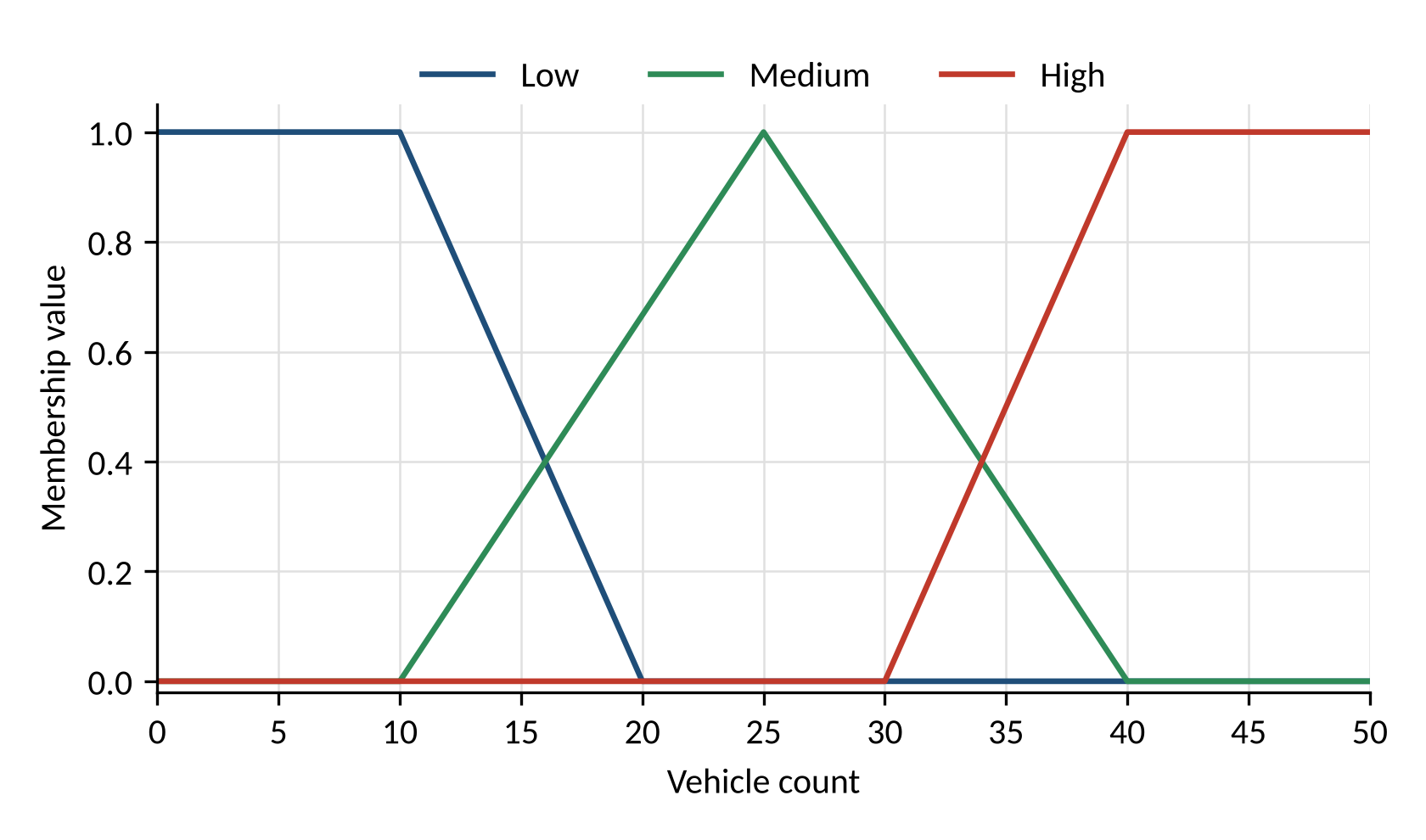
These levels are categorized into fuzzy sets: low, medium, and high, each represented by a membership function. For the low vehicle count, the membership function gradually increases as the number of vehicles approaches 20. This means that for vehicle counts near 0, the membership degree is closer to 1, signifying a clear classification as low traffic. As the vehicle count increases towards 20, the membership value for low traffic decreases, transitioning towards medium traffic.
The medium membership function covers vehicle counts between 20 and 40 cars. This range exhibits partial overlap with both the low and high membership functions, meaning that vehicle counts near 20 have a degree of membership in both low and medium sets, and those near 40 also belong to both medium and high sets. This overlap allows for smooth transitions between traffic states, a hallmark of fuzzy logic.
For high traffic, the membership function starts around 30 cars and reaches full membership at 50 cars. This indicates that as vehicle counts increase above 30, traffic is increasingly classified as high. The gradual nature of the transitions between the fuzzy sets ensures that the system adapts dynamically to changing traffic conditions without abrupt changes in control actions as shown in Figure 1.
4.2Fuzzification of queue length
Figure 2 illustrates the fuzzification of the queue length.
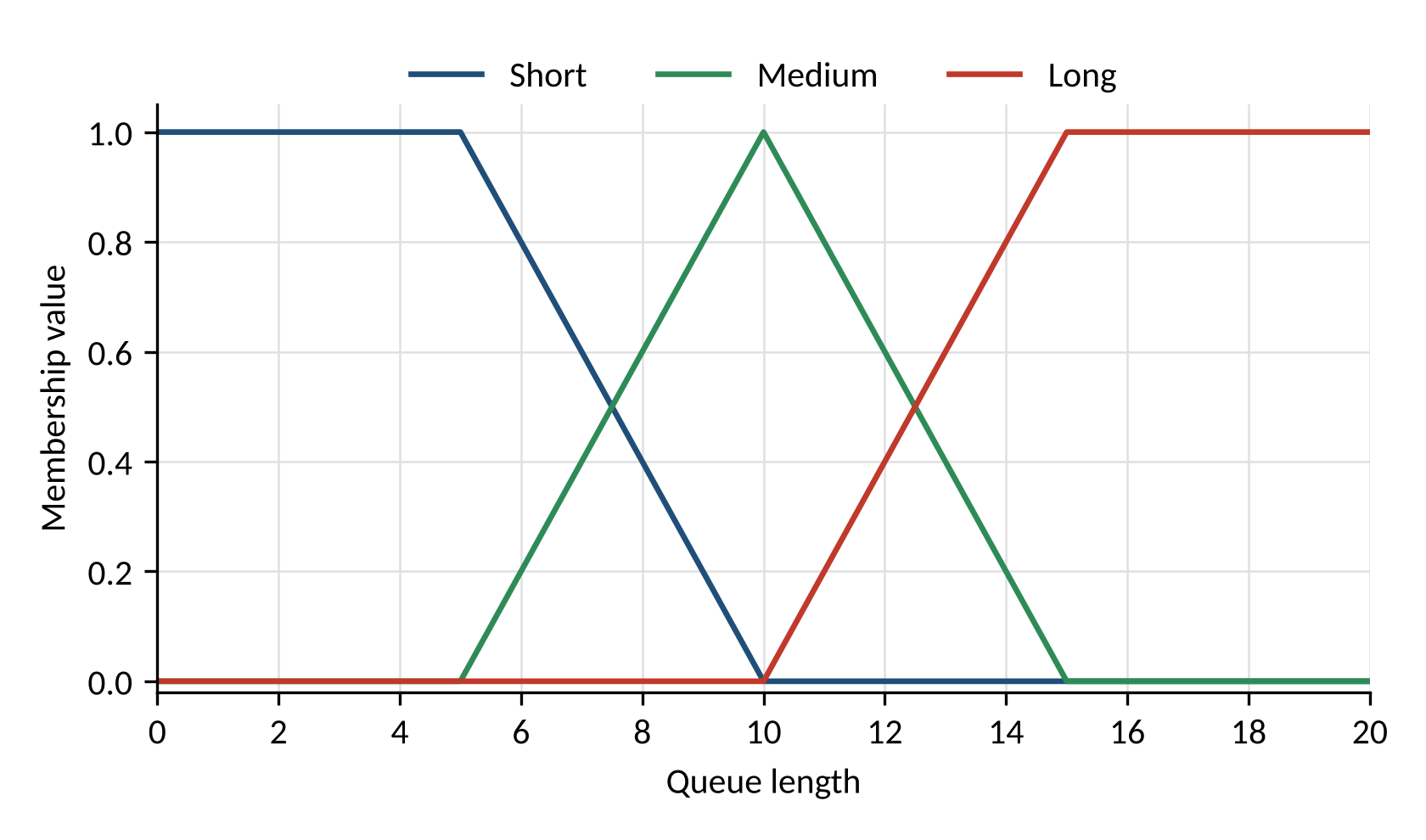
The fuzzification of queue length defines three membership functions: short, medium, and long vehicle queue lengths. For short queue lengths, the membership function covers values from 0 to 10. At lower queue lengths, such as 0 or 1, the membership value is high (close to 1), indicating that these lengths are fully classified as short. As the queue length approaches 10, the membership value decreases, gradually transitioning into the medium category.
The medium membership function spans a queue length of 5 to 15 vehicles. This overlap with the short queue length from 5 to 10 demonstrates the flexibility of fuzzy logic, as a queue length of, say, 8 vehicles would have partial membership in both short and medium categories. This overlapping region allows for smooth transitions between states. Similarly, as the queue count reaches 15, the medium membership begins to taper off, while the long queue membership starts to increase.
The long queue length, which ranges from 10 to 20, increases as the queue length grows beyond 10, becoming fully classified as long around 20 vehicles. This gradual shift between fuzzy sets ensures that the traffic control system can adapt smoothly to varying traffic conditions, allowing for dynamic decision-making based on real-time queue lengths.
4.3Fuzzification of waiting time
Figure 3 shows the fuzzification of waiting time.
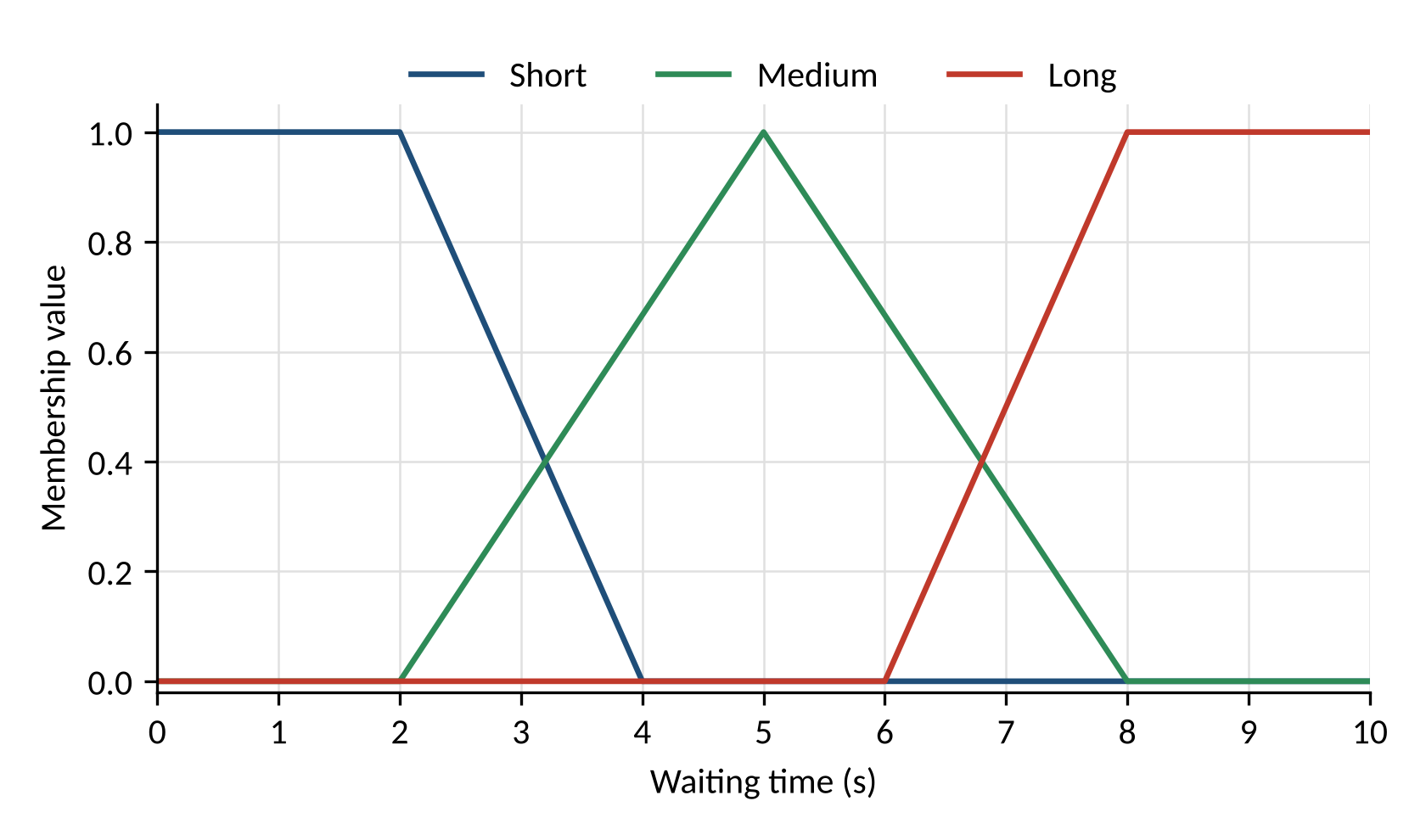
In Figure 3, the fuzzification of the waiting time is represented by three membership functions: short, medium, and long waiting times. For short waiting times, the membership function spans from 0 to 4 seconds. At the lower end of this range, the membership degree is close to 1, indicating that waiting times near 0 seconds are classified as fully short. As the waiting time approaches 4 seconds, the short membership function decreases, allowing a smooth transition into the medium category.
The medium membership function covers waiting times between 4 and 8 seconds. This region overlaps with both the short and long membership functions, meaning that waiting times around 4 seconds have partial membership in both the short and medium sets. Similarly, waiting times around 8 seconds are partially classified as both medium and long. This overlapping of fuzzy sets ensures that waiting times can be flexibly classified and avoids abrupt changes in the system’s control actions.
The long waiting time membership function starts around 6 seconds and reaches full membership at 10 seconds. As the waiting time increases beyond 6 seconds, the system gradually classifies it as long. This approach allows the traffic control system to adjust traffic signals in a flexible and adaptive manner, ensuring optimal traffic flow and minimizing excessive wait times for vehicles at intersections.
4.4Vehicle arrival over time
Figure 4 shows vehicle arrival over a period of time.
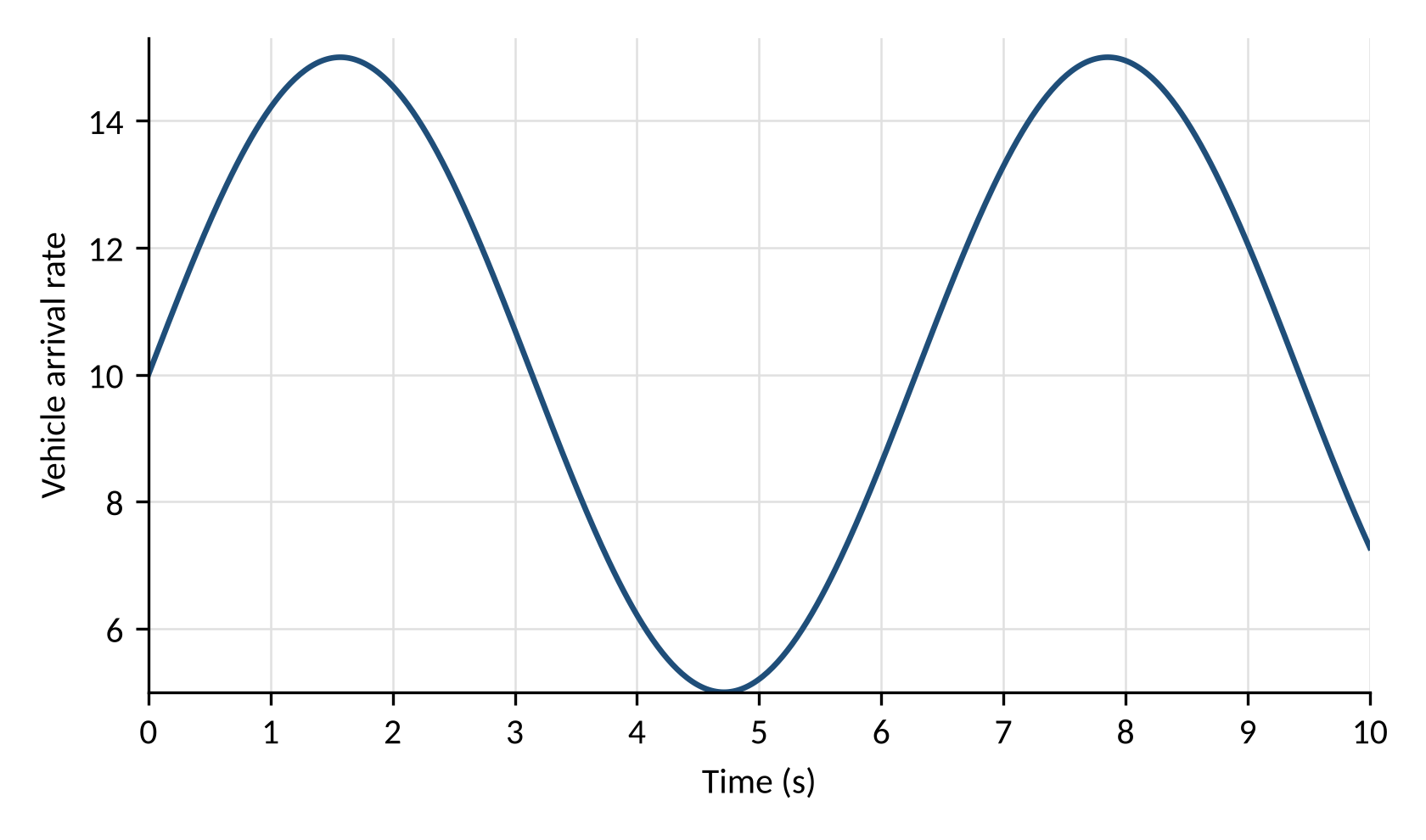
In Figure 4, the graph depicts the fuzzification of the vehicle arrival interval rate for different traffic volumes. The vehicle arrival rate of 10 to 15 cars within 2 seconds represents a high-density traffic flow. In this scenario, the vehicles are arriving rapidly, which causes a sharp increase in the vehicle count over a short period of time. The graph would likely show a steep incline, indicating that the traffic system is experiencing heavy congestion in this range, requiring immediate intervention by the traffic control system, such as increasing the green light duration to ease the flow.
On the other hand, the arrival of over 5 cars within 5 seconds represents a more moderate flow of traffic. This lower vehicle arrival rate would be reflected in the graph as a more gradual slope, indicating a moderate level of traffic density. The system can afford a balanced green light cycle, as the traffic flow is not as overwhelming compared to the previous case.
By using these two intervals for fuzzification, the control system can adapt to varying levels of traffic intensity. The faster arrival rate triggers the need for quicker green light responses, while the slower rate allows for more relaxed timing adjustments, ensuring smooth traffic management at different levels of congestion.
4.5Defuzzified green light duration
Figure 5 shows the defuzzification of the green light duration.
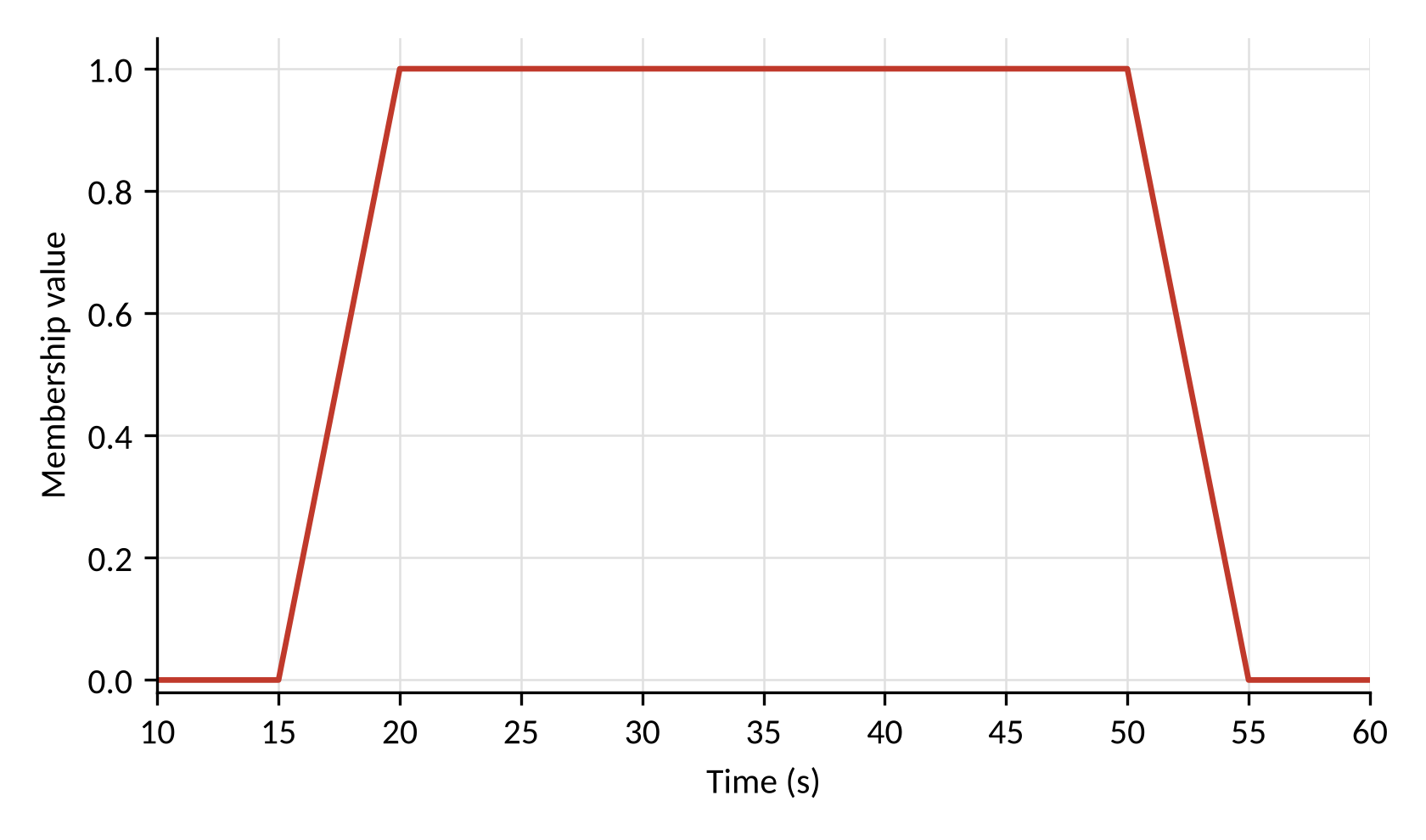
In Figure 5, the graph illustrates the defuzzification of the green light duration, which ranges from 15 to 55 seconds. The defuzzification process translates the fuzzy input data (such as vehicle count, waiting time, and queue length) into a crisp output, in this case, the green light duration.
At the lower end of the range, near 15 seconds, the traffic flow is light, and the green light duration is short because fewer vehicles need to pass through the intersection. As traffic increases, the green light duration gradually extends, accommodating more vehicles to minimize congestion.
The maximum green light duration of 55 seconds corresponds to high traffic density, where a longer green light is needed to clear accumulated vehicles efficiently. The smooth transition in the graph reflects how the fuzzy logic system adjusts the green light timing dynamically, ensuring optimal traffic flow under various conditions, preventing excessive delays while maintaining safety at the intersection.
4.6Queue length over time
Figure 6 shows the progression of queue length over a period of time.
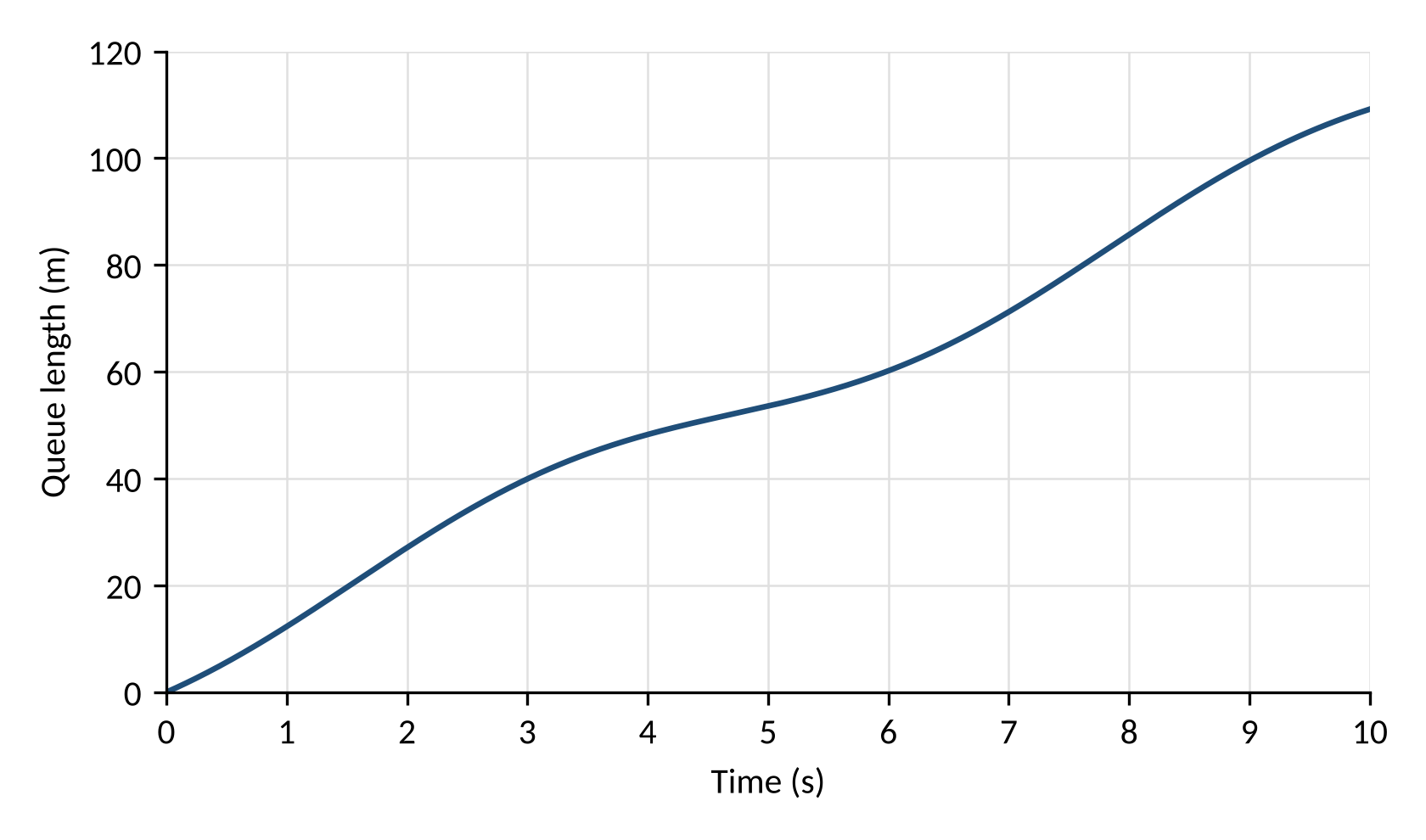
In Figure 6, the graph depicts the progression of queue length over time, showing a rapid increase from 0 meters to 120 meters within just 10 seconds. This sharp rise indicates a significant traffic build-up at the intersection, likely caused by a red light or insufficient green light duration to clear the vehicles.
At the start, the queue length is 0 meters, suggesting no congestion or a cleared intersection. However, as time progresses, the queue quickly grows, reaching 120 meters by the 10-second mark. This rapid accumulation of vehicles points to high traffic demand and potentially inefficient traffic light timing, as the system cannot clear the intersection quickly enough to prevent the queue from expanding.
The graph likely shows a steep, linear incline, reflecting the constant and fast-growing queue. Such results suggest the need for adjustments in the traffic control system, particularly extending the green light duration or adjusting signal phases to accommodate the surge in vehicles. Without proper intervention, the increasing queue length could lead to significant delays and traffic congestion. This graphical representation highlights the importance of dynamic traffic management to adapt to sudden changes in traffic flow and minimize queue build-up at intersections.
5Conclusions
In conclusion, this study successfully demonstrates the effectiveness of a fuzzy logic traffic control system in managing urban traffic flow:
- 1. The project aimed to establish a robust framework for traffic management using fuzzy logic. The results indicated that fuzzy logic outperforms traditional fixed-time systems by adapting to real-time conditions, enhancing responsiveness to fluctuating traffic demands.
- 2. It focused on analyzing vehicle count and its impact on signal timing. The findings revealed that the fuzzy logic system efficiently classified vehicle counts into low, medium, and high categories, allowing for tailored signal adjustments that significantly improved traffic throughput.
References
- [1]Ai-min S. Discussion on countermeasures and intelligent operation mode of division construction for the expressway passenger and freight transport system. China Journal of Highway and Transport. 2020;33(5):1–7.
- [2]Boukerche A, Tao Y, Sun P. Artificial intelligence-based vehicular traffic flow prediction methods for supporting intelligent transportation systems. Computer Networks. 2020;182:107484.
- [3]Bui DT, Hoang ND, Nhu VH. A swarm intelligence-based machine learning approach for predicting soil shear strength for road construction: A case study at Trung Luong National Expressway Project (Vietnam). Engineering with Computers. 2019;35(3):955–965.
- [4]Chen IMA. IMG/M v.5.0: An integrated data management and comparative analysis system for microbial genomes and microbiomes. Nucleic Acids Research. 2019;47(D1):D666–D677.
- [5]Cheng Z, Wang W, Lu J, Xing X. Classifying the traffic state of urban expressways: A machine-learning approach. Transportation Research Part A: Policy and Practice. 2020;137:411–428.
- [6]Cheng Z, Yuan J, Yu B, Lu J, Zhao Y. Crash risks evaluation of urban expressways: A case study in Shanghai. IEEE Transactions on Intelligent Transportation Systems. 2022;23(9):15329–15339.
- [7]Cui Y, Lei D. Design of highway intelligent transportation system based on the internet of things and artificial intelligence. IEEE Access. 2023.
- [8]Ding Y, Jin M, Li S, Feng D. Smart logistics based on the Internet of Things technology: An overview. International Journal of Logistics Research and Applications. 2021;24(4):323–345.
- [9]Enems Project. Design and construction of automatic traffic control system [blog post]. 2017 May 8. https://enemsproject.wordpress.com/
- [10]Jan B, Farman H, Khan M, Talha M, Din IU. Designing a smart transportation system: An Internet of Things and big data approach. IEEE Wireless Communications. 2019;26(4):73–79.
- [11]Traffic light control in vehicular network system using fuzzy logic. European Journal of Computer Science and Information Technology.
- [12]Jiang D. The construction of smart city information system based on the Internet of Things and cloud computing. Computer Communications. 2020;150:158–166.