Electrical Safety and Infrastructure Resilience
Strengthening Electrical Safety and Infrastructure Resilience in Saudi Industrial Facilities: Integrating Arc-Flash Risk Mitigation, Protection Coordination and Energy-Reducing Maintenance Systems
Published October 2026
Abstract
Electrical distribution failures in industrial facilities threaten workers, equipment and continuity of production. Arc-flash severity cannot be controlled through hazard labels or personal protective equipment alone: it is shaped by prospective short-circuit conditions, protective-device operating times, equipment construction and the exposure created by maintenance tasks. This critical review examines how incident-energy mitigation, selective protection coordination and energy-reducing maintenance systems can be designed as one assurance programme for Saudi industrial facilities. A structured, interpretative synthesis of engineering publications dated 2020–2025 compares modelling assumptions, fast-acting protective measures, maintenance-mode arrangements, circuit-breaker health assessment and the challenges introduced by distributed energy resources. Rather than report simulated results, the article derives a practical decision framework linking verified electrical data, scenario-specific studies, task-based controls, commissioning and lifecycle governance. It identifies three recurring tensions: fast tripping versus selectivity, maintenance accessibility versus continuous production, and digital adaptability versus dependable protection. The proposed approach treats safe isolation as the default, applies temporary high-speed protection only within verified operating envelopes and reassesses exposure after network modifications. For Saudi facilities pursuing infrastructure modernisation, the principal implication is that personnel protection and service resilience are complementary only when engineering settings, human work processes and equipment condition are managed together.
Keywords: arc-flash mitigation; incident energy; protective coordination; maintenance switching; circuit breaker condition; Saudi Arabia; industrial resilience
1Introduction
Industrial power systems underpin the availability of petrochemical processes, desalination assets, manufacturing lines, logistics facilities and associated utility services in Saudi Arabia. Their dependence on interconnected switchgear, transformers, motor control centres and standby supplies creates an important design problem: the same protection configuration must limit dangerous electrical energy while preventing avoidable interruptions. Severe internal faults can produce thermal radiation, pressure, molten particles and secondary equipment damage. Circuit interruption is consequently both a personnel-safety intervention and a determinant of production continuity. Technical commentary on IEEE 1584 explains why operating voltage, enclosure geometry, electrode arrangement, arcing current and clearing time must be represented rather than replaced by a generic hazard category [1].
An arc-flash assessment estimates incident energy at an assumed working distance and identifies a boundary for a specified thermal exposure threshold. It does not calculate an individual's probability of injury, guarantee that an enclosure withstands internal pressure, or establish permission for energised work. Reeves and colleagues demonstrate that electrode configurations can change current and exposure predictions in counterintuitive ways [2]. Subsequent application studies reinforce the need to inspect actual equipment geometry and avoid converting convenient default inputs into apparent certainty [3]. Therefore, meaningful mitigation requires a credible electrical model as well as control of the physical tasks performed beside that modelled equipment.
Traditional selectivity protects upstream supply by delaying a main breaker until a downstream protective device has had an opportunity to clear a fault. The delay may leave an arc sustained within the upstream compartment for longer than is acceptable during intrusive work. Research on steel-making facilities indicates that operating-state-dependent settings can reduce calculated exposure while accommodating varying industrial loads [4]. Yet an overly sensitive setting can interrupt an entire process during motor starts or external disturbances. The engineering question is not whether clearing should always be fastest, but when additional speed is justified, how it is enabled and which consequences follow if the control malfunctions.
The Saudi context adds practical complexity. Facilities may combine legacy equipment with newly electrified processes, embedded solar generation, battery storage, high ambient temperatures and stringent operating commitments. Studies of grounding and asymmetrical fault contribution underline the danger of neglecting source characteristics [5], while experimental pressure investigations caution against equating thermal protection with complete blast protection [6]. This review accordingly moves beyond independent discussions of protective settings, maintenance and labels. Its central contribution is an integrated assurance architecture in which arc-flash risk, fault selectivity and maintenance-mode operation are evaluated against the same network scenarios and work activities.
2Aim, objectives and review questions
The study aims to develop an evidence-informed approach for strengthening electrical safety and supply resilience in Saudi industrial facilities through coordinated design and lifecycle control. Its first objective is to identify the technical variables and data-quality limitations governing credible incident-energy estimates. The second is to examine how time-current discrimination can be reconciled with rapid fault clearance. The third is to evaluate energy-reducing maintenance measures, including temporary instantaneous settings, optical detection and compartment-level isolation, alongside their operating restrictions. The fourth is to translate the literature into auditable engineering and organisational decisions appropriate to industrial maintenance.
Three questions organise the synthesis. Which assumptions most strongly affect decisions about arc-flash exposure? Under which conditions does improved personnel protection create an unacceptable loss of selectivity or process availability? What verification, training and monitoring arrangements permit maintenance-specific protection to remain effective after network changes? These are conceptual questions, not hypotheses tested with plant measurements. The paper neither assigns unsubstantiated incident rates to Saudi industry nor claims to measure the effectiveness of a retrofit in a facility that was not examined.
3Review methodology
A structured critical-review method was adopted because the relevant evidence spans thermal hazard modelling, industrial protection engineering, equipment condition monitoring and infrastructure management. The review window was restricted to publications bearing dates from January 2020 through December 2025. Selection emphasised technical relevance, identifiable publication metadata, traceable digital object identifiers and transferable engineering reasoning. Journal articles and selected technical conference papers were eligible. Foundational standards were considered as engineering context, while the numbered bibliography contains only works inside the defined publication window.
Literature was located using combinations of the concepts arc flash, incident energy, protective relay coordination, maintenance switch, fast clearing, optical detection, circuit breaker condition, distribution resilience and Saudi smart grid. Sources were assessed for the physical system studied, treatment of source and operating scenarios, clarity about actual versus simulated results, proposed protection mechanism and limitations of generalisation. Studies addressing only generic artificial intelligence without clear fault protection or asset-management relevance were not treated as primary evidence. Publication titles and DOI strings were cross-checked against identifiable publisher or scholarly catalogue records during preparation.
The synthesis used a thematic matrix organised around hazard estimation, coordination trade-offs, maintenance controls, condition evidence and site governance. Findings were compared qualitatively rather than statistically pooled because methods, switchgear categories, incident-energy assumptions and outcome definitions were not sufficiently uniform. Priority was given to experimentally informed claims where available, and to explicit separation of a demonstrated mechanism from an anticipated operational benefit. This design is a critical narrative review with structured source appraisal; it is not an exhaustive database census or a quantitative effectiveness meta-analysis. No screening totals, effect sizes, site inspections or software simulations are presented as new observations.
Confidence was assigned conceptually rather than numerically. Direct physical evidence supports narrow statements about the equipment and arrangements tested. Simulation supports conditional performance under the specified topology and device models. Reviews and engineering guidance provide wider context but do not establish a site-specific safety outcome. The proposed implementation framework is therefore an analytical product of comparison, not a validated national standard. Its value is to make the necessary assumptions, trade-offs and approval checkpoints visible to engineers responsible for design and maintenance.
For interpretative balance, the review distinguishes engineering validity from implementation feasibility. A fast protective method may be physically persuasive yet impractical in a congested switchroom with uncertain cable identification or limited outage windows. Conversely, a carefully governed conventional protection scheme may provide dependable operation even without extensive automation. The assessment therefore weighs data transparency, configuration specificity, transferability to industrial duty and human verification requirements, instead of ranking publications by technological novelty. This approach is intended to prevent an optimistic literature summary from being mistaken for a commissioned protection design.
4Arc-flash exposure as an engineering variable
Electrical fault severity depends upon more than the maximum available short-circuit current. At particular bus locations, lower arcing currents may fall beneath instantaneous trip thresholds, increasing clearing time and potentially raising incident energy despite reduced fault magnitude. Earlier studies recalculated under updated arc models found that legacy results are not necessarily conservative across all configurations [7]. Accordingly, a credible assessment must consider both high and reduced arcing-current cases, alternate supply arrangements and the trip response associated with each case. A single headline value can conceal the operating state that actually governs exposure.
Equipment construction affects the direction and confinement of energy. An upstream main-breaker line-side compartment may remain energised even after downstream devices are opened, making a load-side setting change irrelevant to the worker's immediate hazard. Comparative research distinguishes arc-resistant equipment, isolation barriers and energy-reducing line-side isolation: they modify different elements of the exposure mechanism and cannot be interchanged without checking their intended protective boundaries [8]. A useful study therefore identifies the precise compartment, accessible conductors, enclosure doors, cable entry and expected body position for each maintenance activity.
The normal condition of doors and shutters matters because interventions such as testing, thermography and troubleshooting can alter the physical barrier protecting personnel. Investigations of arc mitigation under open-door conditions stress that successful tests with doors closed do not automatically represent exposed maintenance situations [9]. More recent examinations of quenching technology likewise make correct configuration and acceptance testing central to performance claims [10]. Consequently, equipment specifications should identify which configurations have been verified and whether fast mitigation depends on sensors, dedicated protection logic, breaker operating capability or a separate extinguishing device.
A hierarchy of prevention remains essential. Establishing an electrically safe work condition, verifying absence of voltage and controlling stored energy are preferable to assuming that a reduced incident-energy estimate makes routine energised intervention desirable. A 2025 engineering-controls review describes why shortening arc duration generally addresses both damage and exposure more directly than relying only on distance [11]. Nevertheless, distance, remote operation, enclosure design, barriers and appropriately selected protective clothing remain useful complementary measures. Each operates on a different pathway of harm; none substitutes for a documented justification of why energised access is necessary.
Uncertainty also arises from the working distance adopted for an activity. A nominal distance derived from the equipment class may differ from the position of hands, upper body or face during probing, tightening or withdrawal. Consequently, task analysis should record the point of potential interaction and whether a remote device genuinely removes the person from the exposed zone. Labels should communicate the approved hazard assessment and its revision state without inviting workers to interpret calculated energy as a promise of safety. Decisions remain subject to isolation procedures, competency and the actual field condition.
5Protection coordination and continuity
Selectivity is often represented using time-current characteristic curves, but a persuasive coordination study also verifies interrupting capacity, relay sensing, current-transformer performance, breaker tolerances and short-circuit withstand. The design task is to protect cables and machines while permitting a downstream device to isolate the smallest practical faulted zone. Task-based risk assessment adds an important distinction: equipment age, maintenance history, operating condition and activity affect exposure even where the calculated incident energy is unchanged [12]. A setting considered adequate for normal closed-door operation may therefore be unsuitable for a planned activity requiring an open compartment.
Coordination should be studied over an operating envelope rather than at a single source strength. Industrial feeders encounter different available fault levels when a utility incomer is disconnected, an emergency generator starts, bus ties close or an inverter-based resource becomes available. The arc-flash programme at a large utility demonstrates the practical value of site-specific calculations and structured decisions when broad worst-case classifications would impose disproportionate burdens [13]. For Saudi plants this suggests maintaining several reviewed configurations, each tied to clear switching conditions and an approved protection setting group, rather than continuously applying the most conservative arrangement regardless of operating duty.
Comparisons across regulatory contexts further show why calculations and work controls must be treated as distinct activities. Applying an established calculation technique does not remove the need to assess equipment tasks, local obligations and competency [14]. Engineering teams should document both the protective device that actually clears the arcing fault and any upstream backup that operates if the preferred device fails. A design that preserves service during ordinary downstream faults can still expose personnel to unacceptable energy within the upstream main compartment. Conversely, indiscriminate reduction of every time delay can enlarge the outage from a minor fault.
The introduction of batteries and variable sources further changes fault response. Battery arc-flash behaviour is not necessarily captured by assumptions developed for alternating-current switchgear; practical battery models explicitly address electrode erosion and self-extinguishing behaviour [15]. Photovoltaic inverters also exhibit control-dependent limited fault contribution, potentially weakening overcurrent sensitivity. The correct response is not simply to choose smaller instantaneous pickups, because inrush, load transfers and downstream transient conditions may then cause nuisance trips. Protection studies must distinguish the thermal exposure calculation from the separate question of secure fault detection and selectivity.
Data collection is itself a protective function. Incorrect fuse identification or outdated device catalogues can invalidate upstream clearing times. Research on deep-learning identification of power fuses illustrates a potential method for reconciling photographic survey evidence with installed components, while leaving final verification to the engineer [16]. The practical baseline includes manufacturer and trip-unit details, long-time and short-time settings, instantaneous thresholds, operating time, CT ratios, conductors, transformer impedances, earthing arrangements and current single-line diagrams. Unverified fields should be flagged explicitly instead of silently filled using assumptions.
Protection acceptance should include sensitivity and discrimination at the weakest credible source condition, not only at maximum utility fault duty. This is especially important when generation transfer changes fault-current magnitude faster than operating teams update documentation. Selectivity margins require allowance for breaker clearing time and relay tolerances; plotted curves that merely touch under idealised assumptions are not convincing evidence of dependable discrimination. Engineers should also inspect whether faster settings remain compatible with transformer energisation, motor acceleration and permissible equipment thermal limits. A setting that works for one event class can still fail a different part of the operational envelope.
6Energy-reducing maintenance operation
Energy-reducing maintenance systems temporarily privilege rapid protective action while a defined task is performed. In one implementation, an authorised local switch selects a low instantaneous threshold or a dedicated high-speed setting group; a prominent indication confirms the selected state. This is conceptually different from permanent coordination, which may incorporate intentional delay to maintain downstream discrimination. It is also different from relying on a maintenance label: the control must alter the actual clearing mechanism or exposure route. The success criterion is not merely an illuminated lamp but verified operation of the protective device for credible arcing-current cases.
A disciplined sequence begins with an explicit permit and an assessment of whether the equipment can instead be isolated. Where energised diagnosis is justified, the competent person verifies equipment identity, maintenance-mode availability and downstream production consequences. The mode is then enabled before approach, independently confirmed and retained throughout the defined exposure window. Following withdrawal, settings are restored under controlled authority, with a documented handback to operations. If the switch is forgotten, disabled, blocked or unexpectedly reset, a normal-looking installation may no longer provide the anticipated exposure reduction.
High-speed arc detection using light and current criteria can support shorter clearing times while reducing false optical triggers. Yet sensor placement, coverage of separate compartments, supply integrity, trip-circuit supervision and the mechanical opening time of the interrupter must be included. A separate arc-quenching device may offer a distinct protective route, but it introduces commissioning, reset and inspection requirements. Reviews comparing tested control concepts advise against treating arc resistance, barriers and active mitigation as universally interchangeable [8–11]. The relevant question is where each measure works, which foreseeable failure disables it, and what residual hazard remains when doors are open.
Maintenance-mode acceleration can compromise coordination. A main breaker placed in instantaneous mode might clear a downstream event ahead of a feeder breaker, turning a local disturbance into a site-wide interruption. For high-consequence processes, a facility may therefore require scheduled production windows, selective zone logic, local isolation, temporary process buffering or an engineered alternative to exposing an energised main. The configuration should be reviewed with both the electrical safety authority and plant operations; personnel safety cannot be delegated to a production-priority decision taken at the point of work.
Protective performance depends on breaker health. Condition assessment based on operating-coil signatures has been used to prioritise inspection and identify degradation in mechanical functions [17]. More recent monitoring frameworks propose analysing operation timings and transient signals to identify deterioration earlier [18]. These methods can enhance maintenance scheduling, but an algorithmic health score does not verify instantaneous clearing during a specific task. Periodic functional tests, trip-circuit checks and evidence of actual protective-device capability remain necessary parts of the maintenance safety case.
Human factors must be treated as engineered interfaces rather than training afterthoughts. A two-position selector with a vague indication provides less assurance than a clearly identified mode, authorised control, conspicuous local status and a defined restoration confirmation. When several breakers protect one working location, activation logic should prevent confusion about which device is in the reduced-energy state. Permits should identify the authorised switching point and the verified protection zone. Periodic drills can test whether personnel recognise an unavailable mode and stop the task instead of improvising an unapproved workaround.
7Changing supply architecture and digital supervision
Where distributed generation is connected, conventional protection settings may lose discrimination or sensitivity. Reviews of protective-device coordination in renewable microgrids identify changes in fault-current magnitude, direction and source contribution as central difficulties [19]. Alternative methods for active distribution networks combine directional, differential and transient features to identify faults despite changing inverter-based contributions [20]. These findings do not justify replacing established industrial protection indiscriminately; they indicate when a fixed overcurrent arrangement must be challenged using the plant's actual grid-connected and islanded operating scenarios.
Adaptive approaches may retain selectivity by updating settings after a recognised change of topology or generation state. Research incorporating photovoltaic generation reports coordination benefits under the modelled operating constraints [21], while work on inverter-dominated networks explores harmonic methods designed to tolerate contingency conditions [22]. Neither result guarantees dependable protection in a particular Saudi plant. Communications delays, incomplete state signals, mismatched relay firmware and unsupervised setting changes create failure modes that should be assessed before adaptive functionality is accepted.
A broad review of inverse-characteristic coordination methods shows that sophisticated optimisation remains bounded by the relay models and fault assumptions chosen by the researcher [23]. Restoration approaches using intelligent control similarly depend upon reliable identification of faulted areas and explicit allowance for communication problems [24]. For industrial application, adaptation should use a small, validated library of setting groups, independently checked enabling conditions and a conservative response to lost communications. Automation must not bypass local isolation authority or permit an unapproved change during an active maintenance permit.
Distributed energy resilience is sometimes used to justify increasingly complex controls. However, avoiding unnecessary trips and sustaining safe conditions are separate outcomes: a system that keeps a process energised may also maintain fault energy at a compartment where people work. Recent studies of sympathetic tripping illustrate how coordination errors can propagate outages beyond the original faulted zone [25]. The engineering objective must therefore include worker exposure, protective dependability, fault containment and time to safe restoration, rather than optimise interruption frequency alone.
8Implications for Saudi industrial facilities
Saudi Arabia's energy transition and expanding industrial base create a setting in which grid modernisation intersects with established heavy-duty electrical installations. A review of smart-grid deployment in the Kingdom identifies digitalisation and renewable integration as important features of this transition [26]. However, national policy alignment should not be confused with evidence of local electrical safety performance. Site-specific hazards depend on switchgear condition, maintenance access, network topology and verified protective settings, not on the existence of a national digital transformation programme.
High ambient temperatures, dust exposure, corrosive coastal environments and process-intensive duty can affect cabinets, sensors, ventilation and breaker mechanisms. These factors are relevant inspection considerations, not a basis for invented failure percentages. Jeddah-based research on smart-grid digital twins explores how monitoring and asset models might improve maintenance decisions [27]; a separate assessment of digital substations identifies structured indicators for examining digitalisation benefits [28]. Applied responsibly, the same ideas support controlled revision of plant one-line diagrams, configuration records and breaker-health histories after expansions or equipment replacement.
The most transferable digital capability is not an autonomous instruction to trip or reset breakers. It is a governed source of truth that links as-built equipment, protection firmware, approved settings, maintenance activity and evidence of test performance. A survey of digital-twin and internet-connected power systems describes condition monitoring as a promising application, while identifying the dependence on trustworthy instrumentation and representations [29]. Such records can support risk-based scheduling, but protection action should remain independently engineered, tested and explainable to the authorised site team.
Hybrid alternating-current and direct-current distribution requires particular attention where solar installations, chargers or storage systems are added near industrial services. Studies using signal decomposition demonstrate that rapid fault identification and coordination can be developed for interconnected AC/DC systems under simulated conditions [30]. Their lesson for implementation is the need to reassess interfaces, not a claim that the approach has already been validated in Saudi industrial settings. Plants should define clear fault domains, isolation boundaries and personnel access rules before new power-electronic resources are commissioned.
9Integrated implementation and assurance framework
Figure 1 translates the review into a linked electrical and work-control architecture. The first gate is verified system information: utility fault duties, transformer data, rotating-machine contribution, device models and actual cabinet arrangements. Engineers then complete load-flow, short-circuit, coordination and incident-energy studies across credible normal, alternate and maintenance configurations. The review of each scenario records the estimated exposure, the clearing device, residual hazards and the load segment that would be interrupted. This sequence makes the safety consequence of a setting visible before a proposed modification is released.
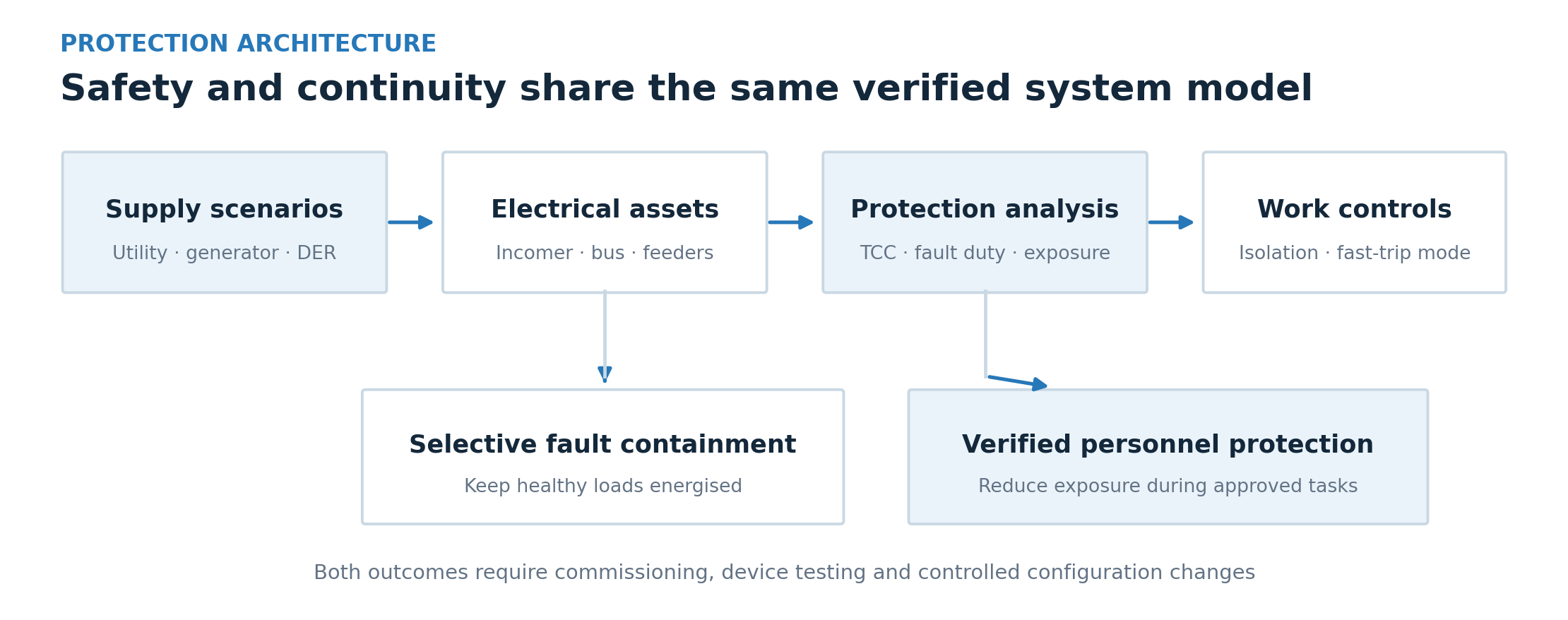
The second gate ranks controls according to the nature of the work and the particular compartment. Planned isolation and test-before-touch procedures are the baseline. Where the work cannot be performed de-energised, the chosen measure might be remote racking, an appropriate barrier, active arc detection, an additional upstream sensing arrangement or a temporary energy-reducing setting. The decision should justify why alternatives were rejected and verify manufacturer limitations. Table 1 compares measures by protective mechanism, operational penalty and evidence required before use; it deliberately avoids unsubstantiated percentage reductions.
| Intervention | Primary protective contribution | Constraint or verification requirement |
|---|---|---|
| De-energise and test | Eliminates planned exposure to accessible live parts. | Requires verified isolation, stored-energy control and safe restart. |
| Selective device settings | Localise faults while limiting upstream disruption. | Check minimum and maximum source duties; retain tested coordination margins. |
| Temporary maintenance mode | Accelerates a designated clearing path during authorised tasks. | Confirm indication, operating envelope, trip-path health and controlled reversion. |
| Optical arc detection | Detects light with current supervision for rapid protection. | Test sensor coverage, auxiliary power, trip logic and configuration with doors open. |
| Arc-resistant or separated compartments | Contain or redirect effects or remove accessible line-side exposure. | Confirm tested equipment configuration and remaining access restrictions. |
| Remote operation and asset monitoring | Increase distance and detect degradation before intrusive access. | Demonstrate task-specific separation and verify monitoring against field tests. |
The third gate is commissionable protection logic. For each mode, the site should specify the initiating switch or command, permitted users, interlocks, expected indications, protection settings, clearing-device identity and fail-safe response. Acceptance testing verifies logical paths under controlled conditions and confirms that the installation returns to normal coordination. A relay setting file alone is insufficient: the breaker mechanism, trip supply, wiring, indications and protection-zone coverage must operate as intended. The test record becomes part of the maintenance authorisation package.
The fourth gate establishes management of change. Any modification to a transformer, utility connection, generator contribution, bus tie, feeder size, relay firmware or accessible enclosure initiates a documented review of affected fault levels and operating modes. Industrial expansions should not inherit old hazard labels merely because voltage has not changed. Figure 2 shows the iterative assurance cycle: change identification, targeted study, implementation, competence verification, task authorisation, operating evidence and reassessment. The cycle has no automatic claim of zero risk; it is a practical means of preventing model obsolescence.
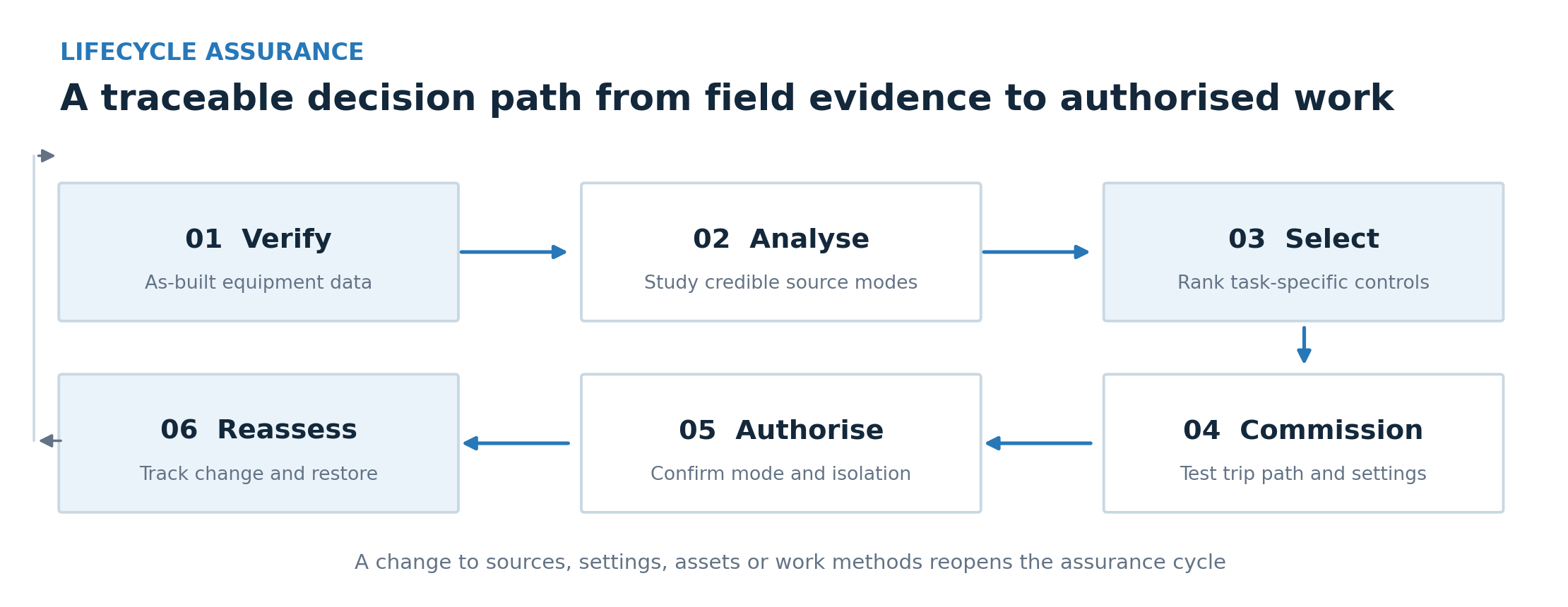
An assurance file should contain the single-line diagram revision, study assumptions, approved protection setting group, equipment list, label revision, critical-task register, functional-test result, maintenance-switch status checks and competency evidence. Each record needs an owner and a review trigger. Table 2 proposes minimal decision gates and evidence examples that could be audited without disclosing sensitive plant configurations. The evidence is especially useful where original equipment manufacturers, contractors and in-house electrical teams share responsibility for different portions of an installation.
| Decision gate | Representative evidence | Release or stop criterion |
|---|---|---|
| Field baseline | As-built one-lines, source contribution, trip-unit identity, asset photos | Unknown inputs formally resolved before release |
| Scenario study | Fault current, arcing current, time-current curves, incident-energy results | Relevant supply and work states are covered |
| Engineering decision | Selected control, protected compartment, process-loss assessment | Residual hazard and selectivity conflict reviewed |
| Site acceptance | Trip-circuit test, setting files, interlocks, optical or switch checks | Protective mode and normal reversion demonstrated |
| Work authorisation | Permit, isolation test, mode confirmation, competent approver | No access if defined conditions are unmet |
| Lifecycle revision | Change log, maintenance records, periodic verification | Re-study after material configuration changes |
Performance indicators should be chosen before implementation. Suitable measures include the proportion of critical boards with current studies, completion of overdue breaker tests, verified restoration of normal settings after maintenance and the frequency of configuration changes triggering reassessment. These are process indicators rather than substitutes for injury statistics or proofs of reduced incident energy. Any claimed safety benefit should be linked to a documented change in credible exposure, with the relevant settings and fault scenarios retained for inspection. The governance objective is to identify drift early enough for corrective action, rather than declare success from the installation of a new device.
10Critical discussion and research agenda
The literature supports a consistent physical proposition: shorter credible arc duration commonly reduces thermal incident energy. It does not support a universal intervention ranking independent of equipment geometry, task exposure and supply arrangement. Selectivity remains necessary to contain disturbances; maintenance-mode acceleration is justified only where the temporary protection boundary and plant consequence have been established. The combined approach therefore converts a false opposition between safety and continuity into a transparent engineering trade-off. Neither fastest overall tripping nor maximum uptime is an adequate standalone design objective.
Evidence gaps are substantial. Published investigations use different enclosures, arc assumptions and switching states; comparison across sites is difficult without reporting the same minimum input variables. Digital monitoring studies may show credible diagnostic potential without demonstrating improved injury outcomes. Testing of quenching arrangements may represent configurations unlike open-door maintenance. For Saudi industry, prospective research should compare verified before-and-after settings in representative low- and medium-voltage installations, record protection performance during controlled tests and collect anonymised indicators of maintenance-mode usage, inappropriate activation and restoration errors.
Future evaluations should report the full scenario envelope, including low arcing-current conditions, alternate sources and credible protective failures. They should separately measure protection sensitivity, selectivity, trip-path availability, exposure duration and production interruption. Qualitative interviews with authorised electricians and operations personnel could reveal whether mode indications, work permits and handback procedures are understood. Such mixed evidence would be more useful to asset owners than broad claims that digital technology or faster relays independently eliminate arc-flash danger.
11Conclusion
Electrical safety in Saudi industrial facilities is strengthened most credibly when incident-energy assessment, selective fault isolation and maintenance-specific protection are managed within one engineering process. This review finds that the decisive issues are not simply equipment ratings or nominal fault levels, but verified modelling inputs, the actual arcing-current operating point, physical accessibility, device clearing performance and disciplined transition between normal and maintenance configurations. Active mitigation and condition monitoring can improve the available options; neither releases the employer from prioritising safe isolation and verifying the protection actually installed.
The proposed framework requires scenario-based studies, task-specific engineering controls, explicit approval of temporary fast-trip modes, functional commissioning and revision after system changes. It preserves a necessary distinction between personnel exposure and the ability to keep unaffected processes energised. For industrial modernisation programmes, the practical priority is an auditable connection between network data, protective settings, work authorisation and operating evidence. Further site-based research is required before quantitative safety or reliability benefits can be attributed to this approach. Any proposed retrofit should pass independent design review and documented site acceptance testing before maintenance permits rely upon its protective function; otherwise the apparent reduction in risk remains an unverified assumption.
References
- [1]Mohla D, Lee WJ, Phillips J, Marroquin A. Introduction to IEEE Standard 1584: Guide for Performing Arc-Flash Hazard Calculations, 2018 Edition. IEEE Industry Applications Magazine. 2020;26(5):64–76. https://doi.org/10.1109/MIAS.2020.2982574
- [2]Reeves A, Freyenberger M, Hodder M. Understanding the Effect of Electrode Configuration on Incident Energy and Arc-Flash Boundary. IEEE Transactions on Industry Applications. 2020;56(6):6069–6075. https://doi.org/10.1109/TIA.2020.3023918
- [3]Reeves A, Hodder M, Freyenberger M. A Practical Application of IEEE Std 1584–2018. In: IEEE IAS Pulp and Paper Industry Conference; 2022. https://doi.org/10.1109/PPIC52995.2022.9888925
- [4]Ustariz-Farfan AJ, Cano Plata EA, Arias-Guzman S. Adaptive Commissioning Methodology for Arc-Flash Mitigation in Steel Making Users. IEEE Transactions on Industry Applications. 2021;57(1):1129–1137. https://doi.org/10.1109/TIA.2020.3031548
- [5]Chaparro JV, Ramos G, Celeita D. The Effects of Means of Grounding and Asymmetrical Current on Arc Flash. In: IEEE/IAS Industrial and Commercial Power Systems Technical Conference; 2021. https://doi.org/10.1109/ICPS51807.2021.9416617
- [6]Hoagland H, Maurice C, Haines A, Maurice A. Arc Flash Pressure and Door Ejection Measurement. IEEE Transactions on Industry Applications. 2020;56(4):3297–3305. https://doi.org/10.1109/TIA.2020.2994183
- [7]Valdes M, Floyd H. Considerations for Adapting IEEE 1584-2002 Arc Flash Study Results to a Post IEEE 1584-2018 Risk Assessment. IEEE Transactions on Industry Applications. 2021;57(6):5562–5570. https://doi.org/10.1109/TIA.2021.3105620
- [8]Carne C, Brown WA, Clark HH, McConnell M. Comparison of Low-Voltage Arc-Resistant Equipment, Equipment With Isolation Barriers, and Equipment With Energy-Reducing Line-Side Isolation for Reduction of Arc-Flash Hazards. IEEE Transactions on Industry Applications. 2024;60(5):7930–7939. https://doi.org/10.1109/TIA.2024.3409522
- [9]Kay JA, Arvola J, Manninen M. Doors Wide Open: Safety Beyond the Standards. In: IEEE IAS Electrical Safety Workshop; 2023. https://doi.org/10.1109/ESW49992.2023.10188256
- [10]Kay JA, Arvola J, Manninen M. Do Arc Mitigating Systems Really Work? IEEE Transactions on Industry Applications. 2025;61(5):8264–8272. https://doi.org/10.1109/TIA.2025.3567430
- [11]Camponogara M, Spellmeier JP, Bacin PO, Bernardon DP, Bender VC, Simoes CA, et al. Reducing Arc-Flash Risk: A Review of Engineering Controls. In: IEEE ESW Brazil – Electrical Safety Workshop Brazil; 2025. https://doi.org/10.1109/ESWBrazil64921.2025.11277914
- [12]Scarborough MS. Electrical Equipment Task-Based Risk Assessment: Using the Hazard Rating Number Method. IEEE Industry Applications Magazine. 2025;31(3):43–53. https://doi.org/10.1109/MIAS.2025.3531722
- [13]Gamage A, Jackson S, Therrien P. 347/600 Volt Arc Flash Mitigation at British Columbia Hydro. In: IEEE IAS Electrical Safety Workshop; 2023. https://doi.org/10.1109/ESW49992.2023.10188315
- [14]Ruta M. Arc Flash Risk Assessment: Experiences from Projects in EU. In: IEEE IAS Electrical Safety Workshop; 2024. https://doi.org/10.1109/ESW52258.2024.10752771
- [15]Rosewater D, Gordon LB, Cantor W. Practical Battery Arc-Flash Models. In: IEEE IAS Electrical Safety Workshop; 2025. https://doi.org/10.1109/ESW58401.2025.11159144
- [16]Giard-Leroux S, Cléroux G, Kulkarni SS, Bouffard F, Vallières M. Electric Power Fuse Identification With Deep Learning. IEEE Transactions on Industrial Informatics. 2023;19(11):11310–11321. https://doi.org/10.1109/TII.2023.3245645
- [17]Aranizadeh A, Shahrtash SM, Gholami A. Comprehensive condition assessment of circuit breakers in a power network for maintenance scheduling. IET Generation, Transmission & Distribution. 2023;17(15):3463–3476. https://doi.org/10.1049/gtd2.12908
- [18]Rouhani SH, Chiang CY, Su CL, et al. An Intelligent Predictive Maintenance Framework for High Voltage Circuit Breakers in Smart Grids Using Condition Monitoring Data. In: IEEE Industry Applications Society Annual Meeting; 2025. https://doi.org/10.1109/IAS62731.2025.11061458
- [19]Reiz C, Leite JB. Protection Devices Coordination in Distribution Systems with Microgrids Powered by Renewable Distributed Generation. IEEE Access. 2022. https://doi.org/10.1109/ACCESS.2022.3203713
- [20]Adewole AC, Rajapakse AD, Ouellette D, Forsyth P. Protection of active distribution networks incorporating microgrids with multi-technology distributed energy resources. Electric Power Systems Research. 2022;202:107575. https://doi.org/10.1016/j.epsr.2021.107575
- [21]Dorosti P, Moazzami M, Fani B, Siano P. An adaptive protection coordination scheme for microgrids with optimum PV resources. Journal of Cleaner Production. 2022;340:130723. https://doi.org/10.1016/j.jclepro.2022.130723
- [22]Sati TE, Azzouz MA, Shaaban MF. Adaptive harmonic-based protection coordination for inverter-dominated isolated microgrids considering N-1 contingency. International Journal of Electrical Power & Energy Systems. 2024;156:109750. https://doi.org/10.1016/j.ijepes.2023.109750
- [23]Alasali F, Mustafa H, Saidi AS, et al. The recent development of protection coordination schemes based on inverse of AC microgrid: A review. IET Generation, Transmission & Distribution. 2024;18(1):1–23. https://doi.org/10.1049/gtd2.13074
- [24]Hojjaty M, et al. Intelligent protection coordination restoration strategy for active distribution networks. IET Generation, Transmission & Distribution. 2022. https://doi.org/10.1049/gtd2.12238
- [25]Almoola A, Ahmed S, Gatsis N. Optimal Protection Coordination for Mitigating Sympathetic Tripping in DER-Integrated Power Systems. In: IEEE Texas Power and Energy Conference; 2025. https://doi.org/10.1109/TPEC63981.2025.10906986
- [26]Khan KA, Quamar MM, Al-Qahtani FH, et al. Smart grid infrastructure and renewable energy deployment: A conceptual review of Saudi Arabia. Energy Strategy Reviews. 2023;50:101247. https://doi.org/10.1016/j.esr.2023.101247
- [27]Khan SA, Rehman HZU, Waqar A, et al. Digital Twin for Advanced Automation of Future Smart Grid. In: International Conference on Advanced Innovations in Smart Cities, Jeddah; 2023. https://doi.org/10.1109/ICAISC56366.2023.10085428
- [28]Santos GR, Zancul E. A framework to assess the impacts of digital electrical substations. Smart Energy. 2023;12:100125. https://doi.org/10.1016/j.segy.2023.100125
- [29]Mansour DEA, Numair M, Zalhaf AS, et al. Applications of IoT and digital twin in electrical power systems: A comprehensive survey. IET Generation, Transmission & Distribution. 2023;17(20):4457–4479. https://doi.org/10.1049/gtd2.12940
- [30]Abd el-Ghany HA, Elmezain MI, Rashad EM, Ahmed ES. Discrete-wavelet-based scheme for protection coordination of hybrid AC/DC distribution networks. Alexandria Engineering Journal. 2024;90:76–88. https://doi.org/10.1016/j.aej.2024.01.060