Case Evaluation and Benefits Management
Integrating Business Case Evaluation and Benefits Management in Saudi Mining Investment Portfolios under Vision 2030
Published October 2026
Abstract
Mining investment appraisal frequently concentrates on forecast financial returns, while benefits management focuses on outcomes after assets become operational. Treating these activities separately weakens accountability when scope, delivery dates, market conditions, or operating assumptions change. This paper develops an integrative framework connecting business case evaluation and benefits management in Saudi mining investment portfolios under Vision 2030. A targeted review of scholarly literature and official reporting informs the analysis of benefit formulation, governance, portfolio constraints, digital evidence, and post-investment evaluation. The proposed framework links an assumption register, benefit ownership, staged authorization, delivery monitoring, operational verification, and portfolio reassessment. It distinguishes physical outputs from realized outcomes and corporate financial changes from attributable project benefits. A transparent hypothetical discounted-cash-flow exercise shows how delay, benefit shortfall, and capital-cost escalation can reverse an apparently favorable investment case. Three tables define appraisal criteria, benefit records, and review responsibilities; an original diagram represents the proposed feedback architecture. The framework remains conceptual and requires testing with authorized project records. Its contribution is a practical account of how investment promises can remain connected to measurable outcomes throughout the project and operating lifecycle.
Keywords: business case; benefits management; mining investment; portfolio governance; investment appraisal; Saudi Vision 2030
1Introduction
Saudi mining investment combines economic diversification ambitions with demanding technical and commercial conditions. Extraction and processing assets depend on resource interpretation, metallurgical performance, infrastructure, equipment supply, and operating capabilities. A project may deliver its physical scope while failing to achieve planned production or economic value. Conversely, an investment may remain strategically useful despite changes in its original configuration. Business case evaluation must therefore remain connected to benefits management after the initial funding decision, rather than ending when construction begins.
Official Vision 2030 reporting identifies mining as a component of national economic diversification (Saudi Vision 2030, 2024). This establishes a relevant policy context but does not demonstrate the merits of every mining investment. Each project needs its own explanation of value, uncertainty, and delivery requirements. Relevant benefits may include profitable capacity, downstream integration, reliable supply, workforce capability, and improved resource efficiency. Their importance should be assessed through observable mechanisms and explicit responsibilities, without assuming that a reference to national strategy validates otherwise weak investment assumptions.
The research problem concerns continuity between appraisal and outcomes. Business cases can be updated to obtain approval without preserving why assumptions changed. Benefits may be transferred to operations without agreed baselines or accountable owners. Portfolio committees can then compare projects using financial models whose timing, risk treatment, and benefit definitions differ. This paper proposes a connected decision structure that retains assumptions, tracks enabling conditions, and supports reassessment when the expected value of an investment changes.
The study aims to integrate investment evaluation, benefit ownership, and portfolio governance. Its objectives are to distinguish outputs from benefits, define comparable appraisal evidence, identify portfolio dependencies, and propose a validation design. Three questions guide the analysis: how should benefits be formulated before authorization; how should changing delivery evidence affect investment decisions; and how can realized benefits be evaluated without confusing market movements with project performance? No company interviews or confidential project datasets are presented.
2Review methodology
A targeted integrative review was selected because the topic spans investment appraisal, benefits realization, governance, portfolio management, and mining risk. Snyder (2019) provides methodological guidance on aligning review design with research purpose. Searches conducted on 12 October 2026 used combinations of business case evaluation, project benefits management, mining investment, portfolio selection, front-end decisions, and digital project controls. Publisher-hosted records and accessible scholarly material were prioritized. Official reporting supported contextual statements rather than claims of causal effectiveness.
Authenticated Scopus and Web of Science database searches were not performed. Interpretation of subscription-restricted sources was limited to accessible abstracts and publisher descriptions. Sources were retained when they explained a relevant mechanism or limitation; promotional savings claims and unsupported success rates were excluded. Foundational studies were included because benefit formulation and governance concepts remain central to the question. No screening counts, interview findings, empirical correlations, or mining-project outcomes were invented.
Evidence was synthesized around five relationships: strategic intent to benefit definition, assumptions to valuation, delivery to operational readiness, ownership to accountability, and project outcomes to portfolio reassessment. Each relationship was translated into proposed records and decision rules. The synthesis distinguishes published findings from the original framework. Its targeted coverage cannot establish an exhaustive evidence base, pooled performance estimates, or universal approval thresholds. A systematic-review submission would require a broader documented search and full-text appraisal.
3Business cases and benefits realization
Benefits management extends evaluation beyond the delivery of an asset. Serra and Kunc (2015) report associations between benefits realization practices and strategic project value, while Laursen and Svejvig (2016) connect project value creation to benefits and strategic management. The implication for mining portfolios is that completing a concentrator, utility connection, or logistics facility is an enabling output. Its value depends on subsequent operating outcomes and the costs incurred to achieve them.
Chih and Zwikael (2015) identify criteria for formulating target benefits, including measurability, realism, timing, and accountability. Zwikael et al. (2018) further develop specificity, attainability, and comprehensiveness as dimensions of effective target benefits. Applied here, increased capacity requires a defined product, measurement boundary, target period, and evidence of the operating conditions supporting the target. A statement such as improved competitiveness is insufficient until the investment team explains which observable changes would demonstrate improvement.
Benefits are also stakeholder-dependent. Breese (2012) questions simplifying assumptions in benefits realization practice, indicating that formal measurement arrangements may not capture every interpretation of value. Mining investment can create benefits for owners while imposing burdens on other parties. A credible business case should therefore disclose material adverse outcomes, competing objectives, and uncertain distributional effects. It should avoid presenting all consequences as positive or assigning financial values to nonfinancial outcomes without an explicit valuation method.
The business case should describe options rather than only justify a preferred project. Williams and Samset (2010) discuss complexity, ambiguity, and bias in front-end decisions; Samset and Volden (2016) distinguish strategic investment success from tactical delivery performance. Comparing expansion, phased development, alternative processing routes, and deferral can reveal whether the selected concept remains preferable. The options must use compatible assumptions about resources, prices, timing, and infrastructure so that differences in value reflect genuine choices.
Babaei et al. (2021) identify interconnected front-end issues in infrastructure megaprojects. Their evidence supports examining dependencies, although it cannot establish Saudi mining effects. A profitable processing concept may depend on utility readiness or transport capacity outside its delivery boundary. The appraisal should identify these enabling investments, their owners, and their schedules. Omitting their cost or assuming immediate availability can exaggerate value even when the plant’s own capital estimate is technically credible.
| Criterion | Evidence | Decision concern |
|---|---|---|
| Benefit quality | Owner, baseline, target and date | Vague or unattainable outcome |
| Financial value | Consistent cash-flow assumptions | Unexplained valuation boundary |
| Technical basis | Resource and process evidence | Unresolved critical assumption |
| Delivery readiness | Cost, time and interface evidence | Benefits delayed by dependencies |
| Portfolio fit | Resource and infrastructure demand | Competing shared commitments |
| Adverse effects | Disbenefits and affected stakeholders | Material consequences omitted |
4Portfolio evaluation and governance
Portfolio evaluation considers a set of investments under shared constraints. Patanakul (2015) describes strategic and operational attributes of portfolio effectiveness, including alignment, adaptability, transparency, and delivery predictability. Blichfeldt and Eskerod (2008) show why portfolios can be distorted when unrecognized projects consume resources. Mining owners should therefore include supporting infrastructure, studies, sustaining capital, and operational improvement initiatives when assessing capacity constraints, rather than considering only formally designated growth projects.
Marques et al. (2022) present a multicriteria portfolio approach using partial information about decision preferences. Their work supports making trade-offs explicit instead of pretending that one financial indicator resolves every choice. Financial attractiveness, execution risk, infrastructure dependency, strategic contribution, and resource demand can inform comparison. Mandatory requirements should remain separate: a high commercial score cannot compensate for an unresolved critical technical or legal condition. This paper does not propose universal weights or nationally applicable pass marks.
Too and Weaver (2014) connect governance to portfolio choice, sponsorship, PMO oversight, and delivery management. Biesenthal and Wilden (2014) emphasize multiple organizational levels. Applied to investment portfolios, these perspectives require a distinction between project-level scope decisions and portfolio-level capital allocation. A project team can optimize its own outcome while consuming scarce engineering or commissioning resources needed elsewhere. Portfolio review should therefore examine interactions and opportunity costs rather than simply aggregate independently approved business cases.
Musawir et al. (2017) investigate relationships between governance, benefits management, and project success, while Musawir et al. (2020) identify the need for context-specific governance guidance. These studies support connecting decisions to benefit responsibilities, but they do not validate the present mining framework. Derakhshan et al. (2019) add the importance of external stakeholder relationships, and Müller et al. (2014) examine organizational enablers. Governance needs both defined authority and practical capacity to challenge an investment’s assumptions.
Staged commitment can preserve investment flexibility. Cooper (2008) discusses scalable gate discipline in product development; its transfer to mining requires sector-specific evidence. Early authorization may fund studies, while later authorization permits major procurement or construction. Each decision should specify what is being committed, which assumptions remain uncertain, and what evidence is needed next. A gate should permit return, redesign, or termination when the investment case is no longer defensible.
Portfolio selection should distinguish mandatory sustaining investments from discretionary growth opportunities. A safety-critical replacement may have limited standalone financial upside while remaining necessary to operate the existing asset. Such projects need a defensible justification and proportional appraisal, but ranking them alongside optional expansion solely by net present value can misrepresent the decision. The committee should first establish required commitments, then examine remaining capital and execution capacity. Where mandatory work enables growth, the relationship should be recorded explicitly. This prevents attractive expansion cases from absorbing resources needed to maintain the operating foundation on which their benefits depend.
5Mining valuation and portfolio risk
Financial appraisal should separate operating cash flows, capital expenditure, sustaining requirements, and closure obligations within a stated boundary. Net present value expresses discounted net cash flows relative to investment expenditure, but the result depends on price, quantity, timing, and cost assumptions. A positive value is not evidence that these assumptions will occur. Sensitivity and scenario analysis should identify which variables dominate the decision and which dependencies can be influenced by management.
Faúndez and Guzmán (2025) analyze mining cost deviation through price, quantity, and delay relationships. Their decomposition supports examining drivers rather than treating every unfavorable variance alike. Quantity growth may arise from incomplete definition; price changes may be external; delay can increase indirect costs and postpone benefits. The benefit record should preserve these distinctions so that a revised forecast explains why value changed and whether the response addresses the relevant cause.
Portfolio risks can be correlated. Projects may share suppliers, labor markets, utilities, or exposure to the same commodity cycle. Individually acceptable contingencies do not establish that the portfolio can absorb simultaneous adverse events. The owner should examine common assumptions and competing resource demands, retain explicit scenario boundaries, and test the consequences of deferral or resequencing. This analysis should avoid claiming diversification benefits where several investments depend on the same underlying market or infrastructure constraint.
Corporate reporting provides commercial context but cannot replace project attribution. Ma’aden’s annual report describes consolidated financial performance (Ma’aden, 2025). Changes in revenue can reflect commodity prices, volumes, acquisitions, or portfolio composition. A project benefit evaluation needs a defined baseline and explanation of incremental contribution. Increased corporate revenue alone cannot demonstrate that a particular investment realized its original business case or that benefits management improved performance.
Benefit attribution needs a counterfactual: an explanation of what would probably have occurred without the investment. For an expansion, this could involve a documented continuation of existing operations under comparable market assumptions. For an efficiency project, it could involve an adjusted operating baseline that accounts for throughput or input quality. The comparison should disclose uncertainty rather than imply perfect causal identification. Changes in commodity prices can then be reported separately from production changes attributable to the project. Where attribution cannot be isolated reliably, reviewers should report contribution and evidence strength instead of presenting an unsupported precise financial benefit.
6Proposed integrated framework
Figure 1 presents an original framework connecting investment assumptions, portfolio decisions, delivery controls, and operational benefit verification. The assumption register records the basis of valuation and the evidence supporting it. A linked benefit register defines outcomes, owners, baselines, targets, and measurement periods. Authorization records accepted uncertainty and permitted commitments. Delivery evidence updates expected cost and benefit timing, while operational evaluation compares outcomes with the original and revised promises.
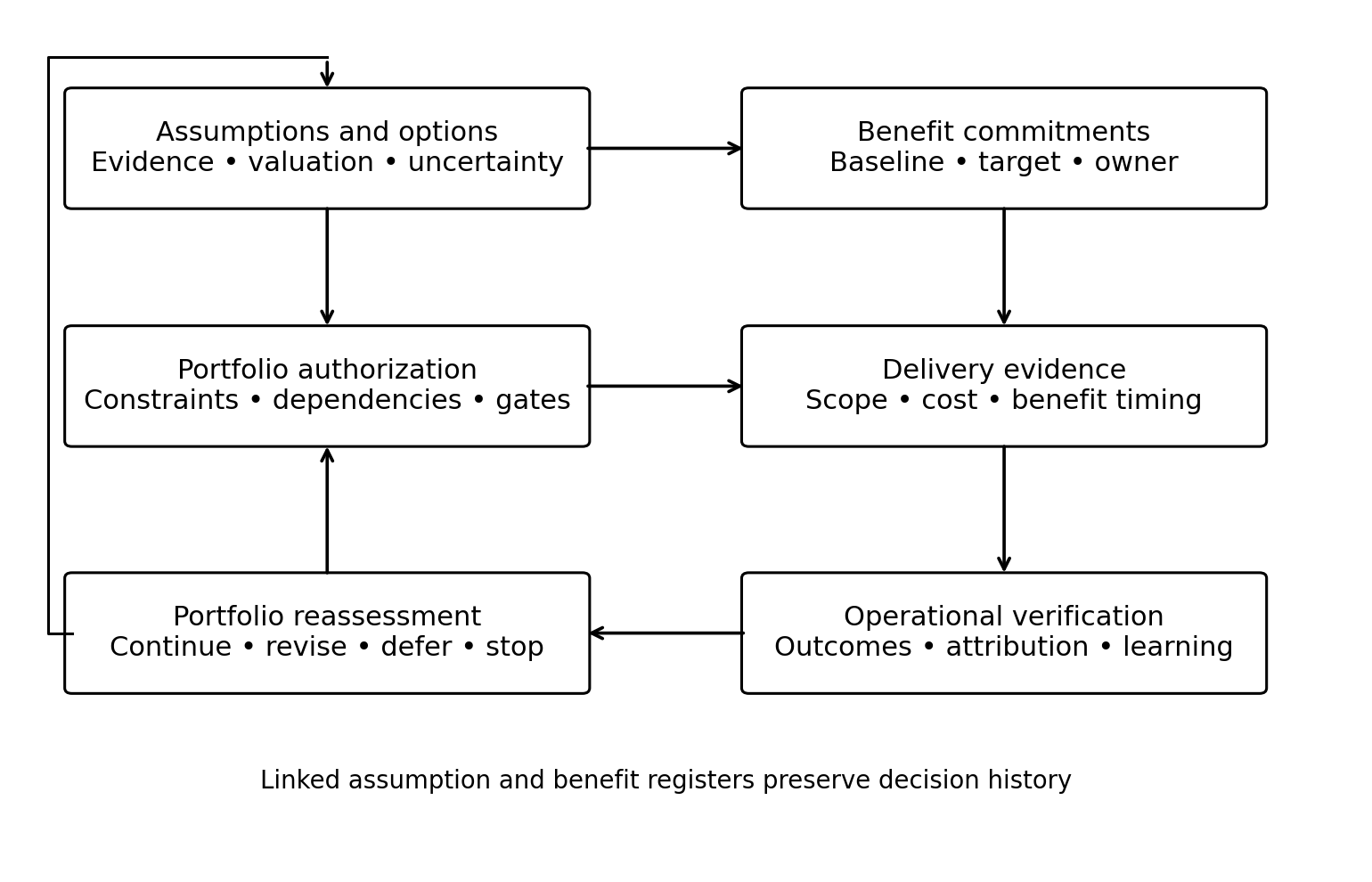
The benefit owner should normally belong to the function able to realize the outcome. Operations can own production and reliability benefits, finance can validate valuation and reporting boundaries, and technical specialists can certify process assumptions. Project management delivers agreed outputs and supports transition. The PMO coordinates records and review consistency, while the investment committee decides whether revised exposure remains acceptable. Assigning every benefit to the project manager would overlook the operating decisions needed after handover.
Table 1 defines proposed appraisal tests, and Table 2 presents a benefit-register structure. Benefit definitions should distinguish direct contribution from enabling contribution. A utility project can enable several production investments, but its value should not be counted repeatedly as though each dependent project independently created the same infrastructure benefit. Portfolio records should allocate contributions or explicitly identify shared benefits. Targets, baselines, and attribution rules should be approved before outcomes are measured.
| Field | Required record | Purpose |
|---|---|---|
| Benefit identity | Outcome and portfolio link | Prevent duplicate counting |
| Measurement | Unit, baseline and target | Make change observable |
| Timing | Expected realization period | Connect delay to value |
| Owner | Accountable operating function | Preserve post-handover responsibility |
| Dependencies | Enabling outputs and assumptions | Expose conditional benefits |
| Attribution | Comparison and adjustment method | Separate markets from project effects |
| History | Original and revised commitments | Retain approval evidence |
Digital integration can improve traceability when common identifiers link assumptions, work packages, estimates, risks, and benefit records. Chen et al. (2025) emphasize sociotechnical integration in project management, and Vial (2019) describes organizational changes surrounding digital transformation. A linked register therefore needs ownership, revision control, and decision procedures. A dashboard displaying current values should retain historical snapshots so reviewers can determine what was known when authorization occurred.
Delivery measures also need boundaries. Aramali et al. (2022) review earned value systems and the gap between research and practice. Cost and schedule performance can signal threats to benefit timing, but favorable delivery indices do not demonstrate realized investment value. A project may meet its construction budget while its operating assumptions deteriorate. The proposed framework therefore maintains separate delivery and benefit measures, linked through identified consequences rather than combined into an unexplained success score.
Table 3 specifies review responsibilities across the lifecycle. A material change should trigger reassessment of affected benefits, remaining options, and further commitments. Commissioning should transfer the register to operations with agreed monitoring arrangements. Post-investment review should retain cancelled, delayed, and underperforming investments where records permit. Reviewing only completed successes would weaken learning and create a misleading account of portfolio effectiveness.
| Review | Principal responsibility | Evidence |
|---|---|---|
| Concept selection | Sponsor and technical teams | Options and assumptions |
| Investment gate | Investment committee | Valuation and accepted uncertainty |
| Delivery review | Project team and PMO | Changes and benefit timing |
| Handover | Operations and benefit owners | Readiness and monitoring plan |
| Post-investment | Finance and independent review | Attributable outcomes |
| Portfolio refresh | Portfolio committee | Dependencies and resource choices |
A benefits review should examine leading indicators before the outcome target is missed. Examples include completion of operator training, availability of critical spares, process-test acceptance, and readiness of supporting utilities. These indicators do not constitute realized benefits; they indicate whether enabling conditions are present. The register should explain which outcome depends on each condition and what action follows an adverse status. This avoids treating commissioning completion as automatic evidence of production capability. It also gives benefit owners time to intervene while operational preparation remains adjustable, rather than discovering a shortfall only after financial results have deteriorated.
7Illustrative business case sensitivity
Figure 2 uses a hypothetical discounted-cash-flow exercise to demonstrate valuation sensitivity. It is not a Saudi project dataset. Initial expenditure is 100 normalized units at time zero. Annual net benefits are 30 units for five years, beginning at year one, and the discount rate is 10 percent. No terminal value, tax, inflation, or additional sustaining expenditure is included. These simplifying assumptions are stated to make the calculation reproducible.
The baseline net present value is 13.72 units. Delaying all benefits by one year reduces it to 3.39. A 20 percent reduction in annual net benefits produces negative 9.02, while a 20 percent increase in initial expenditure produces negative 6.28. Combining the one-year delay with the benefit reduction produces negative 17.29. These calculated scenarios illustrate sensitivity; they are not probabilities, forecasts, measured losses, or evidence of benefits-management effectiveness.
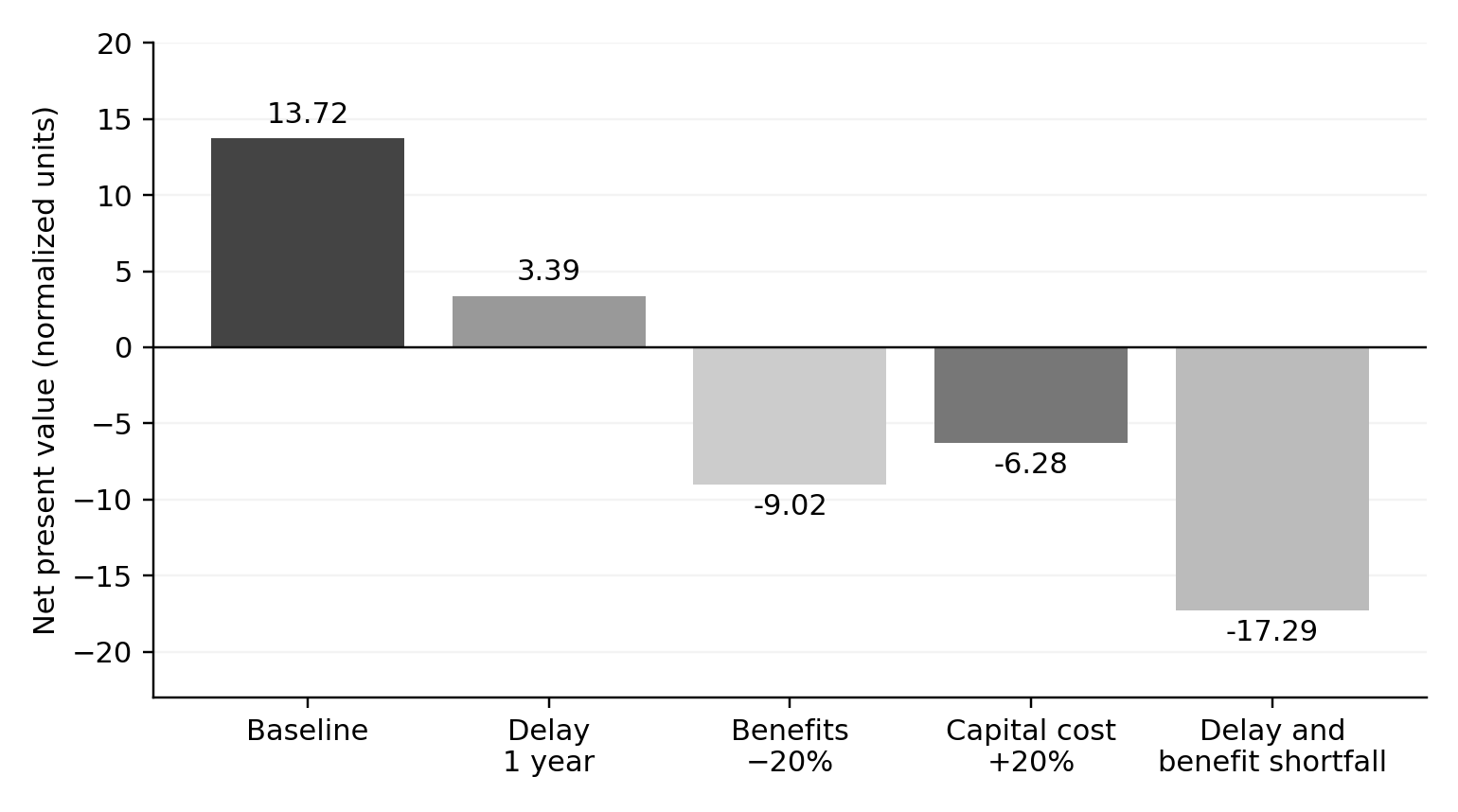
The decision implication concerns linked assumptions. A delivery delay affects both expenditure timing and the benefit pathway, and operating underperformance may reverse the investment case despite successful construction. Managers should therefore update benefit forecasts when material delivery or technical evidence changes. The exercise does not establish the correct discount rate or evaluate any actual mining investment. A real appraisal would need authorized project-specific cash flows, fiscal treatment, closure requirements, and uncertainty assumptions.
Scenario interpretation should preserve the difference between uncertainty and controllable response. Management may improve operating preparation or revise a procurement strategy, but it cannot assume that commodity prices will recover to restore a weak case. A response proposal should identify the mechanism, implementation cost, required resources, and residual exposure. Its effect should be reflected consistently in both cash flows and benefit commitments. If a response increases capital expenditure to reduce delay, the revised case must include both consequences. This discipline prevents optimistic recovery narratives from improving one assumption while leaving their associated costs or dependencies outside the valuation.
8Implementation and research evaluation
A pilot should begin with a small group of investments covering different maturity levels. The owner should map existing business cases, approval records, benefit measures, and operating reports before procuring additional software. The initial objective is to determine whether commitments and outcomes can be traced consistently. Implementation can then standardize definitions, establish owners, and introduce periodic reassessment. Reporting effort should be measured because a burdensome register may discourage accurate maintenance.
Evaluation should distinguish process improvement from economic outcomes. Process measures include completeness of benefit definitions, condition closure, forecast revision explanations, and timely operational ownership. Outcome measures include attributable benefit realization, forecast bias, and revised investment value. Comparisons should consider commodity exposure, investment scale, technical novelty, and operating maturity. Improved documentation may reveal previously hidden underperformance; this should not automatically be interpreted as evidence that the framework caused deterioration.
A longitudinal study could compare dated investment assumptions with delivery and operating outcomes. Researchers should retain original and approved revised targets, explain scope changes, and assess forecasts at comparable maturity levels. Interviews can clarify why decisions were made, while contemporaneous records establish what evidence was available. The design should report uncertainty and avoid claiming causality from a small observational sample. Access to internal records requires explicit authorization and confidentiality arrangements.
Three propositions merit testing: explicit benefit ownership improves continuity after handover; linked assumption and benefit records improve the explanation of investment-value changes; and portfolio dependency assessment reduces unrecognized competition for shared resources. These are proposed relationships rather than established findings. Future work should examine their boundary conditions in greenfield mining, brownfield expansion, processing infrastructure, and sustaining-capital portfolios, including unsuccessful implementation and the administrative cost of assurance.
Independent challenge should be directed toward consequential assumptions rather than document volume. Reviewers can sample the assumptions with the greatest effect on investment value, inspect their evidence, and ask whether alternatives have been evaluated on comparable terms. Disagreement should remain visible in the approval record, together with the authority accepting the exposure. After operations begin, the review should identify whether deviations arose from foreseeable assumptions, implementation failures, or external events. This classification supports learning without equating every unfavorable result with negligence or every favorable outcome with good appraisal. Successful outcomes can also occur despite weak decisions under unexpectedly favorable conditions.
9Limitations
The targeted review does not provide exhaustive database coverage or full-text appraisal of every source. Several foundational studies originate outside mining, and their transfer requires testing. The framework has not been implemented or validated with Saudi project records. The numerical graph is hypothetical and cannot support claims of achieved savings or improved investment returns. Policy relevance provides context, while project-specific eligibility, regulatory approvals, and financing decisions remain outside the framework’s evidentiary scope.
10Conclusion
Integrating business case evaluation and benefits management requires continuity between investment assumptions, delivery evidence, operational ownership, and portfolio decisions. The proposed framework preserves that continuity through linked registers, staged commitments, and post-investment verification. In Saudi mining portfolios under Vision 2030, these mechanisms provide a practical basis for disciplined appraisal and research. Their effectiveness must be established through authorized longitudinal evidence, rather than inferred from completed assets, favorable dashboards, or corporate financial growth.
References
- [1]Aramali V, Sanboskani H, Gibson GE Jr, El Asmar M, Cho N (2022). Forward-looking state-of-the-art review on earned value management systems: The disconnect between academia and industry. Journal of Management in Engineering, 38(3). https://doi.org/10.1061/(ASCE)ME.1943-5479.0001019
- [2]Babaei A, Locatelli G, Sainati T (2021). What is wrong with the front-end of infrastructure megaprojects and how to fix it: A systematic literature review. Project Leadership and Society, 2, 100032. https://doi.org/10.1016/j.plas.2021.100032
- [3]Biesenthal C, Wilden R (2014). Multi-level project governance: Trends and opportunities. International Journal of Project Management, 32(8), 1291–1308. https://doi.org/10.1016/j.ijproman.2014.06.005
- [4]Blichfeldt BS, Eskerod P (2008). Project portfolio management—There’s more to it than what management enacts. International Journal of Project Management, 26(4), 357–365. https://doi.org/10.1016/j.ijproman.2007.06.004
- [5]Breese R (2012). Benefits realisation management: Panacea or false dawn? International Journal of Project Management, 30(3), 341–351. https://doi.org/10.1016/j.ijproman.2011.08.007
- [6]Chen M, Martins TS, Zhang L, Dong H (2025). Digital transformation in project management: A systematic review and research agenda. Systems, 13(8), 625. https://doi.org/10.3390/systems13080625
- [7]Chih YY, Zwikael O (2015). Project benefit management: A conceptual framework of target benefit formulation. International Journal of Project Management, 33(2), 352–362. https://doi.org/10.1016/j.ijproman.2014.06.002
- [8]Cooper RG (2008). Perspective: The Stage-Gate® Idea-to-Launch Process—Update, What’s New, and NexGen Systems. Journal of Product Innovation Management, 25(3), 213–232. https://doi.org/10.1111/j.1540-5885.2008.00296.x
- [9]Derakhshan R, Turner R, Mancini M (2019). Project governance and stakeholders: A literature review. International Journal of Project Management, 37(1), 98–116. https://doi.org/10.1016/j.ijproman.2018.10.007
- [10]Faúndez P, Guzmán JI (2025). Deconstructing cost overrun and delay in mining projects: A system-based model of prices, quantities, and time. Resources Policy, 110, 105754. https://doi.org/10.1016/j.resourpol.2025.105754
- [11]Laursen M, Svejvig P (2016). Taking stock of project value creation: A structured literature review with future directions for research and practice. International Journal of Project Management, 34(4), 736–747. https://doi.org/10.1016/j.ijproman.2015.06.007
- [12]Marques AC, Frej EA, de Almeida AT (2022). Multicriteria decision support for project portfolio selection with the FITradeoff method. Omega, 111, 102661. https://doi.org/10.1016/j.omega.2022.102661
- [13]Musawir AU, Abd-Karim SB, Mohd-Danuri MS (2020). Project governance and its role in enabling organizational strategy implementation: A systematic literature review. International Journal of Project Management, 38(1), 1–16. https://doi.org/10.1016/j.ijproman.2019.09.007
- [14]Musawir AU, Serra CEM, Zwikael O, Ali I (2017). Project governance, benefit management, and project success: Towards a framework for supporting organizational strategy implementation. International Journal of Project Management, 35(8), 1658–1672. https://doi.org/10.1016/j.ijproman.2017.07.007
- [15]Müller R, Pemsel S, Shao J (2014). Organizational enablers for governance and governmentality of projects: A literature review. International Journal of Project Management, 32(8), 1309–1320. https://doi.org/10.1016/j.ijproman.2014.03.007
- [16]Patanakul P (2015). Key attributes of effectiveness in managing project portfolio. International Journal of Project Management, 33(5), 1084–1097. https://doi.org/10.1016/j.ijproman.2015.01.004
- [17]Samset K, Volden GH (2016). Front-end definition of projects: Ten paradoxes and some reflections regarding project management and project governance. International Journal of Project Management, 34(2), 297–313. https://doi.org/10.1016/j.ijproman.2015.01.014
- [18]Saudi Arabian Mining Company (Ma’aden) (2025). Annual report 2024. https://www.saudiexchange.sa/Resources/fsPdf/370_0_2025-03-27_19-54-48_En.pdf
- [19]Saudi Vision 2030 (2024). Vision 2030 annual report 2023. https://www.vision2030.gov.sa/media/xi2jlj0y/english_vision2030_annual_report_2023.pdf
- [20]Serra CEM, Kunc M (2015). Benefits Realisation Management and its influence on project success and on the execution of business strategies. International Journal of Project Management, 33(1), 53–66. https://doi.org/10.1016/j.ijproman.2014.03.011
- [21]Snyder H (2019). Literature review as a research methodology: An overview and guidelines. Journal of Business Research, 104, 333–339. https://doi.org/10.1016/j.jbusres.2019.07.039
- [22]Too EG, Weaver P (2014). The management of project management: A conceptual framework for project governance. International Journal of Project Management, 32(8), 1382–1394. https://doi.org/10.1016/j.ijproman.2013.07.006
- [23]Vial G (2019). Understanding digital transformation: A review and a research agenda. The Journal of Strategic Information Systems, 28(2), 118–144. https://doi.org/10.1016/j.jsis.2019.01.003
- [24]Williams T, Samset K (2010). Issues in front-end decision making on projects. Project Management Journal, 41(2), 38–49. https://doi.org/10.1002/pmj.20160
- [25]Zwikael O, Chih YY, Meredith JR (2018). Project benefit management: Setting effective target benefits. International Journal of Project Management, 36(4), 650–658. https://doi.org/10.1016/j.ijproman.2018.01.002